Chessie System Paint Scheme: Origins of the Yellow, Blue & Vermilion Look
Published: August 5, 2026
By: Adam Burns

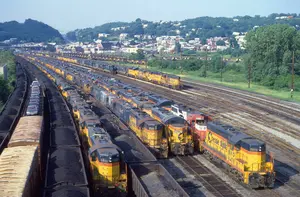
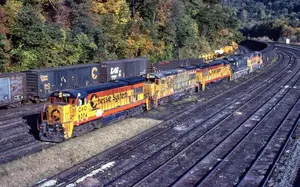
The Chessie System’s yellow, blue, and vermilion livery remains one of the most recognizable freight paint schemes of the late twentieth century. Here, Chessie System power, led by Baltimore & Ohio GP40-2 #4432, has westbound empties on the Chesapeake & Ohio main line near Moss Run, Virginia, circa 1970s. Photographer unknown.
For a railroad that existed as a holding company for barely a decade and a half, the Chessie System left an outsized visual legacy. Long after CSX gray and blue replaced it on the main line, railfans still recognize the look in a single glance: a field of bright yellow, dark blue at the roof and skirting, thin vermilion stripes, and a sleeping kitten curled inside a bold letter C. That livery was not a random splash of color. It was a deliberate corporate-identity program—rooted in Depression-era advertising, executed in the early 1970s, and applied to three historic railroads that still insisted on signing their own names.
From Sleeping Kitten to System Name
The story begins not in a paint shop but in a magazine. In 1933, Chesapeake & Ohio public-relations officer Lionel C. Probert needed a way to sell new air-conditioned sleeping cars in the depths of the Depression. He found an etching of a contented kitten under a blanket—work by Viennese animal artist Guido Grünewald—and secured rights for a token sum. Named Chessie after the railroad, the cat debuted in Fortune that September under the slogan “Sleep Like a Kitten.” The campaign exploded: calendars sold by the tens of thousands, merchandise followed, and the C&O became known almost as much for the cat as for coal.
By the late 1960s passenger trains were fading and so, for the general public, was Chessie. The name and image remained railroad folklore—until management needed a banner under which three companies could stand together without fully disappearing into one another.

Franklyn Carr’s Ches-C—Chessie the kitten as a silhouette inside a large letter C—became the mark that unified B&O, C&O, and Western Maryland equipment. Here, B&O caboose C-3831 at the B&O's shops and roundhouse in Chillicothe, Ohio along the St. Louis main line (since abandoned); March, 1975. Little remains here today but the roundhouse base. American-Rails.com collection.
Three Railroads, One Identity
The industrial logic came first. The Chesapeake & Ohio gained control of the Baltimore & Ohio in 1962 and, with the B&O, of the Western Maryland. Rather than dissolve the B&O overnight—employee loyalty, corporate culture, and Maryland tax considerations all argued against it—C&O treated the group more as allies under common control. In 1971 Hays T. Watkins became C&O president and pushed for a shared moniker that would signal affiliation the way “Family Lines” did for Seaboard’s family of roads. The answer was Chessie System: familiar, affectionate, and already stamped in railroad memory. Chessie System, Inc. was incorporated in Virginia on February 26, 1973.
The paint scheme, however, arrived slightly ahead of the formal holding company. That timing matters: the colors and the “Ches-C” were the public face of the idea before the legal structure was fully in place.
Carr’s Brief: Safety, Strength, and a Silhouette
Watkins tasked public-relations leadership—Howard Skidmore and, for the creative work, Franklyn J. Carr, director of visual media and design—with a new logo and equipment appearance. The brief was practical as much as aesthetic. Management wanted a bright scheme so trains would stand out at crossings and in yards (safety), and bold lettering that read as strength and modernity. Separate corporate identities were no longer the priority they had been a decade earlier; the look had to unify the fleet at a distance.
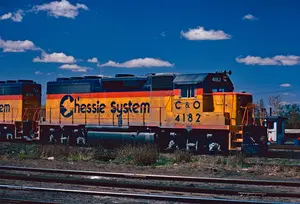
Carr’s solution was elegant. He took the sleeping Chessie silhouette and set it inside a large letter C—the Ches-C or “cat-in-a-C”—so the mascot became the mark. On locomotives, “Chessie System” rode a broad panel of C&O Federal Yellow. Enchantment Blue framed roof and skirting. Thin bands of vermilion completed the triad. Board and management approved quickly. The whole package did what the brief asked: it was unmistakable, cheerful, and serious at once.
It also solved a political problem. Equipment still carried B&O, C&O, or WM sublettering. One paint scheme; three owners on paper. Fans learned to read the cab initials the way earlier generations had read heralds.
|
Editor’s Box: The Three Colors Chessie’s classic locomotive look rests on three named colors, each with a clear job. Federal Yellow (also simply called Chessie yellow) filled the long hood and carbody—the largest visual field, chosen so power would read as bright and present at grade crossings and in yards. Enchantment Blue, a deep C&O blue often compared with B&O’s Royal Blue tradition, ran along the roof line and skirting, anchoring the yellow and giving the unit a finished “frame.” Vermilion—a reddish-orange accent, not a pure fire-engine red—appeared as thin stripes that separated the major color fields and sharpened the overall contrast. Together the triad was high-visibility without looking carnival. Modelers still debate exact commercial matches (Floquil Reefer Yellow and Polly S Enchantment Blue are often cited as close), but the railroad’s intent was simpler: safety, strength, and instant recognition. Cabooses, many in full yellow with blue graphics, and freight cars following house rules (black hoppers with yellow lettering, blue/yellow boxcars and covered hoppers) carried the same vocabulary beyond the locomotive fleet. |
Debut: Number 1977 and the Long Roll-Out
The first unit commonly associated with the new look was Baltimore & Ohio GP40-2 No. 1977, completed by General Motors in 1972 and unveiled in connection with the B&O’s 150th anniversary year—hence the number. Publicity that fall, including events tied to EMD and a high-profile showing at the Greenbrier, put yellow, blue, and vermilion in front of executives and the press before “Chessie System” was everyday corporate language. Secondary accounts note renumbering quirks around the anniversary display unit, but the message was clear: this was the face of the combined system.
From there the scheme spread across new deliveries and shop repaints. Cabooses in bright yellow became rolling billboards. Freight cars followed house rules rather than a single formula: many hoppers and gondolas stayed black with yellow graphics; boxcars and covered hoppers often took blue/yellow treatments; the Ches-C and Chessie System wordmark stitched the fleet together. Special one-offs—most famously the gold GM50 GP40-2 for EMD’s locomotive-building anniversary—proved the identity was flexible enough for celebration without losing the core brand.
By the mid-1970s operations were tightening into a more unified Chessie System even as the three reporting marks persisted. The paint had done its job: you could tell a Chessie train from a mile off.

From the Chessie Steam Special and Safety Express to modern CSX heritage paint, the yellow-blue-vermilion language outlived the holding company that introduced it. Here, Reading 4-8-4 #2101 leads the "Chessie Steam Special". Bill Kalkman photo.
Steam, Safety, and a Short Golden Age
Watkins’s Chessie was also show business when it wanted to be. The Chessie Steam Special (Reading T-1 2101 in Chessie colors, 1977–78) and later the Chessie Safety Express (C&O 614) carried the same yellow-and-blue language into excursion service, tying grade-crossing safety and anniversary pride to a look the public already loved. Those trains did not invent the scheme, but they fixed it in memory for people who never stood trackside on a coal drag.
Corporate life was shorter than the legend. Chessie merged with Seaboard Coast Line Industries to form CSX Corporation in 1980. The Chessie image continued on new and repainted equipment until mid-1986, when CSXT introduced its own scheme; last new Chessie-painted power is often cited among the mid-1980s SD50 deliveries. Legal consolidations followed: WM into B&O, B&O into C&O, C&O into CSX Transportation—and by 1987 the Chessie System name was retired.
The replacement gray-and-blue CSX look was functional. It was never as loved. That contrast is part of why the Chessie scheme still sells models, fills museum tracks, and returned in spirit on CSX heritage unit 1973 in 2023—numbered for the year the holding company took form, half a century on.
Why It Still Works
Strip the history to design principles and the scheme is almost textbook. High contrast for distance recognition. Limited palette for shop consistency and brand discipline. One icon (the cat-in-C) that carries emotion without needing a full illustration on every car. Sublettering that respected local pride while the colors did the unifying work. In an era when many freight roads were drifting toward utilitarian solids, Chessie bet on color—and won the aesthetic argument for decades after the company chart was redrawn.
Chessie’s classic paint was not nostalgia applied to diesels. It was revived nostalgia put to work: a 1930s advertising cat, redesigned by Franklyn Carr under Watkins’s system-identity push, rolled out from 1972, and worn by B&O, C&O, and Western Maryland until the CSX era closed the book. The railroads merged. The kitten in the C never quite left the rails.
Related Reading on American-Rails.com
- Chessie System (Railroad): The C&O, B&O, and WM
- Chesapeake & Ohio Railway
- Baltimore & Ohio Railroad
- Western Maryland Railway
- Fallen Flags
- CSX Transportation
Further detail on Chessie the kitten and corporate history appears in specialist works such as Thomas W. Dixon, Jr.’s Chessie-related titles and Dave Ori’s Chessie System (MBI Railroad Color History).
Recent Articles


-
Lehigh and New England Railroad: Map, Rosters, History
Sep 21, 26 12:33 AM
 Lehigh & New England—South Mountain & Boston 1873, named April 2 1895. Anthracite, cement, Maybrook. Last Camelbacks, Alco FAs. Voluntary shutdown October 31 1961.
 -
TVRM Chattanooga Dinner Train (2026): Dates, Tickets & What to Expect
Sep 21, 26 12:20 AM
 2026 TVRM Chattanooga Dinner Train Experience—Grand Junction, select Fri/Sat March 6–October 24, three-course, 2–3 hours, from $110. Confirm on tvrail.com.
 -
Lehigh and Hudson River Railroad: Map, Rosters, History
Sep 20, 26 11:55 PM
 Lehigh & Hudson River—Warwick Valley 1860, Railway April 1 1882. Easton–Maybrook bridge road, Alphabet Route, Alco RS-3s and C420s. Conrail April 1 1976.
 -
Royal Gorge First Class Dinner Train (2026)
Sep 20, 26 11:47 PM
 2026 Royal Gorge Route First Class Lunch & Dinner—Cañon City, about 2 hours, from $199+, 12+. Confirm on royalgorgeroute.com.
 -
GE "44-Tonner" Locomotives: Roster, Specs, History
Sep 20, 26 11:09 PM
 GE 44-ton switcher—90,000-pound rule, Caterpillar D17000 center-cab, Sept 4 1940 CB&Q 9103 through Oct 1956 Dansville & Mount Morris 1. Phases, serial roster, PRR 46.
 -
Strasburg Rail Road Dining (2026): Dinner on the Rails & Elegant Expre
Sep 20, 26 11:00 PM
 2026 Strasburg Rail Road seated meals—Dinner on the Rails, Elegant Express, Valentine dinner. Lee E. Brenner diner. Confirm on strasburgrailroad.com.
 -
International-Great Northern Railroad: Map, History, Timetables
Sep 20, 26 10:43 PM
 International–Great Northern—Houston & Great Northern 1866, International Railroad 1870, merged Sept 30 1873. Palestine, Longview–Laredo, Gould, Missouri Pacific March 1 1956.
 -
Nevada Northern Taste of Italy Dinner Train (2026)
Sep 20, 26 03:25 PM
 2026 Nevada Northern Taste of Italy—adults-only multi-course Italian dinner, steam when healthy, East Ely. Sep. 19 gala listed. Confirm on nnry.com.
 -
Cape Cod Dinner Train (2026): Dates, Tickets & What to Expect
Sep 20, 26 02:53 PM
 Cape Cod Central Dinner Train—Hyannis, Buzzards Bay, and Falmouth. Four-course, 3–3½ hours, from $99.99. Confirm on capetrain.com.
 -
Erie Steam Locomotives: History, Roster & Photos
Sep 20, 26 11:55 AM
 Erie Railroad steam—Camelback 2-8-0s, 155 N-1 Mikados, 105 Berkshires, K-class Pacifics, Triplexes. Post-1900 roster after Drury. Last steam March 17, 1954.
 -
Erie Railroad Diesel Roster: All-Time
Sep 20, 26 11:47 AM
 Erie Railroad diesel—boxcabs 1926, FTs 1944, F3/F7, FA/PA, GP7/GP9, Baldwins, Limas. All-time roster with serials, orders, classes. Last steam March 17 1954. EL October 17 1960.
 -
Erie Railroad: Map, Passenger Trains, Logo, History
Sep 20, 26 11:44 AM
 Erie Railroad—New York & Erie 1832, Piermont–Dunkirk May 14 1851, six-foot then standard June 1880, Chicago 1883. High-and-wide fourth way. Erie Lackawanna October 17 1960.
 -
Colebrookdale Railroad Dining (2026): Secret Valley Dinner Train
Sep 20, 26 11:36 AM
 2026 Colebrookdale Railroad dinner in Boyertown—Secret Valley Dining Class, about 2 hours. Saturday evenings. Confirm on colebrookdalerailroad.com.
 -
Boone & Scenic Valley Wolf Dinner Train (2026)
Sep 19, 26 08:15 PM
 2026 Boone & Scenic Valley Wolf Dinner Train—Des Moines River valley, Bass Point Creek High Bridge, Union Pacific dining cars. Confirm on bsvrr.com.
 -
C&NW 4-6-2s 1617 & 1620: Minnesota 400 Yellow Jackets
Sep 19, 26 11:28 AM
 C&NW Class E Pacifics 1617 and 1620—Alco Schenectady 1917, yellow-and-green E-4-style shrouds 1941 for the Minnesota 400. Crews called them Yellow Jackets. Renumbered 617/620. Scrapped 1956.
 -
Erie Lackawanna Diesel Roster: All-Time
Sep 19, 26 10:13 AM
 Erie Lackawanna diesel—Erie and DL&W inheritance, GP35s, U25Bs, SD45/SDP45/SD45-2, U34CH. All-time roster with serials and orders. Conrail April 1 1976.
 -
Erie Lackawanna Railway: Map, History, Logo
Sep 19, 26 10:06 AM
 Erie Lackawanna Railway—Erie and DL&W, October 17 1960–March 31 1976. Von Willer, White revival, Dereco, Agnes, Conrail. High-and-wide Chicago main. Map, logo, what remains.
 -
"Empire State Express" (1941 Train): Timetables, Route, Consist
Sep 18, 26 10:59 PM
 NYC Empire State Express—George Daniels 1891 day train, 999’s 112.5 mph claim, Budd stainless streamliner December 7 1941, Cleveland and Detroit sections, diesels, 1967 name drop. Timetables, consist…
 -
New York Central 4-6-4s 5426 & 5429: Empire State Express Hudsons
Sep 18, 26 10:32 PM
 NYC J-3a Hudsons 5426 and 5429—Alco 1937, Budd stainless shrouds 1941 for the Empire State Express. Pearl Harbor inaugural. Shrouds off by 1950. Neither preserved.
 -
"Stourbridge Lion" Locomotive: Facts, History, Photos
Sep 18, 26 10:27 PM
 Stourbridge Lion—Foster, Rastrick 0-4-0, first steam locomotive in the United States. Horatio Allen, Honesdale, August 8, 1829. Too heavy for D&H gravity track. Boiler in Baltimore; Colonie replic…
 -
Delaware & Hudson Steam Roster (Post 1900)
Sep 18, 26 10:01 PM
 Delaware & Hudson steam—Camelback 2-8-0s, Loree high-pressure compounds, Class K 4-8-4s, forty Challengers. Post-1900 class roster after Drury. Last steam July 21, 1953.
 -
Boston & Maine Steam Roster (Post 1900)
Sep 18, 26 02:57 PM
 Boston & Maine steam—B-15 Moguls, K-8 Consolidations, P-4 Lima Pacifics, T-1 Limas, R-1 Mountains. Post-1900 class roster after Drury. Last steam July 23, 1956.
 -
Boston & Maine Diesel Roster (All-Time)
Sep 18, 26 01:25 PM
 Boston & Maine diesel—boxcab 1100 1935, Flying Yankee 6000, FTs, E7s, BL2s, GP7/GP9, GP38-2s and GP40-2s. All-time roster. Last steam July 23, 1956.
 -
Mid-Continent Railway Museum Dining (2026)
Sep 18, 26 01:21 PM
 2026 Mid-Continent dining in North Freedom—select-date seated meals in luxury cars, reservations required. Pizza Limited June 28. Confirm on midcontinent.org.
 -
Bessemer & Lake Erie Steam Roster (Post 1900)
Sep 18, 26 12:11 PM
Bessemer & Lake Erie steam—C3A 150–151, D1A/D2A Santa Fes, 47 H1 Texas types after Burlington. Post-1900 class roster after Drury. Last steam 2-8-0 156, May 14, 1953. -
Bessemer & Lake Erie Diesel Roster (All Time)
Sep 18, 26 12:09 PM
 Bessemer & Lake Erie diesel—Westinghouse 281 1936, Baldwin DRS-6-6-1500s, F7s 1950–53, SD7/SD9/SD18/SD38 family, RSD-15s. All-time roster. Last steam 2-8-0 156, May 14, 1953.
 -
Bangor & Aroostook Steam Roster (Post 1900)
Sep 18, 26 11:21 AM
 Bangor & Aroostook steam—Manchester Ten-Wheelers, Alco Mountains 100–109, G-2 Consolidations, Pacifics 250–254. Post-1900 class roster after Drury. Last steam Pacific 251, July 22, 1951.
 -
Bangor & Aroostook Diesel Roster (All Time)
Sep 18, 26 11:09 AM
 Bangor & Aroostook diesel—F3s 1947, eight BL2s, E7s, GP7s leased to the PRR, GP9s, GP38s. All-time roster. Last regular steam July 22, 1951.
 -
B&O Steam Locomotive Roster (Post 1900)
Sep 18, 26 10:33 AM
 Baltimore & Ohio steam—Old Maude, E-27 Consolidations, Q Mikados, Big Sixes, EM-1 Yellowstones, President Pacifics. Post-1900 class roster after Drury. Last public steam May 17, 1958.
 -
Baltimore & Ohio (B&O): Diesel Roster (All-Time)
Sep 18, 26 10:28 AM
 Baltimore & Ohio diesel—boxcab 1925, EMC 50 1935, EA 1937, FTs, F3s, F7s, FA-2s, sharks, GP7/GP9, GP30s after C&O 1963, SD50s 8576–8595 1984. All-time roster. Last steam 1958.
 -
Detroit & Toledo Shore Line Railroad: Map, Roster, History
Sep 18, 26 12:32 AM
 Detroit & Toledo Shore Line—Pleasant Bay 1898, named 1899, Detroit–Toledo freight bridge, GTW and Clover Leaf/NKP/N&W. Merged into Grand Trunk Western June 26, 1981.
 -
Lackawanna Steam Locomotives: History, Roster & Photos
Sep 18, 26 12:17 AM
 Delaware, Lackawanna & Western steam—Camelback 2-8-0s, Mikados, freight Pacifics, Poconos 4-8-4s, Hudsons. Post-1900 roster after Drury. Last steam July 13, 1953.
 -
Lackawanna (DL&W) Diesel Roster: All Time
Sep 18, 26 12:11 AM
Delaware, Lackawanna & Western diesel—boxcabs 1926, EMC SC 425–426 1935, FTs 1945, F3/F7/E8, GP7s, RS-3s, FM Train Masters. All-time roster. Last steam 1953. -
Lackawanna Railroad: Map, History, Viaducts, Rosters
Sep 18, 26 12:04 AM
 TDelaware, Lackawanna & Western—Liggett’s Gap 1832, named March 11 1853, Hoboken–Buffalo, anthracite, Phoebe Snow, Cutoff and Tunkhannock. It merged with the Erie to form Erie Lackawanna on Octobe…
 -
Rail News, The Latest
Sep 17, 26 11:56 PM
This page provides a portal to the latest in rail news, from preservation and restortation subjects to other notable topics. -
Union Pacific Big Boy 4014 Sets First Holiday Tour for Make-A-Wish
Sep 17, 26 11:54 PM
Union Pacific Big Boy 4014’s first holiday tour: Cheyenne–Denver tickets, Nov. 21 Denver-area display, Make-A-Wish. Museum patrons Oct. 16; public Oct. 19. -
Conrail Diesel Roster (All Time)
Sep 17, 26 10:27 PM
Conrail diesel—~5,000 inherited 1976, Big Blue, GP15-1s, SD40-2s, SD50s, Dash-8s, SD60/60M/60I, SD80MACs. All-time CR-number roster. -
Chessie System (Railroad): The C&O, B&O, And WM
Sep 17, 26 09:38 PM
 Chessie System, Inc.—C&O, B&O, and Western Maryland. Kitten-C paint 1972, holding company February 26 1973, CSX November 1 1980, C&O into CSXT August 31 1987.
 -
Chesapeake & Ohio (C&O) Diesel Roster: All-Time
Sep 17, 26 06:01 PM
Chesapeake & Ohio diesel—late steam, no Fairbanks-Morse, E7s 1946, GP7/GP9 flood, F7s, GP40-2s, B30-7s, SD50s 1984–85. All-time roster. Steam ended 1956. -
Chesapeake & Ohio (C&O) Steam Roster: Post-1900
Sep 17, 26 03:18 PM
 Chesapeake & Ohio steam—H-8 Alleghenies, K-4 Kanawhas, T-1 Texas, Greenbriers, H-6 1949 Mallets. Post-1900 class roster including Pere Marquette and Hocking Valley. Last steam 1956.
 -
Chesapeake and Ohio Railway: Map, Logo, History
Sep 17, 26 02:36 PM
 Chesapeake & Ohio Railway—Louisa Railroad 1836, named August 31 1868, Ohio River 1873. Coal, Chessie the kitten, Pere Marquette 1947, B&O control 1963, into CSX August 31 1987. Complete corporate…
 -
TVRM Valentine Train Ride (2026)
Sep 17, 26 02:31 PM
 2026 TVRM Valentine Train Ride in Chattanooga—Feb. 6–15, plated dinner, Grand Junction Depot. Confirm on tvrail.com.
 -
River Fox Train Dining (2026)
Sep 17, 26 02:29 PM
2026 River Fox Train in West Sacramento—Brunch Train and Murder Mystery dinner. 18095 County Road 117. Confirm on riverfoxtrain.com. -
Weehawken Terminal, Serving The West Shore Railroad
Sep 17, 26 01:38 PM
 Weehawken Terminal—West Shore / New York Central Hudson waterfront station, opened 1884. Five ferry slips, sixteen tracks, Weehawken Tunnel 4,014 feet. Last ferry March 25, 1959. Port Imperial and HBL…
 -
West Shore Railroad: Map, History, Timetables
Sep 17, 26 01:32 PM
 West Shore Railroad—New York, West Shore & Buffalo 1880–83, Weehawken to Buffalo. PRR-backed rival to the Central. Morgan settlement, 475-year NYC lease January 1 1886. CSX River Sub today.
 -
Jersey Central Diesel Locomotives: History, Roster & Photos
Sep 17, 26 01:20 PM
 Central Railroad of New Jersey diesel—boxcab 1000, Baldwin double-enders, F3s, Train Masters, SD35s, GP40Ps. All-time roster. Steam ended July 1, 1954.
 -
Jersey Central Steam Locomotives: History, Roster & Photos
Sep 17, 26 01:17 PM
 Central Railroad of New Jersey steam—Camelback Ten-Wheelers, USRA Mikados, G-class Pacifics, suburban tanks. Post-1900 class roster after Drury. Dieselized July 1, 1954.
 -
Jersey Central Railroad (CNJ): Map, Rosters, History
Sep 17, 26 01:14 PM
 Central Railroad of New Jersey—Elizabethtown & Somerville 1831, named April 23 1849. Communipaw, anthracite, Blue Comet, Reading/B&O control. Conrail April 1 1976. Complete corporate history.
 -
Central Vermont Diesel Locomotives: History, Roster & Photos
Sep 17, 26 11:35 AM
 Central Vermont diesel—Alco S-2s 1942, RS-3s, RS-11s from DW&P, EMD GP9s 1956–57, GP38ACs 1971. All-time roster. Last steam April 4, 1957.
 -
Central Vermont Steam Locomotives: History, Roster & Photos
Sep 17, 26 11:19 AM
 Central Vermont steam—ten Alco 2-10-4s of 1928, four U-1-a Mountains, Consolidations. Post-1900 class roster after Drury. Last steam April 4, 1957.