Alaska Railroad's Unique, Streamlined RF-1s
Published: August 17, 2026
By: Adam Burns
Alaska Railroad’s unique RF-1 “streamlined” Alcos (rebuilt from RSD-1s), including the two examples pictured below in 1971, were among the most distinctive diesels ever operated in North America. They were not factory streamliners but heavily rebuilt wartime military surplus units given full carbody shrouds primarily for passenger service on the railroad’s new Aurora trains, with important practical benefits for Alaska’s extreme winters.
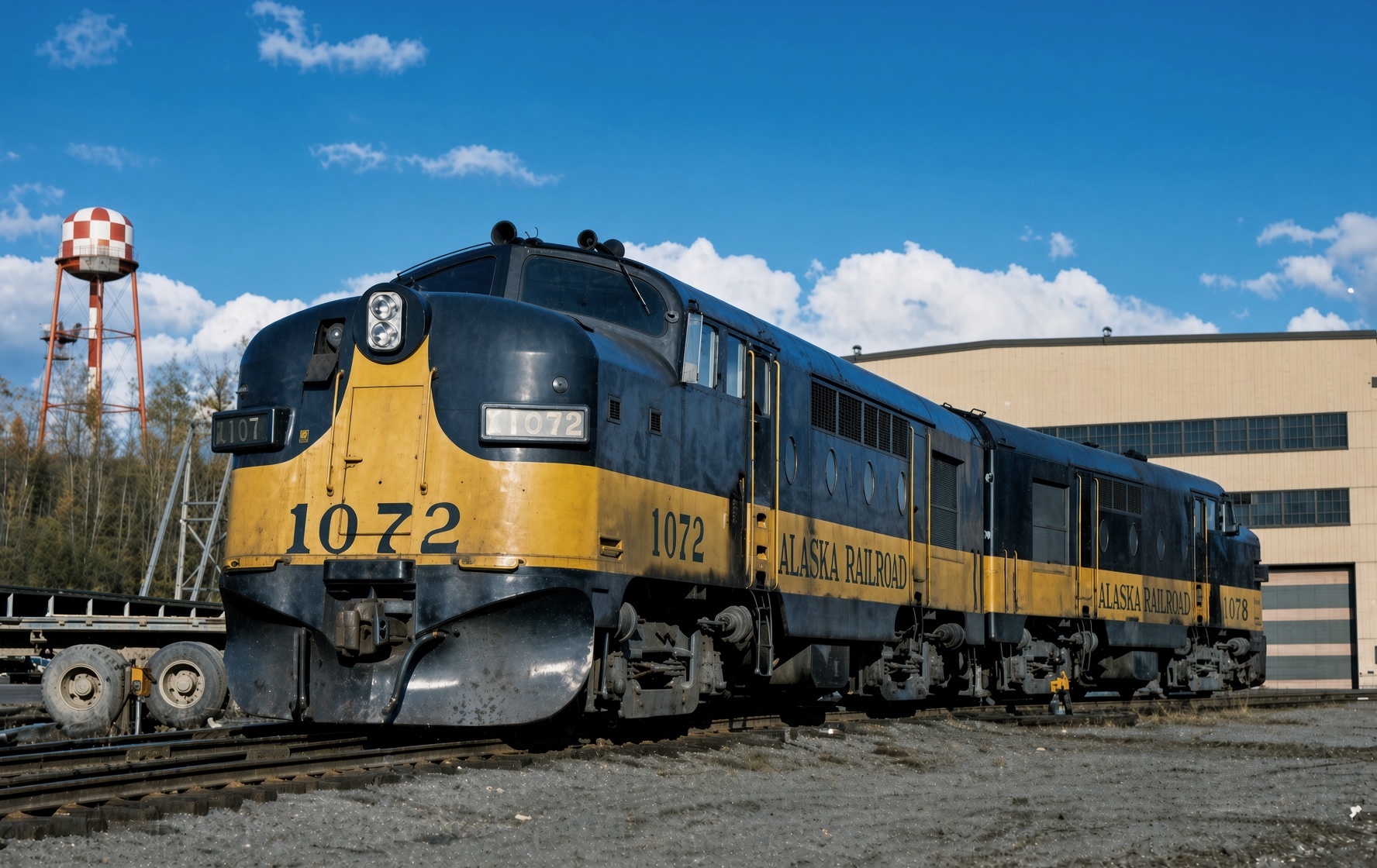 Perhaps one of the most unique examples of streamlining ever attempted was that done by the Alaska Railroad when several RSD-1s were rebuilt between 1947-1949 and shrouded, and reclassified as RF-1As/RF-1Bs. Due to a power shortage two of the four remaining RF-1As were reactivated in August, 1971 and pictured here (1072 and 1078) in Anchorage on October 11th that year. Phillip C. Faudi photo.
Background: Surplus RSD-1s Arrive in Alaska
The Alaska Railroad’s first diesels were a pair of new Alco RS-1s (Nos. 1000–1001) delivered in 1944 specifically for the Whittier tunnel run. After World War II the railroad acquired a large fleet of surplus U.S. Army RSD-1s. These were six-axle (C-C) versions of the RS-1 design, built with lower-profile cabs for overseas clearances (many for the Trans-Iranian Railway supply route to the Soviet Union). They retained the 1,000 hp Alco 539 prime mover and were essentially RS-1s on six-wheel trucks.
The open-hood road-switcher design proved problematic in Alaska. Extreme cold made routine maintenance difficult, and the railroad wanted modern-looking power for upgraded passenger service.
The Rebuild Program and Purpose of the Shrouds
In 1947 the Alaska Railroad began converting RSD-1s into enclosed “carbody” locomotives for the new AuRoRa (later Aurora) streamliner service between Anchorage and Fairbanks. The inaugural train debuted that October for Alaska Day celebrations, with experimental units 1050A and 1051B. These early conversions were described as “extremely homely.”
Lessons from the prototypes led to better-looking units. In 1949–1950, Puget Sound Bridge and Dry Dock Co. of Seattle rebuilt additional RSD-1s into the RF-1 class. The work enclosed the machinery in a full streamlined carbody (side sheeting applied outside the original walkways), improved the overall lines, and converted the trucks from C-C to B-B. Some B-units (boosters) were also produced, with construction split between Seattle and the Anchorage shops (records for some were lost in a 1951 shop fire).
Primary purpose: Streamlined appearance and performance for passenger trains. These became Alaska’s first true streamliners and powered the Aurora.
Practical winter benefits: The enclosed carbody protected the engine and auxiliaries from severe cold, snow, and ice far better than an open hood. It also improved access and reliability for maintenance crews working in sub-zero conditions—exactly the issue the railroad faced with the original open-hood RSD-1s/RS-1s. Contemporary accounts and later modeling/historical notes from Alaska railroaders emphasize both the passenger aesthetics and the cold-weather practicality.
The RF-1As (cab units) received even numbers (non-sequential): 1052, 1054, 1070, 1072, 1074, 1076, 1078 (and the earlier experimental pair). RF-1Bs (cabless boosters) received odd numbers: 1053, 1055, 1057, 1065, 1067, 1069, 1075, 1077.
No. 1073 Pictured Above
- Built February 1943 by Alco as U.S. Army RSD-1 No. 8052 (builder’s number 70673).
- Acquired by the Alaska Railroad and initially rostered in the 1000-series (as 1023 in some accounts).
- Rebuilt in 1950 (shroud applied 1949–1950 timeframe) as RF-1A 1072 with B-B trucks.
- Served in passenger service (photographed on Train 36 at Healy in 1952 and at Curry Hotel in 1950) and later in mixed/freight and snow-plow helper roles.
- Reactivated in August 1971 (along with a few other remaining cab units) during a power shortage.
- Retired and scrapped in 1973.
Sister units such as 1070 (last to retire still in the original blue-and-yellow scheme, April 1970) and 1078 followed similar paths. A few survived into the early 1970s in black-and-yellow paint, used as rotary snowplow power until summer 1972.
Specifications (RF-1 Class, Approximate)
These are derived from the RSD-1 base with documented rebuild changes:
| Specification | Detail |
|---|---|
| Builder (original) | American Locomotive Company (Alco) |
| Original Model | RSD-1 (U.S. Army surplus) |
| Rebuilt Class | RF-1A (cab unit) / RF-1B (booster) |
| Horsepower | 1,000 hp |
| Prime Mover | Alco 539 (6-cylinder) |
| Original Trucks | C-C (six-axle) |
| Rebuilt Trucks | B-B (four-axle) |
| Gear Ratio | 75:16 (double reduction, retained) |
| Service Weight (rebuilt) | Approximately 253,700 lbs |
| Starting Tractive Effort | ~63,500 lbs (RSD-1 base; adjusted after B-B conversion) |
| Maximum Speed | Approximately 65 mph |
| Rebuild Location | Primarily Puget Sound Bridge & Dry Dock Co. (Seattle); some B-units in Anchorage shops |
| Rebuild Period | 1947 (experimental) / 1949–1953 (production) |
Exact weights and dimensions varied slightly by unit; the enclosed body added visual bulk while the truck conversion and other changes kept weight close to the original.
Rosters
RF-1A Cab Units
| Road No. | Builder No. | Built | Original Identity | ARR Acquisition / Rebuild | Retirement | Notes |
|---|---|---|---|---|---|---|
| 1050 | 70661 | 1943 | US Army 8040 | 1947 (as 1050A) | 1963 | First streamliner; scrapped 1963 |
| 1051 | 70675 | 1943 | US Army 8054 | 1947 (as 1050B) | 1964 | Scrapped 1965–67 |
| 1052 | 70676 | 1943 | US Army 8055 (ex ARR 1020) | 1949 | 1956 | Scrapped 1966–68 |
| 1054 | 70677 | 1943 | US Army 8056 (ex ARR 1087) | 1950 | 1964 | Scrapped 1965–67 |
| 1070 | 70668 | 1943 | US Army 8047 (ex ARR 1022) | 1949–50 | 1973 | Last in original blue/yellow; scrapped late 1973 |
| 1072 | 70673 | 1943 | US Army 8052 (ex ARR 1023) | 1950 | 1973 | Reactivated 1971 for power shortage; scrapped 1973 |
| 1074 | 70657 | 1943 | US Army 8036 (ex ARR 1024) | 1950 | ~1966 | Scrapped 1966–67 |
| 1076 | 70667 | 1943 | US Army 8046 (ex ARR 1025) | 1950 | 1973 | Scrapped 1973 |
| 1078 | 70674 | 1943 | US Army 8053 (ex ARR 1019) | 1949 | 1972 | Used on rotary snowplow service; scrapped 1973 |
RF-1B Booster Units
| Road No. | Builder No. | Built | Original Identity | ARR Acquisition / Rebuild | Retirement | Notes |
|---|---|---|---|---|---|---|
| 1053 | 70642 | 1942 | US Army 8021 (ex ARR 1089) | 1950 | 1965 | Scrapped 1966–68 |
| 1055 | 70659 | 1943 | US Army 8038 (ex ARR 1002) | 1950 | 1965 | Scrapped 1966–68 |
| 1057 | 69993 | 1942 | US Army 8001 / nee NYSW 233 | 1950 | 1965 | Scrapped 1965–67 |
| 1065 | 70656 | 1943 | US Army 8035 (ex ARR 1015) | 1952 (after fire damage) | 1972 | Scrapped 1973 |
| 1067 | 70647 | 1942 | US Army 8026 (ex ARR 1016) | 1953 | 1965 | Scrapped ~1966 |
| 1069 | 69567 | 1941 | US Army 8002 / nee MILW 1678 | 1950 | 1963 | Scrapped ~1963 |
| 1075 | 70672 | 1943 | US Army 8051 (ex ARR 1011) | 1950 | ~1964–65 | Scrapped mid-1960s |
| 1077 | 70664 | 1943 | US Army 8043 (ex ARR 1012) | 1950 | ~1965–66 | Scrapped mid-1960s |
Notes on the roster: Numbers were non-sequential. Early experimental pair (1050A/1050B) were rebuilt in Alaska; most later A-units were converted by Puget Sound Bridge & Dry Dock in Seattle (1949–50). Some B-units were completed in Anchorage (records partially lost in the 1951 shop fire). All were eventually scrapped; none survive.
Service Life, Paint, and Fate
Early units wore the attractive blue-and-yellow passenger scheme associated with the Aurora. Later survivors received black-and-yellow. They handled passenger, mixed, and eventually secondary freight/snow-fighting duties as newer EMD F-units and Geeps arrived in the 1950s–60s.
By the early 1970s the RF-1 fleet was obsolete. Most were retired and scrapped between the mid-1960s and 1973. None survive today.
These locomotives remain a fascinating footnote in diesel history: wartime military surplus transformed in Seattle and Anchorage into Alaska’s first streamliners, blending passenger-era styling with hard-earned adaptations for one of the most demanding operating environments in North America.
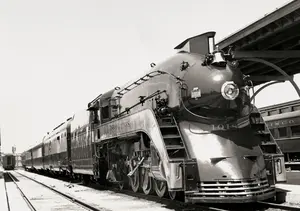
 An Alaska Railroad publicity photo featuring the new "Aurora" in 1947. The RF-1A and RF-1B testbed set pictured here, 1050A and 1051B, retained their C-C trucks.
History of the Aurora Passenger Train
The Aurora (originally stylized AuRoRa) was the Alaska Railroad’s first true streamliner and marked a major postwar upgrade in passenger service.
Origins and Debut (1947) After World War II the railroad sought to modernize its image and improve the Anchorage–Fairbanks passenger run. In 1947 it rebuilt the first two surplus RSD-1s into full-carbody units (1050A and 1050B). These became the power for the new train.
- October 16, 1947: No. 1050 made a shakedown run from Anchorage to Palmer and back with a trainload of schoolchildren.
- October 18, 1947: Formal ceremonies were held at the Anchorage depot. A military band played, steam locomotive No. 6 (temporarily renumbered 1 for aesthetics) was displayed as a contrast between old and new, and the streamliner was christened AuRoRa. It then departed north for the first Alaska Day celebration at the Mount McKinley Park Hotel.
The train was painted in the attractive blue-and-gold scheme that became iconic for Alaska Railroad passenger power. It offered significantly improved service on the long Anchorage–Fairbanks route (roughly 350–360 miles), reducing travel time as track conditions improved.
Service Evolution The Aurora operated as a daytime streamliner. In summer 1956 the railroad added the Midnight Sun, which featured overnight sleeper-car service; that service ended in the mid-1960s. By the early 1950s competition from highways had already forced the end of through passenger service to Seward (1953).
As newer EMD F-units arrived in the early 1950s, the RF-1s gradually shifted from primary Aurora power to secondary and mixed-train duties, though they remained associated with the train’s early years.
Modern Legacy The Aurora name survives today as the Aurora Winter Train. It operates between Anchorage and Fairbanks on weekends (northbound Saturdays, southbound Sundays) from mid-September through mid-May, with occasional mid-week trips. Like the historic Hurricane Turn, it offers flag-stop service at many intermediate points, making it one of the last true flag-stop trains in the United States. The modern version is a continuation of the same corridor service that began with the 1947 streamliner.
The original AuRoRa remains one of the most significant milestones in Alaska Railroad passenger history—the moment the railroad stepped into the streamlined diesel era with purpose-built (or rather purpose-rebuilt) power tailored to both passenger appeal and the harsh Alaskan operating environment.
Recent Articles


-
Wyoming Scenic Train Rides (2026): A Complete Guide
Oct 03, 26 12:07 AM
 Wyoming has no full-size tourist railroad on the calendar in October 2026. Cheyenne Depot Museum and Douglas Railroad Museum are static. Union Pacific 4014’s posted public trip is a November run to De…
 -
Washington Scenic Train Rides (2026): A Complete Guide
Oct 02, 26 11:53 PM
 Washington tourist trains in 2026—Mount Rainier Scenic at Elbe, the Northwest Railway Museum, and Chehalis-Centralia. Lake Whatcom has no 2026 date on its ticket page.
 -
Wisconsin Scenic Train Rides (2026): A Complete Guide
Oct 02, 26 11:48 PM
 Wisconsin tourist trains in 2026—Wisconsin Great Northern, Osceola & St. Croix Valley, Mid-Continent, East Troy, and the National Railroad Museum.
 -
Pennsylvania Railroad Class Q2 4-4-6-4: Specs, Roster, History
Oct 02, 26 11:28 PM
 Pennsylvania Railroad Class Q2 4-4-6-4 duplexes. Twenty-six engines, 6131 and 6175–6199, Altoona 1944–45. Form 109-J specs, the 7,987 hp test of 6175, and a roster. All scrapped.
 -
Utah Scenic Train Rides (2026): A Complete Guide
Oct 02, 26 11:18 PM
 Utah tourist trains in 2026—Heber Valley Railroad from Heber City. Golden Spike at Promontory is a locomotive demonstration, not a line-haul ride.
 -
South Dakota Scenic Train Rides (2026): A Complete Guide
Oct 02, 26 11:06 PM
 South Dakota’s 2026 scenic train is the Black Hills Central 1880 Train, Hill City to Keystone. Steam is the summer assignment. Confirm the engine.
 -
Oregon Scenic Train Rides (2026): A Complete Guide
Oct 02, 26 11:04 PM
 Oregon tourist trains in 2026—Oregon Coast Scenic from Rockaway Beach, Mount Hood at Hood River, Eagle Cap from Elgin, and the Oregon Rail Heritage Center in Portland.
 -
Oklahoma Scenic Train Rides (2026): A Complete Guide
Oct 02, 26 10:36 PM
 Oklahoma has no full-size scenic railroad on an October 2026 calendar. Oklahoma Railway Museum Halloween and Polar trains, the El Reno trolley, and the Heartland Flyer.
 -
North Dakota Scenic Train Rides (2026): A Complete Guide
Oct 02, 26 01:14 PM
North Dakota has no tourist railroad on a 2026 calendar. Ride Amtrak’s daily Empire Builder. The Fort Lincoln Trolley in Mandan is not a current ticket. -
Nebraska Scenic Train Rides (2026): A Complete Guide
Oct 02, 26 10:11 AM
 Nebraska has no full-size scenic railroad in 2026. The Omaha Zoo Railroad runs weekends through October 4. Ride Amtrak’s California Zephyr across the state.
 -
Missouri Scenic Train Rides (2026): A Complete Guide
Oct 02, 26 09:56 AM
 Missouri tourist trains in 2026—Branson Scenic Railway and the St. Louis, Iron Mountain & Southern at Jackson. Belton has no 2026 schedule posted.
 -
Minnesota Scenic Train Rides (2026): A Complete Guide
Oct 02, 26 09:52 AM
 Minnesota tourist trains in 2026—North Shore Scenic Railroad in Duluth, the Duluth River Train, and the Como-Harriet streetcar.
 -
Kansas Scenic Train Rides (2026): A Complete Guide
Oct 02, 26 09:32 AM
 Kansas tourist trains in 2026—the Abilene & Smoky Valley Railroad. Santa Fe 3415 is in overhaul. Midland Railway at Baldwin City is closed.
 -
Iowa Scenic Train Rides (2026): A Complete Guide
Oct 02, 26 08:41 AM
 Iowa tourist trains in 2026—Boone & Scenic Valley across the Bass Point Creek High Bridge, and Midwest Central’s December North Pole trains
 -
Indiana Scenic Train Rides (2026): A Complete Guide
Oct 02, 26 08:35 AM
 Indiana tourist trains in 2026—French Lick Scenic Railway, Nickel Plate Express, Hoosier Valley, and Hesston. Whitewater Valley is suspended.
 -
Illinois Scenic Train Rides (2026): A Complete Guide
Oct 02, 26 12:28 AM
 Illinois tourist trains in 2026—Illinois Railway Museum, Monticello Railway Museum, Fox River Trolley, and Silver Creek & Stephenson.
 -
Texas Scenic Train Rides (2026): A Complete Guide
Oct 02, 26 12:14 AM
 Texas tourist trains in 2026—Texas State Railroad, Grapevine Vintage Railroad, Austin Steam Train's Hill Country Flyer, and the Galveston Railroad Museum.
 -
Tennessee Scenic Train Rides (2026): A Complete Guide
Oct 02, 26 12:03 AM
Tennessee tourist trains in 2026—Tennessee Valley Railroad Museum, Dollywood Express, Three Rivers Rambler Christmas trains, and the Tennessee Central Railway Museum. -
South Carolina Scenic Train Rides (2026): A Complete Guide
Oct 01, 26 11:52 PM
 South Carolina's tourist train is the South Carolina Railroad Museum in Winnsboro—Blue Granite Express, pumpkin trains, and Santa trains on the old Rockton & Rion.
 -
Mississippi Scenic Train Rides (2026): A Complete Guide
Oct 01, 26 11:38 PM
 Mississippi has no regular tourist railroad in 2026. Ride Amtrak through the state, or book the excursion lines in Alabama, Tennessee, Louisiana, or Arkansas.
 -
Louisiana Scenic Train Rides (2026): A Complete Guide
Oct 01, 26 02:52 PM
 Louisiana has no regular full-size tourist railroad in 2026. New Orleans Polar Express returns December 11–31. Museums at Long Leaf, DeQuincy, and Jackson.
 -
Kentucky Scenic Train Rides (2026): A Complete Guide
Oct 01, 26 02:45 PM
 Kentucky tourist trains in 2026—Big South Fork Scenic Railway, Bluegrass Scenic Railroad, Kentucky Railway Museum, and My Old Kentucky Dinner Train.
 -
Georgia Scenic Train Rides (2026): A Complete Guide
Oct 01, 26 02:27 PM
 Georgia tourist trains in 2026—Blue Ridge Scenic Railway, SAM Shortline, Azalea Sprinter, Savannah shop rides, and what to confirm at Stone Mountain.
 -
Arkansas Scenic Train Rides (2026): A Complete Guide
Oct 01, 26 01:02 PM
 Arkansas tourist trains in 2026—Arkansas & Missouri through the Boston Mountains, and the Eureka Springs & North Arkansas dinner and excursion trains.
 -
Alabama Scenic Train Rides (2026): A Complete Guide
Oct 01, 26 12:59 PM
Alabama tourist trains in 2026—Heart of Dixie Railroad Museum at Calera, North Alabama Railroad Museum at Chase, and the Wales West Light Railway at Silverhill. -
The Circus Train: How Such Attractions Reached Distant Cities
Oct 01, 26 12:22 PM
 How circuses moved by rail: Coup's 1872 flats, the Ringling train's sections and car counts, the 1918 Hammond wreck, and the last show on May 21, 2017.
 -
West Virginia Halloween Train Rides (2026)
Oct 01, 26 12:19 PM
 2026 West Virginia Halloween train. Cass Scenic Halloween Train, October 30 and 31, steam, 5:00 p.m. from Cass Depot. Adult $75. About two hours to Whittaker. Family ride.
 -
Wisconsin Halloween Train Rides (2026)
Oct 01, 26 12:11 PM
2026 Wisconsin Halloween trains. Mid-Continent Pumpkin Special October 24–25, adult $24, pumpkins extra. Halloween Flyer October 24 at 4:30 p.m., adult $30. Osceola Pumpkin Express boards in Osceola… -
Utah Halloween Train Rides (2026)
Oct 01, 26 12:00 PM
 2026 Utah Halloween trains at Heber Valley Railroad. Pumpkin Train, about 40 minutes, with a cookie and a pumpkin. Halloween Express, about 90 minutes to Grim Hollow, Monday, Thursday, and Friday even…
 -
Texas Halloween Train Rides (2026)
Oct 01, 26 11:28 AM
 2026 Texas Halloween train. Texas State Railroad Spooky Special, adult-only, October 24. Boards Palestine at 5:00 p.m. About five hours to Rusk and back. Dinner on the grounds. Not steam. No fare on t…
 -
Tennessee Halloween Train Rides (2026)
Oct 01, 26 12:15 AM
 2026 Tennessee Halloween trains. Tennessee Valley Railroad Museum Rails, Wizards & Spells, selected days September 18 through October 25, from $35, about 2.5 hours. Spells & Potions tea from $60. The…
 -
Frisco's "Firefly" (Train): Consist, Route, Timetable
Sep 30, 26 11:37 PM
 Frisco Firefly—daylight streamliner, Kansas City to Tulsa and Oklahoma City. Trains 117 and 118. Pacifics 1018, 1026, and 1031. Last run May 22, 1960.
 -
South Carolina Halloween Train Rides (2026)
Sep 30, 26 11:29 PM
 2026 South Carolina Halloween train. South Carolina Railroad Museum Pumpkin Patch Express, the two Saturdays before Halloween. About three miles to the Greenbriar pavilion. Pumpkin for children 12 and…
 -
Oregon Halloween Train Rides (2026)
Sep 30, 26 08:10 PM
2026 Oregon Halloween train. Sumpter Valley Railroad Halloween Express at the Sumpter Depot, calendar window October 31 at 11:00 a.m. through November 1 at 12:30 p.m. Fare and the individual clocks ar… -
Oklahoma Halloween Train Rides (2026)
Sep 30, 26 03:45 PM
2026 Oklahoma Halloween train. Oklahoma Railway Museum, October 30 and 31, from Oakwood Station in Oklahoma City. Adults $15, children 3–12 $8. A candy bag with the ride. -
McCloud River Railroad: Serving The Timber Industry (1897-2009)
Sep 30, 26 03:37 PM
 McCloud River Railroad—Mount Shasta City to McCloud, Hambone, and Burney. Opened August 1, 1897. Alco No. 25 and EMD SD38s. Dinner train through January 2010. Railbikes in 2026; a dinner train is stil…
 -
Nevada Halloween Train Rides (2026)
Sep 30, 26 03:30 PM
2026 Nevada Halloween trains in Ely. Nevada Northern Pumpkin Patch Caper and Haunted Ghost Train. Adult tickets start at $45. Dates are on the railroad’s ticket calendar. Boulder City stays off until… -
Missouri Halloween Train Rides (2026)
Sep 30, 26 11:12 AM
 2026 Missouri Halloween trains. St. Louis Iron Mountain & Southern Pumpkin Patch Train on October 3, 4, 10, and 11, and Halloween Express on October 31 at 1:00 p.m. Jackson depot. No fare on the sched…
 -
Minnesota Halloween Train Rides (2026)
Sep 30, 26 11:06 AM
 2026 Minnesota Halloween trains. North Shore Scenic Great Pumpkin Train in Duluth, October 15–18. Everyone gets a pumpkin. Terror Train is October 30, an adult costume party, about three hours. Fares…
 -
Maryland Halloween Train Rides (2026)
Sep 30, 26 10:42 AM
 2026 Maryland Halloween trains. Western Maryland Scenic Pumpkin Patch Limited, October 17, 18, 24, and 25, $14. Colesville Trolleyween October 24, 25, and 31.
 -
West Side Lumber Company Railroad: Roster, History, Lines
Sep 30, 26 09:45 AM
 West Side Lumber at Tuolumne, California. Three-foot Shay and Heisler logging railroad. Lima shop numbers, builder specs, and where the engines are in 2026.
 -
Kansas Halloween Train Rides (2026)
Sep 30, 26 09:41 AM
 2026 Kansas Halloween train. Abilene & Smoky Valley Pumpkin Harvest Express, October 17 through 31. About one hour. Shop prices $35.56 to $41.02. Everyone picks a pumpkin.
 -
Iowa Halloween Train Rides (2026)
Sep 29, 26 11:58 PM
2026 Iowa Halloween train. Boone & Scenic Valley Pumpkin Express, October 10, 10:00 a.m. from 225 10th Street. About 1 hour 15 minutes. Children pick a pumpkin. -
Arizona Halloween Train Rides (2026)
Sep 29, 26 11:43 PM
 2026 Arizona Halloween train. Grand Canyon Railway Pumpkin Patch Train from Williams, $39 with a pumpkin included. Select October dates on the ticket calendar. Haunted train cars are optional.
 -
Nevada Northern Halloween Trains (2026)
Sep 29, 26 06:18 PM
Nevada Northern 2026 Halloween trains in Ely. Pumpkin Patch Caper to Keystone Gulch and the Haunted Ghost Train. Adult tickets start at $45. Dates are on the railroad’s calendar. Confirm on nnry.com. -
Grand Canyon Railway Pumpkin Patch Train (2026)
Sep 29, 26 02:42 PM
Grand Canyon Railway Pumpkin Patch Train—select October 2026 dates from Williams, $39 with a pumpkin included. Haunted train cars are optional. Days are on the ticket calendar. Confirm on thetrain.com… -
Cass Scenic Railroad Halloween Trains (2026)
Sep 29, 26 02:37 PM
 Cass Scenic Halloween Trains—October 30 and 31, 2026, steam, 5:00 p.m. from Cass Depot. About two hours to Whittaker. Adult $75. Candy for every child. Confirm on mountainrailwv.com.
 -
Halloween Train Rides (2026): Pumpkin Patch, Haunted & Spooky Trips
Sep 29, 26 11:26 AM
 2026 Halloween train rides in nine checked states. Conway Scenic Halloween Express October 24–25. Strasburg’s three fall tickets. Great Smoky Mountains Railroad’s October trains are the gorge and rive…
 -
Maine Halloween Train Rides (2026)
Sep 29, 26 11:08 AM
 2026 Maine Halloween trains. Seashore Pumpkin Patch Trolley through October 18, adult $17. Happy Trolleyween October 23–25 at $15. WW&F Pumpkin Pickin’ October 3, 12, 17, and 24. Downeast’s booking it…
 -
Kentucky Halloween Train Rides (2026)
Sep 29, 26 10:58 AM
 2026 Kentucky Halloween trains. Kentucky Railway Museum Trick and Track Express, October 24 and 31, from $17. Bluegrass Scenic pumpkin trains in Versailles. Confirm on the ticket shop.