San Diego and Arizona Eastern Railway: Map, History, Timetables
Published: February 17, 2025
By: Adam Burns
The San Diego and Arizona Eastern Railway (SD&AE) was more than just a means of transportation; it was a symbol of ambition, tenacity, and the transformative power of railroads in early 20th-century America.
The system was established in 1932 as the successor to the San Diego & Arizona Railway (SD&A), originally founded in 1906 by the entrepreneur John D. Spreckels. Often referred to as the "Impossible Railroad" due to its challenging construction across harsh terrains, the SD&AE was built specifically to provide San Diego with a direct rail corridor to eastern markets.
Since 1979, ownership of the SD&AE has been held by the San Diego Metropolitan Transit Development Board and its successor, the San Diego Metropolitan Transit System.
There have been many attempts to reopen the line for passenger and freight service but the entire route has not been utilized since 2008.
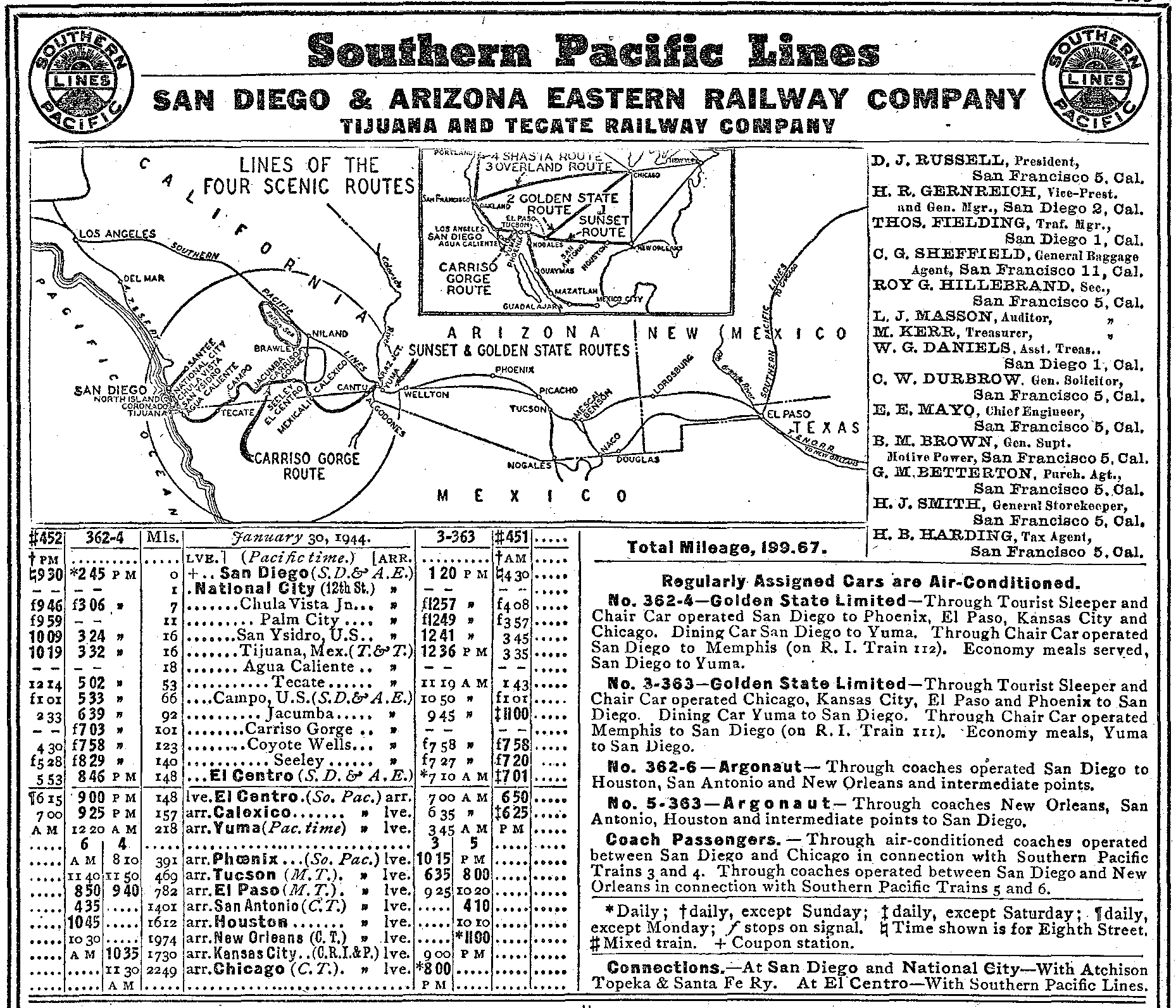
Map and Timetable (1945)
Conception and Early Efforts
The origins of the SD&AE can be traced back to the dreams of several visionary entrepreneurs and community leaders who saw immense potential in connecting San Diego with the eastern parts of the country.
In the late 19th century, John D. Spreckels, a prominent businessman with interests in sugar, shipping, and real estate, became a pivotal figure in advocating for the construction of this railway. At the time, transportation options for connecting San Diego to other parts of the country were limited and cumbersome, hindering economic growth and development.
The idea was to create a direct rail link across the treacherous terrains of the Peninsular Ranges and the Sonoran Desert to connect with the Southern Pacific Railroad in Yuma, Arizona.
While this concept was ambitious, the geographical challenges were significant. Nevertheless, Spreckels, with his entrepreneurial spirit, acquired several existing small railroads and initiated the project under the San Diego & Arizona Railway Company on December 14, 1906.
In 1909, the San Diego & Arizona Railway Company (SD&A) formalized an arrangement with the Mexican Government to extend their tracks across the border. As a stipulation of this agreement, the SD&A was mandated to establish the Tijuana and Tecate Railway, which would be responsible for constructing and managing a 44-mile stretch of the railway within Mexico under a 99-year lease.
Construction Challenges
From its inception, the construction of the railroad faced numerous obstacles. The rugged landscape, characterized by steep mountains, deep canyons, and harsh desert conditions, made building the route an engineering nightmare.
The most daunting was the stretch known as Carrizo Gorge, which required extensive tunnel work – including the construction of the 600-foot-long Goat Canyon Trestle, which remains one of the largest curved wooden trestles ever built.
The construction teams in Mexico faced attacks from revolutionaries who sought to conscript soldiers, seize supplies, and sever communication lines. Stateside, in 1917, the U.S. federal government commandeered all railroads to preserve resources for World War I, halting construction temporarily. Work resumed only upon the reassessment that the SD&A would be instrumental in supporting military facilities.
The outbreak of World War I and subsequent material shortages further complicated efforts, causing delays and inflating costs. Labor difficulties and natural disasters, such as floods, landslides, and fires, repeatedly disrupted progress. Despite these issues, Spreckels remained determined, investing considerable resources into overcoming each challenge.
Completion and Operations
Against all odds, on November 15, 1919, the San Diego & Arizona Railway was completed at a cost of $18 million.
The inaugural run of the "Impossible Railroad" was celebrated with great fanfare and was hailed as a monumental achievement in engineering and determination. The line stretched 146 miles from San Diego to Calexico on the Mexican border, including crossing into Mexico itself.
The railway quickly became a vital link for transporting goods and passengers between San Diego and American Southwest. It facilitated the movement of agricultural produce, raw materials, and manufactured goods, thereby playing a key role in the economic development of the region.
Nevertheless, operational challenges persisted. Torrential rains between 1926 and 1929 severely eroded tracks east of San Diego, precipitating financial difficulties for the railway. In 1932, natural disasters including floods, landslides, and fires resulted in the closure of three tunnels, with repair costs exceeding $600,000.
Transition to San Diego and Arizona Eastern Railway
Following the death of John D. Spreckels in 1926, his heirs opted against enduring the railroad's financial strains and sold the SD&A to the Southern Pacific. It was subsequently reincorporated as the San Diego & Arizona Eastern Railway, marking a new chapter in its history. Under SP's management, efforts were made to modernize operations and maintain the line, but challenges persisted.
The line's profitability fluctuated over the decades, with sections frequently damaged by storms and landslides, requiring costly repairs. Notably, the construction of highways and the rise of automobile transportation reduced the passenger service appeal, forcing a focus on freight to sustain operations.
During the height of passenger rail travel the SP utilized the SD&AE as a through route for several notable trains, most notable the Imperial. The train gained its name from the region in which it operated, California's beautiful Imperial Valley located not far from the Mexican border.
Working in conjunction with the Rock Island the train operated from San Diego to Chicago via Tucumcari, New Mexico, operating from 1932 until August 18, 1967
Decline and Revival Efforts
The latter half of the 20th century saw further declines in rail transportation's prominence. The SD&AE discontinued local passenger service on January 11, 1951. On May 20, 1970, the SP ceded its interest in the Tijuana & Tecate Railway to the Mexican national railway, Ferrocarril Sonora–Baja California.
By 1976, sections of the SD&AE were deemed financially unsustainable, leading SP to seek abandonment of the track connecting to Yuma. However, due to the strategic importance of maintaining a cross-border link, the railroad found support from regional and government stakeholders interested in preserving the line for potential freight traffic, tourism, and strategic transit.
The San Diego Metropolitan Transit Development Board (MTDB) purchased the SD&AE line in 1979. The acquisition was driven by the vision of utilizing the line as a rail transit corridor while sustaining freight operations.
Several portions of the line were upgraded to accommodate trolley services, spearheading the development of the San Diego Trolley, which became the city's first modern light rail system, further embedding the line into San Diego's urban landscape.
Heritage and Legacy
Despite its challenges, the San Diego and Arizona Eastern Railway has left an indelible mark on the region's history. While parts of the original railway continue to serve freight and light rail services, segments have historical significance and are maintained for their heritage value.
The line is a testament to early 20th-century railroad engineering and the determination to conquer geographical barriers in pursuit of progress and development.
Rail enthusiasts and historians alike continue to celebrate the SD&AE's legacy, cherishing its fascinating story and the enduring structures like the Goat Canyon Trestle and numerous tunnels. The railway's history is often recounted through tours, museums, and societies dedicated to preserving the memory of this "Impossible Railroad."
Overview
In conclusion, the San Diego and Arizona Eastern Railway embodies the entrepreneurial spirit and resilience necessary to overcome tremendous odds.
From its visionary inception by John D. Spreckels to its contemporary role in urban transit and historical preservation, the SD&AE has contributed significantly to shaping the regional identity and economic landscape of Southern California and beyond.
Ranked as one of the most challenging railways ever built, its existence is a powerful reminder of human ingenuity's ability to redefine the possible.
Recent Articles


-
Conway Scenic Pumpkin Patch Express (2026): Dates, Tickets & Tips
Sep 28, 26 02:22 PM
 Conway Scenic Halloween Express—October 24 and 25, 2026, about 1 hour from North Conway. Coach adult $30. A pumpkin after the ride while supplies last. Confirm on conwayscenic.com.
 -
Black River & Western Pumpkin Trains (2026): Dates, Tickets & Tips
Sep 28, 26 02:20 PM
 Suggested meta description: Black River & Western Pumpkin Train—Flemington to Everitt Farms, weekends September 26–October 25, 2026. Pumpkin patch, maze, and wagon rides. Confirm on blackriverrail…
 -
Scenic Dinner Train Rides (2026): A Complete Guide
Sep 28, 26 01:30 PM
 2026 scenic dinner trains by state—a seated meal on the train. Branson through October 30, Cincinnati Saturdays, Potomac Eagle, and the full state list. Confirm on the railroad.
 -
West Virginia Dinner Train Rides (2026): A Complete Guide
Sep 28, 26 11:58 AM
 2026 Potomac Eagle dining from Romney—about 3 hours in the Trough. Premium three courses $124. Superior four courses $159, ages 17 and older. Confirm on potomaceagle.com.
 -
Washington Dinner Train Rides (2026): A Complete Guide
Sep 28, 26 11:51 AM
 2026 Chehalis-Centralia dinner trains have run. The July 18 Roaring 20s dinner was $89. The planning calendar lists no later dinner. Confirm on steamtrainride.com.
 -
Texas Dinner Train Rides (2026): A Complete Guide
Sep 28, 26 11:27 AM
 2026 Texas has no plated dinner aboard the train. Grapevine sells snacks. The Texas State Railroad Dogwood lunch was served at the Rusk depot. Confirm on the railroad.
 -
Ohio Dinner Train Rides (2026): A Complete Guide
Sep 28, 26 10:15 AM
 2026 Ohio dinner trains—Cincinnati Saturdays, $140, about 3 hours, ages 12 and up. Hocking Valley Elegant Dinner Train October 17 and November 7, from $95.
 -
Missouri Dinner Train Rides (2026): A Complete Guide
Sep 28, 26 10:09 AM
 2026 Branson Scenic Railway dinner train—three courses, about 2 hours, Fridays and Saturdays through October 30. Dome $123.50 plus tax. Confirm on bransontrain.com.
 -
Minnesota Dinner Train Rides (2026): A Complete Guide
Sep 28, 26 09:40 AM
 2026 North Shore Scenic Northwoods Dinner Train in Duluth—four courses in the SkyView dome, 2½ hours, $90, through September 26. Confirm on duluthtrains.com.
 -
Maine Dinner Train Rides (2026): A Complete Guide
Sep 28, 26 09:29 AM
 2026 Maine has no dining-car dinner. WW&F Pig Roast at SeaLyon Farm was June 13 and has run, $54.95. Sunset Express was a drink and ended September 5.
 -
Greenbrier, Cheat & Elk Railroad: Western Maryland's Logging Line
Sep 26, 26 11:59 PM
 Greenbrier, Cheat and Elk—the logging railroad the Western Maryland bought in 1927. Cass to Spruce, Summit Cut at 4,066.6 feet, Elk River Branch, Laurel Bank.
 -
Elkins (Western Maryland): Yard, History, Operations
Sep 26, 26 11:56 PM
 Western Maryland at Elkins—the Elkins Division yard, roundhouse, and wash rack. Belington, Durbin, Black Fork, and the Elk River branches met here.
 -
B&O's "Cincinnatian" (Train): Route, Consist, Timetable
Sep 26, 26 11:51 PM
 B&O Cincinnatian—Mount Clare five-car streamliner, January 19, 1947, trains 75 and 76. P-7d Pacifics 5301–5304. Detroit–Cincinnati from June 25, 1950, trains 53 and 54. Last run April 30, 1971.
 -
The Semaphore: Railroading's Classic Signal
Sep 26, 26 11:51 AM
 Railroad semaphore signals: blade and spectacle, lower quadrant and upper quadrant, US&S Style B and GRS Model 2A, Robinson’s track circuit, and the last blades on the Raton Subdivision.
 -
Black Fork Grade (Western Maryland): History and Operations
Sep 26, 26 11:47 AM
 Black Fork Grade—the Western Maryland climb through Blackwater Canyon. Thomas to Hendricks, past 3 percent, an H-9 and ten loads, helpers off at Fairfax.
 -
Western Maryland Steam Locomotives: History & Roster
Sep 26, 26 11:39 AM
 Western Maryland steam—H-9 Consolidations, I-2 Decapods, Lima 2-8-8-2s, Baldwin Challengers, and twelve Baldwin Potomac 4-8-4s. Post-1900 roster.
 -
Western Maryland Diesel Roster: All-Time
Sep 26, 26 11:32 AM
 Western Maryland diesels—S1 102 in 1941, fourteen F7 boosters, BL2s, hammerhead RS3s, Circus SD40s, and Chessie GP40-2s. Serials and order numbers.
 -
The Dutch Line (Western Maryland): History, Map, Operations
Sep 25, 26 09:38 PM
 Western Maryland Dutch Line—the Hanover Subdivision. Emory Grove to Highfield via Hanover and Gettysburg, York branch 1893, stone trains, and the route CSX still runs.
 -
The Durbin Branch (Western Maryland): History, Map, Operations
Sep 25, 26 09:13 PM
 Western Maryland Durbin Branch—the Coal & Iron Railway, 46.9 miles Elkins to Durbin, opened July 27, 1903. Mixed train until April 10, 1959. H-7B Consolidations.
 -
Western Maryland Railway: Map, Rosters, Logo, History
Sep 25, 26 10:24 AM
 Western Maryland Railway—the Fast Freight Line. Baltimore, Carroll & Frederick, May 27, 1852. Connellsville Extension 1912. Chessie, then into the B&O May 1, 1983.
 -
Illinois Dinner Train Rides (2026): A Complete Guide
Sep 25, 26 09:52 AM
 2026 Monticello Railway Museum Murder Mystery Dinner Train—June 13, July 11, August 1, and September 5 have run. Three courses, about 2 hours, $112. Confirm on mrym.org.
 -
Georgia Dinner Train Rides (2026): A Complete Guide
Sep 25, 26 12:29 AM
 2026 Azalea Sprinter dinner train from Nashville and Willacoochee, Georgia—2½ hours. Club Car adult $147, Executive adult $177. Confirm on azaleasprinter.com.
 -
Baldwin "Centipede" Locomotives: Specs, Roster, Photos
Sep 25, 26 12:02 AM
 Baldwin DR-12-8-1500/2 Centipede—2-D+D-2, two 608SC engines, 3,000 hp. SAL 4500 from the 1943 test bed. 54 on the serial list, 52 sold. PRR BP60 then BH50. None preserved.
 -
Florida Dinner Train Rides (2026): A Complete Guide
Sep 24, 26 11:56 PM
 2026 Seminole Gulf Murder Mystery Dinner Train in Fort Myers—five courses cooked onboard, 3½ hours, $129 or $135 Saturday, plus tax and gratuity. Confirm on semgulf.com.
 -
West Virginia Northern Railroad: Map, Photos, History
Sep 24, 26 11:27 PM
 West Virginia Northern—Kingwood to Tunnelton, 11 miles of Preston County coal. Narrow gauge 1888, standard gauge 1895. Last freight February 19, 1991. Consolidations 8 and 9 survive.
 -
Rutland Railroad: Map, Rosters, History, Logo
Sep 24, 26 01:18 PM
 Rutland Railroad—Follett’s Champlain & Connecticut River, November 1, 1843. Bellows Falls–Burlington December 18, 1849. Green Mountain Gateway. Last train September 25, 1961. Vermont Railway Janua…
 -
Arkansas Dinner Train Rides (2026): A Complete Guide
Sep 24, 26 01:12 PM
 2026 Eureka Springs & North Arkansas Dinner Train—Eurekan dining car, about 2 hours, $53.62 tax included, opens May 9, Tuesday, Wednesday, Friday, and Saturday. Confirm on esnarailway.com.
 -
Arizona Dinner Train Rides (2026): A Complete Guide
Sep 24, 26 01:01 PM
 2026 Arizona has no plated dinner train. Grand Canyon Railway sells snacks in the cars and meals in Williams or at the rim. Verde Canyon includes a charcuterie tray.
 -
Rail News, The Latest
Sep 24, 26 12:36 PM
This page provides a portal to the latest in rail news, from preservation and restortation subjects to other notable topics. -
Cotton Belt 819 Moved Outside at Pine Bluff for Evaluation
Sep 24, 26 12:35 PM
 Cotton Belt 819 left the Pine Bluff shop on September 22, 2026, first time outside in about 30 years. RDG Steam Services is evaluating the engine. No donation link posted.
 -
Reading Steam Locomotives: History, Roster & Photos
Sep 24, 26 12:14 PM
 Reading steam—Wootten fireboxes, Camelback Consolidations, Mallets, K-1 Santa Fes, G-3 Pacifics, T-1 4-8-4s. Post-1900 roster after Drury. Rambles ended October 17, 1964.
 -
Reading Diesel Roster: All-Time
Sep 24, 26 12:10 PM
 Reading diesel roster—AGEIR boxcabs, FTs, FA-1s, RS-3s, Train Masters, GP30s through GP39-2s. Serials and order numbers. Conrail April 1, 1976.
 -
Reading Railroad: Map, Logo, History, Rosters
Sep 24, 26 12:08 PM
 Reading Company—Philadelphia & Reading, 1833. Anthracite, Port Richmond, Reading Terminal. Operating company January 1, 1924. Conrail April 1, 1976.
 -
Nevada Dinner Train Rides (2026): A Complete Guide
Sep 24, 26 12:02 PM
 2026 Nevada Northern Taste of Italy—adults-only gala from East Ely. The September 19 date has run. Confirm any later night on nnry.com.
 -
North Carolina Dinner Train Rides (2026): A Complete Guide
Sep 24, 26 11:24 AM
 2026 North Carolina dinner trains—NCTM Wine & Dine in Spencer sold out February 13–15. GSMR First Class is the plated meal on the Nantahala Gorge excursion. Confirm on the railroad.
 -
Railway Express Agency (REA): Signs, Trucks, Logo & History
Sep 24, 26 09:40 AM
 Railway Express Agency—railroad-owned express company. Incorporated December 7, 1928. Operations March 1, 1929. Red diamond, green trucks. Last regular express November 7, 1975.
 -
Michigan Dinner Train Rides (2026): A Complete Guide
Sep 24, 26 09:28 AM
 2026 Steam Railroading Institute dining in Owosso—select evenings, no public dinner dates posted. Confirm on michigansteamtrain.com.
 -
Pittsburgh and West Virginia Railway: Map, Rosters, History
Sep 24, 26 12:24 AM
 Pittsburgh & West Virginia—the Hi-Line. Wabash-Pittsburgh Terminal 1904. Railway January 29, 1917. Connellsville February 11, 1931. N&W lease October 16, 1964. Wheeling & Lake Erie from May 17, 1990.
 -
Indiana Dinner Train Rides (2026): A Complete Guide
Sep 24, 26 12:13 AM
2026 Spirit of Jasper Ride & Dine is paused. No public trains. Depot at 201 Mill Street stays open as a rental. Confirm on spiritofjaspertrain.com. -
New Jersey Dinner Train Rides (2026): A Complete Guide
Sep 24, 26 12:01 AM
2026 Woodstown Central Dining in Motion—private table of four from $190, about an hour, Salem County. Confirm on woodstowncentral.com. -
Maryland Dinner Train Rides (2026): A Complete Guide
Sep 23, 26 05:19 PM
 2026 Western Maryland Scenic Allegheny Mountain Dinner Train—Cumberland, 3 hours, 21+, Saturday 7 p.m. Confirm on wmsr.com.
 -
Pittsburgh and Lake Erie Railroad: Map, Rosters, Photos
Sep 23, 26 03:28 PM
 Pittsburgh & Lake Erie—the Little Giant. Chartered 1875, Pittsburgh to Youngstown February 10, 1879. New York Central from 1883. Independent May 15, 1979. Last day September 11, 1992.
 -
Kansas Dinner Train Rides (2026): A Complete Guide
Sep 23, 26 01:11 PM
 2026 Abilene & Smoky Valley Smoky Valley Limited—two hours from the Rock Island Depot, about $72–$110, dates into December 31. Confirm on asvrr.org.
 -
The Belpaire Firebox: Simplicity and Greater Power
Sep 23, 26 01:03 PM
 Belpaire firebox—Alfred Belpaire, 1864. Square crown, straight staybolts at right angles. Pennsylvania standard after the 1880s. Great Northern was the other big user.
 -
Pennsylvania Railroad (PRR) Electric Roster: All Classes
Sep 23, 26 12:57 PM
Pennsylvania Railroad electrics—DD1s into Penn Station, P5s, 139 GG1s, B1 switchers, and 66 E44s. Class roster, 1905–1963. No unit-by-unit GG1 list. -
Penn Central Diesel Roster: All-Time
Sep 23, 26 12:46 PM
 Penn Central diesel roster—PRR classes on NYC, PRR, and New Haven power. New orders carry serials. GP38-2s are 7940-8162. Conrail April 1, 1976.
 -
Penn Central Railroad: Map, History, Logo
Sep 23, 26 12:32 PM
 Penn Central—Pennsylvania and New York Central merged February 1, 1968. New Haven January 1, 1969. Section 77 bankruptcy June 21, 1970. Conrail April 1, 1976.
 -
Iowa Dinner Train Rides (2026): A Complete Guide
Sep 23, 26 11:42 AM
2026 Boone & Scenic Valley Wolf Dinner Train—Saturdays May–October, Union Pacific dining cars, Bass Point Creek High Bridge. Confirm on bsvrr.com. -
Pennsylvania-Reading Seashore Lines: Map, Roster, History
Sep 23, 26 12:32 AM
 Pennsylvania-Reading Seashore Lines—Atlantic City Railroad renamed July 15, 1933. Pennsylvania two-thirds, Reading one-third. Camden to Atlantic City, Cape May, and Millville. Conrail April 1, 1976.
 -
Wisconsin Dinner Train Rides (2026): A Complete Guide
Sep 23, 26 12:28 AM
2026 Wisconsin Great Northern dinner train in Trego—$105, Namekagon River, January 8–31 and May 5–December 17. Mid-Continent’s remaining 2026 calendar is snack and scenic. Confirm on the railroad.