The Wigwag: Classic Grade-Crossing Signals
Last revised: September 4, 2024
By: Adam Burns
In the early 20th century, a distinctive type of railroad signal known as the "wigwag" became a familiar sight at many railroad grade crossings across the United States.
These mechanical marvels served as vigilant guardians, warning motorists and pedestrians of approaching trains and enhancing safety at crossings.
Though largely replaced by more modern systems today, wigwags have left an indelible mark on railroading history and hold a special place in the hearts of rail enthusiasts. This article explores the history, functionality, cultural significance, and eventual decline of the beloved wigwag signal.
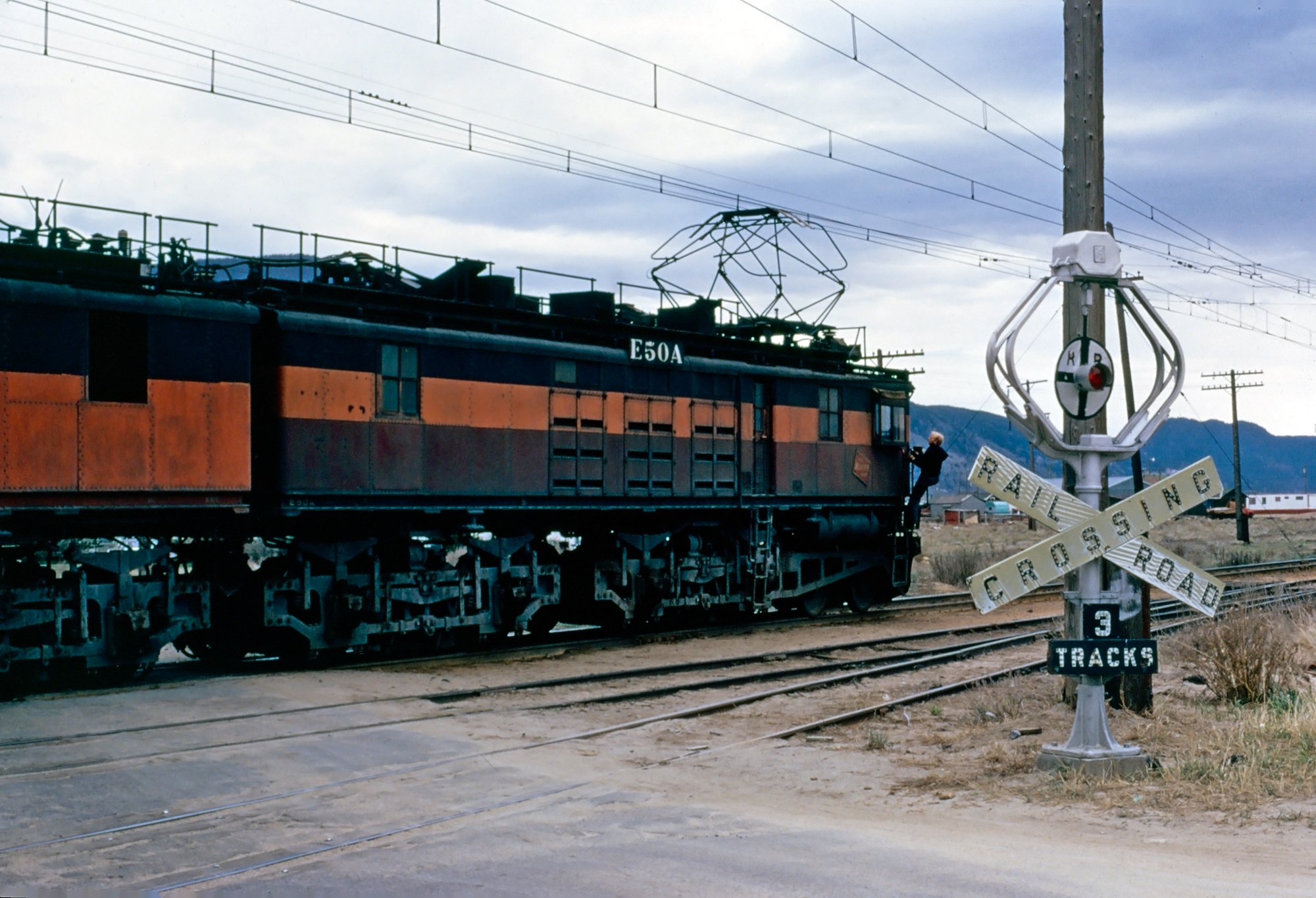 Milwaukee Road boxcab E50A and other motors were photographed here at the yard in Butte, Montana in May, 1973. Note the classic wig-wag crossing signal. Photographer unknown. American-Rails.com collection.
Birth of the Wigwag Signal
Origins and Development
The development of the wigwag signal can be traced back to the early 1900s, a time when the rapid expansion of railway networks in the United States posed increasing safety challenges at railroad grade crossings.
The need for a reliable and effective warning system became critical as automobiles became more common, and the potential for collisions at crossings escalated.
The first wigwag was designed and patented by Albert Hunt, an engineer for the Los Angeles-based Pacific Electric Railway Company, in 1909. Hunt's innovation aimed to create a visible and attention-grabbing signal that would effectively warn approaching motorists and pedestrians of an oncoming train.
Design and Mechanism
The classic wigwag signal consisted of a vertical mast, at the top of which was a box containing an electromagnetic mechanism. This mechanism drove the distinctive "wigwagging" motion of the red and white metal target or banner, which hung below the box.
When a train approached, the electromagnet would activate, causing the banner to swing back and forth in a pendulum-like motion, simulating a wagging finger. In addition, a lamp was often mounted on the target, illuminating it and reinforcing its visibility at night or in poor weather conditions.
A key feature of the wigwag signal was its simplicity and mechanical reliability. The motion of the banner and the flashing lamp provided a visual and auditory warning that was more effective than static signs or non-mechanical devices.
The wigwag's design was robust and could function in various environmental conditions, making it a preferred choice for many railroads.
Functionality: How Wigwag Signals Work
Activation and Operation
Wigwag signals were typically activated by the train itself as it approached a crossing. A common method of activation involved the use of a track circuit, a section of track that was electrically isolated and wired to detect the presence of a train. As the train entered the track circuit, it would complete the electrical circuit, triggering the wigwag signal to operate.
1. **Detection**: As the train approached, it would enter a track circuit, completing an electrical connection that activated the wigwag signal.
2. **Movement**: The electromagnet within the signal's mechanism would energize, causing the banner to begin its oscillating motion. This distinctive back-and-forth movement provided a clear warning of the impending train.
3. **Illumination**: Simultaneously, the lamp on the target would begin flashing, adding a visual cue to the mechanical motion. Some wigwags also included a bell that would sound as the banner swung, further enhancing the warning with audible alerts.
4. **Deactivation**: Once the train had passed through the crossing and exited the track circuit, the electrical connection would be broken, causing the signal to deactivate. The banner would come to rest, and the lamp would cease flashing.
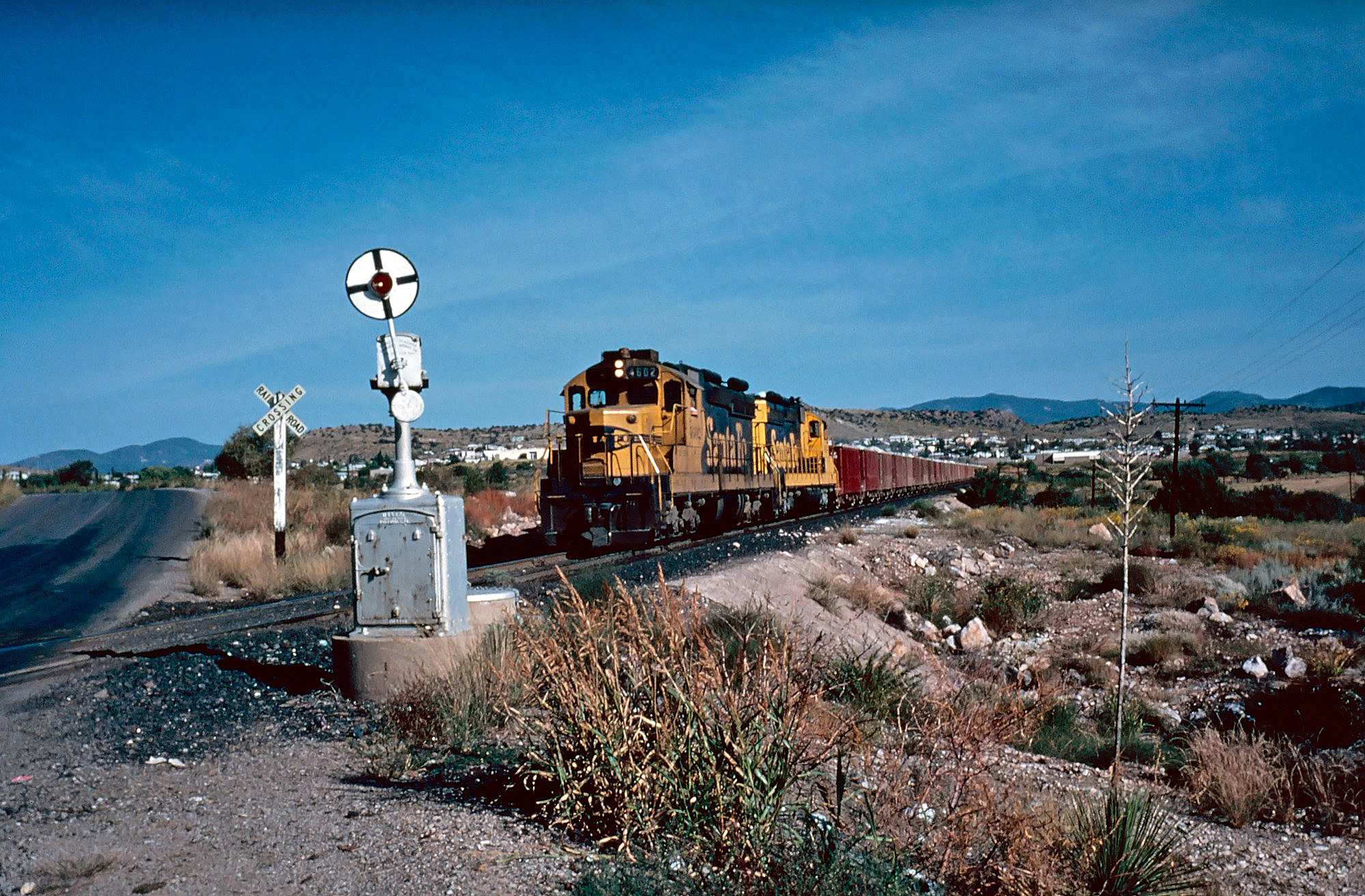 A classic wigwag protects a grade-crossing near Deming, New Mexico as a pair of Santa Fe SD26s, led by #4602, has an ore train about to cross the roadway, circa 1982. Mike Bledsoe photo. American-Rails.com collection.
Variations and Adaptations
While the basic design and operation of wigwags remained largely consistent, several variations and adaptations emerged over the years to address different operational needs and environmental conditions.
- **Undercut Arm Wigwags**: Some wigwags featured an undercut arm design, where the metal target was attached to the lower end of the pendulum rod. This design was intended to prevent the arm from striking obstacles or the ground during windy conditions.
- **Magnetic Flagmen**: A variation known as the "magnetic flagman" incorporated a swinging target with a crossbuck sign. This design enhanced visibility by combining the wigwag motion with the familiar crossbuck symbol.
- **Rotating Wigwags**: Some regions, particularly in the Pacific Northwest, saw the use of rotating wigwag signals. Instead of oscillating, these signals used a rotating mechanism to create a distinctive warning motion.
- **Cantilever Designs**: Some wigwags featured a fully cantilevered mast either atop - or just below - the signal mast upon which was attached a "Railroading Crossing" crossbuck. These types sometimes also had signs attached denoted the number of tracks and "Stop When Swinging" or "Stop When Ringing."
Cultural Significance and Iconic Status
Impact on Rail Safety
The widespread adoption of wigwags had a significant impact on rail safety, particularly at grade crossings. Their robust and attention-grabbing design helped reduce accidents and collisions by providing a clear and reliable warning to motorists and pedestrians.
Iconic Status
Beyond their functional role, wigwags achieved iconic status in American railroading culture. They became synonymous with the golden age of railroads and were often featured in classic films, literature, and even toys.
The distinctive swinging motion and the rhythmic clang of the signal bells evoked a sense of nostalgia and romance associated with the era of steam locomotives and bustling rail lines.
Preservation and Enthusiast Appeal
While wigwag signals can rarely be found in service today, many rail enthusiasts and preservation societies have worked diligently to restore and maintain these historical artifacts.
Some wigwags have been restored to full operational status and are used in heritage railway operations, allowing new generations to experience their unique charm.
Decline and Modern Alternatives
Technological Advancements
The eventual decline of wigwags can be attributed to the advent of more advanced and reliable warning systems. The development of modern electronic crossing signals, such as flashing light signals, gates, and bells, offered several advantages over the mechanical wigwags.
Electronic signals provided more consistent and fail-safe operation, with fewer moving parts that could wear out or malfunction. The use of gates added an additional layer of protection by physically blocking the crossing, further reducing the risk of collisions.
Regulatory Changes
Regulatory changes and safety standards also played a role in the phasing out of the wigwag. As safety requirements became more stringent, railroads were encouraged or mandated to adopt newer technologies that could provide higher levels of safety and compliance.
Conclusion
The wigwag stands as a testament to the ingenuity and innovation of early 20th-century railway engineers.
Its distinctive swinging motion, combined with the flashing lamp and rhythmic bell, provided an effective and reliable warning system that greatly improved safety at railroad grade crossings.
While largely replaced by modern electronic systems, the wigwag signal remains an iconic symbol of railroading history, evoking a sense of nostalgia and admiration among rail enthusiasts and historians.
As we reflect on the legacy of the wigwag, we are reminded of the critical role that technology plays in enhancing safety and efficiency in transportation.
The wigwag's contribution to rail safety paved the way for future innovations, ensuring that the principles of vigilance and protection continue to guide the evolution of railroad crossing technologies.
Recent Articles


-
Halloween Train Rides (2026): Pumpkin Patch, Haunted & Spooky Trips
Sep 29, 26 11:26 AM
 2026 Halloween train rides in nine checked states. Conway Scenic Halloween Express October 24–25. Strasburg’s three fall tickets. Great Smoky Mountains Railroad’s October trains are the gorge and rive…
 -
Maine Halloween Train Rides (2026)
Sep 29, 26 11:08 AM
 2026 Maine Halloween trains. Seashore Pumpkin Patch Trolley through October 18, adult $17. Happy Trolleyween October 23–25 at $15. WW&F Pumpkin Pickin’ October 3, 12, 17, and 24. Downeast’s booking it…
 -
Kentucky Halloween Train Rides (2026)
Sep 29, 26 10:58 AM
 2026 Kentucky Halloween trains. Kentucky Railway Museum Trick and Track Express, October 24 and 31, from $17. Bluegrass Scenic pumpkin trains in Versailles. Confirm on the ticket shop.
 -
Connecticut Halloween Train Rides (2026)
Sep 29, 26 10:26 AM
 2026 Connecticut Halloween trains. East Windsor Pumpkin Patch Fridays through Sundays, October 2–31. Naugatuck coach $20. Shore Line Pumpkin Patch on nine October days. Confirm on each site.
 -
Pennsylvania Halloween Train Rides (2026)
Sep 29, 26 09:45 AM
 2026 Pennsylvania Halloween trains—Everett October 3, 4, 10, and 17, Strasburg’s three fall shows, Oil Creek on October 24, plus Kutztown, Kempton, Honesdale, Middletown, and West Chester.
 -
New York Halloween Train Rides (2026)
Sep 29, 26 12:08 AM
 2026 New York Halloween trains—Catskill Pumpkin Express October 17–18 and 24–25, Adirondack pumpkin and family trains, Arcade & Attica haunt, Cooperstown patch and trick-or-treat, Tupper Lake triv…
 -
North Carolina Halloween Train Rides (2026)
Sep 28, 26 11:56 PM
 2026 North Carolina Halloween trains—New Hope Valley Track or Treat on October 10, 17, 23, and 24, and Tweetsie Ghost Train Friday and Saturday nights through October 31. GSMR’s October menu is the go…
 -
Tweetsie Railroad Ghost Train Halloween Festival (2026)
Sep 28, 26 11:44 PM
 Tweetsie Ghost Train—Friday and Saturday nights September 25–October 31, 2026, in Blowing Rock. Adult $65, child $45. One reserved steam ride plus the park. Ages 8 and up for the haunt.
 -
Milwaukee Road Class A 4-4-2: Specs, Roster, History
Sep 28, 26 11:20 PM
 Milwaukee Road Class A Atlantics 1–4, Alco 1935–1937, for the Hiawatha. Order S-1740, 84-inch drivers, 19x28, 300 psi, 30,685 lb. Full builder specs, roster, and the May 15, 1935 run at 112.5 mph. All…
 -
Strasburg Rail Road Halloween Trains (2026)
Sep 28, 26 11:00 PM
 Strasburg’s 2026 Halloween tickets—Pumpkins in Paradise on October 3, The Haunting of Pumpkin Junction, and The Brakeman’s Curse through October 25. Three fares. Legacy of Sleepy Hollow is an earlier…
 -
GSMR Peanuts Pumpkin Train (2026): Not on This Year’s Ticket Menu
Sep 28, 26 10:50 PM
Great Smoky Mountains Railroad’s September 28, 2026 ticket menu lists Nantahala and Tuckasegee excursions. A Peanuts Great Pumpkin train is not on that menu. Polar Express is on the November calendar. -
New Jersey Halloween Train Rides (2026)
Sep 28, 26 06:45 PM
2026 New Jersey Halloween trains—Black River & Western to Everitt Farms through October 25, Delaware River Great Pumpkin through November 1, Whippany October 4, 10, and 11, Pine Creek night trains. -
New Hampshire Halloween Train Rides (2026)
Sep 28, 26 05:17 PM
 2026 New Hampshire Halloween train—Conway Scenic Halloween Express, October 24 and 25, about 1 hour from North Conway. Coach adult $30. Confirm on conwayscenic.com.
 -
Conway Scenic Pumpkin Patch Express (2026): Dates, Tickets & Tips
Sep 28, 26 05:09 PM
 Conway Scenic Halloween Express—October 24 and 25, 2026, about 1 hour from North Conway. Coach adult $30. A pumpkin after the ride while supplies last. Confirm on conwayscenic.com.
 -
Black River & Western Pumpkin Trains (2026): Dates, Tickets & Tips
Sep 28, 26 02:20 PM
 Suggested meta description: Black River & Western Pumpkin Train—Flemington to Everitt Farms, weekends September 26–October 25, 2026. Pumpkin patch, maze, and wagon rides. Confirm on blackriverrail…
 -
Scenic Dinner Train Rides (2026): A Complete Guide
Sep 28, 26 01:30 PM
 2026 scenic dinner trains by state—a seated meal on the train. Branson through October 30, Cincinnati Saturdays, Potomac Eagle, and the full state list. Confirm on the railroad.
 -
West Virginia Dinner Train Rides (2026): A Complete Guide
Sep 28, 26 11:58 AM
 2026 Potomac Eagle dining from Romney—about 3 hours in the Trough. Premium three courses $124. Superior four courses $159, ages 17 and older. Confirm on potomaceagle.com.
 -
Washington Dinner Train Rides (2026): A Complete Guide
Sep 28, 26 11:51 AM
 2026 Chehalis-Centralia dinner trains have run. The July 18 Roaring 20s dinner was $89. The planning calendar lists no later dinner. Confirm on steamtrainride.com.
 -
Texas Dinner Train Rides (2026): A Complete Guide
Sep 28, 26 11:27 AM
 2026 Texas has no plated dinner aboard the train. Grapevine sells snacks. The Texas State Railroad Dogwood lunch was served at the Rusk depot. Confirm on the railroad.
 -
Ohio Dinner Train Rides (2026): A Complete Guide
Sep 28, 26 10:15 AM
2026 Ohio dinner trains—Cincinnati Saturdays, $140, about 3 hours, ages 12 and up. Hocking Valley Elegant Dinner Train October 17 and November 7, from $95. -
Missouri Dinner Train Rides (2026): A Complete Guide
Sep 28, 26 10:09 AM
 2026 Branson Scenic Railway dinner train—three courses, about 2 hours, Fridays and Saturdays through October 30. Dome $123.50 plus tax. Confirm on bransontrain.com.
 -
Minnesota Dinner Train Rides (2026): A Complete Guide
Sep 28, 26 09:40 AM
 2026 North Shore Scenic Northwoods Dinner Train in Duluth—four courses in the SkyView dome, 2½ hours, $90, through September 26. Confirm on duluthtrains.com.
 -
Maine Dinner Train Rides (2026): A Complete Guide
Sep 28, 26 09:29 AM
 2026 Maine has no dining-car dinner. WW&F Pig Roast at SeaLyon Farm was June 13 and has run, $54.95. Sunset Express was a drink and ended September 5.
 -
Greenbrier, Cheat & Elk Railroad: Western Maryland's Logging Line
Sep 26, 26 11:59 PM
 Greenbrier, Cheat and Elk—the logging railroad the Western Maryland bought in 1927. Cass to Spruce, Summit Cut at 4,066.6 feet, Elk River Branch, Laurel Bank.
 -
Elkins (Western Maryland): Yard, History, Operations
Sep 26, 26 11:56 PM
 Western Maryland at Elkins—the Elkins Division yard, roundhouse, and wash rack. Belington, Durbin, Black Fork, and the Elk River branches met here.
 -
B&O's "Cincinnatian" (Train): Route, Consist, Timetable
Sep 26, 26 11:51 PM
 B&O Cincinnatian—Mount Clare five-car streamliner, January 19, 1947, trains 75 and 76. P-7d Pacifics 5301–5304. Detroit–Cincinnati from June 25, 1950, trains 53 and 54. Last run April 30, 1971.
 -
The Semaphore: Railroading's Classic Signal
Sep 26, 26 11:51 AM
 Railroad semaphore signals: blade and spectacle, lower quadrant and upper quadrant, US&S Style B and GRS Model 2A, Robinson’s track circuit, and the last blades on the Raton Subdivision.
 -
Black Fork Grade (Western Maryland): History and Operations
Sep 26, 26 11:47 AM
 Black Fork Grade—the Western Maryland climb through Blackwater Canyon. Thomas to Hendricks, past 3 percent, an H-9 and ten loads, helpers off at Fairfax.
 -
Western Maryland Steam Locomotives: History & Roster
Sep 26, 26 11:39 AM
 Western Maryland steam—H-9 Consolidations, I-2 Decapods, Lima 2-8-8-2s, Baldwin Challengers, and twelve Baldwin Potomac 4-8-4s. Post-1900 roster.
 -
Western Maryland Diesel Roster: All-Time
Sep 26, 26 11:32 AM
 Western Maryland diesels—S1 102 in 1941, fourteen F7 boosters, BL2s, hammerhead RS3s, Circus SD40s, and Chessie GP40-2s. Serials and order numbers.
 -
The Dutch Line (Western Maryland): History, Map, Operations
Sep 25, 26 09:38 PM
 Western Maryland Dutch Line—the Hanover Subdivision. Emory Grove to Highfield via Hanover and Gettysburg, York branch 1893, stone trains, and the route CSX still runs.
 -
The Durbin Branch (Western Maryland): History, Map, Operations
Sep 25, 26 09:13 PM
 Western Maryland Durbin Branch—the Coal & Iron Railway, 46.9 miles Elkins to Durbin, opened July 27, 1903. Mixed train until April 10, 1959. H-7B Consolidations.
 -
Western Maryland Railway: Map, Rosters, Logo, History
Sep 25, 26 10:24 AM
 Western Maryland Railway—the Fast Freight Line. Baltimore, Carroll & Frederick, May 27, 1852. Connellsville Extension 1912. Chessie, then into the B&O May 1, 1983.
 -
Illinois Dinner Train Rides (2026): A Complete Guide
Sep 25, 26 09:52 AM
2026 Monticello Railway Museum Murder Mystery Dinner Train—June 13, July 11, August 1, and September 5 have run. Three courses, about 2 hours, $112. Confirm on mrym.org. -
Georgia Dinner Train Rides (2026): A Complete Guide
Sep 25, 26 12:29 AM
 2026 Azalea Sprinter dinner train from Nashville and Willacoochee, Georgia—2½ hours. Club Car adult $147, Executive adult $177. Confirm on azaleasprinter.com.
 -
Baldwin "Centipede" Locomotives: Specs, Roster, Photos
Sep 25, 26 12:02 AM
 Baldwin DR-12-8-1500/2 Centipede—2-D+D-2, two 608SC engines, 3,000 hp. SAL 4500 from the 1943 test bed. 54 on the serial list, 52 sold. PRR BP60 then BH50. None preserved.
 -
Florida Dinner Train Rides (2026): A Complete Guide
Sep 24, 26 11:56 PM
 2026 Seminole Gulf Murder Mystery Dinner Train in Fort Myers—five courses cooked onboard, 3½ hours, $129 or $135 Saturday, plus tax and gratuity. Confirm on semgulf.com.
 -
West Virginia Northern Railroad: Map, Photos, History
Sep 24, 26 11:27 PM
 West Virginia Northern—Kingwood to Tunnelton, 11 miles of Preston County coal. Narrow gauge 1888, standard gauge 1895. Last freight February 19, 1991. Consolidations 8 and 9 survive.
 -
Rutland Railroad: Map, Rosters, History, Logo
Sep 24, 26 01:18 PM
 Rutland Railroad—Follett’s Champlain & Connecticut River, November 1, 1843. Bellows Falls–Burlington December 18, 1849. Green Mountain Gateway. Last train September 25, 1961. Vermont Railway Janua…
 -
Arkansas Dinner Train Rides (2026): A Complete Guide
Sep 24, 26 01:12 PM
 2026 Eureka Springs & North Arkansas Dinner Train—Eurekan dining car, about 2 hours, $53.62 tax included, opens May 9, Tuesday, Wednesday, Friday, and Saturday. Confirm on esnarailway.com.
 -
Arizona Dinner Train Rides (2026): A Complete Guide
Sep 24, 26 01:01 PM
 2026 Arizona has no plated dinner train. Grand Canyon Railway sells snacks in the cars and meals in Williams or at the rim. Verde Canyon includes a charcuterie tray.
 -
Rail News, The Latest
Sep 24, 26 12:36 PM
This page provides a portal to the latest in rail news, from preservation and restortation subjects to other notable topics. -
Cotton Belt 819 Moved Outside at Pine Bluff for Evaluation
Sep 24, 26 12:35 PM
Cotton Belt 819 left the Pine Bluff shop on September 22, 2026, first time outside in about 30 years. RDG Steam Services is evaluating the engine. No donation link posted. -
Reading Steam Locomotives: History, Roster & Photos
Sep 24, 26 12:14 PM
 Reading steam—Wootten fireboxes, Camelback Consolidations, Mallets, K-1 Santa Fes, G-3 Pacifics, T-1 4-8-4s. Post-1900 roster after Drury. Rambles ended October 17, 1964.
 -
Reading Diesel Roster: All-Time
Sep 24, 26 12:10 PM
 Reading diesel roster—AGEIR boxcabs, FTs, FA-1s, RS-3s, Train Masters, GP30s through GP39-2s. Serials and order numbers. Conrail April 1, 1976.
 -
Reading Railroad: Map, Logo, History, Rosters
Sep 24, 26 12:08 PM
 Reading Company—Philadelphia & Reading, 1833. Anthracite, Port Richmond, Reading Terminal. Operating company January 1, 1924. Conrail April 1, 1976.
 -
Nevada Dinner Train Rides (2026): A Complete Guide
Sep 24, 26 12:02 PM
 2026 Nevada Northern Taste of Italy—adults-only gala from East Ely. The September 19 date has run. Confirm any later night on nnry.com.
 -
North Carolina Dinner Train Rides (2026): A Complete Guide
Sep 24, 26 11:24 AM
 2026 North Carolina dinner trains—NCTM Wine & Dine in Spencer sold out February 13–15. GSMR First Class is the plated meal on the Nantahala Gorge excursion. Confirm on the railroad.
 -
Railway Express Agency (REA): Signs, Trucks, Logo & History
Sep 24, 26 09:40 AM
 Railway Express Agency—railroad-owned express company. Incorporated December 7, 1928. Operations March 1, 1929. Red diamond, green trucks. Last regular express November 7, 1975.
 -
Michigan Dinner Train Rides (2026): A Complete Guide
Sep 24, 26 09:28 AM
 2026 Steam Railroading Institute dining in Owosso—select evenings, no public dinner dates posted. Confirm on michigansteamtrain.com.