Third & Townsend Depot — San Francisco’s Lost Terminal
Published: April 10, 2026
By: Adam Burns
For more than a century, San Francisco’s relationship with railroads was shaped as much by geography as by ambition. Hemmed in by water and dense urban development, the city never achieved the grand, centralized rail terminal that many American metropolises enjoyed. Instead, its principal gateway to the rails became Southern Pacific’s Third & Townsend Depot—a station that, while initially intended as temporary, evolved into the city’s primary rail terminal for over six decades.
This article traces the full history of the depot, from its origins in the earliest rail expansion into San Francisco, through its heyday as a bustling passenger hub, to its decline and eventual demolition in the 1970s.
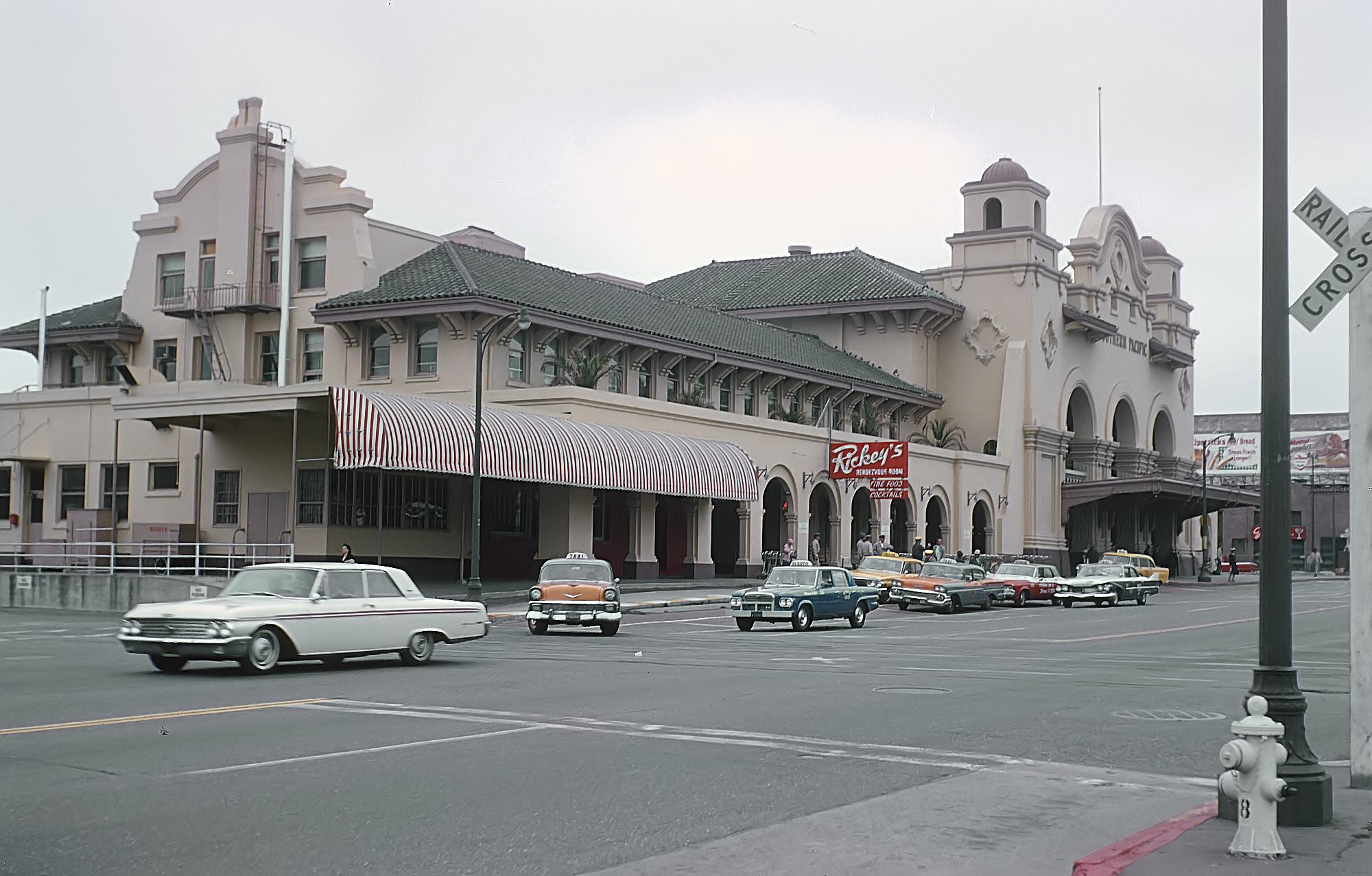 Rick Burn photographed the beautiful Third & Townsend Depot here in July, 1964.
Early Rail Beginnings in San Francisco (1860s–1874)
The story of Third & Townsend begins not with the depot itself, but with the arrival of rail service to San Francisco in the early 1860s. The San Francisco and San Jose Railroad completed its line to San Jose in 1864, establishing one of California’s earliest rail corridors.
Initially, passenger service terminated inland at Valencia Street, but the railroad soon sought a more practical waterfront-adjacent location for freight and passenger interchange. A depot opened at Brannan Street in 1864, closer to the city’s industrial and maritime activity.
The expansion of rail access into the Mission Bay area was further encouraged by the Tidelands Bill of 1868, which granted large tracts of land to railroads—including the Southern Pacific Railroad—on the condition they establish terminal facilities. This legislative push set the stage for the construction of a permanent terminal closer to the waterfront and industrial district.
The First Third & Townsend Depot (1874–1889)
Southern Pacific formally established its San Francisco terminal at Third and Townsend Streets on August 17, 1874. This early facility served as the northern endpoint of the railroad’s Peninsula route to San Jose and beyond. It also functioned as a combined passenger and freight complex, reflecting the dual nature of rail service in the late 19th century.
Importantly, this location became the “zero mile” point of the Southern Pacific system—effectively the starting reference for distances across one of the largest rail networks in the United States. By the 1880s, growing passenger traffic necessitated improvements. In 1889, a new station replaced the original structure, marking the first major upgrade of the Third & Townsend site.
Expansion and Ambition: The Dream of a Downtown Terminal
Despite its importance, Third & Townsend was never intended to be San Francisco’s ultimate rail terminal. Southern Pacific harbored grand ambitions of extending its lines directly to downtown—near Market Street and the Ferry Building, where passengers could seamlessly connect with ferries and urban transit.
Beginning around 1909, the railroad even acquired multiple city blocks to facilitate such an extension.
However, these plans encountered significant obstacles:
- Dense urban development
- Political resistance to closing streets
- High land acquisition costs
- The logistical complexity of routing trains into downtown
Ultimately, these challenges proved insurmountable, and the dream of a grand downtown terminal was abandoned.
The 1914–1915 Depot: A “Temporary” Masterpiece
Built for the Panama-Pacific Exposition
The most iconic version of Third & Townsend Depot was constructed between 1914 and 1915, timed to accommodate the massive influx of visitors for the Panama-Pacific International Exposition. Ironically, this impressive structure was intended as a temporary solution until a permanent downtown terminal could be built. That permanent terminal never materialized.
Architecture and Design
Designed by Southern Pacific’s architectural bureau, the depot became one of the finest examples of Mission Revival architecture in San Francisco.
Key features included:
- Reinforced concrete construction
- Red tile roofs and arcaded walkways
- A grand waiting room with marble floors and a 45-foot ceiling
- Amber-glass windows providing natural light
- Oak-finished interiors
The station’s design intentionally evoked California’s Spanish heritage, aligning with broader cultural themes of the early 20th century. It was not only functional but symbolic—meant to present San Francisco as a gateway to the romanticized West.
The Depot in Its Prime (1915–1940s)
San Francisco’s Primary Rail Gateway
From 1915 onward, Third & Townsend served as San Francisco’s main rail terminal for approximately 62 years.
It handled two primary types of service:
1. Peninsula Commute Service
- Frequent trains between San Francisco and San Jose
- Predecessor to today’s Caltrain
- A vital commuter link for the growing Peninsula region
2. Long-Distance Passenger Trains
The depot hosted some of Southern Pacific’s most famous trains, including:
- Coast Daylight (to Los Angeles)
- Sunset Limited (to New Orleans via Los Angeles)
However, unlike cities with centralized rail hubs, San Francisco’s terminal had limitations. Passengers traveling:
- East (Chicago)
- North (Seattle)
…typically had to transfer to ferries or buses to reach Oakland terminals.
This fragmented system reflected the city’s geographic constraints and the absence of a transbay rail crossing at the time.
Mid-Century Changes and Decline (1940s–1960s)
Shifting Travel Patterns
By the mid-20th century, several forces began eroding the depot’s importance:
- Growth of automobile travel
- Expansion of highway systems
- Decline in long-distance passenger rail
Even Southern Pacific’s flagship services were affected. The Sunset Limited, for example, was cut back from San Francisco to Los Angeles in 1942 after earlier suspensions and restorations.
Continued Importance for Commuters
Despite declining long-distance service, the depot remained busy thanks to Peninsula commuter trains. These services continued to carry thousands of daily passengers and helped sustain the station’s relevance well into the 1960s.
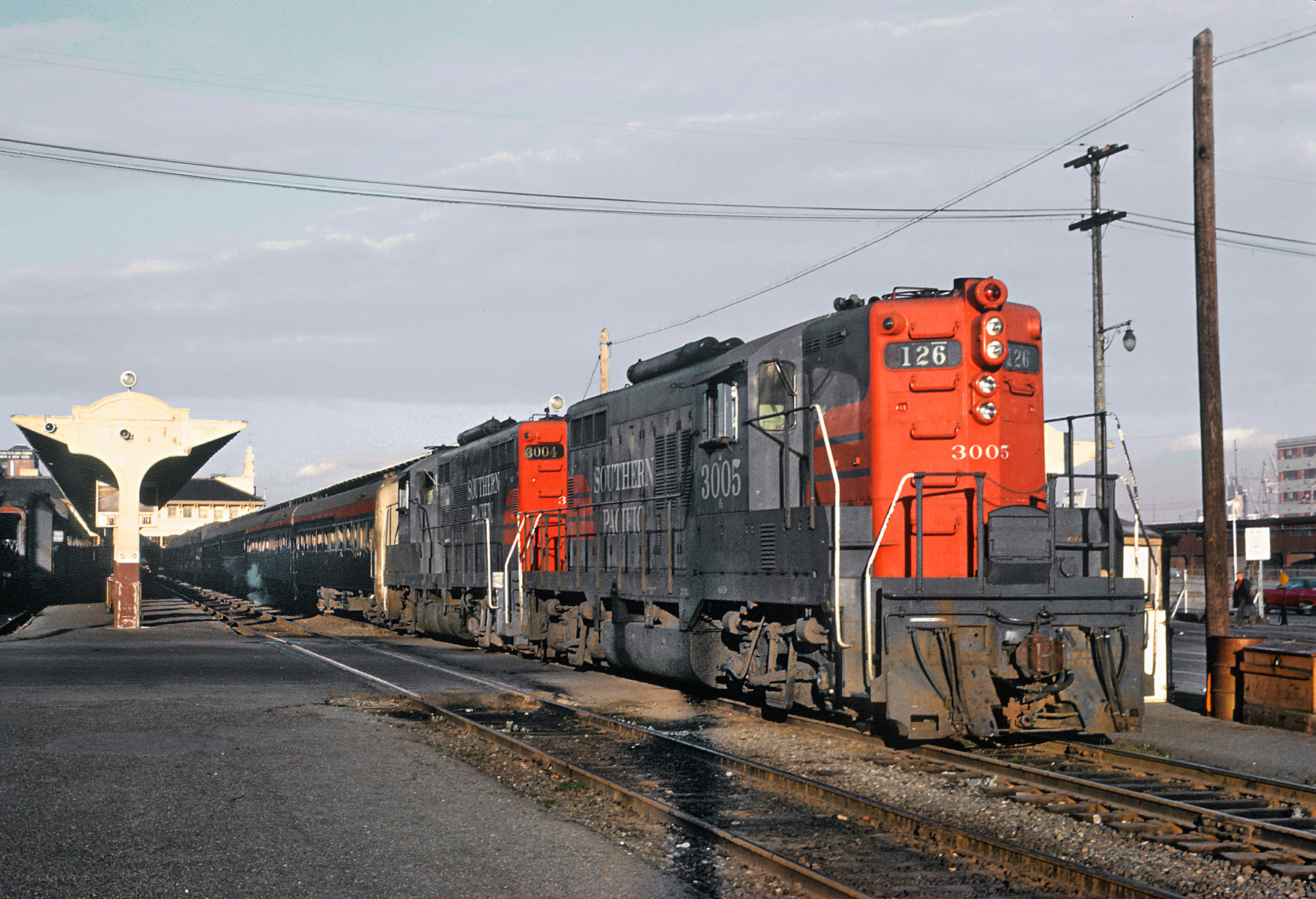 A pair of Southern Pacific GP9s - leds by #3005 - await departure from San Francisco's 3rd & Townsend depot with train #126, the "Del Monte," at around 4:50 PM on February 5, 1971. Roger Puta photo.
The Amtrak Era and Final Years (1970–1975)
The creation of Amtrak in 1971 marked a turning point.
End of Long-Distance Service
On April 30, 1971:
- Southern Pacific handed over intercity passenger service to Amtrak
- The Coast Daylight’s northern terminus shifted to Oakland
- The Del Monte train was discontinued
With these changes, Third & Townsend lost its role as a long-distance terminal.
Reduced to Commuter Service
After 1971, only commuter trains remained. Southern Pacific responded by constructing a smaller, more utilitarian facility nearby at Fourth and King Streets.
Demolition and Replacement (1975–1976)
In 1975, Southern Pacific officially closed Third & Townsend.
Shortly thereafter:
- The station was demolished (1975–1976)
- Operations shifted to the new Fourth & King terminal
- The historic structure was lost permanently
The replacement station—essentially a modest commuter facility—reflected the diminished role of passenger rail in the era.
Legacy and Historical Significance
A Terminal That Should Have Been Temporary
One of the most fascinating aspects of Third & Townsend is that it was never meant to last. Built as a temporary structure, it instead served as San Francisco’s primary rail terminal for over six decades.
Architectural Loss
The demolition of the depot is often cited as a significant loss to San Francisco’s architectural heritage. Its Mission Revival design and grand interior spaces stood in stark contrast to the utilitarian structures that replaced it.
Influence on Modern Rail Service
Today, the nearby Fourth & King station—used by Caltrain—continues the legacy of Peninsula commuter service first anchored at Third & Townsend.
Meanwhile, long-distance rail passengers still generally begin their journeys outside San Francisco, typically in Oakland or Emeryville, continuing a pattern established during the depot’s operational years.
Conclusion
Third & Townsend occupies a unique place in American railroad history. It was:
- A product of early railroad expansion into San Francisco
- A symbol of unrealized ambitions for a grand downtown terminal
- A major transportation hub during the golden age of rail travel
- A casualty of shifting transportation trends in the 20th century
From its origins in the 1870s to its demolition in the 1970s, the depot reflects both the promise and limitations of railroading in San Francisco. Its story is one of adaptation—of a “temporary” station that became indispensable, only to vanish when the era that sustained it came to an end.
Today, little physical trace remains. Yet in the history of the Southern Pacific and the development of rail transportation in California, Third & Townsend remains an enduring and essential chapter.
Recent Articles


-
Wisconsin Railroad Museums (2026): A Complete Guide
Oct 10, 26 11:51 PM
Wisconsin railroad museums—Green Bay’s Big Boy 4017 and Eisenhower’s A4, Mid-Continent at North Freedom, East Troy’s interurban, and the Riverside & Great Northern. Confirm hours on each site. -
Interstate Railroad (Virginia): Map, Roster, Logo, History
Oct 10, 26 11:22 PM
 Interstate Railroad, a Virginia coal road chartered February 18, 1896. Andover shops. Ten Alco RS3s, 30–39. Southern control in 1961. The company ended October 31, 1985.
 -
North Carolina Railroad Museums (2026): A Complete Guide
Oct 10, 26 11:16 PM
 North Carolina railroad museums—Spencer Shops, Wilmington’s Atlantic Coast Line 250, Hamlet’s Seaboard depot, and the New Hope Valley Railway. Confirm hours on each site.
 -
New Mexico Railroad Museums (2026): A Complete Guide
Oct 10, 26 10:54 PM
 New Mexico railroad museums—Santa Fe 2926 in Albuquerque, the Clovis depot, Alamogordo’s Toy Train Depot, and Belen. Confirm hours on each site.
 -
New York Railroad Museums (2026): A Complete Guide
Oct 10, 26 09:33 PM
 New York railroad museums—Phoenicia, Medina’s New York Central freight house, the Transit Museum, Long Island 35 and 39, and GG1 4933. Confirm hours on each site.
 -
Columbia, Newberry & Laurens Railroad: History, Timetable, Roster
Oct 10, 26 09:08 PM
 Columbia, Newberry & Laurens Railroad, Columbia to Laurens, 75 miles. Chartered in 1885. Five Atlantic Coast Line GP7s, 100–104. Merged into the Seaboard System on April 30, 1984.
 -
New Haven Diesel Roster (All-Time)
Oct 10, 26 06:35 PM
 New Haven diesel roster, all-time. 558 road numbers: 60 DL-109s, 30 FA-1s, 27 PA-1s, 60 FL9s, and the switchers from HH600 0900. Serials and order numbers.
 -
New Haven Steam Roster (Post 1900)
Oct 10, 26 06:31 PM
 New Haven steam since 1900. Drury's class grid: 226 Moguls, 33 Mikados, 50 Santa Fes, 70 Mountains, 141 Pacifics, and 10 Hudsons. Last fan trip July 19, 1953.
 -
New Haven Railroad: Rosters, Map, Logo, History, Trains
Oct 10, 26 06:26 PM
 New York, New Haven and Hartford. The Shore Line, Hell Gate, the 1952 map at 1,838.89 miles, and the railroad Penn Central took at 11:59:59 p.m. on December 31, 1968.
 -
C&O's 4-6-4 "Hudson" Locomotives (Class L): Specs, Roster, History
Oct 10, 26 05:36 PM
 Chesapeake & Ohio Class L 4-6-4 Hudsons. Eight L-2s, five L-1 rebuilds, five L-2-As. Specs, Baldwin works numbers, and the roster. No. 490 survives.
 -
Alton Railroad: Map, History, Timetables
Oct 09, 26 10:31 PM
 Alton Railroad, chartered February 27, 1847 as the Alton & Sangamon. Chicago, St. Louis, and Kansas City, the 1937 Official Guide, and the May 31, 1947 merger into the Gulf, Mobile & Ohio.
 -
Mobile & Ohio Steam Roster (Post 1900)
Oct 09, 26 12:26 PM
 Mobile & Ohio steam since 1900. Drury's class grid: 48 six-wheel switchers, 107 Ten-Wheelers, 15 Consolidations, 58 Mikados, and 14 Pacifics. Last revenue steam October 7, 1949.
 -
Mobile & Ohio Railroad: History, Map, Timetable
Oct 09, 26 11:31 AM
 Mobile & Ohio Railroad, chartered in 1848. Columbus on April 22, 1861, the Cairo & St. Louis, the March 1940 Official Guide, and the September 13, 1940 merger into the Gulf, Mobile & Ohio.
 -
Gulf, Mobile & Northern Steam Roster (Post 1900)
Oct 09, 26 10:42 AM
 Gulf, Mobile & Northern steam since 1900. Drury's class grid: Ten-Wheelers, Mikados, Russian Decapods, Pacifics 425 and 426, and three light 4-8-2s. Last revenue steam October 7, 1949.
 -
Gulf, Mobile & Ohio Diesel Roster (All-Time)
Oct 09, 26 10:41 AM
 Gulf, Mobile & Ohio diesel roster, all-time. The 1935 boxcab, DL-107s, 55 FA-1s, F3s and F7s, the Ingalls 4-S, GP30s through GP38-2s, and 21 SD40s. Serials and order numbers.
 -
Gulf, Mobile & Northern Railroad: History, Rebel Route
Oct 09, 26 10:36 AM
 Gulf, Mobile & Northern, from the 1890 Mobile, Jackson & Kansas City to the Rebel and the September 13, 1940 merger into the Gulf, Mobile & Ohio. Steam roster is the companion page.
 -
Gulf, Mobile & Ohio Railroad: Map, Photos, Trains, History
Oct 08, 26 11:48 PM
 Gulf, Mobile & Ohio, chartered in 1938 and merged September 13, 1940. The Mobile & Ohio, the Alton on May 31, 1947, the Rebel Route, and Illinois Central Gulf on August 10, 1972.
 -
New Jersey Railroad Museums (2026): A Complete Guide
Oct 08, 26 11:37 PM
 New Jersey railroad museums—Whippany, Maywood, Pine Creek, Mahwah’s Erie depot, Phillipsburg, and Boonton. Confirm hours on each site.
 -
New Hampshire Railroad Museums (2026): A Complete Guide
Oct 08, 26 11:34 PM
 New Hampshire railroad museums—North Conway, the Flying Yankee, Ashland, Gorham, Raymond, and Sandown. Confirm hours on each site.
 -
Missouri Railroad Museums (2026): A Complete Guide
Oct 08, 26 11:00 PM
 Missouri railroad museums—the National Museum of Transportation, Patee House, Frisco 4524, the Chicago & Alton depot, and Marceline. Confirm hours on each site.
 -
Milwaukee Road X3800: Deer Lodge’s Shop Goat
Oct 08, 26 04:28 PM
 Milwaukee Road X3800, the a home-built shop goat that served the Deer Lodge, MT yard. It was a 220-volt DC switcher, powered through an extension cord that moved electrics into a roundhouse where the…
 -
Key West Extension (Overseas Railroad): History, Construction, Decline
Oct 08, 26 03:59 PM
 Henry Flagler's Overseas Railroad, Miami to Key West, 1905–1935. The Seven Mile Bridge, the 1935 Labor Day Hurricane, and the road that became U.S. 1.
 -
Florida East Coast Steam Roster (Post 1900)
Oct 08, 26 02:34 PM
 Florida East Coast steam since 1897. Seventeen Ten-Wheelers, twenty Atlantics, eighty-seven Pacifics, ninety Mountains, fifteen Mikados, and the switchers.
 -
Florida East Coast Diesel Roster (All-Time)
Oct 08, 26 02:12 PM
 Florida East Coast diesel roster, all-time. E units from 1939, F3s, BL2s, GP7s and GP9s, the GP40-2 orders, 22 SD40-2s, and 24 ES44C4s. Serials and EMD order numbers.
 -
Florida East Coast Railway: Map, History, Rosters
Oct 08, 26 01:46 PM
 Florida East Coast Railway, Henry Flagler's line from Jacksonville to Miami and Key West. Receivership in 1931, the 1963 strike, Grupo México in 2017, and Brightline on the same track.
 -
Minnesota Railroad Museums (2026): A Complete Guide
Oct 08, 26 10:32 AM
Minnesota railroad museums—the Lake Superior Railroad Museum, Two Harbors, Jackson Street, Willmar’s Great Northern 2523, and Currie. Confirm hours on each site. -
Maine Railroad Museums (2026): A Complete Guide
Oct 08, 26 09:24 AM
 Maine railroad museums—Seashore Trolley, the two-foot lines at Portland, Alna, and Phillips, Boothbay, and the Bangor & Aroostook depots. Confirm hours on each site.
 -
Massachusetts Railroad Museums (2026): A Complete Guide
Oct 08, 26 12:08 AM
 Massachusetts railroad museums—Berkshire Scenic at Lenox, Shelburne Falls trolley No. 10, Edaville, Chatham’s 1887 depot, and Lowell. Confirm hours on each site.
 -
Clinchfield Steam Roster (Post 1900)
Oct 07, 26 12:09 PM
 Clinchfield steam since 1900. Fifteen H-4 Consolidations, K-1 Mikados, M-2 and M-3 Mallets, L-class 2-8-8-2s, eighteen Challengers. Class grid after Drury. Last steam April 16, 1954.
 -
Clinchfield Diesel Roster (All-Time)
Oct 07, 26 12:05 PM
 Clinchfield diesel roster, all-time. F3A 800, FP7 200, the F7s, GP7s, 25 SD40s, 18 SD45-2s, seven U36Cs, and the Family Lines hoods. Serials and EMD order numbers.
 -
Clinchfield Railroad: Map, Steam Locomotives, Roster, Logo
Oct 07, 26 12:02 PM
 Clinchfield Railroad, Elkhorn City to Spartanburg. George L. Carter, the Carolina, Clinchfield & Ohio, the 1924 lease, coal, the loops, and CSX. Steam and diesel rosters are companion pages.
 -
Kentucky Railroad Museums (2026): A Complete Guide
Oct 07, 26 11:39 AM
 Kentucky railroad museums—the Kentucky Railway Museum, Bowling Green’s L&N depot, Paducah, Versailles, and Covington. Confirm hours on each site.
 -
Kansas Railroad Museums (2026): A Complete Guide
Oct 07, 26 11:26 AM
 Kansas railroad museums—Santa Fe 3768 at Wichita, Santa Fe 132 in Topeka, the Great Overland Station, and Abilene. Confirm hours on each site.
 -
Cincinnati, New Orleans and Texas Pacific Diesel Roster (All-Time)
Oct 07, 26 10:38 AM
 All-time diesel roster of Southern locomotives lettered for the Cincinnati, New Orleans and Texas Pacific. Serials, order numbers, and builder dates.
 -
Cincinnati, New Orleans and Texas Pacific Railway
Oct 07, 26 10:31 AM
 Cincinnati, New Orleans and Texas Pacific Railway, incorporated September 8, 1881, to lease Cincinnati’s railroad to Chattanooga. Queen and Crescent route, Rathole, and the 2024 sale to Norfolk Southe…
 -
Indiana Railroad Museums (2026): A Complete Guide
Oct 07, 26 12:26 AM
Indiana railroad museums—Nickel Plate 765, Elkhart’s New York Central collection, French Lick, Linden’s junction depot, and Haley Tower. Confirm hours on each site. -
"Triplex" Steam Locomotive: Specs, History, Photos
Oct 06, 26 11:52 PM
 Erie class P-1 Triplex 2-8-8-8-2s. Three Baldwin compounds, 2603–2605, later 5014–5016, built 1914 and 1916. Matt H. Shay, the 1930 class card, and Virginian XA 700.
 -
Illinois Railroad Museums (2026): A Complete Guide
Oct 06, 26 11:47 PM
 Illinois railroad museums—the Illinois Railway Museum, Monticello, the Pioneer Zephyr, Galesburg’s Burlington 3006, and the depots. Confirm hours on each site.
 -
Iowa Railroad Museums (2026): A Complete Guide
Oct 06, 26 11:41 PM
 Iowa railroad museums—the Union Pacific Railroad Museum, RailsWest, Sioux City, Boone, and the National Hobo Museum in Britt. Confirm hours on each site.
 -
Charleston and Western Carolina Diesel Roster (All-Time)
Oct 06, 26 11:29 PM
Charleston and Western Carolina diesel roster. Twenty-one GP7s, two SW7s, two SW9s, and six F7As, all built 1950–1952. Serials, order numbers, and ACL and SCL numbers. -
Charleston and Western Carolina Railway: Map, History, Timetables
Oct 06, 26 11:18 PM
 Charleston and Western Carolina Railway, incorporated September 16, 1896. Port Royal to Spartanburg, with branches to Anderson and Greenville. Merged into the Atlantic Coast Line on December 31, 1959.
 -
Central of Georgia Steam Roster (Post 1900)
Oct 06, 26 04:00 PM
 Central of Georgia steam since 1900. Cooke Consolidations, Harriman Mikados, 32 Mountains, and eight Lima 4-8-4s. Class grid after Drury. Last steam May 1953.
 -
Central of Georgia Diesel Roster (All-Time)
Oct 06, 26 03:44 PM
 Central of Georgia diesel roster. SW1 No. 1 in 1939, E7s and E8s, nine F3As, 39 RS3s, GP7s through SD35s. Serials and order numbers.
 -
Central of Georgia Railway: Map, Logo, History, Rosters
Oct 06, 26 03:42 PM
 Central of Georgia Railway, from the 1833 Savannah charter to Southern control on June 17, 1963. Map, logos, Nancy Hanks II, and links to the steam and diesel rosters.
 -
Georgia Railroad Museums (2026): A Complete Guide
Oct 06, 26 03:33 PM
Georgia railroad museums—Savannah’s Central shops, Duluth, the General at Kennesaw, the Texas in Atlanta, Tifton, Waycross, and Albany. Confirm hours on each site. -
Florida Railroad Museums (2026): A Complete Guide
Oct 06, 26 03:18 PM
 Florida railroad museums—Boca Raton, Winter Garden, Whitehall, the Gold Coast, Parrish, Fort Myers, Milton, and Plant City. Confirm hours on each site.
 -
Connecticut Railroad Museums (2026): A Complete Guide
Oct 06, 26 01:05 PM
 Connecticut railroad museums—the Shore Line Trolley, East Windsor, the Naugatuck Railroad, Danbury Union Station, Willimantic, and the SoNo tower. Confirm hours on each site.
 -
Colorado Railroad Museums (2026): A Complete Guide
Oct 06, 26 12:47 PM
 Colorado railroad museums—Golden, the Forney’s Big Boy 4005, Pueblo’s Santa Fe 2912, and the depots at Castle Rock, Limon, and Ridgway. Confirm hours on each site.
 -
Atlantic Coast Line Steam Roster (Post 1900)
Oct 06, 26 12:44 PM
 Atlantic Coast Line steam since 1900. Copper Head Ten-Wheelers, 235 P-5 Pacifics, Q-1 Santa Fes, twelve R-1 4-8-4s. Class grid after Drury. Last steam June 30, 1955.
 -
Atlantic Coast Line Diesel Roster (All-Time)
Oct 06, 26 11:57 AM
 Atlantic Coast Line diesel roster. HH660 1900 in 1939, E3s for the Champion, FTs and F2s, GP7s 100–279, GP30s, U25Cs, and the 1967 SCL numbers. Serials and orders.