Minneapolis & St. Louis Steam Roster (Post 1900)
Published: October 27, 2026
By: Adam Burns
The Minneapolis & St. Louis never owned a locomotive larger than a Mikado. The quantity column on the post-1900 list is 170. Thirty-five of them are 2-8-2s, class M1-46, built from 1915 through 1921. The five Pacifics, 500–504, came from Brooks in 1921 and were the last new steam the railroad bought. A class number such as M1-46 is the tractive effort in thousands of pounds, 46,000 in that case.
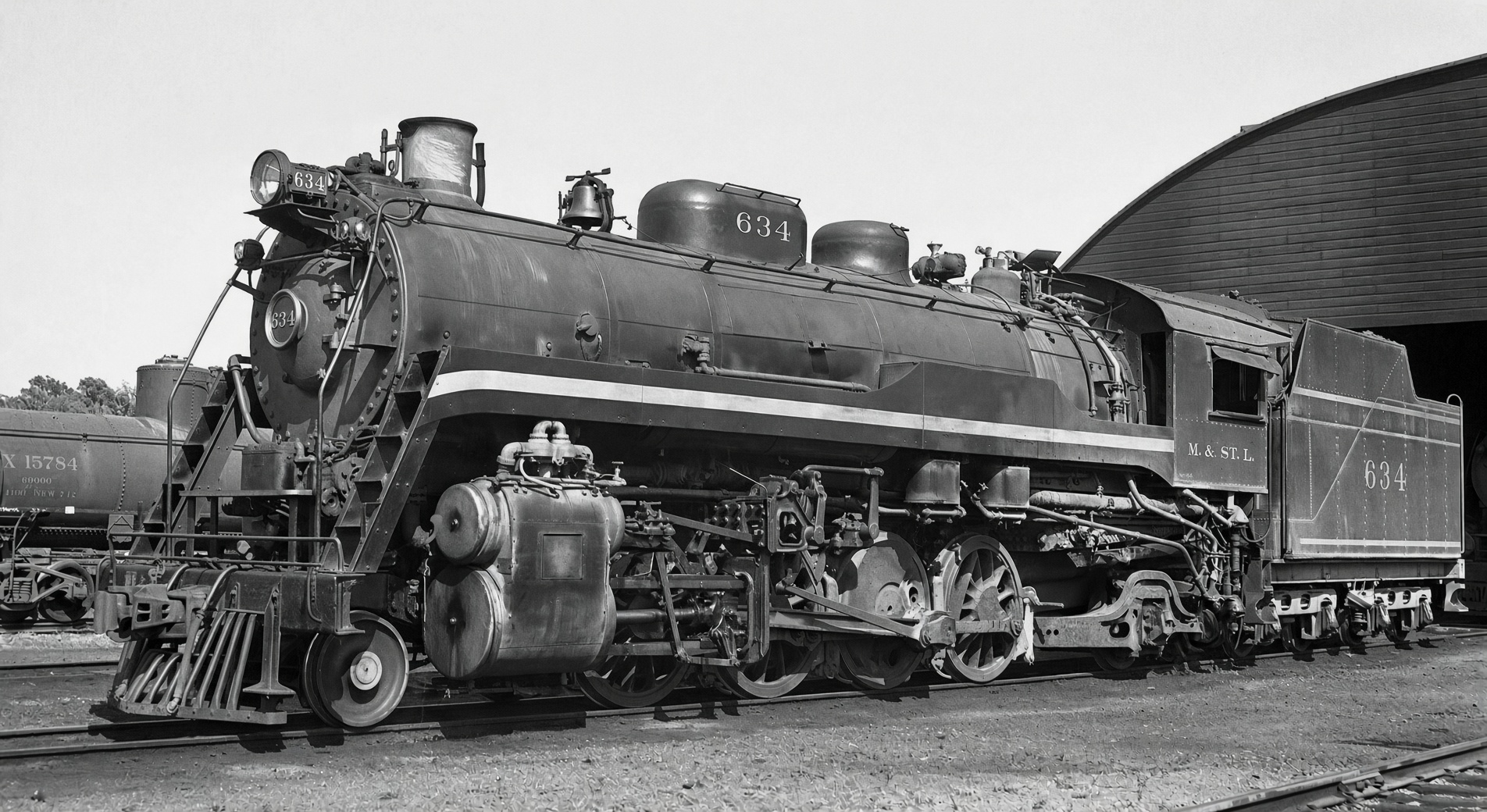
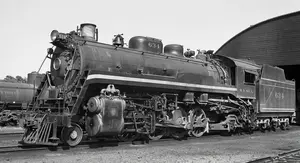
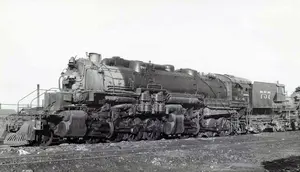
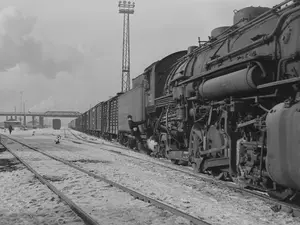
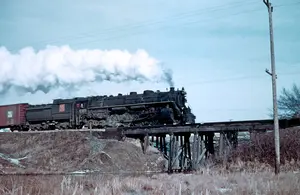
Minneapolis & St. Louis 2-8-2 #634 at the engine terminal in Minnneapolis, circa 1945. Photographer unknown. American-Rails.com collection.
On this page: At a glance · Moguls, Consolidations, Mikados · Americans, Ten-Wheelers, Pacifics · Switchers · Roster
At a glance
| Item | Detail |
|---|---|
| Railroad | Minneapolis & St. Louis. Mark MSTL. Company history |
| This table | Steam locomotives built since 1900. The class numeral is tractive effort in thousands of pounds |
| Moguls | 42. F1-27 through F5-32. The 23 F1-28s are the ex-Iowa Central engines, 306–328 |
| Consolidations | 57. H2-38, H4-34, H5-39, and H6-38 |
| Mikados | 35. M1-46, 600–634, Schenectady and Brooks, 1915–1921. The largest steam the railroad owned |
| Americans | 2. D9-24, 156 and 157, Schenectady, 1906 |
| Ten-Wheelers | 18. G3-22, G5-25, G6-24, and G7-25 |
| Pacifics | 5. K1-32, 500–504, Brooks, 1921. No. 502 stayed until 1949 |
| Switchers | 11. B2-27 quantity 1, numbers 59 and 60. B3-35, 80–89, Brooks, 1916 |
| Quantity column | 170 |
| Last new steam | Mikados and Pacifics, Brooks, 1921 |
| Dieselization | Completed in 1951. No. 502’s appearance at the Chicago Railroad Fair was September 1949 |
Moguls, Consolidations, Mikados
Both the Minneapolis & St. Louis and the Iowa Central favored the 2-6-0. The largest single class is F1-28, twenty-three Schenectady Moguls, 306–328, built from 1899 through 1906 and inherited from the Iowa Central. They had 63-inch drivers. The road’s own F1-27s, 300–305, came from Schenectady in 1902. Baldwin’s F2-33s, 329–334, followed in 1908 with 57-inch drivers. The three small ex-Iowa Central classes, F3-30, F4-33, and F5-32, had 51-inch drivers and were later given numbers down among the six-wheel switchers. The table still lists them as Moguls, under the last class and the Mogul numbers.
The Consolidations were bought in step with the Iowa Central engines. Most had 59-inch drivers and 21-by-30-inch cylinders. Class H5-39 used 22-inch cylinders. The H2-38s were not superheated. The H6-38s, built in 1910 and fitted with superheaters in 1915 and 1916, were the modern end of the type. No. 451, an H5-39, carried a tender booster. Class H4-34 was the odd one, with 55-inch drivers, and that difference accounts for its early retirement. One of the 1910 Baldwins, No. 471, class H6-38, is displayed at Janesville, Minnesota.
Alco’s Schenectady works delivered fifteen Mikados in 1915. They weighed 259,900 pounds, light for a 2-8-2, with 24-by-30-inch cylinders and 59-inch drivers. Brooks delivered the rest, a smaller group in 1916 and fifteen more in 1921, at 252,500 pounds. Those Brooks engines were later given trailing-truck boosters and 200 pounds of boiler pressure. Three of the earlier 2-8-2s received boosters and stayed at 185 pounds. Under Lucian C. Sprague the best of the Mikados were rebuilt with booster-equipped trailing trucks and running-board skirts. Two of them were given a further dressing of stainless-steel boiler jackets and concealed piping. The whole class is M1-46, numbers 600–634, thirty-five locomotives.
In the early 1940s the railroad went looking for something larger. It sought bids on five 2-6-6-4s. What came back, in 1942, were photographs of Seaboard Air Line 2-6-6-4s with the lettering blanked out. The War Production Board assigned Electro-Motive FT freight diesels instead, and the FTs were the better fit. The Mikados remained the heaviest steam the Minneapolis & St. Louis ever owned. The retirement column on the M1 row runs from 1938 to 1947.
Americans, Ten-Wheelers, Pacifics
The nineteenth-century Americans had been dual-service engines, with drivers from 60 to 63 inches. The two that belong on this list are 156 and 157, Schenectady, 1906, class D9-24, with 69-inch drivers. They were passenger locomotives. The retirement column carries them as late as 1951, into the year the railroad finished dieselization.
Ten-Wheelers did the same work. Nos. 214–217, class G3-22, came from Schenectady in 1900 and 1901. The Iowa Central preferred the Ten-Wheeler, and in the 1890s it bought batches with 51-, 55-, and 62-inch drivers. Ten more arrived in 1900, all with 63-inch drivers: four simple engines from Cooke, which became 222–225, class G5-25, and six Vauclain compounds from Baldwin, 230–235, class G7-25. The Baldwins were simpled between 1909 and 1911, and the class was gone in 1935. Class G6-24, 226–229, Baldwin, 1909, was the last Ten-Wheeler group on the roster. At least No. 229 was given running-board skirts. The G3s and the G6s, 214–217 and 226–229, were the passenger Ten-Wheelers.
Brooks delivered five Pacifics in 1921, in the same season as the last fifteen Mikados. They were light, 225,000 pounds, with 69-inch drivers, and the class was K1-32, numbers 500–504. They had been bought for the North Star Limited. Gas-electric cars took over most of the passenger trains in the 1930s. By the late 1940s the trains that remained were locals, a mail-and-baggage motor car or a Budd streamlined coach. Four of the Pacifics were scrapped in 1939 and 1940. No. 502 was dressed with running-board skirts and striping, and a flat bar was run across the top of the bell so the bell would not turn over when it was rung hard. Sprague kept 502 for specials after the motor cars had the regular passenger jobs. It appeared at the Chicago Railroad Fair in September 1949 and came off the roster that year.
Switchers
Nos. 59 and 60 were the last of eight six-wheel switchers Baldwin built between 1896 and 1906. The post-1900 quantity on that row is one locomotive, class B2-27, and the retirement dates printed with the pair are 1940 and 1936. The modern switchers were Brooks 80–89, class B3-35, delivered in 1916. They had 57-inch drivers, piston valves, and Walschaerts gear. They looked like a United States Railroad Administration 0-6-0 and weighed about 9,000 pounds more. The last of them lasted until 1949 and 1950.
Roster
The quantity column adds to 170. A blank cell is empty. Where a number series is longer than the quantity, the quantity is the figure in the table. The F3, F4, and F5 Moguls were later given switcher numbers. They stay on these rows as 2-6-0s. Iowa Central locomotives that came onto the Minneapolis & St. Louis were renumbered more than once, and the numbers here are the last ones.
| Type | Class | Numbers | Qty | Builder | Built | Retired | Notes |
|---|---|---|---|---|---|---|---|
| 0-6-0 | B2-27 | 59, 60 | 1 | Baldwin | 1906 | 1940, 1936 | — |
| 0-6-0 | B3-35 | 80-89 | 10 | Brooks | 1916 | 1949-1950 | — |
| 2-6-0 | F1-27 | 300-305 | 6 | Schenectady | 1902 | 1935-1950 | — |
| 2-6-0 | F1-28 | 306-328 | 23 | Schenectady | 1899-1906 | 1935-1951 | Ex-Iowa Central |
| 2-6-0 | F2-33 | 329-334 | 6 | Baldwin | 1908 | 1935-1951 | — |
| 2-6-0 | F3-30 | 63, 64 | 2 | Baldwin | 1908 | 1936-1948 | Ex-Iowa Central |
| 2-6-0 | F4-33 | 65, 66 | 2 | Baldwin | 1910 | 1942, 1938 | Ex-Iowa Central |
| 2-6-0 | F5-32 | 67-69 | 3 | Baldwin | 1910 | 1941, 1942 | Ex-Iowa Central |
| 2-8-0 | H2-38 | 400-406 | 7 | Baldwin | 1909 | 1939-1946 | — |
| 2-8-0 | H2-38 | 408-419 | 12 | Baldwin | 1909 | 1936-1950 | 500-506 |
| 2-8-0 | H4-34 | 442-447 | 6 | Schenectady | 1902 | 1935-1947 | Ex-Iowa Central |
| 2-8-0 | H5-39 | 450-461 | 12 | Schenectady | 1912 | 1936-1939 | Ex-Iowa Central |
| 2-8-0 | H6-38 | 462-471 | 10 | Baldwin | 1910 | 1944-1950 | — |
| 2-8-0 | H6-38 | 472-481 | 10 | Baldwin | 1910 | 1938-1946 | Ex-Iowa Central |
| 2-8-2 | M1-46 | 600-634 | 35 | Schenectady, Brooks | 1915-1921 | 1938-1947 | — |
| 4-4-0 | D9-24 | 156, 157 | 2 | Schenectady | 1906 | 1940-1951 | — |
| 4-6-0 | G3-22 | 214-217 | 4 | Schenectady | 1900-1901 | 1938, 1937 | — |
| 4-6-0 | G5-25 | 222-225 | 4 | Cooke | 1900 | 1935-1938 | — |
| 4-6-0 | G6-24 | 226-229 | 4 | Baldwin | 1909 | 1931, 1936 | Ex-Iowa Central |
| 4-6-0 | G7-25 | 230-235 | 6 | Baldwin | 1900 | 1935 | — |
| 4-6-2 | K1-32 | 500-504 | 5 | Brooks | 1921 | 1939-1949 | — |
Related reading
- Minneapolis & St. Louis
- Minneapolis & St. Louis diesel roster
- Chicago & North Western · C&NW steam roster
Sources
- Drury, George H. Guide to North American Steam Locomotives. Revised edition. The Minneapolis & St. Louis chapter, pp. 210–211.
- Railroad magazine, March 1935, p. 81.
- Railroad History, No. 154.
- Chicago & North Western Historical Society.
Recent Articles


-
Minneapolis, Northfield and Southern Railway: Map, History, Rosters
Oct 27, 26 10:32 AM
 The Minneapolis, Northfield & Southern, the Dan Patch Line that became a Twin Cities belt. Steam, gas-electric mules, motor cars, and the 22 diesels, through the Soo Line.
-
Minneapolis & St. Louis Diesel Roster (All-Time)
Oct 27, 26 10:27 AM
 All-time diesel roster of the Minneapolis & St. Louis. 97 locomotives, each frame once. Switchers from 1938, 35 RS-1s, the FT and F-unit cabs, two SD7s, and 23 GP9s. Builder numbers included.
-
Minneapolis & St. Louis Steam Roster (Post 1900)
Oct 27, 26 10:25 AM
 Minneapolis & St. Louis steam locomotives built since 1900. Moguls, Consolidations, 35 Mikados, and five Pacifics.
-
Minneapolis and St Louis Railway: "The Peoria Gateway"
Oct 27, 26 09:52 AM
 The Minneapolis & St. Louis, the Tootin' Louie, from the 1870 charter to the Peoria Gateway and the Chicago & North Western sale on November 1, 1960.
-
Alco "PA" Locomotives: Restoration, Specs, Engine, Rosters
Oct 27, 26 12:12 AM
 Alco's PA passenger cab, 297 locomotives built from 1946 to 1953. The 244 engine, the production roster, the Delaware & Hudson PA-4s, and Nickel Plate Road 190.
-
Milwaukee Road Diesel Roster: (All Time)
Oct 26, 26 01:44 PM
 All-time diesel roster of the Milwaukee Road. 1,208 locomotives, each frame once. Alco, Baldwin, Davenport, EMD, Fairbanks-Morse, General Electric, and Whitcomb, with builder numbers.
-
Milwaukee Road Steam Roster (All-Time): Post-1900
Oct 26, 26 01:38 PM
 Milwaukee Road steam locomotives built since 1900. Prairies, Mikados, the N-class articulateds, the S-class 4-8-4s, and the Hiawatha Atlantics and Hudsons. Quantity column 1,974. Unique frames 1,951.
-
Milwaukee Road: Map, Electrification, Logo, History
Oct 26, 26 01:20 PM
 The Milwaukee Road, from the Milwaukee & Mississippi of 1850 to the Pacific Coast Extension, the Hiawathas, and the Soo Line sale. Why Lines West should have stayed.
-
Lake Superior & Ishpeming Railroad: Map, Roster, History
Oct 25, 26 11:38 PM
 Lake Superior & Ishpeming Railroad, reporting mark LSI, from the Marquette Range to the Presque Isle ore dock. The 1954 steam list and the diesels the railroad owned.
-
Kansas City Southern Steam Roster (Built Since 1900)
Oct 25, 26 09:09 PM
 Steam locomotives of the Kansas City Southern built since 1900, with the Louisiana & Arkansas and the Texas company.
-
Kansas City Southern Diesel Roster (Built New)
Oct 25, 26 11:46 AM
All-time diesel roster of the Kansas City Southern. E units, F units, Geeps, SD40s through SD70ACes, Fairbanks-Morse, Baldwin, Alco, and General Electric, with serials and order numbers. -
Kansas City Southern Railway: Map, Photos, History
Oct 25, 26 12:24 AM
 The Kansas City Southern, from Arthur Stilwell's Gulf line to Canadian Pacific Kansas City on April 14, 2023. Steam and diesel rosters, the Southern Belle, and the Louisiana & Arkansas.
-
Indiana Harbor Belt Diesel Roster (All-Time)
Oct 25, 26 12:17 AM
 All-time diesel roster of the Indiana Harbor Belt. 202 locomotive frames, each counted once. NW2s, SW7s, SW1500s, road switchers, and gensets. Slugs and boosters are outside the count.
-
Indiana Harbor Belt Steam Roster (Built Since 1900)
Oct 25, 26 12:13 AM
 Steam locomotives of the Indiana Harbor Belt built since 1900. 182 engines, each counted once. 0-6-0s, 2-6-0s, 0-8-0s, and 2-8-2s. The three U-4a switchers are three-cylinder Brooks engines of 1927.
-
Indiana Harbor Belt Railroad: Map, Rosters, History
Oct 25, 26 12:00 AM
 Indiana Harbor Belt, the inner belt across the Calumet, from the East Chicago Belt of May 16, 1896. Renamed June 29, 1907. Still operating, headquarters Hammond. Steam roster is the companion, 182 loc…
-
NYC's "P Motor" Electric Locomotives
Oct 24, 26 11:43 PM
 New York Central P motors: 22 Alco-GE 2-C+C-2 electrics, Cleveland Union Terminal 1050–1071, class P-1a. 3,030 hp one-hour on 3,000-volt DC catenary, then 660-volt third rail as P-2a and P-2b.
-
Illinois Terminal Car Roster
Oct 24, 26 11:40 PM
 Illinois Terminal cars. Mainline motors, the 1948 streamliners, sleepers, Alton and Valley Division cars, express motors, and the line cars rebuilt from pull cars.
-
Illinois Terminal Diesel Roster
Oct 24, 26 09:31 PM
 All-time Illinois Terminal diesels, 62 frames. Alco S-2s and RS-1s, EMD switchers, GP7s, SD39s, GP38-2s, and the two GP20s. Serial numbers from the 1989 roster.
-
Illinois Terminal Electric Locomotives
Oct 24, 26 08:22 PM
 Illinois Terminal electric locomotives, 57 frames. Class A through Class D, the Decatur-built motors, and the battery locomotives. Class D is the same five Class C frames, rebuilt.
-
Illinois Terminal Steam Roster
Oct 24, 26 07:37 PM
 Illinois Terminal steam locomotives, 36 frames. Baldwin Moguls, three Class 30 Mikados, Florida East Coast 0-8-0s, and 2-6-0 No. 21, the last fire on June 30, 1950.
-
Illinois Terminal Railroad: Map, Roster, Photos, History
Oct 24, 26 07:32 PM
Illinois Terminal, McKinley's Illinois Traction System, from the Danville coal towns to St. Louis. The McKinley Bridge, the sleeping cars, the 1937 break with the power company, the 1948 streamliners… -
Southern Railway Diesel Roster (All-Time)
Oct 23, 26 11:00 PM
 All-time diesel roster of the Southern Railway. 2,505 locomotives in the system number series, from the 1939 demonstrator FT to GP50s and B30-7A1s. Serials included.
-
Illinois Central Diesel Roster (All-Time)
Oct 23, 26 04:06 PM
Illinois Central and Illinois Central Gulf diesel locomotives, each frame once. The quantity column is 886. Serials and order numbers from Electro-Motive's builder lists. Paducah rebuilds and Gulf, Mo… -
Illinois Central Gulf Diesel Roster
Oct 23, 26 04:02 PM
 Illinois Central Gulf operating numbers from August 10, 1972, to February 29, 1988. New frames stay on the Illinois Central diesel roster. Gulf, Mobile and Ohio frames stay on that roster. No Gulf fle…
-
Illinois Central Railroad: Map, Logo, History
Oct 23, 26 03:50 PM
Illinois Central, the Main Line of Mid-America, from the 1850 land grant to Canadian National control on July 1, 1999. Charter lines, Cairo bridge, Paducah, and the Illinois Central Gulf. Steam quanti… -
Grand Trunk Western Diesel Roster (All-Time)
Oct 23, 26 12:53 PM
 Grand Trunk Western diesel locomotives, each frame once. The quantity column is 377. Serials are filled for the Detroit, Toledo and Ironton and Detroit and Toledo Shore Line engines the railroad kept…
-
Grand Trunk Western Steam Roster
Oct 23, 26 12:14 PM
 Grand Trunk Western steam locomotives in service about 1937 to 1942, from Richard Leonard's class list. Drury has no chapter. The quantity column is the counted Grand Trunk Western rows. Two mixed Gra…
-
Grand Trunk Western Railroad: Map, Roster, History
Oct 23, 26 12:09 PM
 Grand Trunk Western, reporting mark GTW, Canadian National's railroad between Port Huron and Chicago. Trade name adopted in 1923. Steam class list quantity 232. Diesel quantity column 377. Identity in…
-
Green Bay and Western Railroad: Map, Rosters, History
Oct 22, 26 11:18 PM
 Green Bay & Western, the Green Bay Route, reporting mark GBW. From Kewaunee to Winona. Mailer's steam and diesel rosters, and the August 1993 sale to Fox Valley & Western.
-
Chicago & North Western Class E-4: Streamlined 4-6-4 Hudsons
Oct 22, 26 10:28 PM
 C&NW Class E-4, nine streamlined 4-6-4s, 4001–4009, Alco 1938. 84-inch drivers, 25-by-29 cylinders, 300 psi. Conventional Chicago–Omaha trains. Oil in 1947–48. Retired 1953–1956.
-
Gateway Western Railway: Map, Roster, History
Oct 22, 26 02:43 PM
 Gateway Western Railway, reporting mark GWWR. Class II from Kansas City to East St. Louis. Kansas City Southern control May 5, 1997. The 1992 diesel fleet, with serials and order numbers.