Grand Trunk Western Steam Roster
Published: October 23, 2026
By: Adam Burns
George H. Drury’s Guide to North American Steam Locomotives has no Grand Trunk Western chapter. The class list here is Richard Leonard’s compilation of locomotives in service about 1937–1942. It is not an all-time roster. Most of the engines were still at work in the early 1950s. They were part of the Canadian National roster and were lettered Grand Trunk or Grand Trunk Western for service in the United States. Some number series also include Grand Trunk locomotives used in New England. The Canadian National system rated engines by percentage rather than by tractive effort, so the tractive-effort figure for most classes is approximate.

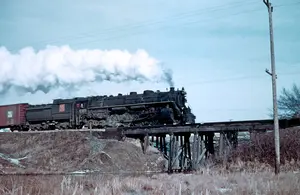
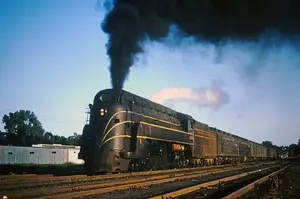
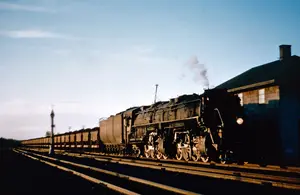
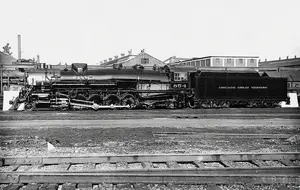
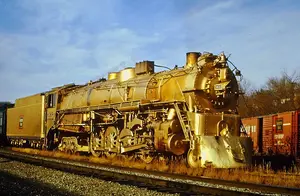
4-8-4 6323, class U-3-b, with an eastbound freight across a wood pile bridge at Drayton Plains, Michigan, just north of Pontiac, circa 1950. Fred Byerly photo. American-Rails.com collection.
On this page: At a glance · Switchers · Consolidations and Mikados · Pacifics · Mountains and 4-8-4s · Roster
At a glance
| Item | Detail |
|---|---|
| Railroad | Grand Trunk Western. Mark GTW. Company history |
| This table | Richard Leonard’s class list, locomotives in service about 1937–1942. Not an all-time roster. Drury has no chapter |
| Quantity column | 232 |
| Outside that total | S-1-f 3430–3450, and S-3-a 3700–3739. Each row mixes Grand Trunk and Grand Trunk Western engines |
| 4-8-4s in the total | U-3-a 6300–6311, twelve. U-3-b 6312–6336, twenty-five. U-4-b 6405–6410, six |
| Pacific 5629 | Class K-4-a, 5627–5631. Its own article. Scrapped in July 1987 |
| Main line | Dieselized in April 1957 |
| Last regular passenger steam | Durand–Detroit locals 21 and 56, in March 1960 |
Switchers
The 1937–1942 list is still a railroad of six-wheel and eight-wheel switchers. Lima built the O-18-b engines, 7474–7498, in 1920, twenty-five of them, and Leonard marks that row as shown on the 1937 roster. Three more Limas, O-18-d 7519–7521, came in 1923. The five O-19-a switchers, 7522–7526, are Alco engines of 1919.
The heavy switchers are the P-4 and P-5 classes. Lima’s five P-4-d engines of 1923, 8222–8226, are the ones that lasted into the 1956 renumbering: 8222 became 8447, and 8226 became 8448. Those are the same two frames. Alco delivered P-5-a 8300–8304 in 1923 and P-5-b 8305–8319 in 1924. Lima’s P-5-c 8320–8329 and Baldwin’s P-5-e 8340–8349 both date from 1927. Baldwin’s P-5-g 8370–8381 followed in 1929, twelve engines, with the class tractive effort printed as 49,691 pounds rather than a round figure.
Six 0-8-2s, class S-1-g,h, were rebuilt from 2-8-2s: 3515–3517, 3520, 3522, and 3523. Schenectady had built the engines in 1918. Leonard says 3523 was renumbered 3522 in June 1956 and that the others were presumably scrapped by then. The three S-1-g,h engines that were still Mikados, 3518, 3519, and 3524, are a different row.
Consolidations and Mikados
The Consolidations still on the list are two small groups of class N-4. N-4-d is sixteen engines, 2664–2668, 2671–2673, and 2676–2683, from Brooks and Schenectady in 1907 and 1911. Leonard’s build note also names 2669. That number is not in the number cell, and it is not in the quantity. He writes that all or some of the class were built as cross-compounds and converted to simple operation around 1926. N-4-e is four engines, 2670, 2674–2675, and 2684, and that subclass kept Stephenson valve gear until it was retired. The dimensions match the N-4-d.
The Mikados are the S classes. Five S-1-f engines from Schenectady in 1913, 3405, 3407–3409, and 3413, are counted. A second S-1-f row, Baldwin 1913, numbers 3430–3450, is not. Leonard says that class includes both Grand Trunk and Grand Trunk Western locomotives, and he does not separate them. Three S-1-g,h Mikados, 3518, 3519, and 3524, Schenectady 1918, are counted. They are not the six 0-8-2 rebuilds.
Class S-3-a, 3700–3739, is the United States Railroad Administration light Mikado. Leonard counts 15 Grand Trunk and 25 Grand Trunk Western locomotives inside the forty numbers and does not say which twenty-five are which. The row stays outside the total. Engines from that series still on the property in 1956 were renumbered into the 4045–4075 band. Those 4000-series numbers are the same frames. Class S-3-b 3740–3747, Schenectady 1923, is eight engines and is counted. Those remaining in 1956 were renumbered 3740 to 4076 and 3742–3747 to 4077–4082. Class S-3-c 3748–3757, Schenectady 1924, is ten engines. Those remaining in 1956 were renumbered 3748 to 4083 and 3750–3757 to 4084–4091.
Pacifics
The older Ten-Wheelers were still on Leonard’s list, with a scrap note of “probably” by the mid-1940s. I-6-b is 1552 and 1553, Schenectady 1898. I-7-a is 1579–1581, Schenectady 1904. I-8-a is 1599 and 1619–1625, various builders, 1906–1908. The pressure cell on that last row does not yield a usable figure, so the table leaves it blank. The tractive effort is the printed 23,000 pounds.
The Pacifics begin with Baldwin’s J-3-a class, 5030–5048, nineteen engines of 1912. Leonard does not mark that row as a mixed Grand Trunk series. The New England warning in his introduction still sits over the whole list. Two older K-3 engines remain as single locomotives: 5609, class K-3-f, built at the Grand Trunk shops in 1920, and 5611, class K-3-d, Baldwin 1912. The cylinder, driver, pressure, weight, and tractive-effort figures match.
Class K-4-a is Alco, 1924, numbers 5627–5631. The class tractive effort in this table is Leonard’s 40,800 pounds. Number 5629 has its own article. That article dates the end of its Grand Trunk Western revenue career to March 1960 and its scrapping to July 1987. Class K-4-b is three Baldwin engines of 1929, 5632–5634, with a vestibule cab, 215 pounds of pressure, and a printed tractive effort of 43,800 pounds.
Mountains and 4-8-4s
Five Baldwin 4-8-2s, class U-1-c, 6037–6041, were built in 1925. Leonard says they were later fully or partly equipped with disc drivers, and that the Canadian National system’s U-1-a through U-1-e classes used the indirect, or reverse, arrangement of the Walschaerts valve gear. Jerry A. Pinkepank adds that these five Mountains also wore, for a time, the smokelifter applied to the U-4-b 4-8-4s.
The 4-8-4s are three classes, and they are not the same engines. Alco built U-3-a 6300–6311 in 1927, twelve locomotives, cylinders 26½ by 30 inches, 73-inch drivers, 250 pounds, a weight of 399,000 pounds, and an approximate tractive effort of 60,000 pounds. Leonard says they were sent to the Canadian National after delivery of the U-3-b class. Pinkepank says they were transferred to Canada in 1940–41, because of the war, and replaced by the U-3-bs. The U-3-b class is Alco, 1942–1943, numbers 6312–6336, twenty-five engines, 26 by 30 cylinders, 73-inch drivers, 250 pounds, 403,000 pounds, and a tractive effort of 59,034 pounds. Leonard says 6313, 6317, 6324, and 6336 were transferred to the Canadian National in 1956. Number 6323 is preserved at the Illinois Railway Museum. Number 6325 is preserved at the Age of Steam Roundhouse. Leonard’s gallery of the class shows 6323 at Durand in May 1954, separated from the Maple Leaf.
The U-4-b is a different machine. Lima built six in 1938, 6405–6410, with 77-inch drivers, 24 by 30 cylinders, 275 pounds, a weight of 382,700 pounds, and a printed tractive effort of 52,500 pounds. Pinkepank’s account of the class agrees: six Limas, 77-inch drivers.
Pinkepank dates the last regular revenue passenger steam in the United States to Grand Trunk Western locals 21 and 56, the Durand–Detroit remnants, in March 1960. Shortly thereafter the Detroit Division hosted the last regular intercity mainline steam freight in the country. The main line itself had been dieselized in April 1957.
Roster
The quantity column sums to 232. A blank cell is empty. The two mixed rows carry an em dash and are not in that sum. A 1956 number is the same locomotive.
| Type | Class | Numbers | Qty | Cylinders | Drivers | Pressure | Weight | Tractive effort | Builder | Year | Notes |
|---|---|---|---|---|---|---|---|---|---|---|---|
| 0-6-0 | O-18-b | 7474–7498 | 25 | 22×26 | 51 | 175 | 174,000 | 37,000 | Lima | 1920 | Shown on the 1937 roster |
| 0-6-0 | O-18-d | 7519–7521 | 3 | 22×26 | 56 | 190 | 180,000 | 36,000 | Lima | 1923 | — |
| 0-6-0 | O-19-a | 7522–7526 | 5 | 21×28 | 51 | 190 | 165,000 | 39,000 | Alco | 1919 | — |
| 0-8-0 | P-4-d | 8222–8226 | 5 | 26×30 | 56 | 180 | 249,000 | 55,000 | Lima | 1923 | Remaining in 1956: 8222 became 8447, and 8226 became 8448. Same frames |
| 0-8-0 | P-5-a | 8300–8304 | 5 | 22×28 | 51 | 200 | 208,000 | 45,000 | Alco | 1923 | — |
| 0-8-0 | P-5-b | 8305–8319 | 15 | 22×28 | 51 | 200 | 211,000 | 45,000 | Alco | 1924 | — |
| 0-8-0 | P-5-c | 8320–8329 | 10 | 22×28 | 51 | 220 | 214,000 | 50,000 | Lima | 1927 | — |
| 0-8-0 | P-5-e | 8340–8349 | 10 | 22×28 | 51 | 220 | 211,200 | 50,000 | Baldwin | 1927 | — |
| 0-8-0 | P-5-g | 8370–8381 | 12 | 22×28 | 51 | 220 | 215,150 | 49,691 | Baldwin | 1929 | — |
| 0-8-2 | S-1-g,h | 3515–3517, 3520, 3522, 3523 | 6 | 27×30 | 63 | 179 | 279,400 | 52,000 | Schenectady | 1918 | Rebuilt from 2-8-2s. 3523 was renumbered 3522 in June 1956. The others were presumably scrapped by then |
| 2-8-0 | N-4-d | 2664–2668, 2671–2673, 2676–2683 | 16 | 23×32 | 63 | 180 | 211,200 | 40,000 | Brooks and Schenectady | 1907, 1911 | 2664, 2665, 2669, 2671–2673, and 2676 built 1907. 2666–2668 and 2677–2683 built 1911. All or some were built as cross-compounds and converted to simple operation around 1926 |
| 2-8-0 | N-4-e | 2670, 2674–2675, 2684 | 4 | 23×32 | 63 | 180 | 211,200 | 40,000 | Brooks and Schenectady | 1907, 1911 | 2670, 2674, and 2675 built 1907. 2684 built 1911. Stephenson valve gear until retired |
| 2-8-2 | S-1-f | 3405, 3407–3409, 3413 | 5 | 27×30 | 63 | 175 | 283,000 | 52,000 | Schenectady | 1913 | — |
| 2-8-2 | S-1-f | 3430–3450 | — | 27×30 | 63 | 175 | 272,100 | 52,000 | Baldwin | 1913 | Class includes both Grand Trunk and Grand Trunk Western locomotives. Not in the total |
| 2-8-2 | S-1-g,h | 3518, 3519, 3524 | 3 | 27×30 | 63 | 175 | 284,800 | 52,000 | Schenectady | 1918 | Still Mikados. Not the six 0-8-2 rebuilds |
| 2-8-2 | S-3-a | 3700–3739 | — | 26×30 | 63 | 200 | 290,000 | 55,000 | Schenectady | 1918 | U.S.R.A. light Mikado. Leonard counts 15 Grand Trunk and 25 Grand Trunk Western locomotives in the span and does not separate them. Not in the total. Remaining in 1956: 3702–3706 became 4045–4049; 3708–3712 became 4050–4054; 3714–3717 became 4055–4058; 3719 became 4059; 3720 became 4060; 3722 became 4061; 3726–3739 became 4062–4075. Same frames |
| 2-8-2 | S-3-b | 3740–3747 | 8 | 26×30 | 63 | 200 | 306,500 | 55,000 | Schenectady | 1923 | Remaining in 1956: 3740 became 4076, and 3742–3747 became 4077–4082. Same frames |
| 2-8-2 | S-3-c | 3748–3757 | 10 | 26×30 | 63 | 200 | 306,500 | 55,000 | Schenectady | 1924 | Remaining in 1956: 3748 became 4083, and 3750–3757 became 4084–4091. Same frames |
| 4-6-0 | I-6-b | 1552, 1553 | 2 | 21×26 | 73 | 180 | 177,800 | 24,000 | Schenectady | 1898 | Probably scrapped by the mid-1940s |
| 4-6-0 | I-7-a | 1579–1581 | 3 | 22×26 | 69 | 200 | 198,100 | 31,000 | Schenectady | 1904 | Probably scrapped by the mid-1940s |
| 4-6-0 | I-8-a | 1599, 1619–1625 | 8 | 21×26 | 73 | — | 167,300 | 23,000 | Various builders | 1906–1908 | Probably scrapped by the mid-1940s. The pressure figure in the source does not yield a usable number |
| 4-6-2 | J-3-a | 5030–5048 | 19 | 23×28 | 69 | 185 | 224,100 | 34,000 | Baldwin | 1912 | — |
| 4-6-2 | K-3-f | 5609 | 1 | 23×28 | 73 | 195 | 229,000 | 34,000 | Grand Trunk shops | 1920 | — |
| 4-6-2 | K-3-d | 5611 | 1 | 23×28 | 73 | 195 | 229,000 | 34,000 | Baldwin | 1912 | — |
| 4-6-2 | K-4-a | 5627–5631 | 5 | 25×28 | 73 | 200 | 285,500 | 40,800 | Alco | 1924 | 5629 has its own article. Scrapped in July 1987. Class tractive effort is Leonard’s 40,800 |
| 4-6-2 | K-4-b | 5632–5634 | 3 | 25×28 | 73 | 215 | 299,350 | 43,800 | Baldwin | 1929 | Vestibule cab |
| 4-8-2 | U-1-c | 6037–6041 | 5 | 26×30 | 73 | 210 | 354,110 | 49,590 | Baldwin | 1925 | Later fully or partly equipped with disc drivers. Indirect Walschaerts valve gear. For a time, the U-4-b smokelifter |
| 4-8-4 | U-3-a | 6300–6311 | 12 | 26½×30 | 73 | 250 | 399,000 | 60,000 | Alco | 1927 | Leonard: sent to the Canadian National after delivery of the U-3-b class. Pinkepank: transferred to Canada in 1940–41 and replaced by the U-3-bs |
| 4-8-4 | U-3-b | 6312–6336 | 25 | 26×30 | 73 | 250 | 403,000 | 59,034 | Alco | 1942–1943 | 6313, 6317, 6324, and 6336 transferred to the Canadian National in 1956. 6323 is at the Illinois Railway Museum. 6325 is at the Age of Steam Roundhouse |
| 4-8-4 | U-4-b | 6405–6410 | 6 | 24×30 | 77 | 275 | 382,700 | 52,500 | Lima | 1938 | — |
Related reading
- Grand Trunk Western company history and map
- Grand Trunk Western diesel roster
- Grand Trunk Western 4-6-2 No. 5629, class K-4-a
- Grand Trunk Railway
- Mikado type, the S-class 2-8-2s
Sources
- Richard Leonard, “Grand Trunk Western Locomotives, Circa 1937–1942,” Richard Leonard’s Steam Locomotive Archive, railarchive.net/rlsteam/gtroster.htm. Class table opened October 23, 2026. His U-3-b gallery is the Durand Maple Leaf scene.
- Jerry A. Pinkepank, “Grand Trunk Western history remembered,” Classic Trains. The U-3-a transfer, the U-4-b smokelifter on the five Mountains, the six U-4-b Limas, and the end of regular steam.
Recent Articles


-
Grand Trunk Western Diesel Roster (All-Time)
Oct 23, 26 12:53 PM
 Grand Trunk Western diesel locomotives, each frame once. The quantity column is 377. Serials are filled for the Detroit, Toledo and Ironton and Detroit and Toledo Shore Line engines the railroad kept…
-
Grand Trunk Western Steam Roster
Oct 23, 26 12:14 PM
 Grand Trunk Western steam locomotives in service about 1937 to 1942, from Richard Leonard's class list. Drury has no chapter. The quantity column is the counted Grand Trunk Western rows. Two mixed Gra…
-
Grand Trunk Western Railroad: Map, Roster, History
Oct 23, 26 12:09 PM
 Grand Trunk Western, reporting mark GTW, Canadian National's railroad between Port Huron and Chicago. Trade name adopted in 1923. Steam class list quantity 232. Diesel quantity column 377. Identity in…
-
Green Bay and Western Railroad: Map, Rosters, History
Oct 22, 26 11:18 PM
 Green Bay & Western, the Green Bay Route, reporting mark GBW. From Kewaunee to Winona. Mailer's steam and diesel rosters, and the August 1993 sale to Fox Valley & Western.
-
Chicago & North Western Class E-4: Streamlined 4-6-4 Hudsons
Oct 22, 26 10:28 PM
 C&NW Class E-4, nine streamlined 4-6-4s, 4001–4009, Alco 1938. 84-inch drivers, 25-by-29 cylinders, 300 psi. Conventional Chicago–Omaha trains. Oil in 1947–48. Retired 1953–1956.
-
Gateway Western Railway: Map, Roster, History
Oct 22, 26 02:43 PM
 Gateway Western Railway, reporting mark GWWR. Class II from Kansas City to East St. Louis. Kansas City Southern control May 5, 1997. The 1992 diesel fleet, with serials and order numbers.
-
Duluth, Winnipeg & Pacific Railway: Roster, Map, History
Oct 22, 26 01:51 PM
 Duluth, Winnipeg & Pacific, the Peg, reporting mark DWP. From the Rainy River to Duluth. CNRHA steam list 36. Fifteen RS-11s. Merged into Wisconsin Central Ltd. on December 31, 2011.
-
Elgin, Joliet and Eastern Diesel Roster (All-Time)
Oct 22, 26 01:35 PM
 All-time diesel roster of the Elgin, Joliet and Eastern.
-
Elgin, Joliet and Eastern Steam Roster
Oct 22, 26 01:25 PM
 Elgin, Joliet and Eastern steam locomotives of the final decade, which largely comprised switcher types, 2-8-0s, and a large fleet of Mikados.
-
Elgin, Joliet and Eastern Railway: Map, Roster, History
Oct 22, 26 12:32 PM
 Elgin, Joliet & Eastern, the outer arc around Chicago, from the Joliet, Aurora & Northern of April 30, 1884. Illinois company March 18, 1887. Merged December 4, 1888. Principal lines sold Janu…
-
Denver and Salt Lake Railway: History, Roster, Timetable
Oct 22, 26 09:47 AM
 Denver & Salt Lake, the Moffat Road, from Denver to Craig. Tunnel opened February 26, 1928. Dotsero Cutoff dedicated June 16, 1934. Merged April 11, 1947. Steam locomotives 59.
-
Duluth, Missabe and Iron Range Diesel Roster (All-Time)
Oct 22, 26 09:43 AM
 All-time diesel roster of the Duluth, Missabe and Iron Range. 148 owned frames, each counted once. SW9s, SD9s, SD18s, SD38s, RSD-15s, and C630s. Serials and builder order numbers included. Helm SD40-3…
-
Duluth, Missabe and Iron Range Steam Locomotives (Since 1900)
Oct 22, 26 09:22 AM
 Duluth, Missabe & Iron Range steam locomotives built since 1900. Duluth & Iron Range, Duluth, Missabe & Northern, and later DM&IR acquisitions. Quantity column 252. Yellowstones 220-23…
-
Duluth, Missabe and Iron Range Railway: Roster, Map, Logo
Oct 22, 26 09:17 AM
Duluth, Missabe & Iron Range, reporting mark DMIR, from the Mesabi and the Vermilion to the Lake Superior docks. Formed July 1, 1937. Steam quantity 252. Owned diesels 148. On paper through Decemb… -
Duluth, South Shore, and Atlantic Railway: Map, Roster, Timetables
Oct 21, 26 11:21 PM
 Duluth, South Shore & Atlantic Railway, the South Shore. Marquette to the Sault, St. Ignace, Houghton, and Duluth-Superior. Soo Line on January 1, 1961. Twenty-four diesels.
-
Detroit, Toledo and Ironton Diesel Roster (All-Time)
Oct 21, 26 02:55 PM
 All-time diesel roster of the Detroit, Toledo and Ironton. 119 frames, each counted once. Serials and builder order numbers included. Last steam was December 24, 1955.
-
Detroit, Toledo and Ironton Steam Roster (Post 1900)
Oct 21, 26 02:49 PM
 Detroit, Toledo and Ironton steam locomotives built after 1900. Drury's class grid. The quantity column prints 141. Counted once, the frames are 137. Last steam was Mikado 805 on December 24, 1955.
-
Detroit, Toledo and Ironton Railroad: Map, Roster, History
Oct 21, 26 02:40 PM
 Detroit, Toledo & Ironton, reporting mark DTI, from Detroit to Ironton, Ohio. Railway organized May 2, 1905. Railroad articles filed February 21, 1914. Henry Ford, 1920 to 1929. Steam and diesel r…
-
Iowa, Chicago and Eastern Railroad: Roster, Map, History
Oct 21, 26 01:04 PM
 Iowa, Chicago & Eastern Railroad Corporation, reporting mark ICE. About 1,125 miles and about 275 miles of trackage rights from the I&M Rail Link. Operations at 12:01 a.m. July 30, 2002. Canad…
-
Rapid City, Pierre & Eastern Railroad: Route, Roster, Overview
Oct 21, 26 10:16 AM
 Rapid City, Pierre & Eastern Railroad, reporting mark RCPE. Genesee & Wyoming Class II. Agreement of January 2, 2014, Finance Docket 35799. Freight service from June 1, 2014, on the Dakota, Mi…
-
Dakota, Minnesota & Eastern Railroad: Roster, Map, History
Oct 21, 26 12:26 AM
 Dakota, Minnesota & Eastern Railroad, reporting mark DME. The July 2, 1986 Chicago & North Western sale, 826 miles and 139 miles of trackage rights. Canadian Pacific control October 30, 2008…
-
Detroit and Mackinac Railway: Map, Roster, History
Oct 20, 26 11:58 PM
 Detroit & Mackinac Railway, the Turtle Line. Bay City to Cheboygan along Lake Huron. Incorporated December 29, 1894. Lake State Railway leased the operation in 1992 and bought the lines in 1997. E…
-
Davenport, Rock Island and Northwestern Railroad
Oct 20, 26 11:22 PM
 Davenport, Rock Island and North Western Railway, the DRI Line. Clinton to East Moline across the Crescent Bridge. Burlington and Milwaukee. Merged into the Soo Line on June 29, 1995. Eighteen diesels…
-
Chicago Great Western Steam Roster (Post 1900)
Oct 20, 26 11:17 PM
 Chicago Great Western steam locomotives built or rebuilt since 1900. Drury's class grid. 320 frames, each once. The quantity column prints 376 because a rebuild is listed again. Last steam in the reti…
-
Chicago Great Western Diesel Roster (All-Time)
Oct 20, 26 10:47 PM
 All-time diesel roster of the Chicago Great Western. 157 frames, each counted once. Serials and builder order numbers included. Steam was gone by 1950. The 1963 glance figure of 141 is one year's flee…
-
Chicago Great Western Railway: Map, Photos, History, Rosters
Oct 20, 26 10:43 PM
 The Chicago Great Western, the Corn Belt Route, linked Chicago, the Twin Cities, Omaha, and Kansas City from September 27, 1885, until the Chicago & North Western merger at 12:01 a.m. on July 1, 1968…
-
Chicago, South Shore & South Bend Railroad: "The South Shore Line"
Oct 20, 26 05:48 PM
 Chicago South Shore & South Bend, the South Shore Line, from the 1901 Air Line through Samuel Insull's 1925 rebuild, the orange cars, the 800s, and the railroad NICTD and Anacostia still run.
-
Northwestern Virginia Railroad: Map, History, Timetable
Oct 20, 26 04:18 PM
 Northwestern Virginia Railroad, chartered February 14, 1851, Grafton to Parkersburg, 104 miles. Opened May 1, 1857. Foreclosure sale February 15, 1865, as the Parkersburg Branch. Twenty-three tunnels…
-
"Exposition Flyer" (Train): Consist, Timetable, History
Oct 20, 26 03:29 PM
 Exposition Flyer, Chicago to Oakland, June 10, 1939 to March 20, 1949. Burlington, Rio Grande, and Western Pacific. Heavyweight cars, then diesels and a vista-dome. Replaced by the California Zephyr.
-
Chicago, St. Paul, Minneapolis & Omaha Railway, "The Omaha Road"
Oct 20, 26 02:13 PM
 The Omaha Road, reporting mark CMO. Formed May 26, 1880. North Western management on December 16, 1882. Leased January 1, 1957. Class K-1 No. 183 and the sublettered diesels.
-
Chicago and Western Indiana Railroad: Map, Rosters, History
Oct 20, 26 01:17 PM
 Chicago and Western Indiana, chartered June 5, 1879. Five equal owners, Dearborn Station, and two main lines. Dolton suburban mile 16.6. Fifteen diesels. Railroad service ended in 1994. The Illinois c…
-
Railroad Tell-Tales: Protecting The Brakeman
Oct 20, 26 12:58 PM
 Railroad tell-tales: hanging ropes that warned a man on a freight-car roof of a low bridge or tunnel. The 1897 bridge-warning report, the 1905 Wisconsin statute, retainers, and why the roof walk outla…
-
Chicago & North Western Steam Roster (Post 1900)
Oct 20, 26 12:54 PM
 Chicago & North Western steam locomotives built since 1900, and the Omaha Road list beside it. Drury's parent quantity column sums to 1,445, with four rows left blank. The Omaha Road column sums to 24…
-
Chicago & North Western Diesel Roster (All-Time)
Oct 20, 26 12:49 PM
 All-time diesel roster of the Chicago & North Western. 2,494 frames, each counted once, including Chicago Great Western, Minneapolis & St. Louis, and Omaha Road units that received North Western numbe…
-
Chicago and North Western Railroad: Map, History, Logo
Oct 20, 26 12:37 PM
 The Chicago & North Western, chartered as the Galena & Chicago Union in 1836 and formed in June 1859. Granger railroad of the 400s, the Cowboy Line, and Powder River coal. Union Pacific common control…
-
Chicago & Illinois Midland Steam Roster (Post 1900)
Oct 20, 26 12:30 AM
 Chicago & Illinois Midland steam locomotives built since 1900. Drury's class grid, 57 engines. Twenty-six 2-10-2s, including nine from the Wabash and nine from the Atlantic Coast Line. Last road steam…
-
Chicago & Illinois Midland Diesel Roster (All-Time)
Oct 20, 26 12:20 AM
 All-time diesel roster of the Chicago & Illinois Midland. 28 frames, each counted once. Six SW1200s, five SD9s, the only two RS1325s, two SD18s, six SD38-2s, and four SD20s. Serials included.
-
Chicago and Illinois Midland Railroad: Map, Rosters, History
Oct 20, 26 12:17 AM
 The Chicago & Illinois Midland moved Illinois coal for Commonwealth Edison, Taylorville and Springfield to Pekin, with Peoria over the Peoria & Pekin Union. The 1906 railway began operating February 1…
-
Chicago & Eastern Illinois Diesel Roster (All-Time)
Oct 19, 26 04:23 PM
 All-time diesel roster of the Chicago & Eastern Illinois. 143 frames, each counted once. Switchers, F3s, FP7s, E7s, the BL1, and the GP7s through GP35s. Serials included.
-
Chicago & Eastern Illinois Steam Roster (Post 1900)
Oct 19, 26 04:19 PM
Chicago & Eastern Illinois steam locomotives built or rebuilt since 1900. 146 Consolidations, 60 Mikados, and 24 Pacifics. Drury's class grid. Last steam was Mikado 1944 at Vincennes on May 5, 1950. -
Chicago and Eastern Illinois Railroad: Map, Rosters, History
Oct 19, 26 03:57 PM
 The Chicago & Eastern Illinois ran from Chicago to Evansville, St. Louis, and Thebes. First company of the name, August 28, 1877. The remainder merged into the Missouri Pacific on October 15, 1976. St…
-
Rock Island Diesel Roser: All-Time
Oct 19, 26 11:05 AM
 Chicago, Rock Island and Pacific diesel locomotives, 1,029 frames counted once. Switchers, cab units, road-switchers, two acquired slugs, five RDCs, and bi-power 10000. Serial and order are separate c…
-
Rock Island Steam Roster: Post 1900
Oct 19, 26 11:01 AM
Chicago, Rock Island and Pacific steam locomotives built or rebuilt since 1900. Drury's class grid, 1,482 frames counted once, including 85 4-8-4s. Last revenue steam was July 1953. -
Rock Island Railroad: Map, Pictures, Logo, History
Oct 19, 26 10:51 AM
 The Chicago, Rock Island and Pacific ran from Chicago to the Twin Cities, Denver, Tucumcari, and the Gulf. First train October 10, 1852. Directed service ended March 23, 1980. Steam and diesel rosters…
-
EMD "F7" Locomotives: Cab, Top Speed, Specs, Rosters
Oct 19, 26 12:27 AM
 EMD F7 cab units and boosters, 1,500 horsepower, built February 1949 through December 1953. Gear ratios, specifications, and the production roster by owner, serial, and order.
-
Harlem Transfer Company: An NYC Terminal System
Oct 19, 26 12:01 AM
 Harlem Transfer Company, the Lackawanna's offline freight terminal on the Bronx side of the Harlem River at East 135th Street. Carfloats to Hoboken, boxcab No. 2, and GE 44-tonner 53.
-
Belpre Industrial Parkersburg Railroad: Roster, History, Photos
Oct 18, 26 11:44 PM
 Belpre Industrial Parkersburg Railroad, a Class III short line leasing about 46.9 miles of CSX track at Parkersburg since 2020. The Ohio River bridge, the Marietta Subdivision, and five GP38-3s.
-
Chicago, Peoria & St. Louis Railroad: Map, Timetables, History
Oct 18, 26 10:57 PM
 Chicago, Peoria & St. Louis Railroad, an Illinois line from Pekin and Peoria through Springfield to Madison. Chartered in 1853. Sold in parcels on November 20, 1924. The Pekin line is today the Illino…
-
Chicago, Burlington & Quincy Diesel Roster (All-Time)
Oct 18, 26 10:54 PM
 All-time diesel roster of the Chicago, Burlington & Quincy. 951 parent frames, 72 Colorado & Southern, and 36 Fort Worth & Denver, each counted once. Serials included.
-
Burlington Railroad (CB&Q): Map, History, Rosters, Photos
Oct 18, 26 10:49 PM
 The Chicago, Burlington & Quincy, the Burlington Route, ran from Chicago to Denver, the Twin Cities, and the Gulf. Steam built since 1900 and the diesel fleets are companion rosters. Burlington Northe…