Pennsylvania Railroad Class Q2 4-4-6-4: Specs, Roster, History
Published: October 2, 2026
By: Adam Burns
The Pennsylvania Railroad’s Class Q2 was a 4-4-6-4 duplex, twenty-six engines built at Altoona for fast freight. The prototype, 6131, went into service on August 28, 1944. The production engines, 6175–6199, followed in 1945, the last of them, 6199, leaving Altoona Works on June 27. Both sets of drivers faced forward. On the railroad’s own 1948 classification the main engine was rated at 100,800 pounds of tractive effort, a trailing-truck booster added 15,000, and the engine in working order weighed 619,100 pounds.
George H. Drury’s chapter, in the revised Guide to North American Steam Locomotives, calls them the most powerful two-unit duplexes anyone built: about 40,000 pounds heavier than a J1, about 5,000 pounds stronger in tractive effort, and more complicated. They were also thirsty and prone to slip. Every one was scrapped.
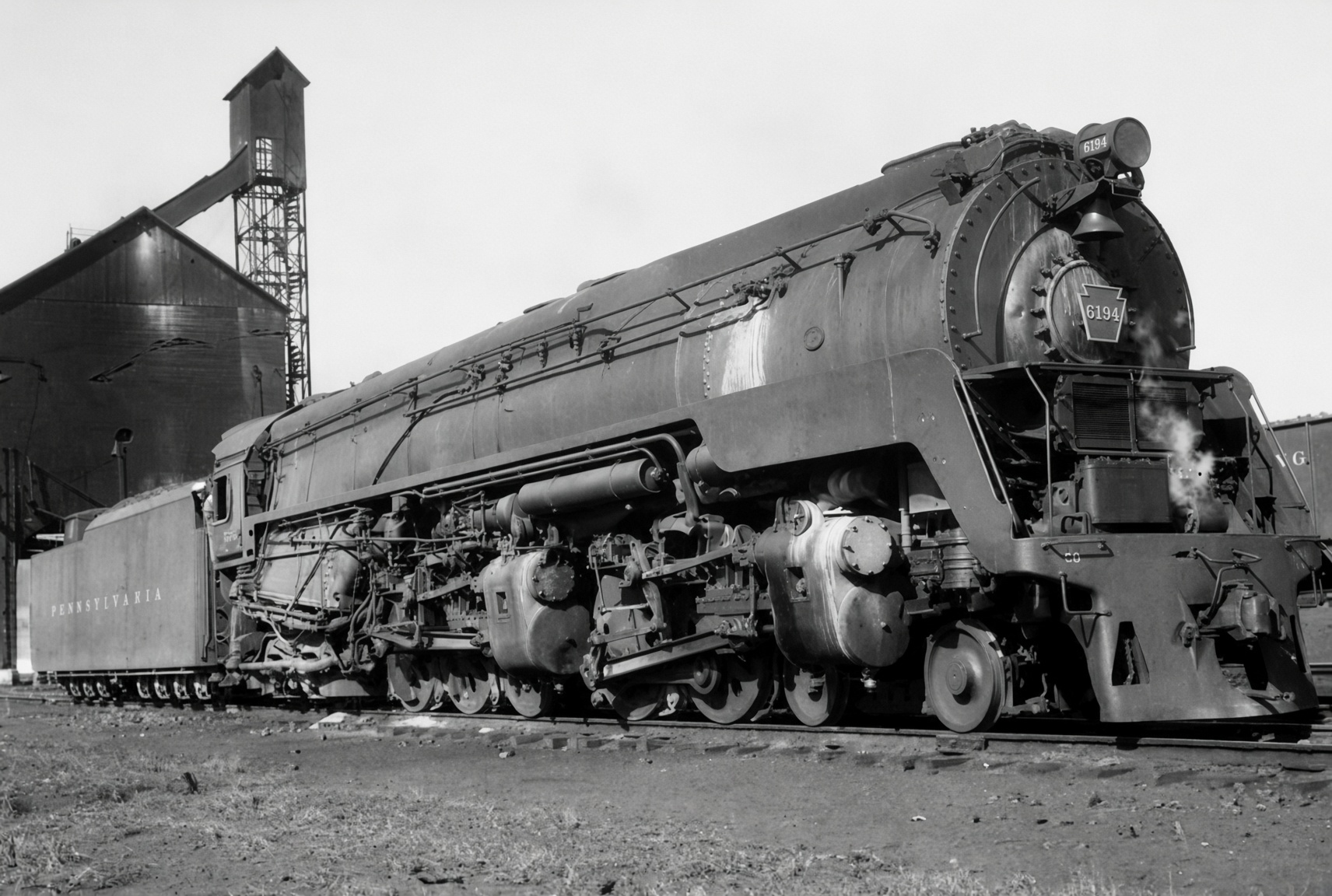
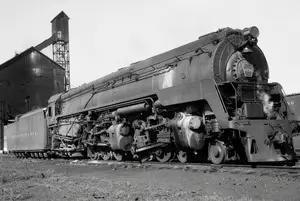
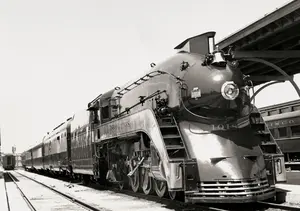
Pennsylvania Railroad Q2 6194 at Crestline, Ohio, in July 1947. Number 6194 is one of the twenty-five production 4-4-6-4s, 6175–6199, built at Altoona in 1945. Photographer unknown.
On this page: At a glance · A freight duplex · Two engines, one frame · The 1948 form · Tender 180 F 84 · Twenty-six engines · 7,987 indicated horsepower · Crestline and the lines west · Heavier than a J1
At a glance
| Item | Detail |
|---|---|
| Railroad | Pennsylvania Railroad. Class Q2. On a Pennsylvania class an s means superheat. The 1948 form’s letter for these engines is Q2 |
| Whyte | 4-4-6-4 duplex. Two engines on one rigid frame. Both sets of drivers faced forward |
| Builder | Juniata shops, Altoona. Twenty-six engines, all on the Pennsylvania’s own account |
| Numbers | Prototype 6131, 1944. Production 6175–6199, twenty-five engines, 1945 |
| In service | 6131, August 28, 1944, Western Region. 6175, January 18, 1945. 6199 left Altoona Works on June 27, 1945 |
| Cylinders | Front engine 19¾ × 28 in, two driving axles. Rear engine 23¾ × 29 in, three driving axles. Walschaerts gear. Piston valves 12 in and 14 in |
| Drivers | 69 in. Leading wheels 36 in. Trailing wheels 44 in |
| Boiler | 300 psi. Belpaire firebox |
| Tractive effort | 100,800 lb, plus a 15,000-lb booster. Total 115,800 lb. Factor of adhesion 3.90 |
| Weight | On drivers, 393,000 lb. Engine, working order, 619,100 lb. Empty, 558,100 lb |
| Tender | Class 180 F 84. Water 19,200 gallons. Coal 75,000 lb (37½ tons). Loaded, 422,000 lb |
| Engine and tender | 1,041,100 lb, the working-order engine plus the loaded tender |
| Test | 6175, Altoona test plant, February 1945: 7,987 indicated horsepower. The last locomotive tested there |
| Retired | 6131 in 1952. 6175–6199 in 1953–1956. All scrapped. Every Q2 was retired before any J1 |
Card dimensions are Pennsylvania Railroad Form 109-J, May 15, 1948, the Q2 column, and tender class 180 F 84 in the same book. Service dates are Christopher T. Baer’s Pennsylvania Railroad chronology, April 2015 edition. Retirement years follow George H. Drury, Guide to North American Steam Locomotives. Information compiled October 2, 2026.
A freight duplex
A duplex puts two engines on one rigid frame. Each engine has its own cylinders, its own rods, and its own set of drivers. There is no hinge between them, so the locomotive is a single wheelbase from the front truck to the trailing truck. The Pennsylvania wanted that arrangement for a freight engine that could use four cylinders, keep each rod assembly shorter than the machinery of a ten-coupled engine, and still put a very large boiler over five driving axles.
The first try was class Q1, engine 6130, a 4-6-4-4 outshopped at Juniata in May 1942. One set of drivers was turned around under the firebox, and the rear cylinders sat beside the ashpan. The Q1 was not repeated. It lasted on the roster until 1952, the same year as the Q2 prototype, and it remained one engine.
The War Production Board had frozen new designs, so the Pennsylvania’s wartime 2-10-4 was a borrowed Chesapeake & Ohio engine rather than a new Altoona design. Those were the J1s: 125 engines built at Altoona in 1942–44, one hundred of them numbered 6401–6500 and twenty-five numbered 6150–6174. The railroad then canceled an order to Lima for twenty-five more 2-10-4s. On March 27, 1944, the Board approved twenty-five Q2s at Juniata in their place. The production numbers, 6175–6199, begin at the next number after that J1 block.
The prototype took the number after the Q1. Number 6131 was placed in service on the Western Region on August 28, 1944, with simplified Loewy streamlining. Baer’s chronology calls it, on that day, the largest non-articulated locomotive in the world. Both sets of drivers faced forward. That was the correction of the Q1.
Two engines, one frame
The front engine has two driving axles and the smaller cylinders, 19¾ by 28 inches. The rear engine has three driving axles and the larger cylinders, 23¾ by 29 inches. Both pairs of cylinders sit ahead of the drivers they turn. Valve gear is Walschaerts, with piston valves of 12 inches and 14 inches, listed on the form in that order with the two cylinder sizes. These are piston valves. The passenger duplex, the T1, was the poppet-valve engine. A new T1, number 5550, is the one now being built.
The boiler is pressed to 300 pounds. The firebox is Belpaire: a flat wrapper, parallel to the inner sheets, with straight staybolts that meet both sheets at a right angle. The J1 beside it on the same 1948 form has a radial-stay wide firebox, the crown the borrowed Chesapeake & Ohio design brought with it. The Q2 went back to the Pennsylvania firebox. The grate is still the large one, 121.71 square feet, 108 3/16 by 162 inches, within a fraction of the J1’s grate.
Five driving axles carry 393,000 pounds. The factor of adhesion printed for the main engine is 3.90. That is a low figure for an engine asked to start a heavy freight train, and it is the mechanical side of the slip problem. Two engines on one frame can lose their feet one at a time. The first production engine made the point immediately. Baer’s entry for January 18, 1945, the day 6175 was placed in service, says the production engines proved slippery and consumed excessive water. They were assigned, at delivery, to the Eastern Division of the Central Region. The prototype had gone to the Western Region.
The 1948 form
Form 109-J, issued at Philadelphia on May 15, 1948, over the name of H. T. Cover, Chief of Motive Power, cards the Q2 in one column. The figures below are that column. They cover the class as the railroad listed it in 1948, prototype and production engines together. The 12.59 square feet on the fire-area line are the fire area. The grate is the 121.71.
| Specification | Form 109-J, May 15, 1948 |
|---|---|
| Class / Whyte | Q2. 4-4-6-4 |
| Wheel diameters | 36 in leading, 69 in drivers, 44 in trailing |
| Cylinders | 19¾ × 28 in and 23¾ × 29 in |
| Valves | Walschaerts. Piston valves 12 in and 14 in. Travel 8 in. Lap 1 11/16 in and 1¾ in. Steam ports 2¼ in wide |
| Cylinder spread | 92 in and 95½ in |
| Journals | Engine truck 8¼ × 6 13/32 in. Drivers 13 × 13⅜ in. Trailer truck 8 × 11 in |
| Driver wheelbase | 26 ft 4½ in |
| Engine wheelbase | 53 ft 5½ in |
| Engine and tender wheelbase | 107 ft 7½ in |
| Deck-plate height | 85 in. Bottom of the drawbar pocket, 37¾ in |
| Boiler | 300 psi. Belpaire. Minimum internal diameter 95 15/16 in |
| Tubes and flues | 51 tubes, 2¼ in. 277 flues, 3½ in. Length between sheets 250 11/16 in |
| Superheater units | 554, at 1 3/16 in, two units to each flue |
| Heating surface | Flues 6,000 sq ft. Firebox 725. Superheater 2,720. Total 9,445 sq ft |
| Fire area / grate | Fire area 12.59 sq ft. Grate 108 3/16 × 162 in, 121.71 sq ft |
| Weight on engine truck | 96,050 lb |
| Weight on drivers | 78,810; 79,780; 77,450; 78,280; 78,680. Total 393,000 lb |
| Weight on trailer truck | 130,050 lb |
| Engine, working order | 619,100 lb. Empty, 558,100 lb |
| Tractive effort | Main engine 100,800 lb. Booster 15,000. Total 115,800 lb |
| Factor of adhesion | 3.90 |
| Tender class | 180 F 84 |
The five driver weights add to the 393,000 pounds the form prints for all drivers, and those three groups of weight, 96,050, 393,000, and 130,050, add to the 619,100. Flues, firebox, and superheater add to 9,445. The 6,725 square feet sometimes quoted as evaporative surface are the flues and the firebox without the superheater.
Tender 180 F 84
The locomotive sheet names tender class 180 F 84. On the tender pages of the same book that class is the last column of the upper table. It is a different tender from the 180 P 84 in the lower table, which carries more coal and weighs more. The Q2’s tender is the F.
| Tender 180 F 84 | Form 109-J |
|---|---|
| Water | 19,200 gallons |
| Coal | 75,000 lb, which is 37½ short tons |
| Frame | Cast steel, tank bottom. Width 10 ft 0 in. Frame length 53 ft 11¼ in |
| Trucks | Two, class 4F5T1, cast steel. Wheels 36 in. Truck wheelbase 13 ft 9 in. Journals 6½ × 12 in |
| Length over the tender | 55 ft 7⅜ in |
| Tender wheelbase | 39 ft 0 in. Truck centers 25 ft 3 in |
| Empty / loaded | 187,000 lb / 422,000 lb |
Class 4F5T1 is two four-axle trucks, and each truck’s wheelbase is 13 feet 9 inches. Engine and tender together, 619,100 pounds plus the loaded tender, come to 1,041,100 pounds. That figure is the sum of the two lines. The form prints the two weights and leaves the addition to the reader. The engine-and-tender wheelbase on the locomotive sheet is 107 feet 7½ inches. On February 23, 1944, a 110-foot turntable replaced a 100-foot table at Conway so the duplexes could be turned.
Twenty-six engines
| No. | Built | In service | Retired | Notes |
|---|---|---|---|---|
| 6131 | Juniata, 1944 | August 28, 1944 | 1952 | Prototype. Western Region. Simplified Loewy streamlining. Both driver-sets faced forward. Scrapped |
| 6175–6199 | Juniata, 1945 | 6175 on January 18, 1945. 6199 left Altoona Works on June 27, 1945 | 1953–1956 | Twenty-five engines, in place of twenty-five further J1s. At delivery, the Eastern Division of the Central Region. All retired before any J1. Scrapped |
Locobase 350’s compilation of Juniata works numbers gives 4527 to 6131 and 4535–4559 to 6175–6199. That is twenty-six numbers. The class count on the steam roster is the same twenty-six: one prototype and twenty-five production engines. None was preserved.
7,987 indicated horsepower
In February 1945 number 6175 was put on the Altoona test plant. Baer records an indicated output of 7,987 horsepower, a record for that plant, and he records that 6175 was the last locomotive tested there. His own note on the line is that another account, Hirsimaki’s, dates the test to April 1946. The horsepower figure is the February entry. It belongs to 6175, the first production engine, the same engine that had gone into service on January 18.
The boiler that made that horsepower was also drawn for an engine that was never built. On June 22, 1944, the mechanical department’s proposal for an experimental class V1 turbine specified the same boiler as the Q2, with the power to come from turbines rather than from the four cylinders. The V1 stayed a design. In 1948 Baer’s chronology records that the railroad canceled further steam development, the V1 included, and ordered full dieselization.
Crestline and the lines west
The photograph shows where a production engine could be found two years after the test. Number 6194 is at Crestline, Ohio, in July 1947, under the coaling tower, with the machinery of both engines out in the open. Crestline sits on the line from Pittsburgh toward Chicago. It was one of four terminals the boards named for the class in 1948.
On January 28, 1948, the Pennsylvania board authorized extending eleven stalls at the Crestline roundhouse, six stalls at Fort Wayne, and all of the stalls at 55th Street in Chicago. On February 25 the Pittsburgh, Fort Wayne & Chicago board approved eleven stalls at Crestline, eleven at 55th Street, and six at Fort Wayne. On December 8, 1948, the Pittsburgh, Cincinnati, Chicago & St. Louis board authorized extending forty stalls and thirty-five outside tracks at the St. Clair roundhouse in Columbus. Baer’s chronology records those authorizations. Richard Leonard’s captions put 6175 in Chicago on December 1, 1948, and 6180 at Englewood, in Chicago, the same year.
The career on the road was short even so. Leonard’s note on 6180 is that by 1949 most of the Q2s were in storage, their work taken by conventional steam that diesels had released from other assignments. Storage and roster removal are two dates. The steam roster’s retirement years, from Drury, are 1952 for 6131 and 1953–1956 for 6175–6199.
Heavier than a J1
The engine the Q2 was built against is on the same 1948 form. A J1 2-10-4, in the three columns for the bar-frame engine, the cast-bed engine, and the J1a, weighs 572,640 to 574,730 pounds in working order. Its cylinders are 29 by 34 inches, its boiler is at 270 pounds, its valve gear is Baker, and its main-engine tractive effort is 93,750 pounds, plus the same 15,000-pound booster. The Q2 at 619,100 pounds is 44,370 to 46,460 pounds heavier than those three columns, and 7,050 pounds stronger before the booster is counted. Drury’s rounded contrast, the sentence on the steam roster, is the one to remember with the class: about 40,000 pounds heavier than a J1, and about 5,000 pounds stronger in tractive effort. The form is the tighter measurement. His other point stands beside either pair of numbers. They were also more complicated.
The J1s outlasted them. The 2-10-4s were retired in 1957–59. Every Q2 was off the roster before any J1. The Pennsylvania’s last steam ran officially on November 30, 1957, behind engines of older and simpler classes. The twenty-six duplexes had already gone to scrap. What the railroad kept is on the steam roster.
Sources
- Pennsylvania Railroad. Form 109-J, Classification and Description of Locomotives and Tenders. H. T. Cover, Chief of Motive Power. Philadelphia, May 15, 1948. The Q2 column: wheel arrangement, cylinders, valves, boiler, heating surfaces, weights, tractive effort, factor of adhesion, and tender class 180 F 84. The same book’s J1 columns, for the weight and tractive-effort comparison, and the tender table for class 180 F 84: water, coal, trucks, length, and weights. The 180 P 84 column is a different tender.
- Baer, Christopher T. A General Chronology of the Pennsylvania Railroad Company. April 2015 edition. The 1944, 1945, and 1948 files: Board approval of twenty-five Q2s, March 27, 1944. Conway’s 110-foot turntable, February 23, 1944. The unbuilt V1 and the Q2 boiler, June 22, 1944. Number 6131 in service, August 28, 1944. Number 6175 in service, January 18, 1945, and the note that the production engines proved slippery and used too much water. The Altoona test of 6175, 7,987 indicated horsepower, February 1945, with Baer’s note that Hirsimaki dates it to April 1946. Number 6199 leaving Altoona Works, June 27, 1945. Roundhouse authorizations at Crestline, Fort Wayne, 55th Street in Chicago, and St. Clair in Columbus, 1948. Cancellation of further steam development, including the V1.
- Drury, George H. Guide to North American Steam Locomotives. Revised edition. Kalmbach, 2015. Pp. 267–271. The class grid used on this site’s Pennsylvania steam roster: 6131, built 1944, retired 1952, both driver-sets faced forward. 6175–6199, built at Altoona in 1945 in place of twenty-five further J1s, retired 1953–1956, all of them before any J1. The roster’s summary: about 40,000 pounds heavier than a J1, and about 5,000 pounds stronger in tractive effort.
- Llanso, Steve. Locobase 350, on steamlocomotive.com. Juniata works numbers 4527 for 6131 and 4535–4559 for 6175–6199.
- Leonard, Richard. Captions for Pennsylvania 6175 and 6180, railarchive.net. Number 6175 in Chicago, December 1, 1948, photographed by Charles E. Winters. Number 6180 at Englewood, Chicago, in 1948. By 1949, most of the class in storage. The cylinder arrangement in the 6175 caption, and the 619,100-pound engine weight, agree with Form 109-J.
Related pages: Pennsylvania Railroad · Pennsylvania steam roster · Duplex drive · Belpaire firebox · 2-10-4 type · T1 5550 · Steam locomotives
Recent Articles


-
Wyoming Scenic Train Rides (2026): A Complete Guide
Oct 03, 26 12:07 AM
 Wyoming has no full-size tourist railroad on the calendar in October 2026. Cheyenne Depot Museum and Douglas Railroad Museum are static. Union Pacific 4014’s posted public trip is a November run to De…
 -
Washington Scenic Train Rides (2026): A Complete Guide
Oct 02, 26 11:53 PM
 Washington tourist trains in 2026—Mount Rainier Scenic at Elbe, the Northwest Railway Museum, and Chehalis-Centralia. Lake Whatcom has no 2026 date on its ticket page.
 -
Wisconsin Scenic Train Rides (2026): A Complete Guide
Oct 02, 26 11:48 PM
 Wisconsin tourist trains in 2026—Wisconsin Great Northern, Osceola & St. Croix Valley, Mid-Continent, East Troy, and the National Railroad Museum.
 -
Pennsylvania Railroad Class Q2 4-4-6-4: Specs, Roster, History
Oct 02, 26 11:28 PM
 Pennsylvania Railroad Class Q2 4-4-6-4 duplexes. Twenty-six engines, 6131 and 6175–6199, Altoona 1944–45. Form 109-J specs, the 7,987 hp test of 6175, and a roster. All scrapped.
 -
Utah Scenic Train Rides (2026): A Complete Guide
Oct 02, 26 11:18 PM
 Utah tourist trains in 2026—Heber Valley Railroad from Heber City. Golden Spike at Promontory is a locomotive demonstration, not a line-haul ride.
 -
South Dakota Scenic Train Rides (2026): A Complete Guide
Oct 02, 26 11:06 PM
 South Dakota’s 2026 scenic train is the Black Hills Central 1880 Train, Hill City to Keystone. Steam is the summer assignment. Confirm the engine.
 -
Oregon Scenic Train Rides (2026): A Complete Guide
Oct 02, 26 11:04 PM
 Oregon tourist trains in 2026—Oregon Coast Scenic from Rockaway Beach, Mount Hood at Hood River, Eagle Cap from Elgin, and the Oregon Rail Heritage Center in Portland.
 -
Oklahoma Scenic Train Rides (2026): A Complete Guide
Oct 02, 26 10:36 PM
 Oklahoma has no full-size scenic railroad on an October 2026 calendar. Oklahoma Railway Museum Halloween and Polar trains, the El Reno trolley, and the Heartland Flyer.
 -
North Dakota Scenic Train Rides (2026): A Complete Guide
Oct 02, 26 01:14 PM
North Dakota has no tourist railroad on a 2026 calendar. Ride Amtrak’s daily Empire Builder. The Fort Lincoln Trolley in Mandan is not a current ticket. -
Nebraska Scenic Train Rides (2026): A Complete Guide
Oct 02, 26 10:11 AM
 Nebraska has no full-size scenic railroad in 2026. The Omaha Zoo Railroad runs weekends through October 4. Ride Amtrak’s California Zephyr across the state.
 -
Missouri Scenic Train Rides (2026): A Complete Guide
Oct 02, 26 09:56 AM
 Missouri tourist trains in 2026—Branson Scenic Railway and the St. Louis, Iron Mountain & Southern at Jackson. Belton has no 2026 schedule posted.
 -
Minnesota Scenic Train Rides (2026): A Complete Guide
Oct 02, 26 09:52 AM
 Minnesota tourist trains in 2026—North Shore Scenic Railroad in Duluth, the Duluth River Train, and the Como-Harriet streetcar.
 -
Kansas Scenic Train Rides (2026): A Complete Guide
Oct 02, 26 09:32 AM
 Kansas tourist trains in 2026—the Abilene & Smoky Valley Railroad. Santa Fe 3415 is in overhaul. Midland Railway at Baldwin City is closed.
 -
Iowa Scenic Train Rides (2026): A Complete Guide
Oct 02, 26 08:41 AM
 Iowa tourist trains in 2026—Boone & Scenic Valley across the Bass Point Creek High Bridge, and Midwest Central’s December North Pole trains
 -
Indiana Scenic Train Rides (2026): A Complete Guide
Oct 02, 26 08:35 AM
 Indiana tourist trains in 2026—French Lick Scenic Railway, Nickel Plate Express, Hoosier Valley, and Hesston. Whitewater Valley is suspended.
 -
Illinois Scenic Train Rides (2026): A Complete Guide
Oct 02, 26 12:28 AM
 Illinois tourist trains in 2026—Illinois Railway Museum, Monticello Railway Museum, Fox River Trolley, and Silver Creek & Stephenson.
 -
Texas Scenic Train Rides (2026): A Complete Guide
Oct 02, 26 12:14 AM
 Texas tourist trains in 2026—Texas State Railroad, Grapevine Vintage Railroad, Austin Steam Train's Hill Country Flyer, and the Galveston Railroad Museum.
 -
Tennessee Scenic Train Rides (2026): A Complete Guide
Oct 02, 26 12:03 AM
Tennessee tourist trains in 2026—Tennessee Valley Railroad Museum, Dollywood Express, Three Rivers Rambler Christmas trains, and the Tennessee Central Railway Museum. -
South Carolina Scenic Train Rides (2026): A Complete Guide
Oct 01, 26 11:52 PM
 South Carolina's tourist train is the South Carolina Railroad Museum in Winnsboro—Blue Granite Express, pumpkin trains, and Santa trains on the old Rockton & Rion.
 -
Mississippi Scenic Train Rides (2026): A Complete Guide
Oct 01, 26 11:38 PM
 Mississippi has no regular tourist railroad in 2026. Ride Amtrak through the state, or book the excursion lines in Alabama, Tennessee, Louisiana, or Arkansas.
 -
Louisiana Scenic Train Rides (2026): A Complete Guide
Oct 01, 26 02:52 PM
 Louisiana has no regular full-size tourist railroad in 2026. New Orleans Polar Express returns December 11–31. Museums at Long Leaf, DeQuincy, and Jackson.
 -
Kentucky Scenic Train Rides (2026): A Complete Guide
Oct 01, 26 02:45 PM
 Kentucky tourist trains in 2026—Big South Fork Scenic Railway, Bluegrass Scenic Railroad, Kentucky Railway Museum, and My Old Kentucky Dinner Train.
 -
Georgia Scenic Train Rides (2026): A Complete Guide
Oct 01, 26 02:27 PM
 Georgia tourist trains in 2026—Blue Ridge Scenic Railway, SAM Shortline, Azalea Sprinter, Savannah shop rides, and what to confirm at Stone Mountain.
 -
Arkansas Scenic Train Rides (2026): A Complete Guide
Oct 01, 26 01:02 PM
 Arkansas tourist trains in 2026—Arkansas & Missouri through the Boston Mountains, and the Eureka Springs & North Arkansas dinner and excursion trains.
 -
Alabama Scenic Train Rides (2026): A Complete Guide
Oct 01, 26 12:59 PM
Alabama tourist trains in 2026—Heart of Dixie Railroad Museum at Calera, North Alabama Railroad Museum at Chase, and the Wales West Light Railway at Silverhill. -
The Circus Train: How Such Attractions Reached Distant Cities
Oct 01, 26 12:22 PM
 How circuses moved by rail: Coup's 1872 flats, the Ringling train's sections and car counts, the 1918 Hammond wreck, and the last show on May 21, 2017.
 -
West Virginia Halloween Train Rides (2026)
Oct 01, 26 12:19 PM
 2026 West Virginia Halloween train. Cass Scenic Halloween Train, October 30 and 31, steam, 5:00 p.m. from Cass Depot. Adult $75. About two hours to Whittaker. Family ride.
 -
Wisconsin Halloween Train Rides (2026)
Oct 01, 26 12:11 PM
2026 Wisconsin Halloween trains. Mid-Continent Pumpkin Special October 24–25, adult $24, pumpkins extra. Halloween Flyer October 24 at 4:30 p.m., adult $30. Osceola Pumpkin Express boards in Osceola… -
Utah Halloween Train Rides (2026)
Oct 01, 26 12:00 PM
 2026 Utah Halloween trains at Heber Valley Railroad. Pumpkin Train, about 40 minutes, with a cookie and a pumpkin. Halloween Express, about 90 minutes to Grim Hollow, Monday, Thursday, and Friday even…
 -
Texas Halloween Train Rides (2026)
Oct 01, 26 11:28 AM
 2026 Texas Halloween train. Texas State Railroad Spooky Special, adult-only, October 24. Boards Palestine at 5:00 p.m. About five hours to Rusk and back. Dinner on the grounds. Not steam. No fare on t…
 -
Tennessee Halloween Train Rides (2026)
Oct 01, 26 12:15 AM
 2026 Tennessee Halloween trains. Tennessee Valley Railroad Museum Rails, Wizards & Spells, selected days September 18 through October 25, from $35, about 2.5 hours. Spells & Potions tea from $60. The…
 -
Frisco's "Firefly" (Train): Consist, Route, Timetable
Sep 30, 26 11:37 PM
 Frisco Firefly—daylight streamliner, Kansas City to Tulsa and Oklahoma City. Trains 117 and 118. Pacifics 1018, 1026, and 1031. Last run May 22, 1960.
 -
South Carolina Halloween Train Rides (2026)
Sep 30, 26 11:29 PM
 2026 South Carolina Halloween train. South Carolina Railroad Museum Pumpkin Patch Express, the two Saturdays before Halloween. About three miles to the Greenbriar pavilion. Pumpkin for children 12 and…
 -
Oregon Halloween Train Rides (2026)
Sep 30, 26 08:10 PM
2026 Oregon Halloween train. Sumpter Valley Railroad Halloween Express at the Sumpter Depot, calendar window October 31 at 11:00 a.m. through November 1 at 12:30 p.m. Fare and the individual clocks ar… -
Oklahoma Halloween Train Rides (2026)
Sep 30, 26 03:45 PM
2026 Oklahoma Halloween train. Oklahoma Railway Museum, October 30 and 31, from Oakwood Station in Oklahoma City. Adults $15, children 3–12 $8. A candy bag with the ride. -
McCloud River Railroad: Serving The Timber Industry (1897-2009)
Sep 30, 26 03:37 PM
 McCloud River Railroad—Mount Shasta City to McCloud, Hambone, and Burney. Opened August 1, 1897. Alco No. 25 and EMD SD38s. Dinner train through January 2010. Railbikes in 2026; a dinner train is stil…
 -
Nevada Halloween Train Rides (2026)
Sep 30, 26 03:30 PM
2026 Nevada Halloween trains in Ely. Nevada Northern Pumpkin Patch Caper and Haunted Ghost Train. Adult tickets start at $45. Dates are on the railroad’s ticket calendar. Boulder City stays off until… -
Missouri Halloween Train Rides (2026)
Sep 30, 26 11:12 AM
 2026 Missouri Halloween trains. St. Louis Iron Mountain & Southern Pumpkin Patch Train on October 3, 4, 10, and 11, and Halloween Express on October 31 at 1:00 p.m. Jackson depot. No fare on the sched…
 -
Minnesota Halloween Train Rides (2026)
Sep 30, 26 11:06 AM
 2026 Minnesota Halloween trains. North Shore Scenic Great Pumpkin Train in Duluth, October 15–18. Everyone gets a pumpkin. Terror Train is October 30, an adult costume party, about three hours. Fares…
 -
Maryland Halloween Train Rides (2026)
Sep 30, 26 10:42 AM
 2026 Maryland Halloween trains. Western Maryland Scenic Pumpkin Patch Limited, October 17, 18, 24, and 25, $14. Colesville Trolleyween October 24, 25, and 31.
 -
West Side Lumber Company Railroad: Roster, History, Lines
Sep 30, 26 09:45 AM
 West Side Lumber at Tuolumne, California. Three-foot Shay and Heisler logging railroad. Lima shop numbers, builder specs, and where the engines are in 2026.
 -
Kansas Halloween Train Rides (2026)
Sep 30, 26 09:41 AM
 2026 Kansas Halloween train. Abilene & Smoky Valley Pumpkin Harvest Express, October 17 through 31. About one hour. Shop prices $35.56 to $41.02. Everyone picks a pumpkin.
 -
Iowa Halloween Train Rides (2026)
Sep 29, 26 11:58 PM
2026 Iowa Halloween train. Boone & Scenic Valley Pumpkin Express, October 10, 10:00 a.m. from 225 10th Street. About 1 hour 15 minutes. Children pick a pumpkin. -
Arizona Halloween Train Rides (2026)
Sep 29, 26 11:43 PM
 2026 Arizona Halloween train. Grand Canyon Railway Pumpkin Patch Train from Williams, $39 with a pumpkin included. Select October dates on the ticket calendar. Haunted train cars are optional.
 -
Nevada Northern Halloween Trains (2026)
Sep 29, 26 06:18 PM
Nevada Northern 2026 Halloween trains in Ely. Pumpkin Patch Caper to Keystone Gulch and the Haunted Ghost Train. Adult tickets start at $45. Dates are on the railroad’s calendar. Confirm on nnry.com. -
Grand Canyon Railway Pumpkin Patch Train (2026)
Sep 29, 26 02:42 PM
Grand Canyon Railway Pumpkin Patch Train—select October 2026 dates from Williams, $39 with a pumpkin included. Haunted train cars are optional. Days are on the ticket calendar. Confirm on thetrain.com… -
Cass Scenic Railroad Halloween Trains (2026)
Sep 29, 26 02:37 PM
 Cass Scenic Halloween Trains—October 30 and 31, 2026, steam, 5:00 p.m. from Cass Depot. About two hours to Whittaker. Adult $75. Candy for every child. Confirm on mountainrailwv.com.
 -
Halloween Train Rides (2026): Pumpkin Patch, Haunted & Spooky Trips
Sep 29, 26 11:26 AM
 2026 Halloween train rides in nine checked states. Conway Scenic Halloween Express October 24–25. Strasburg’s three fall tickets. Great Smoky Mountains Railroad’s October trains are the gorge and rive…
 -
Maine Halloween Train Rides (2026)
Sep 29, 26 11:08 AM
 2026 Maine Halloween trains. Seashore Pumpkin Patch Trolley through October 18, adult $17. Happy Trolleyween October 23–25 at $15. WW&F Pumpkin Pickin’ October 3, 12, 17, and 24. Downeast’s booking it…
 -
Kentucky Halloween Train Rides (2026)
Sep 29, 26 10:58 AM
 2026 Kentucky Halloween trains. Kentucky Railway Museum Trick and Track Express, October 24 and 31, from $17. Bluegrass Scenic pumpkin trains in Versailles. Confirm on the ticket shop.