
Santa Fe Railroad: Map, Logo, History, Rosters
Last revised: October 13, 2024
By: Adam Burns
There were railroads and then there was the Santa Fe. At one time the Atchison, Topeka and Santa Fe Railway was the world's most famous transportation company. In 1948 Fortune magazine named it the Nation's Number One Railroad.
The Santa Fe was the vision of Colonel Cyrus K. Holliday and brought to life through the relentless efforts of William Barstow Strong.
This railroader is often overshadowed by names like Gould, Harriman, Huntington, and Vanderbilt but his unyielding work established the only transcontinental route from Chicago to Southern California.
The AT&SF would retain this status until UP grabbed the Missouri Pacific in 1982. Only once did it experience financial trouble when 1893's financial panic and Strong's aggressive expansion program left the company monetarily overextended.
This setback proved short-lived after which time it enjoyed bountiful success. It even weathered the Great Depression without considerable difficulty.
The Santa Fe attained stardom by introducing the acclaimed Super Chief during the Art Deco era, a streamliner which not only offered first-class accommodations but also paid tribute to the Southwest's Native American tribes.
Photos
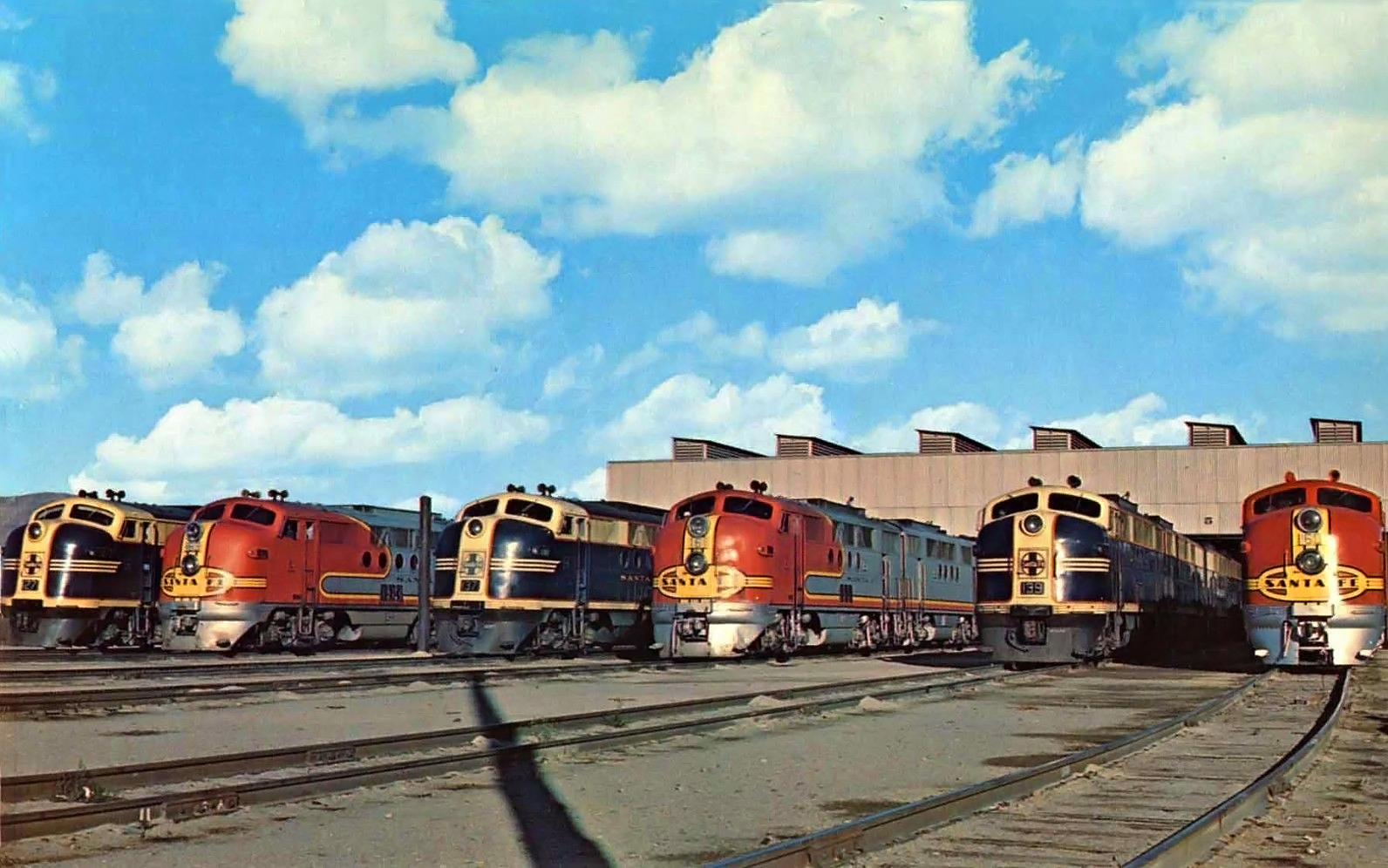 A Santa Fe company photo featuring a beautiful lineup of FT's sitting outside the shops at Barstow, California, circa 1948. American-Rails.com collection.
History
After 137 years of phenomenal prosperity, the AT&SF joined Burlington Northern in 1996 to create the Burlington Northern & Santa Fe Railway. Today, BNSF Railway grosses more than $20 billion annually, ranking it behind only Union Pacific as the country's most powerful railroad.
Long before it became an icon the Santa Fe was nothing more than the dream of Cyrus Holliday. He envisioned a railroad from what was then the Territory of Kansas to the west coast with a branch reaching the Gulf of Mexico.
The colonel believed such a venture would yield strong profits thanks to plentiful trade found along the famous Santa Fe Trail and the Gulf's deepwater ports. Such grand endeavors, of course, bring a healthy dose of skepticism and almost no one believed in Holliday's idea.
At A Glance
13,231 (1930) 13,074 (1950) 9,126 (1995) |
|
Chicago - Kansas City - La Junta, Colorado - Los Angeles Emporia, Kansas - Oklahoma City - Fort Worth - Houston Emporia, Kansas - Dalies, New Mexico Barstow - Richmond, California Temple - Farwell, Texas Denver - La Junta, Colorado Albuquerque, New Mexico - El Paso, Texas Dallas - Presidio, Texas Kansas City - Tulsa |
|
Freight Cars: 84,439 Passenger Cars: 1,235 | |
At the time there was no reason to question this sentiment since the territory had yet to achieve statehood, few settlers could be found west of the Mississippi River, and even fewer railroads served the Great Plains. However, as Holliday correctly foresaw, if the iron horse arrived a great wave of immigrants would follow.
In addition, the fertile lands and mild climate appeared ready-made for agricultural development. With an active role in politics, he sought the territory's inclusion into the Union (Kansas officially became the 34th state of the United States on January 29, 1861) while simultaneously promoting his railroad.
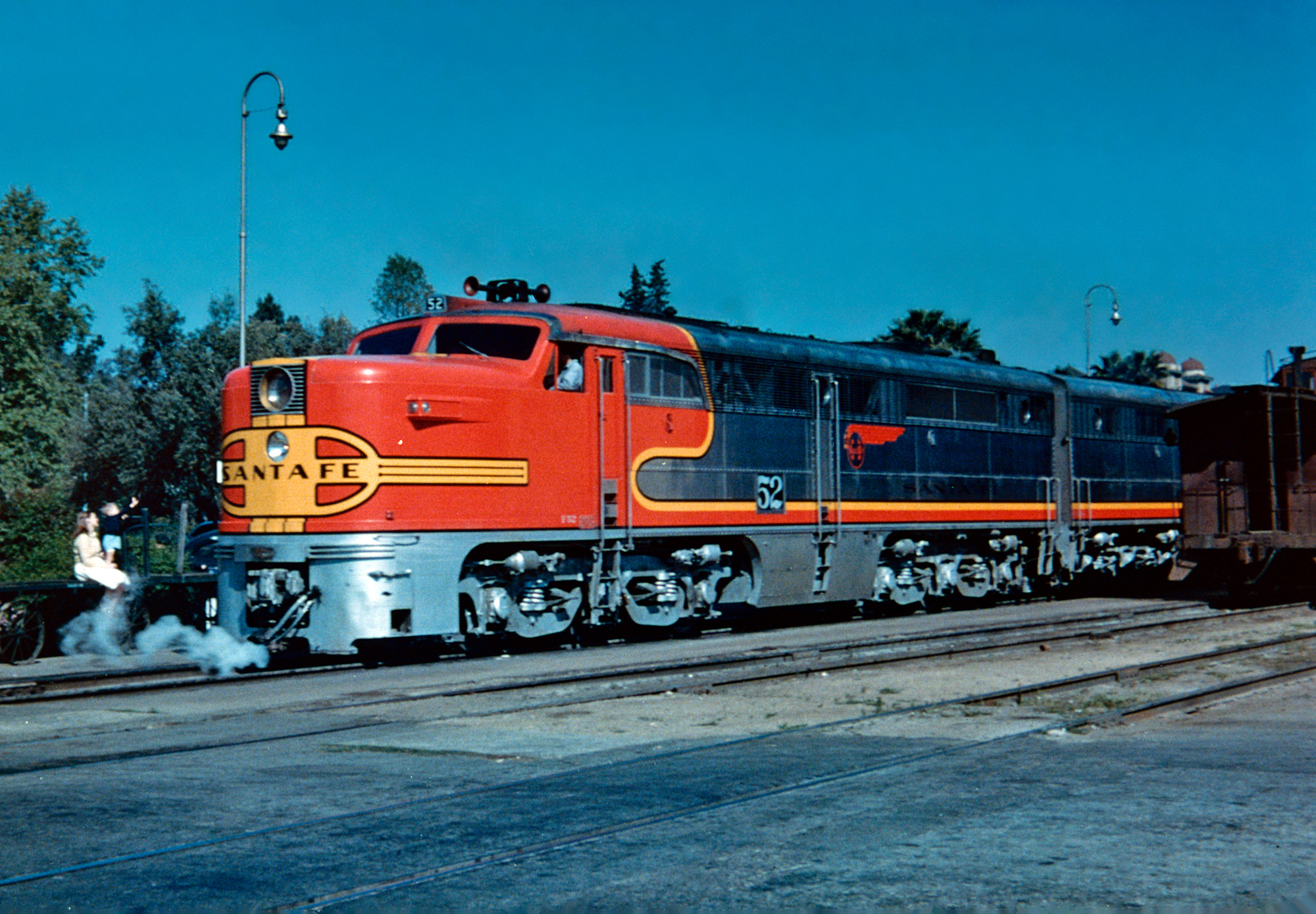 Santa Fe PA-1 #52-L arrives at Pasadena, California in March, 1947. Note the little tot waving to the train. Russ Cole photo. American-Rails.com collection.
Atchison & Topeka Railroad
According to Keith Bryant, Jr.'s excellent book, "History Of The Atchison, Topeka & Santa Fe Railway," Holliday wrote up a charter for the Atchison & Topeka Railroad (A&T) in a hotel room in Lawrence, Kansas Territory during January 30-31, 1859.
According to this document the system would connect its namesake towns, head in a southwesterly direction towards Santa Fe, and construct a branch to the Gulf.
The territory's legislative body introduced a bill on February 1st for the charter, which was signed into law by Governor Samuel Medary on February 11, 1859.
Due to a severe drought and the uncertainty of war between the states, efforts were delayed by more than a year. Finally, during the late summer of 1860 Holliday, and a few supporters, made their way to Atchison for the company's formal incorporation.
It was carried out at Luther Challis's small law office between September 15th and 17th with Holliday elected president, Peter J. Abell secretary, and Milton C. Dickey treasurer.
While the company was authorized to issue $1.5 million in stock, the promoters quickly realized the only chance of acquiring the needed capital was through land grants.
This was attained after a great deal of lobbying, along with the help of Samuel Clarke Pomeroy. The senator worked his political magic to have the A&T included within the amended Pacific Railroad Act of 1863.
When President Abraham Lincoln signed this legislation into law on March 3rd the A&T would receive "odd numbered sections of land for ten sections in width on each side of the track." There was a catch, however; it must be completed to the Colorado state line by March 3, 1873 or forfeit its rights to these grants.
Logo
Atchison, Topeka & Santa Fe Railroad
It was an incredible achievement and for Pomeroy's efforts he was elected president of the railroad on November 23, 1863.
This event coincided with the stockholders' vote to change the company's name to the Atchison, Topeka & Santa Fe Railroad since the prospect of actually reach all three towns now seemed very possible.
Over time, the public simply called it the "Santa Fe" while company officials, and those on Wall Street, referred to it as the "Atchison."
In 1867 Holliday was successful in drumming up local support within the counties of Shawnee, Atchison, Osage, and Lyons when they voted to approve bonds of between $150,000 and $200,000.
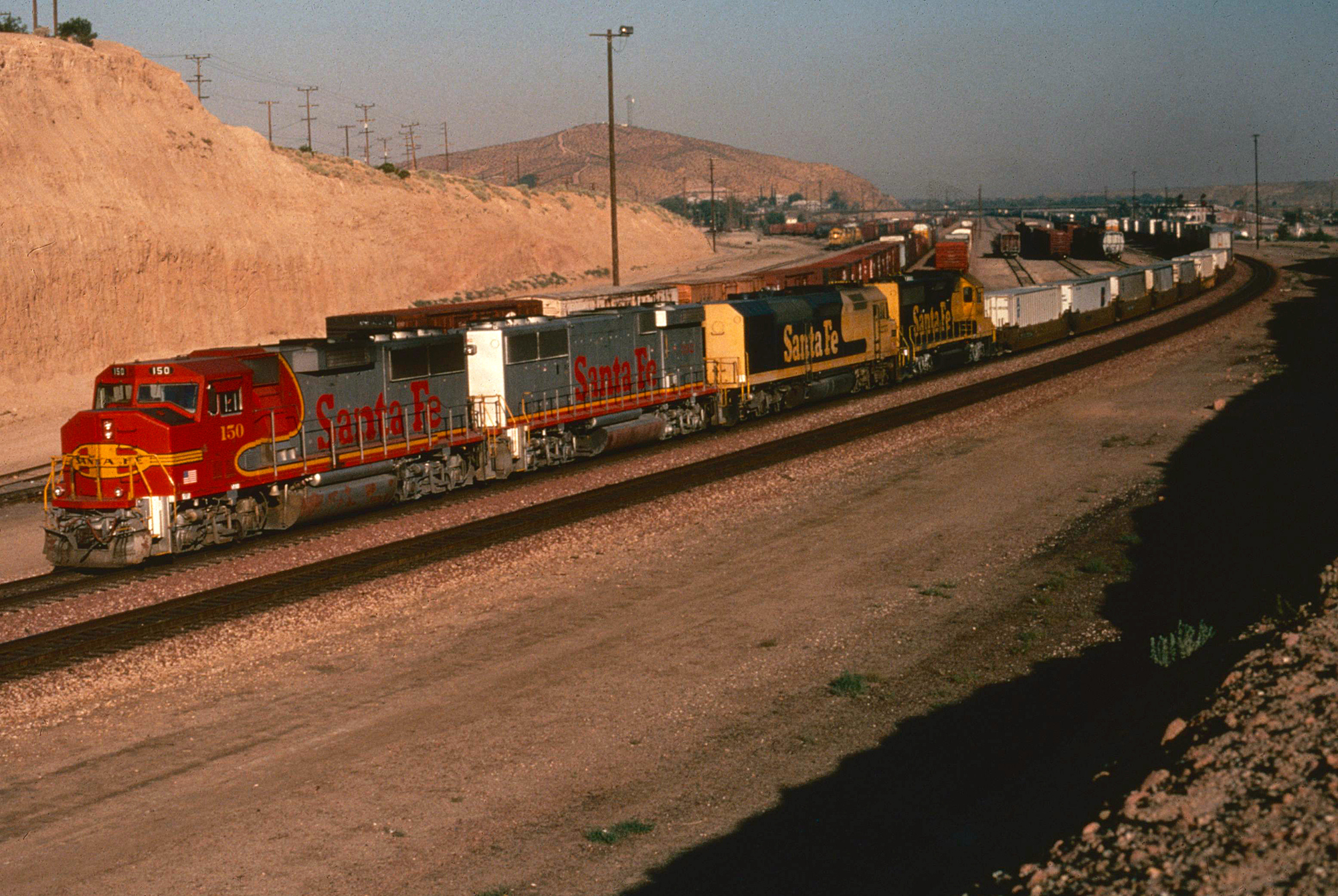 Santa Fe GP60M #150 leads containers eastbound out of Barstow, California on July 18, 1992. American-Rails.com collection.
While these monies and the 1863 act were both important, one less noteworthy event was the 1868 purchase of 338,766 acres from the Potawatomi Indian Reservation. Situated in northeastern Kansas, these lands proved vital in raising initial capital through land sales.
With this money in hand, Holliday and his growing consortium let construction contracts in 1867 and began surveying routes a year later. The task of building the railroad officially kicked off at a small ceremony in Topeka along Washington Street on October 30, 1868.
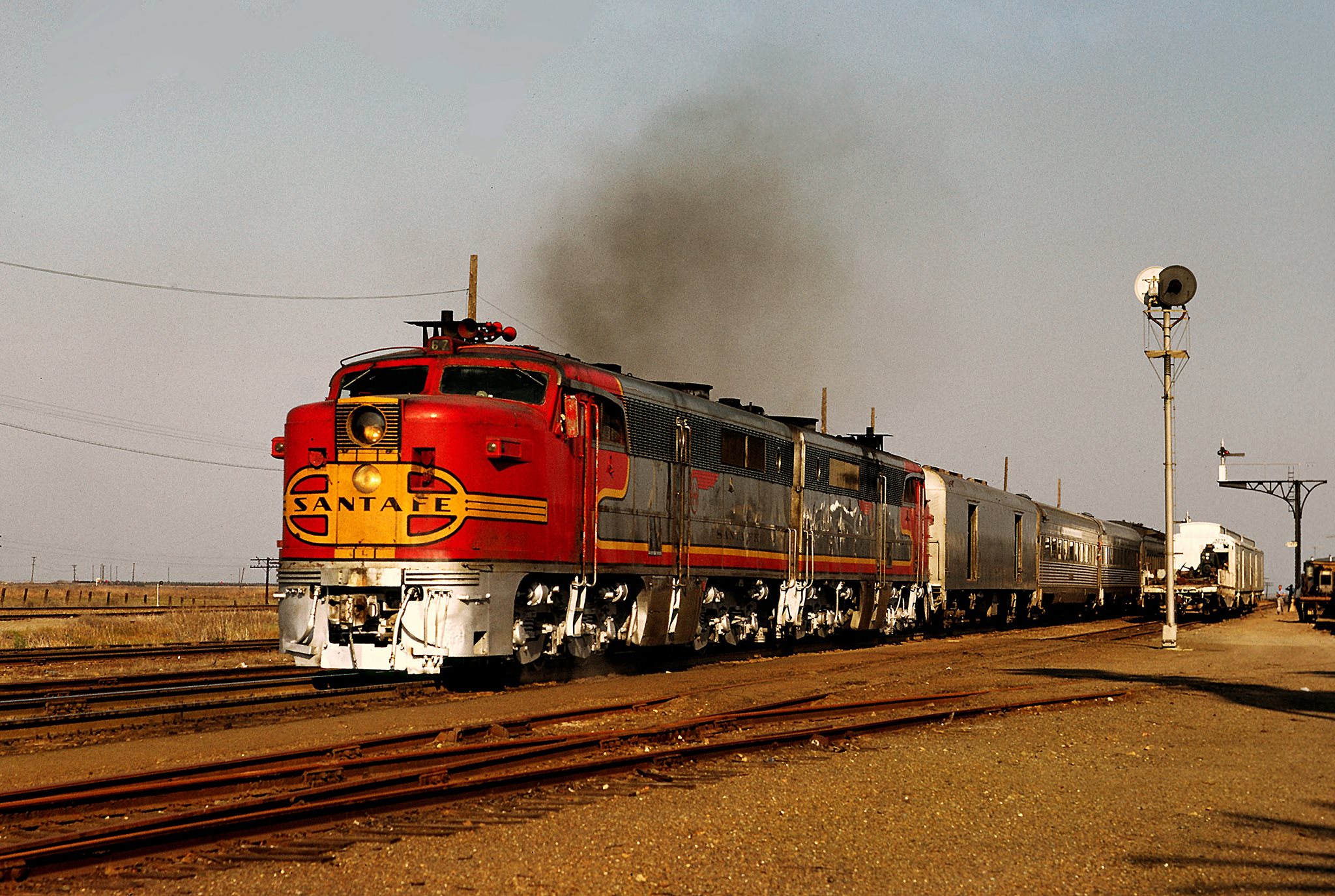 Santa Fe PAs lead their own farewell tour (Richmond - Stockton) as they travel westbound through Port Chicago, California during March of 1968. The trailing unit had died leaving lead unit #67-L to power the train back into Richmond. Drew Jacksich photo.
Right from the start good common sense was used to make the most of limited funds. The town of Atchison, situated along the Missouri River, was originally projected as the initial construction point.
However, that was temporarily changed to Topeka since that town would provide for an important connection with the Kansas Pacific Railway (KP), already in operation between that point and Kansas City.
The interchange would also allow for easy transfer of rails, ties, and other materials to construction crews in the field.
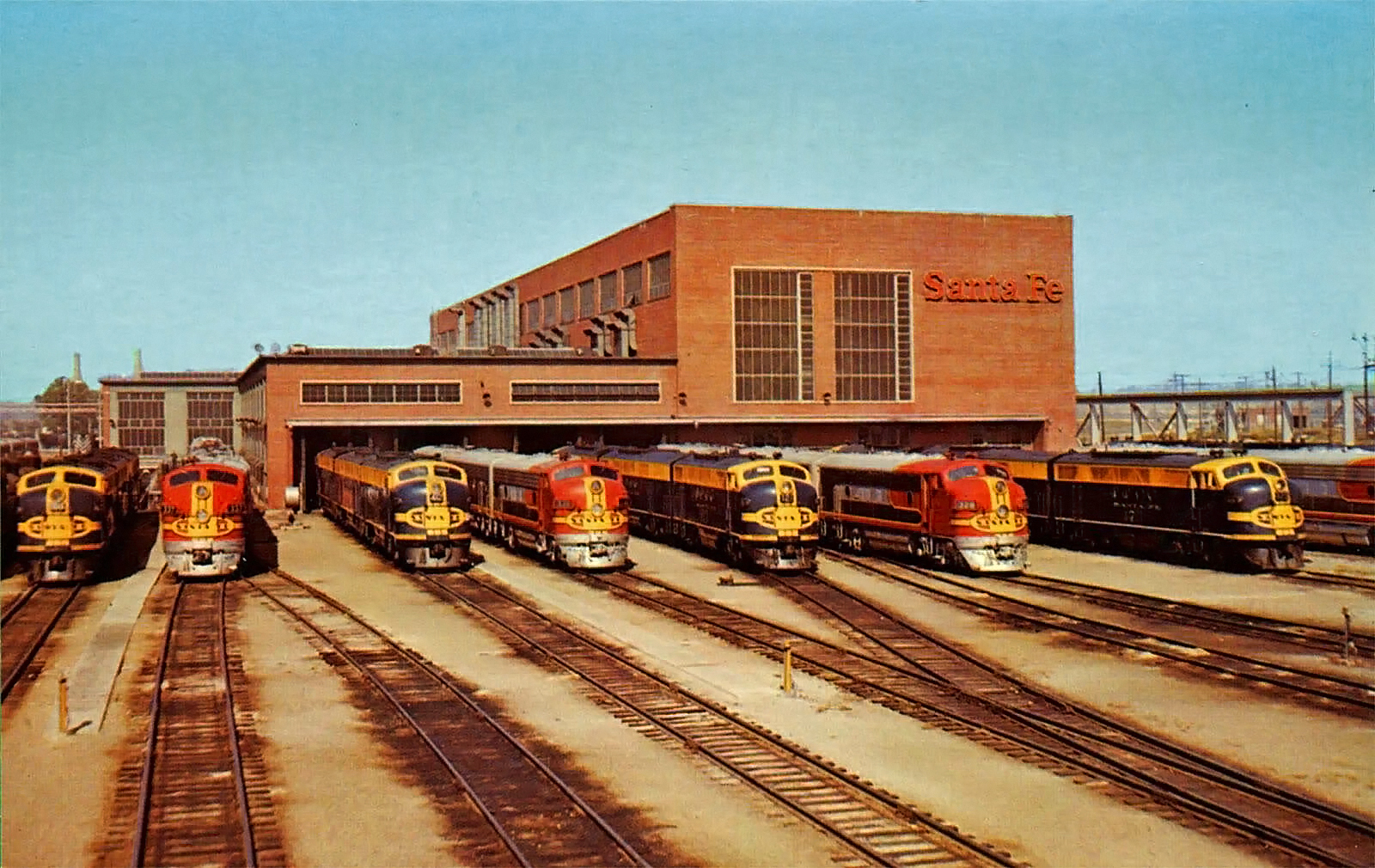 A classic view of the Santa Fe's Argentine Shops (Kansas), likely from the mid-1950s, featuring venerable FTs, F3s, and F7s wearing both the passenger "Warbonnet" livery and blue-and-yellow freight scheme.
Beyond Topeka, officials sought a southern terminus at nearby Carbondale where coal was discovered. The initial construction involved completing a bridge over the Kansas River (also known as the Kaw River) to reach the KP.
Following its opening (March 30, 1869) work continued southward as service commenced into Carbondale by July 1st. With crews nearing Emporia by year's end Holliday also tried to reach Atchison, thus completing the railroad's charter. Unfortunately, funds were exhausted and it appeared the entire project might stall.
Then, a watershed moment occurred in the young company's history. With few options left, officials contracted with the brokerage house Kidder, Peabody & Company of Boston to sell securities, which resulted in wealthy Bostonians acquiring control.
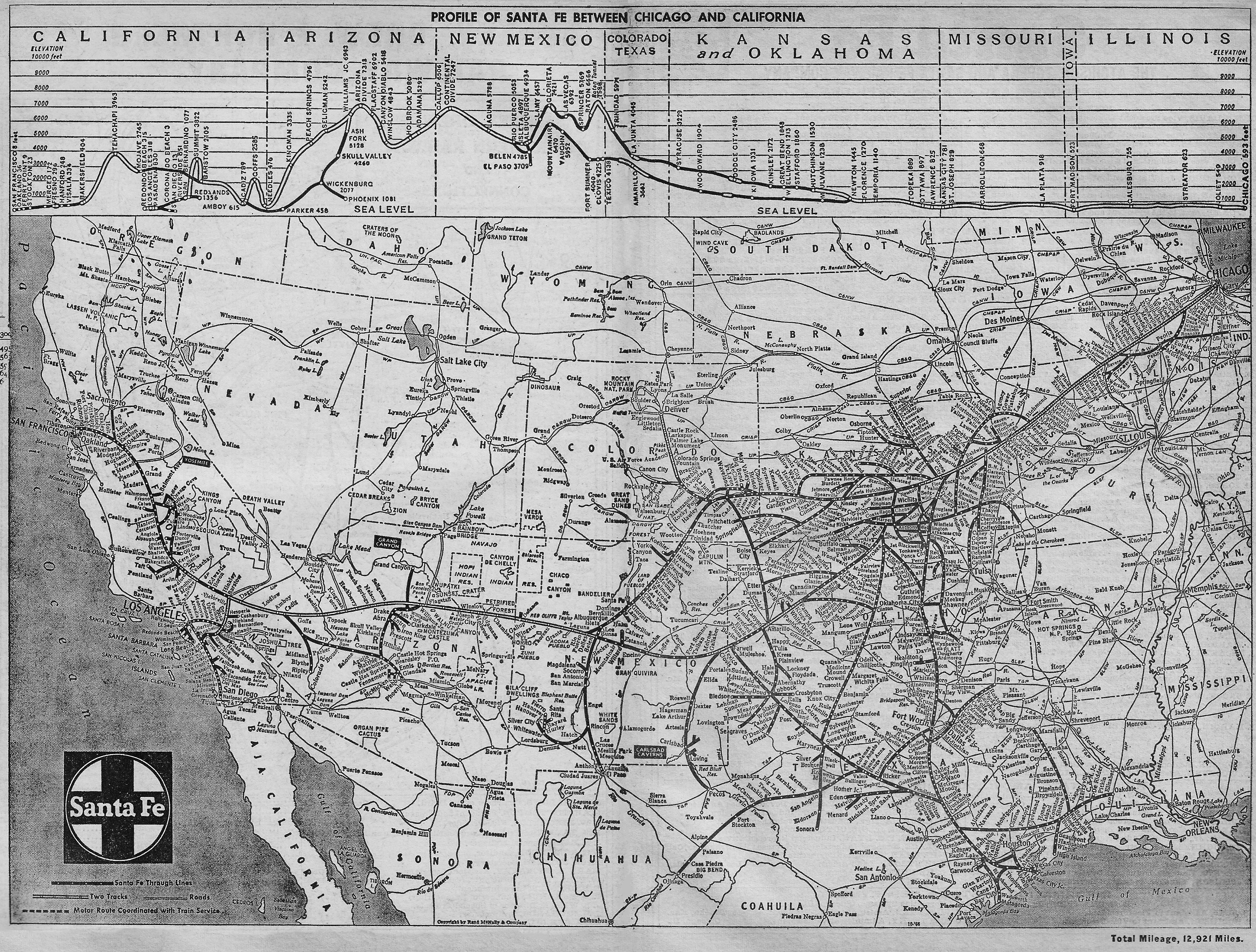
System Map
It was a fortuitous turn of events as the AT&SF not only retained strong management but also achieved solid financial backing. On July 20, 1870 rails reached Emporia. This location contained another lucrative source of traffic which helped fuel its westward expansion, cattle.
As the Santa Fe marched across Kansas this business only grew in importance. By the end of the year gross earnings totaled $126,960 and rails were soon being laid eastward. While the town of Atchison finally celebrated the AT&SF's arrival on May 13, 1872, crews had been working feverishly to reach Colorado since December of 1870.
It was a backbreaking task although the flat topography and relatively mild Midwestern climate sometimes enabled more than one mile of new track laid daily. During the next few years the railroad steadily pushed towards its goal:
- In 1871 Newton was reached.
- On September 19, 1872 the line opened to Dodge City.
- Finally, on December 28, 1872 the rail-head arrived at the deserted outpost of Granada, Colorado. The Santa Fe had accomplished what had once seemed impossible and was awarded its land grant, totaling some 2,928,928.54 acres.
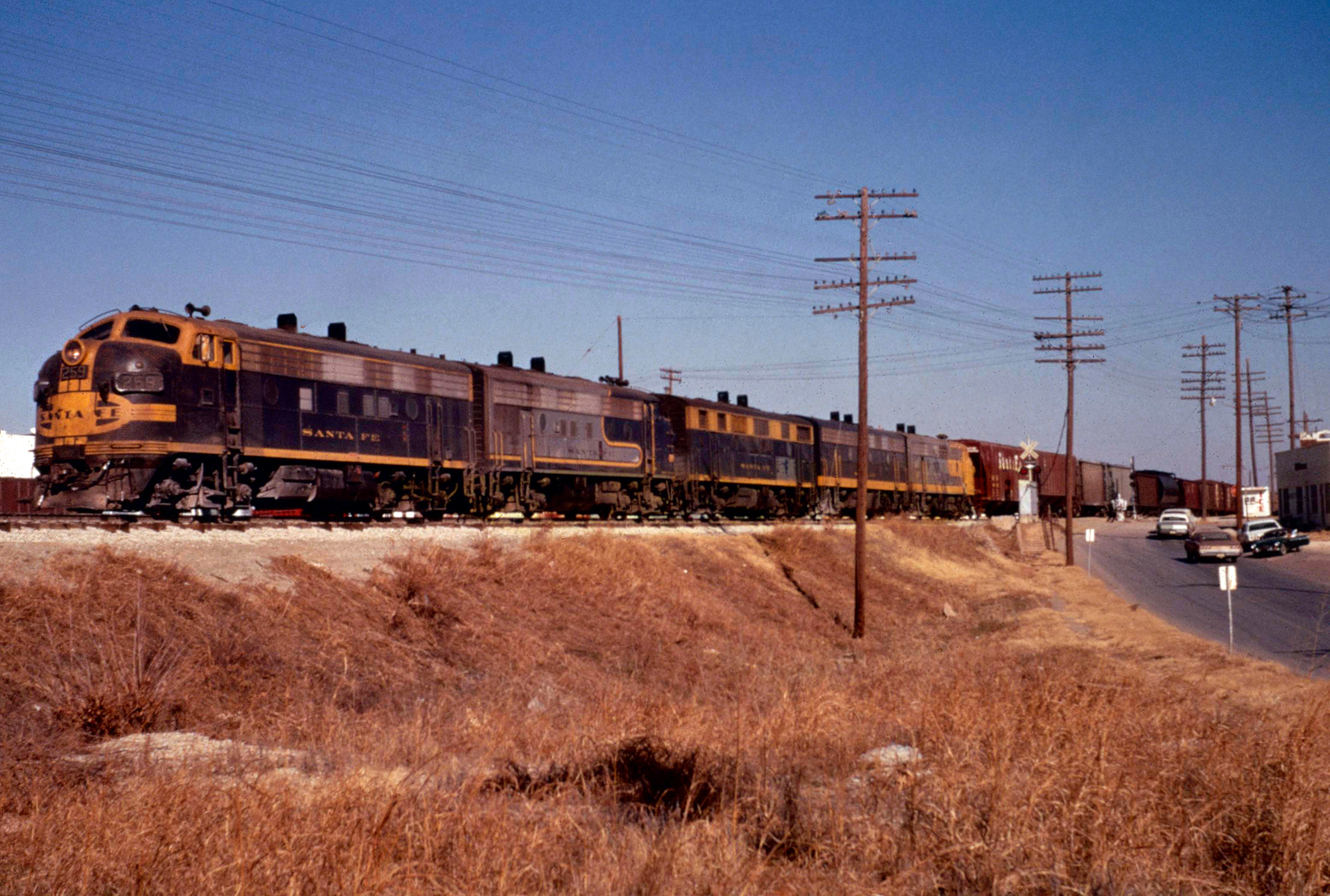 A classic lash-up of Santa Fe "F" units are southbound at Ardmore, Oklahoma on December 29, 1973. American-Rails.com collection.
After completing its charter, Bostonian management stayed true to Holliday's aspirations and continued pushing towards the Pacific and Gulf coasts.
The railroad opened its first branch in May of 1872 when the Wichita & Western, backed by the Santa Fe, connected Wichita (another important cattle town along the Chisholm Trail) with AT&SF's main line at Newton.
The next move involved incorporation of a new subsidiary; in 1873 the Colorado & New Mexico Railroad was formed for the purpose of extending the main line beyond Granada to Albuquerque.
In one of the 19th century's classic railroad wars, a battle ensued with General William Jackson Palmer's narrow-gauge Denver & Rio Grande Railroad (D&RG) for control of New Mexico's Raton Pass and Colorado's Royal Gorge.
According to Mike Schafer's book, "Classic American Railroads," his plan was to extend the D&RG from Denver/Pueblo to El Paso, Texas, using the only natural passageway through the formidable Sangre de Cristo Mountains for this purpose, Raton Pass.
The ensuing fight between the two companies could fill a small book. It all began after the AT&SF reached La Junta, Colorado on February 16, 1876.
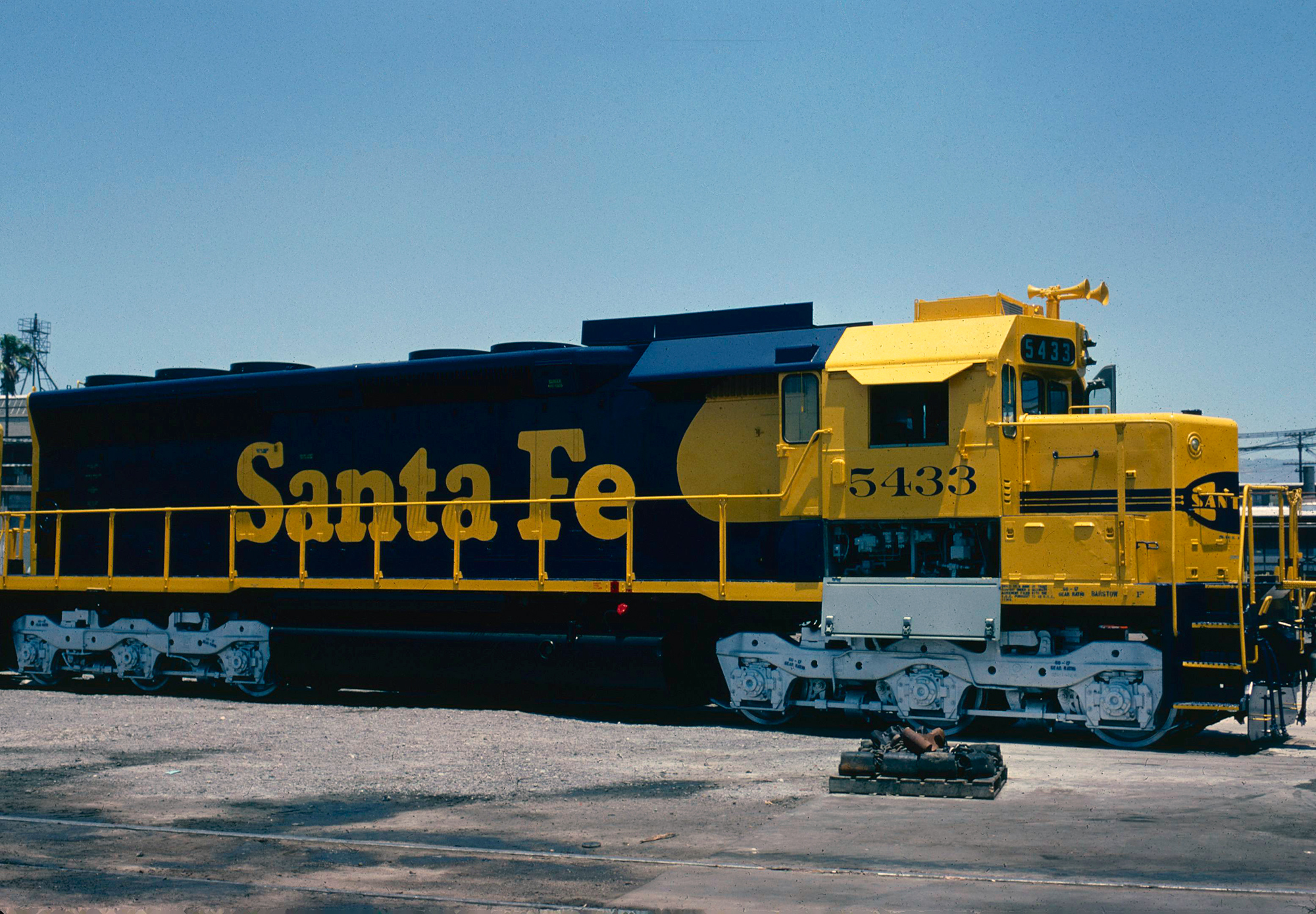 Santa Fe SD45u #5433 following its rebuild at the San Bernardino Shops on June 13, 1981. Steve Wille photo. American-Rails.com collection.
From this point officials sought a two-pronged approach; they would continue the original line southwestward and also build due west through Colorado to tap the state's booming mining industry.
If possible, a potential secondary goal would be a second transcontinental connection at Salt Lake City, Utah; as this plan was under development the board elected William Barstow Strong vice president and general manager in 1877.
Expansion
In the 1884 Annual Report he stated: "A railroad to be successful must also be a progressive institution. It cannot stand still if it would. If it fails to advance, it must inevitably go backward and lose ground already occupied."
He never deviated from this position and during his twelve years with the company carried out most of its expansion. Strong immediately went to war with Palmer and had his team stake out a route over 7,834-foot Raton Pass.
The engineer assigned this task was Ray Morley who befriended Richens Lacy Wootton, owner of a 27-mile toll road over Raton. His home was also based here as well as a small hotel.
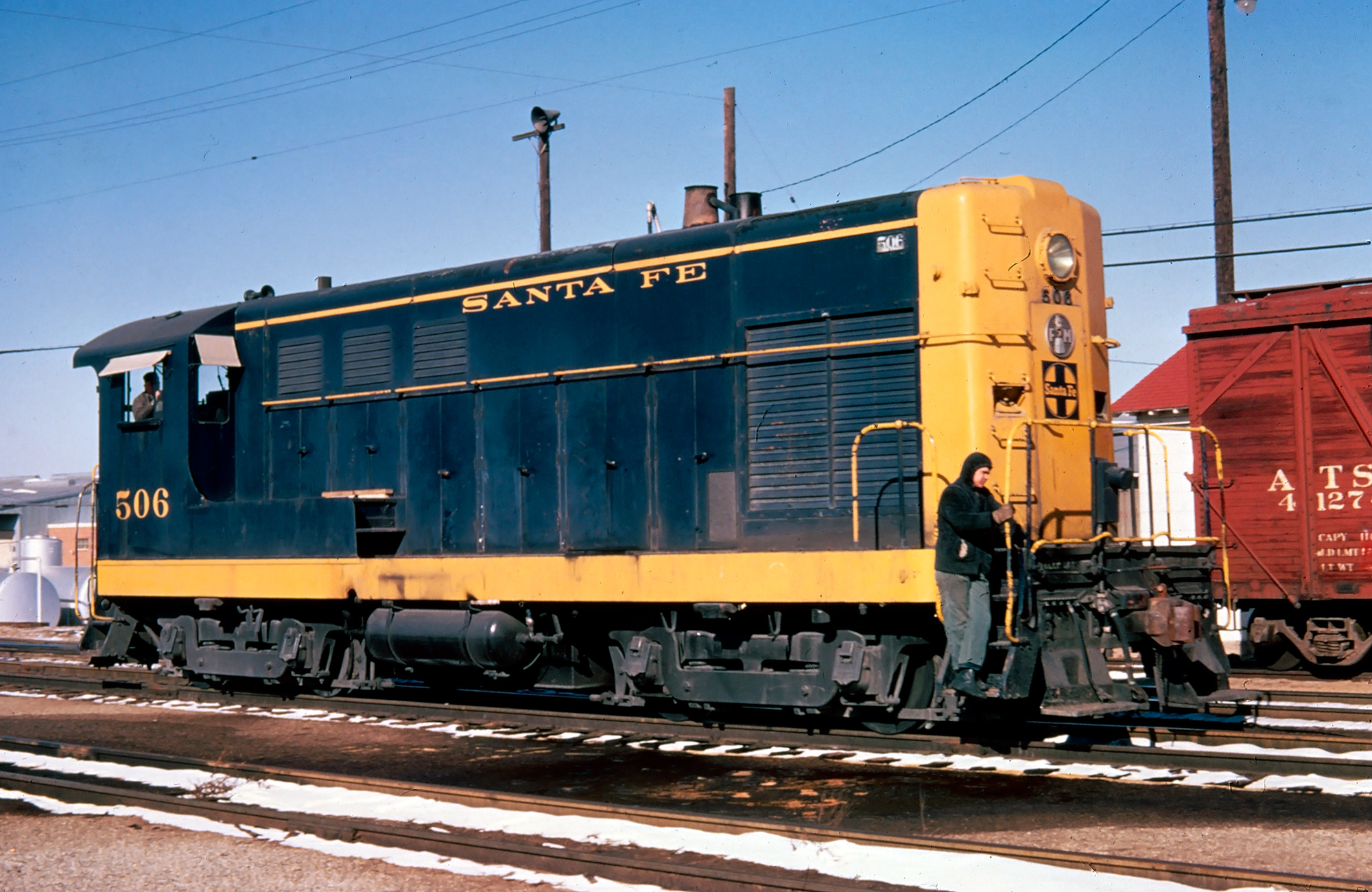 Sant Fe H12-44 #506 is seen here carrying out switching chores, circa 1965. The AT&SF was not a big buyer of FM products but did purchase a number of these switchers, including an H12-44TS variant that featured a steam generator to ferry passenger equipment around its Dearborn Station terminal in Chicago. American-Rails.com collection.
Better unknown as "Uncle Dick," he agreed to sell his enterprise to the Santa Fe. When D&RG's team showed up to claim it the pass for themselves he helped turn away the invaders.
With this victory, Strong, a relentless and determined individual, turned his attention to Colorado where he aimed for Leadville's silver mines situated in the heart of D&RG territory.
The Santa Fe's initial incursion here was built by an independent-but-allying road, the Cañon City & San Juan Railway, which completed an extension from Pueblo to Cañon City in 1878.
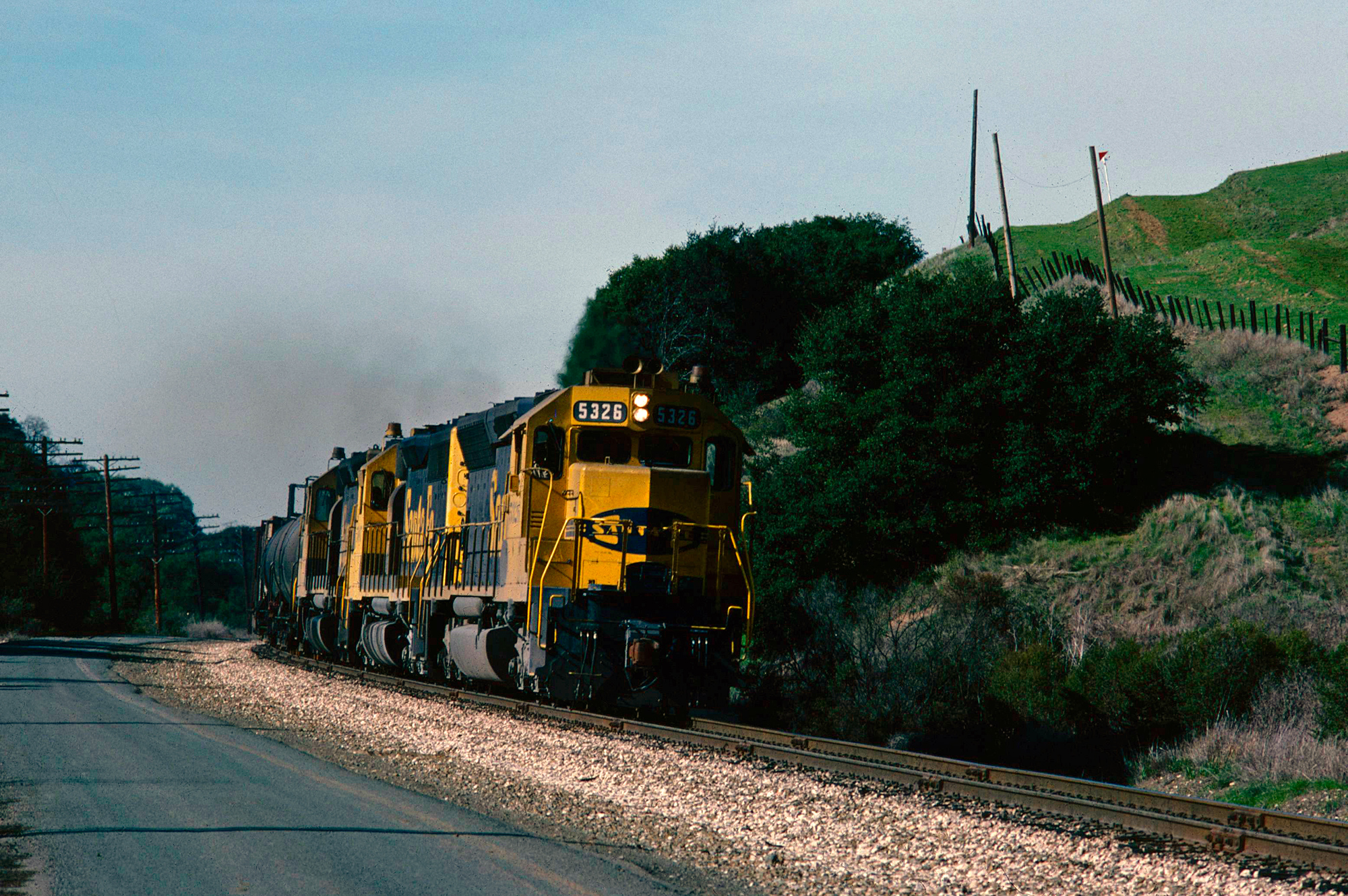 Santa Fe SD45u #5326, SD40u #5007, and SD45u #5435 lead a general manifest eastbound near Christie, California on January 24, 1986. Jon Porter photo. American-Rails.com collection.
It was then merged into an AT&SF subsidiary that same year, the Pueblo & Arkansas Valley Railroad. The Santa Fe made it twenty miles into the hotly contested Royal Gorge, and is credited with constructing the photogenic "Hanging Bridge" over the Arkansas River (which became an often-used location in Rio Grande publicity photos), before a U.S. Supreme Court order rendered on April 21, 1879 ended the fighting.
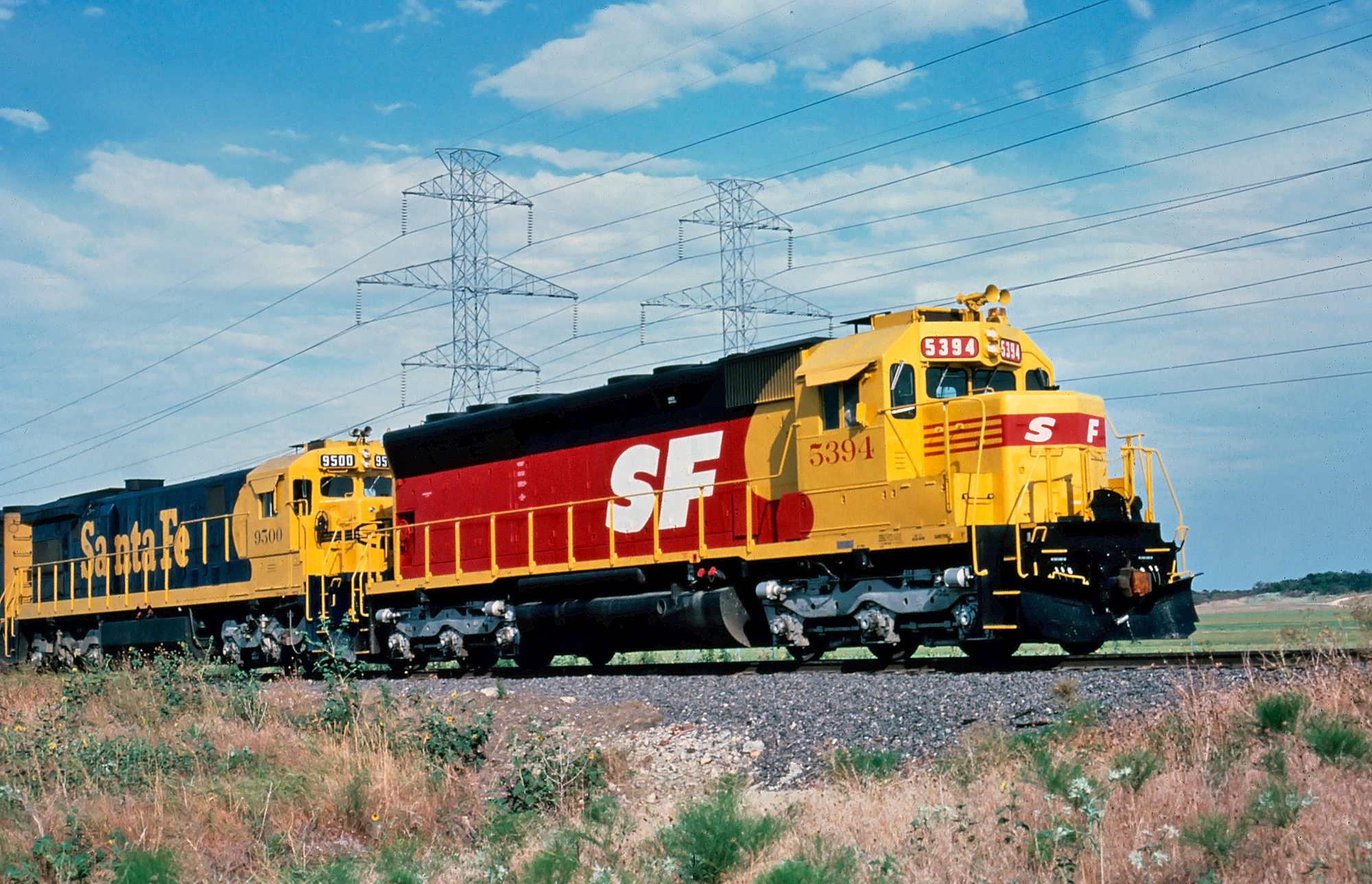 Santa Fe SD45u #5394 in the Santa Fe–Southern Pacific "Kodachrome" livery, along with SF30C #9500 (rebuilt by the Cleburne Shops from U36C #8721 in April, 1985) near Venus, Texas; August, 1985. Mike Bledsoe photo. American-Rails.com collection.
The conflict had nearly resulted in a full-scale war with noted law man Bat Masterson employed by the Santa Fe to help protect construction gangs. There were also armed posse's on both sides and Rio Grande forces even built forts in an attempt to ward off their rivals.
The court order led to the "Treaty of Boston" and an end to hostilities; the railroads agreed to stay out of each other's territory (later broken by both parties) while the Rio Grande purchased AT&SF's completed work through the gorge for $1.4 million.
As the fighting was still ongoing Santa Fe continued its line over Raton; Trinidad, Colorado was reached on September 1, 1878 and the first train passed through the new 2,041-foot tunnel (at an elevation of 7,588 feet) during September of 1879.
- In 1907 the AT&SF opened the Belen Cutoff, a 200+ mile corridor through eastern New Mexico and Texas's Northern Panhandle. The new route offered a more direct link to Chicago, which diverted most transcon traffic off Raton.
It remains in use today under BNSF Railway. The original line continued to see several trains per day including the crack Super Chief and El Capitan along with several coal trains from nearby mines. -
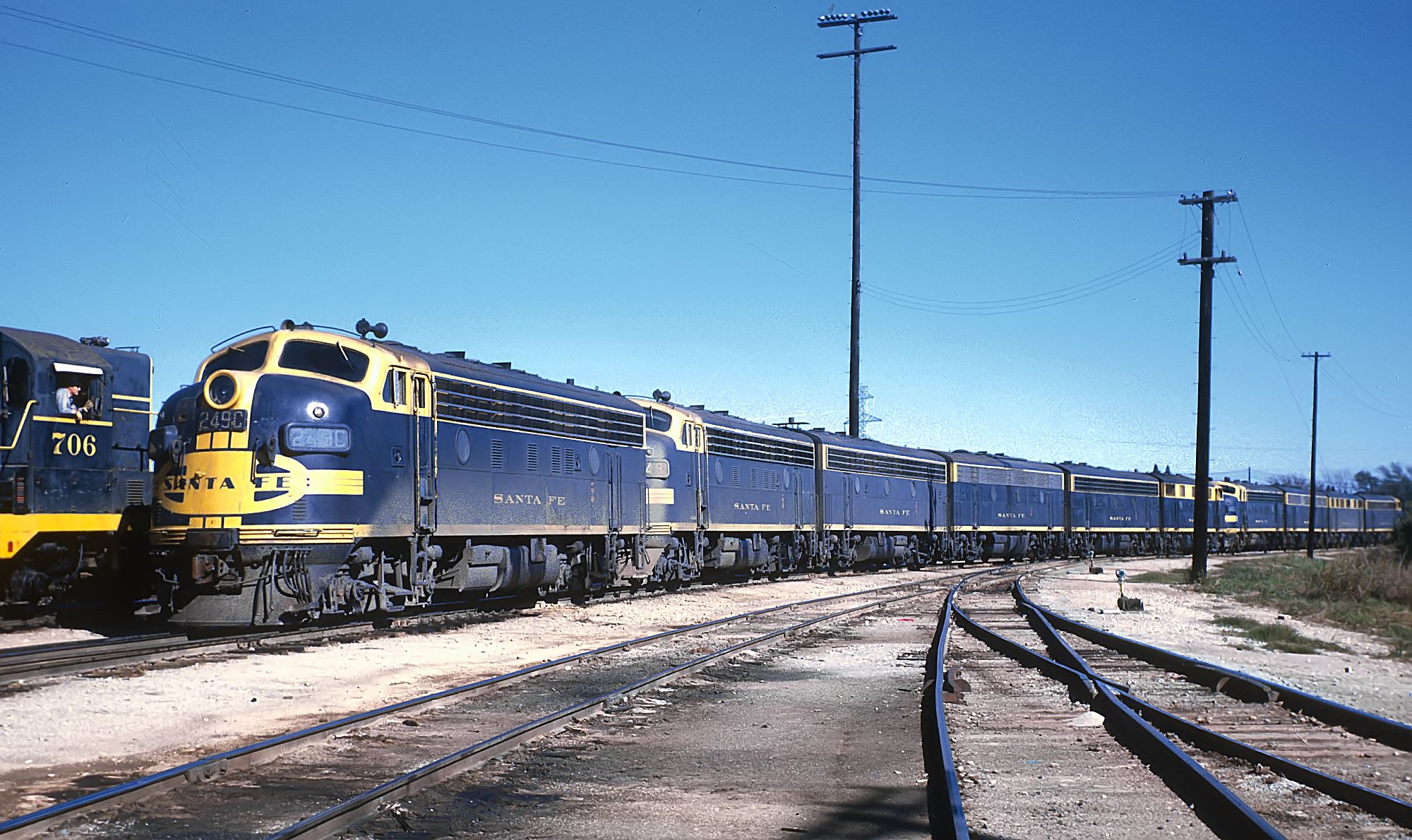 A parade of Santa Fe F7s, F3s, and a few F9Bs, at the north end of the passenger yard in Temple, Texas in December, 1969. Rick Burn photo.
By 1880 the Atchison, Topeka & Santa Fe Railroad had mushroomed into a formidable network. It had battled the Rio Grande, upset Union Pacific and Kansas Pacific, and would soon be fighting Collis P. Huntington's Southern Pacific to enter California.
By 1879, its net income was an impressive $3.455 million with a seemingly endless cash-flow available. As a result, the country's most ardent tycoons could not gain control of this independent menace. The iron-willed Strong continued westward and built up a feeder branch network across Kansas in the process.
After conquering Raton the AT&SF subsequently surmounted nearby 7,453-foot Glorieta Pass and reached Albuquerque on April 15, 1880. (Ironically, the railroad would reach Santa Fe via an 18-mile branch from Lamy, which opened in February 1880. Due to an easier alignment it had initially been bypassed to the east.)
Strong made an interesting decision at this time when he elected to forgo entering California and would, instead, build into Mexico.
The fundamental reasons for doing so are unknown but, ever-independent, he likely felt the Santa Fe could establish its own west coast port at Guaymas which would open trade to the Orient, South Pacific, and other parts of Latin America. He could also eliminate a potential fight with Huntington.
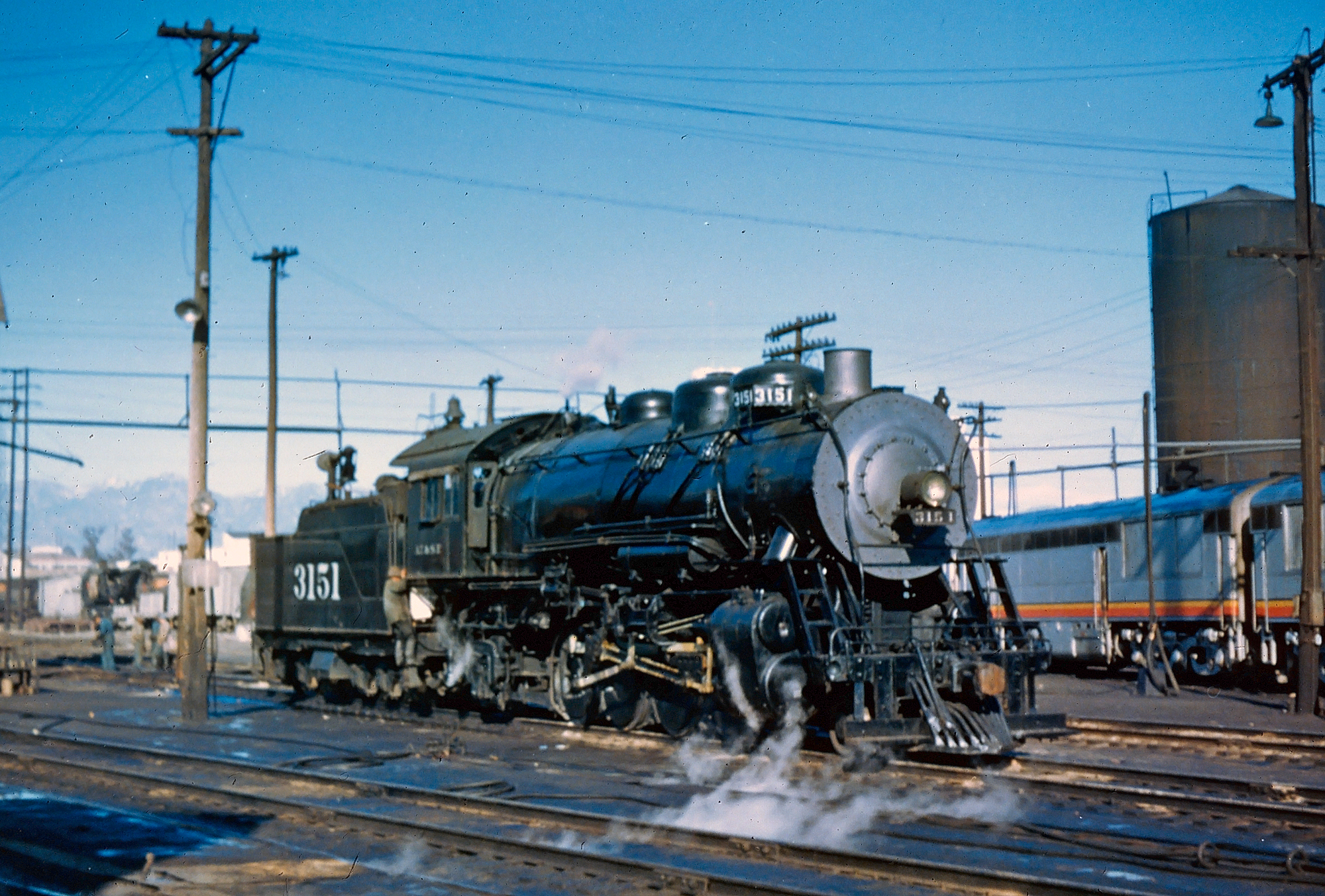 Santa Fe 2-8-2 #3151 is seen here at Redondo Junction (Los Angeles) in February, 1949. Note the railroad's only A-B-A set of "Erie-Builts" at right. American-Rails.com collection.
To accomplish this, the end-of-track was extended to Deming, New Mexico with a disconnected segment also constructed between Benson, Arizona and the Mexican border at Nogales (trackage rights over the Southern Pacific were utilized between Deming and Benson).
From there, the Mexican government granted a charter for the Sonora Railway in 1880 to reach Guaymas along the Gulf of California.
The 260-mile line was finished on October 25, 1882, giving the Santa Fe an impressive 1,700-mile main line from Kansas City (this important gateway was initially reached in June of 1875 through lease of the Kansas City, Topeka & Western) to the coast.
Unfortunately, the Mexican route proved a dismal failure as the hoped for business never materialized. It failed to earn a profit and was sold within a few years. As Strong turned his attention back to California, Huntington was not his only issue in breaching the state.
The St. Louis & San Francisco Railway (the "Frisco"), a project once led by General John Fremont, was hard at work on its own transcontinental extension from St. Louis to California.
It had been launched as the Pacific Railroad in 1849 and following a series of corporate shakeups became the the Atlantic & Pacific Railway in 1870. After more financial difficulty it was renamed as the StL&SF in 1876.
This latest corporation retained A&P's charter to link Isleta, New Mexico with Needles, California where it would meet the Southern Pacific. After the AT&SF realized the Frisco offered the best alignment across New Mexico and Arizona the parties signed what became known as the "Tripartite Agreement" in 1879 that essentially gave Santa Fe control of the StL&SF.
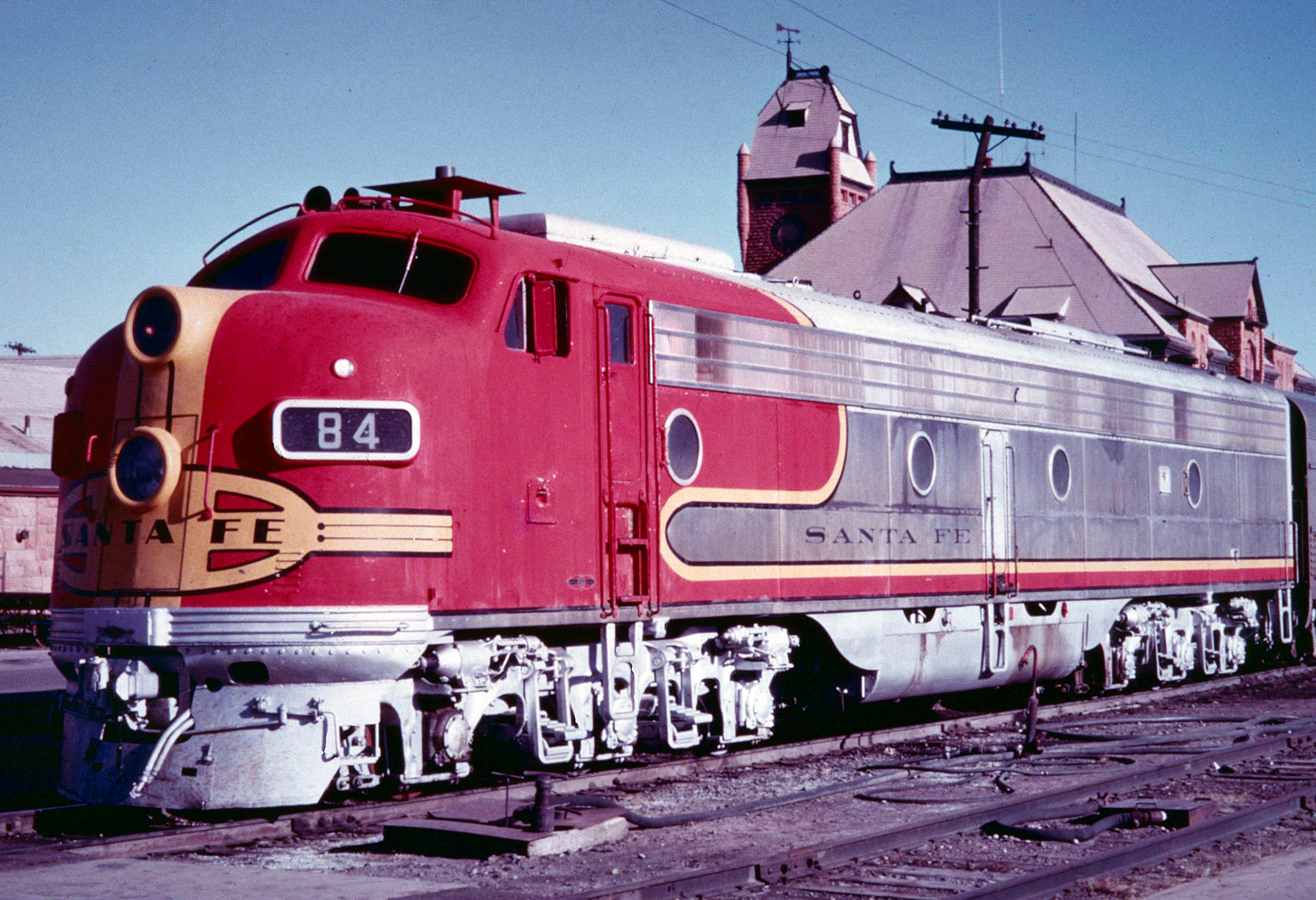 Santa Fe E8Am #84-L in Pueblo, Colorado. This unit was rebuilt by EMD from E1A #6 in 1953. F.H. Worsfold photo. American-Rails.com collection.
Reaching California
Four years later, construction crews arrived in Needles during August of 1883. This section's most impressive natural feature was the 250-foot deep Canyon Diablo, about 26 miles west of Winslow, Arizona.
The railroad built a spectacular 560-foot trestle (completed in July of 1882) over this crevasse and today, BNSF still operates here via a newer structure.
While the Southern Pacific completed a branch to meet the AT&SF it was clear Huntington had no intentions of interchanging eastbound traffic. As he attempted to retain his California monopoly he soon learned William Strong drove a very hard bargain.
In the succeeding years Huntington would capitulate again and again until Southern Pacific had lost its grip on the west coast. As Strong began his assault into the Golden State, San Diego leaders lobbied hard for the AT&SF to reach their town.
He, and the other company officials, were eventually convinced and aided the California Southern Railroad (incorporated on October 16, 1880) in its endeavor to build north along the coast whereupon it would meet the Santa Fe pushing south towards San Bernardino.
The CS was finished in just two years, reaching the connection point on September 13, 1882. The Santa Fe, however, was delayed by its fight with Huntington. In the meantime it purchased the CS (1884) to secure a coastal foothold. Then, Strong negotiated with Huntington to purchase SP's corridor between Needles and Mojave.
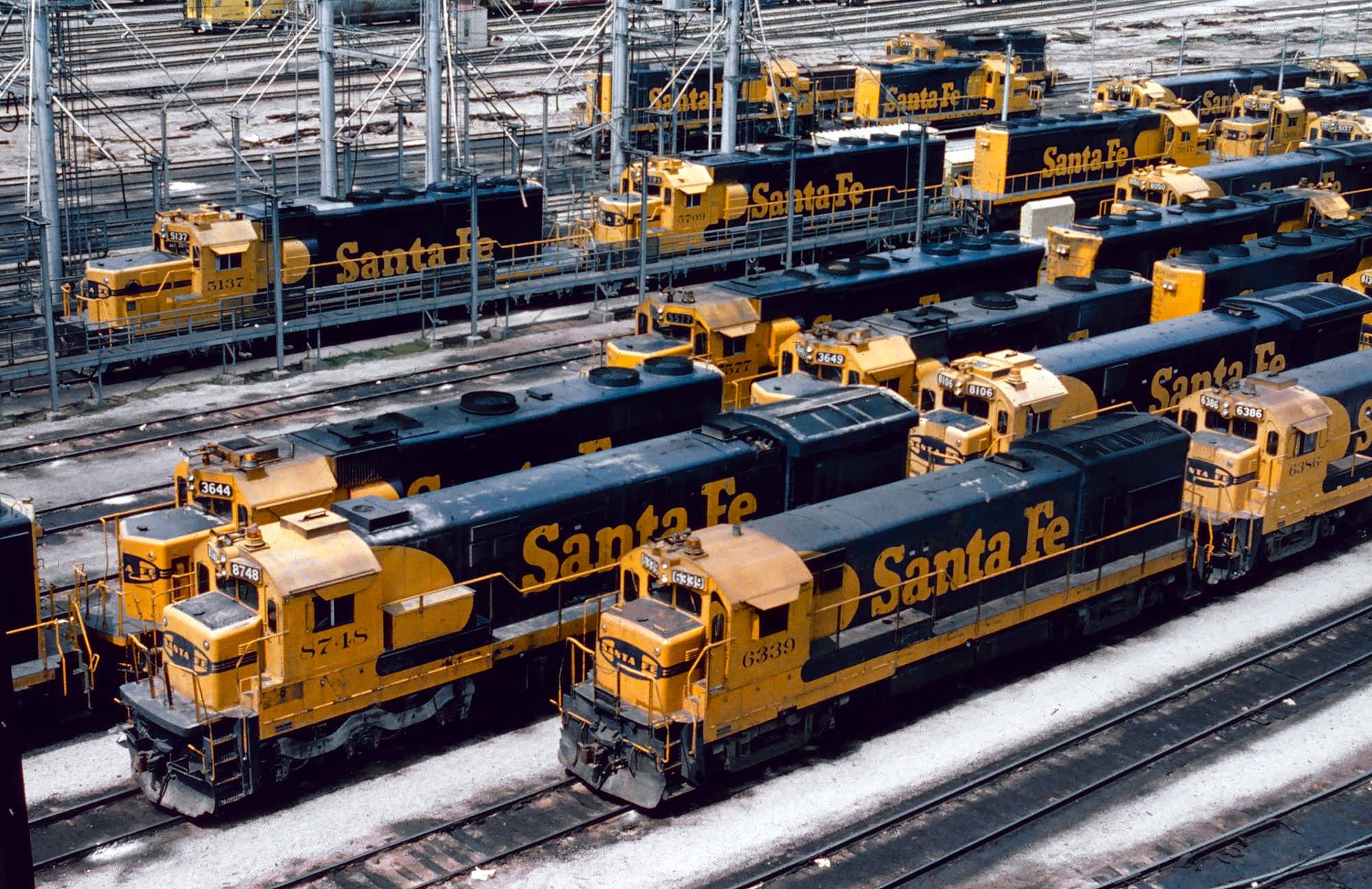 Santa Fe power at the Argentine (Kansas) engine terminal, circa 1983. Mike Bledsoe photo. American-Rails.com collection.
Backed by the Santa Fe, the CS built an additional 81 miles from San Bernardino to Barstow, meeting the AT&SF at that point. This last segment crossed 3,823-foot Cajon Pass, a winding but impressive engineering feat accomplished by California Southern's chief engineer, Joseph Osgood.
When work over Cajon was completed on November 15, 1885 the Santa Fe officially achieved transcontinental status. Shortly thereafter it gained access into Los Angeles by leasing the SP west of Colton.
Dissatisfied with this arrangement, Strong was soon eyeing a direct entry and in early 1887 purchased the independent Los Angeles & San Gabriel Valley Railroad.
This small pike, owned by James F. Crank, had been building out of Los Angeles since 1883 in hopes of establishing an eastern connection. SP refused to assist, leading to Santa Fe's involvement.
Following completion of a short gap between San Bernardino and Duarte, AT&SF trains rolled to Los Angeles over their own rails on May 31, 1887.
Just a year later, on August 12, 1888 a second extension, covering 70 miles, opened from L.A. to Fallbrook; what became known as the "Surf Line" provided a direct Los Angeles-San Diego corridor running the coast. In later years it became a very important corridor and remains so to this day.
Fred Harvey
Without question, Fred Harvey left an indelible mark on the railroad industry by providing the traveling public with their first experience of high-class cuisine.
Prior to his lease of Atchison, Topeka & Santa Fe's lunch counter in Topeka, Kansas during 1876, patrons were left to suffer eating horrendously bad food.
In addition, since on-board dining had yet to be introduced, passengers were forced to hurriedly inhale their meal during lunch stops along the way. Mr. Harvey was an immigrant from England, born in London on June 27, 1835 and moved to the United States in 1850.
He spent his young adult life working for various railroads, during which time he learned the inhospitable nature of dining by train.
He sought to correct this wrong and opened his first two restaurants along the Kansas Pacific (later Union Pacific) main line at Wallace, Kansas and Hugo, Colorado in 1875.
He aimed for an extremely high level of service, providing first-class meals with the old adage, "the customer is always right."
His efforts paid off which led to the lease of the Topeka lunch counter. The AT&SF and Harvey officially signed their first contract on January 1, 1878 to operate a restaurant/hotel in Florence, Kansas.
The concept took off and soon the Santa Fe became recognized for the high-quality food and accommodations provided over its lines, which led to increased patronage. Harvey went out of his way to please customers as the legendary Harvey Houses sprang up all across the Southwest.
Many carried mission-style architecture, themes familiar with the region (such as the Indian Shop at the Alvarado Hotel in Albuquerque, the Hopi House at the El Tovar along the Grand Canyon's South Rim, and the El Ortiz in Lamy which featured Navajo products and other Indian crafts for sale), and a Spanish influence (the result of Spain's former presence in the region).
The buildings' interior designs were thanks largely to the work of Mary E.J. Colter. In 1893 Harvey and the railroad contracted to host dining services on-board although his many brick-and-mortar locations were the best-remembered, carrying the slogan "Meals by Fred Harvey."
He passed away on February 9, 1901 at which time his business included fifteen hotels, forty-seven restaurants, and thirty dining cars.
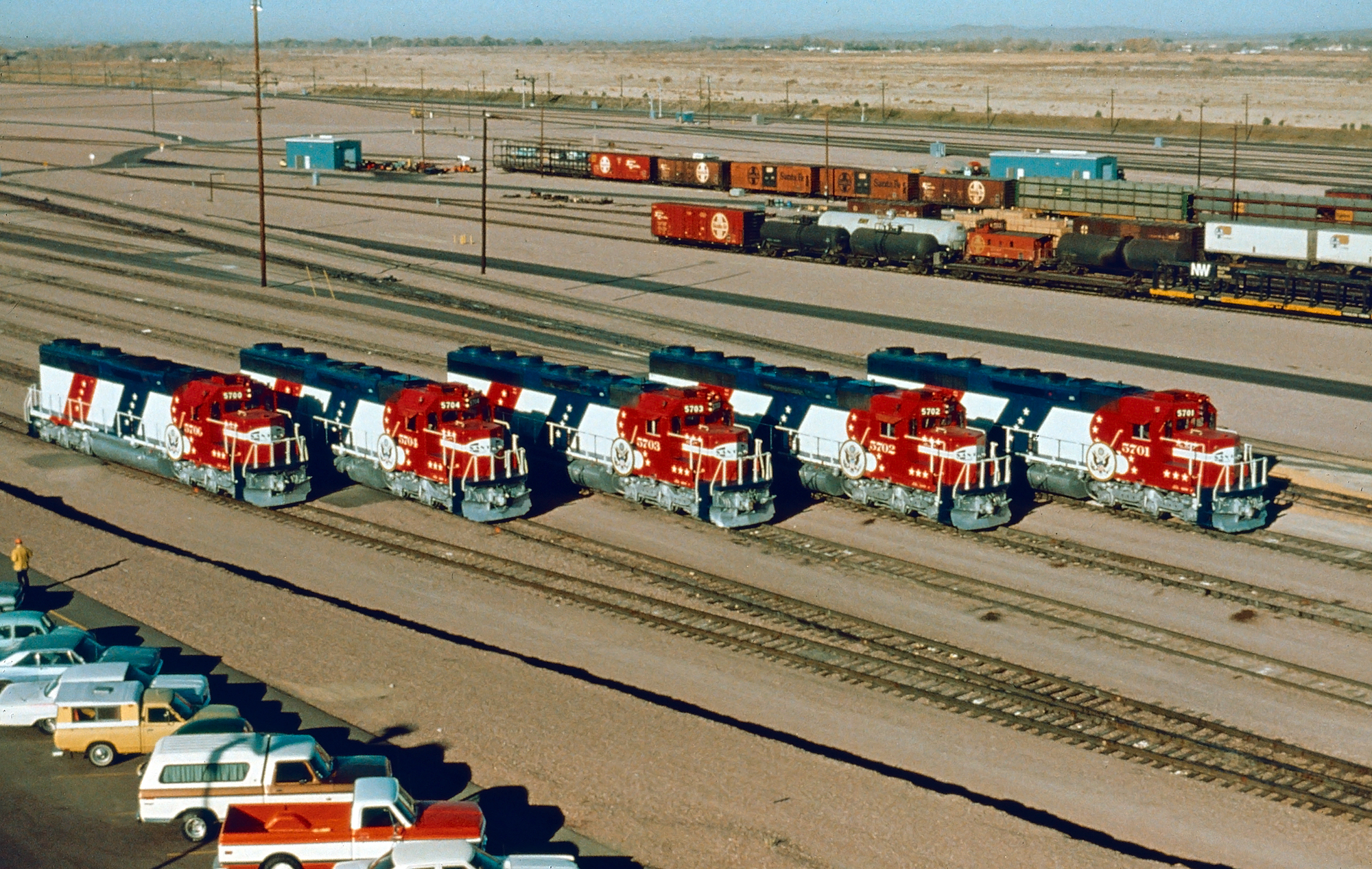 Santa Fe's five "Bicentennial" SD45-2's (#5700-5704) gathered for a group photo at Barstow, California on December 21, 1976. K.B. King photo. American-Rails.com
collection.
Santa Fe's five "Bicentennial" SD45-2's (#5700-5704) gathered for a group photo at Barstow, California on December 21, 1976. K.B. King photo. American-Rails.com
collection.As Strong extended across California he remained focused back east where he sought an entry into Texas, continued expansion of the branch line network, and a planned Chicago corridor. To reach the Lone Star State, Santa Fe acquired the Gulf, Colorado & Santa Fe Railway in 1887.
It owned a respectable 625 miles which connected Galveston, Brownwood, Houston, Conroe, Lampasas, Dallas, and Paris.
As part of the takeover, the AT&SF funded a northward extension to Purcell, Indian Territory (Oklahoma after November 16, 1907) where a connection between the two could be established.
In short order, separate crews had converged on the location and through service into Galveston commenced on June 18, 1887. The last important expansion efforts carried out under Strong included reaching the Windy City and Denver.
For years the AT&SF had partnered with other carriers at Kansas City (particularly the Chicago, Burlington & Quincy) for the interchange of traffic into and out of the Windy City.
Staying true to his ideals, Strong sought a direct entry into the nation's railroad capital, despite pleas to the contrary from his allies.
He chartered the Chicago, Santa Fe & California Railway (CSF&C) on December 3, 1886 for this purpose and the corridor was completed through a combination of new construction and acquisition.
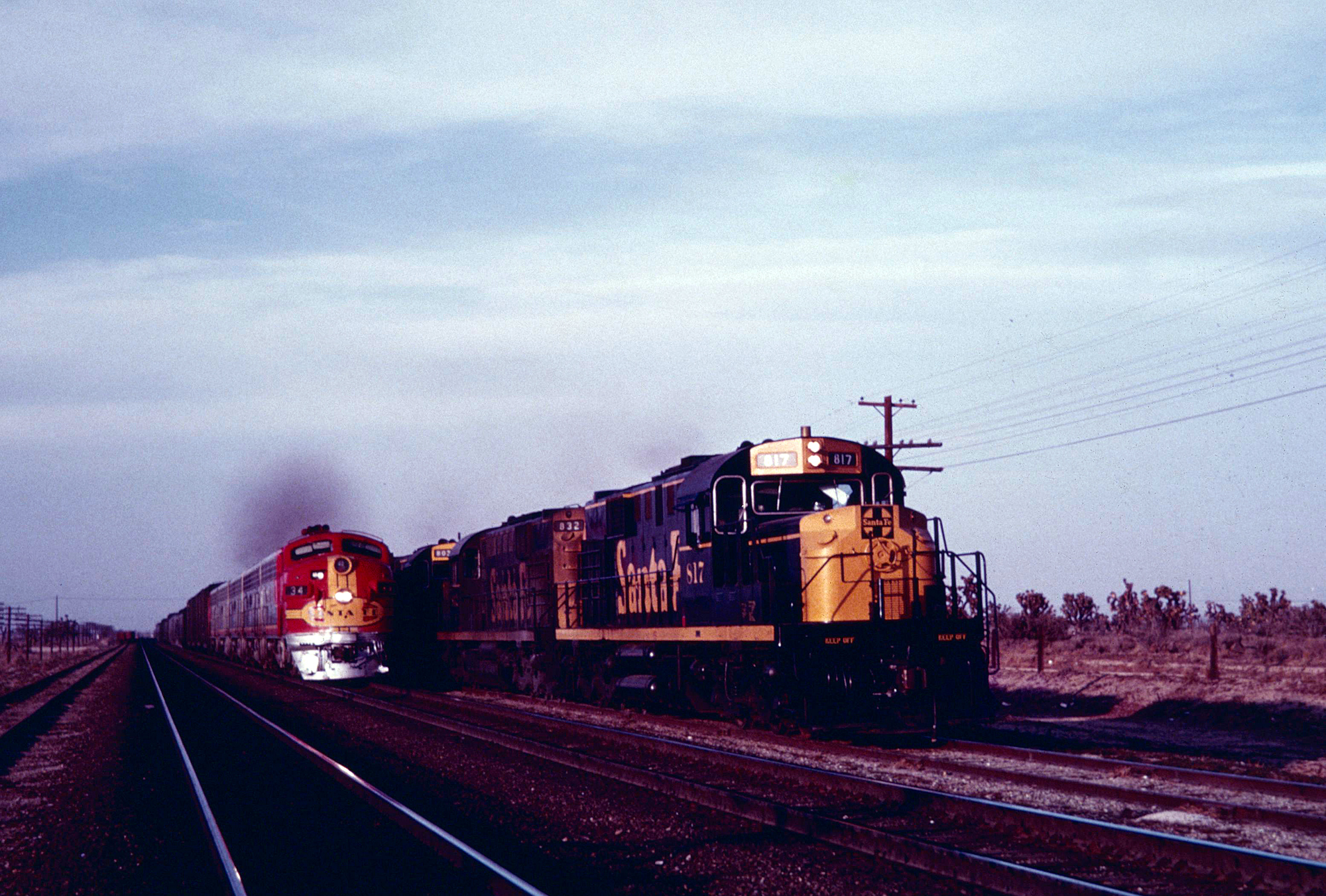 Santa Fe F3A #34-L hustles westbound past a trio of RSD15's waiting in the siding at Hesperia, California during the early 1960s. Fred Worsfold photo. American-Rails.com collection.
First, the CSF&C picked up the 154-mile Chicago & St. Louis Railway between Chicago and Pekin, using it as far as Ancona, Illinois (near Streator) for its main line. Then, the remaining 350 miles was built from scratch to reach the subsidiary, Kansas City Belt Line.
In yet another incredible feat of engineering, the nearly tangent corridor was completed in just over a year with the last spike driven near Medill, Missouri on December 31, 1887.
Following a few months of additional prep work, through trains began rolling into Chicago on April 29, 1888. Mr. Bryant's book notes the Santa Fe spent more than $3.3 million on terminal and yard facilities within the city, including access to Dearborn Station.
While it became the most famous tenant, several others called there including the Chesapeake & Ohio, Chicago & Eastern Illinois, Erie, Grand Trunk Western, Wabash, and Chicago, Indianapolis & Louisville [Monon]. Just before its Chicago line was finished, Strong had opened a direct, 116-mile extension into Denver.
Running via Pueblo it was completed in 1887. By 1888 the Santa Fe boasted a network of 7,010 miles; much of which was agricultural branches concentrated in Kansas, Oklahoma, and Texas.
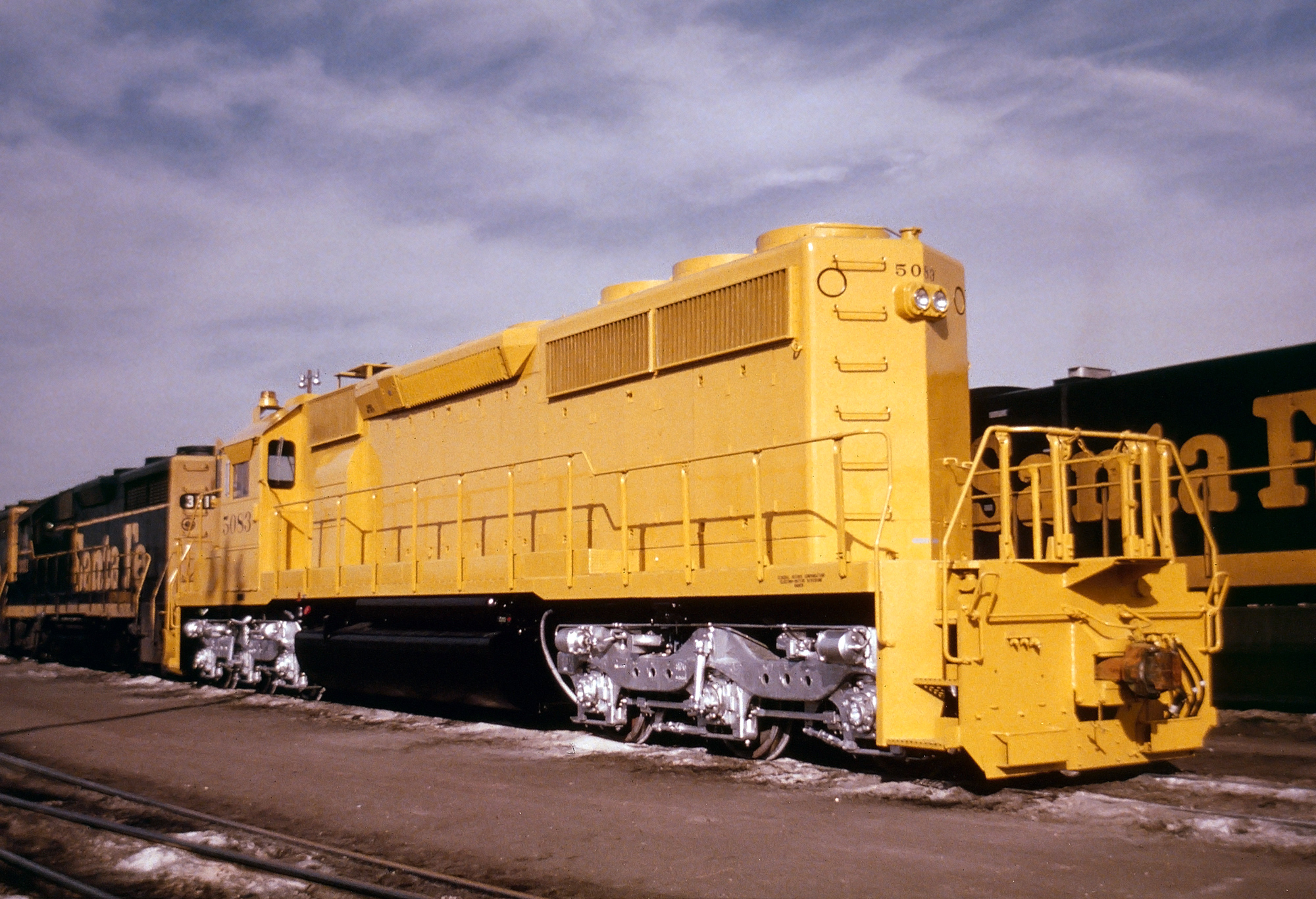 Santa Fe SD40-2 #5083, delivered from Electro-Motive in primer yellow; October, 1979. She was soon completed at San Bernardino in the Blue/Yellow Warbonnet livery. Mike Bledsoe photo. American-Rails.com collection.
Modern Era
If Strong had one fault it was his attempt to add evermore mileage in maintaining leverage against the competition. Some of this trackage proved redundant and unprofitable, which led to the railroad's one and only bout with financial difficulty. The Santa Fe's struggles began during the late 1880's leading to Strong's demotion.
No longer in control he would leave the company although new leadership was not immediately effective at correcting the problem. Following the Panic of 1893 the AT&SF was placed in receivership on December 23rd of that year.
Thanks to its strong earnings power, however, the reorganization was short and it emerged on December 10, 1895 as the Atchison, Topeka & Santa Fe Railway. In the process, it cast off a handful of affiliates, including the Frisco.
Under E.P. Ripley's leadership policies centered on conservatism, traffic growth, customer service, and capital improvement programs became hallmarks of the modern AT&SF. After only a year, Ripley's Santa Fe was back in the black as it earned a net income of $3,382,806.
While not all of the railroad's construction projects/acquisitions are mentioned here it continued to grow throughout the 20th century.
One especially critical route was accessing San Francisco, achieved by purchasing the 278-mile San Francisco & San Joaquin Valley Railway. It was another small independent, focused on reaching the Santa Fe to break up Southern Pacific's last monopoly in the Golden State.
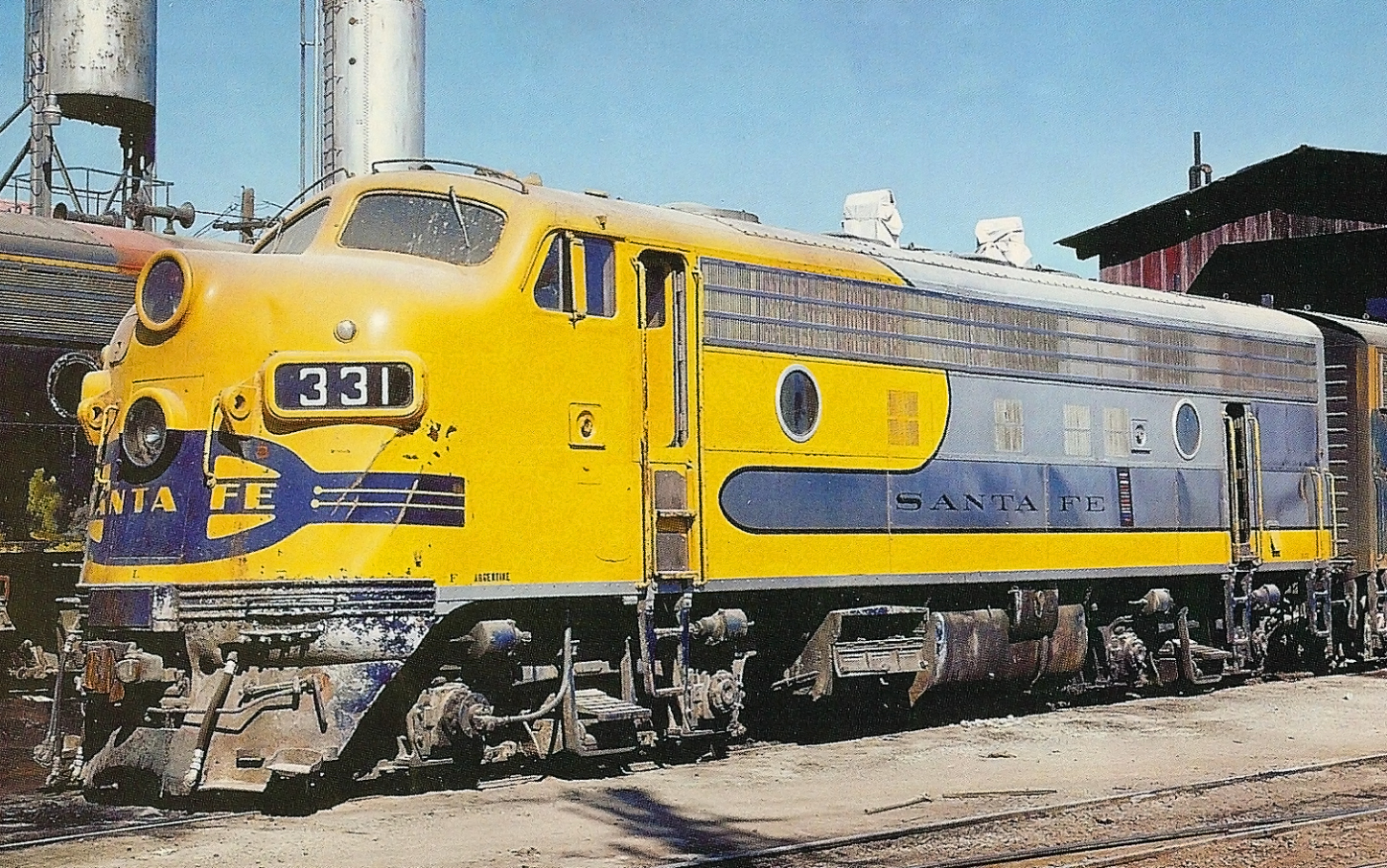 A "Yellowbonnet" Santa Fe F7A, #331, is seen here at the shops in Cleburne, Texas during 1975. This unit was later rebuilt as CF7 #2444 in August, 1977.
By 1897 it stretched 278 miles from Stockton, along the San Francisco Bay, to Bakersfield. In late 1898 it was sold to the AT&SF but unfortunately, engineers could not locate a direct connection at Mojave due to the rugged Tehachapi Mountains where the only usable grade over Tehachapi Pass was already taken by SP.
Its engineers had built an impressive grade through this area, which originally featured fifteen tunnels and a magnificent loop that passed over itself. Unable to find a better way, officials were forced to work out a trackage rights agreement between Mojave and Kern Junction (near Bakersfield).
Interestingly, this setup has remained unchanged today between Union Pacific (current owner) and BNSF Railway. The Santa Fe's primary Bay Area terminal facilities were located at Point Richmond, along the eastern shore and slightly northeast of the downtown area.
Due to the region's unique topography considerable ferry operations were required, which included a small fleet of barges and tugs. Passenger service also utilized ferries which carried patrons to and from the downtown district through the Market Street slip.
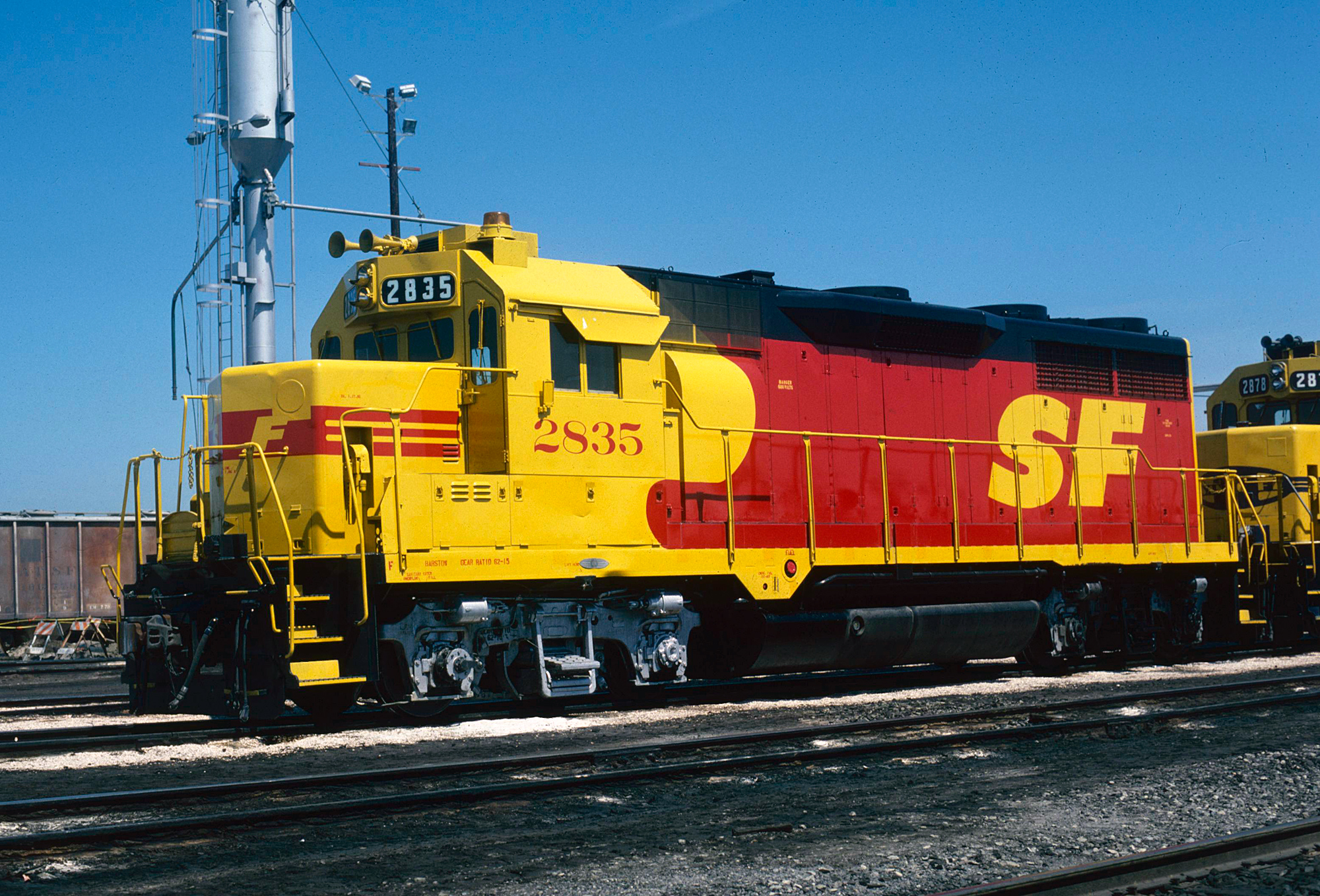
The Santa Fe's network peaked in 1932 when it boasted 13,568 miles. It spent the 20th century as a well-oiled machine, hardly fazed by the Great Depression (it enjoyed a net income of $3.7 million or higher throughout the 1930s). It gained worldwide fame when it introduced the legendary Super Chief in 1936, serving Chicago and Los Angeles.
This train was an offshoot of The Chief launched a decade earlier (1926). On May 12th the all-Pullman consist debuted carrying heavyweight cars that were powered by a pair of Electro-Motive boxcab diesels nicknamed "Amos & Andy."
What really caught everyone's attention was its lightning fast schedule of 39 3/4-hours, easily besting anything the competition had to offer. It truly came of age a year later when it was streamlined with sleek E1's (also Electro-Motive products) and lightweight cars from the Budd Company.
The Super Chief was re-inaugurated on May 18, 1937 boasting a nine car consist (club-baggage, five Chicago-Los Angeles sleepers, a club lounge, diner, and sleeper-observation).
The public was awestruck by its gleaming stainless-steel appearance, Native American-themed livery, and interior décor.
The exterior paint scheme was dubbed the "Warbonnet" by General Motors' styling department. It was conceived by Leland A. Knickerbocker who designed the concept for the original E1's (his original livery was later adapted to future diesel models like the F3 and F7).
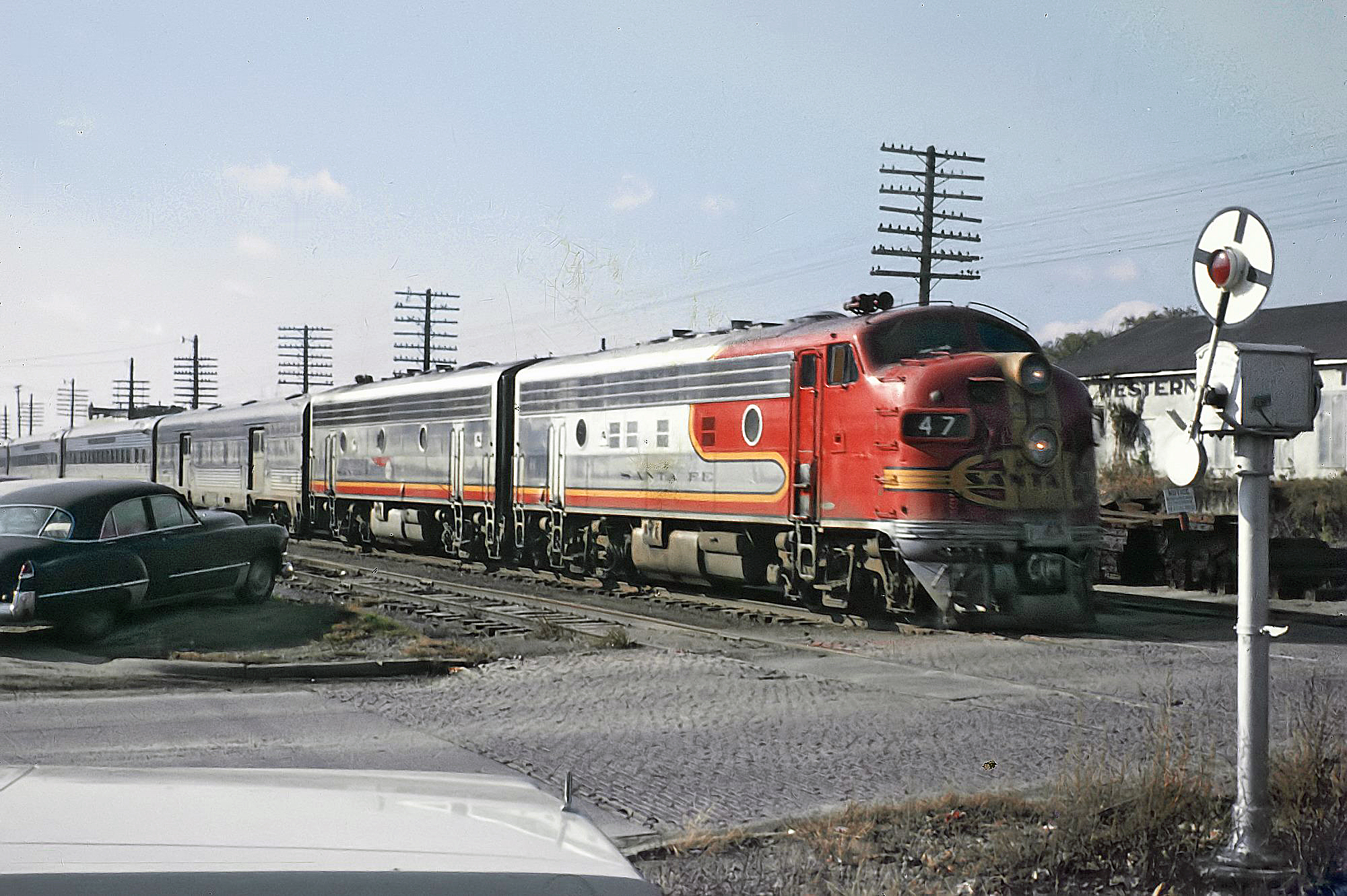 Santa Fe’s train #48, the "Oil Flyer," is northbound at Chanute, Kansas in November, 1969. This train connected Tulsa with Kansas City. Rick Burn photo.
Santa Fe-Southern Pacific
As many railroads struggled after World War II, reaching a critical nature by the 1970's, several saw merger as the only way to reduce costs and increase profits; after the Staggers Act greatly deregulated the industry this movement hastened prodigiously.
In the west, several took place during the 1980's including Union Pacific's takeover of the Western Pacific, Missouri Pacific, and Missouri-Kansas-Texas (Katy).
There was also Burlington Northern, born in 1970 through the merger of Great Northern; Northern Pacific; Chicago, Burlington & Quincy; and Spokane, Portland & Seattle (the St. Louis-San Francisco Railway was added on June 8, 1981).
Although it remained an intimidating presence, Steve Glischinski notes in his book, "Santa Fe Railway," AT&SF officials felt they needed to find their own partner to remain competitive. They announced a union with Southern Pacific on May 15, 1980 to create the Southern Pacific & Santa Fe Railway.
Within months these talks ended but were renewed just three years later on September 27, 1983. In these latest discussions a merger was approved, creating the Santa Fe Southern Pacific Corporation.
While the two railroads remained separate their holding companies (Santa Fe Industries and Southern Pacific Company) were merged into this new holding company on December 23, 1983.
In a stunning defeat, the Interstate Commerce Commission announced on July 24, 1986 that it had denied the marriage on monopolistic grounds.
The new company had recently adopted a new livery of red and yellow (dubbed the "Kodachrome"), which had already been applied to some locomotives and other equipment. Railfans facetiously described it as "Shouldn't Paint So Fast."
According to the book, "Streamliners: A History Of The Railroad Icon" by authors Mike Schafer and Joe Welsh, what Knickerbocker came up with has been proclaimed as the most beautiful scheme to ever grace a locomotive.
He used bright red to convey a bonnet covering the nose, which swept back over the cab and curved downward around the carbody, just behind the cab door. It concluded along the skirting as trim.
On the nose, he applied a Circle and Cross Native American design with "Santa Fe" displayed in the center, all of which was accented with black pinstriping.
The remaining carbody was then dressed in either stainless steel or aluminum to match the cars. As a final touch an Indian head was displayed near the center (later versions removed this elegant touch). Indian themes continued within the interior as industrial designer Sterling McDonald created the Super Chief's classic themes.
Whenever possible he used authentic Native American colors (such as turquoise and copper), patterns, and actual murals/paintings.
Other features included a combination of rare, exotic woods like ebony, teak, satinwood, bubinga, maccassar, and ribbon primavera for trim, giving the train a truly unique elegance; everything inside exuded Native American cultures and their way of life in the Southwest.
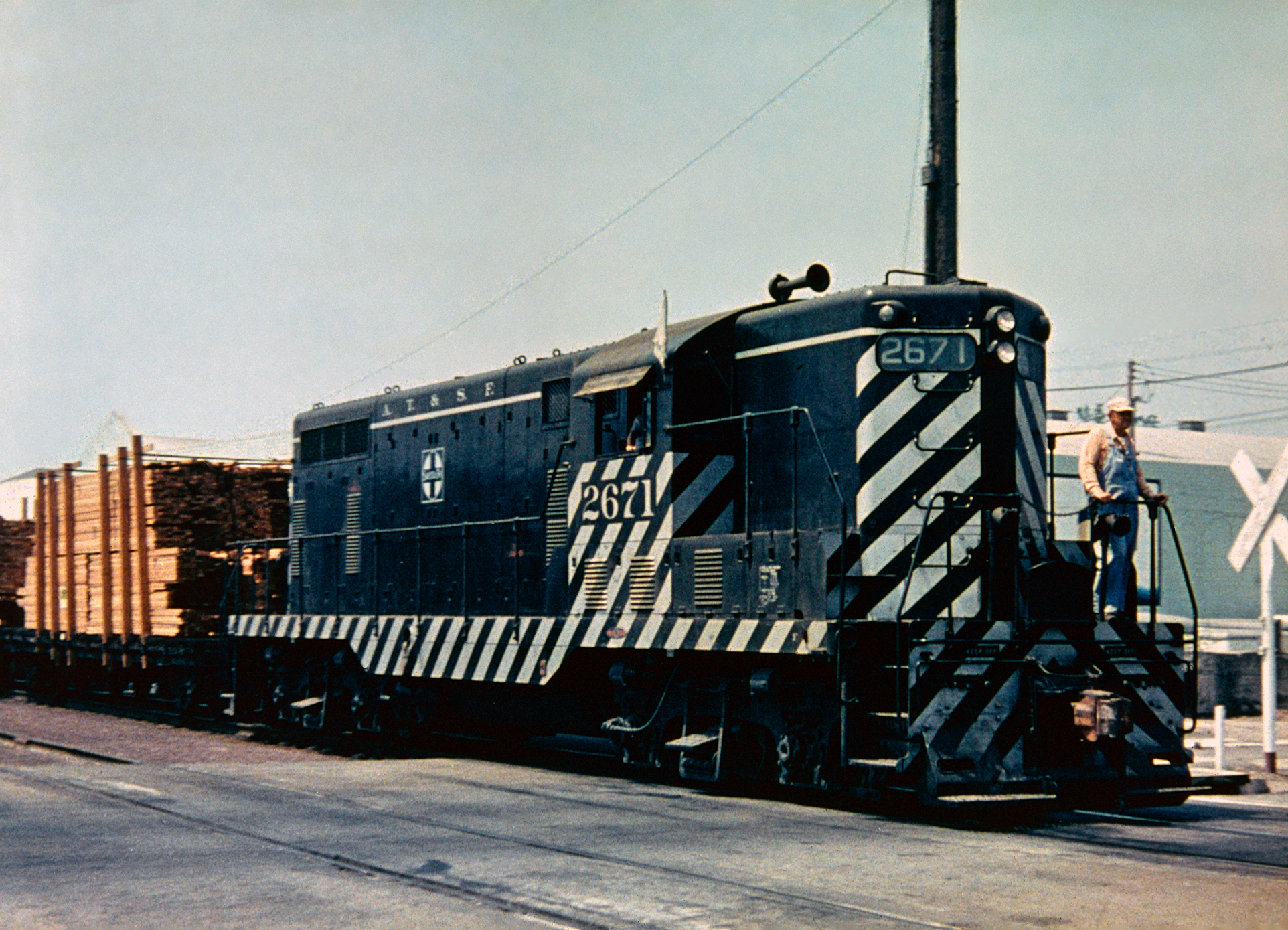 Santa Fe GP7 #2671 works local service in Pasadena, California, circa 1952. Russ Cole photo. American-Rails.com collection.
The Super Chief's success led to an entire fleet of Chiefs including its all-coach sister, the El Capitan, Texas Chief and San Francisco Chief. (For an excellent read highlighting these trains pick up a copy of Bill Yenne's, "Santa Fe Chiefs.")
There were also a bevy of other premier trains such as the Chicagoan/Kansas Cityan, Grand Canyon, and Tulsan. As Patrick Dorin highlights in his book, "Santa Fe Passenger Trains In California: From The 1940s Thru Amtrak And More," along with transcontinental trains it hosted popular intrastate services like the Golden Gate and San Diegans.
The railroad was quick to adopt the diesel in its never-ending quest for efficiency and cost savings; duly impressed with Electro-Motive's early FT, it wasted no time purchasing large blocks of this revolutionary locomotive for passenger and freight assignments.
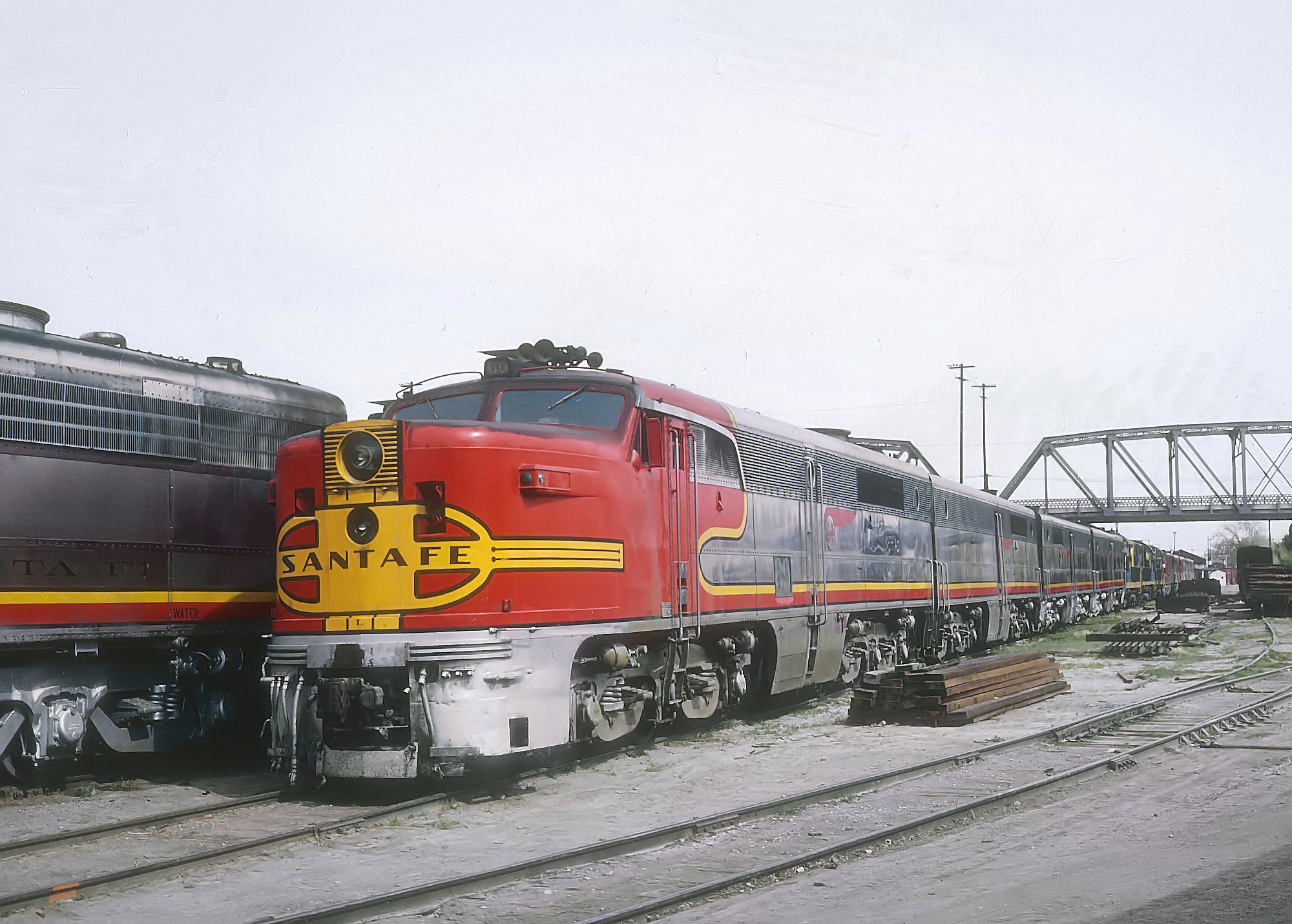 Santa Fe PA-1s and PB-1s in the deadline at Barstow, California in March, 1968. Rick Burn collection.
Passenger Trains
The Scout: (Chicago-Los Angeles)
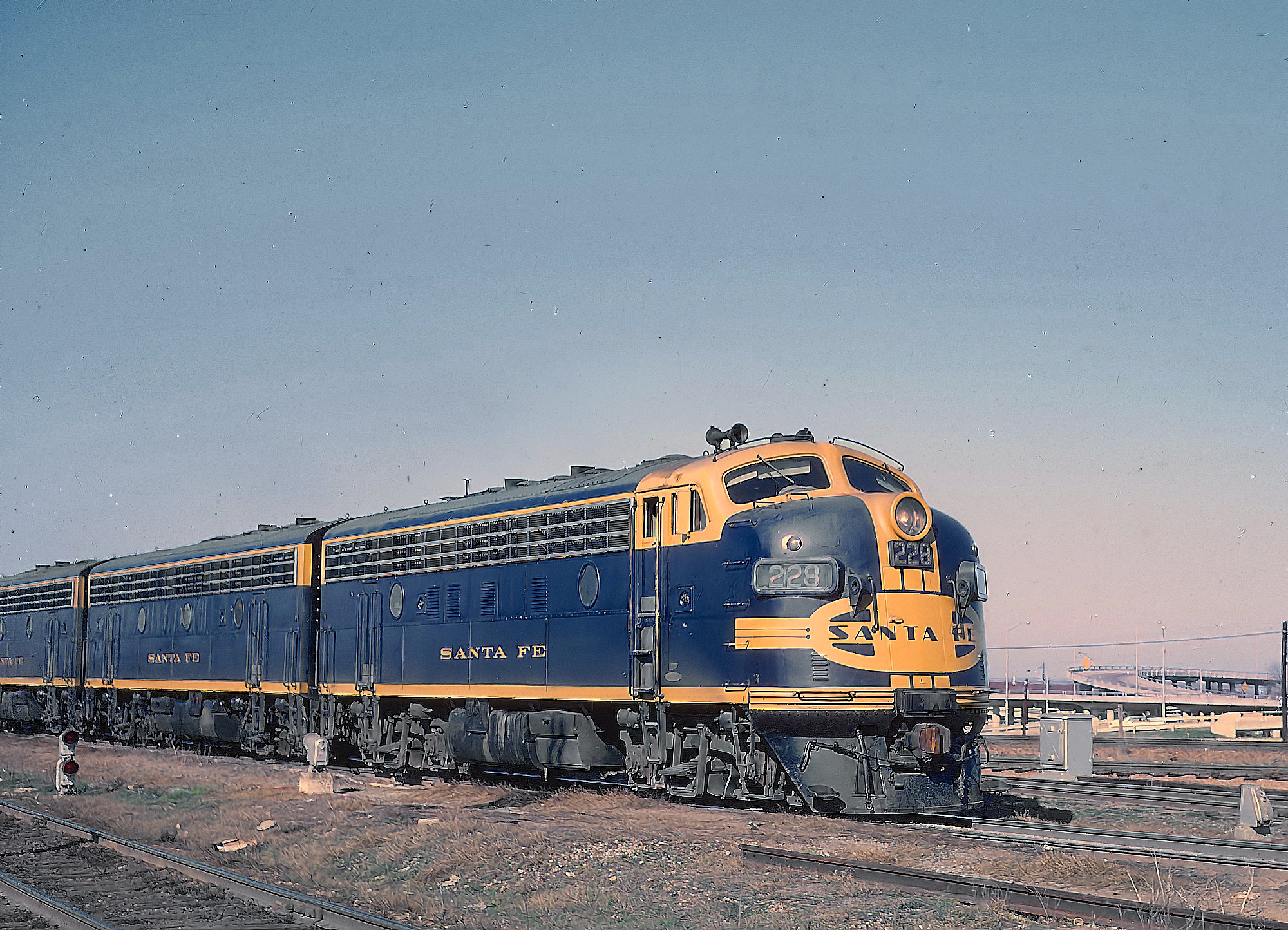 A set of Santa Fe F7s, led by #228L, wearing the railroad's classic blue freight livery, at Fort Worth, Texas in March, 1964. Dennis E. Conniff III photo, Rick Burn collection.
More Reading
It wound up with the single largest fleet, 320 in all, and would have purchased more except for the War Production Board restrictions due to World War II.
Through the 1950's it continued phasing out the iron horse until steam was officially retired on August 27, 1957. Much of the Santa Fe's success throughout its corporate history was the result of a willingness to embrace new technologies and strive for excellence.
Diesel Roster
The American Locomotive Company
| Model Type | Road Number | Date Built | Quantity |
|---|---|---|---|
| DL-109 | 50 | 1941 | 1 |
| DL-110 | 50A | 1941 | 1 |
| PA | 51C, 51L-62L, 64L-78L | 1946-1948 | 28 |
| PB | 51A-62A, 70A-73A | 1946-1948 | 16 |
| RSD-7 | 600-601 | 1955 | 2 |
| RSD-15 | 602-611, 800-849 | 1955-1960 | 60 |
| S4 | 1500-1537 | 1951-1953 | 38 |
| RSD-4 | 2100-2109 | 1951 | 10 |
| RSD-5 | 2110-2162 | 1952-1953 | 53 |
| HH-600 | 2300-2302 | 1935-1937 | 3 |
| S1 | 2303-2304 | 1944 | 2 |
| HH-1000 | 2310-2321 | 1939 | 12 |
| S2 | 2322-2391 | 1942-1949 | 70 |
| RS1 | 2394-2399 | 1947-1950 | 6 |
The Baldwin Locomotive Works
| Model Type | Road Number | Date Built | Quantity |
|---|---|---|---|
| DS-4-4-750 | 525-533 | 1949 | 9 |
| DS-4-4-1000 | 2200, 2260-2299 | 1948-1949 | 41 |
| VO-1000 | 2201-2259 | 1939-1945 | 59 |
| DT-6-6-2000 | 2600-2606 | 1948-1950 | 7 |
Fairbanks Morse
| Model Type | Road Number | Date Built | Quantity |
|---|---|---|---|
| Erie-Built (A) | 90L, 90B | 1947 | 2 |
| Erie-Built (B) | 90A | 1947 | 1 |
| H10-44 | 500-502 | 1945-1948 | 3 |
| H12-44 | 503-540, 544-564 | 1950-1957 | 59 |
| H12-44TS | 541-543 | 1956 | 3 |
| H16-44 | 2800-2819 | 1951-1952 | 20 |
 Santa Fe GP7 #2884 and F7As #231L, #211C, and #273C at Sweetwater, Texas on May 30, 1968. Tom Hoffmann photo, Rick Burn collection.
Electro-Motive Corporation/Electro-Motive Division
| Model Type | Road Number | Date Built | Quantity |
|---|---|---|---|
| E1A | 2-9 | 1937-1938 | 8 |
| E1B | 2A-4A | 1937-1938 | 3 |
| E3A | 11L | 1939 | 1 |
| E3B | 11A | 1939 | 1 |
| E6A | 12L-15L | 1939-1941 | 4 |
| E6B | 12A, 13A, 15A | 1939-1941 | 3 |
| E8A | 2, 4-5, 82, 84-87 | 1952-1953 | 8 |
| E8B | 83A-84A | 1953 | 2 |
| F3A | 16L-36L, 16C-36C | 1946-1949 | 42 |
| F3B | 16A-36A, 16B-36B | 1946-1949 | 42 |
| FP45 | 100-108 | 1967 | 9 |
| GP60M | 100-162 | 1990 | 63 |
| FTA | 100L-179L, 100C-179C | 1940-1945 | 160 |
| FTB | 100A-179A, 100B-179B | 1940-1945 | 160 |
| SD75M | 200-275 | 1995-1996 | 76 |
| F7A | 37-47, 37C-47C, 200L-280L, 200C-280C, 202-280, 300-316, 336-344, 300L-314L, 325L-344L | 1948-1953 | 324 |
| F7B | 200A-280A, 200B-280B, 300A-314A, 300B-314B, 325A-344A, 325B-340B | 1948-1953 | 228 |
| F9A | 281L-289L, 281C-289C | 1956 | 18 |
| F9A | 281A-289A, 281B-289B | 1956 | 18 |
| GP60B | 325-347 | 1991 | 23 |
| GP9 | 700-751 | 1956-1957 | 52 |
| SD24 | 900-979 | 1959-1960 | 80 |
| GP20 | 1100-1174 | 1960-1961 | 75 |
| GP30 | 1200-1284 | 1962-1963 | 85 |
| GP35 | 1300-1460 | 1964-1965 | 161 |
| SD40 | 1700-1719 | 1966 | 20 |
| SD45 | 1800-1889, 5590-5624 | 1966-1970 | 125 |
| F45 | 1900-1939 | 1968 | 40 |
| SC | 2151-2153, 2301 | 1936-1937 | 4 |
| NW | 2350-2352 | 1937 | 3 |
| NW2 | 2353-2367 | 1939-1943 | 15 |
| SW7 | 2420-2438 | 1953 | 19 |
| GP7 | 2650-2893 | 1950-1953 | 244 |
| GP7B | 2788A-2792A | 1953 | 5 |
| GP38 | 3500-3560 | 1970 | 61 |
| GP39-2 | 3600-3705 | 1974-1980 | 106 |
| GP40X | 3800-3809 | 1978 | 10 |
| GP50 | 3810-3854 | 1981-1985 | 45 |
| GP60 | 4000-4039 | 1988-1989 | 40 |
| GP60 | 4000-4019 | 1969 | 20 |
| SD40-2 | 5020-5192, 5200-5213 | 1977-1981 | 187 |
| SD45-2 | 5625-5714 | 1972-1974 | 90 |
General Electric
| Model Type | Road Number | Date Built | Quantity |
|---|---|---|---|
| U28CG | 350-359 | 1965 | 10 |
| U30CG | 400-405 | 1968 | 6 |
| 44-Tonner | 460-468 | 1942-1944 | 9 |
| B40-8/W | 500-582, 7410-7449 | 1988-1992 | 123 |
| C44-9W | 600-699 | 1993-1994 | 100 |
| C40-8W | 800-926 | 1992-1993 | 127 |
| C41-8W | 927-951 | 1993 | 25 |
| U25B | 1600-1615 | 1962 | 16 |
| U23B | 6300-6348 | 1970-1971 | 49 |
| B23-7 | 6350-6418 | 1978-1984 | 69 |
| B39-8 | 7400-7402 | 1984 | 3 |
| B36-7 | 7484-7499 | 1980 | 16 |
| U23C | 7500-7519 | 1969 | 20 |
| C30-7 | 8010-8166 | 1977-1982 | 157 |
| U33C | 8500-8524 | 1969 | 25 |
| U36C | 8700-8799 | 1972-1975 | 100 |
Steam Roster
| Class | Type | Wheel Arrangement |
|---|---|---|
| 1170, 3300 | Articulated | 2-6-6-2 |
| 3296 | Articulated | 2-8-8-0 |
| 1790, 1798 | Articulated | 2-8-8-2 |
| 3000 | Articulated | 2-10-10-2 |
| 507 | Atlantic | 4-4-2 |
| 4101, 4193 | Berkshire | 2-8-4 |
| 789, 2439, 2442 | Consolidation | 2-8-0 |
| 987 | Decapod | 2-10-0 |
| 3450, 3460 | Hudson | 4-6-4 |
| 1396 | Mallet | 4-4-6-2 |
| 882, 3100, 3129, 3160, 4000 | Mikado | 2-8-2 |
| 591, 2445 | Mogul | 2-6-0 |
| 3700 | Mountain | 4-8-2 |
| 2900, 3751, 3765, 3776 | Northern | 4-8-4 |
| 1200, 1226, 3400, 3500, 3600 | Pacific | 4-6-2 |
| 1000, 1050 | Prairie | 2-6-2 |
| 900, 985, 1600, 3020, 3290, 3291, 3800 | Santa Fe | 2-10-2 |
| 2110 | Switcher | 0-6-0 |
| 2450 | Switcher | 0-6-0T |
| 2535 | Switcher | 0-8-0 |
| 5000, 5001, 5011 | Texas | 2-10-4 |
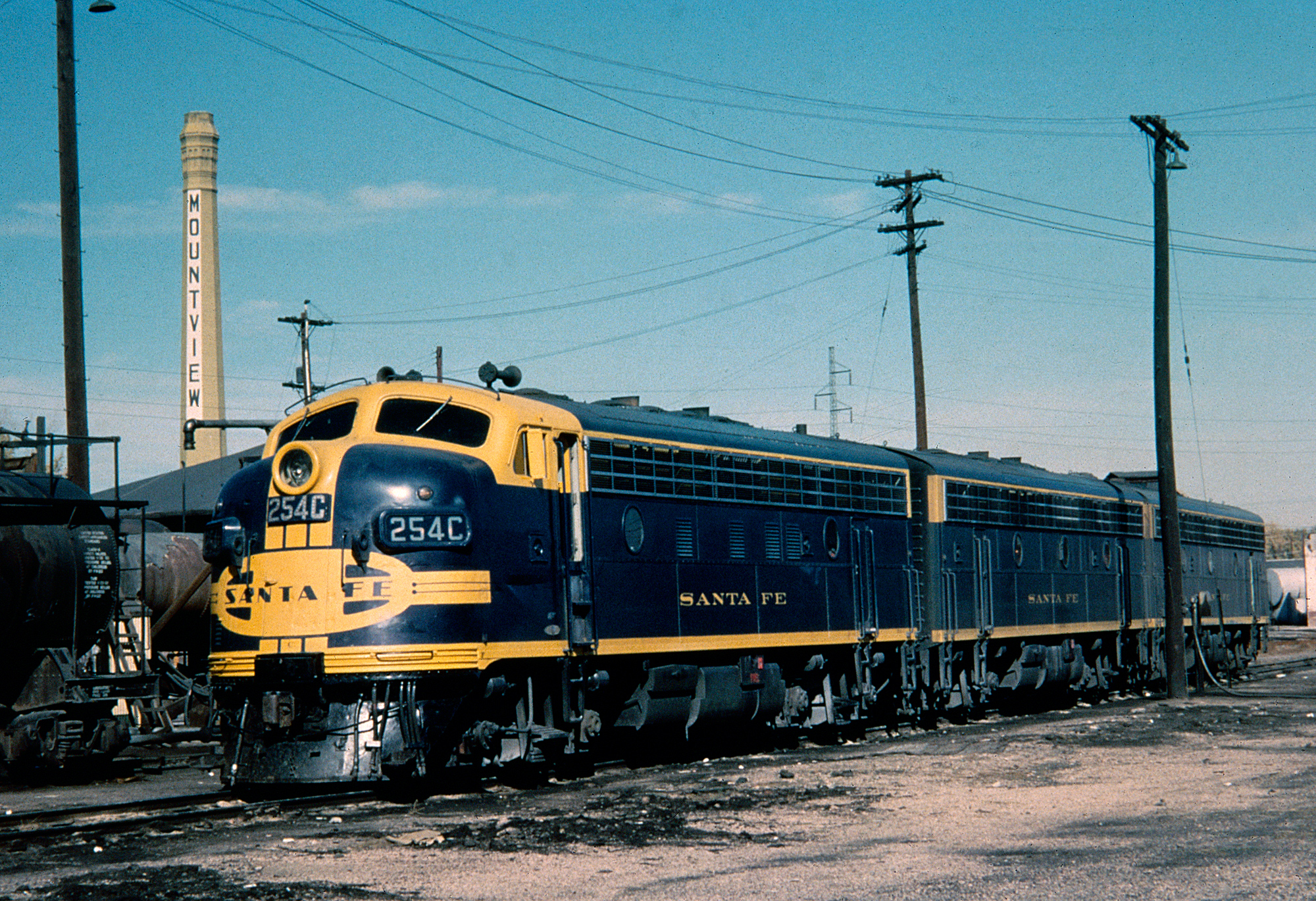 Santa Fe F7A #254-C and a pair of B units layover at Colorado & Southern's Rice Yard in Denver, Colorado during the 1950s. American-Rails.com collection.
Burlington Northern Santa Fe
It was quick to employ the newfangled autorack (a specialized car with two or three levels to haul automobiles) and began experimenting with TOFC (trailer-on-flat-car)/piggyback service in 1952. As the intermodal revolution took hold its transcontinental main line was ideally suited to handle shipping containers.
While UP was working to acquire the C&NW in 1995 and SP/D&RGW a year later, Burlington Northern entered talks with the Atchison, Topeka & Santa Fe about a possible merger. The two made the formal announcement on June 30, 1994 and the plan was approved by shareholders on February 7, 1995.
After Union Pacific dropped its appeal a month earlier the Interstate Commerce Commission gave its blessing on August 23, 1995.
With legal hurdles out of the way, the Burlington Northern Santa Fe Corporation was formed to acquire each railroad's holding company (Burlington Northern, Inc. and the Santa Fe Pacific Corporation), a process made official on September 22, 1995.
The last piece of the puzzle included the merging of the actual railroads; on December 31, 1996 Santa Fe and its iconic "Warbonnet" livery was dissolved into Burlington Northern, subsequently renamed as the Burlington Northern and Santa Fe Railway Company. While it is gone the Atchison, Topeka and Santa Fe Railway and its famous Warbonnet livery will certainly forever live on.
Photos
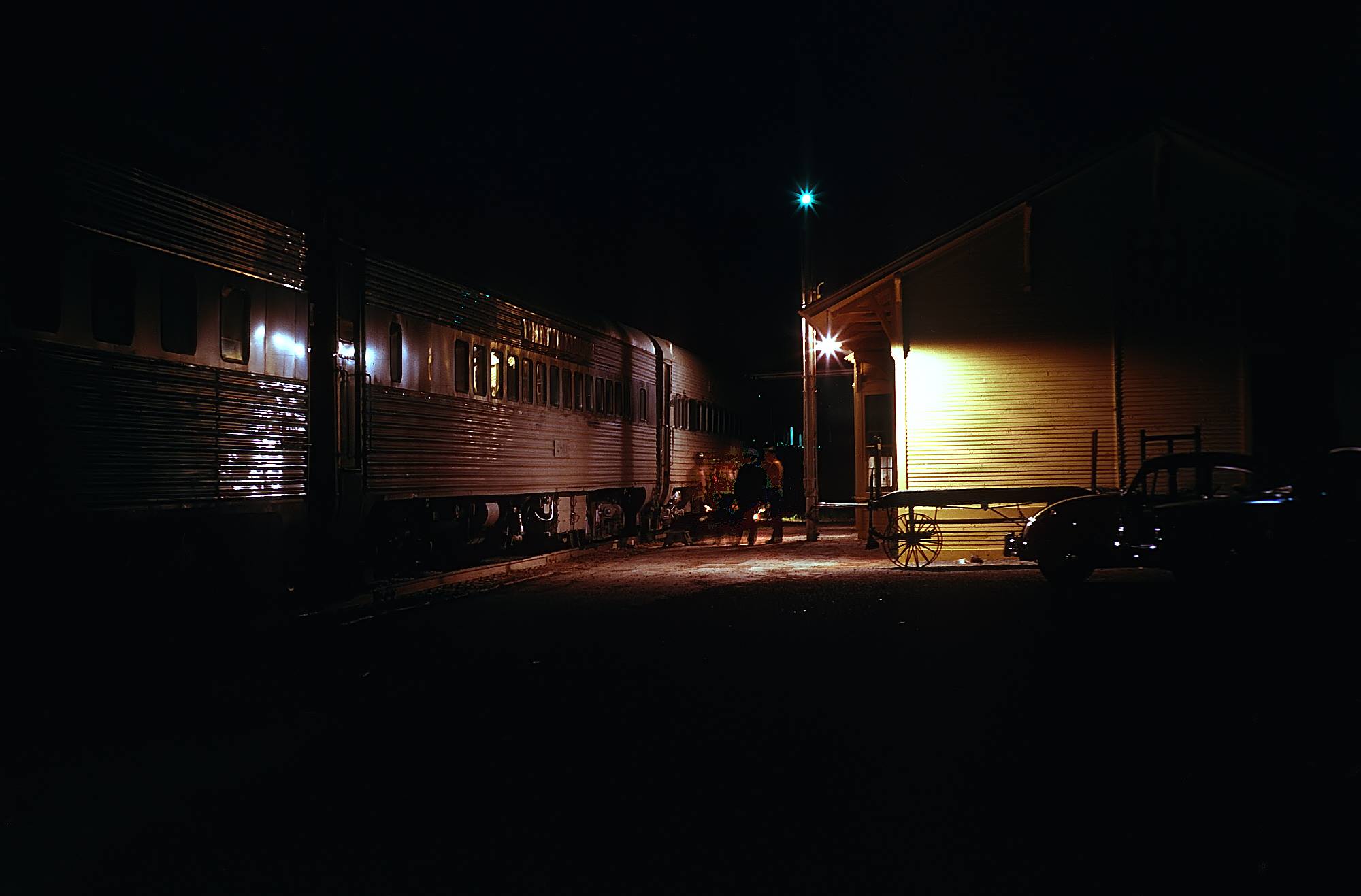 A fascinating night scene of train 76, the "California Special," stopped at View, TX in May, 1968. This train was essentially the Houston connection for the "San Francisco Chief," running between Houston and Clovis, New Mexico where the two trains met. Tom Hoffmann photo, Rick Burn collection.
Recent Articles


-
DM&IR Railroad Timetables (March, 1940)
May 15, 26 12:25 AM
 Highlighted here is the Duluth, Missabe & Iron Range's timetable listing from the March, 1940 edition of the "Official Guide Of The Railways."
 -
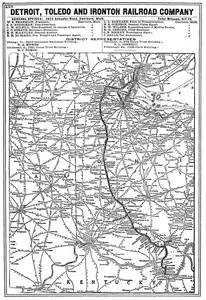
Detroit, Toledo & Ironton Timetables (January, 1930)
May 15, 26 12:17 AM
 Featured here is the Detroit, Toledo & Ironton Railroad's timetable listing from the January, 1930 edition of the "Official Guide Of The Railways."
 -
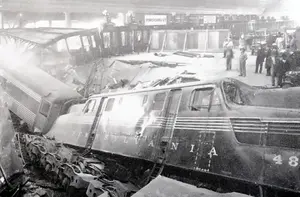
The Wreck of PRR's "The Federal" At Washington Union Station
May 15, 26 12:09 AM
 On the morning of January 15, 1953 Washington Union Station became the scene of one of the most spectacular yet miraculously non-fatal train wrecks in American railroad history.
 -
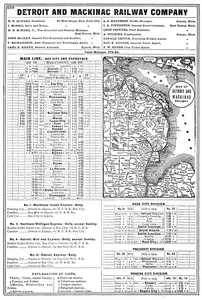
Detroit & Mackinac Timetables (January, 1930)
May 14, 26 04:13 PM
 Featured here is the Detroit & Mackinac Railway's brief timetable listing from the January, 1930 edition of the "Official Guide Of The Railways."
 -
Friends of the 261 to Host Exclusive Charity Dinner
May 14, 26 02:34 PM
 Friends of the 261, the nonprofit organization dedicated to preserving and operating historic rail equipment, invites the public to celebrate railroading heritage with a special evening charity dinner…
 -
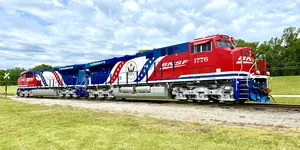
BNSF Unveils "America250" Heritage Locomotives
May 14, 26 02:06 PM
 BNSF Railway today rolled out three specially painted locomotives honoring America’s 250th birthday, featuring bold red, white, and blue liveries and the official America250 logo.
 -
Wisconsin 'Murder Mystery' Dinner Train Rides
May 14, 26 12:18 PM
 Whether you're a fan of mystery novels or simply relish a night of theatrical entertainment, Wisconsin's murder mystery dinner trains promise an unforgettable adventure.
 -
Missouri 'Murder Mystery' Dinner Train Rides
May 14, 26 12:17 PM
 Missouri, with its rich history and scenic landscapes, is home to one location hosting these unique excursion experiences.
 -
Maryland - Whiskey Tasting - Train Rides
May 14, 26 12:15 PM
 You can enjoy whiskey tasting by train at just one location in Maryland, the popular Western Maryland Scenic Railroad based in Cumberland.
 -
California - Whiskey Tasting - Train Rides
May 14, 26 12:13 PM
 There is currently just one location in California offering whiskey tasting by train, the famous Skunk Train in Fort Bragg.
 -
Oregon 'Wine Tasting' Train Rides
May 14, 26 11:43 AM
 For those looking to explore this wine paradise in style and comfort, Oregon's wine tasting trains offer a unique and enjoyable way to experience the region's offerings.
 -
Virginia 'Wine Tasting' Train Rides
May 14, 26 11:29 AM
 Wine tasting trains in Virginia provide just that—a unique experience that marries the romance of rail travel with the sensory delights of wine exploration.
 -
South Shore Line Timetables (August, 1952)
May 14, 26 11:25 AM
 Included here is the Chicago, South Shore & South Bend Railroad's timetable listing from the August, 1952 edition of the "Official Guide."
 -
Chicago & Illinois Midland Timetables (March, 1933)
May 13, 26 07:15 PM
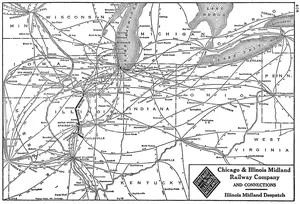
 Included here is the Chicago & Illinois Midland's two-page listing from the March, 1933 edition of the "Official Guide of the Railways."
 -
Scenic Dinner Train Rides (2026): A Complete Guide
May 13, 26 01:57 PM
 Dinner trains have become a popular attraction in recent years. Here, you can find dates and locations for these events in 2025.
 -
Railroad Museums In The USA (2026): A Complete Guide
May 13, 26 01:56 PM
 Find out about all of the many railroad museums that operate around the United States, which work to keep alive our nation's history with trains.
 -
Pennsylvania "Father's Day" Train Rides
May 13, 26 12:53 PM
 This state offers a unique way to celebrate Father's Day with unforgettable train rides that combine history, stunning landscapes, and a dash of nostalgia.
 -
New York "Father's Day" Train Rides
May 13, 26 12:52 PM
 If you’re looking to make this day memorable, consider taking a scenic train ride with your dad through the beautiful landscapes of New York State.
 -
Texas Father's Day Train Rides
May 13, 26 12:50 PM
 In Texas, Father's Day can be made unique by combining the nostalgia and charm of train rides with the grandeur of the Texas landscape.
 -
Alabama - Murder Mystery - Dinner Train Rides
May 13, 26 12:49 PM
 There is currently one location in the state offering a murder mystery dinner experience, the Wales West Light Railway!
 -
Pennsylvania - Whiskey Tasting - Train Rides
May 13, 26 12:38 PM
 For whiskey aficionados and history buffs alike, a train ride through the Keystone State offering such spirits provides a unique and memorable experience.
 -
Tennessee 'Wine Tasting' Train Rides
May 13, 26 12:35 PM
 One of the most unique and enjoyable ways to savor the flavors of Tennessee’s vineyards is by train aboard the Tennessee Central Railway Museum.
 -
North Carolina 'Wine Tasting' Train Rides
May 13, 26 12:32 PM
 A noteworthy way to explore North Carolina's beauty is by hopping aboard the Great Smoky Mountains Railroad and sipping fine wine!
 -
Reading & Northern Showcases "America250" Caboose
May 13, 26 12:04 PM
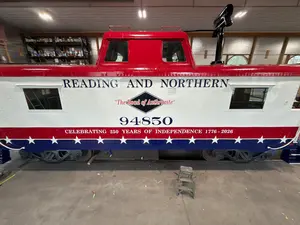
The Reading & Northern has unveiled repainted PRR N-8 caboose #94850 in "America250" colors. The car made its first run on May 8, 2026. -
Chicago & Eastern Illinois Timetables (August, 1952)
May 13, 26 11:50 AM
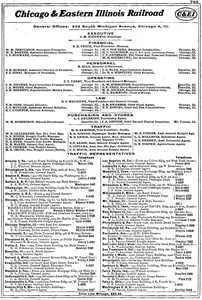
 Covered here is the Chicago & Eastern Illinois Railroad's complete timetable listing from the August, 1952 edition of the "Official Guide."
 -
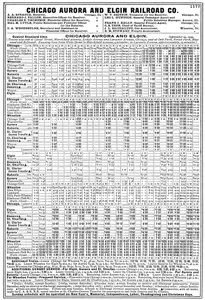
Chicago, Aurora and Elgin Timetables (March, 1940)
May 13, 26 12:03 AM
 Featured here is the Roarin' Elgin's single page timetable listing from the March, 1940 issue of the "Official Guide Of The Railways."
 -
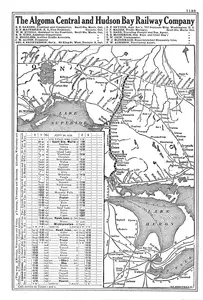
Algoma Central Railway Timetables (March, 1940)
May 12, 26 11:51 PM
 Highlighted here is the Algoma Central Railway's single page timetable listing in the March, 1940 edition of the "Official Guide."
 -
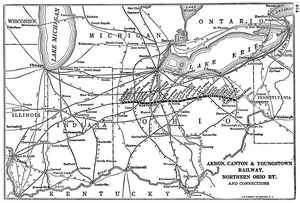
Akron, Canton & Youngstown Timetables (March, 1940)
May 12, 26 10:45 PM
 Featured here is the Akron, Canton & Youngstown's brief timetable listing in the "Official Guide" from the March, 1940 edition.
 -
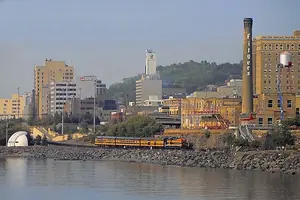
Minnesota 'Dinner Train' Rides At Duluth
May 12, 26 12:47 PM
 One of the best ways to feel the region's history in motion today is aboard the North Shore Scenic Railroad (NSSR), which operates out of Duluth’s historic depot.
 -
Maryland 'Dinner Train' Rides At Walkersville
May 12, 26 12:45 PM
 While WSRR runs a variety of seasonal and special trains, one of its most appealing “date night” offerings is the Valentine’s Dinner Train, a romantic two-hour ride built around classic railroad ambia…
 -
Utah 'Murder Mystery' Dinner Train Rides
May 12, 26 12:43 PM
 This article highlights the murder mystery dinner trains currently avaliable in the state of Utah!
 -
Rhode Island 'Murder Mystery' Dinner Train Rides
May 12, 26 12:41 PM
 Let's dive into the enigmatic world of murder mystery dinner train rides in Rhode Island, where each journey promises excitement, laughter, and a challenge for your inner detective.
 -
Nevada 'Wine Tasting' Train Rides
May 12, 26 12:20 PM
 While it may not be the first place that comes to mind when you think of wine, you can sip this delight by train in Nevada at the Nevada Northern Railway.
 -
New Hampshire "Wine Tasting" Train Rides
May 12, 26 12:18 PM
 This article details New Hampshire's most enchanting wine tasting trains, where every sip is paired with breathtaking views and a touch of adventure.
 -
New Jersey 'Wine Tasting' Train Rides
May 12, 26 12:17 PM
 If you're seeking a unique outing or a memorable way to celebrate a special occasion, wine tasting train rides in New Jersey offer an experience unlike any other.
 -
West Pointe Route Timetables (August, 1952)
May 11, 26 08:23 PM
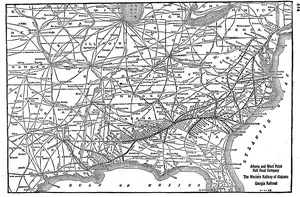
 Included here is the complete West Point Route timetables, including the Georgia Railroad, from the August, 1952 edition of the "Official Guide."
 -
Virginian Railway Timetables (August, 1952)
May 11, 26 04:27 PM
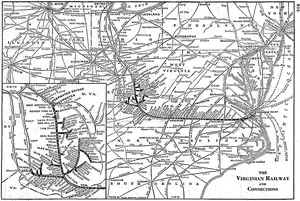
 Included here is the Virginian Railway's complete system map and brief timetable listing from the August, 1952 edition of the "Official Guide."
 -
RF&P Railroad Timetables (August, 1952)
May 11, 26 02:21 PM
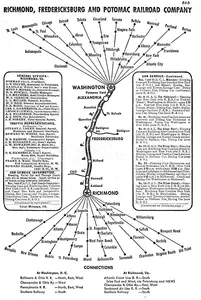
 Featured here is the Richmond, Frederickburg & Potomac's public timetables from the August, 1952 edition of the "Official Guide."
 -
Missouri 'Wine Tasting' Train Rides
May 11, 26 12:20 PM
 The fusion of scenic vistas, historical charm, and exquisite wines is beautifully encapsulated in Missouri's wine tasting train experiences.
 -
Minnesota 'Wine Tasting' Train Rides
May 11, 26 12:19 PM
 This article takes you on a journey through Minnesota's wine tasting trains, offering a unique perspective on this novel adventure.
 -
Alabama - Whiskey Tasting - Train Rides
May 11, 26 12:14 PM
 With a little planning, you can build a memorable whiskey-and-rails getaway in the Heart of Dixie.
 -
Washington 'Murder Mystery' Dinner Train Rides
May 11, 26 12:11 PM
 This article delves into what makes murder mystery dinner train rides in Washington State such a captivating experience.
 -
Nevada 'Murder Mystery' Train Rides
May 11, 26 12:09 PM
 Seamlessly blending the romance of train travel with the allure of a theatrical whodunit, these excursions promise suspense, delight, and an unforgettable journey through Nevada’s heart.
 -
Kentucky 'Murder Mystery' Dinner Train Rides
May 11, 26 12:06 PM
 In the realm of unique travel experiences, Kentucky offers an enchanting twist that entices both locals and tourists alike: murder mystery dinner train rides.
 -
Original Norfolk Southern Timetables (January, 1930)
May 11, 26 10:06 AM
 Featured here is the complete timetable listing of the original Norfolk Southern Railway from the January, 1930 edition of the "Official Guide."
 -
Atlantic and Danville Railway: Serving Southern VA
May 11, 26 09:50 AM
 The Atlantic and Danville Railway (reporting mark AD), often referred to in its early years as the Atlantic & Danville Railroad, stands as a quintessential example of late-19th-century American railro…
 -
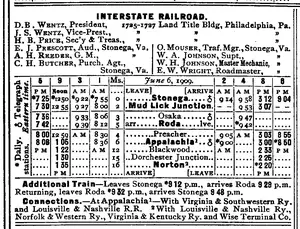
Interstate Railroad Timetables (January, 1910)
May 11, 26 09:25 AM
 Featured here is the Interstate Railroad's very brief timetable listing from the January, 1910 edition of the "Official Guide Of The Railways."
 -
Virginia "Whiskey Tasting" Train Rides
May 10, 26 01:01 PM
 Among the Virginia Scenic Railway's most popular specialty excursions is the “Bourbon & BBQ” tasting train, an adults-oriented rail journey that pairs scenic views of the Shenandoah Valley wit…
 -
Tennessee 'Whiskey Tasting' Train Rides
May 10, 26 12:58 PM
 Here’s what to know, who to watch, and how to plan an unforgettable rail-and-whiskey experience in the Volunteer State.
 -
New York 'Dinner Train' Rides In The Adirondacks
May 10, 26 12:51 PM
 Operating over a restored segment of the former New York Central’s Adirondack Division, the Adirondack Railroad has steadily rebuilt both track and public interest in passenger rail across the region.



%20as%20they%20travel%20westbound%20through%20Port%20Chicago%2C%20California%20during%20March%20of%201968.%20The%20trailing%20unit%20had%20died%20leaving%20lead%20unit%20%2367-L%20to%20power%20the%20train%20back%20into%20Richmond.%20Drew%20Jacksich%20photo.)
%2C%20likely%20from%20the%20mid-1950s%2C%20featuring%20venerable%20FTs%2C%20F3s%2C%20and%20F7s%20wearing%20both%20the%20passenger%20%22Warbonnet%22%20livery%20and%20blue-and-yellow%20freight%20scheme.)


%20near%20Venus%2C%20Texas%3B%20August%2C%201985.%20%20Mike%20Bledsoe%20photo.%20%20American-Rails.com%20collection.)
%20in%20February%2C%201949.%20%20Note%20the%20railroad's%20only%20A-B-A%20set%20of%20%22Erie-Builts%22%20at%20right.%20American-Rails.com%20collection.)

%20engine%20terminal%2C%20circa%201983.%20%20Mike%20Bledsoe%20photo.%20%20American-Rails.com%20collection.)
%20gathered%20for%20a%20group%20photo%20at%20Barstow%2C%20California%20on%20December%2021%2C%201976.%20K.B.%20King%20photo.%20American-Rails.com%0A%20collection.)


