Reading Iron Horse Rambles: T-1 Steam Excursions, 1959–1964
Last revised: August 11, 2026
By: Adam Burns
The Iron Horse Rambles were the Reading Company’s official steam excursion program of 1959–1964: main-line fan trips behind the road’s home-rebuilt Class T-1 4-8-4s over anthracite country, New Jersey branches, fall-foliage routes, and Gettysburg battlefield specials. In roughly five seasons the railroad ran on the order of fifty to fifty-one Rambles, carried tens of thousands of passengers, and left a permanent mark on American steam preservation. The first trip left Wayne Junction on October 25, 1959, behind #2124; the last official Ramble ran October 17, 1964, between Philadelphia and Tamaqua—not early 1964, as thinner accounts sometimes claim.
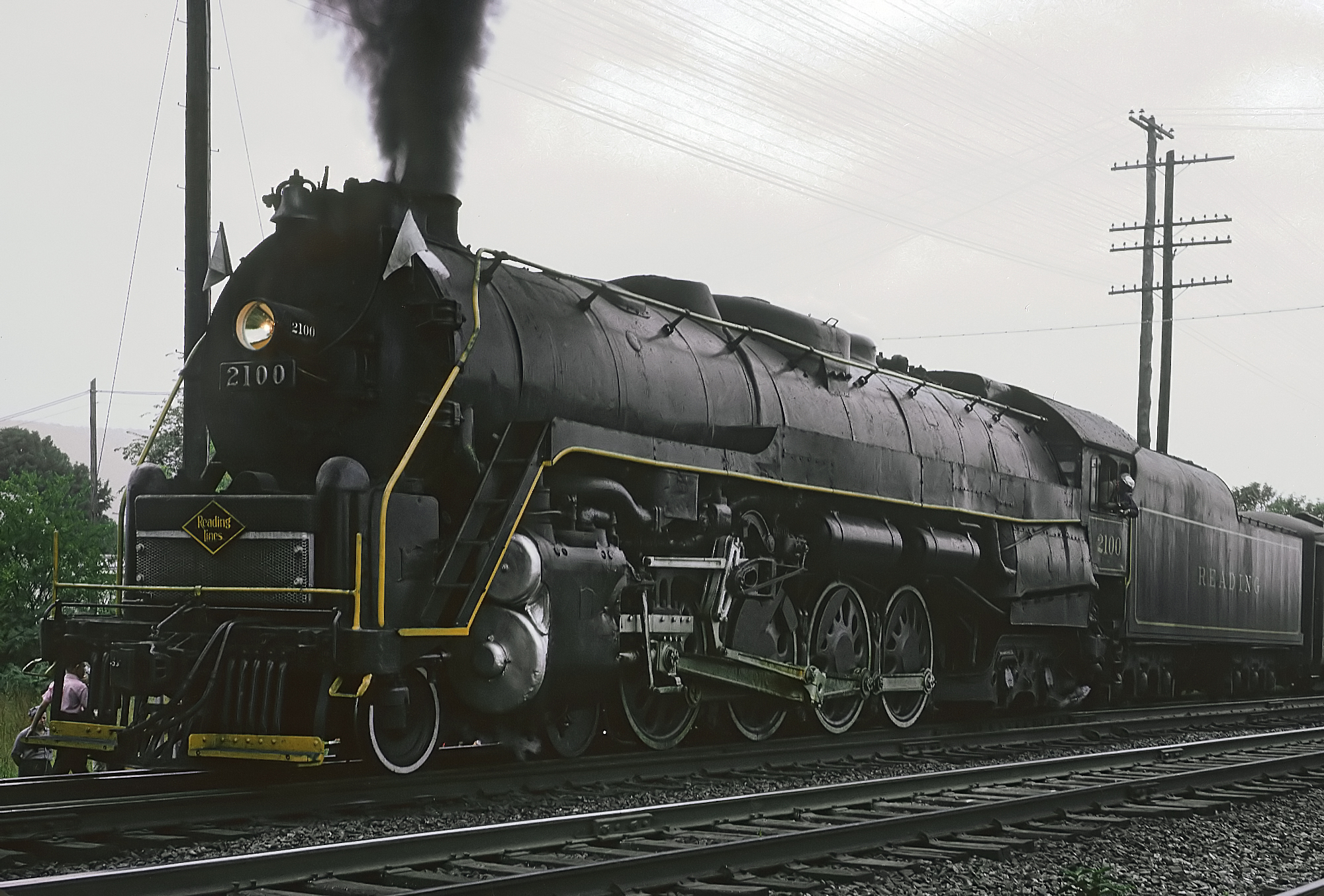
Reading T-1 #2100 on an Iron Horse Ramble between Bound Brook, New Jersey, and Tamaqua, Pennsylvania, September 1964—late in the program’s life. Roger Puta photo.
Today the name lives again on the Reading & Northern, where T-1 #2102 has returned to passenger service and market trips under the Iron Horse Rambles banner. The modern trains are spiritual successors, not a continuous company program—but they prove how deeply the original Reading outings still resonate.
At a Glance
| Topic | Detail |
|---|---|
| Operator | Reading Company (passenger / public relations departments with multi-department support) |
| Program name | Iron Horse Rambles |
| Years | October 25, 1959 – October 17, 1964 |
| Approximate trips | About 50–51 Rambles |
| Approximate ridership | On the order of 50,000 passengers over the program |
| Power | Reading Class T-1 4-8-4s (principally 2100, 2101, 2102, 2124) |
| First Ramble power | #2124 (Wayne Junction, Philadelphia → Shamokin) |
| Typical consist | Long coach trains (first trip often cited around 16 cars; later trains varied) |
| Popular themes | Fall foliage; Gettysburg battlefield tours; anthracite-region destinations |
| Why they ended | Rising steam maintenance costs + Reading’s financial stress of the early 1960s |
| Modern revival | Reading & Northern / #2102 excursions branded as Iron Horse Rambles (2022–present) |
Steam Was Almost Gone—Then the Fans Showed Up
By the late 1950s the Reading, like nearly every eastern coal road, had dieselized revenue freight. The T-1 fleet that had handled fast freights only a decade earlier sat stored or headed for scrap. Rail enthusiasts still wanted to see and ride behind those 4-8-4s. On May 2, 1959, the New Jersey Chapter of the National Railway Historical Society and the New York Division of the Railway Enthusiasts sponsored a diesel-powered fan trip from Jersey City to Reading that included opportunities to photograph T-1s in storage. The crowd’s appetite was obvious.
Rather than leave the market to outside sponsors, Reading management under president Joseph A. Fisher chose an in-house program it could control for safety, image, and revenue. Passenger and public-relations staffs, with other departments, organized what became the Iron Horse Rambles: company trains, company engines, company branding. That decision is what made the Rambles different from many one-off fan trips of the era—they were a scheduled product of a Class I railroad, not a charter that merely rented the property.
The Stars: Reading Class T-1 4-8-4s
The locomotives that defined the Rambles were not brand-new 1940s Northerns from a blank sheet. They were T-1s (2100–2129), rebuilt at the Reading shops between 1945 and 1947 from thirty Baldwin-built I-10sa 2-8-0 Consolidations (originally 2020–2049). War Production Board rules limited all-new designs; rebuilding was the legal path to more power. Reading and Baldwin collaborated: Wootten fireboxes and major boiler courses from the Consolidations; new frames, drivers, and much else from Baldwin and suppliers. The result was a dual-service-capable 4-8-4 with roughly 68,000 lbf locomotive tractive effort (more with booster), 70-inch drivers, and the anthracite-road look fans still call a “T-hog.”
In freight service the T-1s were short-lived stars—withdrawn from revenue use by the mid-1950s, with a brief traffic-surge return around 1956–57 (including some Pennsylvania Railroad leases). By Ramble time they were already historical objects that still ran under their original owner’s paint. That combination—big modern steam, still lettered Reading, on home rails—was irresistible.
For the excursion program the railroad initially selected:
- #2124 and #2100 as primary power
- #2101 as a backup
- #2123 as a parts source
When #2124’s flue time expired in 1962, it left the active pool (and later went to F. Nelson Blount’s Steamtown collection). #2102 entered Ramble service as its replacement. Those four engines—2100, 2101, 2102, and 2124—are the only T-1s that survive today; every one of them is a Ramble veteran.
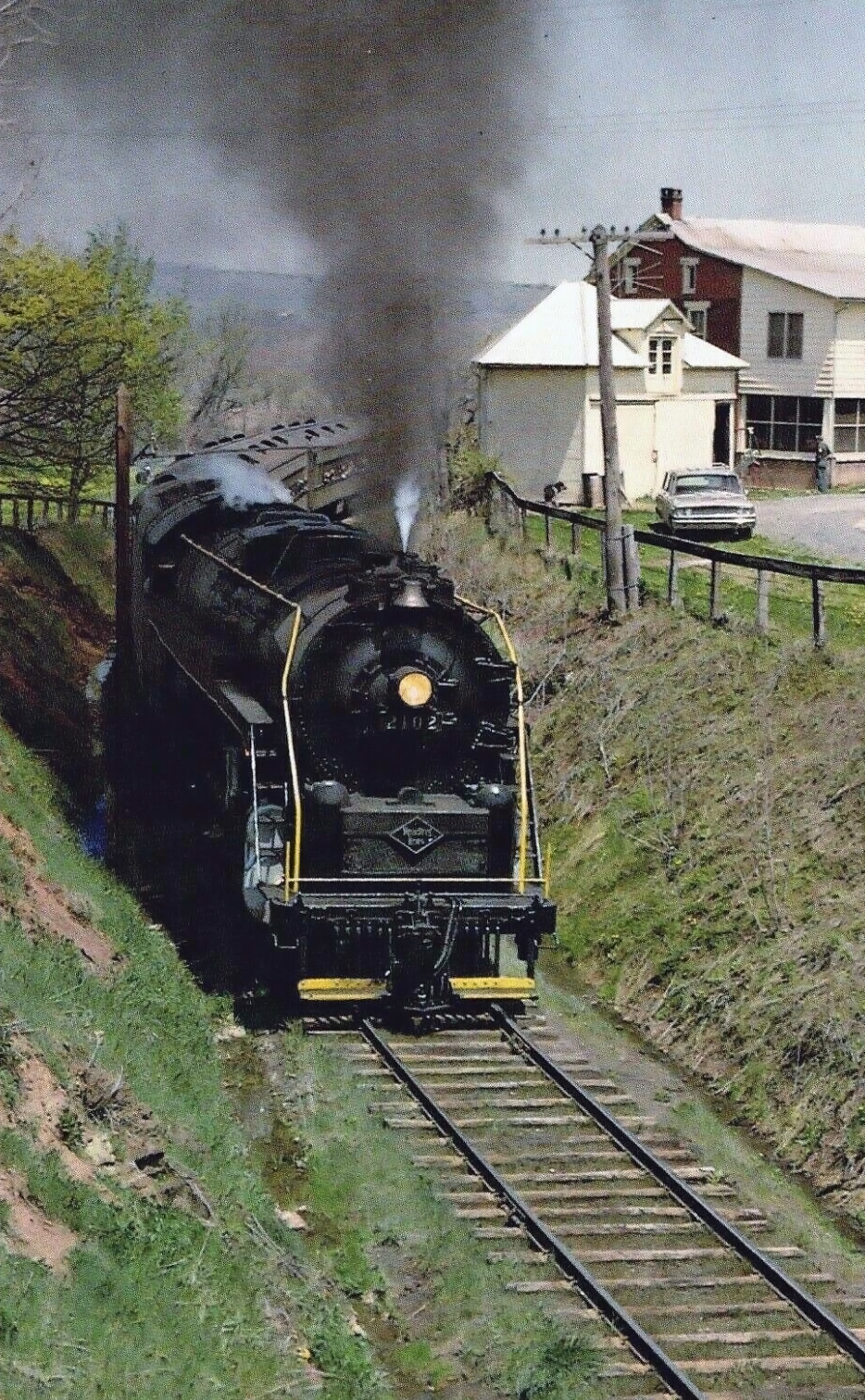
Reading #2102 leads a Ramble southbound near Biglerville, Pennsylvania, May 2, 1964, bound for Gettysburg. Carl Sturner photo.
First Trip: October 25, 1959
The inaugural Iron Horse Ramble ran on Sunday, October 25, 1959. #2124 headed a long passenger train from Wayne Junction in Philadelphia to Shamokin, deep in the anthracite region. Contemporary accounts put about 950 passengers on board—sold-out enthusiasm for a railroad that was otherwise bleeding passenger traffic. The message was clear: steam could still fill coaches if the product was special enough.
From that opening the program settled into a pattern of weekend and special-date outings through the early 1960s. Publicity sold scenery, power, and heritage. Fares in the later seasons (period newspaper notices) ran on the order of roughly $11–$12 for adults and about half that for children—real money for a day’s outing in early-1960s dollars, but still a mass-market excursion rather than a luxury cruise train.
Where the Rambles Went
Sources summarizing the program list on the order of sixteen destination patterns over the years. Themes that define the Rambles in photographs and memory include:
- Anthracite country — Shamokin, Tamaqua, and related coal-region terminals that showcased why the Reading existed
- Gettysburg — among the most popular: battlefield tourism paired with a main-line steam ride (e.g., the May 2, 1964, trip with #2102 near Biglerville)
- Fall foliage — autumn color specials through Pennsylvania hills
- New Jersey / Reading main combinations — such as Bound Brook–Tamaqua territory late in the program (#2100, September 1964)
- Other Pennsylvania points on Reading iron that gave coaches a full day of steam and photo runbys
Consists were typically long strings of coaches—crowded vestibules, open windows, and the smell of coal smoke that diesel-era riders came specifically to experience. Photo lines at runbys became part of the culture of the trips, as they did on other Class I steam excursions of the period.
Near-End, Drought, and the Real Last Ramble
Reading’s finances deteriorated in the early 1960s. Steam maintenance is expensive even when the engines are loved; flues, stays, and fireboxes do not care about fan mail. By late 1963 the company was preparing to wind the program down.
A trip originally positioned as a finale around October 19, 1963, ran into drought restrictions: state authorities wanted diesels rather than steam because of fire risk. Reading substituted diesel power for the movement and fired a T-1 for static display at the shops so passengers still saw a Northern under steam. As compensation, the railroad scheduled additional Rambles in 1964.
The final Iron Horse Ramble is generally recorded as October 17, 1964, Philadelphia area to Tamaqua. That date—not February 1, 1964—closes the official Reading program. High repair costs and the road’s broader economic condition made continuation impractical. Within a few years the surviving Ramble engines would be sold into private and museum hands; the Reading itself was sliding toward the bankruptcy and Conrail era that remade eastern railroading.
What Happened to the Ramble Engines
All four Ramble T-1s survive—an extraordinary outcome for a late steam class of thirty:
| Engine | Ramble role | Later highlights (summary) |
|---|---|---|
| 2100 | Primary power | Scrapyard, parts/restoration cycles, oil conversion plans, western storage; American Steam Railroad restoration; returned to operation in the 2020s |
| 2101 | Backup / program engine | American Freedom Train #1 (1975–76); Chessie Steam Special; fire damage 1979; static display as AFT 1 at B&O Railroad Museum (recent cosmetic work) |
| 2102 | Entered Rambles after 2124’s flue expiration (1962) | Steam Tours and other fans trips; Blue Mountain & Reading / Reading & Northern; long storage; restored 2016–2022; operating Rambles-branded excursions |
| 2124 | First Ramble engine (Oct. 25, 1959) | Sold 1962 to F. Nelson Blount; Steamtown collection; static display at Steamtown NHS, Scranton |
That four-engine preservation story is inseparable from the Rambles. Without the public program, more T-1s would almost certainly have been scrapped in the 1960s.
Why the Rambles Mattered
The Iron Horse Rambles sat at a turning point. Main-line steam was finished as a commercial tool, but it was not yet finished as a product. Reading proved a Class I could still sell out steam trips if it offered authentic power on home territory with professional organization. The program influenced how later excursion operators—private and corporate—thought about marketing steam: name the series, brand the engines, repeat the calendar, sell scenery and history together.
For Pennsylvania, the Rambles tied the Reading’s coal-road identity to public memory at the exact moment that identity was economically fading. For the national railfan community, they produced a photographic and oral archive that still circulates every autumn when leaves turn along former Reading mains.
Reading & Northern: The Name Returns
After decades of private ownership, fan trips, and storage, #2102 became the crown jewel of Andy Muller’s Reading & Northern (and predecessor Blue Mountain & Reading) steam program. Following a multi-year mechanical evaluation and rebuild, the locomotive returned to steam and, on May 28, 2022, debuted a long passenger excursion between Reading Outer Station and Jim Thorpe under the revived Iron Horse Rambles name—complete with the black-and-yellow Ramble-era look and Reading & Northern lettering.
R&N continues to operate steam trips that deliberately echo the original brand: big T-1 power, Pennsylvania scenery, and a schedule aimed at families and enthusiasts alike. They are not Reading Company trains, and the corporate map is different—but when 2102 leans into a grade with a long coach train, the connection to October 1959 is audible.
For current tickets and dates, use the railroad’s passenger site rather than this historical page; schedules change season to season.
Related Reading
- Steam Locomotives — broader U.S. steam context
- Fallen Flags — Reading Company among classic eastern systems
- Rail Tours — modern excursion landscape
- Pennsylvania scenic / fall train coverage (where listed on the site) — seasonal travel angles on former Reading territory
Sources
- Zimmermann, Karl. “Rambling on the Reading,” Classic Trains (Fall 2018) — standard narrative of the Ramble program, power assignments, and 1963–64 wind-down
- Steamtown NHS / NPS historical notes on Reading #2124 and T-1 reconstruction
- Reading Company and contemporary newspaper coverage of fares and the 1964 season
- Reading & Northern passenger / steam program materials on #2102’s return and modern Iron Horse Rambles branding
- Dirkes, Rod. The Reading’s T-1: An Unusual Northern (Andover Junction) — mechanical background
This article replaces an earlier short, generalized overview of the Iron Horse Rambles with a fact-checked history of the Reading Company program, its T-1 locomotives, dates, destinations, and modern revival.
Recent Articles


-
Kansas City Southern Steam Roster (Built Since 1900)
Oct 25, 26 11:50 AM
Steam locomotives of the Kansas City Southern built since 1900, with the Louisiana & Arkansas and the Texas company. -
Kansas City Southern Diesel Roster (Built New)
Oct 25, 26 11:46 AM
 All-time diesel roster of the Kansas City Southern. E units, F units, Geeps, SD40s through SD70ACes, Fairbanks-Morse, Baldwin, Alco, and General Electric, with serials and order numbers.
 -
Kansas City Southern Railway: Map, Photos, History
Oct 25, 26 12:24 AM
 The Kansas City Southern, from Arthur Stilwell's Gulf line to Canadian Pacific Kansas City on April 14, 2023. Steam and diesel rosters, the Southern Belle, and the Louisiana & Arkansas.
 -
Indiana Harbor Belt Diesel Roster (All-Time)
Oct 25, 26 12:17 AM
 All-time diesel roster of the Indiana Harbor Belt. 202 locomotive frames, each counted once. NW2s, SW7s, SW1500s, road switchers, and gensets. Slugs and boosters are outside the count.
 -
Indiana Harbor Belt Steam Roster (Built Since 1900)
Oct 25, 26 12:13 AM
 Steam locomotives of the Indiana Harbor Belt built since 1900. 182 engines, each counted once. 0-6-0s, 2-6-0s, 0-8-0s, and 2-8-2s. The three U-4a switchers are three-cylinder Brooks engines of 1927.
 -
Indiana Harbor Belt Railroad: Map, Rosters, History
Oct 25, 26 12:00 AM
 Indiana Harbor Belt, the inner belt across the Calumet, from the East Chicago Belt of May 16, 1896. Renamed June 29, 1907. Still operating, headquarters Hammond. Steam roster is the companion, 182 loc…
 -
NYC's "P Motor" Electric Locomotives
Oct 24, 26 11:43 PM
 New York Central P motors: 22 Alco-GE 2-C+C-2 electrics, Cleveland Union Terminal 1050–1071, class P-1a. 3,030 hp one-hour on 3,000-volt DC catenary, then 660-volt third rail as P-2a and P-2b.
 -
Illinois Terminal Car Roster
Oct 24, 26 11:40 PM
 Illinois Terminal cars. Mainline motors, the 1948 streamliners, sleepers, Alton and Valley Division cars, express motors, and the line cars rebuilt from pull cars.
 -
Illinois Terminal Diesel Roster
Oct 24, 26 09:31 PM
 All-time Illinois Terminal diesels, 62 frames. Alco S-2s and RS-1s, EMD switchers, GP7s, SD39s, GP38-2s, and the two GP20s. Serial numbers from the 1989 roster.
 -
Illinois Terminal Electric Locomotives
Oct 24, 26 08:22 PM
 Illinois Terminal electric locomotives, 57 frames. Class A through Class D, the Decatur-built motors, and the battery locomotives. Class D is the same five Class C frames, rebuilt.
 -
Illinois Terminal Steam Roster
Oct 24, 26 07:37 PM
 Illinois Terminal steam locomotives, 36 frames. Baldwin Moguls, three Class 30 Mikados, Florida East Coast 0-8-0s, and 2-6-0 No. 21, the last fire on June 30, 1950.
 -
Illinois Terminal Railroad: Map, Roster, Photos, History
Oct 24, 26 07:32 PM
 Illinois Terminal, McKinley's Illinois Traction System, from the Danville coal towns to St. Louis. The McKinley Bridge, the sleeping cars, the 1937 break with the power company, the 1948 streamliners…
 -
Southern Railway Diesel Roster (All-Time)
Oct 23, 26 11:00 PM
 All-time diesel roster of the Southern Railway. 2,505 locomotives in the system number series, from the 1939 demonstrator FT to GP50s and B30-7A1s. Serials included.
 -
Illinois Central Diesel Roster (All-Time)
Oct 23, 26 04:06 PM
 Illinois Central and Illinois Central Gulf diesel locomotives, each frame once. The quantity column is 886. Serials and order numbers from Electro-Motive's builder lists. Paducah rebuilds and Gulf, Mo…
 -
Illinois Central Gulf Diesel Roster
Oct 23, 26 04:02 PM
 Illinois Central Gulf operating numbers from August 10, 1972, to February 29, 1988. New frames stay on the Illinois Central diesel roster. Gulf, Mobile and Ohio frames stay on that roster. No Gulf fle…
 -
Illinois Central Railroad: Map, Logo, History
Oct 23, 26 03:50 PM
Illinois Central, the Main Line of Mid-America, from the 1850 land grant to Canadian National control on July 1, 1999. Charter lines, Cairo bridge, Paducah, and the Illinois Central Gulf. Steam quanti… -
Grand Trunk Western Diesel Roster (All-Time)
Oct 23, 26 12:53 PM
 Grand Trunk Western diesel locomotives, each frame once. The quantity column is 377. Serials are filled for the Detroit, Toledo and Ironton and Detroit and Toledo Shore Line engines the railroad kept…
 -
Grand Trunk Western Steam Roster
Oct 23, 26 12:14 PM
 Grand Trunk Western steam locomotives in service about 1937 to 1942, from Richard Leonard's class list. Drury has no chapter. The quantity column is the counted Grand Trunk Western rows. Two mixed Gra…
 -
Grand Trunk Western Railroad: Map, Roster, History
Oct 23, 26 12:09 PM
 Grand Trunk Western, reporting mark GTW, Canadian National's railroad between Port Huron and Chicago. Trade name adopted in 1923. Steam class list quantity 232. Diesel quantity column 377. Identity in…
 -
Green Bay and Western Railroad: Map, Rosters, History
Oct 22, 26 11:18 PM
 Green Bay & Western, the Green Bay Route, reporting mark GBW. From Kewaunee to Winona. Mailer's steam and diesel rosters, and the August 1993 sale to Fox Valley & Western.
 -
Chicago & North Western Class E-4: Streamlined 4-6-4 Hudsons
Oct 22, 26 10:28 PM
 C&NW Class E-4, nine streamlined 4-6-4s, 4001–4009, Alco 1938. 84-inch drivers, 25-by-29 cylinders, 300 psi. Conventional Chicago–Omaha trains. Oil in 1947–48. Retired 1953–1956.
 -
Gateway Western Railway: Map, Roster, History
Oct 22, 26 02:43 PM
 Gateway Western Railway, reporting mark GWWR. Class II from Kansas City to East St. Louis. Kansas City Southern control May 5, 1997. The 1992 diesel fleet, with serials and order numbers.
 -
Duluth, Winnipeg & Pacific Railway: Roster, Map, History
Oct 22, 26 01:51 PM
 Duluth, Winnipeg & Pacific, the Peg, reporting mark DWP. From the Rainy River to Duluth. CNRHA steam list 36. Fifteen RS-11s. Merged into Wisconsin Central Ltd. on December 31, 2011.
 -
Elgin, Joliet and Eastern Diesel Roster (All-Time)
Oct 22, 26 01:35 PM
 All-time diesel roster of the Elgin, Joliet and Eastern.
 -
Elgin, Joliet and Eastern Steam Roster
Oct 22, 26 01:25 PM
 Elgin, Joliet and Eastern steam locomotives of the final decade, which largely comprised switcher types, 2-8-0s, and a large fleet of Mikados.
 -
Elgin, Joliet and Eastern Railway: Map, Roster, History
Oct 22, 26 12:32 PM
 Elgin, Joliet & Eastern, the outer arc around Chicago, from the Joliet, Aurora & Northern of April 30, 1884. Illinois company March 18, 1887. Merged December 4, 1888. Principal lines sold Janu…
 -
Denver and Salt Lake Railway: History, Roster, Timetable
Oct 22, 26 09:47 AM
 Denver & Salt Lake, the Moffat Road, from Denver to Craig. Tunnel opened February 26, 1928. Dotsero Cutoff dedicated June 16, 1934. Merged April 11, 1947. Steam locomotives 59.
 -
Duluth, Missabe and Iron Range Diesel Roster (All-Time)
Oct 22, 26 09:43 AM
 All-time diesel roster of the Duluth, Missabe and Iron Range. 148 owned frames, each counted once. SW9s, SD9s, SD18s, SD38s, RSD-15s, and C630s. Serials and builder order numbers included. Helm SD40-3…
 -
Duluth, Missabe and Iron Range Steam Locomotives (Since 1900)
Oct 22, 26 09:22 AM
 Duluth, Missabe & Iron Range steam locomotives built since 1900. Duluth & Iron Range, Duluth, Missabe & Northern, and later DM&IR acquisitions. Quantity column 252. Yellowstones 220-23…
 -
Duluth, Missabe and Iron Range Railway: Roster, Map, Logo
Oct 22, 26 09:17 AM
Duluth, Missabe & Iron Range, reporting mark DMIR, from the Mesabi and the Vermilion to the Lake Superior docks. Formed July 1, 1937. Steam quantity 252. Owned diesels 148. On paper through Decemb… -
Duluth, South Shore, and Atlantic Railway: Map, Roster, Timetables
Oct 21, 26 11:21 PM
 Duluth, South Shore & Atlantic Railway, the South Shore. Marquette to the Sault, St. Ignace, Houghton, and Duluth-Superior. Soo Line on January 1, 1961. Twenty-four diesels.
 -
Detroit, Toledo and Ironton Diesel Roster (All-Time)
Oct 21, 26 02:55 PM
 All-time diesel roster of the Detroit, Toledo and Ironton. 119 frames, each counted once. Serials and builder order numbers included. Last steam was December 24, 1955.
 -
Detroit, Toledo and Ironton Steam Roster (Post 1900)
Oct 21, 26 02:49 PM
 Detroit, Toledo and Ironton steam locomotives built after 1900. Drury's class grid. The quantity column prints 141. Counted once, the frames are 137. Last steam was Mikado 805 on December 24, 1955.
 -
Detroit, Toledo and Ironton Railroad: Map, Roster, History
Oct 21, 26 02:40 PM
 Detroit, Toledo & Ironton, reporting mark DTI, from Detroit to Ironton, Ohio. Railway organized May 2, 1905. Railroad articles filed February 21, 1914. Henry Ford, 1920 to 1929. Steam and diesel r…
 -
Iowa, Chicago and Eastern Railroad: Roster, Map, History
Oct 21, 26 01:04 PM
 Iowa, Chicago & Eastern Railroad Corporation, reporting mark ICE. About 1,125 miles and about 275 miles of trackage rights from the I&M Rail Link. Operations at 12:01 a.m. July 30, 2002. Canad…
 -
Rapid City, Pierre & Eastern Railroad: Route, Roster, Overview
Oct 21, 26 10:16 AM
 Rapid City, Pierre & Eastern Railroad, reporting mark RCPE. Genesee & Wyoming Class II. Agreement of January 2, 2014, Finance Docket 35799. Freight service from June 1, 2014, on the Dakota, Mi…
 -
Dakota, Minnesota & Eastern Railroad: Roster, Map, History
Oct 21, 26 12:26 AM
 Dakota, Minnesota & Eastern Railroad, reporting mark DME. The July 2, 1986 Chicago & North Western sale, 826 miles and 139 miles of trackage rights. Canadian Pacific control October 30, 2008…
 -
Detroit and Mackinac Railway: Map, Roster, History
Oct 20, 26 11:58 PM
 Detroit & Mackinac Railway, the Turtle Line. Bay City to Cheboygan along Lake Huron. Incorporated December 29, 1894. Lake State Railway leased the operation in 1992 and bought the lines in 1997. E…
 -
Davenport, Rock Island and Northwestern Railroad
Oct 20, 26 11:22 PM
 Davenport, Rock Island and North Western Railway, the DRI Line. Clinton to East Moline across the Crescent Bridge. Burlington and Milwaukee. Merged into the Soo Line on June 29, 1995. Eighteen diesels…
 -
Chicago Great Western Steam Roster (Post 1900)
Oct 20, 26 11:17 PM
Chicago Great Western steam locomotives built or rebuilt since 1900. Drury's class grid. 320 frames, each once. The quantity column prints 376 because a rebuild is listed again. Last steam in the reti… -
Chicago Great Western Diesel Roster (All-Time)
Oct 20, 26 10:47 PM
All-time diesel roster of the Chicago Great Western. 157 frames, each counted once. Serials and builder order numbers included. Steam was gone by 1950. The 1963 glance figure of 141 is one year's flee… -
Chicago Great Western Railway: Map, Photos, History, Rosters
Oct 20, 26 10:43 PM
 The Chicago Great Western, the Corn Belt Route, linked Chicago, the Twin Cities, Omaha, and Kansas City from September 27, 1885, until the Chicago & North Western merger at 12:01 a.m. on July 1, 1968…
 -
Chicago, South Shore & South Bend Railroad: "The South Shore Line"
Oct 20, 26 05:48 PM
 Chicago South Shore & South Bend, the South Shore Line, from the 1901 Air Line through Samuel Insull's 1925 rebuild, the orange cars, the 800s, and the railroad NICTD and Anacostia still run.
 -
Northwestern Virginia Railroad: Map, History, Timetable
Oct 20, 26 04:18 PM
 Northwestern Virginia Railroad, chartered February 14, 1851, Grafton to Parkersburg, 104 miles. Opened May 1, 1857. Foreclosure sale February 15, 1865, as the Parkersburg Branch. Twenty-three tunnels…
 -
"Exposition Flyer" (Train): Consist, Timetable, History
Oct 20, 26 03:29 PM
 Exposition Flyer, Chicago to Oakland, June 10, 1939 to March 20, 1949. Burlington, Rio Grande, and Western Pacific. Heavyweight cars, then diesels and a vista-dome. Replaced by the California Zephyr.
 -
Chicago, St. Paul, Minneapolis & Omaha Railway, "The Omaha Road"
Oct 20, 26 02:13 PM
 The Omaha Road, reporting mark CMO. Formed May 26, 1880. North Western management on December 16, 1882. Leased January 1, 1957. Class K-1 No. 183 and the sublettered diesels.
 -
Chicago and Western Indiana Railroad: Map, Rosters, History
Oct 20, 26 01:17 PM
 Chicago and Western Indiana, chartered June 5, 1879. Five equal owners, Dearborn Station, and two main lines. Dolton suburban mile 16.6. Fifteen diesels. Railroad service ended in 1994. The Illinois c…
 -
Railroad Tell-Tales: Protecting The Brakeman
Oct 20, 26 12:58 PM
 Railroad tell-tales: hanging ropes that warned a man on a freight-car roof of a low bridge or tunnel. The 1897 bridge-warning report, the 1905 Wisconsin statute, retainers, and why the roof walk outla…
 -
Chicago & North Western Steam Roster (Post 1900)
Oct 20, 26 12:54 PM
 Chicago & North Western steam locomotives built since 1900, and the Omaha Road list beside it. Drury's parent quantity column sums to 1,445, with four rows left blank. The Omaha Road column sums to 24…
 -
Chicago & North Western Diesel Roster (All-Time)
Oct 20, 26 12:49 PM
 All-time diesel roster of the Chicago & North Western. 2,494 frames, each counted once, including Chicago Great Western, Minneapolis & St. Louis, and Omaha Road units that received North Western numbe…