- Home ›
- Fallen Flags ›
- Monon ›
- Thoroughbred
The “Thoroughbred”: Monon's Streamliner to the Bluegrass
Published: April 10, 2026
By: Adam Burns
The “Thoroughbred” was the flagship streamlined passenger train of the Monon Railroad, a modest Midwestern carrier whose identity was deeply tied to the state of Indiana. Though never as famous as the great streamliners of larger railroads, the Thoroughbred embodied the Monon’s postwar ambition to modernize, compete, and maintain relevance in an era increasingly dominated by highways and airlines.
Operating between Chicago and Louisville from 1948 until 1967, the train was both a product of its time and a symbol of the Monon’s final push to sustain passenger service.
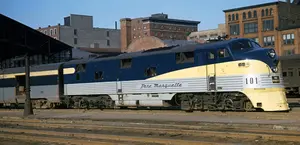
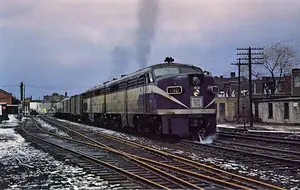
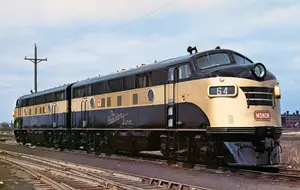
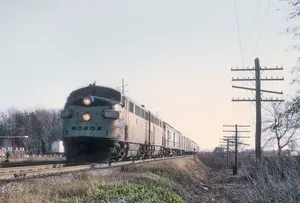
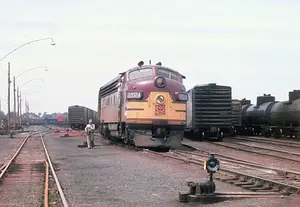
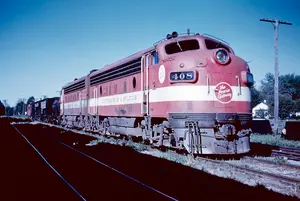
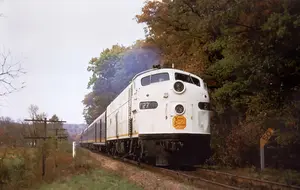
 Monon F3A #208 with train 5, the southbound "Thoroughbred," as it rounds a curve after crossing the New York Central and EJ&E at Dyer, Indiana on February 10, 1963. Rick Burn photo.
Origins: A Railroad Reborn After World War II
By the mid-1940s, the Monon faced a familiar challenge. Like many regional carriers, it had struggled through the Great Depression and wartime constraints, leaving its passenger services dated and uncompetitive. That changed dramatically in 1946 with the arrival of new president John W. Barriger III, a reform-minded railroad executive determined to modernize operations.
Barriger initiated a sweeping improvement program that included new diesel locomotives, upgraded infrastructure, and—most notably—a complete overhaul of passenger service. At the center of this effort was the creation of three streamlined trains, including the Chicago–Louisville Thoroughbred.
Rather than ordering entirely new equipment, the Monon adopted an innovative and economical approach. It acquired surplus U.S. Army hospital cars built during World War II and rebuilt them into modern lightweight passenger cars. These conversions produced coaches, dining cars, parlor-observation cars, and baggage-mail cars suitable for a streamlined consist. This resourceful reuse of wartime equipment allowed the Monon to field a modern train at a fraction of the cost of its larger competitors.
Inauguration of the Thoroughbred
The Thoroughbred made its inaugural run on February 15, 1948, replacing the older “Day Express.” The name itself was carefully chosen, reflecting Louisville’s deep association with horse racing and the prestigious Kentucky Derby.
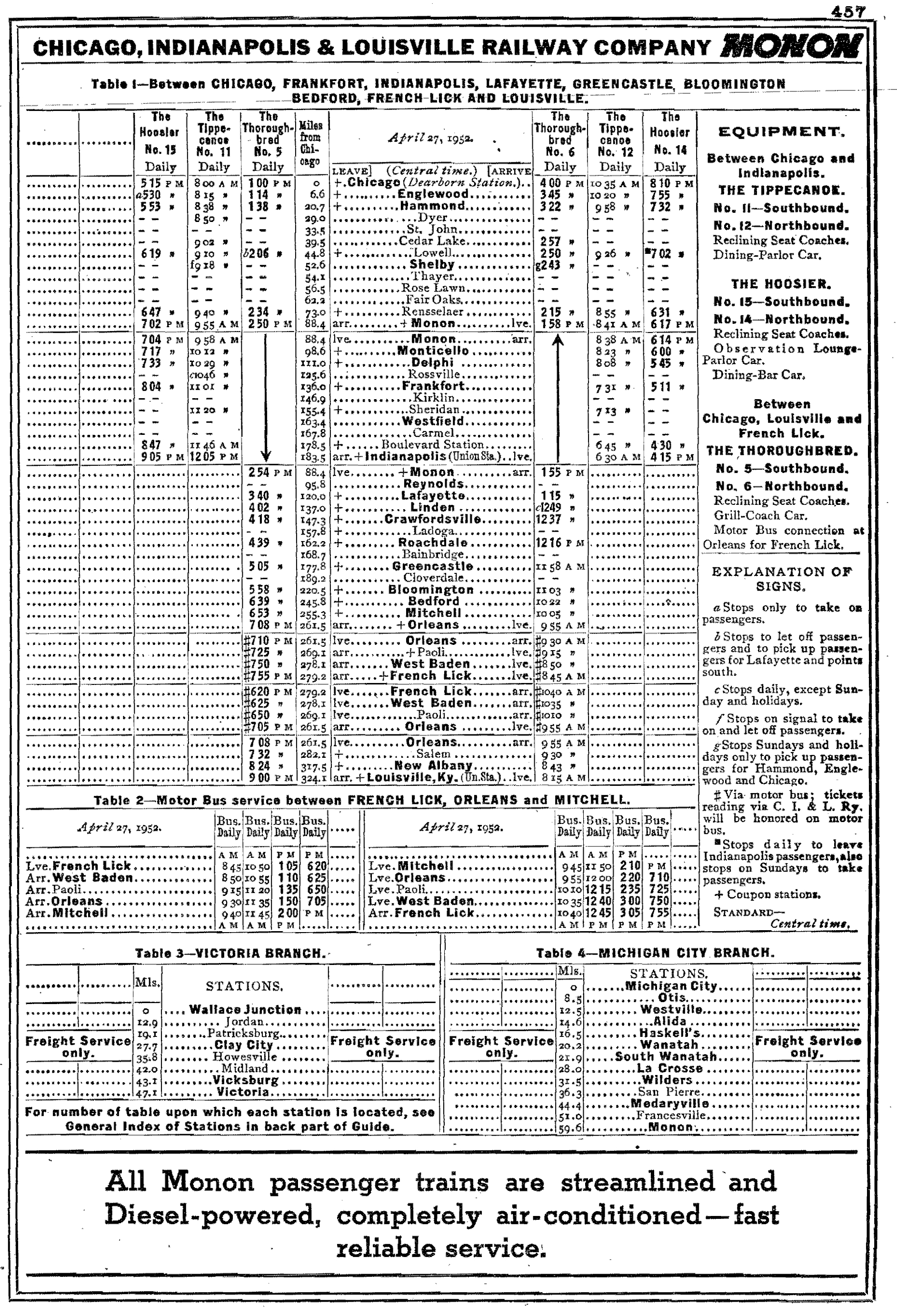
Operating daily as Train No. 5 (southbound) and No. 6 (northbound), the Thoroughbred covered approximately 324 miles between Chicago’s Dearborn Station and Louisville Union Station.
The route traversed the heart of Indiana, passing through key Monon towns such as Lafayette and the junction point of Monon itself. This corridor formed the backbone of the railroad’s system, which was laid out in an “X” pattern across the state.
Consist and Timetable (1952)
Streamlined Style and Onboard Experience
Although built from rebuilt equipment, the Thoroughbred was marketed as a modern, streamlined train. It was typically hauled by EMD F3 diesel locomotives, reflecting the Monon’s early embrace of dieselization—indeed, the railroad became one of the first Class I carriers to fully dieselize.
The train’s consist was designed to offer a comfortable and efficient travel experience:
- Reclining-seat coaches for general passengers
- Parlor cars for first-class service
- Dining cars providing full meal service
- Observation lounges offering scenic rearward views
The Monon’s distinctive red-and-gray passenger livery, inspired by Indiana University colors, gave the Thoroughbred a unique visual identity. Equipment could also occasionally be found in gold and black, honoring two other state university's, Purdue and DePauw. While not as luxurious as trains like the 20th Century Limited or Super Chief, the service delivered a dependable and respectable level of service tailored to regional travelers.
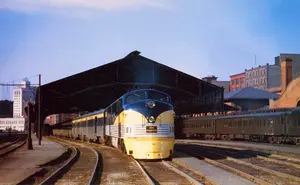
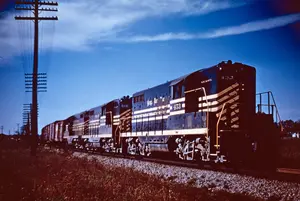
 The same train as seen above going away from the photographer. Rick Burn photo.
Role and Purpose
The Thoroughbred served multiple roles beyond simply connecting Chicago and Louisville.
Business and Regional Travel
The train linked two important economic centers while serving numerous smaller Indiana communities. For many Hoosiers, it was a primary means of intercity transportation.
College Traffic
The Monon was famously known as the “Hoosier Line,” serving several major universities including Purdue, Indiana University, and DePauw. The Thoroughbred carried students, faculty, and visitors along this academic corridor.
Kentucky Derby Travel
Perhaps most famously, the train catered to Louisville’s horse racing culture. Special patronage during Derby season made it a favored way to reach Churchill Downs, reinforcing the appropriateness of its name.
Competition and Decline
Despite its modernization, the Thoroughbred faced overwhelming challenges common to American passenger rail in the postwar era. The rapid expansion of automobile ownership, improved highways, and the growth of commercial aviation steadily eroded ridership. By the 1950s, passenger numbers were declining across the industry, and the Monon—lacking the financial strength of larger railroads—was especially vulnerable.
Cost-cutting measures gradually reduced the train’s amenities. Dining service was scaled back, consists shortened, and schedules adjusted to reflect declining demand. By the late 1950s, the Monon began discontinuing many of its passenger services entirely. Trains such as the Hoosier and Tippecanoe disappeared, leaving the Thoroughbred as the railroad’s final remaining intercity passenger train.
 Monon F3A #207 has northbound train 6, the "Thoroughbred," at Dyer, Indiana on November 26, 1965. Rick Burn photo.
Final Years
Through the 1960s, the Thoroughbred soldiered on as a lone survivor of the Monon’s once broader passenger network. It represented both tradition and necessity—maintained in part due to regulatory requirements even as profitability vanished.
On September 30, 1967, the Thoroughbred made its final run, marking the end of all passenger service on the Monon Railroad.
Just a few years later, in 1971, the Monon itself was absorbed into the Louisville and Nashville Railroad, bringing an end to the independent existence of Indiana’s “Hoosier Line.”
Legacy
Though relatively short-lived, the Thoroughbred holds an important place in Midwestern railroad history.
It represented:
- The Monon’s most ambitious modernization effort, despite its small size and modest budget.
- A creative reuse of wartime equipment
- The last stand of passenger rail service on the line
- A uniquely regional streamliner tied to Indiana identity
In many ways, the Thoroughbred exemplifies the broader story of American passenger trains in the mid-20th century—an era of innovation and optimism followed by rapid decline.
Today, portions of the former Monon route remain active under modern freight operators, and echoes of its passenger heritage live on in corridors later used by services such as Amtrak’s Hoosier State.
The Thoroughbred was never the fastest, most luxurious, or most famous train in America—but it didn’t need to be. It was a train built for its region, reflecting the character of Indiana and its connections to Chicago and Louisville.
For nearly two decades, it carried students, business travelers, and Derby-goers across the Hoosier State, embodying the Monon’s determination to remain relevant in a changing world. Its story is one of ingenuity, adaptation, and ultimately, the quiet end of an era in American railroading.
Recent Articles


-
Baldwin "Baby Face" Locomotives: Specs, Photos, Roster
Oct 30, 26 11:01 PM
 Baldwin's Babyface cab on the early road diesels: 50 short-cab units, 1946-1948, plus the related Centipede. Construction numbers, specs, and the sharknose that followed.
-
California High-Speed Rail Chief Resigns
Oct 30, 26 08:36 PM
 Ian Choudri resigned October 28, 2026 as chief executive of the California High-Speed Rail Authority. The board named Joe Stephenshaw interim chief executive.
-
The 1910 Portal Bridge Is Handed Over for Demolition
Oct 30, 26 04:03 PM
 Amtrak handed the 1910 Portal Bridge over for demolition on October 29, 2026, during the final cutover to Portal North. Regular NJ Transit and Amtrak schedules are expected November 15.
-
Union Pacific-Norfolk Southern Merger Review Runs to 2027
Oct 30, 26 03:59 PM
 Union Pacific says the Surface Transportation Board's review of the Norfolk Southern merger gathers information through May 28, 2027. A closing still depends on board approval.
-
Amtrak Board Will Hear Restructuring Comments on November 10
Oct 30, 26 03:41 PM
 Amtrak's board will hear public comments on its restructuring on November 10, 2026, from 2 to 3 p.m. Eastern. Written comments were due October 30. A proposal goes to the board in December.
-
Canadian Pacific Selkirk 5931 Restored in Calgary
Oct 30, 26 01:36 PM
 Heritage Park in Calgary unveiled a cosmetic restoration of Canadian Pacific 2-10-4 No. 5931 on October 27, 2026. One of two surviving Selkirks. It stays on display.
-
Gettysburg Railway to Host Steam for Lincoln
Oct 30, 26 01:18 PM
 Northern Central Railway of York No. 17 will recreate Lincoln's arrival at Gettysburg on November 18, 2026, with public steam trips November 19-21.
-
NC&StL No. 576 to Steam for the Public in Nashville
Oct 30, 26 01:00 PM
 Nashville Steam will fire NC&StL 4-8-4 No. 576 for the public on November 7, 2026, 9 a.m. to 3 p.m., at 220 Willow Street. Admission is free.
-
Pennsylvania Railroad E8s Join the T1 Trust
Oct 30, 26 12:38 PM
 The T1 Trust has acquired former Pennsylvania Railroad E8A diesels 5702A and 5761A from the Fort Wayne Railroad Historical Society. They are bound for Cumberland.
-
Ligonier Valley Railroad: History, Roster, Timetable
Oct 30, 26 12:03 PM
 The Ligonier Valley Railroad ran 10.5 miles from Latrobe to Ligonier, Pennsylvania. Opened December 1, 1877. Last day August 31, 1952.
-
Toledo, Peoria & Western Diesel Roster (All-Time)
Oct 30, 26 10:25 AM
 Toledo, Peoria & Western diesel locomotives, each frame once. Thirteen Alcos, three Lima-Hamilton switchers, and 26 Electro-Motive units.
-
Toledo, Peoria & Western Steam Roster
Oct 30, 26 09:14 AM
 Toledo, Peoria & Western steam locomotives from the Rogers Consolidations of 1895 through the 4-8-4s of 1937
-
Toledo, Peoria & Western Railway: Map, Roster, History
Oct 29, 26 11:12 PM
 History of the Toledo, Peoria & Western. The Peoria & Oquawka, George P. McNear, the Santa Fe and Pennsylvania years, and the railroad that came back in 1989.
-
Cotton Belt Diesel Roster (All-Time)
Oct 29, 26 07:58 PM
 St. Louis Southwestern diesel locomotives, each frame once. Baldwin switchers, F units, and new Cotton Belt-lettered power through the GP60s of May 1990.
-
Cotton Belt Steam Roster (Built Since 1900)
Oct 29, 26 06:52 PM
 St. Louis Southwestern steam locomotives built since 1900. Consolidations, Ten-Wheelers, and twenty class L-1 4-8-4s. The quantity column is 297.
-
Cotton Belt Railroad: Map, Logo, History, Rosters
Oct 29, 26 10:56 AM
 History of the St. Louis Southwestern, the Cotton Belt Route. The Tyler Tap, Paramore's silver spike, the Thebes Bridge, the Blue Streak, and Southern Pacific control. Steam and diesel rosters are sep…
-
Pere Marquette Steam Roster (Built Since 1900)
Oct 28, 26 11:54 PM
 Pere Marquette steam locomotives built since 1900. Consolidations, Mikados, Pacifics, and 39 Berkshires. The quantity column is 503.
-
Pere Marquette Diesel Roster (All-Time)
Oct 28, 26 11:48 PM
 Pere Marquette diesel locomotives, each frame once. Two SW1s, 14 NW2s, three GE 70-tonners, eight E7As, and six BL2s delivered lettered Chesapeake and Ohio. The quantity column is 33.
-
Pere Marquette Railway: Map, Logo, Rosters, History
Oct 28, 26 11:44 PM
 History of the Pere Marquette Railway. Timber roads, the Prince years, the Van Sweringens, the Ludington car ferries, and the Chesapeake and Ohio merger of June 6, 1947.
-
Nickel Plate Road (Railroad): Map, History, Rosters
Oct 28, 26 10:51 PM
 History of the Nickel Plate Road, the New York, Chicago and St. Louis. The Seney syndicate, the Van Sweringens, the Berkshires, and the Norfolk and Western absorption at 12:01 a.m. on October 16, 1964…
-
Nickel Plate Diesel Roster (All-Time)
Oct 28, 26 10:48 PM
 Nickel Plate diesel locomotives, each frame once. Alco switchers and PAs, GP7s and GP9s, and the GP30s. The quantity column is 440. The 1950 fleet was 117.
-
Nickel Plate Steam Roster (Built Since 1900)
Oct 28, 26 10:43 PM
 Nickel Plate steam locomotives built since 1900, including the Lake Erie and Western, the Clover Leaf, and the Wheeling engines that took Nickel Plate numbers. The quantity column is 786.
-
EMD "E9" Locomotives: Specs, Roster, History
Oct 28, 26 10:37 PM
 EMD E9 cab units and boosters, 2,400 horsepower, built April 1954 through January 1964. Gear ratios, specifications, and the production roster by owner, serial, and order.
-
NYC 4-6-4 #5344, "Commodore Vanderbilt"
Oct 28, 26 04:31 PM
 NYC J-1e Hudson 5344, the Commodore Vanderbilt. Alco, November 1931. Carl Kantola’s shroud, December 1934, then a Dreyfuss bullet nose in 1939. Scrapped at Collinwood in 1954.
-
New Jersey, Indiana & Illinois Railroad: A South Bend Shortline
Oct 28, 26 11:05 AM
 The New Jersey, Indiana & Illinois, the Jersey Line, ran from South Bend to Pine. Singer built it in 1905. Wabash stock control came in 1926. Two diesels, and the steam the record names.
-
Monon Diesel Roster (All-Time)
Oct 28, 26 10:13 AM
 Monon diesel locomotives, each frame once. F3s, nine BL2s, the C420s, and eight U23Bs. The quantity column is 96. The 1951 fleet was 57.
-
Monon Steam Roster (Built Since 1900)
Oct 28, 26 10:09 AM
 Monon steam locomotives built since 1900. Twelve-Wheelers, Mikados, light Pacifics, and thirteen six-wheel switchers. The quantity column is 148.
-
Monon Railroad: Map, Photos, History, Logo
Oct 28, 26 09:55 AM
 History of the Monon, the Hoosier Line. The New Albany & Salem, the X at Monon, Barriger's streamliners, and the Louisville & Nashville merger of July 31, 1971.
-
Missouri-Kansas-Texas Diesel Roster (All-Time)
Oct 28, 26 09:48 AM
 All-time diesel roster of the Missouri-Kansas-Texas. 406 locomotives, each frame once. Baldwin switchers, Alco cab units, F units, Geeps, and the SD40-2s.
-
Missouri-Kansas-Texas Steam Roster (Built Since 1900)
Oct 28, 26 09:43 AM
 Missouri-Kansas-Texas steam locomotives built since 1900. Moguls, Mikados, Pacifics, and the narrow-gauge shop tanks. The quantity column is 715.
-
Missouri-Kansas-Texas Railroad (Katy): Map, History, Rosters
Oct 27, 26 11:02 PM
 History of the Missouri-Kansas-Texas, the Katy. The race into Indian Territory, Gould, the 1923 railroad, the Texas Special, and the 1988 sale. Steam and diesel rosters are linked.
-
Soo Line Diesel Roster (All-Time)
Oct 27, 26 10:55 PM
 All-time diesel roster of the Soo Line and the Wisconsin Central. 786 locomotives, each frame once. Cab units, Geeps, the Milwaukee Road engines, and the SD60s. The South Shore's 24 stay on that page.
-
Soo Line Steam Roster (Built Since 1900)
Oct 27, 26 10:49 PM
 Soo Line and Wisconsin Central steam locomotives built since 1900. Consolidations, Mikados, Pacifics, 21 Mountains, and four Lima 4-8-4s.
-
Soo Line Railroad: Map, Logo, History, Rosters
Oct 27, 26 10:24 PM
 The Soo Line, from the flour millers' railroad around Chicago to the Sault, the Wisconsin Central, and the Milwaukee Road. Steam quantity 422. Diesels 786. Canadian Pacific took full control in 1990.
-
Minneapolis, Northfield and Southern Railway: Map, History, Rosters
Oct 27, 26 10:32 AM
 The Minneapolis, Northfield & Southern, the Dan Patch Line that became a Twin Cities belt. Steam, gas-electric mules, motor cars, and the 22 diesels, through the Soo Line.
-
Minneapolis & St. Louis Diesel Roster (All-Time)
Oct 27, 26 10:27 AM
 All-time diesel roster of the Minneapolis & St. Louis. 97 locomotives, each frame once. Switchers from 1938, 35 RS-1s, the FT and F-unit cabs, two SD7s, and 23 GP9s. Builder numbers included.
-
Minneapolis & St. Louis Steam Roster (Post 1900)
Oct 27, 26 10:25 AM
Minneapolis & St. Louis steam locomotives built since 1900. Moguls, Consolidations, 35 Mikados, and five Pacifics. -
Minneapolis and St Louis Railway: "The Peoria Gateway"
Oct 27, 26 09:52 AM
 The Minneapolis & St. Louis, the Tootin' Louie, from the 1870 charter to the Peoria Gateway and the Chicago & North Western sale on November 1, 1960.
-
Alco "PA" Locomotives: Restoration, Specs, Engine, Rosters
Oct 27, 26 12:12 AM
 Alco's PA passenger cab, 297 locomotives built from 1946 to 1953. The 244 engine, the production roster, the Delaware & Hudson PA-4s, and Nickel Plate Road 190.
-
Milwaukee Road Diesel Roster: (All Time)
Oct 26, 26 01:44 PM
 All-time diesel roster of the Milwaukee Road. 1,208 locomotives, each frame once. Alco, Baldwin, Davenport, EMD, Fairbanks-Morse, General Electric, and Whitcomb, with builder numbers.
-
Milwaukee Road Steam Roster (All-Time): Post-1900
Oct 26, 26 01:38 PM
 Milwaukee Road steam locomotives built since 1900. Prairies, Mikados, the N-class articulateds, the S-class 4-8-4s, and the Hiawatha Atlantics and Hudsons. Quantity column 1,974. Unique frames 1,951.
-
Milwaukee Road: Map, Electrification, Logo, History
Oct 26, 26 01:20 PM
 The Milwaukee Road, from the Milwaukee & Mississippi of 1850 to the Pacific Coast Extension, the Hiawathas, and the Soo Line sale. Why Lines West should have stayed.
-
Lake Superior & Ishpeming Railroad: Map, Roster, History
Oct 25, 26 11:38 PM
 Lake Superior & Ishpeming Railroad, reporting mark LSI, from the Marquette Range to the Presque Isle ore dock. The 1954 steam list and the diesels the railroad owned.
-
Kansas City Southern Steam Roster (Built Since 1900)
Oct 25, 26 09:09 PM
 Steam locomotives of the Kansas City Southern built since 1900, with the Louisiana & Arkansas and the Texas company.
-
Kansas City Southern Diesel Roster (Built New)
Oct 25, 26 11:46 AM
All-time diesel roster of the Kansas City Southern. E units, F units, Geeps, SD40s through SD70ACes, Fairbanks-Morse, Baldwin, Alco, and General Electric, with serials and order numbers. -
Kansas City Southern Railway: Map, Photos, History
Oct 25, 26 12:24 AM
The Kansas City Southern, from Arthur Stilwell's Gulf line to Canadian Pacific Kansas City on April 14, 2023. Steam and diesel rosters, the Southern Belle, and the Louisiana & Arkansas. -
Indiana Harbor Belt Diesel Roster (All-Time)
Oct 25, 26 12:17 AM
 All-time diesel roster of the Indiana Harbor Belt. 202 locomotive frames, each counted once. NW2s, SW7s, SW1500s, road switchers, and gensets. Slugs and boosters are outside the count.
-
Indiana Harbor Belt Steam Roster (Built Since 1900)
Oct 25, 26 12:13 AM
 Steam locomotives of the Indiana Harbor Belt built since 1900. 182 engines, each counted once. 0-6-0s, 2-6-0s, 0-8-0s, and 2-8-2s. The three U-4a switchers are three-cylinder Brooks engines of 1927.
-
Indiana Harbor Belt Railroad: Map, Rosters, History
Oct 25, 26 12:00 AM
 Indiana Harbor Belt, the inner belt across the Calumet, from the East Chicago Belt of May 16, 1896. Renamed June 29, 1907. Still operating, headquarters Hammond. Steam roster is the companion, 182 loc…
-
NYC's "P Motor" Electric Locomotives
Oct 24, 26 11:43 PM
 New York Central P motors: 22 Alco-GE 2-C+C-2 electrics, Cleveland Union Terminal 1050–1071, class P-1a. 3,030 hp one-hour on 3,000-volt DC catenary, then 660-volt third rail as P-2a and P-2b.