Erie Steam Locomotives: History, Roster & Photos
Published: September 20, 2026
By: Adam Burns
Erie entered the twentieth century still buying Camelback 2-8-0s in quantity, then spent a decade trying articulation—three 0-8-8-0 Camelback Mallets, a shop-built 2-6-8-0, and three Baldwin Triplexes—before the natural next step from the Consolidation proved to be the Mikado. Between 1911 and 1913 it took 155 N-1 2-8-2s. John J. Bernet, arriving from the Nickel Plate in 1927, found the road spending fifty percent more on locomotive maintenance than other companies, parked the oldest 2-8-0s, and split an order for fifty 2-8-4s between Brooks and Lima. One hundred five Berkshires later, Erie owned more of the type than any other railroad. They were all gone by 1952. Last steam was K-1 Pacific 2530 (Rogers, 1906) on March 17, 1954, Jersey City from Spring Valley, New York.
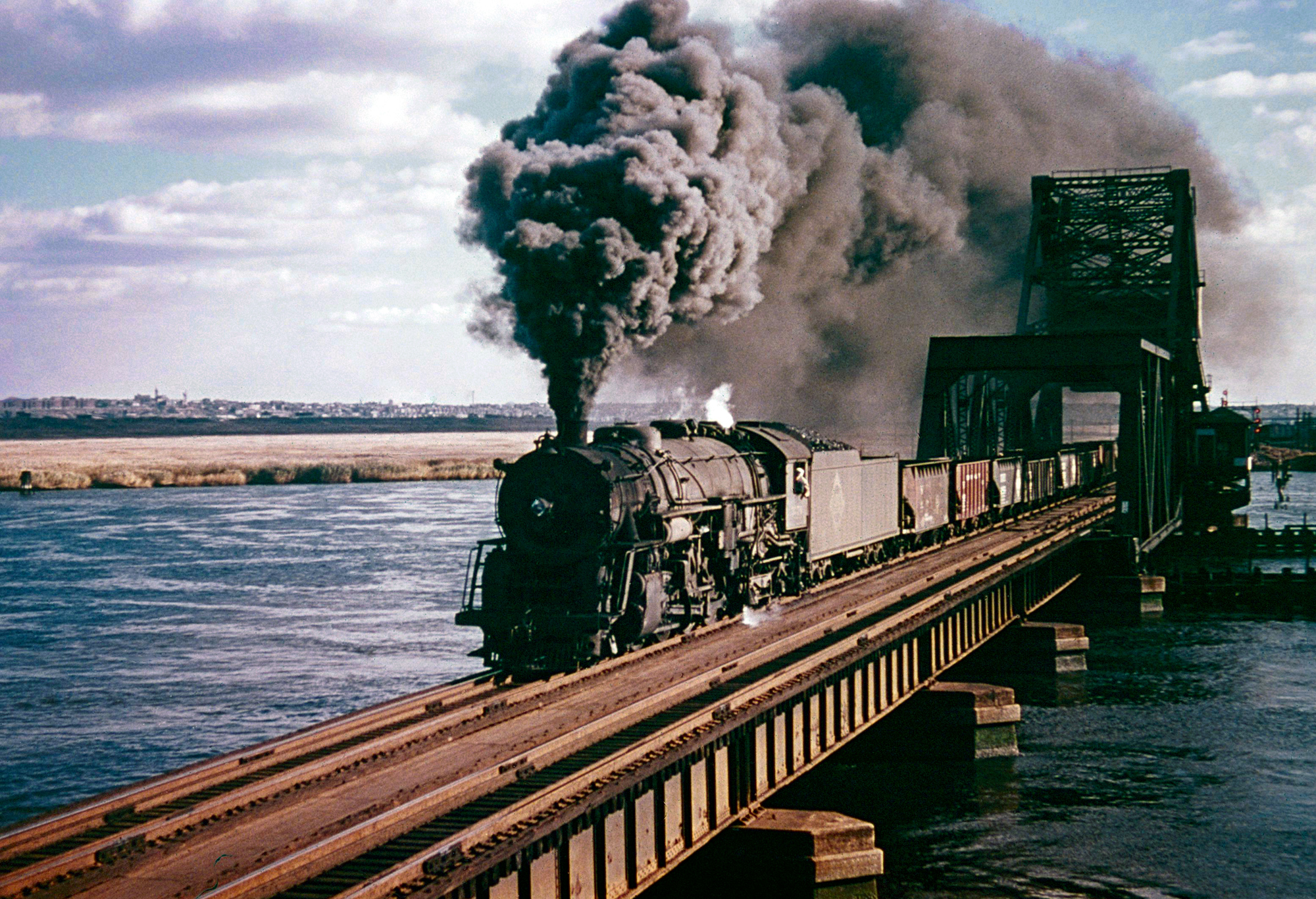
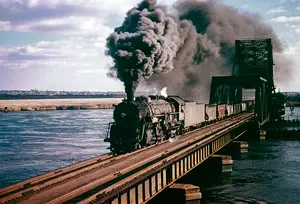
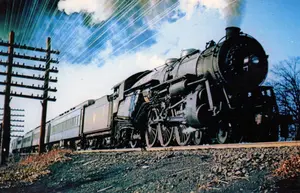
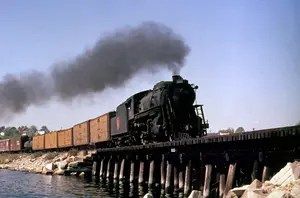
Erie Railroad 2-8-4 #3376 (S-3) steams west across the Hackensack River at Secaucus, New Jersey, on October 18, 1951. Bob Collins photo. American-Rails.com collection.
On this page: At a glance · Map and shops · Consolidations, Mikes, Berkshires · Mallets and Triplexes · Santa Fes and Decapods · Atlantics, Ten-Wheelers, Pacifics · Switchers · March 17, 1954 · All-time roster (built since 1900)
At a glance
| Item | Detail |
|---|---|
| Railroad | Erie Railroad. Mark ERIE. Company Erie |
| This roster | Engines built since 1900, after Drury, pages 172–176 |
| Freight after 1911 | 155 N-1 Mikados, 1911–13; 15 USRA heavy N-2s; 40 N-3s plus one N-3-A |
| Berkshires | 105 2-8-4s, S-1 through S-4, 1927–29. Largest fleet of the type. All scrapped 1950–52. Photo: S-3 #3376 Secaucus |
| Pacifics | K-1s from the Harriman pattern; Lima K-2s 2900–2904 (1913); Alco 50000 as K-3 #2509; USRA heavy K-5s 2915–2934, copies to no other road |
| Articulateds | Three Camelback 0-8-8-0s (L-1), 1907, then the largest locomotives in the world; one 2-6-8-0; three P-1 Triplexes, 5014–5016 |
| Last steam | March 17, 1954. K-1 #2530, Jersey City from Spring Valley, N.Y. |
| Shops | Meadville, Pennsylvania; Hornell, New York. Camelback Mallets were too large for Erie’s own shops |
Roster follows Drury, Guide to North American Steam Locomotives (revised edition), pages 172–176. Information compiled September 19, 2026.
Southern Tier grades, and a fast railroad that still needed pushers
Drury’s chapter opens on the map. The main ran northwest from Jersey City through New York’s Southern Tier, then west through Youngstown and Lima, Ohio, and Huntington, Indiana, before it reached Chicago. A network of branches covered northern New Jersey, Pennsylvania coal, and secondary lines that reached Rochester, Buffalo, Dunkirk, Cleveland, and Cincinnati. The road was built to six-foot gauge. It converted to standard in 1880. The early choice of wide gauge ultimately proved expensive, but it produced one minor benefit: the standard-gauge Erie was a railroad of generous clearances.
The New York–Chicago route was forty miles longer than the New York Central’s and ninety miles more than the Pennsylvania’s, and it seemed to make a point of avoiding big cities. It had no major grades, except for a couple of hills in western New York, the sawtooth-profile country of eastern Ohio, and the hilly country of northern New Jersey between the Hudson and Delaware rivers. As a result the Erie developed into a fast carrier of freight, not passengers. Its New York–Chicago passenger trains never numbered more than three each way, and they took four to eight hours longer than the trains of the New York Central and Pennsylvania.
H-class Consolidations, then 155 Mikados, then Berkshires
Erie was using the Consolidation type long before 1900 and continued to purchase 2-8-0s in quantity well into the twentieth century. In 1910 it took delivery of three groups of Camelback 2-8-0s, classes H-10, H-11, and H-12, seventy-five engines in all. H-13s had 56-inch drivers and 21 × 28-inch cylinders, as did the H-11s of 1899. H-12s had 62-inch drivers and 22 × 30. Baldwin delivered fifteen more Camelback Consolidations in 1901 similar to the H-13s in dimensions but with piston valves. Four 2-8-0s of the H-14 class were equipped with 48-inch Wootten fireboxes for the Erie & Wyoming Valley; their 54-inch drivers and 22 × 30-inch cylinders gave them more pulling power than any of Erie’s own Consolidations then in service.
Erie continued to add 2-8-0s in 1902. The H-16 class, 1510–1529, came from Baldwin as Vauclain compounds. H-17s and H-18s were delivered by Rogers and Cooke in 1904 and 1911. They had 56-inch drivers and 22-inch cylinders, and weighed an even 200,000 pounds, about the same as the H-16s. Cooke built the five engines of class H-19 as tandem compounds. The Vauclain compounds were converted to simple engines between 1904 and 1911 (the first two conversions were done by Baldwin), and the Cooke tandem compounds were simpled in 1908. All the Camelback 2-8-0s in classes H-9 through H-14 except H-15—five 1884 Dicksons from the Erie & Wyoming Valley—were scrapped in 1927 after being stored several years for accounting reasons.
The 45 H-20 Consolidations of 1903 and 1904 brought changes: a single-arch bituminous-burning firebox about the size of a Camelback’s, 62-inch drivers, 22 × 32-inch cylinders, slide valves, and Stephenson valve gear. They had a tractive force of 42,500 pounds, less than the biggest of the preceding Camelbacks. The 2-8-0s were later superheated, fitted with larger cylinders, and equipped with Baker or Walschaerts valve gear.
The extensive H-22 class, 1800–1886, was neither particularly successful nor well liked. The first 37 of the group were diverted from an order built for the Harriman railroads, which had found themselves oversupplied with 2-8-0s. Erie ordered 50 more. They had 22 × 30-inch cylinders and 57-inch drivers and slightly more tractive effort than the H-20s and H-21s. Some were converted to 0-8-0s, but that did not prolong their service; they were scrapped between 1927 and 1940 without being superheated. The final 2-8-0 on the roster was 1540, built in 1906 for display at an exposition and then sent to the Rock Island, which found it too heavy. Baldwin sold it to the New York, Susquehanna & Western, which at the time owned the NYSW, and transferred it to the Erie.
The natural progression from the 2-8-0 was to the 2-8-2. Between 1911 and 1913 Erie purchased 155 Mikados from Baldwin (65), Schenectady (65), and Lima (5). They had 63-inch drivers and 28 × 32-inch cylinders, weighed about 329,000 pounds—just a bit more locomotive than a USRA heavy Mike. Classed N-1 and numbered 3000 to 3154, they were built with superheaters and were hand-fired; in 1927 they received mechanical stokers and feedwater heaters. In 1918 the road received 15 USRA heavy 2-8-2s built by Brooks, classifying them N-2 and numbering them 3200–3214. In 1923 Erie returned to its own design for 40 N-3 class Mikes, 3155–3194, continuing the N-1 number series. The principal difference was the booster-equipped cast trailing truck on the N-3. One final 2-8-2 came from Baldwin in 1926, N-3-A 3199. It was to have had uniflow cylinders, with steam admission ports at the ends and exhaust ports in the middle. At some point during construction the uniflow design proved impractical and the locomotive was completed with conventional cylinders.
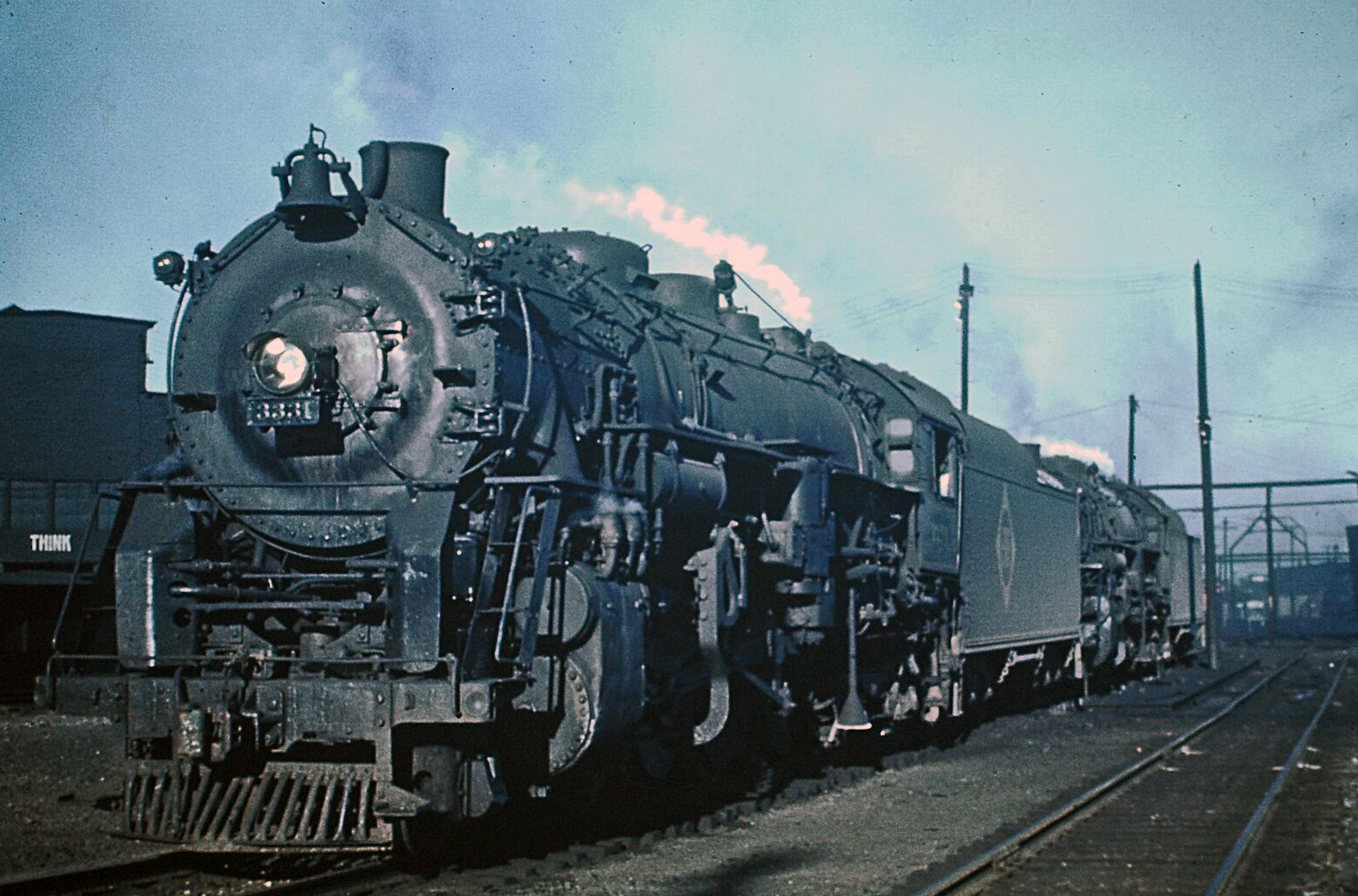
A pair of Erie’s handsome 2-8-4s await their next assignment at the road’s Marion, Ohio, terminal in April 1947. The lead unit, #3331 (S-2), was manufactured by Lima in 1927. The railroad owned 105 Berkshires; all were scrapped between 1950 and 1952.
Bernet divided an order for 50 2-8-4s equally between Lima and Brooks. The Brooks engines, 3300–3324, were class S-1; the Limas, 3325–3349, S-2. The major differences were boiler pressure—225 pounds for the S-1s and 250 for the S-2s—and the trailing trucks. The Brooks engines had cast trailing trucks and full-length frames; the S-2s had Lima’s own built-up trailing truck, through which drawbar forces were transmitted. Both classes differed from Lima’s original design of 1924 in having 70-inch drivers instead of 63. Two more groups followed in quick succession: S-3s 3350–3384 from Baldwin in 1928 and S-4s 3385–3404 from Lima in 1929. Lima-built S-4 3389 represents the ultimate development of steam freight power on the Erie. Erie’s 2-8-4 was the basis of Berkshire design for the Pere Marquette, Chesapeake & Ohio, Virginian, and Richmond, Fredericksburg & Potomac.
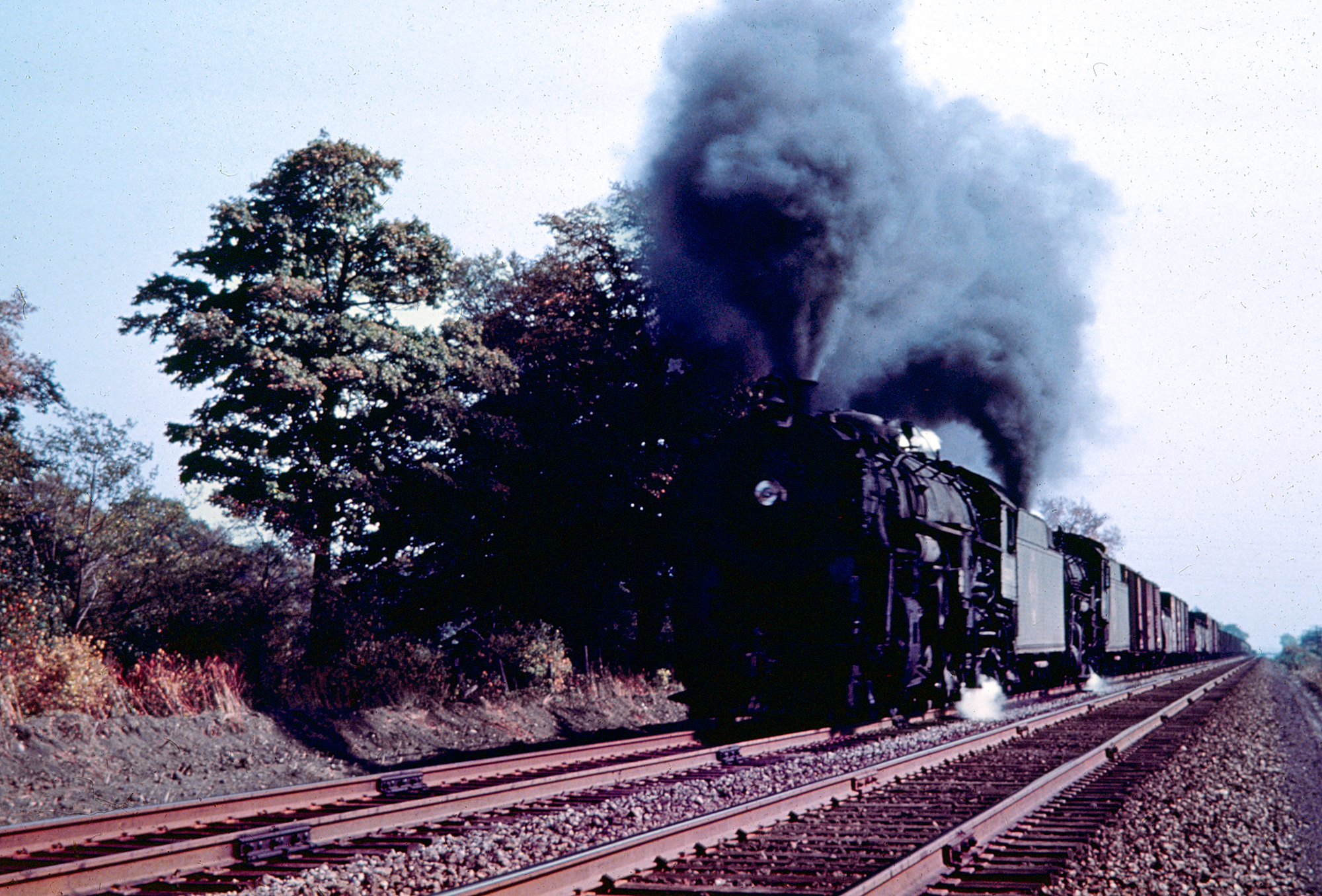
Erie 2-8-4s double-head a long freight west, bound for Chicago, through northern Indiana during the 1950s. Ed Olsen photo. American-Rails.com collection.
Camelback Mallets, a 2-6-8-0, and the Triplex
In 1907 Schenectady built three Camelback 0-8-8-0s for pusher service over Gulf Summit between Deposit, New York, and Susquehanna, Pennsylvania. When built they were the largest locomotives in the world. On the job they proved mostly that it took a skilled and strong fireman to produce the power they were designed to deliver. Baldwin rebuilt them in 1921 as 2-8-8-2s with mechanical stokers and other improvements. They were too large for Erie’s own shops, so heavy repairs were performed at Lehigh Valley’s shops at Sayre, Pennsylvania. The Erie & Wyoming Valley shops at Dunmore, Pennsylvania, did a minor overhaul of 5016 in 1920.
Erie’s next try at articulation was to convert a 2-8-0 to a 2-6-8-0 by purchasing running gear for the front low-pressure engine and a boiler extension that was mostly feedwater heater. Class M-1, number 2900, Meadville Shops, 1910; rebuilt back to a 2-8-0 in 1916.
Erie had a long-standing custom of honoring a superior engineer by painting his name on the cabs of locomotives. Triplex no. 5014 for some years carried the name of Matt H. Shay. The seven articulateds turned out to be a digression in the development of Erie freight locomotives. The type page is Triplex. This roster does not dump it.
Santa Fes, and Russian Decapods
Increases in traffic during the early Teens prompted Erie to seek a freight locomotive larger than the Mikado. It received a single experimental 2-10-2, no. 4000, class R-1, from Baldwin in 1915. Like the N-1 Mikes it had 63-inch drivers and 31 × 32-inch cylinders, and the rods and pistons were of lightweight design to ease the counterbalancing problems common to the 2-10-2 type. It was equipped with superheater, mechanical stoker, and lateral-motion devices on the driver axles. Because the boiler was so wide, it had paired sand domes mounted side by side. The locomotive was immediately successful, and Erie ordered 40 more from Baldwin, Schenectady, and Lima. Production R-1s weighed 417,200 pounds, about 10,000 pounds more than 4000.
Between 1915 and 1917 Schenectady built 30 R-2 Santa Fes. They were shorter and somewhat lighter than the R-1s, 404,000 pounds, with large shallow fireboxes over the rear drivers and small inboard-bearing trailing trucks. They looked like a regression in design, but they were just as powerful as the R-1s and were good steamers. The R-1s and R-2s were delivered with small Vanderbilt tenders so they could fit on existing turntables. Many eventually got larger tenders.
Erie’s third group of 2-10-2s were USRA heavy Santa Fes built by Brooks in 1919, though they were lighter and less powerful than Erie’s own design; they lasted longer. Most of the R-1s and about half the R-2s were scrapped before World War II; the USRA 2-10-2s were scrapped between 1949 and 1952.
Decapods constitute another side trip. The road had six Camelback Vauclain compound 2-10-0s that were built in 1891 and 1895 for pusher service on Susquehanna Hill. They were simpled in 1904 and 1905, demoted to yard service, and scrapped between 1924 and 1926. More significant, though, are Erie’s Russian Decapods. The Erie was pleased enough with their performance while they were on lease from the USRA that it purchased 75 in 1921. They proved useful in local freight service because of their high tractive effort and low axle loading. Later Erie sold 16 of them to the New York, Susquehanna & Western and 8 to various other roads.
Harriman Pacifics, Alco 50000, and USRA heavies no one else received
Baldwin delivered two groups of Ten-Wheelers, G-12s and G-13s, in 1901. Both classes were Camelbacks and had 62-inch drivers; the G-12s were Vauclain compounds. In 1908 four of the G-13s were converted to simple engines and reclassified G-16; the rest were similarly rebuilt in 1915 and 1916, though the last two rebuilt retained their G-13 classification. The G-15 class, 950–974, came from Schenectady, Rogers, and Baldwin between 1902 and 1908.
When the road realized its principal passenger trains needed more than an Atlantic or a Ten-Wheeler, it tested a San Pedro, Los Angeles & Salt Lake 4-6-2 built to the standard design used by several railroads in E. H. Harriman’s empire. The Harriman Pacific had 77-inch drivers, 22 × 28-inch cylinders, 49.5 square feet of grate area, and weighed 225,295 pounds. Erie K-1 Pacifics, based on the design, had 74½-inch drivers, 22½ × 26-inch cylinders, 50.5 square feet of grate area, and weighed 248,550 pounds. Alco’s Schenectady Works built three, 2510–2512, in 1905; 2510 and 2512 were equipped with Cole superheaters. Rogers built 41 K-1s in 1905 and 1906 and Baldwin built 15 in 1908. All had piston valves, Stephenson valve gear, and outside-journal trailing trucks. The Rogers and Baldwin engines were not superheated. Between 1912 and 1917 the shops at Meadville and Hornell rebuilt the K-1s with superheaters, outboard piston valves, and Baker valve gear.
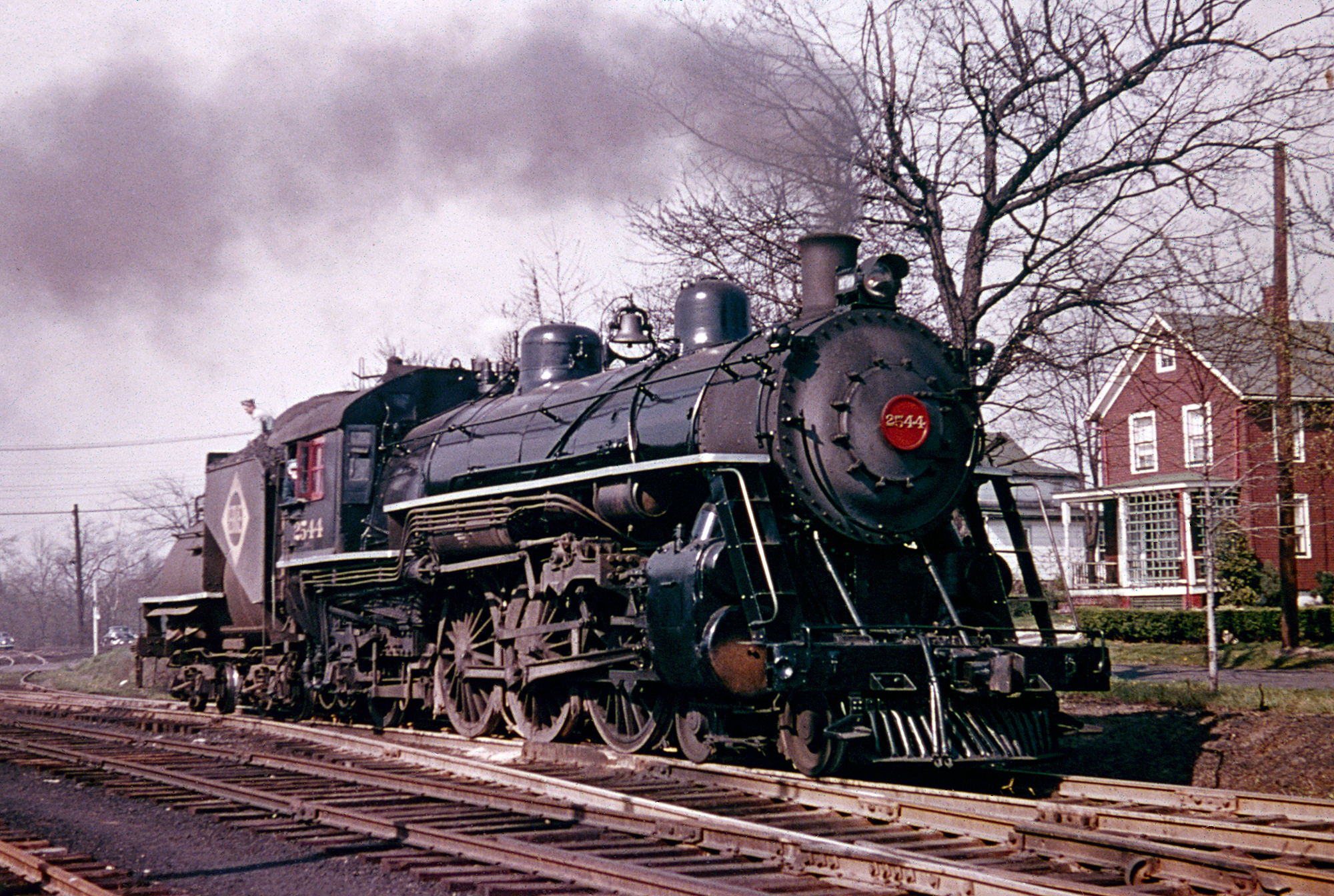
Erie 4-6-2 #2544 working suburban service at Spring Valley, New York, April 18, 1953. Bob Collins photo. American-Rails.com collection. Last steam, a year later, was sister K-1 #2530 on the same Jersey City–Spring Valley run.
In 1910 Alco built an experimental Pacific, no. 50000, designed by Francis J. Cole, chief consulting engineer at the Schenectady Works. It had a much larger boiler than was common at the time, but the weight of the boiler required that other parts be trimmed down. It had 79-inch drivers and 27 × 28-inch cylinders, carried 185 pounds of boiler pressure, exerted a tractive force of 40,630 pounds—10,000 pounds more than Erie’s K-1—and weighed 269,000 pounds. It demonstrated on several railroads and came to the Erie in November 1911. The road liked the big Pacific well enough to buy it in September 1912; it was renumbered 2509 and classed K-3. It worked until 1950, a longer career than most one-of-a-kind engines.
In June 1913 Erie ordered five Pacifics similar to Alco 50000 from Lima, that builder’s first large road engines for a Class I railroad. The K-2s, numbered 2900–2904, were delivered in 1913. Alco built ten more, 2905–2914, class K-2-A, in 1917. Between 1913 and 1916 Alco and Baldwin delivered 44 K-4 Pacifics. They had 69-inch drivers and were somewhat lighter than the K-2s but could exert slightly more tractive effort. Baldwin built ten similar 4-6-2s, class K-4-A, in 1923, for fast freight service. After only six years they were rebuilt as passenger engines with 75-inch drivers.
Among the USRA designs was a heavy Pacific resembling in some of its dimensions Alco 50000 and the Pennsylvania Railroad’s K4. USRA allocated 20 heavy Pacifics to Erie, 10 from Baldwin and 10 from Richmond. Erie numbered them 2915–2934 and classed them K-5. No other roads received them; USRA allocated light Pacifics only to Atlantic Coast Line, Baltimore & Ohio, and Louisville & Nashville. Baldwin built 10 copies, class K-5-A, nos. 2935–2944, in 1923; they differed principally in having Delta trailing trucks. The K-5s and K-5-As were fitted with Elesco feedwater heaters, and the K-5-As were rebuilt in 1941 with cast frames and cylinders, disk drivers, boosters, air pumps mounted on the pilot, and large 12-wheel tenders; some also received roller bearings. There was also one renumbering. K-5 2917 had been in several accidents and came to be considered a jinxed engine—crews refused to take it out. The road renumbered it 2945 in 1930.
Baldwin delivered a single Pacific in 1926, no. 2960, class K-5-B. Its principal difference from the K-5-As was an inch more in cylinder diameter, which gave it a tractive force of 47,200 pounds. Like Mikado 3199, it was ordered with uniflow cylinders, but construction halted partway along and the locomotive was completed with conventional cylinders.
The Erie was all but alone among major eastern railroads in halting passenger locomotive development with the Pacific, lacking even the experimental or tentative ventures of other roads that for all practical purposes stopped with that type. It had nothing like the experimental Hudsons of the Baltimore & Ohio, the Pennsylvania’s duplex-drivers, or Maine Central’s pair of Hudsons.
Atlantics came first. Baldwin in 1903 and 1904 built suburban 4-4-2s out of Jersey City. They had single cabs, a firebox over the rear drivers that could burn either bituminous or anthracite, and 68-inch drivers. They were quite successful and eventually were fitted with superheaters, piston valves, and Baker or Walschaerts valve gear. Erie purchased three groups of Vauclain compound Atlantics between 1899 and 1903: E-1s 502–527 and 532–534; E-2s 535–544 (later renumbered 935–943 and 934); and E-3s 545–559. The E-1s and E-2s were Camelbacks; the E-3s had single cabs. All three classes had 76-inch drivers; the E-2s and E-3s had the same size cylinders, which were larger than those of the E-1s. All three classes were converted to simple-expansion engines between 1904 and 1906. Erie received three Atlantics in 1905 that could be considered experimental, two Vauclain balanced compounds from Baldwin and one Cole balanced compound from Alco. The Baldwin engines had 72-inch drivers; the Alco, 78. The Baldwins were simpled in 1917 and the Alco engine in 1919; all three were given 76-inch drivers.
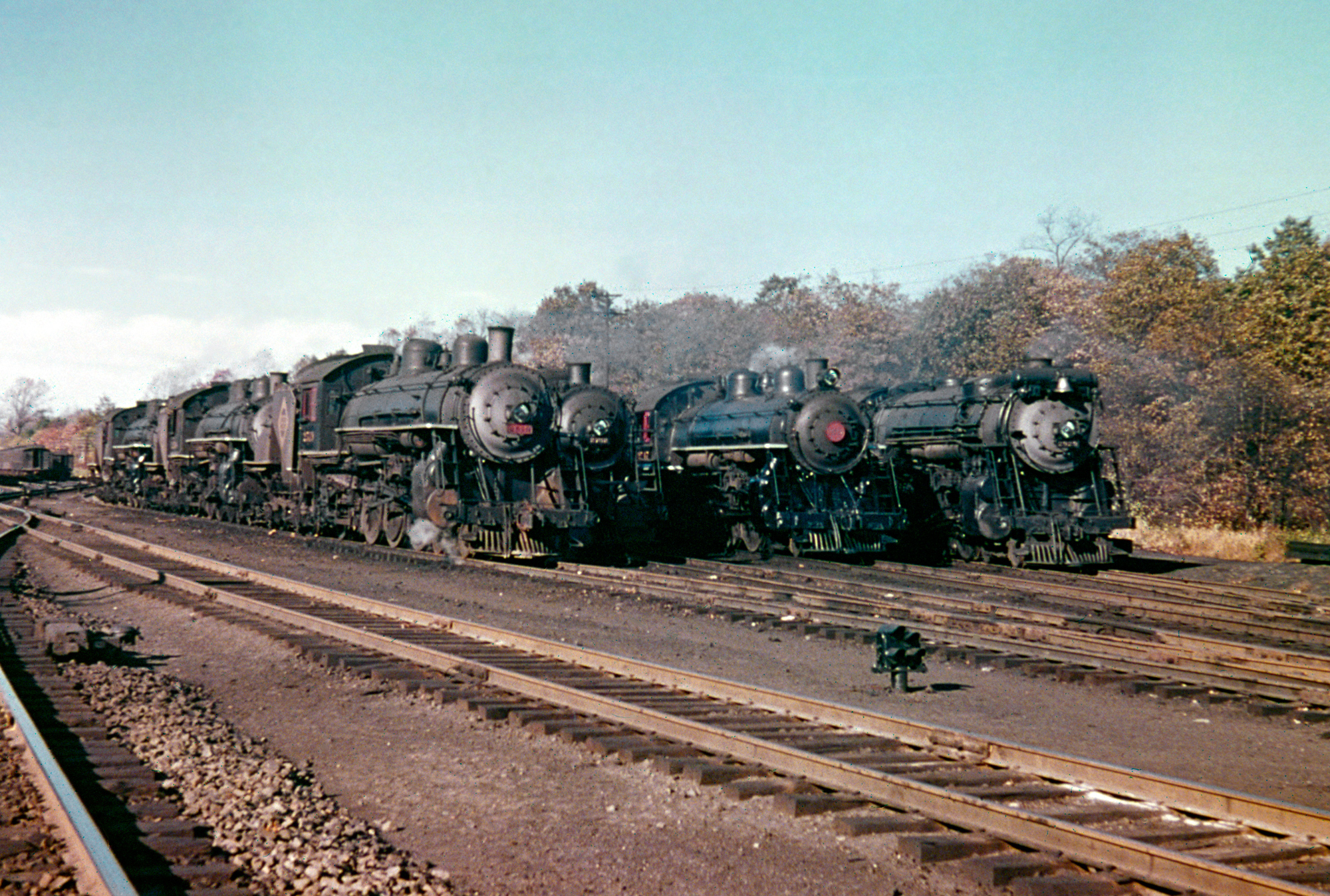
Erie Railroad 4-6-2s lined up at Waldwick, New Jersey, following their afternoon commuter runs on October 23, 1949. Bob Collins photo. American-Rails.com collection.
0-6-0s, then USRA 0-8-0s, then Baldwin copies
The first switchers Erie received after 1900 were 30 0-6-0s, class B-5, nos. 50–79, built in early 1904 by Cooke and Schenectady. Later that same year Cooke delivered six B-4 class 0-6-0s. The difference between the two was an inch less in cylinder diameter on the B-4. Erie continued to obtain switchers from various builders, including its own Meadville shops, through 1912. The engines were typical of the period, with slide valves, Stephenson gear, 50-inch drivers, and main rods connected to the second drivers. Meadville built the 10 locomotives of the B-6 class in 1912. They had main rods connected to the rear drivers and slide valves actuated by Baker valve gear. Odd class 0-6-0T (tank engine) no. 2 was built for the Undercliff Terminal Company and purchased by the Erie in 1912 for use as a shop goat.
Switching was upgraded in 1918 when Alco’s Pittsburgh Works delivered 16 USRA 0-8-0s. Between 1927 and 1930 Baldwin delivered 55 more 0-8-0s, 200–244, class C-3, and 245–254, class C-3-A. Except for 52-inch drivers they were copies of the USRA design. They were delivered with huge 12-wheeled tenders that were intended for road locomotives; upon delivery the switchers were coupled to small Vanderbilt tenders. Erie converted 33 of its H-22 Consolidations into 0-8-0s by removing the lead trucks. The conversions were most likely done in the late Teens or early 1920s. In 1939 Erie purchased two 0-8-0s from the Buffalo Creek Railroad, numbering them 298 and 299 and classifying them C-4.
March 17, 1954
Freight steam was finished in 1952. The Berkshires, the remaining Mikes, and the USRA Santa Fes came off that year. Commuter Pacifics on the New Jersey & New York—today’s Pascack Valley—lasted a little longer. Stagner records the last run: K-1 2530, Jersey City from Spring Valley, March 17, 1954. No main-line Erie steam locomotive was set aside. The diesels are the all-time diesel roster.
All-time roster (built since 1900)
Columns follow Drury as printed. Classification is Erie’s letter-and-number scheme. Some 1899 engines sit in the table because Drury put them there.
| Type | Class | Numbers | Qty | Builder | Built | Retired | Notes |
|---|---|---|---|---|---|---|---|
| 0-6-0 | B-4 | 44–49 | 6 | Cooke | 1904 | 1929–1945 | 45 rebuilt to 0-6-0T |
| 0-6-0 | B-4 | 50–64 | 15 | Cooke | 1904 | 1928–1950 | |
| 0-6-0 | B-5 | 65–79 | 15 | Schenectady | 1904 | 1921–1950 | |
| 0-6-0 | B-5 | 80–84 | 5 | Baldwin | 1910 | 1948–1950 | |
| 0-6-0 | B-5 | 85–99 | 15 | Meadville Shops | 1911–1912 | 1912–1950 | |
| 0-6-0 | B-5 | 110–114 | 5 | Lima | 1911 | 1947–1950 | |
| 0-6-0 | B-5 | 115–119 | 5 | Schenectady | 1911 | 1944–1950 | |
| 0-6-0 | B-6 | 100–109 | 10 | Meadville Shops | 1912 | 1948–1950 | |
| 0-6-0T | B Odd | 2 | 1 | Rogers | 1912 | 1947 | Ex-Undercliff Terminal; shop goat |
| 0-8-0 | C-1 | 120–135 | 16 | Pittsburgh | 1918 | 1950 | USRA |
| 0-8-0 | C-2 | 1804–1836 | 33 | Erie Shops | 1922–1940 | Rebuilt from H-22 2-8-0s | |
| 0-8-0 | C-3 | 200–244 | 45 | Baldwin | 1927, 1929 | 1950–1953 | |
| 0-8-0 | C-3-A | 245–254 | 10 | Baldwin | 1930 | 1950–1953 | |
| 0-8-0 | C-4 | 298, 299 | 2 | Brooks | 1914, 1916 | 1950 | Ex-Buffalo Creek, 1939 |
| 2-8-0 | H-9 | 1400–1409 | 10 | Brooks | 1899 | 1927 | Camelback |
| 2-8-0 | H-10 | 1450–1469 | 20 | Brooks | 1900 | 1927 | Camelback |
| 2-8-0 | H-11 | 1470–1499 | 30 | Rogers | 1900 | 1927 | Camelback |
| 2-8-0 | H-12 | 1425–1449 | 25 | Brooks | 1900 | 1927 | Camelback |
| 2-8-0 | H-13 | 1410–1424 | 15 | Baldwin | 1901 | 1927 | Camelback |
| 2-8-0 | H-14 | 1500–1503 | 4 | Schenectady | 1900 | 1927 | Camelback; E&WY |
| 2-8-0 | H-16 | 1510–1529 | 20 | Baldwin | 1902 | 1927 | Vauclain compound, later simpled |
| 2-8-0 | H-17 | 1530–1544 | 15 | Rogers | 1902 | 1927 | |
| 2-8-0 | H-18 | 1545–1564 | 20 | Cooke | 1902 | 1927 | |
| 2-8-0 | H-19 | 1565–1569 | 5 | Cooke | 1902 | 1927 | Tandem compound, later simpled |
| 2-8-0 | H-20 | 1570–1615 | 45 | Schenectady | 1903–1904 | 1927–1947 | |
| 2-8-0 | H-21 | 1616–1790 | 175 | Rogers, Cooke | 1904–1906 | 1927–1952 | |
| 2-8-0 | H-21 | 2000–2034 | 35 | Cooke | 1904–1906 | 1927–1952 | |
| 2-8-0 | H-21 | 2035–2084 | 50 | Baldwin | 1910 | 1927–1952 | |
| 2-8-0 | H-22 | 1800–1886 | 87 | Baldwin | 1905–1906 | 1927–1936 | 33 rebuilt to C-2 0-8-0s |
| 2-8-0 | H-27 | 1540 | 1 | Baldwin | 1906 | 1936 | Ex-NYSW; exposition engine via Rock Island |
| 2-8-2 | N-1 | 3000–3154 | 155 | Baldwin, Schenectady, Lima | 1911–1913 | 1947–1951 | Stokers and feedwater heaters 1927 |
| 2-8-2 | N-2 | 3200–3214 | 15 | Brooks | 1918 | 1950–1952 | USRA heavy |
| 2-8-2 | N-3 | 3155–3194 | 40 | Baldwin | 1923 | 1949–1952 | Booster trailing truck |
| 2-8-2 | N-3-A | 3199 | 1 | Baldwin | 1926 | 1950 | Ordered with uniflow cylinders; completed conventional |
| 2-8-4 | S-1 | 3300–3324 | 25 | Brooks | 1927 | 1950–1952 | 225 psi |
| 2-8-4 | S-2 | 3325–3349 | 25 | Lima | 1927 | 1950–1952 | 250 psi. Photo: 3331 Marion |
| 2-8-4 | S-3 | 3350–3384 | 35 | Baldwin | 1928 | 1950–1952 | Photo: 3376 Secaucus |
| 2-8-4 | S-4 | 3385–3404 | 20 | Lima | 1929 | 1950–1952 | 3389 the ultimate Erie Berkshire |
| 2-10-0 | J-2 | 2600–2699 | 75 | Baldwin, Richmond, Schenectady | 1919 | 1950–1952 | Russian Decapods; 16 to NYSW, 8 to others. Not sequential |
| 2-10-2 | R-1 | 4000–4041 | 42 | Baldwin, Schenectady, Lima | 1915–1917 | 1939–1949 | 4000 experimental 1915 |
| 2-10-2 | R-2 | 4100–4129 | 30 | Schenectady | 1915–1917 | 1949–1952 | |
| 2-10-2 | R-3 | 4200–4224 | 25 | Brooks | 1919 | 1949–1952 | USRA heavy |
| 0-8-8-0 | L-1 | 2600–2602 | 3 | Schenectady | 1907 | 1930 | Camelback; rebuilt 2-8-8-2 by Baldwin 1921 |
| 2-6-8-0 | M-1 | 2900 | 1 | Meadville Shops | 1910 | Rebuilt to 2-8-0, 1916 | |
| 2-8-8-2 | P-1 | 5014–5016 | 3 | Baldwin | 1914, 1916 | 1929–1933 | Triplex. 5014 Matt H. Shay. See Triplex |
| 4-4-2 | E-1 | 502–527, 532–534 | 29 | Baldwin | 1899–1901 | 1927–1928 | Camelback Vauclain compound, later simpled |
| 4-4-2 | E-2 | 934–943 | 10 | Baldwin | 1902 | 1927–1928 | Ex 535–544; Camelback |
| 4-4-2 | E-3 | 545–559 | 15 | Baldwin | 1903 | 1930–1933 | Single cab |
| 4-4-2 | E-4 | 535, 536 | 2 | Baldwin | 1905 | 1927–1936 | Vauclain balanced compound |
| 4-4-2 | E-5 | 537 | 1 | Schenectady | 1905 | 1942 | Cole balanced compound |
| 4-6-0 | G-12 | 909–918 | 10 | Baldwin | 1901 | 1927 | Camelback Vauclain compound |
| 4-6-0 | G-13 | 919–933 | 15 | Baldwin | 1901 | 1941–1950 | Camelback; four to G-16 1908 |
| 4-6-0 | G-15 | 950–974 | 25 | Schenectady, Rogers, Baldwin | 1902–1908 | 1942, 1947 | |
| 4-6-2 | K-1 | 2510–2568 | 59 | Schenectady, Rogers, Baldwin | 1905–1908 | 1947–1954 | Harriman pattern. 2530 last steam. Photo: 2544 Spring Valley |
| 4-6-2 | K-2 | 2900–2904 | 5 | Lima | 1913 | 1950 | Lima’s first large road engines for a Class I |
| 4-6-2 | K-2-A | 2905–2914 | 10 | Schenectady | 1917 | 1947–1954 | |
| 4-6-2 | K-3 | 2509 | 1 | Schenectady | 1911 | 1950 | Alco 50000; bought September 1912 |
| 4-6-2 | K-4 | 2700–2743 | 44 | Alco, Baldwin | 1913–1916 | 1949–1950 | 69-inch drivers |
| 4-6-2 | K-4-A | 2744–2753 | 10 | Baldwin | 1923 | 1950–1952 | Built for freight; rebuilt passenger, 75-inch drivers |
| 4-6-2 | K-5 | 2915–2934 | 20 | Baldwin, Richmond | 1919 | 1950–1952 | USRA heavy; no other road received them. 2917 to 2945, 1930 |
| 4-6-2 | K-5-A | 2935–2944 | 10 | Baldwin | 1923 | 1951 | Rebuilt 1941, disk drivers, boosters |
| 4-6-2 | K-5-B | 2960 | 1 | Baldwin | 1926 | 1951 | Tractive effort 47,200 lb |
Related reading on American-Rails.com
- Erie Railroad · Erie diesel roster · Erie Lackawanna
- Triplex · Berkshire type · Camelbacks · Pacific type
- Lackawanna steam · New York, Susquehanna & Western · Feedwater heaters
Sources
- Drury, George H. Guide to North American Steam Locomotives, revised edition. Kalmbach, 2015. Pages 172–176, Erie chapter and class table
- Westing, Frederick, and Alvin F. Staufer. Erie Power. Alvin F. Staufer, 1970
- Stagner, Lloyd E. American Steam Finale, 1954–1970. South Platte Press, 2001. March 17, 1954, K-1 2530
- Railroad magazine, October 1935, page 88, and May 1949, page 110; Railway & Locomotive Historical Society Bulletin No. 131 (entire issue). Published rosters cited by Drury
- Erie Lackawanna Historical Society, erielackhs.org
- American-Rails.com, Triplex (P-1 5014–5016) and Berkshire type
Recent Articles


-
Erie Steam Locomotives: History, Roster & Photos
Sep 20, 26 11:55 AM
 Erie Railroad steam—Camelback 2-8-0s, 155 N-1 Mikados, 105 Berkshires, K-class Pacifics, Triplexes. Post-1900 roster after Drury. Last steam March 17, 1954.
 -
Erie Railroad Diesel Roster: All-Time
Sep 20, 26 11:47 AM
 Erie Railroad diesel—boxcabs 1926, FTs 1944, F3/F7, FA/PA, GP7/GP9, Baldwins, Limas. All-time roster with serials, orders, classes. Last steam March 17 1954. EL October 17 1960.
 -
Erie Railroad: Map, Passenger Trains, Logo, History
Sep 20, 26 11:44 AM
 Erie Railroad—New York & Erie 1832, Piermont–Dunkirk May 14 1851, six-foot then standard June 1880, Chicago 1883. High-and-wide fourth way. Erie Lackawanna October 17 1960.
 -
Colebrookdale Railroad Dining (2026): Secret Valley Dinner Train
Sep 20, 26 11:36 AM
 2026 Colebrookdale Railroad dinner in Boyertown—Secret Valley Dining Class, about 2 hours. Saturday evenings. Confirm on colebrookdalerailroad.com.
 -
Boone & Scenic Valley Wolf Dinner Train (2026)
Sep 19, 26 08:15 PM
 2026 Boone & Scenic Valley Wolf Dinner Train—Des Moines River valley, Bass Point Creek High Bridge, Union Pacific dining cars. Confirm on bsvrr.com.
 -
C&NW 4-6-2s 1617 & 1620: Minnesota 400 Yellow Jackets
Sep 19, 26 11:28 AM
 C&NW Class E Pacifics 1617 and 1620—Alco Schenectady 1917, yellow-and-green E-4-style shrouds 1941 for the Minnesota 400. Crews called them Yellow Jackets. Renumbered 617/620. Scrapped 1956.
 -
Erie Lackawanna Diesel Roster: All-Time
Sep 19, 26 10:13 AM
 Erie Lackawanna diesel—Erie and DL&W inheritance, GP35s, U25Bs, SD45/SDP45/SD45-2, U34CH. All-time roster with serials and orders. Conrail April 1 1976.
 -
Erie Lackawanna Railway: Map, History, Logo
Sep 19, 26 10:06 AM
 Erie Lackawanna Railway—Erie and DL&W, October 17 1960–March 31 1976. Von Willer, White revival, Dereco, Agnes, Conrail. High-and-wide Chicago main. Map, logo, what remains.
 -
"Empire State Express" (1941 Train): Timetables, Route, Consist
Sep 18, 26 10:59 PM
 NYC Empire State Express—George Daniels 1891 day train, 999’s 112.5 mph claim, Budd stainless streamliner December 7 1941, Cleveland and Detroit sections, diesels, 1967 name drop. Timetables, consist…
 -
New York Central 4-6-4s 5426 & 5429: Empire State Express Hudsons
Sep 18, 26 10:32 PM
 NYC J-3a Hudsons 5426 and 5429—Alco 1937, Budd stainless shrouds 1941 for the Empire State Express. Pearl Harbor inaugural. Shrouds off by 1950. Neither preserved.
 -
"Stourbridge Lion" Locomotive: Facts, History, Photos
Sep 18, 26 10:27 PM
 Stourbridge Lion—Foster, Rastrick 0-4-0, first steam locomotive in the United States. Horatio Allen, Honesdale, August 8, 1829. Too heavy for D&H gravity track. Boiler in Baltimore; Colonie replic…
 -
Delaware & Hudson Steam Roster (Post 1900)
Sep 18, 26 10:01 PM
 Delaware & Hudson steam—Camelback 2-8-0s, Loree high-pressure compounds, Class K 4-8-4s, forty Challengers. Post-1900 class roster after Drury. Last steam July 21, 1953.
 -
Boston & Maine Steam Roster (Post 1900)
Sep 18, 26 02:57 PM
 Boston & Maine steam—B-15 Moguls, K-8 Consolidations, P-4 Lima Pacifics, T-1 Limas, R-1 Mountains. Post-1900 class roster after Drury. Last steam July 23, 1956.
 -
Boston & Maine Diesel Roster (All-Time)
Sep 18, 26 01:25 PM
 Boston & Maine diesel—boxcab 1100 1935, Flying Yankee 6000, FTs, E7s, BL2s, GP7/GP9, GP38-2s and GP40-2s. All-time roster. Last steam July 23, 1956.
 -
Mid-Continent Railway Museum Dining (2026)
Sep 18, 26 01:21 PM
 2026 Mid-Continent dining in North Freedom—select-date seated meals in luxury cars, reservations required. Pizza Limited June 28. Confirm on midcontinent.org.
 -
Bessemer & Lake Erie Steam Roster (Post 1900)
Sep 18, 26 12:11 PM
 Bessemer & Lake Erie steam—C3A 150–151, D1A/D2A Santa Fes, 47 H1 Texas types after Burlington. Post-1900 class roster after Drury. Last steam 2-8-0 156, May 14, 1953.
 -
Bessemer & Lake Erie Diesel Roster (All Time)
Sep 18, 26 12:09 PM
 Bessemer & Lake Erie diesel—Westinghouse 281 1936, Baldwin DRS-6-6-1500s, F7s 1950–53, SD7/SD9/SD18/SD38 family, RSD-15s. All-time roster. Last steam 2-8-0 156, May 14, 1953.
 -
Bangor & Aroostook Steam Roster (Post 1900)
Sep 18, 26 11:21 AM
 Bangor & Aroostook steam—Manchester Ten-Wheelers, Alco Mountains 100–109, G-2 Consolidations, Pacifics 250–254. Post-1900 class roster after Drury. Last steam Pacific 251, July 22, 1951.
 -
Bangor & Aroostook Diesel Roster (All Time)
Sep 18, 26 11:09 AM
 Bangor & Aroostook diesel—F3s 1947, eight BL2s, E7s, GP7s leased to the PRR, GP9s, GP38s. All-time roster. Last regular steam July 22, 1951.
 -
B&O Steam Locomotive Roster (Post 1900)
Sep 18, 26 10:33 AM
 Baltimore & Ohio steam—Old Maude, E-27 Consolidations, Q Mikados, Big Sixes, EM-1 Yellowstones, President Pacifics. Post-1900 class roster after Drury. Last public steam May 17, 1958.
 -
Baltimore & Ohio (B&O): Diesel Roster (All-Time)
Sep 18, 26 10:28 AM
 Baltimore & Ohio diesel—boxcab 1925, EMC 50 1935, EA 1937, FTs, F3s, F7s, FA-2s, sharks, GP7/GP9, GP30s after C&O 1963, SD50s 8576–8595 1984. All-time roster. Last steam 1958.
 -
Detroit & Toledo Shore Line Railroad: Map, Roster, History
Sep 18, 26 12:32 AM
 Detroit & Toledo Shore Line—Pleasant Bay 1898, named 1899, Detroit–Toledo freight bridge, GTW and Clover Leaf/NKP/N&W. Merged into Grand Trunk Western June 26, 1981.
 -
Lackawanna Steam Locomotives: History, Roster & Photos
Sep 18, 26 12:17 AM
 Delaware, Lackawanna & Western steam—Camelback 2-8-0s, Mikados, freight Pacifics, Poconos 4-8-4s, Hudsons. Post-1900 roster after Drury. Last steam July 13, 1953.
 -
Lackawanna (DL&W) Diesel Roster: All Time
Sep 18, 26 12:11 AM
Delaware, Lackawanna & Western diesel—boxcabs 1926, EMC SC 425–426 1935, FTs 1945, F3/F7/E8, GP7s, RS-3s, FM Train Masters. All-time roster. Last steam 1953. -
Lackawanna Railroad: Map, History, Viaducts, Rosters
Sep 18, 26 12:04 AM
 TDelaware, Lackawanna & Western—Liggett’s Gap 1832, named March 11 1853, Hoboken–Buffalo, anthracite, Phoebe Snow, Cutoff and Tunkhannock. It merged with the Erie to form Erie Lackawanna on Octobe…
 -
Rail News, The Latest
Sep 17, 26 11:56 PM
This page provides a portal to the latest in rail news, from preservation and restortation subjects to other notable topics. -
Union Pacific Big Boy 4014 Sets First Holiday Tour for Make-A-Wish
Sep 17, 26 11:54 PM
 Union Pacific Big Boy 4014’s first holiday tour: Cheyenne–Denver tickets, Nov. 21 Denver-area display, Make-A-Wish. Museum patrons Oct. 16; public Oct. 19.
 -
Conrail Diesel Roster (All Time)
Sep 17, 26 10:27 PM
Conrail diesel—~5,000 inherited 1976, Big Blue, GP15-1s, SD40-2s, SD50s, Dash-8s, SD60/60M/60I, SD80MACs. All-time CR-number roster. -
Chessie System (Railroad): The C&O, B&O, And WM
Sep 17, 26 09:38 PM
 Chessie System, Inc.—C&O, B&O, and Western Maryland. Kitten-C paint 1972, holding company February 26 1973, CSX November 1 1980, C&O into CSXT August 31 1987.
 -
Chesapeake & Ohio (C&O) Diesel Roster: All-Time
Sep 17, 26 06:01 PM
Chesapeake & Ohio diesel—late steam, no Fairbanks-Morse, E7s 1946, GP7/GP9 flood, F7s, GP40-2s, B30-7s, SD50s 1984–85. All-time roster. Steam ended 1956. -
Chesapeake & Ohio (C&O) Steam Roster: Post-1900
Sep 17, 26 03:18 PM
 Chesapeake & Ohio steam—H-8 Alleghenies, K-4 Kanawhas, T-1 Texas, Greenbriers, H-6 1949 Mallets. Post-1900 class roster including Pere Marquette and Hocking Valley. Last steam 1956.
 -
Chesapeake and Ohio Railway: Map, Logo, History
Sep 17, 26 02:36 PM
 Chesapeake & Ohio Railway—Louisa Railroad 1836, named August 31 1868, Ohio River 1873. Coal, Chessie the kitten, Pere Marquette 1947, B&O control 1963, into CSX August 31 1987. Complete corporate…
 -
TVRM Valentine Train Ride (2026)
Sep 17, 26 02:31 PM
 2026 TVRM Valentine Train Ride in Chattanooga—Feb. 6–15, plated dinner, Grand Junction Depot. Confirm on tvrail.com.
 -
River Fox Train Dining (2026)
Sep 17, 26 02:29 PM
 2026 River Fox Train in West Sacramento—Brunch Train and Murder Mystery dinner. 18095 County Road 117. Confirm on riverfoxtrain.com.
 -
Weehawken Terminal, Serving The West Shore Railroad
Sep 17, 26 01:38 PM
 Weehawken Terminal—West Shore / New York Central Hudson waterfront station, opened 1884. Five ferry slips, sixteen tracks, Weehawken Tunnel 4,014 feet. Last ferry March 25, 1959. Port Imperial and HBL…
 -
West Shore Railroad: Map, History, Timetables
Sep 17, 26 01:32 PM
 West Shore Railroad—New York, West Shore & Buffalo 1880–83, Weehawken to Buffalo. PRR-backed rival to the Central. Morgan settlement, 475-year NYC lease January 1 1886. CSX River Sub today.
 -
Jersey Central Diesel Locomotives: History, Roster & Photos
Sep 17, 26 01:20 PM
 Central Railroad of New Jersey diesel—boxcab 1000, Baldwin double-enders, F3s, Train Masters, SD35s, GP40Ps. All-time roster. Steam ended July 1, 1954.
 -
Jersey Central Steam Locomotives: History, Roster & Photos
Sep 17, 26 01:17 PM
 Central Railroad of New Jersey steam—Camelback Ten-Wheelers, USRA Mikados, G-class Pacifics, suburban tanks. Post-1900 class roster after Drury. Dieselized July 1, 1954.
 -
Jersey Central Railroad (CNJ): Map, Rosters, History
Sep 17, 26 01:14 PM
 Central Railroad of New Jersey—Elizabethtown & Somerville 1831, named April 23 1849. Communipaw, anthracite, Blue Comet, Reading/B&O control. Conrail April 1 1976. Complete corporate history.
 -
Central Vermont Diesel Locomotives: History, Roster & Photos
Sep 17, 26 11:35 AM
 Central Vermont diesel—Alco S-2s 1942, RS-3s, RS-11s from DW&P, EMD GP9s 1956–57, GP38ACs 1971. All-time roster. Last steam April 4, 1957.
 -
Central Vermont Steam Locomotives: History, Roster & Photos
Sep 17, 26 11:19 AM
 Central Vermont steam—ten Alco 2-10-4s of 1928, four U-1-a Mountains, Consolidations. Post-1900 class roster after Drury. Last steam April 4, 1957.
 -
Central Vermont Railway: Map, Logo, Rosters
Sep 17, 26 11:03 AM
 Central Vermont Railway—Vermont Central charter October 1843, Bethel–White River Junction June 26, 1848. Grand Trunk 1898, CN 1923, RailTex/NECR 1995. Complete corporate history.
 -
Fitchburg Railroad: Map, History, Timetables
Sep 17, 26 10:40 AM
 Fitchburg Railroad—chartered March 3, 1842, Boston–Fitchburg March 5, 1845. Alvah Crocker, Hoosac west door, Vermont & Massachusetts, Cheshire. B&M 99-year lease July 1, 1900. Complete corpora…
 -
Steam Railroading Institute Dining (2026)
Sep 17, 26 10:30 AM
 2026 SRI Owosso dining—vintage dining cars, select evenings. 2026 dinner calendar not posted; 2025 Up In Smoke is the recent example. Confirm on michigansteamtrain.com.
 -
Canadian Pacific Railway: Map, History, Logo, Photos
Sep 17, 26 12:06 AM
 Canadian Pacific Railway—incorporated February 16, 1881. Last spike Craigellachie November 7, 1885. Soo, Milwaukee, D&H, DM&E. CPKC April 14, 2023. Complete corporate history.
 -
Canadian Pacific Diesel Locomotives: History, Roster & Photos
Sep 17, 26 12:03 AM
 Canadian Pacific diesel—E8A 1800 in 1949, FP7/FP9, FA-2, C424, SD40-2, SD40-2F Red Barns, AC4400CW, ES44AC, SD30C-ECO, SD70ACu heritage. All-time roster. Last steam November 6, 1960.
 -
Canadian Pacific Steam Locomotives: History, Roster & Photos
Sep 16, 26 11:35 PM
 Canadian Pacific steam—3,257 engines 1881–1949. D10 Ten-Wheelers, G3 Pacifics, Royal Hudsons, Selkirk 2-10-4s. Post-1900 class roster after Drury. Last steam November 6, 1960.
 -
Woodstown Central Dining in Motion (2026)
Sep 16, 26 11:31 PM
 2026 Woodstown Central Dining in Motion—Salem County table car, 50–60 minutes, private table of four from $190. Confirm on woodstowncentral.com.
 -
NCTM Wine & Dine on the Rails (2026)
Sep 16, 26 11:28 PM
 2026 NCTM Wine & Dine on the Rails in Spencer—Feb. 13–15, three-course dinner, 21+, $145/$140. Sold out. Confirm next season on nctransportationmuseum.org.
 -
Southern Railway 4-6-2 1380: The Streamlined Ps-4
Sep 16, 26 10:34 PM
 Southern Railway Ps-4 4-6-2 1380—Alco 1923, serial 64857. Otto Kuhler streamlining at Spencer 1940–41 for the Tennessean. Only streamlined steam locomotive on the Southern. Scrapped Baltimore 1953.