Lackawanna Steam Locomotives: History, Roster & Photos
Last revised: September 17, 2026
By: Adam Burns
The Lackawanna of the first half of the twentieth century was a prosperous road and looked it. It burned anthracite and ran Camelbacks, then switched freight to soft coal from the Mikados on, kept locomotives simple, and never bought an Atlantic or a Mallet. George H. Drury, in Guide to North American Steam Locomotives, makes those omissions the point: the wide firebox was already on the 4-4-0s, and Scranton sat on the main, not a branch.
In 1910 the railroad adopted a letter-and-number classification. It loaded the system with stokers, power reverses, and brick arches until the scheme became unwieldy, and dropped it in 1938. Even-hundred road numbers—200, 300, 1600—were skipped. Last steam was 0-8-0 232 at Scranton on July 13, 1953.
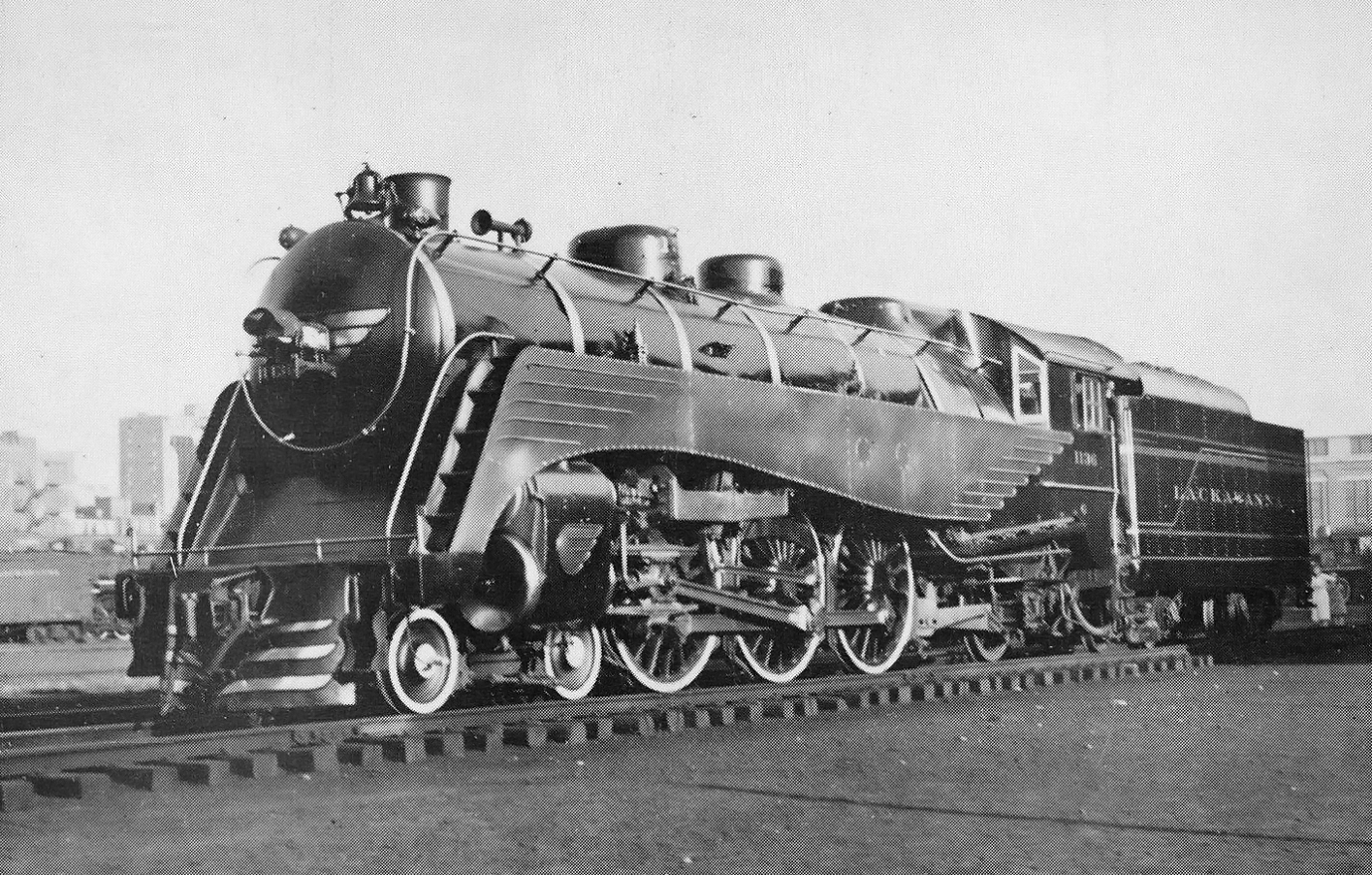
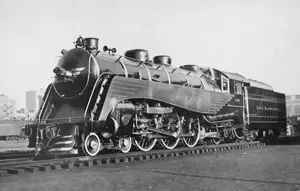
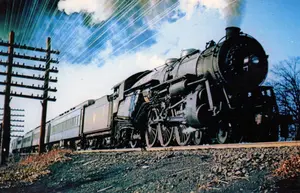
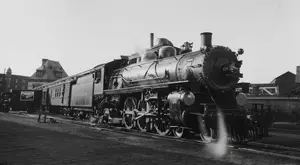
Delaware, Lackawanna & Western 4-6-2 #1136 in semi-streamlining, with English undertones, at Scranton, Pennsylvania, in 1938. One of four Pacifics given stainless-steel running-board skirts in 1936–37. Schenectady, 1923.
On this page: At a glance · Anthracite and what it omitted · Twelve-Wheelers, Consolidations, Mikados · Americans, Ten-Wheelers, Pacifics · Poconos and Hudsons · Switchers · July 13, 1953 · All-time roster (built since 1900)
At a glance
| Item | Detail |
|---|---|
| Railroad | Delaware, Lackawanna & Western. Mark DLW. Company Lackawanna |
| This roster | Engines built since 1900, after Drury, pages 155–159. Classification dropped 1938; no class letters |
| Fuel | Anthracite, then soft coal from the Mikados on. Passenger Pacifics kept wide fireboxes |
| Omitted | No Atlantics. No Mallets. Paired single air pumps; compounding and feedwater heaters avoided |
| Freight after 1912 | Mikados from 1912; freight Pacifics 1151–1193; thirty-five three-cylinder 4-8-2s, 2201–2235 |
| Poconos | Fifty-five 4-8-4s, 1501–1505 and 1601–1650, 1927–1934. Lackawanna’s name for the type |
| Hudsons | Five 4-6-4s, 1151–1155, Schenectady, 1937. Last new steam. Numbers reused after freight Pacifics |
| Shop 0-8-0s | Sixty, 201–260, Scranton, 1929–1935, from surplus Mike and Pacific boilers. Tractive effort 67,300 lb |
| Last steam | July 13, 1953. 0-8-0 #232 at Scranton |
| Shops | Scranton, Pennsylvania |
Roster follows Drury, Guide to North American Steam Locomotives (revised edition), pages 155–159. Information compiled September 17, 2026.
Anthracite, Camelbacks, and two types the roster never had
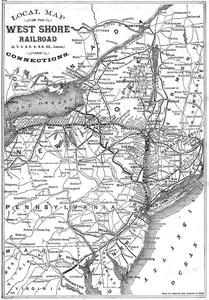
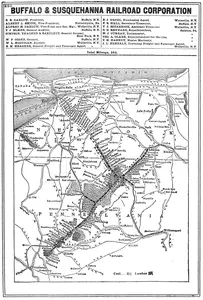
Drury’s chapter opens on the map. The main ran from Hoboken northwest through Scranton and Binghamton to Buffalo. Long branches reached north from Binghamton to Utica, Syracuse, and Oswego, and southwest from Scranton along the Susquehanna to Northumberland. It was the shortest New York–Buffalo route. It also ran a heavy New Jersey suburban service. In the early twentieth century, with an eye to speeding trains, the road built the cutoffs that still define the map: heavy earthworks and tall concrete viaducts. Those projects are the company page. They are why later Mikes and Pacifics could run faster than the 2-8-0s they replaced.
The route west crossed the ridges between the Hudson and Delaware, threaded Delaware Water Gap, climbed the Poconos into the Lackawanna Valley at Scranton, climbed again to Binghamton, followed the Susquehanna, Chenango, and Cohocton, and then ran level country into Buffalo. Scranton was on the main. The Erie and the Delaware & Hudson both used Mallets on the grades out of Scranton; those grades were on secondary lines. The Lackawanna did not. It was a fast railroad. It also preferred locomotives as simple as possible: paired single air pumps rather than cross-compound pumps, and no compounding or feedwater heaters as a matter of policy. Pacific 1135 was a test bed for a heater. The roster as a whole did not follow her.
The other omission was the Atlantic. The wide firebox that a 4-4-2 made possible was already present as a Wootten firebox over the 69-inch drivers of Lackawanna 4-4-0s and 4-6-0s. By the time the railroad wanted trailing trucks, passenger trains needed six driving axles. The Atlantic was not a mountain engine.
In 1900 the Lackawanna burned anthracite and was one of the principal Camelback users. Hard, clean-burning coal was the heart of the 1901 advertising campaign that put Phoebe Snow on the Road of Anthracite. The New York Central had a longer route to Buffalo but ran faster on sooty soft coal. By the Teens, mechanical stokers needed small-size coal, and small anthracite cost more than bituminous. From the Mikados on, freight engines were designed to burn soft coal. Passenger Pacifics kept wide fireboxes; after World War I they burned a mixture, then straight bituminous, and the advertising department stopped talking about Phoebe’s white dress. The character came back on a streamliner in 1949. That train is the Phoebe Snow page.
Twelve-Wheelers, two generations of Consolidation, then Mikados
In 1899 the DL&W took fifteen Camelback 4-8-0s from Brooks, then five from Dickson in 1900, similar to Twelve-Wheelers Brooks had built for the Central Railroad of New Jersey. They were too powerful for their weight, about 200,000 pounds, and slippery. For 33 more freight engines that year the road switched to the 2-8-0, which put more weight on the drivers. Those two groups, 801–820 and 821–853, spent most of their lives in secondary service after boiler pressure and cylinder diameter were cut. Except for two that lasted a few years longer, the 4-8-0s were scrapped in 1923.
In 1901 Schenectady turned out a 57-inch-drivered 2-8-0 at 186,000 pounds as a Camelback or 178,000 as a single-cab. The railroad ordered 30 Camelbacks, 855–884, and 30 single-cab engines, 740–769, then 30 more: 20 Camelbacks 885–899 and 301–305, and 10 conventional 770–779. By 1910 it had 91 Camelback 2-8-0s and 100 conventional 2-8-0s to the same specification except firebox and cab: 57-inch drivers, 21 × 26 cylinders, 186,000 to 190,000 pounds. In 1911 Schenectady built 15 larger 2-8-0s, 385–399, for Dansville Hill between Groveland and Wayland, New York: same 57-inch drivers and 200-pound boiler, 26 × 30 cylinders, 239,000 pounds, about 50 percent more tractive effort.
The 2-8-0s were for heavy, slow freight. Faster trains still needed something. In 1903 Schenectady delivered 25 2-6-0s with 63-inch drivers, 18 of them Camelbacks 570–587 and seven single-cab 550–556. Schenectady, Baldwin, and Rogers kept delivering Moguls through 1911: 20 Camelbacks and 46 single-cab engines in all. Ten, 501–510, Rogers 1906 and Schenectady 1908, had 57-inch drivers and matched contemporary 2-8-0 tractive effort.
In 1912 the railroad bought its first engines with trailing trucks. Schenectady built fifteen 2-8-2s, 1201–1215: 63-inch drivers, a deeper firebox, inside-bearing trailing trucks, and outside ashpan hoppers. Engineers disliked the screw reverse; firemen cursed the hard-fired boxes. Power reverses and stokers later fixed both. 1216–1227 followed in 1913. Later groups—1228–1237 in 1916, 1238–1252 in 1918, 1253–1262 in 1920—had outside-frame trailing trucks and were slightly heavier. They were about as successful as a USRA light Mikado, with 28 × 30 cylinders and 6,000 to 9,000 pounds more tractive effort. Twenty-two of the first Mikes, 1201–1222, were rebuilt into 0-8-0s.
In the early 1920s came 50 heavy Mikados, 2101–2150: about as much locomotive as a 2-8-2 with 63-inch drivers would hold. Cylinders 28 × 32, 356,500 pounds, 67,700 pounds tractive effort, 79,200 with the booster. They were in the class of a Chesapeake & Ohio K-3 and more powerful because of the booster. When dieselization started, seven were sold to Chicago & Illinois Midland, Alton & Southern, and Monon.
The 1912 Mikes were good for heavy freight, but the cutoffs then in progress meant trains could move faster. The railroad had just received its first passenger Pacifics and thought a medium-drivered 4-6-2 could replace the Moguls on fast merchandise. In 1913 Schenectady built seven freight Pacifics, 1151–1157, 69-inch drivers, 43,116 pounds tractive effort, 50 percent more than the Moguls. Lima built 14 more the next year, 1158–1171. Later freight Pacifics had 70-inch drivers: 1172–1183 from Schenectady in 1916 and 1922, 1184–1193 from Brooks in 1924. By then the 2100-series Mikes were almost as fast; 70-inch 4-8-4s in 1929 ended the need for freight Pacifics. Most of 1151–1193 were rebuilt into 0-8-0s. Four of the Brooks engines went to the Boston & Maine. The 1151–1155 numbers were reused in 1937 on Hudsons.
In the 1920s Alco pushed three-cylinder locomotives for heavy freight: lighter rods, six impulses per revolution instead of four, less surge in the rail. The center main rod, between the frames, was hard to lubricate—less of a problem in slow freight than in passenger service. In 1926 and 1927 the Lackawanna bought 35 three-cylinder 4-8-2s, 2201–2235, 63-inch drivers like the 2100 Mikes, outside cylinders 25 × 32, inside cylinder 25 × 28, 394,000 pounds, 77,600 pounds tractive effort. Gresley conjugating gear sat ahead of the cylinders. They remained three-cylinder engines until they were scrapped after World War II. Five passenger three-cylinder 4-8-2s, 1450–1454, are in the next section; those overheated and were rebuilt as two-cylinder engines.
Sixty-five Camelback Americans, Ten-Wheelers, then Pacifics
Between 1901 and 1911 the DL&W bought 65 Camelback 4-4-0s with 69-inch drivers. The first group, 973–981, continued an existing series; 18 more from Schenectady in 1903 and 1904 filled the numbers to 999. Later batches were 958–972, 944–955, 939–943, and 933–938, older 4-4-0s being renumbered to keep the new engines in one block. Baldwin 958–972 were among the few Lackawanna classes from a builder other than Alco or its predecessors. 953–955 of 1905 had experimental superheaters; 954 and 955 had piston valves. The rest were built with slide valves and superheated, with piston valves, between 1916 and 1921.
The Americans were main-line engines until trains outgrew them. Steel coaches from 1923 on were about 25 percent heavier than wood cars of the same capacity, and axle generators added drag. Between 1923 and 1925 the road rebuilt ten 4-4-0s with new cylinders and Baker valve gear. The decision that year to electrify suburban service put most of the 4-4-0s out of work; as others came due for repair they were scrapped. Nine of the ten rebuilds were streamstyled in 1937 with single cabs. One, 988, received running-board skirts.
Before those 65 Americans the railroad had tried the 4-6-0. In 1900 Brooks delivered seven heavy Camelback Ten-Wheelers similar to CNJ’s, 69-inch drivers, inside piston valves, Stephenson gear. They were slow. Four were rebuilt early; with slide valves, then superheated in 1919–20 with new cylinders and Walschaerts gear, they were the only 4-6-0s scrapped when the suburban lines were electrified. Schenectady tried again in 1905 with 1008–1012, Rogers with 1013–1016 the next year, heavier than the Brooks engines. Twenty more, 1017–1036, Rogers and Schenectady 1907–1910, had 69-inch drivers, Walschaerts, and piston valves. 1050–1052, Rogers 1907, were similar with 73-inch drivers. Nine Ten-Wheelers received single cabs in 1937–38. 1011 was streamstyled.
Between 1912 and 1914 Schenectady delivered 14 Pacifics, 1101–1114: wide fireboxes, single cabs, 73-inch drivers, 284,000 to 290,000 pounds. Somewhat heavier than a USRA light Pacific, they exerted the same tractive effort. All had 25 × 28 cylinders except 1110, built with 25 × 26 to see if shorter piston travel made a faster engine. Apparently not: the 1914 Pacifics went back to 25 × 28. Five heavier Pacifics, 305,500 pounds, with regular fireboxes for bituminous coal, came in 1915 for the Poconos. 1131 had an experimental watertube firebox; 1132 tried Baker gear briefly; 1135 tested a feedwater heater. Schenectady then delivered 79-inch-drivered Pacifics in groups: 1126–1130 in 1917, 1120–1125 in 1920, 1115–1119 in 1922, and 1136–1140 in 1923. In 1936 and 1937 four Pacifics received stainless-steel wing-shaped running-board skirts. 1136 at Scranton in 1938 is one of those four. 1123 was further painted bright green and red on the skirts and tender.
In 1924 Brooks built five 4-8-2s, 1401–1405, 69-inch drivers, to cut doubleheading east of Scranton. They were not particularly fast and lasted only a year on premier trains. During World War II, with a surplus of power, they were sold to Atlantic Coast Line. Five more 4-8-2s, 1450–1454, arrived from Brooks in 1925: 73-inch drivers, three 25 × 28 cylinders, two with Baker gear and three with Walschaerts, all with Gresley gear on the center cylinder. The center valve and main-rod bearings overheated at speed, partly because they were hard to reach for lubrication. In 1930 and 1931 the railroad rebuilt them with new drivers and two 28 × 32 cylinders.
Poconos, then five Hudsons
In 1927 Brooks delivered five 4-8-4s, 1501–1505, the second batch of 4-8-4s built in the United States, after Northern Pacific. They had 77-inch drivers and, unlike the NP engines, conventional frames under the firebox. Lackawanna called them Poconos. They were successful enough that Schenectady built 20 copies with 70-inch drivers for freight, 1601–1620, in 1929; ten more freight engines, 1621–1630, in 1932; and a final 20 dual-service locomotives with 74-inch drivers, 1631–1650, in 1934, despite the Depression. The last 20 had roller bearings on all axles and were among the most powerful 4-8-4s built. Tractive effort of 76,000 pounds was exceeded among 4-8-4s by only the Norfolk & Western class J. They carried air horns ahead of the sand dome instead of whistles. Fifty-five Poconos in all.
The last new passenger steam was five Hudsons, 1151–1155, Schenectady, 1937, 80-inch drivers. They were meant to run Scranton–Buffalo without change, 16 to 18 cars at 80 mph. The speed limit was 70, and the trains were rarely more than eight to ten cars. Diesels took the varnish shortly after World War II. The Hudsons went to suburban service. Their numbers had already been used on the 1913 freight Pacifics that Scranton had rebuilt into 0-8-0s.
One hundred twenty-five 0-6-0s, then sixty shop 0-8-0s
Between 1901 and 1911 the Lackawanna bought 125 0-6-0s of the same design: 57 Camelbacks and 68 single-cab engines. They had 51-inch drivers, slide valves, main rods to the second drivers, and only 170 pounds boiler pressure. In 1906 Dickson delivered five Camelback 0-8-0s, 151–155, for transfer between Hoboken and Secaucus. In 1909 four single-cab 0-8-0s arrived: 169 and 168, in that order, for Buffalo, and 184 and 185 for the humps at Secaucus and Hampton. Twenty-eight more, similar to 168 and 169, came from Lima and from Scranton shops between 1912 and 1916, numbered 156–169 and 170–185. The original 184 and 185 became 198 and 199.
By 1928 the railroad had not bought a new switcher in twelve years. The 0-6-0s could not move long strings of loaded hoppers, let alone the 70-ton cars then appearing. Between 1929 and 1935 Scranton shops used boilers from surplus Mikados and Pacifics, plus new running gear, to build 60 modern 0-8-0s, 201–260. They had 58-inch drivers, 27 × 30 cylinders, 258,000 to 265,500 pounds, and 67,300 pounds tractive effort—more than a USRA 0-8-0 (214,000 pounds, 51,000 pounds tractive effort). During the Depression those conversions kept the shop employed. One of them, 232, was the last Lackawanna steam locomotive under fire.
July 13, 1953
The Lackawanna dieselized quickly once it started. FTs arrived in 1945. Express passenger steam, including the Hudsons, was off the main shortly after the war. Last steam was 0-8-0 232 at Scranton on July 13, 1953. Some of the shop 0-8-0s were not cut up until 1955. The diesels that replaced this fleet—boxcabs and EMC SCs, then FTs, F3s, E8As, GP7s, RS-3s, and Train Masters—are the diesel roster. Erie Lackawanna began October 17, 1960. That story is the company page.
All-time roster (built since 1900)
Builder “Schenectady,” “Brooks,” “Cooke,” “Dickson,” and “Rogers” are Alco works or predecessors. “DL&W” and “Scranton” are company shops. Classification was dropped in 1938; there are no class letters included here. Number 1151 appears twice: freight Pacifics rebuilt to 0-8-0s, then Hudsons.
| Type | Numbers | Qty | Builder | Built | Retired | Notes |
|---|---|---|---|---|---|---|
| 0-4-0T | 4 | 1 | Rogers | 1913 | 1949 | |
| 0-4-0T | 7 | 1 | Baldwin | 1922 | 1926 | Ex-Brooklyn Dock & Terminal |
| 0-6-0T | 8 | 1 | Baldwin | 1904 | 1933–1940 | |
| 0-6-0 | 78–84 | 7 | Schenectady | 1911 | 1926–1932 | |
| 0-6-0 | 85–106 | 21 | Cooke | 1903, 1905 | 1927–1935 | |
| 0-6-0 | 107–112 | 6 | Dickson | 1906 | 1927–1953 | |
| 0-6-0 | 113–146 | 34 | Schenectady | 1908 | 1927–1953 | Camelback |
| 0-6-0 | 13–18 | 6 | Dickson | 1901 | 1930–1936 | Camelback |
| 0-6-0 | 19–26 | 8 | Baldwin | 1901 | 1926–1936 | Camelback |
| 0-6-0 | 27–31 | 5 | Schenectady | 1908 | 1932–1941 | Camelback |
| 0-6-0 | 32–43 | 10 | Dickson | 1906–1907 | 1929–1937 | Camelback |
| 0-6-0 | 44–69 | 6 | Cooke | 1902, 1906 | 1926–1937 | |
| 0-8-0 | 156–161 | 6 | Scranton | 1913 | 1940–1946 | |
| 0-8-0 | 162–167 | 6 | Lima | 1912 | 1937–1949 | |
| 0-8-0 | 168, 169 | 2 | Schenectady | 1909, 1910 | 1939 | |
| 0-8-0 | 170–185 | 16 | DL&W | 1914, 1916 | 1946–1953 | To 198, 199 in 1916 |
| 0-8-0 | 184, 185 | 2 | Schenectady | 1910 | 1937 | |
| 0-8-0 | 201–260 | 60 | DL&W | 1929–1935 | 1948–1955 | Rebuilt from 4-6-2s and 2-8-2s |
| 0-8-0 | 151–155 | 5 | Dickson | 1906 | 1937 | Camelback |
| 2-6-0 | 501–506 | 6 | Rogers | 1906 | 1930–1937 | |
| 2-6-0 | 507–510 | 4 | Schenectady | 1908 | 1931–1937 | |
| 2-6-0 | 534–556 | 23 | Schenectady | 1903–1911 | 1929–1947 | |
| 2-6-0 | 557–562 | 6 | Baldwin | 1904 | 1926–1935 | |
| 2-6-0 | 563, 564 | 2 | Rogers | 1906 | 1930, 1942 | |
| 2-6-0 | 565–569 | 5 | Schenectady | 1908 | 1934–1947 | |
| 2-6-0 | 570–587 | 18 | Schenectady | 1903 | 1926–1934 | Camelback |
| 2-6-0 | 588, 589 | 2 | Rogers | 1906 | 1927, 1929 | Camelback |
| 2-8-0 | 350–373 | 24 | Schenectady | 1910 | 1940–1953 | |
| 2-8-0 | 385–399 | 15 | Schenectady | 1911 | 1937, 1940 | |
| 2-8-0 | 724–739 | 16 | Schenectady | 1909 | 1937–1953 | |
| 2-8-0 | 740–779 | 40 | Schen, Dickson | 1901–1902 | 1926–1935 | |
| 2-8-0 | 780–783 | 4 | Rogers | 1906 | 1932, 1936 | |
| 2-8-0 | 784–799 | 16 | Schenectady | 1908–1909 | 1932–1953 | |
| 2-8-0 | 301–305 | 5 | Schenectady | 1902 | 1929–1934 | Camelback |
| 2-8-0 | 306–314 | 9 | Baldwin | 1904 | 1927–1935 | Camelback |
| 2-8-0 | 315–322 | 8 | Schenectady | 1905 | 1927–1935 | Camelback |
| 2-8-0 | 323–346 | 24 | Rogers | 1906–1908 | 1926–1936 | Camelback |
| 2-8-0 | 821–853 | 33 | Dickson, Brooks | 1900 | 1923 | Camelback |
| 2-8-0 | 855–899 | 45 | Dickson, Schen | 1901, 1902 | 1923–1935 | Camelback |
| 2-8-2 | 1201–1227 | 27 | Schenectady | 1912–1913 | 1936–1948 | 1201–1222 rebuilt to 0-8-0 |
| 2-8-2 | 1228–1262 | 35 | Schenectady | 1916–1920 | 1946–1953 | |
| 2-8-2 | 2101–2140 | 40 | Schenectady | 1922, 1923 | 1946–1952 | |
| 2-8-2 | 2141–2150 | 10 | Brooks | 1924 | 1946–1950 | |
| 4-4-0 | 933–943 | 11 | Schenectady | 1910–1911 | 1931–1935 | |
| 4-4-0 | 944–955 | 12 | Schenectady | 1905 | 1929–1937 | Camelback |
| 4-4-0 | 958–972 | 15 | Baldwin | 1904 | 1929–1946 | Camelback |
| 4-4-0 | 973–999 | 27 | Schenectady | 1901–1903 | 1929–1946 | Camelback |
| 4-6-0 | 1001–1007 | 7 | Brooks | 1900 | 1929–1946 | Camelback |
| 4-6-0 | 1008–1012 | 5 | Schenectady | 1905 | 1931 | Camelback |
| 4-6-0 | 1013–1023 | 11 | Rogers | 1906–1907 | 1932–1942 | Camelback |
| 4-6-0 | 1024–1036 | 13 | Schenectady | 1908, 1910 | 1932–1942 | Camelback |
| 4-6-0 | 1050–1052 | 3 | Rogers | 1907 | 1936 | Camelback |
| 4-6-2 | 1101–1114 | 14 | Schenectady | 1912–1914 | 1940–1948 | |
| 4-6-2 | 1115–1130 | 16 | Schenectady | 1917–1922 | 1950–1953 | |
| 4-6-2 | 1131–1135 | 5 | Schenectady | 1915 | 1953 | |
| 4-6-2 | 1136–1140 | 5 | Schenectady | 1923 | 1948–1953 | Photo: #1136 Scranton |
| 4-6-2 | 1151–1157 | 7 | Schenectady | 1913 | Rebuilt into 0-8-0s | |
| 4-6-2 | 1158–1171 | 14 | Lima | 1914 | Rebuilt into 0-8-0s | |
| 4-6-2 | 1172–1183 | 12 | Schenectady | 1916, 1922 | Rebuilt into 0-8-0s | |
| 4-6-2 | 1184–1193 | 10 | Brooks | 1924 | 4 sold to B&M, 6 rebuilt to 0-8-0s | |
| 4-6-4 | 1151–1155 | 5 | Schenectady | 1937 | 1951, 1952 | |
| 4-8-0 | 801–815 | 15 | Brooks | 1899 | 1923 | Camelback |
| 4-8-0 | 816–820 | 5 | Dickson | 1900 | 1923–1929 | Camelback |
| 4-8-2 | 1401–1405 | 5 | Brooks | 1924 | Sold to ACL, 1943 | |
| 4-8-2 | 1450–1454 | 5 | Brooks | 1925 | 1946 | Three-cylinder |
| 4-8-2 | 2201–2235 | 35 | Schenectady | 1926–1927 | 1946–1950 | Three-cylinder |
| 4-8-4 | 1501–1505 | 5 | Brooks | 1927 | 1949 | |
| 4-8-4 | 1601–1620 | 20 | Schenectady | 1929 | 1951 | |
| 4-8-4 | 1621–1630 | 10 | Schenectady | 1932 | 1951, 1952 | |
| 4-8-4 | 1631–1650 | 20 | Schenectady | 1934 | 1951–1953 |
ACL = Atlantic Coast Line. B&M = Boston & Maine.
Related reading on American-Rails.com
- Lackawanna · Lackawanna diesel roster
- Camelbacks · Pacific type · Mountain type · 4-8-4 · Hudson type · Feedwater heaters
- Phoebe Snow · Hoboken Terminal · Jersey Central · Erie
- Erie Lackawanna · Boston & Maine
Sources
- Drury, George H. Guide to North American Steam Locomotives, revised edition, pp. 155–159. All roster rows, Camelback and soft-coal narrative, no Atlantics, no Mallets, Poconos, Hudsons 1151–1155, shop 0-8-0s, last steam July 13, 1953. Table photographed from the same edition
- Taber, Thomas Townsend, and Thomas Townsend Taber III. The Delaware, Lackawanna & Western Railroad in the Twentieth Century, Volume 2, 1981. Drury’s recommended reading
- Published rosters cited by Drury: Railroad magazine, August 1933, p. 46; April 1948, p. 122; Railway & Locomotive Historical Society Bulletin No. 72
- National Park Service / Steamtown. Last day of steam, 1953, 0-8-0 #232
- American-Rails.com: Lackawanna company; Phoebe Snow; Camelbacks
Recent Articles


-
Detroit & Toledo Shore Line Railroad: Map, Roster, History
Sep 18, 26 12:32 AM
 Detroit & Toledo Shore Line—Pleasant Bay 1898, named 1899, Detroit–Toledo freight bridge, GTW and Clover Leaf/NKP/N&W. Merged into Grand Trunk Western June 26, 1981.
 -
Lackawanna Steam Locomotives: History, Roster & Photos
Sep 18, 26 12:17 AM
 Delaware, Lackawanna & Western steam—Camelback 2-8-0s, Mikados, freight Pacifics, Poconos 4-8-4s, Hudsons. Post-1900 roster after Drury. Last steam July 13, 1953.
 -
Lackawanna (DL&W) Diesel Roster: All Time
Sep 18, 26 12:11 AM
 Delaware, Lackawanna & Western diesel—boxcabs 1926, EMC SC 425–426 1935, FTs 1945, F3/F7/E8, GP7s, RS-3s, FM Train Masters. All-time roster. Last steam 1953.
 -
Lackawanna Railroad: Map, History, Viaducts, Rosters
Sep 18, 26 12:04 AM
 TDelaware, Lackawanna & Western—Liggett’s Gap 1832, named March 11 1853, Hoboken–Buffalo, anthracite, Phoebe Snow, Cutoff and Tunkhannock. It merged with the Erie to form Erie Lackawanna on Octobe…
 -
Rail News, The Latest
Sep 17, 26 11:56 PM
This page provides a portal to the latest in rail news, from preservation and restortation subjects to other notable topics. -
Union Pacific Big Boy 4014 Sets First Holiday Tour for Make-A-Wish
Sep 17, 26 11:54 PM
 Union Pacific Big Boy 4014’s first holiday tour: Cheyenne–Denver tickets, Nov. 21 Denver-area display, Make-A-Wish. Museum patrons Oct. 16; public Oct. 19.
 -
Conrail Diesel Roster (All Time)
Sep 17, 26 10:27 PM
 Conrail diesel—~5,000 inherited 1976, Big Blue, GP15-1s, SD40-2s, SD50s, Dash-8s, SD60/60M/60I, SD80MACs. All-time CR-number roster.
 -
Chessie System (Railroad): The C&O, B&O, And WM
Sep 17, 26 09:38 PM
 Chessie System, Inc.—C&O, B&O, and Western Maryland. Kitten-C paint 1972, holding company February 26 1973, CSX November 1 1980, C&O into CSXT August 31 1987.
 -
Chesapeake & Ohio (C&O) Diesel Roster: All-Time
Sep 17, 26 06:01 PM
 Chesapeake & Ohio diesel—late steam, no Fairbanks-Morse, E7s 1946, GP7/GP9 flood, F7s, GP40-2s, B30-7s, SD50s 1984–85. All-time roster. Steam ended 1956.
 -
Chesapeake & Ohio (C&O) Steam Roster: Post-1900
Sep 17, 26 03:18 PM
 Chesapeake & Ohio steam—H-8 Alleghenies, K-4 Kanawhas, T-1 Texas, Greenbriers, H-6 1949 Mallets. Post-1900 class roster including Pere Marquette and Hocking Valley. Last steam 1956.
 -
Chesapeake and Ohio Railway: Map, Logo, History
Sep 17, 26 02:36 PM
 Chesapeake & Ohio Railway—Louisa Railroad 1836, named August 31 1868, Ohio River 1873. Coal, Chessie the kitten, Pere Marquette 1947, B&O control 1963, into CSX August 31 1987. Complete corporate…
 -
TVRM Valentine Train Ride (2026)
Sep 17, 26 02:31 PM
 2026 TVRM Valentine Train Ride in Chattanooga—Feb. 6–15, plated dinner, Grand Junction Depot. Confirm on tvrail.com.
 -
River Fox Train Dining (2026)
Sep 17, 26 02:29 PM
 2026 River Fox Train in West Sacramento—Brunch Train and Murder Mystery dinner. 18095 County Road 117. Confirm on riverfoxtrain.com.
 -
Weehawken Terminal, Serving The West Shore Railroad
Sep 17, 26 01:38 PM
 Weehawken Terminal—West Shore / New York Central Hudson waterfront station, opened 1884. Five ferry slips, sixteen tracks, Weehawken Tunnel 4,014 feet. Last ferry March 25, 1959. Port Imperial and HBL…
 -
West Shore Railroad: Map, History, Timetables
Sep 17, 26 01:32 PM
 West Shore Railroad—New York, West Shore & Buffalo 1880–83, Weehawken to Buffalo. PRR-backed rival to the Central. Morgan settlement, 475-year NYC lease January 1 1886. CSX River Sub today.
 -
Jersey Central Diesel Locomotives: History, Roster & Photos
Sep 17, 26 01:20 PM
 Central Railroad of New Jersey diesel—boxcab 1000, Baldwin double-enders, F3s, Train Masters, SD35s, GP40Ps. All-time roster. Steam ended July 1, 1954.
 -
Jersey Central Steam Locomotives: History, Roster & Photos
Sep 17, 26 01:17 PM
 Central Railroad of New Jersey steam—Camelback Ten-Wheelers, USRA Mikados, G-class Pacifics, suburban tanks. Post-1900 class roster after Drury. Dieselized July 1, 1954.
 -
Jersey Central Railroad (CNJ): Map, Rosters, History
Sep 17, 26 01:14 PM
 Central Railroad of New Jersey—Elizabethtown & Somerville 1831, named April 23 1849. Communipaw, anthracite, Blue Comet, Reading/B&O control. Conrail April 1 1976. Complete corporate history.
 -
Central Vermont Diesel Locomotives: History, Roster & Photos
Sep 17, 26 11:35 AM
 Central Vermont diesel—Alco S-2s 1942, RS-3s, RS-11s from DW&P, EMD GP9s 1956–57, GP38ACs 1971. All-time roster. Last steam April 4, 1957.
 -
Central Vermont Steam Locomotives: History, Roster & Photos
Sep 17, 26 11:19 AM
 Central Vermont steam—ten Alco 2-10-4s of 1928, four U-1-a Mountains, Consolidations. Post-1900 class roster after Drury. Last steam April 4, 1957.
 -
Central Vermont Railway: Map, Logo, Rosters
Sep 17, 26 11:03 AM
 Central Vermont Railway—Vermont Central charter October 1843, Bethel–White River Junction June 26, 1848. Grand Trunk 1898, CN 1923, RailTex/NECR 1995. Complete corporate history.
 -
Fitchburg Railroad: Map, History, Timetables
Sep 17, 26 10:40 AM
 Fitchburg Railroad—chartered March 3, 1842, Boston–Fitchburg March 5, 1845. Alvah Crocker, Hoosac west door, Vermont & Massachusetts, Cheshire. B&M 99-year lease July 1, 1900. Complete corpora…
 -
Steam Railroading Institute Dining (2026)
Sep 17, 26 10:30 AM
 2026 SRI Owosso dining—vintage dining cars, select evenings. 2026 dinner calendar not posted; 2025 Up In Smoke is the recent example. Confirm on michigansteamtrain.com.
 -
Canadian Pacific Railway: Map, History, Logo, Photos
Sep 17, 26 12:06 AM
 Canadian Pacific Railway—incorporated February 16, 1881. Last spike Craigellachie November 7, 1885. Soo, Milwaukee, D&H, DM&E. CPKC April 14, 2023. Complete corporate history.
 -
Canadian Pacific Diesel Locomotives: History, Roster & Photos
Sep 17, 26 12:03 AM
 Canadian Pacific diesel—E8A 1800 in 1949, FP7/FP9, FA-2, C424, SD40-2, SD40-2F Red Barns, AC4400CW, ES44AC, SD30C-ECO, SD70ACu heritage. All-time roster. Last steam November 6, 1960.
 -
Canadian Pacific Steam Locomotives: History, Roster & Photos
Sep 16, 26 11:35 PM
 Canadian Pacific steam—3,257 engines 1881–1949. D10 Ten-Wheelers, G3 Pacifics, Royal Hudsons, Selkirk 2-10-4s. Post-1900 class roster after Drury. Last steam November 6, 1960.
 -
Woodstown Central Dining in Motion (2026)
Sep 16, 26 11:31 PM
 2026 Woodstown Central Dining in Motion—Salem County table car, 50–60 minutes, private table of four from $190. Confirm on woodstowncentral.com.
 -
NCTM Wine & Dine on the Rails (2026)
Sep 16, 26 11:28 PM
 2026 NCTM Wine & Dine on the Rails in Spencer—Feb. 13–15, three-course dinner, 21+, $145/$140. Sold out. Confirm next season on nctransportationmuseum.org.
 -
Southern Railway 4-6-2 1380: The Streamlined Ps-4
Sep 16, 26 10:34 PM
 Southern Railway Ps-4 4-6-2 1380—Alco 1923, serial 64857. Otto Kuhler streamlining at Spencer 1940–41 for the Tennessean. Only streamlined steam locomotive on the Southern. Scrapped Baltimore 1953.
 -
Texas Mexican Railway: Serving The Border Since The 1880s
Sep 16, 26 09:58 PM
 Texas Mexican Railway—Corpus Christi, San Diego & Rio Grande March 1875, 3-foot. Tex-Mex June 1881, Laredo Sept 1881, Rio Grande bridge 1883. Standard gauge July 17 1902. Mexican government 1900–1…
 -
Mount Hood Railroad Dining (2026): No Plated Dinner Train This Season
Sep 16, 26 09:53 PM
 2026 Mount Hood Railroad in Hood River is scenic Fruit Loop trains with snacks and sandwiches—not a plated dinner train. Confirm on mthoodrr.com.
 -
Peoria and Eastern Railway: Map, Timetables, History
Sep 16, 26 09:39 PM
 Peoria & Eastern—Danville, Urbana, Bloomington & Pekin 1866, IB&W 1869, OI&W 1887. Incorporated Feb 21 1890, Big Four next day. NYC 1930, Conrail 1976. GP7s 5612–5625. Complete corporate history.
 -
Boston and Maine Railroad: "Route Of The Minute Man"
Sep 16, 26 11:30 AM
 Boston & Maine—Andover & Wilmington 1833, NH charter June 27 1835. Eastern, Boston & Lowell, Fitchburg/Hoosac, Concord & Montreal. Section 77 March 12 1970. Guilford June 30 1983. CSX June 1 2…
 -
Smoky Valley Limited Dinner Train (2026)
Sep 16, 26 11:24 AM
 2026 Abilene & Smoky Valley Smoky Valley Limited—two-hour dinner from the 1887 Rock Island Depot. Kansas catering, ~$72–$110. Confirm on asvrr.org.
 -
Canadian National Diesel Locomotives: History, Roster & Photos
Sep 16, 26 11:14 AM
 Canadian National diesel—CLC boxcabs 1929, GMD FP9 and GP9, MLW FPA-4 and RS-18, GMD1, wide-cab SD40-2W, Dash-9s, ES44AC and ET44AC. All-time roster.
 -
Canadian National Steam Locomotives: History, Roster & Photos
Sep 16, 26 10:07 AM
 Canadian National steam—CGR, Canadian Northern, Grand Trunk, GTP. 4-8-4 Confederations, U-1 Mountains, J and K Pacifics. Post-1900 class roster. Last scheduled steam April 25, 1960.
 -
Canadian National Railway: Map, Logo, History, Photos
Sep 16, 26 08:55 AM
 Canadian National—name Dec 20 1918, incorporated June 6 1919, Grand Trunk Jan 20 1923. Crown corporation, IPO Nov 17 1995. IC, Wisconsin Central, BC Rail, EJ&E. Class I, mark CN.
 -
Buffalo, Rochester and Pittsburgh Railway: "Safety and Service"
Sep 16, 26 12:12 AM
 Buffalo, Rochester & Pittsburgh—Rochester & State Line 1869, BR&P March 12 1887. Pennsylvania coal to Buffalo and Rochester. B&O January 1 1932. All-time steam roster, LL 2-6-6-2s, XX…
 -
Buffalo Creek & Gauley Railroad: Map, Roster, Logo, Photos
Sep 15, 26 11:55 PM
 Buffalo Creek & Gauley—Elk River Coal & Lumber, April 1 1904, Dundon–Widen. Last all-steam WV coal road, February 27 1965. All-time steam roster, #4 Baldwin 59472, Majestic and Elk River diesels…
 -
Buffalo and Susquehanna Railroad: Map & History
Sep 15, 26 11:42 PM
 Buffalo & Susquehanna—Goodyear hemlock railroad, Sinnemahoning Valley December 14 1885, 1893 merger, coal to Sagamore, Buffalo extension, bankruptcy May 6 1910, B&O 1932, WAG 1956.
 -
WMSR Allegheny Mountain Dinner Train (2026): Dates & Tickets
Sep 15, 26 11:36 PM
 2026 Western Maryland Scenic Allegheny Mountain Dinner Train—Cumberland, 3 hours, 21+, Saturday 7 p.m. Confirm on wmsr.com.
 -
Boston and Albany Railroad: Map & History
Sep 15, 26 11:28 PM
 Boston & Albany Railroad—Boston & Worcester June 23 1831, Western Railroad across the Berkshires, merger 1867–70. NYC 99-year lease July 1 1900. Berkshires, New England States, CSX and MBTA today.
 -
Grand Bellevue Dinner Train (2026): Portsmouth, Rhode Island
Sep 15, 26 11:14 PM
2026 Grand Bellevue Rail Dining in Portsmouth, RI—2.5-hour seated dinner on Narragansett Bay. Fall/winter TBA after Aug. 29. Confirm on thegrandbell.com. -
The "John Bull": The C&A's First Locomotive (1831)
Sep 15, 26 11:01 PM
 John Bull locomotive—Stephenson Planet-type 0-4-0, 1831. Dripps assembly, 4-2-0 rebuild, cowcatcher. Specs, Camden & Amboy career, Smithsonian 1884, 1981 steam-up, 1939 replica.
 -
Napa Valley Wine Train Dining (2026): Lunch, Dinner & Vista Dome
Sep 15, 26 10:56 PM
 2026 Napa Valley Wine Train dining—downtown Napa, 36-mile round trip, gourmet lunch and dinner, Vista Dome. Confirm packages on winetrain.com.
 -
My Old Kentucky Dinner Train (2026): Dates, Tickets & What to Expect
Sep 15, 26 10:50 PM
 2026 My Old Kentucky Dinner Train in Bardstown—2.5 hours, 35-mile round trip, four-course dinner from $116. Confirm on kydinnertrain.com.
 -
LaSalle Street Station: One Of Chicago's Great Terminals
Sep 15, 26 10:42 PM
 LaSalle Street Station—Rock Island October 10, 1852. Frost & Granger July 1, 1903. 20th Century Limited, Rockets, Golden State. Headhouse razed 1981. Metra Rock Island District today.
 -
Charlie Russell Chew Choo (2026): Montana Dinner Train from Lewistown
Sep 15, 26 10:39 PM
 2026 Charlie Russell Chew Choo dinner train—Hanover/Lewistown, 4.5 hours, 56-mile round trip, prime rib. Adult $151. Remaining listed dates sold out. Confirm on montanadinnertrain.com.
 -
Central Pacific Railroad: Map, History, Facts, Logo
Sep 15, 26 10:30 PM
 Central Pacific—Judah, Big Four, June 28 1861. Sierra, Chinese labor, Donner Summit Tunnel. Ten-mile day April 28 1869. Promontory May 10. Southern Pacific lease April 1 1885. Dissolved June 30 1959…
 -
Bessemer & Lake Erie Railroad: "The Bessemer Road"
Sep 15, 26 05:20 PM
 Bessemer & Lake Erie—Bear Creek 1865, Carnegie 1897, U.S. Steel 1901. Ore south from Conneaut, coal north. 2-10-4s, Missabe sister road. CN May 10, 2004. Complete corporate history.