Steam Locomotive Feedwater Heaters: Elesco, Coffin & Worthington
Last revised: September 10, 2026
By: Adam Burns
A feedwater heater takes exhaust steam that has already done work in the cylinders and uses it to warm water from the tender before that water enters the boiler. Cold feed is a tax. At typical working pressure the water already in the boiler is near 400°F. A live-steam injector will heat incoming water to around 200°F, but the remaining gap is thermal shock on the sheets and heat the fire has to make up. The heater puts that job on steam that would otherwise go up the stack.
Three makers owned the American market: Elesco (the Superheater Company), Coffin, and Worthington. Closed heaters (Elesco and Coffin) kept exhaust steam and feedwater apart. Open heaters (Worthington) mixed them and skimmed the oil. By the 1930s a heater was standard on new mainline power, and Worthington’s SA type was the one most roads specified. Not every locomotive received one. Fuel was sometimes cheaper than the pumps, piping, and leaks.
This page is that appliance—how it works, the three common types, and how to read one on a smokebox. How a boiler makes steam is on the steam locomotives hub. The injector and the superheater can be found at the glossary. Finally, the firebox can be found here.
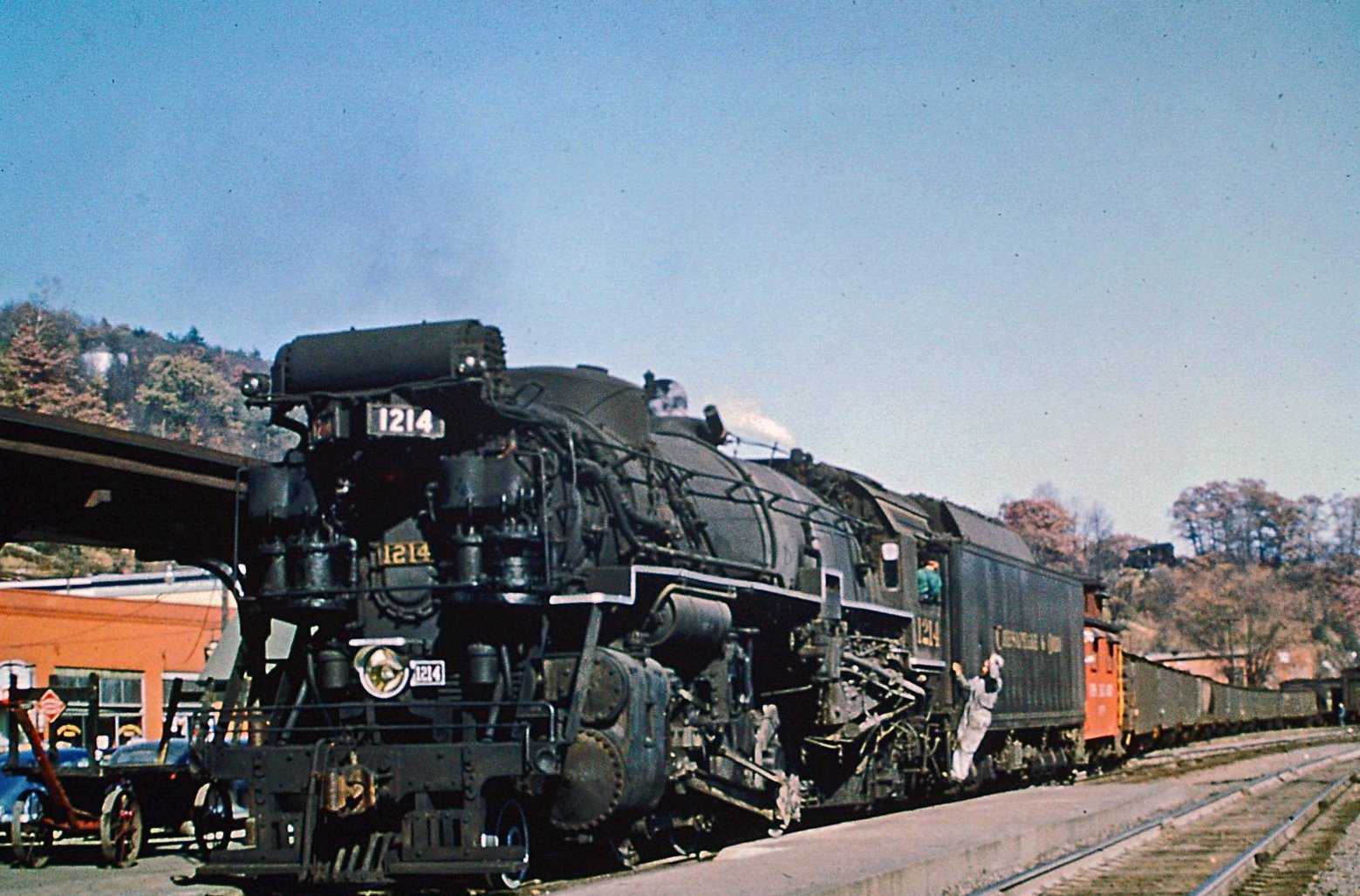
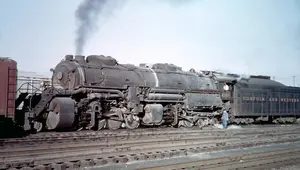
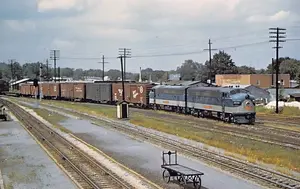
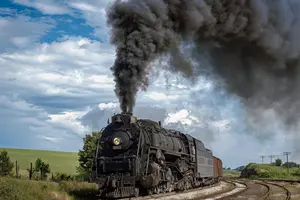
Chesapeake & Ohio 2-8-2 No. 1214 (Class K-3) switches coal hoppers at Ronceverte, West Virginia, October 22, 1952. Alco built the fifty K-3s in 1924 (1210–1259) with Elesco K-40 heaters. C&O retired the class as it dieselized in 1952–53. None survive.
On this page: At a glance · Why preheat · Open and closed · Elesco · Coffin · Worthington · How to identify them · Why not every engine
At a glance
| Item | Detail |
|---|---|
| What | An appliance that preheats tender water with cylinder exhaust steam before the water enters the boiler |
| Job | Fuel saving and less thermal shock. Typical service claims were on the order of 10–15 percent less coal than an injector-fed engine doing the same work |
| Heat source | Exhaust steam after the cylinders, not live boiler steam |
| Closed type | Elesco (Superheater Company) and Coffin (J.S. Coffin Jr. Company). Feedwater in tubes; steam outside; condensate back to the tender |
| Open type | Worthington (Worthington Pump and Machinery). Exhaust steam mixes with the feed; oil is skimmed |
| U.S. commercial start | A working heater on a large Pacific in 1916. About 4,100 in service on this continent by 1927 |
| When they became standard | On new mainline power by the 1930s. Worthington SA the most common late-steam specification |
| What they usually replaced | The live-steam injector on the fireman’s side. The engineer’s injector typically stayed as a backup |
| Related appliances | The superheater (dries steam on the way to the cylinders). The injector (forces water into the boiler). Exhaust-steam injectors (heat recovery without a heater pump set) |
Why the water had to be warm
A steam locomotive is a boiler on wheels. Water from the tender keeps the crownsheet covered as steam is made and used. That tender water sits at whatever the weather is doing. The boiler, at 200 to 250 psi on a typical late engine, holds water near the saturation temperature—roughly 388°F at 200 psi, about 406°F at 250. Shoving cold water into that drum cools the sheets, costs steam, and makes the fire work twice: once to reheat the feed, once to make the steam the cylinders actually want.
A live-steam injector already does some of the heating. It mixes boiler steam with the incoming water to force that water in against boiler pressure, and the mix arrives around 200°F. The remaining 200-degree gap is still a drain. The energy in that injector steam came from the fire. A feedwater heater uses exhaust that has already pushed the pistons. The fire does not pay twice.
Makers and road tests in the 1920s typically claimed on the order of 10 to 15 percent less fuel than an injector-fed locomotive on the same work. The Superheater Company advertised 12 to 15 percent for Elesco. Closed-heater tests were reported in a band from about 9 to 16.5 percent. The heater also let a boiler make steam faster when the engine was working hard, and it spared the firebox and barrel some of the shock of a cold slug. Lima treated a high-efficiency feedwater heater as part of the Super Power kit, with the larger grate and a Type E superheater; that story is on the firebox page and the steam hub.
Open heaters and closed heaters
Every American locomotive heater of the late steam era did the same thing with two different plumbing diagrams.
In a closed heater the feedwater runs through small tubes inside a steam-filled shell. Exhaust steam never touches the water that will go into the boiler. Condensate from that steam is collected and piped back to the tender, so the water is not thrown away. Elesco and Coffin were this type. The price was copper tube nests that leaked, and a pump (or pumps) to shove the water through the nest and then into the boiler against pressure.
In an open heater the exhaust steam mixes directly with the incoming water. Heat transfer is simple and the apparatus can be compact. The open type needs two pumps: a cold-water pump to lift from the tender into the mixing chamber, and a hot-water pump to force the heated feed past the boiler check. Worthington built this type. The obvious objection was cylinder oil in the exhaust. Worthington answered it with a separator and a continuous skim of the scum that floated on the mixing-chamber surface. By the last generation of new steam, roads that had once preferred closed heaters were specifying Worthington.
On the engine the heater usually took the fireman’s injector. The engineer kept a live-steam injector as a backup and for standing. That is why a heater-equipped locomotive still has injector piping on one side and a pump, a heater body, and a nest of pipes on the other.
A cheaper cousin, the exhaust-steam injector, also recovered some heat from the stack steam. The Superheater Company sold an Elesco exhaust-steam injector as well as closed heaters; Sellers made another. It is not a feedwater heater. It has no mixing tank or tube nest. It is an injector that can run on exhaust when the engine is working and switch to live steam when it is not. Some roads used it instead of a heater to keep the first cost and the maintenance down. The glossary entry for injectors is here.
Elesco
Elesco is a spoken abbreviation. The Superheater Company—organized in 1910 as the Locomotive Superheater Company to put Wilhelm Schmidt’s smoke-tube superheater into American service—lettered its feedwater gear LSCo. Say the letters: El-Es-Co. Instruction books from the 1920s carry the New York and Chicago addresses and the Elesco name on closed heaters, pumps, and, separately, exhaust-steam injectors.
The heater that made the brand visible is the bundle: a horizontal cylinder of copper tubes, four passes in the mature design, mounted on the smokebox ahead of the stack or partly dropped into the top of the smokebox. That drum is the “beetle brow” on so many 1920s photographs. Water from a pump on the fireman’s side of the boiler ran through the tubes; exhaust steam filled the shell; condensate drained back to the tender by gravity. Early pumps were a single-cylinder reciprocating machine that looked like a Westinghouse 9½-inch air compressor. Later applications used a duplex pump or a centrifugal.
A later Elesco coil heater put a less bulky exchanger ahead of the stack instead of the big drum. The plumbing idea did not change. By the late 1920s the company was advertising more than 2,200 Elesco heaters on American-built locomotives, against more than 52,000 of its superheaters. The superheater was the company’s original product. The heater was the add-on that used the same exhaust the superheater had already helped make more useful in the cylinders.
Chesapeake & Ohio specified the Elesco K-40 on the 1924 K-3 Mikados, including 1214 in the hero photograph. Rio Grande specified Elesco on the simple 2-8-8-2s of classes L-131 and L-132. The bundle on 3615 at Sierra is that heater.
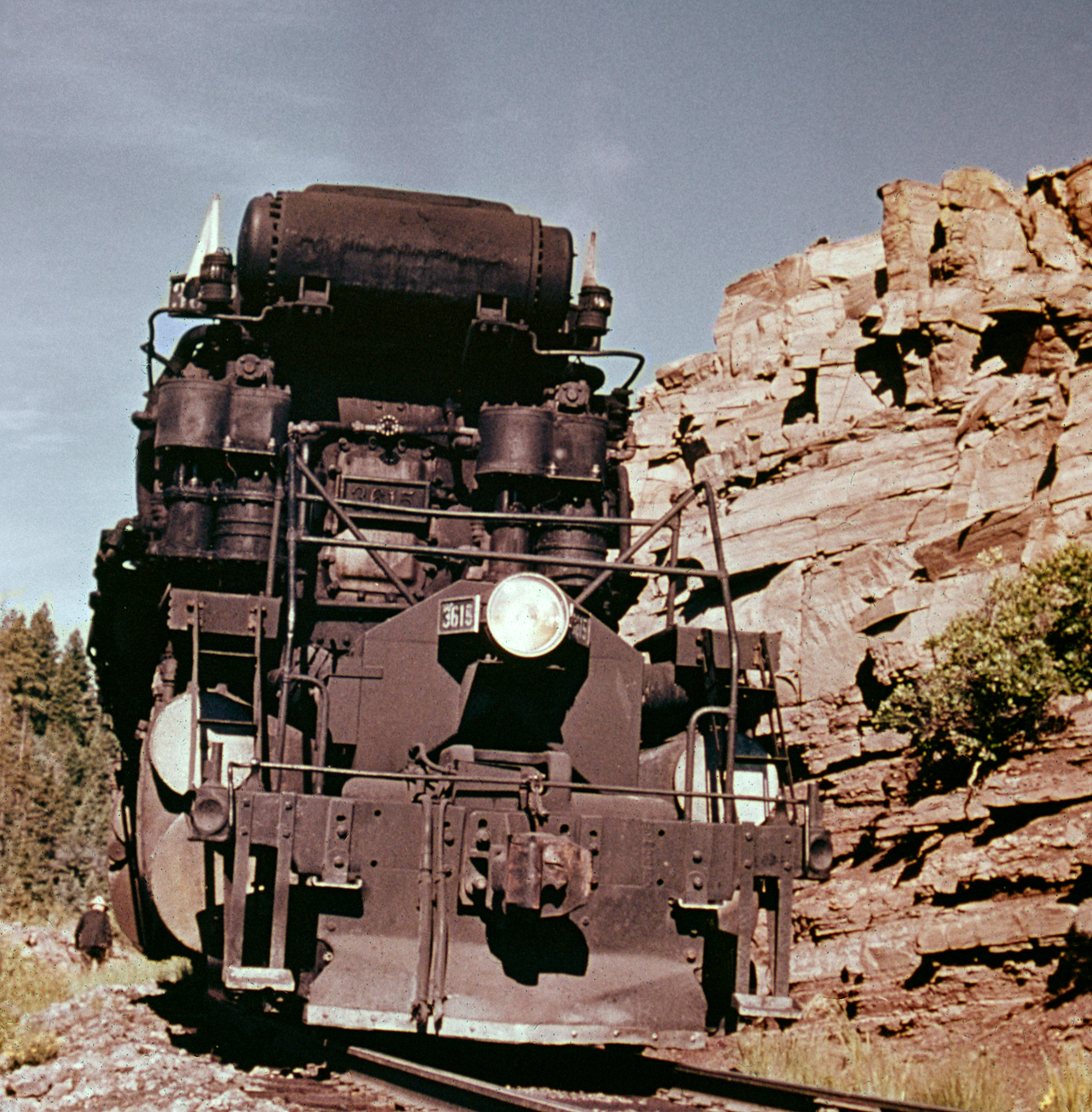
Rio Grande 2-8-8-2 No. 3615 (Class L-132) in a curve at Sierra, Colorado, 1950. The horizontal cylinder on the smokebox is an Elesco bundle-type feedwater heater. Robert LeMassena photo. American-Rails.com collection.
Alco-Schenectady finished the ten L-132s (3610–3619) in June 1930. They were simple articulateds, not compounds, with a Type E superheater layout and an Elesco heater as built. 3615 was one of three in the class that later carried three thermic syphons in the firebox. The class encyclopedia is the Rio Grande 2-8-8-2 page; the company is Denver & Rio Grande Western.
Coffin
The J.S. Coffin Jr. Company brought a closed heater of a different shape about 1927. The exchanger is a horseshoe or inverted U, rectangular in cross-section, with five tube passes, bent to the curve of the smokebox. As designed it sat inside the top of the smokebox, flush with the wrapper, so the engine kept a clean face. A turbine-driven centrifugal pump under the cab, on the fireman’s side ahead of the trailing truck, shoved water through the nest. Condensate went back to a small auxiliary heater in the tank, which warmed the tender water before it reached the pump.
When the same heater was hung on the front of an existing smokebox it became one of the most argued-over looks in steam. Railfans call the external Coffin a cobra hood or a heavy eyebrow: a dark arch over the top half of the smokebox door. Boston & Maine’s Lima 2-8-4s of 1928–29 (class T-1) wore that face as built. New York Central, which cared how a Hudson looked, put Coffin gear inside the smokebox on some passenger engines instead of hanging it out front. Fewer roads standardized on Coffin than on Elesco or Worthington. The heater worked. The plumbing and the face were the arguments.
Worthington
Worthington Pump and Machinery Corporation of Harrison, New Jersey, sold the open type. The first widely applied locomotive model, later called the BL, appeared around 1920. Pump and heater were one large rectangular casting, usually on the fireman’s side of the boiler. From the platform it is easy to read as a second air compressor. It is not. The cold-water pump lifts from the tender; the mixing chamber is in the same box; the hot-water pump sends the heated feed to the boiler checks.
The type that won the late steam era was the SA (and the related S / S-2 family from about 1929). The heater itself is a tank inset into the top of the smokebox, ahead of the stack—a box rather than Elesco’s cylinder. The pumps are separate: cold water under the cab, hot water often on the pilot deck. Piping is cleaner than the BL. Oil still entered with the exhaust, and the SA still skimmed it. Roads that had fought the open type on contamination grounds came around once the separator proved out in shop reports.
By the 1930s, when a new 4-8-4, 2-10-4, or simple articulated left the builder, a Worthington SA was the default specification more often than not. C&O’s later Texas types wore it. So did a long list of Super Power freight engines. The BL never disappeared from older power, and some roads mixed makers across a class as engines were shopped.
How to identify them
Look at the smokebox first, then the fireman’s side.
| What you see | What it is |
|---|---|
| Horizontal cylinder on or partly in the smokebox, ahead of the stack | Elesco bundle (closed). The common 1920s face |
| Smaller coil exchanger ahead of the stack, no big drum | Later Elesco coil (closed) |
| Deep or unusually tall smokebox, no drum, no eyebrow | Often a Coffin (closed) inside the smokebox |
| Horseshoe or arch over the smokebox door (“cobra hood,” “heavy eyebrow”) | Coffin (closed) hung on the front, typical of retrofits and of Boston & Maine Berkshires |
| Large rectangular box on the fireman’s side of the boiler, not an air pump | Worthington BL (open). Combined pump and heater |
| Rectangular tank inset in the smokebox top; separate pumps under the cab and on the pilot | Worthington SA (open). The late-steam standard |
Air pumps sit on the smokebox front or the side as well, and they confuse the Worthington BL more than any other heater. Count the piping. A BL has tender suction, a delivery to the boiler check, and exhaust-steam connections into the same casting. An air compressor has reservoir piping and no tender hose.
Why not every locomotive had one
The thermodynamic case was never the whole case. A heater added first cost (on the order of $2,500 a set in 1920s figures), extra pumps, extra copper, extra joints, and a shop skill that not every roundhouse had. Closed-heater tubes leaked. Open heaters needed the oil skim kept honest. On a coal-cheap district, or on a switcher that spent its life drifting and standing, the injector was enough. Branch engines and older power often kept both injectors and never received a heater. New mainline freight and passenger power after about 1930 usually did.
That is why a 1924 C&O K-3 and a 1930 Rio Grande L-132 both wear heaters in the photographs on this page, and why a 1910 ten-wheeler on a short line often does not. The appliance belonged to the era that was already squeezing every pound of steam out of a Super Power boiler. Dieselization ended the argument. The heaters went to the scrapper with the engines.
Related reading on American-Rails.com
- Steam locomotives hub · Steam terms glossary (feedwater heater, injector, superheater)
- Firebox · 4-8-4 Northern (late-steam kit, including heaters)
- Walschaerts · Baker · Stephenson valve gear · Smoke deflectors / elephant ears
- Chesapeake & Ohio · Denver & Rio Grande Western · Rio Grande 2-8-8-2s
- Railroads in the 1920s (Super Power in the decade frame)
Sources
- Barris, Wes. “Steam Locomotive Feedwater Heaters.” SteamLocomotive.com appliance page (open vs closed; Elesco name; identification of bundle, Coffin, Worthington BL and SA)
- Railway and Locomotive Engineering, August 1927. Feedwater-heater paper: 1916 U.S. Pacific application; about 4,100 heaters in service on this continent; Elesco, Coffin, and Worthington described; first-cost figure about $2,500
- The Superheater Company. Elesco Locomotive Feed Water Heaters instruction books (1925; 5th ed., 1929). Elesco as LSCo / Superheater Company product
- Superheater Company advertising, Transportation, 1927–28. Elesco claimed 12–15 percent less fuel per thousand ton-miles; more than 2,200 Elesco heaters and 52,000 Elesco superheaters applied
- International Correspondence Schools. Locomotive feedwater heating equipment. Elesco closed system about 1920; Coffin about 1927; Worthington open type, BL around 1920, SA the late standard
- Locomotive Cyclopedia (1947). Worthington S / SA / S-2 family from 1929
- Llanso, Steve. Locobase 482 (C&O K-3 / K-3a, Elesco K-40 on the K-3s, Alco 1924, dieselization 1952) and Locobase 16242 (D&RGW L-132, Alco-Schenectady June 1930, works 68328–68337)
- Shuster, Philip, Eugene Huddleston, and Alvin Staufer. C&O Power. Alvin Staufer, 1965. K-2 / K-3 as C&O gradient mainstay
- Solomon, Brian. The Majesty of Big Steam. Super Power practice (larger firebox, superheater, feedwater heater as a kit)
Recent Articles


-
Utah Railroad Museums (2026): A Complete Guide
Oct 15, 26 12:04 AM
 Utah railroad museums—Ogden Union Station, Golden Spike at Promontory, the Helper mining museum, and the Heber Valley Railroad. Confirm hours on each site.
 -
Escanaba & Lake Superior Diesel Roster (All-Time)
Oct 14, 26 10:44 PM
 All-time diesel roster of the Escanaba & Lake Superior. 30 locomotives: Baldwin switchers and RS-12s, two RF16s, three GP38s, three SD40-2s, and the Reserve Mining units. Serials and order numbers.
 -
Escanaba & Lake Superior Railroad: In Service Since 1898
Oct 14, 26 09:04 PM
 Escanaba & Lake Superior Railroad, chartered November 17, 1898, and still operating from Wells, Michigan. Logging line to Channing, the Milwaukee Road lines, and the diesel roster.
 -
Richmond, Fredericksburg & Potomac Diesel Roster (All-Time)
Oct 14, 26 08:49 PM
 All-time diesel roster of the Richmond, Fredericksburg and Potomac. 107 locomotives: 22 Alco S2s, one SW1, and an Electro-Motive road fleet from E8s to GP40-2s. Serials and order numbers.
 -
Richmond, Fredericksburg & Potomac Steam Roster (Since 1900)
Oct 14, 26 08:46 PM
 Richmond, Fredericksburg and Potomac steam locomotives built since 1900. Pacifics, Mountains, Berkshire-type 2-8-4s, and the named 4-8-4s. Last revenue run December 17, 1954.
 -
Richmond, Fredericksburg and Potomac Railroad: Map, Rosters, Logo
Oct 14, 26 08:36 PM
 The Richmond, Fredericksburg and Potomac, chartered February 25, 1834. A 113-mile Richmond–Washington bridge line. Named 4-8-4s, Potomac Yard, and the CSX sale of October 10, 1991.
 -
North Dakota Railroad Museums (2026): A Complete Guide
Oct 14, 26 08:29 PM
 North Dakota railroad museums—Mandan’s state museum, the Railroad Museum of Minot, and Bonanzaville’s Northern Pacific 684. Confirm hours on each site.
 -
Oklahoma Railroad Museums (2026): A Complete Guide
Oct 14, 26 08:02 PM
Oklahoma railroad museums—the Oklahoma Railway Museum, Enid’s Frisco 1519, Waynoka’s Harvey House, and El Reno’s Rock Island depot. Confirm hours on each site. -
Oneida & Western Railroad: Map, History, Timetable
Oct 14, 26 06:47 PM
 Oneida & Western Railroad, a Tennessee short line from Oneida to Jamestown. Chartered in 1912, opened to East Jamestown in 1921, and to Jamestown on December 10, 1930. Last revenue train March 4, 1954…
 -
Oneida and Western Railroad (Shamrock Coal Company)
Oct 14, 26 03:20 PM
 Shamrock Coal's mint-green coal trains, 1979–1987. Eight EMD SD40-2s, OWTX 9950–9957, order 786246. Two 72-car gondola sets. Louisville & Nashville, then CSX. Sold to BC Rail.
 -
Rhode Island Railroad Museums (2026): A Complete Guide
Oct 14, 26 03:03 PM
 Rhode Island railroad museums—the Friends’ museum in the 1875 Kingston depot, on the old New York, Providence and Boston. Confirm what is on view.
 -
Original Norfolk Southern Diesel Roster (All-Time)
Oct 14, 26 12:40 PM
 All-time diesel roster of the original Norfolk Southern Railway. 59 locomotives: Baldwin switchers and AS-416s, three GE 70-tonners, 17 GP18s, and seven GP38s. Serials and order numbers.
 -
Original Norfolk Southern Railway: Map, Rosters, History
Oct 14, 26 10:09 AM
 The original Norfolk Southern Railway, chartered in 1870 as the Elizabeth City & Norfolk. Norfolk to Charlotte. Merged into the Southern Railway on January 1, 1974. Baldwin diesels and the GP18s and G…
 -
Nebraska Railroad Museums (2026): A Complete Guide
Oct 14, 26 10:00 AM
 Nebraska railroad museums—the Durham Museum, Kenefick Park, Cody Park, and the Golden Spike Tower over Bailey Yard. Confirm hours on each site.
 -
Nevada Railroad Museums (2026): A Complete Guide
Oct 14, 26 09:51 AM
 Nevada railroad museums—Carson City, Boulder City, the Nevada Northern at East Ely, and the Virginia City depot. Confirm hours on each site.
 -
Montana Railroad Museums (2026): A Complete Guide
Oct 14, 26 12:17 AM
 Montana railroad museums—the Livingston depot, Fort Missoula’s Willamette, the Harlowton Milwaukee depot, and the Whitefish station. Confirm hours on each site.
 -
"Jawn Henry" Locomotive: Specs, Diagram, Photos
Oct 14, 26 12:03 AM
 Norfolk & Western No. 2300, class TE-1, the steam turbine-electric Jawn Henry. Baldwin-Lima-Hamilton, Westinghouse, and Babcock & Wilcox, May 1954. Specifications, the road tests, and the Dece…
 -
Atlantic and Danville Railway: Serving Southern VA
Oct 13, 26 04:32 PM
 Atlantic and Danville Railway, chartered in 1882, incorporated September 1883. Three-foot line to Claremont, then Norfolk to Danville. Southern lease from September 1, 1899, to July 1, 1949. Alco RS2s…
 -
Norfolk, Franklin and Danville Railroad: Map, Roster, History
Oct 13, 26 04:26 PM
 Norfolk, Franklin and Danville Railway, chartered October 2, 1962, and operating from November 1, 1962. Norfolk to Danville, 210.8 miles. Two Alco RS36s and four RS11s. Merged into the N&W on December…
 -
Norfolk & Western Diesel Roster (All-Time)
Oct 12, 26 11:59 PM
 Norfolk & Western diesel roster, all-time. 1,464 locomotives built new for the railroad, from the 1955 GP9s and RS-3s through the C36-7s, plus the merger fleets.
 -
Norfolk & Western Steam Roster (Post 1900)
Oct 12, 26 11:52 PM
 Norfolk & Western steam since 1898. The Roanoke grid: 1,266 locomotives, the J, the A, and the Y, and the last road steam on May 7, 1960.
 -
Norfolk & Western Railway: Map, Logo, Rosters, History
Oct 12, 26 11:45 PM
 The Norfolk & Western, from the City Point Railroad of 1838 to Norfolk Southern. Pocahontas coal, Roanoke steam, and the 1964 expansion.
 -
Louisiana Railroad Museums (2026): A Complete Guide
Oct 12, 26 11:24 PM
 Louisiana railroad museums—the DeQuincy depot, the Long Leaf sawmill, Jackson’s model railroad, and Southern Pacific 745. Confirm hours on each site.
 -
Michigan Railroad Museums (2026): A Complete Guide
Oct 12, 26 11:14 PM
 Michigan railroad museums—Pere Marquette 1225 at Owosso, Durand Union Station, The Henry Ford, and the Mount Clemens depot. Confirm hours on each site.
 -
Mississippi Railroad Museums (2026): A Complete Guide
Oct 12, 26 10:52 PM
 Mississippi railroad museums—McComb’s rebuilt Illinois Central depot and Illinois Central 2542, and the Casey Jones museum at Water Valley. Confirm hours on each site.
 -
The "E2b": PRR's Experimental Freight Electrics
Oct 12, 26 10:33 PM
 PRR class E2b: six GE B-B freight electrics, 4939–4944, 2,500 hp, 11 kV AC. Specifications, roster, and the 1964 scrap.
 -
Alaska Railroad Museums (2026): A Complete Guide
Oct 12, 26 10:10 PM
 Alaska railroad museums—the Museum of Alaska in Wasilla, Tanana Valley No. 1 at Pioneer Park, and the Engine 557 shop. Confirm hours on each site.
 -
Western and Atlantic Railroad: Map, History, Timetables
Oct 12, 26 09:55 PM
 The Western & Atlantic Railroad of the State of Georgia, authorized December 21, 1836, from Atlanta to Chattanooga. The state still owns the 137.33-mile line. CSX leases it. The through railroad opene…
 -
Nashville, Chattanooga & St. Louis Steam Roster (Post 1900)
Oct 12, 26 09:52 PM
 Nashville, Chattanooga & St. Louis steam since 1900. Drury's class grid: Consolidations, 51 Mikados, three 2-8-8-2s, Pacifics, and 25 4-8-4s. Last steam was January 4, 1953.
 -
Nashville, Chattanooga & St. Louis Diesel Roster (All-Time)
Oct 12, 26 09:27 PM
 Nashville, Chattanooga & St. Louis diesel roster, all-time. Switchers from 1941, 37 GP7s, and the F3s and F7s. The quantity column totals 132 locomotives.
 -
Nashville, Chattanooga and St. Louis Railway: Map, History, Logo
Oct 12, 26 08:41 PM
 The Nashville, Chattanooga & St. Louis, the Dixie Line. Charter of December 11, 1845, the Cumberland tunnel, and the Louisville & Nashville merger of August 30, 1957.
 -
Idaho Railroad Museums (2026): A Complete Guide
Oct 12, 26 02:44 PM
Idaho railroad museums—Nampa’s 1903 depot, Wallace’s Northern Pacific depot, and Boise’s 1925 Union Pacific depot. Confirm hours on each site. -
Hawaii Railroad Museums (2026): A Complete Guide
Oct 12, 26 12:50 PM
Hawaii railroad museums—the Hawaiian Railway Society at Ewa Beach and the Laupahoehoe Train Museum on the Big Island. Confirm hours on each site. -
Marietta and Cincinnati Railroad: Map, History, Timetable
Oct 12, 26 11:44 AM
 Marietta and Cincinnati Railroad, chartered March 8, 1845 as the Belpre & Cincinnati. Opened in April 1857, sold under foreclosure December 9, 1882, and succeeded by the Baltimore & Ohio Southwestern…
 -
Tennessee Railroad Museums (2026): A Complete Guide
Oct 12, 26 11:39 AM
Tennessee railroad museums—TVRM and Southern 4501 in Chattanooga, the Tennessee Central museum in Nashville, Casey Jones in Jackson, and the depots at Cookeville, Cowan, and Townsend. -
Virginia Railroad Museums (2026): A Complete Guide
Oct 12, 26 09:40 AM
 Virginia railroad museums—Roanoke’s Virginia Museum of Transportation and the O. Winston Link Museum, the C&O center at Clifton Forge, and the depots in Richmond, Fairfax Station, Suffolk, Parksley, a…
 -
Louisville & Nashville Diesel Roster (All-Time)
Oct 12, 26 12:15 AM
 Louisville & Nashville diesel roster, all-time. Switchers from 1939, the cab units, and EMD, Alco, and GE hoods through the SD50s. The quantity column totals 1948 locomotives, plus 29 yard slugs.
 -
Louisville & Nashville Steam Roster (Post 1900)
Oct 11, 26 05:44 PM
Louisville & Nashville steam since 1900. Drury's class grid: Consolidations, 165 heavy Mikados, 42 Big Emma 2-8-4s, Pacifics, and 22 Mountains. Last steam January 1957. -
Louisville and Nashville Railroad: Map, Rosters, History
Oct 11, 26 05:39 PM
 Louisville & Nashville, the Old Reliable. Charter of March 5, 1850, Milton H. Smith, the 921-mile main line, Big Emma, and the December 29, 1982 merger. Steam and diesel rosters are companion pages.
 -
Oregon Railroad Museums (2026): A Complete Guide
Oct 11, 26 05:19 PM
 Oregon railroad museums—the Oregon Rail Heritage Center, Brooks trolleys, Canby’s 1891 depot, Medford’s Willamette, and Train Mountain. Confirm hours on each site.
 -
Texas Railroad Museums (2026): A Complete Guide
Oct 11, 26 05:15 PM
 Texas railroad museums—Frisco’s Big Boy 4018, Galveston’s Santa Fe depot, Temple’s 1911 station, Plano’s interurban, and Fort Worth & Denver 304. Confirm hours on each site.
 -
Wisconsin Railroad Museums (2026): A Complete Guide
Oct 10, 26 11:51 PM
Wisconsin railroad museums—Green Bay’s Big Boy 4017 and Eisenhower’s A4, Mid-Continent at North Freedom, East Troy’s interurban, and the Riverside & Great Northern. Confirm hours on each site. -
Interstate Railroad (Virginia): Map, Roster, Logo, History
Oct 10, 26 11:22 PM
 Interstate Railroad, a Virginia coal road chartered February 18, 1896. Andover shops. Ten Alco RS3s, 30–39. Southern control in 1961. The company ended October 31, 1985.
 -
North Carolina Railroad Museums (2026): A Complete Guide
Oct 10, 26 11:16 PM
North Carolina railroad museums—Spencer Shops, Wilmington’s Atlantic Coast Line 250, Hamlet’s Seaboard depot, and the New Hope Valley Railway. Confirm hours on each site. -
New Mexico Railroad Museums (2026): A Complete Guide
Oct 10, 26 10:54 PM
 New Mexico railroad museums—Santa Fe 2926 in Albuquerque, the Clovis depot, Alamogordo’s Toy Train Depot, and Belen. Confirm hours on each site.
 -
New York Railroad Museums (2026): A Complete Guide
Oct 10, 26 09:33 PM
 New York railroad museums—Phoenicia, Medina’s New York Central freight house, the Transit Museum, Long Island 35 and 39, and GG1 4933. Confirm hours on each site.
 -
Columbia, Newberry & Laurens Railroad: History, Timetable, Roster
Oct 10, 26 09:08 PM
 Columbia, Newberry & Laurens Railroad, Columbia to Laurens, 75 miles. Chartered in 1885. Five Atlantic Coast Line GP7s, 100–104. Merged into the Seaboard System on April 30, 1984.
 -
New Haven Diesel Roster (All-Time)
Oct 10, 26 06:35 PM
 New Haven diesel roster, all-time. 558 road numbers: 60 DL-109s, 30 FA-1s, 27 PA-1s, 60 FL9s, and the switchers from HH600 0900. Serials and order numbers.
 -
New Haven Steam Roster (Post 1900)
Oct 10, 26 06:31 PM
New Haven steam since 1900. Drury's class grid: 226 Moguls, 33 Mikados, 50 Santa Fes, 70 Mountains, 141 Pacifics, and 10 Hudsons. Last fan trip July 19, 1953. -
New Haven Railroad: Rosters, Map, Logo, History, Trains
Oct 10, 26 06:26 PM
 New York, New Haven and Hartford. The Shore Line, Hell Gate, the 1952 map at 1,838.89 miles, and the railroad Penn Central took at 11:59:59 p.m. on December 31, 1968.