- Home ›
- Fallen Flags ›
- Soo Line ›
- Steam Roster
Soo Line Steam Roster (Built Since 1900)
Published: October 27, 2026
By: Adam Burns
The Soo Line’s modern steam was a freight railroad’s fleet, built for grain, ore, and a long passenger run that never tried to be a Hiawatha. The quantity column on the post-1900 list, Soo Line and Wisconsin Central together, is 422. One hundred twenty-two of them are 2-8-0s. The four Lima 4-8-4s of 1938, 5000–5003, were the last new steam the railroad bought and the largest. Locomotives numbered 2000 and above were Wisconsin Central property, except Mountains 4000–4003, which the roster marks as Soo engines. The Duluth, South Shore & Atlantic is a separate railroad and is not in this table.
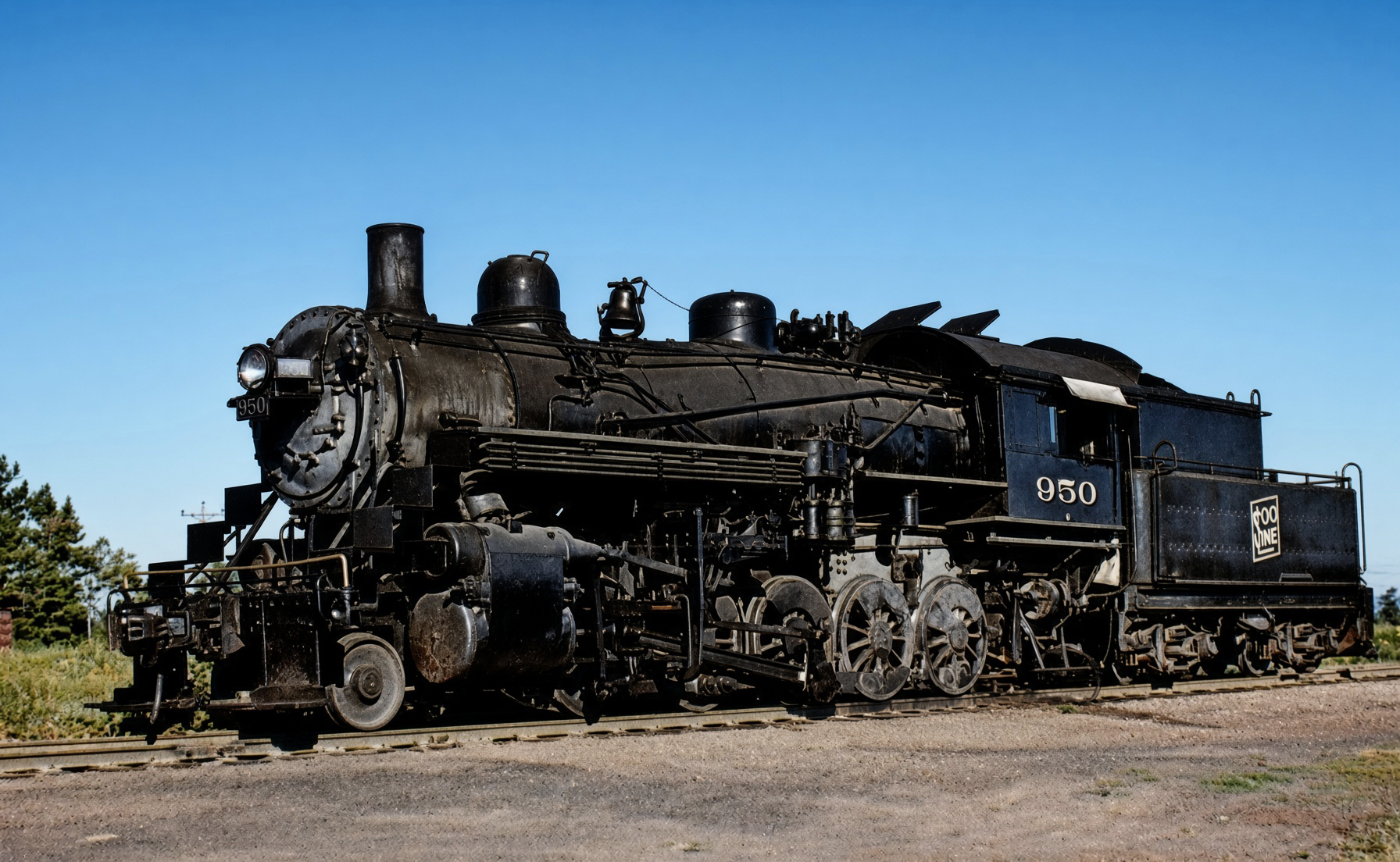
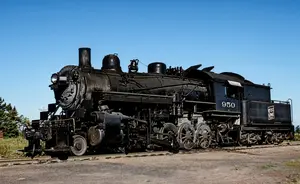
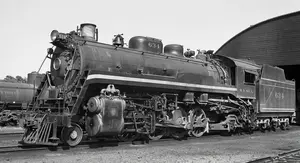
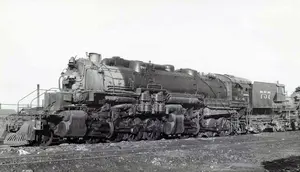
Soo Line's only 2-10-0 decapod, #950, was photographed here at Ashland, Wisconsin during the early 1950s. Photographer unknown.
On this page: At a glance · Consolidations and Mikados · Passenger locomotives · Mountains and the Northerns · Switchers · Roster
At a glance
| Item | Detail |
|---|---|
| Railroad | Minneapolis, St. Paul & Sault Ste. Marie, and the Wisconsin Central. Company history |
| This table | Steam locomotives built since 1900. Wisconsin Central numbers are 2000 and above |
| Switchers | 41. Six-wheel, classes B-1 through B-4 and B-22, B-23. All 51-inch drivers |
| Moguls | 65. D-2, 108–172, Schenectady, 1903–1907, built as cross-compounds |
| Prairies | 10. J, 800–809, Schenectady, 1907, built as cross-compounds |
| Consolidations | 122. F-7 through F-12 and F-20 through F-23 |
| Mikados | 48. L through L-4, and Wisconsin Central L-20 |
| Decapod | 1. G, No. 950, Baldwin, 1900, built as a compound |
| Atlantics | 15. K, 2900–2914, ex-Wisconsin Central 257–271, Brooks, 1902–1905 |
| Ten-Wheelers | 34. E-1, E-2, E-22, E-24, and E-25. The E-1 quantity is 6 against numbers 605–611 |
| Pacifics | 61. H through H-3, and Wisconsin Central H-20 through H-23. The H-1 quantity is 21 against numbers 701–722 |
| Mountains | 21. N-20, 4000–4020, in three batches, 1926, 1928, and 1930 |
| Northerns | 4. O-20, 5000–5003, Lima, 1938 |
| Quantity column | 422 |
| Last new steam | Lima 4-8-4s, 1938 |
| Last fire in service | February 15, 1955, Consolidation 468 |
Consolidations and Mikados
The nineteenth-century freight engine on the Soo was a small cross-compound 2-8-0. Twenty-seven of them, with 51-inch drivers, came from Schenectady and Rhode Island in 1893. They sit outside this table. What the twentieth century added, beginning in 1900, was a larger Consolidation, still a compound at the start, and then a simple engine with a superheater.
Schenectady delivered 51 cross-compound 2-8-0s from 1900 through 1909, numbers 428–474 on the Soo and 2425–2428 on the Wisconsin Central. The early ones had 55-inch drivers. The later ones had 63. All of them were later rebuilt as simple engines and given superheaters. The table marks F-7, F-9, and F-10 as built cross-compound. Between 1910 and 1913 Schenectady added 46 simple Consolidations with 63-inch drivers, weighing 225,000 pounds: 475–499 for the Soo and 2429–2449 for the Wisconsin Central. Class F-23, the last six of that Wisconsin Central group, is dated 1914.
The Wisconsin Central’s own pre-Soo Consolidations were a lighter engine. Twenty-five of them, later Soo 2400–2424, class F-20, were built from 1903 to 1907 as Wisconsin Central 160–184. They had 63-inch drivers, 21-by-26-inch cylinders, and weighed 163,400 pounds, well under the Soo’s own twentieth-century 2-8-0. Consolidation 468, the engine that dropped the last fire in regular service, is one of the F-9s, 445–472.
There were two odd freight engines before the Mikado became the road engine. Baldwin built a single Vauclain-compound 2-10-0 in 1900, No. 950, class G, and at the time it was the largest locomotive in the world. It was later simpled. Its niche was the ore dock at Ashland, Wisconsin. The same decade brought ten cross-compound Prairies from Schenectady, 800–809, class J, built in 1907 and later simpled, and 65 cross-compound Moguls, 108–172, class D-2, Schenectady, 1903–1907, also later simpled. The Moguls are the largest single class on the list.
The first 2-8-2 the Soo owned was not built for the Soo. Bismarck, Washburn & Great Falls No. 3 was a Baldwin of 1901, a 51-inch-driver Vauclain compound weighing 166,900 pounds, with the firebox set behind the drivers and carried on a trailing truck. It was the first Mikado built for service in the United States. The Soo bought it in 1904 and numbered it 1000, class L.
Schenectady’s L-1s, 1001–1010, arrived in 1913 at about the size of a United States Railroad Administration light Mikado: 63-inch drivers, 28-by-30-inch cylinders, and 170 pounds of boiler pressure, with about the same tractive effort as the government engine. In 1920 Brooks delivered 25 more of the same dimensions, slightly heavier. Thirteen were Soo 1011–1023, class L-2. Twelve were Wisconsin Central 3000–3011, class L-20.
The last Mikados were secondhand, a dozen of them in 1941 and 1942. Four Baldwins came from the Rock Island, class L-3, 1030–1033, built in 1913. Eight Brooks engines came from the Monon, class L-4, 1024–1027 and 1034–1037, built in 1912. By then the railroad had been buying diesels for a few years. It had not yet decided that steam was finished.
Passenger locomotives
The Soo was never a great passenger railroad. The Chicago–Minneapolis line was longer than the competitors’, and after 1933 the summer-only Chicago–Vancouver train west of Portal ran on the Chicago & North Western between Chicago and St. Paul. What the Soo did own for passenger work was a long series of Pacifics, a handful of Ten-Wheelers, and fifteen Wisconsin Central Atlantics.
Two groups of passenger Ten-Wheelers date from 1898 and sit outside this table. Baldwin’s Vauclain compounds 600–604, class E, had 73-inch drivers. Wisconsin Central 227–230, later 2625–2628, class E-23, came from Brooks. The Ten-Wheelers that do fall on this list start with Baldwin’s E-1s of 1902 and 1903, numbers 605–611, 69-inch drivers, the only passenger Ten-Wheelers built new for the Soo after 1900. The quantity on that row is 6. The freight Ten-Wheelers were all inherited. Nos. 612 and 613, class E-2, came from the Wisconsin & Northern. Nos. 2629–2654 came from the Wisconsin Central: E-22 with 63-inch drivers, and E-24 and E-25 with 57-inch drivers, small enough that they would be considered switchers on some roads. The Wisconsin Central bought them for tractive effort, just before 1900 on the table’s dating, Brooks, 1900.
The fifteen Atlantics, class K, 2900–2914, were Brooks engines of 1902–1905, former Wisconsin Central 257–271. Their 79-inch drivers were the tallest on the railroad. Most of them were off the roster by 1940.
The Pacifics are the passenger story. No. 700, class H, is former Bismarck, Washburn & Great Falls No. 4, a Baldwin of 1904. The H-1s, 701–722, and the Wisconsin Central H-20s, 2700–2703, had 69-inch drivers and 20-by-26-inch cylinders and weighed between 202,000 and 206,000 pounds. The quantity on the H-1 row is 21. The H-1s had inside piston valves and Stephenson valve gear. Class H-2, 723–726, kept the 69-inch driver and used 24-inch cylinders with 170 pounds of boiler pressure, good for 30,760 pounds of tractive effort. The rest, H-3 and Wisconsin Central H-21, H-22, and H-23, had 75-inch drivers and 25-by-26-inch cylinders. The H-3s, 727–737, and the H-21s, 2704–2713, weighed 258,000 pounds and were built in 1911 and 1913. The H-22s, 2714–2717, were 6,000 pounds heavier. The H-23s, 2718–2723, built in 1923, weighed 271,000 pounds, somewhat lighter than a United States Railroad Administration light Pacific.
Mountains and the Northerns
The Soo had a long disadvantage between Chicago and the Twin Cities. The route was mostly single track, and only about half of it was signaled. About all the operating department could do was run faster. In 1926 the 4-8-2 was assigned to freight and to the heavier passenger trains. Brooks delivered ten class N-20 Mountains that year, updated versions of the government light 4-8-2. They weighed 344,500 pounds. Trailing-truck boosters gave them 64,620 pounds of starting tractive effort. The first four, 4000–4003, were Soo engines. Nos. 4004–4009 were Wisconsin Central power.
Schenectady delivered eight more in 1928, 4010–4017. In 1930 the Soo erected the last three, 4018–4020, at its Shoreham Shops in Minneapolis, using boilers built by Alco. They weighed 338,700 pounds. Successive batches of the same locomotive usually grew heavier. These grew lighter.
The last steam the Soo bought for itself was faster still. Lima delivered four 4-8-4s in 1938, 5000–5003, class O-20. They were mid-size Northerns, 453,500 pounds, with 75-inch drivers, and they would have made handsome passenger engines only a few years earlier. Rated tractive effort was 66,000 pounds, and the trailing-truck booster added another 13,400. They drew the fast Chicago–Twin Cities freights and earned a reputation for availability. They could be turned at a terminal and sent back out in a hurry. No. 5001 was photographed on September 25, 1949, at Van Dyne, Wisconsin, with 60 cars, still in the years when steam and the new diesel road units shared the railroad.
Dieselization was complete, in the sense that the last fire in regular service had been dropped, on February 15, 1955, when 2-8-0 No. 468 came in. As late as July 1958, eleven steam locomotives, 2-8-0s, 2-8-2s, and 4-6-2s, were still carried on the roster, stored serviceable.
Switchers
The Soo rostered only 0-6-0s for yard work. They were 51-inch-driver engines, and as the type developed they grew heavier. Even the B-4s, 344–354, the only switchers with outside piston valves and outside valve gear, did not approach a United States Railroad Administration 0-6-0 in weight or tractive effort. The heavier transfer jobs went to Consolidations.
Classes B-1 through B-4 are the Soo’s own, 326–354, Cooke and Schenectady and Brooks, 1902 through 1920. The Wisconsin Central’s six-wheel switchers are B-22, 2317–2320, Brooks, 1900, and B-23, 2321–2328, Brooks, 1899–1908, built as cross-compounds. The B-23 row reaches back into 1899. The quantity is the eight engines the table lists.
Roster
The quantity column adds to 422. Where a number series is longer than the quantity, the quantity is the figure in the table. That is true of E-1, numbers 605–611, quantity 6, and of H-1, numbers 701–722, quantity 21. A blank cell is empty. Wisconsin Central locomotives carry Soo numbers in the 2000s and above. Bismarck, Washburn & Great Falls is abbreviated BW&GF. Wisconsin & Northern is W&N.
| Type | Class | Numbers | Qty | Builder | Built | Notes |
|---|---|---|---|---|---|---|
| 0-6-0 | B-1 | 326–333 | 8 | Cooke | 1902–1907 | |
| 0-6-0 | B-2 | 334–339 | 6 | Schenectady | 1909–1910 | |
| 0-6-0 | B-3 | 340–343 | 4 | Schenectady | 1912 | |
| 0-6-0 | B-4 | 344–354 | 11 | Brooks, Schenectady | 1915–1920 | |
| 0-6-0 | B-22 | 2317–2320 | 4 | Brooks | 1900 | |
| 0-6-0 | B-23 | 2321–2328 | 8 | Brooks | 1899–1908 | Built as cross-compound |
| 2-6-0 | D-2 | 108–172 | 65 | Schenectady | 1903–1907 | Built as cross-compound |
| 2-6-2 | J | 800–809 | 10 | Schenectady | 1907 | Built as cross-compound |
| 2-8-0 | F-7 | 428–430 | 3 | Schenectady | 1900 | Built as cross-compound |
| 2-8-0 | F-8 | 431–444 | 14 | Schenectady | 1902–1903 | |
| 2-8-0 | F-9 | 445–472 | 28 | Schenectady | 1905–1906 | Built as cross-compound |
| 2-8-0 | F-10 | 473, 474 | 2 | Schenectady | 1909 | Built as cross-compound |
| 2-8-0 | F-11 | 475–484 | 10 | Schenectady | 1910 | |
| 2-8-0 | F-12 | 485–499 | 15 | Schenectady | 1912–1913 | |
| 2-8-0 | F-20 | 2400–2424 | 25 | Schenectady | 1903–1907 | Ex-WC 160–184 |
| 2-8-0 | F-21 | 2425–2428 | 4 | Schenectady | 1909 | |
| 2-8-0 | F-22 | 2429–2443 | 15 | Schenectady | 1911 | |
| 2-8-0 | F-23 | 2444–2449 | 6 | Schenectady | 1914 | |
| 2-8-2 | L | 1000 | 1 | Baldwin | 1901 | Ex-BW&GF 3 |
| 2-8-2 | L-1 | 1001–1010 | 10 | Schenectady | 1913 | |
| 2-8-2 | L-2 | 1011–1023 | 13 | Brooks | 1920 | |
| 2-8-2 | L-3 | 1030–1033 | 4 | Baldwin | 1913 | Ex-Rock Island |
| 2-8-2 | L-4 | 1024–1027 | 4 | Brooks | 1912 | Ex-Monon |
| 2-8-2 | L-4 | 1034–1037 | 4 | Brooks | 1912 | Ex-Monon |
| 2-8-2 | L-20 | 3000–3011 | 12 | Brooks | 1920 | |
| 2-10-0 | G | 950 | 1 | Baldwin | 1900 | Built as compound |
| 4-4-2 | K | 2900–2914 | 15 | Brooks | 1902–1905 | Ex-WC 257–271 |
| 4-6-0 | E-1 | 605–611 | 6 | Baldwin | 1902–1903 | |
| 4-6-0 | E-2 | 612, 613 | 2 | Schenectady | 1913, 1915 | Ex-W&N 4, 5 |
| 4-6-0 | E-22 | 2629–2639 | 11 | Brooks | 1900 | Ex-WC 231–241 |
| 4-6-0 | E-24 | 2640–2644 | 5 | Brooks | 1900 | Ex-WC 242–246 |
| 4-6-0 | E-25 | 2645–2654 | 10 | Brooks | 1900 | Ex-WC 247–256 |
| 4-6-2 | H | 700 | 1 | Baldwin | 1904 | Ex-BW&GF 4 |
| 4-6-2 | H-1 | 701–722 | 21 | Schenectady | 1904–1907 | |
| 4-6-2 | H-2 | 723–726 | 4 | Schenectady | 1910 | |
| 4-6-2 | H-3 | 727–737 | 11 | Schenectady | 1911–1913 | |
| 4-6-2 | H-20 | 2700–2703 | 4 | Schenectady | 1909 | |
| 4-6-2 | H-21 | 2704–2713 | 10 | Schenectady | 1911–1913 | |
| 4-6-2 | H-22 | 2714–2717 | 4 | Schenectady | 1914 | |
| 4-6-2 | H-23 | 2718–2723 | 6 | Schenectady | 1923 | |
| 4-8-2 | N-20 | 4000–4009 | 10 | Brooks | 1926 | 4000–4003 owned by Soo |
| 4-8-2 | N-20 | 4010–4017 | 8 | Schenectady | 1928 | |
| 4-8-2 | N-20 | 4018–4020 | 3 | Soo Line | 1930 | Erected at Shoreham, Alco boilers |
| 4-8-4 | O-20 | 5000–5003 | 4 | Lima | 1938 |
Related Reading
Sources
- George H. Drury, Guide to North American Steam Locomotives, revised edition. Minneapolis, St. Paul & Sault Ste. Marie chapter, including the Wisconsin Central, pp. 212–214. The table is “Soo Line and Wisconsin Central steam locomotives since 1900.”
- Roster notices named in that chapter: Railroad magazine, February 1934, p. 130; June 1947, p. 124; May 1953, p. 106. Trains, December 1958, p. 23. Railway & Locomotive Historical Society Bulletin No. 54, p. 150, the Wisconsin Central.
- Soo Line Historical & Technical Society, sooline.org.
Recent Articles


-
Missouri-Kansas-Texas Railroad (Katy): Map, History, Rosters
Oct 27, 26 11:02 PM
 History of the Missouri-Kansas-Texas, the Katy. The race into Indian Territory, Gould, the 1923 railroad, the Texas Special, and the 1988 sale. Steam and diesel rosters are linked.
-
Soo Line Diesel Roster (All-Time)
Oct 27, 26 10:55 PM
 All-time diesel roster of the Soo Line and the Wisconsin Central. 786 locomotives, each frame once. Cab units, Geeps, the Milwaukee Road engines, and the SD60s. The South Shore's 24 stay on that page.
-
Soo Line Steam Roster (Built Since 1900)
Oct 27, 26 10:49 PM
 Soo Line and Wisconsin Central steam locomotives built since 1900. Consolidations, Mikados, Pacifics, 21 Mountains, and four Lima 4-8-4s.
-
Soo Line Railroad: Map, Logo, History, Rosters
Oct 27, 26 10:24 PM
 The Soo Line, from the flour millers' railroad around Chicago to the Sault, the Wisconsin Central, and the Milwaukee Road. Steam quantity 422. Diesels 786. Canadian Pacific took full control in 1990.
-
Minneapolis, Northfield and Southern Railway: Map, History, Rosters
Oct 27, 26 10:32 AM
 The Minneapolis, Northfield & Southern, the Dan Patch Line that became a Twin Cities belt. Steam, gas-electric mules, motor cars, and the 22 diesels, through the Soo Line.
-
Minneapolis & St. Louis Diesel Roster (All-Time)
Oct 27, 26 10:27 AM
 All-time diesel roster of the Minneapolis & St. Louis. 97 locomotives, each frame once. Switchers from 1938, 35 RS-1s, the FT and F-unit cabs, two SD7s, and 23 GP9s. Builder numbers included.
-
Minneapolis & St. Louis Steam Roster (Post 1900)
Oct 27, 26 10:25 AM
 Minneapolis & St. Louis steam locomotives built since 1900. Moguls, Consolidations, 35 Mikados, and five Pacifics.
-
Minneapolis and St Louis Railway: "The Peoria Gateway"
Oct 27, 26 09:52 AM
 The Minneapolis & St. Louis, the Tootin' Louie, from the 1870 charter to the Peoria Gateway and the Chicago & North Western sale on November 1, 1960.
-
Alco "PA" Locomotives: Restoration, Specs, Engine, Rosters
Oct 27, 26 12:12 AM
 Alco's PA passenger cab, 297 locomotives built from 1946 to 1953. The 244 engine, the production roster, the Delaware & Hudson PA-4s, and Nickel Plate Road 190.
-
Milwaukee Road Diesel Roster: (All Time)
Oct 26, 26 01:44 PM
 All-time diesel roster of the Milwaukee Road. 1,208 locomotives, each frame once. Alco, Baldwin, Davenport, EMD, Fairbanks-Morse, General Electric, and Whitcomb, with builder numbers.
-
Milwaukee Road Steam Roster (All-Time): Post-1900
Oct 26, 26 01:38 PM
 Milwaukee Road steam locomotives built since 1900. Prairies, Mikados, the N-class articulateds, the S-class 4-8-4s, and the Hiawatha Atlantics and Hudsons. Quantity column 1,974. Unique frames 1,951.
-
Milwaukee Road: Map, Electrification, Logo, History
Oct 26, 26 01:20 PM
 The Milwaukee Road, from the Milwaukee & Mississippi of 1850 to the Pacific Coast Extension, the Hiawathas, and the Soo Line sale. Why Lines West should have stayed.
-
Lake Superior & Ishpeming Railroad: Map, Roster, History
Oct 25, 26 11:38 PM
 Lake Superior & Ishpeming Railroad, reporting mark LSI, from the Marquette Range to the Presque Isle ore dock. The 1954 steam list and the diesels the railroad owned.
-
Kansas City Southern Steam Roster (Built Since 1900)
Oct 25, 26 09:09 PM
 Steam locomotives of the Kansas City Southern built since 1900, with the Louisiana & Arkansas and the Texas company.
-
Kansas City Southern Diesel Roster (Built New)
Oct 25, 26 11:46 AM
All-time diesel roster of the Kansas City Southern. E units, F units, Geeps, SD40s through SD70ACes, Fairbanks-Morse, Baldwin, Alco, and General Electric, with serials and order numbers. -
Kansas City Southern Railway: Map, Photos, History
Oct 25, 26 12:24 AM
 The Kansas City Southern, from Arthur Stilwell's Gulf line to Canadian Pacific Kansas City on April 14, 2023. Steam and diesel rosters, the Southern Belle, and the Louisiana & Arkansas.
-
Indiana Harbor Belt Diesel Roster (All-Time)
Oct 25, 26 12:17 AM
 All-time diesel roster of the Indiana Harbor Belt. 202 locomotive frames, each counted once. NW2s, SW7s, SW1500s, road switchers, and gensets. Slugs and boosters are outside the count.
-
Indiana Harbor Belt Steam Roster (Built Since 1900)
Oct 25, 26 12:13 AM
 Steam locomotives of the Indiana Harbor Belt built since 1900. 182 engines, each counted once. 0-6-0s, 2-6-0s, 0-8-0s, and 2-8-2s. The three U-4a switchers are three-cylinder Brooks engines of 1927.
-
Indiana Harbor Belt Railroad: Map, Rosters, History
Oct 25, 26 12:00 AM
 Indiana Harbor Belt, the inner belt across the Calumet, from the East Chicago Belt of May 16, 1896. Renamed June 29, 1907. Still operating, headquarters Hammond. Steam roster is the companion, 182 loc…
-
NYC's "P Motor" Electric Locomotives
Oct 24, 26 11:43 PM
 New York Central P motors: 22 Alco-GE 2-C+C-2 electrics, Cleveland Union Terminal 1050–1071, class P-1a. 3,030 hp one-hour on 3,000-volt DC catenary, then 660-volt third rail as P-2a and P-2b.
-
Illinois Terminal Car Roster
Oct 24, 26 11:40 PM
 Illinois Terminal cars. Mainline motors, the 1948 streamliners, sleepers, Alton and Valley Division cars, express motors, and the line cars rebuilt from pull cars.
-
Illinois Terminal Diesel Roster
Oct 24, 26 09:31 PM
 All-time Illinois Terminal diesels, 62 frames. Alco S-2s and RS-1s, EMD switchers, GP7s, SD39s, GP38-2s, and the two GP20s. Serial numbers from the 1989 roster.
-
Illinois Terminal Electric Locomotives
Oct 24, 26 08:22 PM
 Illinois Terminal electric locomotives, 57 frames. Class A through Class D, the Decatur-built motors, and the battery locomotives. Class D is the same five Class C frames, rebuilt.
-
Illinois Terminal Steam Roster
Oct 24, 26 07:37 PM
 Illinois Terminal steam locomotives, 36 frames. Baldwin Moguls, three Class 30 Mikados, Florida East Coast 0-8-0s, and 2-6-0 No. 21, the last fire on June 30, 1950.
-
Illinois Terminal Railroad: Map, Roster, Photos, History
Oct 24, 26 07:32 PM
Illinois Terminal, McKinley's Illinois Traction System, from the Danville coal towns to St. Louis. The McKinley Bridge, the sleeping cars, the 1937 break with the power company, the 1948 streamliners… -
Southern Railway Diesel Roster (All-Time)
Oct 23, 26 11:00 PM
 All-time diesel roster of the Southern Railway. 2,505 locomotives in the system number series, from the 1939 demonstrator FT to GP50s and B30-7A1s. Serials included.
-
Illinois Central Diesel Roster (All-Time)
Oct 23, 26 04:06 PM
Illinois Central and Illinois Central Gulf diesel locomotives, each frame once. The quantity column is 886. Serials and order numbers from Electro-Motive's builder lists. Paducah rebuilds and Gulf, Mo… -
Illinois Central Gulf Diesel Roster
Oct 23, 26 04:02 PM
 Illinois Central Gulf operating numbers from August 10, 1972, to February 29, 1988. New frames stay on the Illinois Central diesel roster. Gulf, Mobile and Ohio frames stay on that roster. No Gulf fle…
-
Illinois Central Railroad: Map, Logo, History
Oct 23, 26 03:50 PM
Illinois Central, the Main Line of Mid-America, from the 1850 land grant to Canadian National control on July 1, 1999. Charter lines, Cairo bridge, Paducah, and the Illinois Central Gulf. Steam quanti… -
Grand Trunk Western Diesel Roster (All-Time)
Oct 23, 26 12:53 PM
 Grand Trunk Western diesel locomotives, each frame once. The quantity column is 377. Serials are filled for the Detroit, Toledo and Ironton and Detroit and Toledo Shore Line engines the railroad kept…
-
Grand Trunk Western Steam Roster
Oct 23, 26 12:14 PM
 Grand Trunk Western steam locomotives in service about 1937 to 1942, from Richard Leonard's class list. Drury has no chapter. The quantity column is the counted Grand Trunk Western rows. Two mixed Gra…
-
Grand Trunk Western Railroad: Map, Roster, History
Oct 23, 26 12:09 PM
 Grand Trunk Western, reporting mark GTW, Canadian National's railroad between Port Huron and Chicago. Trade name adopted in 1923. Steam class list quantity 232. Diesel quantity column 377. Identity in…
-
Green Bay and Western Railroad: Map, Rosters, History
Oct 22, 26 11:18 PM
 Green Bay & Western, the Green Bay Route, reporting mark GBW. From Kewaunee to Winona. Mailer's steam and diesel rosters, and the August 1993 sale to Fox Valley & Western.
-
Chicago & North Western Class E-4: Streamlined 4-6-4 Hudsons
Oct 22, 26 10:28 PM
 C&NW Class E-4, nine streamlined 4-6-4s, 4001–4009, Alco 1938. 84-inch drivers, 25-by-29 cylinders, 300 psi. Conventional Chicago–Omaha trains. Oil in 1947–48. Retired 1953–1956.
-
Gateway Western Railway: Map, Roster, History
Oct 22, 26 02:43 PM
 Gateway Western Railway, reporting mark GWWR. Class II from Kansas City to East St. Louis. Kansas City Southern control May 5, 1997. The 1992 diesel fleet, with serials and order numbers.