- Home ›
- Fallen Flags ›
- Monon ›
- Diesel Roster
Monon Diesel Roster (All-Time)
Published: October 28, 2026
By: Adam Burns
The Monon dieselized earlier than a railroad of its size had any right to, and then spent the rest of its life learning what would fit the railroad it actually had. Street running, sharp curves, and rail that was never meant for a six-axle Century set the limit. The all-time list counts 96 locomotives, each frame once. A renumbering is the same locomotive. The two cabs and the booster wrecked at Ash Grove in 1947 are counted, and so are the three new units that replaced them. The 57 diesels in the 1951 glance are that year’s fleet, not this total. The company history is a separate page. The steam roster is another.
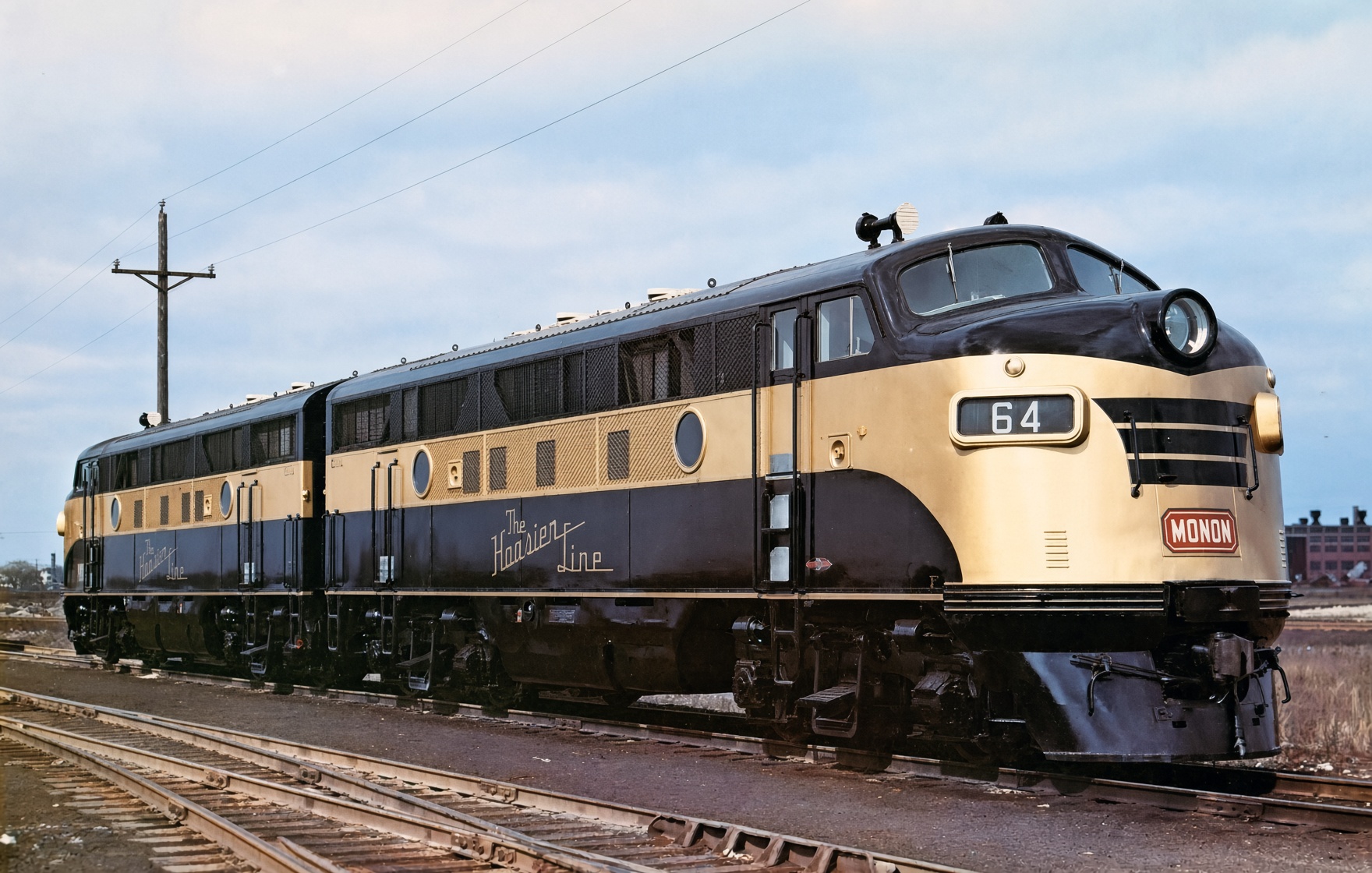
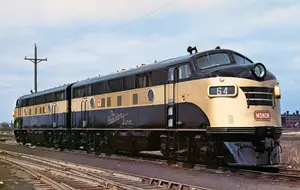
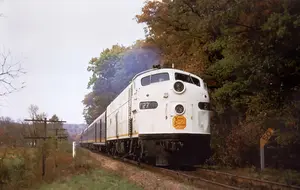
An Electro-Motive photograph of new Monon F3As in January 1947. On this railroad the A and B suffixes were both cabs. The C suffix was the booster.
On this page: At a glance · Switchers · The F3s · BL2s and road switchers · Centuries and the U23Bs · Roster
At a glance
| Item | Detail |
|---|---|
| Railroad | Chicago, Indianapolis & Louisville, later the Monon Railroad. Company history |
| This table | Diesels the railroad owned. Each frame once |
| Electro-Motive | 49. Three SW1s, seven NW2s, nine BL2s, 24 F3A cabs, six F3B boosters |
| American Locomotive | 36. Nine RS-2s, nine C628s, 18 C420s |
| General Electric | 8. U23Bs 601–608, the last new freight power |
| Fairbanks-Morse | 3. One H10-44 and two H15-44s |
| Quantity column | 96 |
| 1951 fleet | 57. A year count, after the Ash Grove wrecks and the sale of the first SW1 |
| First diesels | SW1 DS-50 and three NW2s, 1942 |
| Last new passenger power | C420s 501–502, August 1966, high short hood and a steam generator |
Switchers
The first diesel was a 600-horsepower SW1, DS-50, in February 1942, later numbered 1. It was sold to United Electric Coal in 1947 and is preserved at the Hoosier Valley Railroad Museum. Two more SW1s, 5 and 6, arrived in August 1949. The three NW2s of April 1942, DS-1 through DS-3, became 11, 12, and 13. Four more NW2s, 14–17, came in January 1947. No. 11 was sold to the Elgin, Joliet & Eastern. No. 14 followed in 1970. Nos. 12, 13, and 15–17 passed to the Louisville & Nashville.
Fairbanks-Morse contributed three switchers and then stopped. H10-44 No. 18, November 1946, went to W. R. Grace in 1963. The two H15-44s were built in September and December 1947 as 36 and 37 and were renumbered 45 and 46 in 1949, which cleared 36 and 37 for the last BL2s. Both were re-engined with EMD 567s in July 1960. They were the same two locomotives, and they are counted once.
The F3s
The road freight and passenger fleet began with F3s. On the Monon an A or a B after the number meant a cab. A C meant the booster. That is the opposite of the habit on many other railroads, where B was the booster and C was the second cab. The first cabs were 51A, 51B, 52A, and 52B in December 1946, and 61A through 64B from December 1946 into January 1947. Eight more cabs, 81A through 84B, arrived in May 1947 to lead the rebuilt Army hospital cars. Two further cabs, 85A and 85B, were EMD demonstrators 754A1 and 754A2, built in September 1946 and bought for the Monon. The boosters were 61C through 64C, new, plus 65C, former demonstrator 754B1, built in July 1945.
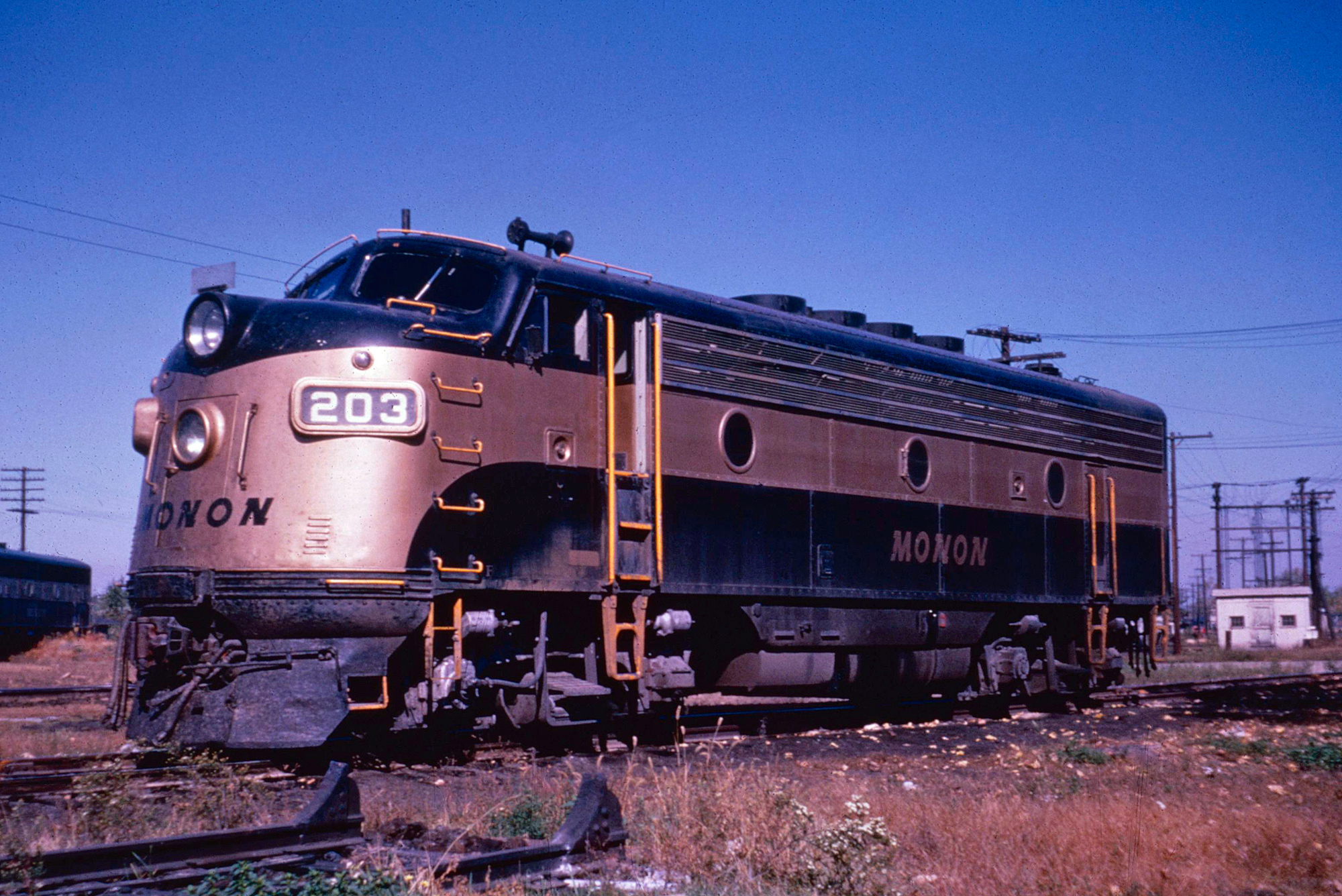
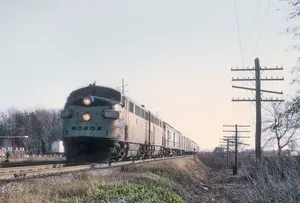
F3A 203, formerly 82A, at Hammond, Indiana, on October 13, 1963. The 81–84 series later carried 201–208. American-Rails.com collection.
On June 3, 1947, a collision at Ash Grove, near the Lafayette shops, wrecked cabs 62B and 64A and booster 64C. Those three frames stay in the count. Two new cabs, the second 62B and the second 64A, replaced the wrecked cabs in April 1948 and later became 106 and 109. A new booster, the second 64C, arrived in October 1947 and later became 304. A few numbers were passed around in the meantime. Original 51A wore 64A for a year and then went back, and original 64B spent time as 62B and as 51B. Those were the same locomotives, not extra ones. In the later three-digit scheme the 100s were the early cabs, the 200s were the 81–85 series, and the 300s were the boosters.
BL2s and road switchers
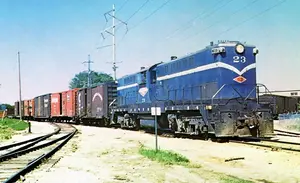
Nine BL2s, 30–38, gave the Monon the largest fleet of that odd EMD road switcher. Four, 30–33, and two more, 34 and 35, came in April 1948 on the same order with two blocks of serials. The last three, 36–38, came in May 1949. No. 32 is at the Kentucky Railway Museum. The nine RS-2s, 21–29, were built from January through October 1947, rebuilt to 1,600 horsepower in 1963 and 1964, and renumbered 51–59 in 1965 and 1966. They went to the Louisville & Nashville as 260–268.
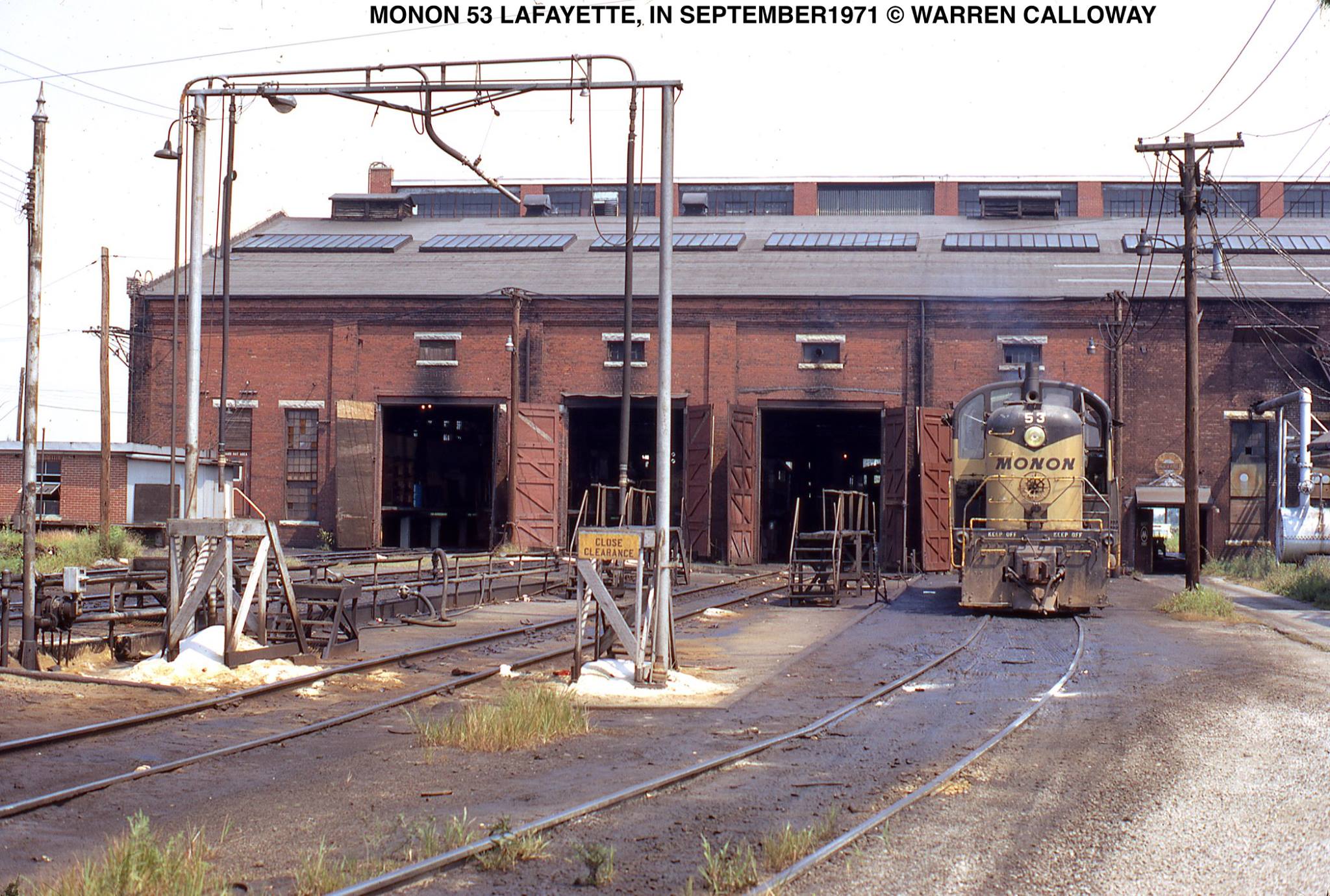
RS-2 53 outside the shop in Lafayette, Indiana, in September 1971, still in Monon paint after the Louisville & Nashville merger. It had been No. 23. Warren Calloway photo.
Centuries and the U23Bs
The six-axle experiment was nine C628s, 400–408, in March 1964. They were bought for a unit-coal move from the Ohio River to Michigan City. The Interstate Commerce Commission refused the plan. The locomotives were too long in the wheelbase for the curves and heavy enough to spread the rail, which is about what a 475,000-pound steam engine would have done on the same railroad thirty-five years earlier. They went back to Alco in 1967 and became Lehigh Valley 633–641.

C628s 404 and 407, nearly new, at New Albany, Indiana, on June 26, 1964. David Hawkins collection.

Three of the C628s, nearly new, at New Albany on the same day. When the coal trains were refused, the nine went back to Alco and on to the Lehigh Valley. David Hawkins collection.

C628 402 at the yard in Hammond, Indiana, on March 31, 1964. Roger Puta photo.
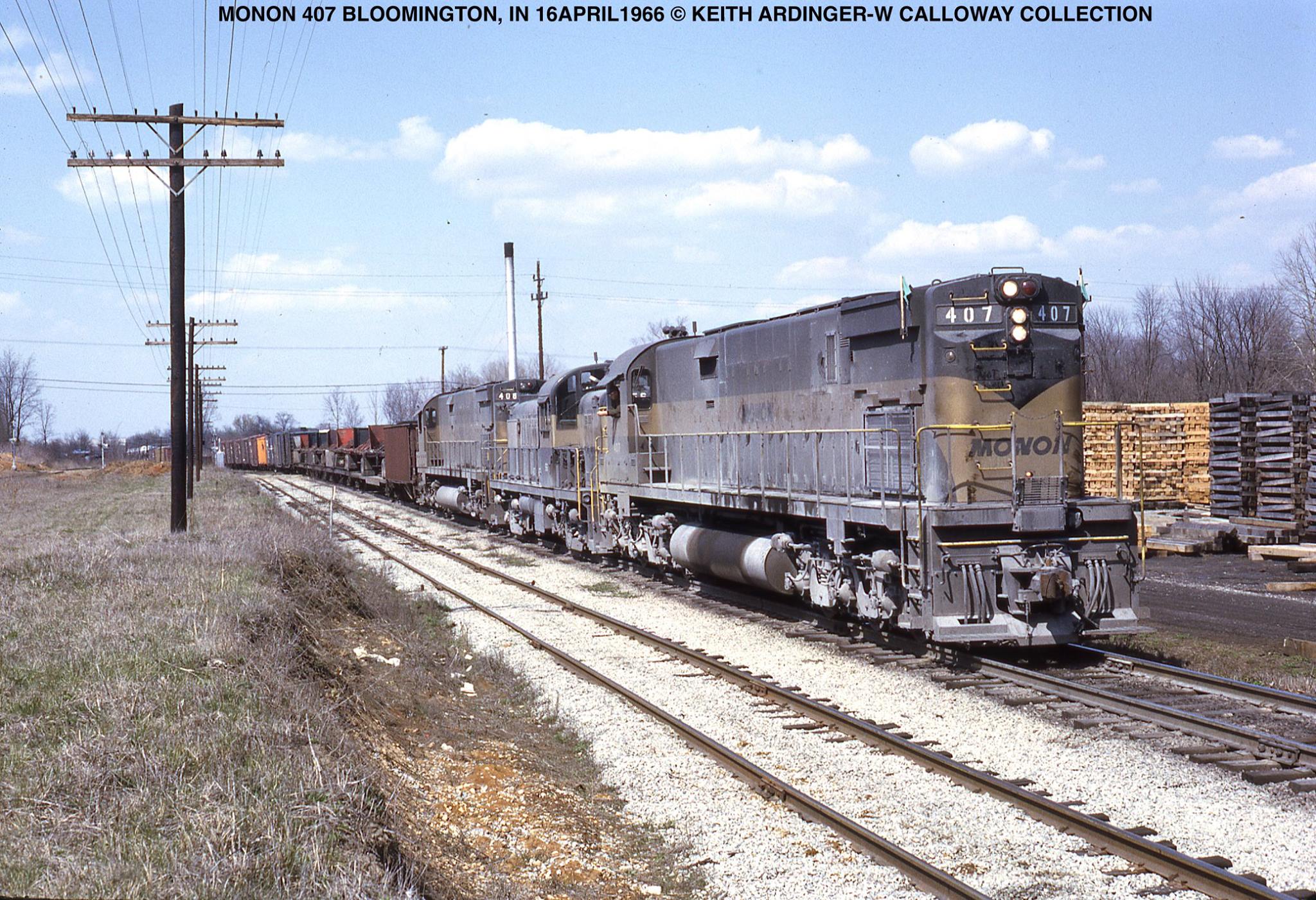
Two C628s and an RS-2 on a mixed freight at Bloomington, Indiana, on April 16, 1966. Keith Ardinger photo. Warren Calloway collection.
What replaced them was the C420, eighteen four-axle units. Nos. 501 and 502, August 1966, were the high-short-hood passenger pair, with a steam generator in the nose. They were the last new passenger locomotives the Monon bought, and among the last anyone bought. Nos. 503–506 came the same month, in the low-hood freight version. Nos. 507–518 followed in August 1967. All eighteen went to the Louisville & Nashville, 1318–1335.
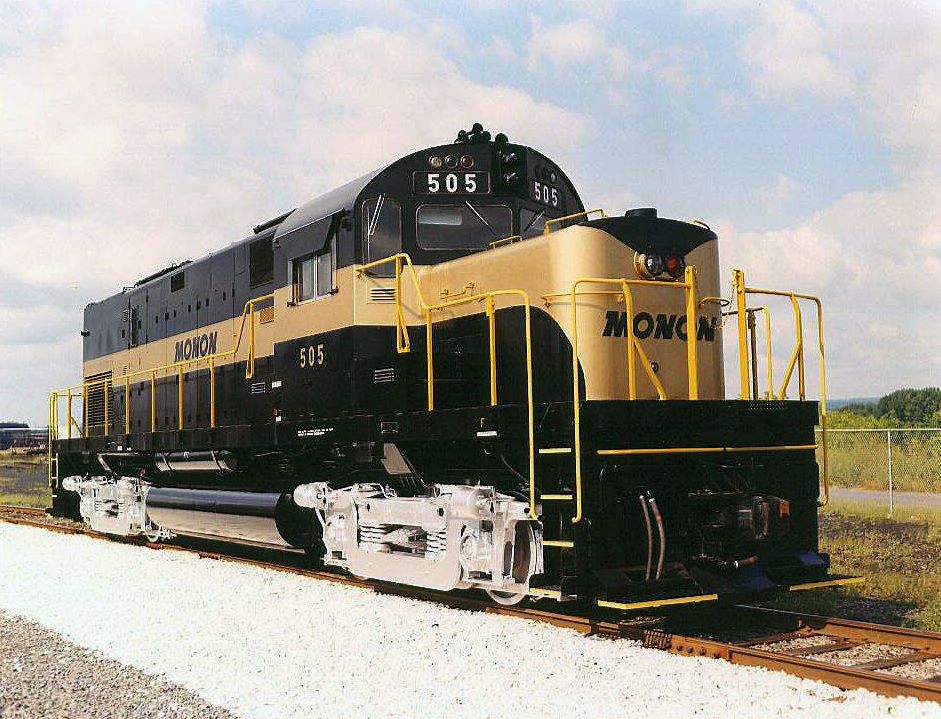
C420 505, new at Schenectady, New York, in August 1966. American Locomotive builder’s photograph.
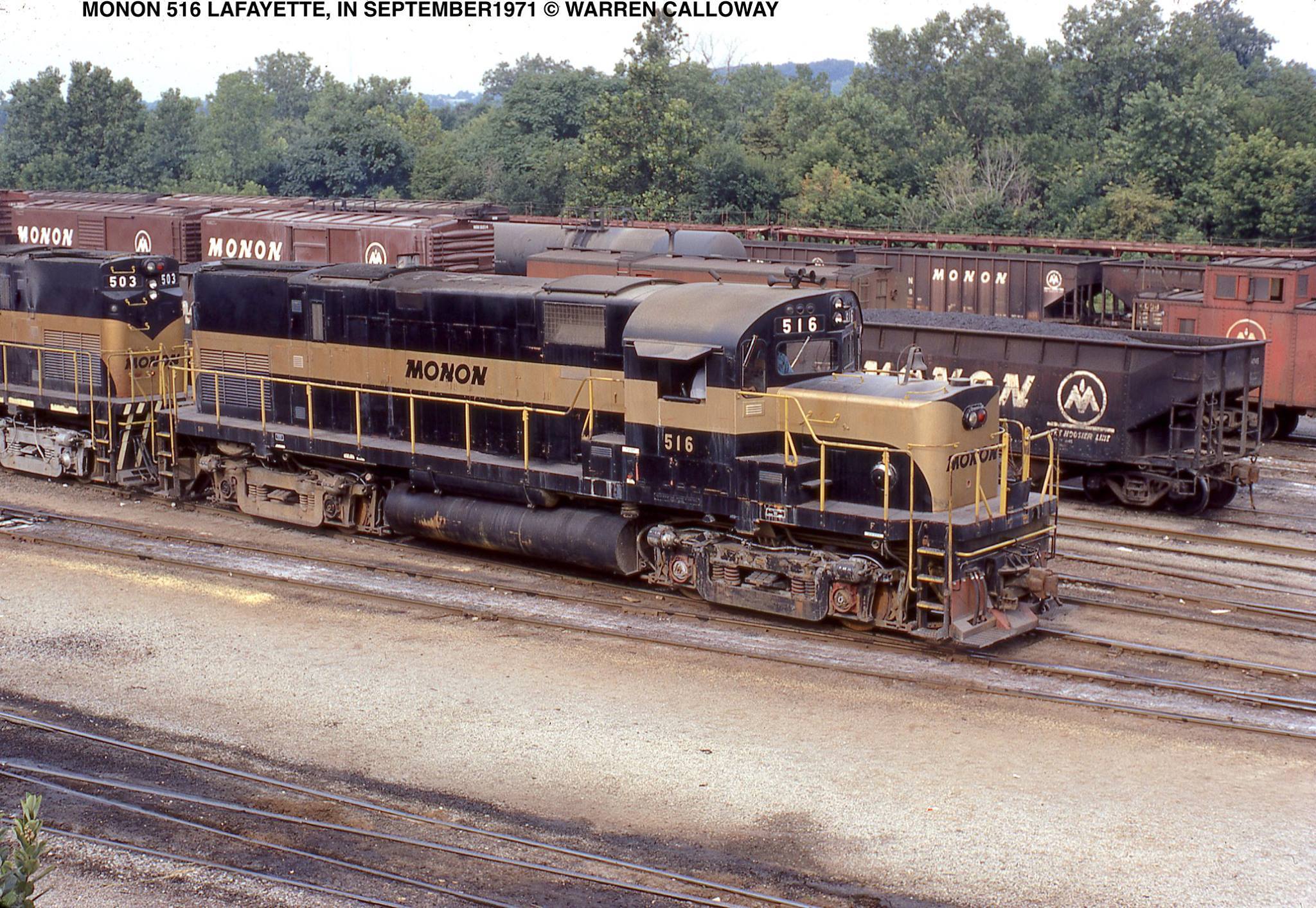
C420s at Lafayette, Indiana, in September 1971. Warren Calloway photo.
The last new freight locomotives were eight General Electric U23Bs, 601–608, in March and April 1970. They became Louisville & Nashville 2700–2707 and, much later, CSX 3230–3237. They are the same eight frames. The one electric, McGuire-Cummings No. 5 of 1915, is not in this 96. It is on the company page.
Roster
| Model | Road Number | Qty | Date | Builder Number | Order | Notes |
|---|---|---|---|---|---|---|
| SW1 | DS-50 | 1 | 2/1942 | 1597 | E460 | Later 1. Sold in 1947 |
| SW1 | 5–6 | 2 | 8/1949 | 8423–8424 | E1254 | |
| NW2 | DS-1–DS-3 | 3 | 4/1942 | 1598–1600 | E461 | Later 11–13. 11 sold to the Elgin, Joliet & Eastern. 12 and 13 to L&N 2202 and 2203 |
| NW2 | 14–17 | 4 | 1/1947 | 4445–4448 | E794 | 14 sold to the Elgin, Joliet & Eastern. 15–17 to L&N 2205–2207 |
| BL2 | 30–33 | 4 | 4/1948 | 4449–4452 | E975 | 32 is at the Kentucky Railway Museum |
| BL2 | 34–35 | 2 | 4/1948 | 5243–5244 | E975 | |
| BL2 | 36–38 | 3 | 5/1949 | 8420–8422 | E1253 | |
| F3A | 51A, 51B, 52A, 52B | 4 | 12/1946 | 3663–3666 | E703A | Cabs. Later 101, 110, 111, and 112 |
| F3A | 61A–64A, 61B–64B | 8 | 12/1946–1/1947 | 3669–3676 | E704A | Cabs. 62B and 64A wrecked at Ash Grove, June 3, 1947 |
| F3A | 62B (2nd), 64A (2nd) | 2 | 4/1948 | 7416–7417 | E1055A | New cabs, replacing the wrecked pair. Later 106 and 109 |
| F3A | 81A–84A, 81B–84B | 8 | 5/1947 | 4453–4460 | E796A | Cabs for the rebuilt passenger cars. Later 201–208. 82A became 203 |
| F3A | 85A, 85B | 2 | 9/1946 | — | — | Cabs. Ex-EMD demonstrators 754A1 and 754A2. Later 209 and 210 |
| F3B | 61C–62C | 2 | 12/1946 | 3677–3678 | E704B | Boosters. Later 301 and 302 |
| F3B | 63C–64C | 2 | 1/1947 | 4067–4068 | E704B | Boosters. 64C wrecked at Ash Grove. 63C later 303 |
| F3B | 64C (2nd) | 1 | 10/1947 | 5194 | E878B | Replacement booster. Later 304 |
| F3B | 65C | 1 | 7/1945 | — | — | Booster. Ex-EMD demonstrator 754B1. Later 305 |
| H10-44 | 18 | 1 | 11/1946 | — | — | Sold in 1963 |
| H15-44 | 36–37 | 2 | 9/1947–12/1947 | — | — | Later 45 and 46. Re-engined with EMD 567s in July 1960. Same frames |
| RS-2 | 21–29 | 9 | 1/1947–10/1947 | — | — | Later 51–59. Rebuilt to 1,600 horsepower, 1963–64. To L&N 260–268 |
| C628 | 400–408 | 9 | 3/1964 | — | — | Returned to Alco in 1967. Lehigh Valley 633–641 |
| C420 | 501–502 | 2 | 8/1966 | — | — | High short hood, steam generator. To L&N 1318–1319 |
| C420 | 503–506 | 4 | 8/1966 | — | — | To L&N 1320–1323 |
| C420 | 507–518 | 12 | 8/1967 | — | — | To L&N 1324–1335 |
| U23B | 601–608 | 8 | 3/1970–4/1970 | — | — | Later L&N 2700–2707, then CSX 3230–3237 |
Related Reading
Sources
- Gary W. Dolzall and Stephen F. Dolzall, Monon: The Hoosier Line. Road numbers, later numbers, and dispositions, including the roster circulated by the Monon Railroad Historical-Technical Society.
- Electro-Motive order numbers and serials for the locomotives on the CI&L production list at trainweb.us/emdloco/cil.htm. Demonstrator cabs 85A and 85B, and booster 65C, are not on that list.
Recent Articles


-
Monon Diesel Roster (All-Time)
Oct 28, 26 10:13 AM
 Monon diesel locomotives, each frame once. F3s, nine BL2s, the C420s, and eight U23Bs. The quantity column is 96. The 1951 fleet was 57.
-
Monon Steam Roster (Built Since 1900)
Oct 28, 26 10:09 AM
 Monon steam locomotives built since 1900. Twelve-Wheelers, Mikados, light Pacifics, and thirteen six-wheel switchers. The quantity column is 148.
-
Monon Railroad: Map, Photos, History, Logo
Oct 28, 26 09:55 AM
 History of the Monon, the Hoosier Line. The New Albany & Salem, the X at Monon, Barriger's streamliners, and the Louisville & Nashville merger of July 31, 1971.
-
Missouri-Kansas-Texas Diesel Roster (All-Time)
Oct 28, 26 09:48 AM
 All-time diesel roster of the Missouri-Kansas-Texas. 406 locomotives, each frame once. Baldwin switchers, Alco cab units, F units, Geeps, and the SD40-2s.
-
Missouri-Kansas-Texas Steam Roster (Built Since 1900)
Oct 28, 26 09:43 AM
 Missouri-Kansas-Texas steam locomotives built since 1900. Moguls, Mikados, Pacifics, and the narrow-gauge shop tanks. The quantity column is 715.
-
Missouri-Kansas-Texas Railroad (Katy): Map, History, Rosters
Oct 27, 26 11:02 PM
 History of the Missouri-Kansas-Texas, the Katy. The race into Indian Territory, Gould, the 1923 railroad, the Texas Special, and the 1988 sale. Steam and diesel rosters are linked.
-
Soo Line Diesel Roster (All-Time)
Oct 27, 26 10:55 PM
 All-time diesel roster of the Soo Line and the Wisconsin Central. 786 locomotives, each frame once. Cab units, Geeps, the Milwaukee Road engines, and the SD60s. The South Shore's 24 stay on that page.
-
Soo Line Steam Roster (Built Since 1900)
Oct 27, 26 10:49 PM
 Soo Line and Wisconsin Central steam locomotives built since 1900. Consolidations, Mikados, Pacifics, 21 Mountains, and four Lima 4-8-4s.
-
Soo Line Railroad: Map, Logo, History, Rosters
Oct 27, 26 10:24 PM
 The Soo Line, from the flour millers' railroad around Chicago to the Sault, the Wisconsin Central, and the Milwaukee Road. Steam quantity 422. Diesels 786. Canadian Pacific took full control in 1990.
-
Minneapolis, Northfield and Southern Railway: Map, History, Rosters
Oct 27, 26 10:32 AM
 The Minneapolis, Northfield & Southern, the Dan Patch Line that became a Twin Cities belt. Steam, gas-electric mules, motor cars, and the 22 diesels, through the Soo Line.
-
Minneapolis & St. Louis Diesel Roster (All-Time)
Oct 27, 26 10:27 AM
 All-time diesel roster of the Minneapolis & St. Louis. 97 locomotives, each frame once. Switchers from 1938, 35 RS-1s, the FT and F-unit cabs, two SD7s, and 23 GP9s. Builder numbers included.
-
Minneapolis & St. Louis Steam Roster (Post 1900)
Oct 27, 26 10:25 AM
 Minneapolis & St. Louis steam locomotives built since 1900. Moguls, Consolidations, 35 Mikados, and five Pacifics.
-
Minneapolis and St Louis Railway: "The Peoria Gateway"
Oct 27, 26 09:52 AM
 The Minneapolis & St. Louis, the Tootin' Louie, from the 1870 charter to the Peoria Gateway and the Chicago & North Western sale on November 1, 1960.
-
Alco "PA" Locomotives: Restoration, Specs, Engine, Rosters
Oct 27, 26 12:12 AM
 Alco's PA passenger cab, 297 locomotives built from 1946 to 1953. The 244 engine, the production roster, the Delaware & Hudson PA-4s, and Nickel Plate Road 190.
-
Milwaukee Road Diesel Roster: (All Time)
Oct 26, 26 01:44 PM
 All-time diesel roster of the Milwaukee Road. 1,208 locomotives, each frame once. Alco, Baldwin, Davenport, EMD, Fairbanks-Morse, General Electric, and Whitcomb, with builder numbers.
-
Milwaukee Road Steam Roster (All-Time): Post-1900
Oct 26, 26 01:38 PM
 Milwaukee Road steam locomotives built since 1900. Prairies, Mikados, the N-class articulateds, the S-class 4-8-4s, and the Hiawatha Atlantics and Hudsons. Quantity column 1,974. Unique frames 1,951.
-
Milwaukee Road: Map, Electrification, Logo, History
Oct 26, 26 01:20 PM
 The Milwaukee Road, from the Milwaukee & Mississippi of 1850 to the Pacific Coast Extension, the Hiawathas, and the Soo Line sale. Why Lines West should have stayed.
-
Lake Superior & Ishpeming Railroad: Map, Roster, History
Oct 25, 26 11:38 PM
 Lake Superior & Ishpeming Railroad, reporting mark LSI, from the Marquette Range to the Presque Isle ore dock. The 1954 steam list and the diesels the railroad owned.
-
Kansas City Southern Steam Roster (Built Since 1900)
Oct 25, 26 09:09 PM
 Steam locomotives of the Kansas City Southern built since 1900, with the Louisiana & Arkansas and the Texas company.
-
Kansas City Southern Diesel Roster (Built New)
Oct 25, 26 11:46 AM
All-time diesel roster of the Kansas City Southern. E units, F units, Geeps, SD40s through SD70ACes, Fairbanks-Morse, Baldwin, Alco, and General Electric, with serials and order numbers. -
Kansas City Southern Railway: Map, Photos, History
Oct 25, 26 12:24 AM
The Kansas City Southern, from Arthur Stilwell's Gulf line to Canadian Pacific Kansas City on April 14, 2023. Steam and diesel rosters, the Southern Belle, and the Louisiana & Arkansas. -
Indiana Harbor Belt Diesel Roster (All-Time)
Oct 25, 26 12:17 AM
 All-time diesel roster of the Indiana Harbor Belt. 202 locomotive frames, each counted once. NW2s, SW7s, SW1500s, road switchers, and gensets. Slugs and boosters are outside the count.
-
Indiana Harbor Belt Steam Roster (Built Since 1900)
Oct 25, 26 12:13 AM
 Steam locomotives of the Indiana Harbor Belt built since 1900. 182 engines, each counted once. 0-6-0s, 2-6-0s, 0-8-0s, and 2-8-2s. The three U-4a switchers are three-cylinder Brooks engines of 1927.
-
Indiana Harbor Belt Railroad: Map, Rosters, History
Oct 25, 26 12:00 AM
 Indiana Harbor Belt, the inner belt across the Calumet, from the East Chicago Belt of May 16, 1896. Renamed June 29, 1907. Still operating, headquarters Hammond. Steam roster is the companion, 182 loc…
-
NYC's "P Motor" Electric Locomotives
Oct 24, 26 11:43 PM
 New York Central P motors: 22 Alco-GE 2-C+C-2 electrics, Cleveland Union Terminal 1050–1071, class P-1a. 3,030 hp one-hour on 3,000-volt DC catenary, then 660-volt third rail as P-2a and P-2b.
-
Illinois Terminal Car Roster
Oct 24, 26 11:40 PM
 Illinois Terminal cars. Mainline motors, the 1948 streamliners, sleepers, Alton and Valley Division cars, express motors, and the line cars rebuilt from pull cars.
-
Illinois Terminal Diesel Roster
Oct 24, 26 09:31 PM
 All-time Illinois Terminal diesels, 62 frames. Alco S-2s and RS-1s, EMD switchers, GP7s, SD39s, GP38-2s, and the two GP20s. Serial numbers from the 1989 roster.
-
Illinois Terminal Electric Locomotives
Oct 24, 26 08:22 PM
 Illinois Terminal electric locomotives, 57 frames. Class A through Class D, the Decatur-built motors, and the battery locomotives. Class D is the same five Class C frames, rebuilt.
-
Illinois Terminal Steam Roster
Oct 24, 26 07:37 PM
 Illinois Terminal steam locomotives, 36 frames. Baldwin Moguls, three Class 30 Mikados, Florida East Coast 0-8-0s, and 2-6-0 No. 21, the last fire on June 30, 1950.
-
Illinois Terminal Railroad: Map, Roster, Photos, History
Oct 24, 26 07:32 PM
Illinois Terminal, McKinley's Illinois Traction System, from the Danville coal towns to St. Louis. The McKinley Bridge, the sleeping cars, the 1937 break with the power company, the 1948 streamliners… -
Southern Railway Diesel Roster (All-Time)
Oct 23, 26 11:00 PM
 All-time diesel roster of the Southern Railway. 2,505 locomotives in the system number series, from the 1939 demonstrator FT to GP50s and B30-7A1s. Serials included.
-
Illinois Central Diesel Roster (All-Time)
Oct 23, 26 04:06 PM
Illinois Central and Illinois Central Gulf diesel locomotives, each frame once. The quantity column is 886. Serials and order numbers from Electro-Motive's builder lists. Paducah rebuilds and Gulf, Mo… -
Illinois Central Gulf Diesel Roster
Oct 23, 26 04:02 PM
 Illinois Central Gulf operating numbers from August 10, 1972, to February 29, 1988. New frames stay on the Illinois Central diesel roster. Gulf, Mobile and Ohio frames stay on that roster. No Gulf fle…
-
Illinois Central Railroad: Map, Logo, History
Oct 23, 26 03:50 PM
Illinois Central, the Main Line of Mid-America, from the 1850 land grant to Canadian National control on July 1, 1999. Charter lines, Cairo bridge, Paducah, and the Illinois Central Gulf. Steam quanti… -
Grand Trunk Western Diesel Roster (All-Time)
Oct 23, 26 12:53 PM
 Grand Trunk Western diesel locomotives, each frame once. The quantity column is 377. Serials are filled for the Detroit, Toledo and Ironton and Detroit and Toledo Shore Line engines the railroad kept…
-
Grand Trunk Western Steam Roster
Oct 23, 26 12:14 PM
 Grand Trunk Western steam locomotives in service about 1937 to 1942, from Richard Leonard's class list. Drury has no chapter. The quantity column is the counted Grand Trunk Western rows. Two mixed Gra…
-
Grand Trunk Western Railroad: Map, Roster, History
Oct 23, 26 12:09 PM
 Grand Trunk Western, reporting mark GTW, Canadian National's railroad between Port Huron and Chicago. Trade name adopted in 1923. Steam class list quantity 232. Diesel quantity column 377. Identity in…
-
Green Bay and Western Railroad: Map, Rosters, History
Oct 22, 26 11:18 PM
 Green Bay & Western, the Green Bay Route, reporting mark GBW. From Kewaunee to Winona. Mailer's steam and diesel rosters, and the August 1993 sale to Fox Valley & Western.
-
Chicago & North Western Class E-4: Streamlined 4-6-4 Hudsons
Oct 22, 26 10:28 PM
 C&NW Class E-4, nine streamlined 4-6-4s, 4001–4009, Alco 1938. 84-inch drivers, 25-by-29 cylinders, 300 psi. Conventional Chicago–Omaha trains. Oil in 1947–48. Retired 1953–1956.
-
Gateway Western Railway: Map, Roster, History
Oct 22, 26 02:43 PM
 Gateway Western Railway, reporting mark GWWR. Class II from Kansas City to East St. Louis. Kansas City Southern control May 5, 1997. The 1992 diesel fleet, with serials and order numbers.