- Home ›
- Fallen Flags ›
- Monon ›
- Steam Roster
Monon Steam Roster (Built Since 1900)
Published: October 28, 2026
By: Adam Burns
By 1900 the Chicago, Indianapolis & Louisville had already reached the shape people meant when they said the Monon Route. Two main lines crossed at Monon, Indiana, and the branches ran off toward coal and limestone. The locomotive that set this railroad apart was not a Mikado or a Pacific. It was the Twelve-Wheeler. Twenty-two of them arrived between 1898 and 1903, and the quantity column on the post-1900 list is 148, across 22 rows. The numbers are the 1911 numbers.
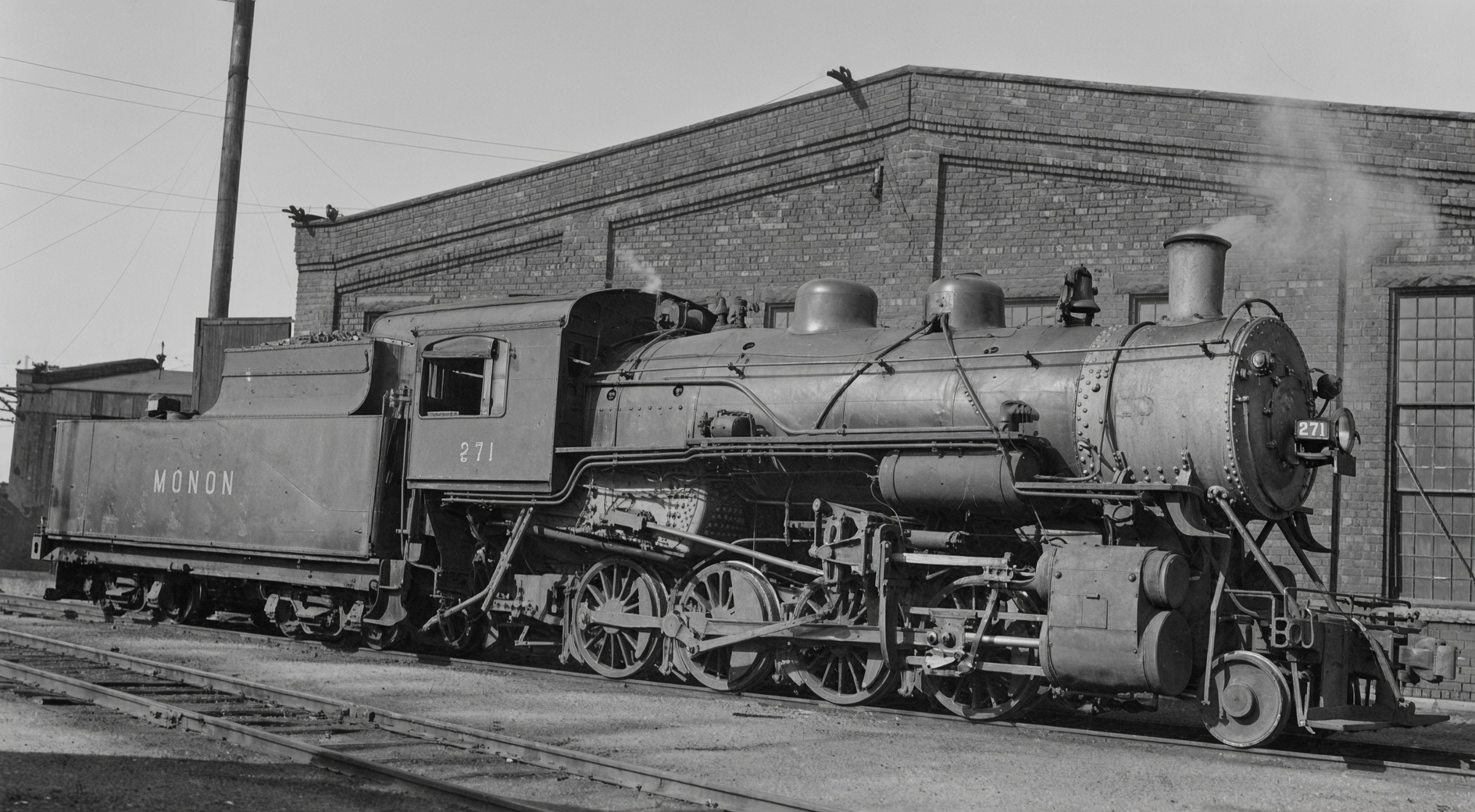
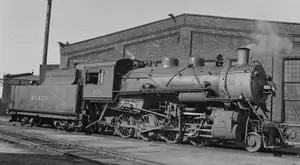
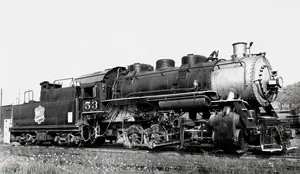
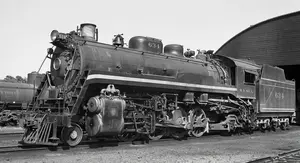
Monon 2-8-0 #271 (a Class H-5 built by the Brooks Locomotive Works in 1906) is seen here in Lafayette, Indiana, circa 1940. Photogrpaher unknown.
On this page: At a glance · Twelve-Wheelers and Consolidations · Mikados · Passenger locomotives · Switchers · Roster
At a glance
| Item | Detail |
|---|---|
| Railroad | Chicago, Indianapolis & Louisville, the Monon. Company history |
| This table | Steam locomotives in the 1911 numbers, the chapter’s since-1900 list |
| Six-wheel switchers | 13. B-7, B-8, and B-9. The railroad’s only switchers |
| Consolidations | 21. H-3 through H-6. The class numbers are not in the order they were built |
| Mikados | 55. J-1 through J-4. All of them had 63-inch drivers |
| Santa Fe type | 8. Class L-1, the largest engines the railroad owned |
| Atlantics | 2. Class I-1, Brooks, 1901 |
| Ten-Wheelers | 2. Class G-6, Brooks, 1900 |
| Pacifics | 25. K-1 through K-6. Light engines, except the three K-6s |
| Twelve-Wheelers | 22. E-1 and E-2. The E-1 row is dated 1898–1900 and stays on this list |
| Quantity column | 148 |
| Last new steam | J-4 Mikados, Schenectady, 1929. The retired cell says Sold |
| Last fire | 0-6-0 No. 95, New Albany, June 29, 1949 |
Twelve-Wheelers and Consolidations
The Monon’s real departure from the usual freight locomotive was the 4-8-0. Twenty-two of them came from Brooks between 1898 and 1903. Both classes had 21-by-26-inch cylinders and were built as simple engines with inboard piston valves. The E-1s had 55-inch drivers. The E-2s had 57-inch drivers. A Twelve-Wheeler was not rare at the turn of the century, but it was often a cross-compound. These were not.
The E-1s, numbers 220–231, were rebuilt in the 1920s with outboard piston valves and Walschaerts valve gear, and they lasted until the diesels. No. 205 of 1899 is the example. It became 225 in the 1911 renumbering, and in 1926 the shops gave it a wide radial-stay firebox over the drivers and a longer smokebox. The E-2s, 240–249, were scrapped in 1936 and 1937 without that rebuild. The E-1 row is dated 1898–1900. Those earliest engines stay inside the 148 because that is how the row is printed.
The Consolidations that followed were modest 2-8-0s, mostly with 57-inch drivers and weights from 194,000 to 216,000 pounds. The class letters do not follow the calendar. The H-3s were built in 1910, after the H-5s and before the H-6s, and they were the ones with 63-inch drivers. The H-4s of 1904 and 1905 and the H-5s of 1906 were the older, smaller engines. The H-6s of 1911 closed the type. None of these classes was large. Twenty-one Consolidations is the whole post-1900 total.
Mikados
Every Monon 2-8-2 had 63-inch drivers. The J-1s, Brooks, 1912 through 1923, numbers 500–533, were slightly lighter than a United States Railroad Administration light Mikado and had 28-by-30-inch cylinders, which gave them a little more tractive effort. There was a 1912 batch, a 1918 batch, and a return to the railroad’s own design for the engines of 1923. All 34 sit on one row.
Five USRA light Mikados arrived just after that 1918 batch. They are class J-2, numbers 550–554, Schenectady, 1918. The note on the row is USRA. The J-3s of 1926, Richmond, numbers 560–565, were heavier copies of the same design, with 27-by-32-inch cylinders. The chapter puts them 31,000 pounds above the light USRA engine. The J-4s, Schenectady, 1929, numbers 570–579, shared those dimensions and were heavier still. They were the last steam locomotives the Monon bought. The retired cell says Sold.
Eight 2-10-2s were the largest engines on the roster, class L-1, numbers 600–607. Five came from Schenectady in 1914 and three from Brooks in 1916. The builder cell is the two works together. The decline of the 1930s and early 1940s left the railroad with power other lines would still buy. Two of the 2-10-2s went to the Tennessee Railroad, one in 1942 and one in 1945. In 1941 and 1942 the Soo Line took eight J-1s. Other J-1s went to the Tennessee Railroad and the Pittsburgh & West Virginia. One of the Soo Line engines was Monon 504, the Mikado displayed at Thief River Falls, Minnesota. The J-4s were sold at dieselization, eight to the Pittsburg & Shawmut and two to the Tennessee, Alabama & Georgia.
In 1928 the railroad wanted a pair of helpers for the grade north out of the Wabash River valley at Lafayette. Baldwin proposed a 4-10-4 of about 475,000 pounds, as heavy as a medium 2-10-4. The bridges and the track would have had to be rebuilt wherever it ran. The J-4s were the wiser purchase. Lima offered a light 2-6-6-6 in 1936 and a 2-6-6-4 in 1940. The mechanical department kept files on the Delaware & Hudson and Clinchfield 4-6-6-4s. Finances ended the conversation, and the F3s did the job those articulateds were supposed to do. None of the proposals is in the 148.
Passenger locomotives
Two Atlantics arrived from Brooks in 1901, class I-1, numbers 390 and 391. They were ordinary Brooks 4-4-2s of that moment: 73-inch drivers, inboard piston valves, and a trailing truck with inboard bearings. In the 1920s they were rebuilt with outboard piston valves, Baker valve gear, and cast trailing trucks. They were too light for steel passenger cars and were scrapped in 1936.
The two G-6 Ten-Wheelers of 1900, numbers 140 and 141, had 69-inch drivers and were meant for passenger trains. In the early 1920s they were rebuilt, with a number of older 4-6-0s, into branch-line engines with 51-inch drivers. The retired cell is 1942 and 1948, one engine in each year.
Most of the Pacifics were light. Total weight ran from 209,000 to 227,000 pounds, against 277,000 pounds for a USRA light Pacific. The K-1s and K-2s, built from 1905 through 1907, differed by half an inch of cylinder diameter, and both had 69-inch drivers. Rebuilding erased the difference. As rebuilt, both classes had 21½-by-26-inch cylinders. The K-3s of 1909, the K-4s of 1911, and the K-5s of 1912 and 1923 had 73-inch drivers. The K-3s and K-4s were built with 22-by-28-inch cylinders. The K-5s were built with 23½-by-28-inch cylinders. In rebuilding, the K-4s and K-5s received 23-by-28-inch cylinders.
The heaviest Pacifics were the three K-6s of 1916, numbers 450–452. They weighed 285,000 pounds, with 26-by-28-inch cylinders and 73-inch drivers. They were too heavy for the bridges on the Indianapolis line and usually drew the Chicago–Louisville night trains.
Switchers
The only switchers were 0-6-0s. Three classes built after 1900 account for 13 of them: B-7 numbers 25–27, Brooks, 1902; B-8 numbers 30–36, Brooks, 1905–1907; and B-9 numbers 37–39, Brooks, 1923. The last steam locomotive in service was 0-6-0 No. 95, switching at New Albany. It had been B-8 No. 35 until the 1947 renumbering. It dropped its fire on June 29, 1949. The railroad retired No. 95 and 4-8-0 No. 229 on September 14, 1949. That was the end of the steam era on a railroad that had dieselized earlier than most of its neighbors.
Roster
| Type | Class | Numbers | Qty | Builder | Built | Retired | Notes |
|---|---|---|---|---|---|---|---|
| 0-6-0 | B-7 | 25–27 | 3 | Brooks | 1902 | 1937 | |
| 0-6-0 | B-8 | 30–36 | 7 | Brooks | 1905–1907 | 1940–1949 | |
| 0-6-0 | B-9 | 37–39 | 3 | Brooks | 1923 | 1947 | |
| 2-8-0 | H-3 | 250–254 | 5 | Brooks | 1910 | 1936–1946 | |
| 2-8-0 | H-4 | 260–265 | 6 | Brooks | 1904–1905 | 1940 | |
| 2-8-0 | H-5 | 270–272 | 3 | Brooks | 1906 | 1940–1941 | |
| 2-8-0 | H-6 | 280–286 | 7 | Brooks | 1911 | 1941–1948 | |
| 2-8-2 | J-1 | 500–533 | 34 | Brooks | 1912–1923 | 1939–1948 | |
| 2-8-2 | J-2 | 550–554 | 5 | Schenectady | 1918 | 1947–1949 | USRA |
| 2-8-2 | J-3 | 560–565 | 6 | Richmond | 1926 | 1947–1948 | |
| 2-8-2 | J-4 | 570–579 | 10 | Schenectady | 1929 | Sold | |
| 2-10-2 | L-1 | 600–607 | 8 | Schenectady, Brooks | 1914, 1916 | 1941–1947 | |
| 4-4-2 | I-1 | 390, 391 | 2 | Brooks | 1901 | 1936 | |
| 4-6-0 | G-6 | 140, 141 | 2 | Brooks | 1900 | 1942, 1948 | |
| 4-6-2 | K-1 | 400–403 | 4 | Brooks | 1905 | 1939 | |
| 4-6-2 | K-2 | 410–415 | 6 | Brooks | 1906–1907 | 1939–1947 | |
| 4-6-2 | K-3 | 420–422 | 3 | Brooks | 1909 | 1941–1947 | |
| 4-6-2 | K-4 | 430–432 | 3 | Brooks | 1911 | 1947 | |
| 4-6-2 | K-5 | 440–445 | 6 | Brooks | 1912, 1923 | 1946–1948 | |
| 4-6-2 | K-6 | 450–452 | 3 | Brooks | 1916 | 1941–1947 | |
| 4-8-0 | E-1 | 220–231 | 12 | Brooks | 1898–1900 | 1946–1949 | |
| 4-8-0 | E-2 | 240–249 | 10 | Brooks | 1902–1903 | 1936–1937 |
Related Reading
Sources
- George H. Drury, Guide to North American Steam Locomotives, revised edition. Chicago, Indianapolis & Louisville chapter, pp. 131–132. The table uses the 1911 numbers.
- Gary W. Dolzall and Stephen F. Dolzall, Monon: The Hoosier Line. The last engine in service, No. 95, and the September 14, 1949, retirement.
Recent Articles


-
Monon Diesel Roster (All-Time)
Oct 28, 26 10:13 AM
 Monon diesel locomotives, each frame once. F3s, nine BL2s, the C420s, and eight U23Bs. The quantity column is 96. The 1951 fleet was 57.
-
Monon Steam Roster (Built Since 1900)
Oct 28, 26 10:09 AM
 Monon steam locomotives built since 1900. Twelve-Wheelers, Mikados, light Pacifics, and thirteen six-wheel switchers. The quantity column is 148.
-
Monon Railroad: Map, Photos, History, Logo
Oct 28, 26 09:55 AM
 History of the Monon, the Hoosier Line. The New Albany & Salem, the X at Monon, Barriger's streamliners, and the Louisville & Nashville merger of July 31, 1971.
-
Missouri-Kansas-Texas Diesel Roster (All-Time)
Oct 28, 26 09:48 AM
 All-time diesel roster of the Missouri-Kansas-Texas. 406 locomotives, each frame once. Baldwin switchers, Alco cab units, F units, Geeps, and the SD40-2s.
-
Missouri-Kansas-Texas Steam Roster (Built Since 1900)
Oct 28, 26 09:43 AM
 Missouri-Kansas-Texas steam locomotives built since 1900. Moguls, Mikados, Pacifics, and the narrow-gauge shop tanks. The quantity column is 715.
-
Missouri-Kansas-Texas Railroad (Katy): Map, History, Rosters
Oct 27, 26 11:02 PM
 History of the Missouri-Kansas-Texas, the Katy. The race into Indian Territory, Gould, the 1923 railroad, the Texas Special, and the 1988 sale. Steam and diesel rosters are linked.
-
Soo Line Diesel Roster (All-Time)
Oct 27, 26 10:55 PM
 All-time diesel roster of the Soo Line and the Wisconsin Central. 786 locomotives, each frame once. Cab units, Geeps, the Milwaukee Road engines, and the SD60s. The South Shore's 24 stay on that page.
-
Soo Line Steam Roster (Built Since 1900)
Oct 27, 26 10:49 PM
 Soo Line and Wisconsin Central steam locomotives built since 1900. Consolidations, Mikados, Pacifics, 21 Mountains, and four Lima 4-8-4s.
-
Soo Line Railroad: Map, Logo, History, Rosters
Oct 27, 26 10:24 PM
 The Soo Line, from the flour millers' railroad around Chicago to the Sault, the Wisconsin Central, and the Milwaukee Road. Steam quantity 422. Diesels 786. Canadian Pacific took full control in 1990.
-
Minneapolis, Northfield and Southern Railway: Map, History, Rosters
Oct 27, 26 10:32 AM
 The Minneapolis, Northfield & Southern, the Dan Patch Line that became a Twin Cities belt. Steam, gas-electric mules, motor cars, and the 22 diesels, through the Soo Line.
-
Minneapolis & St. Louis Diesel Roster (All-Time)
Oct 27, 26 10:27 AM
 All-time diesel roster of the Minneapolis & St. Louis. 97 locomotives, each frame once. Switchers from 1938, 35 RS-1s, the FT and F-unit cabs, two SD7s, and 23 GP9s. Builder numbers included.
-
Minneapolis & St. Louis Steam Roster (Post 1900)
Oct 27, 26 10:25 AM
 Minneapolis & St. Louis steam locomotives built since 1900. Moguls, Consolidations, 35 Mikados, and five Pacifics.
-
Minneapolis and St Louis Railway: "The Peoria Gateway"
Oct 27, 26 09:52 AM
 The Minneapolis & St. Louis, the Tootin' Louie, from the 1870 charter to the Peoria Gateway and the Chicago & North Western sale on November 1, 1960.
-
Alco "PA" Locomotives: Restoration, Specs, Engine, Rosters
Oct 27, 26 12:12 AM
 Alco's PA passenger cab, 297 locomotives built from 1946 to 1953. The 244 engine, the production roster, the Delaware & Hudson PA-4s, and Nickel Plate Road 190.
-
Milwaukee Road Diesel Roster: (All Time)
Oct 26, 26 01:44 PM
 All-time diesel roster of the Milwaukee Road. 1,208 locomotives, each frame once. Alco, Baldwin, Davenport, EMD, Fairbanks-Morse, General Electric, and Whitcomb, with builder numbers.
-
Milwaukee Road Steam Roster (All-Time): Post-1900
Oct 26, 26 01:38 PM
 Milwaukee Road steam locomotives built since 1900. Prairies, Mikados, the N-class articulateds, the S-class 4-8-4s, and the Hiawatha Atlantics and Hudsons. Quantity column 1,974. Unique frames 1,951.
-
Milwaukee Road: Map, Electrification, Logo, History
Oct 26, 26 01:20 PM
 The Milwaukee Road, from the Milwaukee & Mississippi of 1850 to the Pacific Coast Extension, the Hiawathas, and the Soo Line sale. Why Lines West should have stayed.
-
Lake Superior & Ishpeming Railroad: Map, Roster, History
Oct 25, 26 11:38 PM
 Lake Superior & Ishpeming Railroad, reporting mark LSI, from the Marquette Range to the Presque Isle ore dock. The 1954 steam list and the diesels the railroad owned.
-
Kansas City Southern Steam Roster (Built Since 1900)
Oct 25, 26 09:09 PM
 Steam locomotives of the Kansas City Southern built since 1900, with the Louisiana & Arkansas and the Texas company.
-
Kansas City Southern Diesel Roster (Built New)
Oct 25, 26 11:46 AM
All-time diesel roster of the Kansas City Southern. E units, F units, Geeps, SD40s through SD70ACes, Fairbanks-Morse, Baldwin, Alco, and General Electric, with serials and order numbers. -
Kansas City Southern Railway: Map, Photos, History
Oct 25, 26 12:24 AM
The Kansas City Southern, from Arthur Stilwell's Gulf line to Canadian Pacific Kansas City on April 14, 2023. Steam and diesel rosters, the Southern Belle, and the Louisiana & Arkansas. -
Indiana Harbor Belt Diesel Roster (All-Time)
Oct 25, 26 12:17 AM
 All-time diesel roster of the Indiana Harbor Belt. 202 locomotive frames, each counted once. NW2s, SW7s, SW1500s, road switchers, and gensets. Slugs and boosters are outside the count.
-
Indiana Harbor Belt Steam Roster (Built Since 1900)
Oct 25, 26 12:13 AM
 Steam locomotives of the Indiana Harbor Belt built since 1900. 182 engines, each counted once. 0-6-0s, 2-6-0s, 0-8-0s, and 2-8-2s. The three U-4a switchers are three-cylinder Brooks engines of 1927.
-
Indiana Harbor Belt Railroad: Map, Rosters, History
Oct 25, 26 12:00 AM
 Indiana Harbor Belt, the inner belt across the Calumet, from the East Chicago Belt of May 16, 1896. Renamed June 29, 1907. Still operating, headquarters Hammond. Steam roster is the companion, 182 loc…
-
NYC's "P Motor" Electric Locomotives
Oct 24, 26 11:43 PM
 New York Central P motors: 22 Alco-GE 2-C+C-2 electrics, Cleveland Union Terminal 1050–1071, class P-1a. 3,030 hp one-hour on 3,000-volt DC catenary, then 660-volt third rail as P-2a and P-2b.
-
Illinois Terminal Car Roster
Oct 24, 26 11:40 PM
 Illinois Terminal cars. Mainline motors, the 1948 streamliners, sleepers, Alton and Valley Division cars, express motors, and the line cars rebuilt from pull cars.
-
Illinois Terminal Diesel Roster
Oct 24, 26 09:31 PM
 All-time Illinois Terminal diesels, 62 frames. Alco S-2s and RS-1s, EMD switchers, GP7s, SD39s, GP38-2s, and the two GP20s. Serial numbers from the 1989 roster.
-
Illinois Terminal Electric Locomotives
Oct 24, 26 08:22 PM
 Illinois Terminal electric locomotives, 57 frames. Class A through Class D, the Decatur-built motors, and the battery locomotives. Class D is the same five Class C frames, rebuilt.
-
Illinois Terminal Steam Roster
Oct 24, 26 07:37 PM
 Illinois Terminal steam locomotives, 36 frames. Baldwin Moguls, three Class 30 Mikados, Florida East Coast 0-8-0s, and 2-6-0 No. 21, the last fire on June 30, 1950.
-
Illinois Terminal Railroad: Map, Roster, Photos, History
Oct 24, 26 07:32 PM
Illinois Terminal, McKinley's Illinois Traction System, from the Danville coal towns to St. Louis. The McKinley Bridge, the sleeping cars, the 1937 break with the power company, the 1948 streamliners… -
Southern Railway Diesel Roster (All-Time)
Oct 23, 26 11:00 PM
 All-time diesel roster of the Southern Railway. 2,505 locomotives in the system number series, from the 1939 demonstrator FT to GP50s and B30-7A1s. Serials included.
-
Illinois Central Diesel Roster (All-Time)
Oct 23, 26 04:06 PM
Illinois Central and Illinois Central Gulf diesel locomotives, each frame once. The quantity column is 886. Serials and order numbers from Electro-Motive's builder lists. Paducah rebuilds and Gulf, Mo… -
Illinois Central Gulf Diesel Roster
Oct 23, 26 04:02 PM
 Illinois Central Gulf operating numbers from August 10, 1972, to February 29, 1988. New frames stay on the Illinois Central diesel roster. Gulf, Mobile and Ohio frames stay on that roster. No Gulf fle…
-
Illinois Central Railroad: Map, Logo, History
Oct 23, 26 03:50 PM
Illinois Central, the Main Line of Mid-America, from the 1850 land grant to Canadian National control on July 1, 1999. Charter lines, Cairo bridge, Paducah, and the Illinois Central Gulf. Steam quanti… -
Grand Trunk Western Diesel Roster (All-Time)
Oct 23, 26 12:53 PM
 Grand Trunk Western diesel locomotives, each frame once. The quantity column is 377. Serials are filled for the Detroit, Toledo and Ironton and Detroit and Toledo Shore Line engines the railroad kept…
-
Grand Trunk Western Steam Roster
Oct 23, 26 12:14 PM
 Grand Trunk Western steam locomotives in service about 1937 to 1942, from Richard Leonard's class list. Drury has no chapter. The quantity column is the counted Grand Trunk Western rows. Two mixed Gra…
-
Grand Trunk Western Railroad: Map, Roster, History
Oct 23, 26 12:09 PM
 Grand Trunk Western, reporting mark GTW, Canadian National's railroad between Port Huron and Chicago. Trade name adopted in 1923. Steam class list quantity 232. Diesel quantity column 377. Identity in…
-
Green Bay and Western Railroad: Map, Rosters, History
Oct 22, 26 11:18 PM
 Green Bay & Western, the Green Bay Route, reporting mark GBW. From Kewaunee to Winona. Mailer's steam and diesel rosters, and the August 1993 sale to Fox Valley & Western.
-
Chicago & North Western Class E-4: Streamlined 4-6-4 Hudsons
Oct 22, 26 10:28 PM
 C&NW Class E-4, nine streamlined 4-6-4s, 4001–4009, Alco 1938. 84-inch drivers, 25-by-29 cylinders, 300 psi. Conventional Chicago–Omaha trains. Oil in 1947–48. Retired 1953–1956.
-
Gateway Western Railway: Map, Roster, History
Oct 22, 26 02:43 PM
 Gateway Western Railway, reporting mark GWWR. Class II from Kansas City to East St. Louis. Kansas City Southern control May 5, 1997. The 1992 diesel fleet, with serials and order numbers.