Lehigh Valley Steam Locomotives: History, Roster & Photos
Published: September 21, 2026
By: Adam Burns
Lehigh Valley steam was an anthracite railroad’s answer to a profile that never quite justified a Berkshire. Westbound the main stayed under one percent. Eastbound the ruling grade was about 1.2 percent, except where the Mountain Top summit and the climb out of Wilkes-Barre pushed passenger trains near 1.8 percent. The freight answer, for fifty years, was the Consolidation, then the Mikado, then a big fleet of 2-10-2s. The passenger answer stopped at the Pacific until 1931, when the Valley gave its 4-8-4s a name of its own: Wyoming.
George H. Drury, in Guide to North American Steam Locomotives, is the post-1900 class grid below. He also credits this railroad with originating three wheel arrangements in the nineteenth century: the 2-8-0, the 4-8-0, and the 2-10-0.

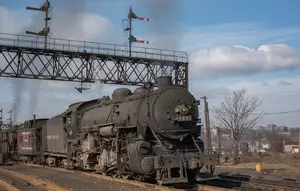
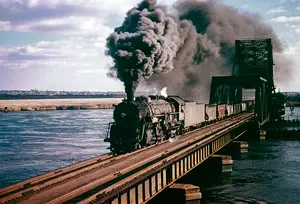
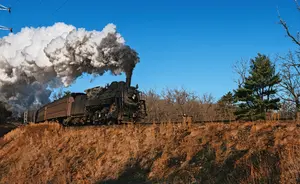
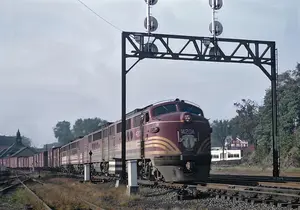
Lehigh Valley 2-8-2 #425, class N-4, under the signal bridge at Easton, Pennsylvania, in the fall of 1948. John Maris photo. Baldwin, 1923. Sister Mikado 432 made the last steam run on September 14, 1951.
On this page: At a glance · Before 1900 · Camelbacks · Mikados, Santa Fes, Mountains · Wyomings · Atlantics, Ten-Wheelers, Pacifics · Switchers · September 14, 1951 · All-time roster (built since 1900)
At a glance
| Item | Detail |
|---|---|
| Railroad | Lehigh Valley Railroad. Mark LV. Company Lehigh Valley |
| This roster | Engines built since 1900, after Drury, pages 197–200. Pre-1900 power is in the narrative |
| Fuel and cabs | Anthracite and Camelbacks well into the twentieth century. Wide fireboxes, then a turn to conventional cabs |
| Freight after 1912 | Camelback 2-8-2s, then conventional Mikados through the N-5B. Seventy-six R-1 2-10-2s. Twenty of those became N-6 Mikados |
| Mountains | Six 4-8-2s, 5000–5005, class S-2, 1923–24, three cylinders as built |
| Wyomings | 37 4-8-4s, T-1, T-2, T-2B, T-3, 1931–35. The Valley’s name for the type. Photo of the type is not on this page; the Easton Mikado is the steam frame the company page had |
| Pacifics | K-1 through K-6B. K-6B 2088–2099 the largest. Three of them shrouded, Kuhler styling, 1939–40. Engines 2101 and 2102 shrouded in 1938 |
| Last steam | September 14, 1951. Mikado 432, Delano, Pennsylvania |
| Shops | Sayre, Pennsylvania. Sayre built and rebuilt a large share of the post-1900 fleet, including the two extra K-6B Pacifics |
Class table follows Drury, Guide to North American Steam Locomotives (revised edition), page 200. Information compiled September 21, 2026.
The Consolidation, and two other wheel arrangements
Drury’s chapter opens on the map and then on a nineteenth-century claim. The Lehigh Valley, he writes, originated the 2-8-0, the 4-8-0, and the 2-10-0. The famous piece of that sentence is the Consolidation: Baldwin’s 2-8-0 of 1866 for this railroad, built while the anthracite lines were being gathered into one company, and the locomotive that gave the type its name. One of the Valley’s two early Decapods was later rebuilt as a 2-8-2 and then as a 2-8-0. The other became a 4-8-0. Those engines are older than this table.
So is the first locomotive, a Norris 4-4-0 named Delaware, bought in 1855 for the new Mauch Chunk–Easton railroad. Nineteenth-century power was a mix of Americans, Ten-Wheelers, and an ever-larger Consolidation fleet burning culm in wide fireboxes. The 1905 renumbering is why the modern class list uses the numbers below. Drury prints the post-1900 grid; the 1905 numbers are the ones in the table.
Camelbacks, then a change of mind
Anthracite wanted a wide firebox. A wide firebox wanted the cab ahead of it. The Valley was still buying Camelbacks in quantity after 1900: 0-6-0s, 0-8-0s, 2-8-0s, 2-8-2s, Atlantics, and Ten-Wheelers. Class G-14 was thirty-three Camelback six-wheel switchers, 3420–3452, Baldwin and Sayre, 1907–1914, and some of them lasted until the end of steam. The M-35 Consolidations, 102 engines numbered 700–769 and 780–812, were Baldwin Camelbacks of 1899–1902 and are in the “since 1900” table because the class straddles the century.
The first Mikados on the road were Camelbacks, and Drury calls them the only Camelback 2-8-2s. Class I-1, 2230–2239, Baldwin 1902, and the much larger N-1 class, 47 engines in the 220–246 series, Baldwin and Schenectady, 1903–1907, are those engines. They were gone by the early 1930s. The railroad had already decided the next freight engine would be a conventional Mikado.
Drury notes a short experiment the other way. In the nineteenth century the Valley had a reputation for trying wheel arrangements, including two Decapods that did not stay Decapods. After the turn of the century it tested freight engines on trailing trucks, found them slow, and went back to rigid-frame Consolidations before the Mikado finally stuck. It was the only eastern anthracite road, in his telling, that moved from Camelbacks to a conventional cab as a policy rather than one locomotive at a time.
From the N-2½ to the Santa Fe, and six Mountains
The modern Mike begins with Baldwin’s N-2½ class, 300–341, in 1912 and 1913. They were not Camelbacks. They weighed about 294,810 pounds and were rated at 43,031 pounds of tractive effort, with 56-inch drivers in the earlier group’s dimensions as Drury gives them for the first of the conventional 2-8-2s. Later N-3s (350–394, 1913 and 1916) and N-4s (395–434, plus the five N-4Bs 460–464) grew the boiler and the cylinders. The N-4 and N-5 Mikes of 1923–24 were the largest two-cylinder freight engines Sayre maintained in quantity: 27 × 32-inch cylinders, 63-inch drivers, and, on the N-5Bs, a booster. Schenectady built the fifty-five N-5Bs, 440–459 and 465–499.
The 2-10-2 was the Valley’s bid for a still heavier road engine. Baldwin delivered the R-1 class, 4000–4075, seventy-six engines, in 1917 and 1919. They were large, and twenty of the highest-numbered ones were more than the railroad wanted to keep. In 1920 engines 4060–4075 went to the Hocking Valley. In 1928 and 1929 Sayre rebuilt twenty R-1s into N-6 Mikados, 275–294. The N-6s were lighter and less powerful than the USRA heavy 2-8-2, with 63-inch drivers and 27 × 32-inch cylinders. When mainline freight shifted to the 4-8-4, the N-6s were the first of the rebuilt Mikes to go, between 1939 and 1949. The remaining Santa Fes lasted until 1948–51.
Between the Santa Fe and the Wyoming the Valley tried the Mountain, briefly. In 1923 and 1924 it bought six 4-8-2s, 5000–5005, class S-2, built as three-cylinder engines on the idea of the New York Central’s three-cylinder L-1. They were the only Mountains the roster carried. They were out of service by 1950–51, before the last Mikado.
1931: the Wyoming
In 1931 the road took one 4-8-4 from Baldwin and one from Alco and named the type for the Wyoming Valley. Baldwin’s engine was 5100, class T-1, with 70-inch drivers and 27 × 30-inch cylinders. Alco’s was 5200, class T-2. The two were the same size of engine. The Baldwin weighed 413,170 pounds and was rated at 66,400 pounds of tractive effort. The Alco weighed 422,700 pounds, on the same cylinder dimensions, and was rated at 66,390. Drury thought the Wyomings the best freight engines the Valley owned.
The follow-on orders filled the type out to thirty-seven locomotives. Baldwin’s T-1s are 5100–5110, eleven engines, 1931–32. Alco-Schenectady’s T-2s are 5200–5210 and the T-2Bs are 5211–5220, twenty-one engines in the two subclasses. In 1934 and 1935 Baldwin added five more, 5125–5129, class T-3, with 77-inch drivers and an eye on passenger trains. They rarely got passenger work. They did get milk trains, where the high drivers were useful. Drury’s line on that job is that a slow milk train can quickly become a yogurt train. The T-3s were gone by 1951–52, with the rest of the Wyomings. None was preserved.
The type page is the 4-8-4. This roster does not dump it. What belongs here is that the Valley’s 4-8-4 was a freight engine with a local name, built in the same years other eastern roads were buying Berkshires, and that Sayre maintained all thirty-seven until dieselization made them redundant at once.
Dual-service Pacifics, and three shrouded K-6Bs
Passenger power in the twentieth century was dual-service more often than it was a pure express engine. The Ten-Wheelers carried 69-inch drivers. Class J-25, thirty-five engines from Sayre, was the high-driver exception, with 77-inch wheels. The big block is J-55, J-55A, and J-57, 105 locomotives numbered 1590–1694. J-56 and J-57 were the conventional-cab 4-6-0s. The J-56½s were Sayre’s own, built in 1917 and 1918. A separate J-54/A group of seven, 1550–1556, sits beside them in the table.
Atlantics were the earlier express engine. F-3s 2400–2416, seventeen engines from Baldwin and Schenectady, 1903–1910, were later classed F-5. Eight F-4s, 2460–2467, were Baldwins of 1900–1901. The F-6s, 2475–2479, were the last of the 4-4-2s in the grid. All of them were gone by the end of the 1920s, replaced by Pacifics.
The Pacific story is a long rebuild as much as a buying program. K-2s, ten engines, were rebuilt in 1916. K-3s and the dual-service machines numbered 2100–2149 came from Baldwin between 1916 and 1919: K-5s 2100–2129 and K-5½s 2130–2149 in the class table. They had 73-inch drivers. Engines 2101 and 2102 were streamlined in 1938. The largest Pacifics were the K-6Bs. Brooks built 2090–2099 in 1924. Sayre added 2089 in 1925 and 2088 in 1926, the latter rebuilt from K-3 2025. They had 77-inch drivers, weighed 291,000 pounds, and exerted 41,534 pounds of tractive effort; a booster was worth about another 10,000 pounds. In 1939 and 1940 three of them were shrouded for the streamliner program Otto Kuhler had already begun on the Asa Packer and the John Wilkes. Those trains, and the Black Diamond’s own shrouded Pacific, are the Black Diamond page.
There was no Hudson. Drury is plain that the Valley stopped passenger development at the Pacific, aside from the five high-driver T-3s that never really became passenger engines.
Sayre’s switchers
The yard engines are half the table, because Sayre kept rebuilding Consolidations into eight-wheel switchers instead of buying everything new. L-1s 3030 and 3031 were Baldwins of 1901 rebuilt from 2-8-0s. L-1½s 3000–3003 were Sayre rebuilds of 1920–21. The Camelback L-2s and L-3s, and fifty Camelback L-5s from Baldwin in 1911–16, filled the anthracite yards. L-5½s 3176–3210, thirty-four engines, were 2-8-0s rebuilt at Sayre between 1919 and 1929. Two of that number series, 3198 and 3199, were Camelbacks rebuilt again into K-2 Pacifics. M-38s and M-38½s, the 900s and 915–934, were further Consolidations cut down into 0-8-0s between 1919 and 1929.
Six-wheel switchers were the G-13s, three Baldwins of 1905, and the G-14 Camelbacks. The last G-14s were still on the property in 1951, in the same final season as the Wyomings.
September 14, 1951
Road diesels arrived late and then all at once. Four two-unit FTs came in 1945 for helper service. The 1948–51 buying program—F3s, F7s, FAs, PAs, Baldwins, Alco road-switchers—is the diesel roster. Drury gives the last steam run to Mikado 432 on September 14, 1951. The fire was dropped at Delano, Pennsylvania, on the old coal-country end of the railroad rather than at Sayre. No Lehigh Valley steam locomotive was kept.
All-time roster (built since 1900)
Classes built since 1900, after Drury, page 200. Where a class was rebuilt from an older wheel arrangement, the built date is the rebuild. Quantities are Drury’s. A few number spans in the book are not a continuous count; the quantity column is the class total.
| Type | Class | Numbers | Qty | Builder | Built | Retired | Notes |
|---|---|---|---|---|---|---|---|
| 0-6-0 | G-13 | 3400–3402 | 3 | Baldwin | 1905 | 1931, 1932 | |
| 0-6-0 | G-14 | 3420–3452 | 33 | Baldwin, LV | 1907–1914 | 1930–1951 | Camelback |
| 0-8-0 | L-1 | 3030, 3031 | 2 | Baldwin | 1901 | 1926 | Rebuilt from 2-8-0s |
| 0-8-0 | L-1½ | 3000–3003 | 4 | LV | 1920, 1921 | 1923, 1924 | Rebuilt from 2-8-0s |
| 0-8-0 | L-2 | 3033–3049 | 17 | LV, Baldwin, Schenectady | 1902–1910 | 1929–1936 | Camelback |
| 0-8-0 | L-3 | 3050–3069 | 20 | LV, Baldwin, Schenectady | 1905–1910 | 1931–1940 | Camelback |
| 0-8-0 | L-4 | 3100–3104 | 5 | LV | 1912 | 1928–1938 | |
| 0-8-0 | L-5 | 3115–3174 | 50 | Baldwin | 1911–1916 | 1932–1951 | Camelback |
| 0-8-0 | L-5½ | 3176–3210 | 34 | LV | 1919–1929 | 1929–1951 | Rebuilt from 2-8-0s |
| 0-8-0 | L-5½ | 3198, 3199 | 2 | LV | 1908 | 1926, 1932 | Camelback, rebuilt to K-2 |
| 2-8-2 | I-1 | 2230–2239 | 10 | Baldwin | 1902 | 1916–1951 | Camelback |
| 2-8-0 | M-35 | 700–769, 780–812 | 102 | Baldwin | 1899–1902 | 1916–1951 | Camelback |
| 2-8-0 | M-36 | 813–832 | 20 | Schenectady | 1907 | 1926–1945 | Camelback |
| 2-8-0 | M-36½ | 816, 820, 826, 828 | 4 | Schenectady | 1907 | 1926, 1930 | Camelback |
| 2-8-0 | M-37 | 950–954 | 15 | Baldwin | 1899, 1900 | 1923–1932 | Camelback |
| 2-8-0 | M-38 | 915–934 | 20 | LV | 1912, 1913 | — | Rebuilt to 0-8-0, 1924–1929 |
| 2-8-0 | M-38½ | 900–914 | 15 | LV | 1909–1910 | — | Rebuilt to 0-8-0, 1919–1929 |
| 2-8-2 | N-1 | 220–246 | 47 | Baldwin, Schenectady | 1903–1907 | 1924–1932 | Camelback |
| 2-8-2 | N-2½ | 300–341 | 42 | Baldwin | 1912, 1913 | 1938–1951 | |
| 2-8-2 | N-3 | 350–394 | 45 | Baldwin | 1913, 1916 | 1937–1951 | |
| 2-8-2 | N-4 | 395–424 | 30 | Baldwin | 1916–1922 | 1938–1951 | |
| 2-8-2 | N-4 | 425–434 | 10 | Baldwin | 1923 | 1948–1951 | Photo: 425 at Easton, 1948 |
| 2-8-2 | N-4B | 460–464 | 5 | Baldwin | 1923 | 1948–1951 | |
| 2-8-2 | N-5B | 440–459, 465–499 | 55 | Schenectady | 1923, 1924 | 1947–1951 | |
| 2-8-2 | N-6 | 275–294 | 20 | LV | 1928, 1929 | 1939–1949 | Rebuilt from 2-10-2s |
| 2-10-2 | R-1 | 4000–4075 | 76 | Baldwin | 1917, 1919 | 1948–1951 | 4060–4075 to Hocking Valley, 1920. Twenty rebuilt to N-6 in 1928–1929 |
| 4-4-2 | F-3 | 2400–2416 | 17 | Baldwin, Schenectady | 1903–1910 | 1923–1929 | Later F-5 |
| 4-4-2 | F-4 | 2460–2467 | 8 | Baldwin | 1900, 1901 | 1923–1928 | |
| 4-4-2 | F-6 | 2475–2479 | 5 | Baldwin | — | — | |
| 4-6-0 | J-25 | 1131–1165 | 35 | Sayre | — | — | 77-in drivers |
| 4-6-0 | J-54/A | 1550–1556 | 7 | Baldwin | — | — | |
| 4-6-0 | J-55, J-55A, J-57 | 1590–1694 | 105 | Baldwin, Schenectady, Sayre | 1900–1918 | — | J-56 and J-57 conventional cabs. J-56½ built at Sayre, 1917–1918 |
| 4-6-2 | K-1 | 1800–1820 | 21 | Baldwin | 1905–1906 | — | |
| 4-6-2 | K-2 | 2000–2007 | 10 | Baldwin | 1906 | — | Rebuilt 1916. 2004–2006 later rebuilt toward K-3 |
| 4-6-2 | K-2½ | 2010–2020 | 11 | Baldwin | 1913–1914 | — | |
| 4-6-2 | K-3 | 2021–2035 | 15 | Baldwin | 1917–1921 | — | 2025 rebuilt to K-6B 2088 |
| 4-6-2 | K-4 | 2050–2064 | 15 | LV | 1915–1917 | — | |
| 4-6-2 | K-5 | 2100–2129 | 30 | Baldwin | 1916–1917 | 1938–1951 | Dual-service. 73-in drivers |
| 4-6-2 | K-5½ | 2130–2149 | 20 | Baldwin | 1916–1919 | 1938–1951 | 2101 and 2102 streamlined in 1938 |
| 4-6-2 | K-6B | 2088–2099 | 12 | Brooks, LV | 1924–1926 | 1950–1951 | 2090–2099 Brooks 1924. 2089 Sayre 1925. 2088 Sayre 1926, rebuilt from K-3 2025. Three shrouded 1939–1940. 77-in drivers, 41,534 lb tractive effort |
| 4-8-2 | S-2 | 5000–5005 | 6 | Baldwin | 1923–1924 | 1950–1951 | Three-cylinder as built |
| 4-8-4 | T-1 | 5100–5110 | 11 | Baldwin | 1931–1932 | 1950–1951 | Wyoming. 5100 was the 1931 Baldwin sample. 70-in drivers |
| 4-8-4 | T-2 | 5200–5210 | 11 | Schenectady | 1931–1932 | 1950–1951 | Wyoming. 5200 was the 1931 Alco sample |
| 4-8-4 | T-2B | 5211–5220 | 10 | Schenectady | 1931–1932 | 1950–1951 | Wyoming |
| 4-8-4 | T-3 | 5125–5129 | 5 | Baldwin | 1934–1935 | 1951–1952 | Wyoming. 77-in drivers, intended for passenger work, used on milk and freight |
Related reading
- Lehigh Valley · Diesel roster
- Camelbacks · Pacific type · 4-8-4 type · USRA designs
- Black Diamond · Jersey Central steam · Lackawanna steam
Sources
- George H. Drury, Guide to North American Steam Locomotives, revised edition, pp. 197–200. Class table transcribed from the author’s copy.
- Drury on the last steam run: Mikado 432, September 14, 1951. Delano is the standard account of where the fire was dropped.
- Locomotive specifications in the Wyoming and K-6B text follow Drury’s chapter. K-6B starting tractive effort of 41,534 pounds agrees with the cylinder dimensions he prints (25 × 28, 215 pounds, 77-inch drivers).
Recent Articles


-
Oregon Coast Scenic Railroad (2026): Sunset Dinner and Moonlight
Sep 21, 26 02:40 PM
 2026 Oregon Coast Scenic does not post the old four-course Sunset Dinner. The evening ride is the 21+ Moonlight Excursion from Garibaldi, with pre-ordered sandwiches. Confirm on oregoncoastscenic.org.
 -
Adirondack Dinner Train (2026): Dates, Tickets & What to Expect
Sep 21, 26 01:38 PM
 2026 Adirondack Dinner Train—Utica Union Station, 6 p.m., about 3 hours to Remsen. First Class from $139. Chef Patrick O’Connor. Confirm on adirondackrr.com.
 -
Lehigh Valley Steam Locomotives: History, Roster & Photos
Sep 21, 26 01:31 PM
 Lehigh Valley steam—Camelback Consolidations, 2-10-2s, K-class Pacifics, six Mountains, Wyoming 4-8-4s. Post-1900 roster after Drury. Last steam September 14, 1951.
 -
Lehigh Valley Diesel Roster: All-Time
Sep 21, 26 01:23 PM
 Lehigh Valley diesel—boxcabs 1926, FTs 1945, F3/F7, FA/PA, C628 Snowbirds, GP38-2s, U23Bs. All-time roster with serials and orders. Last steam September 14, 1951.
 -
Lehigh Valley Railroad: Map, Roster, Logo, History
Sep 21, 26 01:09 PM
 Lehigh Valley—DLS&S 1847, named January 7 1853, Mauch Chunk–Easton September 12 1855. Route of the Black Diamond. Jersey City–Buffalo. Conrail April 1 1976.
 -
Wisconsin Great Northern Dinner Train (2026)
Sep 21, 26 12:47 PM
 2026 Wisconsin Great Northern dinner train—Trego, $105, Namekagon River. January 8–31 and May 5–December 17. Confirm on spoonertrainride.com.
 -
Lehigh and New England Railroad: Map, Rosters, History
Sep 21, 26 12:33 AM
 Lehigh & New England—South Mountain & Boston 1873, named April 2 1895. Anthracite, cement, Maybrook. Last Camelbacks, Alco FAs. Voluntary shutdown October 31 1961.
 -
TVRM Chattanooga Dinner Train (2026): Dates, Tickets & What to Expect
Sep 21, 26 12:20 AM
 2026 TVRM Chattanooga Dinner Train Experience—Grand Junction, select Fri/Sat March 6–October 24, three-course, 2–3 hours, from $110. Confirm on tvrail.com.
 -
Lehigh and Hudson River Railroad: Map, Rosters, History
Sep 20, 26 11:55 PM
 Lehigh & Hudson River—Warwick Valley 1860, Railway April 1 1882. Easton–Maybrook bridge road, Alphabet Route, Alco RS-3s and C420s. Conrail April 1 1976.
 -
Royal Gorge First Class Dinner Train (2026)
Sep 20, 26 11:47 PM
 2026 Royal Gorge Route First Class Lunch & Dinner—Cañon City, about 2 hours, from $199+, 12+. Confirm on royalgorgeroute.com.
 -
GE "44-Tonner" Locomotives: Roster, Specs, History
Sep 20, 26 11:09 PM
 GE 44-ton switcher—90,000-pound rule, Caterpillar D17000 center-cab, Sept 4 1940 CB&Q 9103 through Oct 1956 Dansville & Mount Morris 1. Phases, serial roster, PRR 46.
 -
Strasburg Rail Road Dining (2026): Dinner on the Rails & Elegant Expre
Sep 20, 26 11:00 PM
2026 Strasburg Rail Road seated meals—Dinner on the Rails, Elegant Express, Valentine dinner. Lee E. Brenner diner. Confirm on strasburgrailroad.com. -
International-Great Northern Railroad: Map, History, Timetables
Sep 20, 26 10:43 PM
 International–Great Northern—Houston & Great Northern 1866, International Railroad 1870, merged Sept 30 1873. Palestine, Longview–Laredo, Gould, Missouri Pacific March 1 1956.
 -
Nevada Northern Taste of Italy Dinner Train (2026)
Sep 20, 26 03:25 PM
 2026 Nevada Northern Taste of Italy—adults-only multi-course Italian dinner, steam when healthy, East Ely. Sep. 19 gala listed. Confirm on nnry.com.
 -
Cape Cod Dinner Train (2026): Dates, Tickets & What to Expect
Sep 20, 26 02:53 PM
 Cape Cod Central Dinner Train—Hyannis, Buzzards Bay, and Falmouth. Four-course, 3–3½ hours, from $99.99. Confirm on capetrain.com.
 -
Erie Steam Locomotives: History, Roster & Photos
Sep 20, 26 11:55 AM
 Erie Railroad steam—Camelback 2-8-0s, 155 N-1 Mikados, 105 Berkshires, K-class Pacifics, Triplexes. Post-1900 roster after Drury. Last steam March 17, 1954.
 -
Erie Railroad Diesel Roster: All-Time
Sep 20, 26 11:47 AM
 Erie Railroad diesel—boxcabs 1926, FTs 1944, F3/F7, FA/PA, GP7/GP9, Baldwins, Limas. All-time roster with serials, orders, classes. Last steam March 17 1954. EL October 17 1960.
 -
Erie Railroad: Map, Passenger Trains, Logo, History
Sep 20, 26 11:44 AM
 Erie Railroad—New York & Erie 1832, Piermont–Dunkirk May 14 1851, six-foot then standard June 1880, Chicago 1883. High-and-wide fourth way. Erie Lackawanna October 17 1960.
 -
Colebrookdale Railroad Dining (2026): Secret Valley Dinner Train
Sep 20, 26 11:36 AM
 2026 Colebrookdale Railroad dinner in Boyertown—Secret Valley Dining Class, about 2 hours. Saturday evenings. Confirm on colebrookdalerailroad.com.
 -
Boone & Scenic Valley Wolf Dinner Train (2026)
Sep 19, 26 08:15 PM
 2026 Boone & Scenic Valley Wolf Dinner Train—Des Moines River valley, Bass Point Creek High Bridge, Union Pacific dining cars. Confirm on bsvrr.com.
 -
C&NW 4-6-2s 1617 & 1620: Minnesota 400 Yellow Jackets
Sep 19, 26 11:28 AM
 C&NW Class E Pacifics 1617 and 1620—Alco Schenectady 1917, yellow-and-green E-4-style shrouds 1941 for the Minnesota 400. Crews called them Yellow Jackets. Renumbered 617/620. Scrapped 1956.
 -
Erie Lackawanna Diesel Roster: All-Time
Sep 19, 26 10:13 AM
 Erie Lackawanna diesel—Erie and DL&W inheritance, GP35s, U25Bs, SD45/SDP45/SD45-2, U34CH. All-time roster with serials and orders. Conrail April 1 1976.
 -
Erie Lackawanna Railway: Map, History, Logo
Sep 19, 26 10:06 AM
 Erie Lackawanna Railway—Erie and DL&W, October 17 1960–March 31 1976. Von Willer, White revival, Dereco, Agnes, Conrail. High-and-wide Chicago main. Map, logo, what remains.
 -
"Empire State Express" (1941 Train): Timetables, Route, Consist
Sep 18, 26 10:59 PM
 NYC Empire State Express—George Daniels 1891 day train, 999’s 112.5 mph claim, Budd stainless streamliner December 7 1941, Cleveland and Detroit sections, diesels, 1967 name drop. Timetables, consist…
 -
New York Central 4-6-4s 5426 & 5429: Empire State Express Hudsons
Sep 18, 26 10:32 PM
NYC J-3a Hudsons 5426 and 5429—Alco 1937, Budd stainless shrouds 1941 for the Empire State Express. Pearl Harbor inaugural. Shrouds off by 1950. Neither preserved. -
"Stourbridge Lion" Locomotive: Facts, History, Photos
Sep 18, 26 10:27 PM
 Stourbridge Lion—Foster, Rastrick 0-4-0, first steam locomotive in the United States. Horatio Allen, Honesdale, August 8, 1829. Too heavy for D&H gravity track. Boiler in Baltimore; Colonie replic…
 -
Delaware & Hudson Steam Roster (Post 1900)
Sep 18, 26 10:01 PM
 Delaware & Hudson steam—Camelback 2-8-0s, Loree high-pressure compounds, Class K 4-8-4s, forty Challengers. Post-1900 class roster after Drury. Last steam July 21, 1953.
 -
Boston & Maine Steam Roster (Post 1900)
Sep 18, 26 02:57 PM
 Boston & Maine steam—B-15 Moguls, K-8 Consolidations, P-4 Lima Pacifics, T-1 Limas, R-1 Mountains. Post-1900 class roster after Drury. Last steam July 23, 1956.
 -
Boston & Maine Diesel Roster (All-Time)
Sep 18, 26 01:25 PM
 Boston & Maine diesel—boxcab 1100 1935, Flying Yankee 6000, FTs, E7s, BL2s, GP7/GP9, GP38-2s and GP40-2s. All-time roster. Last steam July 23, 1956.
 -
Mid-Continent Railway Museum Dining (2026)
Sep 18, 26 01:21 PM
 2026 Mid-Continent dining in North Freedom—select-date seated meals in luxury cars, reservations required. Pizza Limited June 28. Confirm on midcontinent.org.