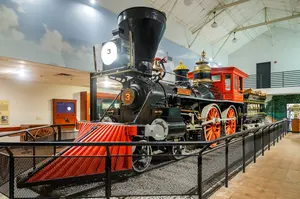
Washington, Baltimore and Annapolis Electric Railway
Published: January 24, 2025
By: Adam Burns
In the early 20th century, as America's urban centers expanded and the demand for efficient transportation grew, the concept of electrified interurban railroads gained momentum.
Among the most advanced and well-built was the Washington Baltimore & Annapolis Electric Railway (WB&A). It featured frequent service and significant suburban and through traffic. The system comprised two distinct parts that operated separately for many years.
This WB&A not only served as a vital connector between major cities but also stood as a testament to the industrial ambitions and technological advancements of its time.
The initial segment included the main line from Washington to Baltimore, a stretch of 38 miles, along with the electrified Annapolis, Baltimore & Washington Railroad.
The AB&W was a former standard steam road that intersected the main line at Naval Academy Junction, with services extending 14 miles eastward to Annapolis and 6 miles westward to Odenton and Fort George G. Meade. The other key portion, the Annapolis Short Line, directly linked Baltimore to Annapolis over 25 miles.
Alas, despite the WB&A's incredibly well-built system and strong patronage, rising costs and increased competition from improved highways caused the system's abandonment in 1935.
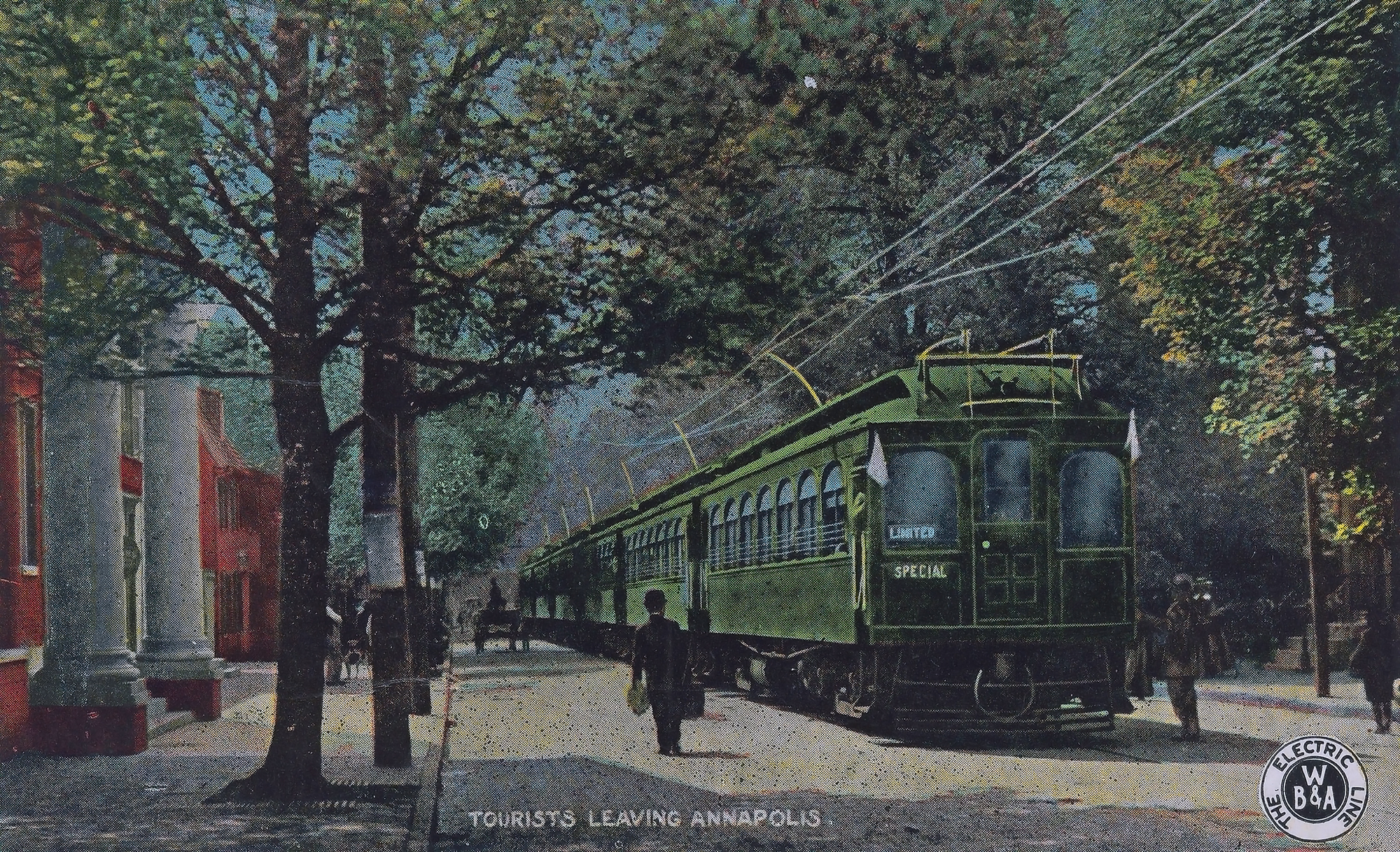
Origins and Rise of the WB&A
The inception of the WB&A traces back to the progressive spirit of the early 1900s, a period marked by rapid urbanization and technological innovation.
Plans for an electrified system linking Washington-Baltimore date back to 1899 as the Potomac & Severn Electric Railway. On April 10, 1900 it was renamed as the Washington & Annapolis Electric Railway and finally, on April 8, 1902 as the Washington, Baltimore & Annapolis Electric Railway.
Construction kicking off in 1902 under the Pomeroy-Christy group. One of several syndicates that funded interurban construction they were best known for lines built in the Midwest. However, financial hurdles led to receivership, transferring ownership to the Cleveland-based Strobel Syndicate, which completed the D.C.-Baltimore route.
Service commenced from Washington to Annapolis in February 1908, extending to Baltimore by April 3. Initially, the southern end terminated at 15th and H Streets with transfers available to streetcars.
Meanwhile, in Baltimore, a more central terminal was accessed with minimal street running operations. For trips to Annapolis, passengers could make connections at the Naval Academy Junction as the system did not make direct runs to the city. Built to high standards, the WB&A featured high-speed cars powered by 6,600-volt AC single-phase power.
This system had its flaws, however, and the heavy cars strained the Washington streetcar archways and catenary infrastructure which could not support them. Eventually, on February 15, 1910, the operation transitioned to 1,200-volt DC, allowing cars to run through to the Treasury via the Seat Pleasant car tracks.
The WB&A was designed to offer a faster, more efficient alternative to the disjointed, rough, and labor-heavy travel options available at the time, capitalizing on growing commuter needs spurred by urban sprawl.
The Annapolis Short Line, an old steam railroad, directly linked Baltimore to Annapolis. In 1907, Maryland Electric Railways, which managed Baltimore's transit system, acquired and electrified this line using AC power.
Trains operated via Baltimore & Ohio tracks, ending their journey at Camden Station. Annapolis, which didn't have a mainline railroad at the time, almost simultaneously gained two electrified systems. Though both companies operated independently for over a decade, the Short Line merged with WB&A in 1921, but both routes to Annapolis continued to operate separately.
Engineering Marvels and Technological Innovation
Notably acclaimed during its inception, the system was among the nation's finest, boasting annual revenues surpassing $2.5 million. The company's cars, especially the articulated ones introduced later, were top-tier, and the tracks were meticulously maintained.
The cars were manufactured by esteemed companies like the St. Louis Car Company. They featured modern amenities including plush seating, restrooms, and heating, providing a comfortable journey for passengers. Signal systems and telegraphic communications further underscored the WB&A’s commitment to reliability and safety.
The WB&A set a benchmark with its cutting-edge engineering and technology. Powered entirely by electricity at a time when steam locomotives dominated, the interurban epitomized modernity and the shift toward cleaner and more sustainable energy sources.
The WB&A's infrastructure was considered state-of-the-art, encompassing double tracks over most of its length, and promoted a high frequency of service and a competitive speed compared to other modes of transport.
Electrification of the lines allowed for smoother and quieter operation, minimizing the disruption typically associated with steam engines.
Economic and Social Impact
The WB&A's impact went beyond mere transportation; it played a crucial role in shaping the economic and social landscape of the region.
By offering rapid transit options, it enabled daily commutes that were previously impractical. The interurban effectively linked urban centers with suburbs and rural areas, catalyzing suburban developments in places that were once considered remote.
Commercially, the WB&A spurred economic growth by facilitating trade and the movement of goods. Industries along the railway line flourished, as businesses could rely on a consistent and speedy means to transport their products to larger markets.
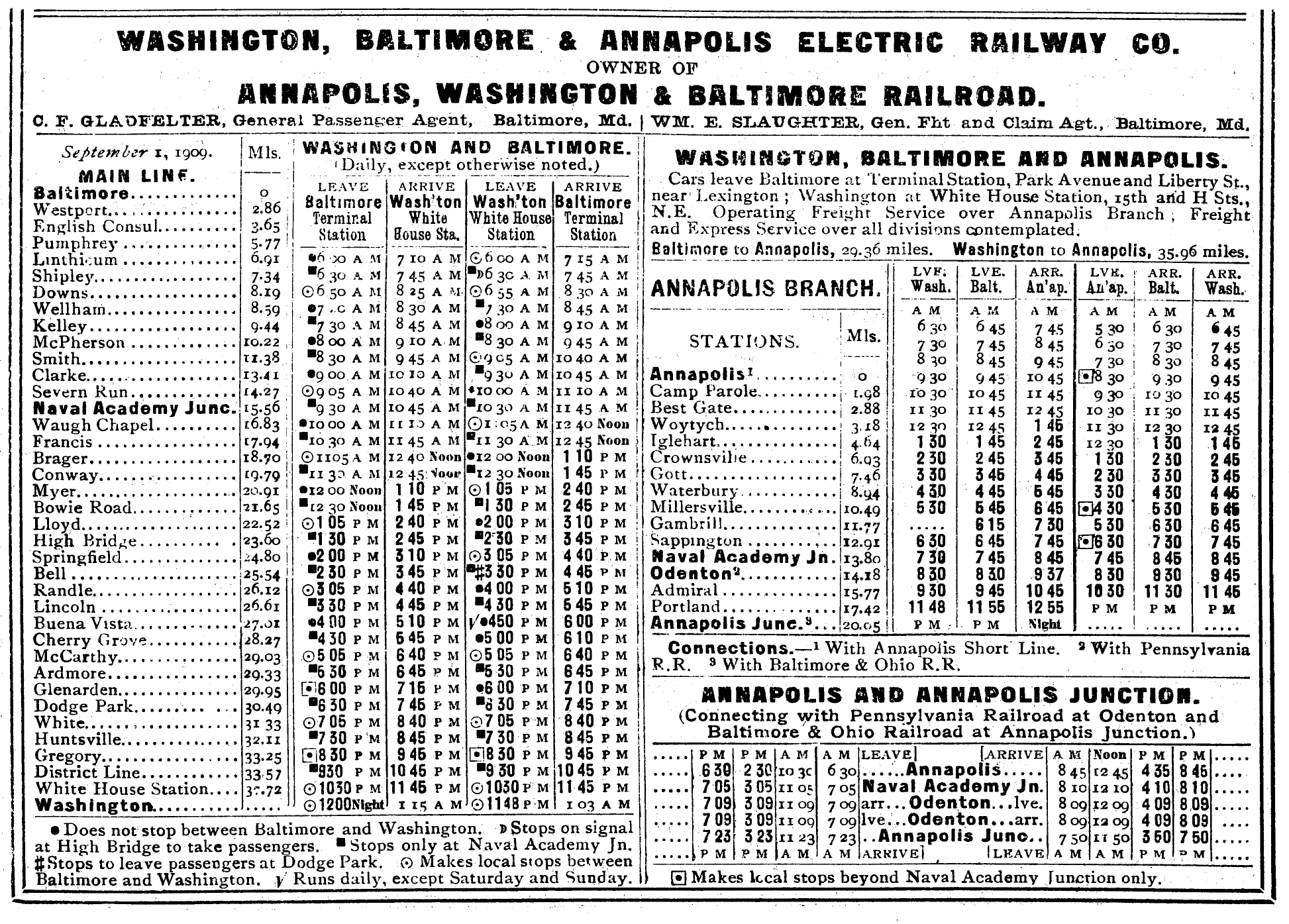
1910 Timetable
Challenges and Decline
Despite its successes, the WB&A faced significant challenges that would eventually lead to its decline. The rise of the automobile and improved highways in the 1920s posed stiff competition. Cars offered personalized and flexible travel that was hard for fixed-route railways to compete against.
The interurban was further hampered by the slow journey into downtown Washington, D.C., which remained a drawback. While the 1920s were generally considered prosperous the Great Depression severely impacted the line, forcing it into receivership in 1931.
Despite this, the WB&A invested heavily in upgrades, anticipating a secure future. Yet by 1934, losses mounted, leading to the surprising decision to cease operations on August 20, 1935, despite having nearly $1 million in gross revenue the previous year.
After the WB&A's downfall, the former Short Line reorganized as the Baltimore & Annapolis Railroad under the B&O's control. This line then became Annapolis's sole rail service.
Despite strong patronage, the B&A's condition worsened, culminating in the complete shift to bus service for passengers in 1950. Freight services continued under the B&O via diesel power.
Legacy and Preservation
Although the WB&A ceased operation, its legacy persists in several forms. The railway is remembered as an integral part of the early 20th-century transportation landscape, demonstrating the potential and limitations of electric interurbans. Its story is preserved through various historical societies and transportation museums dedicated to chronicling America's rail heritage.
In recent years, portions of the old WB&A right-of-way have been repurposed as hiking and biking trails, known as the WB&A Trail.
This provides a tangible connection to the past, allowing residents and visitors to traverse the paths once roaring with electric cars and take in the scenery that captivated passengers over a century ago.
Future transportation planning sometimes reflects on the lessons of the WB&A, as contemporary discussions around public transit revisit the environmental and logistical challenges addressed by earlier electric railways.
Planners and policymakers continue to draw inspiration from the WB&A in pursuit of sustainable and efficient transportation solutions that balance innovation with practical implementation.
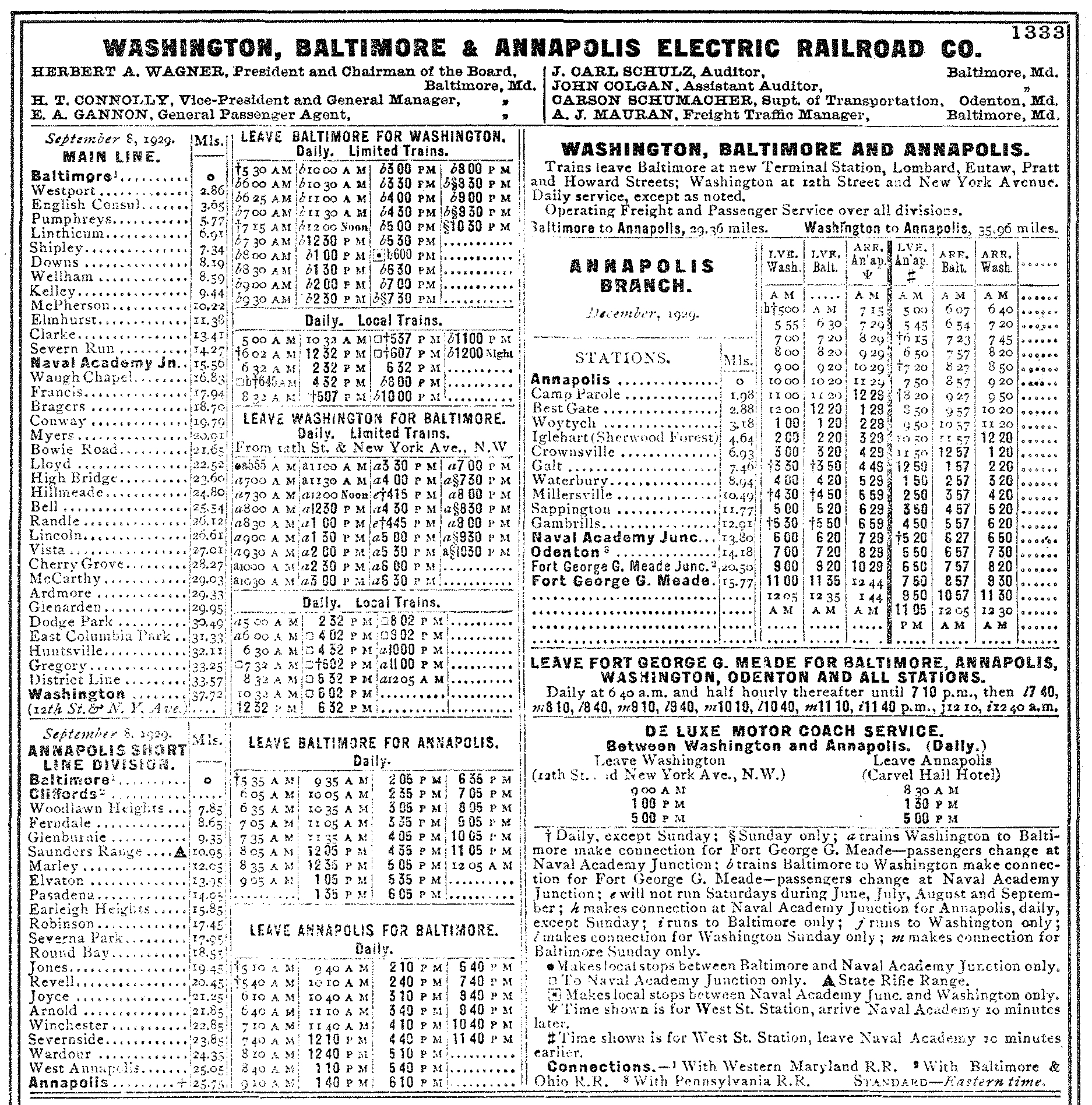
1930 Timetable
Overview
The Washington, Baltimore & Annapolis Electric was more than just a mode of transport; it was a vision realized through technological triumph and cultural change.
Despite its eventual decline, the WB&A exemplified a pioneering spirit and set a precedent in electric travel that influenced subsequent generations.
Today, its story serves as a reminder of the transformative power of innovative infrastructure in shaping societies, economies, and everyday lives.
Recent Articles


-
Louisville & Nashville Diesel Roster (All-Time)
Oct 12, 26 12:15 AM
 Louisville & Nashville diesel roster, all-time. Switchers from 1939, the cab units, and EMD, Alco, and GE hoods through the SD50s. The quantity column totals 1948 locomotives, plus 29 yard slugs.
 -
Louisville & Nashville Steam Roster (Post 1900)
Oct 11, 26 05:44 PM
 Louisville & Nashville steam since 1900. Drury's class grid: Consolidations, 165 heavy Mikados, 42 Big Emma 2-8-4s, Pacifics, and 22 Mountains. Last steam January 1957.
 -
Louisville and Nashville Railroad: Map, Rosters, History
Oct 11, 26 05:39 PM
 Louisville & Nashville, the Old Reliable. Charter of March 5, 1850, Milton H. Smith, the 921-mile main line, Big Emma, and the December 29, 1982 merger. Steam and diesel rosters are companion pages.
 -
Oregon Railroad Museums (2026): A Complete Guide
Oct 11, 26 05:19 PM
 Oregon railroad museums—the Oregon Rail Heritage Center, Brooks trolleys, Canby’s 1891 depot, Medford’s Willamette, and Train Mountain. Confirm hours on each site.
 -
Texas Railroad Museums (2026): A Complete Guide
Oct 11, 26 05:15 PM
 Texas railroad museums—Frisco’s Big Boy 4018, Galveston’s Santa Fe depot, Temple’s 1911 station, Plano’s interurban, and Fort Worth & Denver 304. Confirm hours on each site.
 -
Wisconsin Railroad Museums (2026): A Complete Guide
Oct 10, 26 11:51 PM
Wisconsin railroad museums—Green Bay’s Big Boy 4017 and Eisenhower’s A4, Mid-Continent at North Freedom, East Troy’s interurban, and the Riverside & Great Northern. Confirm hours on each site. -
Interstate Railroad (Virginia): Map, Roster, Logo, History
Oct 10, 26 11:22 PM
 Interstate Railroad, a Virginia coal road chartered February 18, 1896. Andover shops. Ten Alco RS3s, 30–39. Southern control in 1961. The company ended October 31, 1985.
 -
North Carolina Railroad Museums (2026): A Complete Guide
Oct 10, 26 11:16 PM
 North Carolina railroad museums—Spencer Shops, Wilmington’s Atlantic Coast Line 250, Hamlet’s Seaboard depot, and the New Hope Valley Railway. Confirm hours on each site.
 -
New Mexico Railroad Museums (2026): A Complete Guide
Oct 10, 26 10:54 PM
 New Mexico railroad museums—Santa Fe 2926 in Albuquerque, the Clovis depot, Alamogordo’s Toy Train Depot, and Belen. Confirm hours on each site.
 -
New York Railroad Museums (2026): A Complete Guide
Oct 10, 26 09:33 PM
 New York railroad museums—Phoenicia, Medina’s New York Central freight house, the Transit Museum, Long Island 35 and 39, and GG1 4933. Confirm hours on each site.
 -
Columbia, Newberry & Laurens Railroad: History, Timetable, Roster
Oct 10, 26 09:08 PM
 Columbia, Newberry & Laurens Railroad, Columbia to Laurens, 75 miles. Chartered in 1885. Five Atlantic Coast Line GP7s, 100–104. Merged into the Seaboard System on April 30, 1984.
 -
New Haven Diesel Roster (All-Time)
Oct 10, 26 06:35 PM
 New Haven diesel roster, all-time. 558 road numbers: 60 DL-109s, 30 FA-1s, 27 PA-1s, 60 FL9s, and the switchers from HH600 0900. Serials and order numbers.
 -
New Haven Steam Roster (Post 1900)
Oct 10, 26 06:31 PM
 New Haven steam since 1900. Drury's class grid: 226 Moguls, 33 Mikados, 50 Santa Fes, 70 Mountains, 141 Pacifics, and 10 Hudsons. Last fan trip July 19, 1953.
 -
New Haven Railroad: Rosters, Map, Logo, History, Trains
Oct 10, 26 06:26 PM
 New York, New Haven and Hartford. The Shore Line, Hell Gate, the 1952 map at 1,838.89 miles, and the railroad Penn Central took at 11:59:59 p.m. on December 31, 1968.
 -
C&O's 4-6-4 "Hudson" Locomotives (Class L): Specs, Roster, History
Oct 10, 26 05:36 PM
 Chesapeake & Ohio Class L 4-6-4 Hudsons. Eight L-2s, five L-1 rebuilds, five L-2-As. Specs, Baldwin works numbers, and the roster. No. 490 survives.
 -
Alton Railroad: Map, History, Timetables
Oct 09, 26 10:31 PM
 Alton Railroad, chartered February 27, 1847 as the Alton & Sangamon. Chicago, St. Louis, and Kansas City, the 1937 Official Guide, and the May 31, 1947 merger into the Gulf, Mobile & Ohio.
 -
Mobile & Ohio Steam Roster (Post 1900)
Oct 09, 26 12:26 PM
 Mobile & Ohio steam since 1900. Drury's class grid: 48 six-wheel switchers, 107 Ten-Wheelers, 15 Consolidations, 58 Mikados, and 14 Pacifics. Last revenue steam October 7, 1949.
 -
Mobile & Ohio Railroad: History, Map, Timetable
Oct 09, 26 11:31 AM
 Mobile & Ohio Railroad, chartered in 1848. Columbus on April 22, 1861, the Cairo & St. Louis, the March 1940 Official Guide, and the September 13, 1940 merger into the Gulf, Mobile & Ohio.
 -
Gulf, Mobile & Northern Steam Roster (Post 1900)
Oct 09, 26 10:42 AM
 Gulf, Mobile & Northern steam since 1900. Drury's class grid: Ten-Wheelers, Mikados, Russian Decapods, Pacifics 425 and 426, and three light 4-8-2s. Last revenue steam October 7, 1949.
 -
Gulf, Mobile & Ohio Diesel Roster (All-Time)
Oct 09, 26 10:41 AM
 Gulf, Mobile & Ohio diesel roster, all-time. The 1935 boxcab, DL-107s, 55 FA-1s, F3s and F7s, the Ingalls 4-S, GP30s through GP38-2s, and 21 SD40s. Serials and order numbers.
 -
Gulf, Mobile & Northern Railroad: History, Rebel Route
Oct 09, 26 10:36 AM
 Gulf, Mobile & Northern, from the 1890 Mobile, Jackson & Kansas City to the Rebel and the September 13, 1940 merger into the Gulf, Mobile & Ohio. Steam roster is the companion page.
 -
Gulf, Mobile & Ohio Railroad: Map, Photos, Trains, History
Oct 08, 26 11:48 PM
 Gulf, Mobile & Ohio, chartered in 1938 and merged September 13, 1940. The Mobile & Ohio, the Alton on May 31, 1947, the Rebel Route, and Illinois Central Gulf on August 10, 1972.
 -
New Jersey Railroad Museums (2026): A Complete Guide
Oct 08, 26 11:37 PM
 New Jersey railroad museums—Whippany, Maywood, Pine Creek, Mahwah’s Erie depot, Phillipsburg, and Boonton. Confirm hours on each site.
 -
New Hampshire Railroad Museums (2026): A Complete Guide
Oct 08, 26 11:34 PM
 New Hampshire railroad museums—North Conway, the Flying Yankee, Ashland, Gorham, Raymond, and Sandown. Confirm hours on each site.
 -
Missouri Railroad Museums (2026): A Complete Guide
Oct 08, 26 11:00 PM
 Missouri railroad museums—the National Museum of Transportation, Patee House, Frisco 4524, the Chicago & Alton depot, and Marceline. Confirm hours on each site.
 -
Milwaukee Road X3800: Deer Lodge’s Shop Goat
Oct 08, 26 04:28 PM
 Milwaukee Road X3800, the a home-built shop goat that served the Deer Lodge, MT yard. It was a 220-volt DC switcher, powered through an extension cord that moved electrics into a roundhouse where the…
 -
Key West Extension (Overseas Railroad): History, Construction, Decline
Oct 08, 26 03:59 PM
 Henry Flagler's Overseas Railroad, Miami to Key West, 1905–1935. The Seven Mile Bridge, the 1935 Labor Day Hurricane, and the road that became U.S. 1.
 -
Florida East Coast Steam Roster (Post 1900)
Oct 08, 26 02:34 PM
 Florida East Coast steam since 1897. Seventeen Ten-Wheelers, twenty Atlantics, eighty-seven Pacifics, ninety Mountains, fifteen Mikados, and the switchers.
 -
Florida East Coast Diesel Roster (All-Time)
Oct 08, 26 02:12 PM
 Florida East Coast diesel roster, all-time. E units from 1939, F3s, BL2s, GP7s and GP9s, the GP40-2 orders, 22 SD40-2s, and 24 ES44C4s. Serials and EMD order numbers.
 -
Florida East Coast Railway: Map, History, Rosters
Oct 08, 26 01:46 PM
 Florida East Coast Railway, Henry Flagler's line from Jacksonville to Miami and Key West. Receivership in 1931, the 1963 strike, Grupo México in 2017, and Brightline on the same track.
 -
Minnesota Railroad Museums (2026): A Complete Guide
Oct 08, 26 10:32 AM
Minnesota railroad museums—the Lake Superior Railroad Museum, Two Harbors, Jackson Street, Willmar’s Great Northern 2523, and Currie. Confirm hours on each site. -
Maine Railroad Museums (2026): A Complete Guide
Oct 08, 26 09:24 AM
 Maine railroad museums—Seashore Trolley, the two-foot lines at Portland, Alna, and Phillips, Boothbay, and the Bangor & Aroostook depots. Confirm hours on each site.
 -
Massachusetts Railroad Museums (2026): A Complete Guide
Oct 08, 26 12:08 AM
 Massachusetts railroad museums—Berkshire Scenic at Lenox, Shelburne Falls trolley No. 10, Edaville, Chatham’s 1887 depot, and Lowell. Confirm hours on each site.
 -
Clinchfield Steam Roster (Post 1900)
Oct 07, 26 12:09 PM
 Clinchfield steam since 1900. Fifteen H-4 Consolidations, K-1 Mikados, M-2 and M-3 Mallets, L-class 2-8-8-2s, eighteen Challengers. Class grid after Drury. Last steam April 16, 1954.
 -
Clinchfield Diesel Roster (All-Time)
Oct 07, 26 12:05 PM
 Clinchfield diesel roster, all-time. F3A 800, FP7 200, the F7s, GP7s, 25 SD40s, 18 SD45-2s, seven U36Cs, and the Family Lines hoods. Serials and EMD order numbers.
 -
Clinchfield Railroad: Map, Steam Locomotives, Roster, Logo
Oct 07, 26 12:02 PM
 Clinchfield Railroad, Elkhorn City to Spartanburg. George L. Carter, the Carolina, Clinchfield & Ohio, the 1924 lease, coal, the loops, and CSX. Steam and diesel rosters are companion pages.
 -
Kentucky Railroad Museums (2026): A Complete Guide
Oct 07, 26 11:39 AM
 Kentucky railroad museums—the Kentucky Railway Museum, Bowling Green’s L&N depot, Paducah, Versailles, and Covington. Confirm hours on each site.
 -
Kansas Railroad Museums (2026): A Complete Guide
Oct 07, 26 11:26 AM
 Kansas railroad museums—Santa Fe 3768 at Wichita, Santa Fe 132 in Topeka, the Great Overland Station, and Abilene. Confirm hours on each site.
 -
Cincinnati, New Orleans and Texas Pacific Diesel Roster (All-Time)
Oct 07, 26 10:38 AM
 All-time diesel roster of Southern locomotives lettered for the Cincinnati, New Orleans and Texas Pacific. Serials, order numbers, and builder dates.
 -
Cincinnati, New Orleans and Texas Pacific Railway
Oct 07, 26 10:31 AM
 Cincinnati, New Orleans and Texas Pacific Railway, incorporated September 8, 1881, to lease Cincinnati’s railroad to Chattanooga. Queen and Crescent route, Rathole, and the 2024 sale to Norfolk Southe…
 -
Indiana Railroad Museums (2026): A Complete Guide
Oct 07, 26 12:26 AM
Indiana railroad museums—Nickel Plate 765, Elkhart’s New York Central collection, French Lick, Linden’s junction depot, and Haley Tower. Confirm hours on each site. -
"Triplex" Steam Locomotive: Specs, History, Photos
Oct 06, 26 11:52 PM
 Erie class P-1 Triplex 2-8-8-8-2s. Three Baldwin compounds, 2603–2605, later 5014–5016, built 1914 and 1916. Matt H. Shay, the 1930 class card, and Virginian XA 700.
 -
Illinois Railroad Museums (2026): A Complete Guide
Oct 06, 26 11:47 PM
 Illinois railroad museums—the Illinois Railway Museum, Monticello, the Pioneer Zephyr, Galesburg’s Burlington 3006, and the depots. Confirm hours on each site.
 -
Iowa Railroad Museums (2026): A Complete Guide
Oct 06, 26 11:41 PM
 Iowa railroad museums—the Union Pacific Railroad Museum, RailsWest, Sioux City, Boone, and the National Hobo Museum in Britt. Confirm hours on each site.
 -
Charleston and Western Carolina Diesel Roster (All-Time)
Oct 06, 26 11:29 PM
Charleston and Western Carolina diesel roster. Twenty-one GP7s, two SW7s, two SW9s, and six F7As, all built 1950–1952. Serials, order numbers, and ACL and SCL numbers. -
Charleston and Western Carolina Railway: Map, History, Timetables
Oct 06, 26 11:18 PM
 Charleston and Western Carolina Railway, incorporated September 16, 1896. Port Royal to Spartanburg, with branches to Anderson and Greenville. Merged into the Atlantic Coast Line on December 31, 1959.
 -
Central of Georgia Steam Roster (Post 1900)
Oct 06, 26 04:00 PM
 Central of Georgia steam since 1900. Cooke Consolidations, Harriman Mikados, 32 Mountains, and eight Lima 4-8-4s. Class grid after Drury. Last steam May 1953.
 -
Central of Georgia Diesel Roster (All-Time)
Oct 06, 26 03:44 PM
 Central of Georgia diesel roster. SW1 No. 1 in 1939, E7s and E8s, nine F3As, 39 RS3s, GP7s through SD35s. Serials and order numbers.
 -
Central of Georgia Railway: Map, Logo, History, Rosters
Oct 06, 26 03:42 PM
 Central of Georgia Railway, from the 1833 Savannah charter to Southern control on June 17, 1963. Map, logos, Nancy Hanks II, and links to the steam and diesel rosters.
 -
Georgia Railroad Museums (2026): A Complete Guide
Oct 06, 26 03:33 PM
Georgia railroad museums—Savannah’s Central shops, Duluth, the General at Kennesaw, the Texas in Atlanta, Tifton, Waycross, and Albany. Confirm hours on each site.