Maine Central Diesel Roster: All-Time
Last revised: September 22, 2026
By: Adam Burns
Maine Central dieselization was a late, tidy job. A diesel railcar and a joint streamliner arrived in 1935. Two Alco high-hood switchers came in 1939. The railroad did not begin buying road freight diesels in earnest until the F3s of 1947, and steam did not leave until Pacific 470’s excursion on June 13, 1954. What followed was a small roster that fit the Pine Tree Route: maroon-and-gold Geeps and Alcos while the Boston & Maine years lasted, forest green and gold after 1953, and thirteen yellow GP38s in 1966 that finally retired the covered wagons. The last new locomotives the company bought for itself were ten GE U18Bs in 1975, named for the Revolution.
The tables are the diesel-electrics the Maine Central owned or numbered through the June 1981 sale to Guilford, one row per builder order, with serial and order in their own columns. Gasoline switchers are in the narrative. Locomotives Guilford and Pan Am later assigned, and stenciled MEC, belong to that later fleet.
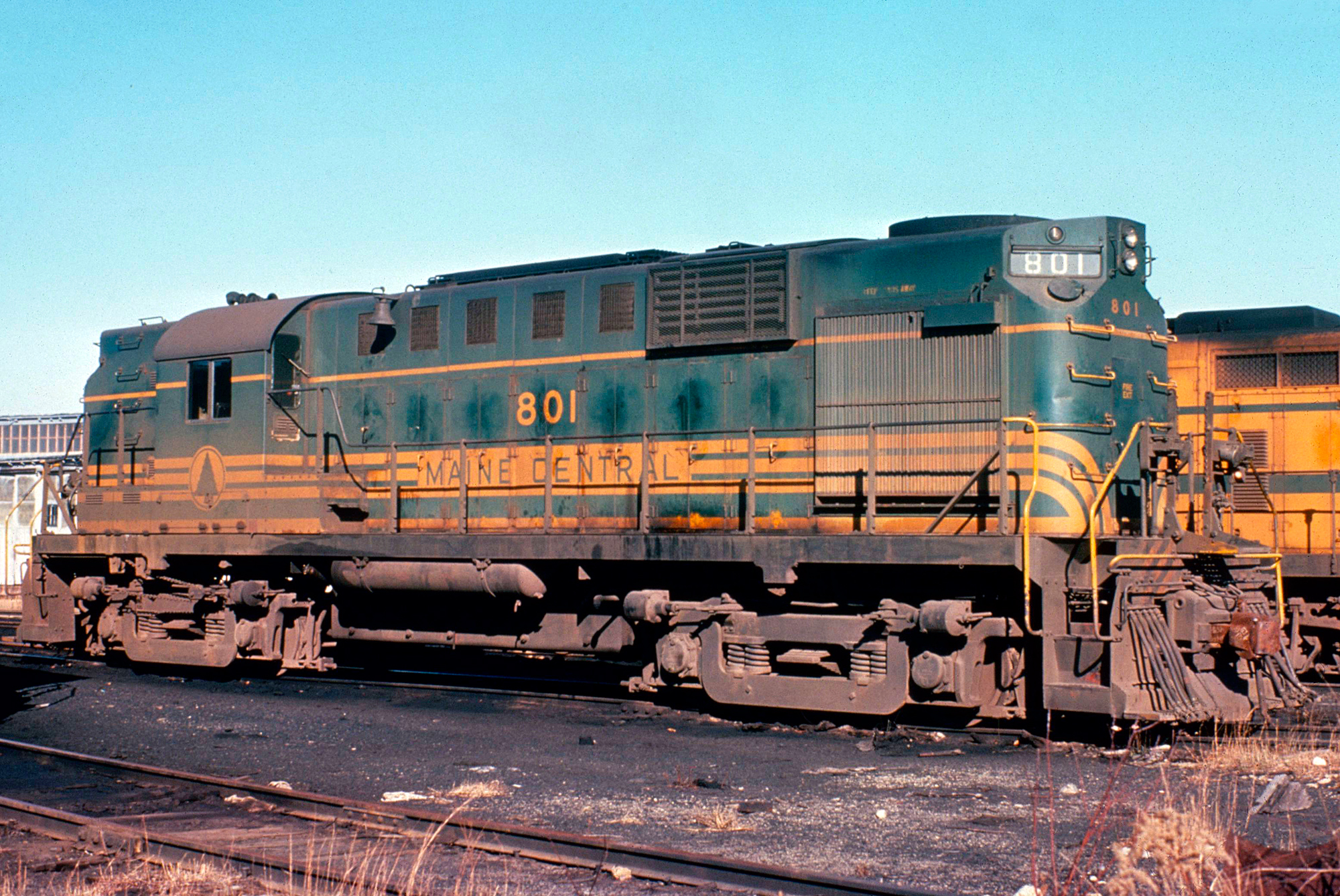
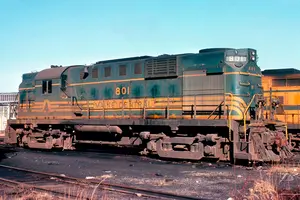
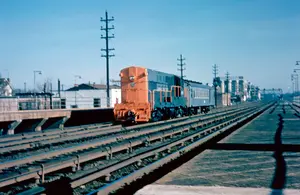
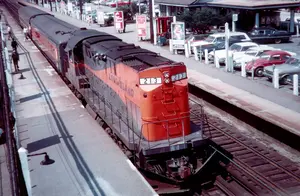
RS-11 #801 at Rigby Yard, South Portland, in the early 1970s. American-Rails.com collection. Alco 81616, June 1956, class DRS-1f. One of two, bought after steam was gone because the first diesel fleet was not quite enough. The 801 was painted yellow in 1977.
On this page: At a glance · Before the road diesels · Paint · Switchers · E7s and F3s · Road switchers · All-time roster
At a glance
| Item | Detail |
|---|---|
| Railroad | Maine Central. Mark MEC |
| This page | Diesel-electrics acquired by the Maine Central through the June 1981 sale |
| First diesel-electric | Ingersoll-Rand railcar 901, in 1935. Demonstrator OE-600 of 1933 |
| Joint streamliner | Flying Yankee, 1935, with the Boston & Maine. Carried as Boston & Maine 6000 |
| First road freight | F3s 671 and 672, December 1947, with steam generators |
| Last steam | June 13, 1954. Pacific 470 |
| Last new power | U18Bs 400–409, May and June 1975. Class name Independence |
| Paint | Black switchers; maroon and gold with the Boston & Maine; forest green and gold from 1953; yellow with green lettering from the 1966 GP38s |
| Steam roster | Post-1900 steam roster |
Before the road diesels
The first internal-combustion experiments were not diesel-electrics. J. G. Brill built a 68-horsepower Model 55 gasoline baggage-mail car, number 700, in 1922. It was scrapped in 1930. Whitcomb 1, works number 12981, was built in 1929, acquired in 1932, and sold to National Fireworks in 1941. Plymouth 2, works number 3957, was built in 1938 and sold to New England Shipbuilding in 1942. Both were gasoline switchers, tried during the Depression and gone by the middle of the war.
The first machine the railroad owned that was a diesel-electric was an Ingersoll-Rand 600-horsepower railcar, built as demonstrator OE-600 in 1933 and numbered Maine Central 901 in 1935. The rear of the car was a railway post office and a baggage compartment. It pulled a coach or two on the Eastern Division, Bangor to Vanceboro, until 1947, then spent two years on the Rumford branch passenger train. In 1949 it was stripped of its machinery and became maintenance-of-way tool car 950.
The same year, 1935, the Maine Central and the Boston & Maine jointly bought the Budd Flying Yankee, a shovel-nose near-sister of Burlington Zephyr 9900. It ran Boston–Bangor as Boston & Maine 6000. Its later life, including the last run on May 7, 1957, is the train’s own page.
Portland Terminal, the 1911 switching company, had Alco high-hood switchers in Portland before the Maine Central bought any. After watching them, the Maine Central took HH660s 951 and 952 in September 1939. They lacked multiple-unit control and lasted until 1967 and 1968.
Paint
Yard switchers through the war were black with white lettering. Road engines built while the 1933 joint-management agreement was in force wore the Boston & Maine’s maroon and gold, the scheme first applied to Boston & Maine FTs. Only the lettering and the herald changed. After the Boston & Maine bought an Alco RS-2 demonstrator in May 1948 in a red-nosed switcher scheme, Maine Central black Alcos and the 44-tonners picked up the same horizontal nose stripes.
Separate Portland headquarters returned in 1953, and the road-engine scheme kept the gold stripes on a forest-green ground. Only a handful of units were delivered that way: RS-3s 556 and 557, RS-11s 801 and 802, SW9 335, and GP7s 566–569. Most of the E7s and F3s, and many of the earlier Geeps, were repainted into it. The S-4s of 1954 came in a simpler green with yellow letters and fewer stripes. RS-11s 801 and 802 went to yellow in 1977 and 1981. Many Alco switcher noses were painted yellow while the cab and hood stayed black.
The GP38s of 1966 introduced the safety-yellow scheme, yellow with green lettering, that the U18Bs and the secondhand road switchers also wore. Most GP7s were repainted yellow beginning in 1972. GP7 572 was put back into the original maroon and gold in December 1978. GP7 580 was the last Geep still in its as-delivered maroon in 1980.
Switchers
Seven GE 44-tonners, class DS-1, worked Augusta, Brunswick, Livermore Falls, Vanceboro, Eastport, and the disconnected upper and lower yards at Lewiston between 1941 and 1947. Brunswick was too much railroad for one. Everywhere else they let the company drop the fireman and the 0-6-0 hostler. They would sit in an unheated enginehouse in January without freezing, which an Alco switcher of the same era would not, so the 660-horsepower Alcos covered for them in summer and the 44-tonners kept the winter assignments. Number 11 was the only one of the seven painted green. Number 15 went to the Conway Scenic Railroad. Number 16 went to the Aroostook Valley as its 14 and lasted until 1985. Eastport’s light rail kept a 44-tonner until service there ended in 1978.
Eight S-1s and two S-3s, class DS-3, and three S-2s, class DS-4b, handled the heavier yards and replaced Ten-Wheelers on the Harmony branch. The S-2s also worked Bangor, Waterville, Rockland, and Rumford, the same job Portland Terminal’s S-2s were doing at Rigby. Seven S-4s, class DS-4d, were the branch-line version, equipped to multiple. Number 311, serial 78008, August 1950, was the first S-4 Alco built. It was sold to the chemical plant at Orrington. The EMD switchers, three SW7s and two SW9s, class DS-5, worked as helpers and local freight engines on the Mountain Division until 1958, then as Portland locals, and from 1966 as the Bucksport branch engines out of Bangor.
Five S-1s and S-3 961 were traded to GE against the U18Bs in 1975. S-1s 957, 958, and 960, and S-3 962, were still on the property into the Guilford sale.
E7s and F3s
Seven E7s, class DP, were bought in 1946 and 1948 to pool with Boston & Maine E7s on passenger trains south and north of Portland. The first four, 705–708, were a cancelled Rock Island order. They ran for a few months in Rock Island paint with Maine Central lettering, then went into maroon and gold. When the last passenger train ran on September 5, 1960, E7s 710 and 711 were scrapped. The other five kept mail and express on the old Gull schedule. Number 709 went to the Kansas City Southern in September 1962. Numbers 705–708 followed in October 1963, as KCS 6, 7, 11, and 12.

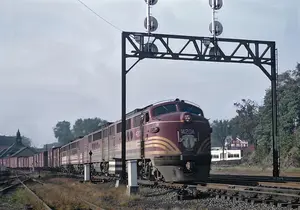
F3A #681 at St. Johnsbury, Vermont, in August 1964. Richard Wallin photo. Order E917A, serial 5695, November 1948, class DF-4. The 681–686 set had the later grilles and were sometimes called F5s (this was railfan nomenclature only, as EMD never cataloged a standalone F5 model). All but wrecked 686 were traded for GP38s in 1966.
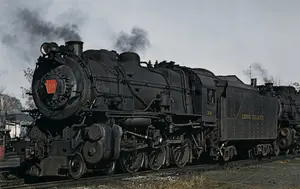
Eight F3As and two F3Bs were the first diesel freight locomotives, delivered in 1947 and 1948 for the main line and the Mountain Division. Class DF-3, the 671 and 672 sets, had the early “chicken wire” grilles and steam generators, in case they were needed on passenger trains. Class DF-4, 681–686, had the later F7-style grilles. Number 686 was wrecked and scrapped in November 1965. The other nine F3s, with three RS-2s, went back to EMD in 1966 against GP38s 251–262.
Road switchers
Five maroon-and-gold RS-2s, 551–555, arrived in 1949 and were based at Bangor for the Eastern Division. Three of them, 551, 552, and 555, were in the 1966 GP38 trade. Number 553 went to the Providence & Worcester in 1975 as 1501. Number 554 was repainted with a yellow cab and green hoods and was scrapped in 1977. Two RS-3s, 556 and 557, came in November 1953 in green and gold, with steam generators. Both were gone in April 1975, 556 to scrap and 557 to the Wolfeboro Railroad as 101. Rock Island RS-3 469 was bought in November 1965, relettered and not repainted, and traded for GP38 263. The two RS-11s of 1956, 801 and 802, were the last new Alco road switchers. Number 802 had been Portland Terminal 1082 for a few months. They were bought because the first diesel fleet, once steam was gone, did not cover the shop time.
The GP7s split by assignment. Class DRS-3a, 561–569, had dynamic brakes for freight. Class DRS-3b, 571–580, had steam generators and no dynamic brake, and the first of them were passenger and milk engines as well as freight. Class DRS-3d was a single unit, 581, former Portland Terminal 1081, acquired in March 1957 after the Terminal had used it as a mileage equalizer on Boston commuter trains. Steam generators came off most of the Geeps once the timetable trains ended. Numbers 571–574 kept them and, through the 1960s, hauled extra trains of New Haven coaches full of children bound for Maine camps. Number 573 was the last steam-generator Geep on the roster. Four secondhand L&N GP7s, 590–593, arrived in December 1978 and were given chopped noses.
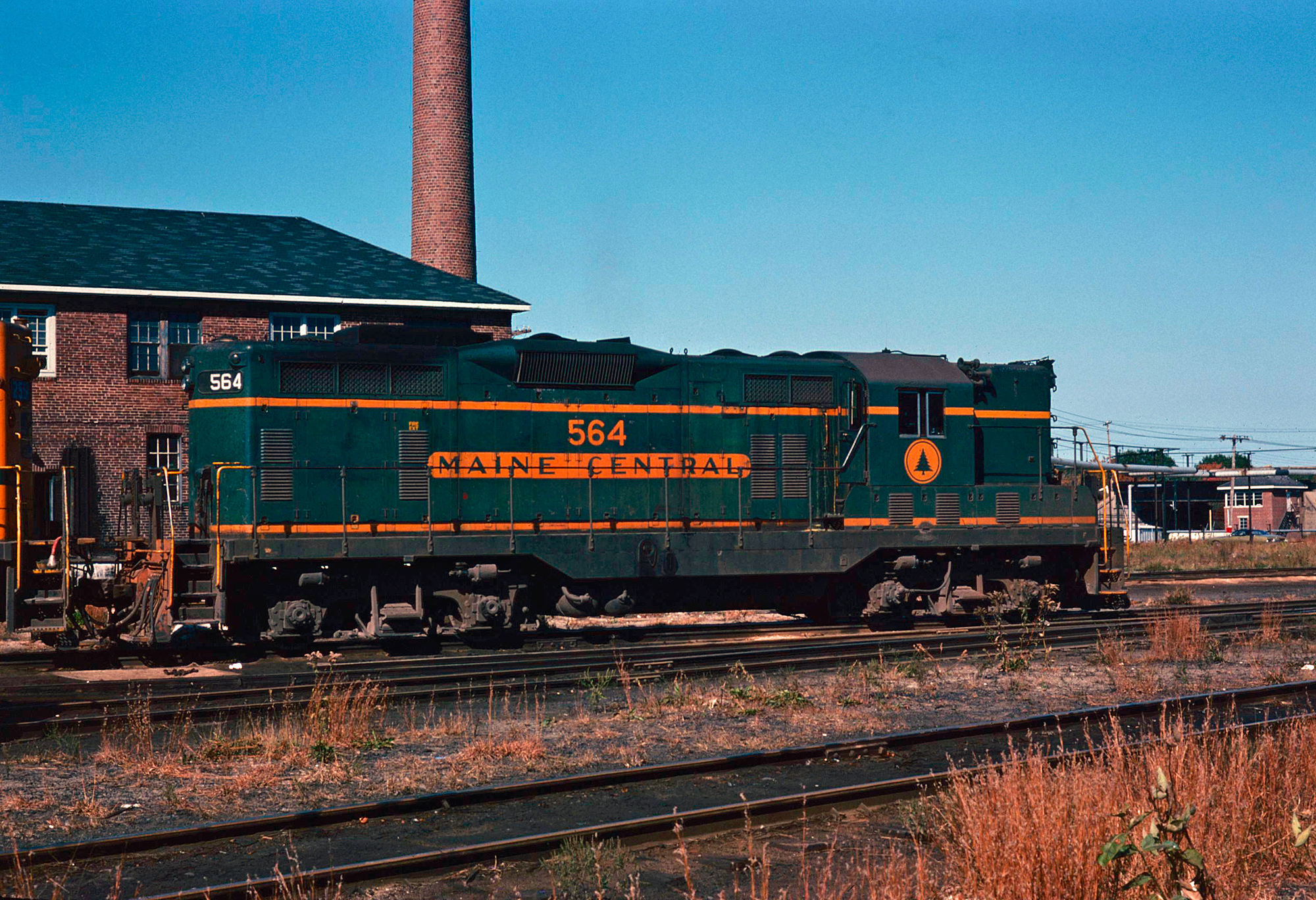
GP7 #564 at South Portland on October 8, 1975. American-Rails.com collection. Order 6147, serial 12365, October 1950, class DRS-3a, one of the dynamic-brake freight Geeps. Guilford renumbered it 470 in December 1982.
Thirteen GP38s, class DRS-4, replaced the cab units. Numbers 251–262 came in November and December 1966. Number 263 followed in 1967 on the Rock Island RS-3 trade. They were yellow with green lettering, and they took over the main line and the Mountain Division. The GP7s moved east, onto the old Alco territory between Bangor and Vanceboro.
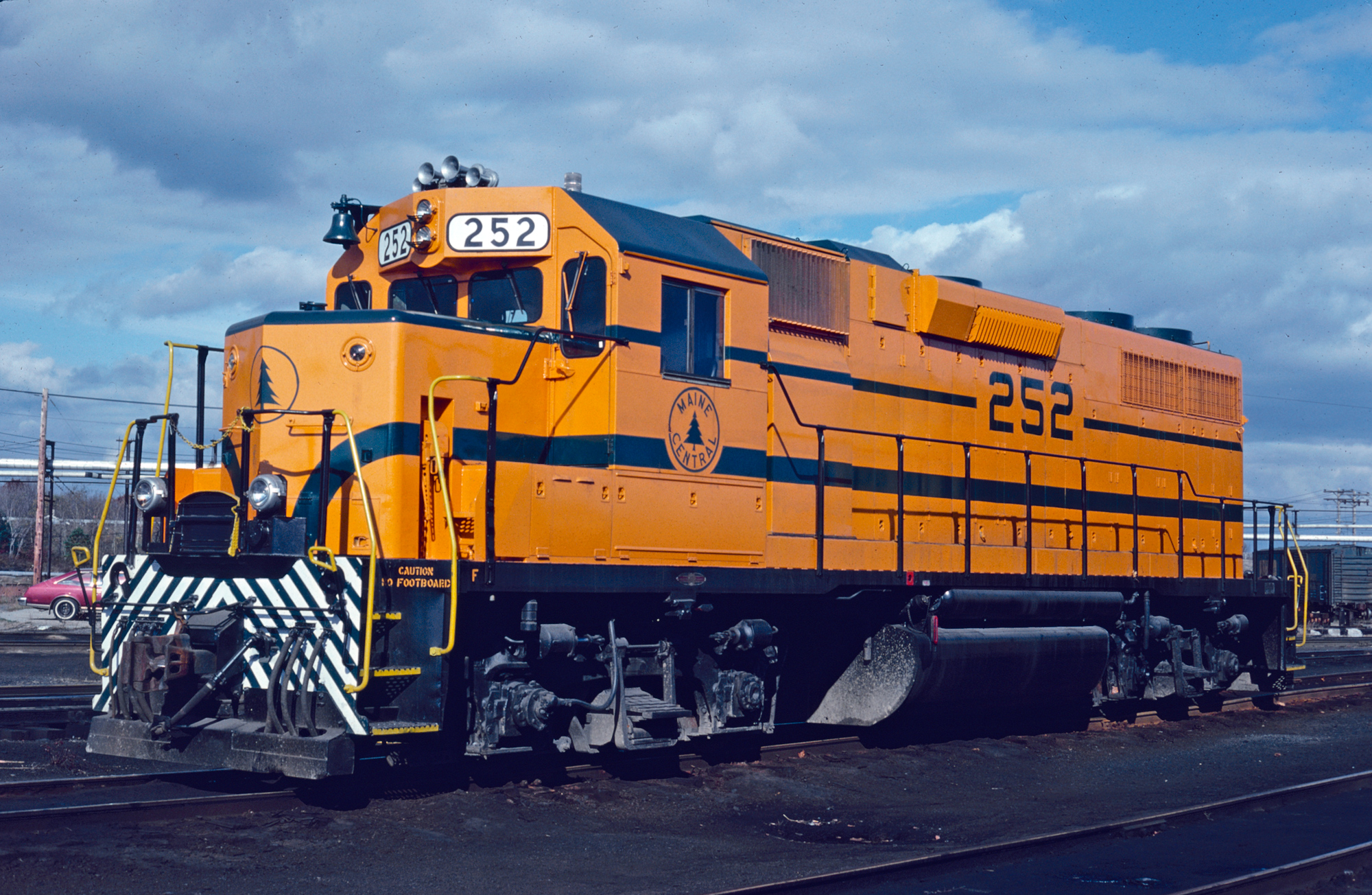
GP38 #252 at South Portland on October 26, 1979. Phil Faudi photo. American-Rails.com collection. Order 7946, serial 32661, November 1966. The yellow-and-green scheme these units introduced in 1966 was the last Maine Central road paint before Guilford gray.
The U18Bs, 400–409, were delivered in May and June 1975 and named, as a class, Independence. Each unit carried a Revolutionary name: Henry Knox, Hannah Weston, John Stark, Peleg Wadsworth, Kenneth Roberts, Arundel, Colonel John Allen, Unity, Bagaduce, and Ethan Allen. The Maine Central was one of two American railroads that bought the model. They were traded against Alco switchers, they were light for a road unit, and they had a reputation for being hard to keep assigned. They did let the remaining GP7s replace Alco switchers in the yards.
After the Bicentennial the railroad bought used power instead of new. Fourteen Rock Island U25Bs, 225–238, same numbers, came in June 1980. Nine were put in service. Five, 227, 233, and 235–237, were kept for parts. In June 1981, the month of the Guilford sale, the company bought GMD GP9 450, former Algoma Central 171, works number A2018, August 1963, the last GP9 built. It carried a later main generator and later traction motors than a 1950s Geep, because GMD finished it so late.
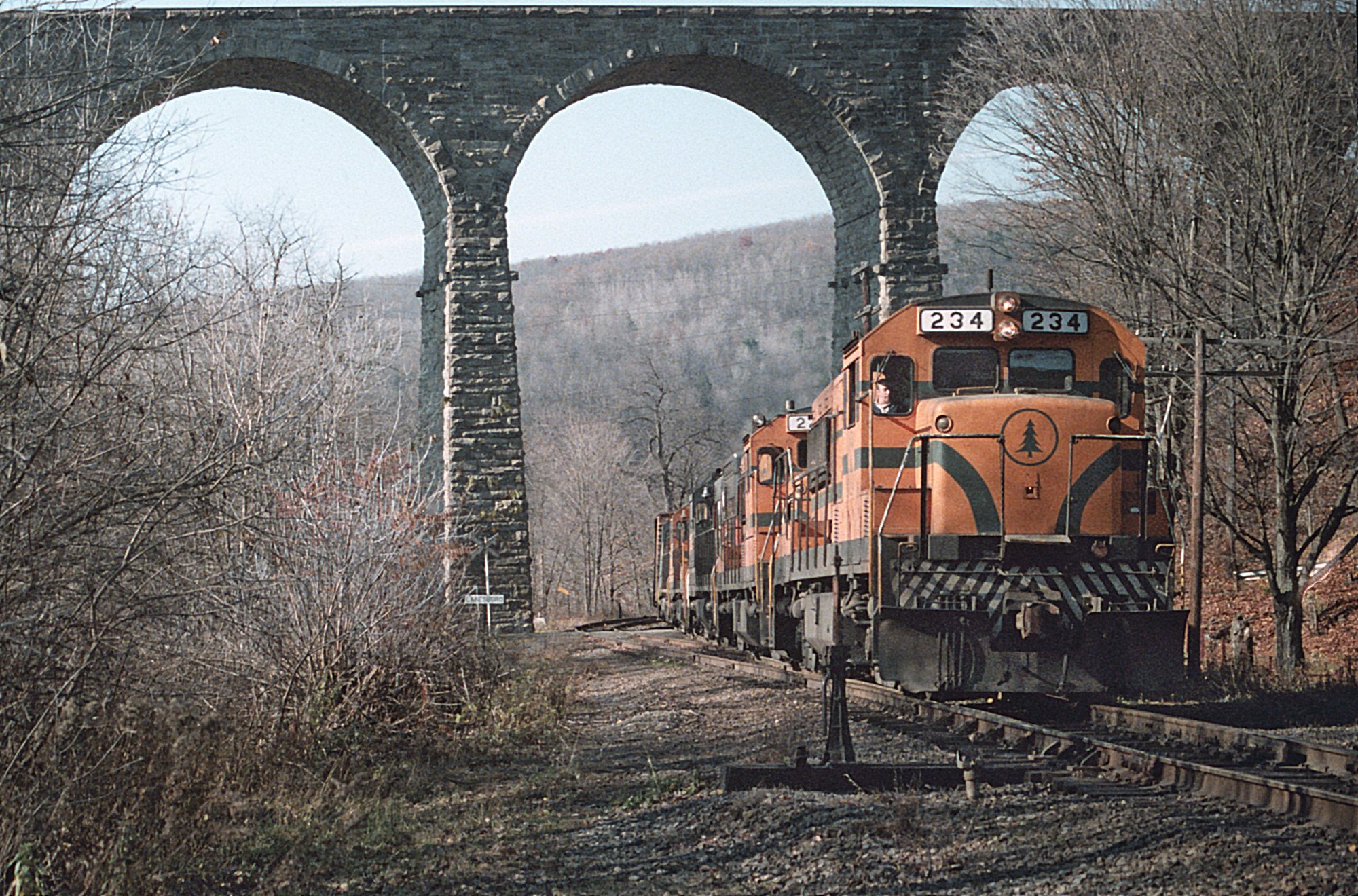
U25B #234, former Rock Island 234, on the Delaware & Hudson’s Penn Division under Starrucca Viaduct at Lanesboro, Pennsylvania, in November 1985. Karl Miller photo. Serial 35710, built September 1965, bought by the Maine Central in June 1980. By the time of this photograph the unit was Guilford power still carrying a Maine Central number.
All-time roster
Owned and lettered Maine Central diesel-electrics through June 1981, including secondhand units that took MEC numbers. One row per builder order. Later Guilford renumbers are in the notes. Where the builder list used here does not give a separate order code, that column is a dash. EMD orders are from the trainweb order list. Alco and GE works numbers are the serials.
Railcar
| Numbers | Model | Class | Builder | Serial | Order | Built | Notes |
|---|---|---|---|---|---|---|---|
| 901 | OE-600 railcar | — | Ingersoll-Rand | — | — | 1933 | Demonstrator OE-600. Maine Central 901 in 1935. Bangor–Vanceboro, then the Rumford branch. Machinery removed in 1949; became tool car 950 |
Yard and branch switchers
| Numbers | Model | Class | Builder | Serial | Order | Built | Notes |
|---|---|---|---|---|---|---|---|
| 11 | 44-ton | DS-1 | GE | 13095 | — | 9/1941 | Only 44-tonner painted green. Sold 3/1974 |
| 12 | 44-ton | DS-1 | GE | 15037 | — | 8/1942 | Sold 9/1975 |
| 13–15 | 44-ton | DS-1 | GE | 27973–27975 | — | 5/1945 | 15 sold 12/1974 as Conway Scenic 15 |
| 16 | 44-ton | DS-1 | GE | 28488 | — | 5/1946 | Sold as Aroostook Valley 14. Off the roster in 1985 |
| 17 | 44-ton | DS-1 | GE | 28348 | — | 6/1947 | Sold 4/1974 |
| 951, 952 | HH660 | DS-2 | Alco | 69087, 69088 | — | 9/1939 | No MU. Scrapped 3/1967 and 2/1968 |
| 953 | S-1 | DS-3 | Alco | 69411 | — | 1/1941 | Traded for a U18B, 1975 |
| 954 | S-1 | DS-3 | Alco | 73085 | — | 1/1945 | Traded for a U18B, 1975 |
| 955 | S-1 | DS-3 | Alco | 73589 | — | 10/1945 | Traded for a U18B, 1975 |
| 956 | S-1 | DS-3 | Alco | 75350 | — | 7/1947 | Traded for a U18B, 1975 |
| 957–960 | S-1 | DS-3 | Alco | 77107–77110 | — | 10/1949 | 959 traded for a U18B and became North Stratford 959. 957, 958, and 960 still on hand in 1982 |
| 961, 962 | S-3 | DS-3 | Alco | 80290, 80291 | — | 3/1953 | 961 traded for a U18B, 1975. 962 retired 4/1981 |
| 301–303 | S-2 | DS-4b | Alco | 76593–76595 | — | 2/1949 | Bangor, Waterville, Rockland, Rumford. 301 retired 7/1978. 302 and 303 about 1980 |
| 311, 312 | S-4 | DS-4d | Alco | 78008, 78020 | — | 8/1950 | 311 is the first S-4 Alco built. MU on the cab end only. 311 sold to the Orrington chemical plant |
| 313 | S-4 | DS-4d | Alco | 79502 | — | 12/1951 | Later repainted in the simpler green |
| 314–317 | S-4 | DS-4d | Alco | 81096–81099 | — | 9/1954 | Delivered in simplified green with yellow lettering |
| 331–333 | SW7 | DS-5 | EMD | 12370–12372 | 6148 | 9/1950 | Maroon and gold. Mountain Division helpers and locals, then Bucksport from 1966 |
| 334 | SW9 | DS-5 | EMD | 14754 | 6300 | 8/1951 | |
| 335 | SW9 | DS-5 | EMD | 19044 | 4248 | 12/1953 | Delivered green and gold |
Cab units
| Numbers | Model | Class | Builder | Serial | Order | Built | Notes |
|---|---|---|---|---|---|---|---|
| 705–708 | E7A | DP | EMD | 3366–3369 | E670A | 6/1946 | Cancelled Rock Island order. Briefly in Rock Island paint with MEC letters. Sold 10/1963 as KCS 6, 7, 11, and 12 |
| 709–711 | E7A | DP | EMD | 6647–6649 | E1071A | 7/1948 | 710 and 711 scrapped when passenger service ended, 1960. 709 sold 9/1962 as KCS 20 |
| 671A, 672A | F3A | DF-3 | EMD | 4494, 4495 | E809A | 12/1947 | Steam generator. Early grilles. Traded for GP38s, 12/1966 |
| 671B, 672B | F3B | DF-3 | EMD | 4496, 4497 | E809B | 12/1947 | Traded 11/1966 |
| 681–686 | F3A | DF-4 | EMD | 5695–5700 | E917A | 11/1948 | Later grilles. Sometimes called F5s. 686 wrecked and scrapped 11/1965. The others traded for GP38s in 1966 |
Road switchers
| Numbers | Model | Class | Builder | Serial | Order | Built | Notes |
|---|---|---|---|---|---|---|---|
| 551–555 | RS-2 | DRS-1b | Alco | 76634–76638 | — | 1/1949–2/1949 | Maroon and gold. Bangor, Eastern Division. 551, 552, and 555 traded for GP38s in 1966. 553 to P&W 1501 in 1975. 554 scrapped 1977 |
| 556, 557 | RS-3 | DRS-1d | Alco | 80566, 80567 | — | 11/1953 | Green and gold. Steam generators. 556 scrapped 4/1975. 557 sold as Wolfeboro 101 |
| 469 | RS-3 | — | Alco | 78291 | — | 9/1950 | Ex-Rock Island 469, bought 11/1965, relettered, not repainted. Traded 6/1967 for GP38 263 |
| 801 | RS-11 | DRS-1f | Alco | 81616 | — | 6/1956 | Green and gold as delivered. Yellow in 1977. Scrapped 1984 |
| 802 | RS-11 | DRS-1f | Alco | 81617 | — | 6/1956 | Ex-Portland Terminal 1082, to MEC 11/1956. Yellow in 1981 |
| 561–565 | GP7 | DRS-3a | EMD | 12362–12366 | 6147 | 10/1950 | Dynamic brakes. Maroon and gold. 564 renumbered 470 in 12/1982 |
| 566, 567 | GP7 | DRS-3a | EMD | 19041, 19042 | 5319 | 11/1953 | Dynamic brakes. Delivered green and gold |
| 568, 569 | GP7 | DRS-3a | EMD | 19302, 19303 | 5319 | 12/1953 | Dynamic brakes. Delivered green and gold |
| 571–573 | GP7 | DRS-3b | EMD | 12367–12369 | 6152 | 9/1950 | Steam generator, no dynamic brake. 571 rebuilt with a crew cab in 12/1985 as 471. 572 repainted maroon and gold in 12/1978. 573 was the last steam-generator Geep |
| 574 | GP7 | DRS-3b | EMD | 14755 | 6301 | 10/1951 | Steam generator. Chopped nose and yellow paint, 8/1972 |
| 575–580 | GP7 | DRS-3b | EMD | 17416–17421 | 5193 | 10/1952 | Steam generator as built. 578 chopped nose 1/1972. 579 chopped nose 10/1980. 580 was the last as-delivered maroon GP7 in 1980 |
| 581 | GP7 | DRS-3d | EMD | 13533 | — | 12/1950 | Ex-Portland Terminal 1081, acquired 3/1957. Steam generator, no MU as received |
| 590 | GP7 | — | EMD | 17770 | 5132 | 2/1953 | Ex-L&N 439. Bought 12/1978. Chopped nose 9/1979 |
| 591 | GP7 | — | EMD | 17764 | 5132 | 2/1953 | Ex-L&N 433. Bought 12/1978. Chopped nose 1/1980 |
| 592 | GP7 | — | EMD | 8872 | 5010 | 3/1950 | Ex-L&N 388. Bought 12/1978. Chopped nose 12/1980 |
| 593 | GP7 | — | EMD | 8878 | 5010 | 12/1950 | Ex-L&N 393. Bought 12/1978. Chopped nose 7/1980 |
| 251–262 | GP38 | DRS-4 | EMD | 32660–32671 | 7946 | 11/1966–12/1966 | Yellow with green lettering. Traded against nine F3s and RS-2s 551, 552, and 555 |
| 263 | GP38 | DRS-4 | EMD | 33280 | 7065 | 10/1967 | Traded against Rock Island RS-3 469 |
| 400–409 | U18B | Independence | GE | 40720–40729 | — | 5/1975–6/1975 | Named Knox, Hannah Weston, Stark, Wadsworth, Kenneth Roberts, Arundel, John Allen, Unity, Bagaduce, and Ethan Allen, in order. Traded against Alco switchers |
| 225–238 | U25B | — | GE | 35701–35714 | — | 9/1965 | Ex-Rock Island, same numbers, bought 6/1980. Nine operated: 225, 226, 228–232, 234, 238. Parts units: 227, 233, 235–237. 231 wrecked 1/1987 |
| 450 | GP9 | — | GMD | A2018 | — | 8/1963 | Last GP9 built. Ex-Algoma Central 171, bought 6/1981 |
Related reading
- Maine Central · Maine Central steam roster
- Boston & Maine · Boston & Maine diesel roster · Flying Yankee
- GE 44-tonner · Bangor & Aroostook · Pan Am Railways
- Gull · Downeast Scenic Railroad
Sources
- Extra 2200 South, issue 86, “All-Time Maine Central Diesel Roster,” as compiled on the Maine Central diesel locomotive record: classes, works numbers, builders’ dates, and dispositions.
- EMD order list, trainweb.us/emdloco/mec.htm, for GP7, GP38, SW, F3, and E7 order numbers and serials.
- Edwin B. Robertson, Maine Central Diesel Locomotives (1978), and the 470 Railroad Club, Meet the Maine Central (1981), for assignments and paint.
- GE 44-ton production record as used on the 44-tonner page, for serials of 11–15 and 17. Number 16’s month follows the Extra 2200 South list.
- Jeremy F. Plant and George F. Melvin, Maine Central in Color, for the yellow repaints, the U18B names, and the secondhand Geeps.
Recent Articles


-
Monongahela Railway Diesel Roster: All-Time
Sep 22, 26 01:16 PM
 Monongahela diesel—27 Baldwin S-12s, NYC RF-16 sharks, P&LE GP7s, GP38s 2000–2004, Super 7s 2300–2310. Serials and orders. Last steam May 26, 1954.
 -
Monongahela Railway: Map, Rosters, History
Sep 22, 26 01:14 PM
 Monongahela Railway—incorporated December 31 1900, Railway July 1 1915. Brownsville–Fairmont coal road. Last steam May 26 1954. Conrail May 1 1993.
 -
Virginia Scenic Railway Dining (2026)
Sep 22, 26 01:09 PM
 2026 Virginia Scenic Railway—Blue Ridge Flyer Dining Class from Staunton, about 3 hours, plated meal. Sunday Brunch from Louisa, about $132. Confirm on virginiascenicrailway.com.
 -
Virginia Dinner Train Rides (2026): A Complete Guide
Sep 22, 26 01:03 PM
 2026 Virginia Scenic Railway—Blue Ridge Flyer Dining Class from Staunton, Alleghany Special Dining Class, Sunday Brunch from Louisa. Confirm on virginiascenicrailway.com.
 -
Oregon Dinner Train Rides (2026): A Complete Guide
Sep 22, 26 12:51 PM
 2026 Oregon has no plated dinner train on the calendar. Mount Hood is scenic with snacks. Oregon Coast Scenic’s evening ride is the 21+ Moonlight with sandwiches.
 -
Maine Central Steam Locomotives: History & Roster
Sep 22, 26 12:33 PM
 Maine Central steam—Ten-Wheelers, W-class Consolidations, S-class Mikados, C-class Pacifics, Hudsons 701 and 702. Post-1900 roster after Drury. Last steam June 13, 1954.
 -
Maine Central Diesel Roster: All-Time
Sep 22, 26 12:04 PM
 Maine Central diesel—railcar 901, HH660s, GP7s, E7s, F3s, GP38s, U18Bs, ex-Rock Island U25Bs. All-time roster with serials and orders. Last steam June 13, 1954.
 -
Maine Central Railroad: Map, Logo, Rosters, History
Sep 22, 26 11:36 AM
 Maine Central—Androscoggin & Kennebec and Penobscot & Kennebec, October 28 1862. Pine Tree Route. Mountain Division, Portland–Bangor–Vanceboro. Last steam June 13 1954. Guilford June 1981.
 -
Maryland and Pennsylvania Railroad: Map, Roster, Logo
Sep 22, 26 12:14 AM
 Ma & Pa—Peach Bottom 1868, Maryland & Pennsylvania February 12 1901, Baltimore to York. Last steam November 29 1956. York Railway December 1 1999.
 -
New York Dinner Train Rides (2026): A Complete Guide
Sep 21, 26 11:59 PM
 2026 New York dinner train—Adirondack Dinner Train from Utica, 6 p.m., about 3 hours, First Class from $139. Arcade & Attica mystery dinner is served at Curriers. Confirm on the railroad.
 -
California Dinner Train Rides (2026): A Complete Guide
Sep 21, 26 11:49 PM
 2026 California dinner trains—Napa Valley Wine Train plated meals, River Fox brunch and mystery dinner, Roaring Camp barbecue at camp. Confirm on each railroad.
 -
Roaring Camp Starlight Dinner Party (2026)
Sep 21, 26 11:33 PM
 2026 Roaring Camp Starlight Dinner Party—Beach Train from the Santa Cruz Boardwalk, barbecue at Felton, ride back after dark. Confirm on roaringcamp.com.
 -
Long Island Rail Road Steam Locomotives: History, Roster & Photos
Sep 21, 26 11:29 PM
 Long Island steam—G5s 20–50, H10s 101–119, last steam at Hicksville October 8, 1955. Post-1898 class roster.
 -
Long Island Rail Road Diesel Roster: All-Time
Sep 21, 26 11:24 PM
 Long Island diesel—boxcab 401 in 1925, FM C-Liners, RS-3s, C-420s, GP38-2s, DE30AC and DM30AC. All-time roster with serials and orders.
 -
Long Island Rail Road: Map, History, Pictures, Logo
Sep 21, 26 08:27 PM
 Long Island Rail Road—Brooklyn & Jamaica 1836, Greenport 1844, Pennsylvania control 1900, Penn Station 1910. MTA since 1968. Steam and diesel rosters.
 -
Oregon Coast Scenic Railroad (2026): Sunset Dinner and Moonlight
Sep 21, 26 02:40 PM
 2026 Oregon Coast Scenic does not post the old four-course Sunset Dinner. The evening ride is the 21+ Moonlight Excursion from Garibaldi, with pre-ordered sandwiches. Confirm on oregoncoastscenic.org.
 -
Adirondack Dinner Train (2026): Dates, Tickets & What to Expect
Sep 21, 26 01:38 PM
 2026 Adirondack Dinner Train—Utica Union Station, 6 p.m., about 3 hours to Remsen. First Class from $139. Chef Patrick O’Connor. Confirm on adirondackrr.com.
 -
Lehigh Valley Steam Locomotives: History, Roster & Photos
Sep 21, 26 01:31 PM
 Lehigh Valley steam—Camelback Consolidations, 2-10-2s, K-class Pacifics, six Mountains, Wyoming 4-8-4s. Post-1900 roster after Drury. Last steam September 14, 1951.
 -
Lehigh Valley Diesel Roster: All-Time
Sep 21, 26 01:23 PM
 Lehigh Valley diesel—boxcabs 1926, FTs 1945, F3/F7, FA/PA, C628 Snowbirds, GP38-2s, U23Bs. All-time roster with serials and orders. Last steam September 14, 1951.
 -
Lehigh Valley Railroad: Map, Roster, Logo, History
Sep 21, 26 01:09 PM
 Lehigh Valley—DLS&S 1847, named January 7 1853, Mauch Chunk–Easton September 12 1855. Route of the Black Diamond. Jersey City–Buffalo. Conrail April 1 1976.
 -
Wisconsin Great Northern Dinner Train (2026)
Sep 21, 26 12:47 PM
2026 Wisconsin Great Northern dinner train—Trego, $105, Namekagon River. January 8–31 and May 5–December 17. Confirm on spoonertrainride.com. -
Lehigh and New England Railroad: Map, Rosters, History
Sep 21, 26 12:33 AM
 Lehigh & New England—South Mountain & Boston 1873, named April 2 1895. Anthracite, cement, Maybrook. Last Camelbacks, Alco FAs. Voluntary shutdown October 31 1961.
 -
TVRM Chattanooga Dinner Train (2026): Dates, Tickets & What to Expect
Sep 21, 26 12:20 AM
 2026 TVRM Chattanooga Dinner Train Experience—Grand Junction, select Fri/Sat March 6–October 24, three-course, 2–3 hours, from $110. Confirm on tvrail.com.
 -
Lehigh and Hudson River Railroad: Map, Rosters, History
Sep 20, 26 11:55 PM
 Lehigh & Hudson River—Warwick Valley 1860, Railway April 1 1882. Easton–Maybrook bridge road, Alphabet Route, Alco RS-3s and C420s. Conrail April 1 1976.
 -
Royal Gorge First Class Dinner Train (2026)
Sep 20, 26 11:47 PM
 2026 Royal Gorge Route First Class Lunch & Dinner—Cañon City, about 2 hours, from $199+, 12+. Confirm on royalgorgeroute.com.
 -
GE "44-Tonner" Locomotives: Roster, Specs, History
Sep 20, 26 11:09 PM
 GE 44-ton switcher—90,000-pound rule, Caterpillar D17000 center-cab, Sept 4 1940 CB&Q 9103 through Oct 1956 Dansville & Mount Morris 1. Phases, serial roster, PRR 46.
 -
Strasburg Rail Road Dining (2026): Dinner on the Rails & Elegant Expre
Sep 20, 26 11:00 PM
2026 Strasburg Rail Road seated meals—Dinner on the Rails, Elegant Express, Valentine dinner. Lee E. Brenner diner. Confirm on strasburgrailroad.com. -
International-Great Northern Railroad: Map, History, Timetables
Sep 20, 26 10:43 PM
 International–Great Northern—Houston & Great Northern 1866, International Railroad 1870, merged Sept 30 1873. Palestine, Longview–Laredo, Gould, Missouri Pacific March 1 1956.
 -
Nevada Northern Taste of Italy Dinner Train (2026)
Sep 20, 26 03:25 PM
2026 Nevada Northern Taste of Italy—adults-only multi-course Italian dinner, steam when healthy, East Ely. Sep. 19 gala listed. Confirm on nnry.com. -
Cape Cod Dinner Train (2026): Dates, Tickets & What to Expect
Sep 20, 26 02:53 PM
 Cape Cod Central Dinner Train—Hyannis, Buzzards Bay, and Falmouth. Four-course, 3–3½ hours, from $99.99. Confirm on capetrain.com.
 -
Erie Steam Locomotives: History, Roster & Photos
Sep 20, 26 11:55 AM
 Erie Railroad steam—Camelback 2-8-0s, 155 N-1 Mikados, 105 Berkshires, K-class Pacifics, Triplexes. Post-1900 roster after Drury. Last steam March 17, 1954.
 -
Erie Railroad Diesel Roster: All-Time
Sep 20, 26 11:47 AM
 Erie Railroad diesel—boxcabs 1926, FTs 1944, F3/F7, FA/PA, GP7/GP9, Baldwins, Limas. All-time roster with serials, orders, classes. Last steam March 17 1954. EL October 17 1960.
 -
Erie Railroad: Map, Passenger Trains, Logo, History
Sep 20, 26 11:44 AM
 Erie Railroad—New York & Erie 1832, Piermont–Dunkirk May 14 1851, six-foot then standard June 1880, Chicago 1883. High-and-wide fourth way. Erie Lackawanna October 17 1960.
 -
Colebrookdale Railroad Dining (2026): Secret Valley Dinner Train
Sep 20, 26 11:36 AM
 2026 Colebrookdale Railroad dinner in Boyertown—Secret Valley Dining Class, about 2 hours. Saturday evenings. Confirm on colebrookdalerailroad.com.
 -
Boone & Scenic Valley Wolf Dinner Train (2026)
Sep 19, 26 08:15 PM
 2026 Boone & Scenic Valley Wolf Dinner Train—Des Moines River valley, Bass Point Creek High Bridge, Union Pacific dining cars. Confirm on bsvrr.com.
 -
C&NW 4-6-2s 1617 & 1620: Minnesota 400 Yellow Jackets
Sep 19, 26 11:28 AM
 C&NW Class E Pacifics 1617 and 1620—Alco Schenectady 1917, yellow-and-green E-4-style shrouds 1941 for the Minnesota 400. Crews called them Yellow Jackets. Renumbered 617/620. Scrapped 1956.
 -
Erie Lackawanna Diesel Roster: All-Time
Sep 19, 26 10:13 AM
 Erie Lackawanna diesel—Erie and DL&W inheritance, GP35s, U25Bs, SD45/SDP45/SD45-2, U34CH. All-time roster with serials and orders. Conrail April 1 1976.
 -
Erie Lackawanna Railway: Map, History, Logo
Sep 19, 26 10:06 AM
 Erie Lackawanna Railway—Erie and DL&W, October 17 1960–March 31 1976. Von Willer, White revival, Dereco, Agnes, Conrail. High-and-wide Chicago main. Map, logo, what remains.
 -
"Empire State Express" (1941 Train): Timetables, Route, Consist
Sep 18, 26 10:59 PM
 NYC Empire State Express—George Daniels 1891 day train, 999’s 112.5 mph claim, Budd stainless streamliner December 7 1941, Cleveland and Detroit sections, diesels, 1967 name drop. Timetables, consist…
 -
New York Central 4-6-4s 5426 & 5429: Empire State Express Hudsons
Sep 18, 26 10:32 PM
NYC J-3a Hudsons 5426 and 5429—Alco 1937, Budd stainless shrouds 1941 for the Empire State Express. Pearl Harbor inaugural. Shrouds off by 1950. Neither preserved. -
"Stourbridge Lion" Locomotive: Facts, History, Photos
Sep 18, 26 10:27 PM
 Stourbridge Lion—Foster, Rastrick 0-4-0, first steam locomotive in the United States. Horatio Allen, Honesdale, August 8, 1829. Too heavy for D&H gravity track. Boiler in Baltimore; Colonie replic…
 -
Delaware & Hudson Steam Roster (Post 1900)
Sep 18, 26 10:01 PM
 Delaware & Hudson steam—Camelback 2-8-0s, Loree high-pressure compounds, Class K 4-8-4s, forty Challengers. Post-1900 class roster after Drury. Last steam July 21, 1953.
 -
Boston & Maine Steam Roster (Post 1900)
Sep 18, 26 02:57 PM
 Boston & Maine steam—B-15 Moguls, K-8 Consolidations, P-4 Lima Pacifics, T-1 Limas, R-1 Mountains. Post-1900 class roster after Drury. Last steam July 23, 1956.
 -
Boston & Maine Diesel Roster (All-Time)
Sep 18, 26 01:25 PM
 Boston & Maine diesel—boxcab 1100 1935, Flying Yankee 6000, FTs, E7s, BL2s, GP7/GP9, GP38-2s and GP40-2s. All-time roster. Last steam July 23, 1956.
 -
Mid-Continent Railway Museum Dining (2026)
Sep 18, 26 01:21 PM
 2026 Mid-Continent dining in North Freedom—select-date seated meals in luxury cars, reservations required. Pizza Limited June 28. Confirm on midcontinent.org.