Maine Central Steam Locomotives: History & Roster
Published: September 22, 2026
By: Adam Burns
Maine Central steam was a Ten-Wheeler railroad that grew a Pacific, a Mikado, and then stopped. Sixty-seven 4-6-0s were built for the company in the twentieth century, more than twice as many as any other road-engine type. The heaviest freight engines it bought new were thirty-two Mikados. The last new steam was a pair of light Hudsons in 1930, Pacific-sized 4-6-4s with a booster. Drury records the order as two engines and leaves the reason open. The official last steam run was June 13, 1954, when Pacific 470 took an excursion from Portland to Bangor and back.
George H. Drury, in Guide to North American Steam Locomotives, is the post-1900 class grid below. In 1900 the railroad adopted letter classes, several of them for each wheel arrangement then on the property, keyed to cylinder diameter. Subclass numbers were applied two ways and neither way stuck. One appended a figure such as 65 or 70 that was a tonnage rating. The other, used by the Railway & Locomotive Historical Society roster and by Drury, was a plain sequence: O, O-1, O-2.
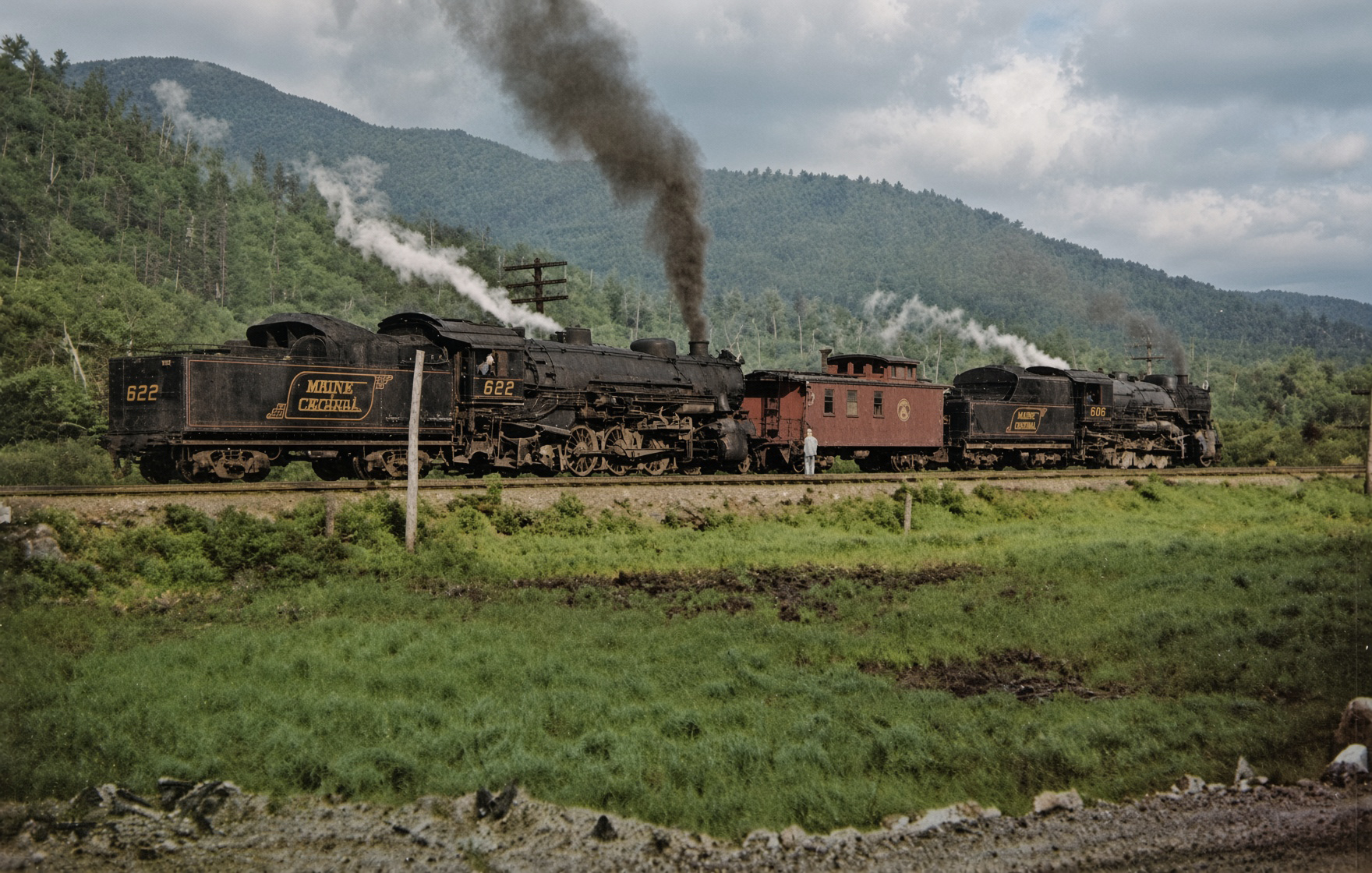
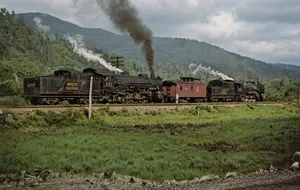
Maine Central 2-8-2 #622 and #606 are on the Mountain Division at Crawford Notch, New Hampshire on a May morning in 1950 shortly after the pair had worked helper service through the Notch. They will soon return to Barlett to await their next assignment. Robert Gustafson photo.
On this page: At a glance · Before 1900 · Ten-Wheelers · Consolidations and Mikados · Pacifics and Hudsons · Switchers and Portland Terminal · Post-1900 roster
At a glance
| Item | Detail |
|---|---|
| Railroad | Maine Central. Mark MEC. Slogan The Pine Tree Route |
| This page | Steam after 1900, Drury’s class grid, plus the Portland Terminal engines he treats with them |
| Shops | Waterville, on the Kennebec |
| Modern power | 21 Pacifics, 32 Mikados, 28 Consolidations, 2 Hudsons |
| Oddities | Four ex-Boston & Maine 2-6-6-2s on Crawford Notch. Eight ex-Boston & Maine 2-10-2s. Two Baldwin 4-6-4s |
| Last new steam | Hudsons 701 and 702, Baldwin, 1930 |
| Last steam | June 13, 1954. Class C-3 Pacific 470, Portland–Bangor excursion |
| Preserved | 470, under restoration by the New England Steam Corporation at Washington Junction, Hancock |
| Diesel roster | All-time diesel roster |
Before 1900
The 1862 railroad inherited a mixed fleet from the Androscoggin & Kennebec, the Penobscot & Kennebec, and then from the Portland & Kennebec, the European & North American, and a shelf of short lines. Americans and Moguls did the work. In 1900 the mechanical department wiped the numbers clean and sorted what remained into letter classes. The 0-6-0s were renumbered again in 1917 and in 1920, and numbers that a transferred switcher had just vacated were handed to a new one, as if a road number were too useful to retire. William D. Edson’s all-time list is Railroad History 152 (Spring 1985). Drury’s table, and the grid on this page, starts with engines built since 1900.
The railroad bought in small annual lots, six or a dozen engines of several types, rather than in the fifties and hundreds of a trunk line. In 1912 the delivery was seven Consolidations, two Pacifics, and switchers. In 1913 it was eight Consolidations, two Pacifics, and more switchers. In 1914 it was four Consolidations, two Pacifics, and the first Mikados. That habit lasted until the early 1920s. After the First World War the annual order stopped. A few modern engines arrived in 1923 and 1924. The Hudsons of 1930 were the end.
Ten-Wheelers
Few railroads kept great numbers of both Moguls and Ten-Wheelers. The Maine Central chose the 4-6-0. Drury counts sixty-seven of them built in the twentieth century.
Four class C engines were small freight power on 55-inch drivers. Numbers 106 and 107 weighed 104,000 pounds. Numbers 108 and 109 weighed 115,000. The letter C was used again, later, for the Pacifics. The N-class Ten-Wheelers were passenger engines, classed together because they shared 19-inch cylinders. Numbers 279–283 had 69-inch drivers and weighed 142,000 pounds. Numbers 284–289 had 73-inch drivers and weighed 156,000 pounds. The Pacifics began replacing them in 1907.
The O class was the dual-service and branch-line engine, 63-inch drivers and 21-by-26-inch cylinders. The 1903 and 1905 engines, 351–363, had inside piston valves and Stephenson valve gear and weighed about 164,000 pounds. Numbers 364–372, built at Rhode Island in 1906, had outside piston valves and Walschaerts gear and were about 3,000 pounds heavier. Baldwin’s 373–382, of 1907 and 1908, carried larger boilers and weighed 179,300 pounds. The design was so useful on light branches that the railroad was still ordering it in 1923. Lima built 383–390 that year, the only Lima steam locomotives the Maine Central ever owned. They kept the 63-inch drivers, dropped to 20-by-28-inch cylinders and Baker valve gear, and weighed 182,000 pounds. That was a year before Lima began arguing, with the Super-Power demonstrator, that a four-wheel trailing truck was the way to a larger firebox. Drury notes that 182,000 pounds was 24,000 pounds under the big passenger Ten-Wheelers of 1918.
Those twelve, 401–412, are the O-3s. The United States Railroad Administration allowed them during federal control because a Maine Central Pacific was smaller than a USRA light Pacific. Schenectady delivered eight in 1918 and four in 1920. They had 67-inch drivers, 22-by-28-inch cylinders, a weight of 206,500 pounds, and 32,700 pounds of tractive effort. They were main-line passenger engines on a freight wheel arrangement, and at 206,500 pounds they were large Ten-Wheelers.
The twentieth-century Moguls were a short list next to that: eight from Schenectady, 308–315, and four from Manchester, 316–319, about the size of a Boston & Maine B-15, plus two heavier 58-inch-driver engines that arrived with the Portland & Rumford Falls lease in 1907.
Consolidations and Mikados
Consolidations began in 1910. Class W, 501–509, had 63-inch drivers and 22-by-28-inch cylinders. Class W-1, 510–524, of 1912 and 1913, and class W-2, 525–528, of 1914, kept the drivers and went to 23-by-28-inch cylinders. They were the heavy freight engine until the Mikado.
In 1910 the Boston & Maine bought four oil-burning 2-6-6-2s, Alco-Schenectady works numbers 48648–48651, for helper service through the Hoosac Tunnel. Electrification made them redundant within a year. The Maine Central took them in late 1911 and early 1912, numbered them 1201–1204, class X, converted them to coal, and put them on the two-percent grade through Crawford Notch, as road engines and as helpers. Later they worked the occasional Portland–Bangor freight, and one was leased to the New Haven in the winter of 1919–1920. Three were scrapped in 1929. Number 1203, given a superheater while it was being repaired after a head-on collision, remained in service until 1931. Drury is the date used here. A Railway & Locomotive Historical Society account puts that survivor as late as 1935.
The first Mikados, 601–603, came from Schenectady in 1914. They had 63-inch drivers and 26½-by-30-inch cylinders and weighed 298,000 pounds, about the size of a USRA light Mikado with roughly 3,000 pounds less tractive effort. Seven more followed in 1915, six in 1916, and four in 1918. In 1919 the USRA assigned the railroad six light 2-8-2s, 621–626, class S-1, and the Maine Central classed them with the Mikados it already had. In 1924 it went back to its own drawing for 627–632, the same general engine plus a booster, which raised the weight to 298,000 pounds on that batch and tractive effort, with the booster, to about 60,400 pounds. Boosters were later applied to 605, 606, 609, 611, 615, 616, and 626 as well. Thirty-two Mikados, 601–632, were the modern freight fleet. They were gone by 1953.
Class A was eight Boston & Maine 2-10-2s, numbered 651–658, acquired between the mid-1930s and the mid-1940s. Documented examples are 651, ex-Boston & Maine 3000; 652, ex-3008; 653, ex-3017; and 655, ex-3020. Every Santa Fe on the roster was a former Boston & Maine engine.
Pacifics and Hudsons
Pacifics started in 1907, three years before the Boston & Maine bought its first 4-6-2. All twenty-one were Schenectady engines, numbered 450–470 as they arrived. Numbers 450 and 451 had 73-inch drivers, 22-by-28-inch cylinders, and a weight of 210,000 pounds, light as Pacifics go. By 463–465, delivered in 1914 as class C-2, the weight was 238,500 pounds, still under the Boston & Maine’s contemporary P-2 with the same size drivers and cylinders.
The five C-3s were the modern passenger engines. Numbers 466–468 came in 1917 and 469 and 470 in 1924, with boosters, 73-inch drivers, and, as built, 25-inch cylinders and a weight around 260,000 pounds. They were rebuilt in 1933 and 1934 with 24-inch cylinders and 195 pounds of boiler pressure. Number 470, works number 65555, was delivered in May 1924 at a billed price of $62,296.90. For thirty years it handled the Gull, the Bar Harbor Express, the Kennebec, and the local passenger trains. On June 13, 1954, it drew the farewell excursion from Portland to Bangor and back. It was retired four days later and placed on display at Waterville. The New England Steam Corporation removed it from that plinth in 2016. It is under restoration at Washington Junction in Hancock, beside the Downeast Scenic Railroad.
The two Hudsons have always been the puzzle. Baldwin delivered 701 and 702 in 1930. Like Pacifics 469 and 470 they had 73-inch drivers. Their cylinders, 23 by 28 inches, were smaller than the C-3s as built, and 240 pounds of boiler pressure made up for it. Grate area was only 62.6 square feet, less than many Pacifics carried. Engine weight was 312,590 pounds. Tractive effort was 41,300 pounds, plus 12,000 for the booster. They were the lightest 4-6-4s built up to that time. Only the Baltimore & Ohio’s Lord Baltimore and the National of Mexico’s Hudsons weighed less. They were Pacific-sized Hudsons.
Drury’s reading of the order is the one that fits the railroad. Passenger traffic was still growing at the end of the 1920s, and the Maine Central was in the market for a larger passenger engine. A heavy Pacific would have pressed the bridges. A Mountain would have spread the weight and added a long rigid wheelbase. A light 4-6-4 with a booster gave eight-driver starting effort and one more axle under the firebox. The railroad kept 701 and 702 on the Portland–Bangor main. The Boston & Maine let them run through on both of its routes to Portland and rated them above its own P-4s. The Maine Central, for its part, held those heavy Boston & Maine Pacifics to the same Portland–Bangor territory. Both Hudsons were retired in 1955. Portland Terminal had the use of 702 in the yards, a movable boiler for melting snow.
Switchers and Portland Terminal
Maine Central 0-6-0s ran from about 90,000 pounds to about 165,000. The heavy ones, 167–180, built between 1916 and 1920, were roughly USRA 0-6-0 size, and the railroad did receive a pair of the USRA engines themselves. When Portland Terminal was formed in 1911, a number of the older six-wheel switchers were assigned to it. The 0-6-0s were renumbered in 1917 and again in 1920. In 1946 the Maine Central bought a single 0-8-0 from the Boston & Maine, the only eight-wheel switcher on its own roster.
Portland Terminal bought twelve 0-6-0s of its own between 1912 and 1920, then two Boston & Maine 0-8-0s in 1935. In 1951 it sold four 0-6-0s back to the Boston & Maine. Its single 4-6-4 was Maine Central 702, kept as a steam supply. Drury’s chapter prints the Portland Terminal number grid on the same page as the Maine Central’s. The assignments and the resales are clearer than a second table of renumbered 0-6-0s, so they stay in this section.
Post-1900 roster
Engines built since 1900, in Drury’s order of type and class. Quantities are his, checked against Edwin B. Robertson’s Maine Central Steam Locomotives where a subclass letter on the printed grid is ambiguous. Pre-1900 engines, and the two Portland & Rumford Falls Moguls, are above. Retirement years are class spans, not unit-by-unit scrapping dates.
| Type | Class | Numbers | Qty | Builder | Built | Retired | Notes |
|---|---|---|---|---|---|---|---|
| 2-6-0 | P | 308–315 | 8 | Schenectady | 1900 | — | About the size of a Boston & Maine B-15 |
| 2-6-0 | P | 316–319 | 4 | Manchester | 1902 | — | |
| 4-6-0 | C | 106, 107 | 2 | — | — | — | 55-in drivers. 104,000 lb. Light freight. Letter C was later reused for the Pacifics |
| 4-6-0 | C | 108, 109 | 2 | — | — | — | 55-in drivers. 115,000 lb |
| 4-6-0 | N | 279–283 | 5 | Schenectady | 1903–1906 | — | Passenger. 69-in drivers. 19-in cylinders. 142,000 lb |
| 4-6-0 | N | 284–289 | 6 | Schenectady | 1903–1906 | — | Passenger. 73-in drivers. 156,000 lb. Same 19-in cylinders |
| 4-6-0 | O | 351–363 | 13 | Schenectady | 1903, 1905 | 1949–1953 | 63-in drivers, 21×26. Stephenson valve gear. About 164,000 lb |
| 4-6-0 | O-1 | 364–372 | 9 | Rhode Island | 1906 | 1949–1953 | Walschaerts. About 3,000 lb heavier than 351–363 |
| 4-6-0 | O-2 | 373–382 | 10 | Baldwin | 1907–1908 | 1949–1953 | Larger boilers. 179,300 lb |
| 4-6-0 | O-3 | 401–412 | 12 | Schenectady | 1918, 1920 | 1949–1953 | Big O. Passenger. 67-in drivers, 22×28, 206,500 lb. USRA allowed them because the Pacifics were smaller than a USRA light Pacific. Eight in 1918, four in 1920 |
| 4-6-0 | O-4 | 383–390 | 8 | Lima | 1923 | 1949–1953 | Only Lima steam on the roster. Baker valve gear. 63-in drivers, 20×28, 182,000 lb |
| 2-8-0 | W | 501–509 | 9 | Schenectady | 1910 | by 1954 | 63-in drivers, 22×28 |
| 2-8-0 | W-1 | 510–524 | 15 | Schenectady | 1912–1913 | by 1954 | 63-in drivers, 23×28 |
| 2-8-0 | W-2 | 525–528 | 4 | Schenectady | 1914 | by 1954 | 63-in drivers, 23×28 |
| 2-6-6-2 | X | 1201–1204 | 4 | Schenectady | 1910 | 1929; 1203 in 1931 | Ex-Boston & Maine oil-burning Hoosac helpers. To MEC late 1911 and early 1912. Converted to coal. Crawford Notch. Works numbers 48648–48651 |
| 2-8-2 | S | 601–620 | 20 | Schenectady | 1914–1918 | 1953 | 63-in drivers, 26½×30. 601–603 in 1914. Boosters later on 605, 606, 609, 611, 615, and 616 |
| 2-8-2 | S-1 | 621–626 | 6 | Schenectady | 1919 | 1953 | USRA light Mikado. 626 later given a booster |
| 2-8-2 | S-2 | 627–632 | 6 | Schenectady | 1924 | 1953 | Original design plus a booster. About 60,400 lb tractive effort with the booster cut in |
| 2-10-2 | A | 651–658 | 8 | Schenectady | 1920–1923 | 1948–1953 | Ex-Boston & Maine, acquired mid-1930s to mid-1940s. 651 ex-3000, 652 ex-3008, 653 ex-3017, 655 ex-3020 are the documented renumberings |
| 4-6-2 | C | 450–457 | 8 | Schenectady | 1907–1911 | 1954 | 73-in drivers, 22×28. 450 and 451 weighed 210,000 lb. Two in 1907, three in 1909, one in 1910, two in 1911 |
| 4-6-2 | C-1 | 458–462 | 5 | Schenectady | 1912–1913 | 1954 | Two in 1912, three in 1913 |
| 4-6-2 | C-2 | 463–465 | 3 | Schenectady | 1914 | 1954 | 238,500 lb |
| 4-6-2 | C-3 | 466–470 | 5 | Schenectady | 1917, 1924 | 1954 | Boosters. As built, 25-in cylinders and about 260,000 lb. Rebuilt 1933–34 to 24×28 and 195 psi. 470, works 65555, preserved. Last steam run June 13, 1954 |
| 4-6-4 | D | 701, 702 | 2 | Baldwin | 1930 | 1955 | 73-in drivers, 23×28, 240 psi, 312,590 lb. Tractive effort 41,300 lb plus 12,000 lb booster. Portland–Bangor only. 702 later supplied steam at Portland Terminal |
Related reading
- Maine Central · Maine Central diesel roster
- Boston & Maine · Boston & Maine steam · Bangor & Aroostook · Bangor & Aroostook steam
- Pacific type · Hudson type · Mikado type · Consolidation type · Hoosac Tunnel
- Downeast Scenic Railroad, where 470 is under restoration
Sources
- George H. Drury, Guide to North American Steam Locomotives, revised edition, Maine Central chapter, pp. 205–207, including Portland Terminal. User photographs in Downloads/MEC_Steam.
- Edwin B. Robertson, Maine Central Steam Locomotives (Westbrook, Maine, 1977), for subclass letters, builder groups, and the O-3 passenger Ten-Wheelers.
- William D. Edson, “Maine Central All-Time Locomotive Roster,” Railroad History 152 (Spring 1985), pp. 55–83. Drury also cites Railway & Locomotive Historical Society Bulletin 55 and 56.
- Ron Johnson, Maine Central R.R. Mountain Division (470 Railroad Club), for Mountain Division assignments and Pacific weights.
- New England Steam Corporation and the 470 locomotive record: works number 65555, last run June 13, 1954, removed from the Waterville display in 2016.
Recent Articles


-
Monongahela Railway Steam Locomotives: History & Roster
Sep 22, 26 01:34 PM
 Monongahela steam—H-5 Consolidations, USRA light Mikados 170–179, Baldwin L-2s, ex-P&LE L-3s. All-time roster. Last steam May 26, 1954.
 -
Monongahela Railway Diesel Roster: All-Time
Sep 22, 26 01:16 PM
 Monongahela diesel—27 Baldwin S-12s, NYC RF-16 sharks, P&LE GP7s, GP38s 2000–2004, Super 7s 2300–2310. Serials and orders. Last steam May 26, 1954.
 -
Monongahela Railway: Map, Rosters, History
Sep 22, 26 01:14 PM
 Monongahela Railway—incorporated December 31 1900, Railway July 1 1915. Brownsville–Fairmont coal road. Last steam May 26 1954. Conrail May 1 1993.
 -
Virginia Scenic Railway Dining (2026)
Sep 22, 26 01:09 PM
 2026 Virginia Scenic Railway—Blue Ridge Flyer Dining Class from Staunton, about 3 hours, plated meal. Sunday Brunch from Louisa, about $132. Confirm on virginiascenicrailway.com.
 -
Virginia Dinner Train Rides (2026): A Complete Guide
Sep 22, 26 01:03 PM
 2026 Virginia Scenic Railway—Blue Ridge Flyer Dining Class from Staunton, Alleghany Special Dining Class, Sunday Brunch from Louisa. Confirm on virginiascenicrailway.com.
 -
Oregon Dinner Train Rides (2026): A Complete Guide
Sep 22, 26 12:51 PM
 2026 Oregon has no plated dinner train on the calendar. Mount Hood is scenic with snacks. Oregon Coast Scenic’s evening ride is the 21+ Moonlight with sandwiches.
 -
Maine Central Steam Locomotives: History & Roster
Sep 22, 26 12:33 PM
 Maine Central steam—Ten-Wheelers, W-class Consolidations, S-class Mikados, C-class Pacifics, Hudsons 701 and 702. Post-1900 roster after Drury. Last steam June 13, 1954.
 -
Maine Central Diesel Roster: All-Time
Sep 22, 26 12:04 PM
 Maine Central diesel—railcar 901, HH660s, GP7s, E7s, F3s, GP38s, U18Bs, ex-Rock Island U25Bs. All-time roster with serials and orders. Last steam June 13, 1954.
 -
Maine Central Railroad: Map, Logo, Rosters, History
Sep 22, 26 11:36 AM
 Maine Central—Androscoggin & Kennebec and Penobscot & Kennebec, October 28 1862. Pine Tree Route. Mountain Division, Portland–Bangor–Vanceboro. Last steam June 13 1954. Guilford June 1981.
 -
Maryland and Pennsylvania Railroad: Map, Roster, Logo
Sep 22, 26 12:14 AM
 Ma & Pa—Peach Bottom 1868, Maryland & Pennsylvania February 12 1901, Baltimore to York. Last steam November 29 1956. York Railway December 1 1999.
 -
New York Dinner Train Rides (2026): A Complete Guide
Sep 21, 26 11:59 PM
 2026 New York dinner train—Adirondack Dinner Train from Utica, 6 p.m., about 3 hours, First Class from $139. Arcade & Attica mystery dinner is served at Curriers. Confirm on the railroad.
 -
California Dinner Train Rides (2026): A Complete Guide
Sep 21, 26 11:49 PM
 2026 California dinner trains—Napa Valley Wine Train plated meals, River Fox brunch and mystery dinner, Roaring Camp barbecue at camp. Confirm on each railroad.
 -
Roaring Camp Starlight Dinner Party (2026)
Sep 21, 26 11:33 PM
 2026 Roaring Camp Starlight Dinner Party—Beach Train from the Santa Cruz Boardwalk, barbecue at Felton, ride back after dark. Confirm on roaringcamp.com.
 -
Long Island Rail Road Steam Locomotives: History, Roster & Photos
Sep 21, 26 11:29 PM
 Long Island steam—G5s 20–50, H10s 101–119, last steam at Hicksville October 8, 1955. Post-1898 class roster.
 -
Long Island Rail Road Diesel Roster: All-Time
Sep 21, 26 11:24 PM
 Long Island diesel—boxcab 401 in 1925, FM C-Liners, RS-3s, C-420s, GP38-2s, DE30AC and DM30AC. All-time roster with serials and orders.
 -
Long Island Rail Road: Map, History, Pictures, Logo
Sep 21, 26 08:27 PM
 Long Island Rail Road—Brooklyn & Jamaica 1836, Greenport 1844, Pennsylvania control 1900, Penn Station 1910. MTA since 1968. Steam and diesel rosters.
 -
Oregon Coast Scenic Railroad (2026): Sunset Dinner and Moonlight
Sep 21, 26 02:40 PM
 2026 Oregon Coast Scenic does not post the old four-course Sunset Dinner. The evening ride is the 21+ Moonlight Excursion from Garibaldi, with pre-ordered sandwiches. Confirm on oregoncoastscenic.org.
 -
Adirondack Dinner Train (2026): Dates, Tickets & What to Expect
Sep 21, 26 01:38 PM
 2026 Adirondack Dinner Train—Utica Union Station, 6 p.m., about 3 hours to Remsen. First Class from $139. Chef Patrick O’Connor. Confirm on adirondackrr.com.
 -
Lehigh Valley Steam Locomotives: History, Roster & Photos
Sep 21, 26 01:31 PM
 Lehigh Valley steam—Camelback Consolidations, 2-10-2s, K-class Pacifics, six Mountains, Wyoming 4-8-4s. Post-1900 roster after Drury. Last steam September 14, 1951.
 -
Lehigh Valley Diesel Roster: All-Time
Sep 21, 26 01:23 PM
 Lehigh Valley diesel—boxcabs 1926, FTs 1945, F3/F7, FA/PA, C628 Snowbirds, GP38-2s, U23Bs. All-time roster with serials and orders. Last steam September 14, 1951.
 -
Lehigh Valley Railroad: Map, Roster, Logo, History
Sep 21, 26 01:09 PM
 Lehigh Valley—DLS&S 1847, named January 7 1853, Mauch Chunk–Easton September 12 1855. Route of the Black Diamond. Jersey City–Buffalo. Conrail April 1 1976.
 -
Wisconsin Great Northern Dinner Train (2026)
Sep 21, 26 12:47 PM
2026 Wisconsin Great Northern dinner train—Trego, $105, Namekagon River. January 8–31 and May 5–December 17. Confirm on spoonertrainride.com. -
Lehigh and New England Railroad: Map, Rosters, History
Sep 21, 26 12:33 AM
 Lehigh & New England—South Mountain & Boston 1873, named April 2 1895. Anthracite, cement, Maybrook. Last Camelbacks, Alco FAs. Voluntary shutdown October 31 1961.
 -
TVRM Chattanooga Dinner Train (2026): Dates, Tickets & What to Expect
Sep 21, 26 12:20 AM
 2026 TVRM Chattanooga Dinner Train Experience—Grand Junction, select Fri/Sat March 6–October 24, three-course, 2–3 hours, from $110. Confirm on tvrail.com.
 -
Lehigh and Hudson River Railroad: Map, Rosters, History
Sep 20, 26 11:55 PM
 Lehigh & Hudson River—Warwick Valley 1860, Railway April 1 1882. Easton–Maybrook bridge road, Alphabet Route, Alco RS-3s and C420s. Conrail April 1 1976.
 -
Royal Gorge First Class Dinner Train (2026)
Sep 20, 26 11:47 PM
 2026 Royal Gorge Route First Class Lunch & Dinner—Cañon City, about 2 hours, from $199+, 12+. Confirm on royalgorgeroute.com.
 -
GE "44-Tonner" Locomotives: Roster, Specs, History
Sep 20, 26 11:09 PM
 GE 44-ton switcher—90,000-pound rule, Caterpillar D17000 center-cab, Sept 4 1940 CB&Q 9103 through Oct 1956 Dansville & Mount Morris 1. Phases, serial roster, PRR 46.
 -
Strasburg Rail Road Dining (2026): Dinner on the Rails & Elegant Expre
Sep 20, 26 11:00 PM
2026 Strasburg Rail Road seated meals—Dinner on the Rails, Elegant Express, Valentine dinner. Lee E. Brenner diner. Confirm on strasburgrailroad.com. -
International-Great Northern Railroad: Map, History, Timetables
Sep 20, 26 10:43 PM
 International–Great Northern—Houston & Great Northern 1866, International Railroad 1870, merged Sept 30 1873. Palestine, Longview–Laredo, Gould, Missouri Pacific March 1 1956.
 -
Nevada Northern Taste of Italy Dinner Train (2026)
Sep 20, 26 03:25 PM
2026 Nevada Northern Taste of Italy—adults-only multi-course Italian dinner, steam when healthy, East Ely. Sep. 19 gala listed. Confirm on nnry.com. -
Cape Cod Dinner Train (2026): Dates, Tickets & What to Expect
Sep 20, 26 02:53 PM
 Cape Cod Central Dinner Train—Hyannis, Buzzards Bay, and Falmouth. Four-course, 3–3½ hours, from $99.99. Confirm on capetrain.com.
 -
Erie Steam Locomotives: History, Roster & Photos
Sep 20, 26 11:55 AM
 Erie Railroad steam—Camelback 2-8-0s, 155 N-1 Mikados, 105 Berkshires, K-class Pacifics, Triplexes. Post-1900 roster after Drury. Last steam March 17, 1954.
 -
Erie Railroad Diesel Roster: All-Time
Sep 20, 26 11:47 AM
 Erie Railroad diesel—boxcabs 1926, FTs 1944, F3/F7, FA/PA, GP7/GP9, Baldwins, Limas. All-time roster with serials, orders, classes. Last steam March 17 1954. EL October 17 1960.
 -
Erie Railroad: Map, Passenger Trains, Logo, History
Sep 20, 26 11:44 AM
 Erie Railroad—New York & Erie 1832, Piermont–Dunkirk May 14 1851, six-foot then standard June 1880, Chicago 1883. High-and-wide fourth way. Erie Lackawanna October 17 1960.
 -
Colebrookdale Railroad Dining (2026): Secret Valley Dinner Train
Sep 20, 26 11:36 AM
 2026 Colebrookdale Railroad dinner in Boyertown—Secret Valley Dining Class, about 2 hours. Saturday evenings. Confirm on colebrookdalerailroad.com.
 -
Boone & Scenic Valley Wolf Dinner Train (2026)
Sep 19, 26 08:15 PM
 2026 Boone & Scenic Valley Wolf Dinner Train—Des Moines River valley, Bass Point Creek High Bridge, Union Pacific dining cars. Confirm on bsvrr.com.
 -
C&NW 4-6-2s 1617 & 1620: Minnesota 400 Yellow Jackets
Sep 19, 26 11:28 AM
 C&NW Class E Pacifics 1617 and 1620—Alco Schenectady 1917, yellow-and-green E-4-style shrouds 1941 for the Minnesota 400. Crews called them Yellow Jackets. Renumbered 617/620. Scrapped 1956.
 -
Erie Lackawanna Diesel Roster: All-Time
Sep 19, 26 10:13 AM
 Erie Lackawanna diesel—Erie and DL&W inheritance, GP35s, U25Bs, SD45/SDP45/SD45-2, U34CH. All-time roster with serials and orders. Conrail April 1 1976.
 -
Erie Lackawanna Railway: Map, History, Logo
Sep 19, 26 10:06 AM
 Erie Lackawanna Railway—Erie and DL&W, October 17 1960–March 31 1976. Von Willer, White revival, Dereco, Agnes, Conrail. High-and-wide Chicago main. Map, logo, what remains.
 -
"Empire State Express" (1941 Train): Timetables, Route, Consist
Sep 18, 26 10:59 PM
 NYC Empire State Express—George Daniels 1891 day train, 999’s 112.5 mph claim, Budd stainless streamliner December 7 1941, Cleveland and Detroit sections, diesels, 1967 name drop. Timetables, consist…
 -
New York Central 4-6-4s 5426 & 5429: Empire State Express Hudsons
Sep 18, 26 10:32 PM
NYC J-3a Hudsons 5426 and 5429—Alco 1937, Budd stainless shrouds 1941 for the Empire State Express. Pearl Harbor inaugural. Shrouds off by 1950. Neither preserved. -
"Stourbridge Lion" Locomotive: Facts, History, Photos
Sep 18, 26 10:27 PM
 Stourbridge Lion—Foster, Rastrick 0-4-0, first steam locomotive in the United States. Horatio Allen, Honesdale, August 8, 1829. Too heavy for D&H gravity track. Boiler in Baltimore; Colonie replic…
 -
Delaware & Hudson Steam Roster (Post 1900)
Sep 18, 26 10:01 PM
 Delaware & Hudson steam—Camelback 2-8-0s, Loree high-pressure compounds, Class K 4-8-4s, forty Challengers. Post-1900 class roster after Drury. Last steam July 21, 1953.
 -
Boston & Maine Steam Roster (Post 1900)
Sep 18, 26 02:57 PM
 Boston & Maine steam—B-15 Moguls, K-8 Consolidations, P-4 Lima Pacifics, T-1 Limas, R-1 Mountains. Post-1900 class roster after Drury. Last steam July 23, 1956.
 -
Boston & Maine Diesel Roster (All-Time)
Sep 18, 26 01:25 PM
 Boston & Maine diesel—boxcab 1100 1935, Flying Yankee 6000, FTs, E7s, BL2s, GP7/GP9, GP38-2s and GP40-2s. All-time roster. Last steam July 23, 1956.
 -
Mid-Continent Railway Museum Dining (2026)
Sep 18, 26 01:21 PM
 2026 Mid-Continent dining in North Freedom—select-date seated meals in luxury cars, reservations required. Pizza Limited June 28. Confirm on midcontinent.org.