- Home ›
- Museums ›
- Pennsylvania
Pennsylvania Railroad Museums (2026): A Complete Guide
Last revised: October 6, 2026
By: Adam Burns
Pennsylvania built the railroad that other railroads measured themselves against, and it kept more of the evidence than almost any other state. The Main Line of Public Works crossed the Alleghenies on inclined planes in 1834. The Pennsylvania Railroad replaced that portage with the Horseshoe Curve in 1854 and then built Altoona into the largest railroad shop town in the country. The Reading, the Lehigh Valley, the Baltimore & Ohio, the Erie, and the Western Maryland each took a piece of the map. What is open to the public now runs from a state museum at Strasburg, next door to a steam railroad chartered in 1832, to a National Park Service roundhouse in Scranton, a narrow-gauge coal railroad that still has its original shops, and a long list of towers, depots, and trolley barns.
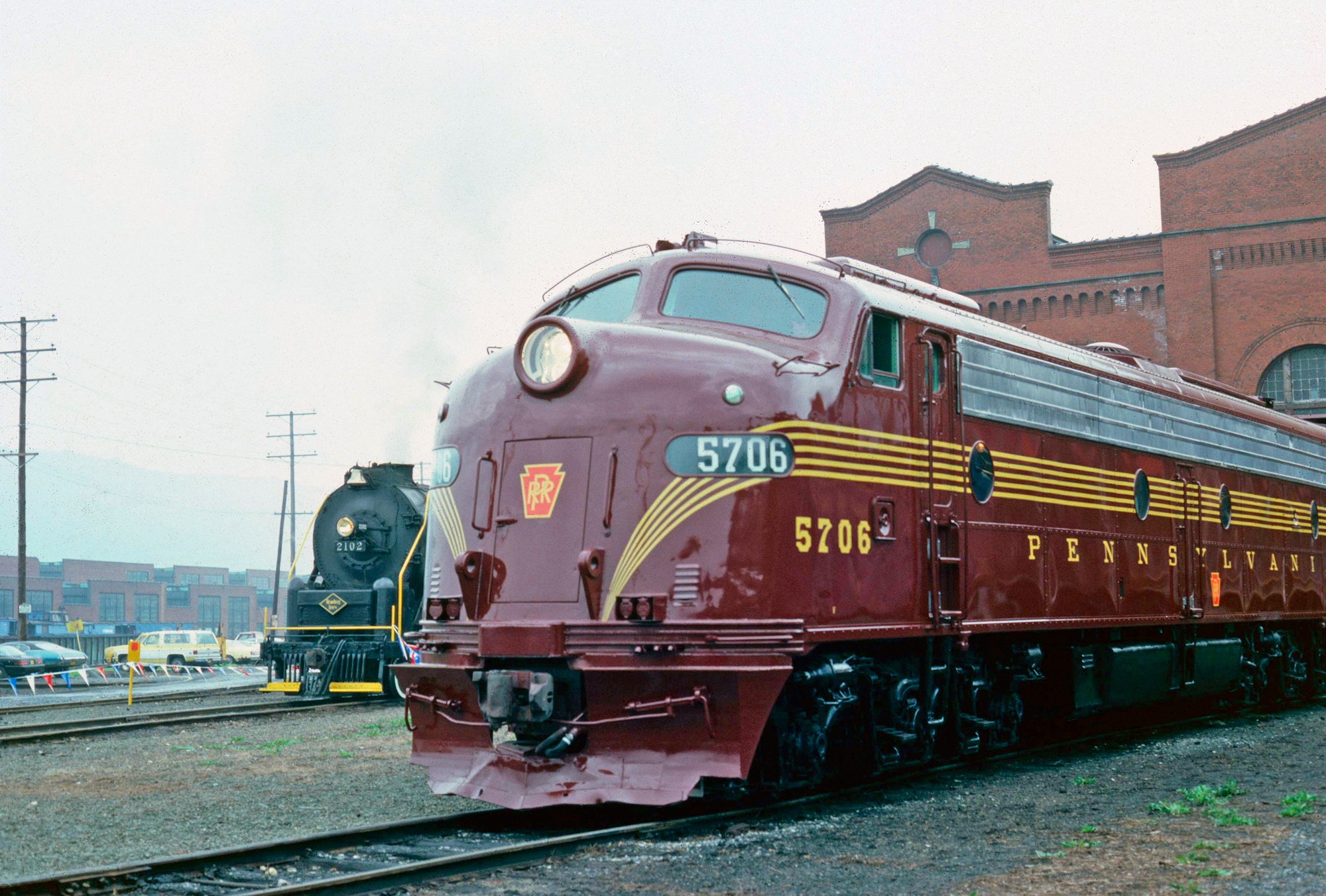
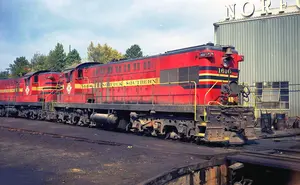
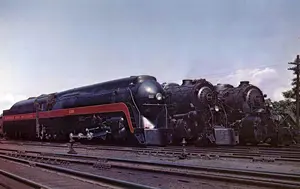
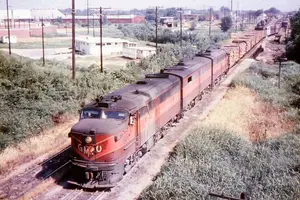
Pennsylvania E8A #5706 and Reading T-1 4-8-4 #2102, both freshly out of the shops, outside the old Reading shops in Reading, Pennsylvania, on June 28, 1986. American-Rails.com collection.
On this page: At a glance · Pennsylvania’s railroads · Strasburg · Steamtown · Altoona and the Horseshoe Curve · Allegheny Portage · East Broad Top · Reading · Harris Tower · Franklin Institute · The northwest and the small museums · Related reading
At a glance
| Place | Town | What it is known for | Site |
|---|---|---|---|
| Railroad Museum of Pennsylvania | Strasburg | State museum, opened 1975. Pennsylvania Railroad 1223, K4s 3750, the Atlantic carried as 7002, GG1s 4800 and 4935 | rrmuseumpa.org · profile |
| Strasburg Rail Road | Strasburg | Chartered 1832. Steam tourist railroad since the late 1950s, next door to the state museum | strasburgrailroad.com · rides |
| National Toy Train Museum | Strasburg | Train Collectors Association museum, open since 1977 | tcatrains.org/museum |
| Choo Choo Barn | Strasburg | Animated layout, 1,700 square feet, on Gap Road. A 1924 carousel building was approved in 2026 | choochoobarn.com |
| Steamtown National Historic Site | Scranton | National Park Service. The Steamtown Foundation collection, including Union Pacific Big Boy 4012, in the old Lackawanna shops | nps.gov/stea · profile |
| Railroaders Memorial Museum and Horseshoe Curve | Altoona | Master Mechanics Building of 1882. K4s 1361 under restoration. Curve opened February 15, 1854. GP9 7048 at the curve | railroadcity.org |
| Allegheny Portage Railroad National Historic Site | Gallitzin | Inclined-plane railroad of 1834–1854. Staple Bend Tunnel. Lemon House | nps.gov/alpo |
| East Broad Top | Rockhill Furnace | Three-foot gauge, 1872–1874, National Historic Landmark. Shops intact. Baldwin 2-8-2 #16 back in excursion service in 2023 | eastbroadtop.com |
| Rockhill Trolley Museum | Rockhill Furnace | Operating streetcars beside the East Broad Top | rockhilltrolley.org |
| Reading Railroad Heritage Museum | Hamburg | Reading Company Technical & Historical Society. Reading equipment and paper | society site |
| Harris Tower | Harrisburg | Pennsylvania Railroad interlocking tower, opened April 26, 1930. Harrisburg Chapter, NRHS. GG1 4859 is at the station | harrisburgnrhs.org |
| Franklin Institute | Philadelphia | Baldwin 60000, the builder’s 60,000th locomotive, a 4-10-2 of 1926, indoors since 1933 | fi.edu |
| Lake Shore Railway Museum | North East | 1899 Lake Shore & Michigan Southern depot. General Electric locomotives built in Erie, including a South Shore Little Joe | lakeshorerailway.com |
| Greenville Railroad Park | Greenville | Union Railroad 0-10-2 #604, Baldwin, 1936 | park site |
| Pennsylvania Trolley Museum | Washington | Operating streetcars on the museum’s own line | pa-trolley.org |
| Electric City Trolley Museum | Scranton | Streetcars on the Steamtown campus | museum site |
| Ma & Pa Railroad Heritage Village | York | About 31 acres and a short ride, on the old Maryland & Pennsylvania | Ma & Pa · rides |
| Pioneer Tunnel | Ashland | Public anthracite mine since 1962. Surface train is narrow-gauge #123, Vulcan, 1927, about three-quarters of a mile | pioneertunnel.com |
American-Rails.com does not operate these places and does not sell tickets. Confirm hours before you travel.
Pennsylvania’s railroads
The state’s own Main Line of Public Works, a mix of canals and railroads, was the first through route from Philadelphia to Pittsburgh. The hard piece was the Allegheny Portage Railroad, opened in 1834, about thirty-six miles from Hollidaysburg to Johnstown on ten inclined planes. It worked until 1854. The Pennsylvania Railroad, chartered in 1846, replaced it with a grade a locomotive could climb. The Horseshoe Curve opened on February 15, 1854. Altoona, at the foot of that grade, became the place where the Pennsylvania designed, built, and heavy-repaired its own locomotives.
The Reading Company owned the anthracite side of the state and a commuter empire into Philadelphia. The Lehigh Valley and the Central Railroad of New Jersey took the other anthracite routes. The Baltimore & Ohio crossed the southwest. The Erie and the Lackawanna crossed the north, and the Lackawanna built Scranton. The Western Maryland reached Connellsville. Penn Central, Conrail, and then Norfolk Southern and CSX inherited the freight mains. Amtrak still uses the old Pennsylvania electrified railroad from Philadelphia through Harrisburg. The museums are thick because those companies were thick, and because Strasburg, Scranton, Altoona, and Rockhill Furnace each kept an entire campus.
Railroad Museum of Pennsylvania
The Railroad Museum of Pennsylvania, at Strasburg, is the state’s official railroad collection, under the Pennsylvania Historical and Museum Commission. The Pennsylvania Railroad had gathered a historic fleet and stored it in the Northumberland roundhouse. In 1969 that collection moved to Strasburg for safekeeping on the Strasburg Rail Road. The museum building opened in 1975. The collection runs past a hundred locomotives and cars. The fuller article is the museum profile. The engines a first visit is built around are these:
- Pennsylvania Railroad #1223. A D16sb 4-4-0. It ran on the Strasburg Rail Road and appeared in the 1969 film Hello, Dolly! It is back in the museum.
- The Atlantic displayed as #7002. This is the former #8063, an E7s 4-4-2. The Pennsylvania renumbered it for the 1949 New York World’s Fair so the railroad could show an engine in the number of the 1905 speed-record Atlantic, which had already been scrapped. It too ran on the Strasburg Rail Road, into the late 1980s, often paired with #1223.
- K4s #3750. A Pacific, built at Juniata in 1920. It pulled Warren G. Harding’s funeral train. It is in the museum collection.
- GG1 #4800 and GG1 #4935. No. 4800 is the prototype of the class. No. 4935 was built at Juniata in 1943, made its last revenue run on October 10, 1980, and reached Strasburg on February 19, 1983. Both are indoors.
- E7 #5901. A Pennsylvania passenger diesel, in the same hall as the electrics.
Next door, the Strasburg Rail Road is the operating half of the visit. The company was chartered in 1832. Railfans bought the short line and put steam tourist trains on it in the late 1950s. The locomotives on the train change. Dates, consists, and which engine is under steam are on strasburgrailroad.com and on the scenic-train page.
Two model museums in the same town
The National Toy Train Museum, also in Strasburg, is the Train Collectors Association’s public museum and its headquarters. It has been open since 1977. The operating layouts are in G, Standard, O, S, and HO. The collection is toy trains as manufactured objects, in a different room from the full-size locomotives across the road.
The Choo Choo Barn is at 226 Gap Road, on the east side of Strasburg. The Groff family built the animated layout up over more than seventy years. It covers 1,700 square feet, with operating trains and hand-built scenes of Lancaster County, including a miniature of the Strasburg Rail Road. In September 2026 Strasburg Township approved a new building on the site for the 1924 Rocky Springs Dentzel carousel, plus a gift shop and classrooms. The owner hoped to open the carousel about two years later. The Barn’s own site has the current hours.
Steamtown
Steamtown National Historic Site is the National Park Service railroad museum in the Delaware, Lackawanna & Western shops at Scranton. The collection began as the Steamtown Foundation, which F. Nelson Blount established at Bellows Falls, Vermont, in 1964. Blount died on August 31, 1967. The locomotives eventually came to Scranton, and the Park Service took the site. Union Pacific Big Boy #4012 came east with that collection and is one of the engines in the roundhouse. The Steamtown profile has the longer history. Excursion trains run from the site on a piece of the old Lackawanna. Dates are on the Park Service calendar and on the scenic-train page.
The Electric City Trolley Museum shares the Scranton campus and runs streetcars on its own short line, using Lackawanna property at the edge of the Steamtown yard. It is a separate ticket and a separate collection. The two visits fit in one day.
Altoona and the Horseshoe Curve
The Railroaders Memorial Museum and the Horseshoe Curve visitor center are one organization. The museum has occupied the Pennsylvania Railroad’s Master Mechanics Building since April 1998. The railroad built that building in 1882, in the middle of the shop city where the Pennsylvania designed its locomotives. A quarter-roundhouse on the museum grounds, the Harry Bennett Memorial Roundhouse, holds the rolling stock. The first wedge of it was finished in 2002.
K4s #1361 is the locomotive the city knows. Juniata built it in May 1918, one of the 425 Pacifics in the class and one of 350 built at Altoona. The museum’s account is that it was retired in 1956 after about 2.5 million miles. From June 8, 1957 until September 1985 it stood on display at the Horseshoe Curve. A return to excursion service in the 1980s ended with an axle failure. The museum canceled one long restoration in 2010. A new effort began in 2021. Through the summer of 2026 the work was on the boiler and was moving toward the frame, and the museum said a return to steam still had no date. It is a restoration in a roundhouse, and it is worth seeing on those terms.
The Horseshoe Curve opened on February 15, 1854, the grade that let the Pennsylvania Railroad retire the inclined planes. The railroad opened a park at the curve in 1879. The visitor center, the funicular, and the trackside park are part of the same Altoona organization. When #1361 left the curve, Pennsylvania Railroad GP9 #7048, an Electro-Motive product of December 1955, took its place as the locomotive on display. Norfolk Southern freights still climb the curve. The museum’s site, railroadcity.org, covers both stops.
Allegheny Portage Railroad
Allegheny Portage Railroad National Historic Site, near Gallitzin, is the inclined-plane railroad the Horseshoe Curve replaced. The portage opened in 1834 and closed in 1854. It was about thirty-six miles long, Hollidaysburg to Johnstown, with five planes on each side of the summit, and it carried canal boats over the mountain on railroad cars. The National Park Service calls Staple Bend Tunnel, at the head of plane 1, the first railroad tunnel in the United States. The Lemon House, a tavern at the summit, is open on its first floor. Engine House No. 6 is explained in a replica shelter. The summit visitor center has the film and the exhibits. This is a National Park Service site, and it is a short drive from the curve and from Altoona.
Two smaller stops sit on the same mountain. The Portage Station Museum, in the old Pennsylvania depot at Portage, is the town historical society’s building, with a model layout, near the Gallitzin Tunnels. Tunnel Park at Gallitzin has a Pennsylvania Railroad caboose and a place to watch Norfolk Southern freights still using the tunnels under the summit.
East Broad Top
The East Broad Top is a three-foot-gauge railroad at Rockhill Furnace, built from 1872 to 1874 to bring coal down to an iron furnace. It is a National Historic Landmark, and the railroad’s own description is the oldest narrow-gauge railroad in the United States still operating, and the last narrow-gauge common carrier east of the Rockies. The shops, the roundhouse, and six Baldwin Mikados survived because the Kovalchick family, scrap dealers who bought the property in 1956, did not cut it up. They opened a tourist train in 1960 on a few miles north of Rockhill Furnace and ran it until 2011.
The East Broad Top Foundation bought the railroad from the Kovalchicks in February 2020. Baldwin 2-8-2 #16, built in 1916, went back into excursion service in 2023. A second Mikado, #15, has been in the restoration queue. The regular trip still runs north from Rockhill Furnace toward Colgate Grove, and the foundation has been rebuilding the main line south toward Saltillo, with a ceremonial start of tracklaying at Saltillo in March 2026. Open miles change with the construction season. The status page on this site is the East Broad Top restoration note, and the ride list is on the scenic-train guide. Shop tours show the belt-driven machines. Tickets and the steam schedule are on eastbroadtop.com.
The Rockhill Trolley Museum is next to the Orbisonia depot and calls itself Pennsylvania’s first operating trolley museum. Streetcars run on their own schedule, on a line that meets the East Broad Top property. It is a second ticket.
Reading Railroad Heritage Museum
The Reading Company Technical & Historical Society keeps the Reading Railroad Heritage Museum in Hamburg. The collection is Reading equipment, paper, and photographs, and the society posts weekend hours. Hamburg is the public face of the Reading Company as a museum.
The photograph at the top of this page was made on June 28, 1986, outside the old Reading shops in the city of Reading. Pennsylvania E8A #5706 and Reading T-1 4-8-4 #2102 had both just come out of those shops. No. 2102 later became a Reading & Northern excursion engine, and that railroad has run it in recent years. The Reading & Northern is a freight railroad with a passenger train, based in Port Clinton. Its excursion dates, when it publishes them, belong on the scenic-train page.
Harris Tower
Harris Tower, also called HG Tower, stands one block north of the Harrisburg station. The Pennsylvania Railroad built it in 1929 and put it in service on April 26, 1930, in place of three older towers. The Union Switch & Signal machine has 113 levers. At the start it controlled about 3,250 feet of railroad, from the middle of the station platforms out to Herr Street, a plant that in the 1930s saw more than a hundred passenger trains a day. Harrisburg was the west end of the Pennsylvania’s passenger electrification. Eastbound trains took a GG1 here. Westbound trains gave the GG1 up and went on behind steam or, later, diesel.
Amtrak closed the tower on November 15, 1991. The Harrisburg Chapter of the National Railway Historical Society bought it on July 24, 1992. It went on the National Register of Historic Places on August 30, 1994. The levers now run a simulation of the 1940s plant, tied to the original machine. The chapter also looks after Pennsylvania Railroad GG1 #4859, displayed at the Harrisburg Transportation Center, the locomotive remembered for the first electric passenger train into the city in January 1938. The chapter posts the days the tower is open. Nearby construction has interrupted that schedule more than once, so check harrisburgnrhs.org before the trip. Amtrak and Norfolk Southern trains still pass the building.
Franklin Institute
Baldwin Locomotive Works built No. 60000 at Eddystone in 1926 and gave it that number because it was the company’s 60,000th locomotive. It is a 4-10-2 with three cylinders, arranged as a compound, and a water-tube firebox. Baldwin sent it out as a demonstrator of high-pressure compounding. It ran trials on the Pennsylvania, the Baltimore & Ohio, the Burlington, the Santa Fe, the Great Northern, and the Southern Pacific. The demonstration runs produced no repeat order. Baldwin used it as a stationary boiler at the works, and in 1933 the company gave it to the Franklin Institute. It was rolled into the building, then still under construction, over a temporary track from 24th and Vine, a move of about five blocks that took five days. It has been indoors ever since, the center of the institute’s railroad hall. The Franklin Institute is a science museum. No. 60000 is why a railroad visitor buys the ticket.
The northwest and the small museums
Lake Shore Railway Museum
The Lake Shore Railway Historical Society was founded in 1956. Its museum is the 1899 Lake Shore & Michigan Southern depot in North East, in Erie County, about fifteen miles from the city of Erie. A depot of 1869 still stands beside it and was reused as a freight house. Passenger service on the New York Central ended here in 1971. CSX freights on the old Water Level Route, and Norfolk Southern freights on the old Nickel Plate, both pass the platform.
The collection follows the factories of Erie. General Electric built locomotives in Lawrence Park for decades, and Heisler built geared steam locomotives in the city. On the property are New York Central U25B #2500, a 1963 GE product, and Chicago South Shore & South Bend #802, a 1949 GE “Little Joe,” one of the last mainline electric freight locomotives to run in North America. A center-cab switcher of the design General Electric built for Ford is here as well. The society posts its own days. The grounds have been open for train-watching beyond the museum hours.
Greenville Railroad Park
Greenville, in Mercer County, displays Union Railroad 0-10-2 #604, a Baldwin of 1936. The Union Railroad used that wheel arrangement, the Union type, for hump service in the Pittsburgh steel district. No. 604 is the locomotive in the park, with cabooses and smaller equipment around it. The park posts a season.
Pennsylvania Trolley Museum
The Pennsylvania Trolley Museum, in Washington, runs restored streetcars from Pennsylvania and from neighboring states on a demonstration line of its own. It is an operating museum. The carbarn tour and the ride are the visit, and the museum posts the days the cars run.
Ma & Pa Railroad Heritage Village
The Maryland & Pennsylvania reached York from Baltimore on a line famous for its curves. The Ma & Pa Railroad Heritage Village occupies about thirty-one acres in York, with historic buildings and a short train ride. The company history is on the Ma & Pa page. Ride dates are on the scenic-train guide.
Pioneer Tunnel
The Pioneer Tunnel Coal Mine, at Ashland, reopened as a public mine on Labor Day weekend in 1962. The mine itself had shut in 1931. Visitors ride about 1,800 feet into Mahanoy Mountain behind a battery locomotive, and a separate ticket covers the surface steam train. That train is Lehigh Valley Coal Company #123, a narrow-gauge locomotive built by Vulcan Iron Works in 1927, on a trip of about three-quarters of a mile. Dates are on pioneertunnel.com and on the scenic-train page.
Catawissa and Connellsville
At Catawissa, a local group keeps the old Reading depot and a set of restored cabooses. Some of the cabooses are fitted out as overnight rentals. It is a small-town railroad stop, and the cabooses are the collection.
The Connellsville Canteen, under the Fayette County Cultural Trust, remembers the troop trains of the Second World War and shows the Great Indian Creek Valley model layout built by Harry Clark. It is a local-history museum with a strong railroad exhibit, in a town the Western Maryland and the Baltimore & Ohio both served.
Related reading
- Railroad museums in the United States
- Railroad Museum of Pennsylvania · Steamtown · East Broad Top restoration
- Pennsylvania scenic train rides · Maryland & Pennsylvania
- Tourist trains · U.S. railroad history
- Neighbors: Ohio museums · New York museums · New Jersey museums · Maryland museums · Delaware museums
Sources
- Railroad Museum of Pennsylvania and the state collection record: Northumberland storage; move to Strasburg, 1969; museum opened 1975. No. 4935, Juniata, 1943, last revenue run October 10, 1980, arrived Strasburg February 19, 1983, joining prototype GG1 #4800. No. 1223 and the Atlantic carried as #7002 (former #8063, renumbered for the 1949 World’s Fair) both ran on the Strasburg Rail Road. K4s #3750 pulled Warren G. Harding’s funeral train
- Choo Choo Barn, choochoobarn.com, and LNP | LancasterOnline, September 16, 2026: 226 Gap Road, Strasburg; layout of 1,700 square feet; township approval for a building to house the 1924 Rocky Springs Dentzel carousel
- National Park Service, Steamtown: Scranton site in the Lackawanna shops. Steamtown Foundation, Bellows Falls, 1964; F. Nelson Blount died August 31, 1967. Union Pacific Big Boy #4012 is part of the collection that came east
- Railroaders Memorial Museum, railroadcity.org: Master Mechanics Building, 1882, museum use from April 1998. K4s #1361, Altoona, May 1918; displayed at the Horseshoe Curve from June 8, 1957 to September 1985. Altoona Mirror, July 10, 2026, and WTAJ, July 27, 2026: restoration underway, no return-to-steam date that summer. Horseshoe Curve opened February 15, 1854. GP9 #7048, Electro-Motive, December 1955, displayed at the curve. Park at the curve, 1879
- National Park Service, Allegheny Portage Railroad: opened 1834, the first railroad across the Alleghenies; Staple Bend Tunnel described as the first railroad tunnel in the United States; Engine House No. 6 exhibit shelter is a replica. The portage closed in 1854 when the Pennsylvania Railroad’s mountain grade replaced it
- East Broad Top, eastbroadtop.com, and American-Rails.com restoration note, August 19, 2026: three-foot gauge, 1872–1874; Kovalchick purchase, 1956; tourist service 1960–2011; Foundation purchase, February 2020; Baldwin 2-8-2 #16 back in excursion service in 2023; tracklaying at Saltillo, March 2026. Rockhill Trolley Museum operates beside the depot
- Harrisburg Chapter, NRHS: tower built 1929, opened April 26, 1930, 113 levers, closed November 15, 1991, purchased July 24, 1992, National Register August 30, 1994. GG1 #4859 at Harrisburg Transportation Center
- Baldwin 60000: Eddystone, 1926, builder’s 60,000th locomotive, 4-10-2 three-cylinder compound; donated to the Franklin Institute in 1933 and moved into the unfinished building
- Lake Shore Railway Historical Society: founded 1956; 1899 Lake Shore & Michigan Southern depot at North East; GE locomotives from the Erie works, including New York Central U25B #2500 (1963) and South Shore “Little Joe” #802 (1949)
- Reading photograph: American-Rails.com collection, Pennsylvania E8A #5706 and Reading T-1 #2102, Reading shops, June 28, 1986
- Train Collectors Association, National Toy Train Museum: open since 1977; layouts in G, Standard, O, S, and HO (tcatrains.org/museum)
- Pioneer Tunnel Coal Mine: public mine since Labor Day weekend 1962; mine closed 1931; battery-locomotive trip of about 1,800 feet; Lehigh Valley Coal Company #123, Vulcan Iron Works, 1927, on a surface ride of about three-quarters of a mile
Confirm hours, admission, and which locomotive is under steam before you travel.
Recent Articles


-
Original Norfolk Southern Railway: Map, Rosters, History
Oct 14, 26 10:09 AM
 The original Norfolk Southern Railway, chartered in 1870 as the Elizabeth City & Norfolk. Norfolk to Charlotte. Merged into the Southern Railway on January 1, 1974. Baldwin diesels and the GP18s and G…
 -
Nebraska Railroad Museums (2026): A Complete Guide
Oct 14, 26 10:00 AM
 Nebraska railroad museums—the Durham Museum, Kenefick Park, Cody Park, and the Golden Spike Tower over Bailey Yard. Confirm hours on each site.
 -
Nevada Railroad Museums (2026): A Complete Guide
Oct 14, 26 09:51 AM
 Nevada railroad museums—Carson City, Boulder City, the Nevada Northern at East Ely, and the Virginia City depot. Confirm hours on each site.
 -
Montana Railroad Museums (2026): A Complete Guide
Oct 14, 26 12:17 AM
 Montana railroad museums—the Livingston depot, Fort Missoula’s Willamette, the Harlowton Milwaukee depot, and the Whitefish station. Confirm hours on each site.
 -
"Jawn Henry" Locomotive: Specs, Diagram, Photos
Oct 14, 26 12:03 AM
 Norfolk & Western No. 2300, class TE-1, the steam turbine-electric Jawn Henry. Baldwin-Lima-Hamilton, Westinghouse, and Babcock & Wilcox, May 1954. Specifications, the road tests, and the Dece…
 -
Atlantic and Danville Railway: Serving Southern VA
Oct 13, 26 04:32 PM
 Atlantic and Danville Railway, chartered in 1882, incorporated September 1883. Three-foot line to Claremont, then Norfolk to Danville. Southern lease from September 1, 1899, to July 1, 1949. Alco RS2s…
 -
Norfolk, Franklin and Danville Railroad: Map, Roster, History
Oct 13, 26 04:26 PM
 Norfolk, Franklin and Danville Railway, chartered October 2, 1962, and operating from November 1, 1962. Norfolk to Danville, 210.8 miles. Two Alco RS36s and four RS11s. Merged into the N&W on December…
 -
Norfolk & Western Diesel Roster (All-Time)
Oct 12, 26 11:59 PM
 Norfolk & Western diesel roster, all-time. 1,464 locomotives built new for the railroad, from the 1955 GP9s and RS-3s through the C36-7s, plus the merger fleets.
 -
Norfolk & Western Steam Roster (Post 1900)
Oct 12, 26 11:52 PM
 Norfolk & Western steam since 1898. The Roanoke grid: 1,266 locomotives, the J, the A, and the Y, and the last road steam on May 7, 1960.
 -
Norfolk & Western Railway: Map, Logo, Rosters, History
Oct 12, 26 11:45 PM
 The Norfolk & Western, from the City Point Railroad of 1838 to Norfolk Southern. Pocahontas coal, Roanoke steam, and the 1964 expansion.
 -
Louisiana Railroad Museums (2026): A Complete Guide
Oct 12, 26 11:24 PM
 Louisiana railroad museums—the DeQuincy depot, the Long Leaf sawmill, Jackson’s model railroad, and Southern Pacific 745. Confirm hours on each site.
 -
Michigan Railroad Museums (2026): A Complete Guide
Oct 12, 26 11:14 PM
 Michigan railroad museums—Pere Marquette 1225 at Owosso, Durand Union Station, The Henry Ford, and the Mount Clemens depot. Confirm hours on each site.
 -
Mississippi Railroad Museums (2026): A Complete Guide
Oct 12, 26 10:52 PM
 Mississippi railroad museums—McComb’s rebuilt Illinois Central depot and Illinois Central 2542, and the Casey Jones museum at Water Valley. Confirm hours on each site.
 -
The "E2b": PRR's Experimental Freight Electrics
Oct 12, 26 10:33 PM
 PRR class E2b: six GE B-B freight electrics, 4939–4944, 2,500 hp, 11 kV AC. Specifications, roster, and the 1964 scrap.
 -
Alaska Railroad Museums (2026): A Complete Guide
Oct 12, 26 10:10 PM
 Alaska railroad museums—the Museum of Alaska in Wasilla, Tanana Valley No. 1 at Pioneer Park, and the Engine 557 shop. Confirm hours on each site.
 -
Western and Atlantic Railroad: Map, History, Timetables
Oct 12, 26 09:55 PM
 The Western & Atlantic Railroad of the State of Georgia, authorized December 21, 1836, from Atlanta to Chattanooga. The state still owns the 137.33-mile line. CSX leases it. The through railroad opene…
 -
Nashville, Chattanooga & St. Louis Steam Roster (Post 1900)
Oct 12, 26 09:52 PM
 Nashville, Chattanooga & St. Louis steam since 1900. Drury's class grid: Consolidations, 51 Mikados, three 2-8-8-2s, Pacifics, and 25 4-8-4s. Last steam was January 4, 1953.
 -
Nashville, Chattanooga & St. Louis Diesel Roster (All-Time)
Oct 12, 26 09:27 PM
 Nashville, Chattanooga & St. Louis diesel roster, all-time. Switchers from 1941, 37 GP7s, and the F3s and F7s. The quantity column totals 132 locomotives.
 -
Nashville, Chattanooga and St. Louis Railway: Map, History, Logo
Oct 12, 26 08:41 PM
 The Nashville, Chattanooga & St. Louis, the Dixie Line. Charter of December 11, 1845, the Cumberland tunnel, and the Louisville & Nashville merger of August 30, 1957.
 -
Idaho Railroad Museums (2026): A Complete Guide
Oct 12, 26 02:44 PM
Idaho railroad museums—Nampa’s 1903 depot, Wallace’s Northern Pacific depot, and Boise’s 1925 Union Pacific depot. Confirm hours on each site. -
Hawaii Railroad Museums (2026): A Complete Guide
Oct 12, 26 12:50 PM
Hawaii railroad museums—the Hawaiian Railway Society at Ewa Beach and the Laupahoehoe Train Museum on the Big Island. Confirm hours on each site. -
Marietta and Cincinnati Railroad: Map, History, Timetable
Oct 12, 26 11:44 AM
 Marietta and Cincinnati Railroad, chartered March 8, 1845 as the Belpre & Cincinnati. Opened in April 1857, sold under foreclosure December 9, 1882, and succeeded by the Baltimore & Ohio Southwestern…
 -
Tennessee Railroad Museums (2026): A Complete Guide
Oct 12, 26 11:39 AM
 Tennessee railroad museums—TVRM and Southern 4501 in Chattanooga, the Tennessee Central museum in Nashville, Casey Jones in Jackson, and the depots at Cookeville, Cowan, and Townsend.
 -
Virginia Railroad Museums (2026): A Complete Guide
Oct 12, 26 09:40 AM
 Virginia railroad museums—Roanoke’s Virginia Museum of Transportation and the O. Winston Link Museum, the C&O center at Clifton Forge, and the depots in Richmond, Fairfax Station, Suffolk, Parksley, a…
 -
Louisville & Nashville Diesel Roster (All-Time)
Oct 12, 26 12:15 AM
 Louisville & Nashville diesel roster, all-time. Switchers from 1939, the cab units, and EMD, Alco, and GE hoods through the SD50s. The quantity column totals 1948 locomotives, plus 29 yard slugs.
 -
Louisville & Nashville Steam Roster (Post 1900)
Oct 11, 26 05:44 PM
Louisville & Nashville steam since 1900. Drury's class grid: Consolidations, 165 heavy Mikados, 42 Big Emma 2-8-4s, Pacifics, and 22 Mountains. Last steam January 1957. -
Louisville and Nashville Railroad: Map, Rosters, History
Oct 11, 26 05:39 PM
 Louisville & Nashville, the Old Reliable. Charter of March 5, 1850, Milton H. Smith, the 921-mile main line, Big Emma, and the December 29, 1982 merger. Steam and diesel rosters are companion pages.
 -
Oregon Railroad Museums (2026): A Complete Guide
Oct 11, 26 05:19 PM
 Oregon railroad museums—the Oregon Rail Heritage Center, Brooks trolleys, Canby’s 1891 depot, Medford’s Willamette, and Train Mountain. Confirm hours on each site.
 -
Texas Railroad Museums (2026): A Complete Guide
Oct 11, 26 05:15 PM
 Texas railroad museums—Frisco’s Big Boy 4018, Galveston’s Santa Fe depot, Temple’s 1911 station, Plano’s interurban, and Fort Worth & Denver 304. Confirm hours on each site.
 -
Wisconsin Railroad Museums (2026): A Complete Guide
Oct 10, 26 11:51 PM
Wisconsin railroad museums—Green Bay’s Big Boy 4017 and Eisenhower’s A4, Mid-Continent at North Freedom, East Troy’s interurban, and the Riverside & Great Northern. Confirm hours on each site. -
Interstate Railroad (Virginia): Map, Roster, Logo, History
Oct 10, 26 11:22 PM
 Interstate Railroad, a Virginia coal road chartered February 18, 1896. Andover shops. Ten Alco RS3s, 30–39. Southern control in 1961. The company ended October 31, 1985.
 -
North Carolina Railroad Museums (2026): A Complete Guide
Oct 10, 26 11:16 PM
North Carolina railroad museums—Spencer Shops, Wilmington’s Atlantic Coast Line 250, Hamlet’s Seaboard depot, and the New Hope Valley Railway. Confirm hours on each site. -
New Mexico Railroad Museums (2026): A Complete Guide
Oct 10, 26 10:54 PM
 New Mexico railroad museums—Santa Fe 2926 in Albuquerque, the Clovis depot, Alamogordo’s Toy Train Depot, and Belen. Confirm hours on each site.
 -
New York Railroad Museums (2026): A Complete Guide
Oct 10, 26 09:33 PM
 New York railroad museums—Phoenicia, Medina’s New York Central freight house, the Transit Museum, Long Island 35 and 39, and GG1 4933. Confirm hours on each site.
 -
Columbia, Newberry & Laurens Railroad: History, Timetable, Roster
Oct 10, 26 09:08 PM
 Columbia, Newberry & Laurens Railroad, Columbia to Laurens, 75 miles. Chartered in 1885. Five Atlantic Coast Line GP7s, 100–104. Merged into the Seaboard System on April 30, 1984.
 -
New Haven Diesel Roster (All-Time)
Oct 10, 26 06:35 PM
 New Haven diesel roster, all-time. 558 road numbers: 60 DL-109s, 30 FA-1s, 27 PA-1s, 60 FL9s, and the switchers from HH600 0900. Serials and order numbers.
 -
New Haven Steam Roster (Post 1900)
Oct 10, 26 06:31 PM
 New Haven steam since 1900. Drury's class grid: 226 Moguls, 33 Mikados, 50 Santa Fes, 70 Mountains, 141 Pacifics, and 10 Hudsons. Last fan trip July 19, 1953.
 -
New Haven Railroad: Rosters, Map, Logo, History, Trains
Oct 10, 26 06:26 PM
 New York, New Haven and Hartford. The Shore Line, Hell Gate, the 1952 map at 1,838.89 miles, and the railroad Penn Central took at 11:59:59 p.m. on December 31, 1968.
 -
C&O's 4-6-4 "Hudson" Locomotives (Class L): Specs, Roster, History
Oct 10, 26 05:36 PM
 Chesapeake & Ohio Class L 4-6-4 Hudsons. Eight L-2s, five L-1 rebuilds, five L-2-As. Specs, Baldwin works numbers, and the roster. No. 490 survives.
 -
Alton Railroad: Map, History, Timetables
Oct 09, 26 10:31 PM
 Alton Railroad, chartered February 27, 1847 as the Alton & Sangamon. Chicago, St. Louis, and Kansas City, the 1937 Official Guide, and the May 31, 1947 merger into the Gulf, Mobile & Ohio.
 -
Mobile & Ohio Steam Roster (Post 1900)
Oct 09, 26 12:26 PM
 Mobile & Ohio steam since 1900. Drury's class grid: 48 six-wheel switchers, 107 Ten-Wheelers, 15 Consolidations, 58 Mikados, and 14 Pacifics. Last revenue steam October 7, 1949.
 -
Mobile & Ohio Railroad: History, Map, Timetable
Oct 09, 26 11:31 AM
 Mobile & Ohio Railroad, chartered in 1848. Columbus on April 22, 1861, the Cairo & St. Louis, the March 1940 Official Guide, and the September 13, 1940 merger into the Gulf, Mobile & Ohio.
 -
Gulf, Mobile & Northern Steam Roster (Post 1900)
Oct 09, 26 10:42 AM
 Gulf, Mobile & Northern steam since 1900. Drury's class grid: Ten-Wheelers, Mikados, Russian Decapods, Pacifics 425 and 426, and three light 4-8-2s. Last revenue steam October 7, 1949.
 -
Gulf, Mobile & Ohio Diesel Roster (All-Time)
Oct 09, 26 10:41 AM
 Gulf, Mobile & Ohio diesel roster, all-time. The 1935 boxcab, DL-107s, 55 FA-1s, F3s and F7s, the Ingalls 4-S, GP30s through GP38-2s, and 21 SD40s. Serials and order numbers.
 -
Gulf, Mobile & Northern Railroad: History, Rebel Route
Oct 09, 26 10:36 AM
 Gulf, Mobile & Northern, from the 1890 Mobile, Jackson & Kansas City to the Rebel and the September 13, 1940 merger into the Gulf, Mobile & Ohio. Steam roster is the companion page.
 -
Gulf, Mobile & Ohio Railroad: Map, Photos, Trains, History
Oct 08, 26 11:48 PM
 Gulf, Mobile & Ohio, chartered in 1938 and merged September 13, 1940. The Mobile & Ohio, the Alton on May 31, 1947, the Rebel Route, and Illinois Central Gulf on August 10, 1972.
 -
New Jersey Railroad Museums (2026): A Complete Guide
Oct 08, 26 11:37 PM
 New Jersey railroad museums—Whippany, Maywood, Pine Creek, Mahwah’s Erie depot, Phillipsburg, and Boonton. Confirm hours on each site.
 -
New Hampshire Railroad Museums (2026): A Complete Guide
Oct 08, 26 11:34 PM
 New Hampshire railroad museums—North Conway, the Flying Yankee, Ashland, Gorham, Raymond, and Sandown. Confirm hours on each site.
 -
Missouri Railroad Museums (2026): A Complete Guide
Oct 08, 26 11:00 PM
 Missouri railroad museums—the National Museum of Transportation, Patee House, Frisco 4524, the Chicago & Alton depot, and Marceline. Confirm hours on each site.
 -
Milwaukee Road X3800: Deer Lodge’s Shop Goat
Oct 08, 26 04:28 PM
 Milwaukee Road X3800, the a home-built shop goat that served the Deer Lodge, MT yard. It was a 220-volt DC switcher, powered through an extension cord that moved electrics into a roundhouse where the…