RailTrends Speakers Recap a Year of Listening
Published: November 27, 2026
By: Adam Burns
OMAHA & ATLANTA — Union Pacific chief executive Jim Vena and Norfolk Southern chief executive Mark George said on November 23 that a year of talks with customers and other stakeholders has pointed to the same demand: rail that is simpler, more reliable, and easier to use. They spoke at RailTrends 2026 in New York. The companies filed their merger application with the Surface Transportation Board nearly a year earlier. They said the proposed combination is meant to win more freight from the highways.
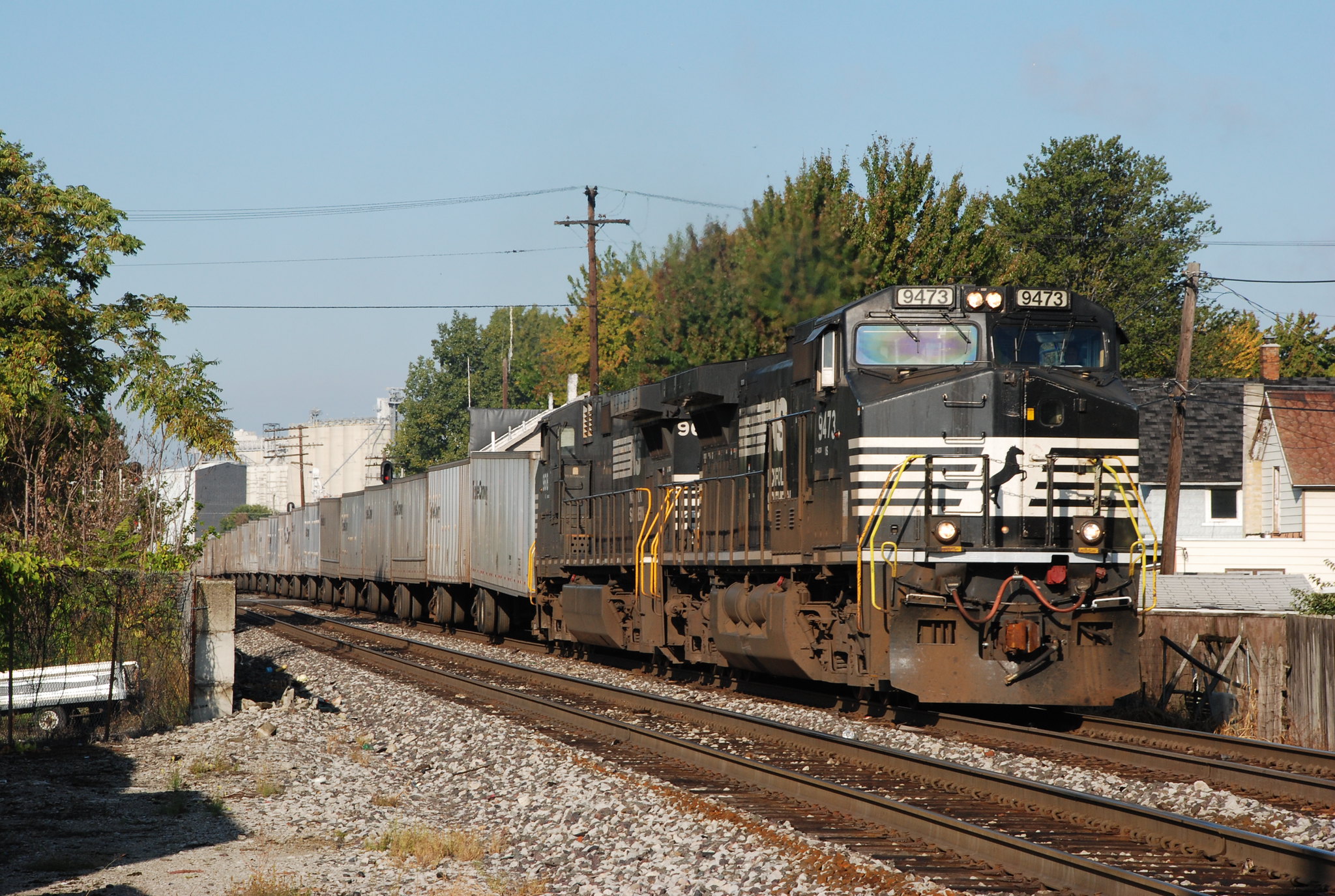
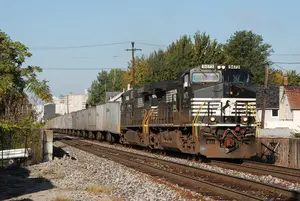
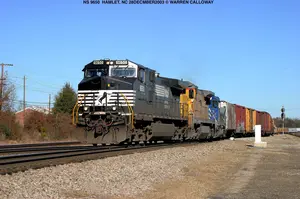
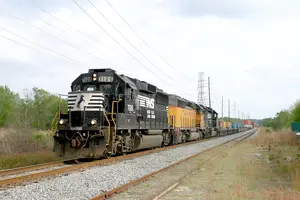
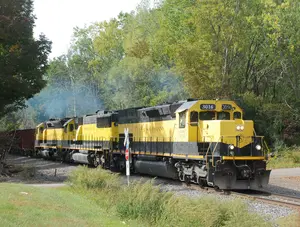
A pair of Norfolk Southern C40-9Ws, led by #9473, are on an eastbound roadrailer train at Fostoria, Ohio on September 22, 2012. Doug Kroll photo.
What the release says the combination would add
A list of takeaways at the top of the release says the combination would add approximately 88,000 new single-line lanes, convert 10,000 existing interline movements to seamless service, and generate an estimated $3.5 billion in annual shipper savings through improved efficiency and reduced transportation costs. The body uses a longer lane description. It says the combination would introduce approximately 88,000 new county-to-county single-line lanes and convert 10,000 existing interline movements into seamless single-line service. The body estimates approximately $3.5 billion in annual shipper savings by shifting freight from higher-cost trucking to lower-cost rail.
The same section says the combination would connect more than 50,000 route miles across 43 states. The takeaways and a later section both say the companies expect the combination to shift approximately 2.1 million truckloads a year from highway to rail.
The takeaway calls the combination America’s first transcontinental railroad. The body calls it America’s first single-line transcontinental railroad. Both phrases are the companies’. The transcontinental railroad completed in 1869 is a separate line. The review schedule is the subject of the October account of the case.
What they told the room
“Is the United States better if it has a railroad that operates seamlessly from one end of the country to the other? Absolutely,” Vena said. “We will open up new products for customers that do not use railroads right now. That includes traffic within the watershed area and trucks that are on the highways now that we think we can convert to long-haul railroad business. All those things enhance the product and help America.”
“The network creates the opportunity, and we know execution will earn the result,” George said. “Delivering the benefits requires detailed integration planning, investment, disciplined execution and uninterrupted customer service.”
George said the defining competitive challenge is the freight on the highways. He said the remarks came one day after Norfolk Southern launched its 200th anniversary celebration. “After 200 years of innovation in this industry, it is time to do it again,” he said. “The opportunity is not to compete with trucking on trucking’s terms. It is to build a better-connected, more capable rail network that customers can use as easily as trucks.” He said that where single-line service is available, rail wins freight that would otherwise move by highway across every length of haul. “When single-line and interline service compete directly, shippers choose single-line service 72% of the time.”
“It’s a compelling case for America,” Vena said. “You’re going to get a U.S. railroad that has the best financials, and the best operating and service metrics, that will be able to operate across the country.”
The filing they described
The release says leaders from both companies have met with customers, short lines, ports, labor organizations, employees, policymakers, and other stakeholders since the combination was announced in July 2025. Those talks, it says, helped the companies add customer protections that go beyond those in any prior rail merger. It says the application is backed by traffic data from all six North American Class I railroads, approximately $2 billion in planned integration investment, and more than 2,000 letters of stakeholder support.
A later section lists the commitments again. It names expanded customer protections, service-level protections, stronger oversight, and jobs-for-life agreements for all union employees working at the time of the merger. It also names approximately $2 billion in planned investment to support technology, capacity, and terminal improvements. The release prints that investment figure in both places.
The company descriptions in the release say Union Pacific operates in 23 western states. They say Norfolk Southern, in business since 1827, operates a 22-state network, helps customers avoid approximately 15 million tons of carbon emissions a year, and delivers approximately 7 million carloads a year.
Other filings in the same case are already on this site. The Georgia Ports Authority is supporting the merger. The American Farm Bureau Federation asked the Board to reject it. J.B. Hunt asked the Board to deny the application.
Related reading on American-Rails.com
- Georgia Ports Backs the Union Pacific-Norfolk Southern Merger
- Farm Bureau Asks the Board to Reject the Union Pacific-Norfolk Southern Merger
- J.B. Hunt Asks the Board to Deny the UP-NS Merger
- Union Pacific-Norfolk Southern Merger Review Runs to 2027
- Transcontinental Railroad: Maps, Facts, Completion
- Rail News
Sources
- Union Pacific and Norfolk Southern, November 23, 2026, “Union Pacific and Norfolk Southern CEOs: A Year of Listening Reinforces the Need for a Simpler, More Competitive Rail Network.” https://www.up-nstranscontinental.com/news-details/railtrends-a-year-of-listening/ Omaha and Atlanta. RailTrends 2026 in New York. Jim Vena and Mark George. Takeaway figures: approximately 88,000 new single-line lanes, 10,000 interline movements converted to seamless service, an estimated $3.5 billion in annual shipper savings through improved efficiency and reduced transportation costs, and approximately 2.1 million truckloads a year. Body figures: approximately 88,000 new county-to-county single-line lanes, the same 10,000 movements described as seamless single-line service, approximately $3.5 billion by shifting freight from higher-cost trucking to lower-cost rail, and more than 50,000 route miles across 43 states. The takeaway calls the combination America’s first transcontinental railroad. The body calls it America’s first single-line transcontinental railroad. Announced July 2025. Traffic data from all six North American Class I railroads. Approximately $2 billion in planned integration investment, and more than 2,000 letters. A later sentence names approximately $2 billion for technology, capacity, and terminal improvements. Jobs-for-life agreements for union employees working at the time of the merger. Shippers choose single-line service 72 percent of the time when single-line and interline service compete directly. The remarks came one day after the Norfolk Southern 200th anniversary celebration. Union Pacific operates in 23 western states. Norfolk Southern: since 1827, a 22-state network, approximately 15 million tons of yearly carbon emissions avoided, and approximately 7 million carloads a year.
Recent Articles


-
Pittsburgh Marks the Inaugural Second Pennsylvanian
Nov 27, 26 11:24 AM
 The second daily Pennsylvanian made its inaugural run on November 18, 2026. PennDOT said it will allocate $318.7 million in state and federal funding toward the expansion.
-
RailTrends Speakers Recap a Year of Listening
Nov 27, 26 11:08 AM
 Jim Vena and Mark George told RailTrends 2026 that a year of talks supports a simpler network, with about 88,000 new single-line lanes and about $3.5 billion in annual shipper savings.
-
CSX Will Serve the Niron Magnetics Plant in Dothan
Nov 27, 26 10:46 AM
CSX on November 23, 2026, joined Niron Magnetics in announcing a $1.8 billion magnet campus on the rail-served Westgate Super Site in Dothan, Alabama. -
Board Proposes Changes to Trail Use and Railbanking
Nov 27, 26 10:44 AM
 The Surface Transportation Board on November 24, 2026, proposed to take interim trail-use negotiations outside its process. Comments are due January 8, 2027.
-
Farm Bureau Asks the Board to Reject the UP-NS Merger
Nov 27, 26 10:43 AM
The American Farm Bureau Federation on November 24, 2026, asked the Surface Transportation Board to reject the Union Pacific application to acquire Norfolk Southern. -
U.S. Rail Traffic Rose 4.7 Percent in the Week Ending November 21
Nov 27, 26 10:33 AM
U.S. railroads moved 540,111 carloads and intermodal units in the week ending November 21, 2026, up 4.7 percent, the Association of American Railroads reported. -
Tulip Viaduct Bridge (Indiana): Trains, Map, History
Nov 26, 26 12:03 AM
 Tulip Viaduct, the railroad bridge over Richland Creek in Greene County, Indiana. Opened accounts give 2,215 feet, 2,295 feet, and 2,000 feet. The Indiana Rail Road still crosses.
-
"Super Chief" (Train): Schedule, Interior, Route
Nov 25, 26 11:40 PM
 The Santa Fe Super Chief, Chicago to Los Angeles, May 12, 1936 to May 18, 1974. The 39-hour-and-45-minute card, the Budd rooms, Fred Harvey, and the Turquoise Room.
-
Salisbury Viaduct: From Trains To Recreational Use
Nov 25, 26 03:05 PM
 Salisbury Viaduct, the Western Maryland bridge west of Meyersdale, Pennsylvania. 1,908 feet, and 101 feet above the Casselman River. The Great Allegheny Passage uses the deck.
-
Rockville Railroad Bridge (Marysville, PA): Map, History
Nov 25, 26 02:57 PM
 Rockville Bridge, the Pennsylvania Railroad stone arches over the Susquehanna between Rockville and Marysville. Opened March 30, 1902. Norfolk Southern still crosses.
-
Norfolk Southern Demurrage at Fairless Yard Can Stand
Nov 25, 26 02:40 PM
The Surface Transportation Board on November 17, 2026, said Yookel and B&J Group have not shown that CSX and Norfolk Southern wrongly charged demurrage at Fairless Yard. -
Georgia Ports Backs the Union Pacific-Norfolk Southern Merger
Nov 25, 26 02:36 PM
 The Georgia Ports Authority on November 24, 2026, supported the proposed Union Pacific-Norfolk Southern merger, joining more than 2,000 backers named by the railroads.
-
Amtrak Faces a $774,476 Grant Repayment
Nov 25, 26 02:12 PM
Amtrak’s inspector general reported on November 19, 2026, that the Federal Railroad Administration will seek $774,476 back from three grant contracts. -
Board Opens a Proceeding on Union Pacific Dispatching
Nov 25, 26 01:21 PM
The Surface Transportation Board on November 19, 2026, opened a case on BNSF’s claim that Union Pacific is not giving BNSF trains equal dispatch under the 1996 merger conditions. -
Amtrak Reports a Record 37.1 Million Trips in Fiscal 2026
Nov 25, 26 01:16 PM
Amtrak reported 37.1 million customer trips in fiscal 2026, up 7.4 percent, with operating revenue of $4.1 billion. The ridership fact sheet totals 37,067,685 trips. -
Gateway Starts the Second Hudson Tunnel Boring Machine
Nov 25, 26 12:52 PM
 The Gateway Development Commission said on November 18, 2026, that a second tunnel boring machine has started the southern tube of the new Hudson rail tunnel.
-
J.B. Hunt Asks the Board to Deny the UP-NS Merger
Nov 25, 26 12:40 PM
J.B. Hunt asked the Surface Transportation Board on November 18, 2026, to deny the Union Pacific-Norfolk Southern merger application in Finance Docket No. 36873. -
U.S. Rail Traffic Rose 7.3 Percent in the Week Ending November 14
Nov 25, 26 11:54 AM
 U.S. railroads moved 529,919 carloads and intermodal units in the week ending November 14, 2026, up 7.3 percent from a year earlier, the Association of American Railroads said on November 18.
-
Newark Bay Bridge (Railroad): Disaster, Photos, History
Nov 25, 26 11:42 AM
 The Central Railroad of New Jersey’s Newark Bay Bridge, J.A.L. Waddell’s vertical-lift crossing between Elizabethport and Bayonne, and the wreck of train 3314 on September 15, 1958.
-
Adirondack Railroad Lists Winter Trains
Nov 25, 26 11:36 AM
 The Adirondack Railroad lists a Santa Train and an Adirondack Christmas Train for November 27, 28, and 29. The November 9 notice also lists Tupper Lake trains and a Polar Express date range.
-
East Broad Top Lists Christmas in Coal Country
Nov 25, 26 11:31 AM
The East Broad Top lists Christmas in Coal Country from November 27 through December 20, 2026, Friday through Sunday. Coach fares are $28 for adults and $22 for children. -
Oregon Coast Scenic Lists the Candy Cane Express
Nov 25, 26 11:24 AM
Oregon Coast Scenic lists the Candy Cane Express from November 27 through December 23, 2026. The page prints peak and regular fares and says motive power is subject to change. -
Oregon Rail Heritage Center Lists the Holiday Express
Nov 25, 26 11:16 AM
The Oregon Rail Heritage Center lists Holiday Express trains from November 27 through December 27. Adult tickets are $35, and admission to the center is included. -
Kinzua Viaduct Bridge (PA): Map, History, Trains
Nov 25, 26 12:36 AM
 Kinzua Viaduct over Kinzua Creek in McKean County. Iron bridge of 1882, steel bridge of 1900. Eleven towers fell on July 21, 2003. The skywalk opened September 15, 2011.
-
Keystone Viaduct: An Engineering Marvel Transformed
Nov 25, 26 12:33 AM
 Keystone Viaduct, the Western Maryland bridge of 1911 near Meyersdale, Pennsylvania. The Connellsville Extension opened August 1, 1912. The Great Allegheny Passage uses the deck.
-
Herndon Lists a Caboose Open House
Nov 25, 26 12:29 AM
The Herndon Fortnightly Library lists the 22nd annual Holiday Model Train Show for December 5, 2026. The Herndon Caboose on Lynn Street is open that day from 11 a.m. to 2 p.m. -
Hoosier Valley Receives a Wheelchair Lift
Nov 25, 26 12:23 AM
The Hoosier Valley Railroad Museum raised more than $20,000 for a mobile wheelchair lift. The lift is at the museum in North Judson and is planned for the Santa trains. -
National Museum Opens the South Car Works
Nov 25, 26 12:22 AM
 The National Museum of Railroad History and Innovation will open the restored South Car Works in Baltimore on January 28, 2027, one month before the Baltimore and Ohio bicentennial.
-
Sierra Railway No. 28 Returns to Steam
Nov 25, 26 12:15 AM
 Sierra Railway No. 28, a 1922 Baldwin 2-8-0, is under steam again at Railtown 1897 in Jamestown. The park has scheduled it for holiday trains and for 2027 excursions.
-
Cranberry Grade (B&O): Map, Operation, History
Nov 24, 26 11:49 PM
 Cranberry Grade is the Baltimore & Ohio climb from Rowlesburg and M&K Junction to Terra Alta. Piedmont opened July 21, 1851. Fairmont opened June 22, 1852.
-
Saluda Railroad Grade (NC): Map, History, Trail
Nov 24, 26 11:45 PM
 Saluda Grade, the Asheville and Spartanburg climb at Saluda, North Carolina. First train July 4, 1878. The 1987 marker gives 4.7 feet in every 100. Trail purchase completed June 17, 2025.
-
Hell Gate Bridge: Facts, Height, Construction, Images
Nov 24, 26 10:31 PM
 Hell Gate Bridge, Gustav Lindenthal’s four-track arch from Astoria to Wards Island. The arch was completed in September 1916. Samuel Rea dedicated it on March 9, 1917.
-
Sherman Hill, Tackling Wyoming's Black Hills
Nov 24, 26 09:48 PM
 Sherman Hill, the Union Pacific climb from Cheyenne to Laramie. The 1868 summit, the 1901 tunnel line, and the westbound line opened in 1953.
-
Cascade Tunnel (Washington): Map, Avalanche, Ventilation
Nov 24, 26 03:01 PM
 Cascade Tunnel at Stevens Pass, Scenic to Berne. The 1900 bore and the tunnel opened January 12, 1929. Wellington, the wires that came down in 1956, and the railroad that still uses it.
-
Moffat Tunnel (Colorado): Ventilation, Length, Facts, Map
Nov 24, 26 01:31 PM
 Moffat Tunnel under James Peak, about 50 miles west of Denver. The Commission bore, holed through July 7, 1927, and opened February 26, 1928. More than six miles, at about 9,200 feet, and still a Unio…
-
B&O's Thomas Viaduct (Bridge): History and Photos
Nov 24, 26 01:26 PM
 Thomas Viaduct at Relay, Maryland. Eight stone arches of the Baltimore & Ohio Washington Branch over the Patapsco, finished July 4, 1835. Latrobe, McCartney, and the railroad that still crosses.
-
Cookeville Depot Caboose Gets a State Grant
Nov 24, 26 01:01 PM
 The Friends of the Cookeville Depot Museum received a $12,000 Tennessee grant to restore the Tennessee Central caboose. The car has been closed to visitors since the COVID pandemic.
-
CSX Opens a Vote on Four CSX 200 Paint Schemes
Nov 24, 26 12:41 PM
 CSX recently posted four paint schemes for a CSX 200 locomotive and will take votes fronm the public through November 25.
-
Reading & Northern Schedules 2102 for Wilkes-Barre
Nov 24, 26 12:33 PM
Times Leader reported on November 23, 2026, that Reading and Northern signed the Luzerne County rail purchase and scheduled steam locomotive 2102 for a Wilkes-Barre display on November 24. -
Great Northern 1355 Cab Comes Off in Sioux City
Nov 24, 26 11:38 AM
On November 19, 2026, crews lifted the cab off Great Northern 1355 at the Sioux City Railroad Museum. The project manager estimates test runs sometime in 2029. -
Norwood & St. Lawrence 210 Arrives in Madrid
Nov 24, 26 11:35 AM
WWNY reported on November 20, 2026, that Norwood and St. Lawrence locomotive 210 arrived at the St. Lawrence Power and Equipment Museum in Madrid, New York -
Huntsville Depot Vote on Railroad Equipment Is Delayed
Nov 24, 26 11:31 AM
On November 19, 2026, the Huntsville City Council postponed a vote on moving 12 pieces of railroad equipment off the Huntsville Depot. The next date is December 3. -
CNJ Train Shed Work Is Underway at Liberty State Park
Nov 24, 26 11:29 AM
 Railfan and Railroad reported on November 17, 2026, that New Jersey is installing temporary supports on the 1914 Central Railroad of New Jersey train shed in Jersey City.
-
Starrucca Viaduct: Completed By The NY&E (1848)
Nov 24, 26 11:06 AM
 Starrucca Viaduct at Lanesboro, Pennsylvania. Stone arches of the New York & Erie, 1,040 feet, first locomotive December 9, 1848. Adams, Kirkwood, and the railroad that still crosses.
-
Hoosac Tunnel (Massachusetts): Map, Length, Location, History
Nov 23, 26 11:59 PM
 Hoosac Tunnel, Florida to North Adams, Massachusetts. 25,081 feet. First train February 9, 1875. Haupt, the Shanlys, 1911 electrification, and Berkshire & Eastern freight today.
-
Tehachapi Loop Grade: Map, Passenger Trains, History
Nov 23, 26 11:47 PM
 Tehachapi Loop, at Walong in Kern County. William Hood, opened 1876. The 77-foot spiral, Santa Fe trackage rights, and Union Pacific and BNSF service today.
-
Horseshoe Curve (Pennsylvania): Map, Photos, History, Operation
Nov 23, 26 11:37 PM
 Horseshoe Curve, west of Altoona. Thomson and Haupt, opened February 15, 1854. Grades, Gallitzin tunnels, helpers, and Norfolk Southern service today.
-
John I. Blair: Net Worth, Railroads, Biography
Nov 23, 26 10:41 PM
 John Insley Blair was born August 22, 1802, in Warren County, New Jersey. He helped build the road that became the Delaware, Lackawanna and Western, and he took an interest in the Cedar Rapids and Mis…
-
Russell Sage: Net Worth, Railroads, Biography
Nov 23, 26 10:33 PM
 Russell Sage was born August 4, 1816. The Congressional biography says Shenandoah, Oneida County, New York. Britannica says Verona. He died July 22, 1906. Britannica estimates the fortune at $70 milli…
-
Henry E. Huntington: Net Worth, Railroads, Biography
Nov 23, 26 09:04 PM
 Henry Edwards Huntington was born February 27, 1850, in Oneonta, New York. He developed the Pacific Electric in Los Angeles and founded the Huntington Library. He died May 23, 1927. The estate tax ret…