J.B. Hunt Asks the Board to Deny the UP-NS Merger
Published: November 25, 2026
By: Adam Burns
WASHINGTON — J.B. Hunt Transport asked the Surface Transportation Board on November 18 to deny the revised application for Union Pacific to acquire Norfolk Southern. The comments are in Finance Docket No. 36873. Hunt says a merger on the terms in that application would likely result in more harm than benefit for its intermodal customers, and that the merger would not be consistent with the public interest.
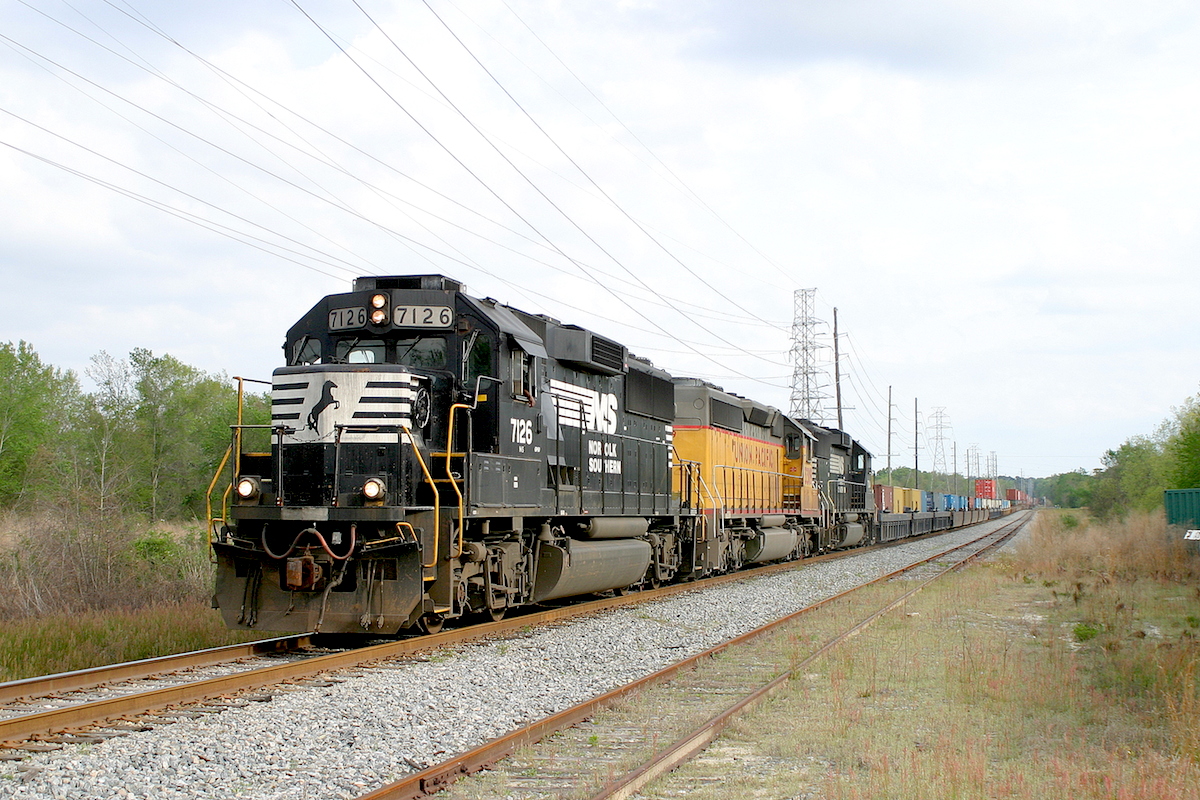
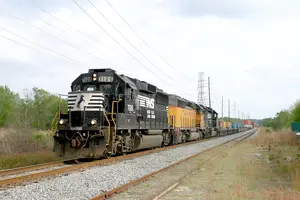
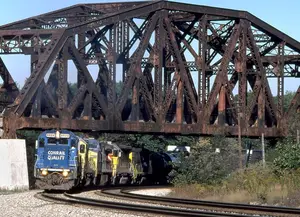
Norfolk Southern GP60 #7126, a Union Pacific unit, and another GP60 lead containers near Savannah, Georgia on April 6, 2005. Warren Calloway photo.
What Hunt told the Board it moves
The public filing says Hunt moved about 2.25 million intermodal loads in the past 12 months, more than 120,000 above the 12 months before that. Loads grew from about 1.77 million in 2015 to about 2.14 million in 2025. Company revenue from trucking, brokerage, and intermodal was over $13 billion in the past 12 months. The intermodal business generated about $6 billion in 2025. Hunt says it owns nearly 125,000 containers and 105,000 chassis, and operates about 20,000 tractors and 48,000 trailers. It puts that container fleet at nearly one-third of North American 53-foot dry-container capacity, and it says it employs over 32,000 people.
Hunt describes itself as the largest intermodal customer of BNSF and of Norfolk Southern, and as one of the largest intermodal customers of CSX. Western traffic moves under a joint service with BNSF that dates from 1996. An eastern agreement with Norfolk Southern dates from 2009. Chicago is the main interchange for the joint movements that continue into the Northeast. The public version redacts the customer count.
The truck-to-rail forecast
Hunt says the revised application projects that about 2.1 million long-haul truckloads would shift to the combined railroad, a figure that includes about 1.2 million intermodal loads a year, phased in over three years. Darren Field, Hunt executive vice president and president of intermodal, reads the ramp as 40 percent in the first year, or 480,000 loads, then 70 percent, or 840,000, and then the full 1.2 million. Hunt says its largest intermodal growth year was 2013, at 181,000 new loads. In 2016 it aimed for 200,000 new loads and added 144,000. Since 2016 the average has been 47,000 loads of growth a year.
The same comments describe the application savings case as about $3.5 billion a year for shippers. Hunt says the application reaches that net from a $7.3 billion gross reduction in long-haul truck spending and about $3.8 billion in replacement rail and drayage costs. Diverted traffic is estimated to bring the railroad about $4.0 billion in revenue, with about $2.3 billion of that from intermodal. Hunt says the application sets drayage at about $0.4 billion for the 1.2 million loads, and that its own experience, more than 4 million drayage moves a year, puts the real cost higher. Field says another 1.2 million loads a year would take more than 60,000 additional 53-foot containers, plus chassis, drivers, and terminal space.
Hunt writes that a rail route, even one with a competitive price and a fast transit time, does not by itself move a customer off the highway. Its own research puts the industry-wide chance to convert truck freight to intermodal at about 9.8 million to 11.2 million loads a year on routes and interline arrangements that already exist. The comments also say the applicants’ Committed Gateway Pricing proposal leaves intermodal traffic out.
Gateways, and the conditions Hunt lists
Hunt says the gateway conditions used in the CPKC merger did not keep its Mexico traffic on the Laredo gateway. The public version redacts the before-and-after Laredo volumes and the rate changes. It does describe the service: by the first quarter of 2025, about 10 percent of freight from Monterrey and San Luis Potosí was left at the origin ramp for seven or more days, and some freight sat as long as 20 days. Hunt says a customs bond expires after 30 days. The largest lanes, Monterrey and San Luis Potosí to Austell, Georgia, were taking 12 to 15 days. Hunt moved that traffic to a Ferromex, BNSF, and Norfolk Southern routing through Eagle Pass. That path is 3,322 rail miles to Atlanta, which Hunt says is 1,570 miles longer than the CPKC routing through Laredo, and it ran faster and more steadily.
The comments ask the Board to deny the application. If the Board approves it, Hunt says the minimum conditions include trackage rights into Harrisburg, either for BNSF from Chicago to Harrisburg, for CSX from Chambersburg to Harrisburg, or for both. It also asks for enforceable intermodal service standards and for Board oversight of at least 10 years.
Hunt told the Board that some customers would not file in their own names. The comments say that after a public video of Union Pacific chief executive Jim Vena, in which he spoke of raising rates for customers who did not support the merger in order to “teach them a lesson,” one customer dropped a plan to file. The order to release that video is already on this site. The merger review timetable is covered here as well.
Related reading on American-Rails.com
- Union Pacific-Norfolk Southern Merger Review Runs to 2027
- Video of the Vena Address Must Be Released
- Schneider Will Shift Its Eastern Intermodal Freight to Norfolk Southern
- Georgia Marks the Opening of the Gainesville Inland Port
- Union Pacific Railroad: Map, History, Logo
- Norfolk Southern Railway: Map, History, Logo
- Rail News
Sources
- J.B. Hunt Transport, Inc., Opening Comments, public version, Finance Docket No. 36873, Union Pacific Corporation and Union Pacific Railroad Company—Control—Norfolk Southern Corporation and Norfolk Southern Railway Company, signed November 18, 2026, and the Verified Statement of Darren Field in the same filing. https://dcms-external.s3.amazonaws.com/DCMS_External_PROD/1795095064744/313053.pdf Filed under the schedule in Decision No. 30, served August 18, 2026. Revised application accepted May 28, 2026. Hunt asks the Board to deny the application. More harm than benefit. About 2.25 million intermodal loads in the past 12 months, up more than 120,000. About 1.77 million loads in 2015 and about 2.14 million in 2025. Revenue over $13 billion in the past 12 months. Intermodal revenue about $6 billion in 2025. Nearly 125,000 containers, 105,000 chassis, about 20,000 tractors, 48,000 trailers, over 32,000 employees. Largest intermodal customer of BNSF and Norfolk Southern. One of the largest of CSX. The application, as Hunt describes it, projects about 2.1 million long-haul truckloads shifting to rail, including about 1.2 million intermodal loads a year. Field ramp: 480,000, then 840,000, then 1.2 million. Hunt growth: 181,000 new loads in 2013; 144,000 added in 2016 against a target of 200,000; average 47,000 a year since 2016. Shipper savings described as about $3.5 billion net, from $7.3 billion gross and $3.8 billion replacement cost. Railroad revenue about $4.0 billion, about $2.3 billion intermodal. More than 60,000 additional 53-foot containers. Industry conversion opportunity about 9.8 million to 11.2 million loads a year. Committed Gateway Pricing excludes intermodal. Laredo volumes and rate figures are redacted in the public version. Service account: about 10 percent of Monterrey and San Luis Potosí freight left seven or more days in the first quarter of 2025; some freight up to 20 days; customs bond 30 days; Austell lanes 12 to 15 days; Eagle Pass routing 3,322 rail miles and 1,570 miles longer. Conditions if approved: Harrisburg trackage rights, enforceable intermodal service standards, oversight of at least 10 years. Customer reaction to the Jim Vena video, in Hunt’s words. Customer counts are redacted.
Recent Articles


-
Gateway Starts the Second Hudson Tunnel Boring Machine
Nov 25, 26 12:52 PM
 The Gateway Development Commission said on November 18, 2026, that a second tunnel boring machine has started the southern tube of the new Hudson rail tunnel.
-
J.B. Hunt Asks the Board to Deny the UP-NS Merger
Nov 25, 26 12:40 PM
 J.B. Hunt asked the Surface Transportation Board on November 18, 2026, to deny the Union Pacific-Norfolk Southern merger application in Finance Docket No. 36873.
-
U.S. Rail Traffic Rose 7.3 Percent in the Week Ending November 14
Nov 25, 26 11:54 AM
 U.S. railroads moved 529,919 carloads and intermodal units in the week ending November 14, 2026, up 7.3 percent from a year earlier, the Association of American Railroads said on November 18.
-
Newark Bay Bridge (Railroad): Disaster, Photos, History
Nov 25, 26 11:42 AM
 The Central Railroad of New Jersey’s Newark Bay Bridge, J.A.L. Waddell’s vertical-lift crossing between Elizabethport and Bayonne, and the wreck of train 3314 on September 15, 1958.
-
Adirondack Railroad Lists Winter Trains
Nov 25, 26 11:36 AM
 The Adirondack Railroad lists a Santa Train and an Adirondack Christmas Train for November 27, 28, and 29. The November 9 notice also lists Tupper Lake trains and a Polar Express date range.
-
East Broad Top Lists Christmas in Coal Country
Nov 25, 26 11:31 AM
The East Broad Top lists Christmas in Coal Country from November 27 through December 20, 2026, Friday through Sunday. Coach fares are $28 for adults and $22 for children. -
Oregon Coast Scenic Lists the Candy Cane Express
Nov 25, 26 11:24 AM
Oregon Coast Scenic lists the Candy Cane Express from November 27 through December 23, 2026. The page prints peak and regular fares and says motive power is subject to change. -
Oregon Rail Heritage Center Lists the Holiday Express
Nov 25, 26 11:16 AM
 The Oregon Rail Heritage Center lists Holiday Express trains from November 27 through December 27. Adult tickets are $35, and admission to the center is included.
-
Kinzua Viaduct Bridge (PA): Map, History, Trains
Nov 25, 26 12:36 AM
 Kinzua Viaduct over Kinzua Creek in McKean County. Iron bridge of 1882, steel bridge of 1900. Eleven towers fell on July 21, 2003. The skywalk opened September 15, 2011.
-
Keystone Viaduct: An Engineering Marvel Transformed
Nov 25, 26 12:33 AM
 Keystone Viaduct, the Western Maryland bridge of 1911 near Meyersdale, Pennsylvania. The Connellsville Extension opened August 1, 1912. The Great Allegheny Passage uses the deck.
-
Herndon Lists a Caboose Open House
Nov 25, 26 12:29 AM
The Herndon Fortnightly Library lists the 22nd annual Holiday Model Train Show for December 5, 2026. The Herndon Caboose on Lynn Street is open that day from 11 a.m. to 2 p.m. -
Hoosier Valley Receives a Wheelchair Lift
Nov 25, 26 12:23 AM
The Hoosier Valley Railroad Museum raised more than $20,000 for a mobile wheelchair lift. The lift is at the museum in North Judson and is planned for the Santa trains. -
National Museum Opens the South Car Works
Nov 25, 26 12:22 AM
 The National Museum of Railroad History and Innovation will open the restored South Car Works in Baltimore on January 28, 2027, one month before the Baltimore and Ohio bicentennial.
-
Sierra Railway No. 28 Returns to Steam
Nov 25, 26 12:15 AM
 Sierra Railway No. 28, a 1922 Baldwin 2-8-0, is under steam again at Railtown 1897 in Jamestown. The park has scheduled it for holiday trains and for 2027 excursions.
-
Cranberry Grade (B&O): Map, Operation, History
Nov 24, 26 11:49 PM
 Cranberry Grade is the Baltimore & Ohio climb from Rowlesburg and M&K Junction to Terra Alta. Piedmont opened July 21, 1851. Fairmont opened June 22, 1852.
-
Saluda Railroad Grade (NC): Map, History, Trail
Nov 24, 26 11:45 PM
 Saluda Grade, the Asheville and Spartanburg climb at Saluda, North Carolina. First train July 4, 1878. The 1987 marker gives 4.7 feet in every 100. Trail purchase completed June 17, 2025.
-
Hell Gate Bridge: Facts, Height, Construction, Images
Nov 24, 26 10:31 PM
 Hell Gate Bridge, Gustav Lindenthal’s four-track arch from Astoria to Wards Island. The arch was completed in September 1916. Samuel Rea dedicated it on March 9, 1917.
-
Sherman Hill, Tackling Wyoming's Black Hills
Nov 24, 26 09:48 PM
 Sherman Hill, the Union Pacific climb from Cheyenne to Laramie. The 1868 summit, the 1901 tunnel line, and the westbound line opened in 1953.
-
Cascade Tunnel (Washington): Map, Avalanche, Ventilation
Nov 24, 26 03:01 PM
 Cascade Tunnel at Stevens Pass, Scenic to Berne. The 1900 bore and the tunnel opened January 12, 1929. Wellington, the wires that came down in 1956, and the railroad that still uses it.
-
Moffat Tunnel (Colorado): Ventilation, Length, Facts, Map
Nov 24, 26 01:31 PM
 Moffat Tunnel under James Peak, about 50 miles west of Denver. The Commission bore, holed through July 7, 1927, and opened February 26, 1928. More than six miles, at about 9,200 feet, and still a Unio…
-
B&O's Thomas Viaduct (Bridge): History and Photos
Nov 24, 26 01:26 PM
 Thomas Viaduct at Relay, Maryland. Eight stone arches of the Baltimore & Ohio Washington Branch over the Patapsco, finished July 4, 1835. Latrobe, McCartney, and the railroad that still crosses.
-
Cookeville Depot Caboose Gets a State Grant
Nov 24, 26 01:01 PM
 The Friends of the Cookeville Depot Museum received a $12,000 Tennessee grant to restore the Tennessee Central caboose. The car has been closed to visitors since the COVID pandemic.
-
CSX Opens a Vote on Four CSX 200 Paint Schemes
Nov 24, 26 12:41 PM
 CSX recently posted four paint schemes for a CSX 200 locomotive and will take votes fronm the public through November 25.
-
Reading & Northern Schedules 2102 for Wilkes-Barre
Nov 24, 26 12:33 PM
Times Leader reported on November 23, 2026, that Reading and Northern signed the Luzerne County rail purchase and scheduled steam locomotive 2102 for a Wilkes-Barre display on November 24. -
Great Northern 1355 Cab Comes Off in Sioux City
Nov 24, 26 11:38 AM
On November 19, 2026, crews lifted the cab off Great Northern 1355 at the Sioux City Railroad Museum. The project manager estimates test runs sometime in 2029. -
Norwood & St. Lawrence 210 Arrives in Madrid
Nov 24, 26 11:35 AM
WWNY reported on November 20, 2026, that Norwood and St. Lawrence locomotive 210 arrived at the St. Lawrence Power and Equipment Museum in Madrid, New York -
Huntsville Depot Vote on Railroad Equipment Is Delayed
Nov 24, 26 11:31 AM
On November 19, 2026, the Huntsville City Council postponed a vote on moving 12 pieces of railroad equipment off the Huntsville Depot. The next date is December 3. -
CNJ Train Shed Work Is Underway at Liberty State Park
Nov 24, 26 11:29 AM
 Railfan and Railroad reported on November 17, 2026, that New Jersey is installing temporary supports on the 1914 Central Railroad of New Jersey train shed in Jersey City.
-
Starrucca Viaduct: Completed By The NY&E (1848)
Nov 24, 26 11:06 AM
 Starrucca Viaduct at Lanesboro, Pennsylvania. Stone arches of the New York & Erie, 1,040 feet, first locomotive December 9, 1848. Adams, Kirkwood, and the railroad that still crosses.
-
Hoosac Tunnel (Massachusetts): Map, Length, Location, History
Nov 23, 26 11:59 PM
 Hoosac Tunnel, Florida to North Adams, Massachusetts. 25,081 feet. First train February 9, 1875. Haupt, the Shanlys, 1911 electrification, and Berkshire & Eastern freight today.
-
Tehachapi Loop Grade: Map, Passenger Trains, History
Nov 23, 26 11:47 PM
 Tehachapi Loop, at Walong in Kern County. William Hood, opened 1876. The 77-foot spiral, Santa Fe trackage rights, and Union Pacific and BNSF service today.
-
Horseshoe Curve (Pennsylvania): Map, Photos, History, Operation
Nov 23, 26 11:37 PM
 Horseshoe Curve, west of Altoona. Thomson and Haupt, opened February 15, 1854. Grades, Gallitzin tunnels, helpers, and Norfolk Southern service today.
-
John I. Blair: Net Worth, Railroads, Biography
Nov 23, 26 10:41 PM
 John Insley Blair was born August 22, 1802, in Warren County, New Jersey. He helped build the road that became the Delaware, Lackawanna and Western, and he took an interest in the Cedar Rapids and Mis…
-
Russell Sage: Net Worth, Railroads, Biography
Nov 23, 26 10:33 PM
 Russell Sage was born August 4, 1816. The Congressional biography says Shenandoah, Oneida County, New York. Britannica says Verona. He died July 22, 1906. Britannica estimates the fortune at $70 milli…
-
Henry E. Huntington: Net Worth, Railroads, Biography
Nov 23, 26 09:04 PM
 Henry Edwards Huntington was born February 27, 1850, in Oneonta, New York. He developed the Pacific Electric in Los Angeles and founded the Huntington Library. He died May 23, 1927. The estate tax ret…
-
William A. Clark: Net Worth, Railroads, Biography
Nov 23, 26 04:31 PM
 William Andrews Clark was born January 8, 1839, near Connellsville, Pennsylvania. He was a senator from Montana and a builder of the San Pedro, Los Angeles and Salt Lake Railroad. He died March 2, 192…
-
"Train Of Tomorrow" (General Motors): A 1947 Concept
Nov 23, 26 04:08 PM
 General Motors Train of Tomorrow, 1947. E7A 765 and four Pullman-Standard Astra Dome cars, the 1947-1949 tour, the 1950 Union Pacific purchase, Portland-Seattle trains 457 and 458, and Moon Glow.
-
William B. Ogden: Net Worth, Railroads, Biography
Nov 23, 26 03:09 PM
 William Butler Ogden was born June 15, 1805, in Walton, New York. He was the first mayor of Chicago and a president of the Chicago and North Western and the Union Pacific. He died August 3, 1877.
-
CPKC Holiday Train Stops at Kansas City Union Station
Nov 23, 26 02:54 PM
 The CPKC Holiday Train is scheduled at Kansas City Union Station on November 27, 2026, from 6 to 6:45 p.m. Blue Springs is a first-time stop.
-
Hartford Line Adds Trains for Thanksgiving Week
Nov 23, 26 02:02 PM
 CTDOT is adding Hartford Line trains on November 24, 25, and 29, 2026. Thanksgiving Day is a Saturday schedule in the department release.
-
Asa Packer: Net Worth, Lehigh Valley Railroad, Biography
Nov 23, 26 01:51 PM
 Asa Packer was born December 29, 1805, in Mystic, Connecticut. He built the Lehigh Valley Railroad, served in Congress, and founded Lehigh University. He died May 17, 1879, in Philadelphia.
-
Steamtown Lists Moscow Holiday Express Trips
Nov 23, 26 01:41 PM
 Steamtown lists Holiday Express trips to Moscow on November 27, 28, and 29, 2026. The plan page says 11 a.m. to 2 p.m. Recreation.gov says 11 a.m. to 2:30 p.m.
-
Indiana Rail Experience Lists the Reindeer Run
Nov 23, 26 01:27 PM
 The Reindeer Run is a new one-hour Christmas train on November 27, 28, and 29, 2026, from Edon, Hudson, and South Milford. Coach starts at $17 and $30.
-
Sunset Limited Derails in Louisiana After Hitting a Truck
Nov 23, 26 08:59 AM
The eastbound Sunset Limited struck a truck hauling a bulldozer at a Broussard crossing on Sunday evening, November 22, 2026. Amtrak said 95 customers were aboard and that the passenger cars stayed up… -
David H. Moffat: Net Worth, Railroads, Biography
Nov 23, 26 12:24 AM
 David H. Moffat was born July 23, 1839, in Washingtonville, New York. He led the First National Bank of Denver and built the Moffat Road toward Salt Lake City. He died March 18, 1911.
-
William Jackson Palmer: Net Worth, Railroads, Biography
Nov 23, 26 12:15 AM
 William Jackson Palmer was born September 17, 1836, in Leipsic, Delaware. He built the Denver & Rio Grande and founded Colorado Springs. He died March 13, 1909.
-
Thomas C. Durant: Net Worth, Railroads, Biography
Nov 23, 26 12:00 AM
Thomas Clark Durant was born February 6, 1820, in Lee, Massachusetts. Vice president of the Union Pacific, he organized the Credit Mobilier. He died in 1885. -
Henry H. Rogers: Net Worth, Railroads, Biography
Nov 22, 26 11:54 PM
 Henry Huttleston Rogers, born January 29, 1840, was a Standard Oil vice-president who built the Virginian Railway. He died in New York on May 19, 1909.
-
Van Sweringen Brothers: Net Worth, Railroads, Biography
Nov 22, 26 11:38 PM
 Oris Paxton Van Sweringen, born April 24, 1879, near Wooster, Ohio, and Mantis James Van Sweringen, born July 8, 1881, developed Shaker Heights and a railroad system around the Nickel Plate. Oris died…
-
Alfred E. Perlman: President, Railroads, Biography
Nov 22, 26 12:33 AM
 Alfred Edward Perlman, born November 22, 1902, in St. Paul, was executive vice president of the Denver and Rio Grande Western, president of the New York Central, and president of the Western Pacific.