Milwaukee Road Class A 4-4-2: Specs, Roster, History
Published: September 28, 2026
By: Adam Burns
The Milwaukee Road’s Class A was four streamlined 4-4-2s, numbers 1–4, built by the American Locomotive Company at Schenectady from 1935 to 1937 for the Hiawatha. They were among the last Atlantics built in the United States, and the largest. Eighty-four-inch drivers, 19-by-28-inch cylinders, and a 300-pound boiler gave them 30,685 pounds of tractive effort. The railroad designed them to cruise above 100 miles an hour with a full-size train, and to be capable of two miles a minute.
Alco’s April 1935 card for the design is class 442 S 280, order S-1740. Numbers 1 and 2 are that order. Numbers 3 and 4 followed in 1936 and 1937 on later serials. All four were scrapped. None were preserved.
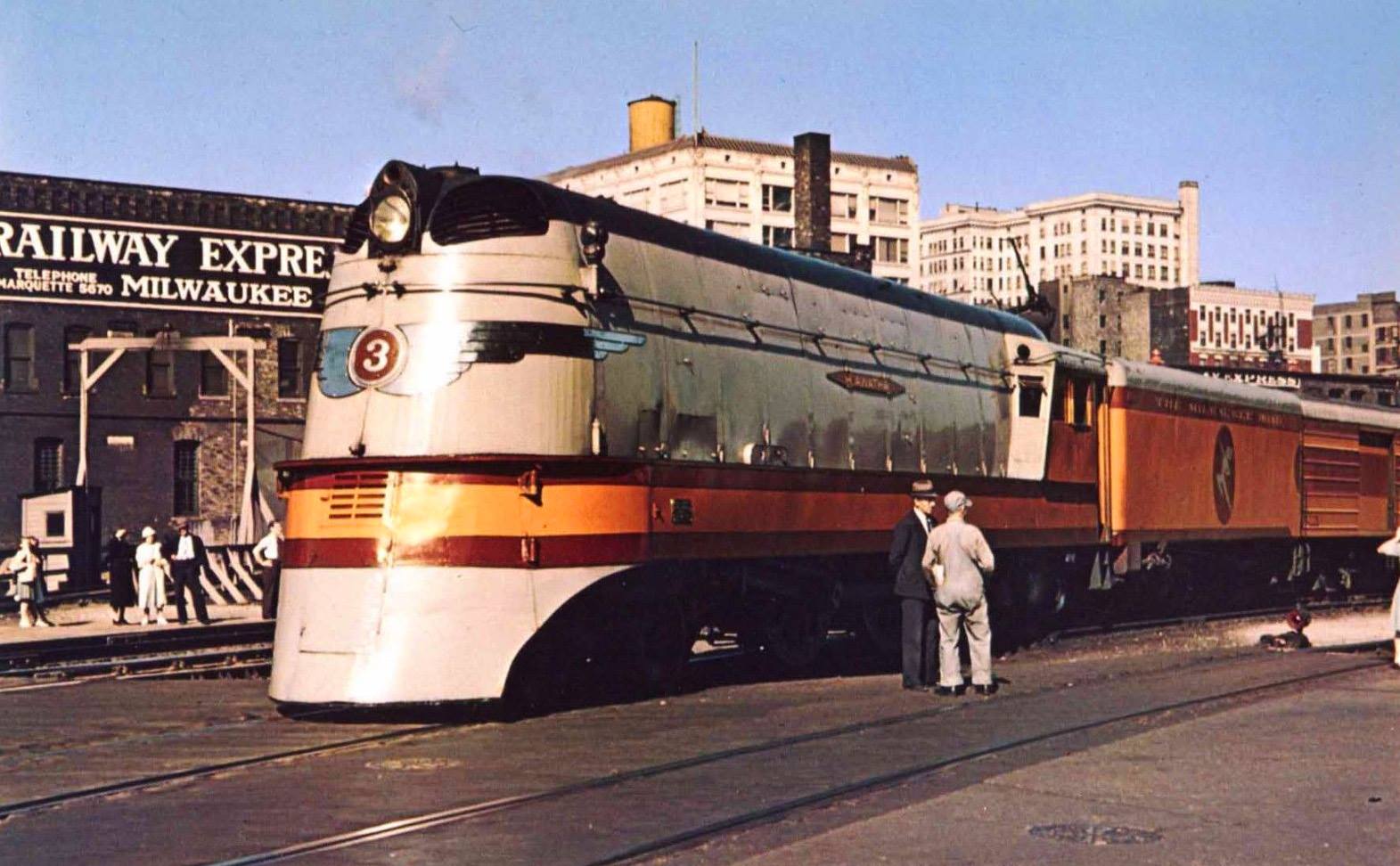
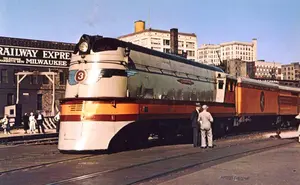
One of the Milwaukee Road’s lightning fast Class A 4-4-2s, #3 (according to Jim Scribbins’ book, “The Hiawatha Story,” she was outshopped from Alco on May 21, 1936), is seen here during a quick station stop at the Everett Street Depot in Milwaukee, Wisconsin with the “Hiawatha” (Chicago–St. Paul/Minneapolis) on September 17, 1939. The Atlantic normally cruised at 100 mph and covered the entire 409 miles from Chicago to St. Paul in just 390 minutes (6½ hours). To maintain its blistering schedule the railroad allowed just 2 minutes in Milwaukee for watering and handling passengers before the train was again on its way. Richard Kindig photo.
On this page: At a glance · A 4-4-2 for 1935 · What Alco delivered · The four engines · 112.5 miles an hour · Two minutes in Milwaukee · Hudsons, then the torch
At a glance
| Item | Detail |
|---|---|
| Railroad | Chicago, Milwaukee, St. Paul & Pacific. Class A. Road numbers 1–4 |
| Whyte | 4-4-2. The railroad also called the type a Milwaukee |
| Builder | American Locomotive Company, Schenectady. Alco class 442 S 280. Order S-1740 is the April 1935 card, covering 1 and 2 |
| Built | 1 and 2, May 1935. 3, outshopped May 21, 1936. 4, April 1937 |
| Serials | 68684, 68685, 68729, 68828 |
| Drivers and cylinders | 84 in drivers. Two cylinders, 19 × 28 in. Walschaerts gear. 10-inch piston valves. Main rods on the front driving axle |
| Boiler | 300 psi, conventionally staybolted. Oil fuel |
| Tractive effort | 30,685 lb. Factor of adhesion 4.70 on 144,300 lb on the drivers |
| Weight, as carded | Engine 280,000 lb. Tender, loaded, 247,000 lb. Engine and tender 527,000 lb |
| Weight, 1945 diagram | Tender 277,443 lb, with oil raised to 5,544 gallons. Engine and tender 563,443 lb. The engine then weighs out at 286,000 lb |
| Tender, as built | 13,000 gallons of water. 4,000 gallons of oil. Roller bearings on the engine and tender axles |
| Service | Hiawatha from May 29, 1935. Later the Morning and Afternoon Hiawathas, then the Midwest Hiawatha and secondary passenger trains |
| Retired | 3 in September 1949. 4 in June 1951. 1 and 2 in November 1951. All scrapped |
Card dimensions follow Alco’s April 1935 data card, class 442 S 280, order S-1740, supplied by Chris Hohl and digested by Steve Llanso, Locobase 106, together with the Milwaukee Road’s 1945 locomotive diagrams supplied by Allen Stanley. The May 21, 1936 outshopping of number 3 is Jim Scribbins, The Hiawatha Story. Information compiled September 28, 2026.
A 4-4-2 for 1935
Chicago to St. Paul was a three-railroad race. The Chicago & North Western put the 400 on in January 1935. The Burlington’s Zephyr followed in April. The Milwaukee had been hearing, since the fall of 1934, that its own answer was already on order: two streamlined Atlantics from Alco. The mechanical design was worked out with the railroad’s chief engineer, C. H. Bilty. Otto Kuhler designed the shroud.
An Atlantic looks like an odd choice for 1935. The type belonged to the turn of the century, and the Milwaukee’s own earlier 4-4-2s were Baldwin compounds, most of them gone by the early 1930s. Class A was a new engine. Four driving wheels kept the reciprocating weight down. The main rods drove the front axle. The drivers were 84 inches, so piston speed stayed reasonable when the train was at a hundred. A 300-pound boiler, one of the first conventionally staybolted boilers pressed that high, let the cylinders stay at 19 by 28 inches. Alfred Bruce, in The Steam Locomotive in America, credited that combination with a remarkably stable ride and called the four about the highest-speed steam locomotives yet built.
The railroad wanted a full-size train, cars that could be added or cut, and steam that could keep a six-and-a-half-hour schedule every day. Oil firing cut the servicing those speeds would otherwise have demanded. Milwaukee Shops built the cars: two six-car sets, each a Beaver Tail parlor-observation, a Tip Top Tap lounge, and coaches. The first engine was shown to the public on April 30, 1935. The second followed within a few days. Between May 5 and May 8, numbers 1 and 2 were in Chicago.
What Alco delivered
The April 1935 card is the specification the first two engines were built to. Heating surface is a firebox of 294 square feet, including 40 square feet of thermic syphons and arch tubes, on a grate of 69 square feet. There were 160 tubes of 2¼ inches and 43 flues of 5½ inches, 19 feet long. Evaporative surface is 3,245 square feet. The superheater is 1,029. Combined, 4,274. Tubes and flues account for 2,951 square feet of that evaporative total. The piston valves were 10 inches. Valve gear was Walschaerts. Every engine axle and every tender axle had roller bearings, and the cab was enclosed for the weather the timetable did not stop for.
On those proportions the four oil-burners were credited with more than 3,000 cylinder horsepower. That is a boiler figure, from the card. The timed speed is a different number, and it is below.
| Specification | April 1935 Alco card |
|---|---|
| Alco class / order | 442 S 280. Order S-1740. Railroad class A |
| Whyte / cylinders | 4-4-2. Two simple cylinders, 19 × 28 in |
| Valve gear | Walschaerts. Piston valves 10 in |
| Drivers | 84 in. Driver wheelbase 8 ft 6 in. Main rods on the front axle |
| Engine wheelbase | 37.58 ft (37 ft 7 in) |
| Engine and tender wheelbase | 78.87 ft (78 ft 10 in) |
| Boiler pressure | 300 psi, conventionally staybolted |
| Tractive effort | 30,685 lb. Factor of adhesion 4.70 |
| Weight on drivers | 144,300 lb |
| Engine weight | 280,000 lb |
| Tender, loaded | 247,000 lb. Water 13,000 gal. Oil 4,000 gal |
| Engine and tender | 527,000 lb |
| Tubes | 160, 2¼ in diameter, 19 ft long |
| Flues | 43, 5½ in diameter, 19 ft long |
| Firebox | 294 sq ft, including 40 sq ft of thermic syphons and arch tubes |
| Grate | 69 sq ft |
| Evaporative heating surface | 3,245 sq ft |
| Superheater | 1,029 sq ft |
| Combined heating surface | 4,274 sq ft |
| Bearings | Roller bearings on all engine and tender axles |
| Fuel | Oil |
The published overall length is 88 ft 8 in over the couplers, and the published height is 14 ft 4 in. Those are the train’s outside dimensions. The wheelbases in the table are the card.
The 1945 diagram shows what a decade of Hiawatha running did to the tender. Oil capacity is up to 5,544 gallons. The loaded tender weighs 277,443 pounds. Engine and tender together weigh 563,443 pounds. Subtracting the tender leaves an engine of 286,000 pounds, six thousand pounds above the 1935 card. Water stayed 13,000 gallons. The grate, the 19-by-28-inch cylinders, the 84-inch drivers, and the 300-pound boiler are the same engine.
The 69 square feet on the card is the grate. The firebox heating surface is 294. Some published tables swap those two numbers.
The four engines
| No. | Alco serial | Built | Retired | Notes |
|---|---|---|---|---|
| 1 | 68684 | May 1935 | November 1951 | Order S-1740. In Chicago with No. 2 between May 5 and May 8, 1935. Scrapped |
| 2 | 68685 | May 1935 | November 1951 | Order S-1740. Dynamometer run, May 15, 1935, 112.5 mph. Scrapped |
| 3 | 68729 | May 21, 1936 | September 1949 | Scribbins’s outshopping date. Withdrawn and used for parts. The Kindig photograph. Scrapped |
| 4 | 68828 | April 1937 | June 1951 | Last of the four. Photographed at West Milwaukee Shops, September 15, 1937. Scrapped |
Order S-1740 is the April 1935 card, and the consecutive serials 68684 and 68685 belong to the first pair. Number 3 is serial 68729. Number 4 is 68828. Those later shop numbers are a separate piece of Alco work. A second order number for them was not on the 1935 card.
112.5 miles an hour
The railroad tested the new engines as soon as they were in Chicago. On May 15, 1935, number 2 ran with a dynamometer car and the original six-car train. Over 14 miles between Milwaukee and New Lisbon the speed was 112.5 miles an hour. The average for that trial was 74.9. In regular service the same trains averaged 80 to 81. At the time, 112.5 was the fastest authenticated steam speed on record, and number 2 was the first steam locomotive timed above 110.
Bruce wrote that on the runs which settled the timetable, the hand of the speed indicator was often against the pin at 128 miles an hour, and that the true maximum was never established. The figure that was timed is 112.5. The recognized steam record is LNER A4 Mallard’s 126 miles an hour, set in July 1938. The Milwaukee engines were built to cruise above 100 and to be capable of 120. The railroad’s own line, still carried on the Midwest Hiawatha page, said the oil-burning locomotive cruised easily at 100 miles an hour and was capable of two miles a minute.
Revenue service started on May 29, 1935. Trains 100 and 101, the Hiawatha, left Chicago and the Twin Cities on a daily 6½-hour schedule. The timing in the photograph’s caption is that schedule: 390 minutes. Published distances for the Chicago–St. Paul run of 1935 sit between 409 and 410 miles, depending on the terminal measured. With nine cars the same Atlantics later kept a 6¼-hour schedule over the 408 miles from Chicago through to Minneapolis. The June 1952 glance on the Hiawatha pages, about 6 hours 45 minutes and 421 miles, is that later timetable.
The six-car train grew as soon as people found it: seven cars, then eight, then nine. The name came from Longfellow, by way of Milwaukee employees and an Alco man. On January 21, 1939, a second Chicago–Twin Cities train went on, the Morning Hiawatha. The 1935 train became the Afternoon Hiawatha, still numbers 101 westbound and 100 eastbound.
Two minutes in Milwaukee
Kuhler’s shroud covered the boiler, the cab, and the tender, and left the running gear open along the bottom. The nose was a bullet, with a winged shield across it and the road number in the center of the wings. The tender carried the Hiawatha emblem. The colors were the train’s: maroon, gray, and orange. The casing was built to come open for the shop, and a pair of clamshell doors ahead of the smokebox gave access to the front end without dismantling the nose. In 1947 a Mars light was added under the winged emblem. That was the one visible change in twelve years.
Oil firing was the other half of the timetable. The stop at Milwaukee was water and passengers, and the railroad allowed two minutes for both. Then the train was moving again. A hundred miles an hour was ordinary running on the Chicago–Milwaukee lap and again on the flat country between Portage and Sparta. The schedule only worked if the station stops stayed that short.
Hudsons, then the torch
Nine cars were the edge of what a 4-4-2 was asked to do on that timing. In 1938 Alco delivered six Class F7 4-6-4s, numbers 100–105, streamlined by Kuhler on the same idea and fitted with the same 84-inch drivers. By 1939 the Hudsons were taking the nine-car Hiawathas. The Atlantics stayed in passenger service. On December 11, 1940, the Midwest Hiawatha went out behind 3 and 4, the pair that had been on the Twin Cities trains, with a six-car consist of its own on the Omaha main.
Diesels took the streamliners after the war. Number 3 was withdrawn in September 1949 and stripped for parts so the other three could finish. In December 1950 a Class A was still on secondary passenger work, leaving Madison, Wisconsin, with eastbound train 14, the On Wisconsin, for Chicago: coaches, a diner, a buffet-parlor, a lounge, and a parlor-solarium. Number 4 went in June 1951. Numbers 1 and 2 went in November 1951. All four were scrapped. The steam roster’s retirement cell for the class, 1949 and 1951, is that span. What the Hiawatha became after the Atlantics is on the train’s own page, and the rest of the Milwaukee’s post-1900 steam is on the steam roster.
Sources
- American Locomotive Company data card, class 442 S 280, order S-1740, April 1935, supplied by Chris Hohl (January 29, 2026) and digested by Steve Llanso, Locobase 106, on steamlocomotive.com. Driver, cylinder, valve, heating-surface, weight, and tender figures for the as-built engine, including Walschaerts gear, 10-inch piston valves, roller bearings, and 40 square feet of thermic syphons and arch tubes. The same entry credits the design with more than 3,000 cylinder horsepower.
- Chicago, Milwaukee, St. Paul & Pacific, 1945 locomotive diagrams, supplied by Allen Stanley (Rail Data Exchange) and quoted in that Locobase entry: tender oil 5,544 gallons, tender 277,443 lb, engine and tender 563,443 lb.
- Bruce, Alfred W. The Steam Locomotive in America. 1952. Pp. 292–293, as quoted by Locobase: 19 × 28 cylinders, 84-inch drivers, 300 psi, main rods on the front axle, a staybolted boiler at 300 pounds, the stable ride, and the untimed 128 mph indicator reading.
- Scribbins, Jim. The Hiawatha Story. Number 3 outshopped from Alco on May 21, 1936, and the schedule in the Kindig caption.
- Trains, “Milwaukee Road’s A-class: ultimate 4-4-2,” January 12, 2025. Four engines, 1935, 1936, and 1937. Number 4 at West Milwaukee Shops, September 15, 1937. Oil fuel, 84-inch drivers, roller bearings, all-weather cabs, main rods on the first driving axle, about 144,300 pounds on the drivers. The 390-minute schedule for a run of about 410 miles. Class F7 Hudsons from Alco in 1938.
- Published class roster for serials and retirement months: 1, serial 68684, May 1935, November 1951; 2, serial 68685, May 1935, November 1951; 3, serial 68729, May 1936, September 1949, then used for parts; 4, serial 68828, April 1937, June 1951. Overall length 88 ft 8 in. Height 14 ft 4 in. Mars light under the winged nose emblem, 1947. Designed to cruise above 100 mph and to reach 120. May 15, 1935, number 2, 112.5 mph over 14 miles between Milwaukee and New Lisbon.
- German-language class account (MILW-Klasse A): the design worked out with chief engineer C. H. Bilty; first engine shown April 30, 1935; the second a few days later; twelve cars built at Milwaukee Shops for two trainsets.
- Milwaukee Road passenger pages on this site, for the operating record already in print: inauguration May 29, 1935, trains 100/101; six cars, then seven, eight, and nine; May 5–8 arrival of 1 and 2; trial average 74.9 mph and 80–81 mph in regular service; Morning Hiawatha, January 21, 1939; Midwest Hiawatha, December 11, 1940, behind 3 and 4; the December 1950 On Wisconsin departure from Madison.
Related pages: Milwaukee Road · Milwaukee Road steam roster · Hiawatha · Afternoon Hiawatha · Midwest Hiawatha · Milwaukee Road passenger trains · Atlantic type · Hudson type · Alco · Steam locomotives
Recent Articles


-
New York Halloween Train Rides (2026)
Sep 29, 26 12:08 AM
 2026 New York Halloween trains—Catskill Pumpkin Express October 17–18 and 24–25, Adirondack pumpkin and family trains, Arcade & Attica haunt, Cooperstown patch and trick-or-treat, Tupper Lake triv…
 -
North Carolina Halloween Train Rides (2026)
Sep 28, 26 11:56 PM
 2026 North Carolina Halloween trains—New Hope Valley Track or Treat on October 10, 17, 23, and 24, and Tweetsie Ghost Train Friday and Saturday nights through October 31. GSMR’s October menu is the go…
 -
Tweetsie Railroad Ghost Train Halloween Festival (2026)
Sep 28, 26 11:44 PM
 Tweetsie Ghost Train—Friday and Saturday nights September 25–October 31, 2026, in Blowing Rock. Adult $65, child $45. One reserved steam ride plus the park. Ages 8 and up for the haunt.
 -
Milwaukee Road Class A 4-4-2: Specs, Roster, History
Sep 28, 26 11:20 PM
 Milwaukee Road Class A Atlantics 1–4, Alco 1935–1937, for the Hiawatha. Order S-1740, 84-inch drivers, 19x28, 300 psi, 30,685 lb. Full builder specs, roster, and the May 15, 1935 run at 112.5 mph. All…
 -
Strasburg Rail Road Halloween Trains (2026)
Sep 28, 26 11:00 PM
 Strasburg’s 2026 Halloween tickets—Pumpkins in Paradise on October 3, The Haunting of Pumpkin Junction, and The Brakeman’s Curse through October 25. Three fares. Legacy of Sleepy Hollow is an earlier…
 -
GSMR Peanuts Pumpkin Train (2026): Not on This Year’s Ticket Menu
Sep 28, 26 10:50 PM
Great Smoky Mountains Railroad’s September 28, 2026 ticket menu lists Nantahala and Tuckasegee excursions. A Peanuts Great Pumpkin train is not on that menu. Polar Express is on the November calendar. -
New Jersey Halloween Train Rides (2026)
Sep 28, 26 06:45 PM
2026 New Jersey Halloween trains—Black River & Western to Everitt Farms through October 25, Delaware River Great Pumpkin through November 1, Whippany October 4, 10, and 11, Pine Creek night trains. -
New Hampshire Halloween Train Rides (2026)
Sep 28, 26 05:17 PM
 2026 New Hampshire Halloween train—Conway Scenic Halloween Express, October 24 and 25, about 1 hour from North Conway. Coach adult $30. Confirm on conwayscenic.com.
 -
Conway Scenic Pumpkin Patch Express (2026): Dates, Tickets & Tips
Sep 28, 26 05:09 PM
 Conway Scenic Halloween Express—October 24 and 25, 2026, about 1 hour from North Conway. Coach adult $30. A pumpkin after the ride while supplies last. Confirm on conwayscenic.com.
 -
Black River & Western Pumpkin Trains (2026): Dates, Tickets & Tips
Sep 28, 26 02:20 PM
 Suggested meta description: Black River & Western Pumpkin Train—Flemington to Everitt Farms, weekends September 26–October 25, 2026. Pumpkin patch, maze, and wagon rides. Confirm on blackriverrail…
 -
Scenic Dinner Train Rides (2026): A Complete Guide
Sep 28, 26 01:30 PM
 2026 scenic dinner trains by state—a seated meal on the train. Branson through October 30, Cincinnati Saturdays, Potomac Eagle, and the full state list. Confirm on the railroad.
 -
West Virginia Dinner Train Rides (2026): A Complete Guide
Sep 28, 26 11:58 AM
 2026 Potomac Eagle dining from Romney—about 3 hours in the Trough. Premium three courses $124. Superior four courses $159, ages 17 and older. Confirm on potomaceagle.com.
 -
Washington Dinner Train Rides (2026): A Complete Guide
Sep 28, 26 11:51 AM
 2026 Chehalis-Centralia dinner trains have run. The July 18 Roaring 20s dinner was $89. The planning calendar lists no later dinner. Confirm on steamtrainride.com.
 -
Texas Dinner Train Rides (2026): A Complete Guide
Sep 28, 26 11:27 AM
 2026 Texas has no plated dinner aboard the train. Grapevine sells snacks. The Texas State Railroad Dogwood lunch was served at the Rusk depot. Confirm on the railroad.
 -
Ohio Dinner Train Rides (2026): A Complete Guide
Sep 28, 26 10:15 AM
2026 Ohio dinner trains—Cincinnati Saturdays, $140, about 3 hours, ages 12 and up. Hocking Valley Elegant Dinner Train October 17 and November 7, from $95. -
Missouri Dinner Train Rides (2026): A Complete Guide
Sep 28, 26 10:09 AM
 2026 Branson Scenic Railway dinner train—three courses, about 2 hours, Fridays and Saturdays through October 30. Dome $123.50 plus tax. Confirm on bransontrain.com.
 -
Minnesota Dinner Train Rides (2026): A Complete Guide
Sep 28, 26 09:40 AM
 2026 North Shore Scenic Northwoods Dinner Train in Duluth—four courses in the SkyView dome, 2½ hours, $90, through September 26. Confirm on duluthtrains.com.
 -
Maine Dinner Train Rides (2026): A Complete Guide
Sep 28, 26 09:29 AM
 2026 Maine has no dining-car dinner. WW&F Pig Roast at SeaLyon Farm was June 13 and has run, $54.95. Sunset Express was a drink and ended September 5.
 -
Greenbrier, Cheat & Elk Railroad: Western Maryland's Logging Line
Sep 26, 26 11:59 PM
 Greenbrier, Cheat and Elk—the logging railroad the Western Maryland bought in 1927. Cass to Spruce, Summit Cut at 4,066.6 feet, Elk River Branch, Laurel Bank.
 -
Elkins (Western Maryland): Yard, History, Operations
Sep 26, 26 11:56 PM
 Western Maryland at Elkins—the Elkins Division yard, roundhouse, and wash rack. Belington, Durbin, Black Fork, and the Elk River branches met here.
 -
B&O's "Cincinnatian" (Train): Route, Consist, Timetable
Sep 26, 26 11:51 PM
 B&O Cincinnatian—Mount Clare five-car streamliner, January 19, 1947, trains 75 and 76. P-7d Pacifics 5301–5304. Detroit–Cincinnati from June 25, 1950, trains 53 and 54. Last run April 30, 1971.
 -
The Semaphore: Railroading's Classic Signal
Sep 26, 26 11:51 AM
 Railroad semaphore signals: blade and spectacle, lower quadrant and upper quadrant, US&S Style B and GRS Model 2A, Robinson’s track circuit, and the last blades on the Raton Subdivision.
 -
Black Fork Grade (Western Maryland): History and Operations
Sep 26, 26 11:47 AM
 Black Fork Grade—the Western Maryland climb through Blackwater Canyon. Thomas to Hendricks, past 3 percent, an H-9 and ten loads, helpers off at Fairfax.
 -
Western Maryland Steam Locomotives: History & Roster
Sep 26, 26 11:39 AM
 Western Maryland steam—H-9 Consolidations, I-2 Decapods, Lima 2-8-8-2s, Baldwin Challengers, and twelve Baldwin Potomac 4-8-4s. Post-1900 roster.
 -
Western Maryland Diesel Roster: All-Time
Sep 26, 26 11:32 AM
 Western Maryland diesels—S1 102 in 1941, fourteen F7 boosters, BL2s, hammerhead RS3s, Circus SD40s, and Chessie GP40-2s. Serials and order numbers.
 -
The Dutch Line (Western Maryland): History, Map, Operations
Sep 25, 26 09:38 PM
 Western Maryland Dutch Line—the Hanover Subdivision. Emory Grove to Highfield via Hanover and Gettysburg, York branch 1893, stone trains, and the route CSX still runs.
 -
The Durbin Branch (Western Maryland): History, Map, Operations
Sep 25, 26 09:13 PM
 Western Maryland Durbin Branch—the Coal & Iron Railway, 46.9 miles Elkins to Durbin, opened July 27, 1903. Mixed train until April 10, 1959. H-7B Consolidations.
 -
Western Maryland Railway: Map, Rosters, Logo, History
Sep 25, 26 10:24 AM
 Western Maryland Railway—the Fast Freight Line. Baltimore, Carroll & Frederick, May 27, 1852. Connellsville Extension 1912. Chessie, then into the B&O May 1, 1983.
 -
Illinois Dinner Train Rides (2026): A Complete Guide
Sep 25, 26 09:52 AM
2026 Monticello Railway Museum Murder Mystery Dinner Train—June 13, July 11, August 1, and September 5 have run. Three courses, about 2 hours, $112. Confirm on mrym.org. -
Georgia Dinner Train Rides (2026): A Complete Guide
Sep 25, 26 12:29 AM
 2026 Azalea Sprinter dinner train from Nashville and Willacoochee, Georgia—2½ hours. Club Car adult $147, Executive adult $177. Confirm on azaleasprinter.com.
 -
Baldwin "Centipede" Locomotives: Specs, Roster, Photos
Sep 25, 26 12:02 AM
 Baldwin DR-12-8-1500/2 Centipede—2-D+D-2, two 608SC engines, 3,000 hp. SAL 4500 from the 1943 test bed. 54 on the serial list, 52 sold. PRR BP60 then BH50. None preserved.
 -
Florida Dinner Train Rides (2026): A Complete Guide
Sep 24, 26 11:56 PM
 2026 Seminole Gulf Murder Mystery Dinner Train in Fort Myers—five courses cooked onboard, 3½ hours, $129 or $135 Saturday, plus tax and gratuity. Confirm on semgulf.com.
 -
West Virginia Northern Railroad: Map, Photos, History
Sep 24, 26 11:27 PM
 West Virginia Northern—Kingwood to Tunnelton, 11 miles of Preston County coal. Narrow gauge 1888, standard gauge 1895. Last freight February 19, 1991. Consolidations 8 and 9 survive.
 -
Rutland Railroad: Map, Rosters, History, Logo
Sep 24, 26 01:18 PM
 Rutland Railroad—Follett’s Champlain & Connecticut River, November 1, 1843. Bellows Falls–Burlington December 18, 1849. Green Mountain Gateway. Last train September 25, 1961. Vermont Railway Janua…
 -
Arkansas Dinner Train Rides (2026): A Complete Guide
Sep 24, 26 01:12 PM
 2026 Eureka Springs & North Arkansas Dinner Train—Eurekan dining car, about 2 hours, $53.62 tax included, opens May 9, Tuesday, Wednesday, Friday, and Saturday. Confirm on esnarailway.com.
 -
Arizona Dinner Train Rides (2026): A Complete Guide
Sep 24, 26 01:01 PM
 2026 Arizona has no plated dinner train. Grand Canyon Railway sells snacks in the cars and meals in Williams or at the rim. Verde Canyon includes a charcuterie tray.
 -
Rail News, The Latest
Sep 24, 26 12:36 PM
This page provides a portal to the latest in rail news, from preservation and restortation subjects to other notable topics. -
Cotton Belt 819 Moved Outside at Pine Bluff for Evaluation
Sep 24, 26 12:35 PM
Cotton Belt 819 left the Pine Bluff shop on September 22, 2026, first time outside in about 30 years. RDG Steam Services is evaluating the engine. No donation link posted. -
Reading Steam Locomotives: History, Roster & Photos
Sep 24, 26 12:14 PM
 Reading steam—Wootten fireboxes, Camelback Consolidations, Mallets, K-1 Santa Fes, G-3 Pacifics, T-1 4-8-4s. Post-1900 roster after Drury. Rambles ended October 17, 1964.
 -
Reading Diesel Roster: All-Time
Sep 24, 26 12:10 PM
 Reading diesel roster—AGEIR boxcabs, FTs, FA-1s, RS-3s, Train Masters, GP30s through GP39-2s. Serials and order numbers. Conrail April 1, 1976.
 -
Reading Railroad: Map, Logo, History, Rosters
Sep 24, 26 12:08 PM
 Reading Company—Philadelphia & Reading, 1833. Anthracite, Port Richmond, Reading Terminal. Operating company January 1, 1924. Conrail April 1, 1976.
 -
Nevada Dinner Train Rides (2026): A Complete Guide
Sep 24, 26 12:02 PM
 2026 Nevada Northern Taste of Italy—adults-only gala from East Ely. The September 19 date has run. Confirm any later night on nnry.com.
 -
North Carolina Dinner Train Rides (2026): A Complete Guide
Sep 24, 26 11:24 AM
 2026 North Carolina dinner trains—NCTM Wine & Dine in Spencer sold out February 13–15. GSMR First Class is the plated meal on the Nantahala Gorge excursion. Confirm on the railroad.
 -
Railway Express Agency (REA): Signs, Trucks, Logo & History
Sep 24, 26 09:40 AM
 Railway Express Agency—railroad-owned express company. Incorporated December 7, 1928. Operations March 1, 1929. Red diamond, green trucks. Last regular express November 7, 1975.
 -
Michigan Dinner Train Rides (2026): A Complete Guide
Sep 24, 26 09:28 AM
 2026 Steam Railroading Institute dining in Owosso—select evenings, no public dinner dates posted. Confirm on michigansteamtrain.com.
 -
Pittsburgh and West Virginia Railway: Map, Rosters, History
Sep 24, 26 12:24 AM
 Pittsburgh & West Virginia—the Hi-Line. Wabash-Pittsburgh Terminal 1904. Railway January 29, 1917. Connellsville February 11, 1931. N&W lease October 16, 1964. Wheeling & Lake Erie from May 17, 1990.
 -
Indiana Dinner Train Rides (2026): A Complete Guide
Sep 24, 26 12:13 AM
2026 Spirit of Jasper Ride & Dine is paused. No public trains. Depot at 201 Mill Street stays open as a rental. Confirm on spiritofjaspertrain.com. -
New Jersey Dinner Train Rides (2026): A Complete Guide
Sep 24, 26 12:01 AM
2026 Woodstown Central Dining in Motion—private table of four from $190, about an hour, Salem County. Confirm on woodstowncentral.com. -
Maryland Dinner Train Rides (2026): A Complete Guide
Sep 23, 26 05:19 PM
 2026 Western Maryland Scenic Allegheny Mountain Dinner Train—Cumberland, 3 hours, 21+, Saturday 7 p.m. Confirm on wmsr.com.
 -
Pittsburgh and Lake Erie Railroad: Map, Rosters, Photos
Sep 23, 26 03:28 PM
 Pittsburgh & Lake Erie—the Little Giant. Chartered 1875, Pittsburgh to Youngstown February 10, 1879. New York Central from 1883. Independent May 15, 1979. Last day September 11, 1992.