Railroad Landmarks (USA): Famous Bridges, Tunnels, Passes & Grades
Last revised: August 13, 2026
By: Adam Burns
American railroading is full of places where the map refuses to stay simple—where the line had to climb, loop, tunnel, leap a river, or cut through a mountain to get freight and passengers through. Those spots became the industry’s landmarks: the Baltimore & Ohio’s early Thomas Viaduct, the Erie’s stone Starrucca Viaduct, the nearly five-mile Hoosac Tunnel, the Great Northern’s long Cascade Tunnel, the Pennsy’s Horseshoe Curve, the Southern Pacific’s Tehachapi Loop, and dozens of other bridges, grades, passes, and cutoffs.
Many were finished with hand tools, black powder, and enormous human cost long before modern machinery. A surprising number still carry trains every day; others survive as trails, overlooks, or ruins. This hub introduces how those works were built, why they still matter, and a directory of American-Rails.com landmark profiles—engineering feats and classic railfan locations (stations and depots are covered separately under stations).
On this page: At a glance · What counts as a landmark · Icons of the map · Built by hand · John Henry · Why they still matter · Directory by type · Bridges & viaducts · Tunnels · Grades, curves & loops · Passes & summits · Cutoffs & lines · Related reading
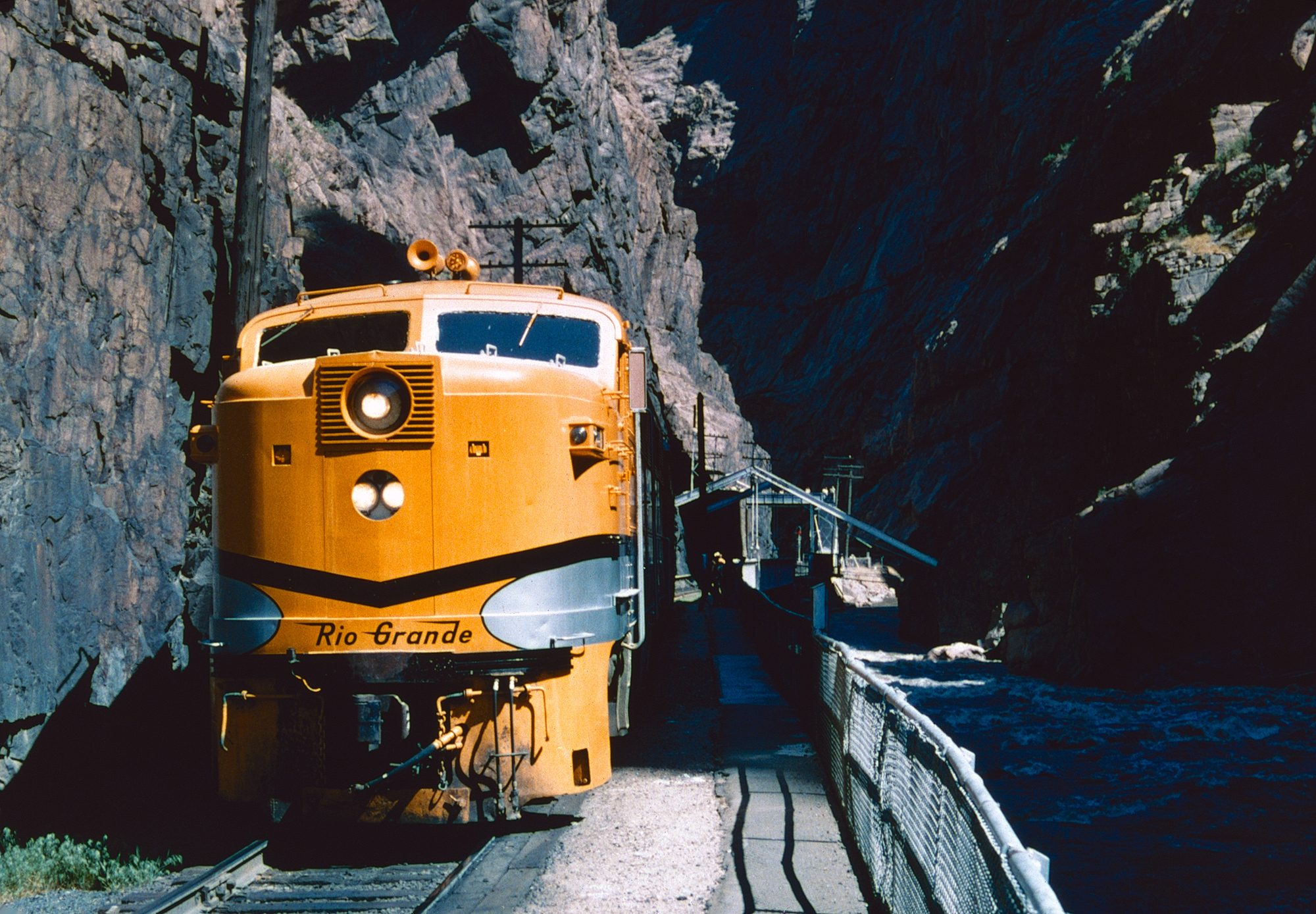
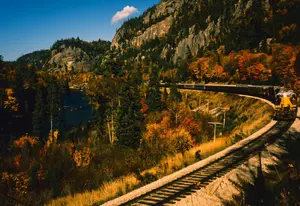
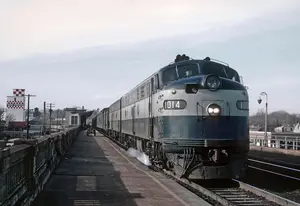
Rio Grande PA-1 #6013 stopped at the famous Hanging Bridge in Colorado’s Royal Gorge with the Royal Gorge, May 21, 1967. The Arkansas River is at right. Ed Fulcomer photo. American-Rails.com collection.
At a Glance
| Topic | Notes |
|---|---|
| What this hub covers | Major U.S. railroad engineering works and famous line locations: bridges/viaducts, tunnels, mountain passes, steep grades, loops/curves, cutoffs, and selected railfan hot spots |
| What it does not cover | Passenger stations and depots (see stations); museums as institutions (see museums); individual fallen-flag company histories (see fallen flags) |
| Typical construction eras | 1830s pioneers (e.g., Thomas Viaduct, Staple Bend Tunnel) through early–mid 20th century bores and steel spans (Moffat, Cascade rebuilds, Hell Gate, etc.) |
| Materials evolution | Stone masonry → iron → steel → concrete; each shift cut cost or increased span/length while changing how landmarks look |
| Historic recognition | Many sites are ASCE Historic Civil Engineering Landmarks, National Historic Landmarks, or National Register properties—and still host freights or Amtrak |
| First U.S. railroad tunnel (often cited) | Staple Bend Tunnel near Johnstown, Pa.—Allegheny Portage Railroad; construction 1831–1834 |
| Profiles linked below | About 40 American-Rails.com landmark and location articles (bridges, tunnels, grades, passes, cutoffs, loops) |
| Living vs. legacy | Many landmarks remain in freight service; others are abandoned, trail-converted, or partially ruined (e.g., Kinzua after storm damage) |
What Counts as a “Railroad Landmark” Here?
On this site, a landmark is usually a place where engineering or geography made the railroad memorable—not every milepost and not every small depot. Readers (and search engines) tend to group the same ideas under several everyday phrases:
- Famous railroad landmarks / historic railroad sites
- Railroad bridges and viaducts
- Railroad tunnels
- Mountain railroad passes and summit grades
- Railfan hot spots (Tehachapi, Horseshoe Curve, Cajon, Sherman Hill, and similar)
Those queries point to one family of places: the spectacular bits of the map. A stone viaduct that still carries coal trains, a five-mile tunnel under a mountain range, a spiral loop that gains elevation without an impossible grade—these are the landmarks. They are also where photographers and railfans still gather, because the railroad is forced into drama instead of straight, flat running.
Railroads themselves recognized the cost of pure stone construction and shifted to iron, steel, and later concrete for many large works. The best early masonry projects—Thomas, Starrucca, and peers—were so well built that they outlasted the companies that ordered them and still appear on modern operating maps.
Icons of the Map (If You Only Know a Few Names)
Most visitors to this hub arrive knowing one famous place and wanting the rest of the map. These are among the names that dominate both railfan conversation and general “what should I see?” lists—each has a full profile linked in the directory below.
| Landmark | Why it is famous | Profile |
|---|---|---|
| Horseshoe Curve (Pa.) | PRR’s Allegheny crossing; still a premier railfan overlook on the former Pennsy main | Horseshoe Curve |
| Tehachapi Loop (Calif.) | SP spiral that gains elevation without an impossible grade; among the most photographed freights in the West | Tehachapi Loop |
| Hoosac Tunnel (Mass.) | Nearly five-mile bore; long the longest railroad tunnel in the U.S. and a legendary construction ordeal | Hoosac Tunnel |
| Starrucca Viaduct (Pa.) | Stone-arch masterpiece of the Erie era; still carries trains and often cited as ASCE historic landmark | Starrucca Viaduct |
| Thomas Viaduct (Md.) | Early B&O multi-arch stone bridge; pioneer engineering still in the operating plant | Thomas Viaduct |
| Moffat Tunnel (Colo.) | Continental Divide bore that reshaped Denver–West access; still a key UP mountain passage | Moffat Tunnel |
| Cascade Tunnel (Wash.) | Great Northern mountain solution in the Cascades; successor BNSF still depends on the alignment family | Cascade Tunnel |
| Sherman Hill (Wyo.) | Classic UP Overland summit district; helper and high-horsepower country in steam and diesel eras | Sherman Hill |
| Donner Pass (Calif.) | Central Pacific / SP Sierra crossing; snow, snowsheds, and transcontinental lore | Donner Pass |
| Hell Gate Bridge (N.Y.) | Steel arch into New York; still a critical passenger/freight approach span | Hell Gate Bridge |
| Saluda Grade (N.C.) | Among the steepest mainline grades in the East; operating legend even after freights left the hill | Saluda Grade |
| Key West Extension (Fla.) | Flagler’s overseas railroad—bridges over open water, hurricane drama, partial trail rebirth | Key West Extension |
From those anchors, the directory spreads into less-publicized but equally important works: cutoffs that shortened main lines, southern and western helper districts, stone viaducts that never made the postcard rack, and junctions like the Richmond Triple Crossing where geography and corporate ambition stacked three levels of track.
Built by Hand: Labor, Danger & How the Landmarks Were Made
It is hard, from a world of diesel excavators and laser surveys, to picture how 19th-century rail lines were forced through mountains and across rivers. There was little heavy machinery at first, no modern OSHA regime, and no easy escape from weather. Put bluntly, construction was not for the weak.
Jeffrey Marcos Garcilazo, in Traqueros: Mexican Railroad Workers in the United States, 1870–1930, notes that track workers were injured so often that “space does not allow for the discussion of the wide variety and conditions under which these accidents occurred.” An entire bookshelf could be devoted to that subject alone. The men who built the landmarks came from many backgrounds—Irish and other European immigrants in the East, Chinese labor on much of the Central Pacific’s Sierra work, African American crews (including the steel drivers of southern tunnel lore), Mexican traqueros and their families (sometimes living in converted boxcars), and, in the antebellum South, enslaved labor on some projects.
Tunneling was among the worst work. The first railroad tunnel commonly credited in the United States is the Staple Bend Tunnel near Johnstown, Pennsylvania, built for the Allegheny Portage Railroad beginning in 1831 and completed in 1834. With no mechanization, crews used picks, shovels, and unstable black powder, “eyeballing” alignment in conditions that killed and maimed. Later bores such as Hoosac in Massachusetts and the Sierra tunnels of the Central Pacific became notorious for the same mix of geology, explosives, and poor ventilation. Dynamite and power drills improved the tools; they did not make the work gentle.
Surveyors shared the hardship in a different way. From the 1830s projects through the Transcontinental routes west of the Mississippi, corridors were laid out on horseback and on foot, often without wagon roads. The editors of American Heritage’s Railroads in the Days of Steam include a well-known image of surveyors scaling rock in the Uinta country of Utah on Central Pacific work. In parts of the West, construction and survey parties also faced conflict with Native nations whose lands and buffalo herds were disrupted by the advancing railhead; the federal government sometimes provided military escorts numbering from small detachments to parties of a hundred men—protection that was imperfect.
When we admire the finished landmarks—the arches of Starrucca or Thomas, the bore of Cascade or Moffat, the geometry of Tehachapi—we are looking at engineering directed by surveyors and civil engineers and realized by thousands of workers whose names almost never appear on dedication plaques. Both sides of that story belong in any honest landmark history.
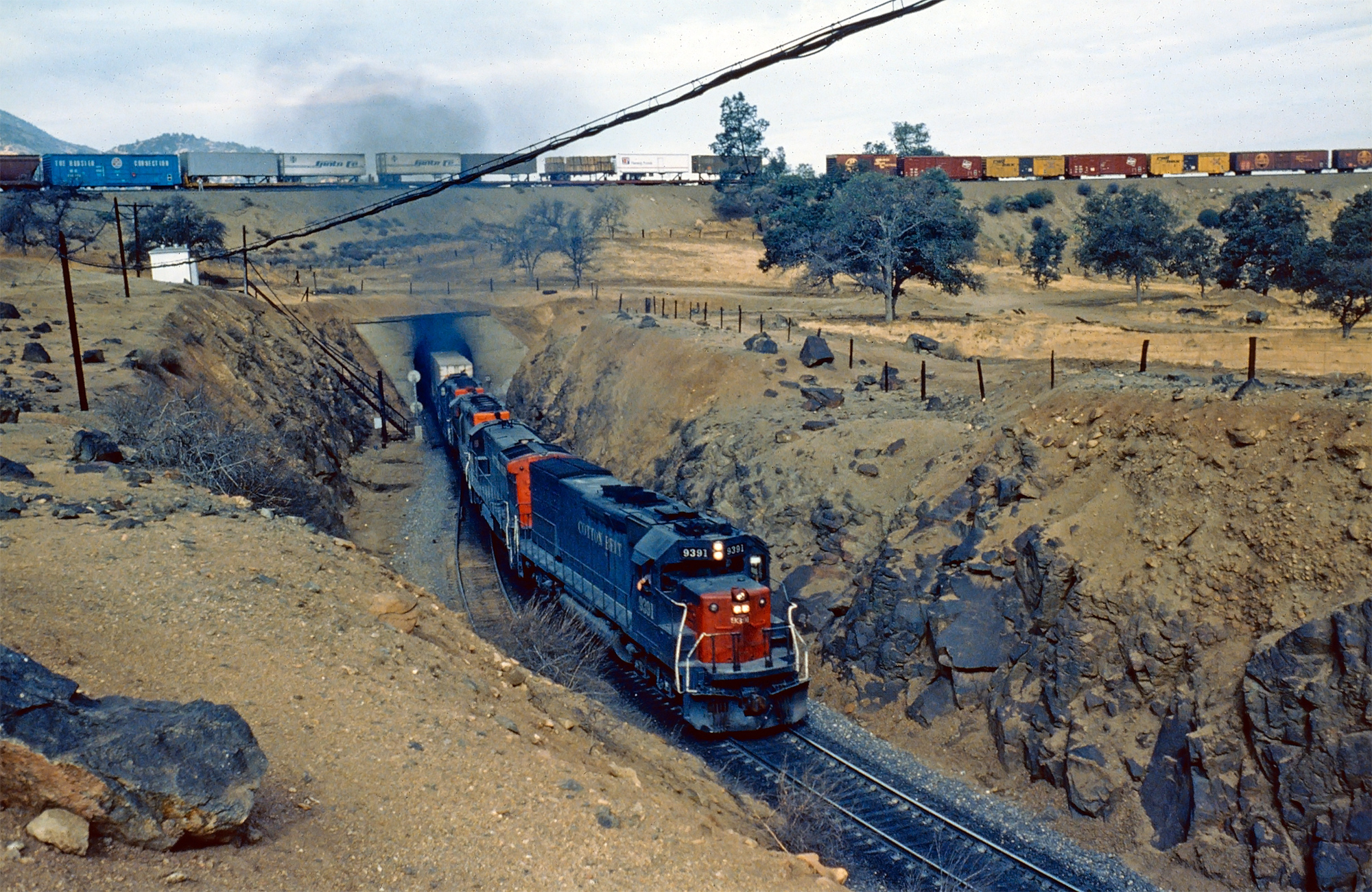
Southern Pacific / Cotton Belt SD45T-2 #9391 leads an eastbound over the loop on Tehachapi at Walong, California. Mike Bledsoe photo. American-Rails.com collection.
John Henry and the Big Bend Tunnel
No piece of American railroad labor folklore is more famous than John Henry, the steel-driving man associated with construction of the Chesapeake & Ohio’s Big Bend Tunnel near Talcott, West Virginia. In the legend, Henry races a steam drill, wins, and dies with his hammer in his hand. Historians still debate how much of the tale is biography and how much is ballad—but the song preserved a truth every tunnel crew understood: human muscle was pitted against new machines in deadly rock, and the cost of winning a day’s progress could be a life.
A few lines from the traditional piece capture the tone:
John Henry was a railroad man,
He worked from six ’till five,
“Raise ’em up bullies and let ’em drop down,
I’ll beat you to the bottom or die.”
John Henry said to his captain:
“You are nothing but a common man,
Before that steam drill shall beat me down,
I’ll die with my hammer in my hand.”
For more on C&O mountain railroading and related West Virginia grades, see profiles such as Cranberry Grade and the broader railroad history hub.
Why Railroad Landmarks Still Matter
Unlike many 19th-century factories that survive only as ruins or museums, a remarkable number of great railroad works remain operationally critical. Trains still climb Horseshoe Curve, spiral through the Tehachapi Loop, and use the Cascade and Moffat tunnels. Hell Gate Bridge still feeds passenger and freight moves into New York. Older masonry such as Starrucca and Thomas continues in service on successor railroads. Visitors at a public overlook are not only looking at history; they are watching a modern supply chain use infrastructure designed in the steam age.
That continuity is rare in industrial America. Rights-of-way through difficult terrain are hard to replace, and the original alignments were often the best available paths. Landmarks also concentrate drama: railroads are mostly linear and repetitive, so the places where the line must bend, climb, or leap become magnets for railfans and photographers generations after opening day.
Finally, these sites embody a particular American story—the willingness to spend money, labor, and ingenuity to force transportation through hard country. In an age of interstates and air travel, the permanence of the old railroad works remains impressive. They are among the most durable, still-functional monuments of the industrial era. Some locations, sadly, are gone or no longer used as built (storm-damaged viaducts, abandoned summits, trail conversions); even those remnants show what the industry once dared to build.
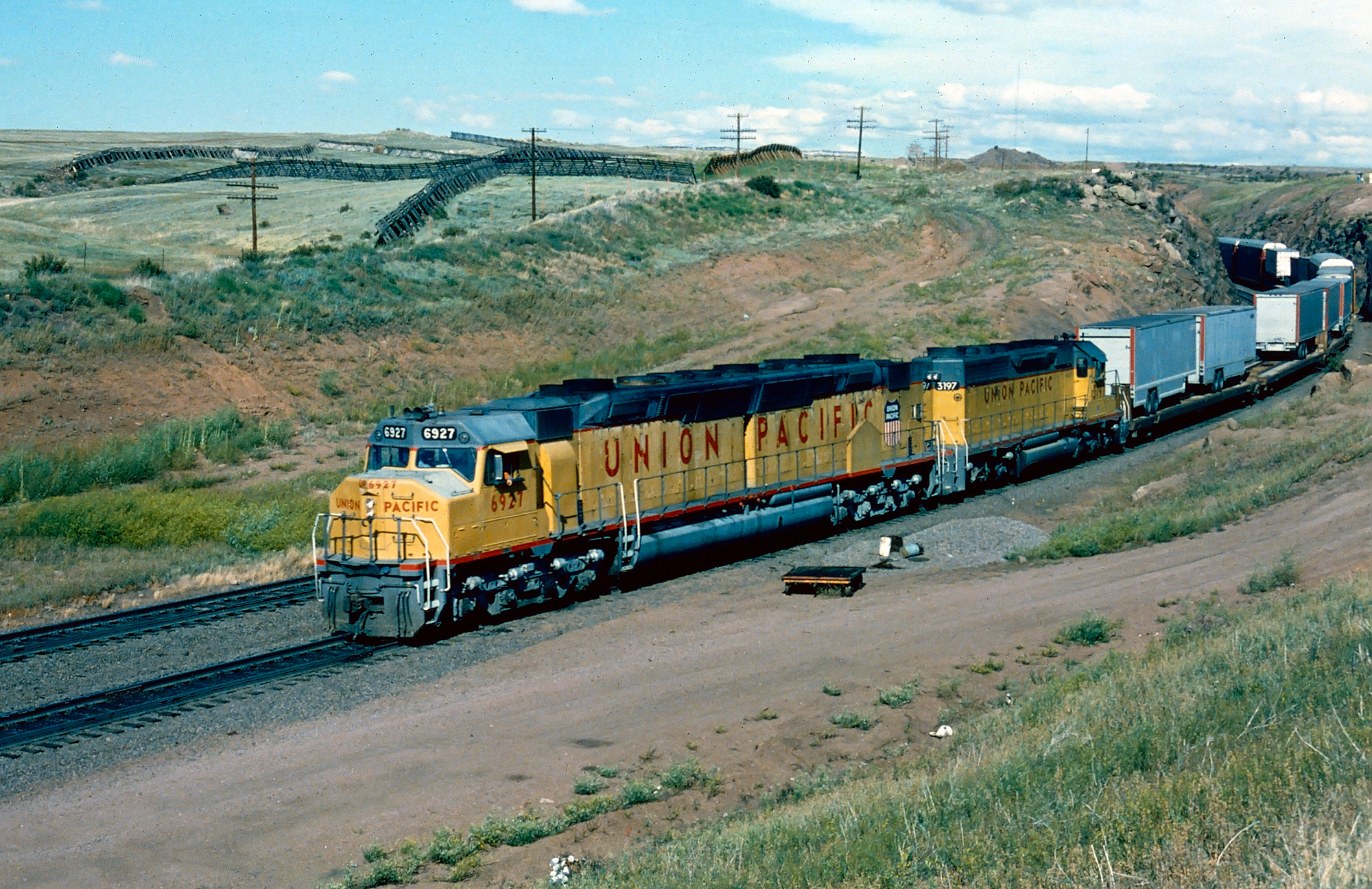
Union Pacific DDA40X #6927 and SD40-2 #3197 lead a westbound over Sherman Hill, Wyoming, circa 1985. Mike Bledsoe photo. American-Rails.com collection.
Landmark Directory (American-Rails.com Profiles)
Jump to detailed articles by type. The same list is what the original hub collected as a flat A–Z set; grouping by bridge, tunnel, grade/loop, pass, and cutoff matches how people actually browse and search.
Bridges & Viaducts
- Hell Gate Bridge
- Keystone Viaduct
- Kinzua Viaduct
- Newark Bay Bridge
- Poughkeepsie Bridge
- Rockville Bridge
- Salisbury Viaduct
- Starrucca Viaduct
- Thomas Viaduct
- Tulip Viaduct
- Tunkhannock Viaduct
- Key West Extension (overseas railroad / bridges over water)
Tunnels
Grades, Curves & Loops
- Clinchfield Loops
- Cranberry Grade
- Helmstetter’s Curve
- Horseshoe Curve
- The “Rathole Division”
- Saluda Grade
- Sand Patch
- Tehachapi Loop
- Triple Crossing
- Vendome Loop
Mountain Passes & Summits
- Cajon Pass
- Donner Pass
- Pipestone Pass
- Raton Pass
- Sherman Hill
- Stampede Pass
- St. Paul Pass
- Tennessee Pass
Cutoffs, Wyes & Special Alignments
- Connellsville Extension
- Keddie Wye
- Lackawanna Cutoff
- Lucin Cutoff
- Magnolia Cutoff
- Patterson Creek Cutoff
| Type | What readers usually want | Classic examples on this site |
|---|---|---|
| Viaduct / bridge | Span length, builder, still in use? | Thomas, Starrucca, Tunkhannock, Rockville, Hell Gate |
| Tunnel | Length, railroad, construction drama | Hoosac, Cascade, Moffat, Snoqualmie |
| Grade / curve / loop | Percent grade, helper districts, photos | Horseshoe Curve, Tehachapi, Saluda, Sand Patch, Clinchfield Loops |
| Pass / summit | Elevation, winter operations, railroad | Donner, Cajon, Sherman, Raton, Stampede, Tennessee |
| Cutoff | Why built, what it bypassed | Lucin, Lackawanna, Magnolia, Patterson Creek |
Related Reading on American-Rails.com
- Railroad history · Fallen flags · Tycoons
- Steam locomotives · Diesel locomotives · Locomotive history
- Stations and depots · Museums · Tourist trains
- Rail infrastructure · State history · Home
Sources
- Garcilazo, Jeffrey Marcos. Traqueros: Mexican Railroad Workers in the United States, 1870–1930. Denton: University of North Texas Press (and related editions)—labor conditions context
- Editors of American Heritage. Railroads in the Days of Steam—survey and construction imagery/context
- ASCE Historic Civil Engineering Landmark designations and railroad engineering secondary literature for individual bridges and tunnels
- John Henry / Big Bend Tunnel folk history and C&O construction tradition (legend vs. documentary record remains debated)
- American-Rails.com individual landmark profile pages linked in the directory above
- Operating practice and railfan literature on living landmarks (Horseshoe Curve, Tehachapi, Moffat, Cascade, major western passes)
Landmarks hub revised August 2026 (clearer title and scope, anchors, glance and type tables, categorized profile directory, MailChimp stub, lead text before hero image) while retaining core research on hand-built construction, immigrant and minority labor, Staple Bend Tunnel, John Henry, materials evolution, and the idea that many great works still carry trains.
Recent Articles


-
EMD "F7" Locomotives: Cab, Top Speed, Specs, Rosters
Oct 19, 26 12:27 AM
 EMD F7 cab units and boosters, 1,500 horsepower, built February 1949 through December 1953. Gear ratios, specifications, and the production roster by owner, serial, and order.
 -
Harlem Transfer Company: An NYC Terminal System
Oct 19, 26 12:01 AM
 Harlem Transfer Company, the Lackawanna's offline freight terminal on the Bronx side of the Harlem River at East 135th Street. Carfloats to Hoboken, boxcab No. 2, and GE 44-tonner 53.
 -
Belpre Industrial Parkersburg Railroad: Roster, History, Photos
Oct 18, 26 11:44 PM
 Belpre Industrial Parkersburg Railroad, a Class III short line leasing about 46.9 miles of CSX track at Parkersburg since 2020. The Ohio River bridge, the Marietta Subdivision, and five GP38-3s.
 -
Chicago, Peoria & St. Louis Railroad: Map, Timetables, History
Oct 18, 26 10:57 PM
 Chicago, Peoria & St. Louis Railroad, an Illinois line from Pekin and Peoria through Springfield to Madison. Chartered in 1853. Sold in parcels on November 20, 1924. The Pekin line is today the Illino…
 -
Chicago, Burlington & Quincy Diesel Roster (All-Time)
Oct 18, 26 10:54 PM
 All-time diesel roster of the Chicago, Burlington & Quincy. 951 parent frames, 72 Colorado & Southern, and 36 Fort Worth & Denver, each counted once. Serials included.
 -
Burlington Railroad (CB&Q): Map, History, Rosters, Photos
Oct 18, 26 10:49 PM
 The Chicago, Burlington & Quincy, the Burlington Route, ran from Chicago to Denver, the Twin Cities, and the Gulf. Steam built since 1900 and the diesel fleets are companion rosters. Burlington Northe…
 -
Chicago, Burlington & Quincy Steam Roster (Post 1900)
Oct 18, 26 10:33 PM
 Chicago, Burlington & Quincy steam locomotives built or rebuilt since 1900. 429 Prairies, 383 Mikados, the Hudsons, and the O-5 4-8-4s. Drury's class grid.
 -
Virginian Railway's 2-6-6-6 Locomotives (Class AG)
Oct 18, 26 01:38 PM
 Virginian Railway class AG. Eight Lima 2-6-6-6s, Nos. 900-907, built in 1945 for the east end. Billed at 753,000 pounds. Scrapped in 1960.
 -
Pennsylvania (PRR) Steam Roster: Post 1906
Oct 18, 26 01:05 PM
 ennsylvania steam after 1906—H8, H9, and H10 Consolidations, 574 L1s Mikados, 598 I1s Decapods, 425 K4s Pacifics, 301 M1 Mountains. Drury’s grid. Last steam November 30, 1957.
 -
Chicago, Aurora and Elgin Railroad: The "Roarin' Elgin"
Oct 18, 26 10:54 AM
 The Chicago, Aurora & Elgin, the Roarin' Elgin, ran 600-volt third-rail trains from Chicago to Aurora, Batavia, and Elgin. Passenger service ended at noon on July 3, 1957. Freight ended June 11, 1959.
 -
Algoma Central Railway: Map, Logo, Rosters
Oct 17, 26 10:49 PM
 Algoma Central Railway, Sault Ste. Marie to Hearst. Wisconsin Central on February 1, 1995. Fifty-nine steam locomotives and forty-two diesels.
 -
Akron, Canton and Youngstown Railroad: Map, History, Rosters
Oct 17, 26 05:49 PM
 Akron, Canton and Youngstown Railroad, Mogadore to Delphos. The rails never reached Canton or Youngstown. Norfolk & Western control on October 16, 1964. Twenty-six diesels and the historical society's…
 -
Georgia Railroad: Map, History, Logo, Rosters
Oct 17, 26 12:59 PM
 Georgia Railroad, the Georgia Railroad and Banking Company, Augusta to Atlanta, with the Athens branch and the Macon Road. Mark GA. The railroad properties were sold on November 4, 1982.
 -
West Point Route (Railroad): Map, History, Logo
Oct 16, 26 11:26 PM
 The West Point Route was a trademarked name comprising the Atlanta & West Point and Western Railway of Alabama, which were controlled by the Georgia Railroad.
 -
Virginian Railway Diesel Roster (All-Time)
Oct 16, 26 11:11 PM
 All-time diesel roster of the Virginian Railway. 40 Fairbanks-Morse H16-44s, 25 H24-66 Train Masters, and one GE 44-tonner. Serials included.
 -
Virginian Railway Steam Roster (Post 1900)
Oct 16, 26 10:55 PM
 Virginian Railway steam locomotives built since 1900. Mikados, 2-8-8-2s, the Triplex, class AE 2-10-10-2s, and the 1945 2-6-6-6s.
 -
Virginian Railway: Map, Rosters, History, Electrification
Oct 16, 26 10:51 PM
 Virginian Railway, Deepwater to Norfolk. Combined in 1907 and completed in 1909. Electrified from Roanoke to Elmore. Absorbed by the Norfolk & Western on December 1, 1959.
 -
Baldwin "Centipede" Locomotives: Specs, Roster, Photos
Oct 16, 26 03:58 PM
 Baldwin DR-12-8-1500/2 Centipede—2-D+D-2, two 608SC engines, 3,000 hp. SAL 4500 from the 1943 test bed. 54 on the serial list, 52 sold. PRR BP60 then BH50. None preserved.
 -
Louisville & Nashville Class M-1 2-8-4s: The Big Emmas
Oct 16, 26 03:52 PM
Louisville & Nashville class M-1, 42 Big Emma 2-8-4s. Baldwin in 1942 and 1944, Lima in 1949. Coal trains from Neon to DeCoursey. No locomotive survives. -
Tennessee, Alabama and Georgia Railway: Map, History, Rosters
Oct 16, 26 03:21 PM
 Tennessee, Alabama and Georgia Railway, Chattanooga to Gadsden. The May 1929 card is 91.7 miles. Southern stock control closed on a January 1, 1971 schedule. Five diesels and Prince's steam list.
 -
Railroad Museums In The USA (2026): State Guides & Collections
Oct 16, 26 02:29 PM
 U.S. railroad museums—what they are vs tourist railroads, preservation history (R&LHS, NRHS, IRM, Steamtown), state guides, and destination collections. Confirm hours on each museum’s site.
 -
Wyoming Railroad Museums (2026): A Complete Guide
Oct 16, 26 02:26 PM
 Wyoming railroad museums—the Cheyenne Depot, Burlington 5633 at Douglas, Big Boy 4004, and the Laramie depot. Confirm hours and which locomotive is on the property.
 -
West Virginia Railroad Museums (2026): A Complete Guide
Oct 16, 26 12:52 PM
 West Virginia railroad museums—Cass Scenic’s geared steam, the Hinton C&O collection, and the Martinsburg B&O roundhouse. Confirm hours and which locomotive is assigned.
 -
Washington Railroad Museums (2026): A Complete Guide
Oct 16, 26 12:46 PM
 Washington railroad museums—Snoqualmie, Elbe, Chehalis, Reardan, and the Northern Pacific depot at Toppenish. Confirm hours and which locomotive is assigned.
 -
Vermont Railroad Museums (2026): A Complete Guide
Oct 16, 26 12:42 PM
 Vermont railroad museums—the Shelburne Museum’s 1890 station, Central Vermont No. 220, and the private car Grand Isle. Confirm hours on the site.
 -
Tennessee Central Railway: Map, Logo, Rosters, History
Oct 16, 26 11:32 AM
 Tennessee Central Railway, Harriman to Hopkinsville. Reorganized January 26, 1922. Last day August 31, 1968. Thirty-one diesels and the railroad's steam roster.
 -
Southern Railway Steam Roster (Post 1900)
Oct 16, 26 09:40 AM
Southern Railway steam locomotives built since 1900. Ps-4 Pacifics, Ts Mountains, USRA Santa Fes, and the subsidiary grids for the CNO&TP, Alabama Great Southern, and New Orleans and Northeastern. -
Southern Railway (USA): Map, Locomotives, Logo, History
Oct 16, 26 09:28 AM
 The Southern Railway, formed July 1, 1894 from the Richmond and Danville and the East Tennessee, Virginia and Georgia. Washington. Norfolk Southern Railway on December 31, 1990.
 -
Seaboard Coast Line Diesel Roster (All-Time)
Oct 15, 26 04:21 PM
 All-time diesel roster of the Seaboard Coast Line. Inherited Coast Line and Seaboard locomotives, then 623 new locomotives in the printed orders, plus 28 acquired from other railroads.
 -
Seaboard Coast Line Railroad: Map, History, Photos
Oct 15, 26 04:17 PM
 The Seaboard Coast Line, formed July 1, 1967 from the Atlantic Coast Line and the Seaboard Air Line. Jacksonville. Family Lines, then the Seaboard System on December 29, 1982.
 -
South Carolina Railroad Museums (2026): A Complete Guide
Oct 15, 26 02:54 PM
 South Carolina railroad museums—Winnsboro’s Rockton & Rion line, Spartanburg’s Hub City depot, Greenwood’s Baldwin No. 19, and the Best Friend replica. Confirm hours on each site.
 -
South Dakota Railroad Museums (2026): A Complete Guide
Oct 15, 26 10:55 AM
 South Dakota railroad museums—the Hill City museum beside the 1880 Train, and Prairie Village at Madison. Confirm hours, and confirm whether Hill City is still open.
 -
Seaboard Air Line Diesel Roster (All-Time)
Oct 15, 26 10:46 AM
 All-time diesel roster of the Seaboard Air Line. 734 locomotives: E4s in 1938, Centipedes, Alco road switchers, and GP40s through February 1967. Serials included.
 -
Seaboard Air Line Steam Roster (Post 1900)
Oct 15, 26 10:39 AM
 Seaboard Air Line steam locomotives built since 1900. Mikados, Russian Decapods, 2-10-2s, and the 2-6-6-4s sold to the Baltimore and Ohio in 1947. Drury's class grid.
 -
Seaboard Air Line Railroad: Map, Rosters, History
Oct 15, 26 10:34 AM
 The Seaboard Air Line, chartered in the Portsmouth and Roanoke of 1832 and formed July 1, 1900. Inland route to Florida. Merged into the Seaboard Coast Line on July 1, 1967.
 -
Utah Railroad Museums (2026): A Complete Guide
Oct 15, 26 12:04 AM
 Utah railroad museums—Ogden Union Station, Golden Spike at Promontory, the Helper mining museum, and the Heber Valley Railroad. Confirm hours on each site.
 -
Escanaba & Lake Superior Diesel Roster (All-Time)
Oct 14, 26 10:44 PM
All-time diesel roster of the Escanaba & Lake Superior. 30 locomotives: Baldwin switchers and RS-12s, two RF16s, three GP38s, three SD40-2s, and the Reserve Mining units. Serials and order numbers. -
Escanaba & Lake Superior Railroad: In Service Since 1898
Oct 14, 26 09:04 PM
 Escanaba & Lake Superior Railroad, chartered November 17, 1898, and still operating from Wells, Michigan. Logging line to Channing, the Milwaukee Road lines, and the diesel roster.
 -
Richmond, Fredericksburg & Potomac Diesel Roster (All-Time)
Oct 14, 26 08:49 PM
 All-time diesel roster of the Richmond, Fredericksburg and Potomac. 107 locomotives: 22 Alco S2s, one SW1, and an Electro-Motive road fleet from E8s to GP40-2s. Serials and order numbers.
 -
Richmond, Fredericksburg & Potomac Steam Roster (Since 1900)
Oct 14, 26 08:46 PM
 Richmond, Fredericksburg and Potomac steam locomotives built since 1900. Pacifics, Mountains, Berkshire-type 2-8-4s, and the named 4-8-4s. Last revenue run December 17, 1954.
 -
Richmond, Fredericksburg and Potomac Railroad: Map, Rosters, Logo
Oct 14, 26 08:36 PM
 The Richmond, Fredericksburg and Potomac, chartered February 25, 1834. A 113-mile Richmond–Washington bridge line. Named 4-8-4s, Potomac Yard, and the CSX sale of October 10, 1991.
 -
North Dakota Railroad Museums (2026): A Complete Guide
Oct 14, 26 08:29 PM
North Dakota railroad museums—Mandan’s state museum, the Railroad Museum of Minot, and Bonanzaville’s Northern Pacific 684. Confirm hours on each site. -
Oklahoma Railroad Museums (2026): A Complete Guide
Oct 14, 26 08:02 PM
Oklahoma railroad museums—the Oklahoma Railway Museum, Enid’s Frisco 1519, Waynoka’s Harvey House, and El Reno’s Rock Island depot. Confirm hours on each site. -
Oneida & Western Railroad: Map, History, Timetable
Oct 14, 26 06:47 PM
Oneida & Western Railroad, a Tennessee short line from Oneida to Jamestown. Chartered in 1912, opened to East Jamestown in 1921, and to Jamestown on December 10, 1930. Last revenue train March 4, 1954… -
Oneida and Western Railroad (Shamrock Coal Company)
Oct 14, 26 03:20 PM
 Shamrock Coal's mint-green coal trains, 1979–1987. Eight EMD SD40-2s, OWTX 9950–9957, order 786246. Two 72-car gondola sets. Louisville & Nashville, then CSX. Sold to BC Rail.
 -
Rhode Island Railroad Museums (2026): A Complete Guide
Oct 14, 26 03:03 PM
 Rhode Island railroad museums—the Friends’ museum in the 1875 Kingston depot, on the old New York, Providence and Boston. Confirm what is on view.
 -
Original Norfolk Southern Diesel Roster (All-Time)
Oct 14, 26 12:40 PM
 All-time diesel roster of the original Norfolk Southern Railway. 59 locomotives: Baldwin switchers and AS-416s, three GE 70-tonners, 17 GP18s, and seven GP38s. Serials and order numbers.
 -
Original Norfolk Southern Railway: Map, Rosters, History
Oct 14, 26 10:09 AM
 The original Norfolk Southern Railway, chartered in 1870 as the Elizabeth City & Norfolk. Norfolk to Charlotte. Merged into the Southern Railway on January 1, 1974. Baldwin diesels and the GP18s and G…
 -
Nebraska Railroad Museums (2026): A Complete Guide
Oct 14, 26 10:00 AM
 Nebraska railroad museums—the Durham Museum, Kenefick Park, Cody Park, and the Golden Spike Tower over Bailey Yard. Confirm hours on each site.
 -
Nevada Railroad Museums (2026): A Complete Guide
Oct 14, 26 09:51 AM
 Nevada railroad museums—Carson City, Boulder City, the Nevada Northern at East Ely, and the Virginia City depot. Confirm hours on each site.