Pennsylvania Railroad (PRR) Electric Roster: All Classes
Published: September 23, 2026
By: Adam Burns
The Pennsylvania Railroad’s electric locomotives were two plants, not one. From 1910 the Hudson and East River tunnels into Pennsylvania Station ran on 650-volt DC third rail, and the motors for that job were side-rod DD1s. From 1915 the railroad strung 11,000-volt, 25-cycle catenary, first to Paoli, then down to Washington on February 10, 1935, and west to Harrisburg for passenger trains on January 15, 1938. Everything from the P5 to the E44 was built for that wire. The class letters are the same letters the railroad used on steam. A B is an 0-6-0. A P is a Pacific. A GG is two 4-6-0s back to back. Multiple-unit cars are not in this list. The GG1’s unit roster is the GG1 page. The yard switchers, unit by unit, are the B1 page.
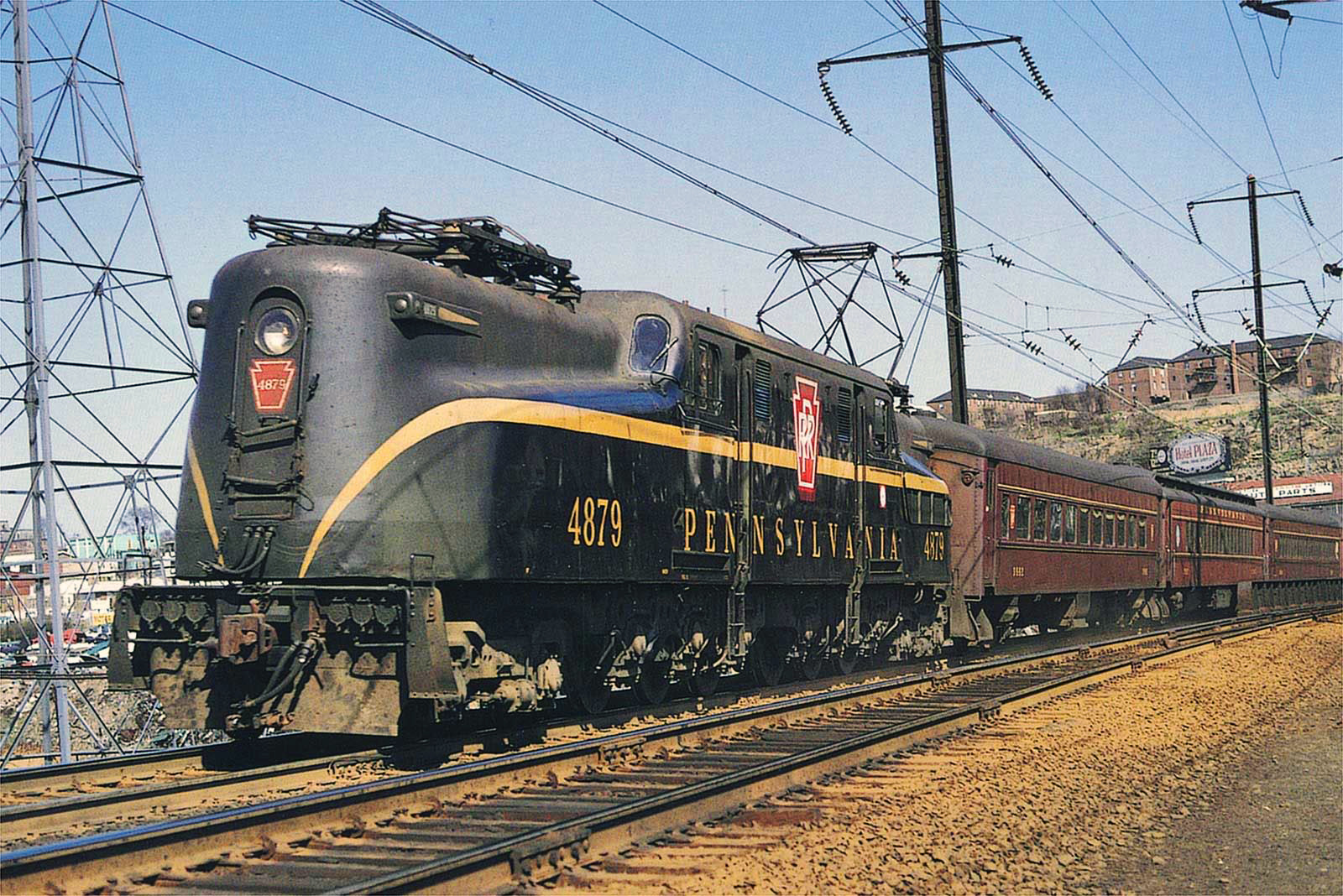
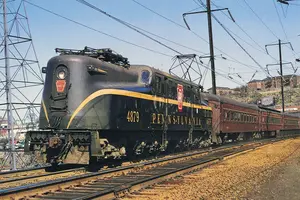
A 1960s postcard GG1. The class handled passenger trains and, when required, freight. Author’s collection.
On this page: At a glance · Third rail · The first AC motors · Switchers · Looking for a passenger motor · Freight, rectifiers, and the E44 · Class roster · Sources
At a glance
| Item | Detail |
|---|---|
| Railroad | Pennsylvania Railroad. Electric operations through January 31, 1968. Penn Central from February 1 |
| Third rail | 650 volts DC. New York terminal, 1910. Classes AA1, DD1, and the DC L5s |
| Catenary | 11,000 volts, 25 cycles. Paoli 1915. New York–Washington completed February 10, 1935. Harrisburg passenger trains January 15, 1938 |
| Production passenger motor | GG1. 139 locomotives, 4800–4938, 1934–1943 |
| Production freight motor | E44. 66 locomotives, 4400–4465, General Electric, 1960–1963 |
| Switchers | 28 Pennsylvania B1s. The Long Island’s 14 B3s are the same carbody and a different roster |
| How a DD1 is counted | Two carbodies, drawbar-coupled, are one locomotive. The class table uses that count |
| Diesels | Pennsylvania diesel roster |
Class lines follow Classic Trains’ 2021 survey except where the B1 page or the GG1 page is the closer source. Information compiled September 23, 2026.
Third rail into Penn Station
Steam could not run the Hudson tubes. While the station was being planned, Altoona built two experimental third-rail units, class AA1, numbers 10001 and 10002, in 1905. Westinghouse supplied the electrical equipment. They were B+B machines, a pair of four-wheel trucks, and they were scrapped after they had done their job as test beds. The locomotive that came out of that work was the DD1.
A DD1 is two 4-4-0 carbodies coupled back to back, each with a jackshaft and side rods, and the railroad counted the pair as one locomotive. Juniata and Westinghouse built 33 of them in 1909–1911. The carbodies are numbered in the 3932–3999 series, which also includes two earlier odd-DD pairs, and the series is not solid: 3950 and 3951 are not a DD1. Horsepower for a pair was 3,160, on 650-volt DC third rail. They took passenger trains from Manhattan Transfer, through the station, and out to Sunnyside Yard in Queens. When the L5s arrived in 1924, many DD1s moved to the Long Island for freight. One pair lasted long enough to be saved: 3936 and 3937, at the Railroad Museum of Pennsylvania.
The L5 was supposed to be the next step, a single-unit side-rod motor with a 1-B-B-1 arrangement, usable as a passenger engine or a mountain freight engine and, in theory, on either kind of current. It was not. One AC prototype, class L5paw, number 3930, was built in 1924. Twenty-three DC third-rail locomotives, 3922–3929 and 7801–7815, followed through 1928, with Westinghouse and Brown Boveri electrical equipment. They were meant to help the DD1s between Sunnyside and Manhattan Transfer. They were worse at it than the engines they were sent to replace. The long rigid wheelbase and the weight distribution limited them, and they were gone from that job by the early 1930s, when AC catenary reached the terminal. All of them were scrapped.

FF2 #5, a 1-C+C-1, at Thorndale, circa 1960. These were Great Northern Y-1s from the Cascade Tunnel electrification. The Great Northern shut that operation down in 1956, and the Pennsylvania bought most of the motors, classed them FF2, and scrapped them in the 1960s.
The first AC motors
Before the tunnels, Baldwin and Westinghouse had already tried single-phase AC. In 1907 they built one 2-B boxcab, number 10003, the "odd class D," and tested it under a short stretch of catenary on the Long Island. It made about 750 horsepower. It did not go into production. It did show that two such engines, set back to back, could be a road locomotive, which is the idea the DD1 later used on direct current.
The other early one-off was built for a railroad that was never wired. Class FF1 number 3931, "Big Liz," came out of Juniata in 1917: a 1-C+C-1 side-rod freight motor of about 4,000 horsepower, meant for a catenary main line over the Alleghenies. That electrification was never built. Big Liz spent her life as a helper between Philadelphia and Paoli, on the 1915 Paoli wire, and was scrapped in 1940.
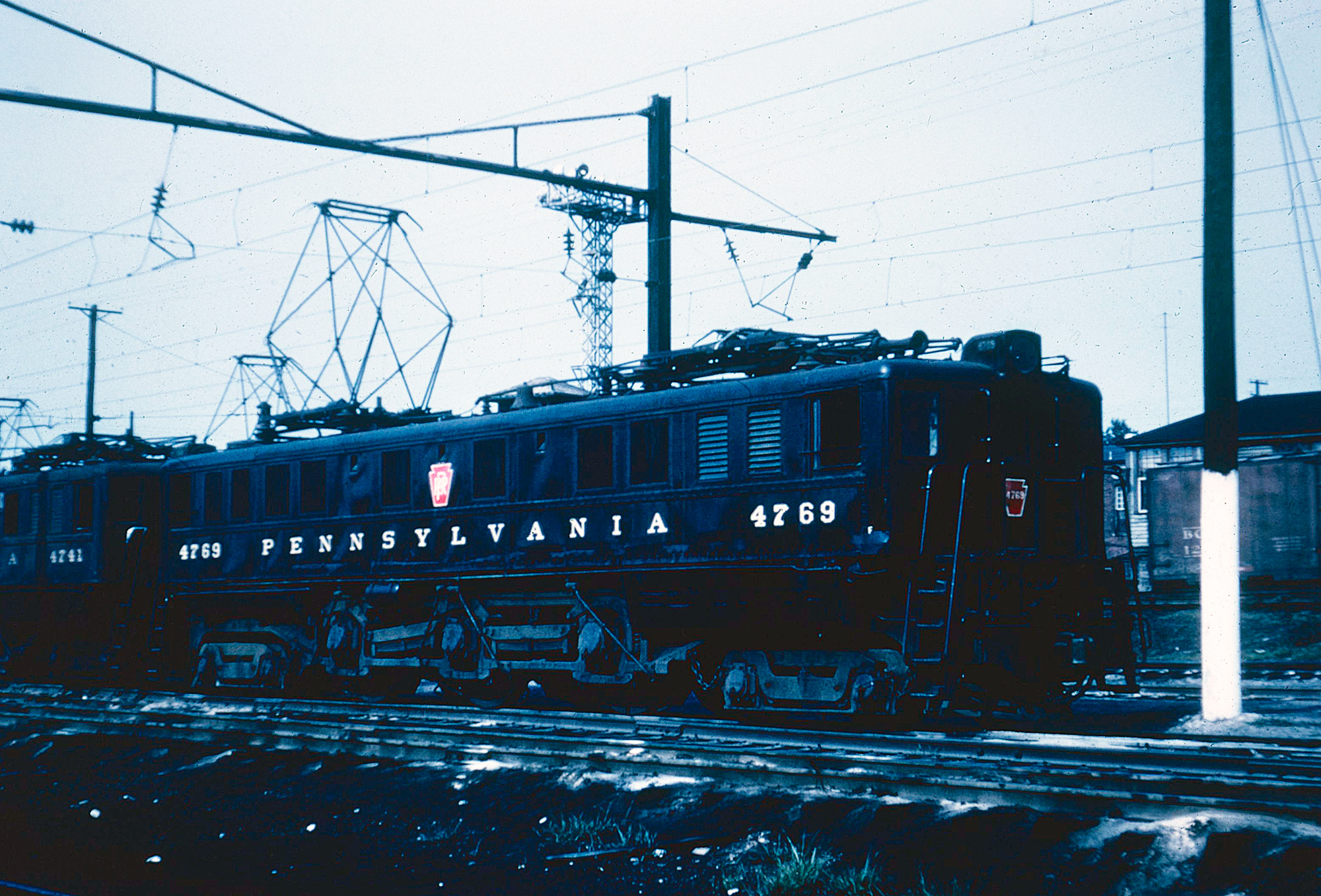
P5a #4769, a 2-C-2, at Enola, August 22, 1962. The P5a was the rebuilt form of the P5, with the cab moved out of the center of the box after the original arrangement proved dangerous in a collision. Bill Volkmer photo. American-Rails.com collection.
Switchers
Once coach yards sat under wire, a steam 0-6-0 was the wrong shifter. Juniata’s answer was a three-axle boxcab, class B, the same letter the railroad used for a steam six-wheel switcher. Twenty-eight of them were Pennsylvania engines. The first twenty-eight carbodies of 1926 were built as married pairs: BB1 numbers 3900 and 3901, AC from the start, and BB2 numbers 3910–3921, twelve DC third-rail locomotives in six pairs for Sunnyside and Penn Station. In 1933 the pairs were split, the DC engines were converted to 11,000-volt AC, and everything was reclassed B1. Fourteen more, 5684–5697, were built in 1934–35 as single units, Allis-Chalmers electrical equipment, for Philadelphia and for Harrisburg as the passenger wire moved west.
Three motors, 233 horsepower each, come to about 700 horsepower. Classic Trains prints 570 horsepower for the class, which is the continuous figure against that hourly rating. Crews called them rats. 5690 is the survivor, indoors at Strasburg. It was briefly Penn Central 4756. The Long Island’s fourteen Bay Ridge freight motors, class B3, are the same Altoona machine and a different roster. The unit list, construction numbers, and the 1966–67 renumbering are the B1 page.
Looking for a passenger motor
The wire east of Harrisburg needed a passenger locomotive, and the railroad spent a decade finding one. Eight class O1 experimentals, numbers 7850–7857, were built in 1930–31 on a 2-B-2 wheel arrangement, with Westinghouse, General Electric, and Brown Boveri electrical equipment split across subclasses O1, O1a, O1b, and O1c. They were light, 2,000 to 2,500 horsepower, and they were often doubled. They were not repeated.
The production try was the P5. Ninety-two locomotives, class P5 and P5a, were built from 1931 to 1935 by the railroad, Baldwin, and General Electric, on a 2-C-2 arrangement, at 3,750 horsepower. The two prototypes, 7898 and 7899, became 4700 and 4791. The other ninety are 4701–4790. The first sixty-four of the family were boxcabs, cab at each end. After a grade-crossing collision killed the crew in the nose of a boxcab, the rest were built with a center cab and a streamlined nose, classed P5a modified: 4743–4754 and 4775–4790, twenty-eight locomotives. No. 4770, a boxcab, was later rebuilt to the modified form. No. 4702 was rebuilt in 1937 to 5,000 horsepower and reclassed P5b. That was a rebuild, not a new order.
The P5 was a hard-riding passenger engine. The driving axles took a beating from the torque, and the railroad moved the class to freight, where the motors worked into the early 1960s. One of them is preserved. The search for a replacement produced two prototypes in 1934. Baldwin-Westinghouse built the R1, a rigid 2-D-2, originally numbered 4800. General Electric and the railroad built the GG1, a 2-C+C-2 with an articulated frame. The GG1 tracked better. It got the order. The R1 was renumbered 4899 in November 1934, when the GG1 prototype took 4800, and became 4999 in 1940. It stayed in passenger service for about twenty years and was scrapped in the 1950s.
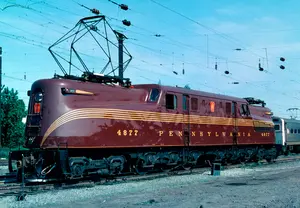
The GG1 that won is 139 locomotives, 4800–4938, built from 1934 to 1943, continuous rating 4,620 horsepower. No. 4800 is Old Rivets, the riveted prototype. Builders, weights, gear ratios, the Amtrak numbers, and the last revenue trip are the class page, not this one. A single later experiment, class DD2 number 5800, tried in 1938 to get GG1-sized power out of a 2-B+B-2. It was geared for freight, it stayed unique, and it was scrapped in 1962.
The freight design that lost out to the reassigned P5s was the L6. Two prototypes, 7825 and 7826, later 5938 and 5939, and one Lima-built L6a, number 5940, were 1-D-1 boxcabs of 2,500 horsepower, built in 1931–34. The 5940 was the first of a thirty-unit Lima order that was cancelled. The three worked as switchers around New York into the 1960s and were scrapped.
Freight, rectifiers, and the E44
By the early 1950s the P5s were old and the railroad still had no new freight motor. It bought ten experimentals. General Electric delivered six class E2b locomotives, 4939–4944, a B-B carbody with AC traction motors, 2,500 horsepower. Four of them, 4939–4942, came in 1951–52. The last pair, 4943 and 4944, were GE demonstrators, bought in 1953. They were usually run as pairs. Baldwin-Westinghouse delivered four more in 1951, and these were the important ones: ignitron rectifiers turned the AC from the wire into DC for ordinary traction motors. E3b numbers 4995 and 4996 rode on a B-B-B arrangement. E3c numbers 4997 and 4998 were C-C. All ten experimentals were scrapped in 1964. Baldwin-Westinghouse was already out of the locomotive business. The rectifier idea was not.
While that test was going on, the Great Northern shut down the Cascade Tunnel electrification. In 1956 the Pennsylvania bought seven of GN’s Y-1 boxcabs, Alco-GE motors of 1927–30, and classed them FF2, numbers 1–7. They were 1-C+C-1 machines of about 3,300 horsepower, used as freight engines and helpers west of Philadelphia, and they were scrapped between 1960 and 1965. They are the only secondhand electrics on this roster.
The production freight locomotive was the E44. General Electric built 66 of them, 4400–4465, in 1960–1963, a C-C road-switcher body on the ignitron-rectifier pattern of the E3s, rated 4,400 horsepower. The locomotives at the end of the order were built with silicon-diode rectifiers, rated 5,000 horsepower, and classed E44a. The Penn Central roster treats 4458–4465 as that block. Classic Trains counts the as-built silicon units as the final six. Others were converted later, until the Penn Central bankruptcy stopped the program. The class is the E44 page. No. 4465 is preserved at Strasburg. The fleet was still intact when Conrail ended electric freight in 1980.
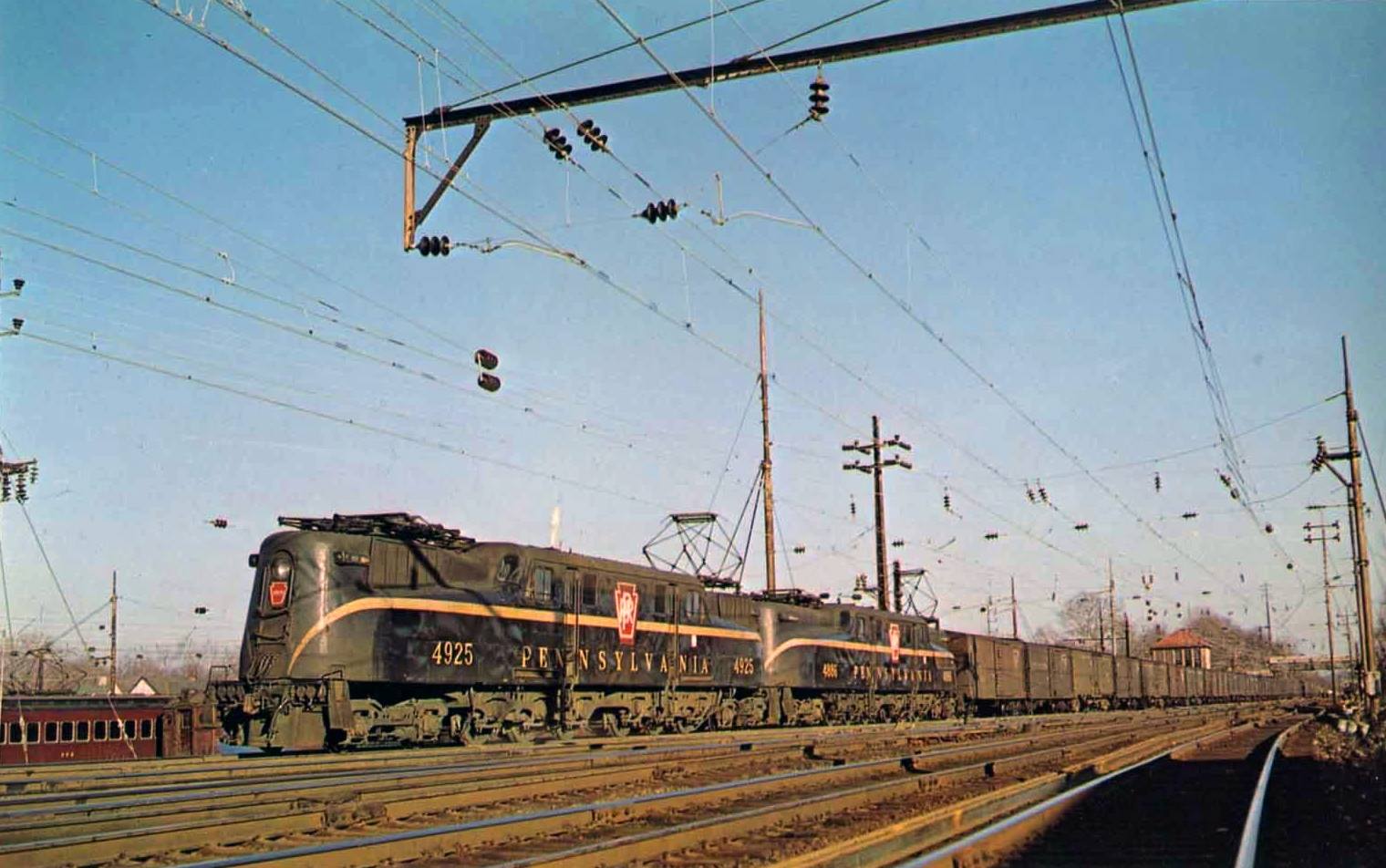
GG1s #4925 and #4886 westbound at Paoli, Pennsylvania, with a long mail and express train for Harrisburg, just after the Penn Central merger, February 1968. Don Sims photo.
Class roster
A DD1 row is one drawbar-coupled pair. Long Island B3 switchers are not in the table. GG1 road numbers and builders are not repeated unit by unit.
| Class | Arrangement | Numbers | Qty | Built | Current | Notes |
|---|---|---|---|---|---|---|
| AA1 | B+B | 10001, 10002 | 2 | 1905 | 650 V DC third rail | Tunnel experiments. Both scrapped. 1,400 hp and 1,240 hp |
| Odd D | 2-B | 10003 | 1 | 1907 | 11 kV AC | Baldwin-Westinghouse. Tested on Long Island catenary. About 750 hp. Scrapped |
| DD1 | 2-B+B-2 | 3932–3999 series | 33 | 1909–1911 | 650 V DC third rail | Each locomotive is a coupled pair. Includes two odd-DD pairs. 3,160 hp. 3936–3937 preserved. 3950–3951 are not a DD1 |
| FF1 | 1-C+C-1 | 3931 | 1 | 1917 | 11 kV AC | Big Liz. About 4,000 hp. Paoli helper. Scrapped 1940 |
| L5paw | 1-B-B-1 | 3930 | 1 | 1924 | 11 kV AC | AC prototype. 3,040 hp. Scrapped |
| L5 (DC) | 1-B-B-1 | 3922–3929, 7801–7815 | 23 | 1924–1928 | 650 V DC third rail | Westinghouse and Brown Boveri. Off the New York passenger job by the early 1930s. All scrapped |
| BB1 / B1 | C | 3900–3901 | 2 | 1926 | 11 kV AC | Built as one AC pair. Split and reclassed B1 in 1933 |
| BB2 / B1 | C | 3910–3921 | 12 | 1926 | DC, then AC | Six DC pairs. Split and converted to AC, 1933–35 |
| B1 | C | 5684–5697 | 14 | 1934–1935 | 11 kV AC | Built as singles. About 700 hp hourly. 5690 preserved. See the B1 roster |
| O1 / O1a / O1b / O1c | 2-B-2 | 7850–7857 | 8 | 1930–1931 | 11 kV AC | Passenger experimentals, 2,000–2,500 hp. Often doubled. All scrapped |
| P5 / P5a | 2-C-2 | 4700–4791 | 92 | 1931–1935 | 11 kV AC | 3,750 hp. Prototypes 7898–7899 became 4700 and 4791. Boxcabs, then 28 center-cab "modified." 4702 rebuilt as 5,000 hp P5b. Moved to freight. One preserved |
| L6 / L6a | 1-D-1 | 5938–5939, 5940 | 3 | 1931–1934 | 11 kV AC | Built as 7825–7826 and Lima 5940. 2,500 hp. A 30-unit Lima order was cancelled. New York switchers into the 1960s |
| R1 | 2-D-2 | 4999 | 1 | 1934 | 11 kV AC | Built as 4800. Became 4899 in November 1934, then 4999 in 1940. Baldwin-Westinghouse. About 5,000 hp. Scrapped in the 1950s |
| GG1 | 2-C+C-2 | 4800–4938 | 139 | 1934–1943 | 11 kV AC | 4,620 hp continuous. 4800 is Old Rivets. Unit roster is the GG1 page |
| DD2 | 2-B+B-2 | 5800 | 1 | 1938 | 11 kV AC | About 5,000 hp. Geared for freight. Scrapped 1962 |
| E2b | B-B | 4939–4944 | 6 | 1951–1953 | 11 kV AC | GE. AC traction motors. 2,500 hp. 4943–4944 were demonstrators. Scrapped 1964 |
| E3b | B-B-B | 4995–4996 | 2 | 1951 | 11 kV AC | Baldwin-Westinghouse. Ignitron rectifiers. 3,000 hp. Scrapped 1964 |
| E3c | C-C | 4997–4998 | 2 | 1951 | 11 kV AC | Same order as the E3b. Scrapped 1964 |
| FF2 | 1-C+C-1 | 1–7 | 7 | 1927–1930 | 11 kV AC | Ex-Great Northern Y-1, bought 1956. About 3,300 hp. Scrapped 1960–1965 |
| E44 / E44a | C-C | 4400–4465 | 66 | 1960–1963 | 11 kV AC | GE. 4,400 hp. Silicon-diode E44a units at 5,000 hp; Penn Central classes 4458–4465 as E44a. 4465 preserved. See the E44 page |
What those numbers became after February 1, 1968, is the electric section of the Penn Central diesel roster. The company that ran them until then is the Penn Central page.
Sources
- Robert S. McGonigal, "Pennsylvania Railroad electric locomotives," Classic Trains, January 14, 2021. Class list, wheel arrangements, quantities, horsepower, and the P5 number split.
- Eugene Connelly and William Edson, PRR numerical roster of steam and electric locomotives, as used on the B1 page. Twenty-eight Pennsylvania switchers. Long Island’s fourteen B3s stay off this table. 5690, briefly Penn Central 4756.
- Michael Bezilla, Electric Traction on the Pennsylvania Railroad, 1895–1968. The tunnel plant and the 1928–38 catenary program. Paoli 1915, New York–Washington February 10, 1935, Harrisburg passenger service January 15, 1938, are the dates used on the company page.
- Alvin F. Staufer and Bert Pennypacker, Pennsy Power (1962), for the B1 motors and the P5 / GG1 generation.
- GG1 class page. 139 locomotives, 4800–4938, continuous 4,620 horsepower. R1 number swap, November 1934 and 1940. Conrail freight electrics ended in 1980.
- E44 class page, and the Penn Central roster’s E44 / E44a split.
Related reading
- Pennsylvania Railroad · Diesel roster · Steam roster
- GG1 · E44 · B1 switchers
- Penn Central diesel and electric roster · Penn Central · Electric locomotives
Recent Articles


-
Kansas Dinner Train Rides (2026): A Complete Guide
Sep 23, 26 01:11 PM
 2026 Abilene & Smoky Valley Smoky Valley Limited—two hours from the Rock Island Depot, about $72–$110, dates into December 31. Confirm on asvrr.org.
 -
The Belpaire Firebox: Simplicity and Greater Power
Sep 23, 26 01:03 PM
 Belpaire firebox—Alfred Belpaire, 1864. Square crown, straight staybolts at right angles. Pennsylvania standard after the 1880s. Great Northern was the other big user.
 -
Pennsylvania Railroad (PRR) Electric Roster: All Classes
Sep 23, 26 12:57 PM
 Pennsylvania Railroad electrics—DD1s into Penn Station, P5s, 139 GG1s, B1 switchers, and 66 E44s. Class roster, 1905–1963. No unit-by-unit GG1 list.
 -
Penn Central Diesel Roster: All-Time
Sep 23, 26 12:46 PM
 Penn Central diesel roster—PRR classes on NYC, PRR, and New Haven power. New orders carry serials. GP38-2s are 7940-8162. Conrail April 1, 1976.
 -
Penn Central Railroad: Map, History, Logo
Sep 23, 26 12:32 PM
 Penn Central—Pennsylvania and New York Central merged February 1, 1968. New Haven January 1, 1969. Section 77 bankruptcy June 21, 1970. Conrail April 1, 1976.
 -
Iowa Dinner Train Rides (2026): A Complete Guide
Sep 23, 26 11:42 AM
 2026 Boone & Scenic Valley Wolf Dinner Train—Saturdays May–October, Union Pacific dining cars, Bass Point Creek High Bridge. Confirm on bsvrr.com.
 -
Pennsylvania-Reading Seashore Lines: Map, Roster, History
Sep 23, 26 12:32 AM
 Pennsylvania-Reading Seashore Lines—Atlantic City Railroad renamed July 15, 1933. Pennsylvania two-thirds, Reading one-third. Camden to Atlantic City, Cape May, and Millville. Conrail April 1, 1976.
 -
Wisconsin Dinner Train Rides (2026): A Complete Guide
Sep 23, 26 12:28 AM
 2026 Wisconsin Great Northern dinner train in Trego—$105, Namekagon River, January 8–31 and May 5–December 17. Mid-Continent’s remaining 2026 calendar is snack and scenic. Confirm on the railroad.
 -
New Hampshire Dinner Train Rides (2026): A Complete Guide
Sep 23, 26 12:21 AM
2026 Cafe Lafayette Dinner Train in North Woodstock—five courses, 2 hours, from $125. Children under 6 not allowed. Confirm on nhdinnertrain.com. -
PRR "GG-1" Locomotives: Roster, Photos, Specs
Sep 23, 26 12:13 AM
 PRR GG1 electric: 139 locomotives, 4800–4938, built 1934–1943. Specs, Loewy shell, Amtrak numbers, and the last revenue trip on October 28, 1983.
 -
Montana Dinner Train Rides (2026): A Complete Guide
Sep 23, 26 12:04 AM
2026 Charlie Russell Chew Choo from Hanover, near Lewistown—4.5 hours, prime rib, adult $151. Remaining listed dates sold out. Confirm on montanadinnertrain.com. -
Kentucky Dinner Train Rides (2026): A Complete Guide
Sep 22, 26 11:52 PM
2026 My Old Kentucky Dinner Train in Bardstown—four courses, 2.5 hours, adult $116. Confirm on kydinnertrain.com. -
Tennessee Dinner Train Rides (2026): A Complete Guide
Sep 22, 26 11:45 PM
2026 TVRM Chattanooga Dinner Train—Grand Junction, select Fri/Sat March 6–October 24, 6 p.m., from $110. Confirm on tvrail.com. -
The Trainphone: PRR's Wireless Radio System
Sep 22, 26 11:17 PM
 Pennsylvania Trainphone—Union Switch & Signal inductive telephone. Bel-Del trial 1941, Frenchtown November 29, 1943. Carriers at 88 kHz and 144 kHz. Out of service April 30, 1967.
 -
Pennsylvania (PRR) Steam Roster: Post 1906
Sep 22, 26 11:13 PM
 ennsylvania steam after 1906—H8, H9, and H10 Consolidations, 574 L1s Mikados, 598 I1s Decapods, 425 K4s Pacifics, 301 M1 Mountains. Drury’s grid. Last steam November 30, 1957.
 -
Pennsylvania Railroad (PRR) Diesel Roster: All-Time List
Sep 22, 26 10:59 PM
 Pennsylvania diesel roster—SW 3908 in June 1937, then Alco, Baldwin, EMD, Fairbanks-Morse, GE, and Lima. Serials and Alco order numbers. Penn Central February 1, 1968.
 -
Pennsylvania Railroad: Map, Logo, History, Rosters
Sep 22, 26 10:02 PM
 Pennsylvania Railroad—chartered April 13, 1846, Harrisburg–Pittsburgh, Horseshoe Curve 1854, Penn Station 1910. Standard Railroad of the World. Penn Central February 1, 1968.
 -
Pennsylvania Dinner Train Rides (2026): A Complete Guide
Sep 22, 26 04:48 PM
 2026 Pennsylvania dinner trains—Colebrookdale Dining Class in Boyertown and Strasburg Dinner on the Rails. Confirm on each railroad.
 -
New York, Ontario & Western Steam Locomotives: History & Roster
Sep 22, 26 04:40 PM
 NYO&W steam—camelback 2-8-0s and 2-6-0s, Class X Bull Moose 2-10-2s, Class Y and Y-2 Mountains. All-time class roster. Steam finished in the summer of 1948. None saved.
 -
New York, Ontario & Western Diesel Roster: All-Time
Sep 22, 26 04:36 PM
 NYO&W diesel—five GE 44-tonners 101-105, eighteen FTs, seven F3s, twenty-one NW2s. Serials and the NW2 order E824. Railroad liquidated March 29 1957.
 -
New York, Ontario & Western Railway: Map, Roster, History
Sep 22, 26 04:26 PM
 New York, Ontario & Western—New York & Oswego Midland chartered January 11 1866, O&W January 21 1880. Scranton coal, West Shore rights. Last train March 29 1957.
 -
Massachusetts Dinner Train Rides (2026): A Complete Guide
Sep 22, 26 04:16 PM
 2026 Cape Cod Dinner Train—Hyannis, Buzzards Bay, and North Falmouth. Four-course, 3–3½ hours, from $99.99. Confirm on capetrain.com.
 -
Colorado Dinner Train Rides (2026): A Complete Guide
Sep 22, 26 03:51 PM
 2026 Royal Gorge Route First Class Dinner and Lunch from Cañon City. About 2 hours, 12+, from $199+. Confirm on royalgorgeroute.com.
 -
New York and Long Branch Railroad: A PRR & CNJ Subsidiary
Sep 22, 26 03:11 PM
 New York & Long Branch—chartered April 8 1868, Perth Amboy–Long Branch July 1 1875, Bay Head Junction 1881. Jersey Central and Pennsylvania trains. Conrail April 1 1976. NJ Transit North Jersey Co…
 -
Monongahela Railway Steam Locomotives: History & Roster
Sep 22, 26 01:34 PM
 Monongahela steam—H-5 Consolidations, USRA light Mikados 170–179, Baldwin L-2s, ex-P&LE L-3s. All-time roster. Last steam May 26, 1954.
 -
Monongahela Railway Diesel Roster: All-Time
Sep 22, 26 01:16 PM
 Monongahela diesel—27 Baldwin S-12s, NYC RF-16 sharks, P&LE GP7s, GP38s 2000–2004, Super 7s 2300–2310. Serials and orders. Last steam May 26, 1954.
 -
Monongahela Railway: Map, Rosters, History
Sep 22, 26 01:14 PM
 Monongahela Railway—incorporated December 31 1900, Railway July 1 1915. Brownsville–Fairmont coal road. Last steam May 26 1954. Conrail May 1 1993.
 -
Virginia Scenic Railway Dining (2026)
Sep 22, 26 01:09 PM
 2026 Virginia Scenic Railway—Blue Ridge Flyer Dining Class from Staunton, about 3 hours, plated meal. Sunday Brunch from Louisa, about $132. Confirm on virginiascenicrailway.com.
 -
Virginia Dinner Train Rides (2026): A Complete Guide
Sep 22, 26 01:03 PM
 2026 Virginia Scenic Railway—Blue Ridge Flyer Dining Class from Staunton, Alleghany Special Dining Class, Sunday Brunch from Louisa. Confirm on virginiascenicrailway.com.
 -
Oregon Dinner Train Rides (2026): A Complete Guide
Sep 22, 26 12:51 PM
 2026 Oregon has no plated dinner train on the calendar. Mount Hood is scenic with snacks. Oregon Coast Scenic’s evening ride is the 21+ Moonlight with sandwiches.
 -
Maine Central Steam Locomotives: History & Roster
Sep 22, 26 12:33 PM
Maine Central steam—Ten-Wheelers, W-class Consolidations, S-class Mikados, C-class Pacifics, Hudsons 701 and 702. Post-1900 roster after Drury. Last steam June 13, 1954. -
Maine Central Diesel Roster: All-Time
Sep 22, 26 12:04 PM
 Maine Central diesel—railcar 901, HH660s, GP7s, E7s, F3s, GP38s, U18Bs, ex-Rock Island U25Bs. All-time roster with serials and orders. Last steam June 13, 1954.
 -
Maine Central Railroad: Map, Logo, Rosters, History
Sep 22, 26 11:36 AM
 Maine Central—Androscoggin & Kennebec and Penobscot & Kennebec, October 28 1862. Pine Tree Route. Mountain Division, Portland–Bangor–Vanceboro. Last steam June 13 1954. Guilford June 1981.
 -
Maryland and Pennsylvania Railroad: Map, Roster, Logo
Sep 22, 26 12:14 AM
 Ma & Pa—Peach Bottom 1868, Maryland & Pennsylvania February 12 1901, Baltimore to York. Last steam November 29 1956. York Railway December 1 1999.
 -
New York Dinner Train Rides (2026): A Complete Guide
Sep 21, 26 11:59 PM
2026 New York dinner train—Adirondack Dinner Train from Utica, 6 p.m., about 3 hours, First Class from $139. Arcade & Attica mystery dinner is served at Curriers. Confirm on the railroad. -
California Dinner Train Rides (2026): A Complete Guide
Sep 21, 26 11:49 PM
 2026 California dinner trains—Napa Valley Wine Train plated meals, River Fox brunch and mystery dinner, Roaring Camp barbecue at camp. Confirm on each railroad.
 -
Roaring Camp Starlight Dinner Party (2026)
Sep 21, 26 11:33 PM
 2026 Roaring Camp Starlight Dinner Party—Beach Train from the Santa Cruz Boardwalk, barbecue at Felton, ride back after dark. Confirm on roaringcamp.com.
 -
Long Island Rail Road Steam Locomotives: History, Roster & Photos
Sep 21, 26 11:29 PM
 Long Island steam—G5s 20–50, H10s 101–119, last steam at Hicksville October 8, 1955. Post-1898 class roster.
 -
Long Island Rail Road Diesel Roster: All-Time
Sep 21, 26 11:24 PM
 Long Island diesel—boxcab 401 in 1925, FM C-Liners, RS-3s, C-420s, GP38-2s, DE30AC and DM30AC. All-time roster with serials and orders.
 -
Long Island Rail Road: Map, History, Pictures, Logo
Sep 21, 26 08:27 PM
 Long Island Rail Road—Brooklyn & Jamaica 1836, Greenport 1844, Pennsylvania control 1900, Penn Station 1910. MTA since 1968. Steam and diesel rosters.
 -
Oregon Coast Scenic Railroad (2026): Sunset Dinner and Moonlight
Sep 21, 26 02:40 PM
 2026 Oregon Coast Scenic does not post the old four-course Sunset Dinner. The evening ride is the 21+ Moonlight Excursion from Garibaldi, with pre-ordered sandwiches. Confirm on oregoncoastscenic.org.
 -
Adirondack Dinner Train (2026): Dates, Tickets & What to Expect
Sep 21, 26 01:38 PM
 2026 Adirondack Dinner Train—Utica Union Station, 6 p.m., about 3 hours to Remsen. First Class from $139. Chef Patrick O’Connor. Confirm on adirondackrr.com.
 -
Lehigh Valley Steam Locomotives: History, Roster & Photos
Sep 21, 26 01:31 PM
 Lehigh Valley steam—Camelback Consolidations, 2-10-2s, K-class Pacifics, six Mountains, Wyoming 4-8-4s. Post-1900 roster after Drury. Last steam September 14, 1951.
 -
Lehigh Valley Diesel Roster: All-Time
Sep 21, 26 01:23 PM
 Lehigh Valley diesel—boxcabs 1926, FTs 1945, F3/F7, FA/PA, C628 Snowbirds, GP38-2s, U23Bs. All-time roster with serials and orders. Last steam September 14, 1951.
 -
Lehigh Valley Railroad: Map, Roster, Logo, History
Sep 21, 26 01:09 PM
 Lehigh Valley—DLS&S 1847, named January 7 1853, Mauch Chunk–Easton September 12 1855. Route of the Black Diamond. Jersey City–Buffalo. Conrail April 1 1976.
 -
Wisconsin Great Northern Dinner Train (2026)
Sep 21, 26 12:47 PM
2026 Wisconsin Great Northern dinner train—Trego, $105, Namekagon River. January 8–31 and May 5–December 17. Confirm on spoonertrainride.com. -
Lehigh and New England Railroad: Map, Rosters, History
Sep 21, 26 12:33 AM
 Lehigh & New England—South Mountain & Boston 1873, named April 2 1895. Anthracite, cement, Maybrook. Last Camelbacks, Alco FAs. Voluntary shutdown October 31 1961.
 -
TVRM Chattanooga Dinner Train (2026): Dates, Tickets & What to Expect
Sep 21, 26 12:20 AM
 2026 TVRM Chattanooga Dinner Train Experience—Grand Junction, select Fri/Sat March 6–October 24, three-course, 2–3 hours, from $110. Confirm on tvrail.com.
 -
Lehigh and Hudson River Railroad: Map, Rosters, History
Sep 20, 26 11:55 PM
 Lehigh & Hudson River—Warwick Valley 1860, Railway April 1 1882. Easton–Maybrook bridge road, Alphabet Route, Alco RS-3s and C420s. Conrail April 1 1976.
 -
Royal Gorge First Class Dinner Train (2026)
Sep 20, 26 11:47 PM
 2026 Royal Gorge Route First Class Lunch & Dinner—Cañon City, about 2 hours, from $199+, 12+. Confirm on royalgorgeroute.com.