PRR B1 Electric Switchers: History, Specs & Roster
Last revised: September 2, 2026
By: Adam Burns
The Pennsylvania Railroad class B1 was a small boxcab built to do one job: shuffle passenger cars under wire. Juniata turned out the type between 1926 and 1935—three axle-hung motors, 62-inch drivers, a single pantograph, cabs at both ends, and a 31-foot-6-inch frame that would fit a coach-yard lead. On the PRR diagram they are 0-6-0s. In AAR they are C. In the yards at Sunnyside, 30th Street, and Harrisburg they were the electric equivalent of a steam shifter, and crews called them rats.
Twenty-eight were Pennsylvania engines. Fourteen more, the same Altoona design, went to the Long Island Rail Road as class B3 for Bay Ridge freight. Some class summaries online, and elsewhere, fold all 42 into B1. The railroad did not. Long Island kept its own numbers and class. One B1 survives: 5690, indoors at the Railroad Museum of Pennsylvania in Strasburg.
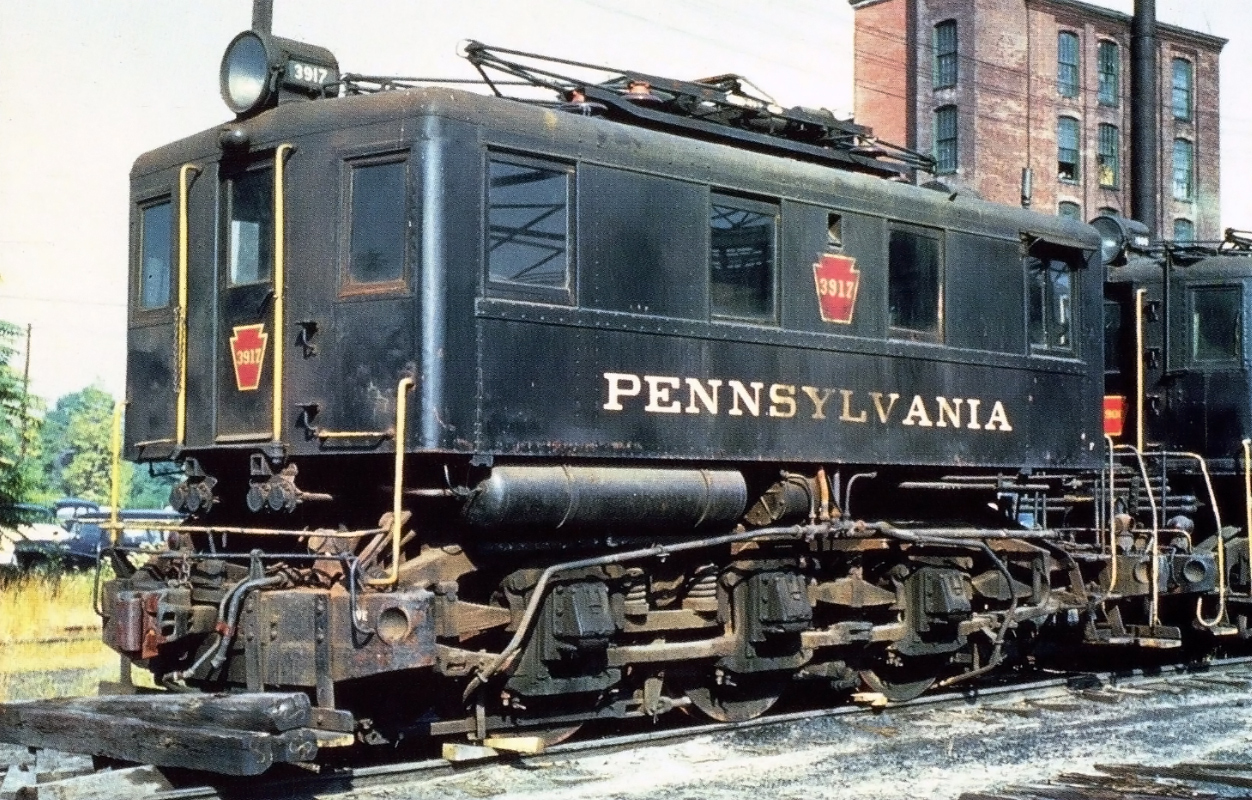
Pennsylvania Railroad class B1 electric switchers #3917 and #3907 are seen here at the 44th Street Shops in Philadelphia. American-Rails.com collection.
On this page: At a glance · Why a three-axle boxcab · BB1 and BB2 pairs · The 1934 singles · Long Island B3s · Sunnyside, 30th Street, Harrisburg · Complete roster · Specifications · Retirement and 5690
At a glance
| Item | Detail |
|---|---|
| Railroad | Pennsylvania Railroad (28). Same carbody on Long Island as class B3 (14) |
| PRR class | B1 (after 1933). Built as BB1 (2), BB2 (12), and B1 (14) |
| PRR road numbers | 3900–3901; 3910–3921; 5684–5697. Five later took 4751, 4752, 4755–4757 in 1966–67 |
| Builder | PRR Juniata Shops (Altoona Works), with Westinghouse (1926 groups) and Allis-Chalmers (1934–35) electrical equipment |
| Built | 1926 (pairs); 1934–35 (singles) |
| Wheel arrangement | Whyte 0-6-0; AAR C; UIC Co. Three driving axles, no guiding trucks. PRR class B is the 0-6-0, steam or electric |
| Power | 11,000 V, 25 Hz AC overhead (as standardized). BB2 built for 650 V DC third rail; converted to AC 1933–35 |
| Horsepower | Three axle-hung motors at 233 hp each, 700 hp combined. Classic Trains lists 570 hp for the class—the usual continuous figure against the hourly rating |
| Work | Passenger-terminal switching: Sunnyside Yard and New York Penn Station, 30th Street coach yard in Philadelphia, Harrisburg. Not road freight |
| Crew name | Rats |
| Survivor | 5690 (briefly Penn Central 4756), Railroad Museum of Pennsylvania, Strasburg. Remainder scrapped |
Roster and construction numbers from Eugene Connelly and William Edson, PRR Numerical Roster, Steam and Electric Locomotives (rev. Dec. 29, 2011). Specs from PRR diagram E-400387-B and Alvin F. Staufer and Bert Pennypacker, Pennsy Power (1962), pp. 260–263. Information compiled September 2, 2026.
Why a three-axle boxcab
Pennsylvania Station opened in 1910 with 650-volt DC third rail through the Hudson and East River tunnels. Pennsylvania DD1 motors hauled varnish between Manhattan Transfer and Sunnyside. Steam still made up the trains in the yards. Michael Bezilla’s Electric Traction on the Pennsylvania Railroad is the book on that plant: first the tunnel problem steam could not solve, then the 1928–38 main-line program that put 11,000-volt, 25-cycle catenary from New York to Washington and west to Harrisburg. Once those coach yards sat under wire, a steam 0-6-0 was the wrong tool. The railroad needed a shifter that took power from the same plant as a GG1.
Until 1933 a through train still changed engines at Manhattan Transfer. DD1s owned the tunnels; steam or the new AC road motors owned everything west of the Hackensack. When catenary was carried through to Penn Station, GG1s and P5s ran into Manhattan without a change, and the yards at Sunnyside had to switch those same cars on AC. The B1s were already there as DC pairs. Converting the BB2s and splitting the drawbars was how the terminal kept up with the road.
PRR classification made the carbody obvious. Class B was already the 0-6-0: three driving axles, short wheelbase, no lead truck to bind on yard curves. The electric B1 is that idea in a boxcab. Three universal motors geared straight to the axles. One pantograph on the roof centerline. Controls at both ends so the engine did not have to run around a cut. Top speed 25 mph—enough to drag a cut of head-end cars and coaches through Sunnyside, not enough to get in a GG1’s way on the main. Starting tractive effort was 39,250 pounds on 157,000 pounds of engine. That is a high factor of adhesion for a yard goat, which is what you want when the cut is P70s on wet rail and there is no room to slip.
They are not the steam B1, an 1860s 0-6-0T. Same letter, different century.
Married pairs: BB1 and BB2
The first twenty-eight locomotives left Juniata in 1926 as semi-permanently coupled pairs. Two B units together were class BB, the same doubling PRR used on DD1s. More motors, more tractive effort, still a yard engine.
The prototype pair, class BB1, was 3900 and 3901, construction number 4080, built as New York Terminal No. 8. They were AC from the start. They proved the carbody. Production for the New York terminal was class BB2: twelve locomotives, six pairs, 3910–3921, construction numbers 4031–4036, New York Terminal 1 through 6. Those twelve were 650-volt DC third-rail engines, with contact shoes, to live in the same plant as the DD1s between Penn Station and Sunnyside.
When the AC catenary from the south reached the New York terminal in 1933, the pairs came apart. The BB1s and BB2s were reclassed B1 as single units. The twelve DC engines were rewound and given pantographs for 11,000-volt, 25-cycle AC. After that the whole PRR fleet spoke the same language as the road motors.
Fourteen singles for the expanding wire
The last order did not bother with drawbars between units. Fourteen locomotives, 5684–5697, came out of Juniata in 1934 and 1935 as single-unit class B1 from the start, Allis-Chalmers electrical equipment, AC overhead. Construction numbers run 4257 through 4273 with the usual Juniata gaps. Harrisburg passenger electrification was finishing in those same years; Philadelphia’s 30th Street coach yard was already under wire. The railroad needed extra singles, not more married pairs for the old DC terminal.
These are the engines Bert Pennypacker photographed at Harrisburg—5687 in the 1940s, at the west end of passenger electrification. Robert S. McGonigal, summarizing the class for Classic Trains, called the B1 a member of North America’s largest fleet of electric switch engines. Count only the PRR roster and the class is 28. Count the Long Island sisters and the type is 42. Either way, no other American railroad put that many purpose-built electric switchers under one roof.
Long Island’s B3s
The same shops built fourteen more in 1926 for the Long Island Rail Road, which the Pennsylvania still controlled. They went to the Bay Ridge Branch as class BB3, seven pairs numbered 324–330 with A and B halves, 11,000-volt AC to match New Haven catenary on the freight line from Fremont to the Bay Ridge float yards. They were more locomotive than the branch needed as pairs. Long Island split them into fourteen singles, class B3, numbered 324–337. Edward M. Koehler’s LIRR motive-power summary has them stored after Bay Ridge freight electrification was cut back in the mid-1950s and gone by 1955. Three—324, 325, and 332—were sold as-is to the Pennsylvania on February 24, 1954. They are the same machine as a B1. They are not the PRR B1 roster below.
Sunnyside, 30th Street, Harrisburg
The work was passenger-terminal switching, not the freight main. Sunnyside Yard in Queens was the big assignment: make up and break up the Fleet of Modernism, drag deadhead consists through the East River tunnels, spot head-end cars at Penn Station. Philadelphia’s 30th Street coach yard took a share. A few ran at Harrisburg once the 1938 wire reached the west end of the passenger electrification. They did not go to Enola to switch freight. That remained steam, then diesel.
Yard crews called them rats. The name stuck on Long Island as well as at Sunnyside. A three-axle boxcab darting in and out of coach tracks will do that. It was never a company class name. It is what the men who ran them said.
As through passenger business thinned in the 1950s and 1960s, the railroad needed fewer dedicated electric switchers. Diesel SW1s and their kin could work a dark yard. The B1s could not. Harrisburg and Philadelphia let theirs go first. Sunnyside kept rats the longest. A handful were still on the property when Pennsylvania and New York Central became Penn Central on February 1, 1968. None lasted into Conrail in 1976 as working engines.
Complete PRR B1 roster
Construction numbers are Juniata shop numbers. Pair mates share a number. Dispositions are Connelly and Edson. Five units took 4750-series numbers in 1966–67 to clear the old series; 5690 was one of them and is the engine at Strasburg, restored to 5690.
| PRR no. | As built | Built | C/N | Original pair / NY Terminal | Disposition |
|---|---|---|---|---|---|
| 3900 | BB1 | 1926 | 4080 | With 3901; NYT 8 | Scrap Dec. 1962 |
| 3901 | BB1 | 1926 | 4080 | With 3900; NYT 8 | Scrap Dec. 1962 |
| 3910 | BB2 | 1926 | 4031 | With 3911; NYT 1. DC, then AC | Sold for scrap Aug. 1967 |
| 3911 | BB2 | 1926 | 4031 | With 3910; NYT 1 | Scrap Jan. 1962 |
| 3912 | BB2 | 1926 | 4032 | With 3913; NYT 2 | Renumbered 4751 Oct. 1966; retired, held for display; not the Strasburg engine |
| 3913 | BB2 | 1926 | 4032 | With 3912; NYT 2 | Renumbered 4752 Mar. 1967; retired |
| 3914 | BB2 | 1926 | 4033 | With 3915; NYT 3 | Scrap Dec. 1962 |
| 3915 | BB2 | 1926 | 4033 | With 3914; NYT 3 | Scrap Jan. 1963 |
| 3916 | BB2 | 1926 | 4034 | With 3917; NYT 4 | Scrap Dec. 1962 |
| 3917 | BB2 | 1926 | 4034 | With 3916; NYT 4 | Scrap Dec. 1962 |
| 3918 | BB2 | 1926 | 4035 | With 3919; NYT 5 | Scrap Dec. 1962 |
| 3919 | BB2 | 1926 | 4035 | With 3918; NYT 5 | Sold for scrap Aug. 1967 |
| 3920 | BB2 | 1926 | 4036 | With 3921; NYT 6 | Scrap Aug. 1958 |
| 3921 | BB2 | 1926 | 4036 | With 3920; NYT 6 | Scrap Jan. 1962 |
| 5684 | B1 | 1934 | 4257 | Single, AC | Scrap Jan. 1967 |
| 5685 | B1 | 1934 | 4258 | Single, AC | Scrap Feb. 1967 |
| 5686 | B1 | 1934 | 4259 | Single, AC | Scrap June 1960 |
| 5687 | B1 | 1934 | 4260 | Single, AC | Renumbered 4755 Nov. 1966 |
| 5688 | B1 | 1934 | 4261 | Single, AC | Scrap May 1967 |
| 5689 | B1 | 1934 | 4262 | Single, AC | Scrap Jan. 1963 |
| 5690 | B1 | 1934 | 4263 | Single, AC | Renumbered 4756 Feb. 1967. Preserved, Railroad Museum of Pennsylvania, restored as 5690 |
| 5691 | B1 | 1934 | 4264 | Single, AC | Scrap Feb. 1962 |
| 5692 | B1 | 1934 | 4265 | Single, AC | Scrap May 1967 |
| 5693 | B1 | 1934 | 4266 | Single, AC | Renumbered 4757 Feb. 1967 |
| 5694 | B1 | 1935 | 4268 | Single, AC | Scrap Feb. 1967 |
| 5695 | B1 | 1935 | 4270 | Single, AC | Sold for scrap Aug. 1967 |
| 5696 | B1 | 1935 | 4271 | Single, AC | Retired Dec. 1963 |
| 5697 | B1 | 1935 | 4273 | Single, AC | Scrap Sept. 1962 |
All 28 reclassed B1 when the pairs were split in 1933. BB2 units converted from 650 V DC third rail to 11 kV 25 Hz AC at the same time. Long Island 324–337 (class B3) are omitted here; they are the same design, not PRR numbers.
Specifications
Figures below are the PRR AC diagram (tracing E-400387-B) as published by Staufer and Pennypacker and by the railroad’s own drawing. BB2 dimensions as DC engines were the same carbody with third-rail shoes instead of a pan.
| Item | Detail |
|---|---|
| Builder | PRR Juniata Shops, Altoona Works |
| Electrical equipment | Westinghouse (1926 BB1/BB2); Allis-Chalmers (1934–35 B1) |
| Type | Rigid-frame boxcab switcher, dual-end controls |
| Wheel arrangement | 0-6-0 / AAR C / UIC Co |
| Driver diameter | 62 in |
| Length | 31 ft 6 in |
| Height | 15 ft 0 in (pantograph down) |
| Weight | 157,000 lb |
| Track gauge | 4 ft 8½ in |
| Current collection | One overhead pantograph (AC). BB2 as built: third-rail contact shoes, 650 V DC |
| Line voltage (standard) | 11,000 V, 25 Hz AC |
| Traction motors | Three AC/DC universal motors, axle-hung, geared to the axles |
| Motor rating | 233 hp each |
| Power output | 700 hp combined (hourly). Classic Trains: 570 hp (continuous class figure) |
| Starting tractive effort | 39,250 lbf |
| Maximum speed | 25 mph |
| Control | Tap-changer AC (or resistance control on the original DC BB2s) |
What survived
Connelly and Edson put the first retirement in August 1958 (3920) and the last scrap sales in August 1967. 3912 was held for display after it became 4751. The engine the Commonwealth of Pennsylvania actually kept is 5690, built in 1934, construction number 4263, briefly Penn Central 4756, restored to 5690 and standing on Track 5 in the museum hall at Strasburg beside the DD1 pair, GG1s 4800 and 4935, and E44 4465. It is cosmetic. There is no 11,000-volt switcher lead left to run it on.
Related Reading on American-Rails.com
- Pennsylvania Railroad
- GG1
- E44
- Electric locomotives
- Railroad Museum of Pennsylvania
- PRR diesel roster
Sources
- Alvin F. Staufer and Bert Pennypacker, Pennsy Power: Steam and Electric Locomotives of the Pennsylvania Railroad, 1900–1957 (Carrollton, Ohio: Alvin F. Staufer, 1962), pp. 260–263
- Pennsylvania Railroad locomotive diagram E-400387-B (class B1, AC), via Robert Schoenberg, prr.railfan.net
- Eugene Connelly and William D. Edson, PRR Numerical Roster, Steam and Electric Locomotives, rev. Dec. 29, 2011
- Robert S. McGonigal, “Pennsylvania Railroad electric locomotives,” Classic Trains (online class summary)
- Edward M. Koehler Jr., LIRR motive-power history, 1898–1955
- Michael Bezilla, Electric Traction on the Pennsylvania Railroad, 1895–1968 (University Park: Pennsylvania State University Press, 1980)
- Railroad Museum of Pennsylvania roster (5690)
- Trainweb / BEDT industrial locomotive notes on LIRR BB3/B3
Recent Articles


-
Kansas City Southern Steam Roster (Built Since 1900)
Oct 25, 26 11:50 AM
Steam locomotives of the Kansas City Southern built since 1900, with the Louisiana & Arkansas and the Texas company. -
Kansas City Southern Diesel Roster (Built New)
Oct 25, 26 11:46 AM
 All-time diesel roster of the Kansas City Southern. E units, F units, Geeps, SD40s through SD70ACes, Fairbanks-Morse, Baldwin, Alco, and General Electric, with serials and order numbers.
 -
Kansas City Southern Railway: Map, Photos, History
Oct 25, 26 12:24 AM
 The Kansas City Southern, from Arthur Stilwell's Gulf line to Canadian Pacific Kansas City on April 14, 2023. Steam and diesel rosters, the Southern Belle, and the Louisiana & Arkansas.
 -
Indiana Harbor Belt Diesel Roster (All-Time)
Oct 25, 26 12:17 AM
 All-time diesel roster of the Indiana Harbor Belt. 202 locomotive frames, each counted once. NW2s, SW7s, SW1500s, road switchers, and gensets. Slugs and boosters are outside the count.
 -
Indiana Harbor Belt Steam Roster (Built Since 1900)
Oct 25, 26 12:13 AM
 Steam locomotives of the Indiana Harbor Belt built since 1900. 182 engines, each counted once. 0-6-0s, 2-6-0s, 0-8-0s, and 2-8-2s. The three U-4a switchers are three-cylinder Brooks engines of 1927.
 -
Indiana Harbor Belt Railroad: Map, Rosters, History
Oct 25, 26 12:00 AM
 Indiana Harbor Belt, the inner belt across the Calumet, from the East Chicago Belt of May 16, 1896. Renamed June 29, 1907. Still operating, headquarters Hammond. Steam roster is the companion, 182 loc…
 -
NYC's "P Motor" Electric Locomotives
Oct 24, 26 11:43 PM
 New York Central P motors: 22 Alco-GE 2-C+C-2 electrics, Cleveland Union Terminal 1050–1071, class P-1a. 3,030 hp one-hour on 3,000-volt DC catenary, then 660-volt third rail as P-2a and P-2b.
 -
Illinois Terminal Car Roster
Oct 24, 26 11:40 PM
 Illinois Terminal cars. Mainline motors, the 1948 streamliners, sleepers, Alton and Valley Division cars, express motors, and the line cars rebuilt from pull cars.
 -
Illinois Terminal Diesel Roster
Oct 24, 26 09:31 PM
 All-time Illinois Terminal diesels, 62 frames. Alco S-2s and RS-1s, EMD switchers, GP7s, SD39s, GP38-2s, and the two GP20s. Serial numbers from the 1989 roster.
 -
Illinois Terminal Electric Locomotives
Oct 24, 26 08:22 PM
 Illinois Terminal electric locomotives, 57 frames. Class A through Class D, the Decatur-built motors, and the battery locomotives. Class D is the same five Class C frames, rebuilt.
 -
Illinois Terminal Steam Roster
Oct 24, 26 07:37 PM
 Illinois Terminal steam locomotives, 36 frames. Baldwin Moguls, three Class 30 Mikados, Florida East Coast 0-8-0s, and 2-6-0 No. 21, the last fire on June 30, 1950.
 -
Illinois Terminal Railroad: Map, Roster, Photos, History
Oct 24, 26 07:32 PM
 Illinois Terminal, McKinley's Illinois Traction System, from the Danville coal towns to St. Louis. The McKinley Bridge, the sleeping cars, the 1937 break with the power company, the 1948 streamliners…
 -
Southern Railway Diesel Roster (All-Time)
Oct 23, 26 11:00 PM
 All-time diesel roster of the Southern Railway. 2,505 locomotives in the system number series, from the 1939 demonstrator FT to GP50s and B30-7A1s. Serials included.
 -
Illinois Central Diesel Roster (All-Time)
Oct 23, 26 04:06 PM
 Illinois Central and Illinois Central Gulf diesel locomotives, each frame once. The quantity column is 886. Serials and order numbers from Electro-Motive's builder lists. Paducah rebuilds and Gulf, Mo…
 -
Illinois Central Gulf Diesel Roster
Oct 23, 26 04:02 PM
 Illinois Central Gulf operating numbers from August 10, 1972, to February 29, 1988. New frames stay on the Illinois Central diesel roster. Gulf, Mobile and Ohio frames stay on that roster. No Gulf fle…
 -
Illinois Central Railroad: Map, Logo, History
Oct 23, 26 03:50 PM
Illinois Central, the Main Line of Mid-America, from the 1850 land grant to Canadian National control on July 1, 1999. Charter lines, Cairo bridge, Paducah, and the Illinois Central Gulf. Steam quanti… -
Grand Trunk Western Diesel Roster (All-Time)
Oct 23, 26 12:53 PM
 Grand Trunk Western diesel locomotives, each frame once. The quantity column is 377. Serials are filled for the Detroit, Toledo and Ironton and Detroit and Toledo Shore Line engines the railroad kept…
 -
Grand Trunk Western Steam Roster
Oct 23, 26 12:14 PM
 Grand Trunk Western steam locomotives in service about 1937 to 1942, from Richard Leonard's class list. Drury has no chapter. The quantity column is the counted Grand Trunk Western rows. Two mixed Gra…
 -
Grand Trunk Western Railroad: Map, Roster, History
Oct 23, 26 12:09 PM
 Grand Trunk Western, reporting mark GTW, Canadian National's railroad between Port Huron and Chicago. Trade name adopted in 1923. Steam class list quantity 232. Diesel quantity column 377. Identity in…
 -
Green Bay and Western Railroad: Map, Rosters, History
Oct 22, 26 11:18 PM
 Green Bay & Western, the Green Bay Route, reporting mark GBW. From Kewaunee to Winona. Mailer's steam and diesel rosters, and the August 1993 sale to Fox Valley & Western.
 -
Chicago & North Western Class E-4: Streamlined 4-6-4 Hudsons
Oct 22, 26 10:28 PM
 C&NW Class E-4, nine streamlined 4-6-4s, 4001–4009, Alco 1938. 84-inch drivers, 25-by-29 cylinders, 300 psi. Conventional Chicago–Omaha trains. Oil in 1947–48. Retired 1953–1956.
 -
Gateway Western Railway: Map, Roster, History
Oct 22, 26 02:43 PM
 Gateway Western Railway, reporting mark GWWR. Class II from Kansas City to East St. Louis. Kansas City Southern control May 5, 1997. The 1992 diesel fleet, with serials and order numbers.
 -
Duluth, Winnipeg & Pacific Railway: Roster, Map, History
Oct 22, 26 01:51 PM
 Duluth, Winnipeg & Pacific, the Peg, reporting mark DWP. From the Rainy River to Duluth. CNRHA steam list 36. Fifteen RS-11s. Merged into Wisconsin Central Ltd. on December 31, 2011.
 -
Elgin, Joliet and Eastern Diesel Roster (All-Time)
Oct 22, 26 01:35 PM
 All-time diesel roster of the Elgin, Joliet and Eastern.
 -
Elgin, Joliet and Eastern Steam Roster
Oct 22, 26 01:25 PM
 Elgin, Joliet and Eastern steam locomotives of the final decade, which largely comprised switcher types, 2-8-0s, and a large fleet of Mikados.
 -
Elgin, Joliet and Eastern Railway: Map, Roster, History
Oct 22, 26 12:32 PM
 Elgin, Joliet & Eastern, the outer arc around Chicago, from the Joliet, Aurora & Northern of April 30, 1884. Illinois company March 18, 1887. Merged December 4, 1888. Principal lines sold Janu…
 -
Denver and Salt Lake Railway: History, Roster, Timetable
Oct 22, 26 09:47 AM
 Denver & Salt Lake, the Moffat Road, from Denver to Craig. Tunnel opened February 26, 1928. Dotsero Cutoff dedicated June 16, 1934. Merged April 11, 1947. Steam locomotives 59.
 -
Duluth, Missabe and Iron Range Diesel Roster (All-Time)
Oct 22, 26 09:43 AM
 All-time diesel roster of the Duluth, Missabe and Iron Range. 148 owned frames, each counted once. SW9s, SD9s, SD18s, SD38s, RSD-15s, and C630s. Serials and builder order numbers included. Helm SD40-3…
 -
Duluth, Missabe and Iron Range Steam Locomotives (Since 1900)
Oct 22, 26 09:22 AM
 Duluth, Missabe & Iron Range steam locomotives built since 1900. Duluth & Iron Range, Duluth, Missabe & Northern, and later DM&IR acquisitions. Quantity column 252. Yellowstones 220-23…
 -
Duluth, Missabe and Iron Range Railway: Roster, Map, Logo
Oct 22, 26 09:17 AM
Duluth, Missabe & Iron Range, reporting mark DMIR, from the Mesabi and the Vermilion to the Lake Superior docks. Formed July 1, 1937. Steam quantity 252. Owned diesels 148. On paper through Decemb… -
Duluth, South Shore, and Atlantic Railway: Map, Roster, Timetables
Oct 21, 26 11:21 PM
 Duluth, South Shore & Atlantic Railway, the South Shore. Marquette to the Sault, St. Ignace, Houghton, and Duluth-Superior. Soo Line on January 1, 1961. Twenty-four diesels.
 -
Detroit, Toledo and Ironton Diesel Roster (All-Time)
Oct 21, 26 02:55 PM
 All-time diesel roster of the Detroit, Toledo and Ironton. 119 frames, each counted once. Serials and builder order numbers included. Last steam was December 24, 1955.
 -
Detroit, Toledo and Ironton Steam Roster (Post 1900)
Oct 21, 26 02:49 PM
 Detroit, Toledo and Ironton steam locomotives built after 1900. Drury's class grid. The quantity column prints 141. Counted once, the frames are 137. Last steam was Mikado 805 on December 24, 1955.
 -
Detroit, Toledo and Ironton Railroad: Map, Roster, History
Oct 21, 26 02:40 PM
 Detroit, Toledo & Ironton, reporting mark DTI, from Detroit to Ironton, Ohio. Railway organized May 2, 1905. Railroad articles filed February 21, 1914. Henry Ford, 1920 to 1929. Steam and diesel r…
 -
Iowa, Chicago and Eastern Railroad: Roster, Map, History
Oct 21, 26 01:04 PM
 Iowa, Chicago & Eastern Railroad Corporation, reporting mark ICE. About 1,125 miles and about 275 miles of trackage rights from the I&M Rail Link. Operations at 12:01 a.m. July 30, 2002. Canad…
 -
Rapid City, Pierre & Eastern Railroad: Route, Roster, Overview
Oct 21, 26 10:16 AM
 Rapid City, Pierre & Eastern Railroad, reporting mark RCPE. Genesee & Wyoming Class II. Agreement of January 2, 2014, Finance Docket 35799. Freight service from June 1, 2014, on the Dakota, Mi…
 -
Dakota, Minnesota & Eastern Railroad: Roster, Map, History
Oct 21, 26 12:26 AM
 Dakota, Minnesota & Eastern Railroad, reporting mark DME. The July 2, 1986 Chicago & North Western sale, 826 miles and 139 miles of trackage rights. Canadian Pacific control October 30, 2008…
 -
Detroit and Mackinac Railway: Map, Roster, History
Oct 20, 26 11:58 PM
 Detroit & Mackinac Railway, the Turtle Line. Bay City to Cheboygan along Lake Huron. Incorporated December 29, 1894. Lake State Railway leased the operation in 1992 and bought the lines in 1997. E…
 -
Davenport, Rock Island and Northwestern Railroad
Oct 20, 26 11:22 PM
 Davenport, Rock Island and North Western Railway, the DRI Line. Clinton to East Moline across the Crescent Bridge. Burlington and Milwaukee. Merged into the Soo Line on June 29, 1995. Eighteen diesels…
 -
Chicago Great Western Steam Roster (Post 1900)
Oct 20, 26 11:17 PM
Chicago Great Western steam locomotives built or rebuilt since 1900. Drury's class grid. 320 frames, each once. The quantity column prints 376 because a rebuild is listed again. Last steam in the reti… -
Chicago Great Western Diesel Roster (All-Time)
Oct 20, 26 10:47 PM
All-time diesel roster of the Chicago Great Western. 157 frames, each counted once. Serials and builder order numbers included. Steam was gone by 1950. The 1963 glance figure of 141 is one year's flee… -
Chicago Great Western Railway: Map, Photos, History, Rosters
Oct 20, 26 10:43 PM
 The Chicago Great Western, the Corn Belt Route, linked Chicago, the Twin Cities, Omaha, and Kansas City from September 27, 1885, until the Chicago & North Western merger at 12:01 a.m. on July 1, 1968…
 -
Chicago, South Shore & South Bend Railroad: "The South Shore Line"
Oct 20, 26 05:48 PM
 Chicago South Shore & South Bend, the South Shore Line, from the 1901 Air Line through Samuel Insull's 1925 rebuild, the orange cars, the 800s, and the railroad NICTD and Anacostia still run.
 -
Northwestern Virginia Railroad: Map, History, Timetable
Oct 20, 26 04:18 PM
 Northwestern Virginia Railroad, chartered February 14, 1851, Grafton to Parkersburg, 104 miles. Opened May 1, 1857. Foreclosure sale February 15, 1865, as the Parkersburg Branch. Twenty-three tunnels…
 -
"Exposition Flyer" (Train): Consist, Timetable, History
Oct 20, 26 03:29 PM
 Exposition Flyer, Chicago to Oakland, June 10, 1939 to March 20, 1949. Burlington, Rio Grande, and Western Pacific. Heavyweight cars, then diesels and a vista-dome. Replaced by the California Zephyr.
 -
Chicago, St. Paul, Minneapolis & Omaha Railway, "The Omaha Road"
Oct 20, 26 02:13 PM
 The Omaha Road, reporting mark CMO. Formed May 26, 1880. North Western management on December 16, 1882. Leased January 1, 1957. Class K-1 No. 183 and the sublettered diesels.
 -
Chicago and Western Indiana Railroad: Map, Rosters, History
Oct 20, 26 01:17 PM
 Chicago and Western Indiana, chartered June 5, 1879. Five equal owners, Dearborn Station, and two main lines. Dolton suburban mile 16.6. Fifteen diesels. Railroad service ended in 1994. The Illinois c…
 -
Railroad Tell-Tales: Protecting The Brakeman
Oct 20, 26 12:58 PM
 Railroad tell-tales: hanging ropes that warned a man on a freight-car roof of a low bridge or tunnel. The 1897 bridge-warning report, the 1905 Wisconsin statute, retainers, and why the roof walk outla…
 -
Chicago & North Western Steam Roster (Post 1900)
Oct 20, 26 12:54 PM
 Chicago & North Western steam locomotives built since 1900, and the Omaha Road list beside it. Drury's parent quantity column sums to 1,445, with four rows left blank. The Omaha Road column sums to 24…
 -
Chicago & North Western Diesel Roster (All-Time)
Oct 20, 26 12:49 PM
 All-time diesel roster of the Chicago & North Western. 2,494 frames, each counted once, including Chicago Great Western, Minneapolis & St. Louis, and Omaha Road units that received North Western numbe…