Railroads In The 1940s: War Traffic, Last Steam & the Diesel Flood
Last revised: September 9, 2026
By: Adam Burns
The 1940s opened on a map that had already stopped growing and closed on one that was about to dieselize. John Stover’s first-track series put 233,670 miles in 1940 and 223,779 in 1950. In between sat the largest traffic the American railroad ever moved, the last new steam locomotives a major road would buy, and, after V-J Day, a flood of Electro-Motive F-units and the first Geeps. New York Central and Pennsylvania ordered hundreds of lightweight cars in 1945 as if the wartime coach would last. The California Zephyr began on March 20, 1949. Airline passenger-miles passed Pullman’s the same year.
The war itself—Office of Defense Transportation, the 1944 peak of about 739 billion ton-miles, the three-week seizure of December 1943—is Railroads In World War II. Troop movements by the month are on troop trains. The Depression, the streamliners of 1934, and the FT demonstrator are on the 1930s. What follows here is 1940 through 1950: the war as the decade’s center, the last Super Power, the diesel that the War Production Board had rationed, and the passenger bet that the 1950s had to live with. Named-trains can be on Streamliners.
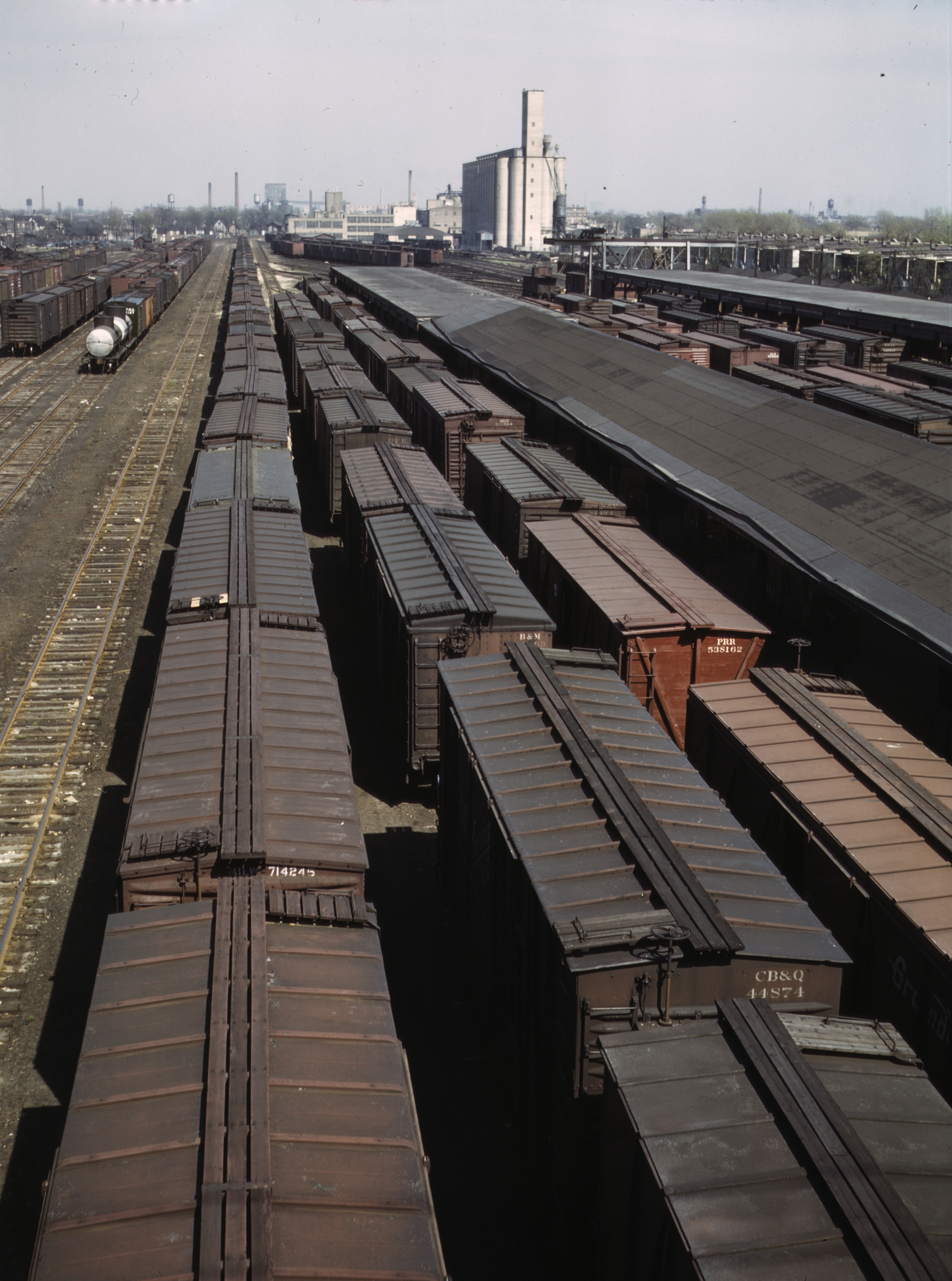
Milwaukee Road’s Galewood Yard in Chicago in May, 1943. Jack Delano photo.
On this page: At a glance · The war as the decade’s center · Last new steam · The diesel flood · The 1945 bet · Named trains, 1947–49 · Highways on paper · Mileage · Into the 1950s
At a glance
| Item | Detail |
|---|---|
| Miles of first track, 1940 | 233,670 (Stover / ICC) |
| Miles of first track, 1945 | About 226,696 |
| Miles of first track, 1950 | 223,779 |
| Peak (already past) | 254,037 in 1916 |
| War operations | World War II page. ODT December 18, 1941. 1944 peak about 739 billion ton-miles |
| Capital spending | About $563 million (1945); about $1.3 billion (1949). Locomotive outlays about $128 million to $406 million |
| New locomotives, Class I, 1942–45 | 3,066: 1,891 diesel, 1,175 steam |
| Steam orders after the war | Eighty-three domestic steam locomotives ordered in 1945; zero in 1946 |
| Diesels on the roster | About 3,882 at the end of 1945. By 1950 steam still handled about 54% of freight, 36% of passenger, 38% of switching |
| Last great steam | UP 4-8-8-4 Big Boy, 1941 (second batch 1944). N&W Class J 4-8-4, 1941. PRR T1 duplex, 1942. B&O EM-1 2-8-8-4, 1944–45 |
| Road diesel after V-J | EMD F3 (1945). F7 and GP7 (1949) |
| NYC passenger order | 721 lightweight cars, $56 million, announced December 15, 1945 (Railway Age). Reequipped 52 trains |
| PRR passenger order | 214 cars, $21 million, same week |
| Dome car | Burlington Silver Dome, June 1945 |
| California Zephyr | First revenue trips March 20, 1949. CB&Q, D&RGW, Western Pacific |
| Federal-Aid Highway Act | 1944. A National System of Interstate Highways on paper. The funded Interstate is June 29, 1956 |
| Interurban miles, 1950 | 1,519 (Hilton and Due). Wartime remnant had been 2,687 |
Mileage is the Stover / ICC first-track series. Information compiled September 9, 2026.
The war as the decade’s center
Pearl Harbor is December 7, 1941. V-J Day is September 2, 1945. Those forty-five months ate the decade. Jack Delano, shooting for the Office of War Information, spent the winters of 1942 and 1943 in the Chicago yards. Galewood, Proviso, Corwith: Mikados on gondolas, westbounds waiting, a classification yard full in May. That is what the 1940s looked like before anyone talked about a Geep. The ton-miles, the ODT loading orders, and the three-week Army possession of December 1943 are on the World War II page. This page only needs the fact that the decade’s center of gravity was a war the railroads ran as private companies, with a smaller plant than in 1918 and a coordinator instead of a director general.
Gasoline and tires were rationed. Coaches filled. Freight share of intercity tonnage peaked around 72 percent in 1943. When the ration books ended, both shares began to fall. The companies knew it. They ordered cars and diesels anyway. Wartime profits paid for a plant the Depression had starved and the war had worn out.
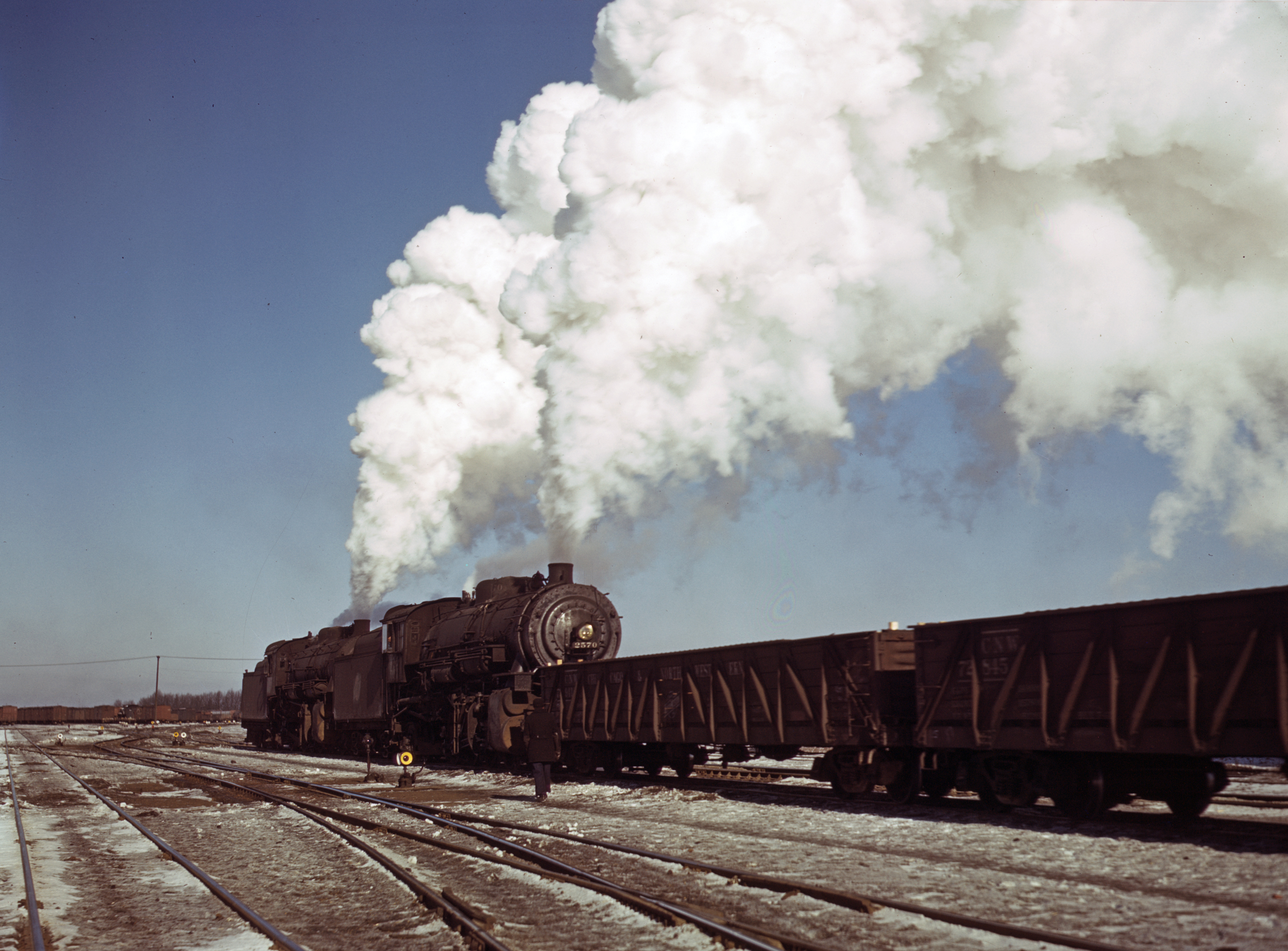
A pair of Chicago & North Western Class J 2-8-2s (led by 2570, a 1923 Alco product) move a cut of gondolas at Proviso Yard (C&NW’s classification/departure yard) in Melrose Park, Illinois in December, 1942. Jack Delano photo.
Last new steam
Super Power was a 1920s idea. The 1930s put it on Challengers, Daylights, and a duplex on a fairgrounds. The 1940s built the last of it, because the War Production Board would not fully release diesel engines wanted for ships and the Military Railway Service. Class I roads still took 1,175 new steam locomotives in 1942–45 against 1,891 diesels.
Union Pacific’s 4-8-8-4 Big Boys came in two batches: Alco 1941 (4000–4019) and 1944 (4020–4024). Norfolk & Western rolled the first Class J 4-8-4 at Roanoke in 1941. Pennsylvania’s T1 duplexes, 6110 and 6111, dated from 1942; production T1s followed late in the war. Baltimore & Ohio’s EM-1 2-8-8-4s, Baldwin 1944–45, were that road’s last new steam. WPB discouraged new designs. Pennsylvania’s J1 2-10-4 followed a Chesapeake & Ohio engine. Domestic steam orders fell from eighty-three in 1945 to zero in 1946.
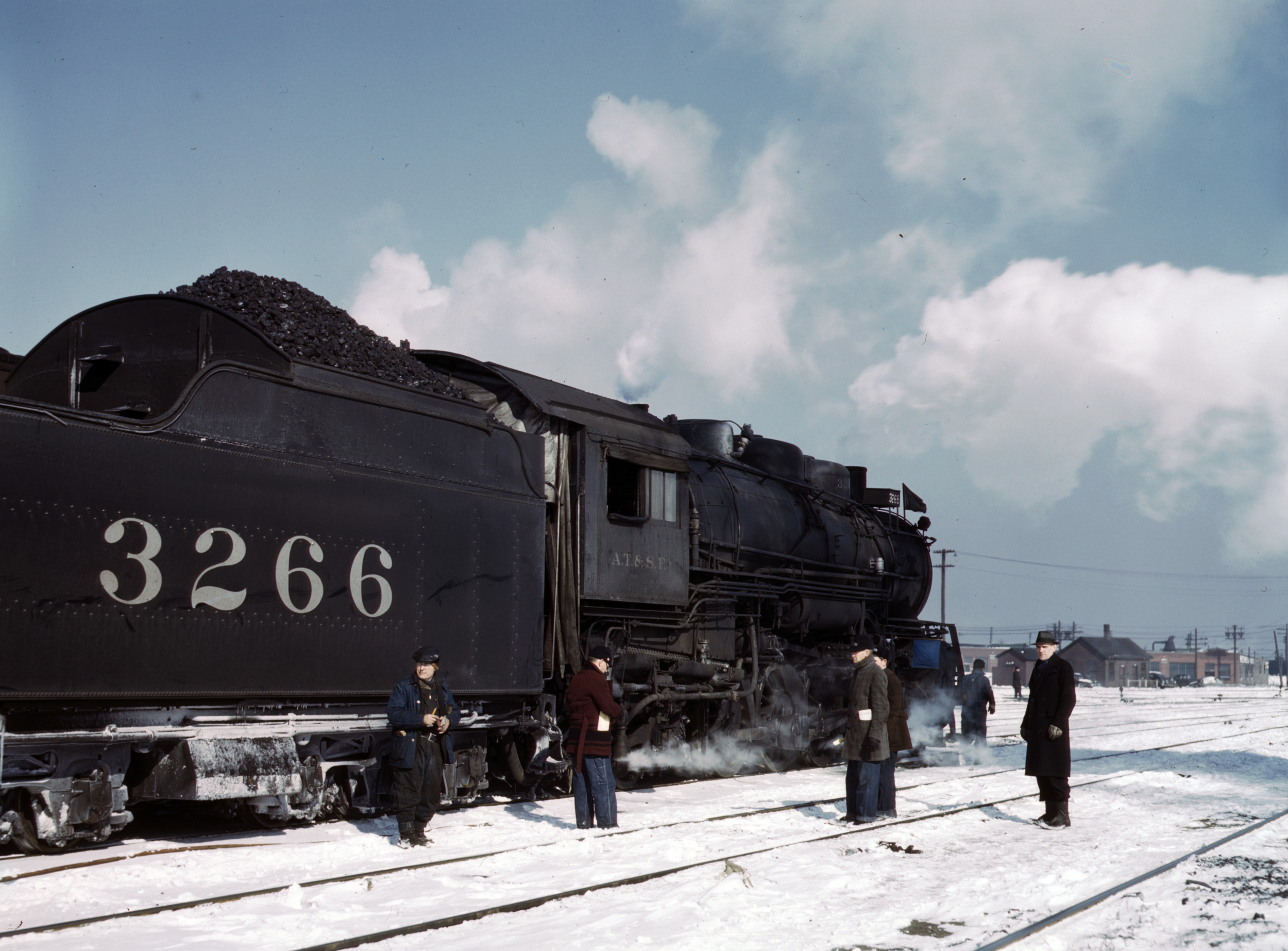
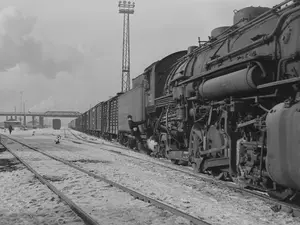
Santa Fe 2-8-2 No. 3266 awaits departure from Corwith Yard in Chicago with a westbound freight in March, 1943. Jack Delano photo.
The diesel flood
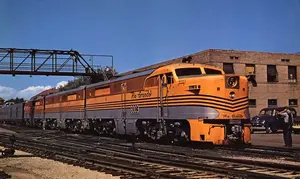
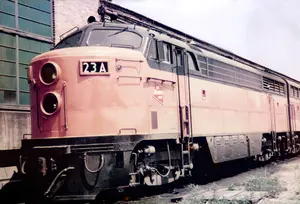
The FT of 1939–40 had already proved freight diesels could handle main line tonnage, and do so efficiently. The war rationed it. After V-J Day the restriction lifted and the roster changed in a hurry. About 3,882 diesels were on American railroads at the end of 1945. Capital spending on locomotives jumped from about $128 million that year to about $406 million in 1949. Electro-Motive’s F3 appeared in 1945; the F7 and the first GP7 road-switcher in 1949. Alco, Baldwin, and Fairbanks-Morse sold against them. The diesel hub owns the model directories. This decade is when the conversion left the demonstrator and entered the back shop as policy.
New York, Susquehanna & Western is often cited as the first Class I to dieselize completely, in 1945. Most big roads were still mixed. By 1950 steam still handled about 54 percent of freight work, 36 percent of passenger, and 38 percent of switching. Norfolk & Western and Chesapeake & Ohio were holdouts. The last steam on a Class I main line is a 1950s date. The decision to stop buying steam is a 1940s date.
The 1945 bet
Wartime coaches were crowded and worn. Railway Age for December 15, 1945, led with New York Central’s order of 721 new passenger cars at $56 million—239 from Budd, 354 from Pullman-Standard, 128 from American Car & Foundry—enough to reequip 52 trains. Pennsylvania, the same week, announced 214 cars at $21 million. Combined with cars already on order, the Central purchase is the largest single passenger-car order an American railroad ever placed. Other roads spent in the same spirit. The industry as a whole bought thousands of lightweights into the early 1950s. Whether those cars earned their keep is the 1950s story. The order date is this decade’s.
Burlington and Budd put the first vista-dome in service in June 1945: coach Silver Alchemy, rebuilt as Silver Dome, on the Twin Cities Zephyrs. General Motors’ Train of Tomorrow, four Astra-Dome cars behind an E7, went on the road in the spring of 1947 and stood at the Chicago Railroad Fair in 1948 and 1949. Union Pacific later bought the set. The consist and the 1950 tour are on the 1950s page. The dome as a 1940s idea is here.
Named trains, 1947–49
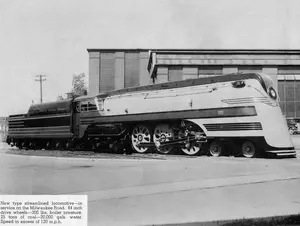
The 1930s had invented the streamliner. The late 1940s put new ones on the timetable and reequipped the old ones. Great Northern’s postwar Empire Builder went out in early 1947. Milwaukee’s Olympian Hiawatha followed on June 29, 1947, Skytop observation and all. Baltimore & Ohio’s Cincinnatian dated from January 19, 1947. New York Central restyled the 20th Century Limited; Pennsylvania answered on the Broadway Limited. Those names have their own pages and the streamliners directory.
The decade’s passenger monument is the California Zephyr. Burlington, Rio Grande, and Western Pacific had ordered the Budd train in 1945. Cars dribbled in; the Exposition Flyer carried a dome and a baggage car from March 1948. Dedication was March 19, 1949, at San Francisco. First revenue trips were March 20, 1949, Chicago–Oakland, scheduled so the Rockies and the Feather River ran in daylight. It did not beat the City of San Francisco on time. It sold the view. The same year, for the first time, airline passenger-miles exceeded the Pullman Company’s.
A highway act, not yet an Interstate
Congress wrote a Federal-Aid Highway Act in 1944 that named a National System of Interstate Highways. It did not fund the system that later ate the passenger train. That statute is June 29, 1956, on the 1950s page. What the 1940s did was put the map on paper while gasoline came back and the airlines took the Pullman trade. Trucks, already under the Motor Carrier Act of 1935, took back the short haul the war had given to rail. Piggyback experiments were older than the war (the North Shore in 1926, Chicago Great Western in 1936). The TOFC boom is the next decade.
A smaller map, a bigger plant
First track fell from 233,670 miles in 1940 to about 226,696 in 1945 and 223,779 in 1950. The 1930s had already taken off more than 15,000 miles. This decade kept cutting weak branches while putting money into what remained: heavier rail, more CTC (about 13,000 miles equipped by 1950), hump yards, and the diesel. Capital improvements ran about $563 million in 1945 and about $1.3 billion in 1949. Interurban mileage, 2,687 in the wartime count, stood at 1,519 in 1950. Hilton and Due remain the account; the overview is Interurbans & Streetcars.
Pennsylvania lost money in 1946 for the first time in its history. That was a signal, not yet a merger. Talks with New York Central waited until 1957. The New York, Ontario & Western’s liquidation is 1957. This decade still looked, on a timetable, like a railroad country. About 2,000 scheduled passenger trains a day were still in the Official Guide as 1950 opened.
Into the 1950s
The decade did not know it was a hinge. Delano’s Chicago yards of 1942–43 were still steam. By 1950 more than half the freight was already diesel, and the other half was on borrowed time. The Zephyr was new. The Central’s 721 cars were in the shops or on the road. Airlines had passed Pullman. The Interstate was still a 1944 drawing.
On August 27, 1950, with a Korean War strike threatening, President Truman ordered the Army to take the railroads again. That seizure, the 1956 highway act, the 1957–58 recession, and the first of the defensive mergers are Railroads In The 1950s. The 1940s left them a worn-out steam roster, a new diesel fleet, a set of stainless-steel trains, and a wartime traffic record nobody would match in peacetime until 1966.
Related Reading on American-Rails.com
- Railroad History (USA)
- Railroads In World War II
- Troop Trains
- Railroads In The 1930s
- Railroads In The 1950s
- Streamliners
- California Zephyr
- Hiawatha
- Diesel Locomotives
- EMD FT
- Steam Locomotives
- 4-8-4 Northerns
- Interurbans & Streetcars
Sources
- Stover, John F. The Routledge Historical Atlas of the American Railroads. New York: Routledge, 1999. First-track 233,670 (1940); about 226,696 (1945); 223,779 (1950)
- Boyd, Jim. The American Freight Train. Osceola, Wis.: MBI, 2001. 1950 mileage as used on the 1950s page; wartime traffic peak
- DeNevi, Don. America’s Fighting Railroads. Missoula: Pictorial Histories Publishing, 1996. See also World War II
- New locomotives, Class I, 1942–45: 3,066 (1,891 diesel, 1,175 steam). Army Transportation Corps / CMH Pub 10-19. Diesels on roster about 3,882 at year-end 1945. Steam share of work, 1950: about 54% freight, 36% passenger, 38% switching
- Domestic steam locomotive orders: 83 (1945), zero (1946). Capital improvements about $563 million (1945) and $1.3 billion (1949); locomotive outlays about $128 million to $406 million
- UP 4-8-8-4 Big Boy, Alco 1941 and 1944. N&W Class J 4-8-4, 1941. PRR T1, 1942. B&O EM-1, Baldwin 1944–45
- EMD F3, 1945; F7 and GP7, 1949. NYS&W complete dieselization, 1945
- Railway Age, December 15, 1945. NYC 721 cars, $56 million; PRR 214 cars, $21 million
- Burlington Silver Dome, June 1945. GM Train of Tomorrow, spring 1947; Chicago Railroad Fair 1948–49
- B&O Cincinnatian, January 19, 1947. Milwaukee Olympian Hiawatha, June 29, 1947. GN postwar Empire Builder, early 1947. California Zephyr first revenue trips, March 20, 1949 (dedication March 19)
- Airline passenger-miles exceeded Pullman Company, 1949
- Federal-Aid Highway Act, 1944. Interstate funding: Federal-Aid Highway Act, June 29, 1956
- Hilton, George W., and John F. Due. The Electric Interurban Railways in America. Stanford: Stanford University Press, 1960. 2,687 (wartime); 1,519 (1950)
- Jack Delano, Office of War Information / Farm Security Administration. Galewood Yard, May 1943; Proviso Yard, December 1942; Corwith Yard, March 1943
- President Truman, railroad seizure, August 27, 1950
Recent Articles


-
Missouri-Kansas-Texas Railroad (Katy): Map, History, Rosters
Oct 27, 26 11:02 PM
 History of the Missouri-Kansas-Texas, the Katy. The race into Indian Territory, Gould, the 1923 railroad, the Texas Special, and the 1988 sale. Steam and diesel rosters are linked.
-
Soo Line Diesel Roster (All-Time)
Oct 27, 26 10:55 PM
 All-time diesel roster of the Soo Line and the Wisconsin Central. 786 locomotives, each frame once. Cab units, Geeps, the Milwaukee Road engines, and the SD60s. The South Shore's 24 stay on that page.
-
Soo Line Steam Roster (Built Since 1900)
Oct 27, 26 10:49 PM
 Soo Line and Wisconsin Central steam locomotives built since 1900. Consolidations, Mikados, Pacifics, 21 Mountains, and four Lima 4-8-4s.
-
Soo Line Railroad: Map, Logo, History, Rosters
Oct 27, 26 10:24 PM
 The Soo Line, from the flour millers' railroad around Chicago to the Sault, the Wisconsin Central, and the Milwaukee Road. Steam quantity 422. Diesels 786. Canadian Pacific took full control in 1990.
-
Minneapolis, Northfield and Southern Railway: Map, History, Rosters
Oct 27, 26 10:32 AM
 The Minneapolis, Northfield & Southern, the Dan Patch Line that became a Twin Cities belt. Steam, gas-electric mules, motor cars, and the 22 diesels, through the Soo Line.
-
Minneapolis & St. Louis Diesel Roster (All-Time)
Oct 27, 26 10:27 AM
 All-time diesel roster of the Minneapolis & St. Louis. 97 locomotives, each frame once. Switchers from 1938, 35 RS-1s, the FT and F-unit cabs, two SD7s, and 23 GP9s. Builder numbers included.
-
Minneapolis & St. Louis Steam Roster (Post 1900)
Oct 27, 26 10:25 AM
 Minneapolis & St. Louis steam locomotives built since 1900. Moguls, Consolidations, 35 Mikados, and five Pacifics.
-
Minneapolis and St Louis Railway: "The Peoria Gateway"
Oct 27, 26 09:52 AM
 The Minneapolis & St. Louis, the Tootin' Louie, from the 1870 charter to the Peoria Gateway and the Chicago & North Western sale on November 1, 1960.
-
Alco "PA" Locomotives: Restoration, Specs, Engine, Rosters
Oct 27, 26 12:12 AM
 Alco's PA passenger cab, 297 locomotives built from 1946 to 1953. The 244 engine, the production roster, the Delaware & Hudson PA-4s, and Nickel Plate Road 190.
-
Milwaukee Road Diesel Roster: (All Time)
Oct 26, 26 01:44 PM
 All-time diesel roster of the Milwaukee Road. 1,208 locomotives, each frame once. Alco, Baldwin, Davenport, EMD, Fairbanks-Morse, General Electric, and Whitcomb, with builder numbers.
-
Milwaukee Road Steam Roster (All-Time): Post-1900
Oct 26, 26 01:38 PM
 Milwaukee Road steam locomotives built since 1900. Prairies, Mikados, the N-class articulateds, the S-class 4-8-4s, and the Hiawatha Atlantics and Hudsons. Quantity column 1,974. Unique frames 1,951.
-
Milwaukee Road: Map, Electrification, Logo, History
Oct 26, 26 01:20 PM
 The Milwaukee Road, from the Milwaukee & Mississippi of 1850 to the Pacific Coast Extension, the Hiawathas, and the Soo Line sale. Why Lines West should have stayed.
-
Lake Superior & Ishpeming Railroad: Map, Roster, History
Oct 25, 26 11:38 PM
 Lake Superior & Ishpeming Railroad, reporting mark LSI, from the Marquette Range to the Presque Isle ore dock. The 1954 steam list and the diesels the railroad owned.
-
Kansas City Southern Steam Roster (Built Since 1900)
Oct 25, 26 09:09 PM
 Steam locomotives of the Kansas City Southern built since 1900, with the Louisiana & Arkansas and the Texas company.
-
Kansas City Southern Diesel Roster (Built New)
Oct 25, 26 11:46 AM
All-time diesel roster of the Kansas City Southern. E units, F units, Geeps, SD40s through SD70ACes, Fairbanks-Morse, Baldwin, Alco, and General Electric, with serials and order numbers. -
Kansas City Southern Railway: Map, Photos, History
Oct 25, 26 12:24 AM
 The Kansas City Southern, from Arthur Stilwell's Gulf line to Canadian Pacific Kansas City on April 14, 2023. Steam and diesel rosters, the Southern Belle, and the Louisiana & Arkansas.
-
Indiana Harbor Belt Diesel Roster (All-Time)
Oct 25, 26 12:17 AM
 All-time diesel roster of the Indiana Harbor Belt. 202 locomotive frames, each counted once. NW2s, SW7s, SW1500s, road switchers, and gensets. Slugs and boosters are outside the count.
-
Indiana Harbor Belt Steam Roster (Built Since 1900)
Oct 25, 26 12:13 AM
 Steam locomotives of the Indiana Harbor Belt built since 1900. 182 engines, each counted once. 0-6-0s, 2-6-0s, 0-8-0s, and 2-8-2s. The three U-4a switchers are three-cylinder Brooks engines of 1927.
-
Indiana Harbor Belt Railroad: Map, Rosters, History
Oct 25, 26 12:00 AM
 Indiana Harbor Belt, the inner belt across the Calumet, from the East Chicago Belt of May 16, 1896. Renamed June 29, 1907. Still operating, headquarters Hammond. Steam roster is the companion, 182 loc…
-
NYC's "P Motor" Electric Locomotives
Oct 24, 26 11:43 PM
 New York Central P motors: 22 Alco-GE 2-C+C-2 electrics, Cleveland Union Terminal 1050–1071, class P-1a. 3,030 hp one-hour on 3,000-volt DC catenary, then 660-volt third rail as P-2a and P-2b.
-
Illinois Terminal Car Roster
Oct 24, 26 11:40 PM
 Illinois Terminal cars. Mainline motors, the 1948 streamliners, sleepers, Alton and Valley Division cars, express motors, and the line cars rebuilt from pull cars.
-
Illinois Terminal Diesel Roster
Oct 24, 26 09:31 PM
 All-time Illinois Terminal diesels, 62 frames. Alco S-2s and RS-1s, EMD switchers, GP7s, SD39s, GP38-2s, and the two GP20s. Serial numbers from the 1989 roster.
-
Illinois Terminal Electric Locomotives
Oct 24, 26 08:22 PM
 Illinois Terminal electric locomotives, 57 frames. Class A through Class D, the Decatur-built motors, and the battery locomotives. Class D is the same five Class C frames, rebuilt.
-
Illinois Terminal Steam Roster
Oct 24, 26 07:37 PM
 Illinois Terminal steam locomotives, 36 frames. Baldwin Moguls, three Class 30 Mikados, Florida East Coast 0-8-0s, and 2-6-0 No. 21, the last fire on June 30, 1950.
-
Illinois Terminal Railroad: Map, Roster, Photos, History
Oct 24, 26 07:32 PM
Illinois Terminal, McKinley's Illinois Traction System, from the Danville coal towns to St. Louis. The McKinley Bridge, the sleeping cars, the 1937 break with the power company, the 1948 streamliners… -
Southern Railway Diesel Roster (All-Time)
Oct 23, 26 11:00 PM
 All-time diesel roster of the Southern Railway. 2,505 locomotives in the system number series, from the 1939 demonstrator FT to GP50s and B30-7A1s. Serials included.
-
Illinois Central Diesel Roster (All-Time)
Oct 23, 26 04:06 PM
Illinois Central and Illinois Central Gulf diesel locomotives, each frame once. The quantity column is 886. Serials and order numbers from Electro-Motive's builder lists. Paducah rebuilds and Gulf, Mo… -
Illinois Central Gulf Diesel Roster
Oct 23, 26 04:02 PM
 Illinois Central Gulf operating numbers from August 10, 1972, to February 29, 1988. New frames stay on the Illinois Central diesel roster. Gulf, Mobile and Ohio frames stay on that roster. No Gulf fle…
-
Illinois Central Railroad: Map, Logo, History
Oct 23, 26 03:50 PM
Illinois Central, the Main Line of Mid-America, from the 1850 land grant to Canadian National control on July 1, 1999. Charter lines, Cairo bridge, Paducah, and the Illinois Central Gulf. Steam quanti… -
Grand Trunk Western Diesel Roster (All-Time)
Oct 23, 26 12:53 PM
 Grand Trunk Western diesel locomotives, each frame once. The quantity column is 377. Serials are filled for the Detroit, Toledo and Ironton and Detroit and Toledo Shore Line engines the railroad kept…
-
Grand Trunk Western Steam Roster
Oct 23, 26 12:14 PM
 Grand Trunk Western steam locomotives in service about 1937 to 1942, from Richard Leonard's class list. Drury has no chapter. The quantity column is the counted Grand Trunk Western rows. Two mixed Gra…
-
Grand Trunk Western Railroad: Map, Roster, History
Oct 23, 26 12:09 PM
 Grand Trunk Western, reporting mark GTW, Canadian National's railroad between Port Huron and Chicago. Trade name adopted in 1923. Steam class list quantity 232. Diesel quantity column 377. Identity in…
-
Green Bay and Western Railroad: Map, Rosters, History
Oct 22, 26 11:18 PM
 Green Bay & Western, the Green Bay Route, reporting mark GBW. From Kewaunee to Winona. Mailer's steam and diesel rosters, and the August 1993 sale to Fox Valley & Western.
-
Chicago & North Western Class E-4: Streamlined 4-6-4 Hudsons
Oct 22, 26 10:28 PM
 C&NW Class E-4, nine streamlined 4-6-4s, 4001–4009, Alco 1938. 84-inch drivers, 25-by-29 cylinders, 300 psi. Conventional Chicago–Omaha trains. Oil in 1947–48. Retired 1953–1956.
-
Gateway Western Railway: Map, Roster, History
Oct 22, 26 02:43 PM
 Gateway Western Railway, reporting mark GWWR. Class II from Kansas City to East St. Louis. Kansas City Southern control May 5, 1997. The 1992 diesel fleet, with serials and order numbers.