Rock Island E8A 652: Bicentennial Independence Paint & History
Last revised: September 10, 2026
By: Adam Burns
Chicago, Rock Island & Pacific 652 is an Electro-Motive E8A, serial 15199, outshopped at La Grange in March 1952. For twenty-four years it was one E among the Rocket pool. In 1976 Chicago’s 20th Century Railroad Club won a contest to paint it for the Bicentennial. The flanks lettered Independence in white script on red. The nose stayed The Rock’s powder blue, with the R herald and the number 652. The club’s name went on the cab door. No other Rock Island passenger unit received a 1970s repaint. 652 wore that scheme on the Peoria Rocket and the Quad Cities Rocket until the railroad’s last intercity trains on December 31, 1978.

Rock Island E8A 652, lettered Independence, leads the Peoria Rocket across 16th Street in Chicago, March 1976. Rick Burn photo.
On this page: At a glance · La Grange, 1952 · Rocket service · Independence · Bicentennial Rocket · Last Rockets, 1978 · Midland, Kansas City, Manly · Specifications
At a glance
| Item | Detail |
|---|---|
| Railroad | Chicago, Rock Island & Pacific (CRIP / RI). Reporting mark later The Rock |
| Road number | 652. Never renumbered |
| Builder | Electro-Motive Division, La Grange, Ill. Serial 15199. Order 2047. Frame 2047-A3 |
| Built | March 1952. Third of six E8As 650–655 (serials 15197–15202, February–March 1952) |
| Model | EMD E8A. 2,250 hp; two 12-cylinder 567B engines |
| Name on the 1976 scheme | Independence, in white script on the red flanks |
| Designer | 20th Century Railroad Club, Chicago (contest). Club name on the cab door |
| Official fan-trip debut | Bicentennial Rocket / Railfair ’76, Chicago–Bureau, Ill., Sunday, May 16, 1976 |
| Regular assignments in the scheme | Peoria Rocket (trains 11–12) and Quad Cities Rocket (trains 5–6) |
| Last Rock Island intercity passenger | December 31, 1978 |
| Where it is (2026) | Manly Junction Railroad Museum, Manly, Iowa, with E6A 630. Moved into the new museum building January 31, 2026 |
| Not this page | The E8 catalog (E8). The national bicentennial list. Rock Island E6A 630 |
Builder data from the EMD order book as tabulated on the American-Rails E8 roster and The Diesel Shop CRIP list. Information compiled September 10, 2026.
La Grange, March 1952
Electro-Motive introduced the E8 in August 1949 with demonstrator 952, which the Rock Island later bought as 643. The production A unit made 2,250 horsepower from two 12-cylinder 567B engines, rode a 70-foot 3-inch carbody, and weighed about 316,500 pounds. Farr-air grilles along the upper sides are the spotting feature against an E7. The type encyclopedia, including the full production roster, is EMD E8.
Rock Island took thirteen new E8As from the factory: 643 (the demonstrator) and 644–655. Order 2032 delivered 644–649 in June–July 1951. Order 2047 delivered 650–655 in February–March 1952, serials 15197–15202. 652 is frame 2047-A3, serial 15199, March 1952. A later E8A, 656, was a December 1953 rebuild of E6A 627, not a new locomotive. Union Pacific E8s bought used in the late 1960s became 657 and up; those are a different story, on the Rock Island diesel roster.
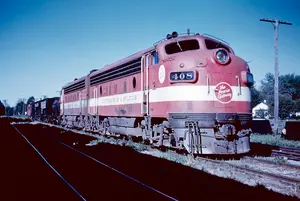
As-built, 652 wore the Rocket passenger dress: maroon (later described as crimson) with stainless and light trim. Electro-Motive issued a builder photograph of the fresh unit in early 1952; that print lives on the E8 page. The locomotive went into the pool that protected the Rocky Mountain Rocket, the Twin Star Rocket, the Golden State on Rock Island rails, Chicago commuter trains out of LaSalle Street, and, as the long-distance map shrank, the two Illinois leftovers that outlived Amtrak Day.
Twenty-four years in the Rocket pool
Photographs pin 652 to the work. In September 1962 it headed train 17, the Twin Star Rocket, north of Northfield, Minnesota. In June 1967 it was on the remnant of the Rocky Mountain Rocket through Pilcher Park between New Lenox and Joliet, with mail and magazine trailers in the consist. On March 29, 1971, it led train 6, the Quad Cities Rocket, at Joliet. By the mid-1970s the long-distance names were gone. What remained were two state-subsidized Illinois trains the Rock Island kept because it could not afford Amtrak’s entry fee: Chicago–Peoria and Chicago–Rock Island. The named-train encyclopedias stay on Peoria Rocket and Quad Cities Rocket. 652 was power on both.
Paint around it changed while the carbody stayed an E8. Maroon with chevrons gave way to a plain crimson dip, then to the bright red-and-yellow speed lettering that appeared on E8 648 about 1969. Freight units began coming out of Silvis in The Rock powder blue in April 1975, starting with GP7R 4508. Passenger E units did not get that blue as a class. 652 is the exception that was not blue all over.
Independence
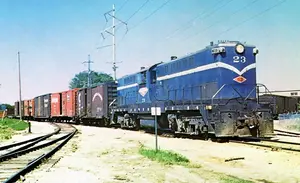
Of 46 Class I railroads in 1976, 31 painted at least one diesel red, white, and blue. Most wrapped a hood unit in stars, stripes, and a 1776 or 1976 number. The Rock Island did not renumber 652. It did not apply a flag wrap. Chicago’s 20th Century Railroad Club held a contest for the scheme, the same method the Central Indiana Railroad Club used on Indianapolis Union SW1500 23. The winning design put The Rock’s new powder-blue nose and cab on an E8, the road’s R herald on the front, the number 652 in the numberboards and on the nose, and a red flank panel lettered Independence in large white script, with THE ROCK and 652 on that same red field. A light stripe separated the blue roof from the red side. The club’s name is on the cab door.
That mix is why the locomotive looks like no other Bicentennial. The nose is a 1975 Rock Island freight identity. The flanks are a name, not a flag. Railfans argued then, and still argue, whether the sides work. The front, in the 16th Street photograph, is the part that reads as The Rock in 1976.
652 was already in the scheme on regular Peoria Rocket assignments in March 1976, when Rick Burn caught it at 16th Street with two stainless cars and the interlocking tower behind. It was the only Rock Island passenger locomotive given a new coat in the mid-to-late 1970s. Everything else in the E pool ran in whatever red, crimson, or faded maroon it still had.

Rock Island E8A 652 at the 47th Street Shops in Chicago, circa 1977. The 20th Century Railroad Club’s name is on the cab door. American-Rails.com collection.
The Bicentennial Rocket, May 16, 1976
The club’s public debut was Railfair ’76. On Sunday, May 16, 1976, 652 headed the Bicentennial Rocket, an eight-car excursion from Chicago to Bureau, Illinois, and return. Bureau is where the Peoria branch leaves the Chicago–Rock Island main. John Dziobko photographed the train leaving Chicago at Roosevelt Road. George Strombeck had it through Ottawa. Ken Carlson had it at New Lenox. The trip is the official maiden voyage of the paint in fan-trip service. The locomotive went back to trains 5, 6, 11, and 12 afterward. John Dziobko had it on the Quad Cities Rocket at Geneseo on June 15, 1976, and on the Peoria Rocket west out of Chicago later that year.
December 31, 1978
The Rock Island had filed bankruptcy on March 17, 1975. Illinois kept a subsidy under the two remaining Rockets. Track was slow. Consists shrank to a couple of cars. 652 was still the celebrity on the point when a photographer wanted the Independence scheme, and still just another E8 when the shop needed a unit that would start. The last revenue runs of the Peoria Rocket and the Quad Cities Rocket were December 31, 1978. A deadhead back to Chicago on New Year’s Day, in a blizzard, closed the passenger book. The Rock Island itself was liquidated in 1980. Chicago commuter trains on the Rock Island District passed to what became Metra. They did not need an E8 named Independence.
Midland, Kansas City, Manly
652 survived the Silvis scrappings that took most of the E fleet. It went to the Midland Railway at Baldwin City, Kansas, and ran tourist trains on the former Santa Fe Baldwin City–Ottawa branch for about a decade, often with E6A 630. A cab ride on 652 was recorded there on October 19, 1995. The pair were sold in 2009 to the Manly Junction Railroad Museum, founded by Iowa Northern president Dan Sabin, a former Rock Island man. A condemned bridge left them landlocked. In early 2012 they moved to Mid-America Car in Kansas City. The shop repainted 652 into a simplified 1960s Rock Island red-and-silver—the Rocket look, not Independence. A first attempt at the stripes had to be corrected from the as-built drawing.
The two units reached Manly, Iowa, in 2017 and made a public appearance at the Hub City Heritage Railroad Museum in Oelwein on August 19, 2017. They sat on a back track in the Iowa Northern yard at Manly for several years, still the last remaining Rock Island E units. On January 31, 2026, 630 and 652 were shoved into the new Manly Junction Railroad Museum building. That is where they are as of this writing. Iowa Northern’s roster still lists 652 as an E8A, March 1952, on display, built as Rock Island 652. The short line is Iowa Northern.
Specifications (E8A 652 as built)
| Item | Detail |
|---|---|
| Builder | Electro-Motive Division, La Grange, Ill. |
| Model | E8A |
| Serial / order / frame | 15199 / 2047 / 2047-A3 |
| Date | March 1952 |
| Prime movers | Two GM 12-cylinder 567B |
| Horsepower | 2,250 |
| RPM | 800 |
| Length | 70 ft 3 in |
| Height (rail to cab roof) | 14 ft 10½ in |
| Width | 10 ft 7½ in |
| Weight | About 316,500 lb |
| Fuel | 1,200 gallons |
| Trucks | A1A-A1A |
Dimensions and weights are EMD E8A class figures from the American-Rails E8 data sheet, applied to this serial. 652 was not rebuilt to a later E rating.
Related reading on American-Rails.com
- Rock Island · Rock Island diesel roster
- EMD E8 · EMD E units · Diesel locomotives hub
- Bicentennial locomotives
- Peoria Rocket · Quad Cities Rocket · Rocky Mountain Rocket
- Iowa Northern · Railroads In The 1970s
Sources
- EMD order 2047, serials 15197–15202 (Rock Island 650–655), February–March 1952. 652 = serial 15199, frame 2047-A3. The Diesel Shop CRIP all-time roster (revised March 18, 2025); American-Rails E8 roster and data sheet
- American-Rails.com, “Bicentennial Locomotives.” Rock Island 652 roster line: serial 15199, name Independence, designed by the 20th Century Railroad Club. 47th Street Shops photograph circa 1977
- Trains.com, “Bicentennial diesel locomotives photo gallery.” 20th Century Railroad Club contest for Rock Island E8 652
- Railfair ’76 / Bicentennial Rocket, Chicago–Bureau, Sunday, May 16, 1976. Photographs: John Dziobko (Roosevelt Road departure); Ken Carlson (New Lenox); George Strombeck (Ottawa)
- Rick Burn photograph, 16th Street, Chicago, March 1976, 652 on the Peoria Rocket
- Last Rock Island intercity passenger trains, December 31, 1978 (Peoria Rocket and Quad Cities Rocket). Illinois subsidy; IDOT cutoff January 1, 1979. Passenger Train Journal / Peoria Journal Star contemporary notices
- Midland Railway, Baldwin City, Kansas, operating era (including October 19, 1995 cab ride). Sale to Manly Junction Railroad Museum, 2009 (Dan Sabin / Iowa Northern). Mid-America Car, Kansas City, 2012. Arrival at Manly, 2017; Oelwein public appearance August 19, 2017. Move into the new Manly Junction Railroad Museum building, January 31, 2026
- Iowa Northern Railway roster: 652, E8A, March 1952, on display, built as Rock Island 652. Companion E6A 630
Recent Articles


-
Missouri-Kansas-Texas Railroad (Katy): Map, History, Rosters
Oct 27, 26 11:02 PM
 History of the Missouri-Kansas-Texas, the Katy. The race into Indian Territory, Gould, the 1923 railroad, the Texas Special, and the 1988 sale. Steam and diesel rosters are linked.
-
Soo Line Diesel Roster (All-Time)
Oct 27, 26 10:55 PM
 All-time diesel roster of the Soo Line and the Wisconsin Central. 786 locomotives, each frame once. Cab units, Geeps, the Milwaukee Road engines, and the SD60s. The South Shore's 24 stay on that page.
-
Soo Line Steam Roster (Built Since 1900)
Oct 27, 26 10:49 PM
 Soo Line and Wisconsin Central steam locomotives built since 1900. Consolidations, Mikados, Pacifics, 21 Mountains, and four Lima 4-8-4s.
-
Soo Line Railroad: Map, Logo, History, Rosters
Oct 27, 26 10:24 PM
 The Soo Line, from the flour millers' railroad around Chicago to the Sault, the Wisconsin Central, and the Milwaukee Road. Steam quantity 422. Diesels 786. Canadian Pacific took full control in 1990.
-
Minneapolis, Northfield and Southern Railway: Map, History, Rosters
Oct 27, 26 10:32 AM
 The Minneapolis, Northfield & Southern, the Dan Patch Line that became a Twin Cities belt. Steam, gas-electric mules, motor cars, and the 22 diesels, through the Soo Line.
-
Minneapolis & St. Louis Diesel Roster (All-Time)
Oct 27, 26 10:27 AM
 All-time diesel roster of the Minneapolis & St. Louis. 97 locomotives, each frame once. Switchers from 1938, 35 RS-1s, the FT and F-unit cabs, two SD7s, and 23 GP9s. Builder numbers included.
-
Minneapolis & St. Louis Steam Roster (Post 1900)
Oct 27, 26 10:25 AM
 Minneapolis & St. Louis steam locomotives built since 1900. Moguls, Consolidations, 35 Mikados, and five Pacifics.
-
Minneapolis and St Louis Railway: "The Peoria Gateway"
Oct 27, 26 09:52 AM
 The Minneapolis & St. Louis, the Tootin' Louie, from the 1870 charter to the Peoria Gateway and the Chicago & North Western sale on November 1, 1960.
-
Alco "PA" Locomotives: Restoration, Specs, Engine, Rosters
Oct 27, 26 12:12 AM
 Alco's PA passenger cab, 297 locomotives built from 1946 to 1953. The 244 engine, the production roster, the Delaware & Hudson PA-4s, and Nickel Plate Road 190.
-
Milwaukee Road Diesel Roster: (All Time)
Oct 26, 26 01:44 PM
 All-time diesel roster of the Milwaukee Road. 1,208 locomotives, each frame once. Alco, Baldwin, Davenport, EMD, Fairbanks-Morse, General Electric, and Whitcomb, with builder numbers.
-
Milwaukee Road Steam Roster (All-Time): Post-1900
Oct 26, 26 01:38 PM
 Milwaukee Road steam locomotives built since 1900. Prairies, Mikados, the N-class articulateds, the S-class 4-8-4s, and the Hiawatha Atlantics and Hudsons. Quantity column 1,974. Unique frames 1,951.
-
Milwaukee Road: Map, Electrification, Logo, History
Oct 26, 26 01:20 PM
 The Milwaukee Road, from the Milwaukee & Mississippi of 1850 to the Pacific Coast Extension, the Hiawathas, and the Soo Line sale. Why Lines West should have stayed.
-
Lake Superior & Ishpeming Railroad: Map, Roster, History
Oct 25, 26 11:38 PM
 Lake Superior & Ishpeming Railroad, reporting mark LSI, from the Marquette Range to the Presque Isle ore dock. The 1954 steam list and the diesels the railroad owned.
-
Kansas City Southern Steam Roster (Built Since 1900)
Oct 25, 26 09:09 PM
 Steam locomotives of the Kansas City Southern built since 1900, with the Louisiana & Arkansas and the Texas company.
-
Kansas City Southern Diesel Roster (Built New)
Oct 25, 26 11:46 AM
All-time diesel roster of the Kansas City Southern. E units, F units, Geeps, SD40s through SD70ACes, Fairbanks-Morse, Baldwin, Alco, and General Electric, with serials and order numbers. -
Kansas City Southern Railway: Map, Photos, History
Oct 25, 26 12:24 AM
 The Kansas City Southern, from Arthur Stilwell's Gulf line to Canadian Pacific Kansas City on April 14, 2023. Steam and diesel rosters, the Southern Belle, and the Louisiana & Arkansas.
-
Indiana Harbor Belt Diesel Roster (All-Time)
Oct 25, 26 12:17 AM
 All-time diesel roster of the Indiana Harbor Belt. 202 locomotive frames, each counted once. NW2s, SW7s, SW1500s, road switchers, and gensets. Slugs and boosters are outside the count.
-
Indiana Harbor Belt Steam Roster (Built Since 1900)
Oct 25, 26 12:13 AM
 Steam locomotives of the Indiana Harbor Belt built since 1900. 182 engines, each counted once. 0-6-0s, 2-6-0s, 0-8-0s, and 2-8-2s. The three U-4a switchers are three-cylinder Brooks engines of 1927.
-
Indiana Harbor Belt Railroad: Map, Rosters, History
Oct 25, 26 12:00 AM
 Indiana Harbor Belt, the inner belt across the Calumet, from the East Chicago Belt of May 16, 1896. Renamed June 29, 1907. Still operating, headquarters Hammond. Steam roster is the companion, 182 loc…
-
NYC's "P Motor" Electric Locomotives
Oct 24, 26 11:43 PM
 New York Central P motors: 22 Alco-GE 2-C+C-2 electrics, Cleveland Union Terminal 1050–1071, class P-1a. 3,030 hp one-hour on 3,000-volt DC catenary, then 660-volt third rail as P-2a and P-2b.
-
Illinois Terminal Car Roster
Oct 24, 26 11:40 PM
 Illinois Terminal cars. Mainline motors, the 1948 streamliners, sleepers, Alton and Valley Division cars, express motors, and the line cars rebuilt from pull cars.
-
Illinois Terminal Diesel Roster
Oct 24, 26 09:31 PM
 All-time Illinois Terminal diesels, 62 frames. Alco S-2s and RS-1s, EMD switchers, GP7s, SD39s, GP38-2s, and the two GP20s. Serial numbers from the 1989 roster.
-
Illinois Terminal Electric Locomotives
Oct 24, 26 08:22 PM
 Illinois Terminal electric locomotives, 57 frames. Class A through Class D, the Decatur-built motors, and the battery locomotives. Class D is the same five Class C frames, rebuilt.
-
Illinois Terminal Steam Roster
Oct 24, 26 07:37 PM
 Illinois Terminal steam locomotives, 36 frames. Baldwin Moguls, three Class 30 Mikados, Florida East Coast 0-8-0s, and 2-6-0 No. 21, the last fire on June 30, 1950.
-
Illinois Terminal Railroad: Map, Roster, Photos, History
Oct 24, 26 07:32 PM
Illinois Terminal, McKinley's Illinois Traction System, from the Danville coal towns to St. Louis. The McKinley Bridge, the sleeping cars, the 1937 break with the power company, the 1948 streamliners… -
Southern Railway Diesel Roster (All-Time)
Oct 23, 26 11:00 PM
 All-time diesel roster of the Southern Railway. 2,505 locomotives in the system number series, from the 1939 demonstrator FT to GP50s and B30-7A1s. Serials included.
-
Illinois Central Diesel Roster (All-Time)
Oct 23, 26 04:06 PM
Illinois Central and Illinois Central Gulf diesel locomotives, each frame once. The quantity column is 886. Serials and order numbers from Electro-Motive's builder lists. Paducah rebuilds and Gulf, Mo… -
Illinois Central Gulf Diesel Roster
Oct 23, 26 04:02 PM
 Illinois Central Gulf operating numbers from August 10, 1972, to February 29, 1988. New frames stay on the Illinois Central diesel roster. Gulf, Mobile and Ohio frames stay on that roster. No Gulf fle…
-
Illinois Central Railroad: Map, Logo, History
Oct 23, 26 03:50 PM
Illinois Central, the Main Line of Mid-America, from the 1850 land grant to Canadian National control on July 1, 1999. Charter lines, Cairo bridge, Paducah, and the Illinois Central Gulf. Steam quanti… -
Grand Trunk Western Diesel Roster (All-Time)
Oct 23, 26 12:53 PM
 Grand Trunk Western diesel locomotives, each frame once. The quantity column is 377. Serials are filled for the Detroit, Toledo and Ironton and Detroit and Toledo Shore Line engines the railroad kept…
-
Grand Trunk Western Steam Roster
Oct 23, 26 12:14 PM
 Grand Trunk Western steam locomotives in service about 1937 to 1942, from Richard Leonard's class list. Drury has no chapter. The quantity column is the counted Grand Trunk Western rows. Two mixed Gra…
-
Grand Trunk Western Railroad: Map, Roster, History
Oct 23, 26 12:09 PM
 Grand Trunk Western, reporting mark GTW, Canadian National's railroad between Port Huron and Chicago. Trade name adopted in 1923. Steam class list quantity 232. Diesel quantity column 377. Identity in…
-
Green Bay and Western Railroad: Map, Rosters, History
Oct 22, 26 11:18 PM
 Green Bay & Western, the Green Bay Route, reporting mark GBW. From Kewaunee to Winona. Mailer's steam and diesel rosters, and the August 1993 sale to Fox Valley & Western.
-
Chicago & North Western Class E-4: Streamlined 4-6-4 Hudsons
Oct 22, 26 10:28 PM
 C&NW Class E-4, nine streamlined 4-6-4s, 4001–4009, Alco 1938. 84-inch drivers, 25-by-29 cylinders, 300 psi. Conventional Chicago–Omaha trains. Oil in 1947–48. Retired 1953–1956.
-
Gateway Western Railway: Map, Roster, History
Oct 22, 26 02:43 PM
 Gateway Western Railway, reporting mark GWWR. Class II from Kansas City to East St. Louis. Kansas City Southern control May 5, 1997. The 1992 diesel fleet, with serials and order numbers.