Greenbrier, Cheat & Elk Railroad: Western Maryland’s Logging Line
Published: September 26, 2026
By: Adam Burns
The Greenbrier, Cheat & Elk was a logging railroad that the Western Maryland bought for the coal underneath the cut-over land. At its peak it was about 175 miles long, from Cheat Junction to Bergoo, and it was called the longest logging railroad in the country. The eight miles from Cass to Spruce were Shay territory and still are, on the Cass Scenic Railroad. What the Western Maryland owned, from 1927, was the line north and west of Spruce: the Elk River Branch, run for coal, with Consolidations and then four-axle diesels.
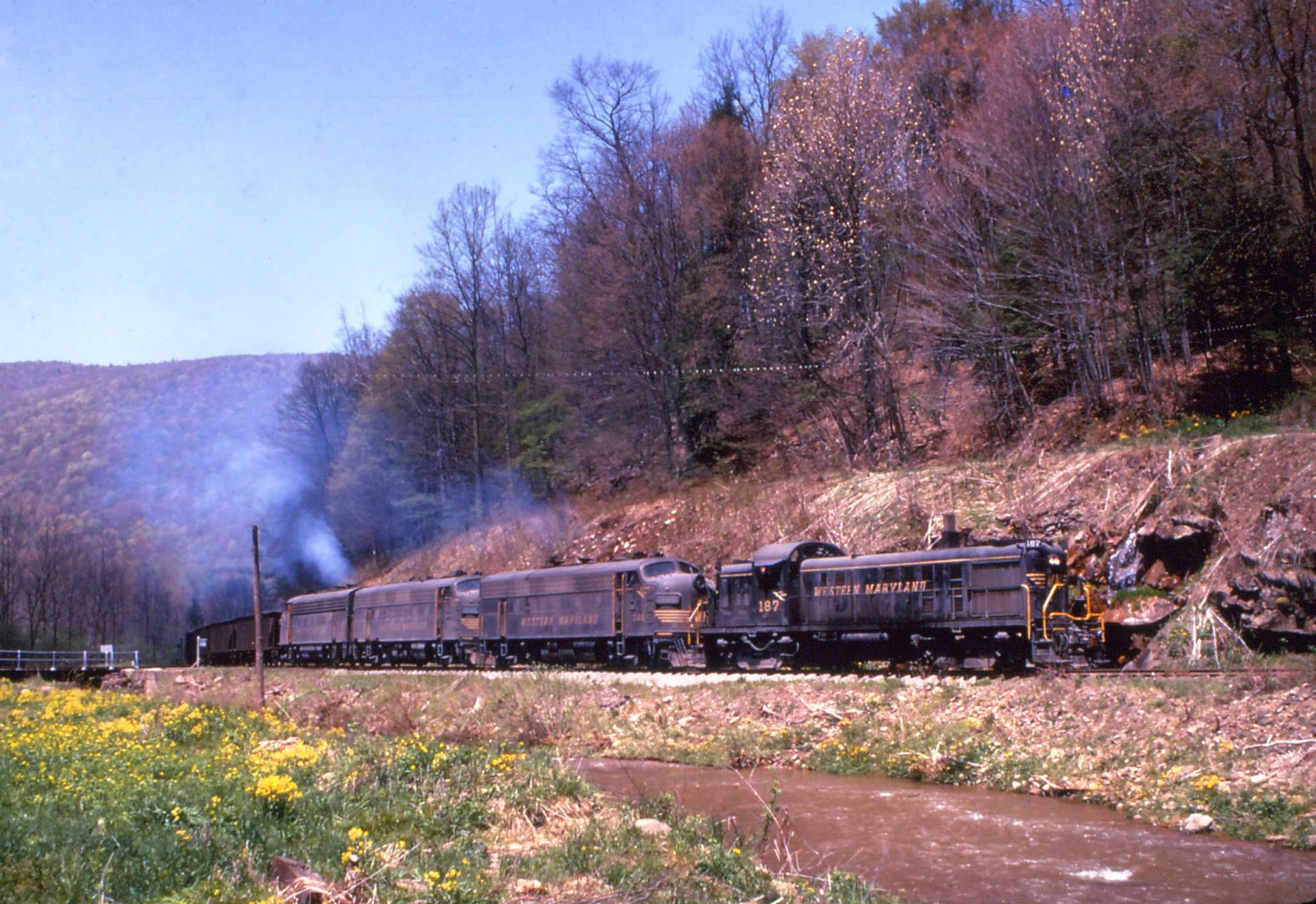
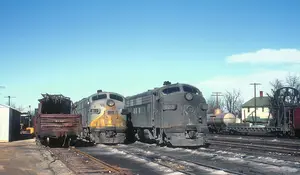
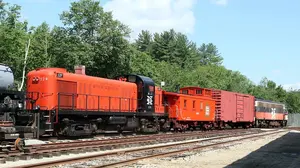
Way off the beaten path in the hollers of West Virginia, Western Maryland RS3 #187 and a trio of F7A's run the GC&E; Subdivision (built as the Greenbrier, Cheat & Elk Railroad) near Laurel Bank along the Elk River (and the location of a small yard) during the 1970's. This branch to Webster Springs once handled coal and timber products (logs/lumber). It survived into the CSX era and the rails remain in place but have not seen a train since the mid-1990's. The right-of-way is owned by the West Virginia State Rail Authority. Wade Massie collection.
On this page: At a glance · A logging railroad · The Western Maryland buys the north end · Coal, curves, and a small yard · Shays, then Consolidations · What is left on the mountain
At a glance
| Item | Detail |
|---|---|
| Railroad | Greenbrier & Elk, renamed the Greenbrier, Cheat & Elk in 1910. Western Maryland’s GC&E Subdivision after 1927 |
| Owner, at first | West Virginia Pulp & Paper. About 173,000 acres near Cass |
| Logging heart | Cass to Spruce, 8 miles, Shay railroad. Spruce had the pulp mill, the store, and the camp |
| Peak | About 175 miles, Cheat Junction to Bergoo |
| WM purchase | 1927, the lines north and west of Spruce. Operated as the Elk River Branch, for coal |
| Summit | Summit Cut, near Spruce, 4,066.6 feet. Highest main-line summit in the East |
| The connector | 1931, about 2½ percent, so an Elkins–Spruce train no longer had to run to Durbin and back |
| WM power | H-7 and H-8 Consolidations. Then RS3s and F-units, as at Laurel Bank |
Built to move logs, and nothing else at first
West Virginia Pulp & Paper bought the timber, and the timber would not move until a common carrier reached it. The Chesapeake & Ohio opened its Greenbrier Branch to Durbin on May 26, 1902. The mill and the camp went in at Cass, on that branch, and at Spruce, eight hard miles up the mountain. Those eight miles were geared-locomotive railroad from the start. Grades and curves that a rod engine would not take were the ordinary profile. Spruce had a pulp mill, a company store, a yard, and housing. In 1910 the logging road took the name it is remembered by, the Greenbrier, Cheat & Elk, and it kept building: north to a connection with the Coal & Iron at Cheat Junction, and west along the Elk River toward Bergoo.
At full growth the GC&E ran about 175 miles. That figure is what people mean by the longest logging railroad in the country. Most of those miles were spurs into a hollow, used until the timber on that hollow was gone and then pulled up. The main stem was shorter, and it was the stem the Western Maryland wanted.
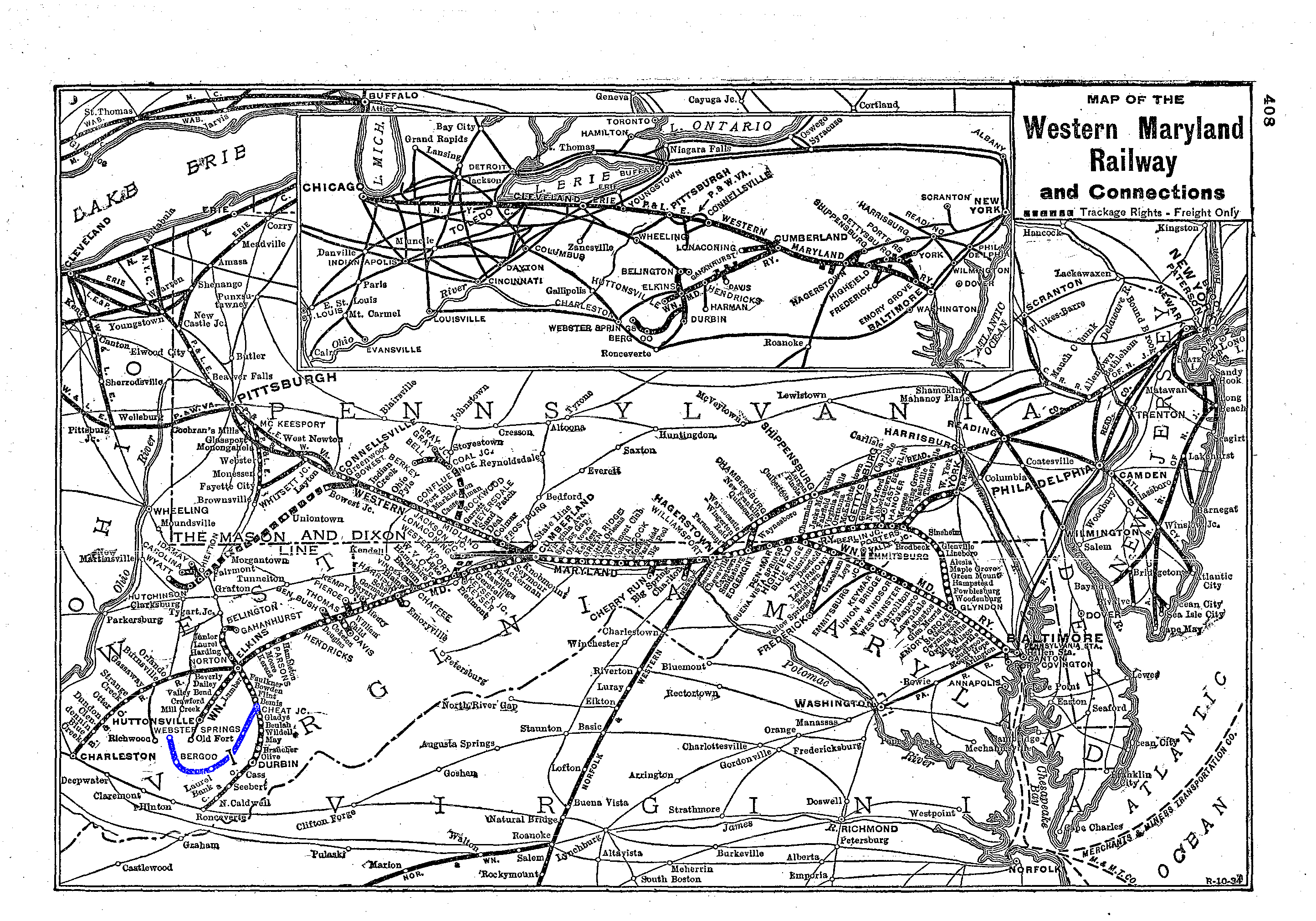
A 1934 system map of the Western Maryland Railway featuring the Greenbrier, Cheat & Elk Subdivision branching off the railroad's Durbin Branch at Cheat Junction. American-Rails.com collection
1927: the railroad changes jobs
The Western Maryland bought the GC&E lines north and west of Spruce in 1927 and ran them as the Elk River Branch. The pulp company kept an interest in the Cass–Spruce piece and the timber that remained. The WM’s reason was coal. Heavier rail and a few eased curves went in. The worst curves kept Maney guard rails, the sort of hardware an interurban used, because a flange would otherwise climb the high rail.
Summit Cut, near Spruce, stands at 4,066.6 feet, the highest summit on a main line in the East. Trains between Elkins and that summit had, at first, an absurd route. The GC&E met the Durbin Branch at Cheat Junction, so a train for Spruce ran east to Durbin and then reversed. In 1931 the Western Maryland built a connector of about a mile on a 2½ percent grade and took the reverse move out of the timetable. After that, Elkins to the Elk River was a railroad in one direction.
Coal, a sawmill spur, and the yard at Laurel Bank
Once the WM owned it, the day’s work was a mine run. Empties left Elkins for tipples along the Elk River. Loads came back to be classified for Cumberland, or, while the Durbin interchange lasted, for the Chesapeake & Ohio at Durbin. Timber did not stop in 1927. Logs and lumber still moved, in smaller lots, and a spur that had been a logging camp became a coal siding with a lumber dock beside it. Laurel Bank, on the Elk River, was one of the few places with a yard long enough to be called one. The 1970s photograph there is the diesel version of the same job: an RS3 and three F7As, far from a main line, with hoppers and whatever local freight the branch still produced.
Webster Springs was the far end after 1929, when the Western Maryland bought the West Virginia Midland and kept only the 1925 piece from Webster Springs to Bergoo, about 12 miles. The town had a depot, a train-order office, and a short sidetrack. Beyond it the railroad crossed the Elk to a tipple on the Back Fork. That was the west end of a division that had started as a logging show.
The trains were short. Grades and curvature set the tonnage the way Black Fork set it, at a smaller scale. A crew out of Elkins expected to spend the day on the branch and to come home with a train the yard could add to a Cumberland coal drag. Nobody dispatched a time freight over Summit Cut.
The engines that fit
Shays built the railroad and, on the Cass–Spruce side, never really left it. Under Western Maryland ownership the rod engines were Consolidations, H-7s and H-8s, the same classes that worked the Durbin Branch and the other Elkins lines. The H-8’s 52-inch drivers were there for railroad like this. One geared engine on the WM roster had GC&E ancestry: Shay No. 5, a four-truck Lima of 1910, retired in 1954. Shay No. 6, Lima’s last and the famous one, was the Chaffee Branch engine, not this one. The classes are the steam roster.
Diesels were the same four-axle fleet Elkins used everywhere else. RS3 187 and the F7As at Laurel Bank are the picture. A six-axle unit was the wrong wheelbase for Maney-guard-rail curves. The branch dieselized when the rest of the Elkins Division did, and it kept those covered wagons and road-switchers into the 1970s, which is late for an F-unit anywhere except a mountain branch that could not use what replaced them. The serials are the diesel roster.
Cass has one end, the state has the other
The Cass–Spruce Shay railroad is the Cass Scenic Railroad, and it is the part of the GC&E the public knows. The Western Maryland portion is quieter. Cheat Junction to Big Cut, near Spruce, is owned by the West Virginia State Rail Authority and tied into the Cass operation and the West Virginia Central. The rail from the Elkins side toward Webster Springs and Bergoo stayed in place after the trains stopped in the mid-1990s. CSX had taken the Tygart and Laurel subdivisions out of service in the middle of that decade, and the state bought what was worth keeping.
A through tourist loop, Elkins to Cass and back by way of Spruce, has been drawn more than once. The missing pieces are the abandoned Durbin Branch and the C&O between Cass and Durbin, which the 1985 flood finished as a railroad. Until those are rebuilt, the GC&E remains two railroads that used to be one: geared engines above Cass, and a coal branch down the Elk that the Western Maryland ran with Consolidations and, later, with an RS3 and three F-units at Laurel Bank.
Related reading
- Western Maryland Railway · Elkins · Durbin Branch
- Cass Scenic Railroad · West Virginia Central · Durbin & Greenbrier Valley
- Steam roster · Diesel roster
Sources
- Warden, William. West Virginia Logging Railroads. West Virginia Pulp & Paper, the Cass–Spruce Shay railroad, and the GC&E’s growth toward Cheat Junction and Bergoo
- Cook, Roger, and Karl Zimmermann. The Western Maryland Railway: Fireballs and Black Diamonds. The 1927 purchase and H-7 / H-8 operation on the Elkins branches
- Western Maryland Railway. Summit Cut, 4,066.6 feet. The 1931 connector between the GC&E and the Durbin Subdivision
- McNeel, William. The Durbin Route. Chesapeake & Ohio open to Durbin on May 26, 1902, which gave the logging railroad its first outlet
Recent Articles


-
Florida East Coast Steam Roster (Post 1900)
Oct 08, 26 02:34 PM
 Florida East Coast steam since 1897. Seventeen Ten-Wheelers, twenty Atlantics, eighty-seven Pacifics, ninety Mountains, fifteen Mikados, and the switchers.
-
Florida East Coast Diesel Roster (All-Time)
Oct 08, 26 02:12 PM
 Florida East Coast diesel roster, all-time. E units from 1939, F3s, BL2s, GP7s and GP9s, the GP40-2 orders, 22 SD40-2s, and 24 ES44C4s. Serials and EMD order numbers.
-
Florida East Coast Railway: Map, History, Rosters
Oct 08, 26 01:46 PM
 Florida East Coast Railway, Henry Flagler's line from Jacksonville to Miami and Key West. Receivership in 1931, the 1963 strike, Grupo México in 2017, and Brightline on the same track.
-
Minnesota Railroad Museums (2026): A Complete Guide
Oct 08, 26 10:32 AM
 Minnesota railroad museums—the Lake Superior Railroad Museum, Two Harbors, Jackson Street, Willmar’s Great Northern 2523, and Currie. Confirm hours on each site.
-
Maine Railroad Museums (2026): A Complete Guide
Oct 08, 26 09:24 AM
 Maine railroad museums—Seashore Trolley, the two-foot lines at Portland, Alna, and Phillips, Boothbay, and the Bangor & Aroostook depots. Confirm hours on each site.
-
Massachusetts Railroad Museums (2026): A Complete Guide
Oct 08, 26 12:08 AM
 Massachusetts railroad museums—Berkshire Scenic at Lenox, Shelburne Falls trolley No. 10, Edaville, Chatham’s 1887 depot, and Lowell. Confirm hours on each site.
-
Clinchfield Steam Roster (Post 1900)
Oct 07, 26 12:09 PM
 Clinchfield steam since 1900. Fifteen H-4 Consolidations, K-1 Mikados, M-2 and M-3 Mallets, L-class 2-8-8-2s, eighteen Challengers. Class grid after Drury. Last steam April 16, 1954.
-
Clinchfield Diesel Roster (All-Time)
Oct 07, 26 12:05 PM
 Clinchfield diesel roster, all-time. F3A 800, FP7 200, the F7s, GP7s, 25 SD40s, 18 SD45-2s, seven U36Cs, and the Family Lines hoods. Serials and EMD order numbers.
-
Clinchfield Railroad: Map, Steam Locomotives, Roster, Logo
Oct 07, 26 12:02 PM
 Clinchfield Railroad, Elkhorn City to Spartanburg. George L. Carter, the Carolina, Clinchfield & Ohio, the 1924 lease, coal, the loops, and CSX. Steam and diesel rosters are companion pages.
-
Kentucky Railroad Museums (2026): A Complete Guide
Oct 07, 26 11:39 AM
 Kentucky railroad museums—the Kentucky Railway Museum, Bowling Green’s L&N depot, Paducah, Versailles, and Covington. Confirm hours on each site.
-
Kansas Railroad Museums (2026): A Complete Guide
Oct 07, 26 11:26 AM
 Kansas railroad museums—Santa Fe 3768 at Wichita, Santa Fe 132 in Topeka, the Great Overland Station, and Abilene. Confirm hours on each site.
-
Cincinnati, New Orleans and Texas Pacific Diesel Roster (All-Time)
Oct 07, 26 10:38 AM
 All-time diesel roster of Southern locomotives lettered for the Cincinnati, New Orleans and Texas Pacific. Serials, order numbers, and builder dates.
-
Cincinnati, New Orleans and Texas Pacific Railway
Oct 07, 26 10:31 AM
 Cincinnati, New Orleans and Texas Pacific Railway, incorporated September 8, 1881, to lease Cincinnati’s railroad to Chattanooga. Queen and Crescent route, Rathole, and the 2024 sale to Norfolk Southe…
-
Indiana Railroad Museums (2026): A Complete Guide
Oct 07, 26 12:26 AM
 Indiana railroad museums—Nickel Plate 765, Elkhart’s New York Central collection, French Lick, Linden’s junction depot, and Haley Tower. Confirm hours on each site.
-
"Triplex" Steam Locomotive: Specs, History, Photos
Oct 06, 26 11:52 PM
 Erie class P-1 Triplex 2-8-8-8-2s. Three Baldwin compounds, 2603–2605, later 5014–5016, built 1914 and 1916. Matt H. Shay, the 1930 class card, and Virginian XA 700.
-
Illinois Railroad Museums (2026): A Complete Guide
Oct 06, 26 11:47 PM
 Illinois railroad museums—the Illinois Railway Museum, Monticello, the Pioneer Zephyr, Galesburg’s Burlington 3006, and the depots. Confirm hours on each site.
-
Iowa Railroad Museums (2026): A Complete Guide
Oct 06, 26 11:41 PM
 Iowa railroad museums—the Union Pacific Railroad Museum, RailsWest, Sioux City, Boone, and the National Hobo Museum in Britt. Confirm hours on each site.
-
Charleston and Western Carolina Diesel Roster (All-Time)
Oct 06, 26 11:29 PM
 Charleston and Western Carolina diesel roster. Twenty-one GP7s, two SW7s, two SW9s, and six F7As, all built 1950–1952. Serials, order numbers, and ACL and SCL numbers.
-
Charleston and Western Carolina Railway: Map, History, Timetables
Oct 06, 26 11:18 PM
 Charleston and Western Carolina Railway, incorporated September 16, 1896. Port Royal to Spartanburg, with branches to Anderson and Greenville. Merged into the Atlantic Coast Line on December 31, 1959.
-
Central of Georgia Steam Roster (Post 1900)
Oct 06, 26 04:00 PM
 Central of Georgia steam since 1900. Cooke Consolidations, Harriman Mikados, 32 Mountains, and eight Lima 4-8-4s. Class grid after Drury. Last steam May 1953.
-
Central of Georgia Diesel Roster (All-Time)
Oct 06, 26 03:44 PM
 Central of Georgia diesel roster. SW1 No. 1 in 1939, E7s and E8s, nine F3As, 39 RS3s, GP7s through SD35s. Serials and order numbers.
-
Central of Georgia Railway: Map, Logo, History, Rosters
Oct 06, 26 03:42 PM
 Central of Georgia Railway, from the 1833 Savannah charter to Southern control on June 17, 1963. Map, logos, Nancy Hanks II, and links to the steam and diesel rosters.
-
Georgia Railroad Museums (2026): A Complete Guide
Oct 06, 26 03:33 PM
Georgia railroad museums—Savannah’s Central shops, Duluth, the General at Kennesaw, the Texas in Atlanta, Tifton, Waycross, and Albany. Confirm hours on each site. -
Florida Railroad Museums (2026): A Complete Guide
Oct 06, 26 03:18 PM
 Florida railroad museums—Boca Raton, Winter Garden, Whitehall, the Gold Coast, Parrish, Fort Myers, Milton, and Plant City. Confirm hours on each site.
-
Connecticut Railroad Museums (2026): A Complete Guide
Oct 06, 26 01:05 PM
 Connecticut railroad museums—the Shore Line Trolley, East Windsor, the Naugatuck Railroad, Danbury Union Station, Willimantic, and the SoNo tower. Confirm hours on each site.
-
Colorado Railroad Museums (2026): A Complete Guide
Oct 06, 26 12:47 PM
 Colorado railroad museums—Golden, the Forney’s Big Boy 4005, Pueblo’s Santa Fe 2912, and the depots at Castle Rock, Limon, and Ridgway. Confirm hours on each site.
-
Atlantic Coast Line Steam Roster (Post 1900)
Oct 06, 26 12:44 PM
 Atlantic Coast Line steam since 1900. Copper Head Ten-Wheelers, 235 P-5 Pacifics, Q-1 Santa Fes, twelve R-1 4-8-4s. Class grid after Drury. Last steam June 30, 1955.
-
Atlantic Coast Line Diesel Roster (All-Time)
Oct 06, 26 11:57 AM
 Atlantic Coast Line diesel roster. HH660 1900 in 1939, E3s for the Champion, FTs and F2s, GP7s 100–279, GP30s, U25Cs, and the 1967 SCL numbers. Serials and orders.
-
Atlantic Coast Line Railroad: "Standard Railroad of the South"
Oct 06, 26 11:53 AM
 Atlantic Coast Line, the Standard Railroad of the South. April 21, 1900 to July 1, 1967. Plant System, L&N, Clinchfield, the Champion, and the Seaboard Coast Line merger.
-
California Railroad Museums (2026): A Complete Guide
Oct 06, 26 09:50 AM
California railroad museums—the California State Railroad Museum, Perris, Portola, Railtown 1897, and the depots that still stand. Confirm hours on each site. -
Arizona Railroad Museums (2026): A Complete Guide
Oct 06, 26 09:46 AM
Arizona railroad museums—the Arizona Railway Museum in Chandler, Southern Pacific 1673 at Tucson, and the McCormick-Stillman park in Scottsdale. -
Arkansas Railroad Museums (2026): A Complete Guide
Oct 06, 26 09:07 AM
 Arkansas railroad museums—Cotton Belt 819 at Pine Bluff, the Fort Smith trolley, the Mammoth Spring depot, and the Eureka Springs railway.
-
Alabama Railroad Museums (2026): A Complete Guide
Oct 06, 26 09:03 AM
Alabama railroad museums—Heart of Dixie at Calera, the North Alabama museum at Chase, Huntsville’s 1860 depot, and Fort Payne. Confirm hours on each site. -
Pennsylvania Railroad Museums (2026): A Complete Guide
Oct 06, 26 12:09 AM
 Pennsylvania railroad museums—Strasburg, Steamtown, the Horseshoe Curve, the East Broad Top, and the depots and towers in between. Confirm hours on each site.
-
Maryland Railroad Museums (2026): A Complete Guide
Oct 05, 26 11:53 PM
 Maryland railroad museums—the Baltimore roundhouse, Ellicott City station, Bowie, Gaithersburg’s Buffalo Creek & Gauley 14, and the Western Maryland collections.
-
Ohio Railroad Museums (2026): A Complete Guide
Oct 05, 26 05:51 PM
 Ohio railroad museums—the Age of Steam Roundhouse, Bellevue, Worthington, Conneaut’s Nickel Plate 755, and the Dennison depot. Confirm hours on each site.
-
Delaware Railroad Museums (2026): A Complete Guide
Oct 05, 26 02:43 PM
 Delaware railroad museums—Wilmington & Western at Greenbank, the Harrington tower and N5 caboose, Felton's 1868 depot, and the Selbyville station museum.
-
C&O's M-1 Steam Turbine Locomotives: Specs, Roster, History
Oct 05, 26 12:13 PM
 Chesapeake & Ohio Class M-1 steam-turbine-electrics. Three Baldwin-Westinghouse locomotives, 500–502, built 1947–48 for The Chessie. Specs, the 2-C1+2-C1-B arrangement, and a roster. All scrapped…
-
N&W 2-6-6-2 Locomotives (Class Z): Specs, Roster, History
Oct 05, 26 11:44 AM
 Norfolk & Western Class Z 2-6-6-2s. One hundred ninety compound Mallets, 1300–1489, from Richmond, Baldwin, and Schenectady, 1912–1918. Diagram specs, the Z-1b rebuilds, Z-2 1399, and a roster. No…
-
Scenic Train Rides (USA 2026): State Guide to Tourist Railroads
Oct 04, 26 12:17 AM
 Scenic and tourist train rides in all 50 states for 2026. Colorado narrow gauge, Pennsylvania steam, Alaska’s White Pass, and the states with no full-size ride this month. Confirm on the railroad.
-
Wyoming Scenic Train Rides (2026): A Complete Guide
Oct 03, 26 12:07 AM
Wyoming has no full-size tourist railroad on the calendar in October 2026. Cheyenne Depot Museum and Douglas Railroad Museum are static. Union Pacific 4014’s posted public trip is a November run to De… -
Washington Scenic Train Rides (2026): A Complete Guide
Oct 02, 26 11:53 PM
 Washington tourist trains in 2026—Mount Rainier Scenic at Elbe, the Northwest Railway Museum, and Chehalis-Centralia. Lake Whatcom has no 2026 date on its ticket page.
-
Wisconsin Scenic Train Rides (2026): A Complete Guide
Oct 02, 26 11:48 PM
 Wisconsin tourist trains in 2026—Wisconsin Great Northern, Osceola & St. Croix Valley, Mid-Continent, East Troy, and the National Railroad Museum.
-
Pennsylvania Railroad Class Q2 4-4-6-4: Specs, Roster, History
Oct 02, 26 11:28 PM
Pennsylvania Railroad Class Q2 4-4-6-4 duplexes. Twenty-six engines, 6131 and 6175–6199, Altoona 1944–45. Form 109-J specs, the 7,987 hp test of 6175, and a roster. All scrapped. -
Utah Scenic Train Rides (2026): A Complete Guide
Oct 02, 26 11:18 PM
 Utah tourist trains in 2026—Heber Valley Railroad from Heber City. Golden Spike at Promontory is a locomotive demonstration, not a line-haul ride.
-
South Dakota Scenic Train Rides (2026): A Complete Guide
Oct 02, 26 11:06 PM
 South Dakota’s 2026 scenic train is the Black Hills Central 1880 Train, Hill City to Keystone. Steam is the summer assignment. Confirm the engine.
-
Oregon Scenic Train Rides (2026): A Complete Guide
Oct 02, 26 11:04 PM
 Oregon tourist trains in 2026—Oregon Coast Scenic from Rockaway Beach, Mount Hood at Hood River, Eagle Cap from Elgin, and the Oregon Rail Heritage Center in Portland.
-
Oklahoma Scenic Train Rides (2026): A Complete Guide
Oct 02, 26 10:36 PM
Oklahoma has no full-size scenic railroad on an October 2026 calendar. Oklahoma Railway Museum Halloween and Polar trains, the El Reno trolley, and the Heartland Flyer. -
North Dakota Scenic Train Rides (2026): A Complete Guide
Oct 02, 26 01:14 PM
North Dakota has no tourist railroad on a 2026 calendar. Ride Amtrak’s daily Empire Builder. The Fort Lincoln Trolley in Mandan is not a current ticket. -
Nebraska Scenic Train Rides (2026): A Complete Guide
Oct 02, 26 10:11 AM
 Nebraska has no full-size scenic railroad in 2026. The Omaha Zoo Railroad runs weekends through October 4. Ride Amtrak’s California Zephyr across the state.