Western Maryland Steam Locomotives: History & Roster
Published: September 26, 2026
By: Adam Burns
Western Maryland steam was a Consolidation railroad that finished with twelve Baldwin 4-8-4s. From 1901 into the early 1920s the company kept buying heavier 2-8-0s, fifty of them in the H-9 class alone, and it was still assigning Consolidations to Black Fork Grade and the branches south of Elkins at the end of steam. The articulateds were for the mountains: Baldwin 2-6-6-2s, Lima 2-8-8-2s, and twelve Baldwin 4-6-6-4s that turned out to be the wrong engine for the Connellsville Extension. George H. Drury’s post-1900 class grid is the table at the foot of this page.
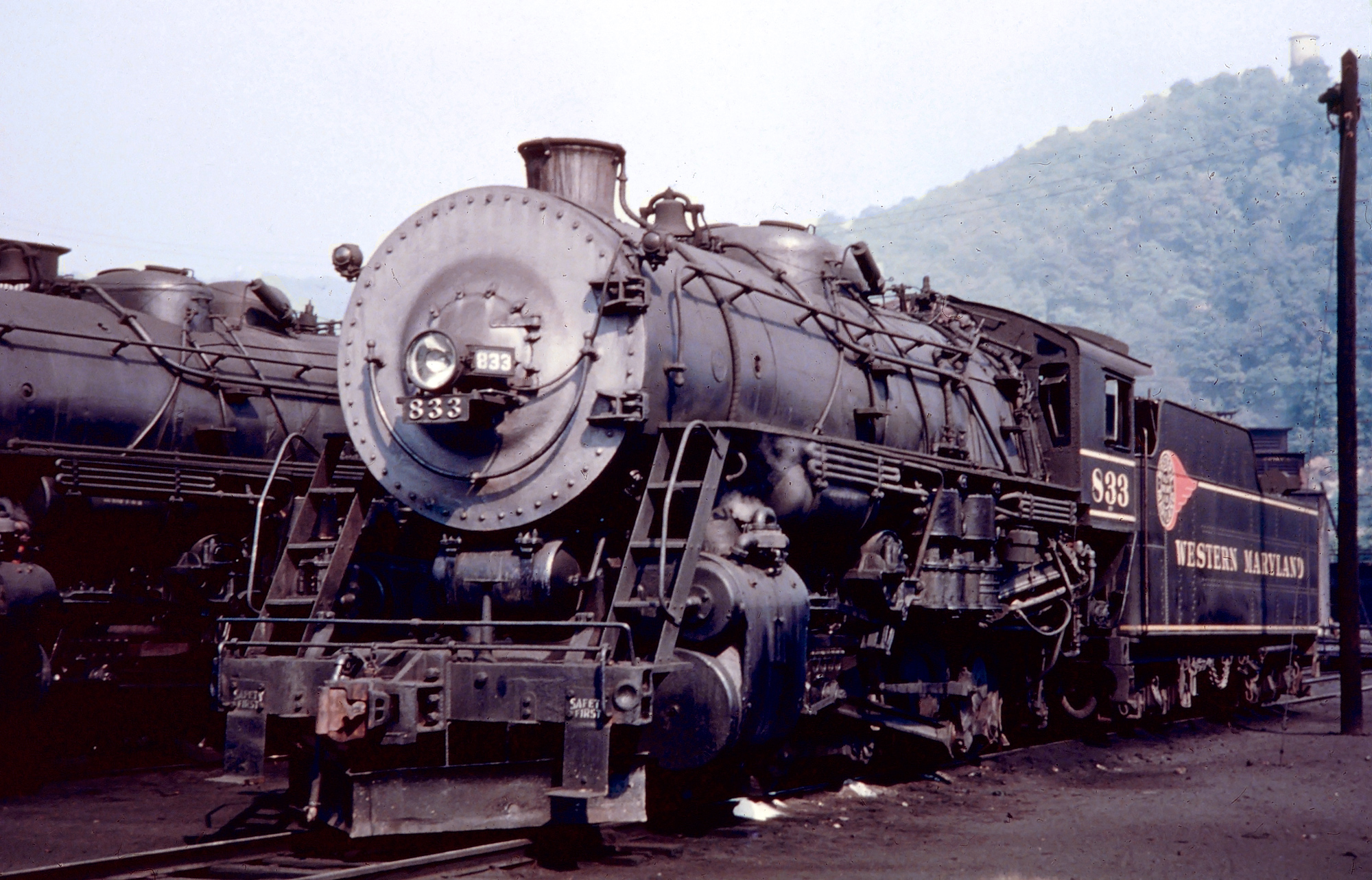
Western Maryland 2-8-0 #833 at the engine terminal in Ridgeley, West Virginia, on September 15, 1953. Homer Newlon, Jr. photo. No. 833 is one of the fifty H-9 Consolidations, Baldwin, 1921–1923.
On this page: At a glance · Consolidations · Decapods and articulateds · Potomacs · Pacifics · Switchers and Shays · Roster built since 1900
At a glance
| Item | Detail |
|---|---|
| Railroad | Western Maryland Railway. Mark WM. Company Western Maryland |
| This roster | Engines built since 1900, after Drury, pages 326–328. The specification table is his 2-8-0 comparison. The class list is his retirement grid |
| Freight engine | The Consolidation. H-9s, fifty engines, 801–850, were the main-line 2-8-0. H-8s carried 52-inch drivers for the branches out of Elkins |
| Helpers | I-2 Decapods 1111–1130. Lima L-1 and L-2 2-8-8-2s, 901–925. M-1 2-6-6-2s, rebuilt as 0-6-6-0s |
| Fast freight | M-2 4-6-6-4s, 1201–1212, Baldwin 1940–41. Retired 1952–53 after helper service |
| Potomac | 12 4-8-4s, 1401–1412, Baldwin 1947. Retired 1954. The company’s only engines of the type |
| Passenger | K-1 Pacifics 151–160, sold to the Seaboard Air Line in 1943. K-2 Pacifics 201–209, Baldwin 1912, retired 1952–54 |
| Last steam | Class retirements in Drury’s grid run through 1954. The Durbin Branch mixed train of April 10, 1959, was the last passenger train |
| One survivor | Shay 6, Lima, May 1945, the last Shay Lima built. B&O Railroad Museum in 1953, Cass from 1980 |
Class table follows Drury, Guide to North American Steam Locomotives (revised edition), pages 326–328. Information compiled September 25, 2026.
Ever-heavier 2-8-0s
Drury groups the Western Maryland with the anthracite roads to the north on one habit: it kept buying Consolidations, each lot heavier than the last, well into the 1920s. The specification table is the cleanest way to see the progression. H-4 and H-4A engines 401–416, built in 1901 and 1903, sit at 159,000 pounds. The H-9s of 1921–1923 sit at 285,600 pounds, with 27-by-32-inch cylinders, 61-inch drivers, and 71,500 pounds of tractive force. Drury’s comparison for that last class is a government design: a little lighter than a USRA light Mikado, and able to pull with a middle-size Decapod.
| Class | Numbers | Built | Cylinders | Drivers | Weight | Tractive force |
|---|---|---|---|---|---|---|
| H-4, H-4A | 401–416 | 1901, 1903 | 22×28 | 56 in | 159,000 | 45,173 |
| H-5 | 501–518 | 1905 | 22×28 | 51 in | 182,700 | 45,173 |
| H-6 | 601–630 | 1906–1909 | 22×30 | 57 in | 200,000 | 43,305 |
| H-7 | 701–736 | 1910–1911 | 24×30 | 60 in | 232,000 | 48,960 |
| H-7B | 750–764 | 1912 | 25×30 | 60 in | 243,000 | 53,125 |
| H-8 | 770–789 | 1914 | 25×30 | 52 in | 244,500 | 61,398 |
| H-9 | 801–850 | 1921–1923 | 27×32 | 61 in | 285,600 | 71,500 |
Weights are in pounds, on the engine. Drury, page 326.
The H-8 is the branch engine in that list. Twenty locomotives, 770–789, came from Alco’s Schenectady works in 1914 with 52-inch drivers, switcher-sized wheels on a road engine, because the branches out of Elkins needed tractive force more than speed. They lasted until 1953–54. The H-7B engines, 750–764, are Richmond, 1912, fifteen locomotives with 60-inch drivers, and they too were still on the property in 1954. Between them, those two classes were the usual power on the Durbin Branch mixed train. The H-6s, thirty Baldwin engines of 1906–1909, were the raw material for the 0-8-0 program described with the switchers.
West Virginia Central & Pittsburg power came onto the roster when that road did, in 1905. Drury’s class list keeps one Baldwin 2-8-0 of 1900, H-3G 357, and eight H-4B engines. Numbers 451–454 were built in 1900–1901 and were gone between 1928 and 1950. Numbers 455–458, built in 1903, lasted until 1947–53. The H-5s, 501–518, eighteen Baldwin engines of 1905, were off the list by 1944.
Decapods, Mallets, and twelve Challengers
The I-1 Decapods, 1101–1110, are Baldwin engines of 1918, Russian Decapods at 219,000 pounds, retired in 1950–51. The I-2s are a different machine. Twenty Baldwin Decapods, 1111–1130, arrived in 1927: 30-by-32-inch cylinders, 61-inch drivers, 419,280 pounds, 96,300 pounds of tractive force, close to a USRA 2-8-8-2. Drury notes that they outweighed the Pennsylvania Railroad’s 2-10-0s by more than 16 tons. They were the helpers, and the class stayed intact until 1954. One of them, 1113, is the engine in the Helmstetter’s Curve photograph on the company page. The curve itself is Helmstetter’s Curve.
Articulated power started with nine Baldwin 2-6-6-2s, class M-1, numbers 951–959, a pair in 1909 and the rest by 1911, bought as pushers. By the late 1920s an H-9 could equal their pull and run a little faster. Between 1927 and 1931 the railroad rebuilt the nine as 0-6-6-0s for yard service. Drury’s retirement span for the class is 1944–1951.
Lima built the 2-8-8-2s. The L-1s, 901–915, are fifteen engines of 1915–1916. The L-2s, 916–925, are ten engines of 1917–1918. They took the Blue Ridge grades. Retirements run from 1939 into 1951. The railroad’s 1947 list lettered 911–915 as L-1a inside the L-1 block.
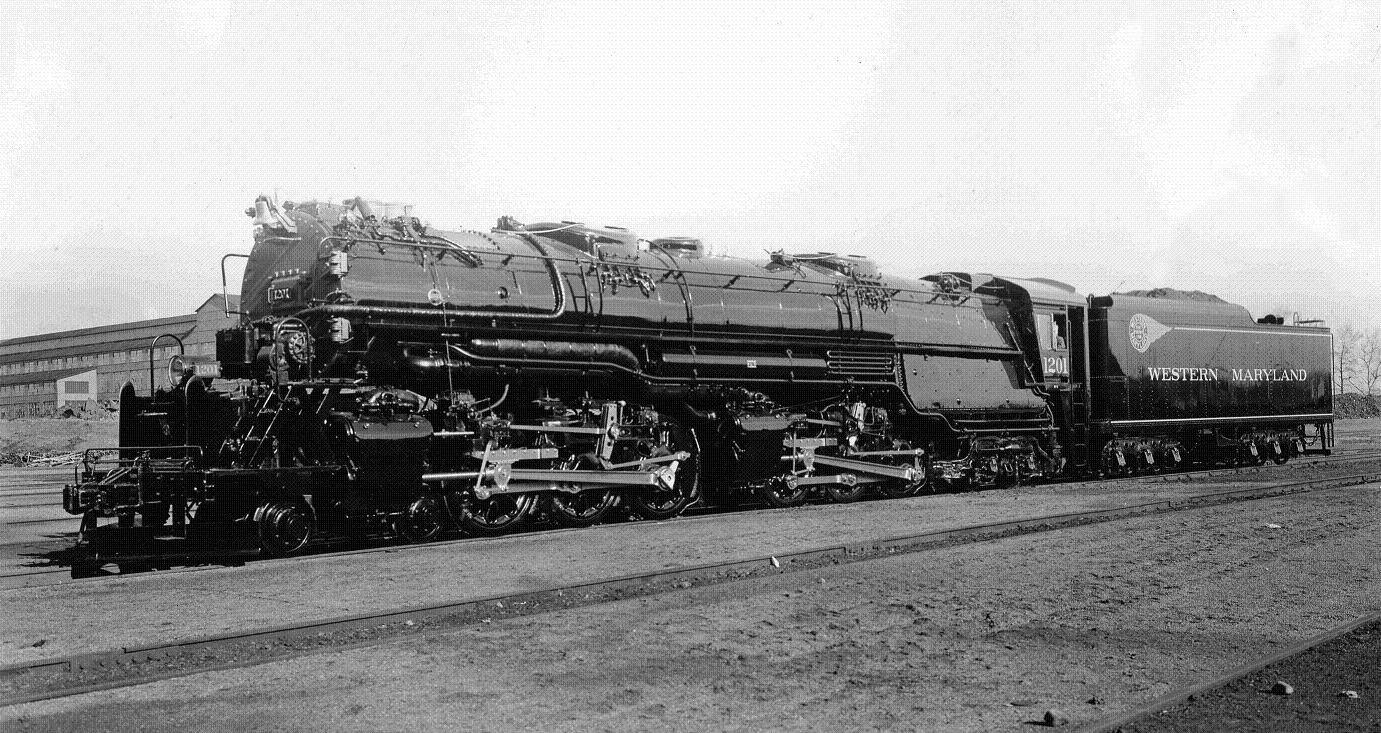
Baldwin builder’s photograph of 4-6-6-4 #1201, about 1940. American-Rails.com collection. Twelve M-2s, 1201–1212, arrived in 1940 and 1941. The Fireball herald went on them that year.
The general speeding-up of freight in the 1930s is why the Western Maryland ordered twelve 4-6-6-4s. Baldwin delivered the M-2s, 1201–1212, in 1940 and 1941. Drury’s figures for the class are 506,500 pounds, about twelve tons under a USRA 2-8-8-2, 52-inch drivers, and 105,600 pounds of tractive effort, four thousand more than the USRA engine. They were meant for the fast freight between Hagerstown and Connellsville. They were the wrong engine for that job. They spent most of their years in helper service, hard on the rail and prone to slip, and they were retired in 1952 and 1953. The company page has the operating story: moved east of Cumberland, and finished in 1953.
Twelve Potomacs
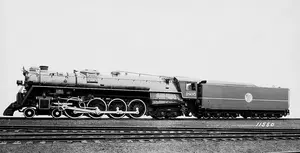
The Western Maryland pooled power with the Reading on the freight route to Shippensburg and liked what it saw in the Reading’s home-built T-1 4-8-4s. For its share of the Hagerstown–Harrisburg–Allentown pool it bought twelve 4-8-4s in 1947. Drury’s point is a narrow one, and it is the accurate one: this was the last railroad to acquire the type for the first time. Much of the Western Maryland lay south of the Mason-Dixon Line, so “Northern” would not do. The engines were called Potomacs.
Class J-1, numbers 1401–1412, Baldwin, 1947, retired in 1954. They were the only 4-8-4s the company owned. Vestibule cabs gave them something of a Rio Grande look. The front end was Western Maryland: a high headlight, a small rectangular number plate, and a rock-pusher pilot. Diagrams for the class give 69-inch drivers, 26½-by-32-inch cylinders, 255 pounds of boiler pressure, an engine weight of 506,500 pounds, and about 70,600 pounds of tractive effort. Baldwin’s construction numbers run 73082–73093; the builder’s plate from 1407 is 73088. They worked east of Cumberland. Diesels replaced them in 1954, and they waited in storage at Hagerstown and Cumberland until the equipment trusts ran out. The wheel arrangement is the 4-8-4.
Two classes of Pacific, and very little else
Baldwin built ten Pacifics in 1909 and 1911, class K-1, numbers 151–160. They were small: 201,700 pounds, 68-inch drivers, 23-by-28-inch cylinders, 37,080 pounds of tractive force. All ten went to the Seaboard Air Line in 1943. In 1912 Baldwin followed with nine larger 4-6-2s, class K-2, numbers 201–209: 24-by-28-inch cylinders, 69-inch drivers, outside-journal trailing trucks, 254,300 pounds. Four of the K-2s burned oil, an oddity on a coal road. They lasted until 1952–54 and handled most of what passenger service remained after the K-1s left. The type is the 4-6-2.
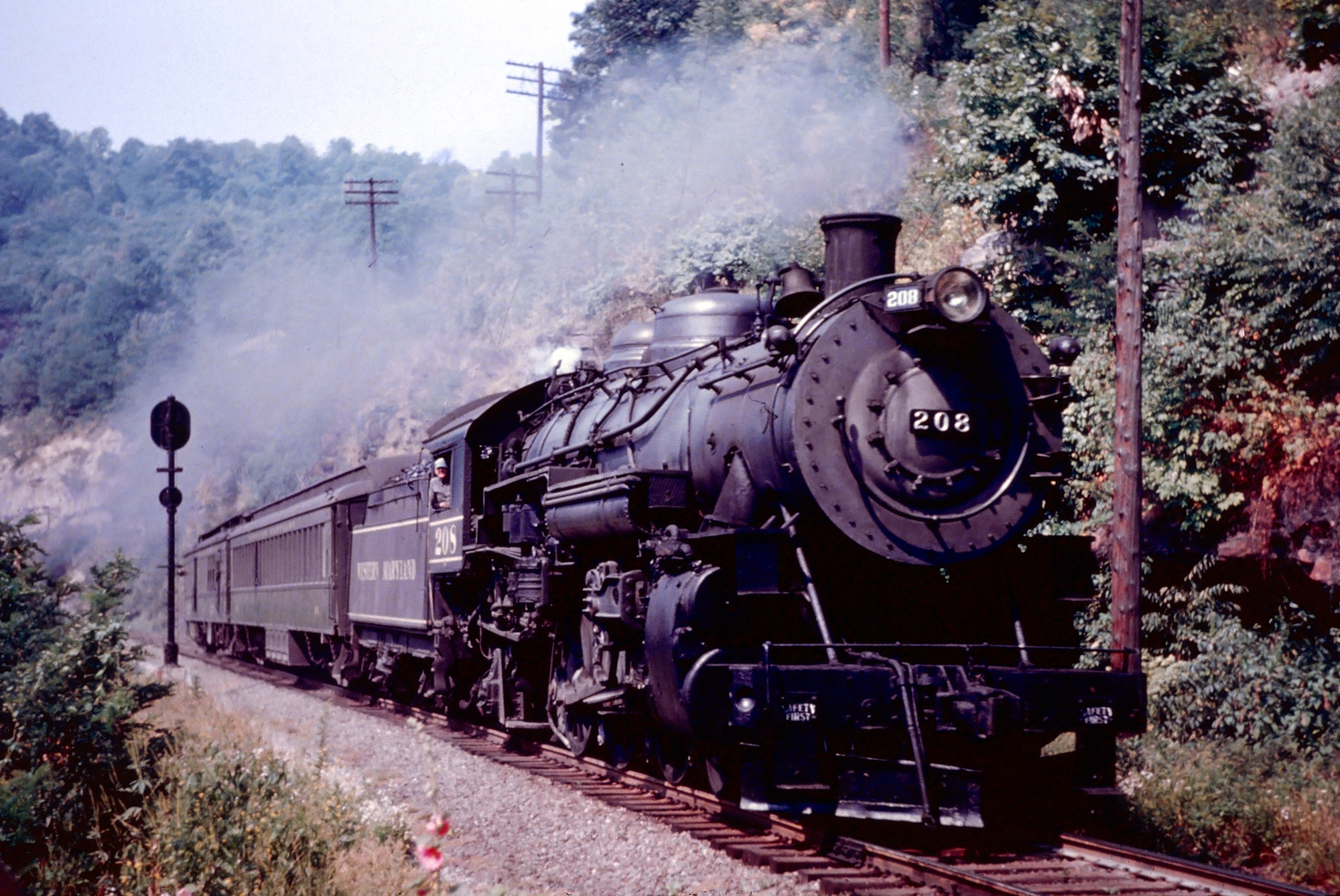
Pacific #208 at Westernport, Maryland, on August 12, 1953. Homer Newlon, Jr. photo. The K-2s, 201–209, were the larger Pacifics, Baldwin 1912. No. 208 was still at work the summer before the class came off.
The rest of the passenger list in Drury’s grid is short. Two 4-4-0s, D-8 numbers 51 and 52, Baldwin 1902, were retired in 1936 and 1935. One Ten-Wheeler, G-5 number 90, Baldwin 1903, lasted until 1926. Two more, G-6 numbers 91 and 92, Baldwin 1901, were former West Virginia Central engines, retired in 1924 and 1927. Earlier Americans and Ten-Wheelers sit outside a roster that starts in 1900.
Eleven six-wheel switchers, fourteen eight-wheelers, and five Shays
Drury counts fewer than a dozen 0-6-0s. Six B-2s, 1003–1008, Baldwin, were built in 1905 and 1909 and retired between 1928 and 1947. Five B-3s, 1009–1013, Baldwin 1914, had slide valves and outside valve gear. They were sold in 1946 to the Conemaugh & Black Lick, a United States Steel switching road in Pennsylvania.
The 0-8-0s were shop conversions of fourteen H-6 2-8-0s. Drury’s three rows are the whole program: C-1 numbers 1051–1053, three engines, 1926–1927; C-2 numbers 1061–1068, eight engines, 1928–1930; C-2A numbers 1071–1073, three engines, 1928–1935. Some were scrapped within two or three years of the conversion, which is why the retirement spans start in 1930 and 1931. The last of them lasted until 1950–51.
Steep mine branches put several Shays on the roster. Some came with coal companies. Some were bought new. The class list is five locomotives, all Lima:
- No. 3, two-truck, 1912, former Lantz Coal Company, retired 1932.
- No. 4, three-truck, 1918, former Chaffee Coal Company, retired 1945.
- No. 5, four-truck, 1910, former Greenbrier, Cheat & Elk, retired 1954.
- No. 6, three-truck, 1945, retired 1953. Lima’s last Shay, and the heaviest three-truck Shay the builder turned out. A 162-ton engine for the Chaffee Branch, where grades passed 9 percent and curves reached 23.5 degrees. The branch played out in 1950. The engine was stored, moved under its own power to the B&O Railroad Museum in 1953, and went to Cass in 1980. It still runs.
- No. 900, four-truck, 1906, sent to the Mexico North-Western in 1910.
No. 6 is the original Western Maryland steam locomotive with a life after the railroad. The tourist operation out of Cumberland is the Western Maryland Scenic Railroad. Its Consolidation 734 and its 2-6-6-2 1309 came from other owners.
Western Maryland steam locomotives built since 1900
The H-4 and H-4A engines, 401–416, are in the specification table above. Pre-1900 power is in the narrative only where a twentieth-century class was rebuilt from it, or where a West Virginia Central engine of 1900–1903 is still in his grid.
| Type | Class | Numbers | Qty | Builder | Built | Retired | Notes |
|---|---|---|---|---|---|---|---|
| 0-6-0 | B-2 | 1003–1008 | 6 | Baldwin | 1905, 1909 | 1928–1947 | |
| 0-6-0 | B-3 | 1009–1013 | 5 | Baldwin | 1914 | 1946 | To Conemaugh & Black Lick |
| 0-8-0 | C-1 | 1051–1053 | 3 | WM | 1926–1927 | 1950–1951 | Ex-H-6 2-8-0 |
| 0-8-0 | C-2 | 1061–1068 | 8 | WM | 1928–1930 | 1931–1950 | Ex-H-6 2-8-0 |
| 0-8-0 | C-2A | 1071–1073 | 3 | WM | 1928–1935 | 1930–1950 | Ex-H-6 2-8-0 |
| 2-8-0 | H-3G | 357 | 1 | Baldwin | 1900 | 1925 | Ex-WVC&P |
| 2-8-0 | H-4B | 451–454 | 4 | Baldwin | 1900–1901 | 1928–1950 | Ex-WVC&P |
| 2-8-0 | H-4B | 455–458 | 4 | Baldwin | 1903 | 1947–1953 | Ex-WVC&P |
| 2-8-0 | H-5 | 501–518 | 18 | Baldwin | 1905 | 1927–1944 | |
| 2-8-0 | H-6 | 601–630 | 30 | Baldwin | 1906–1909 | 1927–1950 | |
| 2-8-0 | H-7 | 701–736 | 36 | Baldwin | 1910–1911 | 1936–1951 | |
| 2-8-0 | H-7B | 750–764 | 15 | Richmond | 1912 | 1954 | |
| 2-8-0 | H-8 | 770–789 | 20 | Schenectady | 1914 | 1953–1954 | |
| 2-8-0 | H-9 | 801–850 | 50 | Baldwin | 1921–1923 | 1952–1954 | |
| 2-10-0 | I-1 | 1101–1110 | 10 | Baldwin | 1918 | 1950–1951 | |
| 2-10-0 | I-2 | 1111–1130 | 20 | Baldwin | 1927 | 1954 | |
| 2-6-6-2 | M-1 | 951–959 | 9 | Baldwin | 1909–1911 | 1944–1951 | Rebuilt to 0-6-6-0 |
| 2-8-8-2 | L-1 | 901–915 | 15 | Lima | 1915–1916 | 1939–1951 | |
| 2-8-8-2 | L-2 | 916–925 | 10 | Lima | 1917–1918 | 1940–1951 | |
| 4-6-6-4 | M-2 | 1201–1212 | 12 | Baldwin | 1940–1941 | 1952–1953 | |
| 4-4-0 | D-8 | 51, 52 | 2 | Baldwin | 1902 | 1936, 1935 | |
| 4-6-0 | G-5 | 90 | 1 | Baldwin | 1903 | 1926 | |
| 4-6-0 | G-6 | 91, 92 | 2 | Baldwin | 1901 | 1924, 1927 | Ex-WVC&P |
| 4-6-2 | K-1 | 151–160 | 10 | Baldwin | 1909, 1911 | 1943 | To SAL |
| 4-6-2 | K-2 | 201–209 | 9 | Baldwin | 1912 | 1952–1954 | |
| 4-8-4 | J-1 | 1401–1412 | 12 | Baldwin | 1947 | 1954 | |
| Shay | 2-truck | 3 | 1 | Lima | 1912 | 1932 | Ex-Lantz Coal Co. |
| Shay | 3-truck | 4 | 1 | Lima | 1918 | 1945 | Ex-Chaffee Coal Co. |
| Shay | 3-truck | 6 | 1 | Lima | 1945 | 1953 | |
| Shay | 4-truck | 5 | 1 | Lima | 1910 | 1954 | Ex-Greenbrier, Cheat & Elk |
| Shay | 4-truck | 900 | 1 | Lima | 1906 | 1910 | To MNW |
WVC&P is the West Virginia Central & Pittsburg. SAL is the Seaboard Air Line. MNW is the Mexico North-Western. Builder “WM” is a Western Maryland shop conversion of an H-6. Drury, page 328.
Related reading
- Western Maryland Railway · Western Maryland diesel roster
- 2-8-0 Consolidation · 4-6-2 Pacific · 4-8-4
- Helmstetter’s Curve · Reading · Western Maryland Scenic Railroad
Sources
- Drury, George H. Guide to North American Steam Locomotives. Revised edition. Milwaukee: Kalmbach, pp. 326–328. Specification table and the class list built since 1900
- Cook, Roger, and Karl Zimmermann. The Western Maryland Railway: Fireballs and Black Diamonds. Assignments around 1947, and the move of the 4-6-6-4s east of Cumberland
- Baldwin Locomotive Works builder’s plate 73088, March 1947, Western Maryland 1407. Construction numbers 73082–73093 for 1401–1412
- Price, William P. Western Maryland Steam Album. Potomac Chapter, National Railway Historical Society, 1985
- Locomotive diagrams for the J-1: 69-inch drivers, 26½×32-inch cylinders, 255 psi, 506,500 pounds, tractive effort about 70,600 pounds
Recent Articles


-
Key West Extension (Overseas Railroad): History, Construction, Decline
Oct 08, 26 03:59 PM
 Henry Flagler's Overseas Railroad, Miami to Key West, 1905–1935. The Seven Mile Bridge, the 1935 Labor Day Hurricane, and the road that became U.S. 1.
-
Florida East Coast Steam Roster (Post 1900)
Oct 08, 26 02:34 PM
 Florida East Coast steam since 1897. Seventeen Ten-Wheelers, twenty Atlantics, eighty-seven Pacifics, ninety Mountains, fifteen Mikados, and the switchers.
-
Florida East Coast Diesel Roster (All-Time)
Oct 08, 26 02:12 PM
 Florida East Coast diesel roster, all-time. E units from 1939, F3s, BL2s, GP7s and GP9s, the GP40-2 orders, 22 SD40-2s, and 24 ES44C4s. Serials and EMD order numbers.
-
Florida East Coast Railway: Map, History, Rosters
Oct 08, 26 01:46 PM
 Florida East Coast Railway, Henry Flagler's line from Jacksonville to Miami and Key West. Receivership in 1931, the 1963 strike, Grupo México in 2017, and Brightline on the same track.
-
Minnesota Railroad Museums (2026): A Complete Guide
Oct 08, 26 10:32 AM
 Minnesota railroad museums—the Lake Superior Railroad Museum, Two Harbors, Jackson Street, Willmar’s Great Northern 2523, and Currie. Confirm hours on each site.
-
Maine Railroad Museums (2026): A Complete Guide
Oct 08, 26 09:24 AM
 Maine railroad museums—Seashore Trolley, the two-foot lines at Portland, Alna, and Phillips, Boothbay, and the Bangor & Aroostook depots. Confirm hours on each site.
-
Massachusetts Railroad Museums (2026): A Complete Guide
Oct 08, 26 12:08 AM
 Massachusetts railroad museums—Berkshire Scenic at Lenox, Shelburne Falls trolley No. 10, Edaville, Chatham’s 1887 depot, and Lowell. Confirm hours on each site.
-
Clinchfield Steam Roster (Post 1900)
Oct 07, 26 12:09 PM
 Clinchfield steam since 1900. Fifteen H-4 Consolidations, K-1 Mikados, M-2 and M-3 Mallets, L-class 2-8-8-2s, eighteen Challengers. Class grid after Drury. Last steam April 16, 1954.
-
Clinchfield Diesel Roster (All-Time)
Oct 07, 26 12:05 PM
 Clinchfield diesel roster, all-time. F3A 800, FP7 200, the F7s, GP7s, 25 SD40s, 18 SD45-2s, seven U36Cs, and the Family Lines hoods. Serials and EMD order numbers.
-
Clinchfield Railroad: Map, Steam Locomotives, Roster, Logo
Oct 07, 26 12:02 PM
 Clinchfield Railroad, Elkhorn City to Spartanburg. George L. Carter, the Carolina, Clinchfield & Ohio, the 1924 lease, coal, the loops, and CSX. Steam and diesel rosters are companion pages.
-
Kentucky Railroad Museums (2026): A Complete Guide
Oct 07, 26 11:39 AM
 Kentucky railroad museums—the Kentucky Railway Museum, Bowling Green’s L&N depot, Paducah, Versailles, and Covington. Confirm hours on each site.
-
Kansas Railroad Museums (2026): A Complete Guide
Oct 07, 26 11:26 AM
 Kansas railroad museums—Santa Fe 3768 at Wichita, Santa Fe 132 in Topeka, the Great Overland Station, and Abilene. Confirm hours on each site.
-
Cincinnati, New Orleans and Texas Pacific Diesel Roster (All-Time)
Oct 07, 26 10:38 AM
 All-time diesel roster of Southern locomotives lettered for the Cincinnati, New Orleans and Texas Pacific. Serials, order numbers, and builder dates.
-
Cincinnati, New Orleans and Texas Pacific Railway
Oct 07, 26 10:31 AM
 Cincinnati, New Orleans and Texas Pacific Railway, incorporated September 8, 1881, to lease Cincinnati’s railroad to Chattanooga. Queen and Crescent route, Rathole, and the 2024 sale to Norfolk Southe…
-
Indiana Railroad Museums (2026): A Complete Guide
Oct 07, 26 12:26 AM
 Indiana railroad museums—Nickel Plate 765, Elkhart’s New York Central collection, French Lick, Linden’s junction depot, and Haley Tower. Confirm hours on each site.
-
"Triplex" Steam Locomotive: Specs, History, Photos
Oct 06, 26 11:52 PM
 Erie class P-1 Triplex 2-8-8-8-2s. Three Baldwin compounds, 2603–2605, later 5014–5016, built 1914 and 1916. Matt H. Shay, the 1930 class card, and Virginian XA 700.
-
Illinois Railroad Museums (2026): A Complete Guide
Oct 06, 26 11:47 PM
 Illinois railroad museums—the Illinois Railway Museum, Monticello, the Pioneer Zephyr, Galesburg’s Burlington 3006, and the depots. Confirm hours on each site.
-
Iowa Railroad Museums (2026): A Complete Guide
Oct 06, 26 11:41 PM
 Iowa railroad museums—the Union Pacific Railroad Museum, RailsWest, Sioux City, Boone, and the National Hobo Museum in Britt. Confirm hours on each site.
-
Charleston and Western Carolina Diesel Roster (All-Time)
Oct 06, 26 11:29 PM
 Charleston and Western Carolina diesel roster. Twenty-one GP7s, two SW7s, two SW9s, and six F7As, all built 1950–1952. Serials, order numbers, and ACL and SCL numbers.
-
Charleston and Western Carolina Railway: Map, History, Timetables
Oct 06, 26 11:18 PM
 Charleston and Western Carolina Railway, incorporated September 16, 1896. Port Royal to Spartanburg, with branches to Anderson and Greenville. Merged into the Atlantic Coast Line on December 31, 1959.
-
Central of Georgia Steam Roster (Post 1900)
Oct 06, 26 04:00 PM
 Central of Georgia steam since 1900. Cooke Consolidations, Harriman Mikados, 32 Mountains, and eight Lima 4-8-4s. Class grid after Drury. Last steam May 1953.
-
Central of Georgia Diesel Roster (All-Time)
Oct 06, 26 03:44 PM
 Central of Georgia diesel roster. SW1 No. 1 in 1939, E7s and E8s, nine F3As, 39 RS3s, GP7s through SD35s. Serials and order numbers.
-
Central of Georgia Railway: Map, Logo, History, Rosters
Oct 06, 26 03:42 PM
 Central of Georgia Railway, from the 1833 Savannah charter to Southern control on June 17, 1963. Map, logos, Nancy Hanks II, and links to the steam and diesel rosters.
-
Georgia Railroad Museums (2026): A Complete Guide
Oct 06, 26 03:33 PM
Georgia railroad museums—Savannah’s Central shops, Duluth, the General at Kennesaw, the Texas in Atlanta, Tifton, Waycross, and Albany. Confirm hours on each site. -
Florida Railroad Museums (2026): A Complete Guide
Oct 06, 26 03:18 PM
 Florida railroad museums—Boca Raton, Winter Garden, Whitehall, the Gold Coast, Parrish, Fort Myers, Milton, and Plant City. Confirm hours on each site.
-
Connecticut Railroad Museums (2026): A Complete Guide
Oct 06, 26 01:05 PM
 Connecticut railroad museums—the Shore Line Trolley, East Windsor, the Naugatuck Railroad, Danbury Union Station, Willimantic, and the SoNo tower. Confirm hours on each site.
-
Colorado Railroad Museums (2026): A Complete Guide
Oct 06, 26 12:47 PM
 Colorado railroad museums—Golden, the Forney’s Big Boy 4005, Pueblo’s Santa Fe 2912, and the depots at Castle Rock, Limon, and Ridgway. Confirm hours on each site.
-
Atlantic Coast Line Steam Roster (Post 1900)
Oct 06, 26 12:44 PM
 Atlantic Coast Line steam since 1900. Copper Head Ten-Wheelers, 235 P-5 Pacifics, Q-1 Santa Fes, twelve R-1 4-8-4s. Class grid after Drury. Last steam June 30, 1955.
-
Atlantic Coast Line Diesel Roster (All-Time)
Oct 06, 26 11:57 AM
 Atlantic Coast Line diesel roster. HH660 1900 in 1939, E3s for the Champion, FTs and F2s, GP7s 100–279, GP30s, U25Cs, and the 1967 SCL numbers. Serials and orders.
-
Atlantic Coast Line Railroad: "Standard Railroad of the South"
Oct 06, 26 11:53 AM
 Atlantic Coast Line, the Standard Railroad of the South. April 21, 1900 to July 1, 1967. Plant System, L&N, Clinchfield, the Champion, and the Seaboard Coast Line merger.
-
California Railroad Museums (2026): A Complete Guide
Oct 06, 26 09:50 AM
California railroad museums—the California State Railroad Museum, Perris, Portola, Railtown 1897, and the depots that still stand. Confirm hours on each site. -
Arizona Railroad Museums (2026): A Complete Guide
Oct 06, 26 09:46 AM
Arizona railroad museums—the Arizona Railway Museum in Chandler, Southern Pacific 1673 at Tucson, and the McCormick-Stillman park in Scottsdale. -
Arkansas Railroad Museums (2026): A Complete Guide
Oct 06, 26 09:07 AM
 Arkansas railroad museums—Cotton Belt 819 at Pine Bluff, the Fort Smith trolley, the Mammoth Spring depot, and the Eureka Springs railway.
-
Alabama Railroad Museums (2026): A Complete Guide
Oct 06, 26 09:03 AM
Alabama railroad museums—Heart of Dixie at Calera, the North Alabama museum at Chase, Huntsville’s 1860 depot, and Fort Payne. Confirm hours on each site. -
Pennsylvania Railroad Museums (2026): A Complete Guide
Oct 06, 26 12:09 AM
 Pennsylvania railroad museums—Strasburg, Steamtown, the Horseshoe Curve, the East Broad Top, and the depots and towers in between. Confirm hours on each site.
-
Maryland Railroad Museums (2026): A Complete Guide
Oct 05, 26 11:53 PM
 Maryland railroad museums—the Baltimore roundhouse, Ellicott City station, Bowie, Gaithersburg’s Buffalo Creek & Gauley 14, and the Western Maryland collections.
-
Ohio Railroad Museums (2026): A Complete Guide
Oct 05, 26 05:51 PM
 Ohio railroad museums—the Age of Steam Roundhouse, Bellevue, Worthington, Conneaut’s Nickel Plate 755, and the Dennison depot. Confirm hours on each site.
-
Delaware Railroad Museums (2026): A Complete Guide
Oct 05, 26 02:43 PM
 Delaware railroad museums—Wilmington & Western at Greenbank, the Harrington tower and N5 caboose, Felton's 1868 depot, and the Selbyville station museum.
-
C&O's M-1 Steam Turbine Locomotives: Specs, Roster, History
Oct 05, 26 12:13 PM
 Chesapeake & Ohio Class M-1 steam-turbine-electrics. Three Baldwin-Westinghouse locomotives, 500–502, built 1947–48 for The Chessie. Specs, the 2-C1+2-C1-B arrangement, and a roster. All scrapped…
-
N&W 2-6-6-2 Locomotives (Class Z): Specs, Roster, History
Oct 05, 26 11:44 AM
 Norfolk & Western Class Z 2-6-6-2s. One hundred ninety compound Mallets, 1300–1489, from Richmond, Baldwin, and Schenectady, 1912–1918. Diagram specs, the Z-1b rebuilds, Z-2 1399, and a roster. No…
-
Scenic Train Rides (USA 2026): State Guide to Tourist Railroads
Oct 04, 26 12:17 AM
 Scenic and tourist train rides in all 50 states for 2026. Colorado narrow gauge, Pennsylvania steam, Alaska’s White Pass, and the states with no full-size ride this month. Confirm on the railroad.
-
Wyoming Scenic Train Rides (2026): A Complete Guide
Oct 03, 26 12:07 AM
Wyoming has no full-size tourist railroad on the calendar in October 2026. Cheyenne Depot Museum and Douglas Railroad Museum are static. Union Pacific 4014’s posted public trip is a November run to De… -
Washington Scenic Train Rides (2026): A Complete Guide
Oct 02, 26 11:53 PM
 Washington tourist trains in 2026—Mount Rainier Scenic at Elbe, the Northwest Railway Museum, and Chehalis-Centralia. Lake Whatcom has no 2026 date on its ticket page.
-
Wisconsin Scenic Train Rides (2026): A Complete Guide
Oct 02, 26 11:48 PM
 Wisconsin tourist trains in 2026—Wisconsin Great Northern, Osceola & St. Croix Valley, Mid-Continent, East Troy, and the National Railroad Museum.
-
Pennsylvania Railroad Class Q2 4-4-6-4: Specs, Roster, History
Oct 02, 26 11:28 PM
Pennsylvania Railroad Class Q2 4-4-6-4 duplexes. Twenty-six engines, 6131 and 6175–6199, Altoona 1944–45. Form 109-J specs, the 7,987 hp test of 6175, and a roster. All scrapped. -
Utah Scenic Train Rides (2026): A Complete Guide
Oct 02, 26 11:18 PM
 Utah tourist trains in 2026—Heber Valley Railroad from Heber City. Golden Spike at Promontory is a locomotive demonstration, not a line-haul ride.
-
South Dakota Scenic Train Rides (2026): A Complete Guide
Oct 02, 26 11:06 PM
 South Dakota’s 2026 scenic train is the Black Hills Central 1880 Train, Hill City to Keystone. Steam is the summer assignment. Confirm the engine.
-
Oregon Scenic Train Rides (2026): A Complete Guide
Oct 02, 26 11:04 PM
 Oregon tourist trains in 2026—Oregon Coast Scenic from Rockaway Beach, Mount Hood at Hood River, Eagle Cap from Elgin, and the Oregon Rail Heritage Center in Portland.
-
Oklahoma Scenic Train Rides (2026): A Complete Guide
Oct 02, 26 10:36 PM
Oklahoma has no full-size scenic railroad on an October 2026 calendar. Oklahoma Railway Museum Halloween and Polar trains, the El Reno trolley, and the Heartland Flyer. -
North Dakota Scenic Train Rides (2026): A Complete Guide
Oct 02, 26 01:14 PM
North Dakota has no tourist railroad on a 2026 calendar. Ride Amtrak’s daily Empire Builder. The Fort Lincoln Trolley in Mandan is not a current ticket.