The Dutch Line (Western Maryland): History, Map, Operations
Published: September 25, 2026
By: Adam Burns
Railroaders called the Western Maryland’s Hanover Subdivision the Dutch Line, for the Pennsylvania Dutch country it crossed. It left the main line at Emory Grove, Maryland, ran north through Hanover, and came back to the main line at Highfield, with a branch from Porters Sideling into York. For most of its life it was a local railroad: stone, paper, merchandise, and passenger trains to Hanover, Gettysburg, and York. After Hurricane Agnes broke the old main line in 1972, it became the way freight got from Baltimore to Hagerstown.
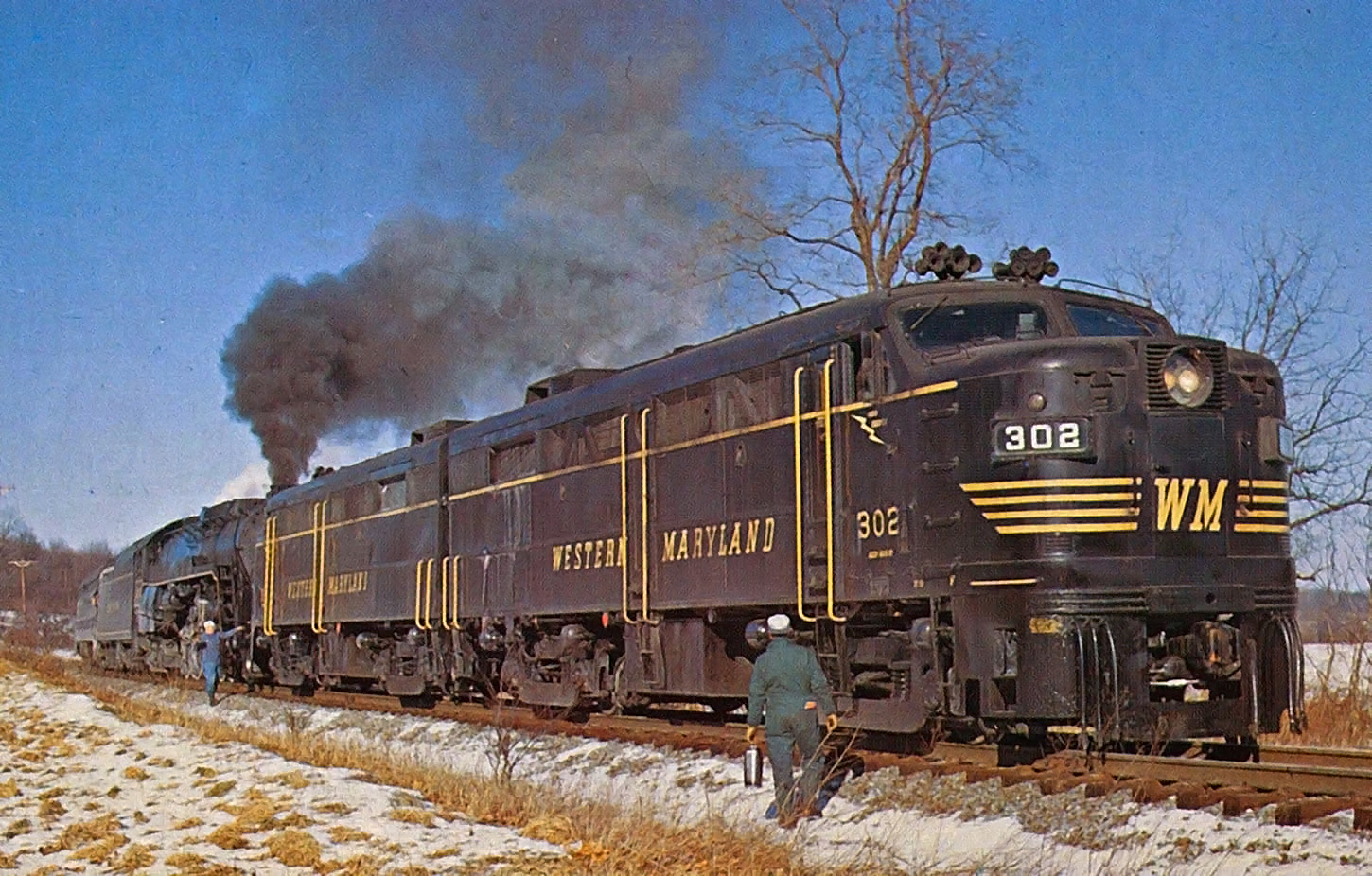
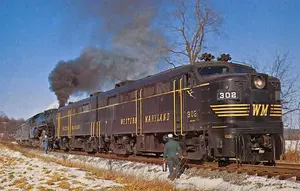
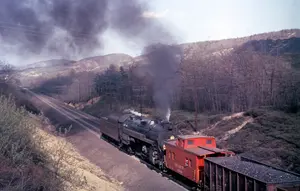
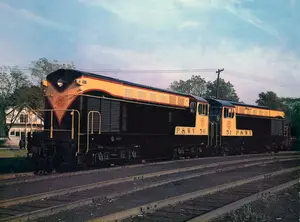
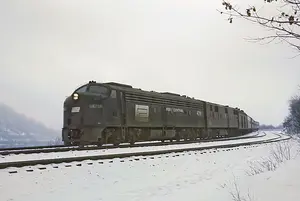
FA-2s #302 and #301, ahead of Reading 4-8-4 #2102, on a Steam Tours excursion at Orrtanna, Pennsylvania, February 5, 1972. Michael Eagleson photo. Orrtanna sits on the hill between Gettysburg and Highfield, the one piece of the Dutch Line that regularly needed helpers.
On this page: At a glance · Baltimore & Harrisburg · The line on the ground · A day on the Dutch Line · What pulled the trains · After Agnes
At a glance
| Item | Detail |
|---|---|
| Railroad | Western Maryland Railway. Hanover Subdivision, called the Dutch Line. The 1893 line into York was the York Subdivision |
| Route | Emory Grove, Maryland, to Highfield Junction, via Hanover, Gettysburg, and Orrtanna. York branch from Porters Sideling |
| Acquired | Baltimore & Hanover and the Gettysburg Railroad, late 1886, consolidated that year as the Baltimore & Harrisburg Railway |
| Finished | West to Highfield, June 1889. Northeast to York, 1893 |
| Junctions | Emory Grove and Highfield, on the WM main. Porters Sideling, for York. York, with the Pennsylvania and the Maryland & Pennsylvania |
| Day’s work | Locals, a stone train off the quarry north of Hanover, paper and merchandise toward York, passenger locals to the three Pennsylvania towns |
| The hill | Gettysburg to Highfield, with Orrtanna on the grade. Helper country |
| Today | CSX Hanover Subdivision, Baltimore–Hagerstown. York Railway on the old line from Porters Sideling into York |
Two short railroads, and a name
John Mifflin Hood spent the 1880s turning a local Maryland railroad into a regional one. Late in 1886 the Western Maryland took in the Baltimore & Hanover and the Gettysburg Railroad. The first reached Hanover from a connection with the WM main at Emory Grove. The second carried the line on through Gettysburg. Hood’s company consolidated them that same year as the Baltimore & Harrisburg Railway, then finished the missing pieces: west to Highfield, Maryland, in June 1889, where the new line met the main again near the state line, and northeast from Porters Sideling to York in 1893.
York gave the railroad the Pennsylvania and the Maryland & Pennsylvania. Hanover and Gettysburg gave it the Pennsylvania Dutch towns the crews already knew. The Hanover Subdivision picked up the nickname from the country, and the nickname outlasted the corporate title. On a Western Maryland map the line is a bow north of the main: out at Emory Grove, through the Pennsylvania towns, and back at Highfield. The York branch is the arrow off that bow at Porters Sideling.
The line on the ground
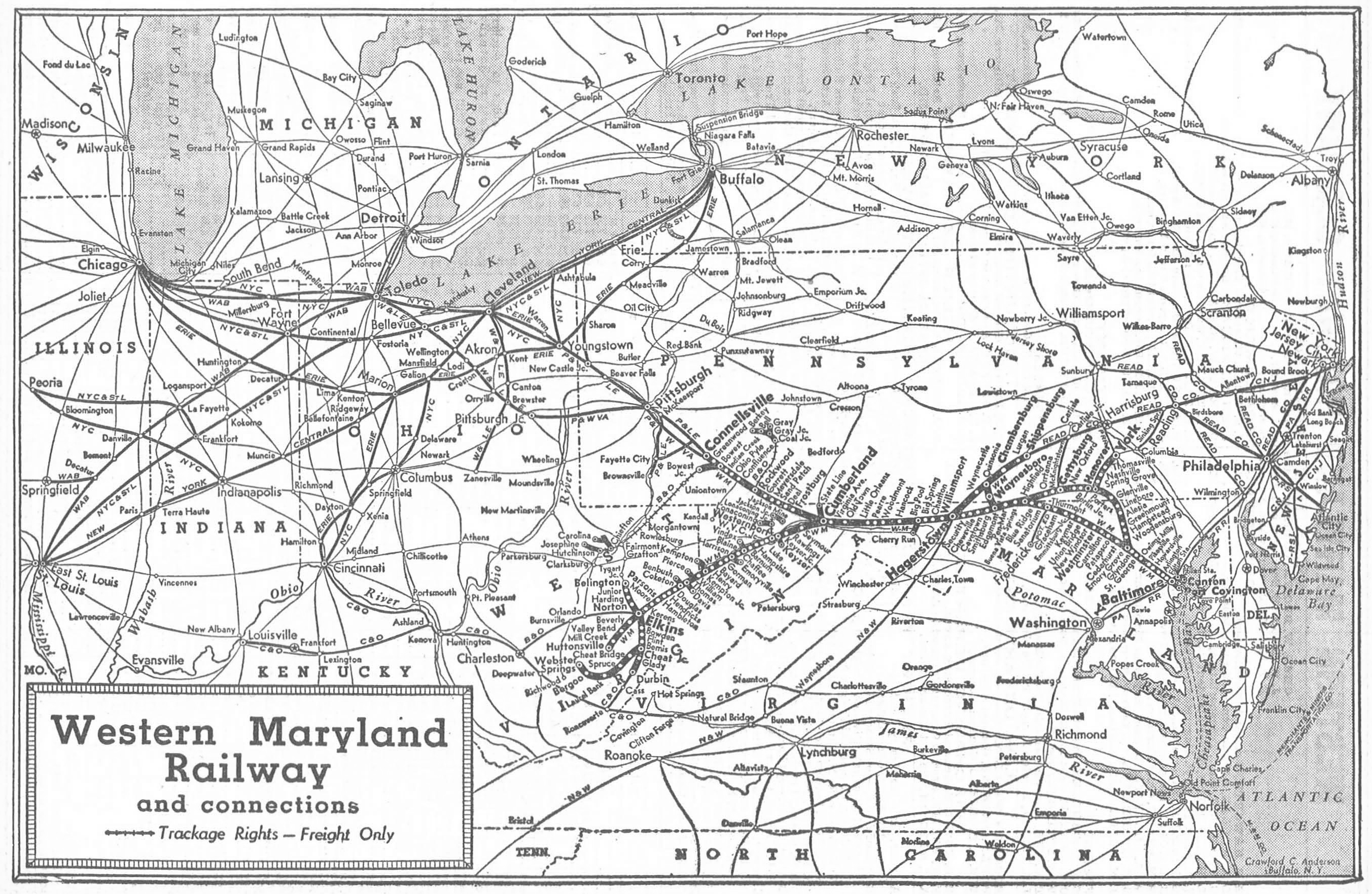
Western Maryland system map, 1941 Official Guide of the Railways. The Dutch Line is the bow north of the Baltimore–Hagerstown main, through Hanover and Gettysburg, with the branch into York.
East to west, a crew leaving Emory Grove Tower climbed into Carroll County and then Pennsylvania: Hampstead, Manchester, and Lineboro, then Hanover. Hanover had the yard, the quarry on the north side of town, and, for years, an engine house. Porters Sideling, west of Hanover, is where the York Subdivision left for Spring Grove and York. The Hanover line itself continued through New Oxford and Gettysburg, then tackled the ridge at Orrtanna and came down to Highfield Junction. Highfield is also on the old main line, a few miles east of Pen Mar and the long descent into Hagerstown. A train could enter the Dutch Line from Baltimore at Emory Grove, or from Hagerstown at Highfield, and never touch the Westminster main at all.
That geography is why the line mattered twice. In Hood’s day it was a way into Pennsylvania markets the main line did not reach. After 1972 it was the only Western Maryland still open between Baltimore and the west.
A day on the Dutch Line
The daily railroad was a local railroad. Out of Hanover, crews switched the town, lifted loads at the quarry, and peddled cars toward Gettysburg, Emory Grove, and York. The quarry on the north side of Hanover belonged to Bethlehem Steel and shipped crushed stone toward the Sparrows Point mill. That stone train was the one heavy, repetitive job on the subdivision, and it ran most days of the week. The quarry later went to Vulcan Materials. The rock still moves, now on CSX, toward Baltimore.
The York branch had a different customer. P. H. Glatfelter’s paper mill at Spring Grove, between Porters Sideling and York, took coal and chemicals and gave back paper. York itself was an interchange: the Pennsylvania on one side of the terminal, the Ma & Pa on the other, and the Western Maryland in between. Merchandise, agricultural traffic, and the occasional car of finished paper were the ordinary consist. Nothing on the Dutch Line looked like a Connellsville time freight. The Alphabet Route used Hagerstown and Shippensburg. This line fed them.
Passenger service was local, and it was the reason a small city such as Gettysburg or Hanover appeared in a Western Maryland timetable. The trains that made the Chicago limiteds famous used the main line through Hagerstown and Hillen Station in Baltimore. The Dutch Line’s own varnish was a coach local. Those locals were gone well before the railroad’s last passenger train, the Durbin mixed of April 10, 1959. What fans remember instead are the excursions. On February 5, 1972, Steam Tours, Inc., put Reading 4-8-4 2102 over the line, with Western Maryland FA-2s 302 and 301 coupled ahead. The photograph at Orrtanna is that trip, in the snow, on the grade where a heavy train needed help even when the train was a fan trip.
What pulled the trains
In steam years the Dutch Line drew the east end’s ordinary engines. Passenger locals were Pacific jobs, the K-1s and then the larger K-2s, the same classes that handled the railroad’s other varnish. Freights were Consolidations. The line never rated a Challenger or a Potomac. Those engines belonged to the Connellsville main and the country east of Cumberland. The one hill that changed the assignment was the ridge between Gettysburg and Highfield. A heavy stone train or a long excursion took a helper there, which is what the two FA-2s are doing in the Orrtanna photograph.
Diesels replaced that pattern without changing the work. RS-3s and Geeps covered the locals and the York branch. FA-2s and F-units covered the heavier freights and, later, the fan trips. The four-axle Alcos and EMDs fit the curves and the short sidings. Six-axle power showed up when the stone train was long enough to need it, and again after the line became a through route. The class-by-class list is the diesel roster. The steam classes are the steam roster.
Highfield Junction is the west end of the subdivision, which is why so many Western Maryland photographs that look like “the main line at Highfield” are actually the Dutch Line arriving. BL2s 81 and 82 were there on July 15, 1961. They were east-end branch power, and Highfield was one end of their railroad.
The line that outlasted the main
Hurricane Agnes, in June 1972, broke the old main between Westminster and Cedarhurst. The company put it back, and another storm took it out again three years later. Chessie did not rebuild it. From then on, Baltimore to Hagerstown meant the Dutch Line: Emory Grove, Hanover, Gettysburg, Orrtanna, Highfield, and down the main into the Hagerstown yard. A branch that had spent eighty years peddling stone and paper became the through freight route. The Western Maryland merged into the Baltimore & Ohio on May 1, 1983. The trains did not stop.
CSX still calls the route the Hanover Subdivision and still runs it from Baltimore to Hagerstown. The York branch left the Class I map in 1989, when Emons bought Porters Sideling–York and operated it as Yorkrail. That piece is the York Railway now, a Genesee & Wyoming road, and it still interchanges with CSX at Porters. The old main line east of Highfield, through Thurmont and Union Bridge toward the Reisterstown country, is a different survivor, the Maryland Midland. The Dutch Line is the one that still carries a through freight.
Related reading
- Western Maryland Railway · Steam roster · Diesel roster
- Maryland & Pennsylvania · Northern Central Railway
- Connellsville Extension · Baltimore & Ohio
Sources
- Cook, Roger, and Karl Zimmermann. The Western Maryland Railway: Fireballs and Black Diamonds. San Diego: Howell-North, 1981. Baltimore & Harrisburg, the Hanover Subdivision, and the York extension
- Official Guide of the Railways, 1941. System map used on this page
- Western Maryland Railway. Corporate history of the Hanover and York subdivisions, as summarized in the company record and in the railroad’s own subdivision list: Emory Grove to Highfield, Porters Sideling to York
- American-Rails.com, Western Maryland and Maryland & Pennsylvania. Agnes, the Westminster break, and the 1989 sale of Porters–York to Yorkrail
Recent Articles


-
The Dutch Line (Western Maryland): History, Map, Operations
Sep 25, 26 09:38 PM
 Western Maryland Dutch Line—the Hanover Subdivision. Emory Grove to Highfield via Hanover and Gettysburg, York branch 1893, stone trains, and the route CSX still runs.
 -
The Durbin Branch (Western Maryland): History, Map, Operations
Sep 25, 26 09:13 PM
 Western Maryland Durbin Branch—the Coal & Iron Railway, 46.9 miles Elkins to Durbin, opened July 27, 1903. Mixed train until April 10, 1959. H-7B Consolidations.
 -
Western Maryland Railway: Map, Rosters, Logo, History
Sep 25, 26 10:24 AM
 Western Maryland Railway—the Fast Freight Line. Baltimore, Carroll & Frederick, May 27, 1852. Connellsville Extension 1912. Chessie, then into the B&O May 1, 1983.
 -
Illinois Dinner Train Rides (2026): A Complete Guide
Sep 25, 26 09:52 AM
 2026 Monticello Railway Museum Murder Mystery Dinner Train—June 13, July 11, August 1, and September 5 have run. Three courses, about 2 hours, $112. Confirm on mrym.org.
 -
Georgia Dinner Train Rides (2026): A Complete Guide
Sep 25, 26 12:29 AM
 2026 Azalea Sprinter dinner train from Nashville and Willacoochee, Georgia—2½ hours. Club Car adult $147, Executive adult $177. Confirm on azaleasprinter.com.
 -
Baldwin "Centipede" Locomotives: Specs, Roster, Photos
Sep 25, 26 12:02 AM
 Baldwin DR-12-8-1500/2 Centipede—2-D+D-2, two 608SC engines, 3,000 hp. SAL 4500 from the 1943 test bed. 54 on the serial list, 52 sold. PRR BP60 then BH50. None preserved.
 -
Florida Dinner Train Rides (2026): A Complete Guide
Sep 24, 26 11:56 PM
 2026 Seminole Gulf Murder Mystery Dinner Train in Fort Myers—five courses cooked onboard, 3½ hours, $129 or $135 Saturday, plus tax and gratuity. Confirm on semgulf.com.
 -
West Virginia Northern Railroad: Map, Photos, History
Sep 24, 26 11:27 PM
 West Virginia Northern—Kingwood to Tunnelton, 11 miles of Preston County coal. Narrow gauge 1888, standard gauge 1895. Last freight February 19, 1991. Consolidations 8 and 9 survive.
 -
Rutland Railroad: Map, Rosters, History, Logo
Sep 24, 26 01:18 PM
 Rutland Railroad—Follett’s Champlain & Connecticut River, November 1, 1843. Bellows Falls–Burlington December 18, 1849. Green Mountain Gateway. Last train September 25, 1961. Vermont Railway Janua…
 -
Arkansas Dinner Train Rides (2026): A Complete Guide
Sep 24, 26 01:12 PM
 2026 Eureka Springs & North Arkansas Dinner Train—Eurekan dining car, about 2 hours, $53.62 tax included, opens May 9, Tuesday, Wednesday, Friday, and Saturday. Confirm on esnarailway.com.
 -
Arizona Dinner Train Rides (2026): A Complete Guide
Sep 24, 26 01:01 PM
 2026 Arizona has no plated dinner train. Grand Canyon Railway sells snacks in the cars and meals in Williams or at the rim. Verde Canyon includes a charcuterie tray.
 -
Rail News, The Latest
Sep 24, 26 12:36 PM
This page provides a portal to the latest in rail news, from preservation and restortation subjects to other notable topics. -
Cotton Belt 819 Moved Outside at Pine Bluff for Evaluation
Sep 24, 26 12:35 PM
 Cotton Belt 819 left the Pine Bluff shop on September 22, 2026, first time outside in about 30 years. RDG Steam Services is evaluating the engine. No donation link posted.
 -
Reading Steam Locomotives: History, Roster & Photos
Sep 24, 26 12:14 PM
 Reading steam—Wootten fireboxes, Camelback Consolidations, Mallets, K-1 Santa Fes, G-3 Pacifics, T-1 4-8-4s. Post-1900 roster after Drury. Rambles ended October 17, 1964.
 -
Reading Diesel Roster: All-Time
Sep 24, 26 12:10 PM
 Reading diesel roster—AGEIR boxcabs, FTs, FA-1s, RS-3s, Train Masters, GP30s through GP39-2s. Serials and order numbers. Conrail April 1, 1976.
 -
Reading Railroad: Map, Logo, History, Rosters
Sep 24, 26 12:08 PM
 Reading Company—Philadelphia & Reading, 1833. Anthracite, Port Richmond, Reading Terminal. Operating company January 1, 1924. Conrail April 1, 1976.
 -
Nevada Dinner Train Rides (2026): A Complete Guide
Sep 24, 26 12:02 PM
 2026 Nevada Northern Taste of Italy—adults-only gala from East Ely. The September 19 date has run. Confirm any later night on nnry.com.
 -
North Carolina Dinner Train Rides (2026): A Complete Guide
Sep 24, 26 11:24 AM
 2026 North Carolina dinner trains—NCTM Wine & Dine in Spencer sold out February 13–15. GSMR First Class is the plated meal on the Nantahala Gorge excursion. Confirm on the railroad.
 -
Railway Express Agency (REA): Signs, Trucks, Logo & History
Sep 24, 26 09:40 AM
 Railway Express Agency—railroad-owned express company. Incorporated December 7, 1928. Operations March 1, 1929. Red diamond, green trucks. Last regular express November 7, 1975.
 -
Michigan Dinner Train Rides (2026): A Complete Guide
Sep 24, 26 09:28 AM
 2026 Steam Railroading Institute dining in Owosso—select evenings, no public dinner dates posted. Confirm on michigansteamtrain.com.
 -
Pittsburgh and West Virginia Railway: Map, Rosters, History
Sep 24, 26 12:24 AM
 Pittsburgh & West Virginia—the Hi-Line. Wabash-Pittsburgh Terminal 1904. Railway January 29, 1917. Connellsville February 11, 1931. N&W lease October 16, 1964. Wheeling & Lake Erie from May 17, 1990.
 -
Indiana Dinner Train Rides (2026): A Complete Guide
Sep 24, 26 12:13 AM
2026 Spirit of Jasper Ride & Dine is paused. No public trains. Depot at 201 Mill Street stays open as a rental. Confirm on spiritofjaspertrain.com. -
New Jersey Dinner Train Rides (2026): A Complete Guide
Sep 24, 26 12:01 AM
2026 Woodstown Central Dining in Motion—private table of four from $190, about an hour, Salem County. Confirm on woodstowncentral.com. -
Maryland Dinner Train Rides (2026): A Complete Guide
Sep 23, 26 05:19 PM
 2026 Western Maryland Scenic Allegheny Mountain Dinner Train—Cumberland, 3 hours, 21+, Saturday 7 p.m. Confirm on wmsr.com.
 -
Pittsburgh and Lake Erie Railroad: Map, Rosters, Photos
Sep 23, 26 03:28 PM
 Pittsburgh & Lake Erie—the Little Giant. Chartered 1875, Pittsburgh to Youngstown February 10, 1879. New York Central from 1883. Independent May 15, 1979. Last day September 11, 1992.
 -
Kansas Dinner Train Rides (2026): A Complete Guide
Sep 23, 26 01:11 PM
 2026 Abilene & Smoky Valley Smoky Valley Limited—two hours from the Rock Island Depot, about $72–$110, dates into December 31. Confirm on asvrr.org.
 -
The Belpaire Firebox: Simplicity and Greater Power
Sep 23, 26 01:03 PM
 Belpaire firebox—Alfred Belpaire, 1864. Square crown, straight staybolts at right angles. Pennsylvania standard after the 1880s. Great Northern was the other big user.
 -
Pennsylvania Railroad (PRR) Electric Roster: All Classes
Sep 23, 26 12:57 PM
Pennsylvania Railroad electrics—DD1s into Penn Station, P5s, 139 GG1s, B1 switchers, and 66 E44s. Class roster, 1905–1963. No unit-by-unit GG1 list. -
Penn Central Diesel Roster: All-Time
Sep 23, 26 12:46 PM
 Penn Central diesel roster—PRR classes on NYC, PRR, and New Haven power. New orders carry serials. GP38-2s are 7940-8162. Conrail April 1, 1976.
 -
Penn Central Railroad: Map, History, Logo
Sep 23, 26 12:32 PM
 Penn Central—Pennsylvania and New York Central merged February 1, 1968. New Haven January 1, 1969. Section 77 bankruptcy June 21, 1970. Conrail April 1, 1976.
 -
Iowa Dinner Train Rides (2026): A Complete Guide
Sep 23, 26 11:42 AM
 2026 Boone & Scenic Valley Wolf Dinner Train—Saturdays May–October, Union Pacific dining cars, Bass Point Creek High Bridge. Confirm on bsvrr.com.
 -
Pennsylvania-Reading Seashore Lines: Map, Roster, History
Sep 23, 26 12:32 AM
 Pennsylvania-Reading Seashore Lines—Atlantic City Railroad renamed July 15, 1933. Pennsylvania two-thirds, Reading one-third. Camden to Atlantic City, Cape May, and Millville. Conrail April 1, 1976.
 -
Wisconsin Dinner Train Rides (2026): A Complete Guide
Sep 23, 26 12:28 AM
2026 Wisconsin Great Northern dinner train in Trego—$105, Namekagon River, January 8–31 and May 5–December 17. Mid-Continent’s remaining 2026 calendar is snack and scenic. Confirm on the railroad. -
New Hampshire Dinner Train Rides (2026): A Complete Guide
Sep 23, 26 12:21 AM
2026 Cafe Lafayette Dinner Train in North Woodstock—five courses, 2 hours, from $125. Children under 6 not allowed. Confirm on nhdinnertrain.com. -
PRR "GG-1" Locomotives: Roster, Photos, Specs
Sep 23, 26 12:13 AM
 PRR GG1 electric: 139 locomotives, 4800–4938, built 1934–1943. Specs, Loewy shell, Amtrak numbers, and the last revenue trip on October 28, 1983.
 -
Montana Dinner Train Rides (2026): A Complete Guide
Sep 23, 26 12:04 AM
2026 Charlie Russell Chew Choo from Hanover, near Lewistown—4.5 hours, prime rib, adult $151. Remaining listed dates sold out. Confirm on montanadinnertrain.com. -
Kentucky Dinner Train Rides (2026): A Complete Guide
Sep 22, 26 11:52 PM
2026 My Old Kentucky Dinner Train in Bardstown—four courses, 2.5 hours, adult $116. Confirm on kydinnertrain.com. -
Tennessee Dinner Train Rides (2026): A Complete Guide
Sep 22, 26 11:45 PM
2026 TVRM Chattanooga Dinner Train—Grand Junction, select Fri/Sat March 6–October 24, 6 p.m., from $110. Confirm on tvrail.com. -
The Trainphone: PRR's Wireless Radio System
Sep 22, 26 11:17 PM
 Pennsylvania Trainphone—Union Switch & Signal inductive telephone. Bel-Del trial 1941, Frenchtown November 29, 1943. Carriers at 88 kHz and 144 kHz. Out of service April 30, 1967.
 -
Pennsylvania (PRR) Steam Roster: Post 1906
Sep 22, 26 11:13 PM
 ennsylvania steam after 1906—H8, H9, and H10 Consolidations, 574 L1s Mikados, 598 I1s Decapods, 425 K4s Pacifics, 301 M1 Mountains. Drury’s grid. Last steam November 30, 1957.
 -
Pennsylvania Railroad (PRR) Diesel Roster: All-Time List
Sep 22, 26 10:59 PM
 Pennsylvania diesel roster—SW 3908 in June 1937, then Alco, Baldwin, EMD, Fairbanks-Morse, GE, and Lima. Serials and Alco order numbers. Penn Central February 1, 1968.
 -
Pennsylvania Railroad: Map, Logo, History, Rosters
Sep 22, 26 10:02 PM
 Pennsylvania Railroad—chartered April 13, 1846, Harrisburg–Pittsburgh, Horseshoe Curve 1854, Penn Station 1910. Standard Railroad of the World. Penn Central February 1, 1968.
 -
Pennsylvania Dinner Train Rides (2026): A Complete Guide
Sep 22, 26 04:48 PM
 2026 Pennsylvania dinner trains—Colebrookdale Dining Class in Boyertown and Strasburg Dinner on the Rails. Confirm on each railroad.
 -
New York, Ontario & Western Steam Locomotives: History & Roster
Sep 22, 26 04:40 PM
 NYO&W steam—camelback 2-8-0s and 2-6-0s, Class X Bull Moose 2-10-2s, Class Y and Y-2 Mountains. All-time class roster. Steam finished in the summer of 1948. None saved.
 -
New York, Ontario & Western Diesel Roster: All-Time
Sep 22, 26 04:36 PM
 NYO&W diesel—five GE 44-tonners 101-105, eighteen FTs, seven F3s, twenty-one NW2s. Serials and the NW2 order E824. Railroad liquidated March 29 1957.
 -
New York, Ontario & Western Railway: Map, Roster, History
Sep 22, 26 04:26 PM
 New York, Ontario & Western—New York & Oswego Midland chartered January 11 1866, O&W January 21 1880. Scranton coal, West Shore rights. Last train March 29 1957.
 -
Massachusetts Dinner Train Rides (2026): A Complete Guide
Sep 22, 26 04:16 PM
 2026 Cape Cod Dinner Train—Hyannis, Buzzards Bay, and North Falmouth. Four-course, 3–3½ hours, from $99.99. Confirm on capetrain.com.
 -
Colorado Dinner Train Rides (2026): A Complete Guide
Sep 22, 26 03:51 PM
 2026 Royal Gorge Route First Class Dinner and Lunch from Cañon City. About 2 hours, 12+, from $199+. Confirm on royalgorgeroute.com.
 -
New York and Long Branch Railroad: A PRR & CNJ Subsidiary
Sep 22, 26 03:11 PM
 New York & Long Branch—chartered April 8 1868, Perth Amboy–Long Branch July 1 1875, Bay Head Junction 1881. Jersey Central and Pennsylvania trains. Conrail April 1 1976. NJ Transit North Jersey Co…
 -
Monongahela Railway Steam Locomotives: History & Roster
Sep 22, 26 01:34 PM
 Monongahela steam—H-5 Consolidations, USRA light Mikados 170–179, Baldwin L-2s, ex-P&LE L-3s. All-time roster. Last steam May 26, 1954.