Southern Railway 4-8-2 Mountains (Class Ts / Ts-1): Specs & Roster
Published: August 27, 2026
By: Adam Burns
The Southern Railway never rostered a 4-8-4. What it did roster, starting in 1917, was a two-class fleet of 4-8-2 Mountains to pull steel passenger cars that had outgrown the 4-6-2 Pacifics on the hills between Washington, Atlanta, Birmingham, and Chattanooga. Baldwin’s custom class Ts came first (30 engines, 1916–17). The United States Railroad Administration’s Light Mountain followed as class Ts-1 (25 engines, 1919)—the largest single USRA Light Mountain allocation of the 47 built nationwide. Southern’s letter T marked the 4-8-2; the trailing s meant superheated.
Together that is 55 Mountains on the Southern family: parent road, Cincinnati, New Orleans & Texas Pacific, and Alabama Great Southern. They took Virginia green and gold in the late 1920s, the same passenger dress as the famous Ps-4 Pacifics. None were saved. The last came off in 1952–53. Southern’s steam celebrities that remain—Ps-4 1401 at the Smithsonian, Mikado 4501 at TVRM—are other wheel arrangements.

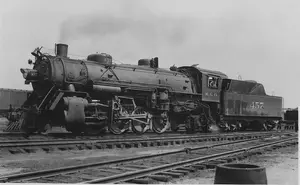
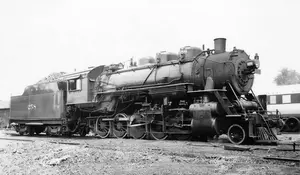
Southern 4-8-2 #1459 (Class Ts) awaits the arrival of train #28 at Asheville, North Carolina on February 16, 1950. The Mountain would lead the train eastbound into Charleston, South Carolina. From the Shelby Lowe collection.
On this page: At a glance · Why a Mountain · Class Ts · Class Ts-1 (USRA) · Specifications · Complete roster · Green and gold · Service and retirement
At a Glance
| Item | Detail |
|---|---|
| Railroad | Southern Railway System (parent, CNO&TP, Alabama Great Southern) |
| Wheel arrangement | 4-8-2 Mountain (Whyte); 2′D1′ UIC |
| Classes | Ts (Baldwin custom, 1916–17); Ts-1 (USRA Light Mountain, 1919) |
| Quantity | 30 Ts + 25 Ts-1 = 55 |
| Why the 4-8-2 | Steel passenger cars on grades that 4-6-2 Pacifics could no longer time |
| Drivers / pressure (both classes) | 69-inch drivers, 200 psi |
| Ts vs Ts-1 cylinders | Ts 27×28 in; Ts-1 27×30 in (USRA Light) |
| Tractive effort | Ts ~50,300 lbf; Ts-1 ~53,900 lbf |
| Paint (from late 1920s) | Virginia green and gold, same family as the Ps-4s |
| Retired | 1952–53. No survivors |
Why Southern bought Mountains
The 4-8-2 was born on the Chesapeake & Ohio in 1911, when Alco stretched a Pacific into eight drivers for the Alleghenies and C&O named the type Mountain. Southern’s problem was the same geometry on different hills. Between Washington and Atlanta, and on the Birmingham, Bristol–Memphis, and Macon–Chattanooga runs, all-steel coaches and sleepers made the older Pacifics late. A two-axle engine truck, four coupled axles, and a trailing axle under a wide firebox gave more adhesion and more boiler than a 4-6-2 without jumping to a 2-8-2 freight engine’s smaller drivers.
Southern did not wait for the USRA. It ordered a custom Baldwin Mountain in 1916, classed Ts, and put 23 on the parent road as 1450–1472 plus seven more on the Queen & Crescent subsidiaries. When the United States Railroad Administration standardized a Light Mountain in 1918, Southern took the biggest slice of that 47-locomotive pie and classed the copies Ts-1.
The later Ps-4 Pacifics (Alco, 1923–26) stole the Crescent and the Washington–Atlanta varnish that photographers remember. The Mountains kept working: passenger extras, mail and express, and fast freight on the same districts, often based at Spencer, North Carolina, and working both directions on the Washington–Atlanta main.
Class Ts — Baldwin, 1916–17
Thirty locomotives. All Baldwin. Works numbers run from 44666–44667 (December 1916) through 46062 (August 1917). They are not USRA engines. Cylinders are nearly square, 27 by 28 inches, fed by 14-inch piston valves. Walschaert valve gear. 69-inch drivers, 200 psi, about 50,290 lbf starting tractive effort. Engine weight 314,800 pounds; 209,800 on drivers.
Road numbers:
- Southern 1450–1472 (23)—the parent-road series everyone photographs
- CNO&TP 6490–6494 (5)—built as 850–854, later 6490-series
- AGS 6695–6696 (2)—built as 280–281, then 6690–6691, then 6695–6696
Tenders as diagrammed carried about 9,000 gallons of water and 12 tons of coal (171,000 pounds loaded). Grate area 77 square feet—larger than the USRA Light Mountain that followed. Firebox heating surface about 329 square feet including arch tubes as built (a 1926 diagram is too low to still include those tubes, so some may have come out in shopping).
Class Ts-1 — USRA Light Mountain, 1919
The USRA Light Mountain (4-8-2A) was the wartime standard dual-service 4-8-2: 69-inch drivers, 27 by 30 cylinders, 200 psi, about 53,900 lbf tractive effort, 327,000-pound engine, Baker valve gear on the USRA drawing (Southern diagrams should be checked per unit if a Ts-1 was later given Walschaert). Forty-seven originals were built for four railroads. Southern’s family took 25.
As delivered they were Southern 1475–1499: Baldwin 1475–1489 (15), Alco-Richmond 1490–1499 (10). Five of the allocation went to CNO&TP as 6495–6499 (Alco-Richmond 6495–6498, Baldwin 6499). Three Baldwin engines associated with 1484 / 1488–1489 went to AGS as 6692–6694. Published tables that add 1475–1499 plus 6495–6499 plus 6692–6694 into 33 new locomotives are counting the same 25 twice. USRA math is 7 Missouri Pacific + 5 NC&StL + 10 New Haven + 25 Southern family = 47.
Ts-1 tenders were larger than the Ts: about 10,000 gallons and 16 tons of coal. The USRA boiler used a combustion chamber; evaporative heating surface about 4,121 square feet, superheater about 966, grate about 70.3 square feet. That is more boiler, slightly less grate, and a longer stroke than the 1917 Baldwins.
Specifications
Figures follow Southern diagrams as compiled by Steve Llanso (Locobase 227 / 1429), the 1930 Locomotive Cyclopedia USRA Light Mountain sheet, and Richard E. Prince’s Southern steam roster. Tractive effort is the usual 0.85×P×d²×s / D calculation at 200 psi.
| Specification | Class Ts (1917 Baldwin) | Class Ts-1 (USRA Light, 1919) |
|---|---|---|
| Whyte | 4-8-2 | 4-8-2 |
| Builder | Baldwin | Baldwin and Alco-Richmond |
| Cylinders (2) | 27 × 28 in | 27 × 30 in |
| Drivers | 69 in | 69 in |
| Boiler pressure | 200 psi | 200 psi |
| Starting tractive effort | 50,290 lbf | 53,900 lbf |
| Valve gear | Walschaert; 14-in piston valves | USRA standard Baker (confirm a given engine against its diagram) |
| Engine weight | 314,800 lb | 327,000 lb |
| Weight on drivers | 209,800 lb | 224,500 lb |
| Max axle load | 54,900 lb | 56,500 lb |
| Tender (loaded) | 171,000 lb | 192,000 lb |
| Engine + tender | 485,800 lb | 519,000 lb |
| Tender water | 9,000 gal | 10,000 gal |
| Tender coal | 12 tons | 16 tons |
| Driver wheelbase | 18 ft 0 in | 18 ft 3 in |
| Engine wheelbase | 38 ft 11 in | 40 ft 0 in |
| Engine + tender wheelbase | 73 ft 3½ in | 75 ft 8½ in |
| Grate area | 77 sq ft | 70.3 sq ft |
| Firebox heating surface | 329 sq ft (as built, with arch tubes) | 348 sq ft (includes combustion chamber / arch tubes) |
| Evaporative heating surface | 3,668 sq ft | 4,121 sq ft |
| Superheater | 942 sq ft | 966 sq ft |
| Combined heating surface | 4,610 sq ft | 5,087 sq ft |
| Factor of adhesion | ~4.17 | ~4.17 |
Complete roster
Road-number blocks, not a builder-card dump. Baldwin works numbers for the Ts are in Prince and in DeGolyer Volume 56; they run 44666 (December 1916) through 46062 (August 1917). Ts-1 Baldwin works include 51647, 51653–51654, 51704–51705, 51730–51733 (April 1919) and 51798–51800, 51814, 51865 (May). Alco-Richmond Ts-1 works include 59800-series numbers for the 1490s and CNO&TP 6495–6498.
Class Ts (30)
| Road | Numbers | Qty | Builder | Year | Notes |
|---|---|---|---|---|---|
| Southern | 1450–1472 | 23 | Baldwin | 1917 (first two Dec. 1916) | Parent-road passenger Mountains. All scrapped |
| CNO&TP | 6490–6494 | 5 | Baldwin | 1917 | Built as 850–854; Queen & Crescent / Cincinnati–Chattanooga. All scrapped |
| Alabama Great Southern | 6695–6696 | 2 | Baldwin | 1917 | Built as 280–281, then 6690–6691, then 6695–6696. All scrapped |
Class Ts-1, USRA Light Mountain (25)
| Road | Numbers | Qty | Builder | Year | Notes |
|---|---|---|---|---|---|
| Southern | 1475–1489 | 15 | Baldwin | 1919 | USRA Light Mountain. Three of this Baldwin group associated with AGS 6692–6694 (ex 1484, 1488, 1489 in some lists) |
| Southern | 1490–1499 | 10 | Alco-Richmond | 1919 | USRA Light Mountain |
| CNO&TP | 6495–6498 | 4 | Alco-Richmond | 1919 | Part of the Southern family’s 25, not a 26th through 29th new engine |
| CNO&TP | 6499 | 1 | Baldwin | 1919 | Same allocation |
| Alabama Great Southern | 6692–6694 | 3 | Baldwin | 1919 | Same allocation. Do not add these three to 1475–1499 as extra new locomotives |
Parent-road photographers will see 1450-series Ts and 1475-series Ts-1. Subsidiary engines wear 64xx (CNO&TP) and 66xx (AGS). There is no 1473, 1474, or 1500 in the Mountain series. There is no Southern 4-8-4 behind them.
Virginia green and gold
Fairfax Harrison, Southern’s president, had the Ps-4 Pacifics painted Virginia green and gold after seeing LNER apple green in Britain (the first Ps-4s had been black with gold lettering). In the late 1920s that passenger livery went onto the Ts and Ts-1 as well. They kept it until dieselization. If a color photograph of a Southern 4-8-2 looks like a Ps-4 with two extra drivers, that is the point. Freight Ms-class Mikados stayed black.
Where they ran, and why none survive
The Washington–Atlanta main through Spencer is the assignment every summary repeats, both directions, steel cars. They also covered Atlanta–Birmingham, Bristol–Memphis, and Macon–Chattanooga—the hills that had finished the light Pacifics. After the Ps-4s took the flagship varnish, Mountains remained useful dual-service power: passenger when a Pacific was short, mail and express, and timed freight. CNO&TP engines worked the Cincinnati gateway; AGS engines the Birmingham–Meridian side of the Queen & Crescent.
Southern dieselized passenger trains relatively early by Southeastern standards. The Mountains came off in 1952–53. Every Ts and Ts-1 was cut up. No museum, no park engine, no Southern steam program 4-8-2. The system saved a Pacific and later a Mikado. It did not save a Mountain.
That is the whole fleet: thirty Baldwin customs and twenty-five USRA Lights, 69-inch drivers, green and gold on the varnish, gone with the rest of Southern steam. If a surviving 4-8-2 in the South is on your itinerary, it is not one of these.
Related Reading on American-Rails.com
- Southern Railway
- 4-8-2 Mountain type
- Southern Ps-4 #1401
- Southern Mikado #4501
- United States Railroad Administration
- Norfolk & Western class K 4-8-2s
- Chesapeake & Ohio 4-8-2s (the type’s 1911 origin)
- Steam locomotives
Sources
- Richard E. Prince, Southern Railway System Steam Locomotives and Boats (1970)—standard all-time Southern steam roster
- Steve Llanso / SteamLocomotive.com Locobase 227 (Ts) and 1429 (Ts-1), from Southern diagrams, DeGolyer Vol. 56, and the 1930 Locomotive Cyclopedia
- USRA Light Mountain allocations (47 originals: MP 7, NC&StL 5, New Haven 10, Southern family 25)
- Baldwin DeGolyer specification books, Vol. 56 (Ts) and Vol. 58 (USRA Light Mountain)
- HawkinsRails Southern steam notes (1450–1472 / 1475–1499; retirement by 1953; no survivors)
Recent Articles


-
Norfolk & Western Diesel Roster (All-Time)
Oct 12, 26 11:59 PM
 Norfolk & Western diesel roster, all-time. 1,464 locomotives built new for the railroad, from the 1955 GP9s and RS-3s through the C36-7s, plus the merger fleets.
 -
Norfolk & Western Steam Roster (Post 1900)
Oct 12, 26 11:52 PM
 Norfolk & Western steam since 1898. The Roanoke grid: 1,266 locomotives, the J, the A, and the Y, and the last road steam on May 7, 1960.
 -
Norfolk & Western Railway: Map, Logo, Rosters, History
Oct 12, 26 11:45 PM
 The Norfolk & Western, from the City Point Railroad of 1838 to Norfolk Southern. Pocahontas coal, Roanoke steam, and the 1964 expansion.
 -
Louisiana Railroad Museums (2026): A Complete Guide
Oct 12, 26 11:24 PM
 Louisiana railroad museums—the DeQuincy depot, the Long Leaf sawmill, Jackson’s model railroad, and Southern Pacific 745. Confirm hours on each site.
 -
Michigan Railroad Museums (2026): A Complete Guide
Oct 12, 26 11:14 PM
 Michigan railroad museums—Pere Marquette 1225 at Owosso, Durand Union Station, The Henry Ford, and the Mount Clemens depot. Confirm hours on each site.
 -
Mississippi Railroad Museums (2026): A Complete Guide
Oct 12, 26 10:52 PM
 Mississippi railroad museums—McComb’s rebuilt Illinois Central depot and Illinois Central 2542, and the Casey Jones museum at Water Valley. Confirm hours on each site.
 -
The "E2b": PRR's Experimental Freight Electrics
Oct 12, 26 10:33 PM
 PRR class E2b: six GE B-B freight electrics, 4939–4944, 2,500 hp, 11 kV AC. Specifications, roster, and the 1964 scrap.
 -
Alaska Railroad Museums (2026): A Complete Guide
Oct 12, 26 10:10 PM
 Alaska railroad museums—the Museum of Alaska in Wasilla, Tanana Valley No. 1 at Pioneer Park, and the Engine 557 shop. Confirm hours on each site.
 -
Western and Atlantic Railroad: Map, History, Timetables
Oct 12, 26 09:55 PM
 The Western & Atlantic Railroad of the State of Georgia, authorized December 21, 1836, from Atlanta to Chattanooga. The state still owns the 137.33-mile line. CSX leases it. The through railroad opene…
 -
Nashville, Chattanooga & St. Louis Steam Roster (Post 1900)
Oct 12, 26 09:52 PM
 Nashville, Chattanooga & St. Louis steam since 1900. Drury's class grid: Consolidations, 51 Mikados, three 2-8-8-2s, Pacifics, and 25 4-8-4s. Last steam was January 4, 1953.
 -
Nashville, Chattanooga & St. Louis Diesel Roster (All-Time)
Oct 12, 26 09:27 PM
 Nashville, Chattanooga & St. Louis diesel roster, all-time. Switchers from 1941, 37 GP7s, and the F3s and F7s. The quantity column totals 132 locomotives.
 -
Nashville, Chattanooga and St. Louis Railway: Map, History, Logo
Oct 12, 26 08:41 PM
 The Nashville, Chattanooga & St. Louis, the Dixie Line. Charter of December 11, 1845, the Cumberland tunnel, and the Louisville & Nashville merger of August 30, 1957.
 -
Idaho Railroad Museums (2026): A Complete Guide
Oct 12, 26 02:44 PM
 Idaho railroad museums—Nampa’s 1903 depot, Wallace’s Northern Pacific depot, and Boise’s 1925 Union Pacific depot. Confirm hours on each site.
 -
Hawaii Railroad Museums (2026): A Complete Guide
Oct 12, 26 12:50 PM
Hawaii railroad museums—the Hawaiian Railway Society at Ewa Beach and the Laupahoehoe Train Museum on the Big Island. Confirm hours on each site. -
Marietta and Cincinnati Railroad: Map, History, Timetable
Oct 12, 26 11:44 AM
 Marietta and Cincinnati Railroad, chartered March 8, 1845 as the Belpre & Cincinnati. Opened in April 1857, sold under foreclosure December 9, 1882, and succeeded by the Baltimore & Ohio Southwestern…
 -
Tennessee Railroad Museums (2026): A Complete Guide
Oct 12, 26 11:39 AM
 Tennessee railroad museums—TVRM and Southern 4501 in Chattanooga, the Tennessee Central museum in Nashville, Casey Jones in Jackson, and the depots at Cookeville, Cowan, and Townsend.
 -
Virginia Railroad Museums (2026): A Complete Guide
Oct 12, 26 09:40 AM
 Virginia railroad museums—Roanoke’s Virginia Museum of Transportation and the O. Winston Link Museum, the C&O center at Clifton Forge, and the depots in Richmond, Fairfax Station, Suffolk, Parksley, a…
 -
Louisville & Nashville Diesel Roster (All-Time)
Oct 12, 26 12:15 AM
 Louisville & Nashville diesel roster, all-time. Switchers from 1939, the cab units, and EMD, Alco, and GE hoods through the SD50s. The quantity column totals 1948 locomotives, plus 29 yard slugs.
 -
Louisville & Nashville Steam Roster (Post 1900)
Oct 11, 26 05:44 PM
Louisville & Nashville steam since 1900. Drury's class grid: Consolidations, 165 heavy Mikados, 42 Big Emma 2-8-4s, Pacifics, and 22 Mountains. Last steam January 1957. -
Louisville and Nashville Railroad: Map, Rosters, History
Oct 11, 26 05:39 PM
 Louisville & Nashville, the Old Reliable. Charter of March 5, 1850, Milton H. Smith, the 921-mile main line, Big Emma, and the December 29, 1982 merger. Steam and diesel rosters are companion pages.
 -
Oregon Railroad Museums (2026): A Complete Guide
Oct 11, 26 05:19 PM
 Oregon railroad museums—the Oregon Rail Heritage Center, Brooks trolleys, Canby’s 1891 depot, Medford’s Willamette, and Train Mountain. Confirm hours on each site.
 -
Texas Railroad Museums (2026): A Complete Guide
Oct 11, 26 05:15 PM
 Texas railroad museums—Frisco’s Big Boy 4018, Galveston’s Santa Fe depot, Temple’s 1911 station, Plano’s interurban, and Fort Worth & Denver 304. Confirm hours on each site.
 -
Wisconsin Railroad Museums (2026): A Complete Guide
Oct 10, 26 11:51 PM
Wisconsin railroad museums—Green Bay’s Big Boy 4017 and Eisenhower’s A4, Mid-Continent at North Freedom, East Troy’s interurban, and the Riverside & Great Northern. Confirm hours on each site. -
Interstate Railroad (Virginia): Map, Roster, Logo, History
Oct 10, 26 11:22 PM
 Interstate Railroad, a Virginia coal road chartered February 18, 1896. Andover shops. Ten Alco RS3s, 30–39. Southern control in 1961. The company ended October 31, 1985.
 -
North Carolina Railroad Museums (2026): A Complete Guide
Oct 10, 26 11:16 PM
North Carolina railroad museums—Spencer Shops, Wilmington’s Atlantic Coast Line 250, Hamlet’s Seaboard depot, and the New Hope Valley Railway. Confirm hours on each site. -
New Mexico Railroad Museums (2026): A Complete Guide
Oct 10, 26 10:54 PM
 New Mexico railroad museums—Santa Fe 2926 in Albuquerque, the Clovis depot, Alamogordo’s Toy Train Depot, and Belen. Confirm hours on each site.
 -
New York Railroad Museums (2026): A Complete Guide
Oct 10, 26 09:33 PM
 New York railroad museums—Phoenicia, Medina’s New York Central freight house, the Transit Museum, Long Island 35 and 39, and GG1 4933. Confirm hours on each site.
 -
Columbia, Newberry & Laurens Railroad: History, Timetable, Roster
Oct 10, 26 09:08 PM
 Columbia, Newberry & Laurens Railroad, Columbia to Laurens, 75 miles. Chartered in 1885. Five Atlantic Coast Line GP7s, 100–104. Merged into the Seaboard System on April 30, 1984.
 -
New Haven Diesel Roster (All-Time)
Oct 10, 26 06:35 PM
 New Haven diesel roster, all-time. 558 road numbers: 60 DL-109s, 30 FA-1s, 27 PA-1s, 60 FL9s, and the switchers from HH600 0900. Serials and order numbers.
 -
New Haven Steam Roster (Post 1900)
Oct 10, 26 06:31 PM
 New Haven steam since 1900. Drury's class grid: 226 Moguls, 33 Mikados, 50 Santa Fes, 70 Mountains, 141 Pacifics, and 10 Hudsons. Last fan trip July 19, 1953.
 -
New Haven Railroad: Rosters, Map, Logo, History, Trains
Oct 10, 26 06:26 PM
 New York, New Haven and Hartford. The Shore Line, Hell Gate, the 1952 map at 1,838.89 miles, and the railroad Penn Central took at 11:59:59 p.m. on December 31, 1968.
 -
C&O's 4-6-4 "Hudson" Locomotives (Class L): Specs, Roster, History
Oct 10, 26 05:36 PM
 Chesapeake & Ohio Class L 4-6-4 Hudsons. Eight L-2s, five L-1 rebuilds, five L-2-As. Specs, Baldwin works numbers, and the roster. No. 490 survives.
 -
Alton Railroad: Map, History, Timetables
Oct 09, 26 10:31 PM
 Alton Railroad, chartered February 27, 1847 as the Alton & Sangamon. Chicago, St. Louis, and Kansas City, the 1937 Official Guide, and the May 31, 1947 merger into the Gulf, Mobile & Ohio.
 -
Mobile & Ohio Steam Roster (Post 1900)
Oct 09, 26 12:26 PM
 Mobile & Ohio steam since 1900. Drury's class grid: 48 six-wheel switchers, 107 Ten-Wheelers, 15 Consolidations, 58 Mikados, and 14 Pacifics. Last revenue steam October 7, 1949.
 -
Mobile & Ohio Railroad: History, Map, Timetable
Oct 09, 26 11:31 AM
 Mobile & Ohio Railroad, chartered in 1848. Columbus on April 22, 1861, the Cairo & St. Louis, the March 1940 Official Guide, and the September 13, 1940 merger into the Gulf, Mobile & Ohio.
 -
Gulf, Mobile & Northern Steam Roster (Post 1900)
Oct 09, 26 10:42 AM
 Gulf, Mobile & Northern steam since 1900. Drury's class grid: Ten-Wheelers, Mikados, Russian Decapods, Pacifics 425 and 426, and three light 4-8-2s. Last revenue steam October 7, 1949.
 -
Gulf, Mobile & Ohio Diesel Roster (All-Time)
Oct 09, 26 10:41 AM
 Gulf, Mobile & Ohio diesel roster, all-time. The 1935 boxcab, DL-107s, 55 FA-1s, F3s and F7s, the Ingalls 4-S, GP30s through GP38-2s, and 21 SD40s. Serials and order numbers.
 -
Gulf, Mobile & Northern Railroad: History, Rebel Route
Oct 09, 26 10:36 AM
 Gulf, Mobile & Northern, from the 1890 Mobile, Jackson & Kansas City to the Rebel and the September 13, 1940 merger into the Gulf, Mobile & Ohio. Steam roster is the companion page.
 -
Gulf, Mobile & Ohio Railroad: Map, Photos, Trains, History
Oct 08, 26 11:48 PM
 Gulf, Mobile & Ohio, chartered in 1938 and merged September 13, 1940. The Mobile & Ohio, the Alton on May 31, 1947, the Rebel Route, and Illinois Central Gulf on August 10, 1972.
 -
New Jersey Railroad Museums (2026): A Complete Guide
Oct 08, 26 11:37 PM
 New Jersey railroad museums—Whippany, Maywood, Pine Creek, Mahwah’s Erie depot, Phillipsburg, and Boonton. Confirm hours on each site.
 -
New Hampshire Railroad Museums (2026): A Complete Guide
Oct 08, 26 11:34 PM
 New Hampshire railroad museums—North Conway, the Flying Yankee, Ashland, Gorham, Raymond, and Sandown. Confirm hours on each site.
 -
Missouri Railroad Museums (2026): A Complete Guide
Oct 08, 26 11:00 PM
 Missouri railroad museums—the National Museum of Transportation, Patee House, Frisco 4524, the Chicago & Alton depot, and Marceline. Confirm hours on each site.
 -
Milwaukee Road X3800: Deer Lodge’s Shop Goat
Oct 08, 26 04:28 PM
 Milwaukee Road X3800, the a home-built shop goat that served the Deer Lodge, MT yard. It was a 220-volt DC switcher, powered through an extension cord that moved electrics into a roundhouse where the…
 -
Key West Extension (Overseas Railroad): History, Construction, Decline
Oct 08, 26 03:59 PM
 Henry Flagler's Overseas Railroad, Miami to Key West, 1905–1935. The Seven Mile Bridge, the 1935 Labor Day Hurricane, and the road that became U.S. 1.
 -
Florida East Coast Steam Roster (Post 1900)
Oct 08, 26 02:34 PM
 Florida East Coast steam since 1897. Seventeen Ten-Wheelers, twenty Atlantics, eighty-seven Pacifics, ninety Mountains, fifteen Mikados, and the switchers.
 -
Florida East Coast Diesel Roster (All-Time)
Oct 08, 26 02:12 PM
 Florida East Coast diesel roster, all-time. E units from 1939, F3s, BL2s, GP7s and GP9s, the GP40-2 orders, 22 SD40-2s, and 24 ES44C4s. Serials and EMD order numbers.
 -
Florida East Coast Railway: Map, History, Rosters
Oct 08, 26 01:46 PM
 Florida East Coast Railway, Henry Flagler's line from Jacksonville to Miami and Key West. Receivership in 1931, the 1963 strike, Grupo México in 2017, and Brightline on the same track.
 -
Minnesota Railroad Museums (2026): A Complete Guide
Oct 08, 26 10:32 AM
Minnesota railroad museums—the Lake Superior Railroad Museum, Two Harbors, Jackson Street, Willmar’s Great Northern 2523, and Currie. Confirm hours on each site. -
Maine Railroad Museums (2026): A Complete Guide
Oct 08, 26 09:24 AM
 Maine railroad museums—Seashore Trolley, the two-foot lines at Portland, Alna, and Phillips, Boothbay, and the Bangor & Aroostook depots. Confirm hours on each site.
 -
Massachusetts Railroad Museums (2026): A Complete Guide
Oct 08, 26 12:08 AM
 Massachusetts railroad museums—Berkshire Scenic at Lenox, Shelburne Falls trolley No. 10, Edaville, Chatham’s 1887 depot, and Lowell. Confirm hours on each site.