Maine -- Dinner Train -- Rides At Portland
Published: August 23, 2026
By: Adam Burns
On the edge of Casco Bay, where Portland’s working waterfront meets the breezy greens of the Eastern Promenade, a small train does something surprisingly powerful: it makes Maine’s famed “two-foot” railroading feel immediate again.
The Maine Narrow-Gauge Railroad & Museum (often shortened to “Maine Narrow Gauge”) isn’t a sprawling, all-day railroad park or a long-distance scenic line. Instead, it’s a compact, living-history operation that pairs museum exhibits with a short-but-memorable train ride—one that rolls past marinas, shoreline views, and classic Maine light and weather along the bay.
And while this isn’t generally a “dinner train” railroad in the traditional sense—no multi-course meal served en route—Maine Narrow Gauge does offer several popular ride experiences where food and drink are a key part of the fun: from family-friendly ice cream outings to sunset rides with beverages, and a holiday production that famously includes hot chocolate and cookies.
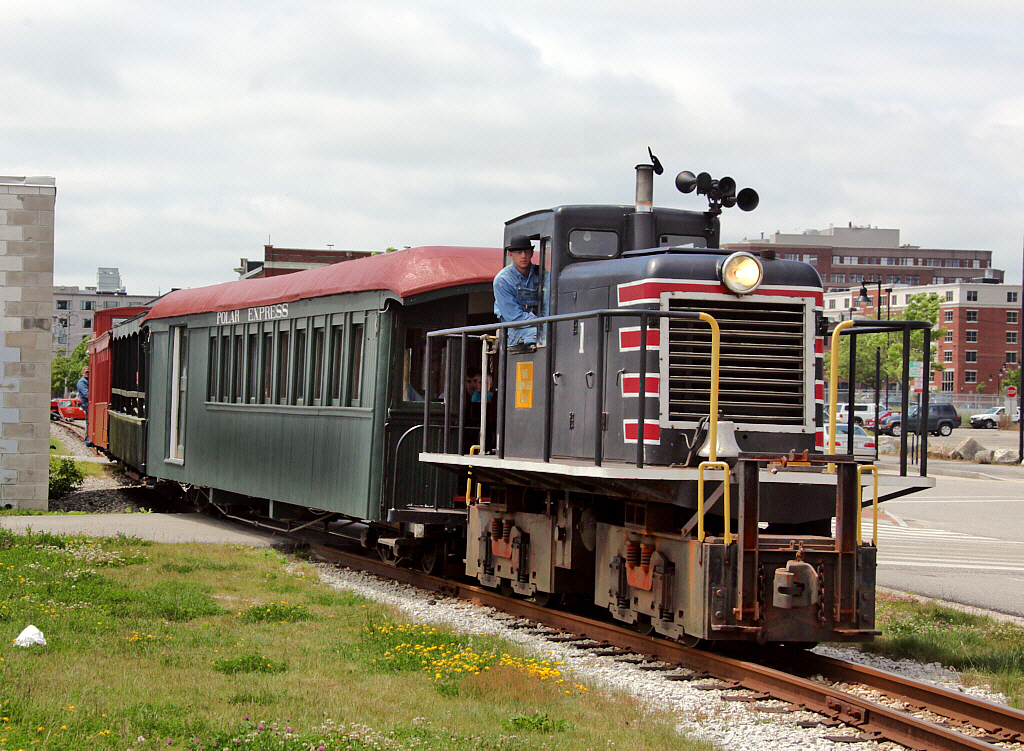 Maine Narrow Gauge Railroad's GE diesel #1 leads an excursion at the Portland, Maine waterfront on June 16, 2012. Marty Bernard photo.
Maine's 2-Footers
To appreciate what’s special about Maine Narrow Gauge, it helps to understand the tradition it interprets. In most of North America, standard-gauge track measures 4 feet, 8½ inches between rails. Maine, however, became famous for a network of narrow-gauge lines—many built to two-foot gauge—which proved cheaper to construct and operate, especially in rural and rugged territory. These railroads served timber towns, farms, and coastal communities, and for a time they were an important part of everyday life in the state.
The equipment, the scale, even the feel of these lines was distinct: smaller locomotives and cars, tighter curves, and a unique “Maine” personality that railfans quickly learn to recognize. Maine Narrow Gauge’s mission is to keep that legacy tangible—not just in exhibits, but through operating equipment and letting visitors ride behind it.
Founding A Museum
The Maine Narrow Gauge Railroad & Museum was founded in 1993 as a nonprofit dedicated to preserving and interpreting Maine’s narrow-gauge heritage. Over time, the organization assembled a collection of two-foot gauge equipment and artifacts—passenger and freight cars, restoration projects, and museum displays that tell the story of the state’s storied narrow-gauge era.
Equally important, it established an operating demonstration railroad in Portland. Today the museum runs an approximately 1.5-mile line along the waterfront, providing a scenic ride that parallels the Eastern Promenade and looks out toward Casco Bay.
That combination—museum plus moving train—matters. Static displays can explain why two-foot gauge was practical, and what it meant to the communities it served. But the moment a locomotive couples on, the whistle sounds, and the cars begin to sway gently along the bay, the story becomes visceral.
What you experience today
A visit typically revolves around two complementary pieces:
1) The museum and collection.
Inside, you’ll find exhibits and artifacts that frame Maine’s narrow-gauge story—how the railroads operated, what they hauled, and why this unusual gauge became such a Maine signature. The museum’s broader collection also supports ongoing restoration and interpretation projects.
2) A scenic round-trip train ride.
The railroad’s regular rides are designed for accessibility and repeat visits: short enough for families, but scenic enough that railfans and photographers will want to come back in different seasons and light. Maine Narrow Gauge emphasizes the constantly changing views along Casco Bay, often pairing the trip with onboard narration that mixes local scenery with rail history.
Because the line is compact, it also functions as an easy “add-on” to a Portland day—perfect between meals, brewery stops, waterfront walks, or museum-hopping.
Notable Equipment
The Maine Narrow-Gauge Railroad & Museum is more than a scenic ride along Casco Bay — it’s also home to one of the most significant collections of Maine two-foot narrow-gauge equipment in the United States. This roster includes steam engines, vintage diesels, and classic passenger cars that once served the state’s legendary 2-foot railroads.
Steam Locomotives
- Bridgton & Saco River #7 — Built in 1913 by Baldwin Locomotive Works, this 2-4-4T steam engine is one of the stars of the collection. After nearly five decades at the Edaville Railroad in Massachusetts, it was restored and returned to Maine, now steaming on select dates and giving visitors a chance to experience authentic steam power on the waterfront line.
- Monson Railroad #3 — A 0-4-4T locomotive built in 1913 by Vulcan Iron Works, #3 originally worked the short Monson Railroad hauling passengers, freight, and slate. It is currently operational and even visits other heritage lines in New England.
- Other Noteworthy Steam Roster Pieces — The museum also owns Bridgton & Saco River #8 (built 1924, the largest narrow-gauge locomotive in Maine) and Monson #4 (built 1918). Both are preserved and awaiting major restoration to return to steam in future years.
Diesel Locomotives
- Maine Narrow Gauge #1 — This 23-ton General Electric diesel locomotive (built 1949) is the railroad’s primary workhorse. It handles most regular passenger runs when a steam engine isn’t available and has become a familiar sight along the Casco Bay route.
- #11 — A compact 10-ton Plymouth locomotive, restored and often used as a switcher or for work trains, highlighting the practical side of narrow gauge operations.
- Other Diesels in the Collection — Units like #5 (a 25DM42a diesel on loan) and smaller Plymouth switchers also form part of the museum’s roster, illustrating the diversity of motive power used on narrow gauge lines across Maine and beyond.
Historic Passenger & Support Cars
- Vintage Coaches and Combines — The museum operates a series of historic and reproduction passenger cars — including Coaches #22, #24, and #25 — originally built for the Edaville Railroad but modeled on classic Maine narrow-gauge designs. These provide authentic seating for scenic rides.
- Open-Air Cars (#102, #105) — Popular on summer trains, these cars offer unobstructed views of Casco Bay and the waterfront, perfect for photographers and casual riders alike.
- Combines, Cabooses, and More — The collection includes combine cars (mixed passenger/freight), historic boxcars, cabooses like #553 (from the Sandy River Railroad), and even original snow plows and tank cars — vivid reminders of the day-to-day operations on Maine’s 2-foot lines.
Excursions With Food Options
If your goal is a classic dinner-train evening (white tablecloths, plated entrées, multi-hour trip), Maine Narrow Gauge usually isn’t that. But if you want railroading plus a strong food-and-drink angle, several signature events stand out.
Ice Cream Train: the easiest “treat on the rails”
This is exactly what it sounds like—and it’s a big reason the museum is a summer staple for families. The Ice Cream Train is typically offered on summer Friday evenings, and the experience includes a complimentary ice cream treat for each passenger during the ride.
It’s not a dinner, but it’s absolutely a food-centered outing: a sweet treat paired with a breezy sunset ride along the bay, often marketed as a simple, memorable Portland waterfront tradition.
Sunset Express: beverages + a dinner voucher nearby
For adults looking for something closer to an evening date-night vibe, the Sunset Express adds refreshments. The museum notes that all passengers receive a complimentary beverage, and adults 21+ may have options such as beer, hard seltzer, or wine (with non-alcoholic options also available).
What makes it especially dinner-adjacent is the built-in pairing with local dining: riders also receive a voucher for a discounted meal at a nearby restaurant, encouraging you to turn the train ride into a full evening out before or after the trip.
THE POLAR EXPRESS™ Train Ride: hot chocolate and cookies on board
Maine Narrow Gauge’s most famous event is its licensed THE POLAR EXPRESS™ Train Ride, a theatrical holiday experience and a major annual fundraiser. The museum describes costumed chefs serving hot chocolate and cookies to everyone on the train, reinforcing the cozy, storybook atmosphere families expect.
In other words: no formal dinner service—but definitely a food-and-drink moment that’s central to the event’s identity.
Pumpkin Train: seasonal treats and “pumpkin included for kids”
In autumn, the Pumpkin Train leans into harvest-season charm. Children can decorate a pumpkin at the station, and the museum notes that a pumpkin is included for all kids.
For riders who upgrade, the museum also notes that First Class tickets include a beverage and snack of your choice, adding a simple “treat” component to the fall excursion.
Final Thoughts
It’s easy to underestimate a 1.5-mile railroad—until you realize what it represents. Maine’s two-footers were never about speed records or transcontinental scale. They were about practicality, community, and ingenuity. Maine Narrow Gauge captures that spirit by making narrow-gauge railroading something you can still do, not just something you can read about.
The museum’s Portland setting helps, too: instead of being tucked deep in the woods, it sits right where locals and visitors naturally spend time—on the waterfront, near downtown, amid parks and shoreline paths. That visibility turns preservation into an everyday encounter. To learn more about the museum's excursions please click here to visit their website.
Recent Articles


-
Kansas City Southern Steam Roster (Built Since 1900)
Oct 25, 26 11:50 AM
Steam locomotives of the Kansas City Southern built since 1900, with the Louisiana & Arkansas and the Texas company. -
Kansas City Southern Diesel Roster (Built New)
Oct 25, 26 11:46 AM
 All-time diesel roster of the Kansas City Southern. E units, F units, Geeps, SD40s through SD70ACes, Fairbanks-Morse, Baldwin, Alco, and General Electric, with serials and order numbers.
-
Kansas City Southern Railway: Map, Photos, History
Oct 25, 26 12:24 AM
 The Kansas City Southern, from Arthur Stilwell's Gulf line to Canadian Pacific Kansas City on April 14, 2023. Steam and diesel rosters, the Southern Belle, and the Louisiana & Arkansas.
-
Indiana Harbor Belt Diesel Roster (All-Time)
Oct 25, 26 12:17 AM
 All-time diesel roster of the Indiana Harbor Belt. 202 locomotive frames, each counted once. NW2s, SW7s, SW1500s, road switchers, and gensets. Slugs and boosters are outside the count.
-
Indiana Harbor Belt Steam Roster (Built Since 1900)
Oct 25, 26 12:13 AM
 Steam locomotives of the Indiana Harbor Belt built since 1900. 182 engines, each counted once. 0-6-0s, 2-6-0s, 0-8-0s, and 2-8-2s. The three U-4a switchers are three-cylinder Brooks engines of 1927.
-
Indiana Harbor Belt Railroad: Map, Rosters, History
Oct 25, 26 12:00 AM
 Indiana Harbor Belt, the inner belt across the Calumet, from the East Chicago Belt of May 16, 1896. Renamed June 29, 1907. Still operating, headquarters Hammond. Steam roster is the companion, 182 loc…
-
NYC's "P Motor" Electric Locomotives
Oct 24, 26 11:43 PM
 New York Central P motors: 22 Alco-GE 2-C+C-2 electrics, Cleveland Union Terminal 1050–1071, class P-1a. 3,030 hp one-hour on 3,000-volt DC catenary, then 660-volt third rail as P-2a and P-2b.
-
Illinois Terminal Car Roster
Oct 24, 26 11:40 PM
 Illinois Terminal cars. Mainline motors, the 1948 streamliners, sleepers, Alton and Valley Division cars, express motors, and the line cars rebuilt from pull cars.
-
Illinois Terminal Diesel Roster
Oct 24, 26 09:31 PM
 All-time Illinois Terminal diesels, 62 frames. Alco S-2s and RS-1s, EMD switchers, GP7s, SD39s, GP38-2s, and the two GP20s. Serial numbers from the 1989 roster.
-
Illinois Terminal Electric Locomotives
Oct 24, 26 08:22 PM
 Illinois Terminal electric locomotives, 57 frames. Class A through Class D, the Decatur-built motors, and the battery locomotives. Class D is the same five Class C frames, rebuilt.
-
Illinois Terminal Steam Roster
Oct 24, 26 07:37 PM
 Illinois Terminal steam locomotives, 36 frames. Baldwin Moguls, three Class 30 Mikados, Florida East Coast 0-8-0s, and 2-6-0 No. 21, the last fire on June 30, 1950.
-
Illinois Terminal Railroad: Map, Roster, Photos, History
Oct 24, 26 07:32 PM
 Illinois Terminal, McKinley's Illinois Traction System, from the Danville coal towns to St. Louis. The McKinley Bridge, the sleeping cars, the 1937 break with the power company, the 1948 streamliners…
-
Southern Railway Diesel Roster (All-Time)
Oct 23, 26 11:00 PM
 All-time diesel roster of the Southern Railway. 2,505 locomotives in the system number series, from the 1939 demonstrator FT to GP50s and B30-7A1s. Serials included.
-
Illinois Central Diesel Roster (All-Time)
Oct 23, 26 04:06 PM
 Illinois Central and Illinois Central Gulf diesel locomotives, each frame once. The quantity column is 886. Serials and order numbers from Electro-Motive's builder lists. Paducah rebuilds and Gulf, Mo…
-
Illinois Central Gulf Diesel Roster
Oct 23, 26 04:02 PM
 Illinois Central Gulf operating numbers from August 10, 1972, to February 29, 1988. New frames stay on the Illinois Central diesel roster. Gulf, Mobile and Ohio frames stay on that roster. No Gulf fle…
-
Illinois Central Railroad: Map, Logo, History
Oct 23, 26 03:50 PM
Illinois Central, the Main Line of Mid-America, from the 1850 land grant to Canadian National control on July 1, 1999. Charter lines, Cairo bridge, Paducah, and the Illinois Central Gulf. Steam quanti… -
Grand Trunk Western Diesel Roster (All-Time)
Oct 23, 26 12:53 PM
 Grand Trunk Western diesel locomotives, each frame once. The quantity column is 377. Serials are filled for the Detroit, Toledo and Ironton and Detroit and Toledo Shore Line engines the railroad kept…
-
Grand Trunk Western Steam Roster
Oct 23, 26 12:14 PM
 Grand Trunk Western steam locomotives in service about 1937 to 1942, from Richard Leonard's class list. Drury has no chapter. The quantity column is the counted Grand Trunk Western rows. Two mixed Gra…
-
Grand Trunk Western Railroad: Map, Roster, History
Oct 23, 26 12:09 PM
 Grand Trunk Western, reporting mark GTW, Canadian National's railroad between Port Huron and Chicago. Trade name adopted in 1923. Steam class list quantity 232. Diesel quantity column 377. Identity in…
-
Green Bay and Western Railroad: Map, Rosters, History
Oct 22, 26 11:18 PM
 Green Bay & Western, the Green Bay Route, reporting mark GBW. From Kewaunee to Winona. Mailer's steam and diesel rosters, and the August 1993 sale to Fox Valley & Western.
-
Chicago & North Western Class E-4: Streamlined 4-6-4 Hudsons
Oct 22, 26 10:28 PM
 C&NW Class E-4, nine streamlined 4-6-4s, 4001–4009, Alco 1938. 84-inch drivers, 25-by-29 cylinders, 300 psi. Conventional Chicago–Omaha trains. Oil in 1947–48. Retired 1953–1956.
-
Gateway Western Railway: Map, Roster, History
Oct 22, 26 02:43 PM
 Gateway Western Railway, reporting mark GWWR. Class II from Kansas City to East St. Louis. Kansas City Southern control May 5, 1997. The 1992 diesel fleet, with serials and order numbers.
-
Duluth, Winnipeg & Pacific Railway: Roster, Map, History
Oct 22, 26 01:51 PM
 Duluth, Winnipeg & Pacific, the Peg, reporting mark DWP. From the Rainy River to Duluth. CNRHA steam list 36. Fifteen RS-11s. Merged into Wisconsin Central Ltd. on December 31, 2011.
-
Elgin, Joliet and Eastern Diesel Roster (All-Time)
Oct 22, 26 01:35 PM
 All-time diesel roster of the Elgin, Joliet and Eastern.
-
Elgin, Joliet and Eastern Steam Roster
Oct 22, 26 01:25 PM
 Elgin, Joliet and Eastern steam locomotives of the final decade, which largely comprised switcher types, 2-8-0s, and a large fleet of Mikados.
-
Elgin, Joliet and Eastern Railway: Map, Roster, History
Oct 22, 26 12:32 PM
 Elgin, Joliet & Eastern, the outer arc around Chicago, from the Joliet, Aurora & Northern of April 30, 1884. Illinois company March 18, 1887. Merged December 4, 1888. Principal lines sold Janu…
-
Denver and Salt Lake Railway: History, Roster, Timetable
Oct 22, 26 09:47 AM
 Denver & Salt Lake, the Moffat Road, from Denver to Craig. Tunnel opened February 26, 1928. Dotsero Cutoff dedicated June 16, 1934. Merged April 11, 1947. Steam locomotives 59.
-
Duluth, Missabe and Iron Range Diesel Roster (All-Time)
Oct 22, 26 09:43 AM
 All-time diesel roster of the Duluth, Missabe and Iron Range. 148 owned frames, each counted once. SW9s, SD9s, SD18s, SD38s, RSD-15s, and C630s. Serials and builder order numbers included. Helm SD40-3…
-
Duluth, Missabe and Iron Range Steam Locomotives (Since 1900)
Oct 22, 26 09:22 AM
 Duluth, Missabe & Iron Range steam locomotives built since 1900. Duluth & Iron Range, Duluth, Missabe & Northern, and later DM&IR acquisitions. Quantity column 252. Yellowstones 220-23…
-
Duluth, Missabe and Iron Range Railway: Roster, Map, Logo
Oct 22, 26 09:17 AM
Duluth, Missabe & Iron Range, reporting mark DMIR, from the Mesabi and the Vermilion to the Lake Superior docks. Formed July 1, 1937. Steam quantity 252. Owned diesels 148. On paper through Decemb… -
Duluth, South Shore, and Atlantic Railway: Map, Roster, Timetables
Oct 21, 26 11:21 PM
 Duluth, South Shore & Atlantic Railway, the South Shore. Marquette to the Sault, St. Ignace, Houghton, and Duluth-Superior. Soo Line on January 1, 1961. Twenty-four diesels.
-
Detroit, Toledo and Ironton Diesel Roster (All-Time)
Oct 21, 26 02:55 PM
 All-time diesel roster of the Detroit, Toledo and Ironton. 119 frames, each counted once. Serials and builder order numbers included. Last steam was December 24, 1955.
-
Detroit, Toledo and Ironton Steam Roster (Post 1900)
Oct 21, 26 02:49 PM
 Detroit, Toledo and Ironton steam locomotives built after 1900. Drury's class grid. The quantity column prints 141. Counted once, the frames are 137. Last steam was Mikado 805 on December 24, 1955.
-
Detroit, Toledo and Ironton Railroad: Map, Roster, History
Oct 21, 26 02:40 PM
 Detroit, Toledo & Ironton, reporting mark DTI, from Detroit to Ironton, Ohio. Railway organized May 2, 1905. Railroad articles filed February 21, 1914. Henry Ford, 1920 to 1929. Steam and diesel r…
-
Iowa, Chicago and Eastern Railroad: Roster, Map, History
Oct 21, 26 01:04 PM
 Iowa, Chicago & Eastern Railroad Corporation, reporting mark ICE. About 1,125 miles and about 275 miles of trackage rights from the I&M Rail Link. Operations at 12:01 a.m. July 30, 2002. Canad…
-
Rapid City, Pierre & Eastern Railroad: Route, Roster, Overview
Oct 21, 26 10:16 AM
 Rapid City, Pierre & Eastern Railroad, reporting mark RCPE. Genesee & Wyoming Class II. Agreement of January 2, 2014, Finance Docket 35799. Freight service from June 1, 2014, on the Dakota, Mi…
-
Dakota, Minnesota & Eastern Railroad: Roster, Map, History
Oct 21, 26 12:26 AM
 Dakota, Minnesota & Eastern Railroad, reporting mark DME. The July 2, 1986 Chicago & North Western sale, 826 miles and 139 miles of trackage rights. Canadian Pacific control October 30, 2008…
-
Detroit and Mackinac Railway: Map, Roster, History
Oct 20, 26 11:58 PM
 Detroit & Mackinac Railway, the Turtle Line. Bay City to Cheboygan along Lake Huron. Incorporated December 29, 1894. Lake State Railway leased the operation in 1992 and bought the lines in 1997. E…
-
Davenport, Rock Island and Northwestern Railroad
Oct 20, 26 11:22 PM
 Davenport, Rock Island and North Western Railway, the DRI Line. Clinton to East Moline across the Crescent Bridge. Burlington and Milwaukee. Merged into the Soo Line on June 29, 1995. Eighteen diesels…
-
Chicago Great Western Steam Roster (Post 1900)
Oct 20, 26 11:17 PM
Chicago Great Western steam locomotives built or rebuilt since 1900. Drury's class grid. 320 frames, each once. The quantity column prints 376 because a rebuild is listed again. Last steam in the reti… -
Chicago Great Western Diesel Roster (All-Time)
Oct 20, 26 10:47 PM
All-time diesel roster of the Chicago Great Western. 157 frames, each counted once. Serials and builder order numbers included. Steam was gone by 1950. The 1963 glance figure of 141 is one year's flee… -
Chicago Great Western Railway: Map, Photos, History, Rosters
Oct 20, 26 10:43 PM
 The Chicago Great Western, the Corn Belt Route, linked Chicago, the Twin Cities, Omaha, and Kansas City from September 27, 1885, until the Chicago & North Western merger at 12:01 a.m. on July 1, 1968…
-
Chicago, South Shore & South Bend Railroad: "The South Shore Line"
Oct 20, 26 05:48 PM
 Chicago South Shore & South Bend, the South Shore Line, from the 1901 Air Line through Samuel Insull's 1925 rebuild, the orange cars, the 800s, and the railroad NICTD and Anacostia still run.
-
Northwestern Virginia Railroad: Map, History, Timetable
Oct 20, 26 04:18 PM
 Northwestern Virginia Railroad, chartered February 14, 1851, Grafton to Parkersburg, 104 miles. Opened May 1, 1857. Foreclosure sale February 15, 1865, as the Parkersburg Branch. Twenty-three tunnels…
-
"Exposition Flyer" (Train): Consist, Timetable, History
Oct 20, 26 03:29 PM
 Exposition Flyer, Chicago to Oakland, June 10, 1939 to March 20, 1949. Burlington, Rio Grande, and Western Pacific. Heavyweight cars, then diesels and a vista-dome. Replaced by the California Zephyr.
-
Chicago, St. Paul, Minneapolis & Omaha Railway, "The Omaha Road"
Oct 20, 26 02:13 PM
 The Omaha Road, reporting mark CMO. Formed May 26, 1880. North Western management on December 16, 1882. Leased January 1, 1957. Class K-1 No. 183 and the sublettered diesels.
-
Chicago and Western Indiana Railroad: Map, Rosters, History
Oct 20, 26 01:17 PM
 Chicago and Western Indiana, chartered June 5, 1879. Five equal owners, Dearborn Station, and two main lines. Dolton suburban mile 16.6. Fifteen diesels. Railroad service ended in 1994. The Illinois c…
-
Railroad Tell-Tales: Protecting The Brakeman
Oct 20, 26 12:58 PM
 Railroad tell-tales: hanging ropes that warned a man on a freight-car roof of a low bridge or tunnel. The 1897 bridge-warning report, the 1905 Wisconsin statute, retainers, and why the roof walk outla…
-
Chicago & North Western Steam Roster (Post 1900)
Oct 20, 26 12:54 PM
 Chicago & North Western steam locomotives built since 1900, and the Omaha Road list beside it. Drury's parent quantity column sums to 1,445, with four rows left blank. The Omaha Road column sums to 24…
-
Chicago & North Western Diesel Roster (All-Time)
Oct 20, 26 12:49 PM
 All-time diesel roster of the Chicago & North Western. 2,494 frames, each counted once, including Chicago Great Western, Minneapolis & St. Louis, and Omaha Road units that received North Western numbe…