- Home ›
- Fallen Flags ›
- Reading ›
- Steam Roster
Reading Steam Locomotives: History, Roster & Photos
Published: September 24, 2026
By: Adam Burns
Reading steam was built around a firebox wide enough to burn culm, the fine waste left after anthracite was cleaned and graded. John E. Wootten, general manager of the Philadelphia & Reading, introduced that shallow grate in 1877. The railroad was still specifying it in the 1940s, on 4-8-4s rebuilt from Consolidation boilers. The shops at Reading, Pennsylvania, turned out well over 600 locomotives between 1845 and 1948. The last of them were ten Pacifics.
George H. Drury, in Guide to North American Steam Locomotives, is the post-1900 class grid below. A small letter after the class number marked a minor change in cylinders or drivers. An “s” between the number and that letter meant the engine was superheated: I-10sa is class I-10, superheated, subclass a.
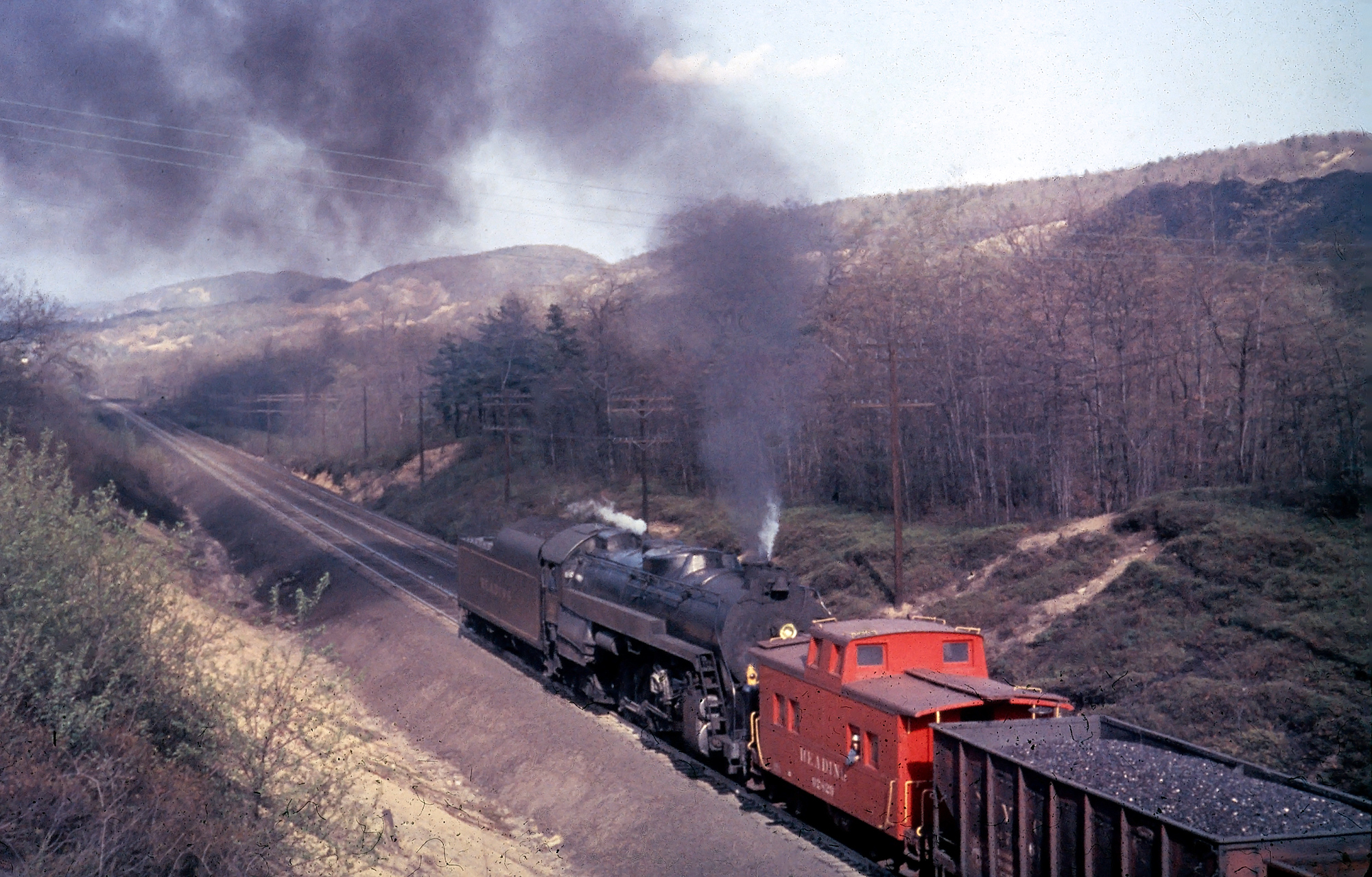
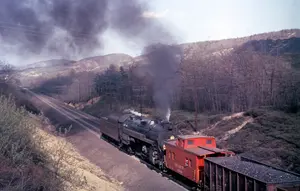
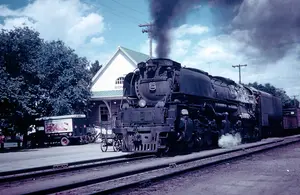
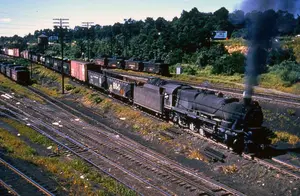
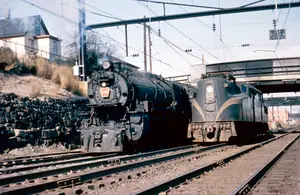
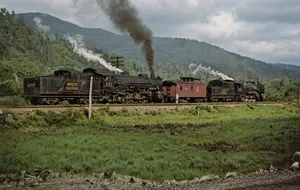
A Reading T-1 4-8-4 assists a westbound coal train past the slag pile at Locust Summit, Pennsylvania, circa 1950. American-Rails.com collection. Thirty of the type, 2100–2129, were built at Reading in 1945–47 on boilers from I-10sa Consolidations.
On this page: At a glance · Wootten and the Camelback · Consolidations · Mikados, Mallets, Santa Fes · T-1 Northerns · Atlantics and Pacifics · Switchers · May 6, 1952, and the Rambles · Roster built since 1900
At a glance
| Item | Detail |
|---|---|
| Railroad | Reading Company. Mark RDG. Company Reading |
| This roster | Engines built since 1900, after Drury, pages 277–278. Pre-1900 power is in the narrative |
| Fuel and cabs | Anthracite culm in a Wootten firebox, often mixed with bituminous. Camelbacks well into the twentieth century, then a turn to rear cabs on the heavy power |
| Freight engine | The Consolidation. I-8a Camelbacks, 117 of them, were the most numerous class. I-10sa engines of 1923 and 1925 were the largest 2-8-0s, and thirty of their boilers became 4-8-4s |
| Helpers | 31 N-1 2-8-8-2s, 1917–19, for the grades northwest of Reading. Eleven became 2-10-2s. The other twenty became 2-8-8-0s |
| T-1 | 30 4-8-4s, 2100–2129, Reading Shops, 1945–47. 70-inch drivers, 94.5 square feet of grate |
| Pacifics | G-1sa, G-1sb, G-2sa, and ten G-3s in 1948, the last steam the company built. 117 and 118 streamlined in 1937 for the Crusader |
| Last steam | Scheduled passenger May 6, 1952, Pacific 134, Newtown to Philadelphia. T-1s on Reading freight for the last time in the spring of 1956. Rambles through October 17, 1964 |
| Shops | Reading, Pennsylvania. New road power came from Baldwin or from those shops |
Class table follows Drury, Guide to North American Steam Locomotives (revised edition), pages 277–278. Information compiled September 24, 2026.
A wide fire, and a cab in the middle
Anthracite does not burn like soft coal. It needs a thin, hot fire over a large grate, and the only grate that worked on culm was a wide one. Wootten’s 1877 firebox became the Reading standard. The mix of hard coal and bituminous changed with the route, the job, and the season. The firebox stayed wide. A wide firebox over the drivers left no room for a cab in the usual place, so the engineer sat astride the boiler in a Camelback and the fireman stayed back on the deck. Later classes, once trailing trucks carried the firebox behind the drivers, could use an ordinary cab and still keep the Wootten grate. The I-10sa and the T-1 are that second generation.
The 1900 classification is why the table looks the way it does. Nineteenth-century Americans, Ten-Wheelers, and the early Consolidations were renumbered into it or left behind. Drury’s grid starts at 1900. The engines below that line are here only when a twentieth-century class was rebuilt from them.
Three times as many Consolidations as everything else
Drury’s count is the shape of the fleet: about three times as many 2-8-0s as all the other freight types together. The I-7s, built 1898–1903, were rear-cab engines with 56-inch drivers and a narrower firebox, ordered that way because other customers wanted the anthracite. Some of them were later rebuilt as Camelbacks and given the vacated class I-6. Baldwin then built the light I-2 Consolidations, 50-inch drivers and about 154,000 pounds, to replace I-1s that dated from the early 1880s. The I-2e and I-2f engines in the table, 53 of them from Reading Shops in 1906–10, are that lightweight group. The numbers 701–802 include gaps.
The I-8a was the great class: 117 Camelbacks, Baldwin and Reading, 1905–14, 61½-inch drivers, about 226,000 pounds. They outweighed the I-6s and I-7s by 25 to 30 tons. The I-9s of 1918–21 stepped up again, to about 285,000 pounds, 25-by-32-inch cylinders, 55½-inch drivers, and 64,300 pounds of tractive force. Drury’s comparison is with a government design: heavier than a USRA light Mikado, and able to pull more than a USRA heavy Mike. Engines 1670–1699, inside the I-9 series, were ordered by the USRA in 1919 and built to Reading specifications. The class I-9sb in the table is a later group, 1900–1924, built in 1922.
The I-10sa was the end of the Consolidation on this railroad. Fifty engines, Baldwin, 1923 and 1925: 27-by-32-inch cylinders, 61½-inch drivers, 322,690 pounds, 71,000 pounds of tractive force. That put them in the same league as a USRA heavy Mike, with a tractive force about halfway between the USRA light and heavy 2-10-2. Thirty of them, 2020–2049, gave up their boilers to the T-1 program. Numbers 2000–2019 stayed 2-8-0s.
Mikados, four Russian Decapods, and the pushers
Fast freight before the T-1 was a Mikado. Baldwin and Reading Shops built 57 M-1sa 2-8-2s in 1912–17: 61½-inch drivers, 24-by-32-inch cylinders, 334,425 pounds. Acquired in the same years were 31 N-1 Mallets, Baldwin 2-8-8-2s of 1917–19, and they were pushers. The grades northwest of Reading, on the way toward the Catawissa line and Locust Summit, were their railroad. They were too slow for the main line.
Between 1927 and 1944 the company broke the class up. Eleven engines, 1800–1810, were rebuilt at Reading into K-1sa 2-10-2s, numbers 3000–3010, between 1927 and 1939. The other twenty, 1811–1830, were simplified and then lost their trailing trucks, which made them 2-8-8-0s. In 1931 Baldwin built ten new 2-10-2s, K-1sb 3011–3020, slightly larger than the rebuilds: 61½-inch drivers, 30½-by-32-inch cylinders, 451,000 pounds, 92,570 pounds of tractive effort. Drury calls them the largest Santa Fe type built. At the other end of the ten-coupled range, four Russian Decapods, J-1sa 1126–1129, Baldwin 1917–18, had short lives and were scrapped in 1935.
Boilers that became Northerns
Between 1945 and 1947 the Reading Shops built thirty 4-8-4s, class T-1, numbers 2100–2129, on the boilers of I-10sa Consolidations 2020–2049. The rear of the boiler, and the 94.5 square feet of grate, stayed Consolidation. The boiler was lengthened at the front and set on new running gear with 70-inch drivers. They were freight engines. Diesels took the regular assignments. The company stored the 4-8-4s in serviceable condition, used them for the last time on its own freight in the spring of 1956, and leased several to the Pennsylvania that fall for a traffic peak. Between 1957 and 1960 it scrapped 25 of them.
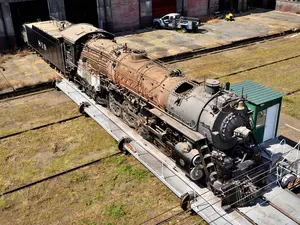
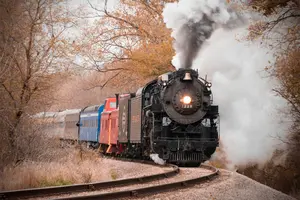
Five were left, for standby and for the excursions. Four survive: 2100, 2101, 2102, and 2124. All four worked the Rambles. No. 2102 runs again on the Reading & Northern. The excursion story, trip by trip, is the Iron Horse Rambles page. The wheel arrangement is the 4-8-4.
From the Atlantic City flyers to the G-3
Camelback 4-4-0s gave way to Camelback 4-4-2s. Drivers ran from 74 inches on the low-wheeled Atlantics to 86 inches on the engines that worked the Atlantic City Railroad between Camden and the shore. The speed run of July 20, 1904, 55.5 miles in 43 minutes, was P-4c No. 334, one of 330–339. That record, and the seashore railroad it was made on, belong to the Pennsylvania-Reading Seashore Lines page. The engine was Reading.
The railroad settled on the Atlantic after trials of high-drivered 2-4-2s and 4-2-2s. The two-wheel lead truck was judged too light for the speed, and the singles carried too little weight on the drivers. Two of those singles, rebuilt, appear in the table as D-10a 378 and D-10b 385. In 1915 the shops built four 4-4-4s, class C-1a, numbers 110–113. Drury credits them as the first American locomotives with four-wheel trailing trucks. The trailing truck matched the lead truck: 36-inch spoked wheels straddling the ashpan hoppers. A four-point suspension failed. In 1916 the four engines were rebuilt into Atlantics, P-7sa 350–353.
Between 1909 and 1911 the shops also built six experimental passenger engines as a controlled test. Atlantics 300 and 303 and Ten-Wheeler 675 had three cylinders. Atlantics 301 and 302 and Ten-Wheeler 676 had two, and were the comparison. Within a few years the three-cylinder engines were rebuilt with two. The 80-inch Atlantics and the 74-inch Ten-Wheelers are P-6 and L-10 in the table. Ten-Wheeler 675 is the three-cylinder L-10a. Camelback Ten-Wheelers did the local passenger work after larger power took the fast trains, and five L-5a engines, 593–597, went to the Jersey Central.
The Pacific arrived in 1916. Drury’s text credits Reading Shops with the first five, 105–109. His table lists the whole G-1sa block, 105–129, as Baldwin, 1916–23. Five more 4-6-2s came in each year through 1926 except 1920 and 1922: G-1sa 130–134 in 1924, G-1sb 200–204 in 1925, and the 74-inch-drivered G-2sa 175–179 in 1926. The others had 80-inch drivers and 25-by-28-inch cylinders. Weights ran from 273,600 to 305,360 pounds. In 1937 the shops streamlined G-1sa 117 and 118 for the Budd Crusader. Engines 108 and 178 received a similar treatment about the same time.
The last steam the company built was also a Pacific. Ten G-3s, 210–219, came out of Reading Shops in 1948 on the 1916 design, modernized with cast trailing trucks, disk main drivers, and feedwater heaters, at 329,450 pounds. G-3 No. 211 was still in showroom paint at Jersey City on May 1, 1948, the week it was new. They were the last new passenger power, and they outlasted the Crusader’s steam assignments on the Pennsylvania-Reading Seashore Lines’ summer peaks into 1955.
Docks, sharp curves, and one engine at Strasburg
The twentieth-century switcher fleet was still mostly Camelback. Fifty-seven Camelback 0-4-0s, classes A-4a and A-5a, worked the tight industrial track and the waterfront. The newest, the A-5a, weighed 110,450 pounds. One of the older engines, A-4a 1187, survives as Strasburg Rail Road No. 4.
The most numerous Camelback 0-6-0 was the B-7a, 36 engines, slide valves, 55-inch drivers, 162,000 pounds. The B-8a put 50-inch drivers on a 108-inch wheelbase so it could go where an 0-4-0 could go. The five B-6a engines were the oddities in the group: rear cab, narrow firebox, 124,900 pounds, the sort of six-wheel switcher any other railroad would have recognized. The twenty B-9a engines were the only superheated switchers, rear-cab Wootten engines with piston valves. The E-3a 0-8-0s were Camelbacks rebuilt in 1905 from Vauclain compound 2-8-0s of 1892–96, light enough for branch rail. The E-5sa 0-8-0s of 1924–25 were the heavy end: rear cab, superheated, 280,000 pounds.
Suburban tanks close the odd-wheel list. Ten Q-1 2-6-4Ts, Baldwin 1903–04, numbers 376–385, worked the Philadelphia locals until the wires and the multiple-unit cars made them unnecessary. They were gone between 1930 and 1936. One 0-6-0T, B-4a 1251, was a Reading product of 1918.
The last fire, and then the excursions
By the spring of 1952 the freight railroad was dieselized except for traffic peaks. The last scheduled passenger train with a steam locomotive ran on May 6, 1952, from Newtown to Philadelphia behind G-1sa Pacific 134. G-3s kept showing up on seashore peaks for another three summers. The T-1s’ last Reading freight was in the spring of 1956. The Iron Horse Rambles began on October 25, 1959, behind 2124, and the last official Ramble ran on October 17, 1964.
Reading steam locomotives built since 1900
Rows and figures follow Drury’s table. Camelback, rebuild, and preservation notes are from his chapter. A blank retirement cell is blank in Drury’s table.
| Type | Class | Numbers | Qty | Builder | Built | Retired | Notes |
|---|---|---|---|---|---|---|---|
| 0-4-0 | A-4a | 1187–1200 | 14 | Baldwin | 1902–1903 | 1935– | Camelback. 1187 survives as Strasburg No. 4 |
| 0-4-0 | A-4a | 1246–1250 | 5 | Baldwin | 1902 | 1935– | Camelback |
| 0-4-0 | A-5a | 1147–1184 | 38 | Baldwin, Reading | 1906–1913 | 1929– | Camelback. 110,450 lb |
| 0-6-0T | B-4a | 1251 | 1 | Reading | 1918 | — | |
| 0-6-0 | B-6a | 1311–1315 | 5 | Baldwin | 1903 | 1929– | Rear cab, narrow firebox, 124,900 lb |
| 0-6-0 | B-7a | 1321–1356 | 36 | Baldwin, Reading | 1906–1913 | 1929– | Camelback. 55-in drivers, 162,000 lb |
| 0-6-0 | B-8a | 1316–1318 | 3 | Baldwin | 1907 | — | Camelback. 50-in drivers, 108-in wheelbase |
| 0-6-0 | B-8b | 1393–1399 | 7 | Reading | 1913, 1921 | — | Camelback |
| 0-6-0 | B-9a | 1451–1470 | 20 | Reading | 1917–1918 | — | Rear cab, Wootten, piston valves. Only superheated switchers |
| 0-8-0 | E-3a | 1400–1409 | 10 | Baldwin | 1905 | 1937– | Camelback. Rebuilt from Vauclain compound 2-8-0s of 1892–1896 |
| 0-8-0 | E-5sa | 1490–1499 | 10 | Baldwin | 1924–1925 | — | Rear cab, superheated, 280,000 lb |
| 2-6-4T | Q-1 | 376–385 | 10 | Baldwin | 1903–1904 | 1930–1936 | Philadelphia suburban tanks |
| 2-8-0 | I-2e, I-2f | 701–802 | 53 | Reading | 1906–1910 | 1923–1940 | Not sequential. Light 50-in-driver engines, about 154,000 lb |
| 2-8-0 | I-7a, b, c | 961–1020 | 60 | Baldwin | 1898–1900 | 1923– | Rear cab, 56-in drivers. Some later rebuilt to Camelback I-6s |
| 2-8-0 | I-7c, d | 1023–1097 | 75 | Baldwin | 1901–1903 | 1926– | Rear cab as built |
| 2-8-0 | I-6a, b, c | 1101–1125 | 25 | Baldwin | 1905, 1907 | 1935–1941 | Camelback. Rebuilt from I-7s |
| 2-8-0 | I-8a | 1501–1617 | 117 | Baldwin, Reading | 1905–1914 | 1937–1945 | Camelback. Most numerous Consolidation. 61½-in drivers, about 226,000 lb |
| 2-8-0 | I-9s, b | 1625–1699 | 75 | Baldwin | 1918–1921 | — | About 285,000 lb, 64,300 lb tractive force. 1670–1699 ordered by the USRA, built 1919 to Reading specs |
| 2-8-0 | I-9sb | 1900–1924 | 25 | Baldwin | 1922 | — | |
| 2-8-0 | I-10sa | 2000–2049 | 50 | Baldwin | 1923, 1925 | — | 27×32, 61½-in drivers, 322,690 lb, 71,000 lb tractive force. 2020–2049 rebuilt as T-1 4-8-4s, 1945–47 |
| 2-8-2 | M-1sa | 1700–1756 | 57 | Reading, Baldwin | 1912–1917 | — | 61½-in drivers, 24×32, 334,425 lb |
| 2-10-0 | J-1sa | 1126–1129 | 4 | Baldwin | 1917–1918 | 1935 | Russian Decapods |
| 2-10-2 | K-1sa | 3000–3010 | 11 | Reading | 1927–1939 | — | Rebuilt from N-1 2-8-8-2s 1800–1810 |
| 2-10-2 | K-1sb | 3011–3020 | 10 | Baldwin | 1931 | — | New engines. 61½-in drivers, 30½×32, 451,000 lb, 92,570 lb tractive effort |
| 2-8-8-2 | N-1sa, c | 1800–1810 | 11 | Baldwin | 1917–1918 | — | Pushers. Rebuilt to K-1sa 2-10-2s |
| 2-8-8-2 | N-1sb, c | 1811–1830 | 20 | Baldwin | 1918–1919 | — | Pushers. Simplified, then rebuilt to 2-8-8-0s |
| 4-4-0 | D-5f | 260–279 | 20 | Baldwin | 1901–1902 | 1928–1936 | Camelback |
| 4-4-0 | D-5h | 280–294 | 15 | Baldwin | 1906 | 1925–1940 | Camelback |
| 4-4-0 | D-8b | 242–246, 250 | 6 | Reading | 1903, 1907 | 1922–1934 | Camelback |
| 4-4-0 | D-8c | 400–409 | 10 | Reading | 1911 | 1932–1940 | Camelback |
| 4-4-0 | D-10a | 378 | 1 | Reading | 1904 | 1930 | Camelback. Rebuilt from a 4-2-2 |
| 4-4-0 | D-10b | 385 | 1 | Reading | 1905 | 1933 | Camelback. Rebuilt from a 4-2-2 |
| 4-4-0 | D-11s | 410–419 | 10 | Baldwin | 1914 | 1941–1945 | |
| 4-4-0 | — | 100 | 1 | Baldwin | 1902 | 1925 | Renumbered 102 in 1912 |
| 4-4-0 | — | 103 | 1 | Reading | 1903 | 1912 | |
| 4-4-2 | P-1c | 318–321 | 4 | Baldwin | 1900 | 1930, 1933 | Camelback |
| 4-4-2 | P-2a | 304–310 | 7 | Reading | 1907–1911 | 1934–1936 | Camelback |
| 4-4-2 | P-2a | 315–317 | 3 | Reading | 1907–1911 | 1923–1934 | Camelback |
| 4-4-2 | P-3a | 322–327 | 6 | Baldwin | 1900 | 1930, 1933 | Camelback |
| 4-4-2 | P-3b | 329 | 1 | Baldwin | 1902 | 1933 | Camelback |
| 4-4-2 | P-4a | 328 | 1 | Baldwin | 1902 | 1933 | Camelback |
| 4-4-2 | P-4b, c | 330–339 | 10 | Baldwin | 1903–1904 | 1933–1935 | Camelback. 334 made the July 20, 1904 Atlantic City run |
| 4-4-2 | P-5 | 340–349 | 10 | Reading | 1906 | 1944– | Camelback |
| 4-4-2 | P-6a | 300, 303 | 2 | Reading | 1909, 1911 | — | Three cylinders, 80-in drivers. Later rebuilt to two cylinders |
| 4-4-2 | P-6b | 301, 302 | 2 | Reading | 1911 | — | Camelback. Two-cylinder comparison engines for 300 and 303 |
| 4-4-2 | P-7sa | 350–353 | 4 | Reading | 1916 | — | Rebuilt from C-1a 4-4-4s 110–113 |
| 4-4-2 | — | 100 | 1 | Reading | 1913 | 1929 | |
| 4-4-4 | C-1a | 110–113 | 4 | Reading | 1915 | 1916 | Rebuilt to P-7sa Atlantics in 1916. Four-wheel trailing truck |
| 4-6-0 | F-2d | 29 / 1025 | 1 | Reading | 1903 | 1916 | |
| 4-6-0 | L-4b | 571–580 | 10 | Baldwin | 1900 | 1928– | |
| 4-6-0 | L-5a | 587–601 | 15 | Baldwin | 1902–1903 | — | Camelback. 593–597 to the Jersey Central |
| 4-6-0 | L-6b | 299 | 1 | Reading | 1905 | 1927 | |
| 4-6-0 | L-7a | 602–615 | 14 | Baldwin, Reading | 1905, 1910 | 1936– | Camelback |
| 4-6-0 | L-8a | 691–700 | 10 | Baldwin | 1906 | — | Camelback |
| 4-6-0 | L-8b | 650–654 | 5 | Reading | 1911 | 1944– | Camelback |
| 4-6-0 | L-10a | 675 | 1 | Reading | 1911 | — | Camelback. Three cylinders, 74-in drivers. Later two cylinders |
| 4-6-0 | L-10b | 676 | 1 | Reading | 1911 | — | Camelback. Two-cylinder comparison engine for 675 |
| 4-6-2 | G-1sa | 105–129 | 30 | Baldwin | 1916–1923 | — | Drury’s text credits Reading Shops with 105–109 in 1916. 80-in drivers. 117 and 118 streamlined in 1937 for the Crusader. 134 hauled the last scheduled steam passenger train, May 6, 1952 |
| 4-6-2 | G-1sa | 130–134 | 5 | Baldwin | 1924 | — | 80-in drivers |
| 4-6-2 | G-1sb | 200–204 | 5 | Baldwin | 1925 | — | 80-in drivers |
| 4-6-2 | G-2sa | 175–179 | 5 | Baldwin | 1926 | — | 74-in drivers. 178 also streamlined |
| 4-6-2 | G-3 | 210–219 | 10 | Reading | 1948 | — | Last steam Reading built. 329,450 lb. PRSL passenger peaks into 1955 |
| 4-8-4 | T-1 | 2100–2129 | 30 | Reading | 1945–1947 | 1957– | Boilers from I-10sa 2020–2049. 70-in drivers, 94.5 sq ft grate. 2100, 2101, 2102, and 2124 survive. Photo: Locust Summit |
Related reading
- Reading · Diesel roster
- Iron Horse Rambles · Crusader · Camelbacks
- 4-8-4 type · Pacific type · Pennsylvania-Reading Seashore Lines
- Jersey Central steam · Lehigh Valley steam · Reading & Northern
Sources
- George H. Drury, Guide to North American Steam Locomotives, revised edition, pp. 275–278. Class table transcribed from the author’s copy of the chapter.
- Drury on the last scheduled steam passenger train: Pacific 134, May 6, 1952, Newtown to Philadelphia. T-1 freight use through the spring of 1956, and the PRR lease that fall, are his account.
- Iron Horse Rambles dates, October 25, 1959 through October 17, 1964, and the four surviving T-1s, follow this site’s Rambles page. Drury’s chapter ends the excursions in 1963 and counts three survivors.
- July 20, 1904: P-4c No. 334, as corrected on this site’s Pennsylvania-Reading Seashore Lines page.
- Drury’s own further roster reference is Bert Pennypacker, Reading Power Pictorial (1973).
Recent Articles


-
Rail News, The Latest
Sep 24, 26 12:36 PM
This page provides a portal to the latest in rail news, from preservation and restortation subjects to other notable topics. -
Cotton Belt 819 Moved Outside at Pine Bluff for Evaluation
Sep 24, 26 12:35 PM
 Cotton Belt 819 left the Pine Bluff shop on September 22, 2026, first time outside in about 30 years. RDG Steam Services is evaluating the engine. No donation link posted.
 -
Reading Steam Locomotives: History, Roster & Photos
Sep 24, 26 12:14 PM
 Reading steam—Wootten fireboxes, Camelback Consolidations, Mallets, K-1 Santa Fes, G-3 Pacifics, T-1 4-8-4s. Post-1900 roster after Drury. Rambles ended October 17, 1964.
 -
Reading Diesel Roster: All-Time
Sep 24, 26 12:10 PM
 Reading diesel roster—AGEIR boxcabs, FTs, FA-1s, RS-3s, Train Masters, GP30s through GP39-2s. Serials and order numbers. Conrail April 1, 1976.
 -
Reading Railroad: Map, Logo, History, Rosters
Sep 24, 26 12:08 PM
 Reading Company—Philadelphia & Reading, 1833. Anthracite, Port Richmond, Reading Terminal. Operating company January 1, 1924. Conrail April 1, 1976.
 -
Nevada Dinner Train Rides (2026): A Complete Guide
Sep 24, 26 12:02 PM
 2026 Nevada Northern Taste of Italy—adults-only gala from East Ely. The September 19 date has run. Confirm any later night on nnry.com.
 -
North Carolina Dinner Train Rides (2026): A Complete Guide
Sep 24, 26 11:24 AM
 2026 North Carolina dinner trains—NCTM Wine & Dine in Spencer sold out February 13–15. GSMR First Class is the plated meal on the Nantahala Gorge excursion. Confirm on the railroad.
 -
Railway Express Agency (REA): Signs, Trucks, Logo & History
Sep 24, 26 09:40 AM
 Railway Express Agency—railroad-owned express company. Incorporated December 7, 1928. Operations March 1, 1929. Red diamond, green trucks. Last regular express November 7, 1975.
 -
Michigan Dinner Train Rides (2026): A Complete Guide
Sep 24, 26 09:28 AM
 2026 Steam Railroading Institute dining in Owosso—select evenings, no public dinner dates posted. Confirm on michigansteamtrain.com.
 -
Pittsburgh and West Virginia Railway: Map, Rosters, History
Sep 24, 26 12:24 AM
 Pittsburgh & West Virginia—the Hi-Line. Wabash-Pittsburgh Terminal 1904. Railway January 29, 1917. Connellsville February 11, 1931. N&W lease October 16, 1964. Wheeling & Lake Erie from May 17, 1990.
 -
Indiana Dinner Train Rides (2026): A Complete Guide
Sep 24, 26 12:13 AM
2026 Spirit of Jasper Ride & Dine is paused. No public trains. Depot at 201 Mill Street stays open as a rental. Confirm on spiritofjaspertrain.com. -
New Jersey Dinner Train Rides (2026): A Complete Guide
Sep 24, 26 12:01 AM
2026 Woodstown Central Dining in Motion—private table of four from $190, about an hour, Salem County. Confirm on woodstowncentral.com. -
Maryland Dinner Train Rides (2026): A Complete Guide
Sep 23, 26 05:19 PM
 2026 Western Maryland Scenic Allegheny Mountain Dinner Train—Cumberland, 3 hours, 21+, Saturday 7 p.m. Confirm on wmsr.com.
 -
Pittsburgh and Lake Erie Railroad: Map, Rosters, Photos
Sep 23, 26 03:28 PM
 Pittsburgh & Lake Erie—the Little Giant. Chartered 1875, Pittsburgh to Youngstown February 10, 1879. New York Central from 1883. Independent May 15, 1979. Last day September 11, 1992.
 -
Kansas Dinner Train Rides (2026): A Complete Guide
Sep 23, 26 01:11 PM
 2026 Abilene & Smoky Valley Smoky Valley Limited—two hours from the Rock Island Depot, about $72–$110, dates into December 31. Confirm on asvrr.org.
 -
The Belpaire Firebox: Simplicity and Greater Power
Sep 23, 26 01:03 PM
 Belpaire firebox—Alfred Belpaire, 1864. Square crown, straight staybolts at right angles. Pennsylvania standard after the 1880s. Great Northern was the other big user.
 -
Pennsylvania Railroad (PRR) Electric Roster: All Classes
Sep 23, 26 12:57 PM
Pennsylvania Railroad electrics—DD1s into Penn Station, P5s, 139 GG1s, B1 switchers, and 66 E44s. Class roster, 1905–1963. No unit-by-unit GG1 list. -
Penn Central Diesel Roster: All-Time
Sep 23, 26 12:46 PM
 Penn Central diesel roster—PRR classes on NYC, PRR, and New Haven power. New orders carry serials. GP38-2s are 7940-8162. Conrail April 1, 1976.
 -
Penn Central Railroad: Map, History, Logo
Sep 23, 26 12:32 PM
 Penn Central—Pennsylvania and New York Central merged February 1, 1968. New Haven January 1, 1969. Section 77 bankruptcy June 21, 1970. Conrail April 1, 1976.
 -
Iowa Dinner Train Rides (2026): A Complete Guide
Sep 23, 26 11:42 AM
 2026 Boone & Scenic Valley Wolf Dinner Train—Saturdays May–October, Union Pacific dining cars, Bass Point Creek High Bridge. Confirm on bsvrr.com.
 -
Pennsylvania-Reading Seashore Lines: Map, Roster, History
Sep 23, 26 12:32 AM
 Pennsylvania-Reading Seashore Lines—Atlantic City Railroad renamed July 15, 1933. Pennsylvania two-thirds, Reading one-third. Camden to Atlantic City, Cape May, and Millville. Conrail April 1, 1976.
 -
Wisconsin Dinner Train Rides (2026): A Complete Guide
Sep 23, 26 12:28 AM
2026 Wisconsin Great Northern dinner train in Trego—$105, Namekagon River, January 8–31 and May 5–December 17. Mid-Continent’s remaining 2026 calendar is snack and scenic. Confirm on the railroad. -
New Hampshire Dinner Train Rides (2026): A Complete Guide
Sep 23, 26 12:21 AM
2026 Cafe Lafayette Dinner Train in North Woodstock—five courses, 2 hours, from $125. Children under 6 not allowed. Confirm on nhdinnertrain.com. -
PRR "GG-1" Locomotives: Roster, Photos, Specs
Sep 23, 26 12:13 AM
 PRR GG1 electric: 139 locomotives, 4800–4938, built 1934–1943. Specs, Loewy shell, Amtrak numbers, and the last revenue trip on October 28, 1983.
 -
Montana Dinner Train Rides (2026): A Complete Guide
Sep 23, 26 12:04 AM
2026 Charlie Russell Chew Choo from Hanover, near Lewistown—4.5 hours, prime rib, adult $151. Remaining listed dates sold out. Confirm on montanadinnertrain.com. -
Kentucky Dinner Train Rides (2026): A Complete Guide
Sep 22, 26 11:52 PM
2026 My Old Kentucky Dinner Train in Bardstown—four courses, 2.5 hours, adult $116. Confirm on kydinnertrain.com. -
Tennessee Dinner Train Rides (2026): A Complete Guide
Sep 22, 26 11:45 PM
2026 TVRM Chattanooga Dinner Train—Grand Junction, select Fri/Sat March 6–October 24, 6 p.m., from $110. Confirm on tvrail.com. -
The Trainphone: PRR's Wireless Radio System
Sep 22, 26 11:17 PM
 Pennsylvania Trainphone—Union Switch & Signal inductive telephone. Bel-Del trial 1941, Frenchtown November 29, 1943. Carriers at 88 kHz and 144 kHz. Out of service April 30, 1967.
 -
Pennsylvania (PRR) Steam Roster: Post 1906
Sep 22, 26 11:13 PM
 ennsylvania steam after 1906—H8, H9, and H10 Consolidations, 574 L1s Mikados, 598 I1s Decapods, 425 K4s Pacifics, 301 M1 Mountains. Drury’s grid. Last steam November 30, 1957.
 -
Pennsylvania Railroad (PRR) Diesel Roster: All-Time List
Sep 22, 26 10:59 PM
 Pennsylvania diesel roster—SW 3908 in June 1937, then Alco, Baldwin, EMD, Fairbanks-Morse, GE, and Lima. Serials and Alco order numbers. Penn Central February 1, 1968.
 -
Pennsylvania Railroad: Map, Logo, History, Rosters
Sep 22, 26 10:02 PM
 Pennsylvania Railroad—chartered April 13, 1846, Harrisburg–Pittsburgh, Horseshoe Curve 1854, Penn Station 1910. Standard Railroad of the World. Penn Central February 1, 1968.
 -
Pennsylvania Dinner Train Rides (2026): A Complete Guide
Sep 22, 26 04:48 PM
 2026 Pennsylvania dinner trains—Colebrookdale Dining Class in Boyertown and Strasburg Dinner on the Rails. Confirm on each railroad.
 -
New York, Ontario & Western Steam Locomotives: History & Roster
Sep 22, 26 04:40 PM
 NYO&W steam—camelback 2-8-0s and 2-6-0s, Class X Bull Moose 2-10-2s, Class Y and Y-2 Mountains. All-time class roster. Steam finished in the summer of 1948. None saved.
 -
New York, Ontario & Western Diesel Roster: All-Time
Sep 22, 26 04:36 PM
 NYO&W diesel—five GE 44-tonners 101-105, eighteen FTs, seven F3s, twenty-one NW2s. Serials and the NW2 order E824. Railroad liquidated March 29 1957.
 -
New York, Ontario & Western Railway: Map, Roster, History
Sep 22, 26 04:26 PM
 New York, Ontario & Western—New York & Oswego Midland chartered January 11 1866, O&W January 21 1880. Scranton coal, West Shore rights. Last train March 29 1957.
 -
Massachusetts Dinner Train Rides (2026): A Complete Guide
Sep 22, 26 04:16 PM
 2026 Cape Cod Dinner Train—Hyannis, Buzzards Bay, and North Falmouth. Four-course, 3–3½ hours, from $99.99. Confirm on capetrain.com.
 -
Colorado Dinner Train Rides (2026): A Complete Guide
Sep 22, 26 03:51 PM
 2026 Royal Gorge Route First Class Dinner and Lunch from Cañon City. About 2 hours, 12+, from $199+. Confirm on royalgorgeroute.com.
 -
New York and Long Branch Railroad: A PRR & CNJ Subsidiary
Sep 22, 26 03:11 PM
 New York & Long Branch—chartered April 8 1868, Perth Amboy–Long Branch July 1 1875, Bay Head Junction 1881. Jersey Central and Pennsylvania trains. Conrail April 1 1976. NJ Transit North Jersey Co…
 -
Monongahela Railway Steam Locomotives: History & Roster
Sep 22, 26 01:34 PM
 Monongahela steam—H-5 Consolidations, USRA light Mikados 170–179, Baldwin L-2s, ex-P&LE L-3s. All-time roster. Last steam May 26, 1954.
 -
Monongahela Railway Diesel Roster: All-Time
Sep 22, 26 01:16 PM
 Monongahela diesel—27 Baldwin S-12s, NYC RF-16 sharks, P&LE GP7s, GP38s 2000–2004, Super 7s 2300–2310. Serials and orders. Last steam May 26, 1954.
 -
Monongahela Railway: Map, Rosters, History
Sep 22, 26 01:14 PM
 Monongahela Railway—incorporated December 31 1900, Railway July 1 1915. Brownsville–Fairmont coal road. Last steam May 26 1954. Conrail May 1 1993.
 -
Virginia Scenic Railway Dining (2026)
Sep 22, 26 01:09 PM
 2026 Virginia Scenic Railway—Blue Ridge Flyer Dining Class from Staunton, about 3 hours, plated meal. Sunday Brunch from Louisa, about $132. Confirm on virginiascenicrailway.com.
 -
Virginia Dinner Train Rides (2026): A Complete Guide
Sep 22, 26 01:03 PM
 2026 Virginia Scenic Railway—Blue Ridge Flyer Dining Class from Staunton, Alleghany Special Dining Class, Sunday Brunch from Louisa. Confirm on virginiascenicrailway.com.
 -
Oregon Dinner Train Rides (2026): A Complete Guide
Sep 22, 26 12:51 PM
 2026 Oregon has no plated dinner train on the calendar. Mount Hood is scenic with snacks. Oregon Coast Scenic’s evening ride is the 21+ Moonlight with sandwiches.
 -
Maine Central Steam Locomotives: History & Roster
Sep 22, 26 12:33 PM
Maine Central steam—Ten-Wheelers, W-class Consolidations, S-class Mikados, C-class Pacifics, Hudsons 701 and 702. Post-1900 roster after Drury. Last steam June 13, 1954. -
Maine Central Diesel Roster: All-Time
Sep 22, 26 12:04 PM
 Maine Central diesel—railcar 901, HH660s, GP7s, E7s, F3s, GP38s, U18Bs, ex-Rock Island U25Bs. All-time roster with serials and orders. Last steam June 13, 1954.
 -
Maine Central Railroad: Map, Logo, Rosters, History
Sep 22, 26 11:36 AM
 Maine Central—Androscoggin & Kennebec and Penobscot & Kennebec, October 28 1862. Pine Tree Route. Mountain Division, Portland–Bangor–Vanceboro. Last steam June 13 1954. Guilford June 1981.
 -
Maryland and Pennsylvania Railroad: Map, Roster, Logo
Sep 22, 26 12:14 AM
 Ma & Pa—Peach Bottom 1868, Maryland & Pennsylvania February 12 1901, Baltimore to York. Last steam November 29 1956. York Railway December 1 1999.
 -
New York Dinner Train Rides (2026): A Complete Guide
Sep 21, 26 11:59 PM
2026 New York dinner train—Adirondack Dinner Train from Utica, 6 p.m., about 3 hours, First Class from $139. Arcade & Attica mystery dinner is served at Curriers. Confirm on the railroad. -
California Dinner Train Rides (2026): A Complete Guide
Sep 21, 26 11:49 PM
 2026 California dinner trains—Napa Valley Wine Train plated meals, River Fox brunch and mystery dinner, Roaring Camp barbecue at camp. Confirm on each railroad.