History of the Locomotive Engineer: Steam Hoggers to PTC-Era Cabs
Last revised: August 12, 2026
By: Adam Burns
The locomotive engineer (hogger, runner, driver in other English dialects) is the person who makes the train move and stop under control. That sentence has been true since the first common-carrier locomotives; almost everything about how the job is learned and performed has changed. Steam demanded a partnership with a fireman and a lifetime of machine-specific feel. Diesels, dynamic brakes, distributed power, and cab signals altered the controls. Positive Train Control and digital displays altered the information environment. The craft remained.
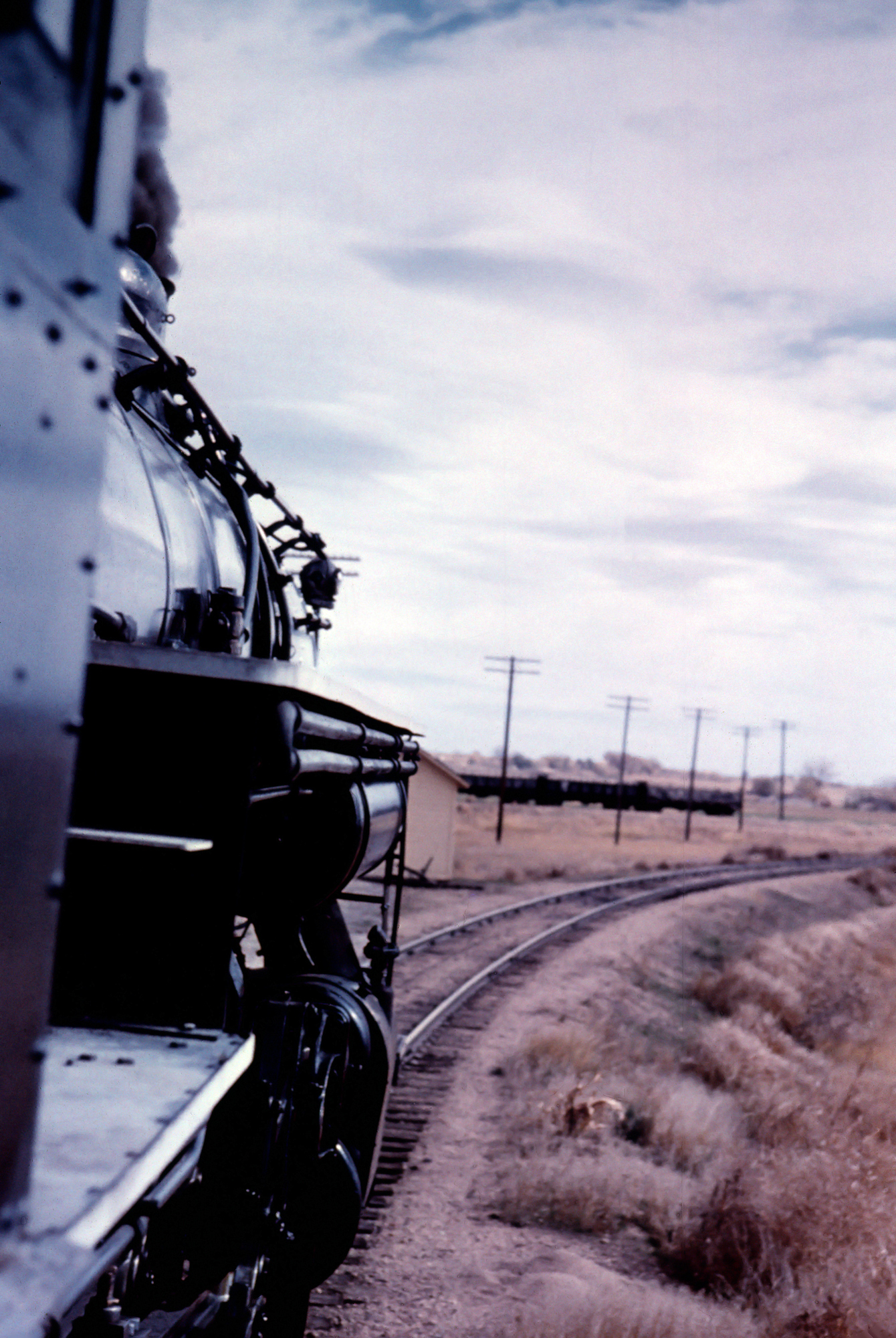
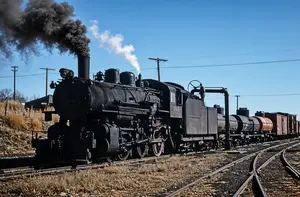
Great Western Railway Of Colorado 2-10-0 #90 in the fall of 1960. The locomotive was still in service at this time hauling sugar beets along the railroad's main line between Longmont, Loveland, and Eaton. Today, it is well known hauling tourists on the Strasburg Railroad in Pennsylvania. A.C. Kalmbach photo. American-Rails.com collection.
Historical essay; for 2026 certification and hiring paths see Locomotive Engineer Jobs (2026).
Steam: Personality in Iron
Nineteenth- and early-twentieth-century engineers worked machines that were never identical. Boilers, valve gears, and drafting quirks gave each locomotive a reputation. Starting a heavy freight without slipping the drivers, holding a steady steam pressure on a grade, and braking a train with only the engineer’s brake valve and hand-brake support from trainmen required muscle memory that no textbook fully captured. Brian Solomon’s craft writing has emphasized how little the purpose of the seat changed even as the hardware did: ease tonnage over a division without breaking drawbars or running away on a descending grade.
Tools were few and eloquent: throttle, reverse (Johnson bar on many engines), independent and automatic brake valves as air systems matured, whistle, and sand. The fireman fed the fire and watched water; the engineer managed the motion and the road. Promotion often ran fireman to engineer under seniority. The cab was loud, hot, and exposed; pride and hazard shared the same seatbox.
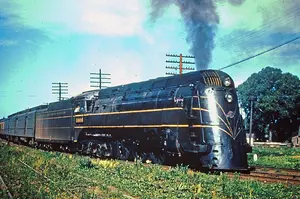
Famous named engines and crack passenger assignments created public celebrities—but most engineers lived in freight pool and extra-board anonymity, measured by on-time performance, fuel reports, and whether they “took care of the train.”
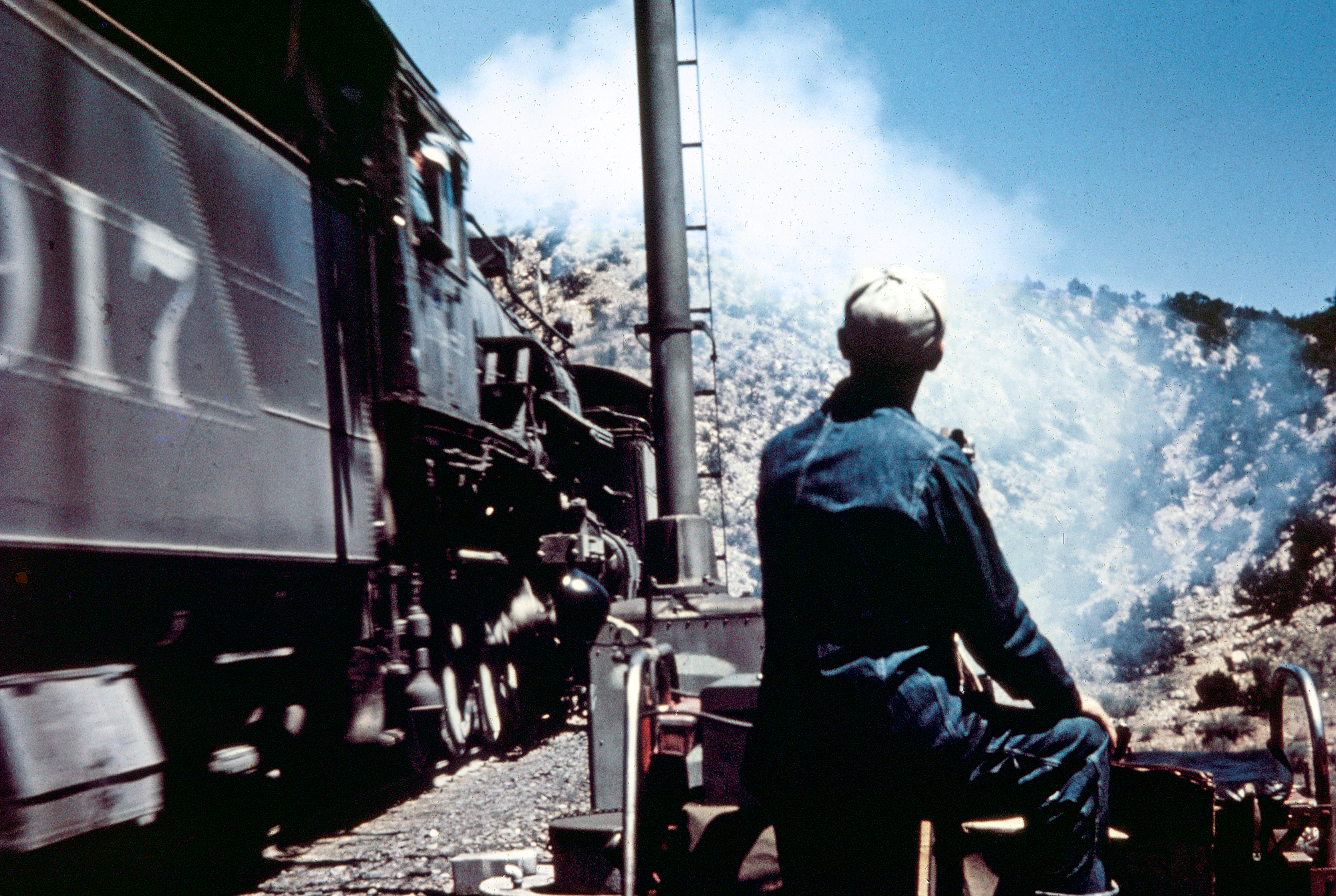
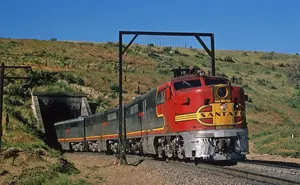
Steam on Glorieta Pass, Santa Fe, circa 1950—grades and tonnage that made train-handling skill non-negotiable. Ed Olsen photo. American-Rails.com collection.
Rules, Timetables, and Shared Authority
Engineers never owned the railroad alone. Timetable superiority, train orders, block signals, and later CTC defined when they could occupy main track. The conductor held commercial and much operational authority over the train’s work; the engineer held the controls. Collisions and runaway investigations repeatedly showed that both seats, plus dispatchers and maintainers, formed a system—not a lone hero narrative.
Whistle signals communicated with trainmen and the public at crossings. Bell, headlight, and later ditch lights became legal and cultural expectations. The engineer’s world was always part machinery, part rule book, part geography memorized in the bones: where the sag was, where leaves greased the rail in autumn, where a certain curve ate slack.
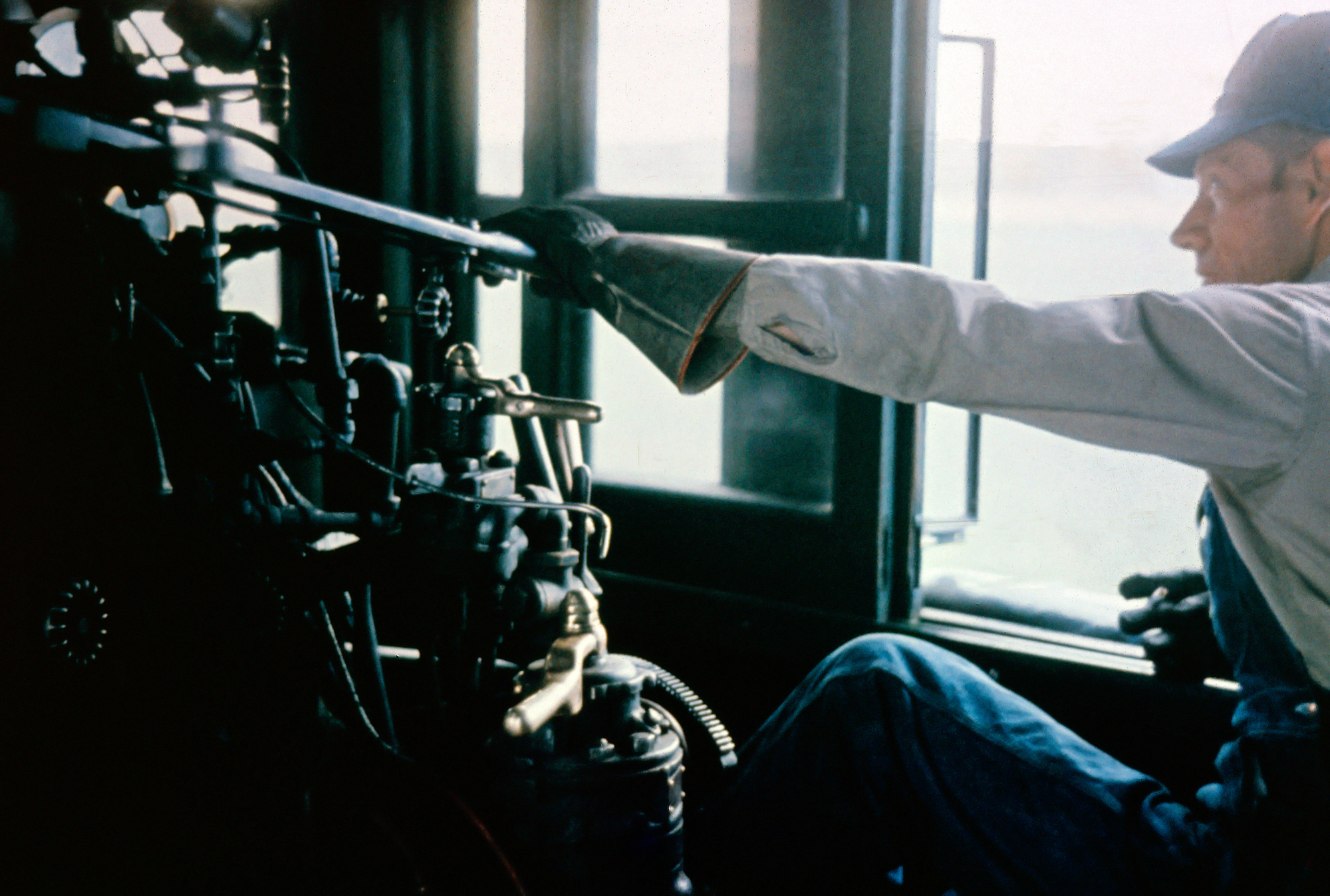
The engineer of Great Western Railway of Colorado 2-10-0 #90 keeps a close eye on his gauges while hauling sugar beets in the fall of 1960. This is an extinct craft in modern railroading but still alive and well at various heritage railroads which operate historic steam locomotives. A.C. Kalmbach photo. American-Rails.com collection.
Dieselization: New Levers, Old Physics
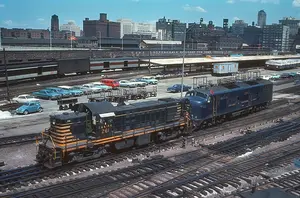
Diesels removed the fireman’s essential combustion work and simplified some mechanical drama, but they did not repeal train dynamics. Multiple-unit consists, transition, dynamic braking, and longer freights created new ways to stall, jackknife slack, or overheat brakes. Transition-era engineers learned both steam and diesel; younger hires after the late 1950s might never oil a steam rod again.
Cab comfort improved unevenly—some early road-switcher cabs were miserable; later wide-nose comfort cabs changed fatigue and climate. Still, the job remained shift work, night work, and away-from-home lodging on pool freights. Seniority still bought the preferred runs.
From Apprenticeship to Formal Certification
For generations, engineers were made on the property: years as fireman or trainman, then a seat under a senior runner’s eye. As steam left and labor agreements changed, the apprenticeship path shifted toward conductor service and company training programs. Federal oversight matured into today’s FRA locomotive engineer certification framework—knowledge, skills, and territory familiarization administered by the railroad, with periodic recertification.
That bureaucratization did not make the job easy; it standardized minimums in an industry that had once accepted terrifying local variation in training quality. Simulators and classroom rules training now precede many first trips, yet physical characteristics of a district still require rides with qualified mentors.
Electronics, Distributed Power, and PTC
Late-twentieth and early-twenty-first-century cabs filled with screens: event recorders, alerters, cab signals, cruise-like speed control on some roads, and distributed power interfaces for mid-train or rear helpers controlled from the lead. Positive Train Control added another enforcement layer—overspeed and unauthorized-movement protection that can intervene when humans err.
Critics sometimes claim electronics “deskilled” the engineer. Working runners rarely agree completely. Automation enforces limits; it does not plan slack action on a undulating profile, negotiate a tricky approach to a stop signal with a heavy train, or handle failures when systems go down. The craft absorbed instruments the way aviation did: more data, same accountability.
Helpers, Distributed Power, and Mountain Railroading
On heavy grades, engineers historically worked with helper crews cut in or pushing at the rear—separate locomotives, separate crews, whistle and radio coordination. Mid-train and remote distributed power later let one engineer control locomotives spaced through the train, changing both physics and labor. Mountain districts (Appalachians, Rockies, Sierras) remained the universities of train handling: where slack action, dynamic brakes, and air management separate adequate runners from respected ones.
Passenger engineers faced different tests: precise station stops, schedule pressure, and dense signal territory. Commuter work trades road freights’ long lodging cycles for intense, repetitive peak-hour precision.
Culture and Myth
American popular culture inflated the engineer into folk hero—Casey Jones, endless children’s books, cab-ride cinema. Real culture was more shop-floor: bottom road, pool turns, investigations after broken knuckles, and quiet pride in a clean stop at the foot of a hill. Engineers’ brotherhoods and later united organizations fought over wages, hours of service, and technology. Hours-of-service law eventually codified rest that earlier eras denied.
Women and broader diversity in engine service are largely late-twentieth and twenty-first-century stories on U.S. freights, after generations of formal and informal exclusion. Heritage steam programs still mint engineers the old way—on live coal and water—keeping steam craft alive outside Class I employment.
What Endures
The engineer remains the person who converts authority and horsepower into a controlled movement of mass. Steam’s personality, diesel’s multiple units, and PTC’s supervision are chapters of one occupation. For career practicalities—conductor-first hiring, pay benchmarks, lifestyle—use the companion jobs page; for the long arc of the seat, this history is the map.
Related Reading
- Engineer jobs (2026) · Jobs hub
- Conductor history · Fireman · Steam locomotives
- Diesel locomotives · Dispatcher history
Sources
- Solomon, Brian. Working on the Railroad and related locomotive craft histories
- Steam and diesel operating practice; train dynamics literature in trade press
- FRA locomotive engineer certification framework (historical development of federal standards)
- Hours of service and labor organization histories in U.S. engine service
- PTC and cab electronics as described in industry safety and AAR/FRA materials
Craft-history series essay, August 2026. Companion career page: engineer.html.
Recent Articles


-
Kansas City Southern Steam Roster (Built Since 1900)
Oct 25, 26 11:50 AM
Steam locomotives of the Kansas City Southern built since 1900, with the Louisiana & Arkansas and the Texas company. -
Kansas City Southern Diesel Roster (Built New)
Oct 25, 26 11:46 AM
 All-time diesel roster of the Kansas City Southern. E units, F units, Geeps, SD40s through SD70ACes, Fairbanks-Morse, Baldwin, Alco, and General Electric, with serials and order numbers.
 -
Kansas City Southern Railway: Map, Photos, History
Oct 25, 26 12:24 AM
 The Kansas City Southern, from Arthur Stilwell's Gulf line to Canadian Pacific Kansas City on April 14, 2023. Steam and diesel rosters, the Southern Belle, and the Louisiana & Arkansas.
 -
Indiana Harbor Belt Diesel Roster (All-Time)
Oct 25, 26 12:17 AM
 All-time diesel roster of the Indiana Harbor Belt. 202 locomotive frames, each counted once. NW2s, SW7s, SW1500s, road switchers, and gensets. Slugs and boosters are outside the count.
 -
Indiana Harbor Belt Steam Roster (Built Since 1900)
Oct 25, 26 12:13 AM
 Steam locomotives of the Indiana Harbor Belt built since 1900. 182 engines, each counted once. 0-6-0s, 2-6-0s, 0-8-0s, and 2-8-2s. The three U-4a switchers are three-cylinder Brooks engines of 1927.
 -
Indiana Harbor Belt Railroad: Map, Rosters, History
Oct 25, 26 12:00 AM
 Indiana Harbor Belt, the inner belt across the Calumet, from the East Chicago Belt of May 16, 1896. Renamed June 29, 1907. Still operating, headquarters Hammond. Steam roster is the companion, 182 loc…
 -
NYC's "P Motor" Electric Locomotives
Oct 24, 26 11:43 PM
 New York Central P motors: 22 Alco-GE 2-C+C-2 electrics, Cleveland Union Terminal 1050–1071, class P-1a. 3,030 hp one-hour on 3,000-volt DC catenary, then 660-volt third rail as P-2a and P-2b.
 -
Illinois Terminal Car Roster
Oct 24, 26 11:40 PM
 Illinois Terminal cars. Mainline motors, the 1948 streamliners, sleepers, Alton and Valley Division cars, express motors, and the line cars rebuilt from pull cars.
 -
Illinois Terminal Diesel Roster
Oct 24, 26 09:31 PM
 All-time Illinois Terminal diesels, 62 frames. Alco S-2s and RS-1s, EMD switchers, GP7s, SD39s, GP38-2s, and the two GP20s. Serial numbers from the 1989 roster.
 -
Illinois Terminal Electric Locomotives
Oct 24, 26 08:22 PM
 Illinois Terminal electric locomotives, 57 frames. Class A through Class D, the Decatur-built motors, and the battery locomotives. Class D is the same five Class C frames, rebuilt.
 -
Illinois Terminal Steam Roster
Oct 24, 26 07:37 PM
 Illinois Terminal steam locomotives, 36 frames. Baldwin Moguls, three Class 30 Mikados, Florida East Coast 0-8-0s, and 2-6-0 No. 21, the last fire on June 30, 1950.
 -
Illinois Terminal Railroad: Map, Roster, Photos, History
Oct 24, 26 07:32 PM
 Illinois Terminal, McKinley's Illinois Traction System, from the Danville coal towns to St. Louis. The McKinley Bridge, the sleeping cars, the 1937 break with the power company, the 1948 streamliners…
 -
Southern Railway Diesel Roster (All-Time)
Oct 23, 26 11:00 PM
 All-time diesel roster of the Southern Railway. 2,505 locomotives in the system number series, from the 1939 demonstrator FT to GP50s and B30-7A1s. Serials included.
 -
Illinois Central Diesel Roster (All-Time)
Oct 23, 26 04:06 PM
 Illinois Central and Illinois Central Gulf diesel locomotives, each frame once. The quantity column is 886. Serials and order numbers from Electro-Motive's builder lists. Paducah rebuilds and Gulf, Mo…
 -
Illinois Central Gulf Diesel Roster
Oct 23, 26 04:02 PM
 Illinois Central Gulf operating numbers from August 10, 1972, to February 29, 1988. New frames stay on the Illinois Central diesel roster. Gulf, Mobile and Ohio frames stay on that roster. No Gulf fle…
 -
Illinois Central Railroad: Map, Logo, History
Oct 23, 26 03:50 PM
Illinois Central, the Main Line of Mid-America, from the 1850 land grant to Canadian National control on July 1, 1999. Charter lines, Cairo bridge, Paducah, and the Illinois Central Gulf. Steam quanti… -
Grand Trunk Western Diesel Roster (All-Time)
Oct 23, 26 12:53 PM
 Grand Trunk Western diesel locomotives, each frame once. The quantity column is 377. Serials are filled for the Detroit, Toledo and Ironton and Detroit and Toledo Shore Line engines the railroad kept…
 -
Grand Trunk Western Steam Roster
Oct 23, 26 12:14 PM
 Grand Trunk Western steam locomotives in service about 1937 to 1942, from Richard Leonard's class list. Drury has no chapter. The quantity column is the counted Grand Trunk Western rows. Two mixed Gra…
 -
Grand Trunk Western Railroad: Map, Roster, History
Oct 23, 26 12:09 PM
 Grand Trunk Western, reporting mark GTW, Canadian National's railroad between Port Huron and Chicago. Trade name adopted in 1923. Steam class list quantity 232. Diesel quantity column 377. Identity in…
 -
Green Bay and Western Railroad: Map, Rosters, History
Oct 22, 26 11:18 PM
 Green Bay & Western, the Green Bay Route, reporting mark GBW. From Kewaunee to Winona. Mailer's steam and diesel rosters, and the August 1993 sale to Fox Valley & Western.
 -
Chicago & North Western Class E-4: Streamlined 4-6-4 Hudsons
Oct 22, 26 10:28 PM
 C&NW Class E-4, nine streamlined 4-6-4s, 4001–4009, Alco 1938. 84-inch drivers, 25-by-29 cylinders, 300 psi. Conventional Chicago–Omaha trains. Oil in 1947–48. Retired 1953–1956.
 -
Gateway Western Railway: Map, Roster, History
Oct 22, 26 02:43 PM
 Gateway Western Railway, reporting mark GWWR. Class II from Kansas City to East St. Louis. Kansas City Southern control May 5, 1997. The 1992 diesel fleet, with serials and order numbers.
 -
Duluth, Winnipeg & Pacific Railway: Roster, Map, History
Oct 22, 26 01:51 PM
 Duluth, Winnipeg & Pacific, the Peg, reporting mark DWP. From the Rainy River to Duluth. CNRHA steam list 36. Fifteen RS-11s. Merged into Wisconsin Central Ltd. on December 31, 2011.
 -
Elgin, Joliet and Eastern Diesel Roster (All-Time)
Oct 22, 26 01:35 PM
 All-time diesel roster of the Elgin, Joliet and Eastern.
 -
Elgin, Joliet and Eastern Steam Roster
Oct 22, 26 01:25 PM
 Elgin, Joliet and Eastern steam locomotives of the final decade, which largely comprised switcher types, 2-8-0s, and a large fleet of Mikados.
 -
Elgin, Joliet and Eastern Railway: Map, Roster, History
Oct 22, 26 12:32 PM
 Elgin, Joliet & Eastern, the outer arc around Chicago, from the Joliet, Aurora & Northern of April 30, 1884. Illinois company March 18, 1887. Merged December 4, 1888. Principal lines sold Janu…
 -
Denver and Salt Lake Railway: History, Roster, Timetable
Oct 22, 26 09:47 AM
 Denver & Salt Lake, the Moffat Road, from Denver to Craig. Tunnel opened February 26, 1928. Dotsero Cutoff dedicated June 16, 1934. Merged April 11, 1947. Steam locomotives 59.
 -
Duluth, Missabe and Iron Range Diesel Roster (All-Time)
Oct 22, 26 09:43 AM
 All-time diesel roster of the Duluth, Missabe and Iron Range. 148 owned frames, each counted once. SW9s, SD9s, SD18s, SD38s, RSD-15s, and C630s. Serials and builder order numbers included. Helm SD40-3…
 -
Duluth, Missabe and Iron Range Steam Locomotives (Since 1900)
Oct 22, 26 09:22 AM
 Duluth, Missabe & Iron Range steam locomotives built since 1900. Duluth & Iron Range, Duluth, Missabe & Northern, and later DM&IR acquisitions. Quantity column 252. Yellowstones 220-23…
 -
Duluth, Missabe and Iron Range Railway: Roster, Map, Logo
Oct 22, 26 09:17 AM
Duluth, Missabe & Iron Range, reporting mark DMIR, from the Mesabi and the Vermilion to the Lake Superior docks. Formed July 1, 1937. Steam quantity 252. Owned diesels 148. On paper through Decemb… -
Duluth, South Shore, and Atlantic Railway: Map, Roster, Timetables
Oct 21, 26 11:21 PM
 Duluth, South Shore & Atlantic Railway, the South Shore. Marquette to the Sault, St. Ignace, Houghton, and Duluth-Superior. Soo Line on January 1, 1961. Twenty-four diesels.
 -
Detroit, Toledo and Ironton Diesel Roster (All-Time)
Oct 21, 26 02:55 PM
 All-time diesel roster of the Detroit, Toledo and Ironton. 119 frames, each counted once. Serials and builder order numbers included. Last steam was December 24, 1955.
 -
Detroit, Toledo and Ironton Steam Roster (Post 1900)
Oct 21, 26 02:49 PM
 Detroit, Toledo and Ironton steam locomotives built after 1900. Drury's class grid. The quantity column prints 141. Counted once, the frames are 137. Last steam was Mikado 805 on December 24, 1955.
 -
Detroit, Toledo and Ironton Railroad: Map, Roster, History
Oct 21, 26 02:40 PM
 Detroit, Toledo & Ironton, reporting mark DTI, from Detroit to Ironton, Ohio. Railway organized May 2, 1905. Railroad articles filed February 21, 1914. Henry Ford, 1920 to 1929. Steam and diesel r…
 -
Iowa, Chicago and Eastern Railroad: Roster, Map, History
Oct 21, 26 01:04 PM
 Iowa, Chicago & Eastern Railroad Corporation, reporting mark ICE. About 1,125 miles and about 275 miles of trackage rights from the I&M Rail Link. Operations at 12:01 a.m. July 30, 2002. Canad…
 -
Rapid City, Pierre & Eastern Railroad: Route, Roster, Overview
Oct 21, 26 10:16 AM
 Rapid City, Pierre & Eastern Railroad, reporting mark RCPE. Genesee & Wyoming Class II. Agreement of January 2, 2014, Finance Docket 35799. Freight service from June 1, 2014, on the Dakota, Mi…
 -
Dakota, Minnesota & Eastern Railroad: Roster, Map, History
Oct 21, 26 12:26 AM
 Dakota, Minnesota & Eastern Railroad, reporting mark DME. The July 2, 1986 Chicago & North Western sale, 826 miles and 139 miles of trackage rights. Canadian Pacific control October 30, 2008…
 -
Detroit and Mackinac Railway: Map, Roster, History
Oct 20, 26 11:58 PM
 Detroit & Mackinac Railway, the Turtle Line. Bay City to Cheboygan along Lake Huron. Incorporated December 29, 1894. Lake State Railway leased the operation in 1992 and bought the lines in 1997. E…
 -
Davenport, Rock Island and Northwestern Railroad
Oct 20, 26 11:22 PM
 Davenport, Rock Island and North Western Railway, the DRI Line. Clinton to East Moline across the Crescent Bridge. Burlington and Milwaukee. Merged into the Soo Line on June 29, 1995. Eighteen diesels…
 -
Chicago Great Western Steam Roster (Post 1900)
Oct 20, 26 11:17 PM
Chicago Great Western steam locomotives built or rebuilt since 1900. Drury's class grid. 320 frames, each once. The quantity column prints 376 because a rebuild is listed again. Last steam in the reti… -
Chicago Great Western Diesel Roster (All-Time)
Oct 20, 26 10:47 PM
All-time diesel roster of the Chicago Great Western. 157 frames, each counted once. Serials and builder order numbers included. Steam was gone by 1950. The 1963 glance figure of 141 is one year's flee… -
Chicago Great Western Railway: Map, Photos, History, Rosters
Oct 20, 26 10:43 PM
 The Chicago Great Western, the Corn Belt Route, linked Chicago, the Twin Cities, Omaha, and Kansas City from September 27, 1885, until the Chicago & North Western merger at 12:01 a.m. on July 1, 1968…
 -
Chicago, South Shore & South Bend Railroad: "The South Shore Line"
Oct 20, 26 05:48 PM
 Chicago South Shore & South Bend, the South Shore Line, from the 1901 Air Line through Samuel Insull's 1925 rebuild, the orange cars, the 800s, and the railroad NICTD and Anacostia still run.
 -
Northwestern Virginia Railroad: Map, History, Timetable
Oct 20, 26 04:18 PM
 Northwestern Virginia Railroad, chartered February 14, 1851, Grafton to Parkersburg, 104 miles. Opened May 1, 1857. Foreclosure sale February 15, 1865, as the Parkersburg Branch. Twenty-three tunnels…
 -
"Exposition Flyer" (Train): Consist, Timetable, History
Oct 20, 26 03:29 PM
 Exposition Flyer, Chicago to Oakland, June 10, 1939 to March 20, 1949. Burlington, Rio Grande, and Western Pacific. Heavyweight cars, then diesels and a vista-dome. Replaced by the California Zephyr.
 -
Chicago, St. Paul, Minneapolis & Omaha Railway, "The Omaha Road"
Oct 20, 26 02:13 PM
 The Omaha Road, reporting mark CMO. Formed May 26, 1880. North Western management on December 16, 1882. Leased January 1, 1957. Class K-1 No. 183 and the sublettered diesels.
 -
Chicago and Western Indiana Railroad: Map, Rosters, History
Oct 20, 26 01:17 PM
 Chicago and Western Indiana, chartered June 5, 1879. Five equal owners, Dearborn Station, and two main lines. Dolton suburban mile 16.6. Fifteen diesels. Railroad service ended in 1994. The Illinois c…
 -
Railroad Tell-Tales: Protecting The Brakeman
Oct 20, 26 12:58 PM
 Railroad tell-tales: hanging ropes that warned a man on a freight-car roof of a low bridge or tunnel. The 1897 bridge-warning report, the 1905 Wisconsin statute, retainers, and why the roof walk outla…
 -
Chicago & North Western Steam Roster (Post 1900)
Oct 20, 26 12:54 PM
 Chicago & North Western steam locomotives built since 1900, and the Omaha Road list beside it. Drury's parent quantity column sums to 1,445, with four rows left blank. The Omaha Road column sums to 24…
 -
Chicago & North Western Diesel Roster (All-Time)
Oct 20, 26 12:49 PM
 All-time diesel roster of the Chicago & North Western. 2,494 frames, each counted once, including Chicago Great Western, Minneapolis & St. Louis, and Omaha Road units that received North Western numbe…