
Penn Central Railroad: Map, History, Logo
Last revised: October 15, 2024
By: Adam Burns
Penn Central, officially known as the Penn Central Transportation Company, spawned the modern-day mega railroad although the
ill-fated system also marked the industry's low point.
When the PC collapsed in 1970 it began a long decade of uncertainty, leaving many to wonder if the railroad was an obsolete mode of transportation.
The dark days then, building since the immediate postwar years, proved a turning point. It was a wake-up call to the government that assistance was desperately needed not only to save the Northeast but also the industry itself.
Passenger trains of all types were no longer a viable business model; if these were to continue the feds or states must subsidize the service.
In addition, suffocating regulations, a plague throughout the 20th century, helped doom Penn Central. The creation of Conrail also brought about change in this area as deregulation freed companies to set freight rates and more easily abandon or sell unprofitable corridors.
Today, many key Penn Central routes remain in use under Amtrak, CSX Transportation, and Norfolk Southern while numerous branches are operated by short lines.
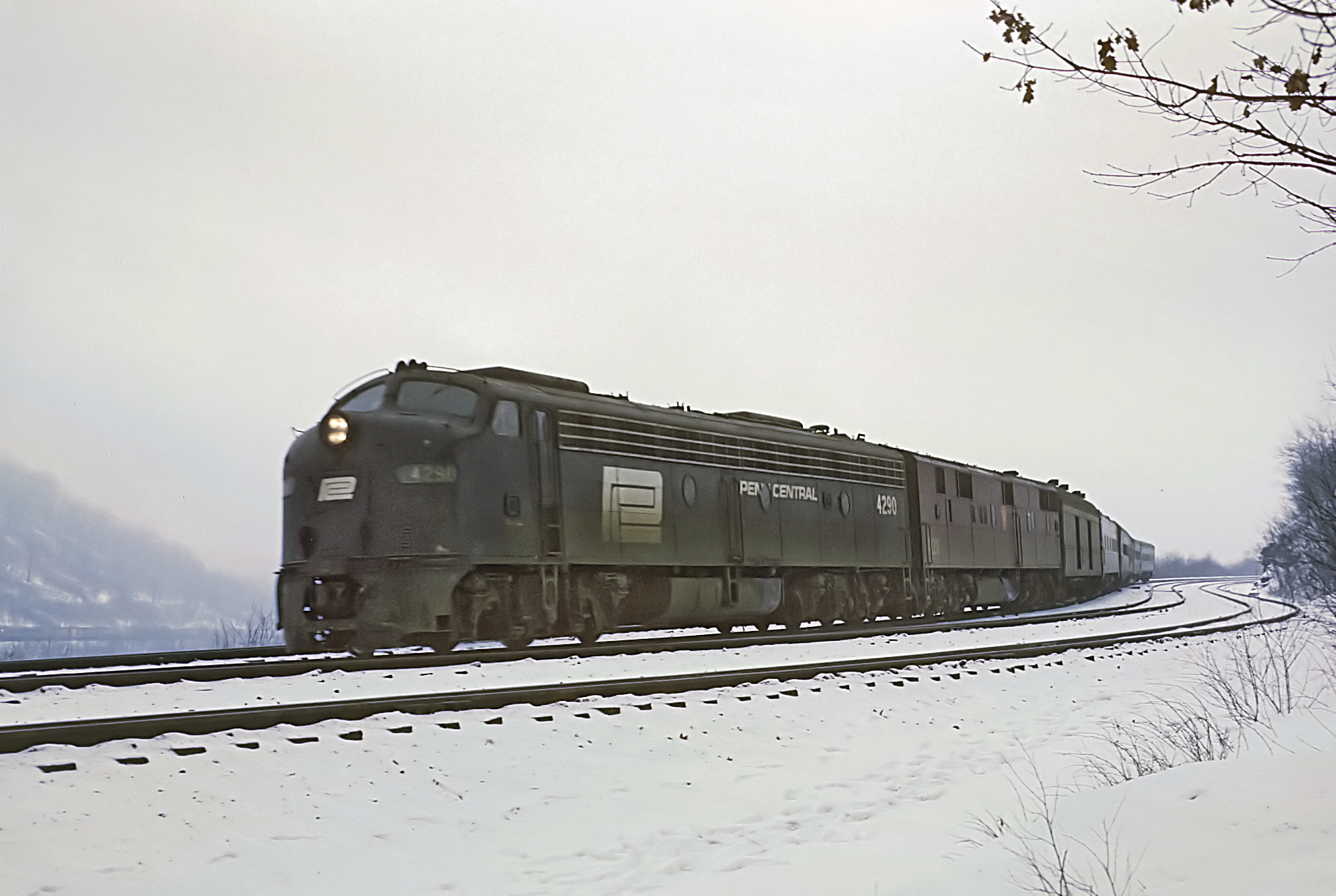 Penn Central E8A #4290 has train #54, the "Pennsylvania Limited," on Horseshoe Curve on a snowy February 23, 1969. Roger Puta photo.
History
When I was in college a few professors highlighted the collapse of Penn Central.
The lectures were interesting albeit too brief for someone who enjoyed railroad history. At the time, Rush Loving, Jr.'s, "The Men Who Loved Trains," had not yet been published.
If so, I am sure it would have been required reading. Today, many educators, at both the high school and collegiate levels, have likely done this very thing.
Loving's title not only provides an in-depth study of the company's failings but also the intricate politics which pervade large corporations.
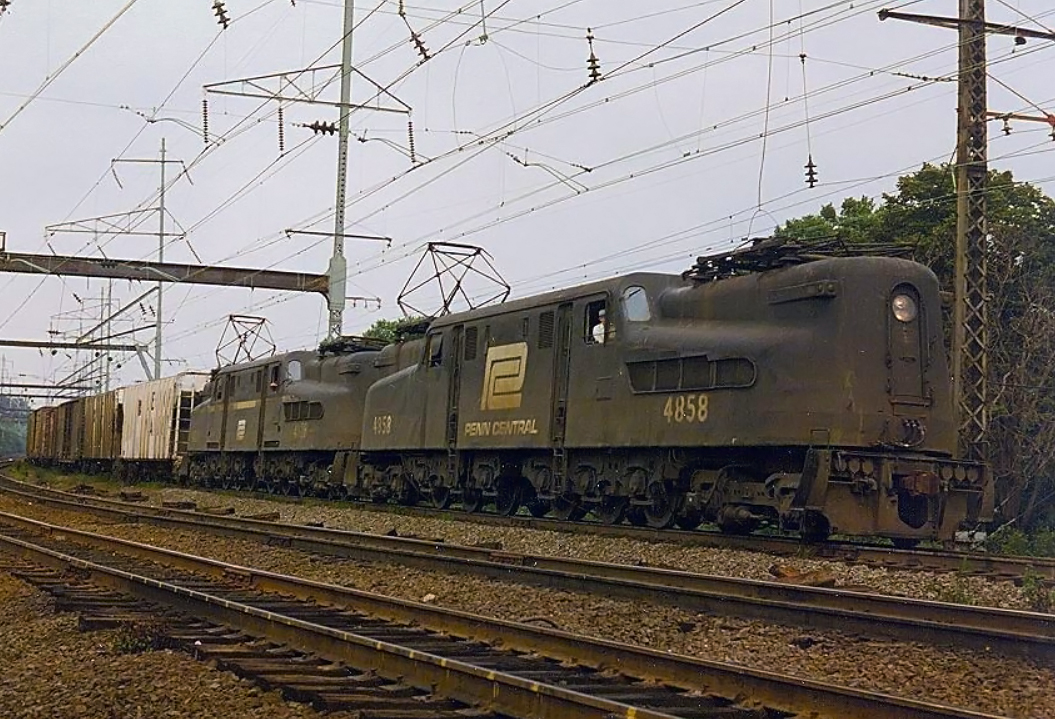 Penn Central GG1s have a freight in tow through Zoo Junction in Philadelphia on August 7, 1974. Doug Kroll photo.
It it is an excellent book vividly illustrating how arrogance can destroy even the most powerful companies. While hubris was a serious problem at Penn Central there were many other factors leading to its downfall. Its creation can be traced back to the end of World War II.
The industry had experienced a resurgence after the lean years of the 1930s and believed these problems were far behind them following the war.
The mighty Pennsylvania Railroad should have recognized the ominous signs. It lost money for the first time in its fabled history during 1946 but continued to spend millions on new passenger equipment while carrying out few modernization or cost-cutting initiatives.
The New York Central was somewhat more cautious. The company had never been as profitable as the PRR but was still regarded as one of the most powerful in the nation.
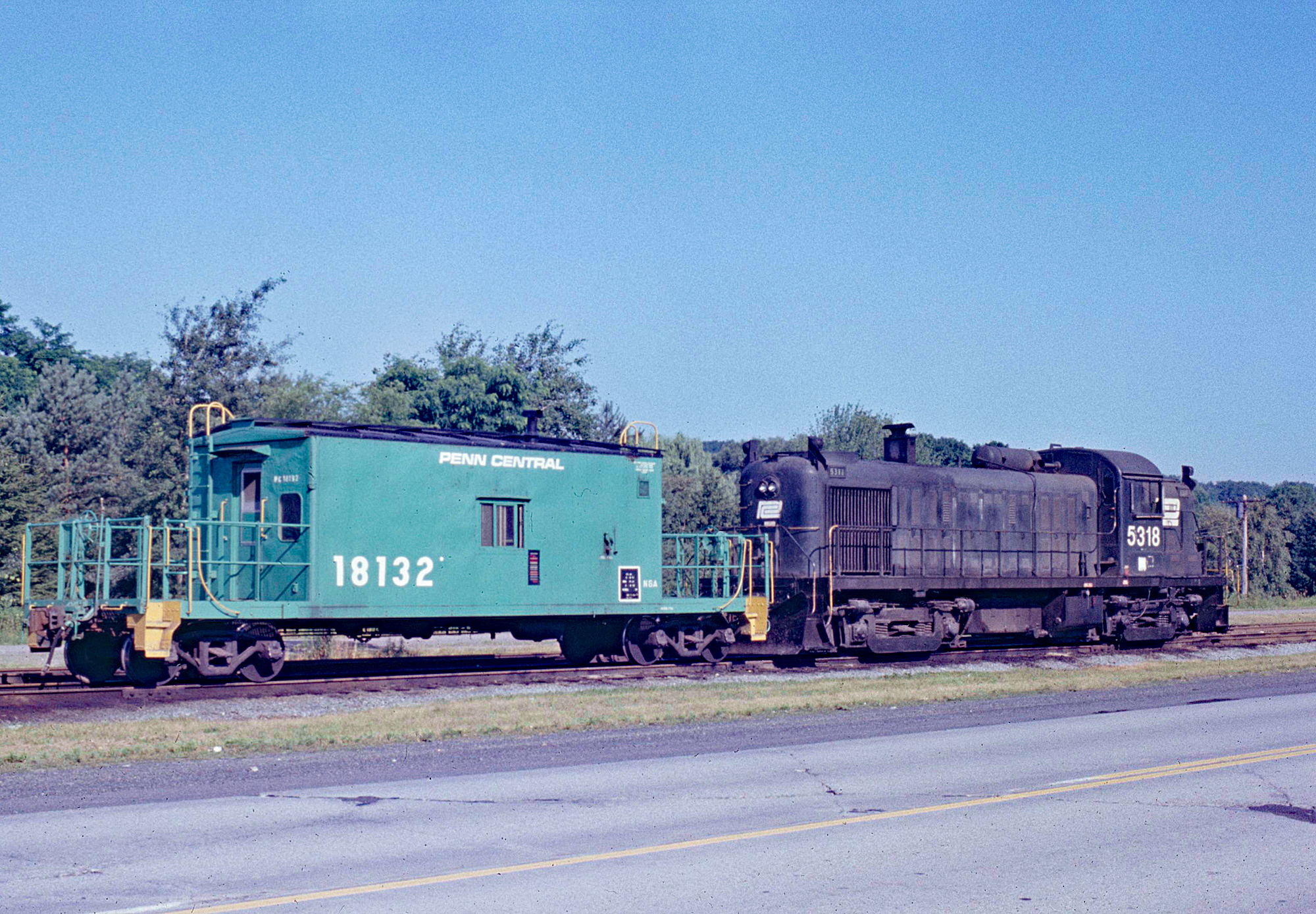 Penn Central RS3 #5318 (ex-New York Central #8318) pulls a transfer caboose along an undisclosed highway (not listed on the listed) in July, 1973. American-Rails.com collection.
It was widely recognized by the general public for its glamorous passenger trains, notably the 20th Century Limited, and high quality of service. By the 1950s the NYC was struggling and nearly broke.
The company's board realized change was needed and brought in Alfred Perlman. After taking the helm in 1954 he quickly turned around the Central's fortunes by hiring young, innovative new managers; completed dieselization; built classification yards; and introduced creative marketing schemes such as Flexi-Van service (the trains themselves were known as Super Vans).
This latter idea was far ahead of its time, the first successful application of Container-On-Flat-Car service (or COFC).
Logos
While Perlman's work greatly helped its future remained uncertain as an independent carrier. The merger movement was stirring as systems attempted to cut costs and streamline operations in the face of declining traffic and strict regulations.
It was a PRR subsidiary, the Norfolk & Western, which ironically kicked off the modern merger movement by acquiring rival Virginian in 1959. It then purchased a handful of other roads during the 1960s including the Wabash, Nickel Plate, and Akron, Canton & Youngstown.
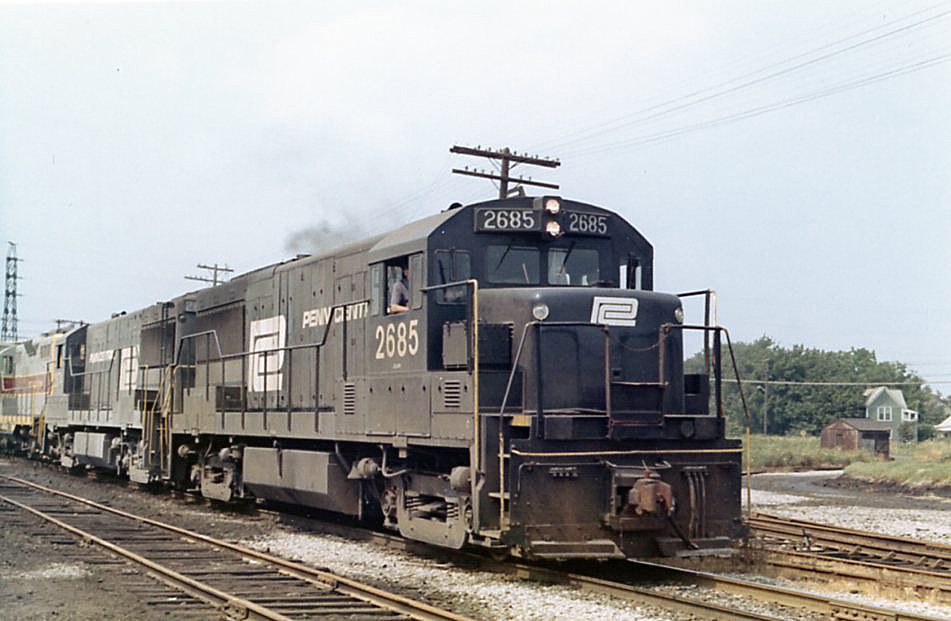 Penn Central U25Bs #2685 and #2674 lead a southbound Erie Lackawanna freight through North Tonawanda, New York on August 5, 1973. Doug Kroll photo.
In addition, it held stakes in the Erie Lackawanna and Delaware & Hudson for a time. The PRR's situation became precarious; despite its outward appearance the company was, essentially, broke. It launched informal merger talks with the NYC during September of 1957, a moved that surprised many outsiders.
It seemed impossible two of the nation's largest railroads, and fiercest rivals, could merge. Perlman knew his railroad needed a partner but not the PRR.
While he had no insider information, Central's head man was very suspicious that the so-called "gold-plated" Pennsylvania Railroad was a house of cards ready to collapse.
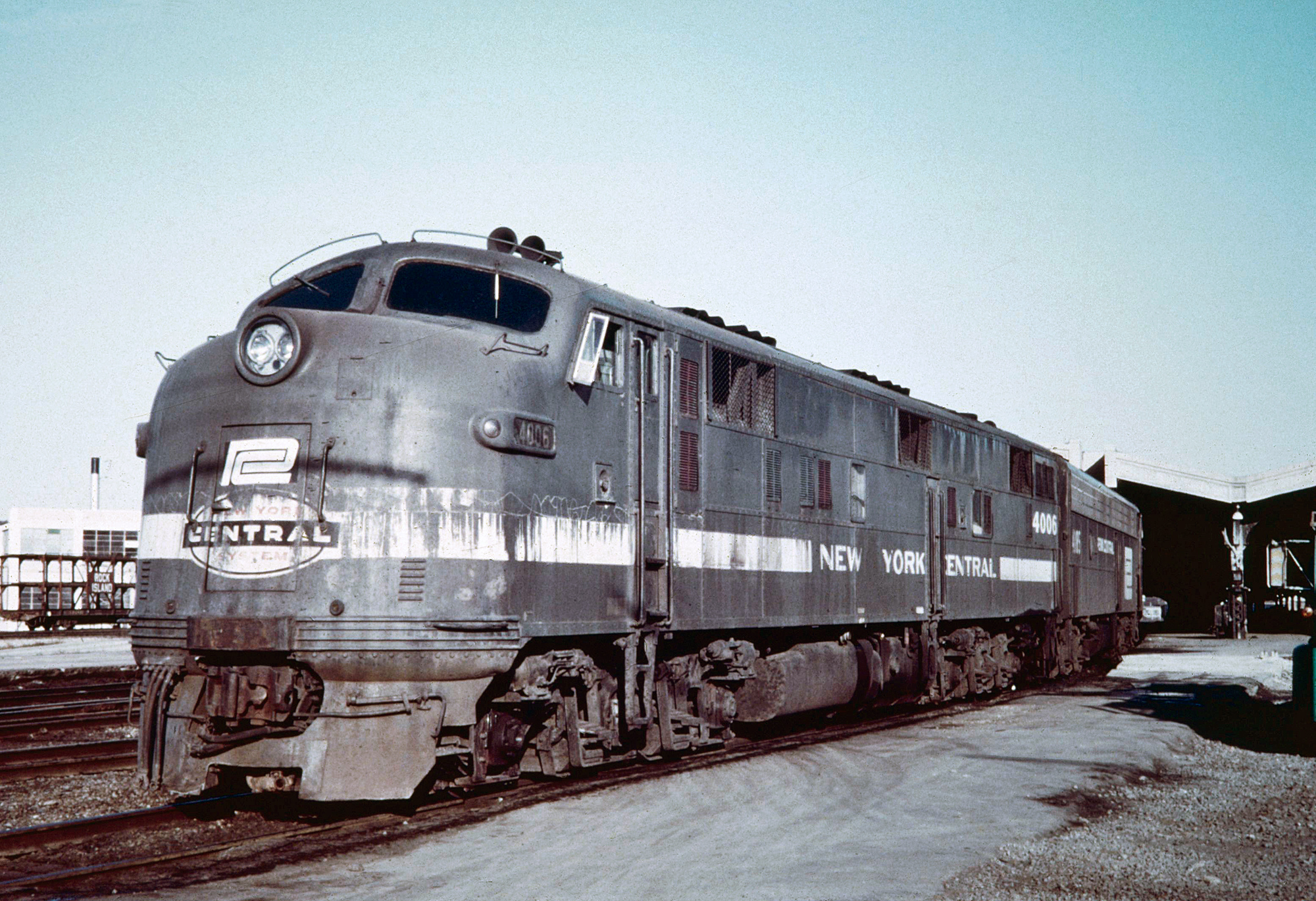 Penn Central E7A #4006 and other power at Michigan Central Station, circa 1969. American-Rails.com collection.
He also did not believe the Interstate Commerce Commission (ICC), governing body of the industry, would ever approve a union that would monopolize the Northeast.
Instead, In 1959, he began courting the Chesapeake & Ohio and Baltimore & Ohio regarding a three-way merger. The Chessie was quite profitable; like the N&W it enjoyed an endless stream of black diamonds originating from mines in southern West Virginia and eastern Kentucky.
As for the historic B&O it was much larger than the C&O but struggled with incessant financial problems. When talks began the B&O was doing somewhat better although its future remained murky.
As Perlman saw it a union would be of great benefit to everyone; the B&O offered new markets, the C&O contained its lucrative coal traffic, and a continued effort of modernization and downsizing would make for an efficient company. In addition, a PRR merger with its now-much larger N&W affiliate would provide balanced competition.
On paper, it seemed like the best outcome with the public interest in mind. Alas, feuding broke out between the leaders of NYC, B&O, and C&O regarding who would head the new company and negotiations fell apart.
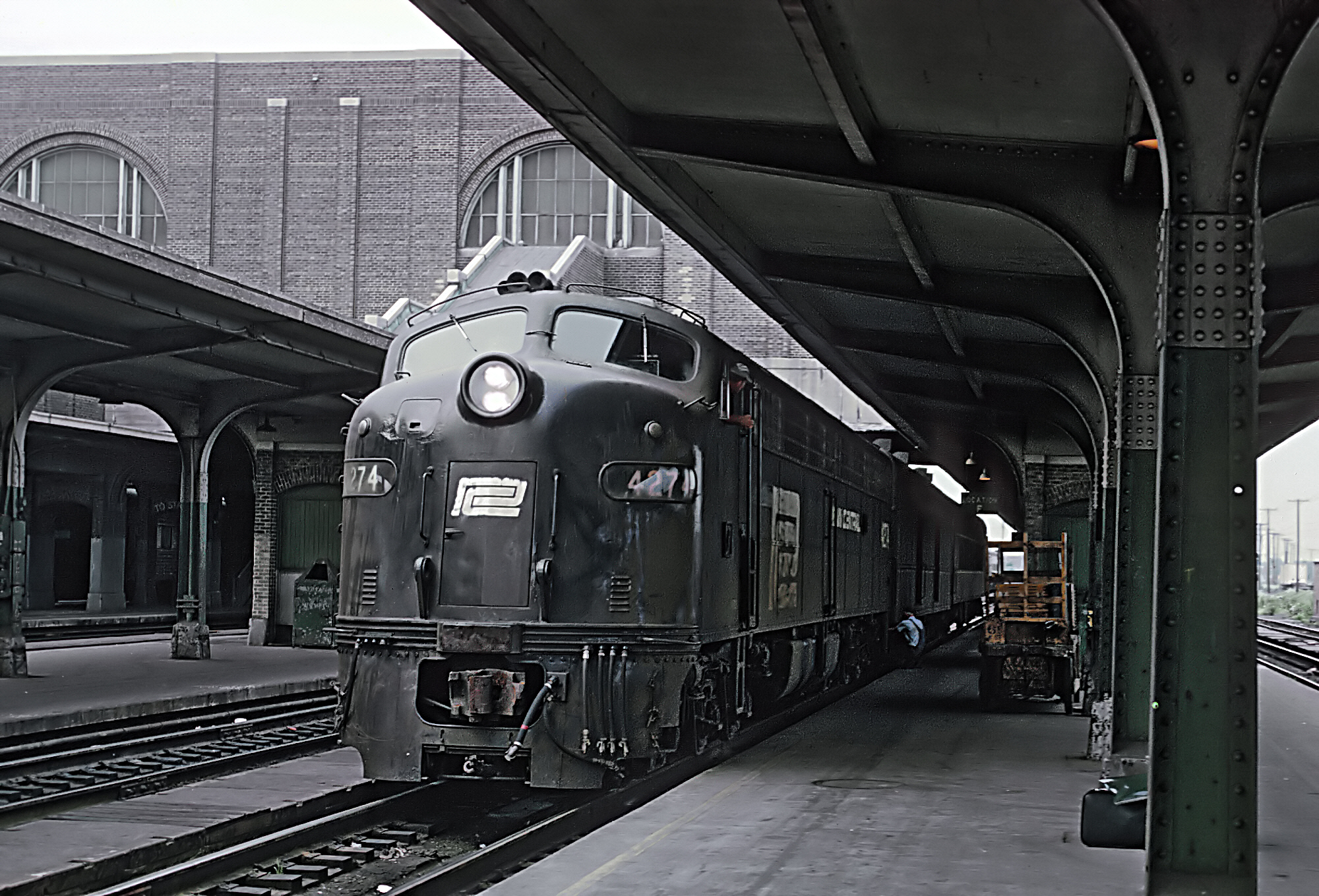 Penn Central E8A #4274 awaits departure from Central Terminal in Buffalo, New York with train 575, the "Buffalo Day Express," on July 20, 1969. Roger Puta photo.
Formation
With nowhere else to turn, Perlman relaunched talks with the Pennsy in October of 1961 and during the next few years the prospects of merger were hashed out.
The ICC proceedings worked their way towards completion until finally, and surprisingly, the federal agency approved the marriage in January of 1968.
A month later, the Penn Central Transportation Company officially launched on Thursday, February 1, 1968 at 12:01 AM. The new railroad was a monster.
According to David P. Morgan's article, "NYC + PRR, What Does It Mean?," from the January, 1958 issue of Trains Magazine, Penn Central boasted more than 20,000 route miles, contained assets of more than $5 billion, and offered a projected operating revenue of more than $1.7 billion annually.
On the surface these numbers appeared rosy. However, there were many warnings PC was headed for disaster. Its astronomical payroll held more than 180,000 employees, a condition agreed upon by new chairman Stuart Saunders who was brought in from the N&W.
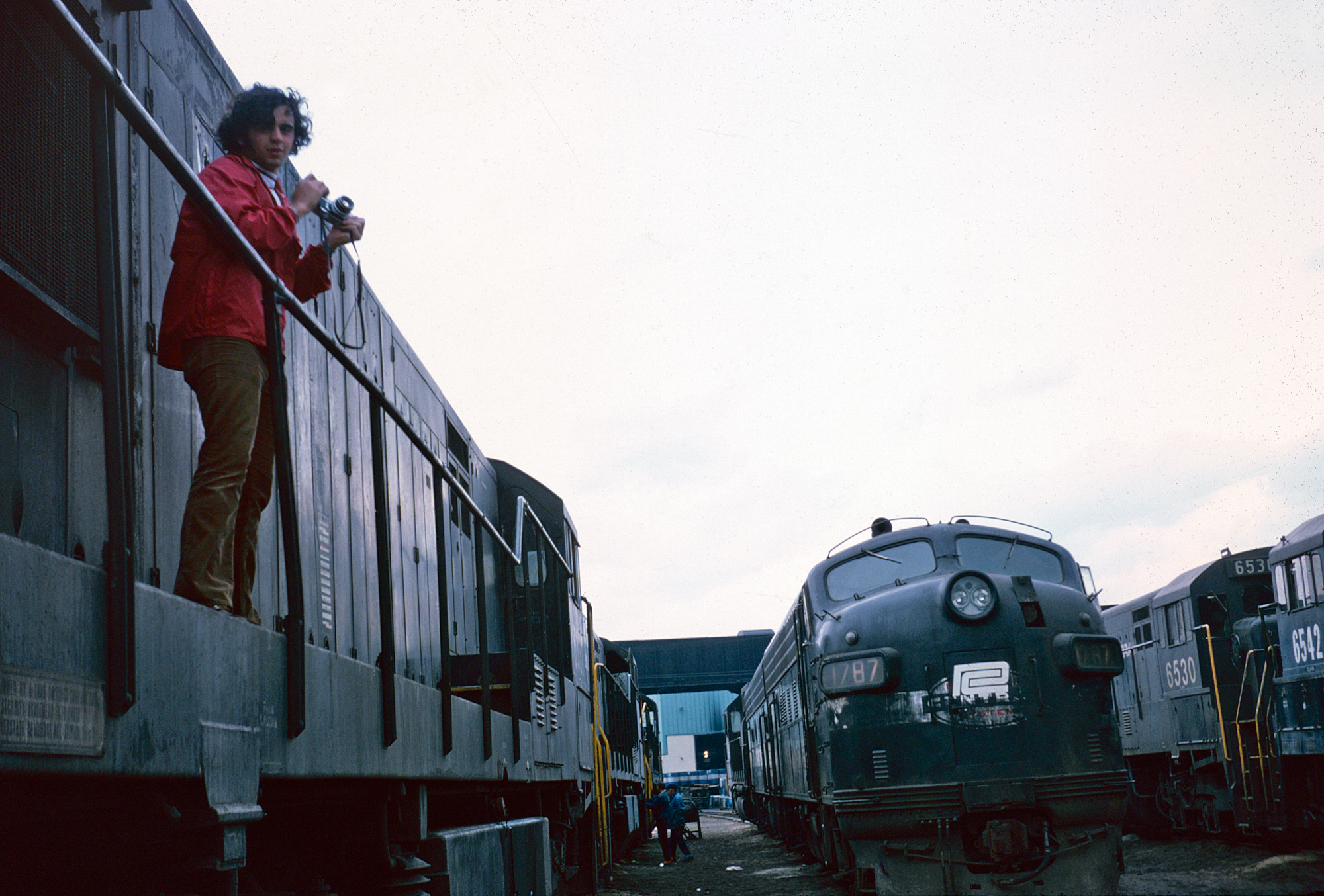 Penn Central locomotives await overhaul outside the shops in Selkirk, New York; April, 1975. American-Rails.com collection.
As Loving argues, Saunders was never a good railroader and understood little regarding operations. However, he was strong in negotiation and appeasement, which wound up working superbly for the unions.
When mergers happen savings are usually derived through the elimination of duplicate routes, terminals, trackage, and redundant positions.
This should have worked to Penn Central's advantage but in an incredible circumstance Saunders gave in to virtually all union demands. The result was predictable, Penn Central became straddled with a ballooned payroll from which it could not escape
- Every employee from both companies was retained
- huge severance packages were promised to anyone fired
- Astoundingly, several-thousand employees were rehired for reasons which had nothing to do with the newly merged company.
Then, there was the operating ratio. This term describes operating expenses as a percentage of revenue. Anything over 80% is extremely high (today's Class I's try to stay in the 60s) and means that for every dollar a railroad earns, at least 80 cents is being devoured by expenses.
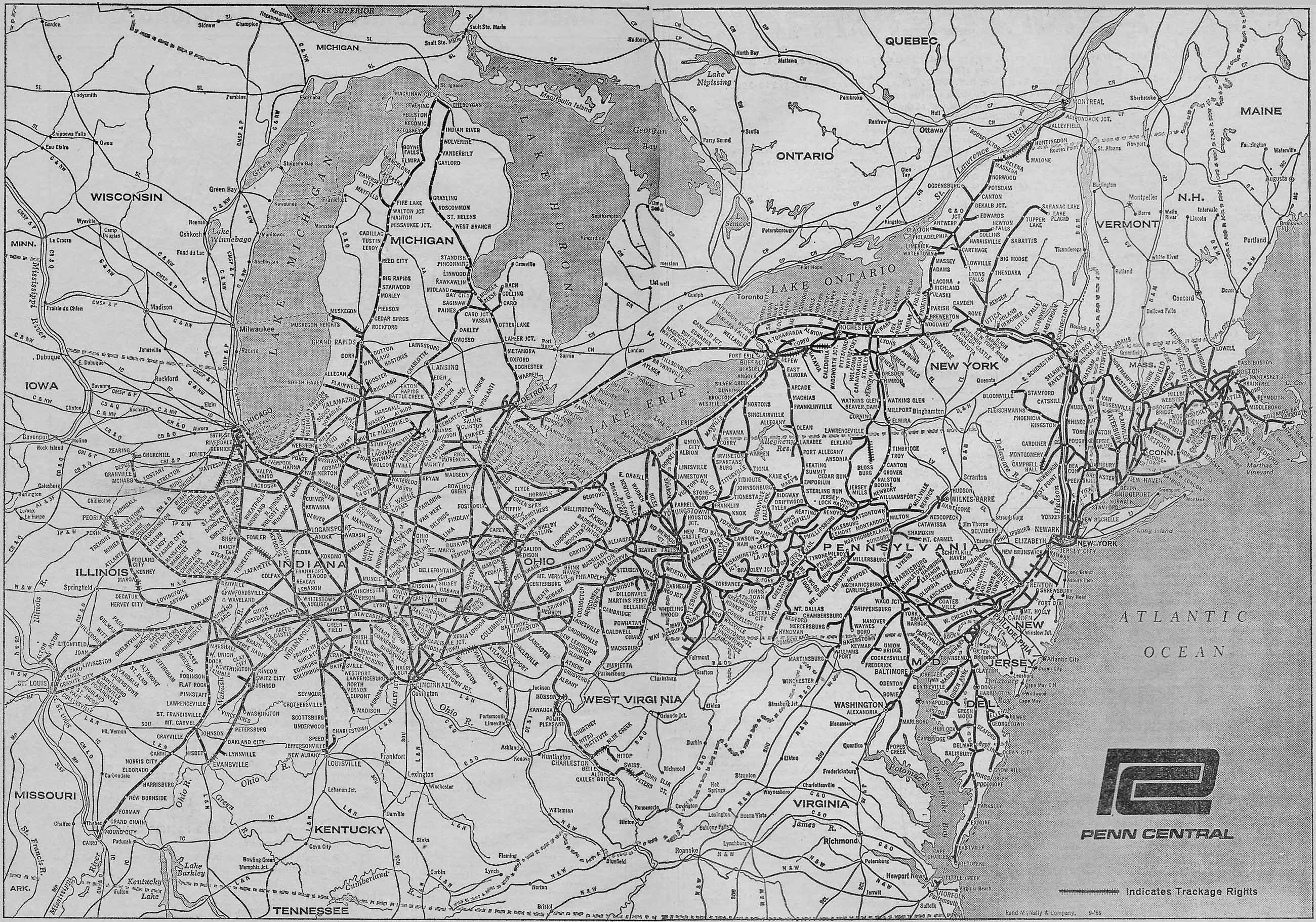
System Map (1969)
With the both the Central and PRR, they carried operating ratios above 81%. Finally, the cash reserves on merger day were slim with just $13 million available (the PRR, alone, required more than three times that amount each day) and spoke of the sickness plaguing each system.
For all of the glaring problems chairman Saunders and president Perlman had attempted initiatives of preparation; to improve operational efficiency they tried to construct massive, new automated freight yards at Selkirk and Albany, New York with another located in Columbus, Ohio.
The New York Central had been implementing such infrastructure upgrades but those at the PRR brushed aside these plans.
Then, the two men worked on an idea to launch an early, computerized system for monitoring and tracing freight cars. Today, this technology is standard and greatly improves efficiency while offering customers the ability to track their product(s). At the time it was innovative stuff.
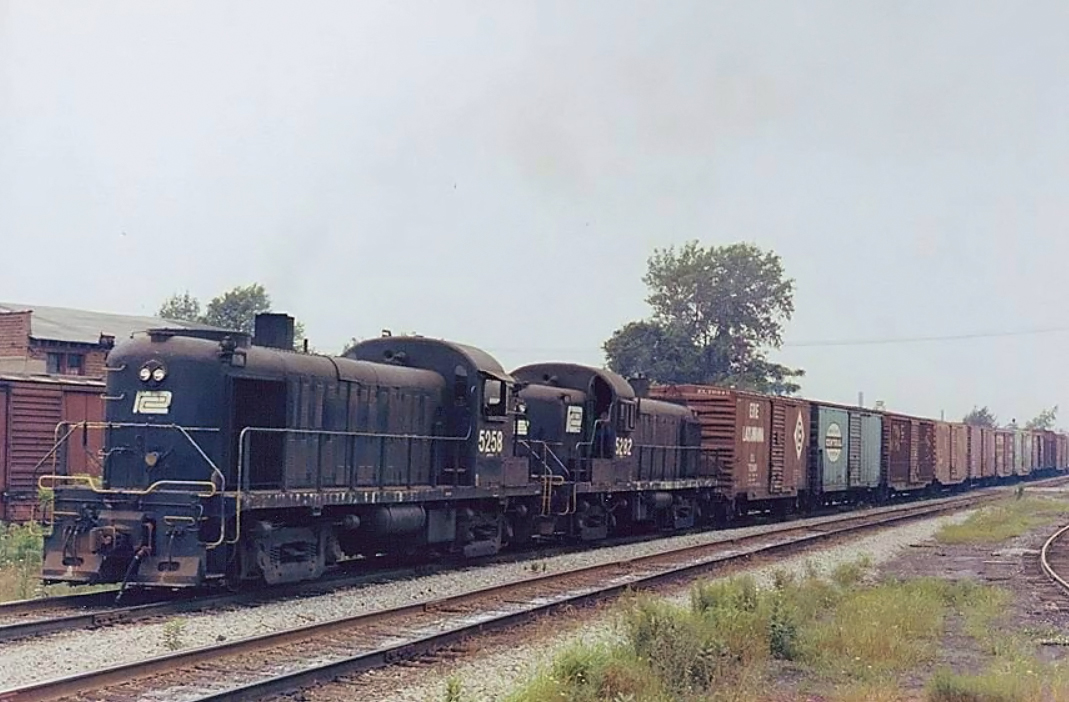 Penn Central RS3's #5258 and 5282 are southbound with a Niagara Falls to Frontier Yard freight at North Tonawanda, New York on August 14, 1973. Doug Kroll photo.
Merger Problems
This time the ICC was the problem; the agency was notorious for dragging its feet on mergers (the Rock Island debacle was unfolding at the same time) and had spent more than six years approving the Penn Central deal; unsure of whether the marriage would happen the men could not invest the capital in the program.
With no other choice they decided to merge each railroad's operating departments from day one. The hope was that over time the situation would work itself out and things would eventually return to normal. Unfortunately, this decision resulted in immediate pandemonium.
As Loving described it: "...None of the classification clerks had been taught the 5,000 new combinations of routings. By the thousands, cars began flowing into the wrong yards."
In one famous incident, former New York Central employees did not know the location of Harrisburg, Pennsylvania; even though it was the state capital and an important PRR terminal the city was never served by the NYC.
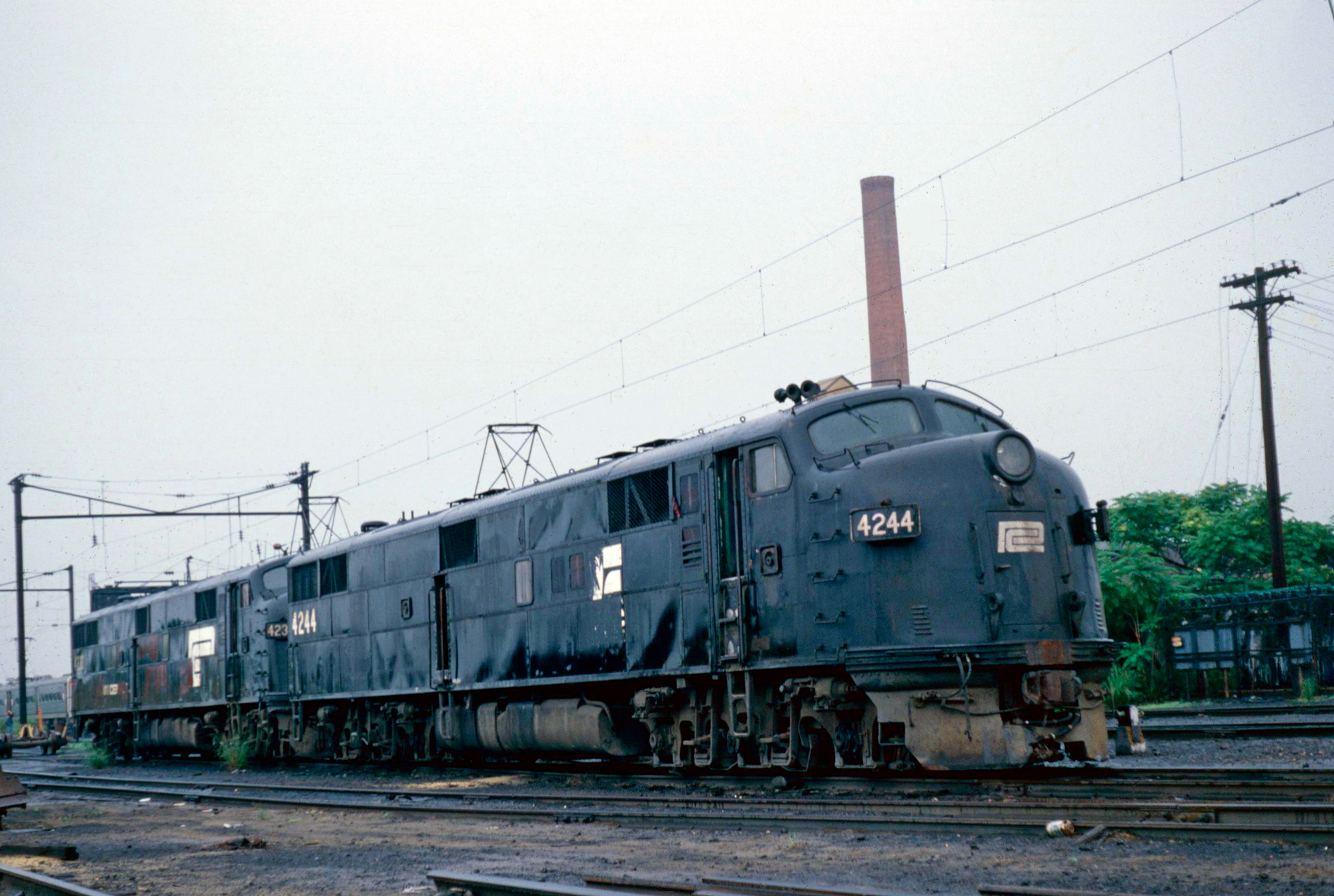 A pair of former Penn Central E7A's (ex-PRR) are seen here at South Amboy, New Jersey during the early Conrail era in July of 1978. American-Rails.com collection.
So, the car in question was sent to nearby Pittsburgh. A similar incident devastated the Bangor & Aroostook, a small railroad serving northern Maine.
For the BAR, potatoes had long been a primary source of freight; its entire business was lost forever when Penn Central's horrid service lost an entire season's crop at Selkirk Yard in 1969.
 Penn Central F7s, led by #1749 (ex-New York Central), power a coal train through Cleveland, Ohio in September, 1975. Photographer unknown.
The fallout resulted in many farms shutting down and those which remained discontinued rail service. The railroad, itself, was nearly forced into bankruptcy. Things only got worse as incoming "Red Hats" (PRR) and "Green Hats" (NYC) struggled to find common ground.
David Bevan, who came in from the Pennsy, headed Penn Central's financial department. Despite his arrogance, Bevan proved a viable asset. As the situation fell apart his many connections throughout financial and business sectors enabled a continual flow of cash and new loans as Penn Central burned through torrents of cash each day.
 It's only a few weeks into the Penn Central era as former New York Central E8As, led by #4051, bring an eastbound train into Albany Union Station at Tower B on February 22, 1968. Norton Clark photo.
At A Glance
In David P. Morgan's article, "NYC + PRR, What Does It Mean?," mentioned above the legendary author and writer painted a foreboding picture of the merger ten years before it was finalized.
He noted the heavy debt of both railroads, their weak earning power, and excess capacity; all three of these issues were only exemplified through the 1960s. The numbers Morgan cites below does not include earnings from the Pittsburgh & Lake Erie, an NYC subsidiary.
His efforts were aided by the PRR's many years of success and vaunted status on Wall Street, which had achieved it an impeccable credit rating. Only those at the very top actually knew how bad the situation was.
As the crisis worsened the railroad missed the lucrative profits of Norfolk & Western; unfortunately, as a condition of the merger PRR had been required to relinquish its ownership in the company.
It seems that whatever could go wrong did. In a further insult, which spoke of the government's feeling towards the industry, the ICC required Penn Central to take in the destitute New Haven.
This regional served southern New England and was an important transportation artery for thousands of commuters traveling between New York and Boston each day. Unfortunately, the New Haven had struggled for years and had been stuck in bankruptcy since 1961.
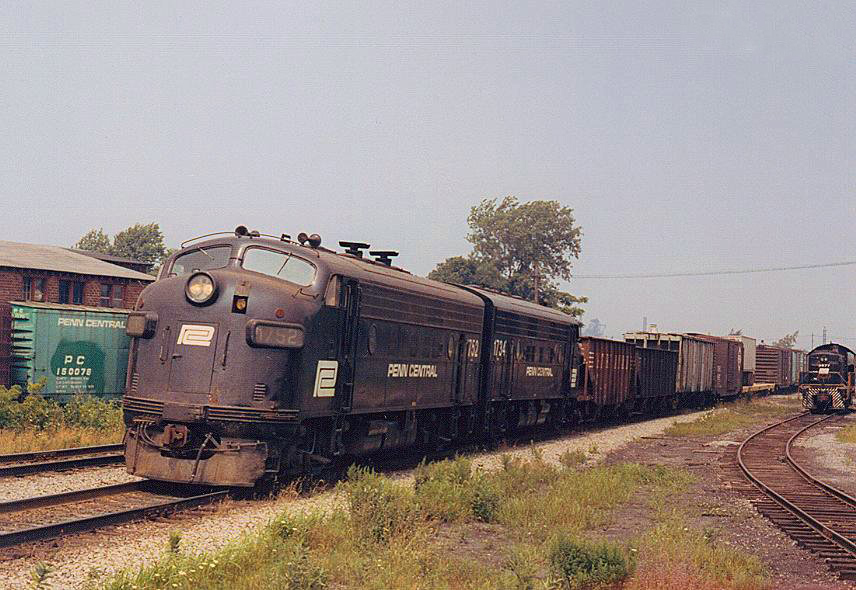 A pair of tired Penn Central F7As are southbound with a freight at North Tonwanda, New York on August 8, 1973. At this date the railroad was just trying to remain in operation while awaiting some kind of assistance. Doug Kroll photo.
According to Tom Nelligan's article, "How PC + NH = PC," from the January, 1970 Trains, it added 1,502 additional route miles to PC's network. The New Haven's issue was not only its bankruptcy, debt, and money-losing passenger services.
As Nelligan points out the road's freight revenues were not even profitable. It officially joined Penn Central on January 1, 1969.
For Perlman's part he was constantly trying to improve an impossible situation. Always outspoken, he drew the ire of former PRR brass who never particularly cared for him.
Using Saunders as a pawn, those on the board eventually garnered enough votes to stage a coup d'etat and have Perlman ousted. On August 29, 1969 the board voted Paul Gorman as the company's new president.
Perlman was handed the lame-duck position of vice chairman. After this stint he went on to head the struggling Western Pacific. His abilities as a railroader again shown brightly as he turned around the moribund road before it was purchased by Union Pacific.
 Marty Bernard caught these worn Penn Central E8As and E7As, with E8A #4257 closest to the photographer, at the 14th Street Coach Yard in Chicago on June 24, 1973.
Bankruptcy
Unfortunately, Gorman had little more success than Perlman in righting the Penn Central's sinking ship. Bevan tried his best in keeping creditors at bay while acquiring new sources of loans.
In a last ditch effort, Bevan worked his accounting "magic" to prop up worsening numbers through paper profits and other shady practices, otherwise described as "cooking the books."
For the year-end 1969, Penn Central's situation was very grim; the company's railroad arm had lost over $300 million since merger day and was still craving ravenous volumes of cash.
Through the first quarter of 1970 it had lost another $100 million, or more than $1 million a day. The end finally came in June, 1970.
Bevan reported to Saunders that he had exhausted all monetary means; if federal assistance could not be secured bankruptcy was the only option. The railroad nearly secured a $200 million from the defense department at the last minute. However, this stop-gap measure was turned down at the last minute.
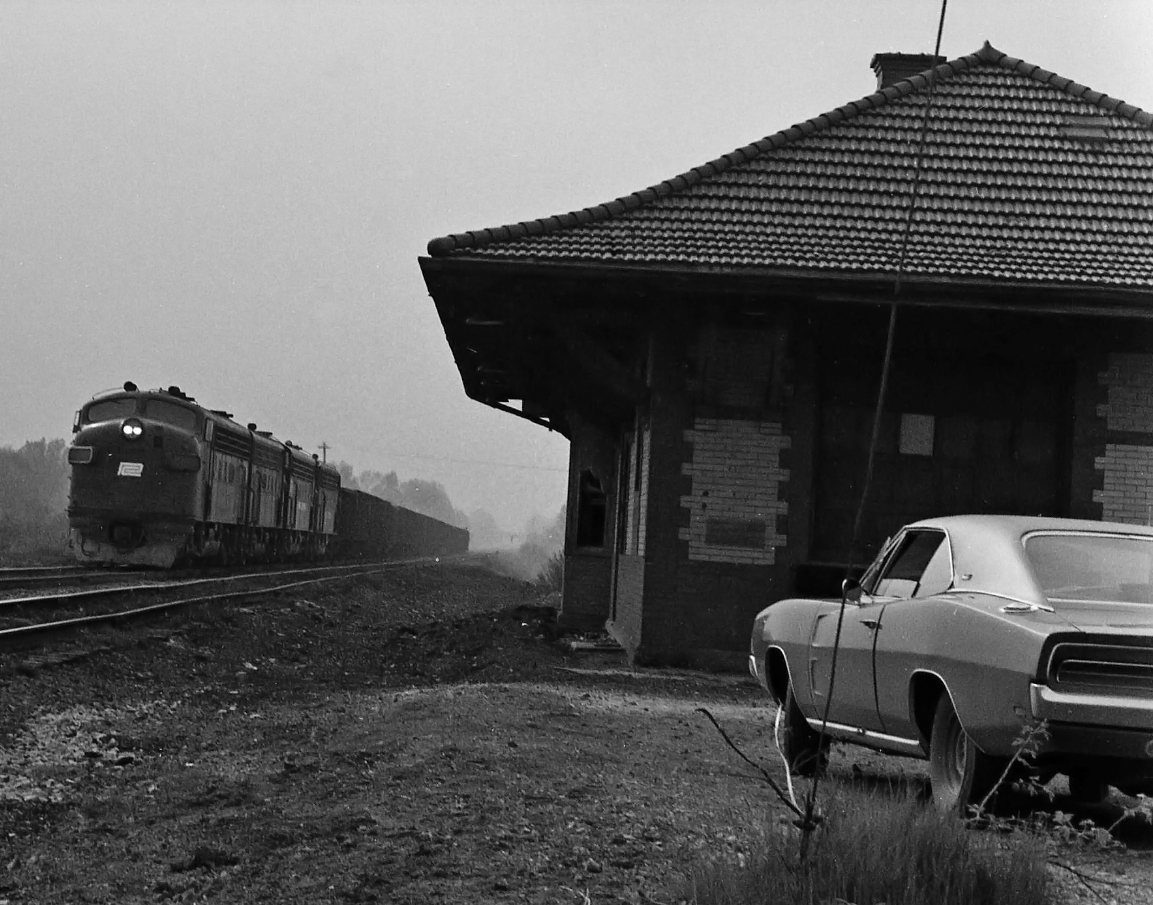 A quartet of Penn Central F7's roll past the former PRR depot in Ravenna, Ohio with a string of hoppers during the early 1970s. The author's 1969 Dodge Charger can be seen in the foreground. Jerry Custer photo.
Late in the day on June 21, 1970, Penn Central's board voted to seek voluntary relief from creditors under Section 77 of the federal Bankruptcy Act. The reaction from Wall Street and those in business sectors was shock, no one believed the mighty Pennsylvania Railroad would ever collapse.
It was the largest bankruptcy of its time. In another sign of the times the general public paid scant attention to this enormous and historic business failure. Most were too caught up in the ongoing Vietnam War while those who did notice questioned only if the passenger trains would still run (they did).
The result of Penn Central's fall caused a ripple effect throughout the entire Northeast as other railroads struggled to keep their freight moving. Penn Central's fate was left to bankruptcy judge John Fullam while Jervis Langdon, Jr., an experienced railroader with a career in the industry, became the chief trustee.
Interestingly, Bevan escaped prosecution for his accounting actions, Saunders quietly retired to Virginia, and Paul Gorman hastily left the company finding work elsewhere. After more than three years in receivership, trustees concluded Penn Central problems were too complex for a traditional reorganization.
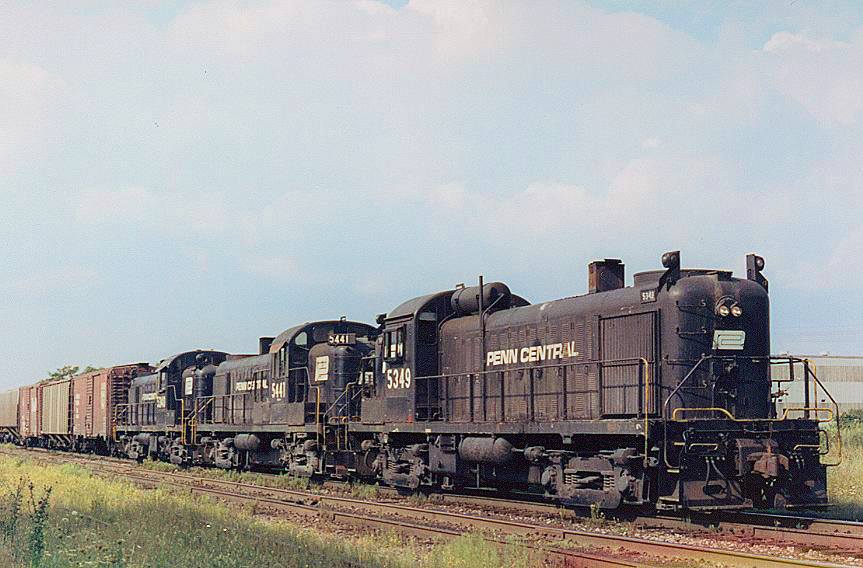 Penn Central RS-3's (#5349, #5441, and #5340) head south on the Belt Line behind Central Terminal in Buffalo, New York on August 12, 1973. Doug Kroll photo.
Conrail
In the end, the railroad's failure eventually improved the industry for the better; Amtrak launched on May 1, 1971, largely relieving railroads of their money losing passenger operations, while the creation of Conrail on April 1, 1976 pieced together the bankrupt shells of several Northeastern lines, including Penn Central.
It took several years but Conrail earned its first profit in 1981, netting $39 million that year. There were several factors which led to this turnaround but one of the most important was the Staggers Rail Act of 1980.
Perhaps Morgan best summed it best up best, all the while articulating the industry's problems: "The point is why in a thriving U.S. economy the biggest railroads in the nation find it necessary to make public such a drastic panacea.
The answer, all but obscured by inept railroad explanation and a nervous competition, is that railroading has been manacled by archaic regulation drawn up in an era when the objective was to see to it that certain roads did not harm the economy while they were clouting one another over the head in the excesses of a vanished day of laissez-faire.
Thus railroading has been unable to stop the advance of water, road and air competition that has always been backed to the hilt by public money and frequently merchandised by Government. That is the point."
Incredibly, this was said in 1958, a decade before Penn Central's creation and more than two decades before deregulation.
Photo Gallery
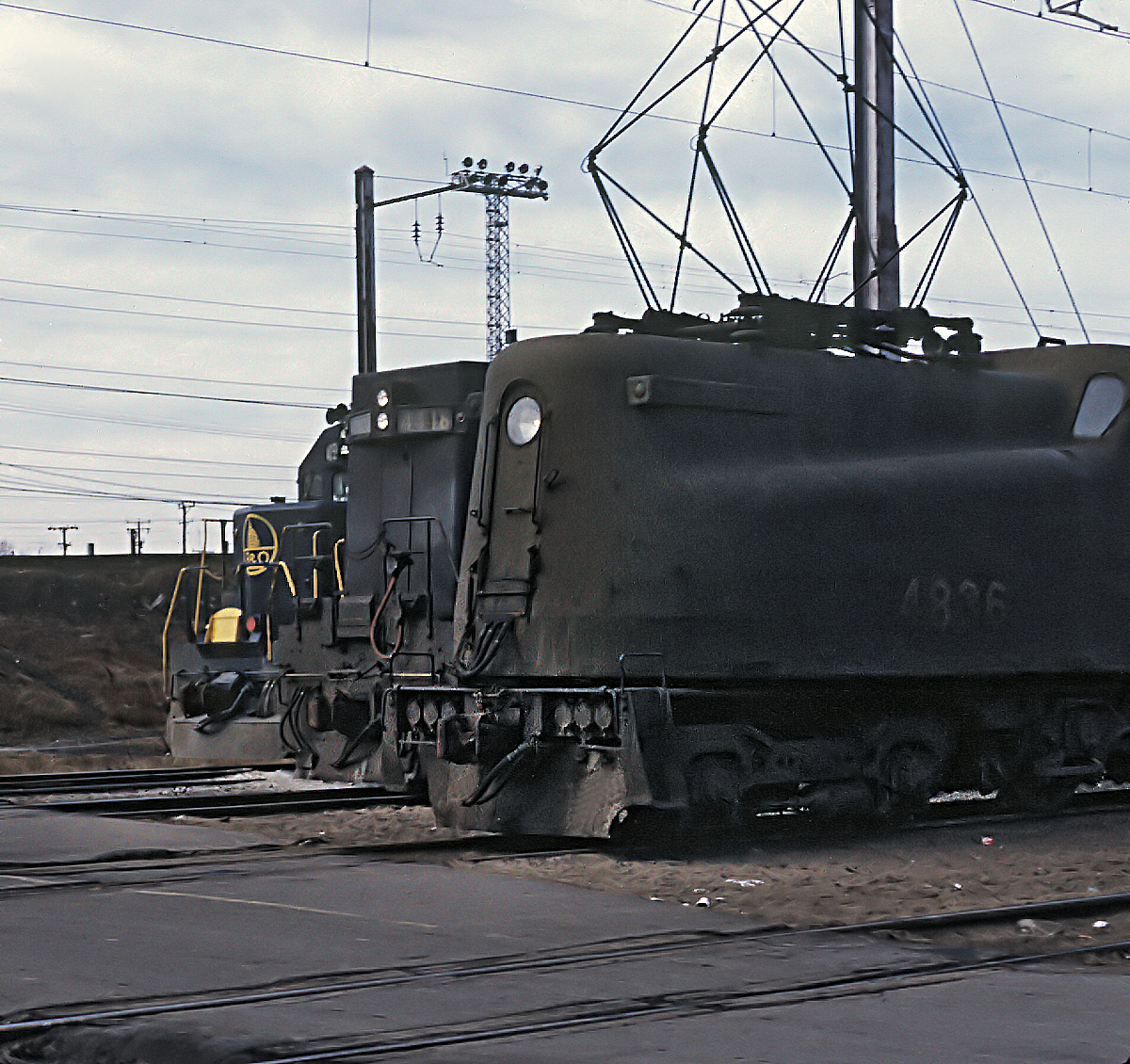 Penn Central GG1 #4836, E44 #4416 and B&O GP40 #4051 are lined up together at Potomac Yard in Alexandria, VA on January 14, 1972. Marty Bernard photo.
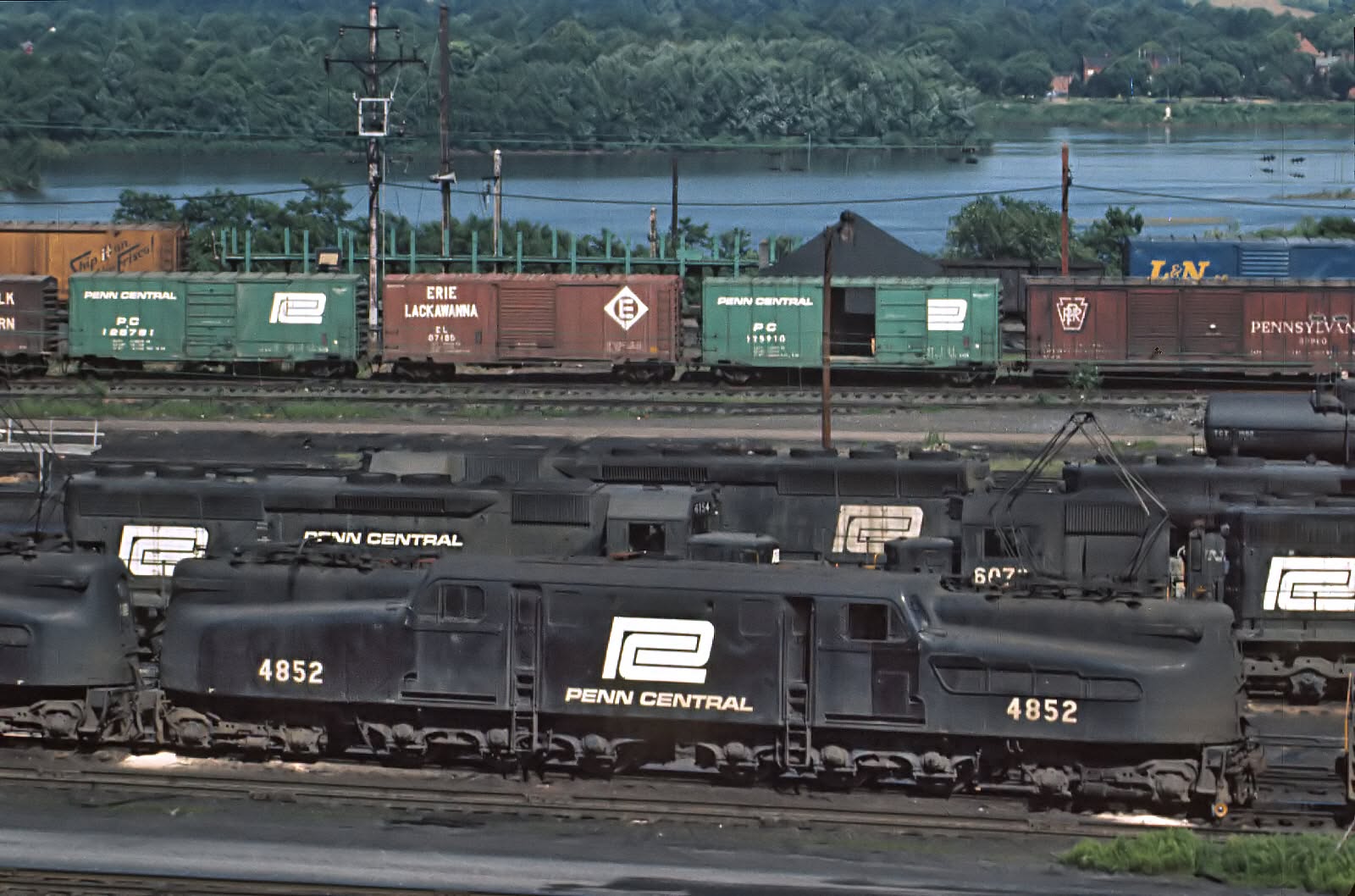 Penn Central GG1 #4852 and other power at the railroad's large Enola, Pennsylvania yard on June 11, 1972. Marty Bernard photo.
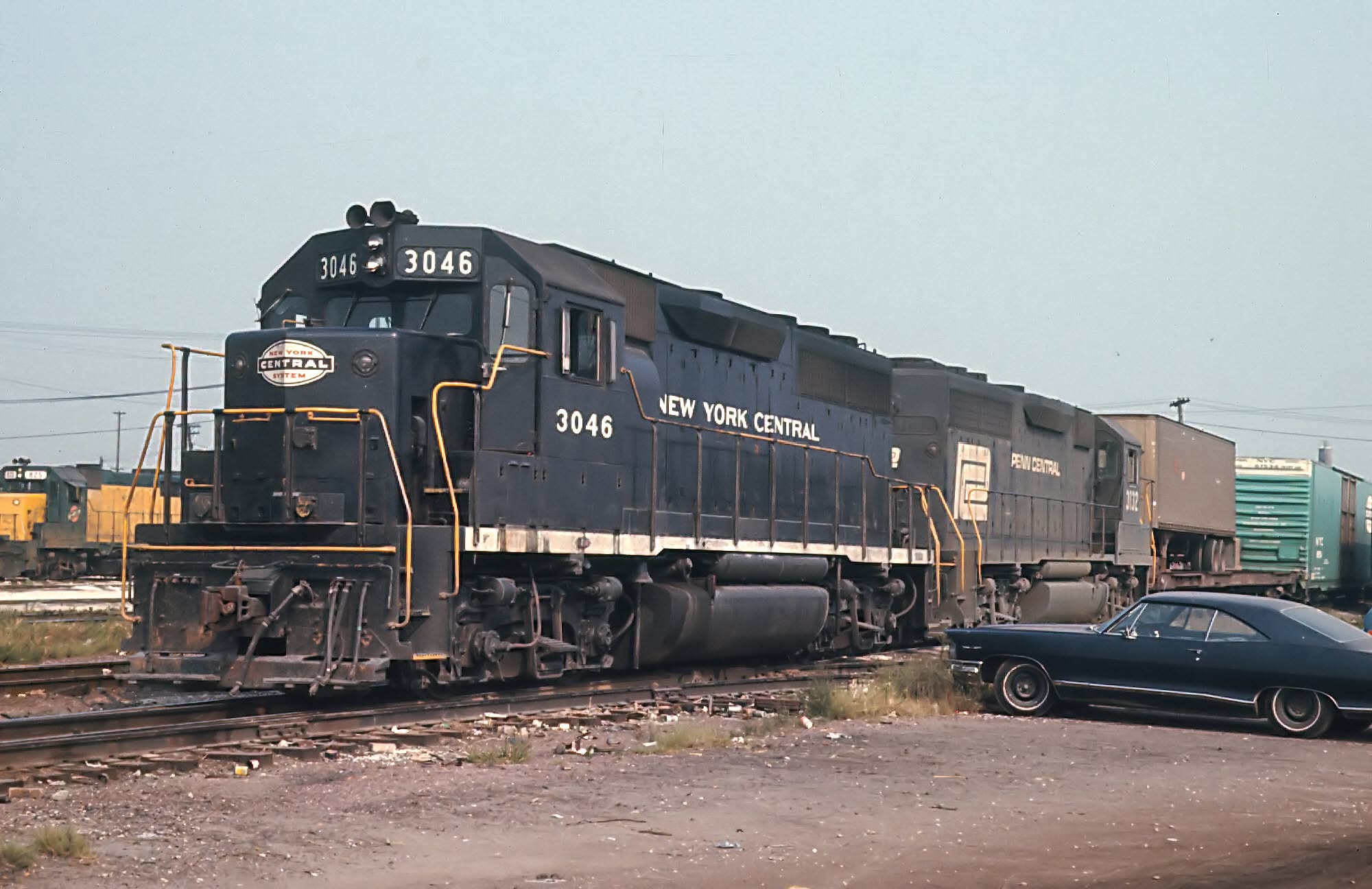 A former New York Central GP40, #3046, and Penn Central GP40 #3132 are seen here at Proviso, Illinois on August 28, 1969. Note the 1965-66 Impala Sport Coupe. Marty Bernard photo.
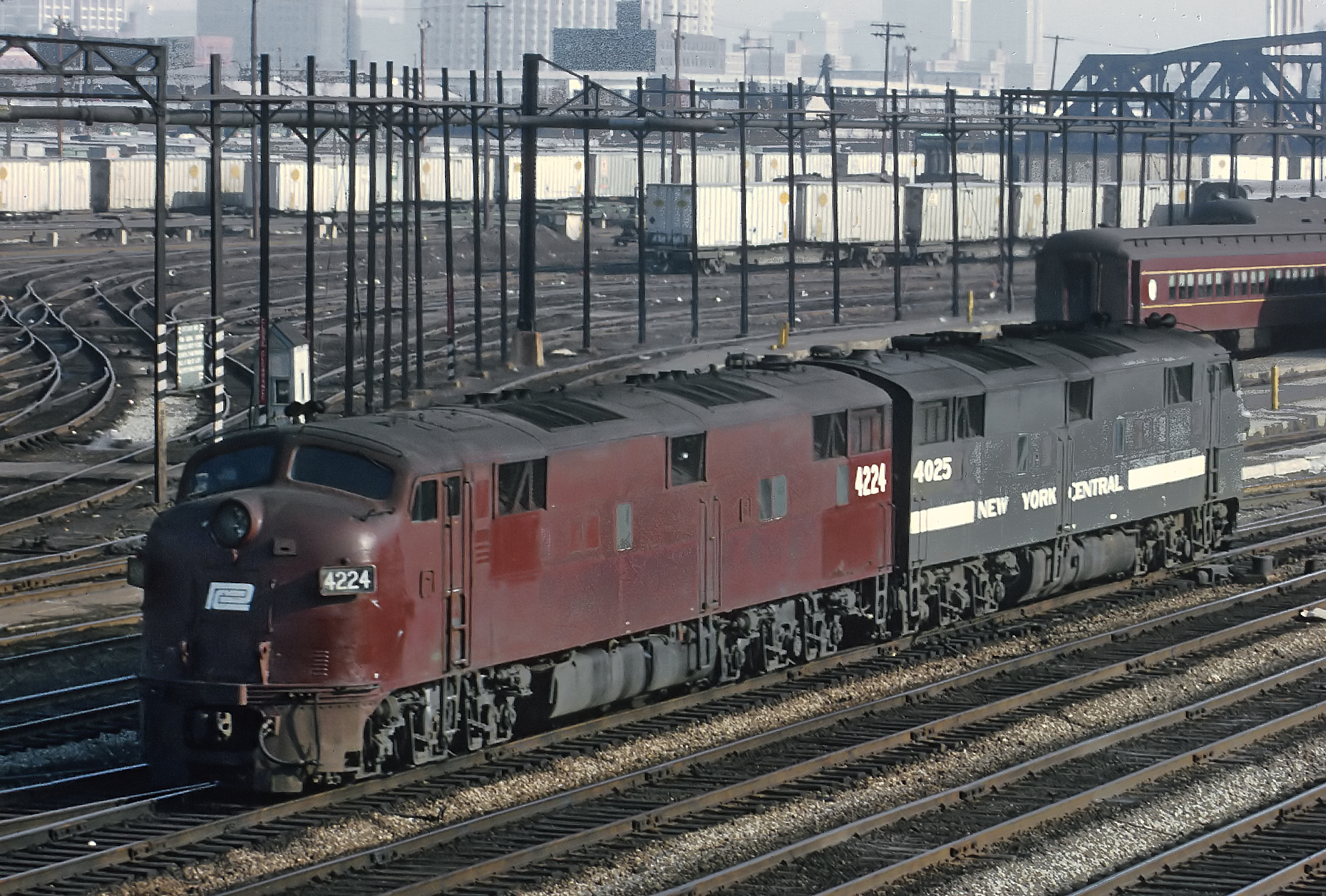 Penn Central 4224 (ex-PRR E7A) and 4025 (ex-NYC E7A) run light at 12th Street in Chicago on March 30, 1971. Note the ex-PRR coach yards in the background. Marty Bernard photo.
Recent Articles


-
C&NW 4-6-2s 1617 & 1620: Minnesota 400 Yellow Jackets
Sep 19, 26 10:20 AM
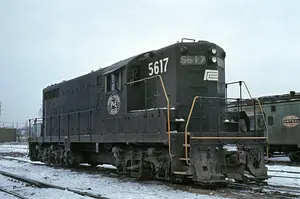
 C&NW Class E Pacifics 1617 and 1620—Alco Schenectady 1917, yellow-and-green E-4-style shrouds 1941 for the Minnesota 400. Crews called them Yellow Jackets. Renumbered 617/620. Scrapped 1956.
 -
Erie Lackawanna Diesel Roster: All-Time
Sep 19, 26 10:13 AM
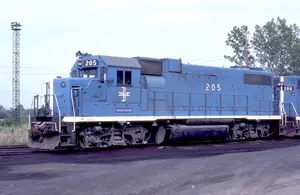
 Erie Lackawanna diesel—Erie and DL&W inheritance, GP35s, U25Bs, SD45/SDP45/SD45-2, U34CH. All-time roster with serials and orders. Conrail April 1 1976.
 -
Erie Lackawanna Railway: Map, History, Logo
Sep 19, 26 10:06 AM
 Erie Lackawanna Railway—Erie and DL&W, October 17 1960–March 31 1976. Von Willer, White revival, Dereco, Agnes, Conrail. High-and-wide Chicago main. Map, logo, what remains.
 -
"Empire State Express" (1941 Train): Timetables, Route, Consist
Sep 18, 26 10:59 PM
 NYC Empire State Express—George Daniels 1891 day train, 999’s 112.5 mph claim, Budd stainless streamliner December 7 1941, Cleveland and Detroit sections, diesels, 1967 name drop. Timetables, consist…
 -
New York Central 4-6-4s 5426 & 5429: Empire State Express Hudsons
Sep 18, 26 10:32 PM
 NYC J-3a Hudsons 5426 and 5429—Alco 1937, Budd stainless shrouds 1941 for the Empire State Express. Pearl Harbor inaugural. Shrouds off by 1950. Neither preserved.
 -
"Stourbridge Lion" Locomotive: Facts, History, Photos
Sep 18, 26 10:27 PM
 Stourbridge Lion—Foster, Rastrick 0-4-0, first steam locomotive in the United States. Horatio Allen, Honesdale, August 8, 1829. Too heavy for D&H gravity track. Boiler in Baltimore; Colonie replic…
 -
Delaware & Hudson Steam Roster (Post 1900)
Sep 18, 26 10:01 PM
 Delaware & Hudson steam—Camelback 2-8-0s, Loree high-pressure compounds, Class K 4-8-4s, forty Challengers. Post-1900 class roster after Drury. Last steam July 21, 1953.
 -
Boston & Maine Steam Roster (Post 1900)
Sep 18, 26 02:57 PM
 Boston & Maine steam—B-15 Moguls, K-8 Consolidations, P-4 Lima Pacifics, T-1 Limas, R-1 Mountains. Post-1900 class roster after Drury. Last steam July 23, 1956.
 -
Boston & Maine Diesel Roster (All-Time)
Sep 18, 26 01:25 PM
 Boston & Maine diesel—boxcab 1100 1935, Flying Yankee 6000, FTs, E7s, BL2s, GP7/GP9, GP38-2s and GP40-2s. All-time roster. Last steam July 23, 1956.
 -
Mid-Continent Railway Museum Dining (2026)
Sep 18, 26 01:21 PM
 2026 Mid-Continent dining in North Freedom—select-date seated meals in luxury cars, reservations required. Pizza Limited June 28. Confirm on midcontinent.org.
 -
Bessemer & Lake Erie Steam Roster (Post 1900)
Sep 18, 26 12:11 PM
 Bessemer & Lake Erie steam—C3A 150–151, D1A/D2A Santa Fes, 47 H1 Texas types after Burlington. Post-1900 class roster after Drury. Last steam 2-8-0 156, May 14, 1953.
 -
Bessemer & Lake Erie Diesel Roster (All Time)
Sep 18, 26 12:09 PM
 Bessemer & Lake Erie diesel—Westinghouse 281 1936, Baldwin DRS-6-6-1500s, F7s 1950–53, SD7/SD9/SD18/SD38 family, RSD-15s. All-time roster. Last steam 2-8-0 156, May 14, 1953.
 -
Bangor & Aroostook Steam Roster (Post 1900)
Sep 18, 26 11:21 AM
 Bangor & Aroostook steam—Manchester Ten-Wheelers, Alco Mountains 100–109, G-2 Consolidations, Pacifics 250–254. Post-1900 class roster after Drury. Last steam Pacific 251, July 22, 1951.
 -
Bangor & Aroostook Diesel Roster (All Time)
Sep 18, 26 11:09 AM
 Bangor & Aroostook diesel—F3s 1947, eight BL2s, E7s, GP7s leased to the PRR, GP9s, GP38s. All-time roster. Last regular steam July 22, 1951.
 -
B&O Steam Locomotive Roster (Post 1900)
Sep 18, 26 10:33 AM
 Baltimore & Ohio steam—Old Maude, E-27 Consolidations, Q Mikados, Big Sixes, EM-1 Yellowstones, President Pacifics. Post-1900 class roster after Drury. Last public steam May 17, 1958.
 -
Baltimore & Ohio (B&O): Diesel Roster (All-Time)
Sep 18, 26 10:28 AM
 Baltimore & Ohio diesel—boxcab 1925, EMC 50 1935, EA 1937, FTs, F3s, F7s, FA-2s, sharks, GP7/GP9, GP30s after C&O 1963, SD50s 8576–8595 1984. All-time roster. Last steam 1958.
 -
Detroit & Toledo Shore Line Railroad: Map, Roster, History
Sep 18, 26 12:32 AM
 Detroit & Toledo Shore Line—Pleasant Bay 1898, named 1899, Detroit–Toledo freight bridge, GTW and Clover Leaf/NKP/N&W. Merged into Grand Trunk Western June 26, 1981.
 -
Lackawanna Steam Locomotives: History, Roster & Photos
Sep 18, 26 12:17 AM
 Delaware, Lackawanna & Western steam—Camelback 2-8-0s, Mikados, freight Pacifics, Poconos 4-8-4s, Hudsons. Post-1900 roster after Drury. Last steam July 13, 1953.
 -
Lackawanna (DL&W) Diesel Roster: All Time
Sep 18, 26 12:11 AM
Delaware, Lackawanna & Western diesel—boxcabs 1926, EMC SC 425–426 1935, FTs 1945, F3/F7/E8, GP7s, RS-3s, FM Train Masters. All-time roster. Last steam 1953. -
Lackawanna Railroad: Map, History, Viaducts, Rosters
Sep 18, 26 12:04 AM
 TDelaware, Lackawanna & Western—Liggett’s Gap 1832, named March 11 1853, Hoboken–Buffalo, anthracite, Phoebe Snow, Cutoff and Tunkhannock. It merged with the Erie to form Erie Lackawanna on Octobe…
 -
Rail News, The Latest
Sep 17, 26 11:56 PM
This page provides a portal to the latest in rail news, from preservation and restortation subjects to other notable topics. -
Union Pacific Big Boy 4014 Sets First Holiday Tour for Make-A-Wish
Sep 17, 26 11:54 PM
 Union Pacific Big Boy 4014’s first holiday tour: Cheyenne–Denver tickets, Nov. 21 Denver-area display, Make-A-Wish. Museum patrons Oct. 16; public Oct. 19.
 -
Conrail Diesel Roster (All Time)
Sep 17, 26 10:27 PM
Conrail diesel—~5,000 inherited 1976, Big Blue, GP15-1s, SD40-2s, SD50s, Dash-8s, SD60/60M/60I, SD80MACs. All-time CR-number roster. -
Chessie System (Railroad): The C&O, B&O, And WM
Sep 17, 26 09:38 PM
 Chessie System, Inc.—C&O, B&O, and Western Maryland. Kitten-C paint 1972, holding company February 26 1973, CSX November 1 1980, C&O into CSXT August 31 1987.
 -
Chesapeake & Ohio (C&O) Diesel Roster: All-Time
Sep 17, 26 06:01 PM
 Chesapeake & Ohio diesel—late steam, no Fairbanks-Morse, E7s 1946, GP7/GP9 flood, F7s, GP40-2s, B30-7s, SD50s 1984–85. All-time roster. Steam ended 1956.
 -
Chesapeake & Ohio (C&O) Steam Roster: Post-1900
Sep 17, 26 03:18 PM
 Chesapeake & Ohio steam—H-8 Alleghenies, K-4 Kanawhas, T-1 Texas, Greenbriers, H-6 1949 Mallets. Post-1900 class roster including Pere Marquette and Hocking Valley. Last steam 1956.
 -
Chesapeake and Ohio Railway: Map, Logo, History
Sep 17, 26 02:36 PM
 Chesapeake & Ohio Railway—Louisa Railroad 1836, named August 31 1868, Ohio River 1873. Coal, Chessie the kitten, Pere Marquette 1947, B&O control 1963, into CSX August 31 1987. Complete corporate…
 -
TVRM Valentine Train Ride (2026)
Sep 17, 26 02:31 PM
 2026 TVRM Valentine Train Ride in Chattanooga—Feb. 6–15, plated dinner, Grand Junction Depot. Confirm on tvrail.com.
 -
River Fox Train Dining (2026)
Sep 17, 26 02:29 PM
 2026 River Fox Train in West Sacramento—Brunch Train and Murder Mystery dinner. 18095 County Road 117. Confirm on riverfoxtrain.com.
 -
Weehawken Terminal, Serving The West Shore Railroad
Sep 17, 26 01:38 PM
 Weehawken Terminal—West Shore / New York Central Hudson waterfront station, opened 1884. Five ferry slips, sixteen tracks, Weehawken Tunnel 4,014 feet. Last ferry March 25, 1959. Port Imperial and HBL…
 -
West Shore Railroad: Map, History, Timetables
Sep 17, 26 01:32 PM
 West Shore Railroad—New York, West Shore & Buffalo 1880–83, Weehawken to Buffalo. PRR-backed rival to the Central. Morgan settlement, 475-year NYC lease January 1 1886. CSX River Sub today.
 -
Jersey Central Diesel Locomotives: History, Roster & Photos
Sep 17, 26 01:20 PM
 Central Railroad of New Jersey diesel—boxcab 1000, Baldwin double-enders, F3s, Train Masters, SD35s, GP40Ps. All-time roster. Steam ended July 1, 1954.
 -
Jersey Central Steam Locomotives: History, Roster & Photos
Sep 17, 26 01:17 PM
 Central Railroad of New Jersey steam—Camelback Ten-Wheelers, USRA Mikados, G-class Pacifics, suburban tanks. Post-1900 class roster after Drury. Dieselized July 1, 1954.
 -
Jersey Central Railroad (CNJ): Map, Rosters, History
Sep 17, 26 01:14 PM
 Central Railroad of New Jersey—Elizabethtown & Somerville 1831, named April 23 1849. Communipaw, anthracite, Blue Comet, Reading/B&O control. Conrail April 1 1976. Complete corporate history.
 -
Central Vermont Diesel Locomotives: History, Roster & Photos
Sep 17, 26 11:35 AM
 Central Vermont diesel—Alco S-2s 1942, RS-3s, RS-11s from DW&P, EMD GP9s 1956–57, GP38ACs 1971. All-time roster. Last steam April 4, 1957.
 -
Central Vermont Steam Locomotives: History, Roster & Photos
Sep 17, 26 11:19 AM
 Central Vermont steam—ten Alco 2-10-4s of 1928, four U-1-a Mountains, Consolidations. Post-1900 class roster after Drury. Last steam April 4, 1957.
 -
Central Vermont Railway: Map, Logo, Rosters
Sep 17, 26 11:03 AM
 Central Vermont Railway—Vermont Central charter October 1843, Bethel–White River Junction June 26, 1848. Grand Trunk 1898, CN 1923, RailTex/NECR 1995. Complete corporate history.
 -
Fitchburg Railroad: Map, History, Timetables
Sep 17, 26 10:40 AM
 Fitchburg Railroad—chartered March 3, 1842, Boston–Fitchburg March 5, 1845. Alvah Crocker, Hoosac west door, Vermont & Massachusetts, Cheshire. B&M 99-year lease July 1, 1900. Complete corpora…
 -
Steam Railroading Institute Dining (2026)
Sep 17, 26 10:30 AM
 2026 SRI Owosso dining—vintage dining cars, select evenings. 2026 dinner calendar not posted; 2025 Up In Smoke is the recent example. Confirm on michigansteamtrain.com.
 -
Canadian Pacific Railway: Map, History, Logo, Photos
Sep 17, 26 12:06 AM
 Canadian Pacific Railway—incorporated February 16, 1881. Last spike Craigellachie November 7, 1885. Soo, Milwaukee, D&H, DM&E. CPKC April 14, 2023. Complete corporate history.
 -
Canadian Pacific Diesel Locomotives: History, Roster & Photos
Sep 17, 26 12:03 AM
 Canadian Pacific diesel—E8A 1800 in 1949, FP7/FP9, FA-2, C424, SD40-2, SD40-2F Red Barns, AC4400CW, ES44AC, SD30C-ECO, SD70ACu heritage. All-time roster. Last steam November 6, 1960.
 -
Canadian Pacific Steam Locomotives: History, Roster & Photos
Sep 16, 26 11:35 PM
 Canadian Pacific steam—3,257 engines 1881–1949. D10 Ten-Wheelers, G3 Pacifics, Royal Hudsons, Selkirk 2-10-4s. Post-1900 class roster after Drury. Last steam November 6, 1960.
 -
Woodstown Central Dining in Motion (2026)
Sep 16, 26 11:31 PM
 2026 Woodstown Central Dining in Motion—Salem County table car, 50–60 minutes, private table of four from $190. Confirm on woodstowncentral.com.
 -
NCTM Wine & Dine on the Rails (2026)
Sep 16, 26 11:28 PM
 2026 NCTM Wine & Dine on the Rails in Spencer—Feb. 13–15, three-course dinner, 21+, $145/$140. Sold out. Confirm next season on nctransportationmuseum.org.
 -
Southern Railway 4-6-2 1380: The Streamlined Ps-4
Sep 16, 26 10:34 PM
 Southern Railway Ps-4 4-6-2 1380—Alco 1923, serial 64857. Otto Kuhler streamlining at Spencer 1940–41 for the Tennessean. Only streamlined steam locomotive on the Southern. Scrapped Baltimore 1953.
 -
Texas Mexican Railway: Serving The Border Since The 1880s
Sep 16, 26 09:58 PM
 Texas Mexican Railway—Corpus Christi, San Diego & Rio Grande March 1875, 3-foot. Tex-Mex June 1881, Laredo Sept 1881, Rio Grande bridge 1883. Standard gauge July 17 1902. Mexican government 1900–1…
 -
Mount Hood Railroad Dining (2026): No Plated Dinner Train This Season
Sep 16, 26 09:53 PM
 2026 Mount Hood Railroad in Hood River is scenic Fruit Loop trains with snacks and sandwiches—not a plated dinner train. Confirm on mthoodrr.com.
 -
Peoria and Eastern Railway: Map, Timetables, History
Sep 16, 26 09:39 PM
 Peoria & Eastern—Danville, Urbana, Bloomington & Pekin 1866, IB&W 1869, OI&W 1887. Incorporated Feb 21 1890, Big Four next day. NYC 1930, Conrail 1976. GP7s 5612–5625. Complete corporate history.
 -
Boston and Maine Railroad: "Route Of The Minute Man"
Sep 16, 26 11:30 AM
 Boston & Maine—Andover & Wilmington 1833, NH charter June 27 1835. Eastern, Boston & Lowell, Fitchburg/Hoosac, Concord & Montreal. Section 77 March 12 1970. Guilford June 30 1983. CSX June 1 2…
 -
Smoky Valley Limited Dinner Train (2026)
Sep 16, 26 11:24 AM
 2026 Abilene & Smoky Valley Smoky Valley Limited—two-hour dinner from the 1887 Rock Island Depot. Kansas catering, ~$72–$110. Confirm on asvrr.org.


%20pulls%20a%20transfer%20caboose%20along%20an%20undisclosed%20highway%20(not%20listed%20on%20the%20listed)%20in%20July%2C%201973.%20%20American-Rails.com%20collection.)


%20are%20seen%20here%20at%20South%20Amboy%2C%20New%20Jersey%20during%20the%20early%20Conrail%20era%20in%20July%20of%201978.%20American-Rails.com%20collection.)


%20head%20south%20on%20the%20Belt%20Line%20behind%20Central%20Terminal%20in%20Buffalo%2C%20New%20York%20on%20August%2012%2C%201973.%20Doug%20Kroll%20photo.)