Milwaukee Road Skytop Lounges: History, Specs & Floor Plans
Published: September 14, 2026
By: Adam Burns
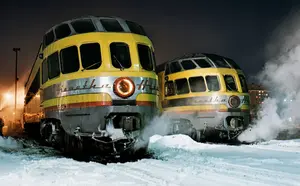
The Milwaukee Road’s Skytop Lounges were ten glass-ended observation cars designed by Milwaukee industrial designer Brooks Stevens for the last Hiawatha equipment sets after World War II. Four parlor-lounges, the Rapids series, came out of the railroad’s own Milwaukee Shops in 1948 for the daytime Twin Cities Hiawatha. Six sleeper-lounges, the Creek series, came from Pullman-Standard (Lot 6775, Plan 4138) that winter for the transcontinental Olympian Hiawatha. The rear was almost ninety percent glass: twenty-seven panes in fifteen shapes, stacked into a solarium that replaced the older Beaver Tail slope. The railroad called them “the finishing touch to a perfect train.”
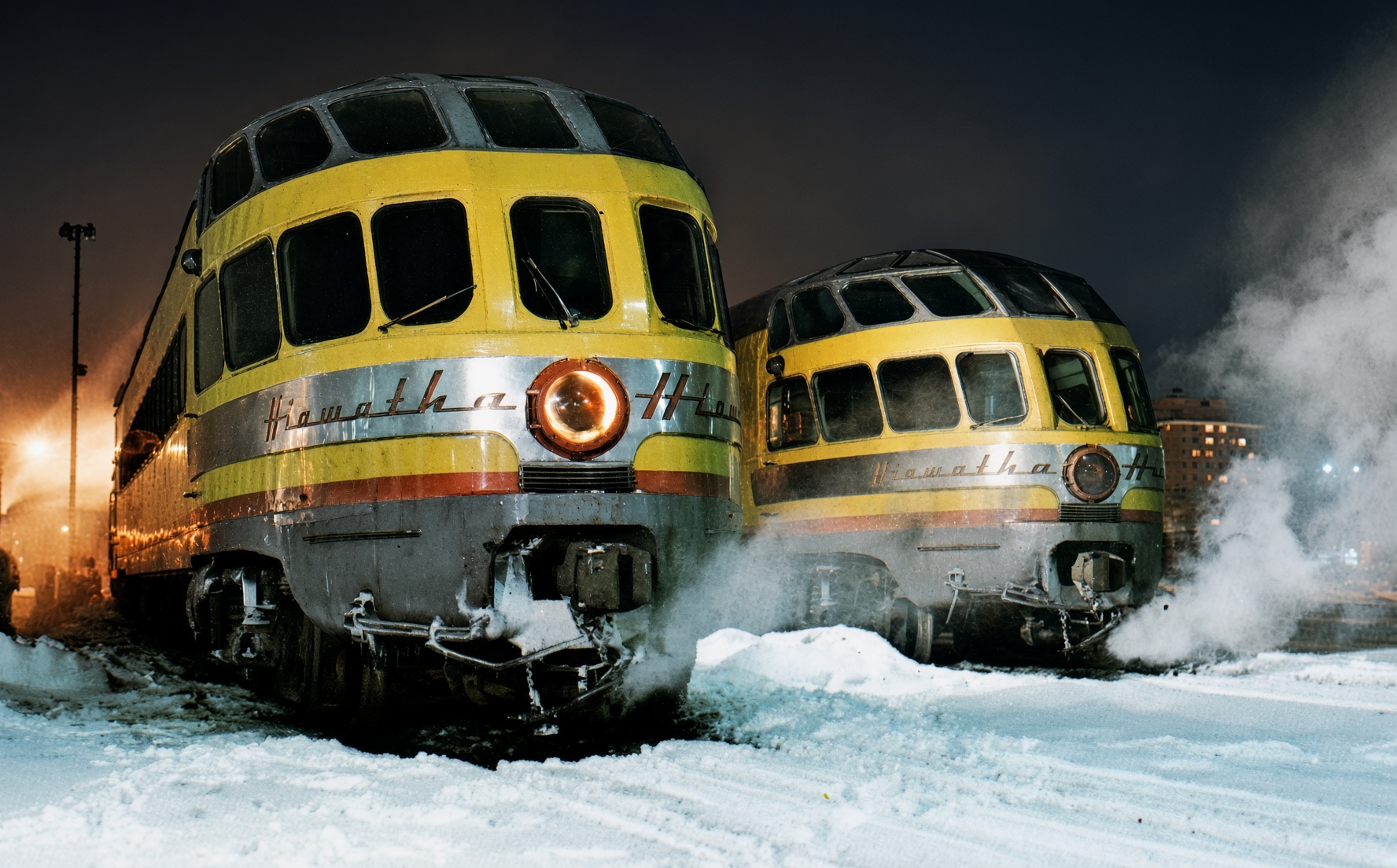
A pair of Milwaukee Road Skytop Rapids-series lounge observations layover in St. Paul, Minnesota, on a bitterly cold night in February 1969. Jim Boyd photo.
On this page: At a glance · Brooks Stevens and the glass end · Rapids parlor-lounges · Creek sleeper-lounges · Service · Roster · Preservation
At a glance
| Item | Detail |
|---|---|
| Fleet | Ten cars. Four parlor-lounges (Rapids). Six sleeper-lounges (Creek) |
| Designer | Brooks Stevens, Milwaukee |
| Parlor-lounges | Milwaukee Shops, 1948. Road numbers 186–189 |
| Sleeper-lounges | Pullman-Standard Lot 6775, Plan 4138, delivered December 1948–January 1949. Road numbers 12, 14–18 (13 omitted) |
| Rapids layout | Drawing room-kitchen, 24 rotating parlor chairs, 12 solarium seats |
| Creek layout | Eight double bedrooms (16 berths), 19 solarium seats |
| Glass end | About 90 percent glass. 27 windows in 15 shapes. No drumhead; oscillating marker; Hiawatha script on the flanks |
| Parlor service | Morning and Afternoon Hiawatha from May 29, 1948. Off the Morning April 1, 1969. Last Milwaukee use January 23, 1970 |
| Sleeper service | Olympian Hiawatha until May 22, 1961. Sold to Canadian National 1964 as Skyview cars |
| Replaced | Beaver Tail parlor-observations of the 1935–42 Hiawatha sets. Beaver Tail has no leaf on this site |
| Not this page | Twin Cities Hiawatha train. Olympian Hiawatha train. Super Dome. Milwaukee 4-8-4 261 |
Layouts and dates from Jim Scribbins, The Hiawatha Story, and Pullman Lot 6775 / Plan 4138. Information compiled September 14, 2026.
Brooks Stevens and the glass end
Otto Kuhler had given the original 1935 Hiawathas their two-tone orange and the Beaver Tail parlor, a sloped closed-end observation with no open platform. After the war the railroad wanted a last new set for the Twin Cities trains and a matching transcontinental. Stevens, a Milwaukee native already working the Olympian Hiawatha as a unit, threw out the Beaver Tail slope and stacked glass to the roof line. The solarium was a greenhouse at 90 mph: curved seating around the perimeter, views up as well as out, and no drumhead. An oscillating rear light sat where other roads hung a sign. Stainless Hiawatha script flanked it on both sides.
The parlor cars were the last observations Milwaukee Shops built. Pullman-Standard took the same Stevens outline and put eight double bedrooms in front of a smaller lounge. Shop-built rears are a tighter bullet; the Pullman cars are a little fuller, with a rear couch about four inches wider, paired bedroom windows, an extra course of glass in the Skytop, and a fluted silver band at the tail that echoed the fluted noses on the Fairbanks-Morse Erie-Builts first assigned to the Olympian. Pullman did not copy Milwaukee’s wood interior paneling.
They are not dome cars. A dome puts a second-story glass blister amidships. The Skytop is an observation whose roof is the glass, at the rear. The dome encyclopedia is dome cars. Milwaukee’s later full-length dome is the Super Dome, Pullman-Standard 1952, ten cars numbered 50–59.
Rapids parlor-lounges: the floor plan
Walk the car from the vestibule (coupled to the train) to the glass:
| From vestibule | Accommodation |
|---|---|
| 1 | Vestibule and side doors |
| 2 | Drawing room-kitchen (private room, typically four seats, with a small pantry) |
| 3 | Men’s and women’s rooms, lockers |
| 4 | Main parlor: 24 deluxe rotating, reclining chairs. Scribbins: “big, comfortable… a pleasure to sink into” |
| 5 | Solarium: 12 seats. Curved sofa around the glass perimeter, meant for sociability as much as for watching the right-of-way. Rear marker and Hiawatha lettering outside |
Parlor-car passengers only. The drawing room-kitchen was the private hire; Friends of the 261 still sell Cedar Rapids that way. There is no sleeping space. These four cars were built for a 421-mile daylight run that was still scheduled under seven hours.
Creek sleeper-lounges: the floor plan
Pullman Plan 4138 put the bedrooms first and cut the lounge to fit the overnight train:
| From vestibule | Accommodation |
|---|---|
| 1 | Vestibule |
| 2 | Eight double bedrooms, 16 berths. Paired windows along the sides |
| 3 | Solarium lounge: 19 seats under the glass. One extra window course versus the parlor cars |
No drawing room. The bedrooms were the revenue space; the Skytop was the after-dinner view across Montana and the Cascades. Road number 13 was skipped. For the Olympian Hiawatha’s first eighteen months the train ran with conventional Pullman compartment-drawing room-observation cars on the rear. The Creek cars arrived December 1948 into January 1949 and finished the Stevens consist.
Where they ran
The Rapids cars went on the Morning and Afternoon Hiawatha on May 29, 1948, thirteen years to the day after the first Hiawatha. They stayed on that Chicago–Twin Cities plant through the Super Dome years and the October 1955 Union Pacific City-train partnership that put Armour Yellow on some Milwaukee passenger cars. Jim Boyd’s St. Paul night shot is February 1969, the last winter they still made both trains. The railroad took the lounges off the Morning on April 1, 1969. The Afternoon kept one until the train itself died on January 23, 1970. That was the end of Skytops in Milwaukee paint on a Milwaukee timetable.
The Creek cars owned the rear of the Olympian Hiawatha from delivery until the railroad discontinued the train on May 22, 1961. In 1964 Milwaukee sold all six, with six Super Domes, to Canadian National. CN called them Skyview lounges, numbered 1900–1905, and ran them on the Ocean and the Scotian (Halifax–Montreal), then briefly on Montreal–Toronto corridor trains, then on Gaspé and Jasper–Prince Rupert assignments. CN cut two of the smallest upper windows next to the big vertical posts. Canadian fire rules wanted a second exit; the Skytops had only the vestibule. CN stored them in the 1970s and disposed of the fleet in 1977.
Roster
Rapids series (parlor-lounge, Milwaukee Shops, 1948)
| No. | Name | Notes |
|---|---|---|
| 186 | Cedar Rapids | Friends of the 261 / Railroading Heritage of Midwest America. Operating, 2026 |
| 187 | Coon Rapids | Withdrawn 1970. Last reported in private storage in Michigan |
| 188 | Dell Rapids | Chapman S. Root, then Museum of Arts and Sciences, Daytona Beach, Florida |
| 189 | Priest Rapids | Scrapped 1970 |
Creek series (sleeper-lounge, Pullman-Standard Lot 6775, Plan 4138)
| MILW | Name | CN | CN name | Notes |
|---|---|---|---|---|
| 12 | Alder Creek | 1900 | Mahone | Scrapped by CN |
| 14 | Arrow Creek | 1901 | Malpeque | Hulk, Milwaukee Road Heritage Center, Montevideo, Minnesota |
| 15 | Coffee Creek | 1902 | Fundy | Iowa Pacific restoration; later Aberdeen, Carolina & Western, North Carolina |
| 16 | Gold Creek | 1903 | Trinity | Hulk, Milwaukee Road Heritage Center, Montevideo |
| 17 | Marble Creek | 1904 | Baddeck | Scrapped |
| 18 | Spanish Creek | 1905 | Gaspe | Scrapped by CN |
Two Creek hulks spent years as part of the SS Lansdowne floating restaurant in Detroit before the Milwaukee Road Historical Association moved them to Montevideo in 2009.
What is left
Cedar Rapids is the car that still moves. The Friends of the 261 acquired it in 1998, finished restoration, and run it as premium space behind Milwaukee Road 4-8-4 261. As of 2026 it is still on that consist. Dell Rapids is a museum piece in Daytona Beach. Coffee Creek is the surviving sleeper in private railroad hands in North Carolina. The Montevideo hulks are the rest of the glass end you can still walk up to. Priest Rapids and three of the Creek cars are gone.
Ten cars, two floor plans, one Stevens outline. The parlors were a daylight parlor on 90-mph Racine Subdivision iron. The sleepers were an overnight view of the Pacific Extension. That is the Skytop: not a dome, not a Beaver Tail, and not a second Hiawatha encyclopedia.
Related reading on American-Rails.com
- Milwaukee Road · Twin Cities Hiawatha · Olympian Hiawatha
- Super Dome · Observation cars · Dome cars · Passenger car types
- Milwaukee Road 4-8-4 261 · Streamliners · Canadian National
Sources
- Scribbins, Jim. The Hiawatha Story. Milwaukee: Kalmbach, 1970; Minneapolis: University of Minnesota Press reprint. Parlor entry May 29, 1948; “finishing touch to a perfect train”; 24 parlor chairs; solarium sofa; Olympian substitutes until Skytop sleepers arrived; Morning lounges off April 1, 1969; Afternoon discontinued January 23, 1970; Olympian Hiawatha discontinued May 22, 1961
- Scribbins, Jim. Milwaukee Road Remembered. Minneapolis: University of Minnesota Press, 2008
- Pullman-Standard Lot 6775, Plan 4138 (Creek series sleeper-lounges). Exterior painting arrangement, Newberry Library / CARLI
- Wisconsin Historical Society, Brooks Stevens Skytop seat note: Rapids series on Twin Cities Hiawathas May 29, 1948; 27 windows in 15 shapes; Creek series Pullman-Standard for Olympian Hiawatha, complete January 1949
- Greenlaw, Christopher C. N. VIA Rail. St. Paul: MBI, 2007 (CN Skyview service and disposal)
- Friends of the 261, Cedar Rapids car page (drawing room-kitchen, 24 parlor chairs; operating 2026). Northstar Railway Historical Society, Northstar News 40, no. 7 (July 2009), Montevideo hulks from SS Lansdowne
- Live American-Rails Hiawatha, Olympian Hiawatha, Super Dome, observation, and Milwaukee 261 pages as linked above
Recent Articles


-
Bessemer & Lake Erie Railroad: "The Bessemer Road"
Sep 15, 26 05:20 PM
 Bessemer & Lake Erie—Bear Creek 1865, Carnegie 1897, U.S. Steel 1901. Ore south from Conneaut, coal north. 2-10-4s, Missabe sister road. CN May 10, 2004. Complete corporate history.
 -
Bangor and Aroostook Railroad: "Serving Northern Maine"
Sep 15, 26 05:05 PM
 Bangor & Aroostook—chartered February 13, 1891, first trains January 1, 1894. Potatoes, paper, Searsport, State of Maine reefers. MM&A 2003, Lac-Mégantic 2013, CP 2020, CPKC today. Complete co…
 -
Baltimore & Ohio Chicago Terminal Railroad: Map and History
Sep 15, 26 03:11 PM
 B&OCT—formed January 6, 1910 to buy Chicago Terminal Transfer. Grand Central, Barr Yard, 78 route-miles. Assigned B&O steam. Complete diesel roster. CSX paper subsidiary, mark BOCT.
 -
The "Alphabet Route" (Railroad): Photos and History
Sep 15, 26 02:53 PM
 Alphabet Route—eight railroads, not one company. P&WV to Connellsville February 11, 1931. Alpha Jets Chicago/St. Louis–New York/Boston. NKP, W&LE, P&WV, WM, Reading, CNJ, L&HR, New Hav…
 -
Milwaukee Road Livestock Operations: Cattle, Dakotas & Montana
Sep 15, 26 02:36 PM
 Milwaukee Road livestock traffic—Dakota and Montana cattle, Iowa hogs, Chicago markets, 28-hour law, head-end stock cars. By 1974 mostly Montana. Rick Burn’s Helena speech. Operations history, not the…
 -
Spirit of Jasper Ride & Dine (2026): Season Pause
Sep 15, 26 02:29 PM
 Spirit of Jasper Ride & Dine in Jasper, Indiana—seated meal on board. Operator: not running public trains for 2026. Depot remains open as a rental. Confirm on spiritofjaspertrain.com.
 -
South Carolina Canal & Rail Road Company: Map and History
Sep 15, 26 01:59 PM
 South Carolina Canal & Rail Road—chartered December 19, 1827. Best Friend of Charleston, 136 miles Charleston–Hamburg October 1833, Aiken inclined plane. South Carolina Railroad 1844, Southern 189…
 -
The Practice of Double-Heading: The Steam Era
Sep 15, 26 01:43 PM
 Doubleheading—two locomotives on the point, each with its own steam crew. Not a rear helper, not diesel MU. How it worked, PRR 1877, mountain grades, and what MU ended.
 -
Mohawk and Hudson Railroad: Map, Pictures, Locomotives
Sep 15, 26 01:20 PM
 Mohawk & Hudson Railroad—New York’s first railroad, chartered April 17, 1826. DeWitt Clinton, inclined planes, Albany & Schenectady 1847, first New York Central May 17, 1853. Complete corporat…
 -
Essex Clipper Dinner Train (2026): Dates, Tickets & What to Expect
Sep 15, 26 01:09 PM
 2026 Essex Clipper Dinner Train in Essex, CT—2.5 hours, four-course meal $129.99, 18+. Fall dates through Oct. 25. Confirm on essexsteamtrain.com.
 -
Camden & Amboy Railroad: Map, History, Photos
Sep 15, 26 12:53 PM
 Camden & Amboy Railroad—chartered February 4, 1830. Joint Companies monopoly with the Delaware & Raritan Canal, John Bull, T-rail. United New Jersey 1872, PRR 999-year lease 1871. Complete corpora…
 -
Cafe Lafayette Dinner Train (2026): Dates, Tickets & What to Expect
Sep 15, 26 12:47 PM
2026 Cafe Lafayette Dinner Train in North Woodstock, NH—2 hours, 20 miles, five-course meal from $125. May–October. Confirm on nhdinnertrain.com. -
Christmas Train Ride Locations (2026): A Complete Guide
Sep 15, 26 10:47 AM
 2026 Christmas train rides by state—Santa, North Pole Express, and holiday trains. Not Polar Express. State guides and product pages. Confirm dates on each railroad.
 -
Baltimore & Ohio Railroad: Linking 13 Great States With The Nation
Sep 15, 26 10:22 AM
 Baltimore & Ohio Railroad—first U.S. common carrier, chartered February 28, 1827. Wheeling 1853, Chicago 1874, C&O control 1963, Chessie 1973, into CSX April 30, 1987. Complete corporate history.
 -
Delaware & Hudson Railway: The Bridge Line
Sep 15, 26 09:59 AM
 Delaware & Hudson Railway—Wurts brothers canal 1823, gravity railroad 1829, Stourbridge Lion, Bridge Line to Montreal. Guilford 1984, CP 1991, NS south line 2015, CPKC north.
 -
Delaware & Hudson Diesel Roster (All-Time)
Sep 15, 26 12:17 AM
 All-time Delaware & Hudson diesel roster—Alco S-2s through C-628s and PA-4s, GE U-boats, Baldwin RF-16s, EMD SD45s and GP38-2/GP39-2s. Serials, dates, dispositions.
 -
Granite Railway, Our Country's First Railroad
Sep 14, 26 11:28 PM
 Granite Railway of Quincy, Massachusetts—chartered March 4, 1826, opened October 7, 1826. Gridley Bryant, 5-foot gauge, horses, Bunker Hill Monument stone. First commercial U.S. railroad.
 -
Milwaukee Road Skytop Lounges: History, Specs & Floor Plans
Sep 14, 26 11:09 PM
 Milwaukee Road Skytop observation cars—Brooks Stevens, 1948. Four Rapids parlor-lounges from Milwaukee Shops, six Creek sleeper-lounges from Pullman-Standard. Floor plans, roster, preservation.
 -
West Virginia Christmas Train Rides (2026): A Complete Guide
Sep 14, 26 11:02 PM
2026 West Virginia Christmas trains—Potomac Eagle North Pole Express in Romney and Christmas at Cass. Not Polar Express. Elkins Polar is not listed for 2026. -
Railroads Of Today: Class I Map, PSR & the 2026 Industry
Sep 14, 26 10:30 PM
 U.S. freight rail in 2026—six Class I railroads on a nearly 140,000-mile network. PSR as everyday practice, how the STB works, traffic mix, short lines and regionals.
 -
Railroad History (USA): Timeline, Facts & How the Network Was Built
Sep 14, 26 10:03 PM
 Full U.S. railroad history hub—origins and inventors, Golden Age peak mileage, Civil War and transcontinental, streamliners, ICC regulation, Penn Central and Conrail, Staggers Act, PSR, and today’s Cl…
 -
Railroads In The 2020s: CPKC, East Palestine & the UP–NS Case
Sep 14, 26 09:51 PM
 U.S. railroads 2020–2026—Class I mileage 91,773 in 2020. COVID traffic drop, CPKC April 14 2023, East Palestine Feb. 3 2023, UP–NS $85 billion case still before the STB.
 -
Railroads In The 2010s: PSR, Coal’s Decline & Positive Train Control
Sep 14, 26 03:51 PM
 U.S. railroads 2010–2020—Class I mileage 95,573 to 91,773. Buffett closed BNSF Feb. 12 2010, Harrison at CP June 29 2012 and CSX 2017, PTC deadline Dec. 31 2018.
 -
Virginia Christmas Train Rides (2026): A Complete Guide
Sep 14, 26 03:46 PM
 2026 Virginia Christmas trains—Virginia Scenic Railway Santa Express from Staunton, about 60 minutes. Confirm dates. Not Polar Express.
 -
MARC Train: Maryland Commuter Rail History, Lines & Roster
Sep 14, 26 01:16 PM
 MARC Train history—Maryland Rail Commuter 1984, B&O and PRR corridors, Penn/Camden/Brunswick lines, Silver Spring 1996, all-time locomotive roster.
 -
Railroads In The 2000s: Merger Freeze, Wisconsin Central & Buffett
Sep 13, 26 07:57 AM
 U.S. railroads 2000–2010—Class I mileage 99,250 to 95,573. STB merger freeze March 17 2000, CN–WC Oct. 9 2001, BNSF Railway Jan. 24 2005, Buffett Nov. 3 2009.
 -
Railroads In The 1990s: Mega-Mergers, Conrail’s Split & the STB
Sep 13, 26 12:13 AM
 U.S. railroads 1990–2000—Class I mileage 119,758 to 99,250. BNSF Sept. 22 1995, UP–SP Sept. 11 1996, Conrail split June 1 1999, ICC Termination Dec. 29 1995.
 -
Railroads In The 1980s: Staggers, Mega-Mergers & Conrail’s IPO
Sep 12, 26 11:12 PM
 U.S. railroads 1980–1990—Class I mileage 164,822 to 119,758. Staggers Oct. 14 1980, CSX and Norfolk Southern, UP–Missouri Pacific–Western Pacific, Conrail IPO March 26 1987.
 -
Wabash Class O-1 4-8-4s: History, Roster & Specifications
Sep 12, 26 11:01 PM
 Wabash Class O-1 4-8-4s—Baldwin 1930–31, twenty-five engines 2900–2924. Fast freight, complete roster, specifications. None preserved.
 -
Staggers Rail Act of 1980: Statute, Contract Rates & the ICC
Sep 10, 26 11:23 PM
 Staggers Rail Act, Pub. L. 96-448, signed October 14, 1980. Harley Staggers, S.1946, contract rates, 180% variable-cost test, abandonments, short lines.
 -
Rock Island E8A 652: Bicentennial Independence Paint & History
Sep 10, 26 10:42 PM
 Rock Island E8A 652—EMD March 1952, serial 15199. 20th Century Railroad Club Independence bicentennial scheme, Peoria and Quad Cities Rockets, Midland Railway, Manly Junction Museum.
 -
Vermont Christmas Train Rides (2026): A Complete Guide
Sep 10, 26 10:37 PM
2026 Vermont Christmas trains—Okemo Valley Holiday Express from Chester Depot Dec. 19–20. Polar is Burlington Dec. 5–6 only. -
Railroads In The 1970s: Penn Central, Amtrak & Conrail
Sep 10, 26 10:18 AM
 U.S. railroads 1970–1980—196,479 miles at the decade’s start. Penn Central bankruptcy June 21 1970, Amtrak May 1 1971, 3R/4R Acts, Conrail April 1 1976, Rock Island 1975, Milwaukee 1977.
 -
Railroads In The 1960s: Mergers, Passenger Collapse & Penn Central
Sep 10, 26 10:03 AM
 U.S. railroads 1960–1970—207,334 to 196,479 miles. Erie Lackawanna 1960, C&O–B&O 1963, N&W–Nickel Plate 1964, SCL 1967, Penn Central Feb. 1 1968.
 -
South Carolina Christmas Train Rides (2026): A Complete Guide
Sep 10, 26 08:36 AM
 2026 South Carolina Christmas trains—South Carolina Railroad Museum Santa Train in Winnsboro. Confirm December dates. Not Polar Express. Drop light-festival padding.
 -
Steam Locomotive Feedwater Heaters: Elesco, Coffin & Worthington
Sep 10, 26 08:29 AM
 Steam locomotive feedwater heaters—open Worthington vs closed Elesco and Coffin. How they work, how to identify them on a smokebox, and why not every engine had one.
 -
Oregon Christmas Train Rides (2026): A Complete Guide
Sep 10, 26 08:22 AM
2026 Oregon Christmas trains—Portland Holiday Express, Garibaldi Candy Cane Express, Sumpter Valley Christmas Trains Dec. 11–13. Polar is Mount Hood. -
Lake Shore & Michigan Southern: Map, History, Timetables
Sep 10, 26 08:12 AM
 Lake Shore & Michigan Southern Railway—Erie & Kalamazoo 1833, Michigan Southern to Chicago 1852, LS&MS April 6 1869, Vanderbilt, Ashtabula 1876, NYC merger Dec. 22 1914. 1910 map and Official Guide.
 -
Big Four Route (CCC&StL): Map, History
Sep 10, 26 12:19 AM
Cleveland, Cincinnati, Chicago & St. Louis Railway—Bee Line 1868, Ingalls’s first Big Four 1880, CCC&StL June 30, 1889, NYC lease Feb. 1, 1930. 1910 and 1930 maps, what still runs. -
Railroads In The 1950s: Diesel, the Interstate & Passenger Collapse
Sep 10, 26 12:15 AM
 U.S. railroads 1950–1960—223,779 to 211,459 miles. Interstate June 29, 1956, dieselization, passenger collapse, TOFC, 1957–58 recession, NYO&W 1957, N&W–Virginian 1959.
 -
New Jersey Christmas Train Rides (2026): A Complete Guide
Sep 10, 26 12:06 AM
 2026 New Jersey Christmas trains—Black River & Western Santa Express from Flemington and Pine Creek Christmas trains in Wall Township. Polar is Whippany and Phillipsburg.
 -
New Mexico Christmas Train Rides (2026): A Complete Guide
Sep 09, 26 11:57 PM
 2026 New Mexico Christmas trains—Cumbres & Toltec Santa’s Holiday Express from Chama Dec. 5–6 (and Antonito, Colo., Dec. 12–13). Coach $25/$15. Not Polar Express.
 -
Grand Trunk Railway: Map, History, Timetables
Sep 09, 26 11:47 PM
 Grand Trunk Railway of Canada—charter Nov. 10, 1852, Montreal–Toronto 1856, Portland, Sarnia, Victoria Bridge, St. Clair Tunnel 1891, Great Western 1882, GTPR, CN Jan. 20, 1923. 1893 map and Official…
 -
Troop Trains In World War II: Sleepers, Kitchen Cars & Movements
Sep 09, 26 11:42 PM
 WWII U.S. troop trains—almost 44 million armed-services passengers, Pullman troop sleepers, ACF kitchen cars, hospital trains, monthly movement tables 1942–45. Not the Military Railway Service. ODT an…
 -
Railroads In The 1940s: War Traffic, Last Steam & the Diesel Flood
Sep 09, 26 11:37 PM
 U.S. railroads 1940–1950—233,670 to 223,779 miles. World War II as the decade’s center, last new steam, diesel flood after V-J Day, 1945 car orders, California Zephyr 1949.
 -
Railroads In World War II: ODT, Record Traffic & Private Operation
Sep 09, 26 03:00 PM
 U.S. railroads in World War II—Lend-Lease freight, Pearl Harbor, Office of Defense Transportation, 1944 peak ~740 billion ton-miles, Dec. 1943–Jan. 1944 seizure. Private operation, not a USRA sequel.
 -
Montana Christmas Train Rides (2026): A Complete Guide
Sep 09, 26 02:54 PM
2026 Montana Christmas trains—Charlie Russell Chew Choo North Pole Adventure from Hanover/Lewistown, Nov. 27–Dec. 19, $71, about 1.5 hours. Not Polar Express. -
Railroads In The 1930s: Depression, Streamliners & the FT
Sep 09, 26 09:32 AM
 U.S. railroads 1930–1940—249,052 to 233,670 miles. Section 77, Eastman, Motor Carrier Act, M-10000 and Pioneer Zephyr 1934, EMC FT 1939. Decade frame, not the streamliner encyclopedia.
 -
Sugar Cane Train (Lahaina): LK&P History, Roster & 2026 End
Sep 09, 26 08:19 AM
 Lahaina, Kaanapali & Pacific Sugar Cane Train—3-foot tourist line 1970–2014. Anaka, Myrtle, 2023 and 2025 fires, September 2026 scrapping. Roster, Hahakea trestle, Pioneer Mill corridor.
 -
Massachusetts Christmas Train Rides (2026): A Complete Guide
Sep 09, 26 08:16 AM
 2026 Massachusetts Christmas trains—Shelburne Falls Moonlight Magic Friday Nov. 27; Edaville Festival of Lights in Carver. Polar is Cape Cod Central in Buzzards Bay.