Railroads In The 1960s: Mergers, Passenger Collapse & Penn Central
Last revised: September 10, 2026
By: Adam Burns
The 1960s opened on the last regular steam of a major eastern trunk and closed on a merger that was already coming apart. First track stood at 207,334 miles in 1960 and 196,479 in 1970. Freight still held about 44 percent of intercity tonnage when the decade began; passengers were already down to about 27 percent of intercity travel. The Interstate was being poured. Section 13a of the Transportation Act of 1958 gave the ICC a way to take trains off. Roads that had talked combination in the 1950s actually merged: Erie Lackawanna, Chesapeake & Ohio over the Baltimore & Ohio, Norfolk & Western with the Nickel Plate and Wabash, Seaboard Coast Line, Chicago Great Western into the North Western, and, on February 1, 1968, Pennsylvania and New York Central as Penn Central.

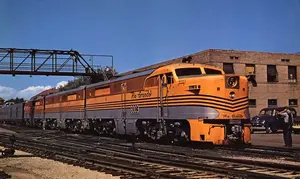
Santa Fe PA-1 No. 69-L lays over at Barstow, California, circa 1969, near the end of the unit’s career. American-Rails.com collection.
On this page: At a glance · What the 1950s left · Last steam, 1960 · Erie Lackawanna · The merger wave · Penn Central, 1968 · Passenger trains under 13a · Second-generation diesels · Into the 1970s
At a glance
| Item | Detail |
|---|---|
| Miles of first track, 1960 | 207,334 |
| Miles of first track, 1970 | 196,479 |
| 1955 (already past) | 211,459 (Stover / ICC, on the 1950s page) |
| Peak (already past) | 254,037 in 1916 |
| Freight share of intercity tonnage, 1960 | About 44 percent (H. Roger Grant). Down from about 68 percent in 1944 |
| Intercity passenger share, 1960 | About 27 percent (Grant). Down from about 74 percent in 1944 |
| Passengers carried, 1964 | About 298 million (from 770 million in 1946) |
| Commuter trains remaining, 1968 | On the order of 500 (from more than 2,500 cutbacks by 1955) |
| N&W last regular steam | May 6–7, 1960 |
| Erie Lackawanna | October 17, 1960. ICC approval September 13 |
| New Haven bankruptcy | July 7, 1961. Included in Penn Central January 1, 1969 |
| C&O control of B&O | February 4, 1963. ICC approval December 31, 1962 |
| N&W–Nickel Plate–Wabash | October 16, 1964 (with Pittsburgh & West Virginia and Akron, Canton & Youngstown) |
| Seaboard Coast Line | Atlantic Coast Line and Seaboard Air Line, July 1, 1967 |
| Penn Central | February 1, 1968, 12:01 a.m. |
| C&NW–Chicago Great Western | July 1, 1968 |
| BN approval | ICC November 30, 1967. Consummation March 2, 1970 is the next decade |
| Metroliner revenue | January 16, 1969 |
| Closer | Penn Central already failing. Burlington Northern and Amtrak open the 1970s |
Mileage continues the first-track series used on the 1950s page. Information compiled September 10, 2026.
What the 1950s left
The decade inherited a diesel railroad, a highway competitor with federal money, a piggyback car pool, and a passenger plant that did not pay. John Stover’s first-track count had already fallen from 223,779 miles in 1950 to 211,459 in 1955. The Transportation Act of August 12, 1958, had given the ICC section 13a authority over passenger-train discontinuance and a guaranteed-loan program. Norfolk & Western had taken the Virginian on December 1, 1959. The New York, Ontario & Western had run its last trains on March 29, 1957. Pennsylvania and New York Central had been talking merger since 1957. Erie and the Delaware, Lackawanna & Western had been talking since the mid-1950s. Those dates are the 1950s. This decade is when the combinations closed, and when 13a became a slaughter.
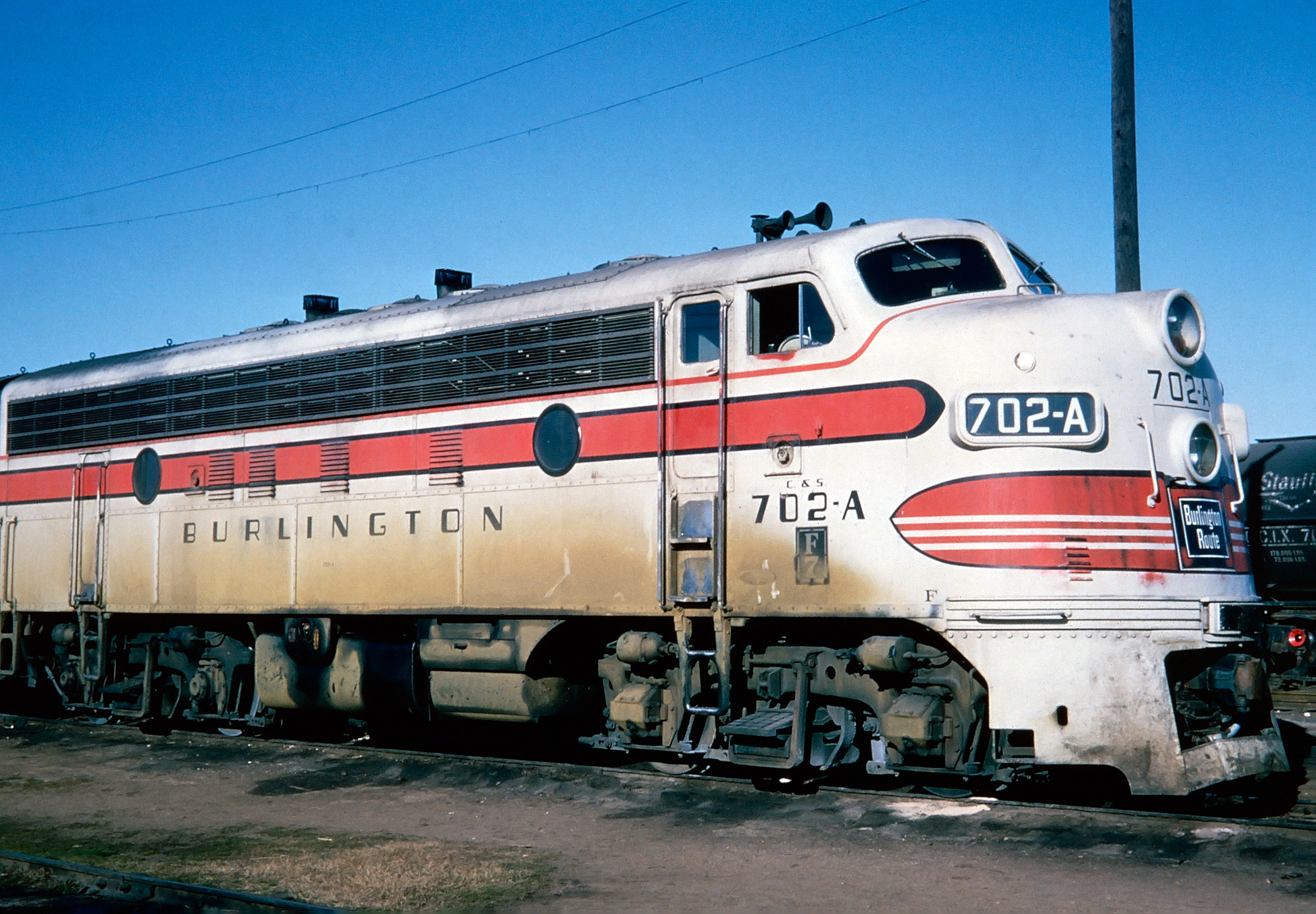
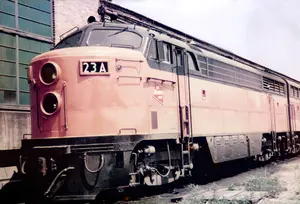
Colorado & Southern (Burlington) F7A No. 702-A lays over in Denver, Colorado, in the early 1960s. American-Rails.com collection.
Last steam on a major eastern trunk
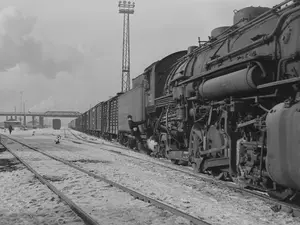
On May 6, 1960, Norfolk & Western Y6b 2190 worked a mine run in southern West Virginia. In the early hours of May 7, the fire came out of S1a switcher 291 at Williamson. That is the last regular steam on a major eastern trunk. Grand Trunk Western had already run its last scheduled steam passenger, Durand to Detroit, on March 27, 1960. O. Winston Link’s night photographs of N&W steam are his page. Reading’s Iron Horse Rambles, T-1 4-8-4s on the main, ran through October 17, 1964; that program is the Rambles page. Rio Grande narrow-gauge freight on the San Juan Extension lasted until 1968. Steam as a Class I tool was over. The remnant was tourist, short line, and three-foot leftover.
Erie Lackawanna, October 17, 1960
The Interstate Commerce Commission approved the Erie and Lackawanna merger on September 13, 1960. The Erie-Lackawanna Railroad began on October 17: 3,031 miles, Hoboken and Jersey City to Chicago via Buffalo, headquarters in Cleveland’s Midland Building. The Delaware & Hudson had dropped out of the three-way talks on April 13, 1959. The company encyclopedia is Erie Lackawanna; Erie is its own page, Lackawanna its own. The 1960s fact is that the first of the defensive Northeastern combinations actually ran, and that it did not fix the map. Anthracite was already gone. The Interstate was already funded. Maybrook still paid, until Penn Central and a fire in the next decade took it away.
The merger wave
Chesapeake & Ohio won control of the Baltimore & Ohio. The ICC approved on December 31, 1962. C&O took direct control on February 4, 1963. New York Central had intervened and lost; that loss is one of the roads that sent Central into the Pennsylvania’s arms. The B&O company page is Baltimore & Ohio; C&O is Chesapeake & Ohio. Chessie System as a holding company is 1973, the next decade.
Norfolk & Western, already holding the Virginian, took the Nickel Plate Road, the Wabash, the Pittsburgh & West Virginia, and the Akron, Canton & Youngstown on October 16, 1964. The Nickel Plate encyclopedia is its page. N&W had been a Pocahontas coal road. After 1964 it was also a Chicago–Buffalo and St. Louis speedway. That is the combination the 1950s talks had pointed at. It is not the 1982 Norfolk Southern merger.
Atlantic Coast Line and Seaboard Air Line became the Seaboard Coast Line on July 1, 1967. Chicago Great Western disappeared into Chicago & North Western on July 1, 1968. Southern Railway took the Central of Georgia in 1963. The Hill Lines—Great Northern, Northern Pacific, Chicago, Burlington & Quincy, and Spokane, Portland & Seattle—won ICC approval on November 30, 1967, after a 1961 application, a court fight, and a 1967 reopening that gave the Milwaukee Road access at Portland. Burlington Northern, Inc. was the name from April 1968. The four railroads became one at 12:01 a.m. on March 2, 1970. That morning is the next decade. The approval is this one. The company is Burlington Northern.
Union Pacific and Rock Island agreed to merge in 1964. The ICC sat on the case through the rest of the decade. By the time the agency blessed a version of it in 1974, UP no longer wanted the property. Rock Island’s bankruptcy is March 17, 1975; the liquidation is 1980. Those dates are the 1970s and after. The 1960s fact is the application, and the years the plant spent waiting. The company is Chicago, Rock Island & Pacific.
Penn Central, February 1, 1968
The Pennsylvania Railroad and the New York Central Railroad became the Penn Central Transportation Company at 12:01 a.m. on Thursday, February 1, 1968. The ICC had approved the marriage in January. Headquarters were at 6 Penn Center Plaza, Philadelphia. The combined system was on the order of 20,500 route-miles. Stuart Saunders came from the Pennsylvania. Alfred Perlman came from the Central. The computers did not talk. The operating rules did not match. The freight did not move. The company encyclopedia is Penn Central; the parents are Pennsylvania and New York Central.
The New York, New Haven & Hartford had been in bankruptcy since July 7, 1961. The ICC made inclusion in Penn Central a condition. The New Haven entered on January 1, 1969. That inclusion handed PC a passenger-heavy New England railroad and, at Maybrook, a freight gateway the merged company no longer needed to short-haul itself by using. Erie Lackawanna felt the loss. The New Haven encyclopedia is its page.
Penn Central posted numbers that looked like a railroad for a few quarters and then did not. The bankruptcy filing is June 21, 1970. That afternoon is the next decade’s center. This decade owns the merger that made it possible.
Passenger trains under 13a
Section 13a let a railroad file to discontinue an interstate passenger train with the ICC, not a thicket of state commissions. The 1958 act is a 1950s date. The docket is this decade’s. Named trains came off by the dozen. H. Roger Grant put railroads’ intercity passenger share at about 27 percent in 1960. About 298 million passengers were carried in 1964, against about 770 million in 1946. Commuter service, more than 2,500 trains already cut by 1955, was down to on the order of 500 by 1968. The named-train encyclopedias stay on Streamliners.
New York Central took the 20th Century Limited off after the run of December 2–3, 1967, weeks before Penn Central. Santa Fe still fielded the Super Chief; Union Pacific still fielded the Cities. They could not carry the industry. Congress passed the High Speed Ground Transportation Act in 1965. Penn Central’s Metroliners entered revenue service between New York and Washington on January 16, 1969. TurboTrains followed on the New Haven Shore Line. Those were federal experiments on a collapsing passenger map, not a revival. The Rail Passenger Service Act is October 30, 1970. Amtrak Day is May 1, 1971. Both open the next decade.
Second-generation diesels
The F-unit and the first Geeps had finished steam. This decade bought hood units with more horsepower: General Electric’s U25B from 1960, Electro-Motive’s GP30 from 1961, then GP35, SD40, SD45, and the rest of the second-generation catalog. Alco’s Century series sold against them and then Alco left the locomotive business. Cab units went to secondary trains, commuter pools, and scrap. The model directories are on the diesel hub. The 1960s fact is that the road-switcher became the default road engine while the passenger fleet that still needed an E or a PA was already on the 13a docket.
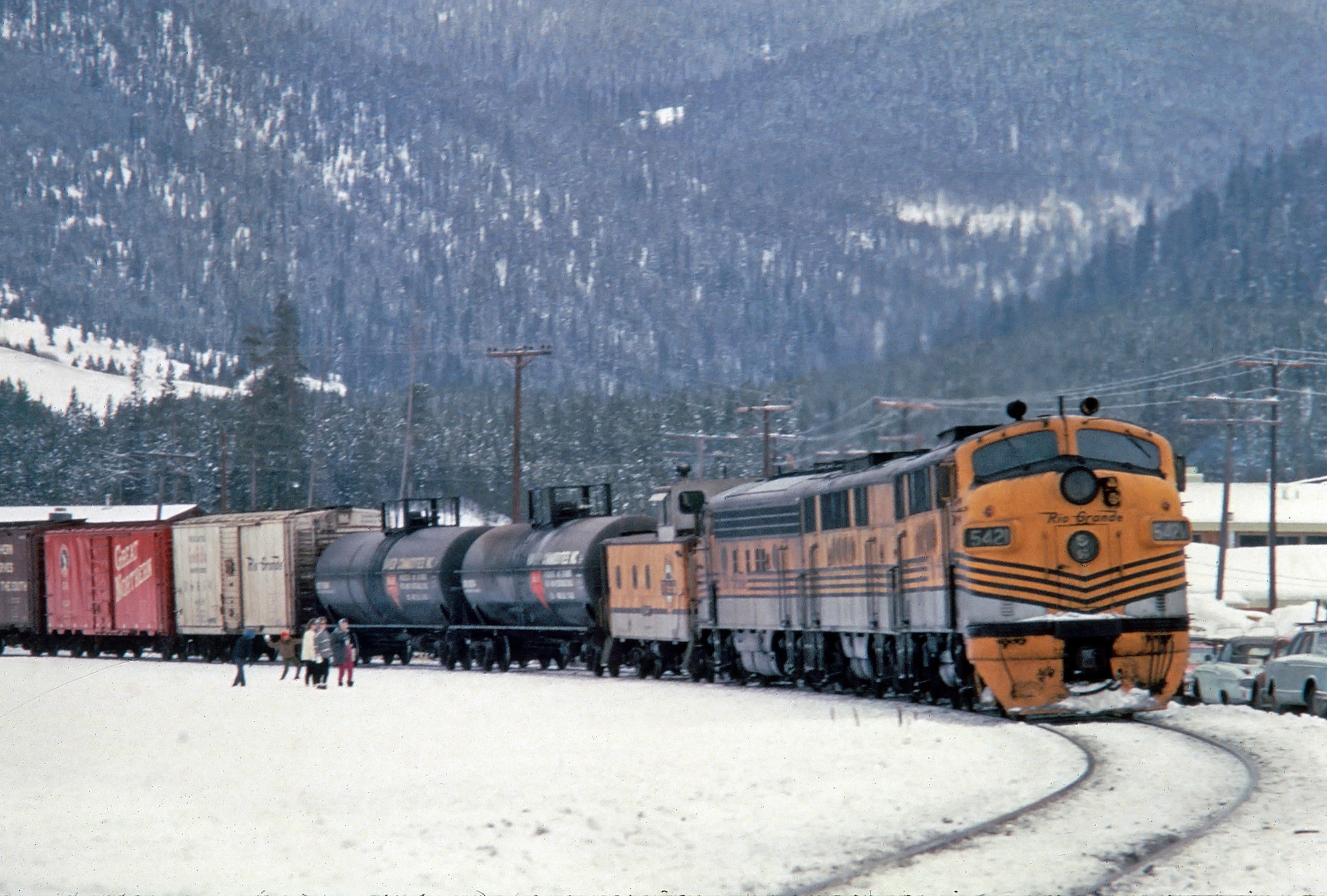
A Rio Grande A-B set of FTs, with an F7A, shoves an eastbound freight at Winter Park, Colorado, during the 1960s. Out of view at left is the west portal of Moffat Tunnel. American-Rails.com collection.
Into the 1970s
The map at the end of the decade was a merger map with a smaller plant. First track had gone from 207,334 miles to 196,479. The names that had been the 1950s timetable—Pennsylvania, New York Central, Erie, Lackawanna, Atlantic Coast Line, Seaboard Air Line, Chicago Great Western, Nickel Plate, Wabash—were lettering on other companies. Penn Central was already failing. The Hill Lines were a week from becoming Burlington Northern. The passenger network was a remnant waiting for a federal corporation.
On March 2, 1970, Burlington Northern began. On June 21, Penn Central’s board voted to file. On May 1, 1971, Amtrak took the intercity trains the private companies still ran. The 3R Act, the 4R Act, Conrail, Rock Island’s bankruptcy, and the Milwaukee Road’s are Railroads In The 1970s. The 1960s left them the combinations, the 13a docket, and a Northeastern giant that could not pay its bills.
Related reading on American-Rails.com
- Railroad History (USA) · Railroads In The 1950s · Railroads In The 1970s
- Penn Central · Pennsylvania · New York Central
- Erie Lackawanna · Erie · Lackawanna · New Haven
- Burlington Northern · Nickel Plate · Rock Island
- Chesapeake & Ohio · Baltimore & Ohio
- Streamliners · Diesel locomotives · Reading Iron Horse Rambles · O. Winston Link
- Amtrak (1971) · Conrail (1976) · Staggers Act (1980)
Sources
- Stover, John F. The Routledge Historical Atlas of the American Railroads. New York: Routledge, 1999. First-track peak 254,037 (1916); 211,459 (1955). 1960 and 1970 first-track 207,334 and 196,479 continue that series as used on the live 1960s/1970s statistics block
- Grant, H. Roger. Erie Lackawanna: Death of an American Railroad, 1938–1992. Stanford: Stanford University Press, 1994. Intercity freight share about 44% (1960); passenger share about 27% (1960); EL formation and Maybrook
- Loving, Rush, Jr. The Men Who Loved Trains. Bloomington: Indiana University Press, 2006. Penn Central, Saunders, Perlman
- Daughen, Joseph R., and Peter Binzen. The Wreck of the Penn Central. Boston: Little, Brown, 1971
- ICC: Erie–Lackawanna approval September 13, 1960; operations October 17, 1960. C&O–B&O approval December 31, 1962; control February 4, 1963. N&W–Nickel Plate–Wabash October 16, 1964. ACL–SAL as Seaboard Coast Line July 1, 1967. Penn Central February 1, 1968. New Haven inclusion January 1, 1969. Hill Lines approval November 30, 1967
- New Haven bankruptcy, July 7, 1961. Chicago Great Western into C&NW, July 1, 1968
- N&W last regular steam, May 6–7, 1960 (Norfolk & Western Historical Society; Kenneth L. Miller). Grand Trunk Western last scheduled steam passenger, March 27, 1960
- High Speed Ground Transportation Act, 1965. Metroliner revenue service, January 16, 1969
- 20th Century Limited, last run December 2–3, 1967
- Transportation Act of 1958, Public Law 85-625, August 12, 1958, section 13a (1950s statute; 1960s docket)
- Welsh, Joe, Kevin Holland, and Bill Howes. The Cars of Pullman. Minneapolis: Voyageur Press, 2010. Passenger counts in the 1950s inheritance
- Reading Iron Horse Rambles, last official trip October 17, 1964
- UP–Rock Island merger application, 1964; ICC delay through the decade (Schneider, Rock Island Requiem)
Recent Articles


-
Missouri-Kansas-Texas Railroad (Katy): Map, History, Rosters
Oct 27, 26 11:02 PM
 History of the Missouri-Kansas-Texas, the Katy. The race into Indian Territory, Gould, the 1923 railroad, the Texas Special, and the 1988 sale. Steam and diesel rosters are linked.
-
Soo Line Diesel Roster (All-Time)
Oct 27, 26 10:55 PM
 All-time diesel roster of the Soo Line and the Wisconsin Central. 786 locomotives, each frame once. Cab units, Geeps, the Milwaukee Road engines, and the SD60s. The South Shore's 24 stay on that page.
-
Soo Line Steam Roster (Built Since 1900)
Oct 27, 26 10:49 PM
 Soo Line and Wisconsin Central steam locomotives built since 1900. Consolidations, Mikados, Pacifics, 21 Mountains, and four Lima 4-8-4s.
-
Soo Line Railroad: Map, Logo, History, Rosters
Oct 27, 26 10:24 PM
 The Soo Line, from the flour millers' railroad around Chicago to the Sault, the Wisconsin Central, and the Milwaukee Road. Steam quantity 422. Diesels 786. Canadian Pacific took full control in 1990.
-
Minneapolis, Northfield and Southern Railway: Map, History, Rosters
Oct 27, 26 10:32 AM
 The Minneapolis, Northfield & Southern, the Dan Patch Line that became a Twin Cities belt. Steam, gas-electric mules, motor cars, and the 22 diesels, through the Soo Line.
-
Minneapolis & St. Louis Diesel Roster (All-Time)
Oct 27, 26 10:27 AM
 All-time diesel roster of the Minneapolis & St. Louis. 97 locomotives, each frame once. Switchers from 1938, 35 RS-1s, the FT and F-unit cabs, two SD7s, and 23 GP9s. Builder numbers included.
-
Minneapolis & St. Louis Steam Roster (Post 1900)
Oct 27, 26 10:25 AM
 Minneapolis & St. Louis steam locomotives built since 1900. Moguls, Consolidations, 35 Mikados, and five Pacifics.
-
Minneapolis and St Louis Railway: "The Peoria Gateway"
Oct 27, 26 09:52 AM
 The Minneapolis & St. Louis, the Tootin' Louie, from the 1870 charter to the Peoria Gateway and the Chicago & North Western sale on November 1, 1960.
-
Alco "PA" Locomotives: Restoration, Specs, Engine, Rosters
Oct 27, 26 12:12 AM
 Alco's PA passenger cab, 297 locomotives built from 1946 to 1953. The 244 engine, the production roster, the Delaware & Hudson PA-4s, and Nickel Plate Road 190.
-
Milwaukee Road Diesel Roster: (All Time)
Oct 26, 26 01:44 PM
 All-time diesel roster of the Milwaukee Road. 1,208 locomotives, each frame once. Alco, Baldwin, Davenport, EMD, Fairbanks-Morse, General Electric, and Whitcomb, with builder numbers.
-
Milwaukee Road Steam Roster (All-Time): Post-1900
Oct 26, 26 01:38 PM
 Milwaukee Road steam locomotives built since 1900. Prairies, Mikados, the N-class articulateds, the S-class 4-8-4s, and the Hiawatha Atlantics and Hudsons. Quantity column 1,974. Unique frames 1,951.
-
Milwaukee Road: Map, Electrification, Logo, History
Oct 26, 26 01:20 PM
 The Milwaukee Road, from the Milwaukee & Mississippi of 1850 to the Pacific Coast Extension, the Hiawathas, and the Soo Line sale. Why Lines West should have stayed.
-
Lake Superior & Ishpeming Railroad: Map, Roster, History
Oct 25, 26 11:38 PM
 Lake Superior & Ishpeming Railroad, reporting mark LSI, from the Marquette Range to the Presque Isle ore dock. The 1954 steam list and the diesels the railroad owned.
-
Kansas City Southern Steam Roster (Built Since 1900)
Oct 25, 26 09:09 PM
 Steam locomotives of the Kansas City Southern built since 1900, with the Louisiana & Arkansas and the Texas company.
-
Kansas City Southern Diesel Roster (Built New)
Oct 25, 26 11:46 AM
All-time diesel roster of the Kansas City Southern. E units, F units, Geeps, SD40s through SD70ACes, Fairbanks-Morse, Baldwin, Alco, and General Electric, with serials and order numbers. -
Kansas City Southern Railway: Map, Photos, History
Oct 25, 26 12:24 AM
 The Kansas City Southern, from Arthur Stilwell's Gulf line to Canadian Pacific Kansas City on April 14, 2023. Steam and diesel rosters, the Southern Belle, and the Louisiana & Arkansas.
-
Indiana Harbor Belt Diesel Roster (All-Time)
Oct 25, 26 12:17 AM
 All-time diesel roster of the Indiana Harbor Belt. 202 locomotive frames, each counted once. NW2s, SW7s, SW1500s, road switchers, and gensets. Slugs and boosters are outside the count.
-
Indiana Harbor Belt Steam Roster (Built Since 1900)
Oct 25, 26 12:13 AM
 Steam locomotives of the Indiana Harbor Belt built since 1900. 182 engines, each counted once. 0-6-0s, 2-6-0s, 0-8-0s, and 2-8-2s. The three U-4a switchers are three-cylinder Brooks engines of 1927.
-
Indiana Harbor Belt Railroad: Map, Rosters, History
Oct 25, 26 12:00 AM
 Indiana Harbor Belt, the inner belt across the Calumet, from the East Chicago Belt of May 16, 1896. Renamed June 29, 1907. Still operating, headquarters Hammond. Steam roster is the companion, 182 loc…
-
NYC's "P Motor" Electric Locomotives
Oct 24, 26 11:43 PM
 New York Central P motors: 22 Alco-GE 2-C+C-2 electrics, Cleveland Union Terminal 1050–1071, class P-1a. 3,030 hp one-hour on 3,000-volt DC catenary, then 660-volt third rail as P-2a and P-2b.
-
Illinois Terminal Car Roster
Oct 24, 26 11:40 PM
 Illinois Terminal cars. Mainline motors, the 1948 streamliners, sleepers, Alton and Valley Division cars, express motors, and the line cars rebuilt from pull cars.
-
Illinois Terminal Diesel Roster
Oct 24, 26 09:31 PM
 All-time Illinois Terminal diesels, 62 frames. Alco S-2s and RS-1s, EMD switchers, GP7s, SD39s, GP38-2s, and the two GP20s. Serial numbers from the 1989 roster.
-
Illinois Terminal Electric Locomotives
Oct 24, 26 08:22 PM
 Illinois Terminal electric locomotives, 57 frames. Class A through Class D, the Decatur-built motors, and the battery locomotives. Class D is the same five Class C frames, rebuilt.
-
Illinois Terminal Steam Roster
Oct 24, 26 07:37 PM
 Illinois Terminal steam locomotives, 36 frames. Baldwin Moguls, three Class 30 Mikados, Florida East Coast 0-8-0s, and 2-6-0 No. 21, the last fire on June 30, 1950.
-
Illinois Terminal Railroad: Map, Roster, Photos, History
Oct 24, 26 07:32 PM
Illinois Terminal, McKinley's Illinois Traction System, from the Danville coal towns to St. Louis. The McKinley Bridge, the sleeping cars, the 1937 break with the power company, the 1948 streamliners… -
Southern Railway Diesel Roster (All-Time)
Oct 23, 26 11:00 PM
 All-time diesel roster of the Southern Railway. 2,505 locomotives in the system number series, from the 1939 demonstrator FT to GP50s and B30-7A1s. Serials included.
-
Illinois Central Diesel Roster (All-Time)
Oct 23, 26 04:06 PM
Illinois Central and Illinois Central Gulf diesel locomotives, each frame once. The quantity column is 886. Serials and order numbers from Electro-Motive's builder lists. Paducah rebuilds and Gulf, Mo… -
Illinois Central Gulf Diesel Roster
Oct 23, 26 04:02 PM
 Illinois Central Gulf operating numbers from August 10, 1972, to February 29, 1988. New frames stay on the Illinois Central diesel roster. Gulf, Mobile and Ohio frames stay on that roster. No Gulf fle…
-
Illinois Central Railroad: Map, Logo, History
Oct 23, 26 03:50 PM
Illinois Central, the Main Line of Mid-America, from the 1850 land grant to Canadian National control on July 1, 1999. Charter lines, Cairo bridge, Paducah, and the Illinois Central Gulf. Steam quanti… -
Grand Trunk Western Diesel Roster (All-Time)
Oct 23, 26 12:53 PM
 Grand Trunk Western diesel locomotives, each frame once. The quantity column is 377. Serials are filled for the Detroit, Toledo and Ironton and Detroit and Toledo Shore Line engines the railroad kept…
-
Grand Trunk Western Steam Roster
Oct 23, 26 12:14 PM
 Grand Trunk Western steam locomotives in service about 1937 to 1942, from Richard Leonard's class list. Drury has no chapter. The quantity column is the counted Grand Trunk Western rows. Two mixed Gra…
-
Grand Trunk Western Railroad: Map, Roster, History
Oct 23, 26 12:09 PM
 Grand Trunk Western, reporting mark GTW, Canadian National's railroad between Port Huron and Chicago. Trade name adopted in 1923. Steam class list quantity 232. Diesel quantity column 377. Identity in…
-
Green Bay and Western Railroad: Map, Rosters, History
Oct 22, 26 11:18 PM
 Green Bay & Western, the Green Bay Route, reporting mark GBW. From Kewaunee to Winona. Mailer's steam and diesel rosters, and the August 1993 sale to Fox Valley & Western.
-
Chicago & North Western Class E-4: Streamlined 4-6-4 Hudsons
Oct 22, 26 10:28 PM
 C&NW Class E-4, nine streamlined 4-6-4s, 4001–4009, Alco 1938. 84-inch drivers, 25-by-29 cylinders, 300 psi. Conventional Chicago–Omaha trains. Oil in 1947–48. Retired 1953–1956.
-
Gateway Western Railway: Map, Roster, History
Oct 22, 26 02:43 PM
 Gateway Western Railway, reporting mark GWWR. Class II from Kansas City to East St. Louis. Kansas City Southern control May 5, 1997. The 1992 diesel fleet, with serials and order numbers.