Union Pacific GE Steam Turbine-Electrics (1938): History & Specifications
Published: August 24, 2026
By: Adam Burns
In December 1938 General Electric finished two steam turbine-electric locomotives at Erie, Pennsylvania, for Union Pacific. They were numbered UP 1 and UP 2. Each was a 90-foot-10-inch, 2-C+C-2 machine with a Babcock & Wilcox water-tube boiler at 1,500–1,600 psi, a turbine at 12,500 rpm, and six traction motors. GE rated each unit 2,500 horsepower and the pair, in multiple, 5,000. The February 1939 General Electric Review claimed 125 mph and twice the thermal efficiency of ordinary steam. They were the first turbine locomotives built in North America, GE’s only steam locomotives, and the only condensing steam locomotives that ever ran in American service.
They also never earned a regular assignment. Union Pacific took them at Omaha on April 3, 1939, showed them off from Cheyenne to Los Angeles and on 11th Street in Omaha for Cecil B. DeMille’s film Union Pacific, and sent them back to Erie on June 17. Road failures, helpers, and shop time ended the railroad’s interest by December 1941. Great Northern leased the pair, then lettered GE 1 and GE 2 and painted dark gray, for wartime short-haul freight in Washington in 1943. Both were scrapped at Erie before the war ended. They are not the later Union Pacific gas-turbine electrics. Those burned Bunker C in a gas turbine. These made steam first.
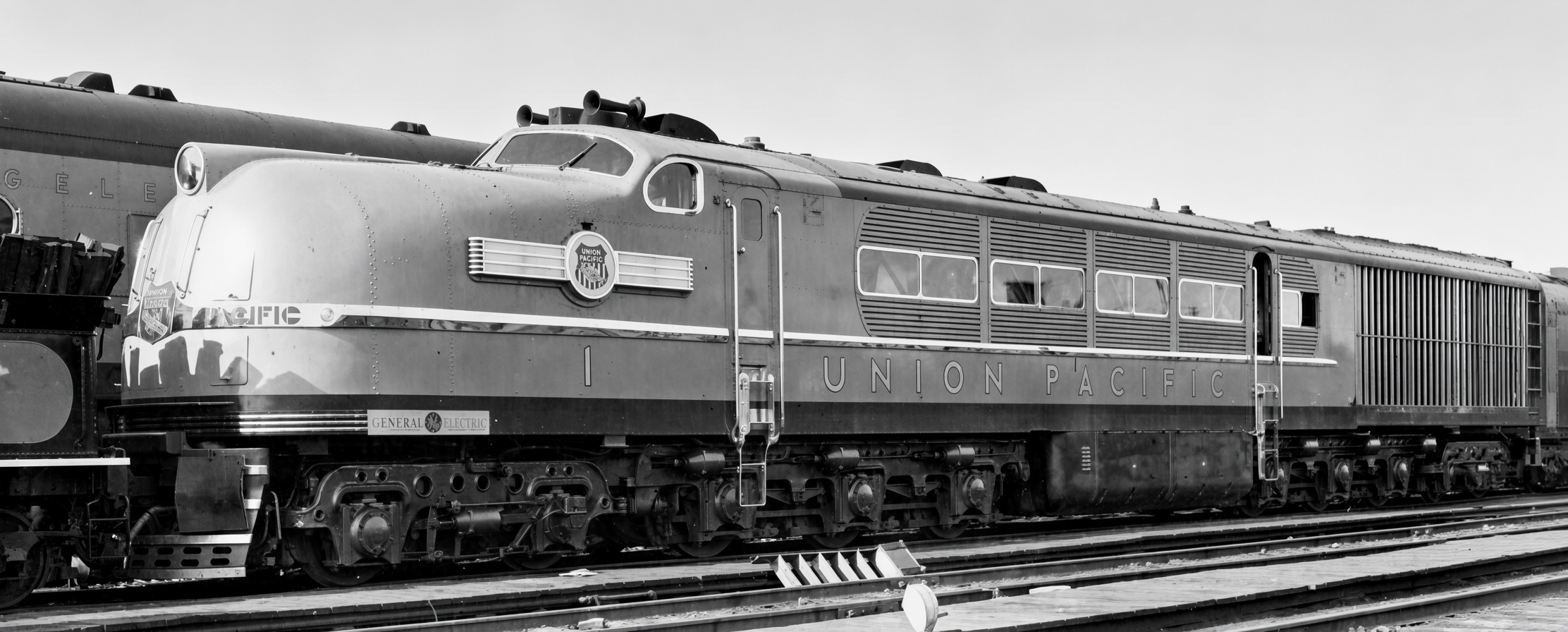
Union Pacific GE steam turbine-electric No. 1 on display in Omaha, Nebraska at 11th Street between Douglas and Farnam on April 29, 1939, during Golden Spike Days and the world premiere of Cecil B. DeMille's Union Pacific. American-Rails.com collection.
On this page: At a glance · Why GE and UP built them · Design · Specifications · Union Pacific, April–June 1939 · Omaha and the movie · After UP: NYC, GN, scrap · What they left
At a Glance
| Item | Detail |
|---|---|
| Builder | General Electric, Erie, Pennsylvania |
| Railroad numbers | Union Pacific 1 and 2 (later GE 1 and GE 2) |
| Builder numbers | 12136 and 12137 |
| Type | Oil-fired steam turbine-electric (condensing) |
| Quantity | 2 (designed to run as a 5,000 hp pair; each could run alone) |
| Project start | Late 1936 (GE–UP) |
| Completed | December 1938 (Erie shop nearly finished by Christmas 1937) |
| NYC road tests | January–March 1939 |
| Delivered to UP | April 3, 1939, Omaha / Council Bluffs |
| Returned to GE | June 17, 1939 |
| UP drops the project | December 18, 1941 (President William Jeffers) |
| Great Northern lease | 1943, Spokane–Wenatchee, Washington |
| Fate | Returned to Erie late 1943; both scrapped before the end of World War II |
Why GE and Union Pacific Built Them
By late 1936 Union Pacific already had lightweight streamliners and was taking 4-6-6-4 Challengers and 4-8-4 800-class Northerns. Electro-Motive was selling passenger diesels. GE had turbines from ships and power plants, and it had generators and traction motors. The proposal was an oil-fired “steam-electric locomotive”: a water-tube boiler, a high-speed turbine, electric transmission. No rods, no piston thrust, no hammer blow. Automatic firing. A condenser so the engine would not stop every hundred miles for water. Head-end power for the train. Dynamic braking that put heat back into the feedwater.
GE hoped to deliver a prototype in 1937. The two units took almost two years. A photograph of the Erie erecting bay dated December 24, 1937, shows them about 95 percent complete. Final assembly is dated December 1938. Plant tests followed on GE’s Erie track. Road tests ran on the New York Central from January through March 1939. They then moved west over NYC and Chicago & North Western to Council Bluffs and onto Union Pacific on April 3, 1939.
William Kratville and Harold Ranks later wrote that the pair were “lauded as replacement to steam; successor of diesels.” Don Strack’s Union Pacific diesel history is more precise about what the mechanical department actually wanted: a 60-day demonstration by GE and Babcock & Wilcox against the Challengers of 1936–37, the 800-class 4-8-4s of 1937, and fifteen more Northerns already on order for August 1939. Otto Jabelmann’s steam program and EMC’s E-units were both in the next room. The turbines had to beat both, or they would not stay.
Design
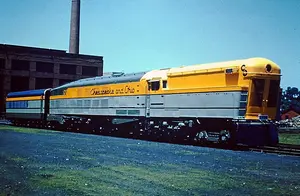
Each locomotive was a single-cab streamliner. The body was a steel frame with riveted sheet, much of it aluminum. The cab sat high, in the manner of UP’s Pullman M-10003 through M-10006 power cars, with a 9-foot nose ahead of the crew. The look was closer to those turret/automobile-cab streamliners and to contemporary EMC diesels than to the original M-10000. Length over the locomotive was 90 feet 10 inches, cab width 10 feet, height 15 feet ¾ inch. Working weight 548,000 pounds (274 tons); adhesive weight about 336,000 pounds.
The running gear was electric, not reciprocating. AAR arrangement 2-C+C-2 (also written 2+C-C+2): a two-axle idler truck, two three-axle powered trucks, a two-axle idler. Whyte notation is the awkward 4-6-0+0-6-4T. GE’s own class string is recorded as 2-C-C-2-530/548-6GE725B—six GE 725B traction motors. Driving wheels 44 inches; leading and trailing wheels 36 inches. Gear ratio 65:31.
Steam came from a Babcock & Wilcox water-tube boiler, oil-fired on Bunker C, with Bailey Meter Company automatic firing and feedwater control from Cleveland. Working pressure was 1,500 to 1,600 psi at about 920°F—far above a contemporary 4-8-4. Steam went to a turbine designed for 12,500 rpm, then through a 10:1 reduction to a generator set at about 1,250 rpm. A twin-armature DC generator fed the six traction motors. A separate three-phase 220-volt AC generator ran traction-motor blowers and head-end power for train lighting, heat, and air conditioning—standard on Amtrak decades later, unusual in 1939.
Exhaust steam went to a condenser and back to the boiler. These two engines are the only condensing steam locomotives known to have operated in North America. Oil and water were sized for a range of about 500 to 700 miles. Dynamic braking ran the traction motors as generators; the resistor heat went into the feedwater loop rather than to rooftop grids. That is regenerative braking in steam clothing.
GE sold and advertised them as a 5,000-horsepower locomotive, usually coupled elephant-style, nose to tail. Each unit had its own cab and could run alone. They could also couple back-to-back. The design target, as later summarized, was a pair able to take twelve Pullmans over 2.2 percent grades.
Specifications (each unit)
| Item | Specification |
|---|---|
| Builder / plant | General Electric, Erie, Pa. |
| Builder nos. | 12136, 12137 |
| Wheel arrangement (AAR) | 2-C+C-2 (2+C-C+2) |
| Wheel arrangement (Whyte) | 4-6-0+0-6-4T |
| Gauge | 4 ft 8½ in |
| Length | 90 ft 10 in |
| Width (cab) | 10 ft |
| Height | 15 ft ¾ in |
| Weight, working order | 548,000 lb |
| Adhesive weight | 336,000 lb |
| Driving-wheel diameter | 44 in |
| Leading / trailing-wheel diameter | 36 in |
| Gear ratio | 65:31 |
| Traction motors | Six GE 725B |
| Boiler | Babcock & Wilcox water-tube, oil-fired (Bunker C) |
| Boiler pressure | 1,500–1,600 psi |
| Steam temperature | About 920°F |
| Boiler controls | Bailey Meter Company, automatic |
| Turbine speed | 12,500 rpm |
| Reduction to generator | 10:1 |
| Main generator | Twin-armature DC |
| Auxiliary generator | 3-phase 220 V AC (blowers and HEP) |
| Horsepower (rated) | 2,500 per unit; 5,000 as a pair |
| Starting tractive effort | 86,500 lbf |
| Continuous tractive effort | 32,000–40,500 lbf (cooling-dependent) |
| Claimed maximum speed | 125 mph (General Electric Review, February 1939) |
| Range (oil/water) | About 500–700 miles |
| Condenser | Yes (unique in North American steam service) |
| Braking | Dynamic / regenerative; resistor heat to feedwater |
| Head-end power | Yes |
| Fuel | Bunker C fuel oil |
Figures compiled from GE contemporary claims, Union Pacific and Don Strack / UtahRails research, Brian Solomon, and roster notes (builder numbers). Claimed 125 mph and “twice the thermal efficiency” are manufacturer statements, not proven revenue-service results.
Union Pacific, April–June 1939
On the property the pair ran test and publicity trains out of Cheyenne: to Laramie, to Denver, and through to Salt Lake City and Los Angeles. They photographed well at the new Los Angeles Union Passenger Terminal (opening ceremonies set for May 1, 1939). Acceleration was real. So were failures. On one Colorado–Omaha move both turbines quit; a 2800-class Pacific had to drag locomotives and train the rest of the way.
They did not take a regular passenger or freight assignment. UP used them as separate units on Omaha–Denver passenger trains in May, then coupled them again. Reliability, not peak horsepower, was the test they failed.
Omaha, April 27–29, 1939
The high-water mark of their public life was not a timetable. It was Hollywood. On April 24 they left Los Angeles eastbound with a Paramount special: the two turbines, fifteen cars of former Virginia & Truckee passenger equipment owned by the studio, and V&T 4-4-0 Dayton lettered as Union Pacific 58 for DeMille’s picture. The train reached Omaha April 27.
Golden Spike Days filled the city for the 70th anniversary of Promontory and the world premiere of Union Pacific (Barbara Stanwyck, Joel McCrea, DeMille) on April 28 at the Omaha, Orpheum, and Paramount theaters. On April 28 the 4-4-0, both turbines, and the vintage cars stood on 11th Street between Douglas and Farnam. They stayed on display through April 29—the date of the photograph of locomotive No. 1 that opens this page.
In the first two weeks of May the pair made an eastern promotional swing for Paramount, including an exhibition for President Franklin D. Roosevelt, then came back to the railroad. On June 5–7 they took the movie special west to Los Angeles again and arrived 2 hours 26 minutes late. Road failures left one unit carrying the train; helpers were needed on Wyoming, Utah, and Nevada grades that did not normally see them. More failures on the return to Ogden, June 8–9.
Mechanical staff on the engines still had enough confidence at Ogden to put them alone on an 1,100-ton block of 18 refrigerator cars, the Cherry Fruit Special, across Utah, Wyoming, and Nebraska to Council Bluffs, arriving June 11. The usual Ogden–Council Bluffs schedule was 23 hours 10 minutes. This trip took 34 hours 20 minutes. Strack notes that those extra hours were delays not charged to the locomotives. It was still not a showing that would displace a Challenger or an E-unit.
Union Pacific returned both units to General Electric at Erie, via Chicago, on June 17, 1939. President W. M. Jeffers called it “necessary modification and/or reconstruction.”
After Union Pacific: New York Central, Great Northern, Scrap
GE and UP kept working. Cold-weather tests ran on the New York Central. A February 1941 report by a UP staff engineer was still hopeful. By the end of that year the railroad had Big Boys on order and coming, E-units in passenger service, and Electro-Motive’s FT freight diesel as a live alternative. On December 18, 1941, Jeffers told GE that Union Pacific was finished with the project. In December the company wrote off $73,276.73.
The two locomotives were repainted dark gray and numbered GE 1 and GE 2. In 1943 Great Northern leased them for the wartime power shortage and put them on short-haul freight between Spokane and Wenatchee, Washington. Crews called the machine “The Jeep.” Forman H. Craton of GE rode one west from Spokane on May 10, 1943, on train 27, a six-car mail train, and wrote it up later in Railroad magazine: they climbed out of Spokane easily, used the rheostatic brake on the descent, ran 70–75 mph in the dark, and arrived Wenatchee on time. Babcock & Wilcox’s Mosher, who had lived with the boilers from the beginning, corrected two minor failures so quickly that nobody else noticed. Craton thought the design enormously complex. He also thought it had run well that night.
By late 1943 the pair were back at Erie. Great Northern service is the last documented work. They were retired and cut up at the builder before World War II ended. No example survives. Overland Models later offered them in brass.
What They Left
Jeffrey W. Schramm called them “the most ambitious and technologically advanced locomotives to have traveled American rails to that point.” Alfred Bruce, writing as a Union Pacific historian, called the design “one of the most exceptional steam locomotives ever built.” Both judgments can be true and still leave the engines as a two-month demonstration that did not replace steam and did not beat the diesel.
What survived of the idea on Union Pacific was the turbine, not the boiler. After the war GE came back with a gas turbine burning Bunker C directly. Those GTELs—the 4,500-horsepower units and the later 8,500-horsepower “Big Blows”—were a different machine. They ran for years. The 1938 steam-electrics did not. The other American steam turbines (PRR S2 6-8-6, C&O M-1, N&W Jawn Henry) used different transmissions and none of them condensed. Those stories sit on the steam turbine overview. Nos. 1 and 2 remain GE’s only steam locomotives, and Union Pacific’s shortest-lived experiment in high-tech road power.
Related Reading on American-Rails.com
- Steam turbine locomotives (U.S. overview)
- Union Pacific gas-turbine electrics (GTEL)
- Union Pacific M-10000
- Steam locomotives · Diesel locomotives · Locomotive history
- Streamliners
Sources
- Strack, Don. “GE Steam Turbines,” in A History of Union Pacific Dieselization, 1934–1982, UtahRails.net (updated 2025)—delivery April 3, 1939; Omaha display April 27–29; return June 17, 1939; Jeffers letter December 18, 1941; write-off; GN 1943; Craton diary
- Lee, Thomas R. “The Steam-Turbine-Electric Story,” The Streamliner 10, no. 2 (1995)
- Solomon, Brian. GE and EMD Locomotives: The Illustrated History (2014); Union Pacific Railroad (2000)
- Kratville, William, and Harold Ranks—quoted contemporary “replacement to steam / successor of diesels” line
- General Electric Review, February 1939—125 mph and efficiency claims
- Schramm, Jeffrey W. Out of Steam (2010)
- Craton, Forman H., letter, Railroad magazine (1970), ride of May 10, 1943, Spokane–Wenatchee
Recent Articles


-
Mobile & Ohio Steam Roster (Post 1900)
Oct 09, 26 12:26 PM
 Mobile & Ohio steam since 1900. Drury's class grid: 48 six-wheel switchers, 107 Ten-Wheelers, 15 Consolidations, 58 Mikados, and 14 Pacifics. Last revenue steam October 7, 1949.
 -
Mobile & Ohio Railroad: History, Map, Timetable
Oct 09, 26 11:31 AM
 Mobile & Ohio Railroad, chartered in 1848. Columbus on April 22, 1861, the Cairo & St. Louis, the March 1940 Official Guide, and the September 13, 1940 merger into the Gulf, Mobile & Ohio.
 -
Gulf, Mobile & Northern Steam Roster (Post 1900)
Oct 09, 26 10:42 AM
 Gulf, Mobile & Northern steam since 1900. Drury's class grid: Ten-Wheelers, Mikados, Russian Decapods, Pacifics 425 and 426, and three light 4-8-2s. Last revenue steam October 7, 1949.
 -
Gulf, Mobile & Ohio Diesel Roster (All-Time)
Oct 09, 26 10:41 AM
 Gulf, Mobile & Ohio diesel roster, all-time. The 1935 boxcab, DL-107s, 55 FA-1s, F3s and F7s, the Ingalls 4-S, GP30s through GP38-2s, and 21 SD40s. Serials and order numbers.
 -
Gulf, Mobile & Northern Railroad: History, Rebel Route
Oct 09, 26 10:36 AM
 Gulf, Mobile & Northern, from the 1890 Mobile, Jackson & Kansas City to the Rebel and the September 13, 1940 merger into the Gulf, Mobile & Ohio. Steam roster is the companion page.
 -
Gulf, Mobile & Ohio Railroad: Map, Photos, Trains, History
Oct 08, 26 11:48 PM
 Gulf, Mobile & Ohio, chartered in 1938 and merged September 13, 1940. The Mobile & Ohio, the Alton on May 31, 1947, the Rebel Route, and Illinois Central Gulf on August 10, 1972.
 -
New Jersey Railroad Museums (2026): A Complete Guide
Oct 08, 26 11:37 PM
 New Jersey railroad museums—Whippany, Maywood, Pine Creek, Mahwah’s Erie depot, Phillipsburg, and Boonton. Confirm hours on each site.
 -
New Hampshire Railroad Museums (2026): A Complete Guide
Oct 08, 26 11:34 PM
 New Hampshire railroad museums—North Conway, the Flying Yankee, Ashland, Gorham, Raymond, and Sandown. Confirm hours on each site.
 -
Missouri Railroad Museums (2026): A Complete Guide
Oct 08, 26 11:00 PM
 Missouri railroad museums—the National Museum of Transportation, Patee House, Frisco 4524, the Chicago & Alton depot, and Marceline. Confirm hours on each site.
 -
Milwaukee Road X3800: Deer Lodge’s Shop Goat
Oct 08, 26 04:28 PM
 Milwaukee Road X3800, the a home-built shop goat that served the Deer Lodge, MT yard. It was a 220-volt DC switcher, powered through an extension cord that moved electrics into a roundhouse where the…
 -
Key West Extension (Overseas Railroad): History, Construction, Decline
Oct 08, 26 03:59 PM
 Henry Flagler's Overseas Railroad, Miami to Key West, 1905–1935. The Seven Mile Bridge, the 1935 Labor Day Hurricane, and the road that became U.S. 1.
 -
Florida East Coast Steam Roster (Post 1900)
Oct 08, 26 02:34 PM
 Florida East Coast steam since 1897. Seventeen Ten-Wheelers, twenty Atlantics, eighty-seven Pacifics, ninety Mountains, fifteen Mikados, and the switchers.
 -
Florida East Coast Diesel Roster (All-Time)
Oct 08, 26 02:12 PM
 Florida East Coast diesel roster, all-time. E units from 1939, F3s, BL2s, GP7s and GP9s, the GP40-2 orders, 22 SD40-2s, and 24 ES44C4s. Serials and EMD order numbers.
 -
Florida East Coast Railway: Map, History, Rosters
Oct 08, 26 01:46 PM
 Florida East Coast Railway, Henry Flagler's line from Jacksonville to Miami and Key West. Receivership in 1931, the 1963 strike, Grupo México in 2017, and Brightline on the same track.
 -
Minnesota Railroad Museums (2026): A Complete Guide
Oct 08, 26 10:32 AM
Minnesota railroad museums—the Lake Superior Railroad Museum, Two Harbors, Jackson Street, Willmar’s Great Northern 2523, and Currie. Confirm hours on each site. -
Maine Railroad Museums (2026): A Complete Guide
Oct 08, 26 09:24 AM
 Maine railroad museums—Seashore Trolley, the two-foot lines at Portland, Alna, and Phillips, Boothbay, and the Bangor & Aroostook depots. Confirm hours on each site.
 -
Massachusetts Railroad Museums (2026): A Complete Guide
Oct 08, 26 12:08 AM
 Massachusetts railroad museums—Berkshire Scenic at Lenox, Shelburne Falls trolley No. 10, Edaville, Chatham’s 1887 depot, and Lowell. Confirm hours on each site.
 -
Clinchfield Steam Roster (Post 1900)
Oct 07, 26 12:09 PM
 Clinchfield steam since 1900. Fifteen H-4 Consolidations, K-1 Mikados, M-2 and M-3 Mallets, L-class 2-8-8-2s, eighteen Challengers. Class grid after Drury. Last steam April 16, 1954.
 -
Clinchfield Diesel Roster (All-Time)
Oct 07, 26 12:05 PM
 Clinchfield diesel roster, all-time. F3A 800, FP7 200, the F7s, GP7s, 25 SD40s, 18 SD45-2s, seven U36Cs, and the Family Lines hoods. Serials and EMD order numbers.
 -
Clinchfield Railroad: Map, Steam Locomotives, Roster, Logo
Oct 07, 26 12:02 PM
 Clinchfield Railroad, Elkhorn City to Spartanburg. George L. Carter, the Carolina, Clinchfield & Ohio, the 1924 lease, coal, the loops, and CSX. Steam and diesel rosters are companion pages.
 -
Kentucky Railroad Museums (2026): A Complete Guide
Oct 07, 26 11:39 AM
 Kentucky railroad museums—the Kentucky Railway Museum, Bowling Green’s L&N depot, Paducah, Versailles, and Covington. Confirm hours on each site.
 -
Kansas Railroad Museums (2026): A Complete Guide
Oct 07, 26 11:26 AM
 Kansas railroad museums—Santa Fe 3768 at Wichita, Santa Fe 132 in Topeka, the Great Overland Station, and Abilene. Confirm hours on each site.
 -
Cincinnati, New Orleans and Texas Pacific Diesel Roster (All-Time)
Oct 07, 26 10:38 AM
 All-time diesel roster of Southern locomotives lettered for the Cincinnati, New Orleans and Texas Pacific. Serials, order numbers, and builder dates.
 -
Cincinnati, New Orleans and Texas Pacific Railway
Oct 07, 26 10:31 AM
 Cincinnati, New Orleans and Texas Pacific Railway, incorporated September 8, 1881, to lease Cincinnati’s railroad to Chattanooga. Queen and Crescent route, Rathole, and the 2024 sale to Norfolk Southe…
 -
Indiana Railroad Museums (2026): A Complete Guide
Oct 07, 26 12:26 AM
 Indiana railroad museums—Nickel Plate 765, Elkhart’s New York Central collection, French Lick, Linden’s junction depot, and Haley Tower. Confirm hours on each site.
 -
"Triplex" Steam Locomotive: Specs, History, Photos
Oct 06, 26 11:52 PM
 Erie class P-1 Triplex 2-8-8-8-2s. Three Baldwin compounds, 2603–2605, later 5014–5016, built 1914 and 1916. Matt H. Shay, the 1930 class card, and Virginian XA 700.
 -
Illinois Railroad Museums (2026): A Complete Guide
Oct 06, 26 11:47 PM
 Illinois railroad museums—the Illinois Railway Museum, Monticello, the Pioneer Zephyr, Galesburg’s Burlington 3006, and the depots. Confirm hours on each site.
 -
Iowa Railroad Museums (2026): A Complete Guide
Oct 06, 26 11:41 PM
 Iowa railroad museums—the Union Pacific Railroad Museum, RailsWest, Sioux City, Boone, and the National Hobo Museum in Britt. Confirm hours on each site.
 -
Charleston and Western Carolina Diesel Roster (All-Time)
Oct 06, 26 11:29 PM
Charleston and Western Carolina diesel roster. Twenty-one GP7s, two SW7s, two SW9s, and six F7As, all built 1950–1952. Serials, order numbers, and ACL and SCL numbers. -
Charleston and Western Carolina Railway: Map, History, Timetables
Oct 06, 26 11:18 PM
 Charleston and Western Carolina Railway, incorporated September 16, 1896. Port Royal to Spartanburg, with branches to Anderson and Greenville. Merged into the Atlantic Coast Line on December 31, 1959.
 -
Central of Georgia Steam Roster (Post 1900)
Oct 06, 26 04:00 PM
 Central of Georgia steam since 1900. Cooke Consolidations, Harriman Mikados, 32 Mountains, and eight Lima 4-8-4s. Class grid after Drury. Last steam May 1953.
 -
Central of Georgia Diesel Roster (All-Time)
Oct 06, 26 03:44 PM
 Central of Georgia diesel roster. SW1 No. 1 in 1939, E7s and E8s, nine F3As, 39 RS3s, GP7s through SD35s. Serials and order numbers.
 -
Central of Georgia Railway: Map, Logo, History, Rosters
Oct 06, 26 03:42 PM
 Central of Georgia Railway, from the 1833 Savannah charter to Southern control on June 17, 1963. Map, logos, Nancy Hanks II, and links to the steam and diesel rosters.
 -
Georgia Railroad Museums (2026): A Complete Guide
Oct 06, 26 03:33 PM
Georgia railroad museums—Savannah’s Central shops, Duluth, the General at Kennesaw, the Texas in Atlanta, Tifton, Waycross, and Albany. Confirm hours on each site. -
Florida Railroad Museums (2026): A Complete Guide
Oct 06, 26 03:18 PM
 Florida railroad museums—Boca Raton, Winter Garden, Whitehall, the Gold Coast, Parrish, Fort Myers, Milton, and Plant City. Confirm hours on each site.
 -
Connecticut Railroad Museums (2026): A Complete Guide
Oct 06, 26 01:05 PM
 Connecticut railroad museums—the Shore Line Trolley, East Windsor, the Naugatuck Railroad, Danbury Union Station, Willimantic, and the SoNo tower. Confirm hours on each site.
 -
Colorado Railroad Museums (2026): A Complete Guide
Oct 06, 26 12:47 PM
 Colorado railroad museums—Golden, the Forney’s Big Boy 4005, Pueblo’s Santa Fe 2912, and the depots at Castle Rock, Limon, and Ridgway. Confirm hours on each site.
 -
Atlantic Coast Line Steam Roster (Post 1900)
Oct 06, 26 12:44 PM
 Atlantic Coast Line steam since 1900. Copper Head Ten-Wheelers, 235 P-5 Pacifics, Q-1 Santa Fes, twelve R-1 4-8-4s. Class grid after Drury. Last steam June 30, 1955.
 -
Atlantic Coast Line Diesel Roster (All-Time)
Oct 06, 26 11:57 AM
 Atlantic Coast Line diesel roster. HH660 1900 in 1939, E3s for the Champion, FTs and F2s, GP7s 100–279, GP30s, U25Cs, and the 1967 SCL numbers. Serials and orders.
 -
Atlantic Coast Line Railroad: "Standard Railroad of the South"
Oct 06, 26 11:53 AM
 Atlantic Coast Line, the Standard Railroad of the South. April 21, 1900 to July 1, 1967. Plant System, L&N, Clinchfield, the Champion, and the Seaboard Coast Line merger.
 -
California Railroad Museums (2026): A Complete Guide
Oct 06, 26 09:50 AM
California railroad museums—the California State Railroad Museum, Perris, Portola, Railtown 1897, and the depots that still stand. Confirm hours on each site. -
Arizona Railroad Museums (2026): A Complete Guide
Oct 06, 26 09:46 AM
Arizona railroad museums—the Arizona Railway Museum in Chandler, Southern Pacific 1673 at Tucson, and the McCormick-Stillman park in Scottsdale. -
Arkansas Railroad Museums (2026): A Complete Guide
Oct 06, 26 09:07 AM
 Arkansas railroad museums—Cotton Belt 819 at Pine Bluff, the Fort Smith trolley, the Mammoth Spring depot, and the Eureka Springs railway.
 -
Alabama Railroad Museums (2026): A Complete Guide
Oct 06, 26 09:03 AM
Alabama railroad museums—Heart of Dixie at Calera, the North Alabama museum at Chase, Huntsville’s 1860 depot, and Fort Payne. Confirm hours on each site. -
Pennsylvania Railroad Museums (2026): A Complete Guide
Oct 06, 26 12:09 AM
 Pennsylvania railroad museums—Strasburg, Steamtown, the Horseshoe Curve, the East Broad Top, and the depots and towers in between. Confirm hours on each site.
 -
Maryland Railroad Museums (2026): A Complete Guide
Oct 05, 26 11:53 PM
 Maryland railroad museums—the Baltimore roundhouse, Ellicott City station, Bowie, Gaithersburg’s Buffalo Creek & Gauley 14, and the Western Maryland collections.
 -
Ohio Railroad Museums (2026): A Complete Guide
Oct 05, 26 05:51 PM
 Ohio railroad museums—the Age of Steam Roundhouse, Bellevue, Worthington, Conneaut’s Nickel Plate 755, and the Dennison depot. Confirm hours on each site.
 -
Delaware Railroad Museums (2026): A Complete Guide
Oct 05, 26 02:43 PM
 Delaware railroad museums—Wilmington & Western at Greenbank, the Harrington tower and N5 caboose, Felton's 1868 depot, and the Selbyville station museum.
 -
C&O's M-1 Steam Turbine Locomotives: Specs, Roster, History
Oct 05, 26 12:13 PM
 Chesapeake & Ohio Class M-1 steam-turbine-electrics. Three Baldwin-Westinghouse locomotives, 500–502, built 1947–48 for The Chessie. Specs, the 2-C1+2-C1-B arrangement, and a roster. All scrapped…
 -
N&W 2-6-6-2 Locomotives (Class Z): Specs, Roster, History
Oct 05, 26 11:44 AM
 Norfolk & Western Class Z 2-6-6-2s. One hundred ninety compound Mallets, 1300–1489, from Richmond, Baldwin, and Schenectady, 1912–1918. Diagram specs, the Z-1b rebuilds, Z-2 1399, and a roster. No…