- Home ›
- Steam Locomotives ›
- 4-8-4 ›
- Wabash O-1
Wabash Class O-1 4-8-4s: History, Roster & Specifications
Published: September 12, 2026
By: Adam Burns
The Wabash Railroad’s only 4-8-4s were twenty-five Baldwin Class O-1 engines, road numbers 2900–2924. Baldwin built them at Eddystone from June 1930 into January 1931 as the second half of a fifty-locomotive order that also produced twenty-five Class M-1 4-8-2s. The two classes shared cylinders, drivers, vestibule cabs, outside-journal lead trucks, and matching tenders. The Northerns carried the larger grate and the extra trailing axle. Wabash put them on fast freight—Montpelier, Ohio, to Decatur, Illinois, and the Detroit–Kansas City automobile and grain business that made a mid-size Midwestern bridge line pay. All twenty-five were cut up in 1955–56. None survive.
This page is that class: why the railroad bought two near-twins, the complete specifications, and the 2900–2924 roster. The 4-8-4 type encyclopedia is 4-8-4 Northern. The company is Wabash Railroad. The M-1 Mountains are the sister order, not a second encyclopedia here.
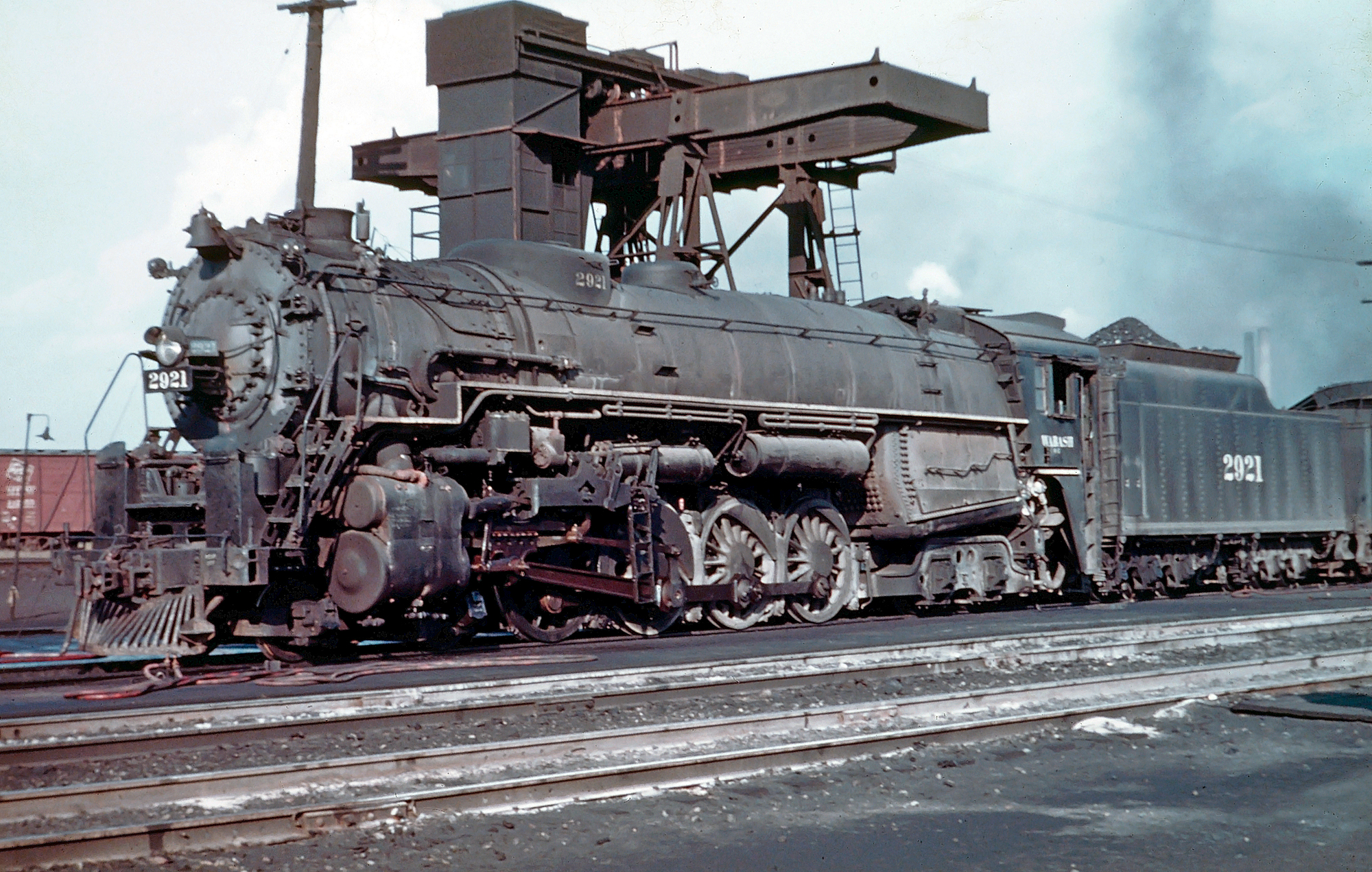
Wabash 4-8-4 #2921 at Decatur, Illinois, circa 1951. Like most examples of this wheel arrangement, the railroad employed the class in fast freight. This unit last operated in December 1951 and was sold for scrap to Luria Brothers in November 1955. Fred Byerly photo. American-Rails.com collection.
On this page: At a glance · The Wabash 50 · Design · Fast freight · Works numbers · Specifications · Complete roster · Retirement
At a glance
| Item | Detail |
|---|---|
| Railroad | Wabash Railway (Wabash Railroad Company after January 1, 1942). Reporting mark WAB |
| Class | O-1 (diagrams and some rosters: O1). Whyte 4-8-4 Northern |
| Road numbers | 2900–2924 (25 engines). Never renumbered |
| Builder | Baldwin Locomotive Works, Eddystone, Pa. |
| Built | Works dates June 1930–January 1931. Railroad freight roster: August 1930–January 1931 |
| Intended service | Fast freight, Montpelier, Ohio–Decatur, Ill. Dual-service in practice on the Detroit–Kansas City main |
| Cylinders / drivers | 27 × 32 in / 70 in. Same as the sister M-1 4-8-2s |
| Boiler pressure | Started at 235 psi with the Mountains; later raised to 250 psi on the 4-8-4s |
| Tractive effort | 70,817 lb at 250 psi |
| Engine weight | 454,090 lb. About a ton more on the Baker-gear engines |
| Valve gear | First twenty (2900–2919) Walschaerts; last five (2920–2924) Baker |
| Feedwater heater | Worthington Type 5-S, left side. See feedwater heaters |
| Retirement | Scrap began October 1955; class gone by February 1956. 2921 last ran December 1951 |
| Preserved | None. None of the sister M-1 4-8-2s were saved either |
| Not this page | The 4-8-4 type. Wabash company history. M-1 Mountains. Decatur-built P-1 Hudsons |
Principal dimensions from the 1930 Locomotive Cyclopedia and Wabash diagram book as tabulated by Steve Llanso (Locobase 285). Information compiled September 12, 2026.
The Wabash 50
Few railroads ordered fifty new road engines in 1930, and fewer still split the purchase down the middle between a 4-8-2 and a 4-8-4 that looked, from the smokebox, like the same locomotive. Kevin P. Keefe later called the pair the Wabash 50. Baldwin delivered the Mountains first, Class M-1, 2800–2824, early in 1930. The Northerns followed the same year and into January 1931 as Class O-1, 2900–2924.
The timing was awkward. Pennsylvania Railroad interests had taken stock control of the Wabash in 1928. The railroad was a roughly 2,500-mile Midwestern bridge line, headquartered in St. Louis, with a fast Detroit–Kansas City route that bypassed both Chicago and St. Louis. Automobile traffic out of Detroit and agricultural tonnage on the same corridor had outgrown World War I-era 2-8-2s and 2-10-2s. St. Louis ordered the fifty Baldwins anyway. The Wabash entered receivership on December 1, 1931, months after the last O-1 left Eddystone, and did not reorganize as the Wabash Railroad Company until January 1, 1942. The engines outlasted the bankruptcy. The company encyclopedia is Wabash Railroad.
George H. Drury put the obvious question in his 1993 steam guide and left it open: why not fifty of one type? Railway Age, on February 14, 1931, reported the Northerns for the same Montpelier–Decatur freight the Mountains had been bought to handle, and named the larger grate in a longer, wider firebox as the chief difference. Keefe suggested a working answer that matches how the power was used: the 4-8-4s took the heavier freight so the 4-8-2s could protect passenger trains—the Wabash Cannonball, Banner Blue, Blue Bird, City of St. Louis, City of Kansas City, and the rest. That practice showed up quickly once the Northerns were on the property.
What Baldwin built
From the front they were twins. Both classes had 70-inch drivers, 27-by-32-inch cylinders, vestibule cabs, centered smokebox bells, matching air-pump shields on the pilot beam, and outside-journal engine trucks. A number plate under the headlight was the honest way to tell them apart. The O-1 was the Mountain idea with Super Power’s firebox hung on four trailing wheels—the same reason the 4-8-4 exists as a type, on the Northern encyclopedia.
Both classes started at 235 psi. Wabash later raised the Mountains to 245 and the Northerns to 250. The O-1 grate was 96.25 square feet, about twelve more than the M-1’s 84.20. Evaporative heating surface was 5,189 square feet against 4,620; superheater 2,360 against 2,004. Combined heating surface on the 4-8-4 was about 11 to 14 percent larger, depending on which pair of figures is compared. Engine weight was 454,090 pounds against 406,400—roughly twenty-four tons more, plus an extra foot of tube and flue length (21 feet against 20). Tractive effort at the later 250-pound setting was 70,817 pounds. Factor of adhesion was 3.87. The Baker-gear engines weighed about a ton more than the Walschaerts engines.
Firebox heating surface was 495 square feet, including 30 square feet of arch tubes and 95.5 square feet of thermic syphons. 2917 carried an extra thermic syphon in the combustion chamber that added 16.5 square feet. A Worthington Type 5-S feedwater heater sat on the left side of every engine in the class. Piston valves were 12 inches in diameter, with 8 inches of travel on Walschaerts gear and 9 inches on Baker.
Tenders matched the Mountains. As delivered they held about 18 tons of coal and 15,000 gallons of water and weighed about 281,000 pounds loaded, for an engine-and-tender figure of 735,090 pounds. Coal capacity later grew to 23 tons, the same change made on the M-1s, and loaded tender weight to 307,510 pounds.
Fast freight, and some varnish
Wabash classed the O-1s as freight power. Railway Age said they were intended for the Montpelier, Ohio–Decatur, Illinois, run, the same assignment given the 4-8-2s a few months earlier. Decatur was the railroad’s principal shop town; the Fred Byerly photograph of 2921 on this page was made there. In service the class ranged farther. Richard J. Cook had 2908 on a westbound freight at Butler, Indiana. Richard Leonard, growing up in Adrian, Michigan, between 1946 and 1951, remembered the 4-8-4s on freight and their deep whistle. Harold Vollrath collection prints pin 2920 at Chicago in July 1939 and 2904 at Decatur in September 1949. Keefe treated 2908 as dual-service. The Mountains took a larger share of the name trains; the Northerns were not locked out of passenger work.
They were imposing without being giants. Santa Fe and Union Pacific 4-8-4s outweighed them. At 454,090 pounds and 70,817 pounds of tractive effort they were still a large two-cylinder freight Northern for a railroad of Wabash size, and they were late enough to carry the full 1930 kit: superheater, Worthington heater, and piston valves. Wabash did not give the type a local nickname. They were Class O-1, or Northerns.
Decatur Shops later rebuilt three-cylinder K-5 and K-4 Mikados into Class P-1 4-6-4 Hudsons (700–706) in 1943–47 for passenger work. Those engines are not O-1s. They exist because the railroad was unwilling, during the war, to pull 4-8-2s and 4-8-4s off freight for varnish.
Baldwin works numbers
Baldwin produced the class over seven months as the Depression deepened. Steve Llanso lists twenty-five construction numbers. The first twenty engines received Walschaerts valve gear; the last five, 2920–2924, received Baker. Richard Leonard identified 2920 as one of those last five. Construction numbers are listed here by month, not paired to individual road numbers.
| Month | Baldwin works numbers | Valve gear (as grouped) | Count |
|---|---|---|---|
| June 1930 | 61417–61418 | Walschaerts | 2 |
| July 1930 | 61435–61438 | Walschaerts | 4 |
| September 1930 | 61482–61485 | Walschaerts | 4 |
| October 1930 | 61516–61521 | Walschaerts | 6 |
| November 1930 | 61567–61568 | Walschaerts | 2 |
| December 1930 | 61572 | Walschaerts | 1 |
| January 1931 | 61588–61593 | Baker | 6 |
| Total | 25 |
The railroad’s own abbreviated freight roster dates the class August 1930 through January 1931, which is when the engines entered Wabash service rather than the first works month. The Wabash Railroad Historical Society, following Railroad History No. 133 (Fall 1975), gives the same August 1930 start and carries the class through January 1956.
Specifications (Class O-1)
| Item | O-1 4-8-4 |
|---|---|
| Builder | Baldwin Locomotive Works, Eddystone, Pa. |
| Whyte / gauge | 4-8-4 / 4 ft 8½ in |
| Road numbers | 2900–2924 |
| Cylinders | 27 × 32 in (two, outside) |
| Drivers | 70 in |
| Boiler pressure | 235 psi as delivered; later 250 psi |
| Tractive effort | 70,817 lb at 250 psi |
| Factor of adhesion | 3.87 |
| Valve gear | Walschaerts (2900–2919); Baker (2920–2924) |
| Piston valves | 12 in diameter; 8 in travel (Walschaerts), 9 in (Baker) |
| Weight on drivers | 274,100 lb |
| Engine weight | 454,090 lb |
| Axle loading | 69,500 lb |
| Tender (as delivered) | ~18 tons coal, 15,000 gal water, ~281,000 lb loaded |
| Tender (later) | 23 tons coal, 307,510 lb loaded |
| Engine and tender (as delivered) | 735,090 lb |
| Driver wheelbase | 18.25 ft |
| Engine wheelbase | 45 ft |
| Engine and tender wheelbase | 86.83 ft |
| Tubes | 49 – 2.25 in |
| Flues | 214 – 3.5 in |
| Tube / flue length | 21 ft |
| Firebox heating surface | 495 sq ft (incl. 30 sq ft arch tubes and 95.5 sq ft thermic syphons; 2917 +16.5 sq ft combustion-chamber syphon) |
| Grate area | 96.25 sq ft |
| Evaporative heating surface | 5,189 sq ft |
| Superheater | 2,360 sq ft |
| Combined heating surface | 7,549 sq ft |
| Feedwater heater | Worthington Type 5-S, left side |
| Minimum rail (calculated) | 114 lb/yd |
Figures from Locobase 285 (1930 Locomotive Cyclopedia; WAB 1 locomotive, crane, and marine diagrams; DeGolyer, Volume 81, pp. 260+). Tender as-delivered weights follow David Popp II. Starting boiler pressure follows Keefe; 250 psi and 70,817 lb tractive effort are the later working figures used in most published tables.
Sister M-1 4-8-2s (comparison only)
| Item | M-1 4-8-2 (2800–2824) | O-1 4-8-4 (2900–2924) |
|---|---|---|
| Builder / dates | Baldwin, early 1930 | Baldwin, June 1930–January 1931 |
| Cylinders / drivers | 27 × 32 in / 70 in | 27 × 32 in / 70 in |
| Starting / later pressure | 235 / 245 psi | 235 / 250 psi |
| Engine weight | 406,400 lb | 454,090 lb |
| Tractive effort | About 66,570–67,400 lb as commonly cited; 69,400 lb at 245 psi | 70,817 lb at 250 psi |
| Grate | 84.20 sq ft | 96.25 sq ft |
| Evaporative HS | 4,620 sq ft | 5,189 sq ft |
| Superheater | 2,004 sq ft | 2,360 sq ft |
| Valve gear | Walschaerts (all 25) | Walschaerts (20), Baker (5) |
Complete roster, 2900–2924
All twenty-five were Baldwin Class O-1 4-8-4s. None was rebuilt to another wheel arrangement, none was renumbered, and none was sold to another railroad in service. Individual construction numbers are not mapped to road numbers here. Class scrap ran from October 1955 through February 1956 except as noted.
| Road no. | Class | Builder | Valve gear | Disposition / notes |
|---|---|---|---|---|
| 2900 | O-1 | Baldwin | Walschaerts | Scrapped with the class, October 1955–February 1956 |
| 2901 | O-1 | Baldwin | Walschaerts | Scrapped with the class, October 1955–February 1956 |
| 2902 | O-1 | Baldwin | Walschaerts | Scrapped with the class, October 1955–February 1956 |
| 2903 | O-1 | Baldwin | Walschaerts | Scrapped with the class, October 1955–February 1956 |
| 2904 | O-1 | Baldwin | Walschaerts | Photographed at Decatur, September 1949. Scrapped with the class |
| 2905 | O-1 | Baldwin | Walschaerts | Scrapped with the class, October 1955–February 1956 |
| 2906 | O-1 | Baldwin | Walschaerts | Scrapped with the class, October 1955–February 1956 |
| 2907 | O-1 | Baldwin | Walschaerts | Scrapped with the class, October 1955–February 1956 |
| 2908 | O-1 | Baldwin | Walschaerts | Photographed westbound freight, Butler, Ind. Scrapped with the class |
| 2909 | O-1 | Baldwin | Walschaerts | Scrapped with the class, October 1955–February 1956 |
| 2910 | O-1 | Baldwin | Walschaerts | Baldwin builder photograph extant. Scrapped with the class |
| 2911 | O-1 | Baldwin | Walschaerts | Scrapped with the class, October 1955–February 1956 |
| 2912 | O-1 | Baldwin | Walschaerts | Scrapped with the class, October 1955–February 1956 |
| 2913 | O-1 | Baldwin | Walschaerts | Scrapped with the class, October 1955–February 1956 |
| 2914 | O-1 | Baldwin | Walschaerts | Scrapped with the class, October 1955–February 1956 |
| 2915 | O-1 | Baldwin | Walschaerts | Scrapped with the class, October 1955–February 1956 |
| 2916 | O-1 | Baldwin | Walschaerts | Scrapped with the class, October 1955–February 1956 |
| 2917 | O-1 | Baldwin | Walschaerts | Extra 16.5 sq ft combustion-chamber thermic syphon. Scrapped with the class |
| 2918 | O-1 | Baldwin | Walschaerts | Scrapped with the class, October 1955–February 1956 |
| 2919 | O-1 | Baldwin | Walschaerts | Scrapped with the class, October 1955–February 1956 |
| 2920 | O-1 | Baldwin | Baker | Photographed at Chicago, July 1939. One of the last five. Scrapped with the class |
| 2921 | O-1 | Baldwin | Baker | Last operated December 1951. Sold for scrap to Luria Brothers, November 1955. Photograph on this page, Decatur, circa 1951 |
| 2922 | O-1 | Baldwin | Baker | Scrapped with the class, October 1955–February 1956 |
| 2923 | O-1 | Baldwin | Baker | Scrapped with the class, October 1955–February 1956 |
| 2924 | O-1 | Baldwin | Baker | Last road number in the class. Scrapped with the class, October 1955–February 1956 |
Retirement
Wabash bought road diesels in quantity from 1949. By the early 1950s the O-1s were already leaving the main line. 2921 last operated in December 1951—the same season as the Decatur photograph on this page—and sat four years before Luria Brothers took it in November 1955. Scrap of the class as a whole began in October 1955 and was finished by February 1956. The Historical Society’s class date runs through January 1956. The sister M-1s followed a similar timetable, the last of them dated through September 1955 on the same roster.
What steam remained on the Wabash after the big power came off was not this class. Light 2-6-0s held the Bluffs, Illinois–Keokuk, Iowa, branch into 1955 because of bridge restrictions; that is a company story, on Wabash. Norfolk & Western leased the Wabash on October 16, 1964. The O-1s had been gone for eight years. None of the Wabash 50 was preserved.
Related reading on American-Rails.com
- Wabash Railroad
- 4-8-4 Northern · 4-8-2 Mountain · Steam locomotives
- Feedwater heaters (Worthington 5-S)
- Wabash Cannonball · Blue Bird
- Nickel Plate Road · Norfolk & Western
Sources
- Steve Llanso of Sweat House Media / Middle Run Media, Locobase 285 (Wabash Class O1), steamlocomotive.com. Data from the 1930 Locomotive Cyclopedia; WAB 1 locomotive, crane, and marine diagrams (Allen Stanley / Rail Data Exchange, May 2005); DeGolyer, Volume 81, pp. 260+. Works numbers, firebox breakdown, Worthington 5-S, piston-valve travel, 2917 syphon, tender weights (David Popp II), Baker engines about a ton heavier
- Wes Barris, steamlocomotive.com, Wabash 4-8-4 roster introduction: 25 engines, 2900–2924, 70-inch drivers, 27 × 32 cylinders, 250 psi, 454,090 lb, 70,817 lb tractive effort; scrap October 1955 through February 1956; none preserved
- Kevin P. Keefe, “The ‘Wabash 50,’” Classic Trains / Trains.com, November 3, 2024. Split 4-8-2 / 4-8-4 order; starting 235 psi; later 245 on the Mountains and 250 on the Northerns; twelve more square feet of grate and about 11 percent more heating surface on the 4-8-4s; last five Northerns Baker gear; 2908 at Butler, Ind.; none of the fifty saved
- Classic Trains staff, “Wabash Railway Steam Locomotives in the 20th Century,” September 1, 2003. Baldwin 4-8-4s August 1930–January 1931; Railway Age on Montpelier–Decatur freight; 2924 as last road number
- Railway Age, February 14, 1931, as cited by Locobase 285 and Classic Trains (1931): intended service and grate/firebox as the chief difference from the M-1s
- George H. Drury, Guide to North American Steam Locomotives (Kalmbach, 1993): similarities to the 25 Mountains; “Why not 50 of one type?”
- Wabash Railroad Historical Society steam roster, citing Railroad History No. 133, Fall 1975 (J. Nixon collection): Class O-1, 2900–2924, Baldwin, August 1930–January 1956. M-1 2800–2824, January 1930–September 1955. P-1 Hudsons 700–706 from K-5s then K-4s, Decatur
- Richard Leonard, Random Steam Photo Collection: Wabash 2904 (Decatur, September 1949; Walschaerts) and 2920 (Chicago, July 1939; one of the last five, Baker gear, slightly heavier)
- American-Rails.com, Wabash company page: Class O1 freight roster, 2900–2924, Baldwin, 8/1930–1/1931; 2921 at Decatur circa 1951, last operated December 1951, sold to Luria Brothers November 1955 (Fred Byerly photograph, American-Rails.com collection); receivership December 1, 1931; Wabash Railroad Company January 1, 1942; N&W lease October 16, 1964
- Steve Llanso, Locobase 1407 (Wabash Class M-1 4-8-2), for the comparison table: 406,400 lb, 84.20 sq ft grate, 4,620 / 2,004 heating surface, later 245 psi
Recent Articles


-
Bessemer & Lake Erie Railroad: "The Bessemer Road"
Sep 15, 26 05:20 PM
 Bessemer & Lake Erie—Bear Creek 1865, Carnegie 1897, U.S. Steel 1901. Ore south from Conneaut, coal north. 2-10-4s, Missabe sister road. CN May 10, 2004. Complete corporate history.
 -
Bangor and Aroostook Railroad: "Serving Northern Maine"
Sep 15, 26 05:05 PM
 Bangor & Aroostook—chartered February 13, 1891, first trains January 1, 1894. Potatoes, paper, Searsport, State of Maine reefers. MM&A 2003, Lac-Mégantic 2013, CP 2020, CPKC today. Complete co…
 -
Baltimore & Ohio Chicago Terminal Railroad: Map and History
Sep 15, 26 03:11 PM
 B&OCT—formed January 6, 1910 to buy Chicago Terminal Transfer. Grand Central, Barr Yard, 78 route-miles. Assigned B&O steam. Complete diesel roster. CSX paper subsidiary, mark BOCT.
 -
The "Alphabet Route" (Railroad): Photos and History
Sep 15, 26 02:53 PM
 Alphabet Route—eight railroads, not one company. P&WV to Connellsville February 11, 1931. Alpha Jets Chicago/St. Louis–New York/Boston. NKP, W&LE, P&WV, WM, Reading, CNJ, L&HR, New Hav…
 -
Milwaukee Road Livestock Operations: Cattle, Dakotas & Montana
Sep 15, 26 02:36 PM
 Milwaukee Road livestock traffic—Dakota and Montana cattle, Iowa hogs, Chicago markets, 28-hour law, head-end stock cars. By 1974 mostly Montana. Rick Burn’s Helena speech. Operations history, not the…
 -
Spirit of Jasper Ride & Dine (2026): Season Pause
Sep 15, 26 02:29 PM
 Spirit of Jasper Ride & Dine in Jasper, Indiana—seated meal on board. Operator: not running public trains for 2026. Depot remains open as a rental. Confirm on spiritofjaspertrain.com.
 -
South Carolina Canal & Rail Road Company: Map and History
Sep 15, 26 01:59 PM
 South Carolina Canal & Rail Road—chartered December 19, 1827. Best Friend of Charleston, 136 miles Charleston–Hamburg October 1833, Aiken inclined plane. South Carolina Railroad 1844, Southern 189…
 -
The Practice of Double-Heading: The Steam Era
Sep 15, 26 01:43 PM
 Doubleheading—two locomotives on the point, each with its own steam crew. Not a rear helper, not diesel MU. How it worked, PRR 1877, mountain grades, and what MU ended.
 -
Mohawk and Hudson Railroad: Map, Pictures, Locomotives
Sep 15, 26 01:20 PM
 Mohawk & Hudson Railroad—New York’s first railroad, chartered April 17, 1826. DeWitt Clinton, inclined planes, Albany & Schenectady 1847, first New York Central May 17, 1853. Complete corporat…
 -
Essex Clipper Dinner Train (2026): Dates, Tickets & What to Expect
Sep 15, 26 01:09 PM
 2026 Essex Clipper Dinner Train in Essex, CT—2.5 hours, four-course meal $129.99, 18+. Fall dates through Oct. 25. Confirm on essexsteamtrain.com.
 -
Camden & Amboy Railroad: Map, History, Photos
Sep 15, 26 12:53 PM
 Camden & Amboy Railroad—chartered February 4, 1830. Joint Companies monopoly with the Delaware & Raritan Canal, John Bull, T-rail. United New Jersey 1872, PRR 999-year lease 1871. Complete corpora…
 -
Cafe Lafayette Dinner Train (2026): Dates, Tickets & What to Expect
Sep 15, 26 12:47 PM
2026 Cafe Lafayette Dinner Train in North Woodstock, NH—2 hours, 20 miles, five-course meal from $125. May–October. Confirm on nhdinnertrain.com. -
Christmas Train Ride Locations (2026): A Complete Guide
Sep 15, 26 10:47 AM
 2026 Christmas train rides by state—Santa, North Pole Express, and holiday trains. Not Polar Express. State guides and product pages. Confirm dates on each railroad.
 -
Baltimore & Ohio Railroad: Linking 13 Great States With The Nation
Sep 15, 26 10:22 AM
 Baltimore & Ohio Railroad—first U.S. common carrier, chartered February 28, 1827. Wheeling 1853, Chicago 1874, C&O control 1963, Chessie 1973, into CSX April 30, 1987. Complete corporate history.
 -
Delaware & Hudson Railway: The Bridge Line
Sep 15, 26 09:59 AM
 Delaware & Hudson Railway—Wurts brothers canal 1823, gravity railroad 1829, Stourbridge Lion, Bridge Line to Montreal. Guilford 1984, CP 1991, NS south line 2015, CPKC north.
 -
Delaware & Hudson Diesel Roster (All-Time)
Sep 15, 26 12:17 AM
 All-time Delaware & Hudson diesel roster—Alco S-2s through C-628s and PA-4s, GE U-boats, Baldwin RF-16s, EMD SD45s and GP38-2/GP39-2s. Serials, dates, dispositions.
 -
Granite Railway, Our Country's First Railroad
Sep 14, 26 11:28 PM
 Granite Railway of Quincy, Massachusetts—chartered March 4, 1826, opened October 7, 1826. Gridley Bryant, 5-foot gauge, horses, Bunker Hill Monument stone. First commercial U.S. railroad.
 -
Milwaukee Road Skytop Lounges: History, Specs & Floor Plans
Sep 14, 26 11:09 PM
 Milwaukee Road Skytop observation cars—Brooks Stevens, 1948. Four Rapids parlor-lounges from Milwaukee Shops, six Creek sleeper-lounges from Pullman-Standard. Floor plans, roster, preservation.
 -
West Virginia Christmas Train Rides (2026): A Complete Guide
Sep 14, 26 11:02 PM
2026 West Virginia Christmas trains—Potomac Eagle North Pole Express in Romney and Christmas at Cass. Not Polar Express. Elkins Polar is not listed for 2026. -
Railroads Of Today: Class I Map, PSR & the 2026 Industry
Sep 14, 26 10:30 PM
 U.S. freight rail in 2026—six Class I railroads on a nearly 140,000-mile network. PSR as everyday practice, how the STB works, traffic mix, short lines and regionals.
 -
Railroad History (USA): Timeline, Facts & How the Network Was Built
Sep 14, 26 10:03 PM
 Full U.S. railroad history hub—origins and inventors, Golden Age peak mileage, Civil War and transcontinental, streamliners, ICC regulation, Penn Central and Conrail, Staggers Act, PSR, and today’s Cl…
 -
Railroads In The 2020s: CPKC, East Palestine & the UP–NS Case
Sep 14, 26 09:51 PM
 U.S. railroads 2020–2026—Class I mileage 91,773 in 2020. COVID traffic drop, CPKC April 14 2023, East Palestine Feb. 3 2023, UP–NS $85 billion case still before the STB.
 -
Railroads In The 2010s: PSR, Coal’s Decline & Positive Train Control
Sep 14, 26 03:51 PM
 U.S. railroads 2010–2020—Class I mileage 95,573 to 91,773. Buffett closed BNSF Feb. 12 2010, Harrison at CP June 29 2012 and CSX 2017, PTC deadline Dec. 31 2018.
 -
Virginia Christmas Train Rides (2026): A Complete Guide
Sep 14, 26 03:46 PM
 2026 Virginia Christmas trains—Virginia Scenic Railway Santa Express from Staunton, about 60 minutes. Confirm dates. Not Polar Express.
 -
MARC Train: Maryland Commuter Rail History, Lines & Roster
Sep 14, 26 01:16 PM
 MARC Train history—Maryland Rail Commuter 1984, B&O and PRR corridors, Penn/Camden/Brunswick lines, Silver Spring 1996, all-time locomotive roster.
 -
Railroads In The 2000s: Merger Freeze, Wisconsin Central & Buffett
Sep 13, 26 07:57 AM
 U.S. railroads 2000–2010—Class I mileage 99,250 to 95,573. STB merger freeze March 17 2000, CN–WC Oct. 9 2001, BNSF Railway Jan. 24 2005, Buffett Nov. 3 2009.
 -
Railroads In The 1990s: Mega-Mergers, Conrail’s Split & the STB
Sep 13, 26 12:13 AM
 U.S. railroads 1990–2000—Class I mileage 119,758 to 99,250. BNSF Sept. 22 1995, UP–SP Sept. 11 1996, Conrail split June 1 1999, ICC Termination Dec. 29 1995.
 -
Railroads In The 1980s: Staggers, Mega-Mergers & Conrail’s IPO
Sep 12, 26 11:12 PM
 U.S. railroads 1980–1990—Class I mileage 164,822 to 119,758. Staggers Oct. 14 1980, CSX and Norfolk Southern, UP–Missouri Pacific–Western Pacific, Conrail IPO March 26 1987.
 -
Wabash Class O-1 4-8-4s: History, Roster & Specifications
Sep 12, 26 11:01 PM
 Wabash Class O-1 4-8-4s—Baldwin 1930–31, twenty-five engines 2900–2924. Fast freight, complete roster, specifications. None preserved.
 -
Staggers Rail Act of 1980: Statute, Contract Rates & the ICC
Sep 10, 26 11:23 PM
 Staggers Rail Act, Pub. L. 96-448, signed October 14, 1980. Harley Staggers, S.1946, contract rates, 180% variable-cost test, abandonments, short lines.
 -
Rock Island E8A 652: Bicentennial Independence Paint & History
Sep 10, 26 10:42 PM
 Rock Island E8A 652—EMD March 1952, serial 15199. 20th Century Railroad Club Independence bicentennial scheme, Peoria and Quad Cities Rockets, Midland Railway, Manly Junction Museum.
 -
Vermont Christmas Train Rides (2026): A Complete Guide
Sep 10, 26 10:37 PM
2026 Vermont Christmas trains—Okemo Valley Holiday Express from Chester Depot Dec. 19–20. Polar is Burlington Dec. 5–6 only. -
Railroads In The 1970s: Penn Central, Amtrak & Conrail
Sep 10, 26 10:18 AM
 U.S. railroads 1970–1980—196,479 miles at the decade’s start. Penn Central bankruptcy June 21 1970, Amtrak May 1 1971, 3R/4R Acts, Conrail April 1 1976, Rock Island 1975, Milwaukee 1977.
 -
Railroads In The 1960s: Mergers, Passenger Collapse & Penn Central
Sep 10, 26 10:03 AM
 U.S. railroads 1960–1970—207,334 to 196,479 miles. Erie Lackawanna 1960, C&O–B&O 1963, N&W–Nickel Plate 1964, SCL 1967, Penn Central Feb. 1 1968.
 -
South Carolina Christmas Train Rides (2026): A Complete Guide
Sep 10, 26 08:36 AM
 2026 South Carolina Christmas trains—South Carolina Railroad Museum Santa Train in Winnsboro. Confirm December dates. Not Polar Express. Drop light-festival padding.
 -
Steam Locomotive Feedwater Heaters: Elesco, Coffin & Worthington
Sep 10, 26 08:29 AM
 Steam locomotive feedwater heaters—open Worthington vs closed Elesco and Coffin. How they work, how to identify them on a smokebox, and why not every engine had one.
 -
Oregon Christmas Train Rides (2026): A Complete Guide
Sep 10, 26 08:22 AM
2026 Oregon Christmas trains—Portland Holiday Express, Garibaldi Candy Cane Express, Sumpter Valley Christmas Trains Dec. 11–13. Polar is Mount Hood. -
Lake Shore & Michigan Southern: Map, History, Timetables
Sep 10, 26 08:12 AM
 Lake Shore & Michigan Southern Railway—Erie & Kalamazoo 1833, Michigan Southern to Chicago 1852, LS&MS April 6 1869, Vanderbilt, Ashtabula 1876, NYC merger Dec. 22 1914. 1910 map and Official Guide.
 -
Big Four Route (CCC&StL): Map, History
Sep 10, 26 12:19 AM
Cleveland, Cincinnati, Chicago & St. Louis Railway—Bee Line 1868, Ingalls’s first Big Four 1880, CCC&StL June 30, 1889, NYC lease Feb. 1, 1930. 1910 and 1930 maps, what still runs. -
Railroads In The 1950s: Diesel, the Interstate & Passenger Collapse
Sep 10, 26 12:15 AM
 U.S. railroads 1950–1960—223,779 to 211,459 miles. Interstate June 29, 1956, dieselization, passenger collapse, TOFC, 1957–58 recession, NYO&W 1957, N&W–Virginian 1959.
 -
New Jersey Christmas Train Rides (2026): A Complete Guide
Sep 10, 26 12:06 AM
 2026 New Jersey Christmas trains—Black River & Western Santa Express from Flemington and Pine Creek Christmas trains in Wall Township. Polar is Whippany and Phillipsburg.
 -
New Mexico Christmas Train Rides (2026): A Complete Guide
Sep 09, 26 11:57 PM
 2026 New Mexico Christmas trains—Cumbres & Toltec Santa’s Holiday Express from Chama Dec. 5–6 (and Antonito, Colo., Dec. 12–13). Coach $25/$15. Not Polar Express.
 -
Grand Trunk Railway: Map, History, Timetables
Sep 09, 26 11:47 PM
 Grand Trunk Railway of Canada—charter Nov. 10, 1852, Montreal–Toronto 1856, Portland, Sarnia, Victoria Bridge, St. Clair Tunnel 1891, Great Western 1882, GTPR, CN Jan. 20, 1923. 1893 map and Official…
 -
Troop Trains In World War II: Sleepers, Kitchen Cars & Movements
Sep 09, 26 11:42 PM
 WWII U.S. troop trains—almost 44 million armed-services passengers, Pullman troop sleepers, ACF kitchen cars, hospital trains, monthly movement tables 1942–45. Not the Military Railway Service. ODT an…
 -
Railroads In The 1940s: War Traffic, Last Steam & the Diesel Flood
Sep 09, 26 11:37 PM
 U.S. railroads 1940–1950—233,670 to 223,779 miles. World War II as the decade’s center, last new steam, diesel flood after V-J Day, 1945 car orders, California Zephyr 1949.
 -
Railroads In World War II: ODT, Record Traffic & Private Operation
Sep 09, 26 03:00 PM
 U.S. railroads in World War II—Lend-Lease freight, Pearl Harbor, Office of Defense Transportation, 1944 peak ~740 billion ton-miles, Dec. 1943–Jan. 1944 seizure. Private operation, not a USRA sequel.
 -
Montana Christmas Train Rides (2026): A Complete Guide
Sep 09, 26 02:54 PM
2026 Montana Christmas trains—Charlie Russell Chew Choo North Pole Adventure from Hanover/Lewistown, Nov. 27–Dec. 19, $71, about 1.5 hours. Not Polar Express. -
Railroads In The 1930s: Depression, Streamliners & the FT
Sep 09, 26 09:32 AM
 U.S. railroads 1930–1940—249,052 to 233,670 miles. Section 77, Eastman, Motor Carrier Act, M-10000 and Pioneer Zephyr 1934, EMC FT 1939. Decade frame, not the streamliner encyclopedia.
 -
Sugar Cane Train (Lahaina): LK&P History, Roster & 2026 End
Sep 09, 26 08:19 AM
 Lahaina, Kaanapali & Pacific Sugar Cane Train—3-foot tourist line 1970–2014. Anaka, Myrtle, 2023 and 2025 fires, September 2026 scrapping. Roster, Hahakea trestle, Pioneer Mill corridor.
 -
Massachusetts Christmas Train Rides (2026): A Complete Guide
Sep 09, 26 08:16 AM
 2026 Massachusetts Christmas trains—Shelburne Falls Moonlight Magic Friday Nov. 27; Edaville Festival of Lights in Carver. Polar is Cape Cod Central in Buzzards Bay.