Railroads In The 2010s: PSR, Coal’s Decline & Positive Train Control
Last revised: September 14, 2026
By: Adam Burns
The 2010s did not redraw the Class I map. They changed how the map was run, and what it hauled. Class I miles of road stood at 95,573 in 2010 and 91,773 in 2020—the same Association of American Railroads series that put 99,250 miles on the books in 2000. Ton-miles peaked at 1,851,000 million in 2014, then fell with coal and again with the 2020 pandemic, to 1,439,814 million. Berkshire Hathaway closed on BNSF on February 12, 2010. Hunter Harrison took Canadian Pacific on June 29, 2012 and CSX in March 2017. Congress’s Positive Train Control deadline, postponed from 2015, landed on December 31, 2018. Genesee & Wyoming bought RailAmerica. Kansas City Southern stayed independent. No two Class Is merged.
What follows here is 2010 through 2020: a private western giant, Precision Scheduled Railroading as a named campaign, coal giving way to chemicals and stacks, a federal safety system on the mains, and a Class I list that was still seven names when the decade ended.
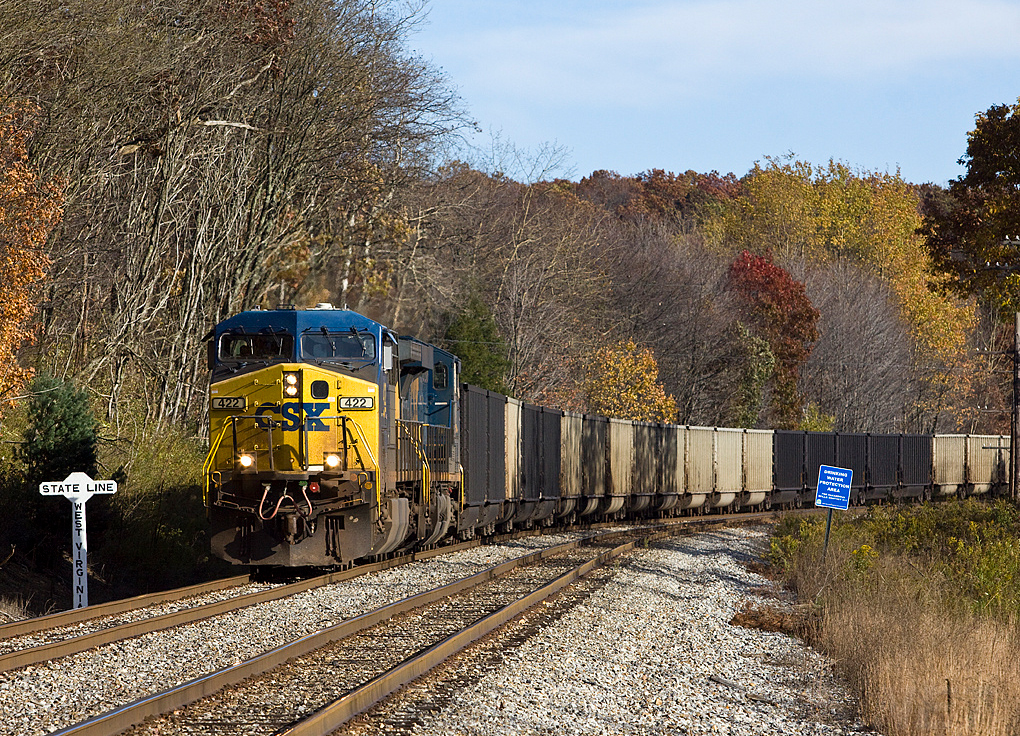
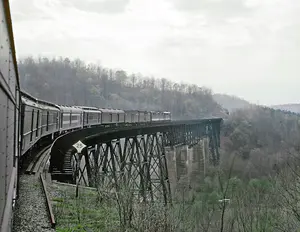
CSX AC4400CW 422 leads westbound empty hoppers, train E725, over the old B&O at Corinth, West Virginia, along the Maryland–West Virginia state line on October 17, 2011. Wade Massie photo.
On this page: At a glance · The map of 2010 · Harrison, CP, and PSR · CSX, 2017 · Coal down, stacks up · Positive Train Control · Short lines, one holding company · Into the 2020s
At a glance
| Item | Detail |
|---|---|
| Class I miles of road, 2010 | 95,573 (AAR / BTS series; same series as 99,250 in 2000 on the 2000s page) |
| Class I miles of road, 2015 | 93,628 |
| Class I miles of road, 2020 | 91,773 |
| Class I ton-miles, 2010 | 1,691,004 million |
| Class I ton-miles, 2014 (peak) | 1,851,000 million |
| Class I ton-miles, 2020 | 1,439,814 million |
| Berkshire Hathaway closes BNSF | February 12, 2010. Announced November 3, 2009 |
| Hunter Harrison at CP | President and CEO June 29, 2012, after Pershing Square’s proxy fight. Left January 2017 |
| G&W control of RailAmerica | Announced July 23, 2012. STB Finance Docket 35654, December 20, 2012; control December 28 |
| NS Heritage locomotives | 2012, 30th anniversary. Twenty predecessor schemes. Date here; heritage overview on fallen flags |
| Lac-Mégantic | July 6, 2013. Montreal, Maine & Atlantic crude train. Crude-by-rail context, not a second encyclopedia |
| Hunter Harrison at CSX | CEO, March 2017. Died December 16, 2017 |
| PTC statutory deadline | Rail Safety Improvement Act 2008 originally December 31, 2015. PTCEI Act to December 31, 2018; some roads to December 31, 2020 |
| EPA locomotive Tier 4 | New line-haul units, model year 2015 |
| Not this decade | CPKC (2023). Pending UP–NS. PSR as 2026 current practice. The 2026 Class I map |
Class I mileage and ton-miles from Association of American Railroads, Railroad Facts, as tabulated by the Bureau of Transportation Statistics. Information compiled September 14, 2026.
The map of 2010
On February 12, 2010, Berkshire Hathaway completed the purchase announced the previous November: the 77.4 percent of Burlington Northern Santa Fe it did not already own, $100 a share, about $44 billion including debt. Fort Worth stayed the railroad’s headquarters. BNSF left the public tape. The company encyclopedia is BNSF. The announcement is the 2000s.
The rest of the list did not move. Union Pacific, CSX, Norfolk Southern, Canadian National, Canadian Pacific, and Kansas City Southern were the other six. Wisconsin Central was already CN. DM&E was already CP. The STB’s 2001 major-merger rules still had not been used on a two-Class-I case. Class I mileage was about 95,500. Ton-miles had come back off the 2009 floor. That is what 2000 left on the table. The 2010s assignment was to run it—and to watch coal, the commodity that had paid the 1980s and 1990s, begin to leave.
Harrison, CP, and PSR
Hunter Harrison had run Illinois Central in the 1990s and Canadian National from January 1, 2003, to December 31, 2009. Those dates are the previous decades. In 2012 William Ackman’s Pershing Square won a proxy fight at Canadian Pacific, ousted Fred Green, and put Harrison in the chair. CP named him president and chief executive on June 29, 2012. The operating ratio was the scoreboard. Longer trains, fewer yards, scheduled freight instead of tonnage waits: the method he had written into How We Work and Why (2005) now had a public name, Precision Scheduled Railroading. Keith Creel, his operating deputy, succeeded him when Harrison left CP in January 2017. The company encyclopedia is Canadian Pacific. Canadian National remains Canadian National.
That is a 2010s operating date. How Class Is run in 2026 is the today page.
CSX, 2017
Harrison was not finished. Backed by Paul Hilal’s Mantle Ridge, he went after CSX. Michael Ward left. Harrison became chief executive in March 2017. Yards closed, locomotives parked, schedules rewritten, in months rather than years. Shippers and some of the railroad’s own officers said the network seized up. He died on December 16, 2017, in Wellington, Florida, eight days short of ten months in the job. Jim Foote took over as acting chief executive. Union Pacific and Norfolk Southern adopted PSR-style operating plans later in the decade; BNSF did not take the brand. CSX is CSX. Norfolk Southern is Norfolk Southern. Union Pacific is Union Pacific.
In 2012, the same year Harrison arrived at CP, Norfolk Southern marked its 30th anniversary with twenty heritage locomotives in predecessor paint. That program is a date here. The fallen-flag overview is fallen flags.
Coal down, stacks up
Class I miles of road moved from 95,573 (2010) to 93,628 (2015) to 91,773 (2020). The slope is flatter than the 1980s–90s spinoff years. The traffic mix is not. Class I ton-miles rose from 1,691,004 million in 2010 to a decade peak of 1,851,000 million in 2014, then fell as Appalachian and Powder River coal lost electric-generation share to gas and renewables. Crude-by-rail filled some of the gap at mid-decade—Bakken oil in unit trains—until prices and pipelines took the business off. Montreal, Maine & Atlantic’s wreck at Lac-Mégantic, Quebec, on July 6, 2013, is the crude-train date the public remembered. Intermodal kept climbing. The 2020 pandemic cut ton-miles to 1,439,814 million.
The Corinth photograph is 2011 coal country still working: CSX empties west on the old B&O toward the mines, Maryland–West Virginia line. Five years later the chemical train on Slab Fork is the other eastern product. The Verona hotshot in January 2019 is the western one, a BNSF stack train at 70 mph across Illinois. EPA Tier 4 hit new line-haul locomotives in model year 2015. The Evolution-series units in the pictures are the 2000s fleet still doing the 2010s’ work. That hardware story is diesel locomotives.
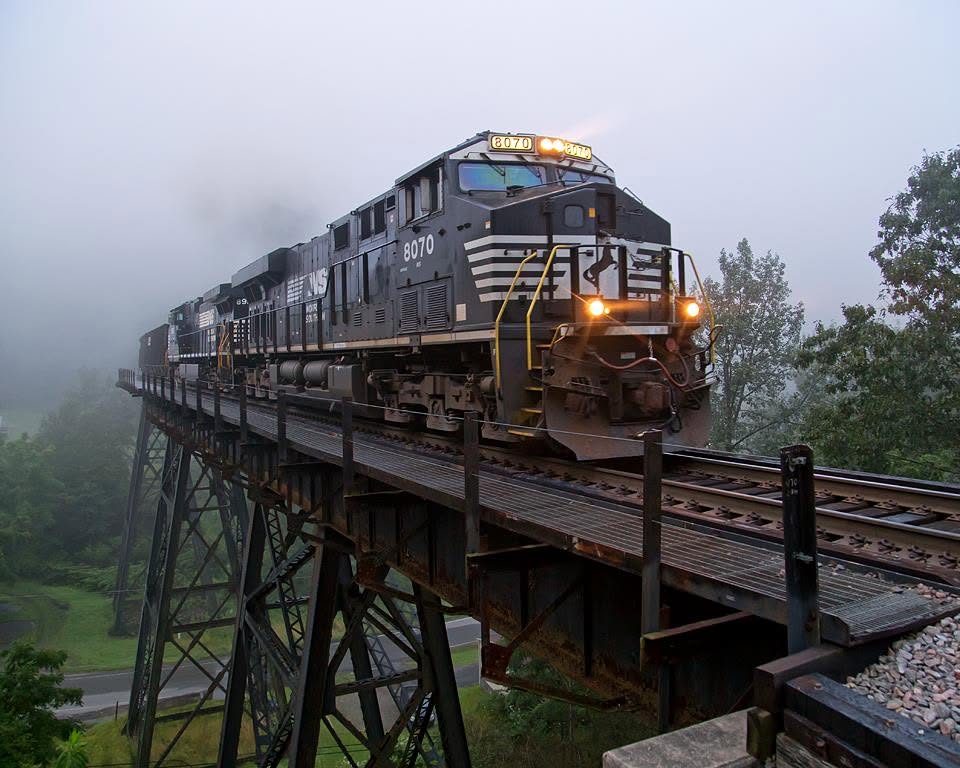
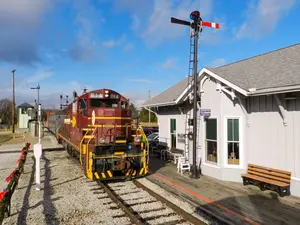
Norfolk Southern ES44AC 8070 leads the Chemical Train over Slab Fork Trestle, West Virginia, in June 2016. Loyd Lowry photo.
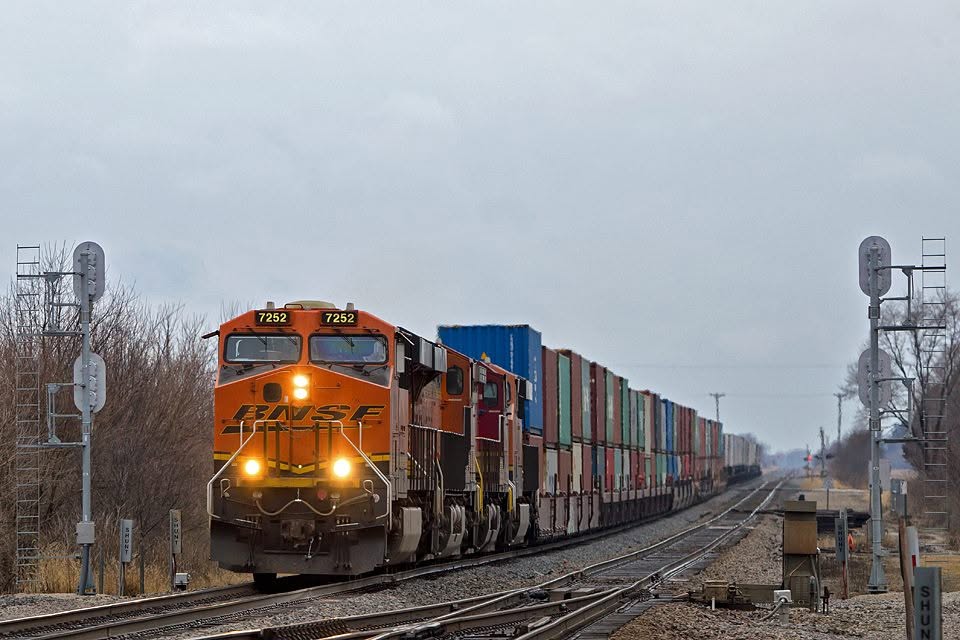
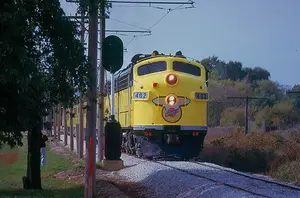
BNSF ES44DC 7252 leads an eastbound hotshot intermodal through Verona, Illinois, at 70 mph in January 2019. Loyd Lowry photo.
The today page uses 164,822 (1980) and 136,650 (2020) for a national-network snapshot. Direction is the same: a smaller Class I plant. Short lines and regionals remain short lines and regionals.
Positive Train Control
The Rail Safety Improvement Act of 2008 required Class I freight railroads and intercity and commuter passenger operators to install Positive Train Control on mains that carried passengers or poison-inhalation-hazard traffic. The original deadline was December 31, 2015. The Positive Train Control Enforcement and Implementation Act of 2015 moved full implementation to December 31, 2018, with a statutory off-ramp to December 31, 2020 if a railroad met six hardware-and-testing tests. Amtrak’s derailment of train 188 at Frankford Junction in Philadelphia on May 12, 2015 kept the political clock running. By the 2018 date the Class Is were largely in revenue service or on FRA alternative schedules; interoperability among hosts and tenants took the extra years. The 2008 statute is a 2000s door. The deadline that actually governed the industry is this decade.
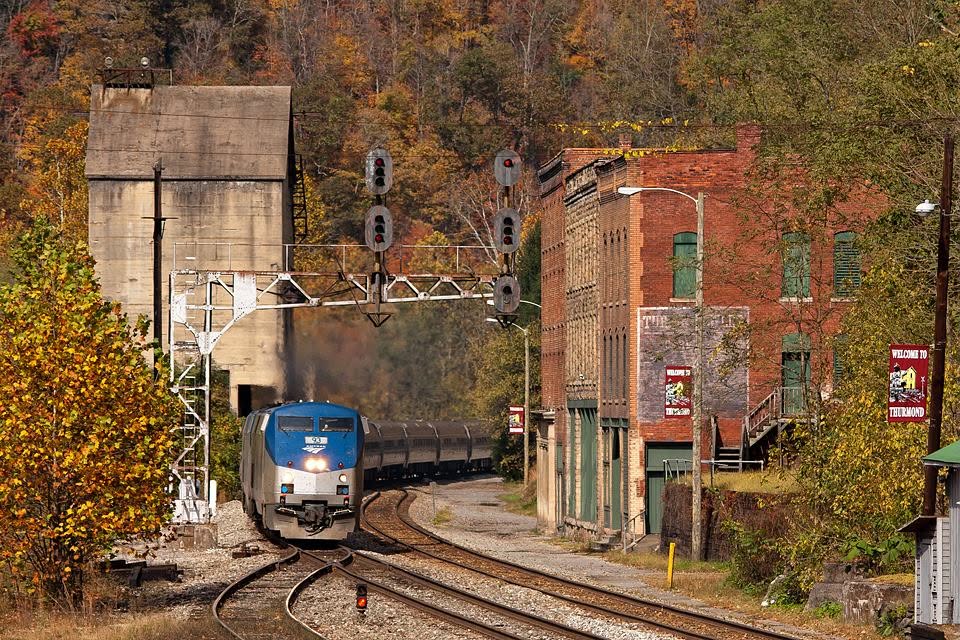
Amtrak’s eastbound Cardinal at historic Thurmond, West Virginia, in October 2018. Loyd Lowry photo.
Thurmond is the passenger leftover on the old Chesapeake & Ohio. The Cardinal still uses that depot three days a week. The named-train encyclopedia is the Cardinal. Amtrak as a company is Amtrak.
Short lines, one holding company
The Class I map froze. The short-line map did not. Genesee & Wyoming agreed to buy RailAmerica on July 23, 2012, $27.50 a share, about $1.4 billion in cash for the shares. The purchase closed into a voting trust on October 1. The Surface Transportation Board approved control on December 20, 2012, Finance Docket 35654, effective December 28. The combination was the largest short-line holding company in the country: on the order of a hundred railroads and 15,000 miles. That is a 2010s date on the Staggers spinoff industry, not a second G&W encyclopedia. Kansas City Southern remained the seventh Class I and kept its Mexican franchise. CPKC is 2023.
Into the 2020s
By 2020 the seven-name Class I list was still intact. BNSF belonged to Berkshire Hathaway. Harrison had been to CP and CSX and was gone. PTC was on the mains or on the last FRA schedules. Coal was no longer the growth commodity. Intermodal was. Class I mileage was about 91,800. Ton-miles had taken the pandemic punch. Kansas City Southern was still independent.
Canadian Pacific Kansas City (2023), the pending Union Pacific–Norfolk Southern case, and Precision Scheduled Railroading as everyday 2026 practice are later than this page. The present-tense industry—who the Class Is are, how the STB works, what the 2026 map looks like—is railroads of today. The 2010s left them a private BNSF, an operating gospel with a public name, a federal overlay on the signals, a short-line holding company that had swallowed its largest rival, and a traffic mix that no longer assumed the power plants would take the coal.
Related reading on American-Rails.com
- Railroad History (USA) · Railroads In The 2000s · Staggers Act · Railroads of today
- Class I railroads · BNSF · Union Pacific · CSX · Norfolk Southern
- Canadian Pacific · Canadian National · Kansas City Southern
- Short lines · Regionals · Diesel locomotives
- Amtrak · Cardinal · Fallen flags
Sources
- Association of American Railroads, Railroad Facts, Class I miles of road and ton-miles, as tabulated by the Bureau of Transportation Statistics (95,573 / 1,691,004 million in 2010; 93,628 / 1,745,000 million in 2015; 94,372 / 1,851,000 million in 2014 peak; 91,773 / 1,439,814 million in 2020)
- Berkshire Hathaway–BNSF closed February 12, 2010 (Associated Press; Berkshire/BNSF). Announcement November 3, 2009, on the 2000s page
- Canadian Pacific: Hunter Harrison appointed president and CEO June 29, 2012 (CP news release; CBC). Pershing Square / William Ackman proxy fight, May 2012. Harrison left CP January 2017; Keith Creel succeeded him
- CSX: Harrison CEO March 2017 (Mantle Ridge / Paul Hilal). Died December 16, 2017, Wellington, Florida (CSX news release). Jim Foote acting CEO
- Genesee & Wyoming–RailAmerica: announced July 23, 2012, $27.50 a share (Reuters; G&W). Closed into voting trust October 1, 2012. STB Finance Docket 35654, December 20, 2012; control December 28, 2012
- Rail Safety Improvement Act of 2008, PTC originally December 31, 2015. Positive Train Control Enforcement and Implementation Act of 2015, deadline December 31, 2018, alternative schedule not later than December 31, 2020 (49 U.S.C. §20157; FRA). Amtrak train 188, Frankford Junction, Philadelphia, May 12, 2015
- Lac-Mégantic, Quebec, July 6, 2013, Montreal, Maine & Atlantic. Norfolk Southern Heritage locomotives, 2012. EPA locomotive Tier 4, model year 2015
- Live American-Rails company and named-train pages as linked above
Recent Articles


-
Florida East Coast Steam Roster (Post 1900)
Oct 08, 26 02:34 PM
 Florida East Coast steam since 1897. Seventeen Ten-Wheelers, twenty Atlantics, eighty-seven Pacifics, ninety Mountains, fifteen Mikados, and the switchers.
-
Florida East Coast Diesel Roster (All-Time)
Oct 08, 26 02:12 PM
 Florida East Coast diesel roster, all-time. E units from 1939, F3s, BL2s, GP7s and GP9s, the GP40-2 orders, 22 SD40-2s, and 24 ES44C4s. Serials and EMD order numbers.
-
Florida East Coast Railway: Map, History, Rosters
Oct 08, 26 01:46 PM
 Florida East Coast Railway, Henry Flagler's line from Jacksonville to Miami and Key West. Receivership in 1931, the 1963 strike, Grupo México in 2017, and Brightline on the same track.
-
Minnesota Railroad Museums (2026): A Complete Guide
Oct 08, 26 10:32 AM
 Minnesota railroad museums—the Lake Superior Railroad Museum, Two Harbors, Jackson Street, Willmar’s Great Northern 2523, and Currie. Confirm hours on each site.
-
Maine Railroad Museums (2026): A Complete Guide
Oct 08, 26 09:24 AM
 Maine railroad museums—Seashore Trolley, the two-foot lines at Portland, Alna, and Phillips, Boothbay, and the Bangor & Aroostook depots. Confirm hours on each site.
-
Massachusetts Railroad Museums (2026): A Complete Guide
Oct 08, 26 12:08 AM
 Massachusetts railroad museums—Berkshire Scenic at Lenox, Shelburne Falls trolley No. 10, Edaville, Chatham’s 1887 depot, and Lowell. Confirm hours on each site.
-
Clinchfield Steam Roster (Post 1900)
Oct 07, 26 12:09 PM
 Clinchfield steam since 1900. Fifteen H-4 Consolidations, K-1 Mikados, M-2 and M-3 Mallets, L-class 2-8-8-2s, eighteen Challengers. Class grid after Drury. Last steam April 16, 1954.
-
Clinchfield Diesel Roster (All-Time)
Oct 07, 26 12:05 PM
 Clinchfield diesel roster, all-time. F3A 800, FP7 200, the F7s, GP7s, 25 SD40s, 18 SD45-2s, seven U36Cs, and the Family Lines hoods. Serials and EMD order numbers.
-
Clinchfield Railroad: Map, Steam Locomotives, Roster, Logo
Oct 07, 26 12:02 PM
 Clinchfield Railroad, Elkhorn City to Spartanburg. George L. Carter, the Carolina, Clinchfield & Ohio, the 1924 lease, coal, the loops, and CSX. Steam and diesel rosters are companion pages.
-
Kentucky Railroad Museums (2026): A Complete Guide
Oct 07, 26 11:39 AM
 Kentucky railroad museums—the Kentucky Railway Museum, Bowling Green’s L&N depot, Paducah, Versailles, and Covington. Confirm hours on each site.
-
Kansas Railroad Museums (2026): A Complete Guide
Oct 07, 26 11:26 AM
 Kansas railroad museums—Santa Fe 3768 at Wichita, Santa Fe 132 in Topeka, the Great Overland Station, and Abilene. Confirm hours on each site.
-
Cincinnati, New Orleans and Texas Pacific Diesel Roster (All-Time)
Oct 07, 26 10:38 AM
 All-time diesel roster of Southern locomotives lettered for the Cincinnati, New Orleans and Texas Pacific. Serials, order numbers, and builder dates.
-
Cincinnati, New Orleans and Texas Pacific Railway
Oct 07, 26 10:31 AM
 Cincinnati, New Orleans and Texas Pacific Railway, incorporated September 8, 1881, to lease Cincinnati’s railroad to Chattanooga. Queen and Crescent route, Rathole, and the 2024 sale to Norfolk Southe…
-
Indiana Railroad Museums (2026): A Complete Guide
Oct 07, 26 12:26 AM
 Indiana railroad museums—Nickel Plate 765, Elkhart’s New York Central collection, French Lick, Linden’s junction depot, and Haley Tower. Confirm hours on each site.
-
"Triplex" Steam Locomotive: Specs, History, Photos
Oct 06, 26 11:52 PM
 Erie class P-1 Triplex 2-8-8-8-2s. Three Baldwin compounds, 2603–2605, later 5014–5016, built 1914 and 1916. Matt H. Shay, the 1930 class card, and Virginian XA 700.
-
Illinois Railroad Museums (2026): A Complete Guide
Oct 06, 26 11:47 PM
 Illinois railroad museums—the Illinois Railway Museum, Monticello, the Pioneer Zephyr, Galesburg’s Burlington 3006, and the depots. Confirm hours on each site.
-
Iowa Railroad Museums (2026): A Complete Guide
Oct 06, 26 11:41 PM
 Iowa railroad museums—the Union Pacific Railroad Museum, RailsWest, Sioux City, Boone, and the National Hobo Museum in Britt. Confirm hours on each site.
-
Charleston and Western Carolina Diesel Roster (All-Time)
Oct 06, 26 11:29 PM
 Charleston and Western Carolina diesel roster. Twenty-one GP7s, two SW7s, two SW9s, and six F7As, all built 1950–1952. Serials, order numbers, and ACL and SCL numbers.
-
Charleston and Western Carolina Railway: Map, History, Timetables
Oct 06, 26 11:18 PM
 Charleston and Western Carolina Railway, incorporated September 16, 1896. Port Royal to Spartanburg, with branches to Anderson and Greenville. Merged into the Atlantic Coast Line on December 31, 1959.
-
Central of Georgia Steam Roster (Post 1900)
Oct 06, 26 04:00 PM
 Central of Georgia steam since 1900. Cooke Consolidations, Harriman Mikados, 32 Mountains, and eight Lima 4-8-4s. Class grid after Drury. Last steam May 1953.
-
Central of Georgia Diesel Roster (All-Time)
Oct 06, 26 03:44 PM
 Central of Georgia diesel roster. SW1 No. 1 in 1939, E7s and E8s, nine F3As, 39 RS3s, GP7s through SD35s. Serials and order numbers.
-
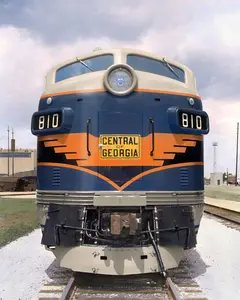
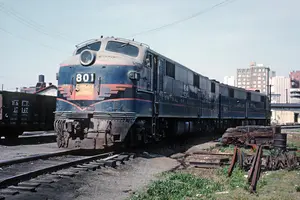
Central of Georgia Railway: Map, Logo, History, Rosters
Oct 06, 26 03:42 PM
 Central of Georgia Railway, from the 1833 Savannah charter to Southern control on June 17, 1963. Map, logos, Nancy Hanks II, and links to the steam and diesel rosters.
-
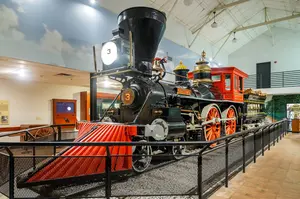
Georgia Railroad Museums (2026): A Complete Guide
Oct 06, 26 03:33 PM
Georgia railroad museums—Savannah’s Central shops, Duluth, the General at Kennesaw, the Texas in Atlanta, Tifton, Waycross, and Albany. Confirm hours on each site. -
Florida Railroad Museums (2026): A Complete Guide
Oct 06, 26 03:18 PM
 Florida railroad museums—Boca Raton, Winter Garden, Whitehall, the Gold Coast, Parrish, Fort Myers, Milton, and Plant City. Confirm hours on each site.
-
Connecticut Railroad Museums (2026): A Complete Guide
Oct 06, 26 01:05 PM
 Connecticut railroad museums—the Shore Line Trolley, East Windsor, the Naugatuck Railroad, Danbury Union Station, Willimantic, and the SoNo tower. Confirm hours on each site.
-
Colorado Railroad Museums (2026): A Complete Guide
Oct 06, 26 12:47 PM
 Colorado railroad museums—Golden, the Forney’s Big Boy 4005, Pueblo’s Santa Fe 2912, and the depots at Castle Rock, Limon, and Ridgway. Confirm hours on each site.
-
Atlantic Coast Line Steam Roster (Post 1900)
Oct 06, 26 12:44 PM
 Atlantic Coast Line steam since 1900. Copper Head Ten-Wheelers, 235 P-5 Pacifics, Q-1 Santa Fes, twelve R-1 4-8-4s. Class grid after Drury. Last steam June 30, 1955.
-
Atlantic Coast Line Diesel Roster (All-Time)
Oct 06, 26 11:57 AM
 Atlantic Coast Line diesel roster. HH660 1900 in 1939, E3s for the Champion, FTs and F2s, GP7s 100–279, GP30s, U25Cs, and the 1967 SCL numbers. Serials and orders.
-
Atlantic Coast Line Railroad: "Standard Railroad of the South"
Oct 06, 26 11:53 AM
 Atlantic Coast Line, the Standard Railroad of the South. April 21, 1900 to July 1, 1967. Plant System, L&N, Clinchfield, the Champion, and the Seaboard Coast Line merger.
-
California Railroad Museums (2026): A Complete Guide
Oct 06, 26 09:50 AM
California railroad museums—the California State Railroad Museum, Perris, Portola, Railtown 1897, and the depots that still stand. Confirm hours on each site. -
Arizona Railroad Museums (2026): A Complete Guide
Oct 06, 26 09:46 AM
Arizona railroad museums—the Arizona Railway Museum in Chandler, Southern Pacific 1673 at Tucson, and the McCormick-Stillman park in Scottsdale. -
Arkansas Railroad Museums (2026): A Complete Guide
Oct 06, 26 09:07 AM
 Arkansas railroad museums—Cotton Belt 819 at Pine Bluff, the Fort Smith trolley, the Mammoth Spring depot, and the Eureka Springs railway.
-
Alabama Railroad Museums (2026): A Complete Guide
Oct 06, 26 09:03 AM
Alabama railroad museums—Heart of Dixie at Calera, the North Alabama museum at Chase, Huntsville’s 1860 depot, and Fort Payne. Confirm hours on each site. -
Pennsylvania Railroad Museums (2026): A Complete Guide
Oct 06, 26 12:09 AM
 Pennsylvania railroad museums—Strasburg, Steamtown, the Horseshoe Curve, the East Broad Top, and the depots and towers in between. Confirm hours on each site.
-
Maryland Railroad Museums (2026): A Complete Guide
Oct 05, 26 11:53 PM
 Maryland railroad museums—the Baltimore roundhouse, Ellicott City station, Bowie, Gaithersburg’s Buffalo Creek & Gauley 14, and the Western Maryland collections.
-
Ohio Railroad Museums (2026): A Complete Guide
Oct 05, 26 05:51 PM
 Ohio railroad museums—the Age of Steam Roundhouse, Bellevue, Worthington, Conneaut’s Nickel Plate 755, and the Dennison depot. Confirm hours on each site.
-
Delaware Railroad Museums (2026): A Complete Guide
Oct 05, 26 02:43 PM
 Delaware railroad museums—Wilmington & Western at Greenbank, the Harrington tower and N5 caboose, Felton's 1868 depot, and the Selbyville station museum.
-
C&O's M-1 Steam Turbine Locomotives: Specs, Roster, History
Oct 05, 26 12:13 PM
 Chesapeake & Ohio Class M-1 steam-turbine-electrics. Three Baldwin-Westinghouse locomotives, 500–502, built 1947–48 for The Chessie. Specs, the 2-C1+2-C1-B arrangement, and a roster. All scrapped…
-
N&W 2-6-6-2 Locomotives (Class Z): Specs, Roster, History
Oct 05, 26 11:44 AM
 Norfolk & Western Class Z 2-6-6-2s. One hundred ninety compound Mallets, 1300–1489, from Richmond, Baldwin, and Schenectady, 1912–1918. Diagram specs, the Z-1b rebuilds, Z-2 1399, and a roster. No…
-
Scenic Train Rides (USA 2026): State Guide to Tourist Railroads
Oct 04, 26 12:17 AM
 Scenic and tourist train rides in all 50 states for 2026. Colorado narrow gauge, Pennsylvania steam, Alaska’s White Pass, and the states with no full-size ride this month. Confirm on the railroad.
-
Wyoming Scenic Train Rides (2026): A Complete Guide
Oct 03, 26 12:07 AM
Wyoming has no full-size tourist railroad on the calendar in October 2026. Cheyenne Depot Museum and Douglas Railroad Museum are static. Union Pacific 4014’s posted public trip is a November run to De… -
Washington Scenic Train Rides (2026): A Complete Guide
Oct 02, 26 11:53 PM
 Washington tourist trains in 2026—Mount Rainier Scenic at Elbe, the Northwest Railway Museum, and Chehalis-Centralia. Lake Whatcom has no 2026 date on its ticket page.
-
Wisconsin Scenic Train Rides (2026): A Complete Guide
Oct 02, 26 11:48 PM
 Wisconsin tourist trains in 2026—Wisconsin Great Northern, Osceola & St. Croix Valley, Mid-Continent, East Troy, and the National Railroad Museum.
-
Pennsylvania Railroad Class Q2 4-4-6-4: Specs, Roster, History
Oct 02, 26 11:28 PM
Pennsylvania Railroad Class Q2 4-4-6-4 duplexes. Twenty-six engines, 6131 and 6175–6199, Altoona 1944–45. Form 109-J specs, the 7,987 hp test of 6175, and a roster. All scrapped. -
Utah Scenic Train Rides (2026): A Complete Guide
Oct 02, 26 11:18 PM
 Utah tourist trains in 2026—Heber Valley Railroad from Heber City. Golden Spike at Promontory is a locomotive demonstration, not a line-haul ride.
-
South Dakota Scenic Train Rides (2026): A Complete Guide
Oct 02, 26 11:06 PM
 South Dakota’s 2026 scenic train is the Black Hills Central 1880 Train, Hill City to Keystone. Steam is the summer assignment. Confirm the engine.
-
Oregon Scenic Train Rides (2026): A Complete Guide
Oct 02, 26 11:04 PM
 Oregon tourist trains in 2026—Oregon Coast Scenic from Rockaway Beach, Mount Hood at Hood River, Eagle Cap from Elgin, and the Oregon Rail Heritage Center in Portland.
-
Oklahoma Scenic Train Rides (2026): A Complete Guide
Oct 02, 26 10:36 PM
Oklahoma has no full-size scenic railroad on an October 2026 calendar. Oklahoma Railway Museum Halloween and Polar trains, the El Reno trolley, and the Heartland Flyer. -
North Dakota Scenic Train Rides (2026): A Complete Guide
Oct 02, 26 01:14 PM
North Dakota has no tourist railroad on a 2026 calendar. Ride Amtrak’s daily Empire Builder. The Fort Lincoln Trolley in Mandan is not a current ticket. -
Nebraska Scenic Train Rides (2026): A Complete Guide
Oct 02, 26 10:11 AM
 Nebraska has no full-size scenic railroad in 2026. The Omaha Zoo Railroad runs weekends through October 4. Ride Amtrak’s California Zephyr across the state.