Railroads In The 2000s: Merger Freeze, Wisconsin Central & Buffett
Last revised: September 13, 2026
By: Adam Burns
The 2000s opened with the Class I map the 1990s had just finished and a federal board that did not want another round. Class I miles of road stood at 99,250 in 2000 and 95,573 in 2010—the same Association of American Railroads series that put 119,758 miles on the books in 1990. Ton-miles rose from 1,465,960 million to a 2008 peak of 1,777,236 million, then dropped to 1,532,214 million in the 2009 recession. The Surface Transportation Board froze major mergers on March 17, 2000. Canadian National and Burlington Northern Santa Fe called off their combination on July 20. Canadian National took Wisconsin Central on October 9, 2001. The railroad subsidiary became BNSF Railway on January 24, 2005. Warren Buffett announced Berkshire Hathaway’s purchase of BNSF on November 3, 2009.
What follows here is 2000 through 2010: a Class I map that froze at seven names, two Canadians buying U.S. regionals, a scheduled railroad at CN that Wall Street learned to watch, a hurricane that took CSX’s Gulf Coast main, and a private purchase of the other western giant.
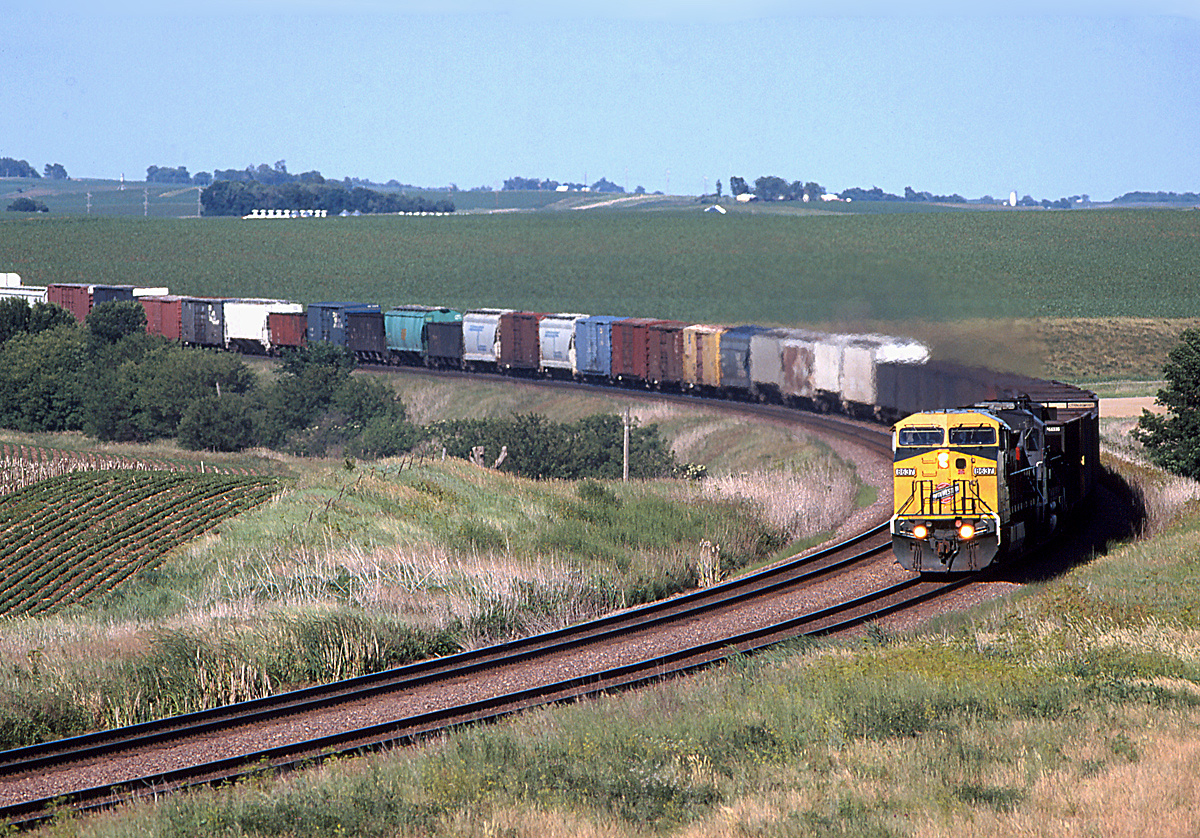
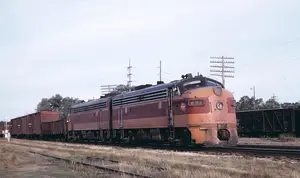
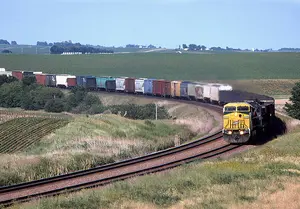
Chicago & North Western C44-9W 8637 on Union Pacific’s Clinton Subdivision at Arcadia, Iowa, on June 18, 2000. Wade Massie photo.
On this page: At a glance · The map of 2000 · The merger that did not happen · Canadian National and Wisconsin Central · Canadian Pacific and the DM&E · BNSF Railway and Berkshire Hathaway · Miles flat, ton-miles up, then the crash · Into the 2010s
At a glance
| Item | Detail |
|---|---|
| Class I miles of road, 2000 | 99,250 (AAR / BTS series; same series as 119,758 in 1990 on the 1990s page) |
| Class I miles of road, 2005 | 95,664 |
| Class I miles of road, 2010 | 95,573 |
| Class I ton-miles, 2000 | 1,465,960 million |
| Class I ton-miles, 2005 | 1,696,425 million |
| Class I ton-miles, 2008 (peak) | 1,777,236 million |
| Class I ton-miles, 2009 | 1,532,214 million |
| Class I ton-miles, 2010 | 1,691,004 million |
| Acela Express revenue service | December 11, 2000. The 1996 order is the 1990s |
| CN–BNSF combination | Notice of intent December 20, 1999. Called off July 20, 2000 |
| STB major-merger moratorium | March 17, 2000, 15 months. Ex Parte 582. D.C. Circuit upheld July 14 |
| New major-merger rules | Ex Parte 582 (Sub-No. 1), issued June 11, 2001, effective July 11 |
| CN–Wisconsin Central | Announced January 30, 2001. STB Finance Docket 34000, September 7, 2001. Closed October 9, 2001 |
| Hunter Harrison at CN | Chief executive January 1, 2003–December 31, 2009. Scheduled railroad as a date, not a PSR encyclopedia |
| BNSF Railway name | Operating subsidiary renamed January 24, 2005. Holding company stayed Burlington Northern Santa Fe Corporation |
| KCS control of TFM / KCSM | April 1, 2005. Renamed Kansas City Southern de México that December |
| Hurricane Katrina | August 29, 2005. CSX NO&M Subdivision, New Orleans–Mobile |
| EPA locomotive Tier 2 | New line-haul units, model year 2005. GE Evolution Series; EMD SD70ACe |
| CP control of DM&E / IC&E | STB Finance Docket 35081, September 30, 2008. Control October 30, 2008 |
| Berkshire Hathaway–BNSF announced | November 3, 2009, $100 a share. Closed February 12, 2010 |
| Not this decade | Buffett closing (February 12, 2010). Harrison at CP (2012). PSR as a brand. CPKC. The 2026 Class I map |
Class I mileage and ton-miles from Association of American Railroads, Railroad Facts, as tabulated by the Bureau of Transportation Statistics. Information compiled September 13, 2026.
The map of 2000
By New Year’s Day 2000 the western duopoly was in place: BNSF and a Union Pacific that included the North Western and Southern Pacific. CSX and Norfolk Southern had divided Conrail on June 1, 1999, and were still digesting it. Canadian National had the Illinois Central. The Interstate Commerce Commission was gone. Kansas City Southern was still independent. Wisconsin Central was still independent. Soo Line was still Canadian Pacific. Class I mileage was under 100,000. Ton-miles were approaching a trillion and a half.
That is what the 1990s left on the table. The Arcadia photograph is the leftover paint. Union Pacific had taken the Chicago & North Western in 1995. Five years later a Dash 9 still lettered North Western is on UP’s Clinton Subdivision—the old Chicago–Omaha main—at Arcadia, Iowa. The North Western encyclopedia is Chicago & North Western. Union Pacific is Union Pacific.
Acela Express carried its first paying passengers on December 11, 2000, Washington to Boston. The 1996 order is the previous decade. After September 11, 2001, freight kept moving; Amtrak carried travelers the airlines could not. Those passenger encyclopedias are Amtrak and commuter rail. The 2000s freight assignment was different: stop the next mega-merger, buy the regionals that still sat between the giants, and run what the 1990s had already combined.
The merger that did not happen
Canadian National and Burlington Northern Santa Fe notified the Surface Transportation Board on December 20, 1999, that they intended to combine as North American Railways: on the order of 50,000 route-miles, Halifax to the Mexican border. Robert Krebs (BNSF) and Paul Tellier (CN) called it end-to-end. The other Class Is, and a large share of the shippers still living with the Union Pacific–Southern Pacific and Conrail integrations, called it the trigger for a final round that would leave two transcontinentals.
The Board opened Ex Parte 582, held four days of hearings, and on March 17, 2000 imposed a 15-month moratorium on major railroad merger filings while it rewrote the rules. The U.S. Court of Appeals for the D.C. Circuit upheld the freeze on July 14. Six days later, on July 20, 2000, both boards voted the combination off. Tellier and Krebs said it was not in shareholders’ interest to wait as long as two and a half years for a decision.
The new major-merger rules came out on June 11, 2001, Ex Parte 582 (Sub-No. 1), effective July 11. Applicants would have to show enhanced competition, not only the absence of harm, and file a service-assurance plan. Kansas City Southern received a waiver as the smallest Class I; that waiver is why a later CP–KCS case could still be heard under the older standard. No major two-Class-I combination used the 2001 rules in this decade. The present-tense Board is today. BNSF is BNSF; Canadian National is Canadian National.
Canadian National and Wisconsin Central
The freeze applied to major Class I combinations. A Class II regional was a different filing. Canadian National announced Wisconsin Central Transportation on January 30, 2001, cash at $17.15 a share, about 2,800 route-miles and rights in Wisconsin, Illinois, Minnesota, Michigan’s Upper Peninsula, and Ontario. The application was Finance Docket 34000. The Board treated it as a minor transaction, approved it on September 7, 2001, and the deal closed on October 9. WC became CN’s sixth operating division. The regional encyclopedia is Wisconsin Central; the 1987 spin from Soo is the 1980s.
Hunter Harrison, who had run Illinois Central to a schedule in the 1990s, was CN’s operating chief and then, from January 1, 2003, to December 31, 2009, its chief executive. In 2005 he published How We Work and Why. CN’s operating ratio became the number Wall Street watched. That is a date on this page. The later Precision Scheduled Railroading brand, and Harrison’s 2012 campaign at Canadian Pacific, are not.
Canadian Pacific and the DM&E
Canadian Pacific had taken the Delaware & Hudson in 1991. In 2007 it agreed to buy the Dakota, Minnesota & Eastern and the Iowa, Chicago & Eastern, the largest U.S. regional, with a paper option on DM&E’s long-proposed Powder River Basin extension. The Board approved control on September 30, 2008, Finance Docket 35081, and control became effective October 30, 2008. Conditions kept the Powder River coal line in a separate environmental review. That line was not built in this decade. The regional encyclopedia is Dakota, Minnesota & Eastern. Canadian Pacific is Canadian Pacific.
Kansas City Southern stayed the seventh Class I. On April 1, 2005, it took control of TFM from Grupo TMM; the Mexican road was renamed Kansas City Southern de México that December. Tex Mex had already come in on January 1. KCS now reached Mexico City and Lázaro Cárdenas under one holding company. The company encyclopedia is Kansas City Southern. Canadian Pacific Kansas City is 2023.
BNSF Railway and Berkshire Hathaway
On January 24, 2005, ten years after the holding-company consummation, Burlington Northern Santa Fe renamed the operating railroad BNSF Railway Company and rolled out a new logo. The parent stayed Burlington Northern Santa Fe Corporation, ticker BNI. Matt Rose rang the New York Stock Exchange closing bell that afternoon.
On November 3, 2009, Warren Buffett’s Berkshire Hathaway announced it would buy the 77.4 percent of BNSF it did not already own, $100 a share in cash and stock, about $44 billion including $10 billion of BNSF debt. Buffett called it an all-in wager on the United States. Shareholders approved the deal in February. Closing was February 12, 2010—the next decade. The 2000s fact is the announcement, in the trough of the recession, of the largest purchase in Berkshire’s history. Fort Worth stayed the railroad’s headquarters. The company encyclopedia is BNSF.
Miles flat, ton-miles up, then the crash
Class I miles of road moved from 99,250 (2000) to 95,664 (2005) to 95,573 (2010). That is not the 1980s–90s drop. The big spinoffs had already happened. Short lines and regionals are still short lines and regionals. The today page uses 164,822 (1980) and 136,650 (2020) for a national-network snapshot. Direction is the same; the slope is not.
Class I ton-miles rose from 1,465,960 million in 2000 to 1,696,425 million in 2005 to 1,777,236 million in 2008, then fell to 1,532,214 million in 2009 and recovered to 1,691,004 million in 2010. Powder River coal, containers, and contract grain filled the boom years. The 2008–09 recession took the rest. EPA Tier 2 standards hit new line-haul locomotives in model year 2005: GE’s Evolution Series (ES44AC and kin) and EMD’s SD70ACe. That hardware story is diesel locomotives.
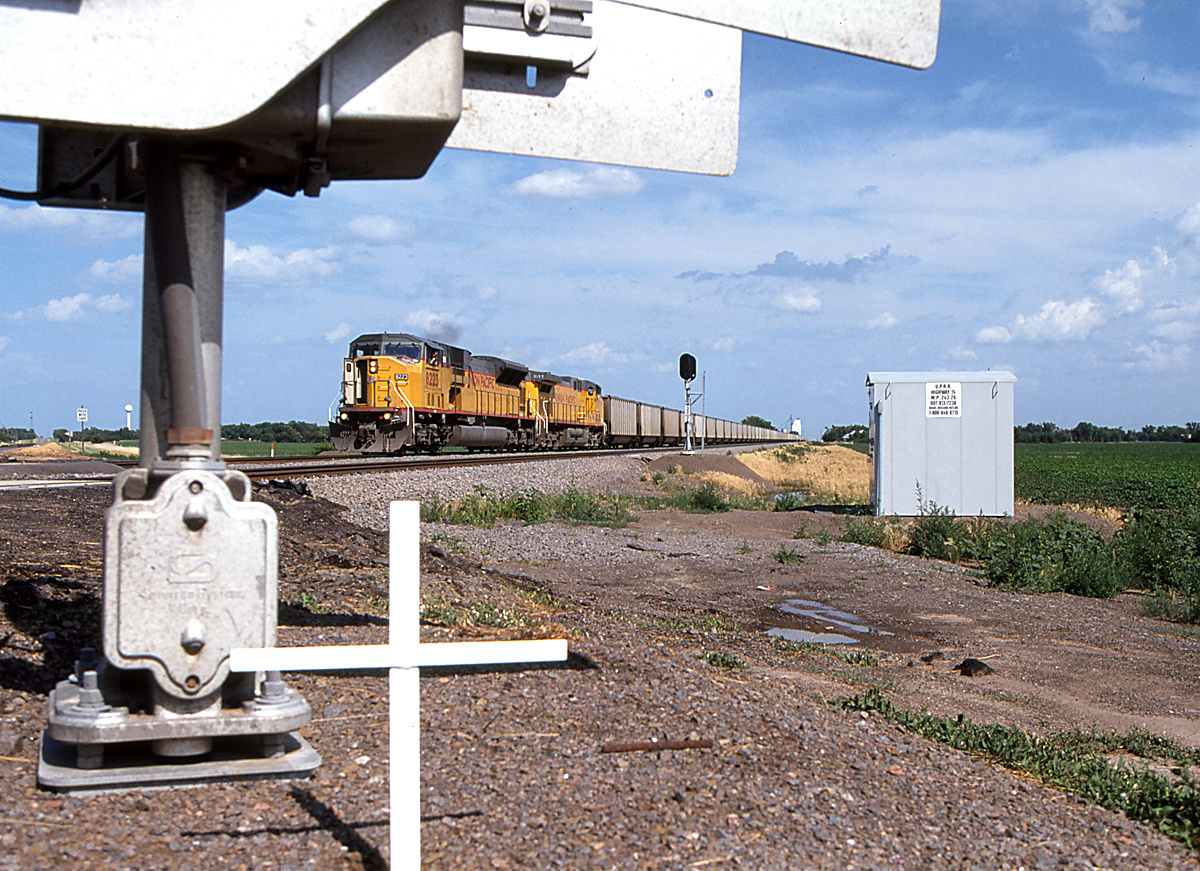
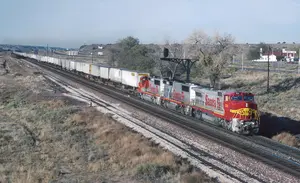
Union Pacific SD90MAC 8223 passes a small memorial outside Fairfield, Nebraska, on June 23, 2000. Wade Massie photo.
The SD90MAC was Union Pacific’s high-horsepower experiment at the turn of the decade: 8200-series convertibles on 4,300-horsepower 710 engines, ordered with a 6,000-horsepower future that mostly did not arrive. Five days after the Arcadia North Western Dash 9, another Massie photograph on another former granger main. The memorial in the weeds is in the picture; the locomotive type is the 2000s fact.
Hurricane Katrina made landfall on August 29, 2005. CSX’s NO&M Subdivision between Gentilly Yard at New Orleans and Mobile took the storm along the Mississippi coast: on the order of 26 contiguous route-miles nearly destroyed, six major bridges damaged or gone, including Bay St. Louis. Through freight was back in early 2006. CN and Norfolk Southern had New Orleans plants of their own. The Gulf Coast main is a CSX fact; the company encyclopedia is CSX.
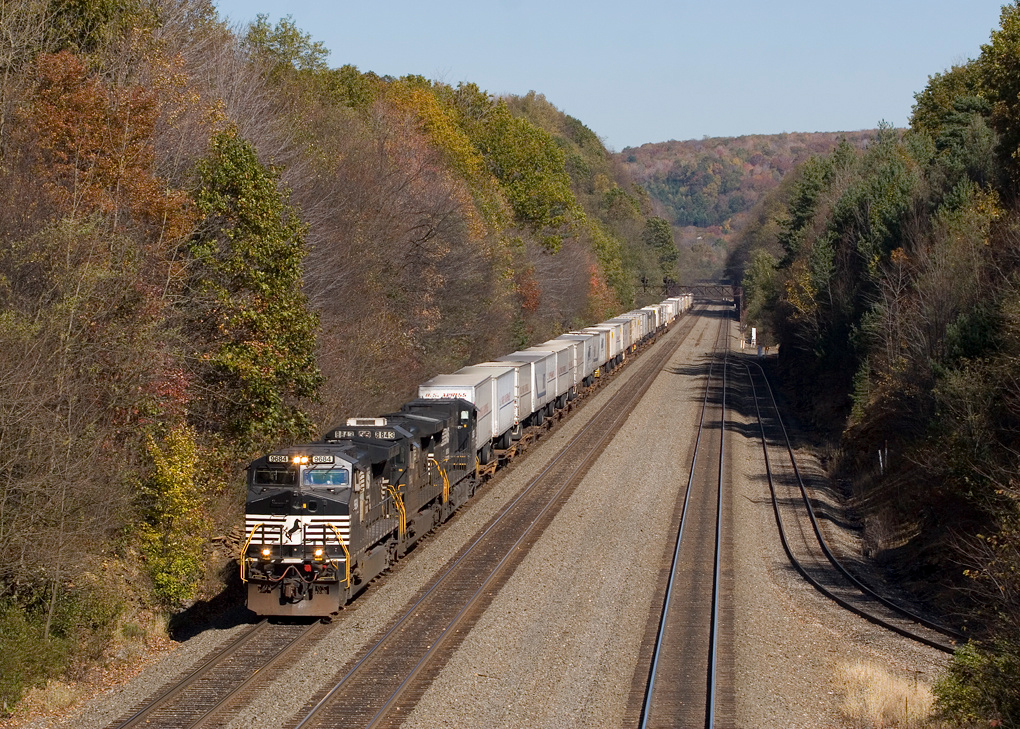
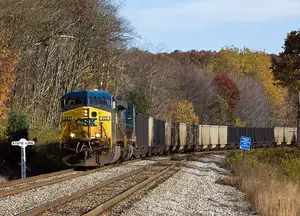
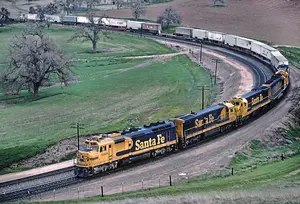
Norfolk Southern C40-9W 9684 with freight 21M at Jamestown, Pennsylvania, on October 19, 2009. Wade Massie photo.
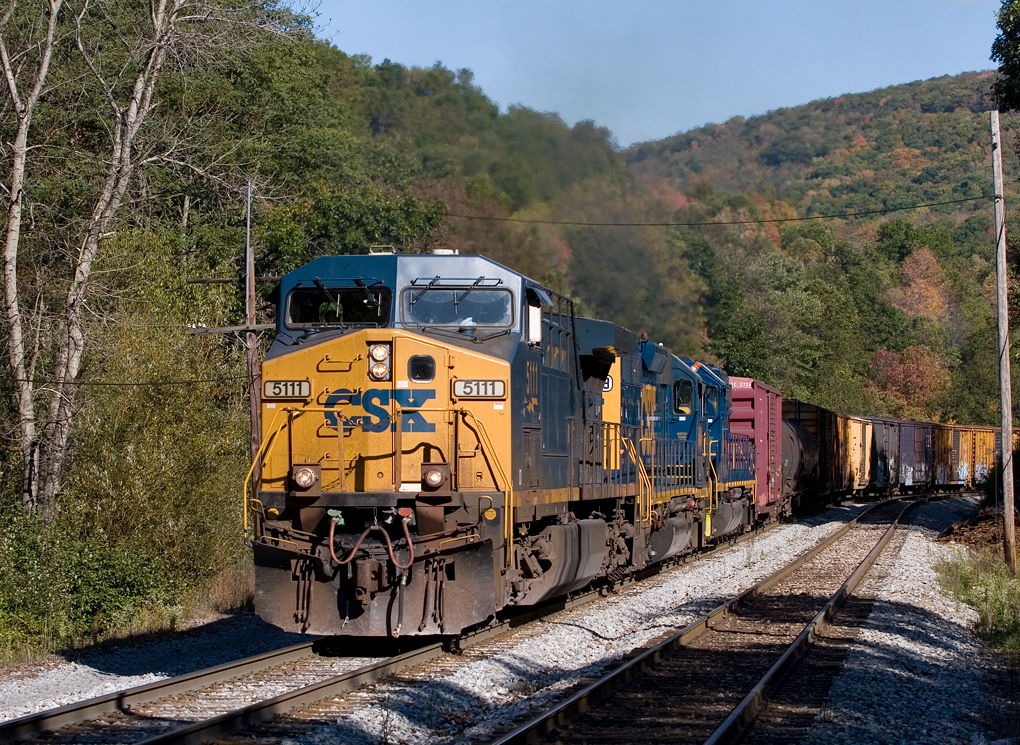
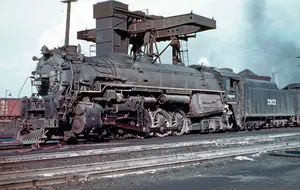
CSX AC4400CW 5111 leads freight Q317 at Swanton, Maryland, on October 5, 2009. Wade Massie photo.
Jamestown and Swanton are the eastern duopoly a decade after Split Date, photographed in the recession year. Norfolk Southern’s 21M is intermodal on the Conrail inheritance. Swanton is the former Baltimore & Ohio West End—CSX’s Mountain Subdivision—the same Appalachian coal and merchandise plant as the Pinto photograph on the 1990s page, now in Evolution-era AC power. Norfolk Southern is Norfolk Southern. Conrail remains Conrail.
Into the 2010s
By 2010 the seven-name Class I list was intact: BNSF, Union Pacific, CSX, Norfolk Southern, Canadian National, Canadian Pacific, Kansas City Southern. Wisconsin Central was CN. DM&E was CP. KCS owned its Mexican franchise. The STB’s 2001 merger rules had not yet been used on a major two-Class-I case. Class I mileage was still about 95,500. Ton-miles had come back off the 2009 floor. Berkshire Hathaway’s BNSF closing was six weeks into the new decade.
That closing (February 12, 2010), Hunter Harrison’s campaign at Canadian Pacific (2012), Precision Scheduled Railroading as a brand, Genesee & Wyoming’s purchase of RailAmerica (2012), Canadian Pacific Kansas City, and the pending Union Pacific–Norfolk Southern case are later than this page. The present-tense industry—who the Class Is are, how the STB works, what the 2026 map looks like—is railroads of today. The 2000s left them a frozen Class I map, two Canadian regionals absorbed, a BNSF that no longer belonged to the public market, a scheduled operating gospel at CN, and a short-line industry still standing on the miles the Class Is no longer wanted.
Related reading on American-Rails.com
- Railroad History (USA) · Railroads In The 1990s · Staggers Act · Railroads of today
- Class I railroads · BNSF · Union Pacific · Chicago & North Western
- Canadian National · Wisconsin Central · Canadian Pacific · Dakota, Minnesota & Eastern
- CSX · Norfolk Southern · Conrail · Kansas City Southern
- Short lines · Regionals · Diesel locomotives · Amtrak
Sources
- Association of American Railroads, Railroad Facts, Class I miles of road and ton-miles, as tabulated by the Bureau of Transportation Statistics (99,250 / 1,465,960 million in 2000; 95,664 / 1,696,425 million in 2005; 94,082 / 1,777,236 million in 2008; 93,921 / 1,532,214 million in 2009; 95,573 / 1,691,004 million in 2010)
- Canadian National–BNSF: notice of intent December 20, 1999; STB Ex Parte 582 moratorium March 17, 2000; D.C. Circuit, Western Coal Traffic League v. STB, July 14, 2000; combination terminated July 20, 2000 (CN/BNSF joint statement; New York Times, July 21, 2000)
- Major Rail Consolidation Procedures, STB Ex Parte No. 582 (Sub-No. 1), issued June 11, 2001, effective July 11, 2001. 49 C.F.R. §1180
- Canadian National–Wisconsin Central: announced January 30, 2001, $17.15 a share (FreightWaves, January 30, 2001); STB Finance Docket 34000, Decision No. 10, September 7, 2001; closed October 9, 2001
- E. Hunter Harrison, CN chief executive January 1, 2003–December 31, 2009. Harrison, How We Work and Why (2005)
- BNSF Railway Company name and new logo, January 24, 2005 (BNSF news release; NYSE closing bell). Berkshire Hathaway–BNSF announced November 3, 2009, $100 a share, about $44 billion including $10 billion of debt; closed February 12, 2010 (Berkshire Hathaway / BNSF joint release; Associated Press, February 12, 2010)
- Kansas City Southern control of TFM, April 1, 2005; renamed Kansas City Southern de México, December 2005. KCS 2005 annual report
- Canadian Pacific–Dakota, Minnesota & Eastern / Iowa, Chicago & Eastern: STB Finance Docket 35081, September 30, 2008; control effective October 30, 2008. CP Annual Information Form 2008
- Hurricane Katrina, August 29, 2005. CSX NO&M Subdivision, New Orleans–Mobile; Tom Judge, “Bridging to Recovery,” Railway Age, November 2005
- Amtrak Acela Express first revenue service, December 11, 2000. EPA locomotive Tier 2 standards, model year 2005 (40 C.F.R. Part 1033). Live American-Rails company pages as linked above
Recent Articles


-
Bessemer & Lake Erie Railroad: "The Bessemer Road"
Sep 15, 26 05:20 PM
 Bessemer & Lake Erie—Bear Creek 1865, Carnegie 1897, U.S. Steel 1901. Ore south from Conneaut, coal north. 2-10-4s, Missabe sister road. CN May 10, 2004. Complete corporate history.
 -
Bangor and Aroostook Railroad: "Serving Northern Maine"
Sep 15, 26 05:05 PM
 Bangor & Aroostook—chartered February 13, 1891, first trains January 1, 1894. Potatoes, paper, Searsport, State of Maine reefers. MM&A 2003, Lac-Mégantic 2013, CP 2020, CPKC today. Complete co…
 -
Baltimore & Ohio Chicago Terminal Railroad: Map and History
Sep 15, 26 03:11 PM
 B&OCT—formed January 6, 1910 to buy Chicago Terminal Transfer. Grand Central, Barr Yard, 78 route-miles. Assigned B&O steam. Complete diesel roster. CSX paper subsidiary, mark BOCT.
 -
The "Alphabet Route" (Railroad): Photos and History
Sep 15, 26 02:53 PM
 Alphabet Route—eight railroads, not one company. P&WV to Connellsville February 11, 1931. Alpha Jets Chicago/St. Louis–New York/Boston. NKP, W&LE, P&WV, WM, Reading, CNJ, L&HR, New Hav…
 -
Milwaukee Road Livestock Operations: Cattle, Dakotas & Montana
Sep 15, 26 02:36 PM
 Milwaukee Road livestock traffic—Dakota and Montana cattle, Iowa hogs, Chicago markets, 28-hour law, head-end stock cars. By 1974 mostly Montana. Rick Burn’s Helena speech. Operations history, not the…
 -
Spirit of Jasper Ride & Dine (2026): Season Pause
Sep 15, 26 02:29 PM
 Spirit of Jasper Ride & Dine in Jasper, Indiana—seated meal on board. Operator: not running public trains for 2026. Depot remains open as a rental. Confirm on spiritofjaspertrain.com.
 -
South Carolina Canal & Rail Road Company: Map and History
Sep 15, 26 01:59 PM
 South Carolina Canal & Rail Road—chartered December 19, 1827. Best Friend of Charleston, 136 miles Charleston–Hamburg October 1833, Aiken inclined plane. South Carolina Railroad 1844, Southern 189…
 -
The Practice of Double-Heading: The Steam Era
Sep 15, 26 01:43 PM
 Doubleheading—two locomotives on the point, each with its own steam crew. Not a rear helper, not diesel MU. How it worked, PRR 1877, mountain grades, and what MU ended.
 -
Mohawk and Hudson Railroad: Map, Pictures, Locomotives
Sep 15, 26 01:20 PM
 Mohawk & Hudson Railroad—New York’s first railroad, chartered April 17, 1826. DeWitt Clinton, inclined planes, Albany & Schenectady 1847, first New York Central May 17, 1853. Complete corporat…
 -
Essex Clipper Dinner Train (2026): Dates, Tickets & What to Expect
Sep 15, 26 01:09 PM
 2026 Essex Clipper Dinner Train in Essex, CT—2.5 hours, four-course meal $129.99, 18+. Fall dates through Oct. 25. Confirm on essexsteamtrain.com.
 -
Camden & Amboy Railroad: Map, History, Photos
Sep 15, 26 12:53 PM
 Camden & Amboy Railroad—chartered February 4, 1830. Joint Companies monopoly with the Delaware & Raritan Canal, John Bull, T-rail. United New Jersey 1872, PRR 999-year lease 1871. Complete corpora…
 -
Cafe Lafayette Dinner Train (2026): Dates, Tickets & What to Expect
Sep 15, 26 12:47 PM
2026 Cafe Lafayette Dinner Train in North Woodstock, NH—2 hours, 20 miles, five-course meal from $125. May–October. Confirm on nhdinnertrain.com. -
Christmas Train Ride Locations (2026): A Complete Guide
Sep 15, 26 10:47 AM
 2026 Christmas train rides by state—Santa, North Pole Express, and holiday trains. Not Polar Express. State guides and product pages. Confirm dates on each railroad.
 -
Baltimore & Ohio Railroad: Linking 13 Great States With The Nation
Sep 15, 26 10:22 AM
 Baltimore & Ohio Railroad—first U.S. common carrier, chartered February 28, 1827. Wheeling 1853, Chicago 1874, C&O control 1963, Chessie 1973, into CSX April 30, 1987. Complete corporate history.
 -
Delaware & Hudson Railway: The Bridge Line
Sep 15, 26 09:59 AM
 Delaware & Hudson Railway—Wurts brothers canal 1823, gravity railroad 1829, Stourbridge Lion, Bridge Line to Montreal. Guilford 1984, CP 1991, NS south line 2015, CPKC north.
 -
Delaware & Hudson Diesel Roster (All-Time)
Sep 15, 26 12:17 AM
 All-time Delaware & Hudson diesel roster—Alco S-2s through C-628s and PA-4s, GE U-boats, Baldwin RF-16s, EMD SD45s and GP38-2/GP39-2s. Serials, dates, dispositions.
 -
Granite Railway, Our Country's First Railroad
Sep 14, 26 11:28 PM
 Granite Railway of Quincy, Massachusetts—chartered March 4, 1826, opened October 7, 1826. Gridley Bryant, 5-foot gauge, horses, Bunker Hill Monument stone. First commercial U.S. railroad.
 -
Milwaukee Road Skytop Lounges: History, Specs & Floor Plans
Sep 14, 26 11:09 PM
 Milwaukee Road Skytop observation cars—Brooks Stevens, 1948. Four Rapids parlor-lounges from Milwaukee Shops, six Creek sleeper-lounges from Pullman-Standard. Floor plans, roster, preservation.
 -
West Virginia Christmas Train Rides (2026): A Complete Guide
Sep 14, 26 11:02 PM
2026 West Virginia Christmas trains—Potomac Eagle North Pole Express in Romney and Christmas at Cass. Not Polar Express. Elkins Polar is not listed for 2026. -
Railroads Of Today: Class I Map, PSR & the 2026 Industry
Sep 14, 26 10:30 PM
 U.S. freight rail in 2026—six Class I railroads on a nearly 140,000-mile network. PSR as everyday practice, how the STB works, traffic mix, short lines and regionals.
 -
Railroad History (USA): Timeline, Facts & How the Network Was Built
Sep 14, 26 10:03 PM
 Full U.S. railroad history hub—origins and inventors, Golden Age peak mileage, Civil War and transcontinental, streamliners, ICC regulation, Penn Central and Conrail, Staggers Act, PSR, and today’s Cl…
 -
Railroads In The 2020s: CPKC, East Palestine & the UP–NS Case
Sep 14, 26 09:51 PM
 U.S. railroads 2020–2026—Class I mileage 91,773 in 2020. COVID traffic drop, CPKC April 14 2023, East Palestine Feb. 3 2023, UP–NS $85 billion case still before the STB.
 -
Railroads In The 2010s: PSR, Coal’s Decline & Positive Train Control
Sep 14, 26 03:51 PM
 U.S. railroads 2010–2020—Class I mileage 95,573 to 91,773. Buffett closed BNSF Feb. 12 2010, Harrison at CP June 29 2012 and CSX 2017, PTC deadline Dec. 31 2018.
 -
Virginia Christmas Train Rides (2026): A Complete Guide
Sep 14, 26 03:46 PM
 2026 Virginia Christmas trains—Virginia Scenic Railway Santa Express from Staunton, about 60 minutes. Confirm dates. Not Polar Express.
 -
MARC Train: Maryland Commuter Rail History, Lines & Roster
Sep 14, 26 01:16 PM
 MARC Train history—Maryland Rail Commuter 1984, B&O and PRR corridors, Penn/Camden/Brunswick lines, Silver Spring 1996, all-time locomotive roster.
 -
Railroads In The 2000s: Merger Freeze, Wisconsin Central & Buffett
Sep 13, 26 07:57 AM
 U.S. railroads 2000–2010—Class I mileage 99,250 to 95,573. STB merger freeze March 17 2000, CN–WC Oct. 9 2001, BNSF Railway Jan. 24 2005, Buffett Nov. 3 2009.
 -
Railroads In The 1990s: Mega-Mergers, Conrail’s Split & the STB
Sep 13, 26 12:13 AM
 U.S. railroads 1990–2000—Class I mileage 119,758 to 99,250. BNSF Sept. 22 1995, UP–SP Sept. 11 1996, Conrail split June 1 1999, ICC Termination Dec. 29 1995.
 -
Railroads In The 1980s: Staggers, Mega-Mergers & Conrail’s IPO
Sep 12, 26 11:12 PM
 U.S. railroads 1980–1990—Class I mileage 164,822 to 119,758. Staggers Oct. 14 1980, CSX and Norfolk Southern, UP–Missouri Pacific–Western Pacific, Conrail IPO March 26 1987.
 -
Wabash Class O-1 4-8-4s: History, Roster & Specifications
Sep 12, 26 11:01 PM
 Wabash Class O-1 4-8-4s—Baldwin 1930–31, twenty-five engines 2900–2924. Fast freight, complete roster, specifications. None preserved.
 -
Staggers Rail Act of 1980: Statute, Contract Rates & the ICC
Sep 10, 26 11:23 PM
 Staggers Rail Act, Pub. L. 96-448, signed October 14, 1980. Harley Staggers, S.1946, contract rates, 180% variable-cost test, abandonments, short lines.
 -
Rock Island E8A 652: Bicentennial Independence Paint & History
Sep 10, 26 10:42 PM
 Rock Island E8A 652—EMD March 1952, serial 15199. 20th Century Railroad Club Independence bicentennial scheme, Peoria and Quad Cities Rockets, Midland Railway, Manly Junction Museum.
 -
Vermont Christmas Train Rides (2026): A Complete Guide
Sep 10, 26 10:37 PM
2026 Vermont Christmas trains—Okemo Valley Holiday Express from Chester Depot Dec. 19–20. Polar is Burlington Dec. 5–6 only. -
Railroads In The 1970s: Penn Central, Amtrak & Conrail
Sep 10, 26 10:18 AM
 U.S. railroads 1970–1980—196,479 miles at the decade’s start. Penn Central bankruptcy June 21 1970, Amtrak May 1 1971, 3R/4R Acts, Conrail April 1 1976, Rock Island 1975, Milwaukee 1977.
 -
Railroads In The 1960s: Mergers, Passenger Collapse & Penn Central
Sep 10, 26 10:03 AM
 U.S. railroads 1960–1970—207,334 to 196,479 miles. Erie Lackawanna 1960, C&O–B&O 1963, N&W–Nickel Plate 1964, SCL 1967, Penn Central Feb. 1 1968.
 -
South Carolina Christmas Train Rides (2026): A Complete Guide
Sep 10, 26 08:36 AM
 2026 South Carolina Christmas trains—South Carolina Railroad Museum Santa Train in Winnsboro. Confirm December dates. Not Polar Express. Drop light-festival padding.
 -
Steam Locomotive Feedwater Heaters: Elesco, Coffin & Worthington
Sep 10, 26 08:29 AM
 Steam locomotive feedwater heaters—open Worthington vs closed Elesco and Coffin. How they work, how to identify them on a smokebox, and why not every engine had one.
 -
Oregon Christmas Train Rides (2026): A Complete Guide
Sep 10, 26 08:22 AM
2026 Oregon Christmas trains—Portland Holiday Express, Garibaldi Candy Cane Express, Sumpter Valley Christmas Trains Dec. 11–13. Polar is Mount Hood. -
Lake Shore & Michigan Southern: Map, History, Timetables
Sep 10, 26 08:12 AM
 Lake Shore & Michigan Southern Railway—Erie & Kalamazoo 1833, Michigan Southern to Chicago 1852, LS&MS April 6 1869, Vanderbilt, Ashtabula 1876, NYC merger Dec. 22 1914. 1910 map and Official Guide.
 -
Big Four Route (CCC&StL): Map, History
Sep 10, 26 12:19 AM
Cleveland, Cincinnati, Chicago & St. Louis Railway—Bee Line 1868, Ingalls’s first Big Four 1880, CCC&StL June 30, 1889, NYC lease Feb. 1, 1930. 1910 and 1930 maps, what still runs. -
Railroads In The 1950s: Diesel, the Interstate & Passenger Collapse
Sep 10, 26 12:15 AM
 U.S. railroads 1950–1960—223,779 to 211,459 miles. Interstate June 29, 1956, dieselization, passenger collapse, TOFC, 1957–58 recession, NYO&W 1957, N&W–Virginian 1959.
 -
New Jersey Christmas Train Rides (2026): A Complete Guide
Sep 10, 26 12:06 AM
 2026 New Jersey Christmas trains—Black River & Western Santa Express from Flemington and Pine Creek Christmas trains in Wall Township. Polar is Whippany and Phillipsburg.
 -
New Mexico Christmas Train Rides (2026): A Complete Guide
Sep 09, 26 11:57 PM
 2026 New Mexico Christmas trains—Cumbres & Toltec Santa’s Holiday Express from Chama Dec. 5–6 (and Antonito, Colo., Dec. 12–13). Coach $25/$15. Not Polar Express.
 -
Grand Trunk Railway: Map, History, Timetables
Sep 09, 26 11:47 PM
 Grand Trunk Railway of Canada—charter Nov. 10, 1852, Montreal–Toronto 1856, Portland, Sarnia, Victoria Bridge, St. Clair Tunnel 1891, Great Western 1882, GTPR, CN Jan. 20, 1923. 1893 map and Official…
 -
Troop Trains In World War II: Sleepers, Kitchen Cars & Movements
Sep 09, 26 11:42 PM
 WWII U.S. troop trains—almost 44 million armed-services passengers, Pullman troop sleepers, ACF kitchen cars, hospital trains, monthly movement tables 1942–45. Not the Military Railway Service. ODT an…
 -
Railroads In The 1940s: War Traffic, Last Steam & the Diesel Flood
Sep 09, 26 11:37 PM
 U.S. railroads 1940–1950—233,670 to 223,779 miles. World War II as the decade’s center, last new steam, diesel flood after V-J Day, 1945 car orders, California Zephyr 1949.
 -
Railroads In World War II: ODT, Record Traffic & Private Operation
Sep 09, 26 03:00 PM
 U.S. railroads in World War II—Lend-Lease freight, Pearl Harbor, Office of Defense Transportation, 1944 peak ~740 billion ton-miles, Dec. 1943–Jan. 1944 seizure. Private operation, not a USRA sequel.
 -
Montana Christmas Train Rides (2026): A Complete Guide
Sep 09, 26 02:54 PM
2026 Montana Christmas trains—Charlie Russell Chew Choo North Pole Adventure from Hanover/Lewistown, Nov. 27–Dec. 19, $71, about 1.5 hours. Not Polar Express. -
Railroads In The 1930s: Depression, Streamliners & the FT
Sep 09, 26 09:32 AM
 U.S. railroads 1930–1940—249,052 to 233,670 miles. Section 77, Eastman, Motor Carrier Act, M-10000 and Pioneer Zephyr 1934, EMC FT 1939. Decade frame, not the streamliner encyclopedia.
 -
Sugar Cane Train (Lahaina): LK&P History, Roster & 2026 End
Sep 09, 26 08:19 AM
 Lahaina, Kaanapali & Pacific Sugar Cane Train—3-foot tourist line 1970–2014. Anaka, Myrtle, 2023 and 2025 fires, September 2026 scrapping. Roster, Hahakea trestle, Pioneer Mill corridor.
 -
Massachusetts Christmas Train Rides (2026): A Complete Guide
Sep 09, 26 08:16 AM
 2026 Massachusetts Christmas trains—Shelburne Falls Moonlight Magic Friday Nov. 27; Edaville Festival of Lights in Carver. Polar is Cape Cod Central in Buzzards Bay.