Canadian National Steam Locomotives: History, Roster & Photos
Published: September 16, 2026
By: Adam Burns
Canadian National inherited four steam railroads and then built a fifth. The Intercolonial and National Transcontinental came in with the Canadian Government Railways. The Canadian Northern came in with Mackenzie and Mann. The Grand Trunk and Grand Trunk Pacific came in on January 20, 1923. George H. Drury, in Guide to North American Steam Locomotives, is the book for how those fleets sat on one roster.
CN’s own new steam started with 4-8-2s in 1923 and peaked with the 4-8-4 Confederation type from 1927. Regular steam ended in April 1960. U-2-g 6218 kept running excursions through July 3–4, 1971. The table below is Drury’s post-1900 class grid—class, numbers, quantity, builder, dates, and which predecessor they were built for. Pre-1900 power is the paragraph on the ancestors. Grand Trunk Western steam that CN classed in the same scheme sits in the table with GTW in the built-for column.
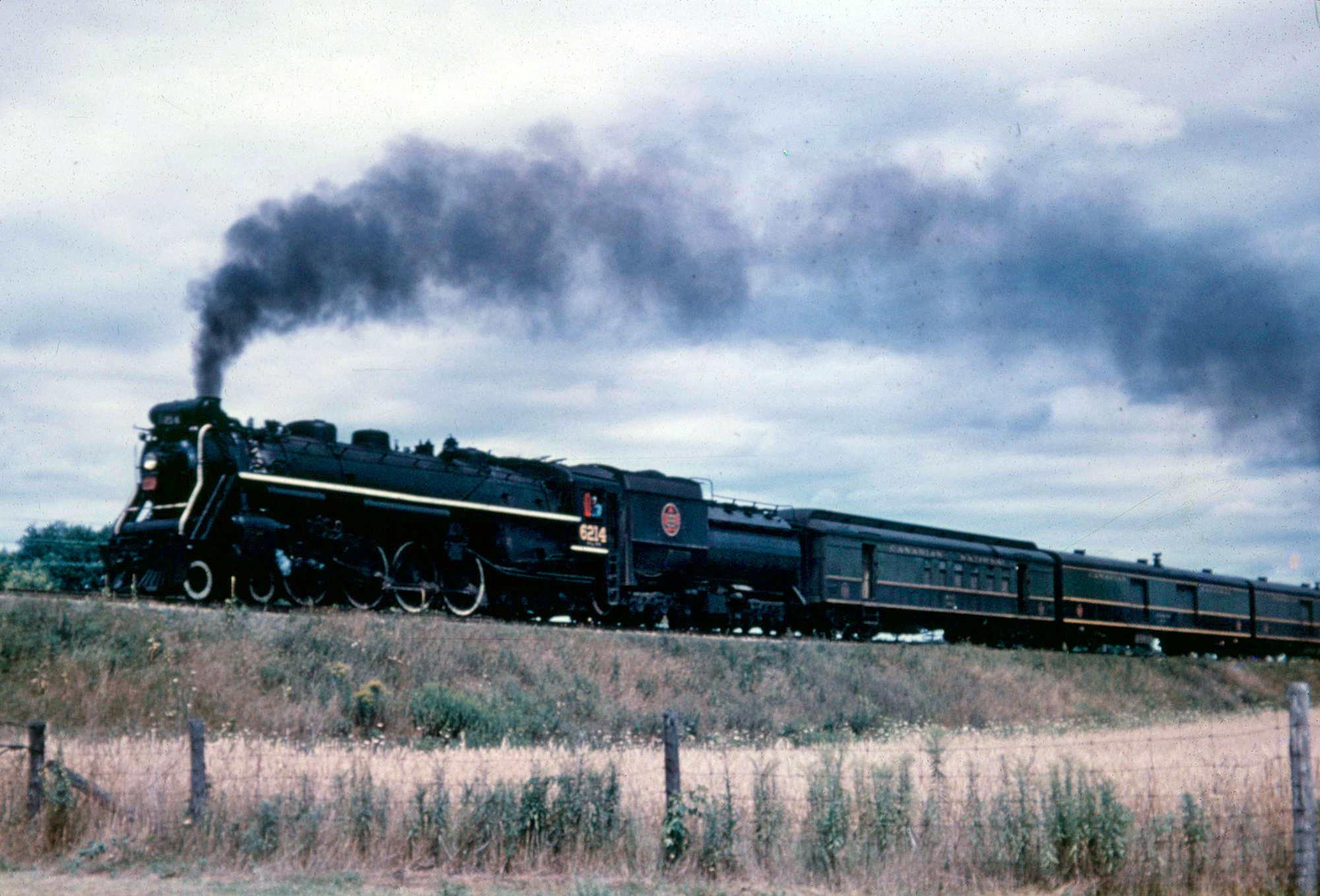
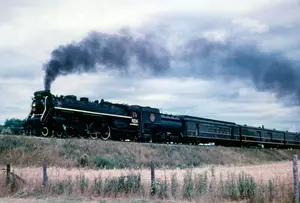
Canadian National 4-8-4 #6214 steams west with train #117 at Komoka, Ontario bound for Detroit during the 1950s. Paul Meyer photo. Author’s collection.
On this page: At a glance · Four railroads · Mikados, Santa Fes, Consolidations · Mountains and Confederations · Switchers · Smoke and streamlining · April 1960 · All-time roster (built since 1900)
At a glance
| Item | Detail |
|---|---|
| Railroad | Canadian National Railways / Canadian National Railway. Mark CN |
| Steam owned (all-time) | About 4,064 (Clegg and Corley / McQueen count of CNR steam owned) |
| This roster | Classes built since 1900, after Drury. Pre-1900 ancestors in the narrative |
| First CN-designed new power | 4-8-2 Mountains, 1923 (16, then 21 more). Dual-service |
| 4-8-4 Confederations | First 40 in 1927. About 160 on CN plus 43 on Grand Trunk Western |
| Last new steam | Twenty semi-streamlined 4-8-2s, class U-1-f 6060–6079, Montreal, 1944 |
| Last scheduled steam | April 25, 1960, The Pas–Winnipeg, Manitoba |
| Last Vancouver steam | October 6, 1957 |
| Last Montreal–Toronto steam | April 17, 1959 |
| Grand Trunk Western last regular steam | March 27, 1960 |
| Excursions | Through the 1960s. 6218 to July 3–4, 1971 |
| Builders | Montreal Locomotive Works, Canadian Locomotive Company (Kingston), Alco, Baldwin, Lima, Brooks, Canada Foundry, CN shops |
Class table follows Drury, Guide to North American Steam Locomotives (revised edition), pages 89–93. Information compiled September 16, 2026.
Four railroads, one class book
Canadian National came into being during World War I and the years immediately after. Canada’s population in 1901 was 5,371,000—about the same as Chicago and its inner suburbs today, Drury notes, but those five million people were spread from the northeastern tip of Nova Scotia’s Cape Breton Island to Prince Rupert, British Columbia. Immigration caused a great increase in Canada’s population during the ensuing decade. Canada’s railroads were able to keep pace with the population increase, but the increase in population was insufficient to support the railroads. When World War I cut off the supply of capital from England, the railroads other than Canadian Pacific found themselves in financial difficulty. They were a diverse lot: the Intercolonial, the National Transcontinental, the Canadian Northern, the Grand Trunk Pacific, and the Grand Trunk.
One of CN’s early tasks was to combine the widely differing motive-power rosters of its predecessors. Canadian Northern was powered almost exclusively by Ten-Wheelers and Consolidations; its roster included four Pacifics and a single Mikado. Duluth, Winnipeg & Pacific was similar. Grand Trunk had large numbers of Moguls and relatively few Ten-Wheelers, plus 186 Consolidations, 105 Pacifics, and 168 Mikados. Canadian Government Railways—which had taken over the Intercolonial and the National Transcontinental—ran heavy to Consolidations, Mikados, and Pacifics; 20 Santa Fes were the largest locomotives on its roster. Six-wheel switchers came to CN from all its components; eight-wheel switchers came from Grand Trunk (27), Canadian Government Railways (7), and Canadian Northern (1).
Anthony Clegg and Ray Corley, in Canadian National Steam Power (1969), remain the class book Drury points to. Donald R. McQueen’s later Canadian National Steam! series expands that work locomotive by locomotive, including Newfoundland and the Central Vermont. Those two roads keep their own steam on this site: CV on Central Vermont, the Peg on Duluth, Winnipeg & Pacific. Newfoundland’s 3 ft 6 in engines are not in Drury’s standard-gauge post-1900 grid.
Mikados, Santa Fes, and a hump at Winnipeg
Canadian National came into existence late enough that it bought only a few small locomotives. It built four 2-8-0s in 1926 and 20 more in 1931, splitting them half and half in each case between its Point St. Charles shops in Montreal and Transcona shops in Winnipeg.
In 1924 CN received 75 2-8-2s for mainline freight trains and five 2-10-2s for transfer service in Toronto, Point St. Charles, and Winnipeg. It turned out one Mikado in 1930, and CN bought five from Canadian Locomotive Company in 1929 and 1930. CLC built 33 2-10-2s for CN. They had two distinctions: they were the largest locomotives in the British Empire, and they introduced the Vanderbilt tender to Canada.
The 75 Mikados built for Canadian National in 1923 and 1924 were medium-weight 2-8-2s, about halfway between the USRA light and heavy Mikados. At 314,800 pounds they were noteworthy in having Belpaire boilers. When built, they were equipped with Worthington feedwater heaters; the device has been removed from no. 3554, shown in Drury in July 1957, accounting for the empty space ahead of the air pump. In November 1954 CN changed the position of its herald from a 9-degree tilt to horizontal.
Class S-1, 3198–3524, 327 engines, was the standard freight Mikado of the predecessors from 1913 on—Canadian Government Railways, Grand Trunk, and CN shops, CLC, Montreal, Alco, and Baldwin. S-2 and S-3 filled in on Grand Trunk and Grand Trunk Western. For new mainline power, Canadian National took the opposite approach from Chesapeake & Ohio, which rostered a wide variety of wheel arrangements for different regions and different services. After an initial group of 4-8-2s, CN practically standardized on the 4-8-4.
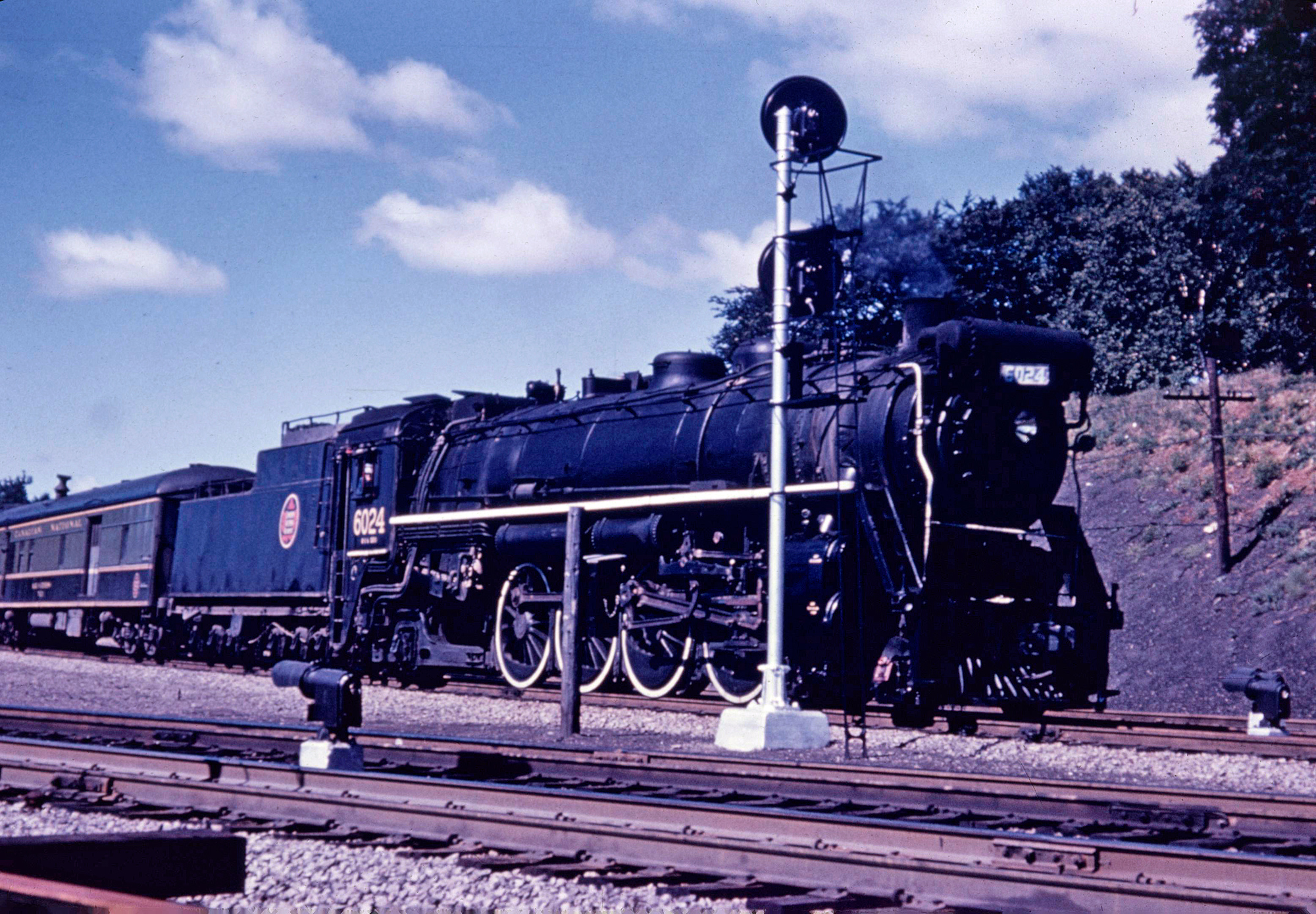
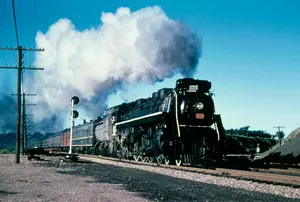
Canadian National 4-8-2 #6024 has westbound train #80, a Toronto run, passing through Bayview, Ontario during the 1950s. Paul Meyer photo. Author’s collection.
Passenger and dual-service: Mountains, then Confederations
Canadian National Railways’ first new steam locomotives were delivered in 1923, sixteen 4-8-2s that were the first of a long line of dual-service Mountains and Northerns. The next year, 21 more 4-8-2s arrived.
Northern Pacific bought the first 4-8-4s in 1927. Canadian National followed almost immediately with 40 of the type, designating them the Confederation type rather than Northern. They were light machines by American standards, ideal for routes inherited from railroads that couldn’t afford heavy rail and rock ballast. They weighed 378,000 pounds, not much more than Canadian Pacific’s contemporary Hudsons, and carried 57,500 pounds per driving axle, little more than a USRA light Mikado. By comparison, total weight of Northern Pacific’s class A 4-8-4 was 426,000 pounds, with 65,000 pounds on each driving axle. NP’s last 4-8-4s, the A-5s, tipped the scales at 508,500 pounds. With their light axle loading, CN’s 4-8-4s could roam over most of the CN system, though they usually remained east of the prairies. Most of the locomotives CN assigned to western Canada were oil burners, and none of the 4-8-4s was converted to oil fuel. The U-4s had 77-inch drivers and were streamlined. For its last new steam engines, delivered in 1944, CN reverted to the Mountain type—twenty semi-streamlined 4-8-2s for fast passenger service.
The 4-8-4 on CN is the U class: U-2 6100–6264 on the parent (155 engines in subclasses a through h), U-3 6300–6336 on Grand Trunk Western (37, Alco, 1927 and 1942), U-4-a 6400–6404 streamlined at Montreal in 1936, and U-4-b 6405–6410, six Lima look-alikes for Grand Trunk Western in 1938. Drury’s count is about 160 CN 4-8-4s plus 43 on GTW. 6218 is the U-2-g that CN kept for fan trips.
Almost the sole exception to the 4-8-2 and 4-8-4 for passenger work was a group of five 80-inch-drivered Hudsons built by Montreal in 1930 for Montreal–Toronto passenger service, class K-5-a, 5700–5704. J- and K-class Pacifics handled the rest of the varnish, including J-7-c 5295–5304 of 1920—the 5302 in the Georgetown photograph.
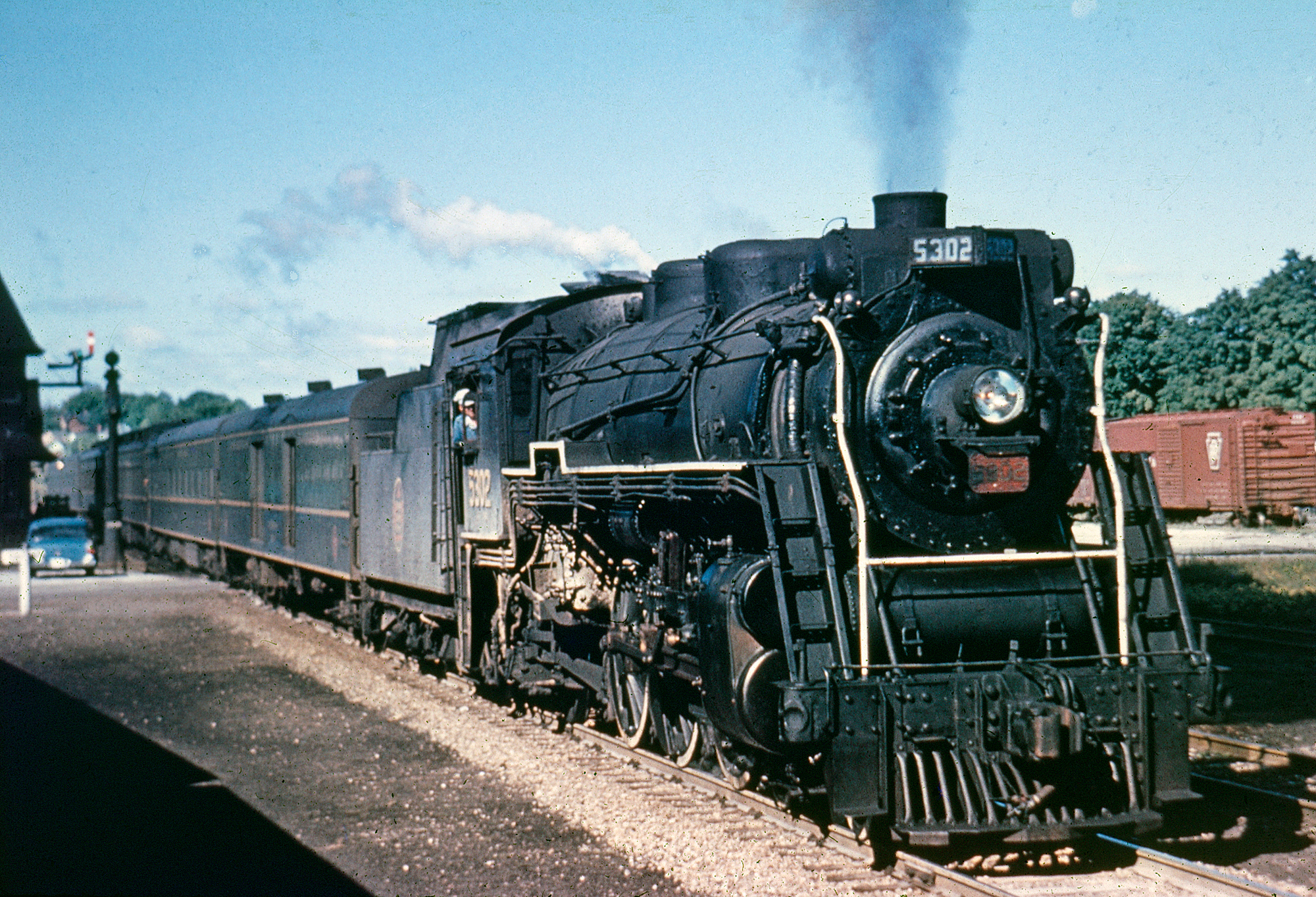
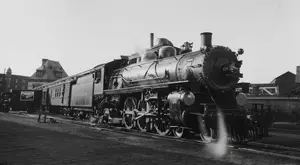
A handsome Canadian National 4-6-2, #5302 (J-7c), departs Georgetown, Ontario during the 1950s. Author’s collection.
Switchers
Between 1919 and 1925 CN continued Canadian Government Railways’ program of converting 2-8-0s into 0-8-0s, then CN built 45 0-8-0s between 1927 and 1931 and bought 10 each from CLC and Montreal in 1929. Between 1923 and 1929 Grand Trunk Western bought 52 from all three major U.S. builders, and in 1936 and 1937 removed the lead trucks from seven Mikados to create 0-8-2 transfer locomotives.
Six-wheel switchers were the common yard engine from every ancestor. Classes O-2 through O-20 cover the post-1900 0-6-0s: Canadian Northern, Canadian Government Railways, Duluth, Winnipeg & Pacific, Grand Trunk Western, and a pair bought from the National Harbours Board at Vancouver in 1955. P-class 0-8-0s did the heavier transfer work.
Smoke, cowls, and a wind tunnel
Canadian National was neither an experimenter nor an innovator except for one item: smoke lifters and deflectors. The most commonly applied smoke lifters were vertical plates alongside the smokebox, but CN tried a variety of cowls around the stack and did considerable research that led to the streamlined 4-8-4s (which nonetheless had non-streamlined Vanderbilt tenders).
The streamlining of Canadian National’s five U-4-a class 4-8-4s, built by Montreal in 1936, was based on wind-tunnel tests. The primary concern of the designers was to keep smoke from swirling around the cab and obscuring the engineer’s view. Grand Trunk Western’s six U-4-b look-alikes came from Lima in 1938. All-weather cabs, Elesco feedwater heaters countersunk into the smokebox front, and the tilted CN herald are the other trademarks. N.W. Emmott’s “How to Streamline a Steam Locomotive” is the period magazine piece Drury lists.
Dieselization, relatively late
CN dieselized relatively late. The last steam run from Vancouver was on October 6, 1957, and the last Montreal–Toronto steam run was on April 17, 1959. The last scheduled steam run on the system was on April 25, 1960, from The Pas to Winnipeg, Manitoba. CN continued to operate steam-powered excursion trains through the 1960s. Central Vermont operated steam locomotives until the spring of 1957, and the last regular operation of steam on Grand Trunk Western was on March 27, 1960.
Road diesels had started with Electro-Motive F3s in 1948. The 1929 CLC boxcabs 9000 and 9001 were the experiment. Territory-by-territory assignments emptied the roundhouses. 6218’s excursion career is the 6218 page. Survivors of the U class, including 6167 at Guelph and streamlined 6400 at Ottawa, sit on the 4-8-4 type page.
All-time roster (built since 1900)
Drury’s grid is classes built from 1900 on. Quantities are his. “Built for” is the original owner: CN, CGR (Canadian Government Railways), CNor (Canadian Northern), GT (Grand Trunk), GTP (Grand Trunk Pacific), GTW, CV, DW&P, and a handful of shorts. Retirement years are the span he prints. Pre-1900 4-4-0s, Moguls, and Ten-Wheelers that never received a post-1900 CN class number are the ancestor paragraph, not a second builder list.
0-6-0
| Class | Numbers | Qty | Builder / years | Built for | Retired |
|---|---|---|---|---|---|
| O-2-a | 7000, 7001 | 2 | Pittsburgh, 1904 | CNor | 1930, 1931 |
| O-3-a | 7002–7005 | 4 | Canada Foundry, 1907 | CNor | 1931, 1939 |
| O-4-a | 7006 | 1 | Baldwin, 1906 | CNor | 1920 |
| O-7-a, -b | 7009–7030 | 22 | Montreal, 1910–11 | CNor | 1931–1954 |
| O-10-a, -b | 7031–7065 | 35 | CLC, 1912–14 | CNor | 1922–1958 |
| O-11-a | 7066 | 1 | Schenectady, 1910 | DW&P | 1956 |
| O-14-a–c | 7067–7159 | 93 | CLC, Schenectady, Baldwin, Lima, Montreal, 1902–08 | CGR | 1923–1952 |
| O-9-a | 7218, 7219 | 2 | Baldwin, 1905, 1913 | D&TSL | 1955 |
| O-5-a | 7300, 7301 | 2 | Pittsburgh, 1907 | CNor | 1954, 1959 |
| O-15 | 7305–7318 | 14 | CLC, 1918 | CNor | 1954, 1958 |
| O-12 | 7319–7423 | 105 | CLC, Canada Foundry, Montreal, 1904–13 | CGR | 1939–1957 |
| O-18 | 7424–7521 | 98 | GT, CLC, Lima, 1914–20 | CGR, CNor | 1939–1958 |
| O-19-a | 7522–7531 | 10 | Cooke, Schenectady, 1919–23 | GTW | 1954–1961 |
| O-20-a | 7532–7541 | 10 | Montreal, 1911 | GTW, GT (New England) | 1955–1961 |
| O-19-b | 7542, 7543 | 2 | Montreal, 1928, 1929 | GTP | 1955, 1966. From National Harbours Board, Vancouver, 1955 |
0-8-0 and 0-8-2
| Class | Numbers | Qty | Builder / years | Built for | Retired |
|---|---|---|---|---|---|
| P-2-a | 8010–8014 | 5 | CGR, CN, 1918–25 | CGR, CN | 1931–1958. Converted from 2-8-0s |
| P-3 | 12 engines | 12 | CGR, CNor, 1918–25 | GT | 1928–1952 |
| P-4 | 8200–8226 | 27 | CLC, GT, Lima, 1920, 1923 | GT | 1925–1957 |
| P-5-a | 8296–8299 | 4 | Schenectady, 1923 | CV (to CN, 1942) | 1955–1957 |
| P-5-b | 8300–8329 | 30 | Schenectady, Lima, 1923–27 | GTW | 1955–1961 |
| P-5-d | 8330–8339 | 10 | CN shops, 1927–28 | GTW | 1957–1961 |
| P-5-e | 8340–8349 | 10 | Baldwin, 1927 | GTW | 1955–1961 |
| P-5-f | 8350–8369 | 20 | CLC, MLW, 1929 | GTW | 1955–1961 |
| P-5-g | 8370–8381 | 12 | Baldwin, 1929 | GTW | 1960–1961 |
| P-5-h | 8382–8416 | 35 | CN shops, 1929–31 | GTW | 1954–1961 |
| P-5-j | 8417–8422 | 6 | Brooks, 1914–23 | BCR (acq. 1947) | 1954–1960. GTW; converted from 2-8-2s |
| S-1 (0-8-2) | 3515–3523 | 7 | 1936–37 rebuilds | GTW (acq. 1947) | 1954–1960. Converted from 2-8-2s |
2-6-0 and 2-8-0
| Class | Numbers | Qty | Builder / years | Built for | Retired |
|---|---|---|---|---|---|
| C-3-a | 401 | 1 | Montreal, 1910–11 | Quebec & Saguenay | 1940 |
| C-3-b, c | 402–407 | 6 | Montreal, 1910–14 | CGR | 1954 |
| C-5-b | 409–420 | 12 | MLW, CLC, 1909–11 | CGR | 1922–1955 |
| E-7-a, b | 661–864 | 204 | Baldwin, Schenectady, Dickson, Brooks, Montreal, CLC, GT, 1898–1908 | GT | 1927–1959. 2-6-0 Moguls |
| E-8-a, -b | 865–889 | 25 | CLC, 1907 | GTP | 1935–1941 |
| E-10-a | 902–926 | 25 | CLC, 1910 | GT | 1929 |
| E-11-a | 927, 928 | 2 | Baldwin, 1907 | D&TSL | 1929 |
| L-4-a / L-5-a | 1800–1802 | 3 | Rhode Island, 1906 | AQ&W, DW&P | 1925–1934. 2-6-0 / 2-8-0 group |
| I-6-a | 1803, 1804 | 2 | Schenectady, 1910 | DW&P | 1926, 1933 |
| M-4 | 1805–1956 | 151 | Rhode Island, Baldwin, Dickson, Manchester, 1898–1910 | CGR | 1922–1954 |
| M-8-a | 1981–1984 | 4 | Schenectady, 1905 | CV (to DW&P, 1928) | 1957 |
| M-1 | 2010–2064 | 55 | CLC, 1907–08 | CNor | 1935–1955 |
| M-2-a | 2065–2089 | 25 | Canada Foundry, 1907–09 | CNor | 1922–1941 |
| M-3-a | 2090–2124 | 35 | Montreal, 1911 | DW&P | 1941–1961 |
| M-3-c | 2125–2129 | 5 | Brooks, 1912–13 | CNor | 1958–1960 |
| M-3-d, -e | 2130–2179 | 50 | CLC, 1912–16 | CGR | 1948–1961 |
| M-5-a, -e | 2180–2200 | 21 | CLC, Montreal, Canada Foundry, 1913–14 | CGR | 1954–1961 |
| N-1-b | 2334–2384 | 51 | MLW, CLC, 1913–14 | CGR | 1952–1958 |
| N-1-c | 2385–2399 | 15 | Canada Foundry, 1912–18 | CNor | 1955–1959 |
| N-1-a, -c | 2400–2454 | 55 | Canada Foundry, 1918 | CNor | 1957–1960 |
| N-2-a | 2455–2464 | 10 | Brooks, 1916–17 | DW&P | 1955–1960 |
| N-2-b | 2465–2514 | 50 | Montreal, 1918 | CNor | 1954–1961 |
| N-4 | 2515–2686 | 172 | Montreal, Schenectady, Brooks, 1906–11 | GT | 1952–1961 |
| N-5-a, -b | 2687–2746 | 60 | MLW, CLC, 1911–12 | GTP | 1952–1961 |
| N-5-c, -d | 2747–2768 | 22 | CN, 1926, 1931 | CV | 1954–1961 |
| N-4-g, -h | 2800, 2801, 2810–2819 | 12 | Point St. Charles, Schenectady, 1906, 1926 | CV, DW&P | 1954–1959 |
| R-3-a | 3000 | 1 | Cooke, 1914 | CV | 1939. 2-8-2 |
2-8-2 and 2-10-2
| Class | Numbers | Qty | Builder / years | Built for | Retired |
|---|---|---|---|---|---|
| S-1 | 3198–3524 | 327 | CN, CLC, MLW, Schenectady, Baldwin, 1913–26 | CGR, GT, CN | 1924–1961 |
| S-2 | 3705–3757 | 53 | Schenectady, 1918–24 | GT, GTW | 1953–1961 |
| S-3 | 3800–3857 | 58 | MLW, CLC, 1923–24 | GT, GTW | 1952–1961. Belpaire; 75 of the 1923–24 batch were CN’s own |
| S-4-b | 6 engines | 6 | CN, CLC, 1930, 1936 | CN | 1957 |
| T-1 | 4000–4019 | 45 | Brooks, MLW, 1916–20 | CGR, CN | 1952–1961. First ten to CGR, 1916 |
| T-2-a | 4100–4104 | 5 | CLC, 1924 | CN | 1955–1957. Transfer, Winnipeg / Toronto / Point St. Charles |
| T-3-a | 4200–4209 | 10 | Brooks, 1919 | Boston & Albany (purch. 1928) | 1955–1961 |
| T-4-a | 4300–4332 | 33 | CLC, 1929–30 | CN | 1957–1959. Largest in the British Empire; Vanderbilt tenders |
Central Vermont’s ten Alco 2-10-4s, class T-3-a 700–709 of 1928, are not in this CN number series. They stay on Central Vermont.
4-4-0 and 4-6-0
| Class | Numbers | Qty | Builder / years | Built for | Retired |
|---|---|---|---|---|---|
| A-20-a, A-21-a | 120–124 | 5 | CLC, 1904, 1906 | CNor | 1925–1951. 4-4-0 |
| B-26-a | 325–399 | 75 | MLW, Canada Foundry, 1908–09 | CNor, GTP | 1922–1931. 4-4-0 |
| F-1-a, -b | 1000–1011 | 12 | Montreal, 1908–09 | CNor | 1925–1941. 4-6-0 |
| G (CNor Ten-Wheelers) | 1016–1178 group | — | Montreal, CLC, Baldwin, Canada Foundry, Schenectady, Cooke, 1901–13 | CNor, AQ&W, QOR, T&NO | 1919–1961. Classes G-2 through G-21; see Drury for subclass splits |
| G-17-a | 1161–1165 | 5 | Montreal, 1913 | CNor | 1954–1957 |
| H-1 through H-4 | 1200–1245 group | — | Montreal, Baldwin, Brooks, CLC, 1903–07 | CNor, QOR, QM&S | 1919–1955 |
| H-5-a | 1246–1260 | 15 | Canada Foundry, 1907 | CNor | 1939–1944 |
| H-6-a, -c | 1261–1346 | 86 | Brooks, MLW, 1902–11 | CNor | 1932–1959 |
| H-6-f | 1347–1351 | 5 | Baldwin, 1911 | DW&P | 1937–1961 |
| H-7-a | 1352, 1353 | 2 | Rogers, 1906 | DW&P | 1953–1961 |
| H-6-g | 1354–1409 | 56 | Montreal, 1912–13 | CNor | 1954–1961 |
| H-8-a | 1410–1412 | 3 | CLC, 1911 | CGR | 1936–1937 |
| H-10-a | 1423–1452 | 30 | MLW, CLC, 1910 | GTP | 1942–1961 |
| I-3 through I-5 | 1509–1542 | 34 | CLC, Manchester, Dickson, 1899–1907 | CGR (Intercolonial) | 1925–1930 |
| I-4-b, I-7, I-8-a | 1547–1628 | 82 | Baldwin, Schenectady, GT, Montreal, 1898–1908 | GT | 1931–1945 |
4-6-2, 4-6-4, and 4-6-4T
| Class | Numbers | Qty | Builder / years | Built for | Retired |
|---|---|---|---|---|---|
| J-1-a, -b | 5000–5003 | 4 | Montreal, 1913 | CNor | 1957–1961. CNor’s four Pacifics |
| J-3-a, -b | 5030–5079 | 50 | Baldwin, MLW, 1912–13 | GT | 1955–1961 |
| J-4 | 5080–5099 | 20 | MLW, CLC, 1914–18 | CGR | 1958–1961 |
| J-4-e, -f | 5125–5156 | 32 | Montreal, 1920 | CN | 1955–1961 |
| J-7-a, -b | 5250–5294 | 45 | Montreal, 1918–19 | CGR | 1957–1961 |
| J-7-c | 5295–5304 | 10 | Montreal, 1920 | CN | 1959–1961. Photo: #5302 at Georgetown |
| K-1 | 5500–5542 | 43 | CLC, MLW, 1905–11 | CGR | 1939–1957 |
| K-2 | 5453–5556 group | 14 | Montreal, 1913–16 | CGR | 1954–1961 |
| K-3 | 5557–5611 | 55 | GT, Montreal, Baldwin, 1910–13 | GT | 1954–1962 |
| K-3-g | 5612–5626 | 15 | Montreal, 1911 | GTP | 1957–1961 |
| K-4 | 5627–5634 | 8 | Alco, Baldwin, 1924, 1929 | GTW | 1950–1961 |
| X-10-a | 45–50 | 6 | Montreal, 1914 | GT | 1960–1961. 4-6-4T suburban tanks |
| K-5-a | 5700–5704 | 5 | Montreal, 1930 | CN | 1960–1967. 80-inch Hudsons, Montreal–Toronto |
4-8-2 and 4-8-4
| Class | Numbers | Qty | Builder / years | Built for | Retired |
|---|---|---|---|---|---|
| U-1-a, -b | 6000–6036 | 37 | CLC, 1923–24 | CN | 1960–1967. First new CN steam; dual-service. Photo: #6024 at Bayview |
| U-1-c | 6037–6041 | 5 | Baldwin, 1925 | GTW | 1955–1961 |
| U-1-d, -e | 6042–6058 | 17 | CLC, MLW, 1929–30 | CN | 1952–1961 |
| U-1-f | 6060–6079 | 20 | Montreal, 1944 | CN | 1960–1962. Last new steam; semi-streamlined Mountains |
| U-2-a through -f | 6100–6189 | 90 | CLC, MLW, 1927–40 | CN | 1948–1961. Confederation type. 6167 later an excursion engine |
| U-2-g, -h | 6200–6264 | 65 | Montreal, 1942–44 | CN | 1958–1961. Photo: #6214 at Komoka. 6218 is U-2-g |
| U-3 | 6300–6336 | 37 | Alco, 1927, 1942 | GTW | 1939–1961 |
| U-4-a | 6400–6404 | 5 | Montreal, 1936 | CN | 1960–1961. Streamlined; 77-inch drivers; oil. 6400 preserved, Ottawa |
| U-4-b | 6405–6410 | 6 | Lima, 1938 | GTW | 1940–1961. Look-alikes of the U-4-a |
U-2 subclasses: U-2-a 6100–6119 CLC 1927; U-2-b 6120–6139 MLW 1927; U-2-c 6140–6159 MLW 1929; U-2-d 6160–6164 MLW 1936; U-2-e 6165–6179 MLW 1940; U-2-f 6180–6189 CLC 1940; U-2-g 6200–6234 MLW 1942–43; U-2-h 6235–6264 MLW 1944. That is 155 parent-road 4-8-4s. GTW U-3 and U-4-b bring the CN-classed 4-8-4 total in line with Drury’s 160-plus-43 figure. The type encyclopedia is 4-8-4.
Built-for abbreviations in the tables: AQ&W Atlantic, Quebec & Western; BCR Buffalo Creek Railroad; CGR Canadian Government Railways; CNor Canadian Northern; CV Central Vermont; D&TSL Detroit & Toledo Shore Line; DW&P Duluth, Winnipeg & Pacific; GT Grand Trunk; GTP Grand Trunk Pacific; GTW Grand Trunk Western; QOR Quebec, Oriental Railway / related Quebec shorts; QM&S Quebec, Montreal & Southern; T&NO Temiskaming & Northern Ontario (later Ontario Northland).
Related reading on American-Rails.com
- Canadian National Railway · CN 4-8-4 6218 · 4-8-4 Northern / Confederation
- Grand Trunk Western · Central Vermont · Duluth, Winnipeg & Pacific · Grand Trunk Railway
- Canadian Locomotive Company · Montreal Locomotive Works · Steam locomotives
Sources
- Drury, George H. Guide to North American Steam Locomotives. Revised edition. Waukesha: Kalmbach Books, 2015. Canadian National Railways, pages 89–93. Class table on this page; narrative on ancestors, Mikados, Santa Fes, Confederations, switchers, streamlining, and last steam dates
- Clegg, Anthony, and Ray Corley. Canadian National Steam Power. Montreal: Trains & Trolleys, 1969. Class book Drury recommends
- McQueen, Donald R. Canadian National Steam! Railfare DC Books. Expanded Clegg & Corley; all-time count and class-to-Whyte map
- Emmott, N.W. “How to Streamline a Steam Locomotive.” Period magazine piece listed by Drury
- Canadian National Railways Historical Association. Steam class practice; dieselization as context
- American-Rails.com: Canadian National Railway; CN 6218; Grand Trunk Western; 4-8-4 type
Recent Articles


-
Canadian National Steam Locomotives: History, Roster & Photos
Sep 16, 26 10:07 AM
 Canadian National steam—CGR, Canadian Northern, Grand Trunk, GTP. 4-8-4 Confederations, U-1 Mountains, J and K Pacifics. Post-1900 class roster. Last scheduled steam April 25, 1960.
 -
Canadian National Railway: Map, Logo, History, Photos
Sep 16, 26 08:55 AM
 Canadian National—name Dec 20 1918, incorporated June 6 1919, Grand Trunk Jan 20 1923. Crown corporation, IPO Nov 17 1995. IC, Wisconsin Central, BC Rail, EJ&E. Class I, mark CN.
 -
Buffalo, Rochester and Pittsburgh Railway: "Safety and Service"
Sep 16, 26 12:12 AM
 Buffalo, Rochester & Pittsburgh—Rochester & State Line 1869, BR&P March 12 1887. Pennsylvania coal to Buffalo and Rochester. B&O January 1 1932. All-time steam roster, LL 2-6-6-2s, XX…
 -
Buffalo Creek & Gauley Railroad: Map, Roster, Logo, Photos
Sep 15, 26 11:55 PM
 Buffalo Creek & Gauley—Elk River Coal & Lumber, April 1 1904, Dundon–Widen. Last all-steam WV coal road, February 27 1965. All-time steam roster, #4 Baldwin 59472, Majestic and Elk River diesels…
 -
Buffalo and Susquehanna Railroad: Map & History
Sep 15, 26 11:42 PM
 Buffalo & Susquehanna—Goodyear hemlock railroad, Sinnemahoning Valley December 14 1885, 1893 merger, coal to Sagamore, Buffalo extension, bankruptcy May 6 1910, B&O 1932, WAG 1956.
 -
WMSR Allegheny Mountain Dinner Train (2026): Dates & Tickets
Sep 15, 26 11:36 PM
 2026 Western Maryland Scenic Allegheny Mountain Dinner Train—Cumberland, 3 hours, 21+, Saturday 7 p.m. Confirm on wmsr.com.
 -
Boston and Albany Railroad: Map & History
Sep 15, 26 11:28 PM
 Boston & Albany Railroad—Boston & Worcester June 23 1831, Western Railroad across the Berkshires, merger 1867–70. NYC 99-year lease July 1 1900. Berkshires, New England States, CSX and MBTA today.
 -
Grand Bellevue Dinner Train (2026): Portsmouth, Rhode Island
Sep 15, 26 11:14 PM
 2026 Grand Bellevue Rail Dining in Portsmouth, RI—2.5-hour seated dinner on Narragansett Bay. Fall/winter TBA after Aug. 29. Confirm on thegrandbell.com.
 -
The "John Bull": The C&A's First Locomotive (1831)
Sep 15, 26 11:01 PM
 John Bull locomotive—Stephenson Planet-type 0-4-0, 1831. Dripps assembly, 4-2-0 rebuild, cowcatcher. Specs, Camden & Amboy career, Smithsonian 1884, 1981 steam-up, 1939 replica.
 -
Napa Valley Wine Train Dining (2026): Lunch, Dinner & Vista Dome
Sep 15, 26 10:56 PM
 2026 Napa Valley Wine Train dining—downtown Napa, 36-mile round trip, gourmet lunch and dinner, Vista Dome. Confirm packages on winetrain.com.
 -
My Old Kentucky Dinner Train (2026): Dates, Tickets & What to Expect
Sep 15, 26 10:50 PM
 2026 My Old Kentucky Dinner Train in Bardstown—2.5 hours, 35-mile round trip, four-course dinner from $116. Confirm on kydinnertrain.com.
 -
LaSalle Street Station: One Of Chicago's Great Terminals
Sep 15, 26 10:42 PM
 LaSalle Street Station—Rock Island October 10, 1852. Frost & Granger July 1, 1903. 20th Century Limited, Rockets, Golden State. Headhouse razed 1981. Metra Rock Island District today.
 -
Charlie Russell Chew Choo (2026): Montana Dinner Train from Lewistown
Sep 15, 26 10:39 PM
 2026 Charlie Russell Chew Choo dinner train—Hanover/Lewistown, 4.5 hours, 56-mile round trip, prime rib. Adult $151. Remaining listed dates sold out. Confirm on montanadinnertrain.com.
 -
Central Pacific Railroad: Map, History, Facts, Logo
Sep 15, 26 10:30 PM
 Central Pacific—Judah, Big Four, June 28 1861. Sierra, Chinese labor, Donner Summit Tunnel. Ten-mile day April 28 1869. Promontory May 10. Southern Pacific lease April 1 1885. Dissolved June 30 1959…
 -
Bessemer & Lake Erie Railroad: "The Bessemer Road"
Sep 15, 26 05:20 PM
 Bessemer & Lake Erie—Bear Creek 1865, Carnegie 1897, U.S. Steel 1901. Ore south from Conneaut, coal north. 2-10-4s, Missabe sister road. CN May 10, 2004. Complete corporate history.
 -
Bangor and Aroostook Railroad: "Serving Northern Maine"
Sep 15, 26 05:05 PM
 Bangor & Aroostook—chartered February 13, 1891, first trains January 1, 1894. Potatoes, paper, Searsport, State of Maine reefers. MM&A 2003, Lac-Mégantic 2013, CP 2020, CPKC today. Complete co…
 -
Baltimore & Ohio Chicago Terminal Railroad: Map and History
Sep 15, 26 03:11 PM
 B&OCT—formed January 6, 1910 to buy Chicago Terminal Transfer. Grand Central, Barr Yard, 78 route-miles. Assigned B&O steam. Complete diesel roster. CSX paper subsidiary, mark BOCT.
 -
The "Alphabet Route" (Railroad): Photos and History
Sep 15, 26 02:53 PM
 Alphabet Route—eight railroads, not one company. P&WV to Connellsville February 11, 1931. Alpha Jets Chicago/St. Louis–New York/Boston. NKP, W&LE, P&WV, WM, Reading, CNJ, L&HR, New Hav…
 -
Milwaukee Road Livestock Operations: Cattle, Dakotas & Montana
Sep 15, 26 02:36 PM
 Milwaukee Road livestock traffic—Dakota and Montana cattle, Iowa hogs, Chicago markets, 28-hour law, head-end stock cars. By 1974 mostly Montana. Rick Burn’s Helena speech. Operations history, not the…
 -
Spirit of Jasper Ride & Dine (2026): Season Pause
Sep 15, 26 02:29 PM
 Spirit of Jasper Ride & Dine in Jasper, Indiana—seated meal on board. Operator: not running public trains for 2026. Depot remains open as a rental. Confirm on spiritofjaspertrain.com.
 -
South Carolina Canal & Rail Road Company: Map and History
Sep 15, 26 01:59 PM
 South Carolina Canal & Rail Road—chartered December 19, 1827. Best Friend of Charleston, 136 miles Charleston–Hamburg October 1833, Aiken inclined plane. South Carolina Railroad 1844, Southern 189…
 -
The Practice of Double-Heading: The Steam Era
Sep 15, 26 01:43 PM
 Doubleheading—two locomotives on the point, each with its own steam crew. Not a rear helper, not diesel MU. How it worked, PRR 1877, mountain grades, and what MU ended.
 -
Mohawk and Hudson Railroad: Map, Pictures, Locomotives
Sep 15, 26 01:20 PM
 Mohawk & Hudson Railroad—New York’s first railroad, chartered April 17, 1826. DeWitt Clinton, inclined planes, Albany & Schenectady 1847, first New York Central May 17, 1853. Complete corporat…
 -
Essex Clipper Dinner Train (2026): Dates, Tickets & What to Expect
Sep 15, 26 01:09 PM
 2026 Essex Clipper Dinner Train in Essex, CT—2.5 hours, four-course meal $129.99, 18+. Fall dates through Oct. 25. Confirm on essexsteamtrain.com.
 -
Camden & Amboy Railroad: Map, History, Photos
Sep 15, 26 12:53 PM
 Camden & Amboy Railroad—chartered February 4, 1830. Joint Companies monopoly with the Delaware & Raritan Canal, John Bull, T-rail. United New Jersey 1872, PRR 999-year lease 1871. Complete corpora…
 -
Cafe Lafayette Dinner Train (2026): Dates, Tickets & What to Expect
Sep 15, 26 12:47 PM
2026 Cafe Lafayette Dinner Train in North Woodstock, NH—2 hours, 20 miles, five-course meal from $125. May–October. Confirm on nhdinnertrain.com. -
Christmas Train Ride Locations (2026): A Complete Guide
Sep 15, 26 10:47 AM
 2026 Christmas train rides by state—Santa, North Pole Express, and holiday trains. Not Polar Express. State guides and product pages. Confirm dates on each railroad.
 -
Baltimore & Ohio Railroad: Linking 13 Great States With The Nation
Sep 15, 26 10:22 AM
 Baltimore & Ohio Railroad—first U.S. common carrier, chartered February 28, 1827. Wheeling 1853, Chicago 1874, C&O control 1963, Chessie 1973, into CSX April 30, 1987. Complete corporate history.
 -
Delaware & Hudson Railway: The Bridge Line
Sep 15, 26 09:59 AM
 Delaware & Hudson Railway—Wurts brothers canal 1823, gravity railroad 1829, Stourbridge Lion, Bridge Line to Montreal. Guilford 1984, CP 1991, NS south line 2015, CPKC north.
 -
Delaware & Hudson Diesel Roster (All-Time)
Sep 15, 26 12:17 AM
 All-time Delaware & Hudson diesel roster—Alco S-2s through C-628s and PA-4s, GE U-boats, Baldwin RF-16s, EMD SD45s and GP38-2/GP39-2s. Serials, dates, dispositions.
 -
Granite Railway, Our Country's First Railroad
Sep 14, 26 11:28 PM
 Granite Railway of Quincy, Massachusetts—chartered March 4, 1826, opened October 7, 1826. Gridley Bryant, 5-foot gauge, horses, Bunker Hill Monument stone. First commercial U.S. railroad.
 -
Milwaukee Road Skytop Lounges: History, Specs & Floor Plans
Sep 14, 26 11:09 PM
 Milwaukee Road Skytop observation cars—Brooks Stevens, 1948. Four Rapids parlor-lounges from Milwaukee Shops, six Creek sleeper-lounges from Pullman-Standard. Floor plans, roster, preservation.
 -
West Virginia Christmas Train Rides (2026): A Complete Guide
Sep 14, 26 11:02 PM
2026 West Virginia Christmas trains—Potomac Eagle North Pole Express in Romney and Christmas at Cass. Not Polar Express. Elkins Polar is not listed for 2026. -
Railroads Of Today: Class I Map, PSR & the 2026 Industry
Sep 14, 26 10:30 PM
 U.S. freight rail in 2026—six Class I railroads on a nearly 140,000-mile network. PSR as everyday practice, how the STB works, traffic mix, short lines and regionals.
 -
Railroad History (USA): Timeline, Facts & How the Network Was Built
Sep 14, 26 10:03 PM
 Full U.S. railroad history hub—origins and inventors, Golden Age peak mileage, Civil War and transcontinental, streamliners, ICC regulation, Penn Central and Conrail, Staggers Act, PSR, and today’s Cl…
 -
Railroads In The 2020s: CPKC, East Palestine & the UP–NS Case
Sep 14, 26 09:51 PM
 U.S. railroads 2020–2026—Class I mileage 91,773 in 2020. COVID traffic drop, CPKC April 14 2023, East Palestine Feb. 3 2023, UP–NS $85 billion case still before the STB.
 -
Railroads In The 2010s: PSR, Coal’s Decline & Positive Train Control
Sep 14, 26 03:51 PM
 U.S. railroads 2010–2020—Class I mileage 95,573 to 91,773. Buffett closed BNSF Feb. 12 2010, Harrison at CP June 29 2012 and CSX 2017, PTC deadline Dec. 31 2018.
 -
Virginia Christmas Train Rides (2026): A Complete Guide
Sep 14, 26 03:46 PM
 2026 Virginia Christmas trains—Virginia Scenic Railway Santa Express from Staunton, about 60 minutes. Confirm dates. Not Polar Express.
 -
MARC Train: Maryland Commuter Rail History, Lines & Roster
Sep 14, 26 01:16 PM
 MARC Train history—Maryland Rail Commuter 1984, B&O and PRR corridors, Penn/Camden/Brunswick lines, Silver Spring 1996, all-time locomotive roster.
 -
Railroads In The 2000s: Merger Freeze, Wisconsin Central & Buffett
Sep 13, 26 07:57 AM
 U.S. railroads 2000–2010—Class I mileage 99,250 to 95,573. STB merger freeze March 17 2000, CN–WC Oct. 9 2001, BNSF Railway Jan. 24 2005, Buffett Nov. 3 2009.
 -
Railroads In The 1990s: Mega-Mergers, Conrail’s Split & the STB
Sep 13, 26 12:13 AM
 U.S. railroads 1990–2000—Class I mileage 119,758 to 99,250. BNSF Sept. 22 1995, UP–SP Sept. 11 1996, Conrail split June 1 1999, ICC Termination Dec. 29 1995.
 -
Railroads In The 1980s: Staggers, Mega-Mergers & Conrail’s IPO
Sep 12, 26 11:12 PM
 U.S. railroads 1980–1990—Class I mileage 164,822 to 119,758. Staggers Oct. 14 1980, CSX and Norfolk Southern, UP–Missouri Pacific–Western Pacific, Conrail IPO March 26 1987.
 -
Wabash Class O-1 4-8-4s: History, Roster & Specifications
Sep 12, 26 11:01 PM
 Wabash Class O-1 4-8-4s—Baldwin 1930–31, twenty-five engines 2900–2924. Fast freight, complete roster, specifications. None preserved.
 -
Staggers Rail Act of 1980: Statute, Contract Rates & the ICC
Sep 10, 26 11:23 PM
 Staggers Rail Act, Pub. L. 96-448, signed October 14, 1980. Harley Staggers, S.1946, contract rates, 180% variable-cost test, abandonments, short lines.
 -
Rock Island E8A 652: Bicentennial Independence Paint & History
Sep 10, 26 10:42 PM
 Rock Island E8A 652—EMD March 1952, serial 15199. 20th Century Railroad Club Independence bicentennial scheme, Peoria and Quad Cities Rockets, Midland Railway, Manly Junction Museum.
 -
Vermont Christmas Train Rides (2026): A Complete Guide
Sep 10, 26 10:37 PM
2026 Vermont Christmas trains—Okemo Valley Holiday Express from Chester Depot Dec. 19–20. Polar is Burlington Dec. 5–6 only. -
Railroads In The 1970s: Penn Central, Amtrak & Conrail
Sep 10, 26 10:18 AM
 U.S. railroads 1970–1980—196,479 miles at the decade’s start. Penn Central bankruptcy June 21 1970, Amtrak May 1 1971, 3R/4R Acts, Conrail April 1 1976, Rock Island 1975, Milwaukee 1977.
 -
Railroads In The 1960s: Mergers, Passenger Collapse & Penn Central
Sep 10, 26 10:03 AM
U.S. railroads 1960–1970—207,334 to 196,479 miles. Erie Lackawanna 1960, C&O–B&O 1963, N&W–Nickel Plate 1964, SCL 1967, Penn Central Feb. 1 1968. -
South Carolina Christmas Train Rides (2026): A Complete Guide
Sep 10, 26 08:36 AM
 2026 South Carolina Christmas trains—South Carolina Railroad Museum Santa Train in Winnsboro. Confirm December dates. Not Polar Express. Drop light-festival padding.
 -
Steam Locomotive Feedwater Heaters: Elesco, Coffin & Worthington
Sep 10, 26 08:29 AM
 Steam locomotive feedwater heaters—open Worthington vs closed Elesco and Coffin. How they work, how to identify them on a smokebox, and why not every engine had one.