D&H RF-16s 1205 & 1216: Heritage, Specs & Where They Ran
Last revised: September 6, 2026
By: Adam Burns
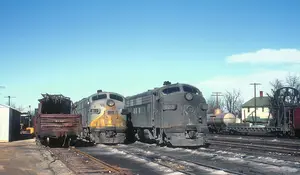
Delaware & Hudson 1205 and 1216 are the last two Baldwin RF-16 “Sharknose” diesels left anywhere. Baldwin-Lima-Hamilton finished them at Eddystone for the New York Central as 3805 (December 7, 1951, construction number 75361) and 3816 (January 25, 1952, construction number 75372). The Central renumbered the class in 1966, traded the survivors to General Electric, and the Monongahela Railway bought them for coal drags. By 1972 they were the only RF-16s still able to move under their own power. In 1974 the Bridge Line, under president Carl B. Sterzing Jr., swapped about $6,000 worth of scrap boxcars for the pair, overhauled them at Colonie, and put them in blue and gold. They were not a museum set. They pulled D&H freight—and the occasional railfan extra—until April 1978. Jim Shaughnessy photographed them at the Colonie shops in February 1975, the month the railroad was showing them off. That is the picture on this page.
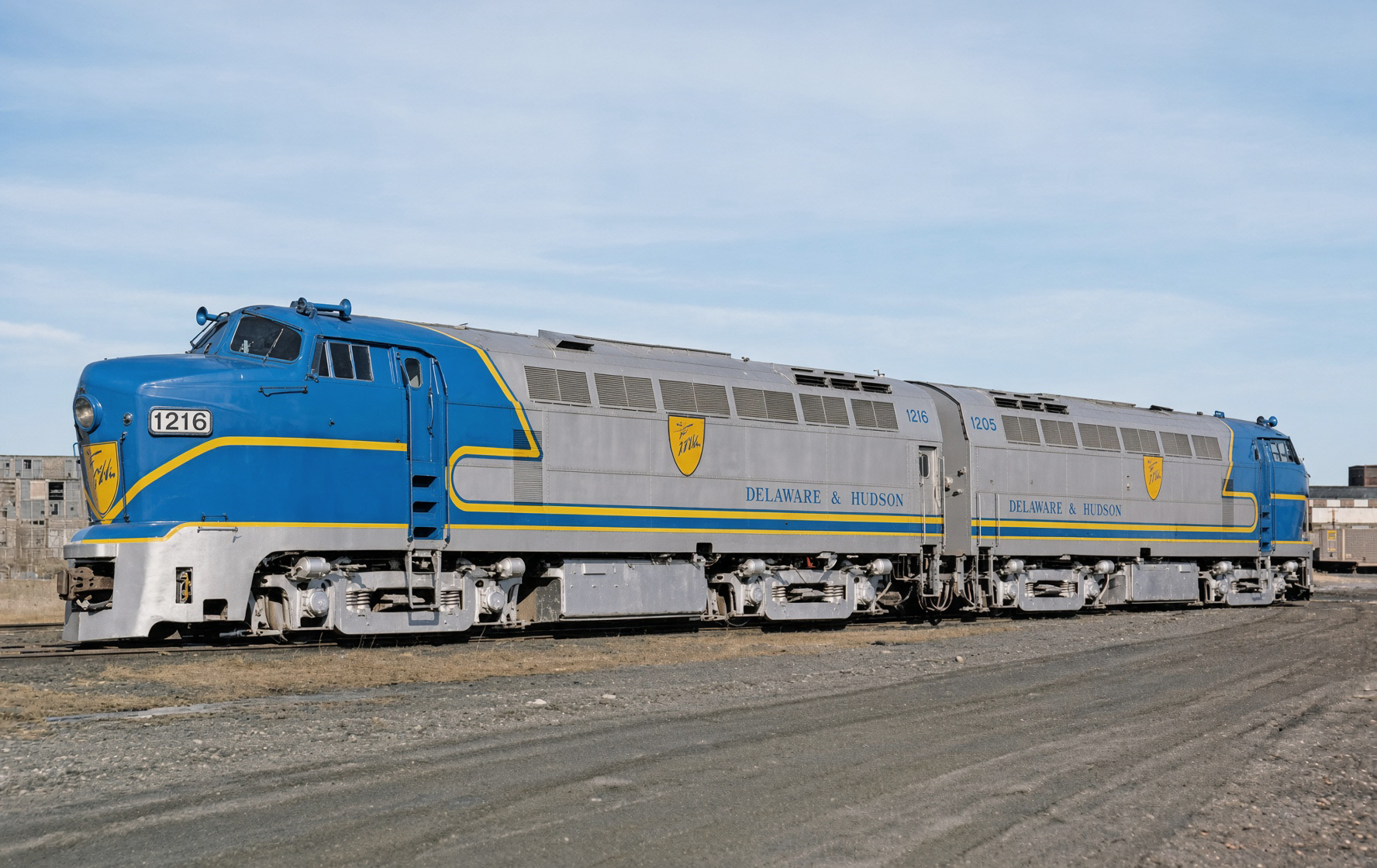
Delaware & Hudson RF-16s 1205 and 1216 pose at the Colonie, New York shops in February 1975. Jim Shaughnessy photo.
On this page: At a glance · New York Central 3805 and 3816 · Monongahela coal · Sterzing and Colonie · Where they ran · Specifications · After the D&H · Related reading · Sources
At a glance
| Item | Detail |
|---|---|
| Railroad (this page) | Delaware & Hudson (reporting mark DH), 1974–April 1978 |
| Road numbers | 1205 and 1216. Kept through NYC 1966, Monongahela, and D&H |
| Builder / model | Baldwin-Lima-Hamilton RF-16 (class DR-4-4-1600/1 SC), Eddystone, Pa. A-units only |
| 1205 | Baldwin c/n 75361, serial 82, completed December 7, 1951. Built New York Central 3805 |
| 1216 | Baldwin c/n 75372, serial 93, completed January 25, 1952. Built New York Central 3816 (not 3812; see heritage note) |
| Prime mover | De La Vergne 608A, Elliott H704 turbocharger, 1,600 hp at 625 rpm |
| Wheel arrangement | B-B (AAR); Bo′Bo′ (UIC) |
| D&H service | Mainline freight plus publicity and railfan extras, August 1974–April 1978. Not a parked display pair |
| Typical D&H geography | Roamed the Bridge Line rather than one assigned district. Photographed most often at Colonie, Kenwood Yard (Albany), and Whitehall, N.Y., and on the Binghamton–Sayre detour |
| Sold | Listed December 1977 at $40,000; sold April 1978 to Castolite Corporation, Minneapolis |
| Location (2026) | Privately stored on the Escanaba & Lake Superior, Michigan. 1205 indoors at Escanaba; 1216 at Wells since December 2, 2021. Not on public view |
Construction numbers and completion dates follow Baldwin works records as tabulated on this site’s RF-16 production roster. Information compiled September 6, 2026.
New York Central 3805 and 3816
The RF-16 was Baldwin’s Standard Line road-freight cab: 1,600 horsepower, B-B trucks, Westinghouse electricals, and the Sharknose carbody. Domestic buyers were only the Baltimore & Ohio, New York Central, and Pennsylvania.
The Central ordered eighteen A-units, 3804–3821, and eight boosters, 3702–3709, in the winter of 1951–52. 3805 and 3816 sat in the middle of that A-unit block. In 1966, a few years short of the Penn Central merger, the railroad recast the cabs as 1204–1221. Arithmetic is simple: 3805 became 1205, 3816 became 1216. They kept those numbers for the rest of their working lives. The surviving pair was then traded to General Electric.
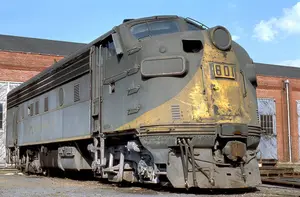
The Sharknose carbody is Hadley, Ryder & Pedersen’s redesign of Baldwin’s unpopular “Baby Face,” not a Raymond Loewy job. The myth comes from the nose’s resemblance to Loewy’s Pennsylvania T-1.
Monongahela coal, then a scrap dealer
In the winter of 1967 the Monongahela Railway bought a handful of the traded Central Sharks—seven cabs and two boosters, including 1205 and 1216—for coal-drag service out of Brownsville, Pennsylvania, and the West Virginia mines. Baldwin’s Westinghouse motors were at home on slow, heavy trains. The MGA already ran Baldwin S-12s; the RF-16s were a secondhand fit, not a collector’s purchase. Dan Cupper photographed 1205 at Brownsville on September 21, 1971, still in that work.
By 1972 only 1205 and 1216 would still start. The rest of the Monongahela Sharks went to scrap. The last two followed them to a dealer and sat there until 1974. That is how a pair of 1951–52 New York Central freight cabs became available to a New York–Pennsylvania–Vermont bridge line that had never bought a Baldwin road unit new.
Sterzing, scrap boxcars, and Colonie blue and gold
Carl B. Sterzing Jr.’s Delaware & Hudson already had a reputation for keeping older power in the public eye. The four ex-Santa Fe Alco PA-1s (16–19), bought in December 1967 and later rebuilt as PA-4s, are the famous example. The Sharks were the Baldwin counterpart: a power shortage on a small roster, plus a president willing to put distinctive secondhand cabs on the point. The railroad traded roughly $6,000 in scrap boxcars for 1205 and 1216 around August 1974. Colonie Shops at Watervliet/Colonie, New York, overhauled them and painted them into the D&H blue-and-gold family that also dressed the PAs—Lightning Stripe / modified warbonnet, not Monongahela black or Central lightning stripe.
Shaughnessy’s February 1975 Colonie portrait is the shop showing the finished pair: 1216 nearest the camera, 1205 coupled behind, both in fresh paint, snow on the ground, shop buildings and a signal bridge behind them. The same month, Richard Allen photographed PA 18 and RF-16 1216 together at Colonie for a company view (February 8, 1975). The railroad understood what it had. Baldwin had left the locomotive business in 1956. Every other RF-16 was already cut up. These two were the last Sharks that could still earn a living.
They were not compatible with the rest of the D&H fleet in multiple-unit. Baldwin used air-powered throttles; EMD and Alco used electrical MU. Crews therefore ran 1205 and 1216 as a set, not mixed into a Geep or Century consist. Railfan later printed the crew verdict: the 608As sounded like John Deere tractors, and newer four-axle power outclassed them in speed. They still pulled. That was the point of Westinghouse motors on a 15:68 gear set.
Where a railfan found them
They were not assigned to one district the way a Colonie switcher or a Penn Division local was assigned. They roamed. The D&H in those years was a 700-odd-mile Bridge Line with a sudden extra map after April 1, 1976, when Conrail trackage rights stretched it toward Buffalo, Newark, Philadelphia, and Washington. A pair of incompatible Baldwins went where the power bureau could use two units that had to stay together. Photographers, not a published assignment sheet, are how the geography reads.
The densest record is the Colonie–Albany–Whitehall end of the Champlain corridor:
- Colonie Shops (Watervliet/Colonie, N.Y.) — overhaul, company portraits, and layover. Shaughnessy, February 1975 (this page); Allen, February 8, 1975, with PA 18
- Kenwood Yard, Albany — Shaughnessy again, circa 1975, the pair on the yard leads
- Whitehall, N.Y. — Arnold Morscher, June 15, 1977, a side-on of 1205. Whitehall is the south end of Lake Champlain and the junction toward Rutland. It was a reliable place to wait if the pair was on the northern main
They also left the home rails on foreign-line detours during the mid-1970s power crunch. The best-documented of those is the Lehigh Valley Binghamton–Sayre run in July and August 1975. Railfan magazine was preparing a story on that line; the editors were allowed to ride a Shark cab. J. J. Young, Jr., published “Riding the Sharks” in the Spring 1976 issue. Jerry Custer photographed Lehigh Valley GP38AC 310 towing the D&H pair and their train into Sayre in August 1975 after the freight had come in off the Erie Lackawanna at the yard’s west end (the caboose on the head end is the runaround). Ed Betz caught them on the Sayre service tracks in the same period; that frame is the hero on the RF-16 type page. The Elmira Star-Gazette of July 26, 1975, ran “No jaws for these sharks” while the pair was in the neighborhood.
So the honest railfan answer is mixed. They did roam the system. They were not a Whitehall-only or Binghamton-only assignment. If you were chasing them in 1975–77, Colonie, Kenwood, and Whitehall were the highest-percentage D&H locations, and Sayre was the highest-percentage off-line location for a few weeks in the summer of 1975. After that you took your chances on whatever freight the pair was called for. They were popular because they were the last two, not because the railroad hid them on one branch.
Specifications (RF-16 A-unit as applied to 1205 and 1216)
Figures below are the Standard Line RF-16 A-unit card as published from Kirkland and this site’s type page. Both D&H units are cab A-units on GSC B-B trucks. Gear ratio on the surviving pair is the 15:68 freight set. No RF-16 order used the catalog 17:62 passenger gearing.
| Item | Specification |
|---|---|
| Builder / model / class | Baldwin-Lima-Hamilton RF-16, class DR-4-4-1600/1 SC |
| 1205 c/n / date | 75361, December 7, 1951 (NYC 3805) |
| 1216 c/n / date | 75372, January 25, 1952 (NYC 3816) |
| Gauge | 4 ft 8½ in |
| Wheel arrangement | B-B |
| Engine | De La Vergne 608A, inline 8, 12.75 in × 15.50 in, 15,832 cu in |
| Turbocharger | Elliott H704 |
| Horsepower / rpm | 1,600 hp at 625 rpm (some later summaries round a test figure to 1,625; Baldwin marketed 1,600) |
| Main generator | Westinghouse 471A (production later used 471B and 471BZ; these early NYC units are on the 471A card) |
| Traction motors | Westinghouse 370G (4). Later production used 370DL, 370DE, then 370DEZ |
| Trucks | GSC swing-bolster, drop-side equalizers; 9 ft 10 in wheelbase; 42 in wheels |
| Length (coupler pulling faces) | 54 ft 8 in (A-unit) |
| Weight | 250,000 lb (Kirkland / type page). Some Bridge Line notes print about 248,000 |
| Gear ratio (this pair) | 15:68 |
| Continuous tractive effort | 52,500 lb at 9.2 mph (15:68) |
| Top speed (15:68) | 65 mph |
| MU | Air throttle. Not electrically compatible with EMD or Alco MU. Ran as a pair on the D&H |
| Carbody | Hadley, Ryder & Pedersen Sharknose. Not Raymond Loewy |
Fuel capacity is not on the published Baldwin card used here; it is omitted rather than guessed. For the rest of the RF-16 production block, including B-units and the Argentine RF-615E export, use the type page.
After the D&H: Castolite, Michigan Northern, Escanaba
Sterzing’s tenure ended; the distinctive secondhand fleet was not going to stay. In December 1977 the D&H listed 1205 and 1216 for sale at $40,000. In April 1978 they went to Castolite Corporation of Minneapolis, a leasing outfit, and Castolite leased them to the Michigan Northern Railway later that year. Michigan Northern was a northern-Michigan short line working the former Pennsylvania / PRR Cadillac–Petoskey country. 1205 took cylinder-head damage, then a crankshaft failure, and came out of service. 1216 shorted a traction motor in snow. Castolite started repairs on 1205 and then went out of business. Both locomotives landed in storage on the Escanaba & Lake Superior at Escanaba, Michigan. E&LS owner John Larkin eventually took title.
1216 ran twice more on the E&LS: once in the summer of 1979, and again in the fall of 1982. A broken crankshaft ended that. 1205 did not return to service on the E&LS. Vandals later stole the builder plates. After that the railroad locked the pair away from public view. For a generation they were the most famous locomotives in Michigan that almost nobody was allowed to see.
Steve Glischinski interviewed Larkin for Trains in January 2020. Larkin said the Sharks would go to a museum upon his passing. He did not name the museum. On December 2, 2021, 1216 was moved out of the Escanaba storage building to Wells, Michigan, to free space for hopper-car cleaning and to keep the traction motors dry. 1205 was still in the Escanaba building as of November 4, 2023. As of 2026 both remain privately stored on the E&LS, indoors, not restored, and not a public exhibit. Do not plan a visit around them. The railroad has not invited railfans onto the property to look at Baldwin cabs in forty years.
They are still the only two RF-16s in existence. That is the current story until a museum actually takes them.
Related Reading on American-Rails.com
- Baldwin RF-16 — type encyclopedia, specs, complete production roster
- Sharknose carbody — Hadley, Ryder & Pedersen, not Loewy; DR-4-4-1500 and DR-6-4-2000 sisters
- Delaware & Hudson — Bridge Line company history
- D&H diesel roster — all-time table, including the PA-1/PA-4s and this pair
- New York Central — original owner, 3804–3821 / 1204–1221
- Monongahela Railway — 1967–72 coal-drag home
- Lehigh Valley — Sayre terminal; August 1975 detour
- Escanaba & Lake Superior — present owner and storage
- Baldwin Locomotive Works
- Diesel locomotives
Sources
- Kirkland, John F. The Diesel Builders, Volume Three: Baldwin Locomotive Works. Pasadena: Interurban Press, 1994. RF-16 class DR-4-4-1600/1 SC, 608A / H704, Westinghouse electricals, 54 ft 8 in A-unit, ~250,000 lb, gear ratios, Hadley, Ryder & Pedersen carbody (not Loewy)
- Pinkepank, Jerry A. Diesel Spotter’s Guide. Milwaukee: Kalmbach, 1967
- Solomon, Brian. Baldwin Locomotives. Minneapolis: Voyageur Press, 2009
- American-Rails.com RF-16 production roster (/rf16.html): NYC 3805 = c/n 75361, serial 82, December 7, 1951; NYC 3816 = c/n 75372, serial 93, January 25, 1952; NYC 3812 = c/n 75368
- American-Rails.com D&H diesel roster (/dhdiesel.html): 1205/1216 sold to Castolite, April 1978; 1205 correctly as NYC 3805. The 1216 line that reads “built as New York Central 3812” with serial 75372 mixes two identities; this leaf follows the Baldwin card
- Bridge Line Historical Society, Baldwin RF-16 notes: NYC 1966 renumber 3804–3821 to 1204–1221; D&H acquisition; Castolite sale
- Star-Gazette (Elmira, N.Y.), July 26, 1975, “No jaws for these sharks”: Sterzing purchase against a D&H power shortage; Colonie overhaul and blue-and-gold paint; mainline freight; incompatibility with EMD/Alco MU; crew comments on the 608A; Railfan Binghamton–Sayre ride
- Ingles, J. David. “The power behind the pointless arrow.” Trains 36, no. 2 (December 1975): 22–29
- Young, J. J., Jr. “Riding the Sharks.” Railfan 1, no. 6 (Spring 1976): 30–32. Lehigh Valley Binghamton–Sayre, July 1975
- Cupper, Dan. The Patriot-News, December 30, 1977: D&H lists 1205 and 1216 at $40,000
- Huff, Alex. “A History of the Michigan Northern and the Last Two Remaining Sharks.” Baldwin Diesel Zone / railroad.net, June 16, 2005. Castolite lease to Michigan Northern; 1205 cylinder head and crankshaft; 1216 snow-shorted traction motor; E&LS storage
- Glischinski, Steve. “Baldwin ‘Sharknose’ locomotives will eventually go to museum, owner says.” Trains Newswire, January 10, 2020. John Larkin, E&LS, unspecified museum upon his passing
- Glischinski, Steve. “Baldwin Sharknose moved in Michigan.” Trains Newswire, December 3, 2021. 1216 moved Escanaba to Wells, December 2, 2021
- Jim Shaughnessy photograph, Colonie shops, February 1975: the pair in D&H blue and gold (this page,
images/dh-rf16s-colonie.jpg) - American-Rails.com live photographs cited in the geography section but not reused as files on this leaf: Shaughnessy at Kenwood Yard; Morscher at Whitehall, June 15, 1977; Ed Betz at Sayre (RF-16 type-page hero); Jerry Custer, LV GP38AC 310 towing the pair into Sayre, August 1975; Richard Allen, PA 18 and 1216 at Colonie, February 8, 1975
1205 and 1216 are privately stored on the Escanaba & Lake Superior in Michigan and are not a public exhibit. It is advisable not to attempt to visit these locomotives, or the railroad at all, which is not a railfan-friendly property.
Recent Articles


-
Key West Extension (Overseas Railroad): History, Construction, Decline
Oct 08, 26 03:59 PM
 Henry Flagler's Overseas Railroad, Miami to Key West, 1905–1935. The Seven Mile Bridge, the 1935 Labor Day Hurricane, and the road that became U.S. 1.
-
Florida East Coast Steam Roster (Post 1900)
Oct 08, 26 02:34 PM
 Florida East Coast steam since 1897. Seventeen Ten-Wheelers, twenty Atlantics, eighty-seven Pacifics, ninety Mountains, fifteen Mikados, and the switchers.
-
Florida East Coast Diesel Roster (All-Time)
Oct 08, 26 02:12 PM
 Florida East Coast diesel roster, all-time. E units from 1939, F3s, BL2s, GP7s and GP9s, the GP40-2 orders, 22 SD40-2s, and 24 ES44C4s. Serials and EMD order numbers.
-
Florida East Coast Railway: Map, History, Rosters
Oct 08, 26 01:46 PM
 Florida East Coast Railway, Henry Flagler's line from Jacksonville to Miami and Key West. Receivership in 1931, the 1963 strike, Grupo México in 2017, and Brightline on the same track.
-
Minnesota Railroad Museums (2026): A Complete Guide
Oct 08, 26 10:32 AM
 Minnesota railroad museums—the Lake Superior Railroad Museum, Two Harbors, Jackson Street, Willmar’s Great Northern 2523, and Currie. Confirm hours on each site.
-
Maine Railroad Museums (2026): A Complete Guide
Oct 08, 26 09:24 AM
 Maine railroad museums—Seashore Trolley, the two-foot lines at Portland, Alna, and Phillips, Boothbay, and the Bangor & Aroostook depots. Confirm hours on each site.
-
Massachusetts Railroad Museums (2026): A Complete Guide
Oct 08, 26 12:08 AM
 Massachusetts railroad museums—Berkshire Scenic at Lenox, Shelburne Falls trolley No. 10, Edaville, Chatham’s 1887 depot, and Lowell. Confirm hours on each site.
-
Clinchfield Steam Roster (Post 1900)
Oct 07, 26 12:09 PM
 Clinchfield steam since 1900. Fifteen H-4 Consolidations, K-1 Mikados, M-2 and M-3 Mallets, L-class 2-8-8-2s, eighteen Challengers. Class grid after Drury. Last steam April 16, 1954.
-
Clinchfield Diesel Roster (All-Time)
Oct 07, 26 12:05 PM
 Clinchfield diesel roster, all-time. F3A 800, FP7 200, the F7s, GP7s, 25 SD40s, 18 SD45-2s, seven U36Cs, and the Family Lines hoods. Serials and EMD order numbers.
-
Clinchfield Railroad: Map, Steam Locomotives, Roster, Logo
Oct 07, 26 12:02 PM
 Clinchfield Railroad, Elkhorn City to Spartanburg. George L. Carter, the Carolina, Clinchfield & Ohio, the 1924 lease, coal, the loops, and CSX. Steam and diesel rosters are companion pages.
-
Kentucky Railroad Museums (2026): A Complete Guide
Oct 07, 26 11:39 AM
 Kentucky railroad museums—the Kentucky Railway Museum, Bowling Green’s L&N depot, Paducah, Versailles, and Covington. Confirm hours on each site.
-
Kansas Railroad Museums (2026): A Complete Guide
Oct 07, 26 11:26 AM
 Kansas railroad museums—Santa Fe 3768 at Wichita, Santa Fe 132 in Topeka, the Great Overland Station, and Abilene. Confirm hours on each site.
-
Cincinnati, New Orleans and Texas Pacific Diesel Roster (All-Time)
Oct 07, 26 10:38 AM
 All-time diesel roster of Southern locomotives lettered for the Cincinnati, New Orleans and Texas Pacific. Serials, order numbers, and builder dates.
-
Cincinnati, New Orleans and Texas Pacific Railway
Oct 07, 26 10:31 AM
 Cincinnati, New Orleans and Texas Pacific Railway, incorporated September 8, 1881, to lease Cincinnati’s railroad to Chattanooga. Queen and Crescent route, Rathole, and the 2024 sale to Norfolk Southe…
-
Indiana Railroad Museums (2026): A Complete Guide
Oct 07, 26 12:26 AM
 Indiana railroad museums—Nickel Plate 765, Elkhart’s New York Central collection, French Lick, Linden’s junction depot, and Haley Tower. Confirm hours on each site.
-
"Triplex" Steam Locomotive: Specs, History, Photos
Oct 06, 26 11:52 PM
 Erie class P-1 Triplex 2-8-8-8-2s. Three Baldwin compounds, 2603–2605, later 5014–5016, built 1914 and 1916. Matt H. Shay, the 1930 class card, and Virginian XA 700.
-
Illinois Railroad Museums (2026): A Complete Guide
Oct 06, 26 11:47 PM
 Illinois railroad museums—the Illinois Railway Museum, Monticello, the Pioneer Zephyr, Galesburg’s Burlington 3006, and the depots. Confirm hours on each site.
-
Iowa Railroad Museums (2026): A Complete Guide
Oct 06, 26 11:41 PM
 Iowa railroad museums—the Union Pacific Railroad Museum, RailsWest, Sioux City, Boone, and the National Hobo Museum in Britt. Confirm hours on each site.
-
Charleston and Western Carolina Diesel Roster (All-Time)
Oct 06, 26 11:29 PM
 Charleston and Western Carolina diesel roster. Twenty-one GP7s, two SW7s, two SW9s, and six F7As, all built 1950–1952. Serials, order numbers, and ACL and SCL numbers.
-
Charleston and Western Carolina Railway: Map, History, Timetables
Oct 06, 26 11:18 PM
 Charleston and Western Carolina Railway, incorporated September 16, 1896. Port Royal to Spartanburg, with branches to Anderson and Greenville. Merged into the Atlantic Coast Line on December 31, 1959.
-
Central of Georgia Steam Roster (Post 1900)
Oct 06, 26 04:00 PM
 Central of Georgia steam since 1900. Cooke Consolidations, Harriman Mikados, 32 Mountains, and eight Lima 4-8-4s. Class grid after Drury. Last steam May 1953.
-
Central of Georgia Diesel Roster (All-Time)
Oct 06, 26 03:44 PM
 Central of Georgia diesel roster. SW1 No. 1 in 1939, E7s and E8s, nine F3As, 39 RS3s, GP7s through SD35s. Serials and order numbers.
-
Central of Georgia Railway: Map, Logo, History, Rosters
Oct 06, 26 03:42 PM
 Central of Georgia Railway, from the 1833 Savannah charter to Southern control on June 17, 1963. Map, logos, Nancy Hanks II, and links to the steam and diesel rosters.
-
Georgia Railroad Museums (2026): A Complete Guide
Oct 06, 26 03:33 PM
Georgia railroad museums—Savannah’s Central shops, Duluth, the General at Kennesaw, the Texas in Atlanta, Tifton, Waycross, and Albany. Confirm hours on each site. -
Florida Railroad Museums (2026): A Complete Guide
Oct 06, 26 03:18 PM
 Florida railroad museums—Boca Raton, Winter Garden, Whitehall, the Gold Coast, Parrish, Fort Myers, Milton, and Plant City. Confirm hours on each site.
-
Connecticut Railroad Museums (2026): A Complete Guide
Oct 06, 26 01:05 PM
 Connecticut railroad museums—the Shore Line Trolley, East Windsor, the Naugatuck Railroad, Danbury Union Station, Willimantic, and the SoNo tower. Confirm hours on each site.
-
Colorado Railroad Museums (2026): A Complete Guide
Oct 06, 26 12:47 PM
 Colorado railroad museums—Golden, the Forney’s Big Boy 4005, Pueblo’s Santa Fe 2912, and the depots at Castle Rock, Limon, and Ridgway. Confirm hours on each site.
-
Atlantic Coast Line Steam Roster (Post 1900)
Oct 06, 26 12:44 PM
 Atlantic Coast Line steam since 1900. Copper Head Ten-Wheelers, 235 P-5 Pacifics, Q-1 Santa Fes, twelve R-1 4-8-4s. Class grid after Drury. Last steam June 30, 1955.
-
Atlantic Coast Line Diesel Roster (All-Time)
Oct 06, 26 11:57 AM
 Atlantic Coast Line diesel roster. HH660 1900 in 1939, E3s for the Champion, FTs and F2s, GP7s 100–279, GP30s, U25Cs, and the 1967 SCL numbers. Serials and orders.
-
Atlantic Coast Line Railroad: "Standard Railroad of the South"
Oct 06, 26 11:53 AM
 Atlantic Coast Line, the Standard Railroad of the South. April 21, 1900 to July 1, 1967. Plant System, L&N, Clinchfield, the Champion, and the Seaboard Coast Line merger.
-
California Railroad Museums (2026): A Complete Guide
Oct 06, 26 09:50 AM
California railroad museums—the California State Railroad Museum, Perris, Portola, Railtown 1897, and the depots that still stand. Confirm hours on each site. -
Arizona Railroad Museums (2026): A Complete Guide
Oct 06, 26 09:46 AM
Arizona railroad museums—the Arizona Railway Museum in Chandler, Southern Pacific 1673 at Tucson, and the McCormick-Stillman park in Scottsdale. -
Arkansas Railroad Museums (2026): A Complete Guide
Oct 06, 26 09:07 AM
 Arkansas railroad museums—Cotton Belt 819 at Pine Bluff, the Fort Smith trolley, the Mammoth Spring depot, and the Eureka Springs railway.
-
Alabama Railroad Museums (2026): A Complete Guide
Oct 06, 26 09:03 AM
Alabama railroad museums—Heart of Dixie at Calera, the North Alabama museum at Chase, Huntsville’s 1860 depot, and Fort Payne. Confirm hours on each site. -
Pennsylvania Railroad Museums (2026): A Complete Guide
Oct 06, 26 12:09 AM
 Pennsylvania railroad museums—Strasburg, Steamtown, the Horseshoe Curve, the East Broad Top, and the depots and towers in between. Confirm hours on each site.
-
Maryland Railroad Museums (2026): A Complete Guide
Oct 05, 26 11:53 PM
 Maryland railroad museums—the Baltimore roundhouse, Ellicott City station, Bowie, Gaithersburg’s Buffalo Creek & Gauley 14, and the Western Maryland collections.
-
Ohio Railroad Museums (2026): A Complete Guide
Oct 05, 26 05:51 PM
 Ohio railroad museums—the Age of Steam Roundhouse, Bellevue, Worthington, Conneaut’s Nickel Plate 755, and the Dennison depot. Confirm hours on each site.
-
Delaware Railroad Museums (2026): A Complete Guide
Oct 05, 26 02:43 PM
 Delaware railroad museums—Wilmington & Western at Greenbank, the Harrington tower and N5 caboose, Felton's 1868 depot, and the Selbyville station museum.
-
C&O's M-1 Steam Turbine Locomotives: Specs, Roster, History
Oct 05, 26 12:13 PM
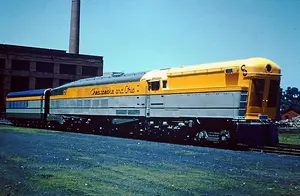
 Chesapeake & Ohio Class M-1 steam-turbine-electrics. Three Baldwin-Westinghouse locomotives, 500–502, built 1947–48 for The Chessie. Specs, the 2-C1+2-C1-B arrangement, and a roster. All scrapped…
-
N&W 2-6-6-2 Locomotives (Class Z): Specs, Roster, History
Oct 05, 26 11:44 AM
 Norfolk & Western Class Z 2-6-6-2s. One hundred ninety compound Mallets, 1300–1489, from Richmond, Baldwin, and Schenectady, 1912–1918. Diagram specs, the Z-1b rebuilds, Z-2 1399, and a roster. No…
-
Scenic Train Rides (USA 2026): State Guide to Tourist Railroads
Oct 04, 26 12:17 AM
 Scenic and tourist train rides in all 50 states for 2026. Colorado narrow gauge, Pennsylvania steam, Alaska’s White Pass, and the states with no full-size ride this month. Confirm on the railroad.
-
Wyoming Scenic Train Rides (2026): A Complete Guide
Oct 03, 26 12:07 AM
Wyoming has no full-size tourist railroad on the calendar in October 2026. Cheyenne Depot Museum and Douglas Railroad Museum are static. Union Pacific 4014’s posted public trip is a November run to De… -
Washington Scenic Train Rides (2026): A Complete Guide
Oct 02, 26 11:53 PM
 Washington tourist trains in 2026—Mount Rainier Scenic at Elbe, the Northwest Railway Museum, and Chehalis-Centralia. Lake Whatcom has no 2026 date on its ticket page.
-
Wisconsin Scenic Train Rides (2026): A Complete Guide
Oct 02, 26 11:48 PM
 Wisconsin tourist trains in 2026—Wisconsin Great Northern, Osceola & St. Croix Valley, Mid-Continent, East Troy, and the National Railroad Museum.
-
Pennsylvania Railroad Class Q2 4-4-6-4: Specs, Roster, History
Oct 02, 26 11:28 PM
Pennsylvania Railroad Class Q2 4-4-6-4 duplexes. Twenty-six engines, 6131 and 6175–6199, Altoona 1944–45. Form 109-J specs, the 7,987 hp test of 6175, and a roster. All scrapped. -
Utah Scenic Train Rides (2026): A Complete Guide
Oct 02, 26 11:18 PM
 Utah tourist trains in 2026—Heber Valley Railroad from Heber City. Golden Spike at Promontory is a locomotive demonstration, not a line-haul ride.
-
South Dakota Scenic Train Rides (2026): A Complete Guide
Oct 02, 26 11:06 PM
 South Dakota’s 2026 scenic train is the Black Hills Central 1880 Train, Hill City to Keystone. Steam is the summer assignment. Confirm the engine.
-
Oregon Scenic Train Rides (2026): A Complete Guide
Oct 02, 26 11:04 PM
 Oregon tourist trains in 2026—Oregon Coast Scenic from Rockaway Beach, Mount Hood at Hood River, Eagle Cap from Elgin, and the Oregon Rail Heritage Center in Portland.
-
Oklahoma Scenic Train Rides (2026): A Complete Guide
Oct 02, 26 10:36 PM
Oklahoma has no full-size scenic railroad on an October 2026 calendar. Oklahoma Railway Museum Halloween and Polar trains, the El Reno trolley, and the Heartland Flyer. -
North Dakota Scenic Train Rides (2026): A Complete Guide
Oct 02, 26 01:14 PM
North Dakota has no tourist railroad on a 2026 calendar. Ride Amtrak’s daily Empire Builder. The Fort Lincoln Trolley in Mandan is not a current ticket.