New York Central Railroad: Map, History, & The Water Level Route
Last revised: August 11, 2026
By: Adam Burns
The New York Central Railroad (reporting mark NYC) was one of the two defining eastern trunk lines of the American railroad age—the other being its perennial rival, the Pennsylvania Railroad. Marketed for generations as The Water Level Route, the Central linked New York City with Chicago, St. Louis, Detroit, Cincinnati, Boston, and Montreal over a network that, at its peak, approached 12,000 route miles. Its heritage reaches back to one of the country’s earliest chartered roads, the Mohawk & Hudson of 1826; its modern shape was forged by Cornelius “Commodore” Vanderbilt and his successors through the Lake Shore, Michigan Central, Big Four, West Shore, Boston & Albany, and a web of coal and terminal subsidiaries.
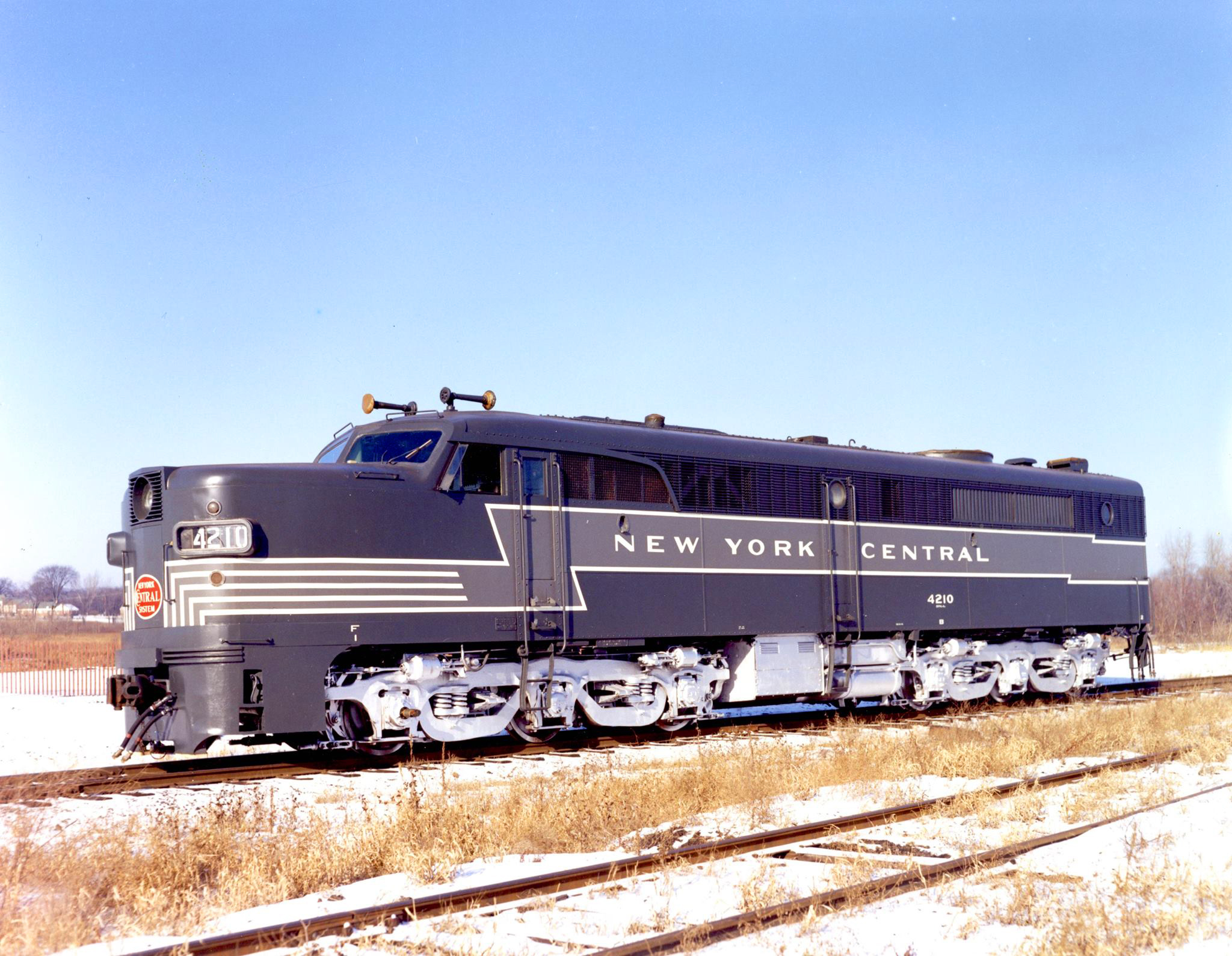
Alco builder’s photo of freshly outshopped New York Central PA-2 #4210, circa 1950. Warren Calloway collection.
The Central’s flagship passenger train, the 20th Century Limited, remains a byword for first-class American rail travel. Its Manhattan portal, Grand Central Terminal, still anchors the city. Much of the freight and passenger iron survives under CSX Transportation, Amtrak, and Metro-North—living proof that the Water Level Route was more than a slogan.
On this page: At a Glance · Formation · Vanderbilt · Water Level Route · NYC vs PRR · Subsidiaries · Electrification · 20th Century Operations · Passenger Trains · Perlman Era · Penn Central · Legacy Today · Related Reading
At a Glance
| Topic | Detail |
|---|---|
| Headquarters | New York City (notably 230 Park Avenue; also 466 Lexington Avenue in later years) |
| States served | New York, Massachusetts, New Jersey, Pennsylvania, West Virginia, Ohio, Michigan, Indiana, Illinois, Kentucky (Louisville), Missouri (St. Louis) |
| Canadian provinces | Ontario (Canada Southern / CASO corridor); Quebec (Montreal) |
| Earliest component | Mohawk & Hudson Railroad (chartered April 17, 1826; opened August 9, 1831) |
| First NYC consolidation | May 17, 1853 (Albany–Buffalo chain of roads) |
| Modern system architect | Cornelius Vanderbilt (NYC&HR era from late 1860s)—not the 1853 corporate “founder,” but the builder of the trunk-line empire |
| Dates of operation (NYC identity) | August 9, 1831 (M&H open) through January 31, 1968 (last full day before Penn Central) |
| Penn Central effective | February 1, 1968 |
| Track gauge | 4 ft 8½ in standard gauge |
| Route miles (1930) | 11,934.11 |
| Locomotives (1963) | Diesels 1,965; electrics 65 |
| Rolling stock (1963) | Freight cars 94,115; passenger cars 2,905 |
| Slogan | The Water Level Route |
| Reporting mark | NYC |
| Successor | Penn Central Transportation Company (1968); major mains later Conrail (1976) and, after 1999, largely CSX (with NS taking much former PRR) |
Principal subsidiaries (c. 1930)
| Property | Role in the NYC system |
|---|---|
| West Shore Railroad | West bank of the Hudson; competitive Buffalo route absorbed after PRR rivalry settlement |
| Boston & Albany | New England gateway Boston–Albany |
| Michigan Central | Detroit, Chicago, and the Canada Southern (Buffalo–Detroit via Ontario) |
| Cleveland, Cincinnati, Chicago & St. Louis (Big Four) | Ohio–Indiana–Illinois–St. Louis web |
| Toledo & Ohio Central; Zanesville & Western; Kanawha & Michigan | Ohio / West Virginia coal and chemical corridors |
| Cincinnati Northern; Peoria & Eastern; Evansville, Indianapolis & Terre Haute | Midwest secondary mains and branches |
| Pittsburgh & Lake Erie | Youngstown–Pittsburgh steel gateway |
| Indiana Harbor Belt; Chicago River & Indiana; Chicago Junction | Chicago terminal and belt operations |
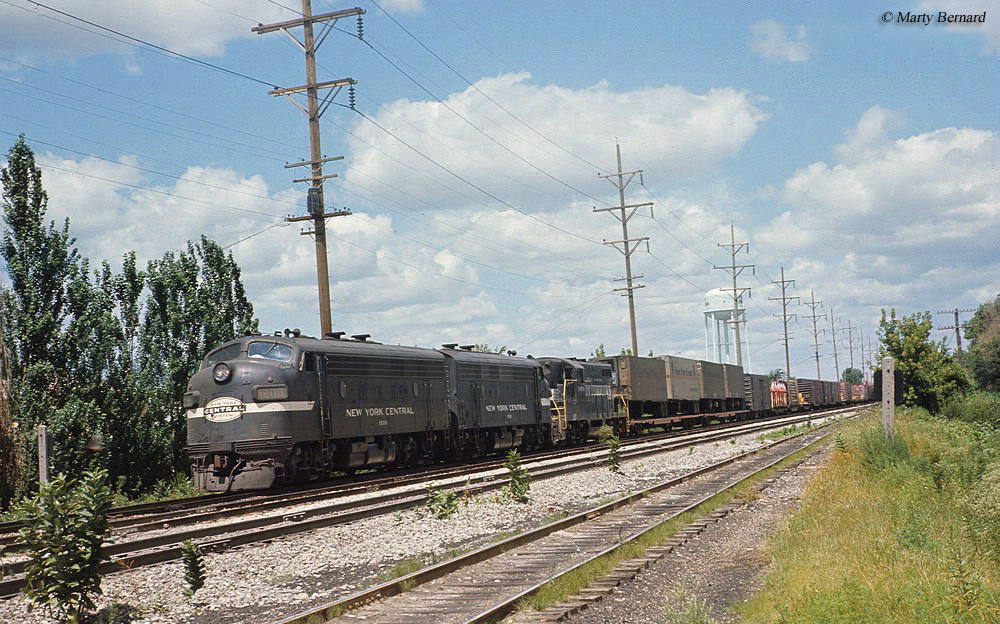
NYC F7As led by #1800 and a GP7 with a manifest on the Indiana Harbor Belt at La Grange, Illinois, August 2, 1965. Marty Bernard photo.
Formation: From Mohawk & Hudson to the First New York Central
The modern New York Central was a collection of predecessor properties merged or acquired over many decades. The earliest component was one of the industry’s pioneers, the Mohawk and Hudson Railroad.
The M&H was incorporated on April 17, 1826, although as early as December 28, 1825, the local public learned of the project through a newspaper article in the Schenectady Cabinet by George Featherstonhaugh. The road holds historical significance as one of the earliest railroads ever chartered and built in the United States, opening 16 miles between Albany and Schenectady on August 9, 1831.
At first it handled primarily passenger traffic. New York State had recently opened the Erie Canal and, to protect that public works investment, restricted railroads from carrying the more lucrative freight—or forced them to pay canal-style tolls. Other early predecessors of the NYC faced the same political and economic headwind.
Despite the freight handicap, the Mohawk & Hudson did relatively well. It is often credited with operating an early covered freight car (essentially a covered gondola—ancestor of the boxcar) in 1833, and it placed steam in service on opening day with the American-built 0-4-0 DeWitt Clinton.
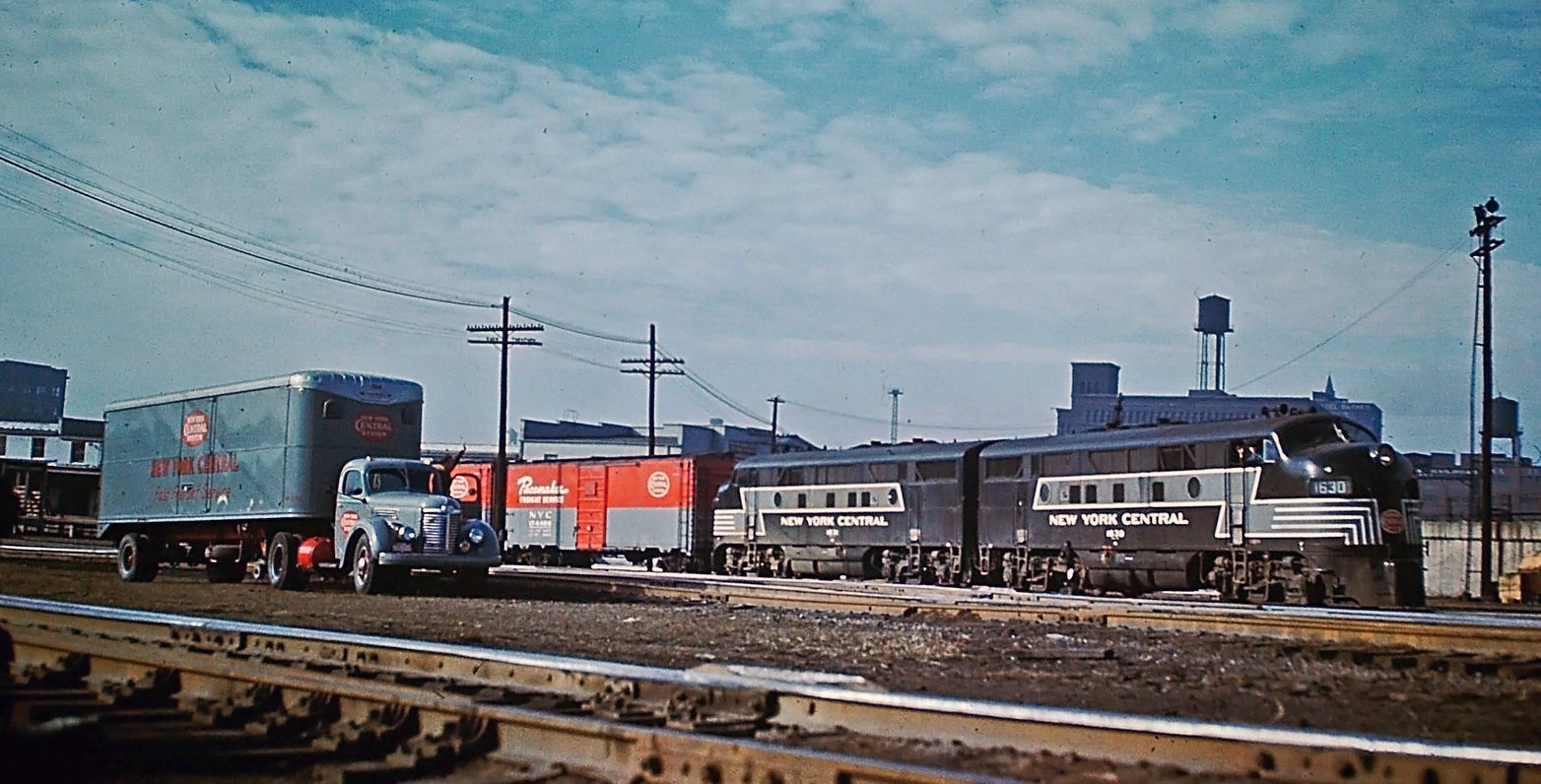
NYC F3As #1630 and #1631 in a publicity view for high-speed Pacemaker freight service, Indianapolis, November 1949. (Pacemaker was also a passenger train name on the New York–Cleveland–Chicago axis.)
Six other small roads completed what later became the Central’s main line between Albany and Buffalo:
- Utica & Schenectady — chartered April 29, 1833; opened 78 miles in 1836
- Syracuse & Utica — chartered May 11, 1836; opened 53 miles to Syracuse in August 1839
- Auburn & Syracuse — chartered May 1, 1834; opened January 1838 (initially horse-powered; steam locomotive Syracuse from June 14, 1839)
- Auburn & Rochester — chartered May 13, 1836; reached Rochester by late 1842; merged with A&S in August 1850 as the Rochester & Syracuse
- Tonawanda Railroad — chartered April 24, 1832; opened to Batavia in 1837
- Attica & Buffalo — chartered 1836; opened November 24, 1842, completing continuous rail from the state capital to Lake Erie
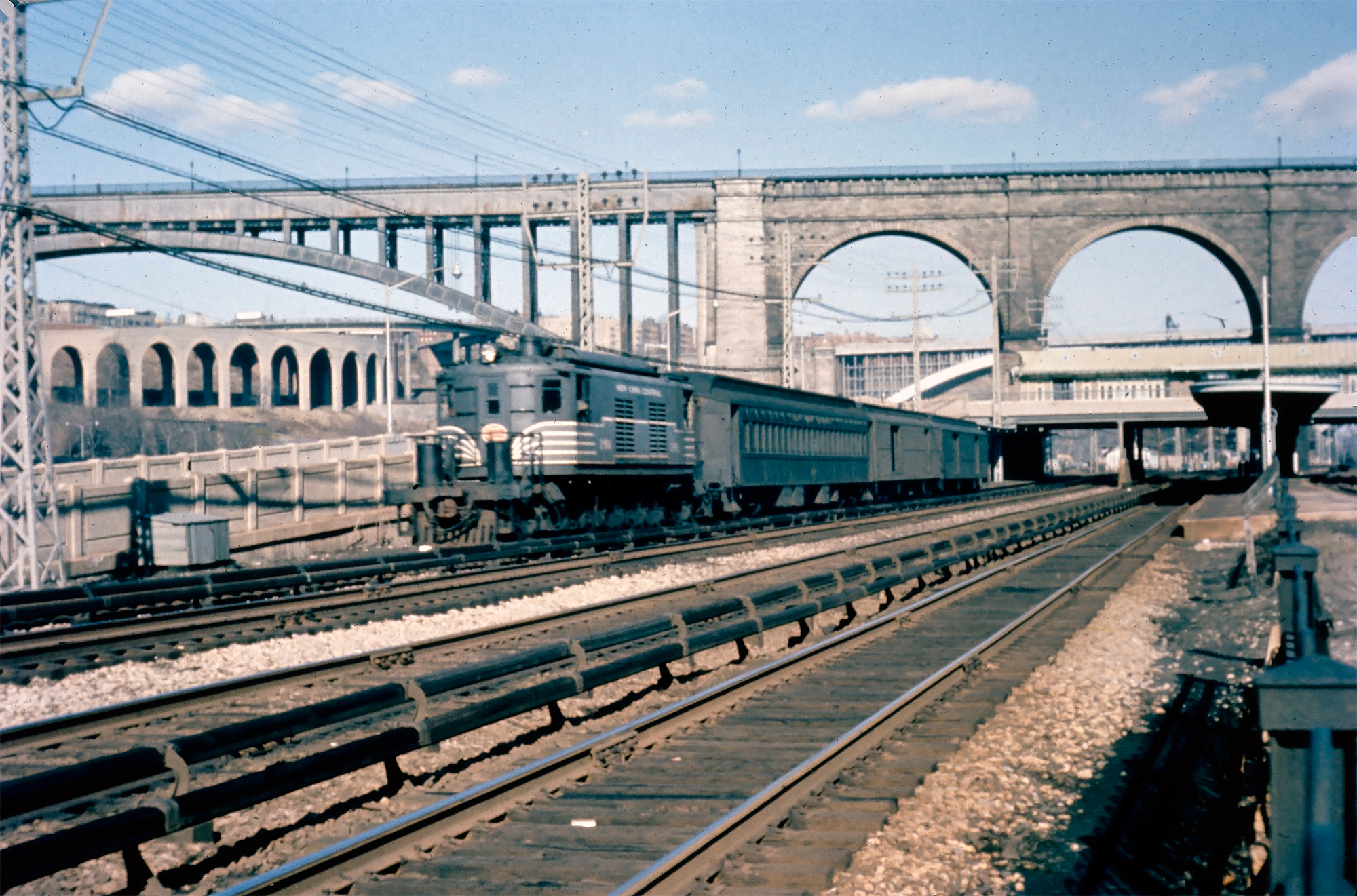
A New York Central T-motor (T-3a) with a coach and two baggage cars at High Bridge in the Bronx, circa 1952. Meyer Pearlman photo. American-Rails.com collection.
Logo & Identity
The classic New York Central oval herald. Author’s work.
According to Mike Schafer and Brian Solomon’s New York Central Railroad, the state discontinued canal tolls on these railroads during December of 1851. Profits soared almost overnight. Merger talks had already begun among the Albany–Buffalo group; operators understood the value of a single through line.
Consolidation was formalized on May 17, 1853, when the roads joined as the original New York Central Railroad. For roughly a decade the first NYC remained essentially an Albany–Buffalo property. The Civil War’s aftermath and the arrival of Vanderbilt capital then turned that corridor into the spine of a continental-scale system.
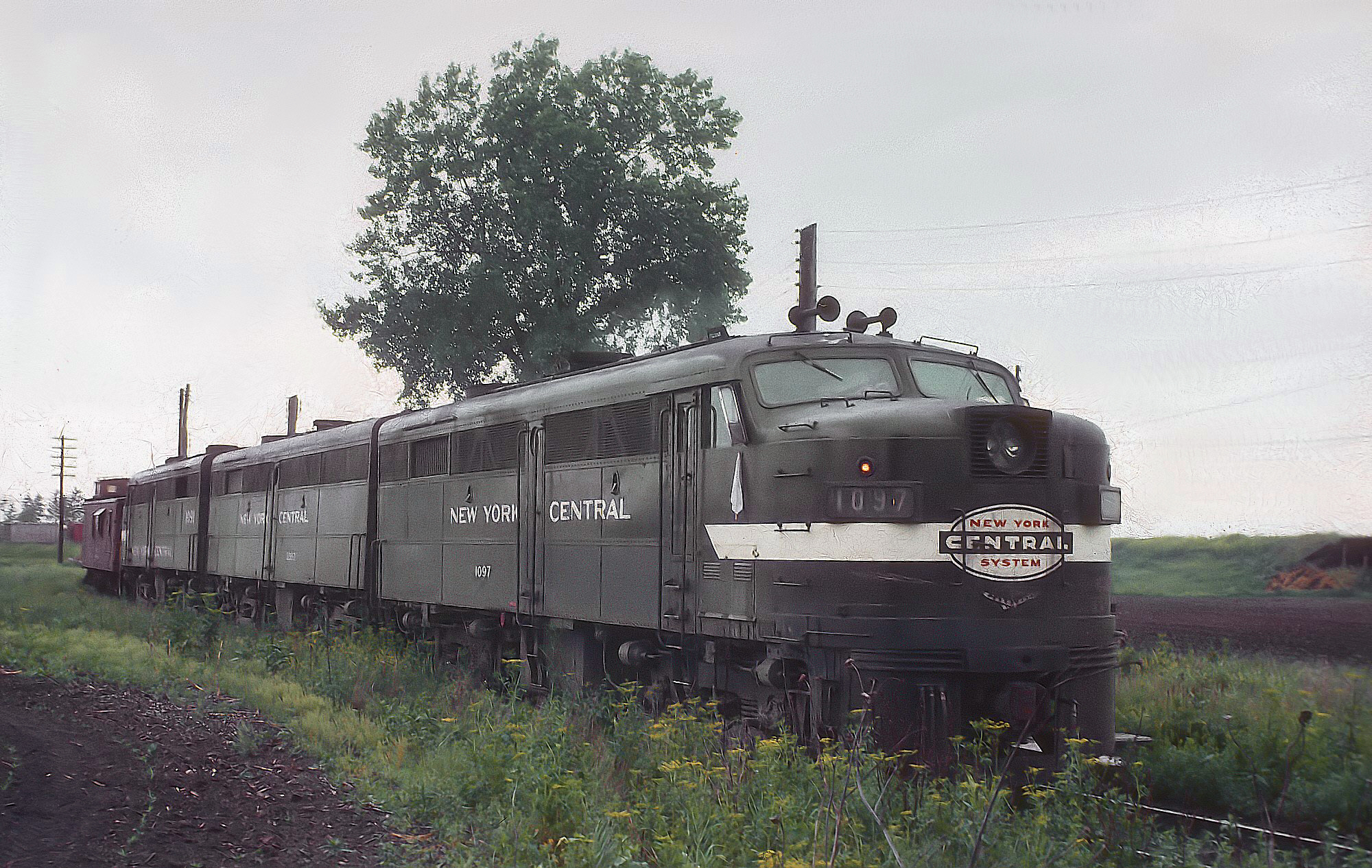
A New York Central FA-2 set led by #1097 lays over at Zearing, Illinois, June 1966. Rick Burn photo.
The Commodore: Vanderbilt Builds the Empire
Cornelius Vanderbilt remains synonymous with the New York Central. Born in 1794, he began at age 16 with ferry service between Staten Island and New York City, built a steamship fortune on the Hudson, and earned the title Commodore as operator of the largest schooner on that river. By 1834 he was already a wealthy man; he stayed in shipping for decades before concluding that the future of American transport lay in rails.
In 1863 he acquired control of the New York & Harlem; a year later he held controlling interest in the Hudson River Railroad. Those two properties gave the later NYC a coveted entry into downtown Manhattan—an advantage the railroad held until the Pennsylvania opened Penn Station in 1910. (For a fuller biography, see the site’s Cornelius Vanderbilt profile.)
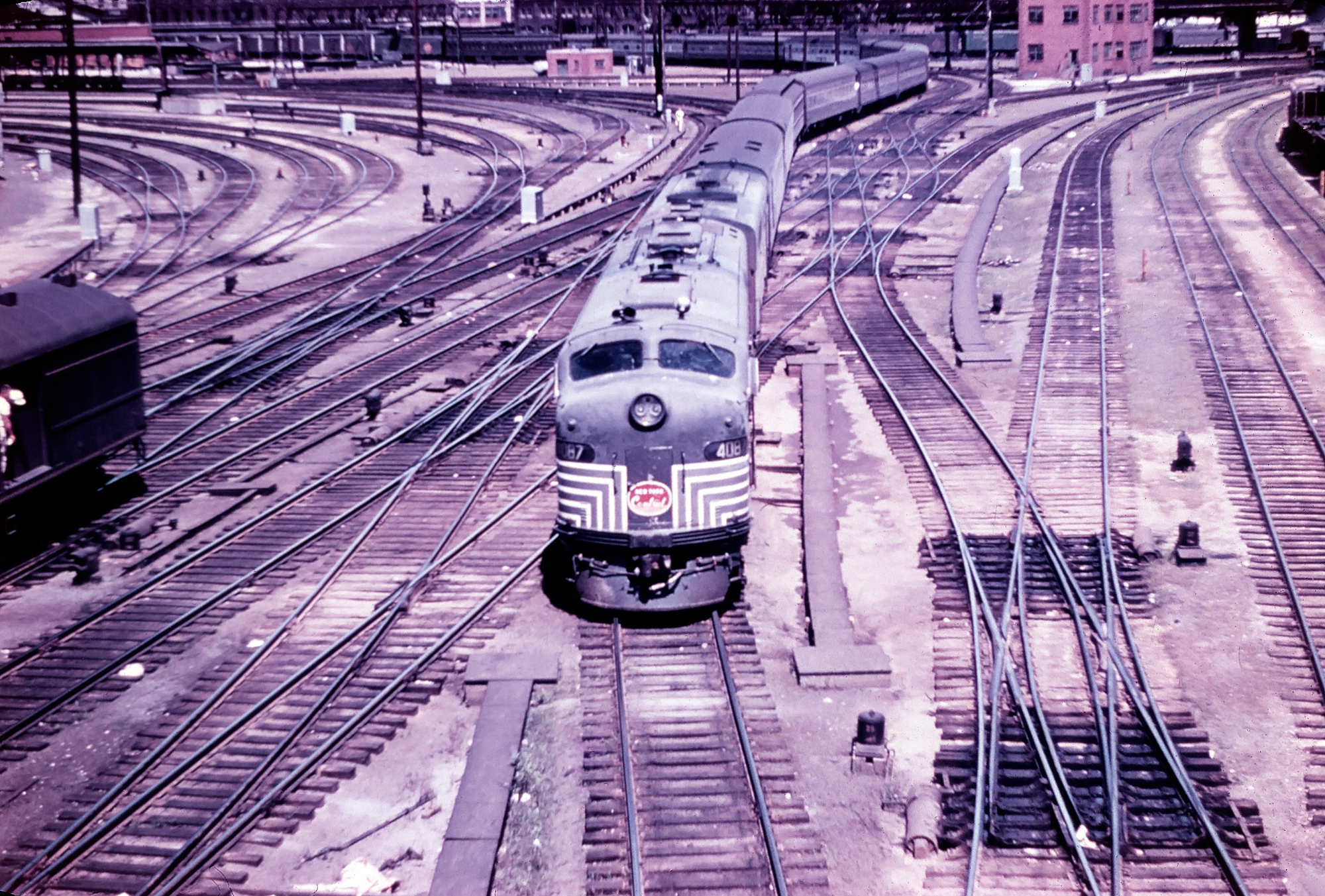
NYC’s westbound Knickerbocker, led by E8A #4087, backs into St. Louis Union Station, June 23, 1957. American-Rails.com collection.
New York & Harlem and the Hudson River Railroad
The NY&H, originally a horse-drawn line, was incorporated on April 25, 1831, to open service on the east side of Manhattan from downtown toward Harlem. It reached Fordham in the Bronx in 1841 and pushed to Chatham, New York (129 miles), by 1852, connecting with the Western Railroad (later Boston & Albany).
The nearby Hudson River Railroad, chartered May 12, 1846, extended from Rensselaer (with a Troy & Greenbush connection, later leased) down the eastern shore of the Hudson to the west side of Manhattan, opening October 3, 1851. That riverside alignment became the heart of the Central’s future high-speed main—the physical basis of the Water Level Route slogan.
Through shrewd and sometimes ruthless business practice, Vanderbilt gained control of the original New York Central in 1867. In 1869 he formed the New York Central & Hudson River Railroad: the HRRR and NYC merged into the new company while the Harlem was leased. Population growth in the New York region and a continuous rail path to Buffalo made the property immensely valuable. Vanderbilt then looked west.
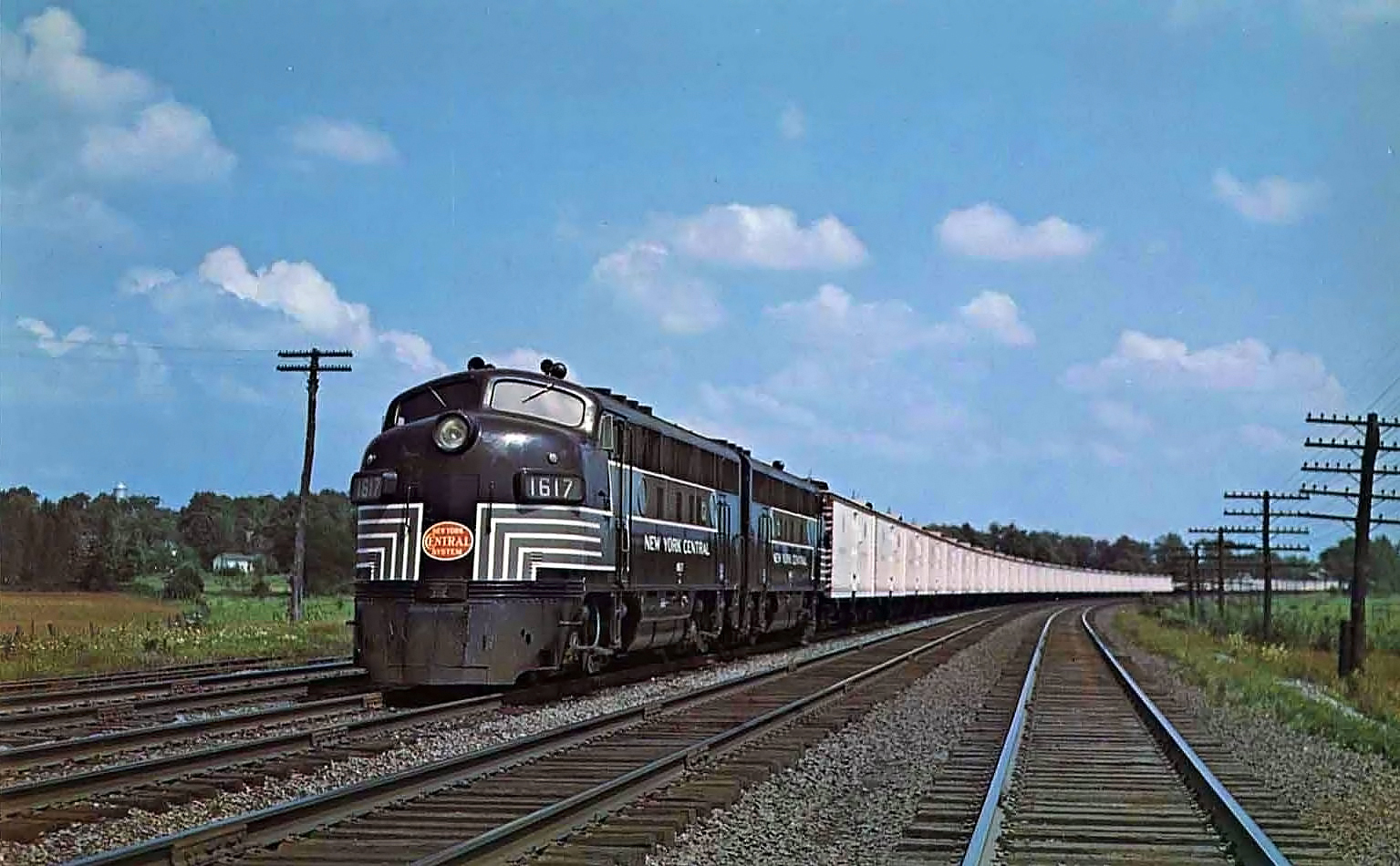
A pair of nearly new NYC F3As showcase Merchants Despatch Transportation reefers near Churchville, New York, October 1947. Ed Nowak photo.
The Water Level Route: Why the Slogan Mattered
No phrase captured the Central’s self-image—or its engineering reality—better than The Water Level Route. Between New York and Chicago the NYC followed rivers and lake shores: the Hudson to Albany, the Mohawk Valley west toward Buffalo, then the south shore of Lake Erie and the southern Great Lakes plain into Indiana and Illinois. Grades were gentle compared with the Pennsylvania’s assault on the Alleghenies. Four-tracking on the busiest segments (especially Albany–Buffalo) allowed passenger flyers and freights to share a corridor without constant meets on single track.
For travelers, water-level meant smoother, often faster carded schedules and less helper-engine drama. For operating officers, it meant higher average speeds with the same horsepower and lower fuel and maintenance per ton-mile on the trunk. Advertising made the comparison explicit for generations: ride the Water Level Route rather than climb the mountains. The rivalry with the PRR was never only about terminals and Pullmans; it was also about physics.
Amtrak’s modern Lake Shore Limited and Empire Corridor services still sell pieces of that geography. CSX’s Chicago Line and related ex-NYC mains still move the freight that once paid for Hudsons and Mohawks. The slogan outlived the corporation because the route was real.

E8A #4095 on train No. 35, the westbound Iroquois (Buffalo–Chicago), at Sandusky, Ohio, September 12, 1962. Richard Wallin photo.
New York Central vs. Pennsylvania Railroad
You cannot tell the Central’s story without the Pennsylvania, and vice versa. Both fought for eastern and midwestern traffic from the mid-nineteenth century through the Penn Central merger. The table below summarizes the classic comparison.
| Dimension | New York Central | Pennsylvania Railroad |
|---|---|---|
| Signature NY–Chicago pitch | Water Level Route (Hudson, Mohawk, Lake Erie plain) | Mountain main via Harrisburg and the Alleghenies |
| Manhattan passenger face | Grand Central (electric third-rail approaches) | Pennsylvania Station (Hudson tunnels, AC electrics) |
| Flagship NY–Chicago train | 20th Century Limited (GCT–LaSalle Street) | Broadway Limited (Penn Station–Chicago) |
| Pittsburgh access | Indirect / P&LE steel gateway rather than a PRR-style trunk through the city | Home road; industrial heartland |
| New England | Boston & Albany; deep New England reach rare among western trunks | Limited compared with NYC’s B&A |
| Canadian corridor | Michigan Central / Canada Southern (Buffalo–Detroit via Ontario) | Not equivalent |
| St. Louis / Ohio Valley | Big Four network | Panhandle and other PRR lines |
| Electrification philosophy | Third-rail for urban ordinances and tunnels (NYC, Cleveland, Detroit tunnel work) | Extensive main-line catenary (NY–Washington corridor and beyond) |
| Corporate culture (mid-20th c.) | Often described as more open to operational experiment under Perlman | Hierarchical “standard railroad of the world” tradition |
| 1968 outcome | Merged into Penn Central | Merged into Penn Central (technically the surviving corporate line in the union) |
Traffic figures and prestige waxed and waned by decade, but the Century frequently edged the Broadway in public imagination and, on many counts, in patronage. Both roads poured capital into streamlining, terminals, and freight plants. Both were overbuilt for the post-1950s traffic world. Their forced marriage in 1968 proved that combining two sick giants does not automatically create one healthy one.
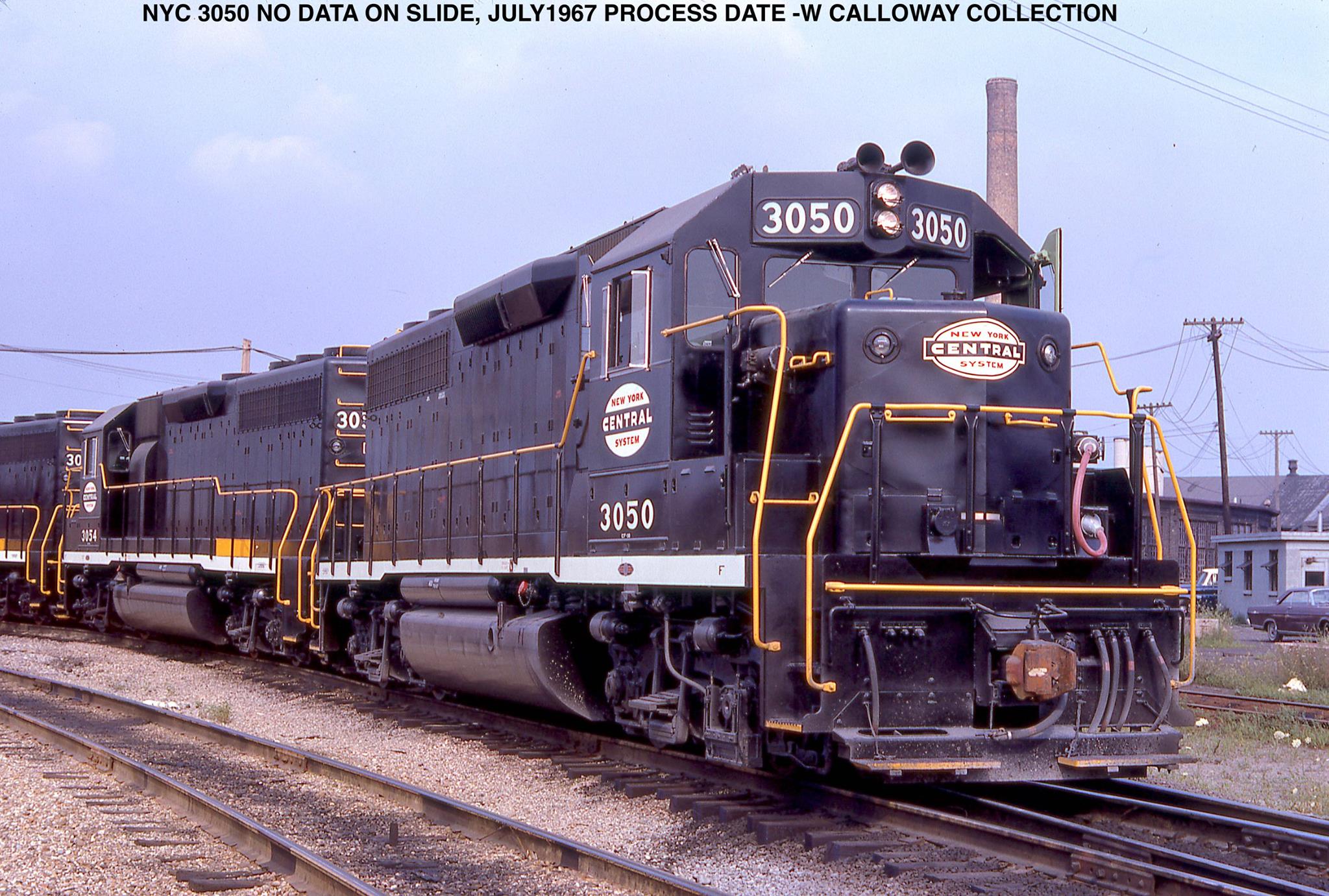
A new set of NYC GP40s, July 1967. Late pre-merger power on both NYC and PRR often wore plain black with company marks only. Warren Calloway collection.
Expansion: Lake Shore, Michigan Central, Big Four & More
In a move often described as manipulative even by Gilded Age standards, Vanderbilt secured what may have been the Central’s greatest single addition: the Lake Shore & Michigan Southern Railway. That Midwestern giant traced roots to the 1830s and, at its peak, connected Buffalo with Chicago via Toledo, Cleveland, and Elkhart, with reaches into Michigan and toward Oil City, Pennsylvania. Vanderbilt gained stock control in 1877; the LS&MS name later disappeared into the modern NYC, but the Lake Shore main remained the western half of the Water Level Route. (Dedicated history: Lake Shore & Michigan Southern.)

E8A #4055 and E7A #4014 on train 354, the New York Special, at Gary, Indiana, December 1960. Rick Burn photo.
Next came the Michigan Central Railroad. Beginning as the Detroit & St. Joseph of 1831, reorganized as the Michigan Central in 1846, it grew toward Chicago, Detroit, Jackson, Mackinaw, and Toledo. Its most strategic artery was the Canada Southern (CASO) across southern Ontario between Detroit and Buffalo—a high-capacity shortcut that avoided the south shore of Lake Erie. At its peak the MC exceeded roughly 1,800 miles. Vanderbilt never fully secured it in his lifetime; it came into the NYC orbit around 1878, after his death. CASO remained a premier Central corridor into the diesel age. (See Michigan Central.)
The last great piece associated with Vanderbilt’s lifetime influence was the Boston & Albany. Roots ran to the Boston & Worcester (1831/1835) and Major George Whistler’s low-grade Western Railroad across Massachusetts (opened Springfield 1839, state line 1841). The B&W and WRR merged September 4, 1867, as the Boston & Albany. Branches reached Winchendon, North Adams, Webster, Milford, and related points. Together with northern New York lines, the B&A made the Central the rare western trunk with deep New England coverage.
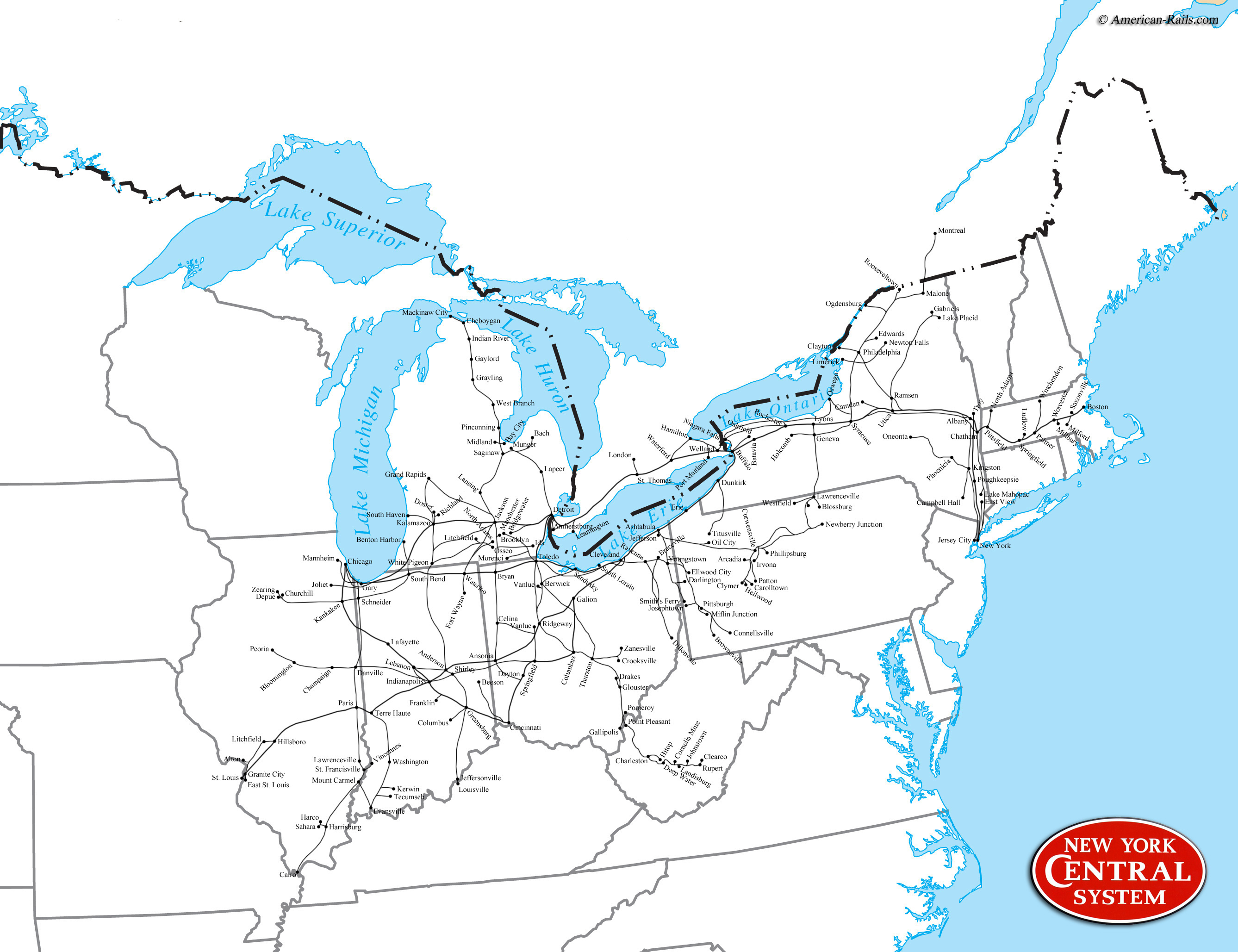
New York Central system map as the railroad appeared in the 1960s. Author’s work.
After Vanderbilt: Big Four, P&LE, Coal Roads
The Commodore’s death did not stop expansion. The Central’s last great territorial addition was the Cleveland, Cincinnati, Chicago & St. Louis Railway—the Big Four—created June 30, 1889, from the Cleveland, Columbus, Cincinnati & Indianapolis (“Bee Line”); the first “Big Four” Cincinnati, Indianapolis, St. Louis & Chicago; and the Indianapolis & St. Louis. Direct lease control by NYC came as late as 1930, but operating and financial ties were older. At its largest the Big Four approached 2,400 route miles across Indiana, Ohio, and Illinois—Indianapolis, St. Louis, Louisville, Cincinnati, Columbus, and another Chicago path. (See Big Four Route.)
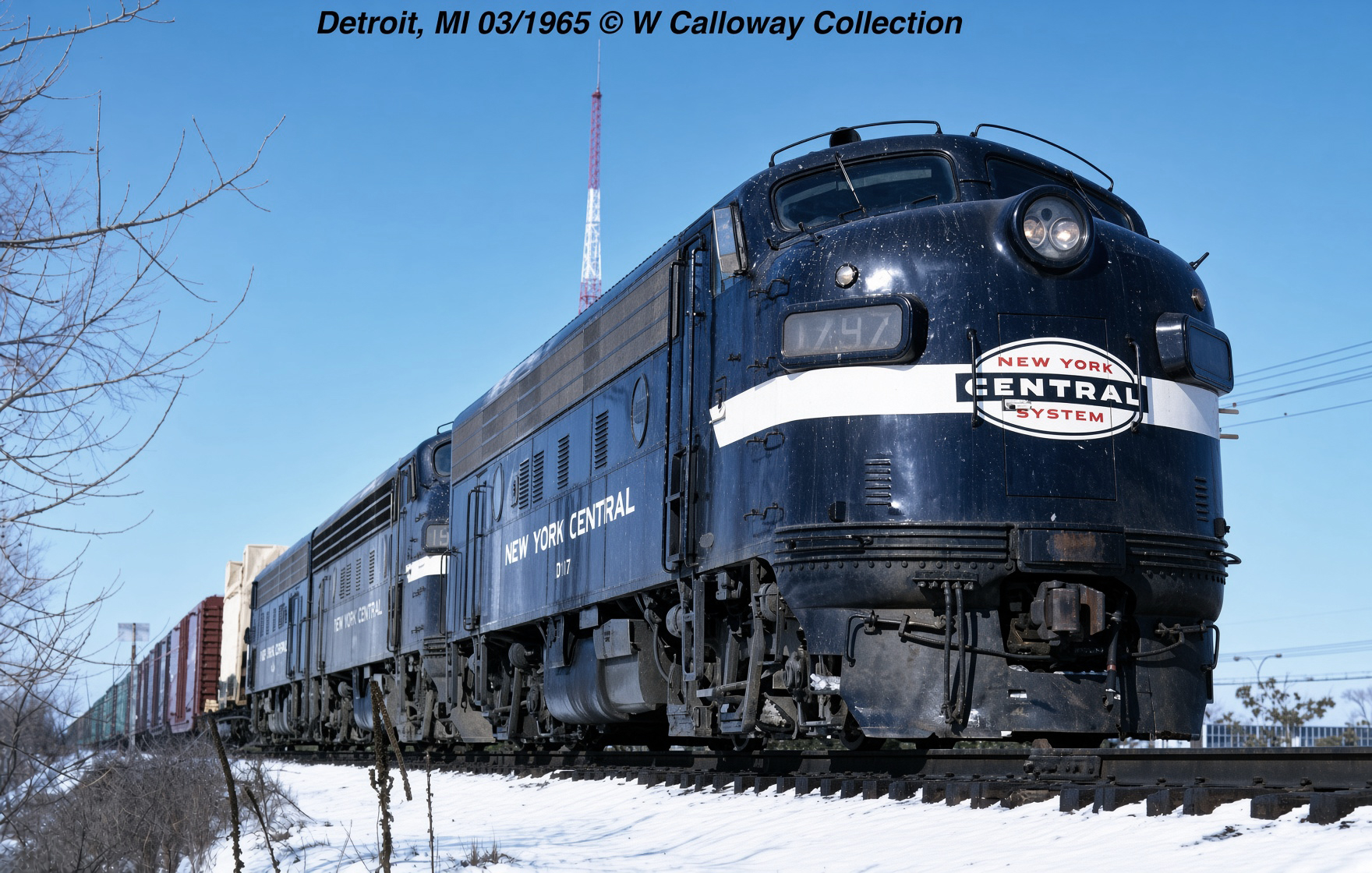
An A-B-A set led by F7A #1797 lead a westbound/northbound freight passing through Dearborn, Michigan in March, 1965. Photographer unknown/Warren Calloway collection.
Among smaller but vital properties, the Pittsburgh & Lake Erie (formed May 11, 1875, with Carnegie-era steel money) gave the Central a Steel City gateway via Youngstown, with later reaches toward Brownsville and Connellsville. It never matched the PRR’s through Pittsburgh trunk, but it was a consistent money-maker. (See Pittsburgh & Lake Erie.)
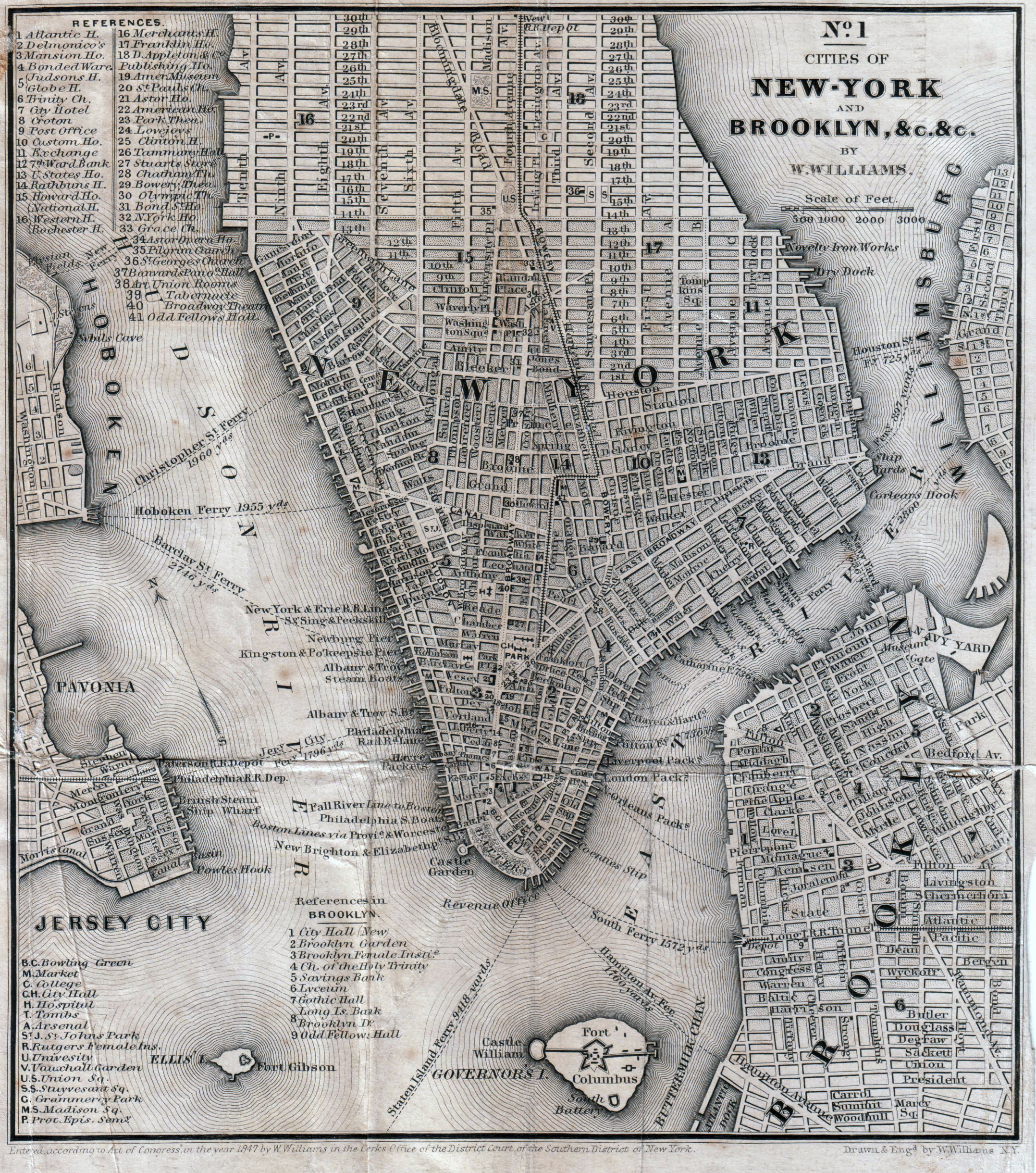
Downtown Manhattan as shown in 1848’s Appleton’s Railroad and Steamboat Companion. Author’s collection.
The LS&MS eyed the P&LE early; the NYC&HR also pushed into central Pennsylvania coal via the Beech Creek Railroad and Fall Brook Coal Company interests. An “inside gateway” eventually ran from Lyons, New York, through Geneva toward Williamsport, Curwensville, and back toward Ashtabula—coal geography layered onto the passenger trunk.
In Ohio and West Virginia, the Toledo & Ohio Central (from the Atlantic & Lake Erie of 1869) and the Kanawha & Michigan (Point Pleasant toward the Charleston area) moved black diamonds and, later, Kanawha Valley petrochemical traffic that still shapes the region. In Illinois, the Cairo & Vincennes (organized 1867, completed 1872) and related Big Four control fed high-sulfur bituminous coal; when the CCC&StL pushed north of Danville to East Chicago via the Chicago, Indiana & Southern (opened January 21, 1906), the Chicago–Cairo path earned the nickname Egyptian Line.
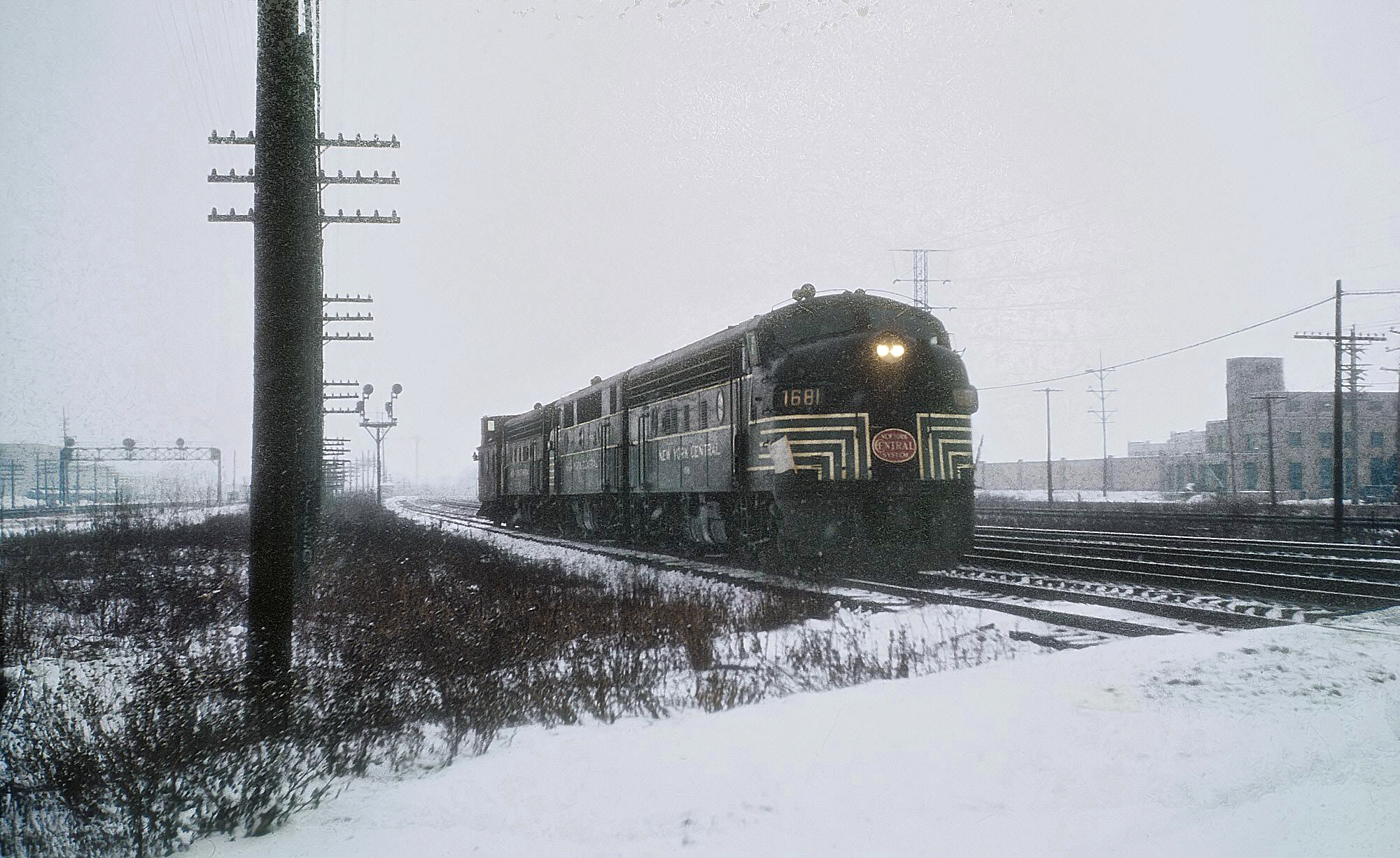
F7A #1681, F2A #1605, and F7A #1817 on a caboose hop at 113th and Lake Streets, Hammond, Indiana, February 1963. Rick Burn photo.
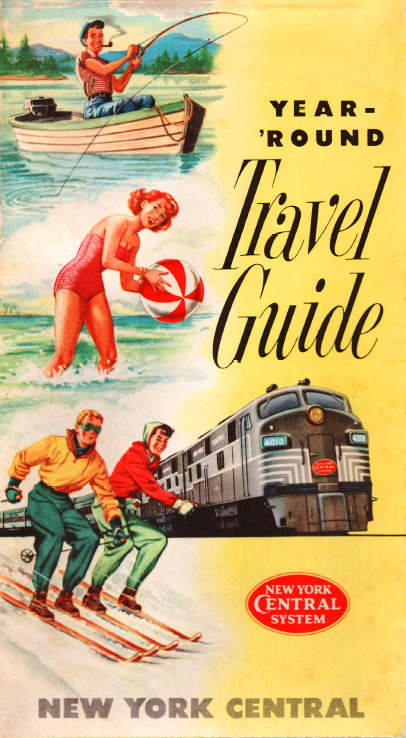
Illustration from a 1953 New York Central travel guide.
Electrified Lines
NYC electrification was never as extensive as the Pennsylvania’s main-line catenary empire, but it was sophisticated, durable, and essential to the railroad’s New York identity. Segments also appeared around Cleveland and at the Detroit River Tunnel. Most projects answered city ordinances and tunnel safety rather than a desire to wire the Water Level Route end to end.
The Central preferred under-running third rail at about 660 volts DC—a “cleaner” right-of-way than overhead wire for dense suburban trackage, with shoes on the locomotives collecting current from a slightly elevated rail. Guidance came partly from the Baltimore & Ohio’s earlier Baltimore Belt electrification.
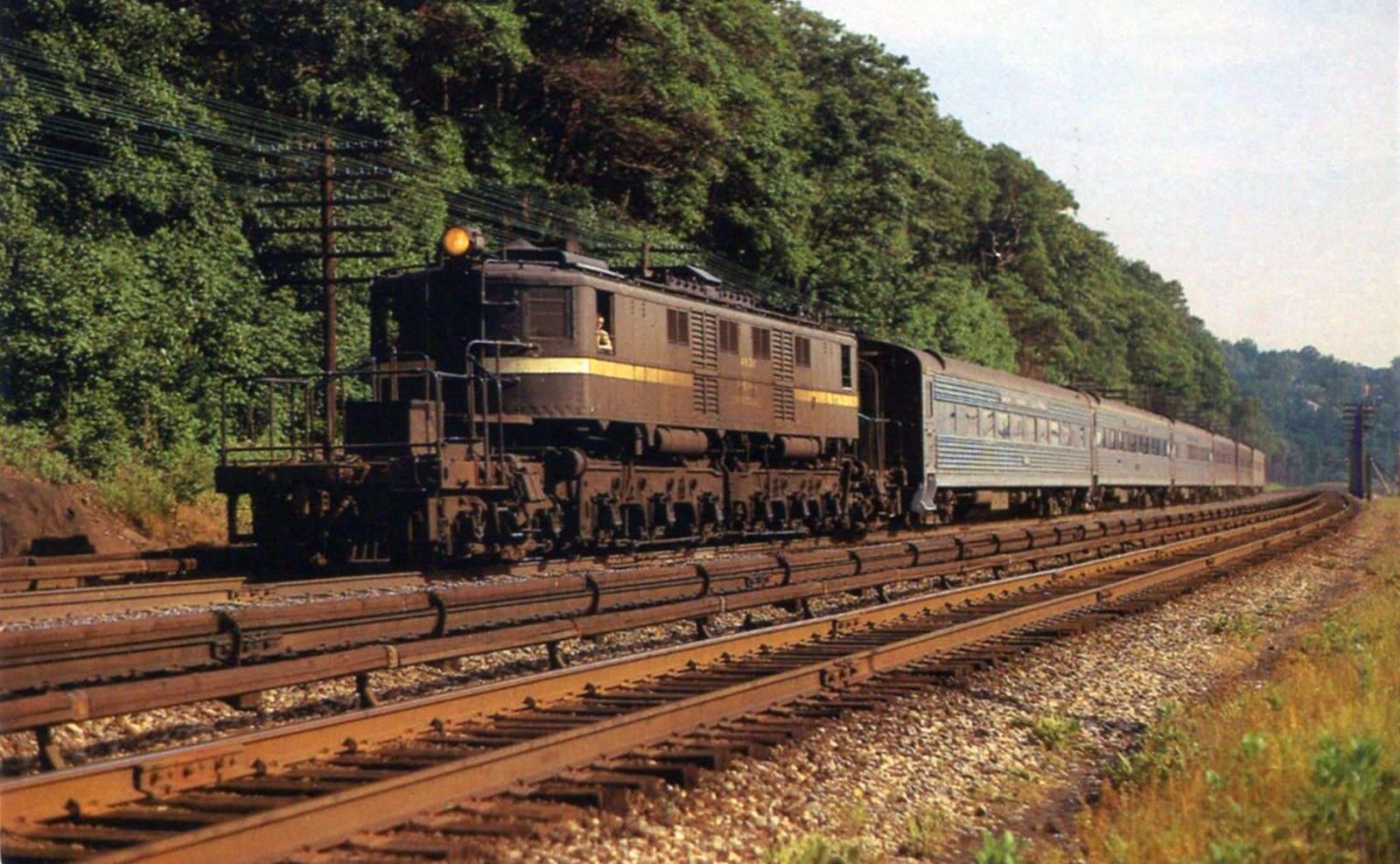
Early Penn Central / Amtrak era: an NYC “P-motor” northbound at Hastings-on-Hudson with Amtrak train No. 75, May 1971. Henry Butz photo.
Pressure to electrify Manhattan approaches intensified after a January 1902 collision in which smoke obscured signals and a New York Central train struck a New Haven suburban train. Cities moved to ban steam from their cores. NYC electric operation began September 20, 1906; ordinance required steam out by July 1, 1908. The railroad electrified the Hudson Division between Grand Central and Harmon (today’s Croton-Harmon) and the Harlem Division.
Motive power evolved through distinctive classes:
- S-motors — Beginning with GE Class L (later S-1) 1-D-1 designs; S-2 and S-3 fleets followed early in the century. After a deadly derailment traced to truck guidance, many were rebuilt to 2-D-2. Gearless traction motors; later mostly yard work. A few preserved, generally not on public display.
- T-motors — From 1913, end-cab B-B+B-B units with all axles powered—higher horsepower with less rail wear per axle. The public face of NYC electrics on open main lines into GCT, often on named trains. Survived into the Penn Central era before FL9s and other power displaced them.
- Q and R steeple-cabs — 1920s GE B-B types; R units notable on Detroit River Tunnel freight; some R-2 C-C designs on West Side freight electrics.
- P-motors — Originally Cleveland Union Terminal P-1a (2-C+C-2); after CUT de-electrification in the 1950s, rebuilt for third-rail as P-2a/P-2b around GCT.
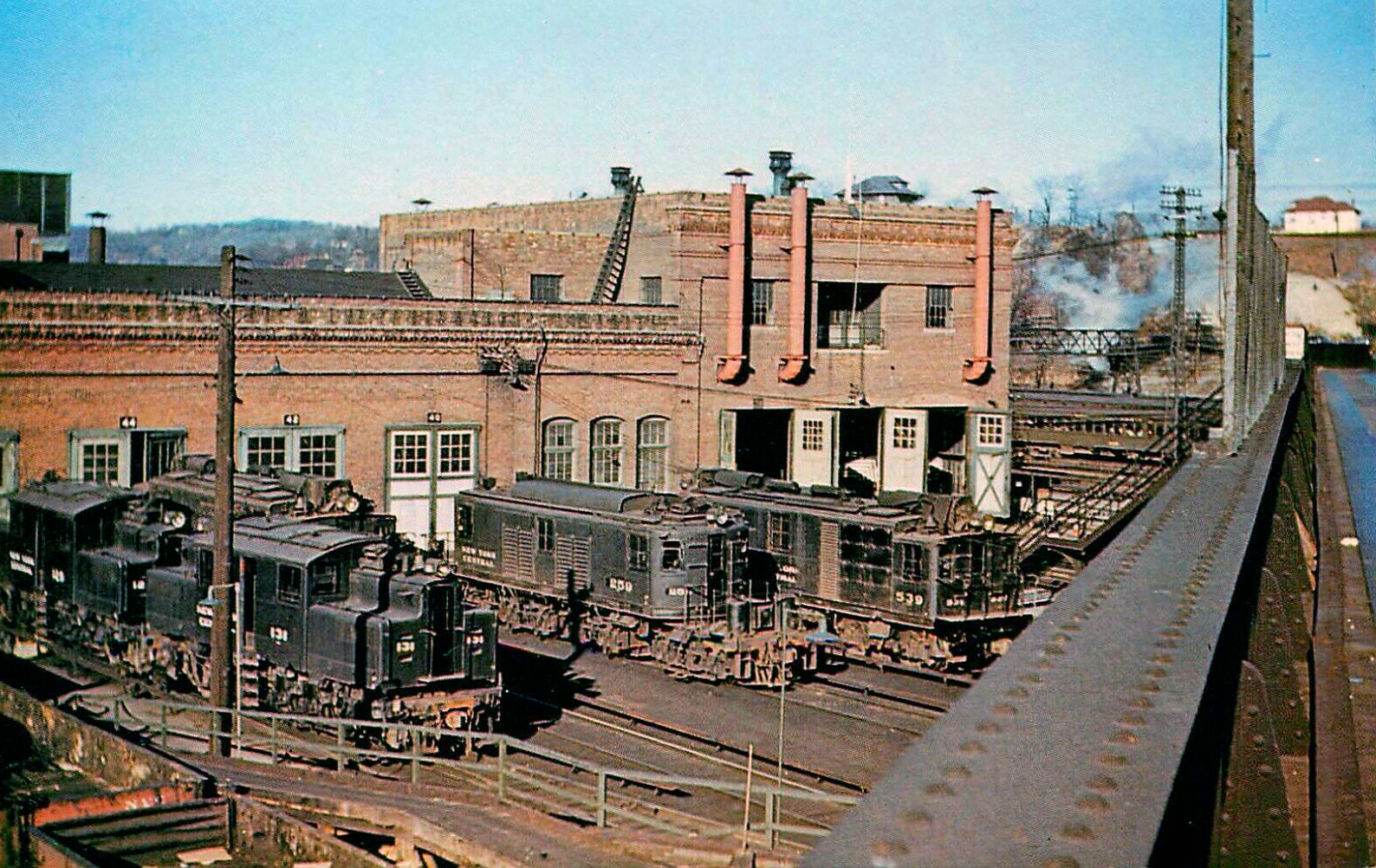
Electric maintenance at Harmon, December 1949: S-motors #131 and #120, T-motor #259, tri-power #539. William Rinn photo.
Amtrak and Metro-North still depend on much of this electrified geography for Empire Corridor and commuter service into Grand Central—though GCT today is a commuter terminal rather than a long-distance palace of the Century era. Thanks to Joe Klapkowski for help with electric locomotive details on earlier versions of this page.
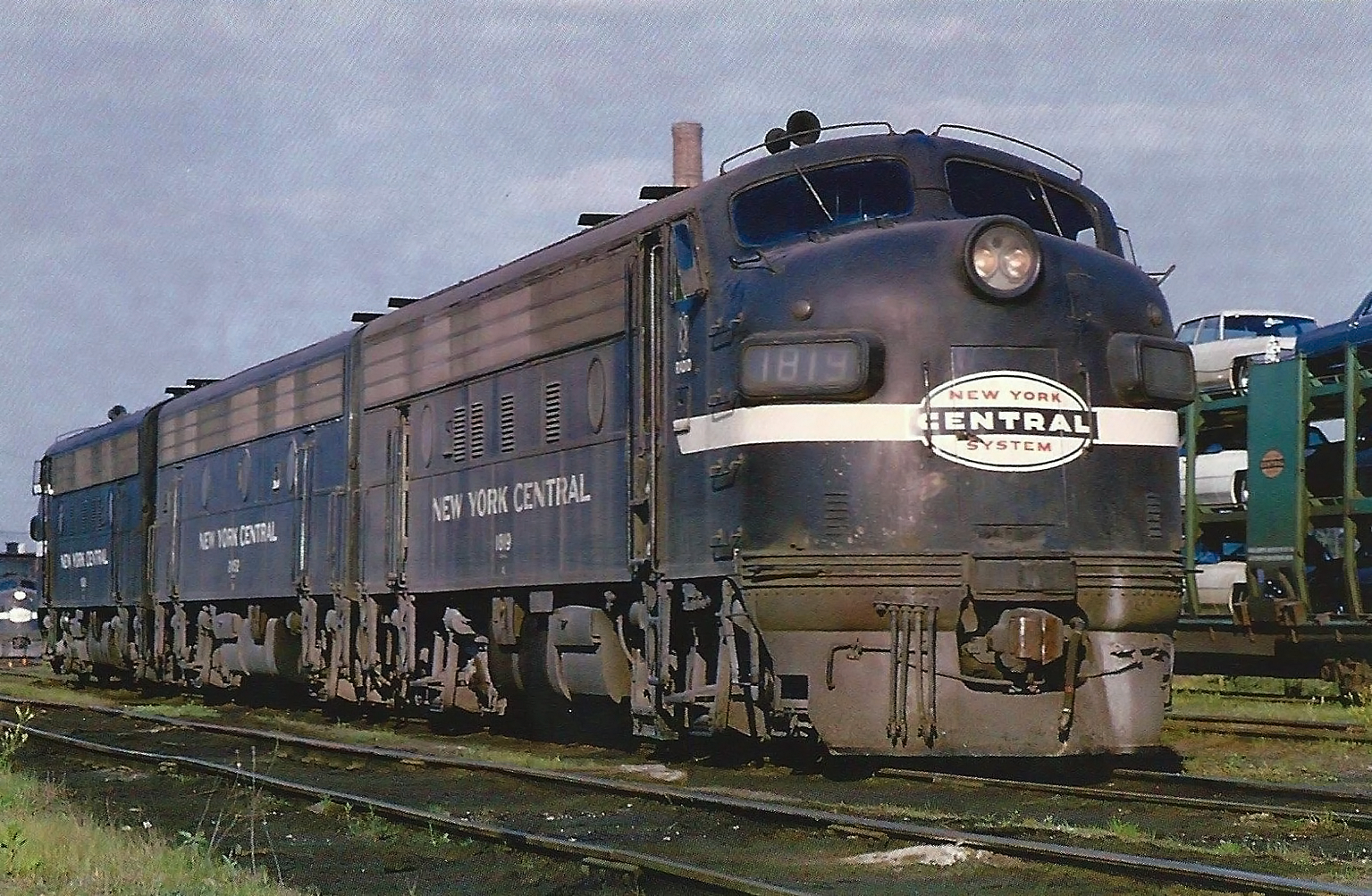
NYC F7s at Collinwood (Cleveland), circa 1965. American-Rails.com collection.
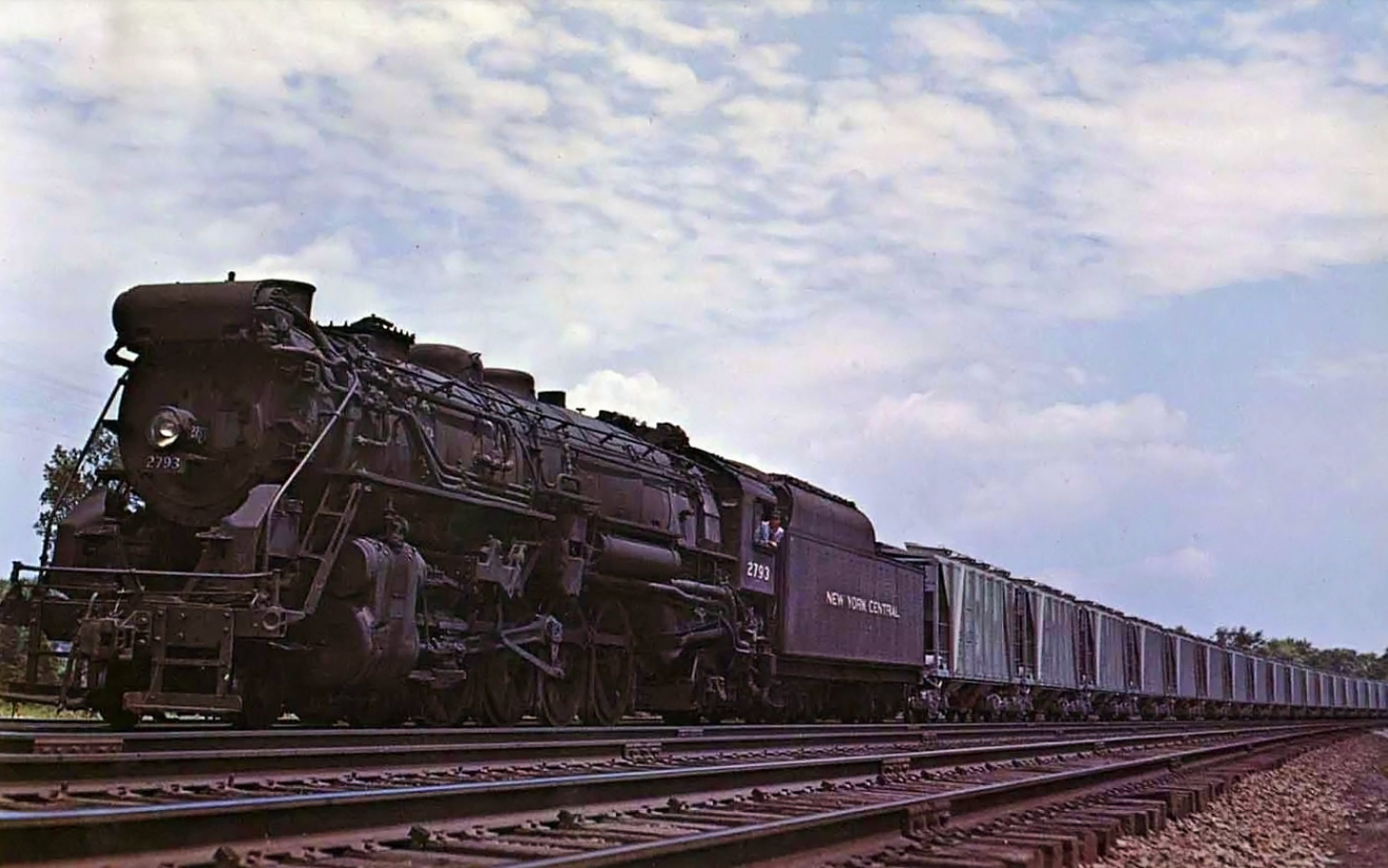
Publicity view of 4-8-2 Mohawk #2793 with covered hoppers at Churchville, New York, June 1946. Ed Nowak photo.
Northern New York, the Put, and the West Shore
In the late nineteenth century the Central expanded in nearly every direction at once. Between those projects and the Boston & Albany, it was the only major trunk that also blanketed the heart of New England.
Business tactics secured the Rome, Watertown & Ogdensburg lease in 1891 (roots in an 1861 merger of Watertown & Rome and Potsdam & Watertown). The RW&O ran Rome–Norwood via Watertown with branches to Ogdensburg and Oswego; Massena came before full NYC&HR control. Montreal access followed via the Mohawk & Malone, leased in 1902.
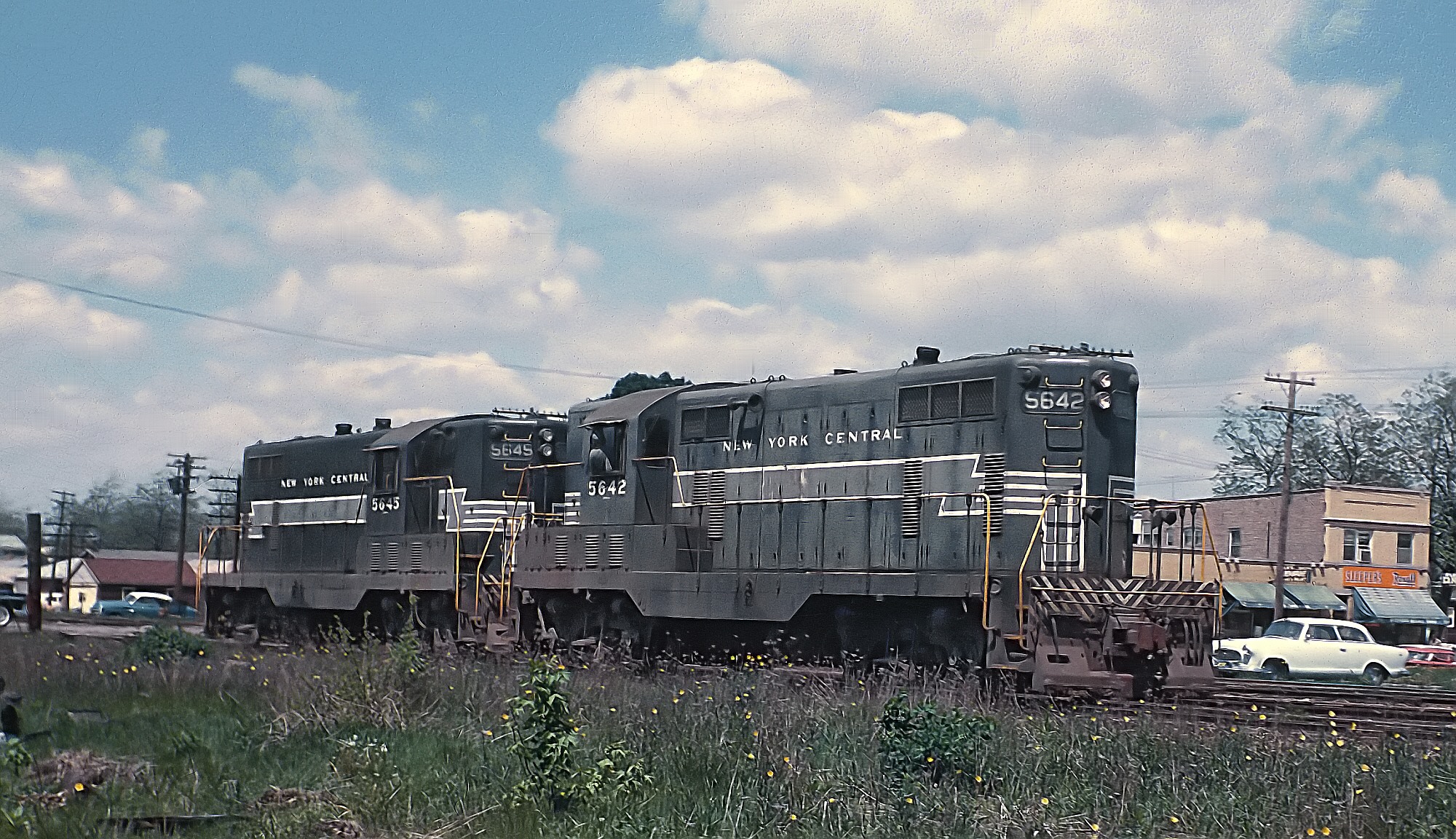
GP7s #5642 and #5645 at Bellwood, Illinois, June 1963. Rick Burn photo.
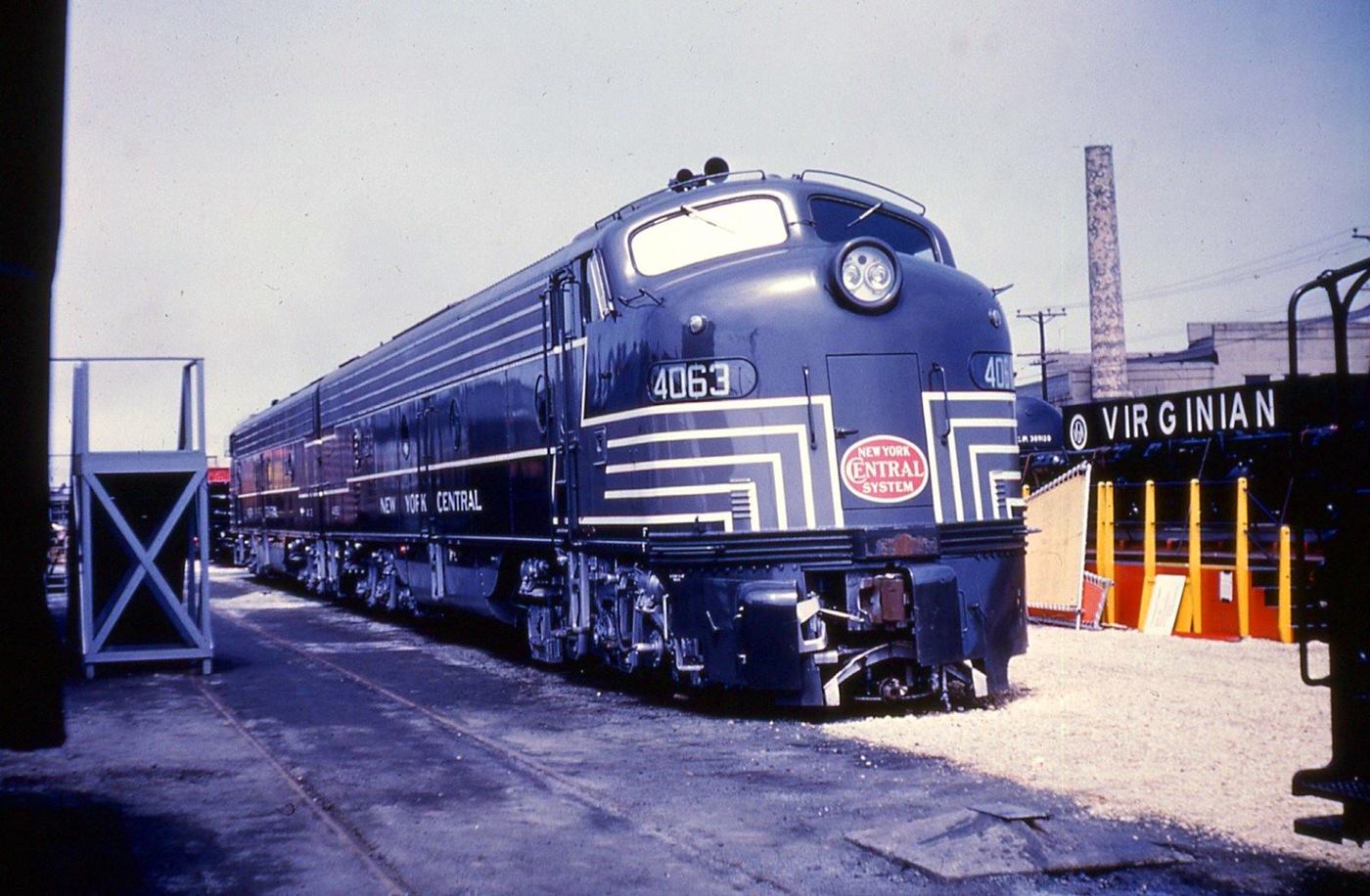
Recently delivered E8As on display at the Railway Supply Manufacturers’ Association show, Atlantic City, late June 1953.
No road dominated the New York region like the Central. At century’s end it added the New York & Northern (later New York & Putnam—“the Put”) and, more consequentially, the New York, West Shore & Buffalo. The Put (Brewster corridor) was more a defensive and commuter property than a trunk; it faded after the 1960s. The West Shore, heavily backed by the PRR, opened a competitive Hudson west-bank route from Weehawken/Jersey City toward Buffalo by 1884 and threatened Vanderbilt control of the New York gateway.
In classic Gilded Age fashion, the NYC&HR answered by advancing the South Pennsylvania Railroad as a rival to the PRR’s Philadelphia–Pittsburgh main. J.P. Morgan mediated a settlement: each side took the other’s threatening project. The Central acquired the West Shore in 1885 (reorganized as the West Shore Railroad); portions of the South Pennsylvania later fed the Pennsylvania Turnpike. (See West Shore Railroad and Weehawken Terminal.)
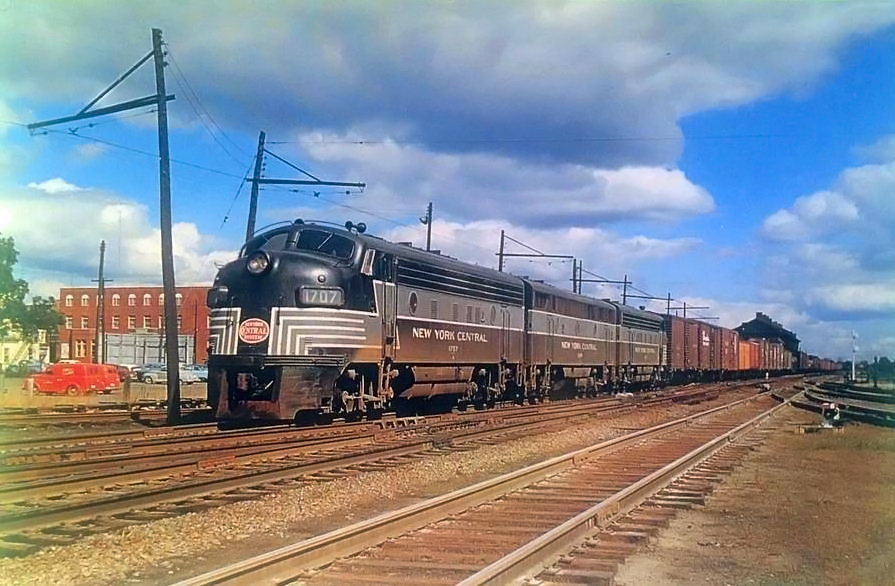
An A-B-A set led by F7A #1707 at St. Thomas, Ontario, on the Canada Southern, September 1957—waiting on the electrified London & Port Stanley. Much of this double-track CASO main has since been abandoned. David Sweetland photo.
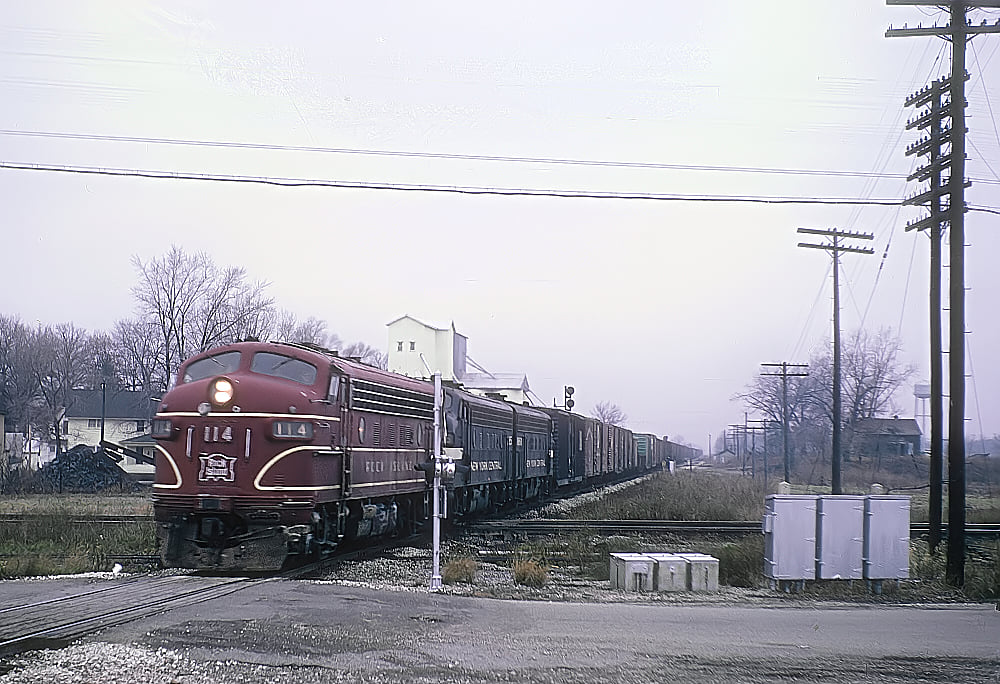
Rock Island F7A #114 leads an eastbound NYC freight on the Kankakee Belt at North Judson, Indiana, November 27, 1966. Rick Burn photo.
Twentieth-Century Operations
By 1900 the NYC&HR was largely in place. On December 22, 1914, properties except the Boston & Albany, Michigan Central, and Big Four were merged into the second New York Central Railroad—streamlining the corporate map without abandoning the great leased names overnight.
Though not quite as large as the Pennsylvania, the NYC was an elite American railroad: more than 10,000 miles, nine states plus Ontario and Montreal, four tracks on the Water Level Route where traffic demanded, double track on key secondary mains, third-rail around New York, and a dense passenger and commuter franchise. It survived World War I and federal control under the United States Railroad Administration (USRA), and it avoided bankruptcy in the Great Depression—though the 1930s were hard years.
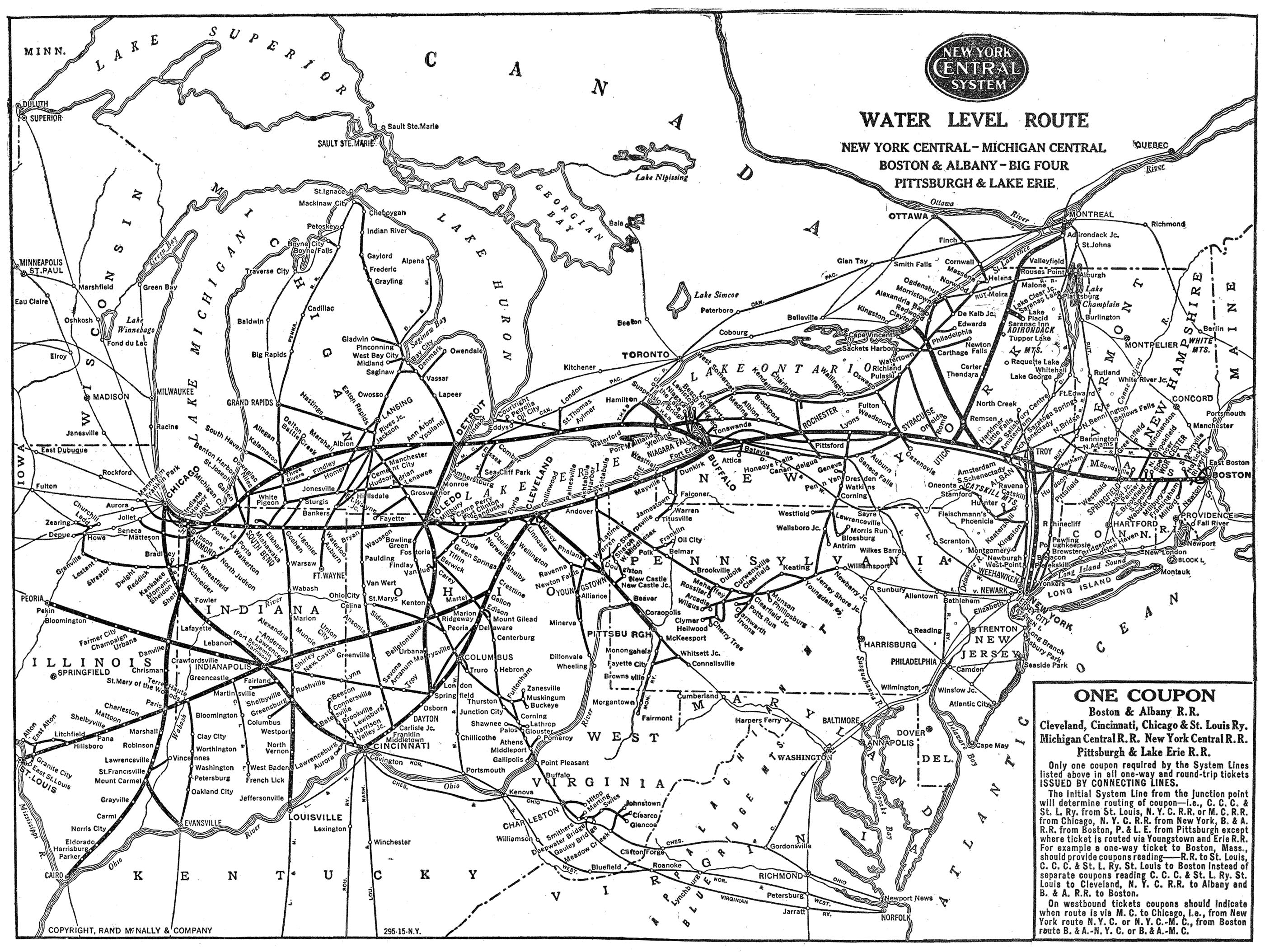
Official 1940 New York Central System map. Author’s collection.
Freight character matched the map: Great Lakes industry and auto parts, coal from Pennsylvania, Ohio, West Virginia, and southern Illinois, perishables under Merchants Despatch and related reefers, and enormous terminal volumes at New York, Chicago (including the Indiana Harbor Belt), and St. Louis. Steam power made the brand visible worldwide—Hudsons on the varnish, Mohawks in dual service, Niagaras as late high-speed masterpieces—before diesels from EMD, Alco, and others took over.
The Central rebounded in World War II and ordered heavily for the postwar passenger boom: roughly 420 new lightweight cars in 1945 on top of about 300 ordered a year earlier—some 720 cars, which Schafer and Solomon note as the largest such commitment by any American railroad. The boom proved a mirage. By the early 1950s traffic was sinking; the PRR posted its first annual loss in 1946 and kept sliding. The NYC was nearly broke when the board turned to a new kind of operating president.
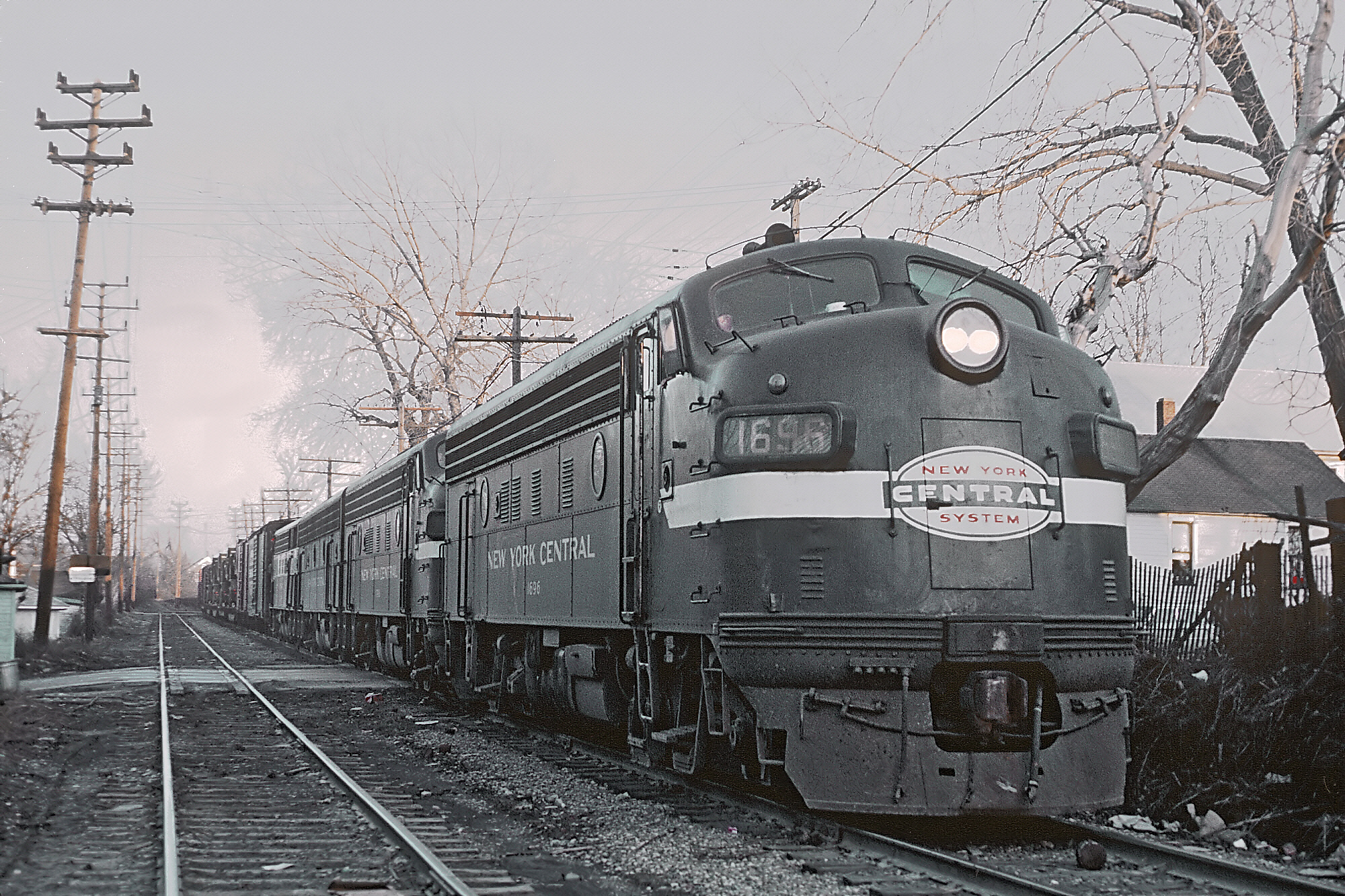
F7s led by #1696 on the old Peoria & Eastern at Bloomington, Illinois, April 1965. Roger Puta photo.
Passenger Trains & Grand Central
The Central fielded one of the great American passenger fleets. Its flagship was the New York–Chicago 20th Century Limited—grays, silvers, and whites; Art Deco interiors; 1938 streamlining; Henry Dreyfuss–styled J-3a Hudsons. Only the Santa Fe, among peers, matched the Central’s pride in its varnish. Secondary and regional name trains blanketed the map from New England to St. Louis and from the Hudson Valley to Michigan.
Grand Central Terminal, opened in 1913 (three years after Penn Station), replaced earlier Grand Central Station with a vast underground layout (famously on the order of 48 platform tracks in the classic plant), Beaux-Arts grandeur, and a functional machine for both long-distance and suburban traffic. It remains a National Historic Landmark and active Metro-North terminal—saved in part because the loss of the original Penn Station taught New York what not to demolish. (See Grand Central Terminal.)
Named trains and related pages:
- 20th Century Limited
- Commodore Vanderbilt
- Mercury
- Lake Shore Limited (NYC era) · Amtrak Lake Shore Limited (2026 guide)
- Empire State Express
- New England States
- James Whitcomb Riley
- Cleveland Limited
- Detroiter
- Ohio State Limited
- Southwestern Limited
- Wolverine
Other familiar NYC names included the Chicagoan, various Mercury corridor sets (Chicago, Cincinnati, Cleveland, Detroit), the Knickerbocker (New York–St. Louis), The Michigan, Motor City Special, and Twilight Limited.

E8As #4056, #4053, and #4055 in testbed “cigar band” liveries at Harmon, September 1961. Ed Nowak photo.
The Perlman Era: Modernization Without a Soft Landing
Alfred E. Perlman, elected president in the mid-1950s, drove an aggressive program to upgrade property, modernize operations, and cut costs. Under his guidance the Central:
- Completed dieselization of the road locomotive fleet
- Built and rebuilt classification yards for faster freight handling
- Pushed innovative marketing such as Flexi-Van / Super Van service—an early successful container-on-flat-car (COFC) application ahead of the industry curve (see Flexi-Van)
- Pruned marginal branches and attacked passenger losses where regulation allowed
- Fostered a culture Rush Loving, Jr. (The Men Who Loved Trains) contrasted with the PRR’s rigid hierarchy: more open debate, younger managers, operational experiment
Perlman improved the company’s relative health, but the structural headwinds of the Northeast—high terminal costs, passenger burdens, highway and air competition, and rate regulation—remained. Independence looked increasingly untenable as the merger wave rolled: N&W–Virginian (1959), Erie Lackawanna (1960), C&O interest in B&O, and more. NYC sought partners (a B&O combination was among the logical hopes) and lost key bids. Despite Perlman’s misgivings about merging with the longtime rival, the Pennsylvania became the path of last resort.

GP9s cross West Broad Street in Columbus, Ohio, September 1964; Toledo & Ohio Central depot at left (today restored). Roger Puta photo.
Penn Central
The ICC approved a union that gave the new Penn Central Transportation Company a near-monopoly on much of the Northeast’s rail map. Penn Central began February 1, 1968 (NYC’s separate identity ending with January 31). Chaos followed almost immediately. Computer and paperwork systems did not mesh; operating rules and cultures clashed; the PRR’s hierarchical style grated against Central people used to freer debate. Loving notes that few industry peers were as disliked as the old Pennsylvania—hardly a foundation for trust.
PC lost money at catastrophic rates (contemporary accounts spoke of more than a million dollars a day at the worst). Trains were misrouted; deferred maintenance produced derailments and widespread slow orders. On June 21, 1970, Penn Central entered bankruptcy—shocking Wall Street, which had still treated the PRR name as gold-plated. The collapse rippled through connecting roads. By the mid-1970s, without federal intervention, large parts of the Northeast rail plant faced shutdown. (Fuller treatment: Penn Central.)
Rosters: NYC diesel roster · NYC steam roster (post-1900) · S-Motors · Niagaras
Conrail and the Split
Congress created the Consolidated Rail Corporation (Conrail), which began operations April 1, 1976, folding skeletons of Penn Central and other bankrupts into a federally backed freight system. Years of pruning, rehabilitation, and marketing eventually returned Conrail to profitability. In 1999 Conrail was divided between CSX Transportation and Norfolk Southern: CSX took the bulk of the former New York Central map; NS took much of the former Pennsylvania. That split still shapes eastern railroading.
Legacy Today
The New York Central as a company is gone; the Water Level Route is not. Commuters still ride third-rail multiple units into Grand Central on the Hudson and Harlem lines under Metro-North. Amtrak’s Empire Service and Lake Shore Limited sell Hudson River scenery and the overnight path toward Chicago that the Century once owned in the public mind. CSX freights pound ex-NYC mains across New York, Ohio, and the Midwest; industrial branches and belt lines (including descendants of IHB and related terminal roads) still serve the factories the Central was built to feed.
Preserved steam and diesel—from Hudson and Mohawk projects to Alco and EMD survivors—keep the visual brand alive, as do museum collections and tourist operations on fragments of the old map (including Adirondack country once reached by NYC-controlled lines). The oval herald, the lightning stripe and cigar-band experiments, Dreyfuss streamlining, and Ed Nowak’s publicity photographs remain among the most recognizable images in American railroading.
For history’s sake, the Central and the Pennsylvania will always be spoken together. For geography’s sake, when you stand beside the Hudson at dusk and watch a stack train or a dual-mode engine lean into the curve, you are still watching Vanderbilt’s railroad go to work.
Related Reading
Further New York Central coverage on American-Rails.com, grouped by theme:
Core system & people
- Cornelius Vanderbilt — the Commodore and the making of the modern Central
- Railroad Tycoons of the Gilded Age
- Penn Central — merger, collapse, and the end of the NYC corporate identity
- Flexi-Van — Perlman-era COFC / Super Van service
Major predecessors & subsidiaries
- Lake Shore & Michigan Southern — Buffalo–Chicago core of the Water Level Route
- Michigan Central — Detroit, Chicago, and the Canada Southern corridor
- Big Four Route (CCC&StL) — Ohio, Indiana, Illinois, St. Louis
- Pittsburgh & Lake Erie — Steel City gateway
- West Shore Railroad — west bank of the Hudson and the South Penn settlement
- Weehawken Terminal — West Shore’s New York harbor face
Stations, landmarks & disasters on the map
- Grand Central Terminal
- The Angola Horror (1867) — LS&MS tragedy on the Water Level Route
- Ashtabula Bridge Disaster (1876) — LS&MS Pacific Express
Passenger trains
- 20th Century Limited
- Commodore Vanderbilt
- Lake Shore Limited (NYC era)
- Amtrak Lake Shore Limited (2026 guide)
- Mercury
- Empire State Express
- Wolverine
- Detroiter
- New England States
- James Whitcomb Riley
- Southwestern Limited
- Ohio State Limited
- Cleveland Limited
Locomotives & rosters
- New York Central diesel roster
- New York Central steam roster (post-1900)
- S-Motors
- 4-8-4 Niagaras
- Hudson #5344 Commodore Vanderbilt
- Mohawk #3001 restoration
Sources & Further Reading (print)
- Schafer, Mike, and Brian Solomon. New York Central Railroad.
- Loving, Rush, Jr. The Men Who Loved Trains.
- Mills, Donald, Jr. The Kanawha & Michigan Railroad: Bridge Line to the Lakes.
- Schwieterman, Joseph. When the Railroad Leaves Town: Eastern United States.
- Doughty, Geoffrey. New York Central’s Great Steel Fleet, 1948–1967 (passenger-era context).
Enhanced and expanded August 2026 from the 2016 fallen-flag history of the New York Central, retaining the original research arc, photograph program, and subsidiary depth while adding Water Level Route and NYC–PRR comparison sections, structural navigation, corrections, a living-legacy close, and a full Related Reading hub.
Recent Articles


-
Grand Canyon Railway Pumpkin Patch Train (2026)
Sep 29, 26 02:42 PM
 Grand Canyon Railway Pumpkin Patch Train—select October 2026 dates from Williams, $39 with a pumpkin included. Haunted train cars are optional. Days are on the ticket calendar. Confirm on thetrain.com…
 -
Cass Scenic Railroad Halloween Trains (2026)
Sep 29, 26 02:37 PM
 Cass Scenic Halloween Trains—October 30 and 31, 2026, steam, 5:00 p.m. from Cass Depot. About two hours to Whittaker. Adult $75. Candy for every child. Confirm on mountainrailwv.com.
 -
Halloween Train Rides (2026): Pumpkin Patch, Haunted & Spooky Trips
Sep 29, 26 11:26 AM
 2026 Halloween train rides in nine checked states. Conway Scenic Halloween Express October 24–25. Strasburg’s three fall tickets. Great Smoky Mountains Railroad’s October trains are the gorge and rive…
 -
Maine Halloween Train Rides (2026)
Sep 29, 26 11:08 AM
 2026 Maine Halloween trains. Seashore Pumpkin Patch Trolley through October 18, adult $17. Happy Trolleyween October 23–25 at $15. WW&F Pumpkin Pickin’ October 3, 12, 17, and 24. Downeast’s booking it…
 -
Kentucky Halloween Train Rides (2026)
Sep 29, 26 10:58 AM
 2026 Kentucky Halloween trains. Kentucky Railway Museum Trick and Track Express, October 24 and 31, from $17. Bluegrass Scenic pumpkin trains in Versailles. Confirm on the ticket shop.
 -
Connecticut Halloween Train Rides (2026)
Sep 29, 26 10:26 AM
 2026 Connecticut Halloween trains. East Windsor Pumpkin Patch Fridays through Sundays, October 2–31. Naugatuck coach $20. Shore Line Pumpkin Patch on nine October days. Confirm on each site.
 -
Pennsylvania Halloween Train Rides (2026)
Sep 29, 26 09:45 AM
 2026 Pennsylvania Halloween trains—Everett October 3, 4, 10, and 17, Strasburg’s three fall shows, Oil Creek on October 24, plus Kutztown, Kempton, Honesdale, Middletown, and West Chester.
 -
New York Halloween Train Rides (2026)
Sep 29, 26 12:08 AM
 2026 New York Halloween trains—Catskill Pumpkin Express October 17–18 and 24–25, Adirondack pumpkin and family trains, Arcade & Attica haunt, Cooperstown patch and trick-or-treat, Tupper Lake triv…
 -
North Carolina Halloween Train Rides (2026)
Sep 28, 26 11:56 PM
 2026 North Carolina Halloween trains—New Hope Valley Track or Treat on October 10, 17, 23, and 24, and Tweetsie Ghost Train Friday and Saturday nights through October 31. GSMR’s October menu is the go…
 -
Tweetsie Railroad Ghost Train Halloween Festival (2026)
Sep 28, 26 11:44 PM
 Tweetsie Ghost Train—Friday and Saturday nights September 25–October 31, 2026, in Blowing Rock. Adult $65, child $45. One reserved steam ride plus the park. Ages 8 and up for the haunt.
 -
Milwaukee Road Class A 4-4-2: Specs, Roster, History
Sep 28, 26 11:20 PM
 Milwaukee Road Class A Atlantics 1–4, Alco 1935–1937, for the Hiawatha. Order S-1740, 84-inch drivers, 19x28, 300 psi, 30,685 lb. Full builder specs, roster, and the May 15, 1935 run at 112.5 mph. All…
 -
Strasburg Rail Road Halloween Trains (2026)
Sep 28, 26 11:00 PM
 Strasburg’s 2026 Halloween tickets—Pumpkins in Paradise on October 3, The Haunting of Pumpkin Junction, and The Brakeman’s Curse through October 25. Three fares. Legacy of Sleepy Hollow is an earlier…
 -
GSMR Peanuts Pumpkin Train (2026): Not on This Year’s Ticket Menu
Sep 28, 26 10:50 PM
Great Smoky Mountains Railroad’s September 28, 2026 ticket menu lists Nantahala and Tuckasegee excursions. A Peanuts Great Pumpkin train is not on that menu. Polar Express is on the November calendar. -
New Jersey Halloween Train Rides (2026)
Sep 28, 26 06:45 PM
2026 New Jersey Halloween trains—Black River & Western to Everitt Farms through October 25, Delaware River Great Pumpkin through November 1, Whippany October 4, 10, and 11, Pine Creek night trains. -
New Hampshire Halloween Train Rides (2026)
Sep 28, 26 05:17 PM
 2026 New Hampshire Halloween train—Conway Scenic Halloween Express, October 24 and 25, about 1 hour from North Conway. Coach adult $30. Confirm on conwayscenic.com.
 -
Conway Scenic Pumpkin Patch Express (2026): Dates, Tickets & Tips
Sep 28, 26 05:09 PM
 Conway Scenic Halloween Express—October 24 and 25, 2026, about 1 hour from North Conway. Coach adult $30. A pumpkin after the ride while supplies last. Confirm on conwayscenic.com.
 -
Black River & Western Pumpkin Trains (2026): Dates, Tickets & Tips
Sep 28, 26 02:20 PM
 Suggested meta description: Black River & Western Pumpkin Train—Flemington to Everitt Farms, weekends September 26–October 25, 2026. Pumpkin patch, maze, and wagon rides. Confirm on blackriverrail…
 -
Scenic Dinner Train Rides (2026): A Complete Guide
Sep 28, 26 01:30 PM
 2026 scenic dinner trains by state—a seated meal on the train. Branson through October 30, Cincinnati Saturdays, Potomac Eagle, and the full state list. Confirm on the railroad.
 -
West Virginia Dinner Train Rides (2026): A Complete Guide
Sep 28, 26 11:58 AM
 2026 Potomac Eagle dining from Romney—about 3 hours in the Trough. Premium three courses $124. Superior four courses $159, ages 17 and older. Confirm on potomaceagle.com.
 -
Washington Dinner Train Rides (2026): A Complete Guide
Sep 28, 26 11:51 AM
 2026 Chehalis-Centralia dinner trains have run. The July 18 Roaring 20s dinner was $89. The planning calendar lists no later dinner. Confirm on steamtrainride.com.
 -
Texas Dinner Train Rides (2026): A Complete Guide
Sep 28, 26 11:27 AM
 2026 Texas has no plated dinner aboard the train. Grapevine sells snacks. The Texas State Railroad Dogwood lunch was served at the Rusk depot. Confirm on the railroad.
 -
Ohio Dinner Train Rides (2026): A Complete Guide
Sep 28, 26 10:15 AM
2026 Ohio dinner trains—Cincinnati Saturdays, $140, about 3 hours, ages 12 and up. Hocking Valley Elegant Dinner Train October 17 and November 7, from $95. -
Missouri Dinner Train Rides (2026): A Complete Guide
Sep 28, 26 10:09 AM
 2026 Branson Scenic Railway dinner train—three courses, about 2 hours, Fridays and Saturdays through October 30. Dome $123.50 plus tax. Confirm on bransontrain.com.
 -
Minnesota Dinner Train Rides (2026): A Complete Guide
Sep 28, 26 09:40 AM
 2026 North Shore Scenic Northwoods Dinner Train in Duluth—four courses in the SkyView dome, 2½ hours, $90, through September 26. Confirm on duluthtrains.com.
 -
Maine Dinner Train Rides (2026): A Complete Guide
Sep 28, 26 09:29 AM
 2026 Maine has no dining-car dinner. WW&F Pig Roast at SeaLyon Farm was June 13 and has run, $54.95. Sunset Express was a drink and ended September 5.
 -
Greenbrier, Cheat & Elk Railroad: Western Maryland's Logging Line
Sep 26, 26 11:59 PM
 Greenbrier, Cheat and Elk—the logging railroad the Western Maryland bought in 1927. Cass to Spruce, Summit Cut at 4,066.6 feet, Elk River Branch, Laurel Bank.
 -
Elkins (Western Maryland): Yard, History, Operations
Sep 26, 26 11:56 PM
 Western Maryland at Elkins—the Elkins Division yard, roundhouse, and wash rack. Belington, Durbin, Black Fork, and the Elk River branches met here.
 -
B&O's "Cincinnatian" (Train): Route, Consist, Timetable
Sep 26, 26 11:51 PM
 B&O Cincinnatian—Mount Clare five-car streamliner, January 19, 1947, trains 75 and 76. P-7d Pacifics 5301–5304. Detroit–Cincinnati from June 25, 1950, trains 53 and 54. Last run April 30, 1971.
 -
The Semaphore: Railroading's Classic Signal
Sep 26, 26 11:51 AM
 Railroad semaphore signals: blade and spectacle, lower quadrant and upper quadrant, US&S Style B and GRS Model 2A, Robinson’s track circuit, and the last blades on the Raton Subdivision.
 -
Black Fork Grade (Western Maryland): History and Operations
Sep 26, 26 11:47 AM
 Black Fork Grade—the Western Maryland climb through Blackwater Canyon. Thomas to Hendricks, past 3 percent, an H-9 and ten loads, helpers off at Fairfax.
 -
Western Maryland Steam Locomotives: History & Roster
Sep 26, 26 11:39 AM
 Western Maryland steam—H-9 Consolidations, I-2 Decapods, Lima 2-8-8-2s, Baldwin Challengers, and twelve Baldwin Potomac 4-8-4s. Post-1900 roster.
 -
Western Maryland Diesel Roster: All-Time
Sep 26, 26 11:32 AM
 Western Maryland diesels—S1 102 in 1941, fourteen F7 boosters, BL2s, hammerhead RS3s, Circus SD40s, and Chessie GP40-2s. Serials and order numbers.
 -
The Dutch Line (Western Maryland): History, Map, Operations
Sep 25, 26 09:38 PM
 Western Maryland Dutch Line—the Hanover Subdivision. Emory Grove to Highfield via Hanover and Gettysburg, York branch 1893, stone trains, and the route CSX still runs.
 -
The Durbin Branch (Western Maryland): History, Map, Operations
Sep 25, 26 09:13 PM
 Western Maryland Durbin Branch—the Coal & Iron Railway, 46.9 miles Elkins to Durbin, opened July 27, 1903. Mixed train until April 10, 1959. H-7B Consolidations.
 -
Western Maryland Railway: Map, Rosters, Logo, History
Sep 25, 26 10:24 AM
 Western Maryland Railway—the Fast Freight Line. Baltimore, Carroll & Frederick, May 27, 1852. Connellsville Extension 1912. Chessie, then into the B&O May 1, 1983.
 -
Illinois Dinner Train Rides (2026): A Complete Guide
Sep 25, 26 09:52 AM
2026 Monticello Railway Museum Murder Mystery Dinner Train—June 13, July 11, August 1, and September 5 have run. Three courses, about 2 hours, $112. Confirm on mrym.org. -
Georgia Dinner Train Rides (2026): A Complete Guide
Sep 25, 26 12:29 AM
 2026 Azalea Sprinter dinner train from Nashville and Willacoochee, Georgia—2½ hours. Club Car adult $147, Executive adult $177. Confirm on azaleasprinter.com.
 -
Baldwin "Centipede" Locomotives: Specs, Roster, Photos
Sep 25, 26 12:02 AM
 Baldwin DR-12-8-1500/2 Centipede—2-D+D-2, two 608SC engines, 3,000 hp. SAL 4500 from the 1943 test bed. 54 on the serial list, 52 sold. PRR BP60 then BH50. None preserved.
 -
Florida Dinner Train Rides (2026): A Complete Guide
Sep 24, 26 11:56 PM
 2026 Seminole Gulf Murder Mystery Dinner Train in Fort Myers—five courses cooked onboard, 3½ hours, $129 or $135 Saturday, plus tax and gratuity. Confirm on semgulf.com.
 -
West Virginia Northern Railroad: Map, Photos, History
Sep 24, 26 11:27 PM
 West Virginia Northern—Kingwood to Tunnelton, 11 miles of Preston County coal. Narrow gauge 1888, standard gauge 1895. Last freight February 19, 1991. Consolidations 8 and 9 survive.
 -
Rutland Railroad: Map, Rosters, History, Logo
Sep 24, 26 01:18 PM
 Rutland Railroad—Follett’s Champlain & Connecticut River, November 1, 1843. Bellows Falls–Burlington December 18, 1849. Green Mountain Gateway. Last train September 25, 1961. Vermont Railway Janua…
 -
Arkansas Dinner Train Rides (2026): A Complete Guide
Sep 24, 26 01:12 PM
 2026 Eureka Springs & North Arkansas Dinner Train—Eurekan dining car, about 2 hours, $53.62 tax included, opens May 9, Tuesday, Wednesday, Friday, and Saturday. Confirm on esnarailway.com.
 -
Arizona Dinner Train Rides (2026): A Complete Guide
Sep 24, 26 01:01 PM
2026 Arizona has no plated dinner train. Grand Canyon Railway sells snacks in the cars and meals in Williams or at the rim. Verde Canyon includes a charcuterie tray. -
Rail News, The Latest
Sep 24, 26 12:36 PM
This page provides a portal to the latest in rail news, from preservation and restortation subjects to other notable topics. -
Cotton Belt 819 Moved Outside at Pine Bluff for Evaluation
Sep 24, 26 12:35 PM
Cotton Belt 819 left the Pine Bluff shop on September 22, 2026, first time outside in about 30 years. RDG Steam Services is evaluating the engine. No donation link posted. -
Reading Steam Locomotives: History, Roster & Photos
Sep 24, 26 12:14 PM
 Reading steam—Wootten fireboxes, Camelback Consolidations, Mallets, K-1 Santa Fes, G-3 Pacifics, T-1 4-8-4s. Post-1900 roster after Drury. Rambles ended October 17, 1964.
 -
Reading Diesel Roster: All-Time
Sep 24, 26 12:10 PM
 Reading diesel roster—AGEIR boxcabs, FTs, FA-1s, RS-3s, Train Masters, GP30s through GP39-2s. Serials and order numbers. Conrail April 1, 1976.
 -
Reading Railroad: Map, Logo, History, Rosters
Sep 24, 26 12:08 PM
 Reading Company—Philadelphia & Reading, 1833. Anthracite, Port Richmond, Reading Terminal. Operating company January 1, 1924. Conrail April 1, 1976.
 -
Nevada Dinner Train Rides (2026): A Complete Guide
Sep 24, 26 12:02 PM
 2026 Nevada Northern Taste of Italy—adults-only gala from East Ely. The September 19 date has run. Confirm any later night on nnry.com.
 -
North Carolina Dinner Train Rides (2026): A Complete Guide
Sep 24, 26 11:24 AM
 2026 North Carolina dinner trains—NCTM Wine & Dine in Spencer sold out February 13–15. GSMR First Class is the plated meal on the Nantahala Gorge excursion. Confirm on the railroad.