New Haven’s Roger Williams Streamliner: History, Specs & Legacy
Published: August 10, 2026
By: Adam Burns
In the mid-1950s the New York, New Haven & Hartford Railroad was fighting a losing battle against automobiles, air travel, and rising operating costs—yet it still controlled one of the densest and most strategically important passenger networks in the East. Under president Patrick B. McGinnis, the railroad gambled on a trio of experimental lightweight high-speed trainsets intended to cut costs, modernize the brand, and reclaim Boston–New York corridor travelers. Two of those sets were locomotive-hauled experiments: the Dan’l Webster (Baldwin RP-210 power) and the John Quincy Adams (Fairbanks-Morse P-12-42 power). The third was something entirely different.
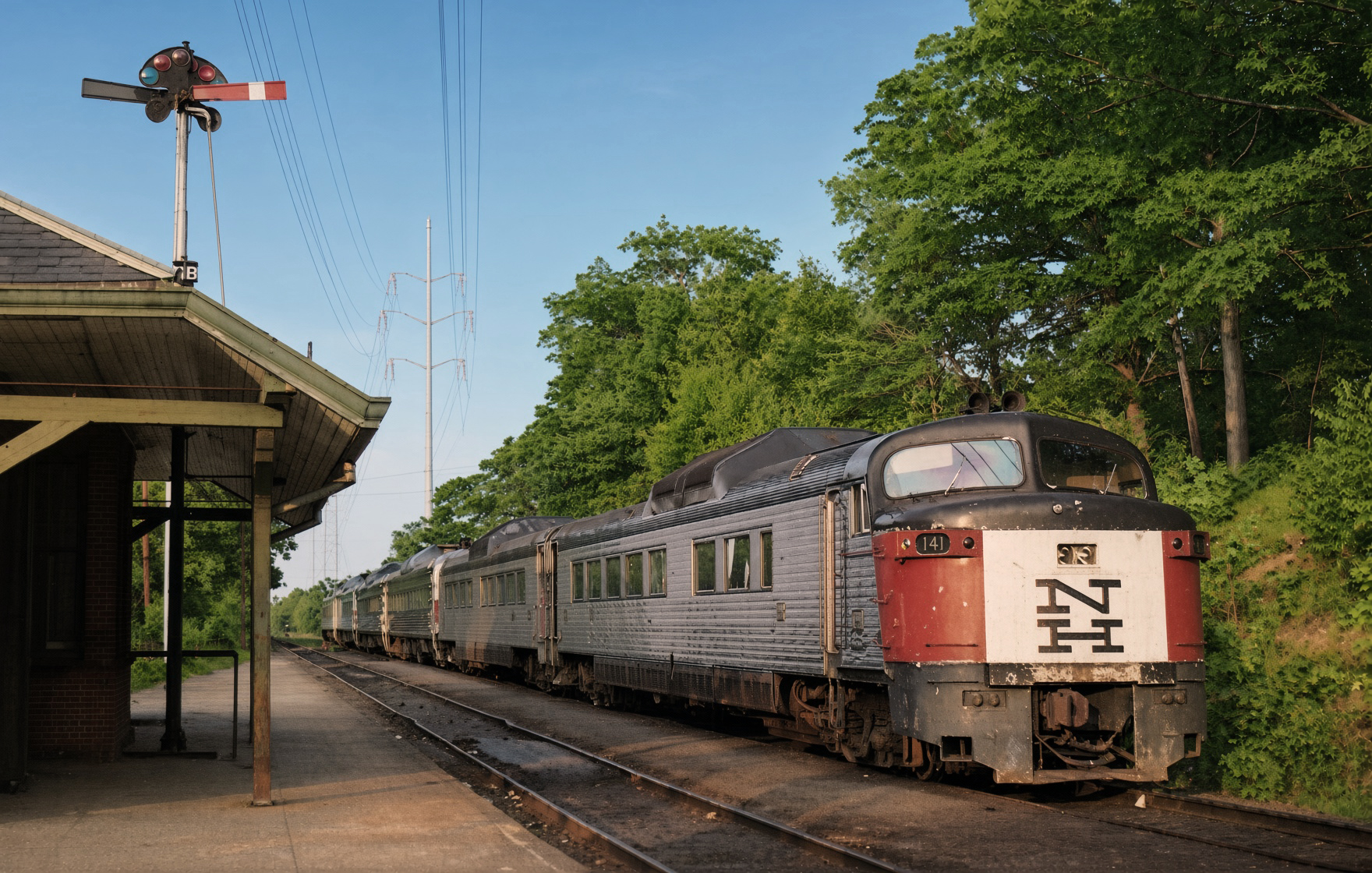
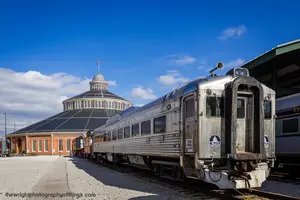
New Haven Railroad’s experimental Roger Williams was Budd’s answer to the lightweight-train craze of the mid-1950s: a complete six-car diesel multiple unit with locomotive-style streamlined cabs, extra horsepower, dual-mode third-rail capability for Grand Central Terminal, and interiors shaped by modernist designer Marcel Breuer. The trainset is seen here late in its career at Needham Junction, Massachusetts in local service on June 2, 1970. Norton Clark photo.
The Roger Williams, built by the Budd Company in 1956 and delivered for 1956–57 service, was a complete six-car diesel multiple unit (DMU) derived from Budd’s hugely successful Rail Diesel Car (RDC) platform. Instead of a locomotive and coaches, every car carried its own diesel power. The two end cars wore locomotive-style streamlined noses; the four intermediate cars ran without operating cabs. For the electrified approach into Grand Central Terminal, the train carried third-rail shoes and small electric traction motors so the diesels could be shut down under the Park Avenue tunnels. It was one of the most technically ambitious—and one of the most visually distinctive—lightweight trains ever built for an American railroad.
This guide covers the Roger Williams’ origins, design, complete trainset specifications, service life under New Haven, Penn Central, and Amtrak, and the three cars that survive in preservation today.
Why the New Haven Ordered the Roger Williams
By the early 1950s the New Haven had already become one of Budd’s best RDC customers. The railroad’s fleet of stainless-steel “Shoreliners” (standard RDCs) handled a large share of secondary and branch passenger runs at lower crew and fuel cost than conventional locomotive-hauled consists. McGinnis wanted more than branch-line thrift, however. He wanted a flagship corridor product that looked modern, ran fast, and could slip into Grand Central without steam-generator or diesel-exhaust complications under the third-rail zone.
Budd’s answer was not a conventional streamliner. It was a purpose-built RDC trainset: semi-permanently conceived as a six-car unit with cab cars at both ends (push-pull style operation), upgraded power for higher speed, a slightly lower carbody for improved high-speed stability, fully corrugated stainless fluting continuing around the nose of the cab cars, and dual-mode capability rare among American DMUs of the era. Exterior and interior styling sat within the broader McGinnis visual identity program associated with Knoll Associates; architect Marcel Breuer is credited with the train’s interior and exterior styling treatment—the same modernist design orbit that also touched the New Haven’s other experimental lightweights.
The name honored Roger Williams, the seventeenth-century founder of Providence and Rhode Island—fitting for a railroad whose Shore Line and Boston–New York identity was inseparable from New England history.
Trainset Formation & Car Types
As delivered, the Roger Williams comprised one six-car trainset:
| Position | Role | New Haven numbers (as rostered) | Notes |
|---|---|---|---|
| End A | Streamlined cab / control car | 140 | Locomotive-style nose; full operating cab; dual diesels; third-rail gear |
| Intermediate | Coach (no cab) | 160 | No operating controls; powered intermediate |
| Intermediate | Coach (no cab) | 161 | No operating controls; powered intermediate |
| Intermediate | Coach (no cab) | 162 | No operating controls; powered intermediate |
| Intermediate | Coach (no cab) | 163 | No operating controls; powered intermediate |
| End B | Streamlined cab / control car | 141 | Locomotive-style nose; full operating cab; dual diesels; third-rail gear |
Cab cars 140 and 141 are the best-documented survivors in the historical and preservation record. Intermediate cars 160–163 completed the original six-car formation; after the set was broken up, all six units mixed into the New Haven’s general RDC pool and later successor fleets. Confirm renumbering under Penn Central / Amtrak against contemporary rosters when citing a specific photograph date.
The cab cars were the visual stars. Their single-ended, locomotive-style noses closely resembled the blunt, streamlined front ends of the Fairbanks-Morse P-12-42 diesels ordered for the companion John Quincy Adams set—giving the Roger Williams a true “streamliner” face rather than the familiar rounded RDC cab. The intermediate cars omitted cabs and operating controls; they were intended to run between the two cab units as a coherent train, though in later years (after the set was split) the cab cars often led ordinary RDC consists.
Complete Trainset Specifications
The following tables consolidate published mechanical and dimensional data for the Roger Williams as a specialized RDC derivative. Where the set improved on standard Budd RDC practice, those differences are called out explicitly.
General trainset data
| Item | Specification |
|---|---|
| Railroad | New York, New Haven & Hartford Railroad (NH) |
| Train name | Roger Williams |
| Builder | Budd Company (Philadelphia, Pa.) |
| Year built | 1956 (delivered for 1956–57 service) |
| Quantity | 1 complete trainset (6 cars) |
| Formation | 2 streamlined cab cars + 4 intermediate coaches |
| Carbody construction | Shot-welded stainless steel (Budd fluted sides) |
| Track gauge | 4 ft 8½ in (1,435 mm) standard gauge |
| Brakes | Air (railway air brake system) |
| Intended service | High-speed corridor / lightweight passenger (Boston–New York sphere; later general RDC duties) |
| Design / styling | Marcel Breuer (interiors/exterior treatment) within McGinnis-era Knoll Associates visual identity |
Dimensions & weight (per car basis, RDC-derived)
| Item | Specification | Notes |
|---|---|---|
| Length over coupler faces | 85 ft (25.91 m) class | Standard Budd RDC coach length platform |
| Width | Approx. 10 ft 0 in class | Comparable to standard RDC |
| Height | Approximately 7 inches lower than standard RDC | Lower center of gravity for high-speed running (standard RDC height ~14 ft 7 in) |
| Empty weight (order of magnitude) | ~109,000–118,000 lb per car class | Comparable to contemporary RDC-1/2/3 empty weights; exact as-built weights varied by cab vs. intermediate equipment |
| Trainset length (approx.) | ~510 ft over six 85-ft cars | Excludes coupling slack; useful for platform planning comparisons |
Diesel propulsion
| Item | Specification | Notes |
|---|---|---|
| Prime mover | Detroit Diesel / GM Series 110 | Same family as standard RDC powerplants |
| Engines per car | 2 | Each car self-propelled |
| Horsepower per engine | ~300 hp (vs. ~275 hp on early standard RDCs) | ~50 hp more per car than early RDC practice |
| Horsepower per car | 550 hp (410 kW) class | Published trainset figure for dual 110s |
| Trainset diesel output (all cars) | Up to ~3,300 hp | 6 cars × 550 hp when all engines online |
| Transmission | Hydraulic torque converter | Budd RDC drive lineage (torque-converter hydraulic, not electric diesel-electric) |
| Wheel arrangement (typical RDC) | 1A-A1 class per car | Each engine driving an axle through the hydraulic drive |
| Original gearing / design speed | Geared for up to ~110 mph | High-speed lightweight-train target |
| Later gearing | Re-geared for roughly ~84–85 mph class | More typical of fleet RDC practice after experimental high-speed period |
Electric (dual-mode) equipment for Grand Central Terminal
| Item | Specification | Notes |
|---|---|---|
| Electric system | 600 V DC third rail | New York Central / Grand Central Terminal third-rail territory |
| Current collection | Contact shoes (third-rail shoes) | Fitted on the cars for under-running / GCT approach |
| Traction for electric mode | Small electric traction motors | Allowed diesel engines to be shut down under the Park Avenue tunnels / GCT |
| Purpose | Terminal / tunnel compliance and dual-mode flexibility | Not a full high-speed third-rail EMU; electric gear supported GCT access |
Dual-mode capability was the Roger Williams’ most New Haven–specific engineering feature. Standard RDCs could not enter Grand Central under their own diesel power in the restricted third-rail zone. By adding shoes and auxiliary electric traction, Budd and the New Haven made a self-propelled stainless train theoretically capable of diesel running on the Shore Line and electrified terminal operation at the New York end—an elegant solution on paper that saw only a limited period of true high-speed “set” service before the cars were folded into everyday RDC work.
Passenger accommodations & styling
| Item | Specification / description |
|---|---|
| Body finish | Stainless-steel fluting; cab-car noses with continuous side fluting into the streamlined front end |
| Cab-car face | Locomotive-style single-ended streamlined nose (visually related to FM P-12-42 practice) |
| Interior design | Marcel Breuer-associated modernist treatment; McGinnis/Knoll-era New Haven identity |
| Seating concept | Coach-oriented lightweight train; Breuer interiors aimed at a fresher commuter/corridor experience than plain branch-line RDC seating |
| Comparison seating (standard RDC-1) | Standard all-coach RDC-1: 90 seats (reference baseline; Roger Williams interiors differed in arrangement/finish) |
Exact as-delivered seat counts for every Roger Williams intermediate and cab car varied with layout (coach density, bulkheads, and later rebuilds). Contemporary accounts emphasize Breuer’s attempt to give the train a more sophisticated interior than a plain Shoreliner RDC—consistent with McGinnis’s branding of the experimental lightweights as modern image products, not merely cheap branch motors.
How It Differed from a Standard Budd RDC
It is easy to call the Roger Williams “just six RDCs with fancy noses.” Mechanically it was more deliberate than that:
- Trainset thinking: Cab cars only at the ends; intermediates without controls, designed as a complete multiple-unit set rather than six independent branch cars.
- Extra horsepower: Later-production / uprated Detroit Diesel 110s (~300 hp each) for ~550 hp per car and a higher design speed target.
- High-speed gearing: Originally geared toward ~110 mph lightweight-train performance; later re-geared downward toward normal RDC speeds when the experimental role faded.
- Lower carbody: About seven inches lower than a stock RDC for improved stability at speed.
- Streamlined cab faces: True locomotive-style ends, not the classic RDC cab silhouette.
- Dual-mode third rail: Shoes and small traction motors for Grand Central Terminal—rare among American DMUs.
- Designer branding: Breuer / Knoll-era styling package tied to the McGinnis New Haven image campaign, alongside the Dan’l Webster and John Quincy Adams.
In short, Budd took its most successful postwar passenger product and stretched it into a lightweight streamliner experiment tailored to New Haven geography: diesel on the Shore Line, electric for the last miles into Manhattan.
Service Life: New Haven, Penn Central, Amtrak
The Roger Williams entered service in the McGinnis experimental period, when the New Haven was trying to prove that stainless lightweight trains could still win corridor riders. Like many mid-1950s lightweight experiments nationwide, the pure “set” concept did not last long as a fixed six-car high-speed product. Mechanical complexity, the railroad’s deepening financial crisis, and the practical need to keep every available RDC turning wheels all worked against keeping a special trainset intact.
After a relatively short spell as a dedicated high-speed train, the six cars were broken up and assigned with the New Haven’s regular RDC fleet. The cab cars remained highly recognizable—photographs from the 1960s often show 140 or 141 leading mixed Shoreliner consists around the Boston–Providence–New Haven territory. The distinctive noses never stopped advertising that these were not ordinary Budds.
When the New Haven was folded into Penn Central (1969), the cars continued in eastern passenger service. Under Amtrak after 1971, former Roger Williams equipment remained useful. Amtrak acquired a substantial number of ex-New Haven RDCs for Connecticut and regional work; published tallies note that Amtrak’s inherited RDC fleet included cars from the Roger Williams set. In the 1970s, ex-Roger Williams cars appeared on services such as the New Haven–Boston Bay State, still stainless and still self-propelled long after the McGinnis advertising copy had faded.
By the early-to-mid 1980s the last of the cars left regular intercity service as Amtrak and the Northeast commuter authorities completed the transition to locomotive-hauled Amfleet / modern MU fleets. The experimental lightweight era was over; the survivors entered the museum and private-ownership world.
Comparison with the New Haven’s Other Lightweight Experiments
McGinnis ordered three experimental products at once. Placing the Roger Williams beside its siblings clarifies why Budd’s DMU was the most enduring of the trio:
| Train | Power concept | Fate in brief |
|---|---|---|
| Dan’l Webster | Baldwin RP-210 lightweight locomotive + articulated train | Problematic power; short experimental life |
| John Quincy Adams | Fairbanks-Morse P-12-42 + lightweight train | Limited success; P-12-42s themselves became rarities |
| Roger Williams | Budd RDC-based six-car DMU, dual-mode | Set concept faded, but cars worked for decades in RDC service |
The locomotive-hauled lightweights were orphans: specialized power, specialized cars, and little fleet commonality. The Roger Williams, for all its custom noses and third-rail gear, still spoke RDC. When the railroad needed to cannibalize the experiment, the cars could still earn their keep beside ordinary Shoreliners. That commonality is why pieces of the Roger Williams outlived the other two experiments by decades.
Preservation & Operation Today
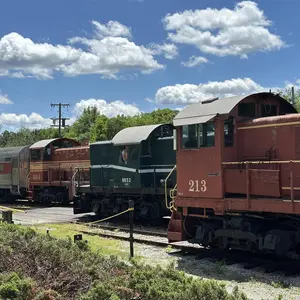
Three cars from the original trainset survive in the care of the non-profit Budd RDC Foundation: both streamlined cab cars (140 and 141) and one intermediate car. For years they were stored and displayed in New Hampshire (Hobo Railroad / Lincoln area). In 2023 the foundation leased the three Roger Williams cars—plus additional RDCs—to the Berkshire Scenic Railway Museum in Massachusetts after the museum demonstrated strong mechanical and cosmetic work on other Budd cars.
On April 27, 2024, cab car 140 moved under its own power at Berkshire Scenic for the first time in roughly thirty years—an important milestone for both the museum and the broader RDC preservation community. Additional mechanical work continues; the long-term goal is meaningful public operation of this rare dual-mode streamliner hardware, not merely static display.
Seeing 140 or 141 in person is the best way to understand the train. Photographs flatten the cab cars into “RDCs with funny noses.” On the ground, the locomotive-style front ends, continuous fluting, and stainless mass read as a true mid-century streamliner experiment that happened to be self-propelled from end to end.
Legacy
The Roger Williams never became the template for a new generation of American high-speed DMUs. Federal passenger policy, the collapse of private intercity service, and the rise of Amtrak’s locomotive-and-Amfleet model pointed elsewhere. Budd’s later SPV-2000 attempt to reinvent the self-propelled car was a commercial disappointment. Yet the Roger Williams remains uniquely important:
- It is the most complete American expression of the RDC as a streamliner trainset, not a branch-line railcar.
- It is one of the few dual-mode (diesel + 600 V third-rail) DMU experiments built for a U.S. railroad.
- It ties the New Haven’s McGinnis design era, Marcel Breuer, and the 1950s lightweight-train fad into a single stainless package.
- Its surviving cab cars are among the most photogenic and historically loaded pieces of postwar New England passenger equipment still capable of moving under their own power.
For students of the New Haven, the Roger Williams is not a footnote to the Shoreliner fleet. It is the moment when Budd’s practical RDC and McGinnis’s modernism briefly shared the same train—and left behind hardware that, against long odds, is still with us.
Related Reading on American-Rails.com
- Streamliners: Complete Guide
- Budd Rail Diesel Car (RDC)
- New York, New Haven & Hartford Railroad
- Passenger Train Guide
- Fallen Flags
Specifications compiled from published Budd RDC data, New Haven lightweight-train histories, and contemporary roster/preservation reporting. As-built seat diagrams, exact empty weights by car, and third-rail motor ratings varied by source and rebuild era—use operator and builder primary documents for engineering-critical work. Always verify preservation operating status with the Berkshire Scenic Railway Museum / Budd RDC Foundation before planning a visit around a live trip.
Recent Articles


-
Gulf, Mobile & Northern Steam Roster (Post 1900)
Oct 09, 26 10:42 AM
 Gulf, Mobile & Northern steam since 1900. Drury's class grid: Ten-Wheelers, Mikados, Russian Decapods, Pacifics 425 and 426, and three light 4-8-2s. Last revenue steam October 7, 1949.
 -
Gulf, Mobile & Ohio Diesel Roster (All-Time)
Oct 09, 26 10:41 AM
 Gulf, Mobile & Ohio diesel roster, all-time. The 1935 boxcab, DL-107s, 55 FA-1s, F3s and F7s, the Ingalls 4-S, GP30s through GP38-2s, and 21 SD40s. Serials and order numbers.
 -
Gulf, Mobile & Northern Railroad: History, Rebel Route
Oct 09, 26 10:36 AM
 Gulf, Mobile & Northern, from the 1890 Mobile, Jackson & Kansas City to the Rebel and the September 13, 1940 merger into the Gulf, Mobile & Ohio. Steam roster is the companion page.
 -
Gulf, Mobile & Ohio Railroad: Map, Photos, Trains, History
Oct 08, 26 11:48 PM
 Gulf, Mobile & Ohio, chartered in 1938 and merged September 13, 1940. The Mobile & Ohio, the Alton on May 31, 1947, the Rebel Route, and Illinois Central Gulf on August 10, 1972.
 -
New Jersey Railroad Museums (2026): A Complete Guide
Oct 08, 26 11:37 PM
 New Jersey railroad museums—Whippany, Maywood, Pine Creek, Mahwah’s Erie depot, Phillipsburg, and Boonton. Confirm hours on each site.
 -
New Hampshire Railroad Museums (2026): A Complete Guide
Oct 08, 26 11:34 PM
 New Hampshire railroad museums—North Conway, the Flying Yankee, Ashland, Gorham, Raymond, and Sandown. Confirm hours on each site.
 -
Missouri Railroad Museums (2026): A Complete Guide
Oct 08, 26 11:00 PM
 Missouri railroad museums—the National Museum of Transportation, Patee House, Frisco 4524, the Chicago & Alton depot, and Marceline. Confirm hours on each site.
 -
Milwaukee Road X3800: Deer Lodge’s Shop Goat
Oct 08, 26 04:28 PM
 Milwaukee Road X3800, the a home-built shop goat that served the Deer Lodge, MT yard. It was a 220-volt DC switcher, powered through an extension cord that moved electrics into a roundhouse where the…
 -
Key West Extension (Overseas Railroad): History, Construction, Decline
Oct 08, 26 03:59 PM
 Henry Flagler's Overseas Railroad, Miami to Key West, 1905–1935. The Seven Mile Bridge, the 1935 Labor Day Hurricane, and the road that became U.S. 1.
 -
Florida East Coast Steam Roster (Post 1900)
Oct 08, 26 02:34 PM
 Florida East Coast steam since 1897. Seventeen Ten-Wheelers, twenty Atlantics, eighty-seven Pacifics, ninety Mountains, fifteen Mikados, and the switchers.
 -
Florida East Coast Diesel Roster (All-Time)
Oct 08, 26 02:12 PM
 Florida East Coast diesel roster, all-time. E units from 1939, F3s, BL2s, GP7s and GP9s, the GP40-2 orders, 22 SD40-2s, and 24 ES44C4s. Serials and EMD order numbers.
 -
Florida East Coast Railway: Map, History, Rosters
Oct 08, 26 01:46 PM
 Florida East Coast Railway, Henry Flagler's line from Jacksonville to Miami and Key West. Receivership in 1931, the 1963 strike, Grupo México in 2017, and Brightline on the same track.
 -
Minnesota Railroad Museums (2026): A Complete Guide
Oct 08, 26 10:32 AM
Minnesota railroad museums—the Lake Superior Railroad Museum, Two Harbors, Jackson Street, Willmar’s Great Northern 2523, and Currie. Confirm hours on each site. -
Maine Railroad Museums (2026): A Complete Guide
Oct 08, 26 09:24 AM
 Maine railroad museums—Seashore Trolley, the two-foot lines at Portland, Alna, and Phillips, Boothbay, and the Bangor & Aroostook depots. Confirm hours on each site.
 -
Massachusetts Railroad Museums (2026): A Complete Guide
Oct 08, 26 12:08 AM
 Massachusetts railroad museums—Berkshire Scenic at Lenox, Shelburne Falls trolley No. 10, Edaville, Chatham’s 1887 depot, and Lowell. Confirm hours on each site.
 -
Clinchfield Steam Roster (Post 1900)
Oct 07, 26 12:09 PM
 Clinchfield steam since 1900. Fifteen H-4 Consolidations, K-1 Mikados, M-2 and M-3 Mallets, L-class 2-8-8-2s, eighteen Challengers. Class grid after Drury. Last steam April 16, 1954.
 -
Clinchfield Diesel Roster (All-Time)
Oct 07, 26 12:05 PM
 Clinchfield diesel roster, all-time. F3A 800, FP7 200, the F7s, GP7s, 25 SD40s, 18 SD45-2s, seven U36Cs, and the Family Lines hoods. Serials and EMD order numbers.
 -
Clinchfield Railroad: Map, Steam Locomotives, Roster, Logo
Oct 07, 26 12:02 PM
 Clinchfield Railroad, Elkhorn City to Spartanburg. George L. Carter, the Carolina, Clinchfield & Ohio, the 1924 lease, coal, the loops, and CSX. Steam and diesel rosters are companion pages.
 -
Kentucky Railroad Museums (2026): A Complete Guide
Oct 07, 26 11:39 AM
 Kentucky railroad museums—the Kentucky Railway Museum, Bowling Green’s L&N depot, Paducah, Versailles, and Covington. Confirm hours on each site.
 -
Kansas Railroad Museums (2026): A Complete Guide
Oct 07, 26 11:26 AM
 Kansas railroad museums—Santa Fe 3768 at Wichita, Santa Fe 132 in Topeka, the Great Overland Station, and Abilene. Confirm hours on each site.
 -
Cincinnati, New Orleans and Texas Pacific Diesel Roster (All-Time)
Oct 07, 26 10:38 AM
 All-time diesel roster of Southern locomotives lettered for the Cincinnati, New Orleans and Texas Pacific. Serials, order numbers, and builder dates.
 -
Cincinnati, New Orleans and Texas Pacific Railway
Oct 07, 26 10:31 AM
 Cincinnati, New Orleans and Texas Pacific Railway, incorporated September 8, 1881, to lease Cincinnati’s railroad to Chattanooga. Queen and Crescent route, Rathole, and the 2024 sale to Norfolk Southe…
 -
Indiana Railroad Museums (2026): A Complete Guide
Oct 07, 26 12:26 AM
 Indiana railroad museums—Nickel Plate 765, Elkhart’s New York Central collection, French Lick, Linden’s junction depot, and Haley Tower. Confirm hours on each site.
 -
"Triplex" Steam Locomotive: Specs, History, Photos
Oct 06, 26 11:52 PM
 Erie class P-1 Triplex 2-8-8-8-2s. Three Baldwin compounds, 2603–2605, later 5014–5016, built 1914 and 1916. Matt H. Shay, the 1930 class card, and Virginian XA 700.
 -
Illinois Railroad Museums (2026): A Complete Guide
Oct 06, 26 11:47 PM
 Illinois railroad museums—the Illinois Railway Museum, Monticello, the Pioneer Zephyr, Galesburg’s Burlington 3006, and the depots. Confirm hours on each site.
 -
Iowa Railroad Museums (2026): A Complete Guide
Oct 06, 26 11:41 PM
 Iowa railroad museums—the Union Pacific Railroad Museum, RailsWest, Sioux City, Boone, and the National Hobo Museum in Britt. Confirm hours on each site.
 -
Charleston and Western Carolina Diesel Roster (All-Time)
Oct 06, 26 11:29 PM
Charleston and Western Carolina diesel roster. Twenty-one GP7s, two SW7s, two SW9s, and six F7As, all built 1950–1952. Serials, order numbers, and ACL and SCL numbers. -
Charleston and Western Carolina Railway: Map, History, Timetables
Oct 06, 26 11:18 PM
 Charleston and Western Carolina Railway, incorporated September 16, 1896. Port Royal to Spartanburg, with branches to Anderson and Greenville. Merged into the Atlantic Coast Line on December 31, 1959.
 -
Central of Georgia Steam Roster (Post 1900)
Oct 06, 26 04:00 PM
 Central of Georgia steam since 1900. Cooke Consolidations, Harriman Mikados, 32 Mountains, and eight Lima 4-8-4s. Class grid after Drury. Last steam May 1953.
 -
Central of Georgia Diesel Roster (All-Time)
Oct 06, 26 03:44 PM
 Central of Georgia diesel roster. SW1 No. 1 in 1939, E7s and E8s, nine F3As, 39 RS3s, GP7s through SD35s. Serials and order numbers.
 -
Central of Georgia Railway: Map, Logo, History, Rosters
Oct 06, 26 03:42 PM
 Central of Georgia Railway, from the 1833 Savannah charter to Southern control on June 17, 1963. Map, logos, Nancy Hanks II, and links to the steam and diesel rosters.
 -
Georgia Railroad Museums (2026): A Complete Guide
Oct 06, 26 03:33 PM
Georgia railroad museums—Savannah’s Central shops, Duluth, the General at Kennesaw, the Texas in Atlanta, Tifton, Waycross, and Albany. Confirm hours on each site. -
Florida Railroad Museums (2026): A Complete Guide
Oct 06, 26 03:18 PM
 Florida railroad museums—Boca Raton, Winter Garden, Whitehall, the Gold Coast, Parrish, Fort Myers, Milton, and Plant City. Confirm hours on each site.
 -
Connecticut Railroad Museums (2026): A Complete Guide
Oct 06, 26 01:05 PM
 Connecticut railroad museums—the Shore Line Trolley, East Windsor, the Naugatuck Railroad, Danbury Union Station, Willimantic, and the SoNo tower. Confirm hours on each site.
 -
Colorado Railroad Museums (2026): A Complete Guide
Oct 06, 26 12:47 PM
 Colorado railroad museums—Golden, the Forney’s Big Boy 4005, Pueblo’s Santa Fe 2912, and the depots at Castle Rock, Limon, and Ridgway. Confirm hours on each site.
 -
Atlantic Coast Line Steam Roster (Post 1900)
Oct 06, 26 12:44 PM
 Atlantic Coast Line steam since 1900. Copper Head Ten-Wheelers, 235 P-5 Pacifics, Q-1 Santa Fes, twelve R-1 4-8-4s. Class grid after Drury. Last steam June 30, 1955.
 -
Atlantic Coast Line Diesel Roster (All-Time)
Oct 06, 26 11:57 AM
 Atlantic Coast Line diesel roster. HH660 1900 in 1939, E3s for the Champion, FTs and F2s, GP7s 100–279, GP30s, U25Cs, and the 1967 SCL numbers. Serials and orders.
 -
Atlantic Coast Line Railroad: "Standard Railroad of the South"
Oct 06, 26 11:53 AM
 Atlantic Coast Line, the Standard Railroad of the South. April 21, 1900 to July 1, 1967. Plant System, L&N, Clinchfield, the Champion, and the Seaboard Coast Line merger.
 -
California Railroad Museums (2026): A Complete Guide
Oct 06, 26 09:50 AM
California railroad museums—the California State Railroad Museum, Perris, Portola, Railtown 1897, and the depots that still stand. Confirm hours on each site. -
Arizona Railroad Museums (2026): A Complete Guide
Oct 06, 26 09:46 AM
Arizona railroad museums—the Arizona Railway Museum in Chandler, Southern Pacific 1673 at Tucson, and the McCormick-Stillman park in Scottsdale. -
Arkansas Railroad Museums (2026): A Complete Guide
Oct 06, 26 09:07 AM
 Arkansas railroad museums—Cotton Belt 819 at Pine Bluff, the Fort Smith trolley, the Mammoth Spring depot, and the Eureka Springs railway.
 -
Alabama Railroad Museums (2026): A Complete Guide
Oct 06, 26 09:03 AM
Alabama railroad museums—Heart of Dixie at Calera, the North Alabama museum at Chase, Huntsville’s 1860 depot, and Fort Payne. Confirm hours on each site. -
Pennsylvania Railroad Museums (2026): A Complete Guide
Oct 06, 26 12:09 AM
 Pennsylvania railroad museums—Strasburg, Steamtown, the Horseshoe Curve, the East Broad Top, and the depots and towers in between. Confirm hours on each site.
 -
Maryland Railroad Museums (2026): A Complete Guide
Oct 05, 26 11:53 PM
 Maryland railroad museums—the Baltimore roundhouse, Ellicott City station, Bowie, Gaithersburg’s Buffalo Creek & Gauley 14, and the Western Maryland collections.
 -
Ohio Railroad Museums (2026): A Complete Guide
Oct 05, 26 05:51 PM
 Ohio railroad museums—the Age of Steam Roundhouse, Bellevue, Worthington, Conneaut’s Nickel Plate 755, and the Dennison depot. Confirm hours on each site.
 -
Delaware Railroad Museums (2026): A Complete Guide
Oct 05, 26 02:43 PM
 Delaware railroad museums—Wilmington & Western at Greenbank, the Harrington tower and N5 caboose, Felton's 1868 depot, and the Selbyville station museum.
 -
C&O's M-1 Steam Turbine Locomotives: Specs, Roster, History
Oct 05, 26 12:13 PM
 Chesapeake & Ohio Class M-1 steam-turbine-electrics. Three Baldwin-Westinghouse locomotives, 500–502, built 1947–48 for The Chessie. Specs, the 2-C1+2-C1-B arrangement, and a roster. All scrapped…
 -
N&W 2-6-6-2 Locomotives (Class Z): Specs, Roster, History
Oct 05, 26 11:44 AM
 Norfolk & Western Class Z 2-6-6-2s. One hundred ninety compound Mallets, 1300–1489, from Richmond, Baldwin, and Schenectady, 1912–1918. Diagram specs, the Z-1b rebuilds, Z-2 1399, and a roster. No…
 -
Scenic Train Rides (USA 2026): State Guide to Tourist Railroads
Oct 04, 26 12:17 AM
 Scenic and tourist train rides in all 50 states for 2026. Colorado narrow gauge, Pennsylvania steam, Alaska’s White Pass, and the states with no full-size ride this month. Confirm on the railroad.
 -
Wyoming Scenic Train Rides (2026): A Complete Guide
Oct 03, 26 12:07 AM
Wyoming has no full-size tourist railroad on the calendar in October 2026. Cheyenne Depot Museum and Douglas Railroad Museum are static. Union Pacific 4014’s posted public trip is a November run to De…