Santa Fe Passenger Trains: The Chiefs, the Super Chief, and the Enduring Romance of the Rails
Published: April 25, 2026
By: Adam Burns
Few American railroads embraced passenger trains with the passion and flair of the Atchison, Topeka and Santa Fe Railway. From its earliest “name trains” in the late 19th century through the streamlined masterpieces of the mid-20th century and into the turbulent final years before Amtrak, Santa Fe’s passenger fleet defined luxury, speed, and cultural immersion across the Southwest. The complete historical narrative reveals a railroad that treated rail travel not merely as transportation, but as an unforgettable experience—complete with Fred Harvey dining, Native American-inspired artistry, revolutionary diesel power, and relentless innovation even as highways and jets eroded its ridership. This is the full story of Santa Fe's passenger service.
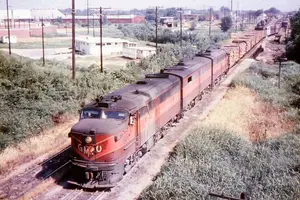
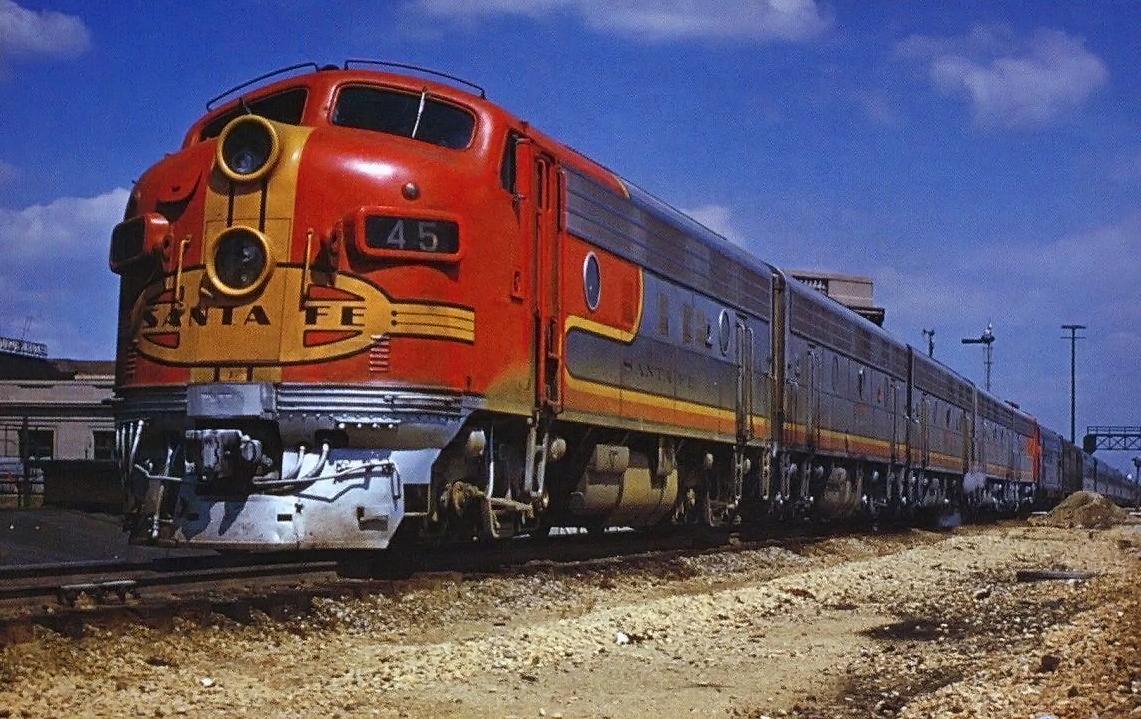 Santa Fe's "Super Chief"/"El Capitan" at Joliet, Illinois circa 1967.
The saga begins in the late 19th century with the California Limited, inaugurated on November 27, 1892, between Chicago and Los Angeles. Assigned train numbers 3 and 4, it operated on a 2½-day schedule with five separate trainsets making continuous round trips. Santa Fe President Allen Manvel promoted it as the “Finest Train West of Chicago,” a bold claim that quickly proved true. By the turn of the century, the train had become enormously popular, setting the stage for even more luxurious offerings.
Even more opulent was the Santa Fe De Luxe, which ran weekly during winter seasons from 1911 to 1917. Limited to just 60 passengers, it featured wicker chairs, brass beds, and an extra fare of $25. Amenities included a library car, showers, bathtubs, a barber, and even a ladies’ maid service. At Cajon Pass, eastbound women received orchid corsages while men got engraved pigskin wallets; westbound passengers enjoyed bouquets and baskets of California oranges. World War I ended the De Luxe on May 1, 1917, but its memory lingered as the pinnacle of pre-war extravagance.
Direct access to the Grand Canyon via a 64-mile branch from Williams, Arizona, opened new marketing opportunities. The Grand Canyon Limited debuted in 1929 on a 58-hour schedule with through Pullmans to the canyon itself. A version of the train persisted into the Amtrak era, though direct service ended in 1968. In 1988, the Biegerts purchased the dormant Grand Canyon Railway branch, rebuilding track and restoring Harvey House depots; operations under the Grand Canyon Railway continue to this day as a heritage line.
The train that truly launched Santa Fe’s legendary “Chief” brand arrived on November 14, 1926. The original Chief operated on a 63-hour all-Pullman schedule between Chicago and Los Angeles, featuring Fred Harvey dining, a club-lounge car, and the advertising slogan “The Chief Way.” It quickly became the railroad’s flagship, offering barber and valet service, ladies’ maid service, bathing facilities, and even a cigar store. By 1928 new buffet/library cars appeared; in 1930 the train was reequipped with fresh Pullmans and lounges. Running times improved to 58 hours in 1929 and 56 hours in 1930. President Samuel T. Bledsoe aggressively pushed air conditioning across the Southwest fleet. In 1934 Santa Fe installed AC in 66 cars—including club cars, café-observations, dining cars, Pullmans, and observations—with more approvals following in 1935. The Chief had become a cool, civilized oasis amid desert heat.
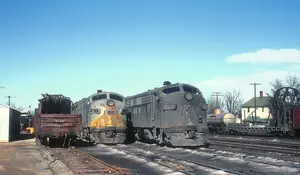
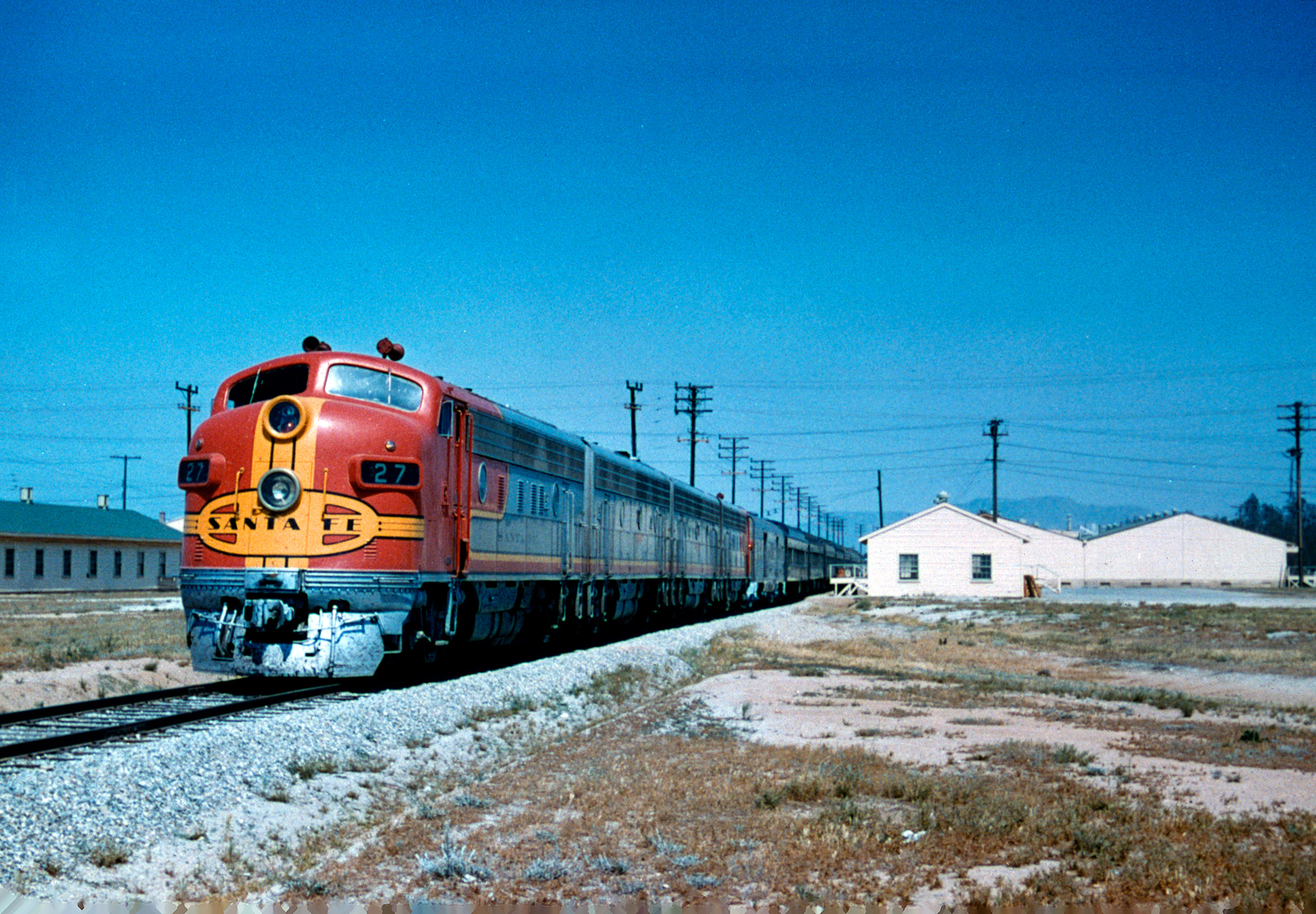 A handsome set of Santa Fe F3's, led by #27-L, are seen here in service on May 30, 1956. Location not recorded. American-Rails.com collection.
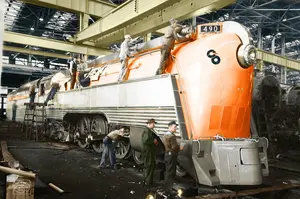
Yet the Chief was soon eclipsed by its own successor. On May 12, 1936, Santa Fe introduced the Super Chief—initially a spiffed-up version using refurbished cars over the same Chicago–Los Angeles route at a $10 extra fare. The streamlined era had truly begun. In spring 1936 the railroad ordered all-new lightweight cars from the Budd Company. The Super Chief entered regular service on May 18, 1937, achieving a blazing 39-hour, 45-minute schedule that averaged nearly 56 miles per hour—the first Santa Fe passenger train to be fully diesel-powered.
Power came from Electro-Motive’s new slant-nosed E1 diesels, the first to wear the iconic “warbonnet” paint scheme designed by Leland A. Knickerbocker. The vivid red, yellow, and silver livery—often called the greatest diesel paint scheme ever—perfectly captured the romance of the Southwest. Box-cab diesels Nos. 1 and 1A pinch-hit for introductory runs, but the E1s soon took over, routinely exceeding 100 mph. The Super Chief was an immediate success; 1937 proved Santa Fe’s best passenger year since 1931.
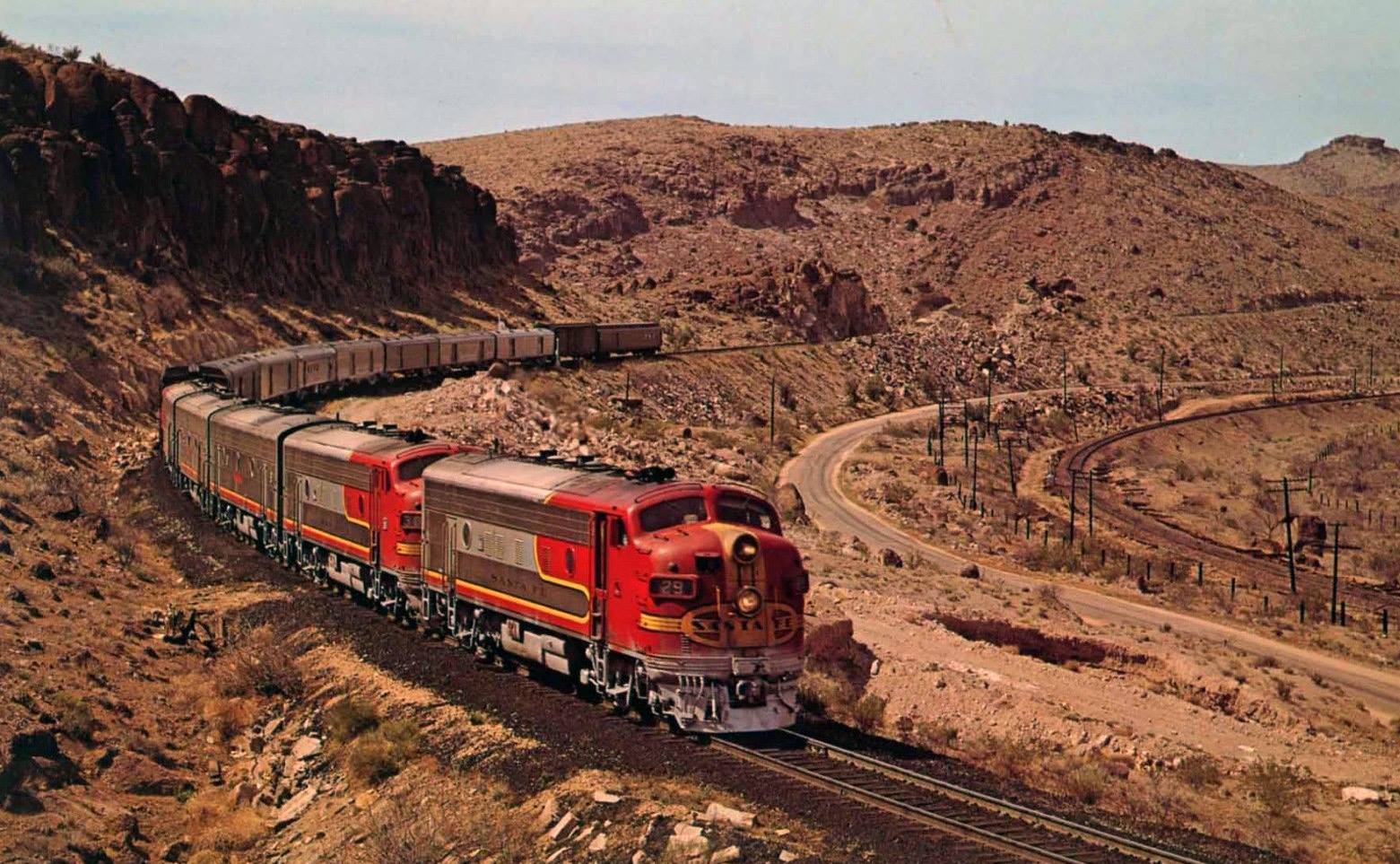 An A-A-B-B-A set of Santa Fe F7's have the eastbound "Fast Mail" (Los Angeles - Chicago) near Kingman, Arizona during June of 1967. Don Erb photo.
No expense was spared on the interiors. Architect Paul F. Cret and designer Sterling B. McDonald, working with Roger W. Birdseye (Santa Fe’s advertising manager), created unique car interiors—no two alike. Southwestern Native American art permeated every detail. Mary Colter, the renowned architect of Harvey Houses and depots, recreated 37 authentic Mimbres tribe motifs for the dining-car china, produced in Bavaria. Reed & Barton and Harrison Brothers & Howson supplied Irish linens and silver. Exotic woods from Africa and South America, specially woven carpets, and upholstery with native motifs appeared throughout. The observation car Navajo featured copper-colored walls with sand paintings, turquoise ceilings, and a domed ceiling evoking desert skies. The Turquoise Room, the first private dining room aboard a train, seated twelve and was always coupled to the Navajo. Even the baggage car carried Native American names. A fictional Navajo boy named “Chico” became the railroad’s mascot, appearing on timetables and advertisements.
The streamlined revolution expanded rapidly. In 1938 the El Capitan debuted as an all-coach economy train on a 39-hour, 45-minute schedule identical to the Super Chief. The Golden Gate streamliner began service July 1, 1938, between Richmond and Bakersfield with connections to San Francisco and Los Angeles. By 1940 seventeen streamlined consists operated system-wide. Postwar, Santa Fe purchased 623 lightweight passenger cars. In September 1946 the Super Chief and El Capitan became daily trains. The Chief itself received coast-to-coast sleepers and was dieselized.
Iconic new equipment defined the 1950s. In 1954 Santa Fe acquired 14 full-length “Big Dome” cars with 57 coach seats and an 18-seat upper lounge. Eight initially served the Chicagoan/Kansas Cityan and El Capitan; later the domes moved to the Chief and San Francisco Chief. The San Francisco Chief debuted June 6, 1954, operating via the southern main line and Belen Cutoff with sleepers from multiple eastern cities. In 1955 Santa Fe ordered 47 new Hi-Level coaches at a cost of $13 million for the El Capitan. These double-deck Budd cars offered exceptionally smooth, quiet rides; all passengers rode on the upper level. The Hi-Level El Capitan entered service July 8, 1956, with five full trainsets. The Super Chief and El Capitan were combined into one consist in 1958 for economy, though they retained separate identities and facilities in peak seasons.
Into the 1960s, under President Ernest Marsh, Santa Fe remained upbeat about passenger service despite mounting competition. In 1963 the luxurious “Champagne Dinner” was introduced on the Super Chief, complete with complimentary champagne and entrées such as sirloin steak or lobster tail. Twenty-four new Hi-Level coaches arrived in 1964 for the El Capitan, with originals shifted to the San Francisco Chief. Sleeping cars were rebuilt, off-peak fares reduced, credit cards accepted, and employees incentivized to generate sales leads. Aggressive advertising appeared in newspapers, magazines, and television.
Yet the writing was on the wall. Highway and air competition caused ridership to plummet. On April 11, 1965, Golden Gate streamliners 60 and 63 were discontinued. The September 1967 decision by the U.S. Postal Service to eliminate most Railway Post Office cars delivered a severe blow. On October 4, 1967, Santa Fe petitioned the Interstate Commerce Commission to discontinue 33 of its 39 passenger trains, retaining only the Super Chief/El Capitan, San Francisco Chief, and Texas Chief. President John Reed noted that travelers increasingly preferred to fly or drive. The Chief made its last run on May 13, 1968; its Big Domes were transferred to the Texas Chief. The Grand Canyon survived as a coach-only train. Fred Harvey’s dining-car contract ended December 31, 1968.
Even with Amtrak’s creation, Santa Fe hesitated, signing on just ten days before the May 1, 1971, takeover. The last Santa Fe streamliners departed their terminals on April 30, 1971; the final Grand Canyon arrived in Chicago on May 2. Amtrak retained the Super Chief and Texas Chief, but Santa Fe withdrew permission to use the “Chief” name in 1974. The Super Chief became the Southwest Limited; the name “Chief” returned in 1984 when the train was renamed the Southwest Chief. The Texas Chief became the Lone Star but was discontinued in 1979. Amtrak continued operating the San Diegans with California state assistance.
Vestiges of Santa Fe’s passenger glory endure. A pair of F units in classic warbonnet colors, along with the restored diner Cochiti from the 1937 Super Chief, reside at the California State Railroad Museum in Sacramento. Observation car Navajo survives at the Colorado Railroad Museum. Most Big Dome cars continued service under new owners; one was retained by Santa Fe itself. Several other passenger cars carried forward the Chiefs tradition.
State-sponsored corridors kept the flame alive. The San Diegan grew into the nation’s second-busiest passenger rail line before the name was retired June 1, 2001, in favor of the Pacific Surfliner. The Golden Gate route was revived in 1974 as the state-sponsored San Joaquins to Bakersfield. In 1999 Oklahoma launched the Heartland Flyer on the former Texas Chief corridor from Oklahoma City to Fort Worth.
The story of Santa Fe passenger trains is one of ambition, artistry, and resilience. From the California Limited’s pioneering elegance through the Super Chief’s warbonnet diesels and Native-inspired interiors, the Hi-Level revolution, and the determined 1960s modernization efforts, Santa Fe never stopped innovating. Even as external forces forced painful cuts and the 1971 transition to Amtrak, the railroad’s DNA—cultural sensitivity, luxurious service, and bold design—lived on in the Southwest Chief and the revived regional routes that still operate today.
Today, riding Amtrak’s Southwest Chief across the same routes once traversed by the Super Chief, or boarding a Pacific Surfliner along the California coast, one still feels echoes of that golden age. The warbonnet livery, the Turquoise Room’s intimate elegance, the sweeping views from Big Domes, and the meticulous Mary Colter motifs remind us that Santa Fe didn’t just move people—it created journeys woven into the fabric of American travel history. The pages preserved here capture that spirit in vivid detail: a railroad that believed passionately in the romance of the rails and left an indelible mark on the American landscape.
Notable Trains
The Scout: (Chicago-Los Angeles)
Recent Articles


-
New Haven Diesel Roster (All-Time)
Oct 10, 26 06:35 PM
 New Haven diesel roster, all-time. 558 road numbers: 60 DL-109s, 30 FA-1s, 27 PA-1s, 60 FL9s, and the switchers from HH600 0900. Serials and order numbers.
 -
New Haven Steam Roster (Post 1900)
Oct 10, 26 06:31 PM
 New Haven steam since 1900. Drury's class grid: 226 Moguls, 33 Mikados, 50 Santa Fes, 70 Mountains, 141 Pacifics, and 10 Hudsons. Last fan trip July 19, 1953.
 -
New Haven Railroad: Rosters, Map, Logo, History, Trains
Oct 10, 26 06:26 PM
 New York, New Haven and Hartford. The Shore Line, Hell Gate, the 1952 map at 1,838.89 miles, and the railroad Penn Central took at 11:59:59 p.m. on December 31, 1968.
 -
C&O's 4-6-4 "Hudson" Locomotives (Class L): Specs, Roster, History
Oct 10, 26 05:36 PM
 Chesapeake & Ohio Class L 4-6-4 Hudsons. Eight L-2s, five L-1 rebuilds, five L-2-As. Specs, Baldwin works numbers, and the roster. No. 490 survives.
 -
Alton Railroad: Map, History, Timetables
Oct 09, 26 10:31 PM
 Alton Railroad, chartered February 27, 1847 as the Alton & Sangamon. Chicago, St. Louis, and Kansas City, the 1937 Official Guide, and the May 31, 1947 merger into the Gulf, Mobile & Ohio.
 -
Mobile & Ohio Steam Roster (Post 1900)
Oct 09, 26 12:26 PM
 Mobile & Ohio steam since 1900. Drury's class grid: 48 six-wheel switchers, 107 Ten-Wheelers, 15 Consolidations, 58 Mikados, and 14 Pacifics. Last revenue steam October 7, 1949.
 -
Mobile & Ohio Railroad: History, Map, Timetable
Oct 09, 26 11:31 AM
 Mobile & Ohio Railroad, chartered in 1848. Columbus on April 22, 1861, the Cairo & St. Louis, the March 1940 Official Guide, and the September 13, 1940 merger into the Gulf, Mobile & Ohio.
 -
Gulf, Mobile & Northern Steam Roster (Post 1900)
Oct 09, 26 10:42 AM
 Gulf, Mobile & Northern steam since 1900. Drury's class grid: Ten-Wheelers, Mikados, Russian Decapods, Pacifics 425 and 426, and three light 4-8-2s. Last revenue steam October 7, 1949.
 -
Gulf, Mobile & Ohio Diesel Roster (All-Time)
Oct 09, 26 10:41 AM
 Gulf, Mobile & Ohio diesel roster, all-time. The 1935 boxcab, DL-107s, 55 FA-1s, F3s and F7s, the Ingalls 4-S, GP30s through GP38-2s, and 21 SD40s. Serials and order numbers.
 -
Gulf, Mobile & Northern Railroad: History, Rebel Route
Oct 09, 26 10:36 AM
 Gulf, Mobile & Northern, from the 1890 Mobile, Jackson & Kansas City to the Rebel and the September 13, 1940 merger into the Gulf, Mobile & Ohio. Steam roster is the companion page.
 -
Gulf, Mobile & Ohio Railroad: Map, Photos, Trains, History
Oct 08, 26 11:48 PM
 Gulf, Mobile & Ohio, chartered in 1938 and merged September 13, 1940. The Mobile & Ohio, the Alton on May 31, 1947, the Rebel Route, and Illinois Central Gulf on August 10, 1972.
 -
New Jersey Railroad Museums (2026): A Complete Guide
Oct 08, 26 11:37 PM
 New Jersey railroad museums—Whippany, Maywood, Pine Creek, Mahwah’s Erie depot, Phillipsburg, and Boonton. Confirm hours on each site.
 -
New Hampshire Railroad Museums (2026): A Complete Guide
Oct 08, 26 11:34 PM
 New Hampshire railroad museums—North Conway, the Flying Yankee, Ashland, Gorham, Raymond, and Sandown. Confirm hours on each site.
 -
Missouri Railroad Museums (2026): A Complete Guide
Oct 08, 26 11:00 PM
 Missouri railroad museums—the National Museum of Transportation, Patee House, Frisco 4524, the Chicago & Alton depot, and Marceline. Confirm hours on each site.
 -
Milwaukee Road X3800: Deer Lodge’s Shop Goat
Oct 08, 26 04:28 PM
 Milwaukee Road X3800, the a home-built shop goat that served the Deer Lodge, MT yard. It was a 220-volt DC switcher, powered through an extension cord that moved electrics into a roundhouse where the…
 -
Key West Extension (Overseas Railroad): History, Construction, Decline
Oct 08, 26 03:59 PM
 Henry Flagler's Overseas Railroad, Miami to Key West, 1905–1935. The Seven Mile Bridge, the 1935 Labor Day Hurricane, and the road that became U.S. 1.
 -
Florida East Coast Steam Roster (Post 1900)
Oct 08, 26 02:34 PM
 Florida East Coast steam since 1897. Seventeen Ten-Wheelers, twenty Atlantics, eighty-seven Pacifics, ninety Mountains, fifteen Mikados, and the switchers.
 -
Florida East Coast Diesel Roster (All-Time)
Oct 08, 26 02:12 PM
 Florida East Coast diesel roster, all-time. E units from 1939, F3s, BL2s, GP7s and GP9s, the GP40-2 orders, 22 SD40-2s, and 24 ES44C4s. Serials and EMD order numbers.
 -
Florida East Coast Railway: Map, History, Rosters
Oct 08, 26 01:46 PM
 Florida East Coast Railway, Henry Flagler's line from Jacksonville to Miami and Key West. Receivership in 1931, the 1963 strike, Grupo México in 2017, and Brightline on the same track.
 -
Minnesota Railroad Museums (2026): A Complete Guide
Oct 08, 26 10:32 AM
Minnesota railroad museums—the Lake Superior Railroad Museum, Two Harbors, Jackson Street, Willmar’s Great Northern 2523, and Currie. Confirm hours on each site. -
Maine Railroad Museums (2026): A Complete Guide
Oct 08, 26 09:24 AM
 Maine railroad museums—Seashore Trolley, the two-foot lines at Portland, Alna, and Phillips, Boothbay, and the Bangor & Aroostook depots. Confirm hours on each site.
 -
Massachusetts Railroad Museums (2026): A Complete Guide
Oct 08, 26 12:08 AM
 Massachusetts railroad museums—Berkshire Scenic at Lenox, Shelburne Falls trolley No. 10, Edaville, Chatham’s 1887 depot, and Lowell. Confirm hours on each site.
 -
Clinchfield Steam Roster (Post 1900)
Oct 07, 26 12:09 PM
 Clinchfield steam since 1900. Fifteen H-4 Consolidations, K-1 Mikados, M-2 and M-3 Mallets, L-class 2-8-8-2s, eighteen Challengers. Class grid after Drury. Last steam April 16, 1954.
 -
Clinchfield Diesel Roster (All-Time)
Oct 07, 26 12:05 PM
 Clinchfield diesel roster, all-time. F3A 800, FP7 200, the F7s, GP7s, 25 SD40s, 18 SD45-2s, seven U36Cs, and the Family Lines hoods. Serials and EMD order numbers.
 -
Clinchfield Railroad: Map, Steam Locomotives, Roster, Logo
Oct 07, 26 12:02 PM
 Clinchfield Railroad, Elkhorn City to Spartanburg. George L. Carter, the Carolina, Clinchfield & Ohio, the 1924 lease, coal, the loops, and CSX. Steam and diesel rosters are companion pages.
 -
Kentucky Railroad Museums (2026): A Complete Guide
Oct 07, 26 11:39 AM
 Kentucky railroad museums—the Kentucky Railway Museum, Bowling Green’s L&N depot, Paducah, Versailles, and Covington. Confirm hours on each site.
 -
Kansas Railroad Museums (2026): A Complete Guide
Oct 07, 26 11:26 AM
 Kansas railroad museums—Santa Fe 3768 at Wichita, Santa Fe 132 in Topeka, the Great Overland Station, and Abilene. Confirm hours on each site.
 -
Cincinnati, New Orleans and Texas Pacific Diesel Roster (All-Time)
Oct 07, 26 10:38 AM
 All-time diesel roster of Southern locomotives lettered for the Cincinnati, New Orleans and Texas Pacific. Serials, order numbers, and builder dates.
 -
Cincinnati, New Orleans and Texas Pacific Railway
Oct 07, 26 10:31 AM
 Cincinnati, New Orleans and Texas Pacific Railway, incorporated September 8, 1881, to lease Cincinnati’s railroad to Chattanooga. Queen and Crescent route, Rathole, and the 2024 sale to Norfolk Southe…
 -
Indiana Railroad Museums (2026): A Complete Guide
Oct 07, 26 12:26 AM
 Indiana railroad museums—Nickel Plate 765, Elkhart’s New York Central collection, French Lick, Linden’s junction depot, and Haley Tower. Confirm hours on each site.
 -
"Triplex" Steam Locomotive: Specs, History, Photos
Oct 06, 26 11:52 PM
 Erie class P-1 Triplex 2-8-8-8-2s. Three Baldwin compounds, 2603–2605, later 5014–5016, built 1914 and 1916. Matt H. Shay, the 1930 class card, and Virginian XA 700.
 -
Illinois Railroad Museums (2026): A Complete Guide
Oct 06, 26 11:47 PM
 Illinois railroad museums—the Illinois Railway Museum, Monticello, the Pioneer Zephyr, Galesburg’s Burlington 3006, and the depots. Confirm hours on each site.
 -
Iowa Railroad Museums (2026): A Complete Guide
Oct 06, 26 11:41 PM
 Iowa railroad museums—the Union Pacific Railroad Museum, RailsWest, Sioux City, Boone, and the National Hobo Museum in Britt. Confirm hours on each site.
 -
Charleston and Western Carolina Diesel Roster (All-Time)
Oct 06, 26 11:29 PM
Charleston and Western Carolina diesel roster. Twenty-one GP7s, two SW7s, two SW9s, and six F7As, all built 1950–1952. Serials, order numbers, and ACL and SCL numbers. -
Charleston and Western Carolina Railway: Map, History, Timetables
Oct 06, 26 11:18 PM
 Charleston and Western Carolina Railway, incorporated September 16, 1896. Port Royal to Spartanburg, with branches to Anderson and Greenville. Merged into the Atlantic Coast Line on December 31, 1959.
 -
Central of Georgia Steam Roster (Post 1900)
Oct 06, 26 04:00 PM
 Central of Georgia steam since 1900. Cooke Consolidations, Harriman Mikados, 32 Mountains, and eight Lima 4-8-4s. Class grid after Drury. Last steam May 1953.
 -
Central of Georgia Diesel Roster (All-Time)
Oct 06, 26 03:44 PM
 Central of Georgia diesel roster. SW1 No. 1 in 1939, E7s and E8s, nine F3As, 39 RS3s, GP7s through SD35s. Serials and order numbers.
 -
Central of Georgia Railway: Map, Logo, History, Rosters
Oct 06, 26 03:42 PM
 Central of Georgia Railway, from the 1833 Savannah charter to Southern control on June 17, 1963. Map, logos, Nancy Hanks II, and links to the steam and diesel rosters.
 -
Georgia Railroad Museums (2026): A Complete Guide
Oct 06, 26 03:33 PM
Georgia railroad museums—Savannah’s Central shops, Duluth, the General at Kennesaw, the Texas in Atlanta, Tifton, Waycross, and Albany. Confirm hours on each site. -
Florida Railroad Museums (2026): A Complete Guide
Oct 06, 26 03:18 PM
 Florida railroad museums—Boca Raton, Winter Garden, Whitehall, the Gold Coast, Parrish, Fort Myers, Milton, and Plant City. Confirm hours on each site.
 -
Connecticut Railroad Museums (2026): A Complete Guide
Oct 06, 26 01:05 PM
 Connecticut railroad museums—the Shore Line Trolley, East Windsor, the Naugatuck Railroad, Danbury Union Station, Willimantic, and the SoNo tower. Confirm hours on each site.
 -
Colorado Railroad Museums (2026): A Complete Guide
Oct 06, 26 12:47 PM
 Colorado railroad museums—Golden, the Forney’s Big Boy 4005, Pueblo’s Santa Fe 2912, and the depots at Castle Rock, Limon, and Ridgway. Confirm hours on each site.
 -
Atlantic Coast Line Steam Roster (Post 1900)
Oct 06, 26 12:44 PM
 Atlantic Coast Line steam since 1900. Copper Head Ten-Wheelers, 235 P-5 Pacifics, Q-1 Santa Fes, twelve R-1 4-8-4s. Class grid after Drury. Last steam June 30, 1955.
 -
Atlantic Coast Line Diesel Roster (All-Time)
Oct 06, 26 11:57 AM
 Atlantic Coast Line diesel roster. HH660 1900 in 1939, E3s for the Champion, FTs and F2s, GP7s 100–279, GP30s, U25Cs, and the 1967 SCL numbers. Serials and orders.
 -
Atlantic Coast Line Railroad: "Standard Railroad of the South"
Oct 06, 26 11:53 AM
 Atlantic Coast Line, the Standard Railroad of the South. April 21, 1900 to July 1, 1967. Plant System, L&N, Clinchfield, the Champion, and the Seaboard Coast Line merger.
 -
California Railroad Museums (2026): A Complete Guide
Oct 06, 26 09:50 AM
California railroad museums—the California State Railroad Museum, Perris, Portola, Railtown 1897, and the depots that still stand. Confirm hours on each site. -
Arizona Railroad Museums (2026): A Complete Guide
Oct 06, 26 09:46 AM
Arizona railroad museums—the Arizona Railway Museum in Chandler, Southern Pacific 1673 at Tucson, and the McCormick-Stillman park in Scottsdale. -
Arkansas Railroad Museums (2026): A Complete Guide
Oct 06, 26 09:07 AM
 Arkansas railroad museums—Cotton Belt 819 at Pine Bluff, the Fort Smith trolley, the Mammoth Spring depot, and the Eureka Springs railway.
 -
Alabama Railroad Museums (2026): A Complete Guide
Oct 06, 26 09:03 AM
Alabama railroad museums—Heart of Dixie at Calera, the North Alabama museum at Chase, Huntsville’s 1860 depot, and Fort Payne. Confirm hours on each site. -
Pennsylvania Railroad Museums (2026): A Complete Guide
Oct 06, 26 12:09 AM
 Pennsylvania railroad museums—Strasburg, Steamtown, the Horseshoe Curve, the East Broad Top, and the depots and towers in between. Confirm hours on each site.