South Shore Line “800s”: CSS&SB 801–803 Freight Electrics, Specs & Roster
Published: August 31, 2026
By: Adam Burns
The Chicago, South Shore & South Bend never called them Little Joes. Crews called them the 800s. They were three double-ended GE freight motors, numbered 801–803, 88 feet 10 inches long and a shade under 273 tons, bought in 1949 from a cancelled Soviet order. Mechanically they were the same 2-D+D-2 design the Milwaukee Road later ran as class EF-4 / EP-4. Electrically they were not. Milwaukee’s Pacific Extension was 3,000-volt DC. The South Shore, after Samuel Insull converted it in 1926 to match the Illinois Central, was 1,500-volt DC. GE and Michigan City Shops wired the trio for that plant. They ran freight, never varnish, from November 1949 until 803’s last trip on January 31, 1981—the last regular electric freight on a U.S. common-carrier railroad. Two survive: 802 at the Lake Shore Railway Museum in North East, Pennsylvania, and 803 under wire at the Illinois Railway Museum in Union, Illinois. 801 was cut up at Hegewisch in the spring of 1981.
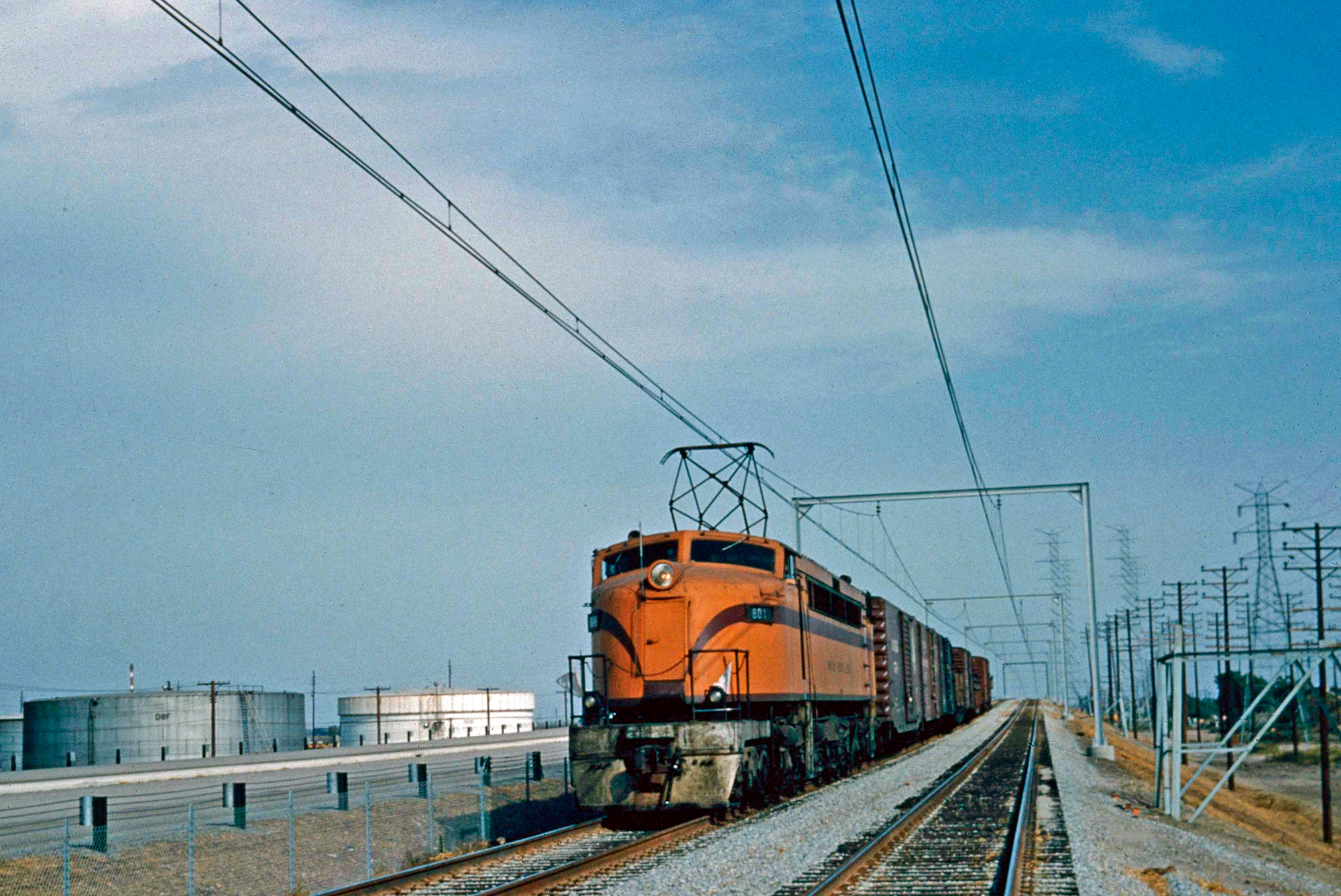
South Shore Line “800” #801 has a short freight on the new main line near East Chicago, Indiana, September 22, 1956. American-Rails.com collection.
On this page: At a glance · The Soviet order · Why the South Shore bought three · 1,500 volts, not 3,000 · Freight service · Last electric freight · 801–803 roster · Specifications · 800s vs. Little Joes · What survived
At a Glance
| Item | Detail |
|---|---|
| Railroad | Chicago, South Shore & South Bend (CSS&SB) |
| Road numbers | 801, 802, 803 (800 class) |
| Crew name | “800s.” Milwaukee called the same GE design Little Joes; South Shore did not |
| Builder / plant | General Electric, Erie, Pa. |
| GE model | 2-D+D-2 406/546 8-GE 750-3300V |
| Wheel arrangement | 2-D+D-2 (AAR); (2′D)+(D2′) UIC; 4-8-0+0-8-4 OE Whyte |
| Original customer | Soviet Railways (SZhD), A-series Amerikanskiy elektrovoz, 3,300 V DC. Not delivered |
| Quantity in the GE order | 20 (serials 29913–29932). South Shore 3, Milwaukee 12, Paulista (Brazil) 5 |
| South Shore wire | 1,500 V DC overhead (Insull conversion, 1926, to match Illinois Central) |
| In service | 803 Nov. 1, 1949; 801 Dec. 31, 1949; 802 Aug. 1, 1950 |
| Work | Freight only. Never passenger on the South Shore |
| Last revenue trip | 803, January 31, 1981. Last regular electric freight on a U.S. common carrier |
| Survivors | 802 Lake Shore Railway Museum, North East, Pa. (static). 803 Illinois Railway Museum, Union, Ill. (operational). 801 scrapped Hegewisch, spring 1981 |
Twenty locomotives for Stalin, none for the Soviet Union
After the war the Soviet Ministry of Railways wanted heavy 3,300-volt DC motors for the South Urals electrification around Kropachyovo–Zlatoust–Chelyabinsk as the country's domestic plants were still recovering. As a result, the Russian looked elsewhere and ultimately placed an order to General Electric at Erie, Pennsylvania: twenty locomotives, factory class 2-D+D-2 406/546 8-GE 750-3300V, serials 29913–29932. In Soviet service they would have been the A-series—Amerikanskiy elektrovoz, American electric locomotive—first numbered 1591–1610, later restated as 2301–2320. Fourteen were laid down to 5-foot gauge. The last six were built standard gauge. Interestingly, Soviet engineers even supervised the work at Erie. The first test, unit A1598, ran September 7, 1948, on a New York Central test track.
With the rising Cold War the State Department barred strategic goods for the Soviet Union and the Russian engineers returned home. Two locomotives were damaged in a plant collision (serials 29923 and 29924). GE finished the order anyway and sat on twenty unsold 2-D+D-2s. Milwaukee Electrification Department head Laurence Wylie tried to take all twenty plus spares for about scrap value—$1 million. Operating vice president J.P. Kiley, a diesel man, blocked it. By the time Korean War traffic forced Milwaukee back to Erie, eight locomotives and every spare part were gone. Three had already gone to the South Shore. Five had gone to Companhia Paulista de Estradas de Ferro in Brazil, later FEPASA Russas 6451–6455. Milwaukee took the remaining twelve in 1950, still for $1 million, and named them Little Joes after Joseph Stalin. That Milwaukee story is on the EF-4 / EP-4 page. This page is the three that left Erie first.
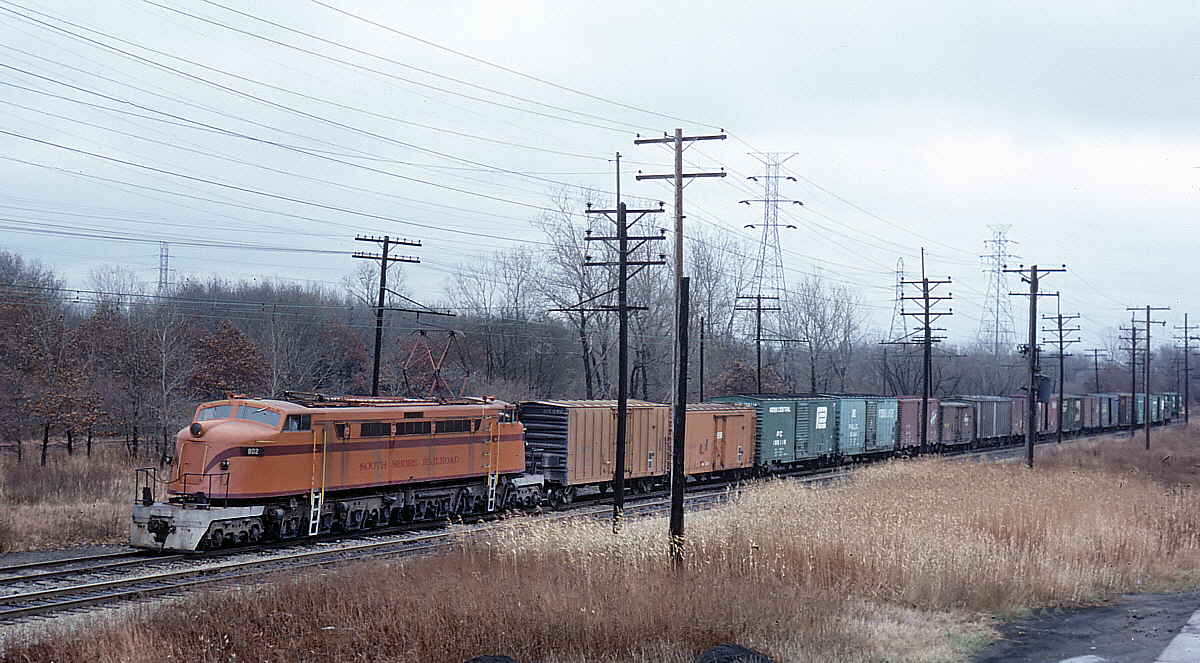
Chicago, South Shore & South Bend 2-D+D-2 #802 leads a string of boxcars at Gary, Indiana on November 26, 1976. Marty Bernard photo.
Why an interurban bought mountain motors
By the late 1940s the South Shore was no longer a typical Midwestern traction line. Insull’s 1925–26 rebuild—100-pound rail, Pullman steel cars, Illinois Central trackage rights into Randolph Street, and the 1,500-volt DC conversion—had made it a heavy commuter-and-freight railroad through the mills of northwestern Indiana. Carload freight, almost an afterthought when the Chicago, Lake Shore & South Bend opened in 1908, was worth $3.5 million a year by 1950. Baldwin-Westinghouse steeple-cabs in the 1000s could switch and handle modest trains. They could not keep up with mill and interchange tonnage on a railroad that still had to thread city streets.
The orphaned GE 2-D+D-2s were the largest things Erie had on the floor. The South Shore took three, numbered them into a new 800 class, and put them in freight. William D. Middleton’s South Shore: The Last Interurban and W. Donald Allison’s May 1953 Trains piece both treat them as the road’s answer to growing carload business, not as passenger power. Allison wrote that they could take whatever tonnage the dispatcher gave them and cruise at 45 mph. That was the job: Hammond and Burnham yards, Gary, the mills, Michigan City, South Bend, and the IC connection west. They did not go downtown under the IC catenary as passenger motors. The orange MU cars still did that work.
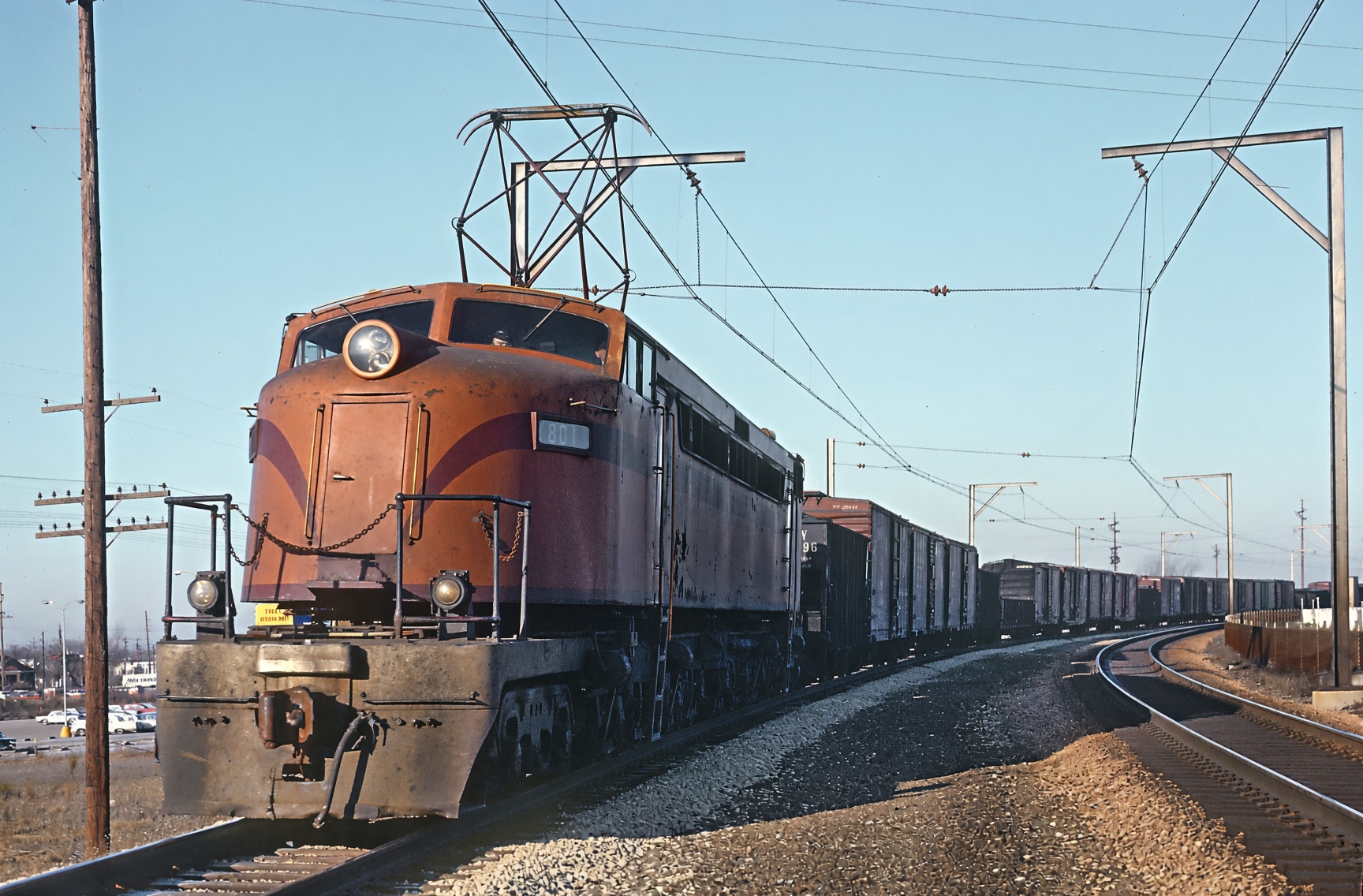
South Shore Line #801 is again at East Chicago with an eastbound freight in January, 1964. Roger Puta photo.
The difference that mattered: 1,500 volts
Your eye says Little Joe. The wire said otherwise. The GE design assumed 3,000–3,300 volts DC at the pantograph. Milwaukee’s Rocky Mountain Division was already 3,000-volt DC, so the twelve Joes could use the rating GE published: about 5,530 horsepower for one hour and 5,110 continuous, eight GE 750 motors, two pans. The South Shore had rebuilt for 1,500 volts DC in 1926 so its trains could run through to Illinois Central’s suburban electrification. Eight substations—Hammond, Gary, Michigan City, New Carlisle, Ogden Dunes, South Bend, Tee Lake, and Tremont—fed interurban cars and, later, freight motors. They were not Milwaukee mountain substations.
The 800s were modified for that plant before delivery. Series DC traction motors will run at half voltage; they will not make the catalog 3-kilovolt horsepower while they do it. South Shore mechanical forces and GE reworked control and motor connections for 1,500 volts. The house electric roster on the South Shore history page quotes 5,120 horsepower for the class—close to GE’s 3-kilovolt continuous figure, and the number this site has used for years. Treat the 5,530 / 5,110 pair as the design rating on 3,000–3,300 volts. Treat 5,120 as the South Shore roster figure. On 1,500-volt wire the 800s worked at reduced output relative to a Milwaukee Joe on 3,000 volts. That is the operational difference, not the carbody.
Other hardware followed the South Shore, not Milwaukee passenger practice:
- Both cabs kept. Milwaukee’s two EP-4 passenger Joes lost the “B” cab to a steam generator. The South Shore had no steam heat to supply and a short railroad that wanted to run either way without turning. IRM still lists 803 as double-end.
- Roller bearings on all axles as delivered, the same treatment Milwaukee gave the EP-4s. Milwaukee’s freight EF-4s left Erie with rollers only on the unpowered guiding trucks; motorized axles were plain-bearing until shops substituted rollers after hotboxes and wrecks.
- Standard gauge. Fourteen of the twenty had been 5-foot. The South Shore trio ran 4 feet 8½ inches from delivery.
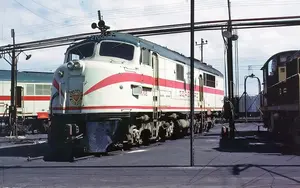
- Freight gearing and freight paint. Orange and maroon South Shore dress, not Milwaukee orange or Olympian Hiawatha two-tone. No steam generator. No MU into trailing EMD passenger units.
The 2-D+D-2 frame, eight GE 750s, two pans, 8-EL air brakes, and 88-foot-10-inch carbody were the same family. The plant they hung on was not.
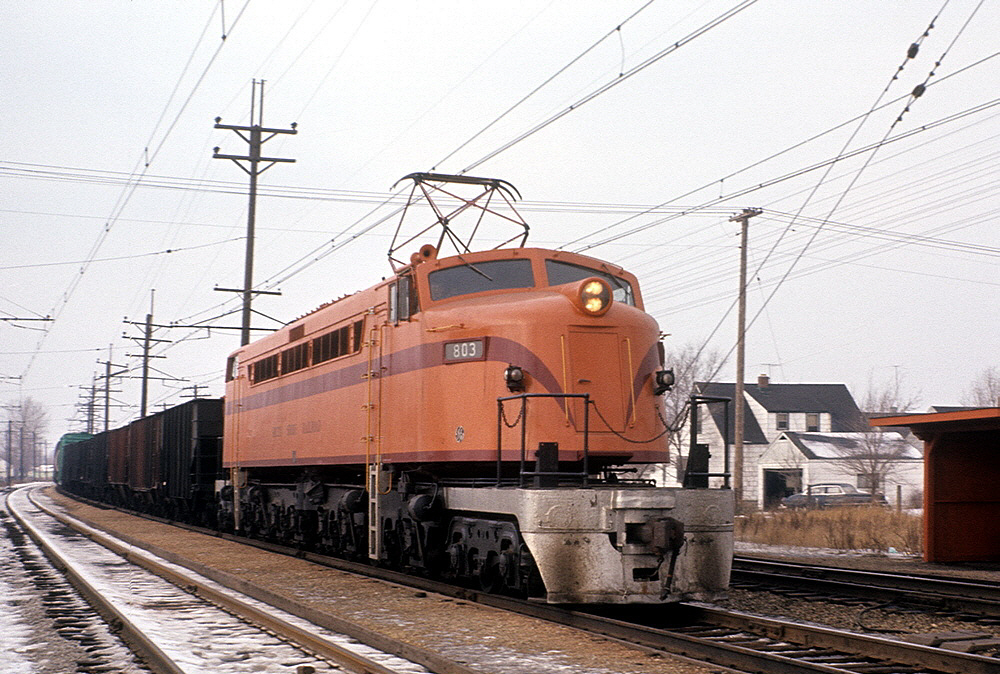
South Shore 800 #803 is seen here in freight service at Clark Road in Gary, Indiana on December 26, 1963. Marty Bernard photo.
What they pulled
For thirty years the 800s were the South Shore’s road freight power. They handled mill products, interchange cuts, and whatever Michigan City dispatched. In the late 1950s the railroad added six second-hand New York Central class R-2 C-C boxcabs, rebuilt at Michigan City as 701–707, 140 tons and 3,000 horsepower each. The 700s let the last Baldwin-Westinghouse steeple-cabs go. The 800s remained the heavy motors. (The R-2 family is on the R-motor page.)
Chesapeake & Ohio bought the South Shore on January 3, 1967, for the freight. Chessie did not buy it for the orange cars. From about 1966 the railroad also moved coal in unit trains to Northern Indiana Public Service plants. That traffic is why the 800s did not finish the job alone. The 1,500-volt plant could not feed 10,000 tons of coal as one train. South Shore had to split those consists between Burnham and Bailly or Michigan City. C&O first sent TR3 cow-calf sets and then GP7s; the 1,500-volt motors simply did not have the substations behind them. The Diesel Shop notes the cow-calf 4,000 horsepower was not enough, then 4,500 with a fourth Geep was not enough either. The 700-class electrics came off April 19, 1976. 801 was already a parts source by the late 1970s—last photographed running in August 1976, then parked at Michigan City missing a coupler and later driving wheels. 802 and 803 kept the remaining electric freight, often the Gary switcher, until the new GP38-2s arrived.
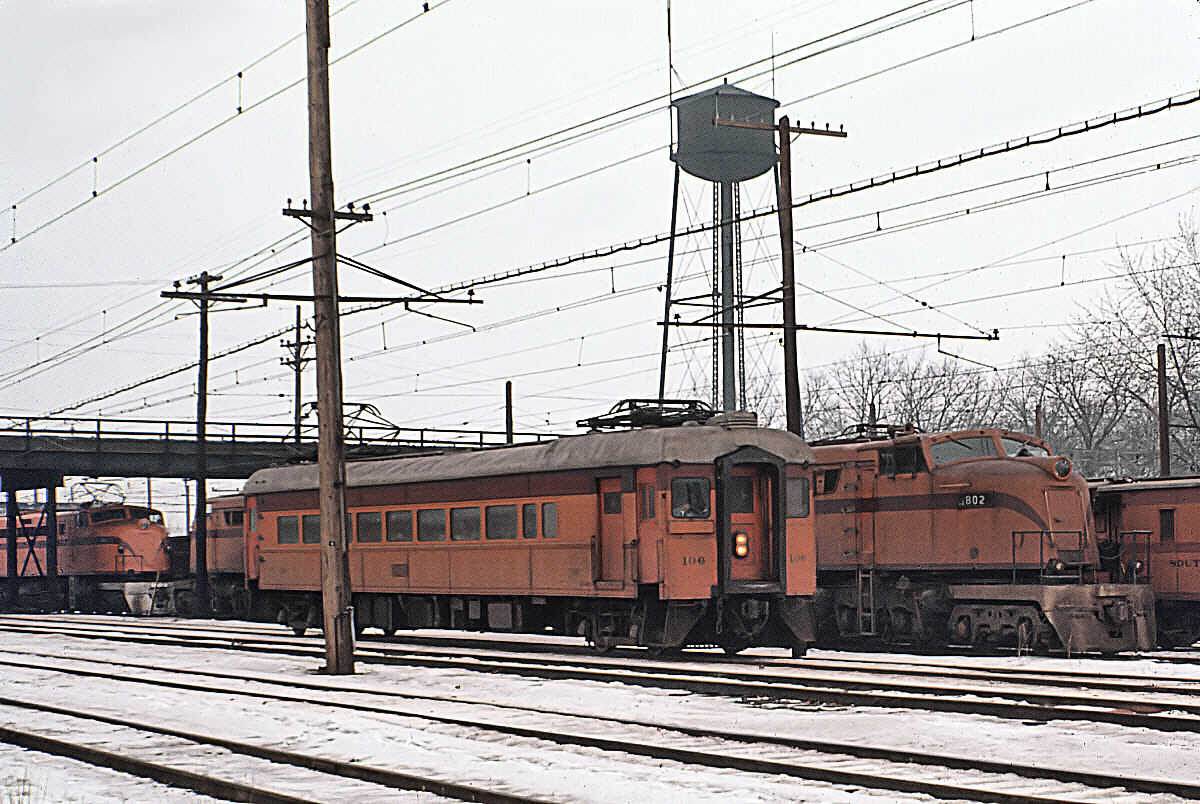
South Shore Line MU 106 along with '800' motors #802, #801, and #803 layover at the Michigan City Shops on December 26, 1962. Marty Bernard photo.
January 31, 1981
EMD GP38-2s 2000–2009, order 79633, went into service in January 1981. Freight electrification ended when 803 made its last run on January 31, 1981. That is the date on this site’s South Shore history page, the date Charles W. McDonald and George H. Drury published in Kalmbach’s 1982 diesel roster (the electrics were already gone), and the retirement year Illinois Railway Museum uses for 803. Some secondary write-ups, including older Wikipedia South Shore copy and a few photo captions, say 1983. 1983 is not the date to lock. 801 was already stripped. 802 and 803 were the last two electric freight locomotives in regular main-line service on a U.S. common carrier. Milwaukee had dropped its wire in June 1974. Virginian and New Haven rectifier freight was long gone. When 803 tied up, American railroad freight under trolley was finished.
Passenger service stayed electric. NICTD still runs 1,500-volt MUs into Millennium Station. Freight on the same railroad is diesel, today under Chicago SouthShore & South Bend (Anacostia). The 800s did not get a second career as passenger motors.

South Shore Line '800' #803 lays over at the shops in Michigan City, Indiana on December 26, 1963. Marty Bernard photo.
801–803 roster
GE serials 29930–29932 for the South Shore trio are the numbers used by the Diesel Shop and Railroad Picture Archives. This site’s Milwaukee Little Joe roster assigns serial 29930 to Milwaukee E73. The Milwaukee table already carries a caveat that Soviet numbers and GE serials for the twenty-unit order are not 100 percent certain. Do not treat either assignment as a settled builder card until a GE shipping record is in hand. Soviet running numbers for the CSS units are commonly listed as A1608–A1610 in the original 1591–1610 block; Railroad Picture Archives captions 801 as USSR A2318, which matches the later 2301–2320 restatement. In-service dates below are the Diesel Shop set.
| Road no. | GE serial | In service | Disposition |
|---|---|---|---|
| 801 | 29930 | December 31, 1949 | Parts source by the late 1970s (last running photographs August 1976). Moved to Hyman-Michaels, Avenue O and Brainerd Avenue, Hegewisch; cut up about May 1981. Not preserved |
| 802 | 29931 | August 1, 1950 | Retired with the 1981 dieselization. Preserved, static, Lake Shore Railway Historical Society, North East, Pa.—about ten miles from the GE Erie plant that built the class |
| 803 | 29932 | November 1, 1949 (first of the three in service) | Last revenue trip January 31, 1981. To Illinois Railway Museum, Union, Ill., that year, in operating condition. Still the largest operating electric locomotive in North America when IRM has it under wire |
Builder dates in photo archives cluster in 1949 (801 and 802 are often listed May 1949). IRM lists 803 as built 1949. GE production of the twenty-unit order ran from 1948 into 1949; the 1946 date that appears on some museum cards is the order era, not the South Shore in-service year.
Specifications
Figures are the GE 2-D+D-2 as built for the Soviet 3,300-volt design, with South Shore notes where the 1,500-volt installation or house roster differs. Mechanical dimensions match Milwaukee EF-4 / EP-4 practice except as listed in the comparison table below. Weight 545,600 pounds is 272.8 short tons; the South Shore locomotive table on this site has long called them 273-ton motors.
| Specification | Value |
|---|---|
| Builder | General Electric, Erie, Pa. |
| Years built (order) | 1948–49 (South Shore units completed 1949) |
| Factory model | 2-D+D-2 406/546 8-GE 750-3300V |
| Quantity, this railroad | 3 (of 20 in the GE order) |
| Wheel arrangement | 2-D+D-2 (AAR); (2′D)+(D2′) UIC; 4-8-0+0-8-4 OE Whyte. Two four-axle motorized groups, unpowered two-axle guiding truck at each end |
| Powered axles / motors | 8 / eight GE 750 |
| Ends / cabs | Double-end, both cabs retained (South Shore). Control: P electro-pneumatic (IRM) |
| Current collection | Two pantographs |
| Electrical system as designed | 3,000–3,300 V DC |
| Electrical system as used | 1,500 V DC overhead (South Shore / Illinois Central plant) |
| Horsepower (design, 3 kV) | 5,530 (1-hour); 5,110 continuous |
| Horsepower (South Shore roster) | 5,120 (house CSS&SB table). 1,500 V operation was at reduced output versus a Milwaukee Joe on 3,000 V |
| Starting tractive effort | 110,000 lbf (Holley, Milwaukee Electrics); some sheets 75,700 lbf. At 25% adhesion, Milwaukee data 110,750 lbf |
| Continuous tractive effort | 77,000 lbf (Holley / Milwaukee EF-4 sheet) |
| 1-hour tractive effort | 85,500 lbf (Milwaukee EF-4 sheet; same mechanical locomotive) |
| Maximum / safe speed | GE design 68 mph safe (some Milwaukee sheets list 84 mph maximum). South Shore freight typically about 45 mph (Allison, 1953) |
| Gear ratio | 21:80 (Milwaukee sheet; no evidence South Shore changed it) |
| Driver diameter | 47¼ inches |
| Length over ends | 88 ft 10 in |
| Width | 10 ft 7 in |
| Height | 14 ft 5 in (GE / Wikipedia). IRM lists 15 ft for 803 |
| Total wheelbase | 77 ft 10 in |
| Rigid wheelbase | 20 ft 7 in |
| Locomotive weight | 545,600 lb (IRM; Wikipedia). House CSS&SB table: 273 tons |
| Adhesive weight | 406,000 lb |
| Bearings (South Shore as delivered) | Roller bearings, all axles |
| Trucks | General Steel Castings (IRM) |
| Brakes | Air, 8-EL |
| Compressors | Two CP-39 (IRM) |
| Gauge as delivered to CSS&SB | 4 ft 8½ in standard |
How they differed from Milwaukee’s Little Joes
Same GE order. Same carbody. Not the same railroad, voltage, or nickname.
| South Shore 800s (801–803) | Milwaukee EF-4 / EP-4 Little Joes | |
|---|---|---|
| Quantity | 3, bought first among U.S. buyers | 12, bought last, $1 million, no spares |
| Nickname | 800s | Little Joes (from “Little Joseph Stalin’s locomotives”) |
| Wire | 1,500 V DC | 3,000 V DC |
| Published horsepower | House roster 5,120 hp; reduced vs. 3 kV rating | 5,530 hp 1-hour / 5,110 continuous at 3,000 V |
| Cabs | Both kept; double-end freight | EF-4 both cabs; EP-4 E20/E21 lost the B cab to a steam generator |
| Bearings as delivered | Rollers on all axles | EP-4: rollers all axles. EF-4: rollers on guiding trucks only until shops substituted |
| Service | Freight only, Chicago–South Bend corridor | Freight (and, until 1961, Olympian Hiawatha on the two EP-4s) Harlowton–Avery |
| Diesel MU | Not a South Shore practice on the 800s | In-house MU so Joes could lead trailing diesels in the 1960s–70s |
| Out of service | January 31, 1981 (803 last) | June 15, 1974 (electrification shutdown) |
| Survivors | 802 North East, Pa.; 803 IRM (operational). 801 scrapped | E70 static, Deer Lodge, Mont. The other eleven scrapped |
Paulista / FEPASA took the other five, converted them to 5 ft 3 in gauge, and ran them in São Paulo state until Brazilian electric freight ended in 1999. Two of those Russas are preserved in Brazil (6452 at Jundiaí; 6455 at Bauru). They were from the same GE order.
What survived
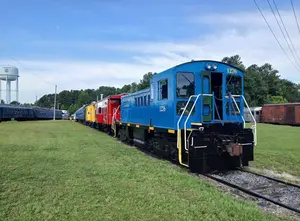
803 went to the Illinois Railway Museum at Union in 1981, still a complete locomotive. IRM calls it the largest operating electric in North America. It runs on museum days when the trolley is up. 802 sits outdoors at the Lake Shore Railway Museum in North East, Pennsylvania, a short drive from the Erie plant that built it.
Related Reading on American-Rails.com
- Chicago, South Shore & South Bend
- Milwaukee Road Little Joes (EF-4 / EP-4)
- Milwaukee Road EP-2 Bipolars
- New York Central / South Shore R-motors
- Electric locomotives
- General Electric locomotives
- Milwaukee Road
- Railroad museums
Sources
- William D. Middleton, South Shore: The Last Interurban (Indiana University Press, 1999 edition)
- W. Donald Allison, “The Railroad With Orange Trains,” Trains, May 1953 (45 mph freight performance)
- Noel T. Holley, Milwaukee Electrics (N J International, 1987): 3 kV ratings, starting/continuous tractive effort, Milwaukee purchase
- American-Rails.com, Chicago, South Shore & South Bend history (/csssb.html): 273-ton / 5,120 hp roster line; 803 last run January 31, 1981; Insull 1,500 V conversion and substation list
- American-Rails.com, Little Joes EF-4 / EP-4 (/joes.html): Milwaukee specifications and serial table (with the page’s own serial caveat)
- The Diesel Shop, Chicago SouthShore roster: 801–803 serials 29930–29932; in-service dates; A1608–A1610; 700s retired April 19, 1976; GP38-2s 1981; coal-train horsepower notes
- Railroad Picture Archives, CSS 801 / 802 / 803 locomotive records (serials 29930–29932)
- Illinois Railway Museum, Chicago South Shore & South Bend 803: 88 ft 10 in, 10 ft 7 in, 15 ft, 545,600 lb, 8-EL, 8 GE 750, P electro-pneumatic, 2 CP-39, GSC trucks, arrived 1981, operational
- Charles W. McDonald and George H. Drury, Diesel Locomotive Rosters – United States, Canada, Mexico (Kalmbach, 1982), p. 40 (electrics already off the CSS roster)
- HawkinsRails, Lake Shore Railway Museum: 802 as 2-D+D-2 406/546, 1,500 V DC, 800s nickname
- railroad.net thread “South Shore Little Joe 801” (skoswift): 801 last running August 1976; Hegewisch scrap about May 1981
- Railway Preservation News, “end of a Little Joe”: Hyman-Michaels Hegewisch cutting of 801
Recent Articles


-
Algoma Central Railway: Map, Logo, Rosters
Oct 17, 26 10:49 PM
 Algoma Central Railway, Sault Ste. Marie to Hearst. Wisconsin Central on February 1, 1995. Fifty-nine steam locomotives and forty-two diesels.
 -
Akron, Canton and Youngstown Railroad: Map, History, Rosters
Oct 17, 26 05:49 PM
 Akron, Canton and Youngstown Railroad, Mogadore to Delphos. The rails never reached Canton or Youngstown. Norfolk & Western control on October 16, 1964. Twenty-six diesels and the historical society's…
 -
Georgia Railroad: Map, History, Logo, Rosters
Oct 17, 26 12:59 PM
 Georgia Railroad, the Georgia Railroad and Banking Company, Augusta to Atlanta, with the Athens branch and the Macon Road. Mark GA. The railroad properties were sold on November 4, 1982.
 -
West Point Route (Railroad): Map, History, Logo
Oct 16, 26 11:26 PM
 The West Point Route was a trademarked name comprising the Atlanta & West Point and Western Railway of Alabama, which were controlled by the Georgia Railroad.
 -
Virginian Railway Diesel Roster (All-Time)
Oct 16, 26 11:11 PM
 All-time diesel roster of the Virginian Railway. 40 Fairbanks-Morse H16-44s, 25 H24-66 Train Masters, and one GE 44-tonner. Serials included.
 -
Virginian Railway Steam Roster (Post 1900)
Oct 16, 26 10:55 PM
 Virginian Railway steam locomotives built since 1900. Mikados, 2-8-8-2s, the Triplex, class AE 2-10-10-2s, and the 1945 2-6-6-6s.
 -
Virginian Railway: Map, Rosters, History, Electrification
Oct 16, 26 10:51 PM
 Virginian Railway, Deepwater to Norfolk. Combined in 1907 and completed in 1909. Electrified from Roanoke to Elmore. Absorbed by the Norfolk & Western on December 1, 1959.
 -
Baldwin "Centipede" Locomotives: Specs, Roster, Photos
Oct 16, 26 03:58 PM
 Baldwin DR-12-8-1500/2 Centipede—2-D+D-2, two 608SC engines, 3,000 hp. SAL 4500 from the 1943 test bed. 54 on the serial list, 52 sold. PRR BP60 then BH50. None preserved.
 -
Louisville & Nashville Class M-1 2-8-4s: The Big Emmas
Oct 16, 26 03:52 PM
 Louisville & Nashville class M-1, 42 Big Emma 2-8-4s. Baldwin in 1942 and 1944, Lima in 1949. Coal trains from Neon to DeCoursey. No locomotive survives.
 -
Tennessee, Alabama and Georgia Railway: Map, History, Rosters
Oct 16, 26 03:21 PM
 Tennessee, Alabama and Georgia Railway, Chattanooga to Gadsden. The May 1929 card is 91.7 miles. Southern stock control closed on a January 1, 1971 schedule. Five diesels and Prince's steam list.
 -
Railroad Museums In The USA (2026): State Guides & Collections
Oct 16, 26 02:29 PM
 U.S. railroad museums—what they are vs tourist railroads, preservation history (R&LHS, NRHS, IRM, Steamtown), state guides, and destination collections. Confirm hours on each museum’s site.
 -
Wyoming Railroad Museums (2026): A Complete Guide
Oct 16, 26 02:26 PM
 Wyoming railroad museums—the Cheyenne Depot, Burlington 5633 at Douglas, Big Boy 4004, and the Laramie depot. Confirm hours and which locomotive is on the property.
 -
West Virginia Railroad Museums (2026): A Complete Guide
Oct 16, 26 12:52 PM
 West Virginia railroad museums—Cass Scenic’s geared steam, the Hinton C&O collection, and the Martinsburg B&O roundhouse. Confirm hours and which locomotive is assigned.
 -
Washington Railroad Museums (2026): A Complete Guide
Oct 16, 26 12:46 PM
 Washington railroad museums—Snoqualmie, Elbe, Chehalis, Reardan, and the Northern Pacific depot at Toppenish. Confirm hours and which locomotive is assigned.
 -
Vermont Railroad Museums (2026): A Complete Guide
Oct 16, 26 12:42 PM
 Vermont railroad museums—the Shelburne Museum’s 1890 station, Central Vermont No. 220, and the private car Grand Isle. Confirm hours on the site.
 -
Tennessee Central Railway: Map, Logo, Rosters, History
Oct 16, 26 11:32 AM
 Tennessee Central Railway, Harriman to Hopkinsville. Reorganized January 26, 1922. Last day August 31, 1968. Thirty-one diesels and the railroad's steam roster.
 -
Southern Railway Steam Roster (Post 1900)
Oct 16, 26 09:40 AM
Southern Railway steam locomotives built since 1900. Ps-4 Pacifics, Ts Mountains, USRA Santa Fes, and the subsidiary grids for the CNO&TP, Alabama Great Southern, and New Orleans and Northeastern. -
Southern Railway (USA): Map, Locomotives, Logo, History
Oct 16, 26 09:28 AM
 The Southern Railway, formed July 1, 1894 from the Richmond and Danville and the East Tennessee, Virginia and Georgia. Washington. Norfolk Southern Railway on December 31, 1990.
 -
Seaboard Coast Line Diesel Roster (All-Time)
Oct 15, 26 04:21 PM
 All-time diesel roster of the Seaboard Coast Line. Inherited Coast Line and Seaboard locomotives, then 623 new locomotives in the printed orders, plus 28 acquired from other railroads.
 -
Seaboard Coast Line Railroad: Map, History, Photos
Oct 15, 26 04:17 PM
 The Seaboard Coast Line, formed July 1, 1967 from the Atlantic Coast Line and the Seaboard Air Line. Jacksonville. Family Lines, then the Seaboard System on December 29, 1982.
 -
South Carolina Railroad Museums (2026): A Complete Guide
Oct 15, 26 02:54 PM
 South Carolina railroad museums—Winnsboro’s Rockton & Rion line, Spartanburg’s Hub City depot, Greenwood’s Baldwin No. 19, and the Best Friend replica. Confirm hours on each site.
 -
South Dakota Railroad Museums (2026): A Complete Guide
Oct 15, 26 10:55 AM
 South Dakota railroad museums—the Hill City museum beside the 1880 Train, and Prairie Village at Madison. Confirm hours, and confirm whether Hill City is still open.
 -
Seaboard Air Line Diesel Roster (All-Time)
Oct 15, 26 10:46 AM
 All-time diesel roster of the Seaboard Air Line. 734 locomotives: E4s in 1938, Centipedes, Alco road switchers, and GP40s through February 1967. Serials included.
 -
Seaboard Air Line Steam Roster (Post 1900)
Oct 15, 26 10:39 AM
 Seaboard Air Line steam locomotives built since 1900. Mikados, Russian Decapods, 2-10-2s, and the 2-6-6-4s sold to the Baltimore and Ohio in 1947. Drury's class grid.
 -
Seaboard Air Line Railroad: Map, Rosters, History
Oct 15, 26 10:34 AM
 The Seaboard Air Line, chartered in the Portsmouth and Roanoke of 1832 and formed July 1, 1900. Inland route to Florida. Merged into the Seaboard Coast Line on July 1, 1967.
 -
Utah Railroad Museums (2026): A Complete Guide
Oct 15, 26 12:04 AM
 Utah railroad museums—Ogden Union Station, Golden Spike at Promontory, the Helper mining museum, and the Heber Valley Railroad. Confirm hours on each site.
 -
Escanaba & Lake Superior Diesel Roster (All-Time)
Oct 14, 26 10:44 PM
All-time diesel roster of the Escanaba & Lake Superior. 30 locomotives: Baldwin switchers and RS-12s, two RF16s, three GP38s, three SD40-2s, and the Reserve Mining units. Serials and order numbers. -
Escanaba & Lake Superior Railroad: In Service Since 1898
Oct 14, 26 09:04 PM
 Escanaba & Lake Superior Railroad, chartered November 17, 1898, and still operating from Wells, Michigan. Logging line to Channing, the Milwaukee Road lines, and the diesel roster.
 -
Richmond, Fredericksburg & Potomac Diesel Roster (All-Time)
Oct 14, 26 08:49 PM
 All-time diesel roster of the Richmond, Fredericksburg and Potomac. 107 locomotives: 22 Alco S2s, one SW1, and an Electro-Motive road fleet from E8s to GP40-2s. Serials and order numbers.
 -
Richmond, Fredericksburg & Potomac Steam Roster (Since 1900)
Oct 14, 26 08:46 PM
 Richmond, Fredericksburg and Potomac steam locomotives built since 1900. Pacifics, Mountains, Berkshire-type 2-8-4s, and the named 4-8-4s. Last revenue run December 17, 1954.
 -
Richmond, Fredericksburg and Potomac Railroad: Map, Rosters, Logo
Oct 14, 26 08:36 PM
 The Richmond, Fredericksburg and Potomac, chartered February 25, 1834. A 113-mile Richmond–Washington bridge line. Named 4-8-4s, Potomac Yard, and the CSX sale of October 10, 1991.
 -
North Dakota Railroad Museums (2026): A Complete Guide
Oct 14, 26 08:29 PM
North Dakota railroad museums—Mandan’s state museum, the Railroad Museum of Minot, and Bonanzaville’s Northern Pacific 684. Confirm hours on each site. -
Oklahoma Railroad Museums (2026): A Complete Guide
Oct 14, 26 08:02 PM
Oklahoma railroad museums—the Oklahoma Railway Museum, Enid’s Frisco 1519, Waynoka’s Harvey House, and El Reno’s Rock Island depot. Confirm hours on each site. -
Oneida & Western Railroad: Map, History, Timetable
Oct 14, 26 06:47 PM
Oneida & Western Railroad, a Tennessee short line from Oneida to Jamestown. Chartered in 1912, opened to East Jamestown in 1921, and to Jamestown on December 10, 1930. Last revenue train March 4, 1954… -
Oneida and Western Railroad (Shamrock Coal Company)
Oct 14, 26 03:20 PM
 Shamrock Coal's mint-green coal trains, 1979–1987. Eight EMD SD40-2s, OWTX 9950–9957, order 786246. Two 72-car gondola sets. Louisville & Nashville, then CSX. Sold to BC Rail.
 -
Rhode Island Railroad Museums (2026): A Complete Guide
Oct 14, 26 03:03 PM
 Rhode Island railroad museums—the Friends’ museum in the 1875 Kingston depot, on the old New York, Providence and Boston. Confirm what is on view.
 -
Original Norfolk Southern Diesel Roster (All-Time)
Oct 14, 26 12:40 PM
 All-time diesel roster of the original Norfolk Southern Railway. 59 locomotives: Baldwin switchers and AS-416s, three GE 70-tonners, 17 GP18s, and seven GP38s. Serials and order numbers.
 -
Original Norfolk Southern Railway: Map, Rosters, History
Oct 14, 26 10:09 AM
 The original Norfolk Southern Railway, chartered in 1870 as the Elizabeth City & Norfolk. Norfolk to Charlotte. Merged into the Southern Railway on January 1, 1974. Baldwin diesels and the GP18s and G…
 -
Nebraska Railroad Museums (2026): A Complete Guide
Oct 14, 26 10:00 AM
 Nebraska railroad museums—the Durham Museum, Kenefick Park, Cody Park, and the Golden Spike Tower over Bailey Yard. Confirm hours on each site.
 -
Nevada Railroad Museums (2026): A Complete Guide
Oct 14, 26 09:51 AM
 Nevada railroad museums—Carson City, Boulder City, the Nevada Northern at East Ely, and the Virginia City depot. Confirm hours on each site.
 -
Montana Railroad Museums (2026): A Complete Guide
Oct 14, 26 12:17 AM
 Montana railroad museums—the Livingston depot, Fort Missoula’s Willamette, the Harlowton Milwaukee depot, and the Whitefish station. Confirm hours on each site.
 -
"Jawn Henry" Locomotive: Specs, Diagram, Photos
Oct 14, 26 12:03 AM
 Norfolk & Western No. 2300, class TE-1, the steam turbine-electric Jawn Henry. Baldwin-Lima-Hamilton, Westinghouse, and Babcock & Wilcox, May 1954. Specifications, the road tests, and the Dece…
 -
Atlantic and Danville Railway: Serving Southern VA
Oct 13, 26 04:32 PM
 Atlantic and Danville Railway, chartered in 1882, incorporated September 1883. Three-foot line to Claremont, then Norfolk to Danville. Southern lease from September 1, 1899, to July 1, 1949. Alco RS2s…
 -
Norfolk, Franklin and Danville Railroad: Map, Roster, History
Oct 13, 26 04:26 PM
 Norfolk, Franklin and Danville Railway, chartered October 2, 1962, and operating from November 1, 1962. Norfolk to Danville, 210.8 miles. Two Alco RS36s and four RS11s. Merged into the N&W on December…
 -
Norfolk & Western Diesel Roster (All-Time)
Oct 12, 26 11:59 PM
 Norfolk & Western diesel roster, all-time. 1,464 locomotives built new for the railroad, from the 1955 GP9s and RS-3s through the C36-7s, plus the merger fleets.
 -
Norfolk & Western Steam Roster (Post 1900)
Oct 12, 26 11:52 PM
 Norfolk & Western steam since 1898. The Roanoke grid: 1,266 locomotives, the J, the A, and the Y, and the last road steam on May 7, 1960.
 -
Norfolk & Western Railway: Map, Logo, Rosters, History
Oct 12, 26 11:45 PM
 The Norfolk & Western, from the City Point Railroad of 1838 to Norfolk Southern. Pocahontas coal, Roanoke steam, and the 1964 expansion.
 -
Louisiana Railroad Museums (2026): A Complete Guide
Oct 12, 26 11:24 PM
 Louisiana railroad museums—the DeQuincy depot, the Long Leaf sawmill, Jackson’s model railroad, and Southern Pacific 745. Confirm hours on each site.
 -
Michigan Railroad Museums (2026): A Complete Guide
Oct 12, 26 11:14 PM
 Michigan railroad museums—Pere Marquette 1225 at Owosso, Durand Union Station, The Henry Ford, and the Mount Clemens depot. Confirm hours on each site.
 -
Mississippi Railroad Museums (2026): A Complete Guide
Oct 12, 26 10:52 PM
Mississippi railroad museums—McComb’s rebuilt Illinois Central depot and Illinois Central 2542, and the Casey Jones museum at Water Valley. Confirm hours on each site.